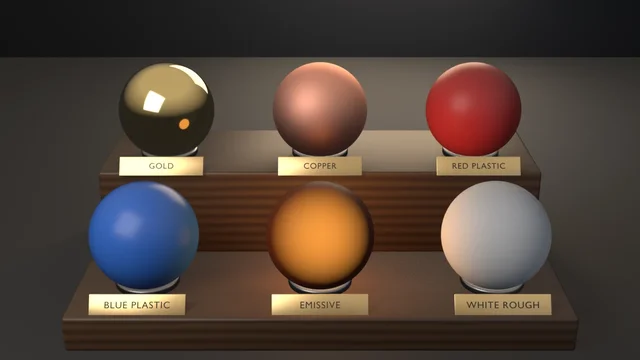
Swatch Grid
Procedural Principled materials — metal and dielectric, the emission pattern, and the cross-version set_specular shim.
examples/gn-sdf-remesh/
A Geometry Nodes SDF remesh (MeshToSDFGrid → GridToMesh at the SDF zero-level), with a Set Material node carrying the material through the remesh.
Rendered headless by the example itself. Select it to enlarge.
tags geometry-nodes materials
blender --background --python examples/gn-sdf-remesh/gn_sdf_remesh.py --
A runnable example that remeshes an input mesh through an OpenVDB SDF grid using the build_remesh_via_sdf pattern from the geometry-nodes-python skill: GeometryNodeMeshToSDFGrid → GeometryNodeGridToMesh at the SDF zero-level, attached as a NODES modifier and evaluated via the depsgraph.
Which fix it witnesses: an SDF grid is meshed with Grid to Mesh, not Volume to Mesh (the Mesh to SDF Grid output is a grid socket; Volume to Mesh takes a volume-geometry socket, so wiring the grid there is an invalid link that yields no geometry). Grid to Mesh has the matching grid input.
Materials gotcha: geometry generated by Geometry Nodes carries no material, so the input mesh's material is dropped on remesh (the result renders with the default white). Re-apply it inside the tree with a Set Material node (GeometryNodeSetMaterial) on the remeshed output — this example does that and asserts the material survives onto the evaluated mesh.
The check measures a torus; the still proves the same build_remesh_via_sdf tree on a subject where remeshing is visible. A vase is kitbashed from overlapping primitives (foot, belly, neck, lip, two handles), each in its own clay tone under a thin cage of its own edges, so the interior faces and hard intersection seams read. Beside it the identical kit runs through the tree (finer 0.018 voxels, cobalt glaze carried in by Set Material) and comes out one fused, watertight shell with the handles filleted into the belly. The torus leaves the stage before the render; the render path gates framing through examples/gallery_framing.py (exit 10).
# Cheap correctness check only (no render) — the CI smoke check:
blender --background --python gn_sdf_remesh.py --

# Falsifier: no SDF modifier. Must exit non-zero (evaluated == base).
blender --background --python gn_sdf_remesh.py -- --no-sdf

# Also render the remeshed result (EEVEE on a GPU host; --engine cycles on GPU-less hosts):
blender --background --python gn_sdf_remesh.py -- --output remesh.png
blender --background --python gn_sdf_remesh.py -- --output remesh.png --engine cyclesPer-script sequential checks. 9 is a valid check code; there is no rule against it.
| Code | Meaning |
|---|---|
| 0 | Success |
| 1 | Uncaught exception (FATAL wrapper) |
| 2 | argparse / usage |
| 3 | SDF remesh produced no/unchanged geometry (--no-sdf lands here) |
| 4 | --output produced no file |
| 5 | Wrong-era EEVEE engine id was accepted |
| 6 | Input material dropped by remesh |
| 10 | Framing gate violation on the --output path (gallery_framing) |
The blender-smoke workflow runs the check on Blender 5.2 LTS and 4.5 LTS (5.1 on the weekly cron, the needs-5.1 PR label, or manual dispatch). Smoke does not pass --output or --no-sdf.
"""Geometry Nodes SDF remesh -- a runnable BDT example.

Builds the `build_remesh_via_sdf` pattern from the geometry-nodes-python skill
(`GeometryNodeMeshToSDFGrid` -> `GeometryNodeGridToMesh` at the SDF zero-level), attaches it
as a NODES modifier to an input mesh, and evaluates via the depsgraph. It witnesses the F2
fix: an SDF grid is meshed with **Grid to Mesh**, not Volume to Mesh.

By default it runs only the cheap, frame-independent correctness check (no render): the
evaluated vertex count must be > 0 AND differ from the base mesh -- proving the remesh
produced geometry. Exits non-zero on failure. This is the check the CI smoke gate runs on
both builds.

    blender --background --python gn_sdf_remesh.py --                  # correctness check only
    blender --background --python gn_sdf_remesh.py -- --no-sdf         # must fail
    blender --background --python gn_sdf_remesh.py -- --output r.png   # also render the result
    blender --background --python gn_sdf_remesh.py -- --output r.png --engine cycles  # GPU-less
"""
import bpy, sys, os, math, argparse

# Shared Layer 1 framing measurement (render path only) -- see
# gallery_framing.py for the __file__-relative import shim this relies on.
sys.path.insert(0, os.path.join(os.path.dirname(os.path.abspath(__file__)), os.pardir))
import gallery_framing  # noqa: E402

def get_eevee_engine_id():
    return 'BLENDER_EEVEE' if bpy.app.version >= (5, 0, 0) else 'BLENDER_EEVEE_NEXT'

def build_remesh_via_sdf(voxel_size=0.1, threshold=0.0, material=None):
    tree = bpy.data.node_groups.new("SDFRemesh", 'GeometryNodeTree')
    tree.interface.new_socket(name="Geometry", in_out='INPUT', socket_type='NodeSocketGeometry')
    tree.interface.new_socket(name="Geometry", in_out='OUTPUT', socket_type='NodeSocketGeometry')
    gi = tree.nodes.new('NodeGroupInput'); go = tree.nodes.new('NodeGroupOutput')
    mesh_to_sdf = tree.nodes.new('GeometryNodeMeshToSDFGrid')
    grid_to_mesh = tree.nodes.new('GeometryNodeGridToMesh')
    mesh_to_sdf.inputs["Voxel Size"].default_value = voxel_size
    grid_to_mesh.inputs["Threshold"].default_value = threshold
    tree.links.new(gi.outputs["Geometry"], mesh_to_sdf.inputs["Mesh"])
    link = tree.links.new(mesh_to_sdf.outputs["SDF Grid"], grid_to_mesh.inputs["Grid"])
    # GN-generated geometry carries no material, so the input mesh's material is dropped on
    # remesh. Re-apply it inside the tree with a Set Material node (the GN-native fix).
    out_socket = grid_to_mesh.outputs["Mesh"]
    if material is not None:
        set_mat = tree.nodes.new('GeometryNodeSetMaterial')
        set_mat.inputs["Material"].default_value = material
        tree.links.new(out_socket, set_mat.inputs["Geometry"])
        out_socket = set_mat.outputs["Geometry"]
    tree.links.new(out_socket, go.inputs["Geometry"])
    return tree, link.is_valid

def build():
    bpy.ops.wm.read_factory_settings(use_empty=True)
    bpy.ops.mesh.primitive_torus_add(location=(0, 0, 0.55), major_radius=1.2, minor_radius=0.5)
    obj = bpy.context.active_object
    for p in obj.data.polygons:
        p.use_smooth = True
    mat = bpy.data.materials.new("Ceramic"); mat.use_nodes = True
    b = mat.node_tree.nodes.get('Principled BSDF')
    b.inputs['Base Color'].default_value = (0.45, 0.025, 0.05, 1)  # crimson ceramic
    b.inputs['Roughness'].default_value = 0.16  # glossy: the SDF facets read by their glints
    obj.data.materials.append(mat)
    return obj

def build_vase_kit(name):
    """Render-only input: a vase blocked out the way a modeller kitbashes it --
    foot, belly, neck, lip and two handles as separate primitives that simply
    overlap, joined into one mesh with interior faces and hard intersection
    seams everywhere. Each part keeps its own bisque tone so the seams read.
    The same `build_remesh_via_sdf` tree then fuses it into one watertight
    shell: the thing an SDF remesh is actually for."""
    tones = [("Clay.Foot", (0.30, 0.13, 0.07)), ("Clay.Belly", (0.62, 0.30, 0.15)),
             ("Clay.Neck", (0.78, 0.62, 0.42)), ("Clay.Lip", (0.86, 0.78, 0.62)),
             ("Clay.Handle", (0.45, 0.20, 0.10))]
    mats = []
    for mname, rgb in tones:
        m = bpy.data.materials.new(mname); m.use_nodes = True
        mb = m.node_tree.nodes.get('Principled BSDF')
        mb.inputs['Base Color'].default_value = (*rgb, 1)
        mb.inputs['Roughness'].default_value = 0.85   # unfired clay: matte
        mats.append(m)
    parts = []

    def add(op, mat_i, **kw):
        op(**kw)
        ob = bpy.context.active_object
        ob.data.materials.append(mats[mat_i])
        for poly in ob.data.polygons:
            poly.use_smooth = True
        parts.append(ob)
        return ob

    add(bpy.ops.mesh.primitive_cylinder_add, 0, vertices=48, radius=0.42, depth=0.22,
        location=(0, 0, 0.11))
    belly = add(bpy.ops.mesh.primitive_uv_sphere_add, 1, segments=48, ring_count=24,
                radius=0.72, location=(0, 0, 0.82))
    belly.scale = (1.0, 1.0, 0.86)
    add(bpy.ops.mesh.primitive_cylinder_add, 2, vertices=40, radius=0.27, depth=0.72,
        location=(0, 0, 1.62))
    add(bpy.ops.mesh.primitive_torus_add, 3, major_segments=48, minor_segments=16,
        major_radius=0.30, minor_radius=0.075, location=(0, 0, 1.98))
    for sx in (-1.0, 1.0):
        add(bpy.ops.mesh.primitive_torus_add, 4, major_segments=40, minor_segments=14,
            major_radius=0.30, minor_radius=0.065, location=(sx * 0.58, 0, 1.36),
            rotation=(math.radians(90), 0, 0))
    with bpy.context.temp_override(active_object=parts[0], selected_editable_objects=parts,
                                   selected_objects=parts):
        bpy.ops.object.join()
    kit = parts[0]
    kit.name = name
    return kit


def render_still(obj, path, engine):
    import bmesh
    sc = bpy.context.scene
    # The torus the check measured leaves the stage; the render proves the
    # same tree on a subject where fusing is visible.
    bpy.context.collection.objects.unlink(obj)

    kit = build_vase_kit("VaseKit")
    glaze = bpy.data.materials.new("Glaze"); glaze.use_nodes = True
    g = glaze.node_tree.nodes.get('Principled BSDF')
    g.inputs['Base Color'].default_value = (0.03, 0.16, 0.30, 1)   # cobalt glaze
    g.inputs['Roughness'].default_value = 0.12
    try:
        g.inputs['Coat Weight'].default_value = 0.6
    except KeyError:
        pass
    fused = bpy.data.objects.new("VaseFused", kit.data.copy())
    bpy.context.collection.objects.link(fused)
    # Same builder, finer voxels than the check's 0.1 so the fused shell
    # holds the handles' profile; the glaze rides in on Set Material.
    tree, _ok = build_remesh_via_sdf(voxel_size=0.018, material=glaze)
    fused.modifiers.new("sdf", 'NODES').node_group = tree
    kit.location.x = -1.45
    fused.location.x = 1.45
    dg = bpy.context.evaluated_depsgraph_get()
    em = fused.evaluated_get(dg).to_mesh()
    fused_v = len(em.vertices)
    zmin = min(v.co.z for v in em.vertices)
    fused.evaluated_get(dg).to_mesh_clear()
    fused.location.z = -zmin + 0.12
    kit.location.z = -min(v.co.z for v in kit.data.vertices) + 0.12
    # the kit's own edges as a thin dark cage: UV rings and torus loops
    # running straight through each other, the topology the remesh replaces
    cage_mat = bpy.data.materials.new("Cage"); cage_mat.use_nodes = True
    cm = cage_mat.node_tree.nodes.get('Principled BSDF')
    cm.inputs['Base Color'].default_value = (0.05, 0.03, 0.02, 1)
    cm.inputs['Roughness'].default_value = 0.6
    cage = bpy.data.objects.new("VaseKitCage", kit.data.copy())
    cage.data.materials.clear(); cage.data.materials.append(cage_mat)
    for poly in cage.data.polygons:
        poly.material_index = 0
    cage.location = kit.location
    wire = cage.modifiers.new("cage", 'WIREFRAME')
    wire.thickness = 0.005; wire.offset = 1.0; wire.use_even_offset = True
    bpy.context.collection.objects.link(cage)
    print(f"render: kit_verts={len(kit.data.vertices)} fused_verts={fused_v} "
          f"kit_mats={len(kit.data.materials)}")

    # walnut potter's bats under each piece
    wood = bpy.data.materials.new("Walnut"); wood.use_nodes = True
    wn = wood.node_tree
    wb = wn.nodes.get('Principled BSDF')
    wave = wn.nodes.new('ShaderNodeTexWave'); wave.inputs['Scale'].default_value = 1.2
    wave.inputs['Distortion'].default_value = 1.5
    wave.inputs['Detail'].default_value = 4.0
    ramp = wn.nodes.new('ShaderNodeValToRGB')
    ramp.color_ramp.elements[0].color = (0.13, 0.065, 0.03, 1)
    ramp.color_ramp.elements[1].color = (0.20, 0.105, 0.05, 1)
    wn.links.new(wave.outputs['Fac'], ramp.inputs['Fac'])
    wn.links.new(ramp.outputs['Color'], wb.inputs['Base Color'])
    wb.inputs['Roughness'].default_value = 0.5
    bats = []
    for x in (-1.45, 1.45):
        bpy.ops.mesh.primitive_cylinder_add(vertices=64, radius=0.95, depth=0.12,
                                            location=(x, 0, 0.06))
        bat = bpy.context.active_object
        bat.data.materials.append(wood)
        bev = bat.modifiers.new("bev", 'BEVEL'); bev.width = 0.025; bev.segments = 3
        bats.append(bat)

    fme = bpy.data.meshes.new("Floor"); bm = bmesh.new()
    try:
        bmesh.ops.create_grid(bm, x_segments=1, y_segments=1, size=30.0); bm.to_mesh(fme)
    finally:
        bm.free()
    fmat = bpy.data.materials.new("Studio"); fmat.use_nodes = True
    fb = fmat.node_tree.nodes.get('Principled BSDF')
    fb.inputs['Base Color'].default_value = (0.03, 0.032, 0.037, 1)  # dark staged studio
    fb.inputs['Roughness'].default_value = 0.7
    fme.materials.append(fmat)
    floor = bpy.data.objects.new("Floor", fme); bpy.context.collection.objects.link(floor)
    wall = bpy.data.objects.new("Wall", fme.copy()); wall.location = (0, 9.0, 0)
    wall.rotation_euler = (1.5708, 0, 0); bpy.context.collection.objects.link(wall)
    w = bpy.data.worlds.new("W"); w.use_nodes = True
    w.node_tree.nodes["Background"].inputs[0].default_value = (0.02, 0.021, 0.025, 1); sc.world = w

    aim = bpy.data.objects.new("Aim", None); aim.location = (0, 0, 1.05)
    bpy.context.collection.objects.link(aim)
    cam = bpy.data.objects.new("cam", bpy.data.cameras.new("cam"))
    cam.data.lens = 58.0
    cam.location = (0.9, -9.4, 3.0)
    bpy.context.collection.objects.link(cam); sc.camera = cam
    c = cam.constraints.new('TRACK_TO'); c.target = aim; c.track_axis = 'TRACK_NEGATIVE_Z'; c.up_axis = 'UP_Y'

    def light(nm, loc, en, sz, col, target=aim):
        ld = bpy.data.lights.new(nm, 'AREA'); ld.energy = en; ld.size = sz; ld.color = col
        lo = bpy.data.objects.new(nm, ld); lo.location = loc
        bpy.context.collection.objects.link(lo)
        lc = lo.constraints.new('TRACK_TO'); lc.target = target
        lc.track_axis = 'TRACK_NEGATIVE_Z'; lc.up_axis = 'UP_Y'
    # shaped warm key, faint cool fill, cool rim for the glaze silhouette,
    # warm wedge raking the back wall (docs/VISUAL-STYLE.md)
    light("Key", (-4.5, -4.5, 5.0), 520, 3.0, (1.0, 0.95, 0.88))
    light("Fill", (5, -4, 2.2), 90, 7.0, (0.75, 0.85, 1.0))
    light("Rim", (2.5, 3.5, 4.0), 260, 2.5, (0.62, 0.78, 1.0))
    wd = bpy.data.lights.new("Wedge", 'AREA'); wd.energy = 520; wd.size = 6.0
    wd.color = (1.0, 0.72, 0.45)
    wo = bpy.data.objects.new("Wedge", wd); wo.location = (2.5, 5.5, 4.0)
    wo.rotation_euler = (math.radians(-68), 0, math.radians(190))
    bpy.context.collection.objects.link(wo)

    sc.render.engine = 'CYCLES' if engine == 'cycles' else get_eevee_engine_id()
    if sc.render.engine == 'CYCLES':
        try: sc.cycles.samples = 32
        except Exception: pass
    else:
        try: sc.eevee.taa_render_samples = 64
        except Exception: pass
    sc.render.resolution_x = 1280; sc.render.resolution_y = 720
    # Blender resolves a relative filepath against the blend-file directory, which
    # for a --background run with no .blend is the drive root, not the cwd.
    path = os.path.abspath(path)
    sc.render.image_settings.file_format = 'PNG'; sc.render.filepath = path
    # AgX would wash the cobalt glaze toward slate (docs/VISUAL-STYLE.md)
    sc.view_settings.view_transform = 'Standard'
    bpy.context.view_layer.update()
    # Layer 1 framing gate before the beauty render (exit 10 on violation)
    fcode = gallery_framing.check_framing(sc, cam, hero=[kit, fused],
                                          elements=[kit, fused] + bats, stage=[floor, wall])
    if fcode:
        return fcode
    bpy.ops.render.render(write_still=True)
    return 0 if os.path.exists(path) and os.path.getsize(path) > 0 else 4


def main():
    argv = sys.argv[sys.argv.index("--") + 1:] if "--" in sys.argv else []
    p = argparse.ArgumentParser()
    p.add_argument("--output", default=None, help="optional: render the remeshed result to this PNG")
    p.add_argument("--engine", choices=["auto", "cycles"], default="auto")
    p.add_argument("--no-sdf", action="store_true",
                   help="skip attaching the SDF remesh modifier (must fail)")
    args = p.parse_args(argv)

    # EEVEE-id inversion witnessed for real: the OTHER era's id must be
    # rejected by this build, the helper's accepted
    eid = get_eevee_engine_id()
    wrong = 'BLENDER_EEVEE_NEXT' if bpy.app.version >= (5, 0, 0) else 'BLENDER_EEVEE'  # engine-id-exempt: the wrong-era id this example asserts is rejected
    try:
        bpy.context.scene.render.engine = wrong
        print(f"ERROR: wrong-era EEVEE id '{wrong}' was accepted", file=sys.stderr); return 5
    except TypeError:
        pass  # correctly rejected
    bpy.context.scene.render.engine = eid  # raises TypeError if the helper's id is invalid

    obj = build()
    base = len(obj.data.vertices)
    src_mat = obj.data.materials[0] if obj.data.materials else None
    tree, link_valid = build_remesh_via_sdf(material=src_mat)
    if not args.no_sdf:
        obj.modifiers.new("sdf", 'NODES').node_group = tree
    dg = bpy.context.evaluated_depsgraph_get(); ev = obj.evaluated_get(dg)
    m = ev.to_mesh(); evc = len(m.vertices)
    mat_names = [mm.name for mm in m.materials if mm is not None]
    ev.to_mesh_clear()
    print(f"link_valid={link_valid} base_vcount={base} eval_vcount={evc} materials={mat_names}")
    if not (link_valid and evc > 0 and evc != base):
        print("ERROR: SDF remesh produced no/unchanged geometry", file=sys.stderr); return 3
    # the Set Material node must carry the input material onto the remeshed result
    if src_mat is not None and src_mat.name not in mat_names:
        print(f"ERROR: material '{src_mat.name}' dropped by remesh", file=sys.stderr); return 6

    if args.output:
        rcode = render_still(obj, args.output, args.engine)
        if rcode:
            if rcode == 4:
                print("ERROR: render produced no file", file=sys.stderr)
            return rcode
        print(f"rendered {args.output} ({os.path.getsize(args.output)} bytes)")
    print("gn-sdf-remesh OK")
    return 0

if __name__ == "__main__":
    try:
        sys.exit(main())
    except Exception as exc:
        import traceback; traceback.print_exc()
        print(f"FATAL: {type(exc).__name__}: {exc}", file=sys.stderr); sys.exit(1)
Procedural Principled materials — metal and dielectric, the emission pattern, and the cross-version set_specular shim.
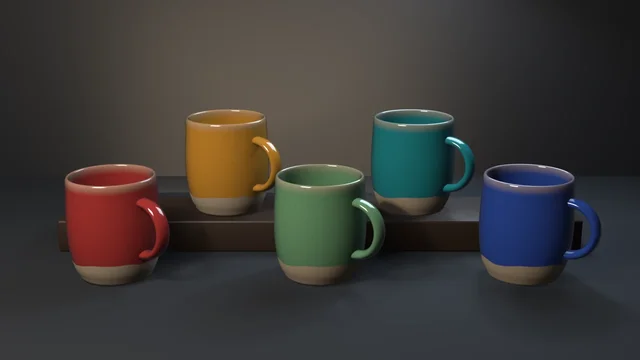
One reusable shader group declared via tree.interface.new_socket, instanced in five materials with different Tint values — one dipped-glaze group, five stoneware mugs, five colors.
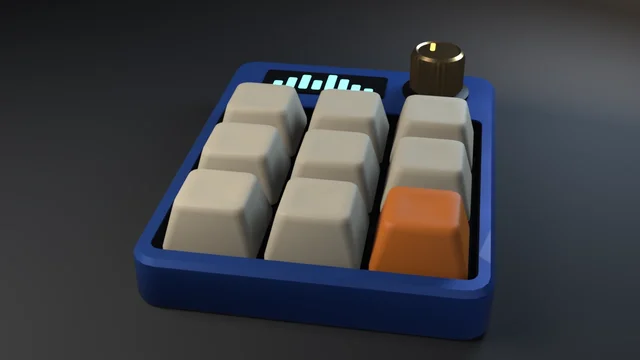
A generative Geometry Nodes tree — Mesh Grid → Instance on Points (a modeled keycap via Object Info) → Realize Instances → Set Shade Smooth → Set Material — attached as a NODES modifier with no Group Input geometry.