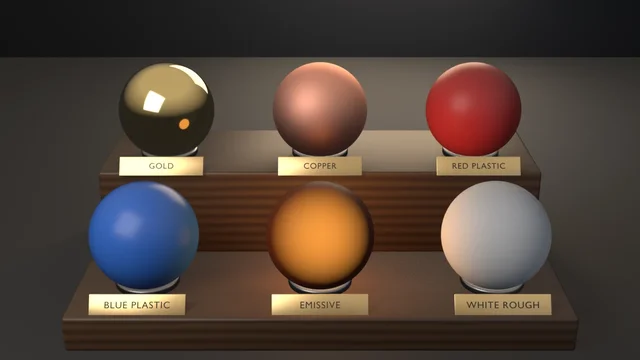
Swatch Grid
Procedural Principled materials — metal and dielectric, the emission pattern, and the cross-version set_specular shim.
examples/shader-node-group/
One reusable shader group declared via tree.interface.new_socket, instanced in five materials with different Tint values — one dipped-glaze group, five stoneware mugs, five colors.
Rendered headless by the example itself. Select it to enlarge.
tags materials node-groups
blender --background --python examples/shader-node-group/shader_node_group.py --
A runnable example that declares a reusable DippedGlaze shader group through tree.interface.new_socket — the 4.x/5.x API that replaced tree.inputs/tree.outputs — and instances it in five mug materials with different parameters, following procedural-materials-and-shaders and the shader-node-group snippet.
What it witnesses: the grouping contract. Sockets declared on the interface appear on every group-node instance; all five materials share ONE group datablock (users == 5); and the per-material Tint lives on the group node, not inside the group — set it inside the tree and every mug changes at once.
The render is the proof. The group is a dipped stoneware glaze: bare buff clay at the foot, a wavy dip line, iron speckle through clay and glaze alike, and a glaze that breaks back toward clay over the rim. All of that lives inside the group, so the five mugs — a warm-to-cool lineup of oxblood, amber, celadon, teal and cobalt — carry the same foot band, the same dip line, the same speckle field and the same rim break. Only the instance-level Tint differs. If Tint were baked into the group, the lineup would be one colour; if each material built its own tree, the shared character would be a copy rather than one datablock (the check's users gate).
A staggered shop-display lineup on the dark house stage: the odd mugs stand on a low walnut riser behind the even ones, so five mugs fill the frame without shrinking to a thin strip. Handles all turn the same way so the only thing that changes along the row is colour. The still renders under the Standard view transform (AgX would wash the five tints toward pastel); the key's spread is narrowed so it lights the mugs, not the back wall, and a warm wedge sits between the riser and the wall. Render path only.
# Cheap correctness check (no render) — the CI check:
blender --background --python shader_node_group.py --

# Falsifier: identical instance Tints. Must exit non-zero.
blender --background --python shader_node_group.py -- --same-tint

# Also render a still (EEVEE on a GPU host; use --engine cycles on GPU-less hosts):
blender --background --python shader_node_group.py -- --output mugs.png
blender --background --python shader_node_group.py -- --output mugs.png --engine cyclesPer-script sequential checks. 9 is a valid check code; there is no rule against it. 10 is the shared framing helper.
| Code | Meaning |
|---|---|
| 0 | Success |
| 1 | Uncaught exception (FATAL wrapper) |
| 2 | argparse / usage |
| 3 | Interface sockets missing Tint / Roughness / Shader |
| 4 | Group datablock users ≠ number of mug materials (5) |
| 5 | Instance points at a different node tree |
| 6 | Instance Tint values not pairwise distinct (--same-tint lands here) |
| 7 | --output produced no file |
| 10 | Gallery framing violation |
The blender-smoke workflow runs the check on Blender 5.2 LTS and 4.5 LTS (5.1 on the weekly cron, the needs-5.1 PR label, or manual dispatch). Smoke does not pass --output or --same-tint.
"""One shader node group, five materials — a runnable example.

Witnesses the node-group socket workflow from procedural-materials-and-shaders:
group sockets are declared through `tree.interface.new_socket` (the 4.x/5.x
API that replaced `tree.inputs`/`tree.outputs`), and per-material parameters
live on the GROUP NODE instance, not inside the group.

The subject is a glaze library: one `DippedGlaze` stoneware shader group —
bare buff clay at the foot, a wavy dip line, iron speckle, a glaze that
breaks back toward clay at the rim — instanced in five mug materials. Only
the instance-level Tint differs, so the five mugs carry an identical foot
band, dip line, speckle field and rim break in five colours. If the Tint
lived inside the group every mug would be the same colour; if each material
built its own tree the shared character would be a copy, not one datablock.

The check asserts the interface carries the declared sockets, every material
shares the same group datablock (users == number of mugs), each instance
points at that tree, and the instance-level Tint values are pairwise
distinct — the whole point of grouping.

``--same-tint`` copies the first mug's Tint onto every instance and still
asserts the values differ. That is the falsifier (``--same-axis`` in
export-preset-axis).

By default it runs only the correctness check (no render) — the CI smoke
check. Pass --output to also render a still:

    blender --background --python shader_node_group.py --                 # check only
    blender --background --python shader_node_group.py -- --same-tint     # must fail
    blender --background --python shader_node_group.py -- --output m.png  # + render
"""
import bpy, bmesh, sys, os, math, argparse
from mathutils import Vector

# Shared Layer 1 framing measurement (render path only) — see gallery_framing.py
sys.path.insert(0, os.path.join(os.path.dirname(os.path.abspath(__file__)), os.pardir))
sys.dont_write_bytecode = True  # keep examples/__pycache__ out of the repo tree
import gallery_framing

# One glaze library, five tints, ordered as a warm-to-cool progression.
TINTS = {
    "Mug.Oxblood": (0.42, 0.035, 0.03, 1.0),
    "Mug.Amber":   (0.62, 0.26, 0.025, 1.0),
    "Mug.Celadon": (0.16, 0.34, 0.16, 1.0),
    "Mug.Teal":    (0.015, 0.26, 0.28, 1.0),
    "Mug.Cobalt":  (0.03, 0.08, 0.40, 1.0),
}

RISER_H, RISER_Y = 0.34, 0.62      # display riser the back-row mugs stand on

CLAY = (0.50, 0.37, 0.24, 1.0)     # buff stoneware body
IRON = (0.07, 0.04, 0.025, 1.0)    # iron speckle


def build_group():
    """A reusable 'DippedGlaze' shader group: Tint + Roughness in, Shader out.

    Everything that makes the glaze a glaze — the unglazed foot, the wavy dip
    line, the iron speckle, the rim break — lives INSIDE the group, so every
    instance shares it. Only Tint and Roughness are exposed per instance.
    """
    tree = bpy.data.node_groups.new("DippedGlaze", 'ShaderNodeTree')
    tree.interface.new_socket(name="Tint", in_out='INPUT', socket_type='NodeSocketColor')
    rough = tree.interface.new_socket(name="Roughness", in_out='INPUT',
                                      socket_type='NodeSocketFloat')
    rough.default_value = 0.12
    tree.interface.new_socket(name="Shader", in_out='OUTPUT', socket_type='NodeSocketShader')

    N, L = tree.nodes, tree.links
    gi = N.new('NodeGroupInput')
    go = N.new('NodeGroupOutput')
    coord = N.new('ShaderNodeTexCoord')
    sep = N.new('ShaderNodeSeparateXYZ')
    L.new(coord.outputs["Generated"], sep.inputs[0])

    # wavy dip line: glaze covers Generated Z above ~0.2, wobbled by noise
    wobble = N.new('ShaderNodeTexNoise')
    wobble.inputs["Scale"].default_value = 2.2
    wobble.inputs["Detail"].default_value = 1.0
    L.new(coord.outputs["Object"], wobble.inputs["Vector"])
    wob_s = N.new('ShaderNodeMath'); wob_s.operation = 'MULTIPLY_ADD'
    L.new(wobble.outputs["Fac"], wob_s.inputs[0])
    wob_s.inputs[1].default_value = 0.16
    wob_s.inputs[2].default_value = 0.13           # line sits at z ~0.21 +- 0.04
    dip = N.new('ShaderNodeMapRange')
    dip.interpolation_type = 'SMOOTHSTEP'
    zline = N.new('ShaderNodeMath'); zline.operation = 'SUBTRACT'
    L.new(sep.outputs["Z"], zline.inputs[0])
    L.new(wob_s.outputs[0], zline.inputs[1])
    L.new(zline.outputs[0], dip.inputs["Value"])
    dip.inputs["From Min"].default_value = -0.004
    dip.inputs["From Max"].default_value = 0.006   # glaze mask 0 (clay) .. 1 (glaze)

    # rim break: glaze thins toward clay over the lip
    brk = N.new('ShaderNodeMapRange')
    brk.interpolation_type = 'SMOOTHSTEP'
    L.new(sep.outputs["Z"], brk.inputs["Value"])
    brk.inputs["From Min"].default_value = 0.90
    brk.inputs["From Max"].default_value = 0.985
    brk.inputs["To Max"].default_value = 0.55
    tint_broken = N.new('ShaderNodeMix'); tint_broken.data_type = 'RGBA'
    L.new(brk.outputs["Result"], tint_broken.inputs["Factor"])
    L.new(gi.outputs["Tint"], tint_broken.inputs["A"])
    tint_broken.inputs["B"].default_value = CLAY

    # glaze vs clay
    body = N.new('ShaderNodeMix'); body.data_type = 'RGBA'
    L.new(dip.outputs["Result"], body.inputs["Factor"])
    body.inputs["A"].default_value = CLAY
    L.new(tint_broken.outputs["Result"], body.inputs["B"])

    # iron speckle: small dark dots through clay and glaze alike
    vor = N.new('ShaderNodeTexVoronoi')
    vor.inputs["Scale"].default_value = 26.0
    L.new(coord.outputs["Object"], vor.inputs["Vector"])
    spk = N.new('ShaderNodeMapRange')
    L.new(vor.outputs["Distance"], spk.inputs["Value"])
    spk.inputs["From Min"].default_value = 0.10
    spk.inputs["From Max"].default_value = 0.06
    speckled = N.new('ShaderNodeMix'); speckled.data_type = 'RGBA'
    L.new(spk.outputs["Result"], speckled.inputs["Factor"])
    L.new(body.outputs["Result"], speckled.inputs["A"])
    speckled.inputs["B"].default_value = IRON

    # roughness: glaze takes the instance Roughness, bare clay stays matte
    rmix = N.new('ShaderNodeMix'); rmix.data_type = 'FLOAT'
    L.new(dip.outputs["Result"], rmix.inputs["Factor"])
    rmix.inputs["A"].default_value = 0.85
    L.new(gi.outputs["Roughness"], rmix.inputs["B"])

    bsdf = N.new('ShaderNodeBsdfPrincipled')
    L.new(speckled.outputs["Result"], bsdf.inputs["Base Color"])
    L.new(rmix.outputs["Result"], bsdf.inputs["Roughness"])
    L.new(dip.outputs["Result"], bsdf.inputs["Coat Weight"])   # glossy glaze coat
    bsdf.inputs["Coat Roughness"].default_value = 0.06
    L.new(bsdf.outputs["BSDF"], go.inputs["Shader"])
    return tree


def material_from_group(name, tree, tint):
    """Instance the group in a fresh material; parameters set on the instance."""
    mat = bpy.data.materials.new(name)
    mat.use_nodes = True
    nt = mat.node_tree
    nt.nodes.clear()
    group = nt.nodes.new('ShaderNodeGroup')
    group.node_tree = tree
    group.inputs["Tint"].default_value = tint
    out = nt.nodes.new('ShaderNodeOutputMaterial')
    nt.links.new(group.outputs["Shader"], out.inputs["Surface"])
    return mat


# (radius, z) lathe profile of a thrown stoneware mug, closed: foot ring,
# bellied wall, rolled lip, inner wall, well floor.
MUG_PROFILE = [
    (0.0, 0.0), (0.30, 0.0), (0.335, 0.012), (0.35, 0.045), (0.365, 0.075),
    (0.40, 0.14), (0.435, 0.32), (0.445, 0.52), (0.435, 0.72), (0.425, 0.88),
    (0.425, 0.96), (0.418, 0.99), (0.402, 1.0), (0.386, 0.99), (0.382, 0.96),
    (0.388, 0.80), (0.395, 0.52), (0.380, 0.30), (0.345, 0.16), (0.28, 0.105),
    (0.0, 0.095),
]


def _bezier(p0, p1, p2, p3, t):
    u = 1.0 - t
    return p0 * u ** 3 + p1 * 3 * u * u * t + p2 * 3 * u * t * t + p3 * t ** 3


def build_mug_mesh(name):
    """Lathe body plus a swept loop handle in one mesh (one Generated space)."""
    me = bpy.data.meshes.new(name)
    bm = bmesh.new()
    try:
        verts = [bm.verts.new((r, 0.0, z)) for r, z in MUG_PROFILE]
        edges = [bm.edges.new((verts[i], verts[i + 1])) for i in range(len(verts) - 1)]
        bmesh.ops.spin(bm, geom=verts + edges, cent=(0, 0, 0), axis=(0, 0, 1),
                       angle=math.tau, steps=72, use_merge=True)
        bmesh.ops.remove_doubles(bm, verts=bm.verts[:], dist=1e-5)

        # handle: an oval section swept along a cubic C from the upper to the
        # lower wall, both ends buried in the body
        p0, p1 = Vector((0.36, 0.0, 0.80)), Vector((0.80, 0.0, 0.86))
        p2, p3 = Vector((0.78, 0.0, 0.26)), Vector((0.37, 0.0, 0.30))
        rings, seg = [], 14
        steps = 28
        for i in range(steps + 1):
            t = i / steps
            c = _bezier(p0, p1, p2, p3, t)
            tan = (_bezier(p0, p1, p2, p3, min(t + 0.01, 1.0))
                   - _bezier(p0, p1, p2, p3, max(t - 0.01, 0.0))).normalized()
            nrm = tan.cross(Vector((0, 1, 0))).normalized()
            ring = []
            for k in range(seg):
                a = math.tau * k / seg
                off = nrm * (0.042 * math.cos(a)) + Vector((0, 1, 0)) * (0.075 * math.sin(a))
                ring.append(bm.verts.new(c + off))
            rings.append(ring)
        for ra, rb in zip(rings, rings[1:]):
            for k in range(seg):
                bm.faces.new((ra[k], ra[(k + 1) % seg], rb[(k + 1) % seg], rb[k]))
        bm.to_mesh(me)
    finally:
        bm.free()
    for poly in me.polygons:
        poly.use_smooth = True
    return me


def build_scene(same_tint=False):
    bpy.ops.wm.read_factory_settings(use_empty=True)
    tree = build_group()
    objs = []
    first = next(iter(TINTS.values()))
    n = len(TINTS)
    for i, (name, tint) in enumerate(TINTS.items()):
        me = build_mug_mesh(name)
        obj = bpy.data.objects.new(name, me)
        # a staggered shop-display lineup read left to right: even mugs on
        # the floor in front, odd mugs on the riser behind, handles all right
        u = i - (n - 1) / 2
        back = i % 2 == 1
        obj.location = (u * 0.98, RISER_Y if back else -0.45, RISER_H if back else 0.0)
        obj.rotation_euler = (0.0, 0.0, math.radians(-38))
        sub = obj.modifiers.new("Smooth", 'SUBSURF')
        sub.levels = 1
        sub.render_levels = 2
        inst_tint = first if same_tint else tint
        me.materials.append(material_from_group(f"Glaze.{name.split('.')[1]}", tree,
                                                inst_tint))
        bpy.context.collection.objects.link(obj)
        objs.append(obj)
    return tree, objs


def check(tree, objs):
    # sockets declared through the interface API actually exist on the interface
    names = {(s.name, s.in_out) for s in tree.interface.items_tree
             if getattr(s, "item_type", "SOCKET") == 'SOCKET'}
    expect = {("Tint", 'INPUT'), ("Roughness", 'INPUT'), ("Shader", 'OUTPUT')}
    if not expect <= names:
        print(f"ERROR: interface sockets {names} missing {expect - names}", file=sys.stderr)
        return 3

    # one shared group datablock, instanced by every material
    if tree.users != len(objs):
        print(f"ERROR: group users {tree.users} != {len(objs)} (not shared)", file=sys.stderr)
        return 4

    # per-instance parameters live on the group NODE, and they all differ
    tints = []
    for obj in objs:
        node = next(n for n in obj.data.materials[0].node_tree.nodes
                    if n.type == 'GROUP')
        if node.node_tree is not tree:
            print(f"ERROR: {obj.name} instance points at a different tree", file=sys.stderr)
            return 5
        tints.append(tuple(round(c, 3) for c in node.inputs["Tint"].default_value))
    if len(set(tints)) != len(tints):
        print(f"ERROR: instance Tint values not pairwise distinct {tints} — parameters "
              "leaked into the group instead of the instance", file=sys.stderr)
        return 6

    print(f"group={tree.name} users={tree.users} instance_tints={tints}")
    return 0


def eevee_engine_id():
    return 'BLENDER_EEVEE' if bpy.app.version >= (5, 0, 0) else 'BLENDER_EEVEE_NEXT'


def render_still(objs, path, engine):
    scene = bpy.context.scene
    floor_me = bpy.data.meshes.new("Floor")
    bm = bmesh.new()
    try:
        bmesh.ops.create_grid(bm, x_segments=1, y_segments=1, size=30.0)
        bm.to_mesh(floor_me)
    finally:
        bm.free()
    fmat = bpy.data.materials.new("Studio")
    fmat.use_nodes = True
    fb = fmat.node_tree.nodes["Principled BSDF"]
    fb.inputs["Base Color"].default_value = (0.018, 0.019, 0.022, 1.0)
    fb.inputs["Roughness"].default_value = 0.8
    floor_me.materials.append(fmat)
    floor = bpy.data.objects.new("Floor", floor_me)
    scene.collection.objects.link(floor)
    wall = bpy.data.objects.new("Wall", floor_me.copy())
    wall.location = (0.0, 3.2, 0.0)
    wall.rotation_euler = (math.radians(90), 0.0, 0.0)
    scene.collection.objects.link(wall)

    # a low dark-walnut display riser for the back row (staging, not hero)
    riser_me = bpy.data.meshes.new("Riser")
    bm = bmesh.new()
    try:
        bmesh.ops.create_cube(bm, size=1.0)
        bmesh.ops.scale(bm, vec=(5.4, 0.9, RISER_H), verts=bm.verts[:])
        bmesh.ops.translate(bm, vec=(0.0, RISER_Y, RISER_H / 2), verts=bm.verts[:])
        bmesh.ops.bevel(bm, geom=bm.edges[:], offset=0.025, segments=3,
                        affect='EDGES', profile=0.5)
        bm.to_mesh(riser_me)
    finally:
        bm.free()
    for poly in riser_me.polygons:
        poly.use_smooth = True
    rmat = bpy.data.materials.new("Walnut")
    rmat.use_nodes = True
    rb = rmat.node_tree.nodes["Principled BSDF"]
    rb.inputs["Base Color"].default_value = (0.045, 0.026, 0.016, 1.0)
    rb.inputs["Roughness"].default_value = 0.45
    riser_me.materials.append(rmat)
    riser = bpy.data.objects.new("Riser", riser_me)
    scene.collection.objects.link(riser)

    world = bpy.data.worlds.new("World")
    world.use_nodes = True
    world.node_tree.nodes["Background"].inputs["Color"].default_value = (0.02, 0.021, 0.025, 1.0)
    scene.world = world

    def light(name, loc, energy, size, col, rot, spread=180.0):
        ld = bpy.data.lights.new(name, 'AREA')
        ld.energy = energy; ld.size = size; ld.color = col
        ld.spread = math.radians(spread)
        ob = bpy.data.objects.new(name, ld)
        ob.location = loc
        ob.rotation_euler = tuple(math.radians(a) for a in rot)
        scene.collection.objects.link(ob)

    # a soft key so the glossy glaze mirrors a soft window, not a hard white
    # square; its spread is narrowed so it lights the mugs, not the back wall
    light("Key", (-4.0, -5.0, 6.0), 540.0, 3.0, (1.0, 0.96, 0.9), (46, 0, -35), spread=55)
    light("Fill", (5.5, -4.0, 2.0), 30.0, 9.0, (0.75, 0.85, 1.0), (70, 0, 52))
    light("Rim", (1.8, 1.9, 3.8), 170.0, 2.5, (0.6, 0.78, 1.0), (-40, 0, -25), spread=45)
    # wedge: between the riser and the wall, raking a warm pool behind the mugs
    light("Wedge", (-0.6, 2.2, 0.7), 170.0, 4.0, (1.0, 0.76, 0.5), (105, 0, 0))

    cam_data = bpy.data.cameras.new("Cam")
    cam_data.lens = 50.0
    cam = bpy.data.objects.new("Cam", cam_data)
    cam.location = (0.0, -8.5, 3.15)
    scene.collection.objects.link(cam)
    aim = bpy.data.objects.new("Aim", None)
    aim.location = (0.0, 0.15, 0.78)
    scene.collection.objects.link(aim)
    track = cam.constraints.new('TRACK_TO')
    track.target = aim
    track.track_axis = 'TRACK_NEGATIVE_Z'
    track.up_axis = 'UP_Y'
    scene.camera = cam

    scene.render.engine = 'CYCLES' if engine == 'cycles' else eevee_engine_id()
    if engine == 'cycles':
        scene.cycles.samples = 48
    else:
        try:
            scene.eevee.taa_render_samples = 64
        except AttributeError:
            pass
    scene.render.resolution_x = 1280
    scene.render.resolution_y = 720
    scene.render.image_settings.file_format = 'PNG'
    scene.render.filepath = path
    # AgX would wash the five glaze tints toward pastel (docs/VISUAL-STYLE.md)
    scene.view_settings.view_transform = 'Standard'
    # Layer 1 framing gate (silhouette matte) — exit 10 on violation, before
    # the beauty render so a defective composition ships no artifact.
    fcode = gallery_framing.check_framing(
        scene, cam,
        hero=list(objs),
        elements=list(objs),
        stage=[floor, wall, riser],
    )
    if fcode:
        return fcode
    bpy.ops.render.render(write_still=True)
    if not (os.path.exists(path) and os.path.getsize(path) > 0):
        print("ERROR: render produced no file", file=sys.stderr)
        return 7
    return 0


def main():
    argv = sys.argv[sys.argv.index("--") + 1:] if "--" in sys.argv else []
    p = argparse.ArgumentParser()
    p.add_argument("--output", default=None, help="optional: render a still PNG here")
    p.add_argument("--engine", default="eevee", choices=("eevee", "cycles"),
                   help="render engine for --output (cycles for GPU-less hosts)")
    p.add_argument("--same-tint", action="store_true",
                   help="falsifier: identical instance Tints, still assert they differ")
    args = p.parse_args(argv)

    tree, objs = build_scene(same_tint=args.same_tint)

    code = check(tree, objs)
    if code:
        return code

    if args.output:
        rcode = render_still(objs, os.path.abspath(args.output), args.engine)
        if rcode:
            return rcode
        print(f"rendered still {args.output}")

    print("shader-node-group OK")
    return 0


if __name__ == "__main__":
    try:
        sys.exit(main())
    except Exception as e:
        import traceback; traceback.print_exc(); print(f"FATAL: {e}", file=sys.stderr); sys.exit(1)
Procedural Principled materials — metal and dielectric, the emission pattern, and the cross-version set_specular shim.
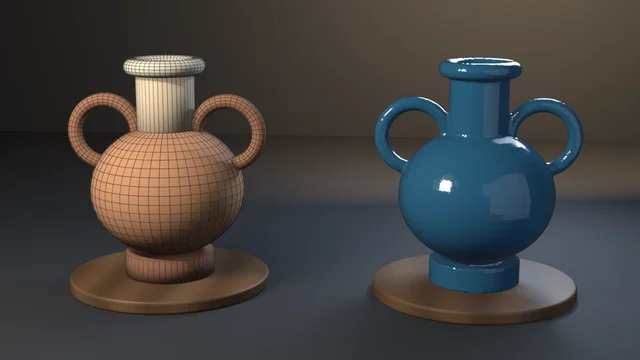
A Geometry Nodes SDF remesh (MeshToSDFGrid → GridToMesh at the SDF zero-level), with a Set Material node carrying the material through the remesh.

The modern color-attributes API — mesh.color_attributes.new() on the CORNER domain, filled by expanding per-vertex HSV across face corners with foreach_get/foreach_set, then wired into a shader Attribute node.