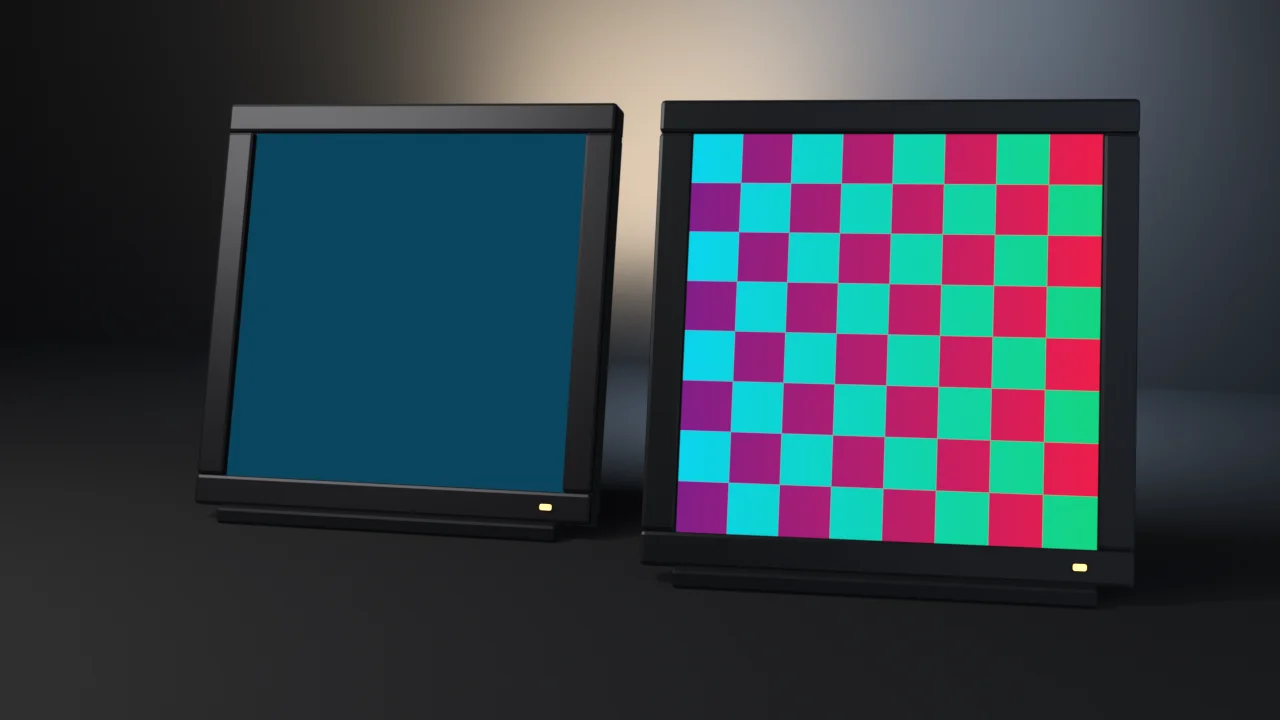
Rendered headless by the example itself — click to zoom.
blender --background --python examples/uv-layer-grid/uv_layer_grid.py --
A runnable example that witnesses the UV-layer authoring hazard behind bmesh.ops.create_grid(..., calc_uvs=True): the flag is a silent no-op unless a UV layer already exists on the BMesh. AI-generated Blender code commonly trusts calc_uvs=True, wires an Image Texture, and ships a mesh that renders as one flat color — every fragment samples texel (0, 0).
Found while authoring image-pixels-testcard; lifted into its own smoke-gated witness so the contract cannot quietly drift.
What it witnesses: three related contracts on the same grid topology (SEG×SEG faces, (SEG+1)² verts, size 1.0 → coords in [-1, 1]):
- Silent no-op —
create_grid(..., calc_uvs=True)with no priorbm.loops.layers.uv.new(...)leaveslen(bm.loops.layers.uv) == 0andmesh.uv_layersempty afterto_mesh. - Pre-create repair — create the UV layer first, then
calc_uvs=Truefills every loop. UVs must match the closed formu = (x/size + 1)/2,v = (y/size + 1)/2within1e-6, both on the BMesh and after persisting tomesh.uv_layers.active.data. - Explicit assignment fallback —
calc_uvs=False, thenuv.new("UVMap")and a loop write of the same closed form. Does not depend oncalc_uvsat all; same tolerance.
What each check catches on failure:
- *Silent no-op* —
calc_uvs=Truestarts creating a layer on its own (falsified: expectingn_layers == 0fails if a layer appears; temporarily pre-creating a layer before the hazard probe exits 3). - *Topology* —
create_gridsegment/size contract drift (wrong face/vert counts). - *Closed-form UVs* —
calc_uvsfilling a different parameterization, or a one-texel shift (falsified: adding0.1to every U exited 6 with measured error0.1). - *Mesh persistence* — UV layer or loop data lost across
to_mesh. - *Explicit path* — loop assignment or the closed form itself regressing.
- *Pixel witness* (with
--output) — the saved PNG is read back and probed at each panel's projected center: the hazard panel must be one flat teal (per-channel spread ≤ 0.02, ordering b>g>r), the repaired panel a high-contrast checker (spread ≥ 0.25). Falsified twice: secretly giving the hazard panel UVs exited 11 with measured spread0.7333; repainting texel (0,0) magenta exited 12 with measured rgb(0.927, 0.118, 0.536).
Version divergence: none probed — the silent no-op and closed-form UV fill assert identically on Blender 4.5 LTS and 5.1. The only gate in the file is the EEVEE engine id for the optional render (BLENDER_EEVEE_NEXT on 4.x, BLENDER_EEVEE on 5.x).
Render: two framed lightbox displays on floor trays (rear kick legs, status LED) sharing one neon checker image, shot at a slight 3/4. Left is the hazard (no UV layer) — flat teal of texel (0, 0). Right is the repair (pre-create + calc_uvs) — full magenta/cyan checker. If the UV contract failed, both panels would read the same — and the still is not just an illustration: the script re-reads its own render and exits non-zero unless the pixels prove the flat-vs-checker split (measured on 5.1.2: hazard spread 0.0078, repair spread 0.7412; identical on 4.5.11).
Run
# Cheap correctness check (no render) — the CI check:
blender --background --python uv_layer_grid.py --

# Also render a still (EEVEE on a GPU host; use --engine cycles on GPU-less hosts):
blender --background --python uv_layer_grid.py -- --output uv.png
blender --background --python uv_layer_grid.py -- --output uv.png --engine cycles
It exits non-zero on failure and prints every measured error and tolerance on success, so CI logs carry the numbers. The blender-smoke workflow runs the check on Blender 5.2 LTS and 4.5 LTS.
Source
"""UV-layer authoring hazard — a runnable example.

Witnesses that `bmesh.ops.create_grid(..., calc_uvs=True)` silently creates
*no* UV layer unless one already exists on the BMesh. AI-generated Blender
code commonly trusts `calc_uvs=True` and then wires an Image Texture; without
a UV layer every fragment samples texel (0, 0) and the mesh renders as one
flat color.

The check proves the silent no-op, then the pre-create + `calc_uvs=True`
repair path against a closed-form UV grid, and an explicit loop-assignment
fallback that does not depend on `calc_uvs` at all. Pass --output to also
render a still that stages the broken (flat) panel beside the repaired
(checker) panel — and then *witnesses the render itself*: the saved PNG is
read back and probed at each panel's projected center, asserting the broken
panel is one flat teal (texel (0,0)) while the repaired panel carries both
checker colors. If the UV contract failed, the pixels would say so:

    blender --background --python uv_layer_grid.py --
    blender --background --python uv_layer_grid.py -- --output uv.png
"""
import bpy, bmesh, sys, os, math, argparse
from mathutils import Vector

SEG = 8
SIZE = 1.0
UV_TOL = 1e-6


def expect_uv(co):
    """Closed-form UV for create_grid verts spanning [-SIZE, SIZE] in X/Y."""
    return ((co.x / SIZE) + 1.0) * 0.5, ((co.y / SIZE) + 1.0) * 0.5


def fail(msg, code):
    print(f"ERROR: {msg}", file=sys.stderr)
    return code


def max_uv_err(bm, uv_layer):
    err = 0.0
    for face in bm.faces:
        for loop in face.loops:
            ex, ey = expect_uv(loop.vert.co)
            got = loop[uv_layer].uv
            err = max(err, abs(got.x - ex), abs(got.y - ey))
    return err


def check():
    bpy.ops.wm.read_factory_settings(use_empty=True)

    # --- 1. The hazard: calc_uvs=True is a silent no-op without a UV layer ---
    me_bad = bpy.data.meshes.new("NoPreUV")
    bm = bmesh.new()
    try:
        bmesh.ops.create_grid(
            bm, x_segments=SEG, y_segments=SEG, size=SIZE, calc_uvs=True,
        )
        n_layers = len(bm.loops.layers.uv)
        n_faces = len(bm.faces)
        n_verts = len(bm.verts)
        bm.to_mesh(me_bad)
    finally:
        bm.free()

    if n_layers != 0:
        return fail(
            f"calc_uvs=True without a pre-existing layer created {n_layers} "
            f"UV layer(s) — the silent-no-op hazard is gone (or changed)",
            3,
        )
    if len(me_bad.uv_layers) != 0:
        return fail(
            f"mesh gained {len(me_bad.uv_layers)} UV layer(s) after "
            f"calc_uvs=True with no pre-create",
            3,
        )
    expect_faces = SEG * SEG
    expect_verts = (SEG + 1) * (SEG + 1)
    if (n_faces, n_verts) != (expect_faces, expect_verts):
        return fail(
            f"grid topology {(n_verts, n_faces)} != "
            f"expected {(expect_verts, expect_faces)}",
            4,
        )

    # --- 2. Repair: pre-create the layer, then calc_uvs=True fills it -----
    me_ok = bpy.data.meshes.new("PreUV")
    bm = bmesh.new()
    try:
        bm.loops.layers.uv.new("UVMap")
        bmesh.ops.create_grid(
            bm, x_segments=SEG, y_segments=SEG, size=SIZE, calc_uvs=True,
        )
        if len(bm.loops.layers.uv) != 1:
            return fail(
                f"pre-create + calc_uvs left {len(bm.loops.layers.uv)} "
                f"layers (expected 1)",
                5,
            )
        uv = bm.loops.layers.uv.active
        calc_err = max_uv_err(bm, uv)
        bm.to_mesh(me_ok)
    finally:
        bm.free()

    if calc_err > UV_TOL:
        return fail(
            f"calc_uvs closed-form error {calc_err:.2e} > {UV_TOL:.0e}",
            6,
        )
    if len(me_ok.uv_layers) != 1 or me_ok.uv_layers.active is None:
        return fail("pre-create path did not persist a UV layer on the mesh", 5)

    # Mesh-side round-trip of the same closed form (loop data, not bmesh).
    mesh_err = 0.0
    uv_data = me_ok.uv_layers.active.data
    for poly in me_ok.polygons:
        for li in poly.loop_indices:
            vi = me_ok.loops[li].vertex_index
            ex, ey = expect_uv(me_ok.vertices[vi].co)
            got = uv_data[li].uv
            mesh_err = max(mesh_err, abs(got.x - ex), abs(got.y - ey))
    if mesh_err > UV_TOL:
        return fail(
            f"mesh UV round-trip error {mesh_err:.2e} > {UV_TOL:.0e}",
            7,
        )

    # --- 3. Explicit assignment fallback (does not rely on calc_uvs) -------
    me_ex = bpy.data.meshes.new("ExplicitUV")
    bm = bmesh.new()
    try:
        bmesh.ops.create_grid(
            bm, x_segments=SEG, y_segments=SEG, size=SIZE, calc_uvs=False,
        )
        if len(bm.loops.layers.uv) != 0:
            return fail(
                "create_grid(calc_uvs=False) unexpectedly created a UV layer",
                8,
            )
        uv = bm.loops.layers.uv.new("UVMap")
        for face in bm.faces:
            for loop in face.loops:
                loop[uv].uv = expect_uv(loop.vert.co)
        explicit_err = max_uv_err(bm, uv)
        bm.to_mesh(me_ex)
    finally:
        bm.free()

    if explicit_err > UV_TOL:
        return fail(
            f"explicit UV assignment error {explicit_err:.2e} > {UV_TOL:.0e}",
            9,
        )

    print(
        f"hazard confirmed: calc_uvs=True alone → 0 UV layers "
        f"(grid {n_verts}v/{n_faces}f); "
        f"pre-create + calc_uvs max err {calc_err:.2e} "
        f"(mesh round-trip {mesh_err:.2e}); "
        f"explicit assign max err {explicit_err:.2e} "
        f"(tol {UV_TOL:.0e})"
    )
    return 0


def eevee_engine_id():
    return "BLENDER_EEVEE" if bpy.app.version >= (5, 0, 0) else "BLENDER_EEVEE_NEXT"


def make_uv_testcard(name, w=256, h=256):
    """Neon checker whose single texel (0,0) is a flat teal, so a missing UV
    layer reads as one solid color instead of a bright false-positive checker."""
    img = bpy.data.images.new(name, w, h, alpha=False)
    px = [0.0] * (w * h * 4)
    cell = w // 8
    for y in range(h):
        for x in range(w):
            i = (y * w + x) * 4
            cx, cy = x // cell, y // cell
            # bottom-left origin: (0,0) is the first pixel the shader samples
            # when no UV layer exists.
            if x == 0 and y == 0:
                # Distinct flat teal — readable as "wrong" at thumbnail scale,
                # still obviously not the checker.
                px[i:i + 4] = [0.04, 0.28, 0.38, 1.0]
                continue
            if (cx + cy) % 2 == 0:
                # warm magenta
                px[i:i + 4] = [0.95, 0.12, 0.55, 1.0]
            else:
                # electric cyan
                px[i:i + 4] = [0.08, 0.85, 0.95, 1.0]
            # saturation wash by U so the gradient is readable at thumbnail
            u = x / (w - 1)
            px[i] = min(1.0, px[i] * (0.55 + 0.45 * u))
            px[i + 2] = min(1.0, px[i + 2] * (0.55 + 0.45 * (1.0 - u)))
    img.pixels.foreach_set(px)
    return img


def specular_off(bsdf):
    if "Specular IOR Level" in bsdf.inputs:
        bsdf.inputs["Specular IOR Level"].default_value = 0.0
    elif "Specular" in bsdf.inputs:
        bsdf.inputs["Specular"].default_value = 0.0


def textured_plane(name, image, with_uvs):
    """Unit grid plane (+/- SIZE). with_uvs=False leaves the hazard in place."""
    me = bpy.data.meshes.new(name)
    bm = bmesh.new()
    try:
        if with_uvs:
            bm.loops.layers.uv.new("UVMap")
        bmesh.ops.create_grid(
            bm, x_segments=SEG, y_segments=SEG, size=SIZE, calc_uvs=with_uvs,
        )
        bm.to_mesh(me)
    finally:
        bm.free()

    mat = bpy.data.materials.new(name + "Mat")
    mat.use_nodes = True
    nodes, links = mat.node_tree.nodes, mat.node_tree.links
    tex = nodes.new("ShaderNodeTexImage")
    tex.image = image
    tex.interpolation = "Closest"
    bsdf = nodes["Principled BSDF"]
    bsdf.inputs["Base Color"].default_value = (0.0, 0.0, 0.0, 1.0)
    bsdf.inputs["Roughness"].default_value = 1.0
    specular_off(bsdf)
    # Emission so the checker reads as authored color, not lit albedo.
    links.new(tex.outputs["Color"], bsdf.inputs["Emission Color"])
    bsdf.inputs["Emission Strength"].default_value = 0.95
    me.materials.append(mat)

    obj = bpy.data.objects.new(name, me)
    bpy.context.collection.objects.link(obj)
    return obj


def render_still(path, engine):
    scene = bpy.context.scene
    card = make_uv_testcard("UVCard")

    # --- Staging materials: quiet and dark, the panel faces carry the color --
    def pbr(name, base, rough, metal=0.0):
        m = bpy.data.materials.new(name)
        m.use_nodes = True
        b = m.node_tree.nodes["Principled BSDF"]
        b.inputs["Base Color"].default_value = (*base, 1.0)
        b.inputs["Roughness"].default_value = rough
        b.inputs["Metallic"].default_value = metal
        return m

    frame_mat = pbr("Frame", (0.05, 0.053, 0.06), 0.32, 0.65)
    stand_mat = pbr("Stand", (0.032, 0.035, 0.042), 0.45, 0.4)
    led_mat = pbr("Led", (0.0, 0.0, 0.0), 0.6)
    led_b = led_mat.node_tree.nodes["Principled BSDF"]
    led_b.inputs["Emission Color"].default_value = (1.0, 0.45, 0.12, 1.0)
    led_b.inputs["Emission Strength"].default_value = 4.0

    def box(name, dims, loc, rot, mat, bevel=0.0):
        dx, dy, dz = (d * 0.5 for d in dims)
        verts = [
            (-dx, -dy, -dz), (dx, -dy, -dz), (dx, dy, -dz), (-dx, dy, -dz),
            (-dx, -dy, dz), (dx, -dy, dz), (dx, dy, dz), (-dx, dy, dz),
        ]
        faces = [
            (0, 1, 2, 3), (4, 7, 6, 5), (0, 4, 5, 1),
            (1, 5, 6, 2), (2, 6, 7, 3), (4, 0, 3, 7),
        ]
        me = bpy.data.meshes.new(name)
        me.from_pydata(verts, [], faces)
        me.materials.append(mat)
        ob = bpy.data.objects.new(name, me)
        ob.location = loc
        ob.rotation_euler = rot
        scene.collection.objects.link(ob)
        if bevel > 0.0:
            mod = ob.modifiers.new("Edge", "BEVEL")
            mod.width = bevel
            mod.segments = 2
        return ob

    def bar_between(name, p1, p2, width, mat):
        a, b = Vector(p1), Vector(p2)
        d = b - a
        ob = box(name, (width, width, d.length), (a + b) * 0.5, (0, 0, 0), mat, 0.01)
        ob.rotation_mode = "QUATERNION"
        ob.rotation_quaternion = d.to_track_quat("Z", "Y")
        return ob

    # --- Two framed lightbox displays, each on a floor tray with a rear
    # kick leg. The face planes keep their origins at the face centers (the
    # pixel witness probes the projected centers), with a ~0.2-unit bezel
    # between the face edge and the frame so the probed patch stays on data.
    LEAN = math.radians(75.0)  # 15° back off vertical, easel-like

    def display(name, with_uvs, cx, cy, yaw_deg):
        yaw = math.radians(yaw_deg)
        asm = bpy.data.objects.new(name + "Asm", None)
        asm.rotation_euler = (LEAN, 0.0, yaw)
        rot = asm.rotation_euler.to_matrix()
        # Face-center height such that the frame's bottom edge rests in tray.
        contact = rot @ Vector((0.0, -1.17, 0.02))
        asm.location = (cx, cy, 0.07 - contact.z)
        scene.collection.objects.link(asm)

        # Left: the hazard — calc_uvs alone, no UV layer → flat teal of
        # texel (0,0). Right: the repair — pre-create, then calc_uvs fills.
        face = textured_plane(name, card, with_uvs)
        face.parent = asm
        face.location = (0.0, 0.0, 0.075)

        plate = box(name + "Back", (2.34, 2.34, 0.14), (0, 0, 0), (0, 0, 0),
                    frame_mat, 0.02)
        plate.parent = asm
        bezels = (
            ((2.34, 0.17, 0.20), (0.0, 1.085, 0.02)),
            ((2.34, 0.17, 0.20), (0.0, -1.085, 0.02)),
            ((0.17, 2.0, 0.20), (1.085, 0.0, 0.02)),
            ((0.17, 2.0, 0.20), (-1.085, 0.0, 0.02)),
        )
        for i, (dims, loc) in enumerate(bezels):
            bez = box(f"{name}Bez{i}", dims, loc, (0, 0, 0), frame_mat, 0.02)
            bez.parent = asm
        led = box(name + "Led", (0.06, 0.03, 0.035), (0.92, -1.085, 0.128),
                  (0, 0, 0), led_mat, 0.008)
        led.parent = asm

        base = asm.location
        box(name + "Tray", (2.0, 0.32, 0.10),
            (base.x + contact.x, base.y + contact.y, 0.05),
            (0, 0, yaw), stand_mat, 0.02)
        back = rot @ Vector((0.0, 0.0, -1.0))
        back.z = 0.0
        back.normalize()
        for side in (-0.75, 0.75):
            attach = base + rot @ Vector((side, 0.55, -0.12))
            foot = (base.x + contact.x + side * math.cos(yaw) + back.x * 0.85,
                    base.y + contact.y - side * math.sin(yaw) + back.y * 0.85,
                    0.02)
            bar_between(f"{name}Leg{side:+.2f}", attach, foot, 0.06, stand_mat)

    display("Broken", False, -1.38, 0.30, 6.0)
    display("Fixed", True, 1.45, -0.10, 9.0)

    floor_me = bpy.data.meshes.new("Floor")
    bm = bmesh.new()
    try:
        bmesh.ops.create_grid(bm, x_segments=1, y_segments=1, size=30.0)
        bm.to_mesh(floor_me)
    finally:
        bm.free()
    fmat = bpy.data.materials.new("Studio")
    fmat.use_nodes = True
    fb = fmat.node_tree.nodes["Principled BSDF"]
    fb.inputs["Base Color"].default_value = (0.03, 0.032, 0.037, 1.0)
    fb.inputs["Roughness"].default_value = 0.7
    floor_me.materials.append(fmat)
    floor = bpy.data.objects.new("Floor", floor_me)
    scene.collection.objects.link(floor)
    wall = bpy.data.objects.new("Wall", floor_me.copy())
    wall.location = (0.0, 6.8, 0.0)
    wall.rotation_euler = (math.radians(90), 0.0, 0.0)
    scene.collection.objects.link(wall)

    world = bpy.data.worlds.new("World")
    world.use_nodes = True
    world.node_tree.nodes["Background"].inputs["Color"].default_value = (
        0.02, 0.021, 0.025, 1.0,
    )
    scene.world = world

    def light(name, loc, energy, size, col, rot):
        ld = bpy.data.lights.new(name, "AREA")
        ld.energy = energy
        ld.size = size
        ld.color = col
        ob = bpy.data.objects.new(name, ld)
        ob.location = loc
        ob.rotation_euler = tuple(math.radians(a) for a in rot)
        scene.collection.objects.link(ob)

    # Aimed steeply down so its spill dies on the floor, not on the wall.
    light("Key", (-4.4, -4.2, 6.4), 340.0, 5.0, (1.0, 0.96, 0.9), (60, 0, -32))
    light("Fill", (4.8, -2.8, 1.6), 80.0, 9.0, (0.75, 0.85, 1.0), (72, 0, 52))
    light("Rim", (0.2, 4.6, 3.0), 250.0, 3.5, (0.6, 0.78, 1.0), (-42, 0, 178))
    # Uplight between the displays and the wall, raking UP the backdrop: the
    # visible wall band above the panel tops only spans z≈2.8–3.4, so the
    # warm pool is aimed to live there instead of hiding behind the panels.
    light("Wedge", (-2.2, 5.6, 2.3), 480.0, 3.0, (1.0, 0.76, 0.5), (-117, 0, 180))

    aim = bpy.data.objects.new("Aim", None)
    aim.location = (0.1, 0.05, 1.0)
    scene.collection.objects.link(aim)

    cam_data = bpy.data.cameras.new("Cam")
    cam_data.lens = 48.0
    cam = bpy.data.objects.new("Cam", cam_data)
    cam.location = (3.1, -8.35, 2.2)
    con = cam.constraints.new("TRACK_TO")
    con.target = aim
    con.track_axis = "TRACK_NEGATIVE_Z"
    con.up_axis = "UP_Y"
    scene.collection.objects.link(cam)
    scene.camera = cam

    scene.render.engine = "CYCLES" if engine == "cycles" else eevee_engine_id()
    if engine == "cycles":
        scene.cycles.samples = 64
    else:
        try:
            scene.eevee.taa_render_samples = 64
        except AttributeError:
            pass
    scene.render.resolution_x = 1280
    scene.render.resolution_y = 720
    scene.render.image_settings.file_format = "PNG"
    scene.render.filepath = path
    # AgX desaturates the neon checker toward pastel — Standard keeps it honest.
    scene.view_settings.view_transform = "Standard"
    bpy.ops.render.render(write_still=True)
    return os.path.exists(path) and os.path.getsize(path) > 0


def patch_stats(px, w, h, cx, cy, half):
    """Mean RGB and per-channel min/max spread of a (2*half)^2 pixel patch."""
    sums = [0.0, 0.0, 0.0]
    lo = [1.0, 1.0, 1.0]
    hi = [0.0, 0.0, 0.0]
    n = 0
    for y in range(max(0, cy - half), min(h, cy + half)):
        for x in range(max(0, cx - half), min(w, cx + half)):
            i = (y * w + x) * 4
            for c in range(3):
                v = px[i + c]
                sums[c] += v
                lo[c] = min(lo[c], v)
                hi[c] = max(hi[c], v)
            n += 1
    mean = [s / n for s in sums]
    spread = max(hi[c] - lo[c] for c in range(3))
    return mean, spread


def verify_still(path):
    """Witness the render itself: the broken panel must be one flat teal, the
    repaired panel a high-contrast checker. Probes the saved PNG at each
    panel's projected center, so a failed UV contract cannot ship a still."""
    from bpy_extras.object_utils import world_to_camera_view

    scene = bpy.context.scene
    bpy.context.view_layer.update()
    img = bpy.data.images.load(path)
    try:
        w, h = img.size
        px = [0.0] * (w * h * 4)
        img.pixels.foreach_get(px)
    finally:
        bpy.data.images.remove(img)

    half = max(8, int(w * 0.055))  # ~70 px at 1280: spans >1 checker cell
    stats = {}
    for name in ("Broken", "Fixed"):
        obj = bpy.data.objects[name]
        ndc = world_to_camera_view(scene, scene.camera, obj.matrix_world.translation)
        cx, cy = int(ndc.x * w), int(ndc.y * h)
        stats[name] = patch_stats(px, w, h, cx, cy, half)

    (b_mean, b_spread), (f_mean, f_spread) = stats["Broken"], stats["Fixed"]
    print(
        f"pixel witness: broken mean rgb=({b_mean[0]:.3f},{b_mean[1]:.3f},"
        f"{b_mean[2]:.3f}) spread={b_spread:.4f}; fixed spread={f_spread:.4f}"
    )
    if b_spread > 0.02:
        return fail(
            f"broken panel is not flat (spread {b_spread:.4f} > 0.02) — "
            f"the hazard did not render as one color",
            11,
        )
    if not (b_mean[2] > b_mean[1] > b_mean[0]):
        return fail(
            f"broken panel is not the teal of texel (0,0) "
            f"(expected b>g>r, got rgb=({b_mean[0]:.3f},{b_mean[1]:.3f},{b_mean[2]:.3f}))",
            12,
        )
    if f_spread < 0.25:
        return fail(
            f"repaired panel is not a checker (spread {f_spread:.4f} < 0.25)",
            13,
        )
    if abs(f_mean[0] - b_mean[0]) < 0.1 and f_spread - b_spread < 0.2:
        return fail("broken and repaired panels render identically", 14)
    return 0


def main():
    argv = sys.argv[sys.argv.index("--") + 1:] if "--" in sys.argv else []
    p = argparse.ArgumentParser()
    p.add_argument("--output", default=None, help="optional: render a still PNG here")
    p.add_argument(
        "--engine", default="eevee", choices=("eevee", "cycles"),
        help="render engine for --output (cycles for GPU-less hosts)",
    )
    args = p.parse_args(argv)

    code = check()
    if code != 0:
        return code
    if args.output:
        # check() already emptied the scene; rebuild for the still.
        out = os.path.abspath(args.output)
        if not render_still(out, args.engine):
            return fail(f"render produced no file at {args.output}", 10)
        code = verify_still(out)
        if code != 0:
            return code
        print(f"wrote {args.output} (pixel witness passed)")
    return 0


if __name__ == "__main__":
    try:
        sys.exit(main())
    except Exception as e:
        import traceback
        traceback.print_exc()
        print(f"FATAL: {e}", file=sys.stderr)
        sys.exit(1)