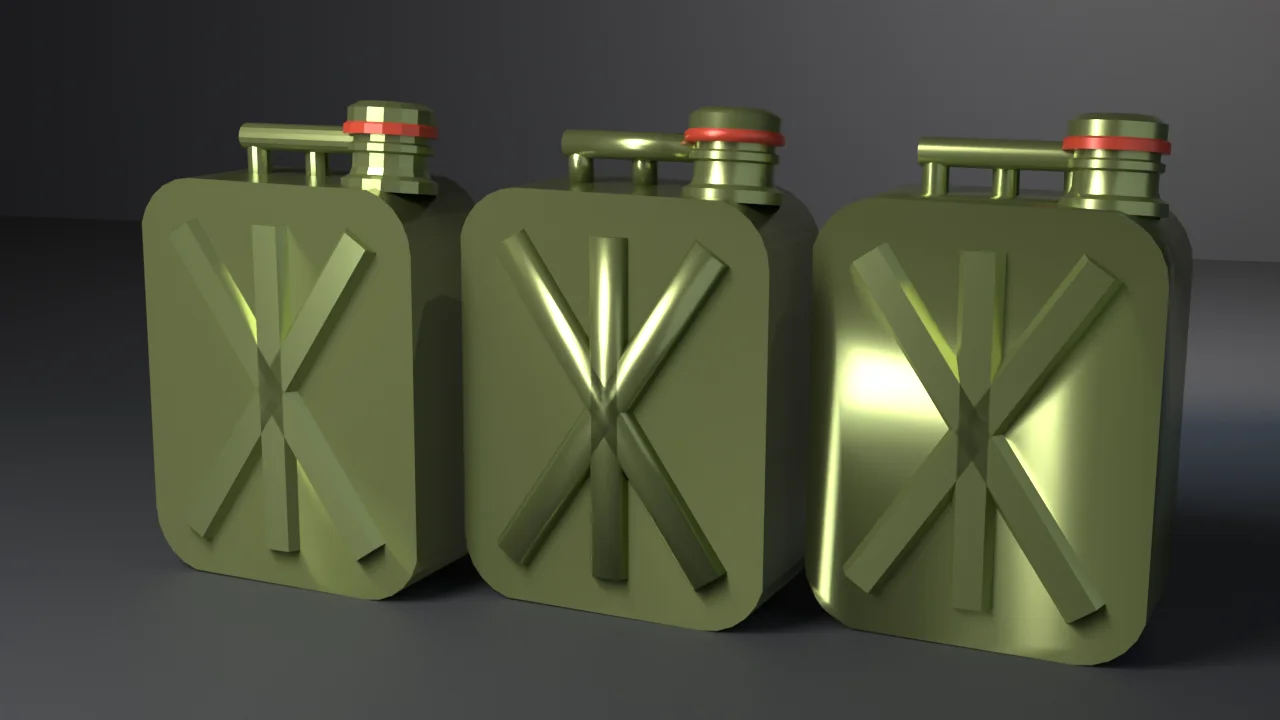
Rendered headless by the example itself — click to zoom.
blender --background --python examples/custom-normals-shade/custom_normals_shade.py --
A runnable example that builds a jerry can prop — rounded-slab shell, pressed X ribs, spout and cap, three-post handle — and verifies the shading contract a game prop's silhouette depends on: which edges read hard and which read smooth is mesh DATA, carried since Blender 4.1 by face smooth flags plus a sharp_edge attribute, following mesh-editing-and-bmesh.
Pipeline arc neighbor: collision in collision-hull-proxy (the pair partner — same prop-pipeline audience), tangent space in triangulate-tangents — normal maps are baked against exactly this shading, and engines harden or soften the same edges at ingest.
Scope: this witnesses the bpy-level contract a prop pipeline relies on. It is not an engine exporter and does not claim engine/FiveM compatibility — it proves the mesh-data properties such an asset's shading must have.
What it witnesses:
- The legacy shading API is gone — on both supported versions.
use_auto_smooth,use_custom_normals, andcalc_normalsare AttributeError on 4.5 LTS *and* 5.1. AI-generated Blender code still emitsmesh.use_auto_smooth = Trueconstantly; any script carrying that habit dies immediately, and this check keeps it dead. - Shade-by-angle is exact.
mesh.set_sharp_from_angle(30°)(which also sets the face smooth flags — probed on both versions) marks sharp exactly the edges whose *independently recomputed* dihedral angle crosses the threshold: Shell 48 of 72 edges, rib 12 of 12, neck 128 of 304 — an exact set match, not a count approximation. - The evaluated shading matches the attribute's promise. Through depsgraph evaluation, loop normals across a smooth edge are welded (deviation 0.0, tol 1e-3) and loop normals across a sharp edge carry their face normals split by exactly the dihedral (angle error 0.0 rad, tol 5e-3), all unit length (err 5.6e-08).
- Custom split normals survive depsgraph evaluation — with a quantization budget, not float precision:
normals_split_custom_setstores per-loop normals in int16, so a 144-loop round-trip reads back within 1.407e-04 (tol 2e-4), unit length within 1.1e-07. Asserting float-exact custom normals is a real bug this check catches. - The divergence: the legacy
shade_auto_smoothOPERATOR is a version-split trap. It builds the Smooth-by-Angle node-group modifier from a bundled asset. Headless on 4.5 LTS the asset load never finishes: the op returns{'CANCELLED'}— no exception — and the mesh stays untouched (measured: 0 smooth faces, 0 modifiers). Any script that ignores the return set ships flat shading and never knows. On 5.1 it FINISHES and adds theSmooth by AngleNODES modifier. The portable path is the data API above, version-gated here explicitly.
What each check catches on failure: author/audit threshold drift (probe: sharp marks applied at 20° but audited at 30°, exit 5, 4 extra edges); the two halves of the contract out of sync (probe: sharp_edge set but face smooth flags lost, exit 6, smooth-edge loops split by 3.83e-01); float-exactness assumed of custom normals (probe: tolerance 1e-6, exit 7, measured 1.407e-04); and any future version that resurrects the legacy API or changes the operator's headless behavior (exit 3/8).
Version witness: every value above is identical on Blender 4.5.11 LTS and 5.1.2 except the shade_auto_smooth operator behavior, which is asserted per version (CANCELLED + untouched on 4.5, FINISHED + NODES modifier on 5.1).
The render shows the same can shaded three ways — flat (faceted corners), smooth-everywhere (the smeared AI bug: ribs melt, highlights warp at the rim), and by-angle (the contract: smooth walls, crisp edges) — under a strip light whose reflection exposes every normal discontinuity.
Run
# Cheap correctness check (no render) — the CI check:
blender --background --python custom_normals_shade.py --

# Also render a still (EEVEE on a GPU host; use --engine cycles on GPU-less hosts):
blender --background --python custom_normals_shade.py -- --output cans.png
blender --background --python custom_normals_shade.py -- --output cans.png --engine cycles
It exits non-zero on failure (legacy API resurrected, sharp-set/dihedral mismatch, broken normal welds, custom normals lost or dequantized in evaluation, or legacy-operator divergence drift). The blender-smoke workflow runs the check on Blender 4.5 LTS and 5.1.
Source
"""A jerry can prop shaded three ways — a runnable example.

Witnesses the shading contract a game prop's silhouette depends on (engines
generally, FiveM/GTA-style prop workflows specifically): which edges read
hard and which read smooth is mesh DATA, and since Blender 4.1 it is carried
by face smooth flags plus a `sharp_edge` attribute — `use_auto_smooth` is
gone. AI-generated Blender code still emits the pre-4.1 API
(`mesh.use_auto_smooth = True`, `bpy.ops.object.shade_auto_smooth()`), so
this example asserts what the supported versions actually expose:

  legacy API    — use_auto_smooth, use_custom_normals, calc_normals are
                  AttributeError on BOTH 4.5 LTS and 5.1
  by-angle data — `mesh.set_sharp_from_angle(angle)` + face smooth flags:
                  the sharp set lands EXACTLY where an independently
                  recomputed dihedral angle crosses the threshold
  normal welds  — through depsgraph evaluation, loops across a smooth edge
                  share one normal (welded) and loops across a sharp edge
                  carry their face normals (split by the dihedral)
  custom normals— per-loop normals set with `normals_split_custom_set`
                  survive depsgraph evaluation within the int16 storage
                  quantization (~7.5e-05 measured, tol 2e-4), unit length
  divergence    — the legacy `shade_auto_smooth` OPERATOR needs the bundled
                  Smooth-by-Angle node-group asset: headless on 4.5 LTS it
                  returns {'CANCELLED'} ("Asset loading is unfinished") and
                  the mesh is UNTOUCHED — silent flat shading for any script
                  that ignores the return set; on 5.1 it FINISHES and adds
                  the NODES modifier. The portable path is the data API.

By default it runs only the correctness check (no render) — the CI smoke
check. Pass --output to also render a still (the same can shaded flat /
smooth-everywhere / by-angle, so a broken path reads as faceting or smear):

    blender --background --python custom_normals_shade.py --                 # check only
    blender --background --python custom_normals_shade.py -- --output c.png  # + render
"""
import bpy, bmesh, sys, os, math, argparse
from mathutils import Vector

ANGLE_DEG = 30.0          # shade-by-angle threshold
ANGLE = math.radians(ANGLE_DEG)
TOL_NORMAL = 2e-4         # custom-normal readback: int16 storage quantizes to ~7.5e-05
TOL_UNIT = 1e-6           # unit-length tolerance for evaluated normals (measured 4.5e-08)
TOL_SMOOTH = 1e-3         # loop-normal equality across a welded (smooth) edge
TOL_SHARP = 5e-3          # radians: split-normal angle vs dihedral across a sharp edge

# ---------------------------------------------------------------------------
# Prop construction. A 20-unit jerry can: rounded-slab shell, pressed X ribs
# floating on both faces, spout neck + cap, three-post carry handle. All
# dimensions invented for this prop; ribs are floater prisms, the game-prop
# norm — every checked mesh is itself closed and manifold.
# ---------------------------------------------------------------------------

SHELL_W, SHELL_H, SHELL_D, SHELL_R = 1.4, 1.8, 0.62, 0.28


def signed_volume(me):
    """Divergence-theorem volume; positive when face winding points outward."""
    vol = 0.0
    for p in me.polygons:
        vs = [me.vertices[i].co for i in p.vertices]
        v0 = vs[0]
        for i in range(1, len(vs) - 1):
            vol += v0.dot(vs[i].cross(vs[i + 1])) / 6.0
    return vol


def finish_mesh(name, bm):
    me = bpy.data.meshes.new(name)
    try:
        bmesh.ops.recalc_face_normals(bm, faces=bm.faces)
        bm.to_mesh(me)
    finally:
        bm.free()
    obj = bpy.data.objects.new(name, me)
    bpy.context.collection.objects.link(obj)
    if signed_volume(me) < 0.0:  # pin outward winding by the closed form
        for p in me.polygons:
            p.flip()
    return obj


def rounded_rect_profile(w, h, r, segs):
    """(x, z) loop of a rounded rectangle, z from 0 to h, CCW seen from -Y."""
    pts = []
    for cx, cz, a0 in ((w / 2 - r, r, -90), (w / 2 - r, h - r, 0),
                       (-(w / 2 - r), h - r, 90), (-(w / 2 - r), r, 180)):
        for i in range(segs):
            a = math.radians(a0 + 90.0 * i / segs)
            pts.append((cx + r * math.cos(a), cz + r * math.sin(a)))
    return pts


def build_shell():
    """Loft the rounded-rect profile along Y; caps are the end ngons."""
    prof = rounded_rect_profile(SHELL_W, SHELL_H, SHELL_R, 6)
    n = len(prof)
    y0, y1 = -SHELL_D / 2, SHELL_D / 2
    bm = bmesh.new()
    front = [bm.verts.new((x, y0, z)) for x, z in prof]
    back = [bm.verts.new((x, y1, z)) for x, z in prof]
    for i in range(n):
        j = (i + 1) % n
        bm.faces.new((front[i], back[i], back[j], front[j]))
    bm.faces.new(front)
    bm.faces.new(back)
    return finish_mesh("Shell", bm)


def build_rib(name, p0, p1, face_y, outward):
    """Trapezoid-section pressed rib from p0 to p1 (x, z), raised off the
    face plane by `outward` (-1 front, +1 back)."""
    wb, wt, hgt = 0.09, 0.06, 0.045
    d = Vector((p1[0] - p0[0], 0.0, p1[1] - p0[1])).normalized()
    side = Vector((-d.z, 0.0, d.x))
    up = Vector((0.0, outward, 0.0))
    bm = bmesh.new()
    ends = []
    for px, pz in (p0, p1):
        c = Vector((px, face_y, pz))
        ends.append([bm.verts.new(c - side * wb), bm.verts.new(c + side * wb),
                     bm.verts.new(c + side * wt + up * hgt),
                     bm.verts.new(c - side * wt + up * hgt)])
    a, b = ends
    bm.faces.new((a[0], a[1], a[2], a[3]))
    bm.faces.new((b[1], b[0], b[3], b[2]))
    bm.faces.new((a[1], b[1], b[2], a[2]))
    bm.faces.new((a[3], b[3], b[0], a[0]))
    bm.faces.new((a[0], b[0], b[1], a[1]))
    bm.faces.new((a[2], b[2], b[3], a[3]))
    return finish_mesh(name, bm)


def lathe(name, profile, segments):
    """Spin an (r, z) profile around Z; r == 0 ends become poles."""
    bm = bmesh.new()
    bot = top = None
    if profile[0][0] == 0.0:
        bot = bm.verts.new((0.0, 0.0, profile[0][1]))
        profile = profile[1:]
    if profile[-1][0] == 0.0:
        top = bm.verts.new((0.0, 0.0, profile[-1][1]))
        profile = profile[:-1]
    rings = []
    for i in range(segments):
        a = 2.0 * math.pi * i / segments
        rings.append([bm.verts.new((r * math.cos(a), r * math.sin(a), z))
                      for r, z in profile])
    for i in range(segments):
        j = (i + 1) % segments
        for k in range(len(profile) - 1):
            bm.faces.new((rings[i][k], rings[j][k], rings[j][k + 1], rings[i][k + 1]))
        if bot is not None:
            bm.faces.new((rings[j][0], rings[i][0], bot))
        if top is not None:
            bm.faces.new((rings[i][-1], rings[j][-1], top))
    return finish_mesh(name, bm)


def build_jerry_can():
    """All parts at world placement; returns {"shell", "rib", "neck", "parts"}."""
    shell = build_shell()
    parts = [shell]

    ribs = []
    inset = [(0.46, 0.22), (0.46, 1.58)]
    specs = [((inset[0], ( -inset[0][0], inset[1][1])), "RibDiagA"),
             (((-inset[0][0], inset[0][1]), inset[1]), "RibDiagB"),
             (((0.0, 0.18), (0.0, 1.62)), "RibVert")]
    for fy, out, tag in ((-SHELL_D / 2, -1.0, "F"), (SHELL_D / 2, 1.0, "B")):
        for (p0, p1), rn in specs:
            ribs.append(build_rib(f"{rn}{tag}", p0, p1, fy, out))
    parts.extend(ribs)

    neck = lathe("Neck", [(0.0, 0.0), (0.21, 0.0), (0.21, 0.05), (0.175, 0.07),
                          (0.165, 0.10), (0.165, 0.16), (0.185, 0.17),
                          (0.185, 0.20), (0.165, 0.21), (0.165, 0.24), (0.0, 0.24)], 16)
    neck.location = (0.42, -0.12, 1.75)
    neck.rotation_euler = (math.radians(-8.0), 0.0, 0.0)
    cap = lathe("Cap", [(0.0, 0.0), (0.205, 0.0), (0.205, 0.04), (0.19, 0.05),
                        (0.19, 0.11), (0.14, 0.14), (0.0, 0.145)], 16)
    cap.location = (0.42, -0.0866, 1.9877)
    cap.rotation_euler = (math.radians(-8.0), 0.0, 0.0)
    parts.extend((neck, cap))

    for i, x in enumerate((-0.28, 0.0, 0.28)):
        post = lathe(f"Post{i}", [(0.0, 0.0), (0.055, 0.0), (0.055, 0.17), (0.0, 0.17)], 16)
        post.location = (x, 0.08, 1.79)
        parts.append(post)
    grip = lathe("Grip", [(0.0, 0.0), (0.06, 0.0), (0.06, 0.68), (0.0, 0.68)], 16)
    grip.rotation_euler = (0.0, math.radians(90.0), 0.0)
    grip.location = (-0.34, 0.08, 1.96)
    parts.append(grip)

    return {"shell": shell, "rib": ribs[0], "neck": neck, "parts": parts}


# ---------------------------------------------------------------------------
# The contract checks.
# ---------------------------------------------------------------------------

def manifold_dihedrals(me):
    """Independent recompute: {vertex-pair key: (degrees, v1, v2)} for edges
    with exactly two link faces, plus the count of non-manifold edges."""
    bm = bmesh.new()
    out = {}
    nonmanifold = 0
    try:
        bm.from_mesh(me)
        for e in bm.edges:
            if len(e.link_faces) != 2:
                nonmanifold += 1
                continue
            deg = math.degrees(e.link_faces[0].normal.angle(e.link_faces[1].normal))
            v1, v2 = e.verts[0].index, e.verts[1].index
            out[frozenset((v1, v2))] = (deg, v1, v2)
    finally:
        bm.free()
    return out, nonmanifold


def sharp_edge_keys(me):
    attr = me.attributes.get("sharp_edge")
    if attr is None:
        return set()
    return {frozenset((me.edges[i].vertices[0], me.edges[i].vertices[1]))
            for i, d in enumerate(attr.data) if d.value}


def check_api_surface(me):
    """The legacy shading API is gone on every supported version."""
    for gone in ("use_auto_smooth", "use_custom_normals", "calc_normals"):
        if hasattr(me, gone):
            print(f"ERROR: mesh still exposes {gone} on {bpy.app.version_string} — "
                  f"the pre-4.1 shading API must stay removed", file=sys.stderr)
            return 3
    for needed in ("normals_split_custom_set", "normals_split_custom_set_from_vertices",
                   "set_sharp_from_angle", "corner_normals", "has_custom_normals"):
        if not hasattr(me, needed):
            print(f"ERROR: mesh lacks {needed} on {bpy.app.version_string}",
                  file=sys.stderr)
            return 3
    print(f"api-surface: use_auto_smooth/use_custom_normals/calc_normals absent, "
          f"modern path present ({bpy.app.version_string})")
    return 0


def check_by_angle(objs):
    """set_sharp_from_angle must mark exactly the edges whose independently
    recomputed dihedral crosses the threshold — on every checked mesh."""
    total_sharp = total_manifold = 0
    for obj in objs:
        me = obj.data
        for p in me.polygons:
            p.use_smooth = True
        me.set_sharp_from_angle(angle=ANGLE)
        dih, nonmanifold = manifold_dihedrals(me)
        if nonmanifold:
            print(f"ERROR: {obj.name}: {nonmanifold} non-manifold edge(s) — the "
                  f"dihedral test is undefined there", file=sys.stderr)
            return 4
        expect = {k for k, (deg, _, _) in dih.items() if deg > ANGLE_DEG}
        got = sharp_edge_keys(me)
        if got != expect:
            only_got = len(got - expect)
            only_exp = len(expect - got)
            print(f"ERROR: {obj.name}: sharp set mismatch vs independent dihedral "
                  f"test ({only_got} extra, {only_exp} missing of {len(expect)} "
                  f"expected)", file=sys.stderr)
            return 5
        total_sharp += len(got)
        total_manifold += len(dih)
        print(f"by-angle {obj.name}: edges={len(dih)} sharp={len(got)} "
              f"matches independent dihedral recompute (>{ANGLE_DEG:.0f}deg)")
    print(f"by-angle: {len(objs)} meshes, {total_manifold} manifold edges, "
          f"{total_sharp} sharp, exact set match")
    return 0


def check_normal_welds(obj):
    """Through depsgraph evaluation: loops across a smooth edge share one
    normal; loops across a sharp edge carry their face normals (split by the
    dihedral). The rendered shading, verified — not the attribute's say-so."""
    me = obj.data
    dih, _ = manifold_dihedrals(me)
    sharp = sharp_edge_keys(me)
    dg = bpy.context.evaluated_depsgraph_get()
    ev = obj.evaluated_get(dg).to_mesh()
    try:
        # per manifold edge, per endpoint vertex, per polygon: the loop normal
        loop_normal = [tuple(l.normal) for l in ev.loops]
        poly_of_loop = [0] * len(ev.loops)
        for p in ev.polygons:
            for li in range(p.loop_start, p.loop_start + p.loop_total):
                poly_of_loop[li] = p.index
        by_edge = {}
        for li, l in enumerate(ev.loops):
            pi, vi = poly_of_loop[li], l.vertex_index
            for vj in ev.polygons[pi].vertices:
                if vj == vi:
                    continue
                k = frozenset((vi, vj))
                if k in dih:
                    by_edge.setdefault(k, {}).setdefault(vi, {})[pi] = loop_normal[li]
        max_smooth = 0.0
        max_sharp = 0.0
        unit_worst = 0.0
        for k, (deg, v1, v2) in dih.items():
            for v in (v1, v2):
                sides = by_edge.get(k, {}).get(v, {})
                if len(sides) != 2:
                    print(f"ERROR: edge {tuple(sorted(k))} endpoint v{v}: expected "
                          f"loop normals on both sides, got {len(sides)}", file=sys.stderr)
                    return 6
                n1, n2 = (Vector(s) for s in sides.values())
                unit_worst = max(unit_worst, abs(n1.length - 1.0), abs(n2.length - 1.0))
                if k in sharp:
                    err = abs(n1.angle(n2) - math.radians(deg))
                    max_sharp = max(max_sharp, err)
                else:
                    max_smooth = max(max_smooth, (n1 - n2).length)
        if unit_worst > TOL_UNIT:
            print(f"ERROR: evaluated normal off unit length by {unit_worst:.3e} "
                  f"(tol {TOL_UNIT})", file=sys.stderr)
            return 6
        if max_smooth > TOL_SMOOTH:
            print(f"ERROR: smooth edge not welded: loop normals differ by "
                  f"{max_smooth:.3e} (tol {TOL_SMOOTH})", file=sys.stderr)
            return 6
        if max_sharp > TOL_SHARP:
            print(f"ERROR: sharp edge split {max_sharp:.6f} rad off its dihedral "
                  f"(tol {TOL_SHARP})", file=sys.stderr)
            return 6
        print(f"normal-welds {obj.name}: smooth max deviation {max_smooth:.3e} "
              f"(tol {TOL_SMOOTH}), sharp max angle err {max_sharp:.3e} rad "
              f"(tol {TOL_SHARP}), unit err {unit_worst:.3e}")
    finally:
        obj.evaluated_get(dg).to_mesh_clear()
    return 0


def check_custom_normals_roundtrip(obj):
    """Per-loop custom normals survive depsgraph evaluation. Tolerance is the
    int16 storage quantization, measured 7.5e-05 on both versions."""
    me = obj.data
    n = len(me.loops)
    custom = []
    for i in range(n):
        a = 2.0 * math.pi * i / n
        custom.append(Vector((0.5 * math.cos(a), 0.5 * math.sin(a), 0.85)).normalized())
    me.normals_split_custom_set(custom)
    if not me.has_custom_normals:
        print("ERROR: has_custom_normals False after normals_split_custom_set — "
              "no use_custom_normals flag exists to flip anymore", file=sys.stderr)
        return 7
    bpy.context.view_layer.update()
    dg = bpy.context.evaluated_depsgraph_get()
    ev = obj.evaluated_get(dg).to_mesh()
    try:
        err = max((Vector(tuple(l.normal)) - custom[i]).length
                  for i, l in enumerate(ev.loops))
        unit = max(abs(Vector(tuple(l.normal)).length - 1.0) for l in ev.loops)
    finally:
        obj.evaluated_get(dg).to_mesh_clear()
    if err > TOL_NORMAL or unit > TOL_UNIT:
        print(f"ERROR: custom normals lost in evaluation: max_err {err:.3e} "
              f"(tol {TOL_NORMAL}), unit err {unit:.3e}", file=sys.stderr)
        return 7
    print(f"custom-normals: {n} loops survive depsgraph evaluation, "
          f"max_err {err:.3e} (tol {TOL_NORMAL}), unit err {unit:.3e}")
    return 0


def check_legacy_operator():
    """The shade_auto_smooth OPERATOR is a version-split trap: it builds the
    Smooth-by-Angle node-group modifier from a bundled asset. Headless on
    4.5 LTS the asset load never finishes and the op CANCELS — silently, no
    exception — leaving flat shading. On 5.1 it FINISHES with the modifier."""
    me = bpy.data.meshes.new("LegacyProbe")
    bm = bmesh.new()
    try:
        bmesh.ops.create_cube(bm, size=1.0)
        bm.to_mesh(me)
    finally:
        bm.free()
    obj = bpy.data.objects.new("LegacyProbe", me)
    bpy.context.collection.objects.link(obj)
    bpy.context.view_layer.objects.active = obj
    obj.select_set(True)
    try:
        result = bpy.ops.object.shade_auto_smooth(angle=ANGLE)
    except Exception as e:
        print(f"ERROR: shade_auto_smooth raised {type(e).__name__}: {e}",
              file=sys.stderr)
        return 8
    mods = [(m.name, m.type) for m in obj.modifiers]
    smooth = sum(1 for p in me.polygons if p.use_smooth)
    bpy.data.objects.remove(obj)
    bpy.data.meshes.remove(me)
    if bpy.app.version >= (5, 0, 0):
        ok = result == {'FINISHED'} and any(t == 'NODES' for _, t in mods) and smooth > 0
        detail = f"expect FINISHED + Smooth-by-Angle NODES modifier, got {result} mods={mods} smooth={smooth}"
    else:
        ok = result == {'CANCELLED'} and not mods and smooth == 0
        detail = f"expect CANCELLED headless (asset load never finishes) + untouched mesh, got {result} mods={mods} smooth={smooth}"
    if not ok:
        print(f"ERROR: legacy-operator divergence drifted: {detail}", file=sys.stderr)
        return 8
    print(f"legacy-op ({bpy.app.version_string}): {detail} — as asserted")
    return 0


# ---------------------------------------------------------------------------
# Render: the same can three ways — flat (faceting), smooth-everywhere (the
# smeared AI bug), by-angle (the contract). Failure modes flank the truth.
# ---------------------------------------------------------------------------

def eevee_engine_id():
    return 'BLENDER_EEVEE' if bpy.app.version >= (5, 0, 0) else 'BLENDER_EEVEE_NEXT'


def make_material(name, color, metallic, roughness):
    mat = bpy.data.materials.new(name)
    mat.use_nodes = True
    bsdf = mat.node_tree.nodes["Principled BSDF"]
    bsdf.inputs["Base Color"].default_value = (*color, 1.0)
    bsdf.inputs["Metallic"].default_value = metallic
    bsdf.inputs["Roughness"].default_value = roughness
    return mat


def variant_meshes(parts, mode):
    """Fresh mesh copies with one shading treatment applied."""
    out = []
    for o in parts:
        me = o.data.copy()
        me.name = f"{o.name}_{mode}"
        for p in me.polygons:
            p.use_smooth = mode != "flat"
        if mode == "byangle":
            me.set_sharp_from_angle(angle=ANGLE)
        dup = bpy.data.objects.new(f"{o.name}_{mode}", me)
        dup.location = o.location
        dup.rotation_euler = o.rotation_euler
        bpy.context.collection.objects.link(dup)
        out.append(dup)
    return out


def render_still(can, path, engine):
    scene = bpy.context.scene
    # semi-gloss painted steel: rough enough to read as paint, glossy enough
    # that a highlight exposes every normal discontinuity — matte would hide
    # the very shading differences this render exists to show
    steel = make_material("OliveDrab", (0.30, 0.345, 0.13), 0.8, 0.26)
    accent = make_material("FuelMarker", (0.55, 0.06, 0.03), 0.3, 0.30)

    # the checked base can IS the by-angle variant; the two failure modes are
    # mesh copies with their own shading, no materials yet
    variants = []
    for mode, x in (("flat", -1.5), ("smooth", 0.0), ("byangle", 1.5)):
        objs = variant_meshes(can["parts"], mode)
        for o in objs:
            o.location.x += x
            o.rotation_euler.z += math.radians(-10.0)  # uniform yaw, fronts to camera
            o.data.materials.append(steel)
            if o.name.startswith("Cap"):
                o.data.materials.append(accent)
                for p in o.data.polygons:  # cap rim ring in the marker red
                    if p.center.z < 0.045:
                        p.material_index = 1
        variants.append(objs)
    # hide the checked originals: the byangle variant re-shows the same data
    for o in can["parts"]:
        o.hide_render = True

    floor_me = bpy.data.meshes.new("Floor")
    bm = bmesh.new()
    try:
        bmesh.ops.create_grid(bm, x_segments=1, y_segments=1, size=30.0)
        bm.to_mesh(floor_me)
    finally:
        bm.free()
    fmat = make_material("Studio", (0.03, 0.032, 0.037), 0.0, 0.7)
    floor_me.materials.append(fmat)
    floor = bpy.data.objects.new("Floor", floor_me)
    scene.collection.objects.link(floor)
    wall = bpy.data.objects.new("Wall", floor_me.copy())
    wall.location = (0.0, 11.0, 0.0)
    wall.rotation_euler = (math.radians(90), 0.0, 0.0)
    scene.collection.objects.link(wall)

    world = bpy.data.worlds.new("World")
    world.use_nodes = True
    world.node_tree.nodes["Background"].inputs["Color"].default_value = (0.02, 0.021, 0.025, 1.0)
    scene.world = world

    def light(name, loc, energy, size, col, rot):
        ld = bpy.data.lights.new(name, 'AREA')
        ld.energy = energy; ld.size = size; ld.color = col
        ob = bpy.data.objects.new(name, ld)
        ob.location = loc
        ob.rotation_euler = tuple(math.radians(a) for a in rot)
        scene.collection.objects.link(ob)

    # key/fill/rim/wedge per docs/VISUAL-STYLE.md
    light("Key", (-4.0, -5.0, 6.0), 520.0, 4.5, (1.0, 0.96, 0.9), (50, 0, -38))
    light("Fill", (5.5, -3.5, 2.5), 150.0, 9.0, (0.75, 0.85, 1.0), (65, 0, 55))
    light("Rim", (1.5, 4.5, 4.0), 340.0, 3.0, (0.6, 0.78, 1.0), (-58, 0, 170))
    light("Wedge", (2.5, 5.5, 4.0), 400.0, 6.0, (1.0, 0.76, 0.5), (-68, 0, 190))
    # the shading audit light: a tall strip whose reflection runs down each
    # can face — it stair-steps on flat shading, warps at the rim on
    # smooth-everything, and stays straight with crisp edges on by-angle
    ld = bpy.data.lights.new("Strip", 'AREA')
    ld.energy = 400.0
    ld.shape = 'RECTANGLE'
    ld.size = 1.35
    ld.size_y = 8.0
    ld.color = (0.9, 0.95, 1.0)
    strip = bpy.data.objects.new("Strip", ld)
    strip.location = (-3.5, -4.5, 3.2)
    strip.rotation_euler = (math.radians(60), 0.0, math.radians(-30))
    scene.collection.objects.link(strip)

    cam_data = bpy.data.cameras.new("Cam")
    cam_data.lens = 50.0
    cam = bpy.data.objects.new("Cam", cam_data)
    cam.location = (1.9, -7.2, 2.6)
    scene.collection.objects.link(cam)
    target = bpy.data.objects.new("Aim", None)
    target.location = (0.0, 0.0, 1.05)
    scene.collection.objects.link(target)
    con = cam.constraints.new('TRACK_TO')
    con.target = target
    scene.camera = cam

    scene.render.engine = 'CYCLES' if engine == 'cycles' else eevee_engine_id()
    if engine == 'cycles':
        scene.cycles.samples = 64
    else:
        try:
            scene.eevee.taa_render_samples = 64
        except AttributeError:
            pass
    scene.render.resolution_x = 1280
    scene.render.resolution_y = 720
    scene.render.image_settings.file_format = 'PNG'
    scene.render.filepath = path
    # AgX would flatten the olive drab toward mud (docs/VISUAL-STYLE.md)
    scene.view_settings.view_transform = 'Standard'
    bpy.ops.render.render(write_still=True)
    return os.path.exists(path) and os.path.getsize(path) > 0


def main():
    argv = sys.argv[sys.argv.index("--") + 1:] if "--" in sys.argv else []
    p = argparse.ArgumentParser()
    p.add_argument("--output", default=None, help="optional: render a still PNG here")
    p.add_argument("--engine", default="eevee", choices=("eevee", "cycles"),
                   help="render engine for --output (cycles for GPU-less hosts)")
    args = p.parse_args(argv)

    bpy.ops.wm.read_factory_settings(use_empty=True)
    can = build_jerry_can()

    for step in (lambda: check_api_surface(can["shell"].data),
                 lambda: check_by_angle([can["shell"], can["rib"], can["neck"]]),
                 lambda: check_normal_welds(can["shell"]),
                 lambda: check_custom_normals_roundtrip(can["shell"]),
                 check_legacy_operator):
        code = step()
        if code:
            return code

    if args.output:
        if not render_still(can, os.path.abspath(args.output), args.engine):
            print("ERROR: render produced no file", file=sys.stderr)
            return 9
        print(f"rendered still {args.output}")

    print("custom-normals-shade OK")
    return 0


if __name__ == "__main__":
    try:
        sys.exit(main())
    except Exception as e:
        import traceback; traceback.print_exc(); print(f"FATAL: {e}", file=sys.stderr); sys.exit(1)