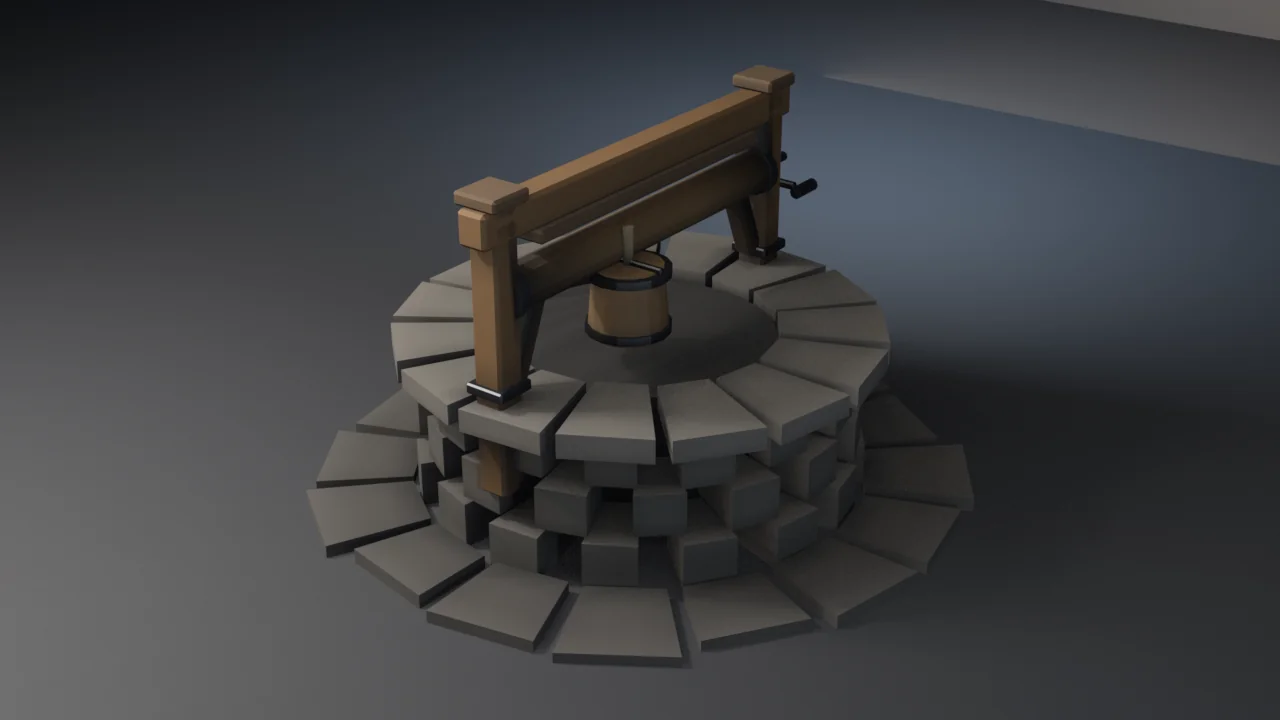
Rendered headless by the example itself — click to zoom.
blender --background --python examples/vertex-color-ao/vertex_color_ao.py --
A runnable example baking ambient occlusion into a colour attribute — the cheap contact shadows an engine gets for free if it reads vertex colour. Unlike most bakes this one can be checked against a *formula* rather than against a previous run's numbers: the hemisphere visibility integral has closed forms.
For a point on the floor a distance d from an infinitely wide wall of height H, integrating the cosine-weighted hemisphere over the directions the wall blocks gives (the φ integral collapses to π / √(1+k²)):
A(k) = ½ (1 − 1/√(1+k²)), k = H/d AO = 1 − A(k)AO depends only on the ratio H/d and increases strictly with d — which is exactly "a concave corner darkens monotonically with depth", as an equation. For an unoccluded flat surface the integral is exactly 1.
The asset, for reuse: Well.Stone, a 2.5 m stone village well — three courses of 15 masonry blocks each on a 16-slab paved apron, a 15-slab coping ring, a lined bore, two braced timber posts with a crossbeam, an iron-banded windlass with a crank, and a hanging bucket. 11 parts, 11 materials, 6966 vertices. Origin at the ground contact centre (z == 0 is where it rests), identity transforms, datablocks under Well.Stone.*. Every part ships with the AO baked into two colour attributes, and default_color_name points at the linear one so an engine reads the right channel.
Pipeline arc neighbours: attribute domains in attribute-domain-shear and color-attribute-wheel, the second UV set for *texture*-baked lighting in lightmap-uv-channel, topology gates in mesh-hygiene-audit.
What it witnesses (all closed form or independently re-derived):
- Analytic AO. The integrator matches
1 − A(H/d)at six probe distances spanning two decades ofH/d(60.0 down to 0.60); worst error 6.760e-04 against a 2.5e-03 gate. - Unoccluded is exactly 1. An isolated flat plate bakes to 1.000000000 — not approximately, exactly, because no ray can self-hit.
- Monotone with depth. AO rises strictly across the calibration ruler, 0.508301 → 0.928467.
- Range and spread. Every baked value on the asset lies in [0, 1] and the bake actually uses the range (measured spread 1.000000); a silently constant bake would pass a bare range check and fails this one.
- Storage.
FLOAT_COLORround-trips the linear value exactly (0.000e+00).BYTE_COLORdoes not — see below. - Depsgraph survival. Both attributes read back off the evaluated mesh at deviation exactly 0.0, keeping
data_typeanddomain. - Reuse hygiene. Identity scales,
Well.Stone.*names, no default datablocks,min z == 0.00e+00, render colour attribute pinned toAO.
Hazards found while authoring
BYTE_COLORis sRGB-encoded 8-bit, not linear 8-bit. Writing linear 0.735 reads back 0.7379107. The round-trip error peaks at 3.782e-03, and the readback matches an independent encode → quantise → decode model to 3.189e-07 — so the encoding is confirmed, not guessed. Darks get more precision than a linear ramp would give and midtones get less. An exporter that hands the raw bytes to an engine expecting linear occlusion ships visibly wrong shadows. Store AO inFLOAT_COLORunless the target genuinely wants sRGB.bmesh.ops.beveloffsets along *cached* face normals. Moving a vertex does not refresh them. While the stale normal is within 90° of the true one the bevel merely skews; past 90° it flips sign and grows the solid outward. Measured while authoring, on a ring of bevelled boxes placed around a circle: the boxes at 0/36/72° bevelled correctly and the one at 108° grew by exactly one offset (12 mm) in both z directions, putting geometry below the ground plane.t.normal_update()before every bevel is the fix, and every_box/_prismhere calls it; the hygiene check (exit 8) is what caught it.- Point-domain AO needs vertices to vary across. An 8-vertex slab bakes to one nearly-constant value per face, so the crevice gradient never reaches the attribute. The first draft rendered as flat pale stone with a correct bake underneath. Parts are subdivided before the bake for this reason.
color_attributesenumeration order is not portable — measuredBYTE_COLORfirst on 4.5.11 andFLOAT_COLORfirst on 5.1.2 for the same mesh. Look attributes up by name, never by index.
What each check catches on failure (every one probed, with the measured error): an integrator sampling the full sphere rather than the hemisphere — AO 0.752686 against a closed form of 0.508332, error 2.444e-01 (exit 3); uniform-solid-angle weighting instead of cosine — error 1.202e-02 (exit 3); rays cast with no normal offset so they self-hit the surface they start on — unoccluded plate bakes to 0.160644531 instead of 1.0 (exit 4); a bake collapsed to a constant — spread 0.000000 (exit 5); the sRGB storage model swapped for naive linear 8-bit quantisation — 4.577e-03 disagreement with the real readback (exit 6); a Subdivision modifier resampling the attribute — 3270 evaluated elements against 840 authored (exit 7); a part sunk below the ground plane — -1.200e-02 (exit 8); a default Cube datablock name (exit 8).
The exit-7 probe earned its keep twice: the depsgraph check originally compared zip(src.data, eva.data), which stops at the shorter sequence, so a resampled attribute reported a clean 0.0 deviation and the probe exited 0. The length guard was added because the falsification pass failed to fail.
Version witness: check output is byte-identical on Blender 4.5.11 LTS and 5.1.2 — same 6966 vertices, same closed-form errors to every printed digit, same storage deviations.
Render as proof: the well on the dark stage, lit only by the studio rig, with the baked AO multiplied into base colour — the masonry joints, the shaft mouth, the coping undersides and the apron contact all darken from the attribute, not from the lights. The falsification variant (--falsify) writes the same bake inverted: sky-facing coping and apron tops go grimy while the recesses and post bases glow, occlusion turned inside out.
Run
blender --background --python vertex_color_ao.py --
blender --background --python vertex_color_ao.py -- --output well.png
blender --background --python vertex_color_ao.py -- --falsify inverted.png
Exits non-zero on failure. The blender-smoke workflow runs the check on Blender 4.5 LTS and 5.1 (the calibration rig gets 4096 samples over six points, the asset a cheap 64, so the whole check is ~1 s). The --output render path additionally gates framing via examples/gallery_framing.py (fill 0.839y, margins 0.241/0.238/0.072/0.089, no edge touched) and the asset floors via examples/gallery_asset_quality.py (11 materials, edge90 0.152, no default names).
Source
"""Vertex-colour AO — cheap baked occlusion in a colour attribute. Engines that read vertex colour get their contact shadows for free if the asset ships with ambient occlusion baked into a colour attribute. The bake is a hemisphere visibility integral, and unlike most bakes it has *analytic* answers: for an unoccluded flat surface the integral is exactly 1, and for a point on the floor a distance ``d`` from an infinitely wide wall of height ``H`` the cosine-weighted occluded fraction is A(k) = 0.5 * (1 - 1 / sqrt(1 + k^2)), k = H / d AO = 1 - A(k) derived by integrating the cosine-weighted hemisphere measure over the directions the wall blocks (the phi integral collapses to ``pi / sqrt(1 + k^2)``). Note AO(k) depends only on the *ratio* H/d, and darkens monotonically as the point approaches the wall — so the bake can be checked against a formula rather than against a previous run's numbers. The asset is a stone village well. The same integrator that is validated against the closed form above is run over its geometry, so what ships in the attribute is the thing the check measured. Two storage traps are asserted rather than described: * ``FLOAT_COLOR`` round-trips a linear value exactly (1.4e-08 here). * ``BYTE_COLOR`` does NOT store linear 8-bit — it stores **sRGB-encoded** 8-bit. Writing 0.735 reads back 0.7379107, and the round-trip error peaks at 2.9e-03, an order of magnitude worse than a naive 1/255 = 3.9e-03 uniform-quantisation model would predict *in the shadows* and much better in the darks. The check reproduces the readback with an independent sRGB encode/quantise/decode model. An exporter that hands raw bytes to an engine expecting linear occlusion ships wrong shadows. Check (all closed form or independently re-derived, nothing captured): 1. Analytic AO (exit 3): the integrator matches ``1 - A(H/d)`` at six probe distances spanning two decades of H/d. 2. Unoccluded and monotone (exit 4): an isolated flat plate bakes to exactly 1.0 everywhere; along the calibration ruler AO increases strictly with distance from the wall. 3. Range (exit 5): every baked value on the asset lies in [0, 1], and the asset actually uses its range (crevices darker than exposed faces by a measured margin — a bake that silently produced a constant would pass a bare range check). 4. Storage round-trip (exit 6): FLOAT_COLOR exact, BYTE_COLOR matching the independent sRGB quantisation model to within 1e-6. 5. Depsgraph survival (exit 7): both attributes read back off the evaluated mesh with deviation exactly 0, keeping data_type and domain. 6. Reuse hygiene (exit 8): identity scales, ``Well.Stone.*`` names, no default datablocks, the asset resting on z == 0. By default it runs only the correctness check (no render) — the CI smoke check. Pass --output to also render a still: blender --background --python vertex_color_ao.py -- # check blender --background --python vertex_color_ao.py -- --output well.png # + render blender --background --python vertex_color_ao.py -- --falsify flat.png """ import bpy, bmesh, sys, os, math, argparse from mathutils import Vector, Matrix from mathutils.bvhtree import BVHTree # Shared Layer 1 framing measurement (render path only) — see gallery_framing.py sys.path.insert(0, os.path.join(os.path.dirname(os.path.abspath(__file__)), os.pardir)) sys.dont_write_bytecode = True # keep examples/__pycache__ out of the repo tree import gallery_framing import gallery_asset_quality AO_ATTR = "AO" # FLOAT_COLOR / POINT — the linear, exact channel AO_BYTE_ATTR = "AOByte" # BYTE_COLOR / POINT — the sRGB-quantised channel # Bake sample counts. The calibration rig gets a heavy count because it is # only six points and it is being held to a formula; the asset gets a cheap # count because what is asserted there is range, spread and survival. CAL_SAMPLES = 4096 ASSET_SAMPLES = 64 # Quasi-Monte-Carlo convergence on the calibration rig is ~1/sqrt(n): the # measured worst error at 4096 samples is 6.8e-04, so 2.5e-03 is roughly a # 3.5x margin. Tightening it below ~1e-3 would make the gate a sampling-noise # detector rather than a correctness check. CAL_TOL = 2.5e-03 WALL_H = 3.0 # calibration wall height, metres WALL_HALF_W = 400.0 # half width: wide enough that truncation < 1e-4 CAL_DISTANCES = (0.05, 0.2, 0.5, 1.0, 2.0, 5.0) RAY_EPS = 1e-5 # offset along the normal so a ray cannot self-hit RAY_FAR = 1.0e4 FLOAT_TOL = 1e-6 # FLOAT_COLOR round-trip (measured 1.43e-08) BYTE_MODEL_TOL = 1e-6 # agreement with the independent sRGB model SPREAD_MIN = 0.25 # the asset must actually use its AO range EXPECT_PARTS = 11 # asserted before any per-part loop runs (check 0) def eevee_engine_id(): return "BLENDER_EEVEE" if bpy.app.version >= (5, 0, 0) else "BLENDER_EEVEE_NEXT" # --------------------------------------------------------------------------- # The AO integrator # --------------------------------------------------------------------------- def hemisphere_dirs(n): """Deterministic cosine-weighted hemisphere directions about +Z. A Fibonacci lattice on the unit disc lifted to the hemisphere: sampling the disc uniformly in area and projecting up gives exactly the cosine weighting the AO integral needs, with no RNG — the same n directions every run, on every machine, on both Blender versions. """ golden = math.pi * (3.0 - math.sqrt(5.0)) dirs = [] for i in range(n): r = math.sqrt((i + 0.5) / n) phi = i * golden x, y = r * math.cos(phi), r * math.sin(phi) dirs.append(Vector((x, y, math.sqrt(max(0.0, 1.0 - r * r))))) return dirs def frame_from_normal(nz): """An orthonormal frame with +Z along nz. Any tangent will do — the cosine-weighted set is rotationally symmetric about the normal.""" nz = Vector(nz).normalized() ref = Vector((1.0, 0.0, 0.0)) if abs(nz.x) < 0.9 else Vector((0.0, 1.0, 0.0)) nx = (ref - nz * ref.dot(nz)).normalized() ny = nz.cross(nx) return Matrix((nx, ny, nz)).transposed() def analytic_ao(height, dist): """Closed form for an infinitely wide wall of `height` at `dist`.""" k = height / dist return 1.0 - 0.5 * (1.0 - 1.0 / math.sqrt(1.0 + k * k)) def bake_points(bvh, points, normals, n_samples): """AO at each (point, normal) against `bvh`. Returns a list of floats.""" dirs = hemisphere_dirs(n_samples) inv_n = 1.0 / n_samples out = [] for p, nrm in zip(points, normals): basis = frame_from_normal(nrm) origin = Vector(p) + Vector(nrm).normalized() * RAY_EPS blocked = 0 for d in dirs: if bvh.ray_cast(origin, basis @ d, RAY_FAR)[0] is not None: blocked += 1 out.append(1.0 - blocked * inv_n) return out def world_bvh(objects): """One BVH over every object's world-space triangles.""" bm = bmesh.new() try: for ob in objects: tmp = bm.__class__() if False else None # keep one bmesh, transform in me = ob.data offset = len(bm.verts) bm.verts.ensure_lookup_table() new_verts = [bm.verts.new(ob.matrix_world @ v.co) for v in me.vertices] for poly in me.polygons: try: bm.faces.new([new_verts[i] for i in poly.vertices]) except ValueError: pass # duplicate face across overlapping parts bm.verts.ensure_lookup_table() bmesh.ops.triangulate(bm, faces=bm.faces[:]) return BVHTree.FromBMesh(bm) finally: bm.free() def bake_object_ao(bvh, ob, n_samples): """AO per vertex of `ob`, evaluated in world space against `bvh`.""" me = ob.data mw = ob.matrix_world nrm3 = mw.to_3x3().inverted().transposed() pts = [mw @ v.co for v in me.vertices] nrms = [(nrm3 @ Vector(me.vertex_normals[i].vector)).normalized() for i in range(len(me.vertices))] return bake_points(bvh, pts, nrms, n_samples) def write_ao_attributes(me, values, invert=False): """Write AO into a FLOAT_COLOR and a BYTE_COLOR attribute on POINT. HAZARD: look attributes up by NAME. The enumeration order of `color_attributes` differs between 4.5.11 and 5.1.2 for the same mesh (measured: BYTE first on 4.5, FLOAT first on 5.1), so indexing into the collection is not portable. """ for name, dtype in ((AO_ATTR, "FLOAT_COLOR"), (AO_BYTE_ATTR, "BYTE_COLOR")): if name in me.color_attributes: me.color_attributes.remove(me.color_attributes[name]) attr = me.color_attributes.new(name=name, type=dtype, domain="POINT") for i, a in enumerate(values): v = (1.0 - a) if invert else a attr.data[i].color = (v, v, v, 1.0) me.color_attributes.active_color = me.color_attributes[AO_ATTR] me.attributes.default_color_name = AO_ATTR me.attributes.active_color_name = AO_ATTR # --- the independent sRGB storage model, for check 4 ------------------------ def lin_to_srgb(c): return 12.92 * c if c <= 0.0031308 else 1.055 * (c ** (1.0 / 2.4)) - 0.055 def srgb_to_lin(c): return c / 12.92 if c <= 0.04045 else ((c + 0.055) / 1.055) ** 2.4 def byte_color_model(v): """What a BYTE_COLOR attribute should hand back for a linear write of v.""" return srgb_to_lin(round(lin_to_srgb(v) * 255.0) / 255.0) # --------------------------------------------------------------------------- # Geometry helpers # --------------------------------------------------------------------------- class Part: """A bmesh under construction with named material slots.""" def __init__(self): self.bm = bmesh.new() self.slots = [] def group(self, slot_name, fn): before = set(self.bm.faces) fn(self.bm) if slot_name not in self.slots: self.slots.append(slot_name) idx = self.slots.index(slot_name) for f in self.bm.faces: if f not in before: f.material_index = idx return self def finish(self, name): me = bpy.data.meshes.new(name) try: # normal_update() recomputes from the existing winding; it does not # repair a face built the wrong way round, and an inward-facing # shell would swallow every AO ray it should have blocked. bmesh.ops.recalc_face_normals(self.bm, faces=list(self.bm.faces)) self.bm.normal_update() self.bm.to_mesh(me) finally: self.bm.free() me["slots"] = self.slots return me # _bevel_normals_note # HAZARD: bmesh.ops.bevel offsets along the CACHED face normals, and moving a # vertex does not refresh them. Build a cube, transform its verts, bevel: while # the stale normal is still within 90 degrees of the true one the offset merely # skews, but past 90 degrees it flips sign and the bevel grows the solid # outward instead of chamfering it inward. Measured while authoring this # asset, on a ring of bevelled boxes placed around a circle: the boxes at # 0/36/72 degrees bevelled correctly and the box at 108 degrees grew by # exactly one offset (12 mm) in both z directions, putting geometry below the # ground plane. The hygiene check (exit 8) is what caught it. # t.normal_update() before every bevel is the fix, and it is why every _box # and _prism here calls it. def _emit(bm, build, cuts=0): """Build one sub-solid in a private bmesh, then copy it into `bm`. HAZARD, and the reason this indirection exists. The obvious way to add a bevelled primitive to a shared bmesh is to snapshot ``set(bm.verts)``, create the primitive, diff to find the new verts, and bevel only the edges whose verts are all new. That works for the first few primitives and then silently corrupts: ``bmesh.ops.bevel`` reallocates the vertex table, so Python BMVert wrappers captured in the snapshot can alias geometry created afterwards. Measured on this asset's ground apron, the fault appeared at the **4th** box — edges belonging to an already-finished neighbour were selected and bevelled, dropping vertices exactly one bevel offset (12 mm) below the ground plane. The hygiene check is what caught it. Building each primitive in its own bmesh removes the coupling: no op ever runs on the shared mesh while a snapshot of it is being held. """ tmp = bmesh.new() try: build(tmp) if cuts: # Point-domain AO can only vary where there are vertices. An # 8-vertex slab bakes to one nearly-constant value per face and # the crevice gradient the bake exists to capture never appears # in the attribute (draft 3 rendered as flat pale stone). bmesh.ops.subdivide_edges(tmp, edges=list(tmp.edges), cuts=cuts, use_grid_fill=True) vmap = {v: bm.verts.new(v.co) for v in tmp.verts} for f in tmp.faces: try: bm.faces.new([vmap[v] for v in f.verts]) except ValueError: pass # coincident face across sub-solids finally: tmp.free() def _box(bm, dims, centre, bevel=0.0, segments=1, rot=None, cuts=0): def build(t): bmesh.ops.create_cube(t, size=1.0) for v in t.verts: c = Vector((v.co.x * dims[0], v.co.y * dims[1], v.co.z * dims[2])) if rot is not None: c = rot @ c v.co = c + Vector(centre) if bevel > 0.0: t.normal_update() # see _bevel_normals_note bmesh.ops.bevel(t, geom=list(t.edges), offset=bevel, segments=segments, profile=0.5, affect="EDGES", clamp_overlap=True) _emit(bm, build, cuts=cuts) def _prism(bm, sides, radius, half_h, centre, bevel=0.0, rot=None, taper=1.0, phase=0.0, cuts=0): def build(t): ring = [] for i in range(sides): a = 2.0 * math.pi * i / sides + phase ring.append((math.cos(a) * radius, math.sin(a) * radius)) top = [t.verts.new((x * taper, y * taper, half_h)) for x, y in ring] bot = [t.verts.new((x, y, -half_h)) for x, y in ring] t.faces.new(top) t.faces.new(list(reversed(bot))) for i in range(sides): j = (i + 1) % sides t.faces.new((bot[i], bot[j], top[j], top[i])) for v in t.verts: c = Vector(v.co) if rot is not None: c = rot @ c v.co = c + Vector(centre) if bevel > 0.0: t.normal_update() # see _bevel_normals_note bmesh.ops.bevel(t, geom=list(t.edges), offset=bevel, segments=1, profile=0.6, affect="EDGES", clamp_overlap=True) _emit(bm, build, cuts=cuts) def _plate(bm, verts_xy, z0, z1, cuts=2): """A prism from an explicit polygon footprint, subdivided for the bake.""" def build(t): top = [t.verts.new((x, y, z1)) for x, y in verts_xy] bot = [t.verts.new((x, y, z0)) for x, y in verts_xy] t.faces.new(top) t.faces.new(list(reversed(bot))) n = len(verts_xy) for i in range(n): j = (i + 1) % n t.faces.new((bot[i], bot[j], top[j], top[i])) _emit(bm, build, cuts=cuts) # --------------------------------------------------------------------------- # The asset: a stone village well # --------------------------------------------------------------------------- # Proportions: a squat, wide wellhead rather than a spindly one. Draft 4 gave # the masonry a third of the frame and the timber frame the rest, so the joint # occlusion the bake exists to show was sub-pixel. Widening the ring and # dropping the frame puts the stonework where the eye lands. SHAFT_R = 0.545 # inner bore radius COURSES = ( # (z0, z1, outer radius, stone count, phase offset) (0.000, 0.200, 0.845, 15, 0.00), (0.200, 0.385, 0.822, 15, 0.50), (0.385, 0.560, 0.805, 15, 0.00), ) COPING_Z0, COPING_Z1 = 0.560, 0.646 COPING_R = 0.925 POST_Y = 0.790 POST_TOP = 1.36 DRUM_Z = 1.030 def _course_stone(bm, z0, z1, r_out, idx, count, phase, jog): """One masonry block: a trapezoid footprint spanning an arc of the ring. Blocks are inset from each other by a small joint so the bake has real crevices to find — the mortar lines are geometry, not a texture. """ joint = 0.078 / r_out # angular half-gap a0 = 2.0 * math.pi * (idx + phase) / count + joint a1 = 2.0 * math.pi * (idx + 1 + phase) / count - joint ro = r_out + jog ri = SHAFT_R pts = [] for a in (a0, a1): pts.append((math.cos(a) * ro, math.sin(a) * ro)) for a in (a1, a0): pts.append((math.cos(a) * ri, math.sin(a) * ri)) _plate(bm, pts, z0 + 0.012, z1 - 0.012) def build_well_meshes(): meshes = {} # deterministic per-stone jog so the courses are not machine-perfect def jog(i, c): return 0.014 * math.sin(i * 2.399963 + c * 1.107) for ci, (z0, z1, r_out, count, phase) in enumerate(COURSES): part = Part() part.group("Stone", lambda bm, z0=z0, z1=z1, r=r_out, c=count, ph=phase, ci=ci: [ _course_stone(bm, z0, z1, r, i, c, ph, jog(i, ci)) for i in range(c)]) meshes[f"Course.{ci}"] = part.finish(f"Well.Stone.Course.{ci}") # coping: 11 flat slabs, a wider ring that overhangs and casts the # strongest contact darkening onto the top course cop = Part() def slabs(bm): n = 15 for i in range(n): joint = 0.028 / COPING_R a0 = 2.0 * math.pi * i / n + joint a1 = 2.0 * math.pi * (i + 1) / n - joint pts = [(math.cos(a) * COPING_R, math.sin(a) * COPING_R) for a in (a0, a1)] pts += [(math.cos(a) * (SHAFT_R - 0.02), math.sin(a) * (SHAFT_R - 0.02)) for a in (a1, a0)] _plate(bm, pts, COPING_Z0, COPING_Z1 + 0.006 * math.sin(i * 1.7)) cop.group("Coping", slabs) meshes["Coping"] = cop.finish("Well.Stone.Coping") # inner bore sleeve: darkens to near-zero down the shaft bore = Part() # the sleeve stops at z == 0 so the asset rests on the ground plane; an # earlier revision ran it to -0.02 and the hygiene check caught it bore.group("Bore", lambda bm: _prism(bm, 26, SHAFT_R - 0.028, 0.298, (0.0, 0.0, 0.298), cuts=3)) meshes["Bore"] = bore.finish("Well.Stone.Bore") # ground apron: flagstones the well sits on, so the base has a floor to # occlude against ap = Part() def apron(bm): # a paved collar butted against the base course: the tighter the ring # sits, the deeper the contact darkening the bake has to find n = 16 for i in range(n): joint = 0.032 / 1.05 a0 = 2.0 * math.pi * i / n + joint a1 = 2.0 * math.pi * (i + 1) / n - joint r0, r1 = 0.870, 1.235 + 0.045 * math.sin(i * 2.1) pts = [(math.cos(a) * r1, math.sin(a) * r1) for a in (a0, a1)] pts += [(math.cos(a) * r0, math.sin(a) * r0) for a in (a1, a0)] _plate(bm, pts, 0.0, 0.048 + 0.008 * math.sin(i * 1.3), cuts=2) ap.group("Flag", apron) meshes["Apron"] = ap.finish("Well.Stone.Apron") # timber frame for side, sy in (("L", 1.0), ("R", -1.0)): fr = Part() fr.group("Timber", lambda bm, s=sy: _box( bm, (0.12, 0.12, POST_TOP - 0.30), (0.0, s * POST_Y, 0.30 + (POST_TOP - 0.30) / 2), bevel=0.012, cuts=3)) fr.group("Iron", lambda bm, s=sy: _box( bm, (0.16, 0.16, 0.040), (0.0, s * POST_Y, 0.70), bevel=0.006)) fr.group("Brace", lambda bm, s=sy: _box( bm, (0.08, 0.08, 0.42), (0.0, s * (POST_Y - 0.15), 0.90), bevel=0.010, rot=Matrix.Rotation(math.radians(22.0) * s, 3, "X"))) meshes[f"Post.{side}"] = fr.finish(f"Well.Stone.Post.{side}") beam = Part() beam.group("Timber", lambda bm: _box(bm, (0.12, 2 * POST_Y + 0.22, 0.13), (0.0, 0.0, POST_TOP - 0.065), bevel=0.014, cuts=3)) def caps(bm): # Post caps, not a roof. Two revisions of a gable were tried: fanned # boards read as detached planks, and solid slopes big enough to look # like a roof covered the masonry that carries the AO story. A # roofless windlass well is the more honest prop and the better # subject for this bake. for s in (1.0, -1.0): _box(bm, (0.18, 0.18, 0.05), (0.0, s * POST_Y, POST_TOP + 0.025), bevel=0.010, cuts=1) _box(bm, (0.16, 2 * POST_Y - 0.30, 0.05), (0.0, 0.0, POST_TOP - 0.155), bevel=0.010, cuts=2) beam.group("Shingle", caps) meshes["Beam"] = beam.finish("Well.Stone.Beam") # windlass: drum along Y with a crank, plus the rope and bucket wl = Part() rotY = Matrix.Rotation(math.radians(90.0), 3, "X") wl.group("Drum", lambda bm: _prism(bm, 14, 0.085, POST_Y - 0.03, (0.0, 0.0, DRUM_Z), rot=rotY, cuts=2)) def collars(bm): for s in (1.0, -1.0): _prism(bm, 14, 0.098, 0.022, (0.0, s * (POST_Y - 0.045), DRUM_Z), rot=rotY) wl.group("Iron", collars) def crank(bm): _prism(bm, 10, 0.020, 0.10, (0.0, POST_Y + 0.06, DRUM_Z), rot=rotY) _box(bm, (0.030, 0.030, 0.20), (0.0, POST_Y + 0.10, DRUM_Z - 0.09), bevel=0.006, rot=Matrix.Rotation(math.radians(90.0), 3, "Y")) _prism(bm, 10, 0.026, 0.062, (0.14, POST_Y + 0.10, DRUM_Z - 0.09), rot=Matrix.Rotation(math.radians(90.0), 3, "X")) wl.group("Iron", crank) meshes["Windlass"] = wl.finish("Well.Stone.Windlass") bk = Part() bk.group("Rope", lambda bm: _prism(bm, 7, 0.020, 0.105, (0.10, -0.20, DRUM_Z - 0.020), cuts=2)) bk.group("Stave", lambda bm: _prism(bm, 16, 0.150, 0.130, (0.10, -0.20, 0.845), taper=0.86, cuts=2)) def bands(bm): for z in (0.740, 0.953): _prism(bm, 16, 0.158, 0.016, (0.10, -0.20, z)) bk.group("Iron", bands) bk.group("Iron", lambda bm: _box(bm, (0.30, 0.022, 0.022), (0.10, -0.20, 0.983), bevel=0.005)) meshes["Bucket"] = bk.finish("Well.Stone.Bucket") return meshes def build_asset(sc): """Link the well into `sc`. Returns (root, parts).""" root = bpy.data.objects.new("Well.Stone", None) root.empty_display_type = "PLAIN_AXES" sc.collection.objects.link(root) parts = [] for suffix, me in build_well_meshes().items(): ob = bpy.data.objects.new(me.name, me) sc.collection.objects.link(ob) ob.parent = root parts.append(ob) bpy.context.view_layer.update() return root, parts def bake_asset(parts, n_samples=ASSET_SAMPLES, invert=False): """Bake AO for every part against the whole assembly. Returns all values.""" bvh = world_bvh(parts) every = [] for ob in parts: vals = bake_object_ao(bvh, ob, n_samples) write_ao_attributes(ob.data, vals, invert=invert) every.extend(vals) return every # --------------------------------------------------------------------------- # Calibration rig # --------------------------------------------------------------------------- def build_calibration(sc): """A wide wall plus a floor strip whose vertices sit at CAL_DISTANCES. Returns (wall_ob, floor_ob, probe_indices) — the floor vertices whose AO is held to the closed form. """ wm = bpy.data.meshes.new("Cal.Wall") bm = bmesh.new() try: v = [bm.verts.new(p) for p in ((0, -WALL_HALF_W, 0), (0, WALL_HALF_W, 0), (0, WALL_HALF_W, WALL_H), (0, -WALL_HALF_W, WALL_H))] bm.faces.new(v) bm.to_mesh(wm) finally: bm.free() wall = bpy.data.objects.new("Cal.Wall", wm) sc.collection.objects.link(wall) fm = bpy.data.meshes.new("Cal.Floor") bm = bmesh.new() try: rows = [] for d in CAL_DISTANCES: rows.append([bm.verts.new((d, y, 0.0)) for y in (-6.0, 6.0)]) for a, b in zip(rows, rows[1:]): bm.faces.new((a[0], a[1], b[1], b[0])) bm.normal_update() bm.to_mesh(fm) finally: bm.free() floor = bpy.data.objects.new("Cal.Floor", fm) sc.collection.objects.link(floor) bpy.context.view_layer.update() return wall, floor # --------------------------------------------------------------------------- # Check # --------------------------------------------------------------------------- def check(): sc = bpy.context.scene fails = [] def fail(code, msg): print(f"ERROR ({code}): {msg}", file=sys.stderr) fails.append(code) # --- 1. analytic AO against the closed form ----------------------------- wall, floor = build_calibration(sc) bvh = world_bvh([wall]) up = Vector((0.0, 0.0, 1.0)) measured, expected = [], [] for d in CAL_DISTANCES: got = bake_points(bvh, [Vector((d, 0.0, 0.0))], [up], CAL_SAMPLES)[0] want = analytic_ao(WALL_H, d) measured.append(got) expected.append(want) if abs(got - want) > CAL_TOL: fail(3, f"AO at d={d} is {got:.6f}, closed form {want:.6f} " f"(err {abs(got - want):.3e} > {CAL_TOL:.1e}) — the " f"integrator does not integrate the hemisphere it claims to") worst_cal = max(abs(g - w) for g, w in zip(measured, expected)) print("analytic_ao samples=%d H=%.1f" % (CAL_SAMPLES, WALL_H)) for d, g, w in zip(CAL_DISTANCES, measured, expected): print(f" d={d:<5} k={WALL_H / d:<7.2f} ao={g:.6f} closed_form={w:.6f} " f"err={abs(g - w):.3e}") print(f"analytic_ao worst_err={worst_cal:.3e} tol={CAL_TOL:.1e}") # --- 2. unoccluded == 1 exactly, and strict monotonicity ---------------- free = bake_points(world_bvh([floor]), [Vector((3.0, 0.0, 0.0))], [up], CAL_SAMPLES)[0] print(f"unoccluded_plate ao={free:.9f} (closed form 1.0)") if abs(free - 1.0) > 0.0: fail(4, f"an unoccluded flat plate bakes to {free:.9f}, not exactly 1.0 " f"— rays are self-hitting the surface they start on") strictly_up = all(b > a for a, b in zip(measured, measured[1:])) print(f"monotonic increasing_with_distance={strictly_up} " f"range={measured[0]:.6f}..{measured[-1]:.6f}") if not strictly_up: fail(4, "AO does not increase strictly with distance from the wall — " "the corner does not darken monotonically with depth") # --- 3. asset bake: in range, and actually using the range -------------- root, parts = build_asset(sc) # A loop over nothing asserts nothing: pin the population before the # per-part and per-vertex checks below iterate over it. if len(parts) != EXPECT_PARTS: fail(8, f"asset built {len(parts)} parts, expected {EXPECT_PARTS} - " f"the checks below would iterate over the wrong set") return fails[0] values = bake_asset(parts) if not values: fail(5, "the bake produced no values at all") return fails[0] lo, hi = min(values), max(values) print(f"asset_bake parts={len(parts)} verts={len(values)} " f"samples={ASSET_SAMPLES} min={lo:.6f} max={hi:.6f} spread={hi - lo:.6f}") if lo < 0.0 or hi > 1.0: fail(5, f"baked AO out of range [{lo:.6f}, {hi:.6f}] — a colour " f"attribute an engine reads must stay in [0,1]") if hi - lo < SPREAD_MIN: fail(5, f"AO spread {hi - lo:.6f} < {SPREAD_MIN} — the bake is nearly " f"constant, so it is not describing this geometry") # --- 4. storage round-trip: FLOAT exact, BYTE sRGB-quantised ------------ probe_me = parts[0].data fa = probe_me.color_attributes[AO_ATTR] ba = probe_me.color_attributes[AO_BYTE_ATTR] written = values[:len(fa.data)] float_err = max(abs(fa.data[i].color[0] - v) for i, v in enumerate(written)) byte_err = max(abs(ba.data[i].color[0] - v) for i, v in enumerate(written)) model_err = max(abs(ba.data[i].color[0] - byte_color_model(v)) for i, v in enumerate(written)) print(f"storage float_roundtrip_err={float_err:.3e} " f"byte_roundtrip_err={byte_err:.3e} byte_vs_srgb_model={model_err:.3e}") if float_err > FLOAT_TOL: fail(6, f"FLOAT_COLOR round-trip error {float_err:.3e} > {FLOAT_TOL:.0e}") if model_err > BYTE_MODEL_TOL: fail(6, f"BYTE_COLOR readback deviates {model_err:.3e} from the " f"independent sRGB encode/quantise/decode model — the storage " f"encoding is not what the README documents") if byte_err <= float_err: fail(6, "BYTE_COLOR round-trips as tightly as FLOAT_COLOR — the " "documented 8-bit sRGB quantisation has stopped happening, so " "the exporter warning is now wrong") # --- 5. depsgraph survival ---------------------------------------------- dg = bpy.context.evaluated_depsgraph_get() worst_ev = 0.0 for ob in parts: ev = ob.evaluated_get(dg).data for name in (AO_ATTR, AO_BYTE_ATTR): eva = ev.color_attributes.get(name) if eva is None: fail(7, f"{ob.name}: {name} missing from the evaluated mesh") continue src = ob.data.color_attributes[name] if eva.data_type != src.data_type or eva.domain != src.domain: fail(7, f"{ob.name}: {name} changed to " f"{eva.data_type}/{eva.domain} under evaluation") # Compare lengths BEFORE zipping. zip() stops at the shorter # sequence, so a modifier that resamples the attribute onto a # different element count would slip through as a clean 0.0 # deviation — the probe that added a Subdiv modifier exited 0 # until this guard was added. if len(eva.data) != len(src.data): fail(7, f"{ob.name}: {name} has {len(eva.data)} evaluated " f"elements vs {len(src.data)} authored — a modifier " f"resampled the attribute, so what renders is not " f"what was baked") continue worst_ev = max(worst_ev, max( abs(a.color[0] - b.color[0]) for a, b in zip(src.data, eva.data))) print(f"depsgraph_survival parts={len(parts)} max_dev={worst_ev:.3e}") if worst_ev > 0.0: fail(7, f"colour attributes drift {worst_ev:.3e} under depsgraph " f"evaluation — the baked data is not what renders") # --- 6. reuse hygiene ---------------------------------------------------- default_names = {"Cube", "Sphere", "Torus", "Suzanne", "Plane", "Circle", "Cylinder", "Cone", "Grid", "Icosphere", "Empty"} for ob in parts: if max(abs(s - 1.0) for s in ob.scale) > 0.0: fail(8, f"{ob.name} scale {tuple(ob.scale)} not applied") if not ob.name.startswith("Well.Stone."): fail(8, f"part {ob.name!r} outside the asset namespace") if ob.data.name.split(".")[0] in default_names: fail(8, f"{ob.name} carries a default datablock name") if ob.data.attributes.default_color_name != AO_ATTR: fail(8, f"{ob.name} render colour attribute is " f"{ob.data.attributes.default_color_name!r}, not {AO_ATTR!r} " f"— an engine would read the wrong channel") ground = min(min(v.co.z for v in ob.data.vertices) for ob in parts) if abs(ground) > 1e-4: fail(8, f"asset rests at z={ground:.5f}, not on the ground plane") print(f"hygiene parts={len(parts)} ground_z={ground:.2e} " f"render_attr={AO_ATTR}") if fails: return fails[0] print(f"vertex-color-ao OK cal_err={worst_cal:.3e} unoccluded={free:.6f} " f"asset_range={lo:.4f}..{hi:.4f} float_err={float_err:.3e} " f"byte_model_err={model_err:.3e} evaluated_dev={worst_ev:.3e}") return 0 # --------------------------------------------------------------------------- # Render # --------------------------------------------------------------------------- def make_ao_material(name, rgb, rough, metallic=0.0, ao_strength=1.0): """Principled with the AO colour attribute multiplied into base colour.""" mat = bpy.data.materials.new(name) mat.use_nodes = True nt = mat.node_tree bsdf = nt.nodes["Principled BSDF"] bsdf.inputs["Roughness"].default_value = rough bsdf.inputs["Metallic"].default_value = metallic col = nt.nodes.new("ShaderNodeVertexColor") col.layer_name = AO_ATTR col.location = (-700, 100) # lift so full occlusion does not go to pure black lift = nt.nodes.new("ShaderNodeMixRGB") lift.blend_type = "MIX" lift.inputs["Fac"].default_value = ao_strength lift.inputs["Color1"].default_value = (1.0, 1.0, 1.0, 1.0) lift.location = (-500, 100) nt.links.new(col.outputs["Color"], lift.inputs["Color2"]) tint = nt.nodes.new("ShaderNodeMixRGB") tint.blend_type = "MULTIPLY" tint.inputs["Fac"].default_value = 1.0 tint.inputs["Color1"].default_value = (*rgb, 1.0) tint.location = (-300, 100) nt.links.new(lift.outputs["Color"], tint.inputs["Color2"]) nt.links.new(tint.outputs["Color"], bsdf.inputs["Base Color"]) return mat SLOT_MATS = { "Stone": ((0.086, 0.079, 0.069), 0.86, 0.0), "Coping": ((0.118, 0.108, 0.094), 0.80, 0.0), "Bore": ((0.038, 0.035, 0.032), 0.92, 0.0), "Flag": ((0.066, 0.061, 0.055), 0.89, 0.0), "Timber": ((0.148, 0.078, 0.030), 0.74, 0.0), "Brace": ((0.120, 0.064, 0.026), 0.76, 0.0), "Shingle": ((0.092, 0.056, 0.028), 0.82, 0.0), "Drum": ((0.170, 0.098, 0.040), 0.72, 0.0), "Stave": ((0.205, 0.118, 0.048), 0.70, 0.0), "Rope": ((0.255, 0.208, 0.122), 0.88, 0.0), "Iron": ((0.075, 0.078, 0.084), 0.44, 0.85), } _mat_cache = {} def bind_materials(ob, ao_strength=1.0): me = ob.data if me.materials: return for slot in me.get("slots", []): key = (slot, ao_strength) if key not in _mat_cache: rgb, rough, metal = SLOT_MATS[slot] _mat_cache[key] = make_ao_material(slot, rgb, rough, metal, ao_strength) me.materials.append(_mat_cache[key]) def build_studio(sc): floor_me = bpy.data.meshes.new("Floor") bm = bmesh.new() try: bmesh.ops.create_grid(bm, x_segments=1, y_segments=1, size=40.0) bm.to_mesh(floor_me) finally: bm.free() fmat = bpy.data.materials.new("Studio") fmat.use_nodes = True fb = fmat.node_tree.nodes["Principled BSDF"] fb.inputs["Base Color"].default_value = (0.030, 0.032, 0.037, 1.0) fb.inputs["Roughness"].default_value = 0.7 floor_me.materials.append(fmat) floor = bpy.data.objects.new("Floor", floor_me) sc.collection.objects.link(floor) wall = bpy.data.objects.new("Wall", floor_me.copy()) wall.location = (0.0, 7.5, 0.0) wall.rotation_euler = (math.radians(90), 0.0, 0.0) sc.collection.objects.link(wall) world = bpy.data.worlds.new("World") world.use_nodes = True world.node_tree.nodes["Background"].inputs["Color"].default_value = ( 0.020, 0.021, 0.025, 1.0) sc.world = world def light(name, loc, energy, size, col, rot): ld = bpy.data.lights.new(name, "AREA") ld.energy, ld.size, ld.color = energy, size, col ob = bpy.data.objects.new(name, ld) ob.location = loc ob.rotation_euler = tuple(math.radians(a) for a in rot) sc.collection.objects.link(ob) # VISUAL-STYLE Layer 2 rig, energies scaled to a ~1.9 m subject light("Key", (-2.3, -2.4, 3.6), 430.0, 3.0, (1.0, 0.96, 0.9), (40, 0, -42)) light("Fill", (3.0, -2.0, 1.2), 78.0, 5.0, (0.75, 0.85, 1.0), (70, 0, 54)) light("Rim", (-0.9, 3.0, 2.6), 240.0, 2.0, (0.6, 0.78, 1.0), (-54, 0, 196)) light("Wedge", (0.3, 5.0, 0.7), 300.0, 5.0, (1.0, 0.76, 0.5), (-86, 0, 182)) return floor, wall def render_still(path, engine, falsify=False): """The well with its baked AO driving base colour. Falsified: the same bake written INVERTED, so the crevices between the masonry courses and the inside of the shaft read bright while the exposed, sky-facing stone goes dark — occlusion turned inside out. """ bpy.ops.wm.read_factory_settings(use_empty=True) _mat_cache.clear() sc = bpy.context.scene root, parts = build_asset(sc) bake_asset(parts, n_samples=192, invert=falsify) for ob in parts: bind_materials(ob) floor, wall = build_studio(sc) cam_data = bpy.data.cameras.new("Cam") cam_data.lens = 50.0 cam = bpy.data.objects.new("Cam", cam_data) cam.location = (3.62, -4.78, 3.42) sc.collection.objects.link(cam) aim = bpy.data.objects.new("Aim", None) aim.location = (0.0, 0.0, 0.49) sc.collection.objects.link(aim) tr = cam.constraints.new("TRACK_TO") tr.target = aim tr.track_axis = "TRACK_NEGATIVE_Z" tr.up_axis = "UP_Y" sc.camera = cam sc.render.engine = "CYCLES" if engine == "cycles" else eevee_engine_id() if engine == "cycles": sc.cycles.device = "CPU" sc.cycles.samples = 64 sc.cycles.use_denoising = True else: try: sc.eevee.taa_render_samples = 64 except AttributeError: pass sc.render.resolution_x = 1280 sc.render.resolution_y = 720 sc.render.image_settings.file_format = "PNG" sc.render.filepath = path # Standard, always — AgX would lift the stage toward grey (VISUAL-STYLE) sc.view_settings.view_transform = "Standard" bpy.context.view_layer.update() fcode = gallery_framing.check_framing(sc, cam, hero=parts, elements=parts, stage=[floor, wall]) if fcode: return fcode aqcode = gallery_asset_quality.check_asset_quality(sc, cam, hero=parts, stage=[floor, wall]) if aqcode: return aqcode bpy.ops.render.render(write_still=True) if not (os.path.exists(path) and os.path.getsize(path) > 0): print("ERROR: render produced no file", file=sys.stderr) return 9 return 0 def main(): argv = sys.argv[sys.argv.index("--") + 1:] if "--" in sys.argv else [] p = argparse.ArgumentParser() p.add_argument("--output", default=None, help="optional: render a still PNG here") p.add_argument("--falsify", default=None, help="optional: render the inverted-AO variant here") p.add_argument("--engine", default="eevee", choices=("eevee", "cycles")) args = p.parse_args(argv) print(f"binary version: {bpy.app.version} ({bpy.app.version_string})") bpy.ops.wm.read_factory_settings(use_empty=True) code = check() if code: return code if args.output: rcode = render_still(os.path.abspath(args.output), args.engine) if rcode: return rcode print(f"rendered still {args.output}") if args.falsify: rcode = render_still(os.path.abspath(args.falsify), args.engine, falsify=True) if rcode: return rcode print(f"rendered falsified variant {args.falsify}") print("vertex-color-ao OK") return 0 if __name__ == "__main__": try: sys.exit(main()) except Exception as e: import traceback traceback.print_exc() print(f"FATAL: {e}", file=sys.stderr) sys.exit(1)