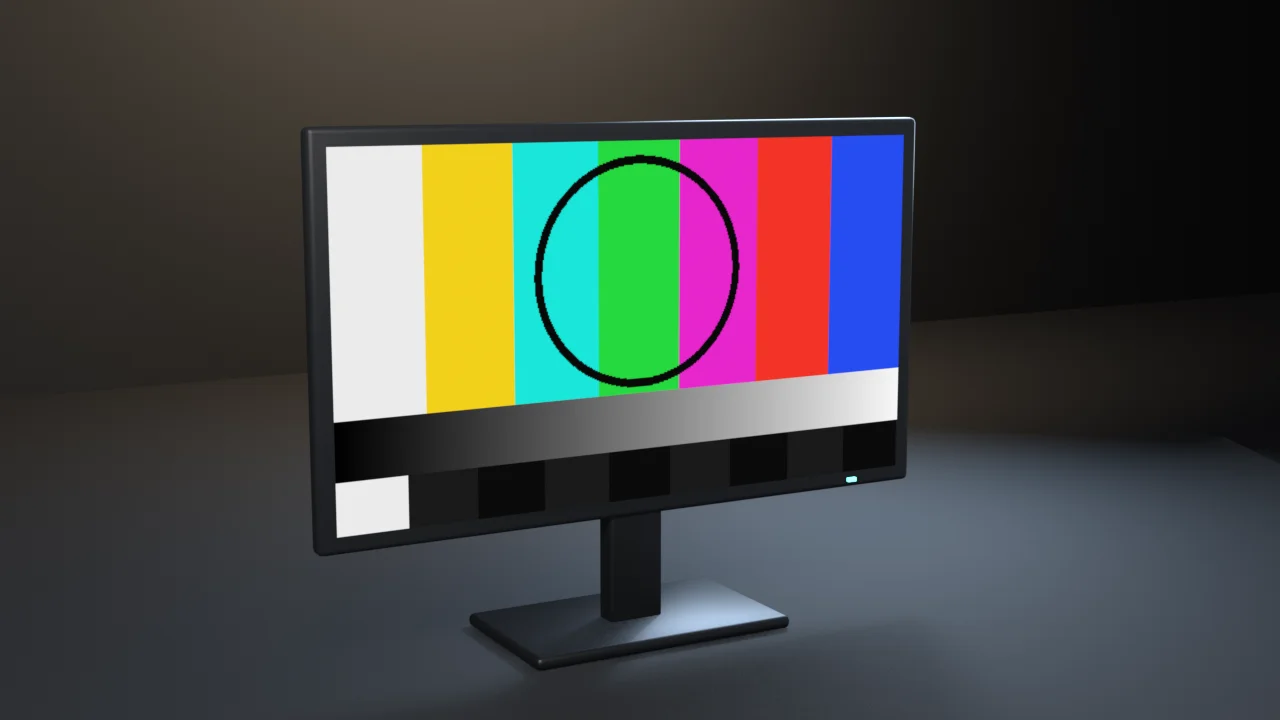
Rendered headless by the example itself — click to zoom.
blender --background --python examples/image-pixels-testcard/image_pixels_testcard.py --
A runnable example that writes a procedural broadcast test card — seven neon bars, a luminance ramp, a PLUGE row with a bottom-left origin marker, and the classic circle — into a bpy.data.images.new() datablock with one pixels.foreach_set() call (512 × 288 × 4 = 589,824 floats), then renders it on an emissive studio monitor.
What it witnesses: the bpy.types.Image pixel-buffer contract. Image.pixels is a flat, row-major, bottom-left-origin float buffer that is *always* RGBA: channels == 4 and len(pixels) == width × height × 4 even when the image is created with alpha=False, so an RGB-stride foreach_set raises TypeError instead of writing. A byte image (the default) stores 8 bits per channel — every written float round-trips with error ≤ 0.5/255 and strictly > 0 (an exact round-trip would mean storage is not 8-bit); float_buffer=True stores float32 and round-trips at ~1e-7. Image.scale() reallocates the buffer, so a foreach_get into a stale-size list raises TypeError rather than silently shearing rows.
The save() trap (found while authoring — identical on 4.5 LTS and 5.1): Image.save() on a GENERATED image silently flips source to 'FILE' and drops the in-memory buffer (has_data becomes False). Every later pixels read re-loads from whatever currently sits at filepath_raw. The check proves it by overwriting the file with a flat-gray imposter image *after* save() and reading the imposter's pixels back through the original datablock. save_render() writes the same PNG but is non-destructive: source stays 'GENERATED' and the buffer stays exact. Scripts that write pixels, save(), then keep computing on pixels are silently computing on a decoded PNG.
What each check catches on failure:
- *Buffer geometry* — an API change to per-image channel counts, or code assuming an RGB stride (falsified: a
W*H*3write raises and the check exits 3). - *Byte/float round-trip vs the closed-form card* — any stride, orientation, or packing bug in the bulk path; a one-pixel shift was deliberately introduced once and the check exited 4 with measured error 0.97 against tolerance 0.00196.
- *Quantization floor* —
byte_err > 0proves 8-bit storage really quantizes; byte and float images swapping behavior cannot hide. - *Reallocation* —
scale()no longer reallocating (stale-size read succeeding). - *save() lifecycle* — the source-flip/buffer-drop behavior changing (falsified: substituting
save_render()forsave()exits 7 becausesourcestaysGENERATED). - *Disk round-trip* — a byte sRGB image saved to PNG and reloaded must match at quantization tolerance.
Version divergence: none — every contract above, including the save() trap, was probed and asserts identically on Blender 4.5.11 LTS and 5.1.2. The only gate in the file is the EEVEE engine id for the optional render (BLENDER_EEVEE_NEXT on 4.x, BLENDER_EEVEE on 5.x).
Render hazard worth knowing: a bmesh-built plane has no UV map, and bmesh.ops.create_grid(..., calc_uvs=True) silently creates none unless a UV layer already exists — without one, an Image Texture samples texel (0,0) for every fragment and the screen renders as one flat color. The render path creates the layer explicitly.
Run
# Cheap correctness check (no render) — the CI check:
blender --background --python image_pixels_testcard.py --

# Also render a still (EEVEE on a GPU host; use --engine cycles on GPU-less hosts):
blender --background --python image_pixels_testcard.py -- --output card.png
blender --background --python image_pixels_testcard.py -- --output card.png --engine cycles
It exits non-zero on failure and prints every measured error and tolerance on success, so CI logs carry the numbers. The blender-smoke workflow runs the check on Blender 5.2 LTS and 4.5 LTS. In the render, Closest interpolation keeps the pixel grid honest — the jagged circle edge is the 512 × 288 buffer itself, and the white marker in the PLUGE row sits at the bottom-left because that is where pixel (0, 0) lives. The monitor is staged as a designed object — beveled dark-polymer case, machined metal stand, teal power LED — on the dark studio stage from docs/VISUAL-STYLE.md (Standard view transform; warm key, cool fill and rim; a warm pool raking the back wall). The screen stays emissive and matte — specular off, emission strength 1.0 — so the card's values read exactly.
Source
"""A procedural broadcast test card written with one foreach_set — a runnable example.

Witnesses the `bpy.types.Image` pixel-buffer contract. `Image.pixels` is a flat,
row-major, bottom-left-origin float buffer that is ALWAYS RGBA: `channels == 4`
and `len(pixels) == width * height * 4` even when the image is created with
`alpha=False`, so RGB-stride writes raise. A byte image (the default) stores
8 bits per channel — every float written round-trips through quantization with
max error exactly <= 0.5/255 and strictly > 0 — while `float_buffer=True` stores
float32 and round-trips to ~1e-7. `Image.scale()` reallocates the buffer, so a
`foreach_get` into a stale-size list raises TypeError instead of silently
shearing rows.

The save lifecycle is the trap (identical on 4.5 LTS and 5.1): `Image.save()`
on a GENERATED image silently flips `source` to 'FILE' and drops the in-memory
buffer (`has_data` becomes False). Every later `pixels` read silently re-loads
from whatever sits at that path — the check proves it by overwriting the file
with a different image and reading the imposter's pixels back through the
original datablock. `save_render()` writes the same PNG but leaves
`source` == 'GENERATED' and the buffer intact and exact.

By default it runs only the correctness check (no render) — the CI smoke
check. Pass --output to also render a still:

    blender --background --python image_pixels_testcard.py --                 # check only
    blender --background --python image_pixels_testcard.py -- --output t.png  # + render
"""
import bpy, sys, os, math, argparse, tempfile

W, H = 512, 288
BYTE_TOL = 0.5 / 255.0 + 1e-6   # 8-bit quantization: round(v*255)/255, worst case half a step
FLOAT_TOL = 1e-6                # float32 storage of float64 Python values

# Saturated neon take on the classic seven SMPTE bars.
BARS = [
    (0.92, 0.92, 0.92), (0.95, 0.82, 0.10), (0.10, 0.90, 0.85),
    (0.15, 0.85, 0.25), (0.90, 0.15, 0.80), (0.95, 0.20, 0.15),
    (0.15, 0.30, 0.95),
]


def pattern(x, y):
    """Closed-form test-card color at pixel (x, y), origin bottom-left.

    Values are deliberately off the 1/255 grid so byte quantization is
    measurable: a byte image that round-trips these exactly is a failure.
    """
    u, v = x / (W - 1), y / (H - 1)
    if v < 0.14:
        # bottom row: castellated PLUGE-style blocks, plus a bright white
        # origin marker in the bottom-left cell — if a consumer assumes a
        # top-down origin, the marker visibly jumps to the top of the frame
        cell = int(u * 9)
        if cell == 0:
            r = g = b = 0.92
        else:
            r = g = b = (0.04, 0.10)[cell % 2]
    elif v < 0.30:
        # luminance ramp: black -> white, shows 8-bit banding
        r = g = b = u * 0.97
    else:
        r, g, b = BARS[min(int(u * len(BARS)), len(BARS) - 1)]
        # center circle outline, the test-card signature
        d = math.hypot((u - 0.5) * (W / H), v - 0.64)
        if abs(d - 0.31) < 0.012:
            r, g, b = 0.03, 0.03, 0.03
    return r, g, b, 1.0


def flat_pattern():
    """The whole card as one flat RGBA buffer in pixel-buffer order:
    row-major from the BOTTOM row up, 4 floats per pixel."""
    buf = [0.0] * (W * H * 4)
    i = 0
    for y in range(H):
        for x in range(W):
            buf[i:i + 4] = pattern(x, y)
            i += 4
    return buf


def fail(msg, code):
    print(f"ERROR: {msg}", file=sys.stderr)
    return code


def check():
    bpy.ops.wm.read_factory_settings(use_empty=True)
    expected = flat_pattern()

    # -- buffer geometry: always RGBA, even with alpha=False ----------------
    img = bpy.data.images.new("TestCard", W, H, alpha=False)
    if img.channels != 4 or len(img.pixels) != W * H * 4:
        return fail(f"expected RGBA buffer ({W*H*4}), got channels={img.channels} "
                    f"len={len(img.pixels)}", 3)
    try:
        img.pixels.foreach_set([0.0] * (W * H * 3))  # RGB stride
        return fail("RGB-stride foreach_set was accepted — buffer is not always RGBA", 3)
    except TypeError:
        pass

    # -- byte image: one bulk write, quantized round-trip --------------------
    img.pixels.foreach_set(expected)
    got = [0.0] * (W * H * 4)
    img.pixels.foreach_get(got)
    byte_err = max(abs(a - b) for a, b in zip(expected, got))
    if byte_err > BYTE_TOL:
        return fail(f"byte round-trip error {byte_err:.7f} > {BYTE_TOL:.7f} "
                    f"(stride/orientation bug cannot hide at 512x288)", 4)
    if byte_err <= 0.0:
        return fail("byte image round-tripped exactly — storage is not 8-bit, "
                    "the quantization contract is broken", 4)

    # -- float image: same write, float32-exact round-trip -------------------
    fimg = bpy.data.images.new("TestCardF", W, H, alpha=True, float_buffer=True)
    if not fimg.is_float:
        return fail("float_buffer=True did not produce a float image", 5)
    fimg.pixels.foreach_set(expected)
    fgot = [0.0] * (W * H * 4)
    fimg.pixels.foreach_get(fgot)
    float_err = max(abs(a - b) for a, b in zip(expected, fgot))
    if float_err > FLOAT_TOL:
        return fail(f"float round-trip error {float_err:.2e} > {FLOAT_TOL:.0e}", 5)

    # -- scale() reallocates: stale-size bulk reads must raise ---------------
    half = bpy.data.images.new("Half", W, H, alpha=True)
    half.pixels.foreach_set(expected)
    stale = [0.0] * (W * H * 4)
    half.scale(W // 2, H // 2)
    if len(half.pixels) != (W // 2) * (H // 2) * 4:
        return fail(f"scale() did not reallocate: len={len(half.pixels)}", 6)
    try:
        half.pixels.foreach_get(stale)
        return fail("foreach_get accepted a stale-size buffer after scale()", 6)
    except TypeError:
        pass

    # -- the save() trap: source flips to FILE and pixels re-source from disk --
    tmpdir = tempfile.mkdtemp()
    trap = bpy.data.images.new("Trap", W, H, alpha=True, float_buffer=True)
    trap.pixels.foreach_set(expected)
    trap.filepath_raw = os.path.join(tmpdir, "trap.png")
    trap.file_format = 'PNG'
    trap.save()
    if trap.source != 'FILE' or trap.has_data:
        return fail(f"save() contract changed: source={trap.source} "
                    f"has_data={trap.has_data} (expected FILE / False)", 7)
    # overwrite the file with a mid-gray card BEFORE touching trap.pixels;
    # if the buffer were still in memory the read below would return the card
    imposter = bpy.data.images.new("Imposter", W, H, alpha=True)
    gray = 154.0 / 255.0  # exactly representable in 8-bit, no quantization noise
    imposter.pixels.foreach_set([gray] * (W * H * 4))
    imposter.filepath_raw = trap.filepath_raw
    imposter.file_format = 'PNG'
    imposter.save()
    tgot = [0.0] * (W * H * 4)
    trap.pixels.foreach_get(tgot)  # silently re-loaded from the PNG on disk
    trap_err = max(abs(v - gray) for v in tgot)
    if trap_err > BYTE_TOL:
        return fail(f"pixels did not re-source from disk after save() "
                    f"(max dev from imposter gray {trap_err:.4f}) — the buffer-drop "
                    "trap this example documents has vanished", 7)

    # -- save_render() is the non-destructive path ----------------------------
    keep = bpy.data.images.new("Keep", W, H, alpha=True, float_buffer=True)
    keep.pixels.foreach_set(expected)
    keep.save_render(os.path.join(tmpdir, "keep.png"))
    if keep.source != 'GENERATED':
        return fail(f"save_render() flipped source to {keep.source}", 8)
    kgot = [0.0] * (W * H * 4)
    keep.pixels.foreach_get(kgot)
    keep_err = max(abs(a - b) for a, b in zip(expected, kgot))
    if keep_err > FLOAT_TOL:
        return fail(f"save_render() disturbed the buffer (err {keep_err:.2e})", 8)

    # -- byte sRGB image: PNG save/reload round-trips at quantization --------
    disk = bpy.data.images.new("Disk", W, H, alpha=True)
    disk.pixels.foreach_set(expected)
    disk.filepath_raw = os.path.join(tmpdir, "disk.png")
    disk.file_format = 'PNG'
    disk.save()
    reloaded = bpy.data.images.load(disk.filepath_raw)
    rgot = [0.0] * (W * H * 4)
    reloaded.pixels.foreach_get(rgot)
    disk_err = max(abs(a - b) for a, b in zip(expected, rgot))
    if disk_err > BYTE_TOL:
        return fail(f"byte PNG save/reload error {disk_err:.7f} > {BYTE_TOL:.7f}", 9)

    print(f"byte round-trip max err {byte_err:.7f} (tol {BYTE_TOL:.7f}, must be > 0), "
          f"float {float_err:.2e} (tol {FLOAT_TOL:.0e}), post-save() imposter read "
          f"max dev {trap_err:.7f} (buffer really dropped), save_render() "
          f"{keep_err:.2e}, byte PNG reload {disk_err:.7f}")
    return 0


def eevee_engine_id():
    return 'BLENDER_EEVEE' if bpy.app.version >= (5, 0, 0) else 'BLENDER_EEVEE_NEXT'


def render_still(path, engine):
    import bmesh
    from mathutils import Vector
    scene = bpy.context.scene
    # Standard view transform, always: AgX lifts the stage toward grey and
    # washes the bars pastel (docs/VISUAL-STYLE.md)
    scene.view_settings.view_transform = 'Standard'

    # the card itself: a byte sRGB image, written with the one bulk call
    card = bpy.data.images.new("TestCard", W, H, alpha=False)
    card.pixels.foreach_set(flat_pattern())

    def principled(name, base, rough, metallic=0.0, emit=None, estr=0.0):
        m = bpy.data.materials.new(name)
        m.use_nodes = True
        b = m.node_tree.nodes["Principled BSDF"]
        b.inputs["Base Color"].default_value = (*base, 1.0)
        b.inputs["Roughness"].default_value = rough
        b.inputs["Metallic"].default_value = metallic
        if emit is not None:
            b.inputs["Emission Color"].default_value = (*emit, 1.0)
            b.inputs["Emission Strength"].default_value = estr
        return m

    def box(name, dims, mat, loc, bevel=0.0):
        """A world-dimensioned box; a small bevel catches a machined edge line."""
        me = bpy.data.meshes.new(name)
        bm = bmesh.new()
        try:
            bmesh.ops.create_cube(bm, size=1.0)
            bmesh.ops.scale(bm, vec=Vector(dims), verts=bm.verts)
            for f in bm.faces:
                f.smooth = bevel > 0.0
            bm.to_mesh(me)
        finally:
            bm.free()
        me.materials.append(mat)
        ob = bpy.data.objects.new(name, me)
        ob.location = loc
        scene.collection.objects.link(ob)
        if bevel > 0.0:
            mod = ob.modifiers.new("EdgeBevel", 'BEVEL')
            mod.width = bevel
            mod.segments = 3
            mod.limit_method = 'ANGLE'
        return ob

    # -- the monitor: designed object, not a black slab ----------------------
    # screen: emissive plane textured with the card (16:9, 3.2 wide), centered
    # at standing height on its stand
    sw, sh = 3.2, 1.8
    scr_z = 1.61
    screen_me = bpy.data.meshes.new("Screen")
    bm = bmesh.new()
    try:
        bmesh.ops.create_grid(bm, x_segments=1, y_segments=1, size=0.5)
        # a UV layer must exist explicitly — without UVs every fragment
        # samples texel (0,0) and the screen renders one flat color
        uv = bm.loops.layers.uv.new("UVMap")
        for face in bm.faces:
            for loop in face.loops:
                loop[uv].uv = (loop.vert.co.x + 0.5, loop.vert.co.y + 0.5)
        bm.to_mesh(screen_me)
    finally:
        bm.free()
    smat = bpy.data.materials.new("CardEmit")
    smat.use_nodes = True
    nodes, links = smat.node_tree.nodes, smat.node_tree.links
    tex = nodes.new("ShaderNodeTexImage")
    tex.image = card
    tex.interpolation = 'Closest'   # keep the pixel grid honest up close
    bsdf = nodes["Principled BSDF"]
    bsdf.inputs["Base Color"].default_value = (0.0, 0.0, 0.0, 1.0)
    bsdf.inputs["Roughness"].default_value = 0.4
    # matte: specular off so the wall/floor horizon never reflects as a line
    # across the witness data; emission 1.0 so the card reads exactly
    bsdf.inputs["Specular IOR Level"].default_value = 0.0
    links.new(tex.outputs["Color"], bsdf.inputs["Emission Color"])
    bsdf.inputs["Emission Strength"].default_value = 1.0
    screen_me.materials.append(smat)
    screen = bpy.data.objects.new("Screen", screen_me)
    screen.scale = (sw, sh, 1.0)
    screen.rotation_euler = (math.radians(90), 0.0, 0.0)
    screen.location = (0.0, 0.0, scr_z)
    scene.collection.objects.link(screen)

    # case: dark polymer shell with a beveled edge the rim light can draw
    case_mat = principled("CasePolymer", (0.030, 0.034, 0.042), 0.38)
    metal_mat = principled("StandMetal", (0.055, 0.060, 0.070), 0.36, metallic=0.7)
    box("Case", (sw + 0.18, 0.11, sh + 0.18), case_mat, (0.0, 0.057, scr_z), bevel=0.03)
    # machined stand: neck + base plate
    box("Neck", (0.30, 0.14, 0.64), metal_mat, (0.0, 0.10, 0.37), bevel=0.025)
    box("Base", (1.45, 0.85, 0.07), metal_mat, (0.0, 0.12, 0.035), bevel=0.03)
    # power LED on the bottom bezel, a small designed detail
    glow_mat = principled("Glow", (0.0, 0.0, 0.0), 0.5, emit=(0.10, 0.85, 0.75), estr=6.0)
    box("LED", (0.05, 0.02, 0.02), glow_mat, (1.30, -0.006, scr_z - sh / 2 - 0.045))

    # -- stage: near-black floor + back wall, matte --------------------------
    stage_mat = principled("Studio", (0.03, 0.032, 0.037), 0.7)
    floor_me = bpy.data.meshes.new("Floor")
    bm = bmesh.new()
    try:
        bmesh.ops.create_grid(bm, x_segments=1, y_segments=1, size=30.0)
        bm.to_mesh(floor_me)
    finally:
        bm.free()
    floor_me.materials.append(stage_mat)
    floor = bpy.data.objects.new("Floor", floor_me)
    scene.collection.objects.link(floor)
    wall = bpy.data.objects.new("Wall", floor_me.copy())
    wall.location = (0.0, 8.5, 0.0)
    wall.rotation_euler = (math.radians(90), 0.0, 0.0)
    scene.collection.objects.link(wall)

    world = bpy.data.worlds.new("World")
    world.use_nodes = True
    world.node_tree.nodes["Background"].inputs["Color"].default_value = (0.02, 0.021, 0.025, 1.0)
    scene.world = world

    # -- lighting: shaped warm key, cool fill/rim, warm pool on the wall -----
    def light(name, loc, target, energy, size, col):
        ld = bpy.data.lights.new(name, 'AREA')
        ld.energy = energy
        ld.size = size
        ld.color = col
        ob = bpy.data.objects.new(name, ld)
        ob.location = loc
        # aim exactly at the target — a guessed euler is how stray bands happen
        d = Vector(target) - Vector(loc)
        ob.rotation_euler = d.to_track_quat('-Z', 'Y').to_euler()
        scene.collection.objects.link(ob)

    light("Key", (-4.0, -5.0, 6.0), (0.0, 0.0, 1.3), 420.0, 5.0, (1.0, 0.96, 0.9))
    light("Fill", (4.2, -1.8, 2.4), (0.0, 0.0, 1.5), 55.0, 9.0, (0.75, 0.85, 1.0))
    light("Rim", (3.4, 2.8, 3.4), (0.3, 0.0, 1.6), 320.0, 3.0, (0.6, 0.78, 1.0))
    # the signature: a warm pool raking the back wall behind the subject;
    # aimed at the wall well above the floor seam so the seam stays in shadow
    light("Wedge", (3.2, 5.2, 6.2), (2.4, 8.5, 4.2), 500.0, 5.0, (1.0, 0.76, 0.5))

    # camera: 50 mm, slightly above the subject, tracking an empty on it
    target = bpy.data.objects.new("AimTarget", None)
    target.location = (0.0, 0.0, 1.42)
    scene.collection.objects.link(target)
    cam_data = bpy.data.cameras.new("Cam")
    cam_data.lens = 50.0
    cam = bpy.data.objects.new("Cam", cam_data)
    cam.location = (-4.2, -7.7, 2.85)
    con = cam.constraints.new('TRACK_TO')
    con.target = target
    scene.collection.objects.link(cam)
    scene.camera = cam

    scene.render.engine = 'CYCLES' if engine == 'cycles' else eevee_engine_id()
    if engine == 'cycles':
        scene.cycles.samples = 32
    else:
        try:
            scene.eevee.taa_render_samples = 64
        except AttributeError:
            pass
    scene.render.resolution_x = 1280
    scene.render.resolution_y = 720
    scene.render.image_settings.file_format = 'PNG'
    scene.render.filepath = path
    bpy.ops.render.render(write_still=True)
    return os.path.exists(path) and os.path.getsize(path) > 0


def main():
    argv = sys.argv[sys.argv.index("--") + 1:] if "--" in sys.argv else []
    p = argparse.ArgumentParser()
    p.add_argument("--output", default=None, help="optional: render a still PNG here")
    p.add_argument("--engine", default="eevee", choices=("eevee", "cycles"),
                   help="render engine for --output (cycles for GPU-less hosts)")
    args = p.parse_args(argv)

    code = check()
    if code:
        return code

    if args.output:
        if not render_still(os.path.abspath(args.output), args.engine):
            print("ERROR: render produced no file", file=sys.stderr)
            return 10
        print(f"rendered still {args.output}")

    print("image-pixels-testcard OK")
    return 0


if __name__ == "__main__":
    try:
        sys.exit(main())
    except Exception as e:
        import traceback; traceback.print_exc(); print(f"FATAL: {e}", file=sys.stderr); sys.exit(1)