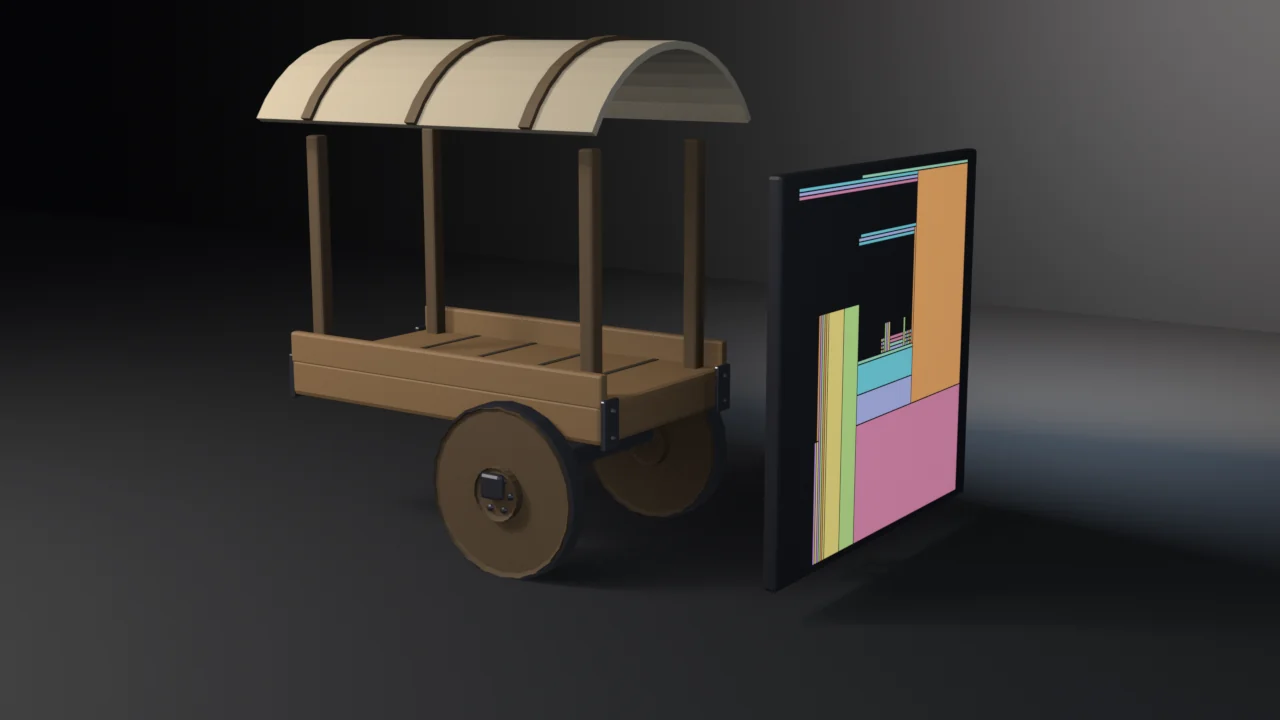
Rendered headless by the example itself — click to zoom.
blender --background --python examples/lightmap-uv-channel/lightmap_uv_channel.py --
A runnable example building the second UV layer engines require for baked lighting, on an asset built to be reused: a market cart assembled from 21 named, watertight parts — a plank-grooved bed with side rails, corner brackets, and fasteners, real wheel assemblies (disc + hub + iron band + bolt ring) on a capped axle, four posts, and a ribbed canvas canopy. Ground-level pivot at z=0, identity transforms by construction, Cart.* datablocks. (An earlier revision shipped a soft uniform-tan cart with lumpy polygon wheels and was remodeled under the asset-quality gate; its wheel material was also silently never applied — a name-key lookup bug the exact per-part mapping now replaces.) UV0 is the texture channel (deterministic dominant-axis box projection per face); UVLight is the baked-lighting atlas (smart_project → lightmap_pack).
What it witnesses (all independently derived, nothing trusted from the packer):
- The flag trap.
uv_layers.new()does not move the active flags — the first layer keepsactive+active_render, so a UV op runs against channel 0 unless you moveactiveyourself (probed: unwrap+pack with the flags unmoved destroys channel 0, measured drift 2.068). Worse, the edit-mode UV ops clear both flags — the sequence must re-assert them. The check pins, per part: exactly two layersUVMap/UVLight,active == UVLight(edit target),active_render == UVMap(render target). - Channel zero untouched. UV0 loops snapshotted before the UVLight unwrap, compared after: drift 0.0 on every part (tol 1e-6).
- Bounds. Every UVLight loop inside
[0, 1]within 1e-5. - Non-overlap. UV1 triangles binned into a 256² spatial hash and tested pairwise with strict SAT (epsilon-separated, so shared edges don't count): 0 overlapping pairs.
- Margin.
MARGIN_DIVsemantics measured live: nominal margin ==MARGIN_DIV × 0.01UV units; the check requires the measured min island-pair distance ≥ half the nominal — measured 0.00401 (≈ 2× the nominal 0.002, the packer's per-island margin applied twice). - Island census + watertight parts. Connected components counted independently per part; loops conserved; every part manifold.
What each check catches on failure: wrong layer names/count (exit 3); flags not re-established after the ops (exit 4); channel 0 touched by the UV1 unwrap (exit 5 — probed via the clobber trap, drift 2.068); UV1 loops outside the unit square (exit 6); overlapping islands (exit 7 — probed by translating an island onto a neighbor, 15 SAT hits); margin floor broken (exit 8 — probed with MARGIN_DIV=0, measured 2e-5 < 0.001); non-watertight part (exit 9).
Authoring hazards pinned while building this (probes in .scratch-style bisect scripts; the reasons the check code re-fetches layers by name and re-asserts flags):
- Holding a
MeshUVLoopLayerreference across edit-mode UV ops and then iterating its.datasegfaults Blender 4.5.11 headless (EXCEPTION_ACCESS_VIOLATION, 5/5 repro); the same read survives on 5.1.2. Re-fetchmesh.uv_layers[name]after CustomData-reallocating calls. Second confirmation of the UV-handle lifetime hazard found authoringtriangulate-tangents. bpy.ops.uv.lightmap_packsilently packs nothing (exit OK) when the active layer has no UVs yet — unwrap first, then pack.
Pipeline arc neighbors: UV-layer authoring in uv-layer-grid, tangent-space from UVs in triangulate-tangents, export round-trip in gltf-export-roundtrip, pivot discipline in prop-origin-transform.
Version witness: check output is byte-identical on Blender 4.5.11 LTS and 5.1.2 (21 parts, 3680 islands, drift 0, overlap 0, min island distance 0.00401). The UV *layout* is packer-version-dependent by design; the contracts are layout-independent invariants.
Render as proof: the cart beside its enlarged UV1 atlas board — the Bed's packed lightmap built from live UV data, so a change in the atlas moves the board geometry. The falsification variant (--falsify) translates the second-largest island onto the largest: a big emissive-red island visibly stacked over the atlas (15 SAT hits in the check probe). The render path also gates the asset itself through examples/gallery_asset_quality.py (naming, material variation, edge treatment — exit 11): 21 named parts, 5 materials, right-angle share 0.069.
Run
blender --background --python lightmap_uv_channel.py --
blender --background --python lightmap_uv_channel.py -- --output atlas.png
blender --background --python lightmap_uv_channel.py -- --falsify overlap.png
Exits non-zero on failure. The blender-smoke workflow runs the check on Blender 4.5 LTS and 5.1. The --output render path additionally measures framing against the Layer 1 band via examples/gallery_framing.py (exit 10 on violation) before writing the still.
Source
"""Lightmap UV channel — the second UV layer engines need for baked lighting. Witnesses the two-channel UV contract a bake pipeline depends on, on an asset built to be reused (a market cart: bed, axle, two wheels, four posts, arched canvas canopy — ground-level pivot, identity transforms, named datablocks, watertight parts): 1. **The flag trap.** `uv_layers.new()` does NOT move the active flags: the first layer keeps `active` + `active_render`, so a UV op runs against channel 0 unless you move `active` yourself. Worse, the edit-mode UV ops CLEAR both flags — they must be re-asserted after the unwrap/pack sequence. The check pins: per part, exactly two layers named UVMap + UVLight, with `active == UVLight` (edit target) and `active_render == UVMap` (render target) at the end. 2. **Channel zero is untouched.** UV0 loops are snapshotted before the UVLight unwrap and compared after: max abs diff == 0 (tol 1e-6). 3. **Bounds.** Every UVLight loop sits inside [0, 1] within 1e-5. 4. **Non-overlap, independently computed.** UV1 triangles are binned into a spatial hash and tested pairwise with exact strict SAT (epsilon-separated, so shared edges/touching don't count) — never trusted from the packer. 5. **Margin.** lightmap_pack MARGIN_DIV semantics measured live: nominal margin == MARGIN_DIV * 0.01 UV units; the check requires the measured min island-pair distance >= half the nominal margin, printed. 6. **Island census.** Connected components of welded UV verts, counted independently, printed per part; loops conserved (no UV data lost). Authoring hazards pinned while building this (see code comments): - Holding a `MeshUVLoopLayer` reference across edit-mode UV ops and then iterating its `.data` SEGFAULTS Blender 4.5.11 headless (EXCEPTION_ACCESS_VIOLATION, repro 5/5); the same read survives on 5.1.2. Always re-fetch `mesh.uv_layers[name]` after CustomData-reallocating ops. - `bpy.ops.uv.lightmap_pack` silently packs NOTHING (exit OK) when the active layer has no UVs yet — unwrap first, then pack. By default it runs only the correctness check (no render) — the CI smoke check. Pass --output to also render a still: blender --background --python lightmap_uv_channel.py -- # check only blender --background --python lightmap_uv_channel.py -- --output u.png # + render blender --background --python lightmap_uv_channel.py -- --falsify f.png # overlapping atlas """ import bpy, bmesh, sys, os, math, argparse # Shared Layer 1 framing measurement (render path only) — see gallery_framing.py sys.path.insert(0, os.path.join(os.path.dirname(os.path.abspath(__file__)), os.pardir)) sys.dont_write_bytecode = True # keep examples/__pycache__ out of the repo tree import gallery_framing import gallery_asset_quality TOL = 1e-6 # UV0 preservation tolerance BOUNDS_TOL = 1e-5 # UV1 unit-square slack MARGIN_DIV = 0.2 # packer request; nominal margin = MARGIN_DIV * 0.01 MARGIN_FACTOR = 0.5 # require measured min island distance >= this * nominal SAT_EPS = 1e-9 # strict-separation epsilon: touching is not overlap UV_WELD = 1e-6 # uv vert weld for island connectivity BIN_N = 256 # spatial hash resolution over [0,1]^2 LAYER0 = "UVMap" LAYER1 = "UVLight" def eevee_engine_id(): return "BLENDER_EEVEE" if bpy.app.version >= (5, 0, 0) else "BLENDER_EEVEE_NEXT" # --------------------------------------------------------------------------- # Asset construction (bmesh, ground pivot at z=0; cart runs along X) # --------------------------------------------------------------------------- def _beveled_box(bm, dims, center, bevel=0.0, segments=2): bmesh.ops.create_cube(bm, size=1.0) for v in bm.verts: v.co.x = v.co.x * dims[0] + center[0] v.co.y = v.co.y * dims[1] + center[1] v.co.z = v.co.z * dims[2] + center[2] if bevel > 0.0: bmesh.ops.bevel(bm, geom=list(bm.edges), offset=bevel, segments=segments, profile=0.5, affect="EDGES", clamp_overlap=True) def _box(name, dims, center, bevel=0.0): me = bpy.data.meshes.new(name) bm = bmesh.new() try: _beveled_box(bm, dims, center, bevel) bm.to_mesh(me) finally: bm.free() return me def _wheel_disc(name, radius, width, center): me = bpy.data.meshes.new(name) bm = bmesh.new() try: bmesh.ops.create_cone(bm, cap_ends=True, cap_tris=False, segments=24, radius1=radius, radius2=radius, depth=width) # cone axis is Z; the wheel rolls around Y -> rotate verts, applied in data for v in bm.verts: x, y, z = v.co.x, v.co.y, v.co.z v.co = (x + center[0], z + center[1], y + center[2]) bmesh.ops.bevel(bm, geom=list(bm.edges), offset=0.02, segments=2, profile=0.5, affect="EDGES", clamp_overlap=True) bm.to_mesh(me) finally: bm.free() return me def _ring(name, r_out, r_in, width, center, segments=24): """Flat annulus (iron tire band) spun from a 4-vert profile, watertight.""" me = bpy.data.meshes.new(name) bm = bmesh.new() try: hw = width / 2 prof = [(r_in, -hw), (r_out, -hw), (r_out, hw), (r_in, hw)] vs = [bm.verts.new((r, 0.0, z)) for r, z in prof] es = [bm.edges.new((vs[i], vs[(i + 1) % 4])) for i in range(4)] bmesh.ops.spin(bm, geom=vs + es, cent=(0.0, 0.0, 0.0), axis=(0.0, 0.0, 1.0), dvec=(0.0, 0.0, 0.0), angle=2 * math.pi, steps=segments, use_merge=True) for v in bm.verts: x, y, z = v.co.x, v.co.y, v.co.z v.co = (x + center[0], z + center[1], y + center[2]) bm.to_mesh(me) finally: bm.free() return me def _bolt_ring(name, count, ring_r, bolt_r, center): """count bolt heads on a ring around Y — one mesh, disconnected islands.""" me = bpy.data.meshes.new(name) bm = bmesh.new() try: for i in range(count): a = 2 * math.pi * i / count cx, cz = center[0] + ring_r * math.cos(a), center[2] + ring_r * math.sin(a) before_v = set(bm.verts) bmesh.ops.create_uvsphere(bm, u_segments=8, v_segments=6, radius=bolt_r) for v in set(bm.verts) - before_v: v.co.x += cx v.co.y += center[1] v.co.z += cz bm.to_mesh(me) finally: bm.free() return me def _arc_band(bm, xc, width, radius, thickness, z0, segments): """One arched sheet spanning x in [xc, xc+width], solidified with rims.""" sweep = math.radians(120.0) a0 = math.radians(90.0) - sweep / 2 outer, inner = [], [] for i in range(segments + 1): a = a0 + sweep * i / segments ca, sa = math.cos(a), math.sin(a) outer.append(bm.verts.new((xc, radius * ca, z0 + radius * sa))) inner.append(bm.verts.new((xc, (radius - thickness) * ca, z0 + (radius - thickness) * sa))) def band(ring_o, ring_i): for i in range(segments): a, b = i, i + 1 bm.faces.new((ring_o[a], ring_o[b], ring_i[b], ring_i[a])) outer_x2 = [bm.verts.new((v.co.x + width, v.co.y, v.co.z)) for v in outer] inner_x2 = [bm.verts.new((v.co.x + width, v.co.y, v.co.z)) for v in inner] band(outer, inner) # underside (thickness face) band(inner_x2, outer_x2) # top face for i in range(segments): # the two long rims a, b = i, i + 1 bm.faces.new((outer[a], outer_x2[a], outer_x2[b], outer[b])) bm.faces.new((inner[a], inner[b], inner_x2[b], inner_x2[a])) bm.faces.new((outer[0], inner[0], inner_x2[0], outer_x2[0])) bm.faces.new((outer[-1], outer_x2[-1], inner_x2[-1], inner[-1])) def _canopy(name, width, radius, thickness, z0, segments=14): """Arched canvas sheet: an arc band solidified with a rim, watertight.""" me = bpy.data.meshes.new(name) bm = bmesh.new() try: _arc_band(bm, -width / 2, width, radius, thickness, z0, segments) bm.to_mesh(me) finally: bm.free() return me def _canopy_ribs(name, positions, width, radius, thickness, z0, segments=14): """Thin wooden ribs following the canopy arc, one mesh, N islands.""" me = bpy.data.meshes.new(name) bm = bmesh.new() try: for px in positions: _arc_band(bm, px - width / 2, width, radius, thickness, z0, segments) bm.to_mesh(me) finally: bm.free() return me def _bolts(name, positions, radius): """Bolt head spheres at positions — one mesh, disconnected islands.""" me = bpy.data.meshes.new(name) bm = bmesh.new() try: for px, py, pz in positions: before_v = set(bm.verts) bmesh.ops.create_uvsphere(bm, u_segments=8, v_segments=6, radius=radius) for v in set(bm.verts) - before_v: v.co.x += px v.co.y += py v.co.z += pz bm.to_mesh(me) finally: bm.free() return me def _multi_box(name, specs): """Several beveled boxes as one mesh (disconnected islands, each watertight). specs: (dims, center, bevel).""" me = bpy.data.meshes.new(name) bm = bmesh.new() try: for dims, center, bevel in specs: before_e = set(bm.edges) before_v = set(bm.verts) bmesh.ops.create_cube(bm, size=1.0) new_edges = list(set(bm.edges) - before_e) for v in set(bm.verts) - before_v: v.co.x = v.co.x * dims[0] + center[0] v.co.y = v.co.y * dims[1] + center[1] v.co.z = v.co.z * dims[2] + center[2] if bevel > 0.0: bmesh.ops.bevel(bm, geom=new_edges, offset=bevel, segments=2, profile=0.5, affect="EDGES", clamp_overlap=True) bm.to_mesh(me) finally: bm.free() return me def build_cart_meshes(): """The cart as an assembly of named, watertight parts: real wheel assemblies (disc + hub + iron band + bolt ring), plank-grooved bed with side rails, corner brackets, and fasteners, and a ribbed canvas canopy.""" parts = {} parts["Bed"] = _box("Cart.Bed", (2.2, 1.2, 0.22), (0.0, 0.0, 0.85), 0.03) parts["Bed.Rails"] = _multi_box("Cart.Bed.Rails", [ ((2.2, 0.06, 0.18), (0.0, 0.57, 1.02), 0.015), ((2.2, 0.06, 0.18), (0.0, -0.57, 1.02), 0.015)]) parts["Bed.Grooves"] = _multi_box("Cart.Bed.Grooves", [ ((0.035, 1.14, 0.015), (x, 0.0, 0.9575), 0.0) for x in (-0.66, -0.22, 0.22, 0.66)]) parts["Bed.Brackets"] = _multi_box("Cart.Bed.Brackets", [ ((0.03, 0.13, 0.26), (sx * 1.105, sy * 0.535, 0.85), 0.008) for sx in (-1, 1) for sy in (-1, 1)]) parts["Bed.Bolts"] = _bolts("Cart.Bed.Bolts", [ (sx * 1.125, sy * 0.535, z) for sx in (-1, 1) for sy in (-1, 1) for z in (0.78, 0.92)], 0.018) parts["Axle"] = _wheel_disc("Cart.Axle", 0.05, 1.56, (0.55, 0.0, 0.5)) parts["Axle.Caps"] = _multi_box("Cart.Axle.Caps", [ ((0.14, 0.05, 0.14), (0.55, sy * 0.80, 0.5), 0.02) for sy in (-1, 1)]) for tag, sy in (("L", 1.0), ("R", -1.0)): y = sy * 0.68 parts[f"Wheel.{tag}.Disc"] = _wheel_disc( f"Cart.Wheel.{tag}.Disc", 0.45, 0.10, (0.55, y, 0.45)) parts[f"Wheel.{tag}.Hub"] = _wheel_disc( f"Cart.Wheel.{tag}.Hub", 0.14, 0.16, (0.55, y, 0.45)) parts[f"Wheel.{tag}.Band"] = _ring( f"Cart.Wheel.{tag}.Band", 0.47, 0.435, 0.10, (0.55, y, 0.45)) parts[f"Wheel.{tag}.Bolts"] = _bolt_ring( f"Cart.Wheel.{tag}.Bolts", 6, 0.09, 0.02, (0.55, y + sy * 0.085, 0.45)) for tag, (px, py) in (("FL", (0.95, 0.48)), ("FR", (0.95, -0.48)), ("RL", (-0.95, 0.48)), ("RR", (-0.95, -0.48))): parts[f"Post.{tag}"] = _box(f"Cart.Post.{tag}", (0.09, 0.09, 1.35), (px, py, 1.55), 0.015) parts["Canopy"] = _canopy("Cart.Canopy", 2.3, 0.85, 0.04, 1.9) parts["Canopy.Ribs"] = _canopy_ribs("Cart.Canopy.Ribs", (-0.75, 0.0, 0.75), 0.07, 0.875, 0.035, 1.9) return parts # --------------------------------------------------------------------------- # UV authoring # --------------------------------------------------------------------------- def write_uv0_box_projection(me): """Channel 0: deterministic dominant-axis box projection per face. Deliberately un-normalized (world-scale UVs) — this is the texture channel; only UV1 is asserted inside [0,1].""" layer = me.uv_layers[LAYER0] for poly in me.polygons: n = poly.normal ax = max(range(3), key=lambda i: abs(n[i])) for li in poly.loop_indices: co = me.vertices[me.loops[li].vertex_index].co layer.data[li].uv = ((co.y, co.z) if ax == 0 else (co.x, co.z) if ax == 1 else (co.x, co.y)) def snapshot(layer): return [tuple(d.uv) for d in layer.data] def author_uv1(ob, clobber=False): """Channel 1: smart_project then lightmap_pack into the ACTIVE layer. clobber=False: the correct pipeline — active moved to UVLight first, so channel 0 survives. clobber=True: the classic trap — active left on UVMap, so the unwrap+pack lands on channel 0 and destroys it. """ me = ob.data if not clobber: for layer in me.uv_layers: layer.active = (layer.name == LAYER1) layer.active_render = (layer.name == LAYER0) bpy.context.view_layer.objects.active = ob ob.select_set(True) bpy.ops.object.mode_set(mode="EDIT") bpy.ops.mesh.select_all(action="SELECT") bpy.ops.uv.smart_project(angle_limit=1.1519, island_margin=0.0, area_weight=False, correct_aspect=True, scale_to_bounds=False) bpy.ops.uv.lightmap_pack(PREF_CONTEXT="ALL_FACES", PREF_PACK_IN_ONE=True, PREF_NEW_UVLAYER=False, PREF_MARGIN_DIV=MARGIN_DIV) bpy.ops.object.mode_set(mode="OBJECT") ob.select_set(False) # HAZARD (pinned while authoring): the ops above CLEAR layer.active and # layer.active_render — re-assert them or downstream bakes/renders pick # whatever Blender falls back to. And never read a held layer handle # here: iterating a stale MeshUVLoopLayer.data segfaults 4.5.11. if not clobber: for layer in me.uv_layers: layer.active = (layer.name == LAYER1) layer.active_render = (layer.name == LAYER0) # --------------------------------------------------------------------------- # Independent UV1 geometry analysis (never trusted from the packer) # --------------------------------------------------------------------------- def uv_tris(me, layer_name): """UV1 triangles per face (fan), plus a weld map for island connectivity.""" layer = me.uv_layers[layer_name] tris = [] for poly in me.polygons: pts = [tuple(layer.data[li].uv) for li in poly.loop_indices] for i in range(1, len(pts) - 1): tris.append((pts[0], pts[i], pts[i + 1])) return tris def islands(me, layer_name): """Connected components of UV verts welded at UV_WELD precision.""" layer = me.uv_layers[layer_name] parent = {} def find(k): parent.setdefault(k, k) while parent[k] != k: parent[k] = parent[parent[k]] k = parent[k] return k def key(uv): return (round(uv[0] / UV_WELD), round(uv[1] / UV_WELD)) for poly in me.polygons: ks = [find(key(tuple(layer.data[li].uv))) for li in poly.loop_indices] for k in ks[1:]: parent[find(k)] = ks[0] comps = {} for poly in me.polygons: for li in poly.loop_indices: comps.setdefault(find(key(tuple(layer.data[li].uv))), len(comps)) return len(comps) def _tri_overlap(t1, t2): """Strict 2D SAT: True only for area-positive overlap (SAT_EPS-separated, so shared edges and touching corners do not count).""" for tri in (t1, t2): for i in range(3): x1, y1 = tri[i] x2, y2 = tri[(i + 1) % 3] nx, ny = -(y2 - y1), (x2 - x1) nlen = math.hypot(nx, ny) if nlen < 1e-12: continue nx, ny = nx / nlen, ny / nlen p1 = [nx * p[0] + ny * p[1] for p in t1] p2 = [nx * p[0] + ny * p[1] for p in t2] if min(max(p1), max(p2)) - max(min(p1), min(p2)) < SAT_EPS: return False return True def overlap_report(tris): """(overlapping pair count, worst measured overlap depth) via binned SAT.""" bins = {} def bounds(t): return (min(p[0] for p in t), min(p[1] for p in t), max(p[0] for p in t), max(p[1] for p in t)) for i, t in enumerate(tris): x0, y0, x1, y1 = bounds(t) for bx in range(max(0, int(x0 * BIN_N)), min(BIN_N - 1, int(x1 * BIN_N)) + 1): for by in range(max(0, int(y0 * BIN_N)), min(BIN_N - 1, int(y1 * BIN_N)) + 1): bins.setdefault((bx, by), []).append(i) pairs = set() hits = 0 worst = 0.0 for members in bins.values(): for a in range(len(members)): for b in range(a + 1, len(members)): i, j = members[a], members[b] if (i, j) in pairs: continue pairs.add((i, j)) if _tri_overlap(tris[i], tris[j]): hits += 1 return hits def min_island_distance(me, layer_name): """Min distance between distinct islands' UV edges (exact seg-seg).""" layer = me.uv_layers[layer_name] parent = {} def find(k): parent.setdefault(k, k) while parent[k] != k: parent[k] = parent[parent[k]] k = parent[k] return k def key(uv): return (round(uv[0] / UV_WELD), round(uv[1] / UV_WELD)) for poly in me.polygons: ks = [find(key(tuple(layer.data[li].uv))) for li in poly.loop_indices] for k in ks[1:]: parent[find(k)] = ks[0] edges = {} # island root -> list of segments for poly in me.polygons: pts = [tuple(layer.data[li].uv) for li in poly.loop_indices] root = find(key(pts[0])) for i in range(len(pts)): edges.setdefault(root, []).append((pts[i], pts[(i + 1) % len(pts)])) def seg_dist(s1, s2): def pt_seg(p, s): (x, y), ((ax, ay), (bx, by)) = p, s dx, dy = bx - ax, by - ay L2 = dx * dx + dy * dy if L2 < 1e-18: return math.hypot(x - ax, y - ay) t = max(0.0, min(1.0, ((x - ax) * dx + (y - ay) * dy) / L2)) return math.hypot(x - (ax + t * dx), y - (ay + t * dy)) if _seg_intersect(s1, s2): return 0.0 return min(pt_seg(s1[0], s2), pt_seg(s1[1], s2), pt_seg(s2[0], s1), pt_seg(s2[1], s1)) def _seg_intersect(s1, s2): (ax, ay), (bx, by) = s1 (cx, cy), (dx, dy) = s2 def cross(ox, oy, px, py, qx, qy): return (px - ox) * (qy - oy) - (py - oy) * (qx - ox) d1 = cross(cx, cy, dx, dy, ax, ay) d2 = cross(cx, cy, dx, dy, bx, by) d3 = cross(ax, ay, bx, by, cx, cy) d4 = cross(ax, ay, bx, by, dx, dy) return ((d1 > 0) != (d2 > 0)) and ((d3 > 0) != (d4 > 0)) roots = sorted(edges) best = float("inf") for i in range(len(roots)): for j in range(i + 1, len(roots)): for s1 in edges[roots[i]]: for s2 in edges[roots[j]]: d = seg_dist(s1, s2) if d < best: best = d return best # --------------------------------------------------------------------------- # Check # --------------------------------------------------------------------------- def check(): meshes = build_cart_meshes() fails = [] def fail(code, msg): print(f"ERROR ({code}): {msg}", file=sys.stderr) fails.append(code) # --- 0. positive control for the overlap detector ----------------------- # "0 overlapping pairs" is only evidence if the detector can find one. A # blinded detector reports zero and the whole check passes: widening # SAT_EPS to 1e9 makes every axis test read as separated, and this example # still exited 0 before this control existed. Prove sensitivity and # strictness on hand-built triangles before trusting the scan. _overlapping = (((0.0, 0.0), (1.0, 0.0), (0.0, 1.0)), ((0.2, 0.2), (1.2, 0.2), (0.2, 1.2))) _disjoint = (((0.0, 0.0), (1.0, 0.0), (0.0, 1.0)), ((5.0, 5.0), (6.0, 5.0), (5.0, 6.0))) _touching = (((0.0, 0.0), (1.0, 0.0), (0.0, 1.0)), ((1.0, 0.0), (2.0, 0.0), (1.0, 1.0))) ctl = (_tri_overlap(*_overlapping), _tri_overlap(*_disjoint), _tri_overlap(*_touching)) print(f"sat_control overlapping={ctl[0]} disjoint={ctl[1]} touching={ctl[2]} " f"(want True/False/False)") if ctl != (True, False, False): fail(7, f"SAT self-test {ctl} != (True, False, False) — the overlap " f"detector cannot detect, so a zero-overlap result proves " f"nothing") return fails[0] nominal_margin = MARGIN_DIV * 0.01 total_islands = 0 for suffix, me in meshes.items(): l0 = me.uv_layers.new(name=LAYER0) me.uv_layers.new(name=LAYER1) write_uv0_box_projection(me) uv0_before = snapshot(me.uv_layers[LAYER0]) ob = bpy.data.objects.new(me.name, me) bpy.context.collection.objects.link(ob) author_uv1(ob) # re-fetch by name after CustomData-reallocating ops (see header) layers = me.uv_layers names = [l.name for l in layers] if names != [LAYER0, LAYER1]: fail(3, f"{suffix}: layers {names} != {[LAYER0, LAYER1]}") act = layers[LAYER1].active rnd = layers[LAYER0].active_render if not act or not rnd: fail(4, f"{suffix}: flags wrong after re-assert — " f"{LAYER1}.active={act}, {LAYER0}.active_render={rnd} " f"(edit-mode UV ops clear both; re-assert after the sequence)") uv0_after = snapshot(layers[LAYER0]) drift = max((max(abs(a - b) for a, b in zip(u0, u1)) for u0, u1 in zip(uv0_before, uv0_after)), default=0.0) if len(uv0_before) != len(uv0_after) or drift > TOL: fail(5, f"{suffix}: channel 0 touched by the UV1 unwrap " f"(loops {len(uv0_before)}->{len(uv0_after)}, drift {drift:.3e})") tris = uv_tris(me, LAYER1) out = [uv for t in tris for uv in t if not (-BOUNDS_TOL <= uv[0] <= 1 + BOUNDS_TOL and -BOUNDS_TOL <= uv[1] <= 1 + BOUNDS_TOL)] if out: fail(6, f"{suffix}: {len(out)} UV1 loops outside [0,1], " f"worst {out[0]}") hits = overlap_report(tris) if hits: fail(7, f"{suffix}: {hits} overlapping UV1 triangle pairs " f"(independent SAT scan, not the packer's word)") n_islands = islands(me, LAYER1) total_islands += n_islands dist = min_island_distance(me, LAYER1) need = MARGIN_FACTOR * nominal_margin if dist < need: fail(8, f"{suffix}: min island distance {dist:.5f} < {need:.5f} " f"(half of nominal margin {nominal_margin})") print(f"part {suffix}: loops={len(me.loops)} tris={len(tris)} " f"islands={n_islands} uv0_drift={drift:.1e} " f"overlap={hits} min_island_dist={dist:.5f} " f"flags ok={act and rnd}") # every part watertight bm = bmesh.new() try: bm.from_mesh(me) n_boundary = sum(1 for e in bm.edges if len(e.link_faces) != 2) finally: bm.free() if n_boundary: fail(9, f"{suffix}: {n_boundary} non-two-face edges — not watertight") if fails: return fails[0] print(f"lightmap-uv-channel OK parts={len(meshes)} islands={total_islands} " f"margin>={MARGIN_FACTOR}*{nominal_margin} uv0_drift=0 overlap=0") return 0 # --------------------------------------------------------------------------- # Render # --------------------------------------------------------------------------- def make_material(name, rgb, rough=0.6, metallic=0.0, emit=None, estr=0.0): mat = bpy.data.materials.new(name) mat.use_nodes = True b = mat.node_tree.nodes["Principled BSDF"] b.inputs["Base Color"].default_value = (*rgb, 1.0) b.inputs["Roughness"].default_value = rough b.inputs["Metallic"].default_value = metallic if emit is not None: sock = b.inputs.get("Emission Color") or b.inputs["Emission"] sock.default_value = (*emit, 1.0) b.inputs["Emission Strength"].default_value = estr return mat def build_studio(sc): floor_me = bpy.data.meshes.new("Floor") bm = bmesh.new() try: bmesh.ops.create_grid(bm, x_segments=1, y_segments=1, size=30.0) bm.to_mesh(floor_me) finally: bm.free() fmat = make_material("Studio", (0.03, 0.032, 0.037), rough=0.7, metallic=0.0) floor_me.materials.append(fmat) floor = bpy.data.objects.new("Floor", floor_me) sc.collection.objects.link(floor) wall = bpy.data.objects.new("Wall", floor_me.copy()) wall.location = (0.0, 9.0, 0.0) wall.rotation_euler = (math.radians(90), 0.0, 0.0) sc.collection.objects.link(wall) world = bpy.data.worlds.new("World") world.use_nodes = True world.node_tree.nodes["Background"].inputs["Color"].default_value = ( 0.02, 0.021, 0.025, 1.0, ) sc.world = world def light(name, loc, energy, size, col, rot): ld = bpy.data.lights.new(name, "AREA") ld.energy = energy ld.size = size ld.color = col ob = bpy.data.objects.new(name, ld) ob.location = loc ob.rotation_euler = tuple(math.radians(a) for a in rot) sc.collection.objects.link(ob) light("Key", (-3.5, -4.5, 5.5), 430.0, 4.5, (1.0, 0.96, 0.9), (48, 0, -35)) light("Fill", (5.0, -3.5, 2.5), 120.0, 9.0, (0.75, 0.85, 1.0), (65, 0, 50)) light("Rim", (1.5, 4.5, 3.5), 300.0, 3.0, (0.6, 0.78, 1.0), (-55, 0, 170)) light("Wedge", (2.5, 5.5, 4.0), 420.0, 6.0, (1.0, 0.72, 0.42), (-68, 0, 190)) return floor, wall def render_still(path, engine, falsify=False): """The cart beside its UV1 atlas board — island polygons built from the LIVE packed UVs, so a change in the atlas moves the board. Falsified: one island dragged onto another, overlap marked in emissive red.""" bpy.ops.wm.read_factory_settings(use_empty=True) sc = bpy.context.scene wood = make_material("Wood", (0.38, 0.22, 0.10), rough=0.55) darkwood = make_material("DarkWood", (0.16, 0.10, 0.05), rough=0.7) iron = make_material("Iron", (0.26, 0.26, 0.30), rough=0.3, metallic=0.9) canvas = make_material("Canvas", (0.66, 0.56, 0.40), rough=0.9) groovemat = make_material("Groove", (0.05, 0.04, 0.03), rough=0.9) mat_by_part = { "Bed": wood, "Bed.Rails": wood, "Bed.Grooves": groovemat, "Bed.Brackets": iron, "Bed.Bolts": iron, "Axle": iron, "Axle.Caps": iron, "Canopy": canvas, "Canopy.Ribs": darkwood, } for tag in ("L", "R"): mat_by_part[f"Wheel.{tag}.Disc"] = darkwood mat_by_part[f"Wheel.{tag}.Hub"] = darkwood mat_by_part[f"Wheel.{tag}.Band"] = iron mat_by_part[f"Wheel.{tag}.Bolts"] = iron for tag in ("FL", "FR", "RL", "RR"): mat_by_part[f"Post.{tag}"] = darkwood parts_obs = [] meshes = build_cart_meshes() for suffix, me in meshes.items(): me.materials.append(mat_by_part[suffix]) me.uv_layers.new(name=LAYER0) me.uv_layers.new(name=LAYER1) write_uv0_box_projection(me) ob = bpy.data.objects.new(me.name, me) sc.collection.objects.link(ob) author_uv1(ob, clobber=False) parts_obs.append(ob) # falsify: translate the Bed's SECOND-LARGEST UV1 island, shape intact, # onto the largest island's anchor — a big visible overlap, marked # emissive red on the board (tiny-strip overlaps would not read) dragged = set() if falsify: bed = meshes["Bed"] layer = bed.uv_layers[LAYER1] polys = sorted(bed.polygons, key=lambda p: p.area, reverse=True) big, second = polys[0], polys[1] anchor = tuple(layer.data[big.loop_indices[0]].uv) dragged.add(second.index) first = second.loop_indices[0] du = (anchor[0] - layer.data[first].uv[0], anchor[1] - layer.data[first].uv[1]) for li in second.loop_indices: u, v = layer.data[li].uv layer.data[li].uv = (u + du[0], v + du[1]) # atlas board: the Bed's live UV1 as flat island polygons mapped onto the # board face — a change in the packed atlas moves the board geometry board_mat = make_material("Board", (0.04, 0.04, 0.05), rough=0.5, metallic=0.4) board = _box("Atlas.Board", (0.08, 2.2, 2.0), (0.0, 0.0, 0.0), 0.02) board.materials.append(board_mat) board_ob = bpy.data.objects.new("Atlas.Board", board) board_ob.location = (2.05, 0.55, 1.15) sc.collection.objects.link(board_ob) bed = meshes["Bed"] layer = bed.uv_layers[LAYER1] palette = [(0.95, 0.45, 0.15), (0.2, 0.75, 0.85), (0.55, 0.85, 0.3), (0.85, 0.3, 0.5), (0.95, 0.8, 0.25), (0.5, 0.55, 0.95), (0.7, 0.4, 0.9), (0.4, 0.85, 0.6)] iso_obs = [] for fi, poly in enumerate(bed.polygons): pts = [tuple(layer.data[li].uv) for li in poly.loop_indices] me = bpy.data.meshes.new(f"Atlas.Island.{fi}") bm = bmesh.new() try: # board face: +X side; UV [0,1]^2 -> y,z on the face (u -> -y, v -> z) vs = [bm.verts.new((0.0, (0.5 - uv[0]) * 1.9, (uv[1] - 0.5) * 1.9)) for uv in pts] bm.faces.new(vs) bm.to_mesh(me) finally: bm.free() defect = fi in dragged rgb = (1.0, 0.12, 0.08) if defect else palette[fi % len(palette)] me.materials.append(make_material(f"IslandMat{fi}", rgb, rough=0.5, emit=rgb, estr=1.6 if defect else 0.5)) ob = bpy.data.objects.new(f"Atlas.Island.{fi}", me) ob.location = (2.05 + 0.045 + (0.004 if fi in dragged else 0.0), 0.55, 1.15) sc.collection.objects.link(ob) iso_obs.append(ob) floor, wall = build_studio(sc) cam_data = bpy.data.cameras.new("Cam") cam_data.lens = 47.0 cam = bpy.data.objects.new("Cam", cam_data) cam.location = (5.9, -7.2, 2.8) sc.collection.objects.link(cam) aim = bpy.data.objects.new("Aim", None) aim.location = (0.85, 0.1, 1.05) sc.collection.objects.link(aim) tr = cam.constraints.new("TRACK_TO") tr.target = aim tr.track_axis = "TRACK_NEGATIVE_Z" tr.up_axis = "UP_Y" sc.camera = cam sc.render.engine = "CYCLES" if engine == "cycles" else eevee_engine_id() if engine == "cycles": sc.cycles.device = "CPU" sc.cycles.samples = 64 sc.cycles.use_denoising = True else: try: sc.eevee.taa_render_samples = 64 except AttributeError: pass sc.render.resolution_x = 1280 sc.render.resolution_y = 720 sc.render.image_settings.file_format = "PNG" sc.render.filepath = path # Standard, always — AgX would lift the stage toward grey (VISUAL-STYLE) sc.view_settings.view_transform = "Standard" hero = parts_obs fcode = gallery_framing.check_framing( sc, cam, hero=hero, elements=hero + [board_ob] + iso_obs, stage=[floor, wall], ) if fcode: return fcode aqcode = gallery_asset_quality.check_asset_quality( sc, cam, hero=hero, stage=[floor, wall]) if aqcode: return aqcode bpy.ops.render.render(write_still=True) if not (os.path.exists(path) and os.path.getsize(path) > 0): print("ERROR: render produced no file", file=sys.stderr) return 10 return 0 def main(): argv = sys.argv[sys.argv.index("--") + 1:] if "--" in sys.argv else [] p = argparse.ArgumentParser() p.add_argument("--output", default=None, help="optional: render a still PNG here") p.add_argument("--falsify", default=None, help="optional: render the overlapping-atlas variant here") p.add_argument("--engine", default="eevee", choices=("eevee", "cycles"), help="render engine for --output/--falsify (cycles for GPU-less hosts)") args = p.parse_args(argv) print(f"binary version: {bpy.app.version} ({bpy.app.version_string})") bpy.ops.wm.read_factory_settings(use_empty=True) code = check() if code: return code if args.output: rcode = render_still(os.path.abspath(args.output), args.engine) if rcode: return rcode print(f"rendered still {args.output}") if args.falsify: rcode = render_still(os.path.abspath(args.falsify), args.engine, falsify=True) if rcode: return rcode print(f"rendered falsified variant {args.falsify}") print("lightmap-uv-channel OK") return 0 if __name__ == "__main__": try: sys.exit(main()) except Exception as e: import traceback traceback.print_exc() print(f"FATAL: {e}", file=sys.stderr) sys.exit(1)