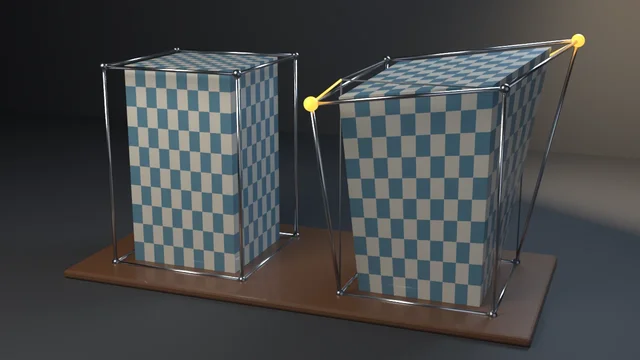
Lattice Deform
A 2x2x2 Lattice modifier set to KEY_LINEAR on all three axes, with two top control points moved through LatticePoint.co_deform, read back through the depsgraph (evaluated_get, to_mesh, to_mesh_clear).
examples/solidify-even-thickness/
Solidify's use_even_offset on a folded strip: off, each fold vertex moves t along the bisector of its face normals and the shell thins to t*cos(phi/2); on, it moves t/cos(phi/2) and stays exactly t thick at 60, 90 and 120 degree folds.
Rendered headless by the example itself. Select it to enlarge.
blender --background --python examples/solidify-even-thickness/solidify_even_thickness.py --
A runnable example that solidifies an open, folded strip with the Solidify modifier and proves, fold by fold, what use_even_offset does to the shell's thickness. The strip is a zigzag profile extruded along Y, folded at bend angles of 60°, 90° and 120°. The evaluated shells are read through the depsgraph lifetime contract from depsgraph-and-evaluated-data (evaluated_get → to_mesh → to_mesh_clear), and the strip is built with bmesh in a try/finally, as mesh-editing-and-bmesh requires.
What it witnesses: in the default Simple mode (solidify_mode = 'EXTRUDE') with offset = -1, the original surface stays put and every vertex gets a copy pushed thickness along its vertex normal. At a fold the vertex normal is the bisector of the two face normals, which meet at the bend angle φ. So:
use_even_offset the copy moves t along the bisector, and the shell's perpendicular thickness at the fold is t · cos(φ/2), which is t · sin(θ/2) for the interior angle θ = 180° − φ. With t = 0.16 that is 0.1386 at 60°, 0.1131 at 90° and 0.0800 at 120°: half the thickness you asked for;use_even_offset the copy moves t / cos(φ/2) along the bisector, and the thickness is exactly t at every fold.The check builds both closed forms from the profile itself, taking the face planes from the segment directions and never from Blender's normals. It measures each shell's perpendicular thickness at every fold and free edge and requires agreement to 1e-5 (measured: 3.7e-8). It also asserts the topology the measurement relies on: 2N evaluated vertices, the first N being the untouched original surface, and copy i at vertex N + i. Finally it checks that the thinning is real, so the witness cannot pass vacuously.
The trap it exposes: use_even_offset is off by default. A script that solidifies a bent panel, a folded bracket or a box with thickness = t gets a wall that is noticeably thinner at every corner, down to half at a 120° bend, and nothing errors. --no-even leaves the flag off on the shell that the check expects to be even, and check 4 fails with the measured thickness.
The still shows both shells in teal glaze side by side on a walnut plinth, viewed nearly end-on. The cut section, Solidify's rim, is drawn in selection-orange enamel through material_offset_rim, so the band's width is the shell's thickness. On the left, with use_even_offset = False, the band pinches at every fold, and to half at the sharp V. A red line on that cut face traces where a t-thick shell's inner face would run: it is the even shell's own evaluated copy positions, placed through the plain shell's transform, so the gap between the orange band and the red line is the thickness lost at each fold, drawn at true size. On the right, with use_even_offset = True, the band stays one width all the way round. Engraved brass plaques name each setting, and brass dowels hold the raised folds off the plinth.
# Cheap correctness check (no render) — the CI check:
blender --background --python solidify_even_thickness.py --

# Falsifier: leave use_even_offset off on the shell checked as even. Must exit 4.
blender --background --python solidify_even_thickness.py -- --no-even

# Also render a still (EEVEE on a GPU host; use --engine cycles on GPU-less hosts):
blender --background --python solidify_even_thickness.py -- --output solidify.png --engine cyclesThe Solidify modifier properties used here (solidify_mode, thickness, offset, use_even_offset, use_rim, material_offset_rim) and the output vertex order (originals first, then copies) are the same on 4.5 LTS, 5.1 and 5.2 LTS. The defaults are also the same: 'EXTRUDE', offset −1, even off, rim on, quality normals off. All values were measured identically on 4.5.11, 5.1.2 and 5.2.1.
| Code | Meaning |
|---|---|
| 0 | Success |
| 1 | Uncaught exception (FATAL wrapper) |
| 2 | argparse / usage |
| 3 | Evaluated topology is not the original surface plus one copy per vertex (2N verts, originals untouched) |
| 4 | The even shell is not t thick at every fold, or its copies are off t / cos(φ/2) (--no-even lands here) |
| 5 | The plain shell is off the t · cos(φ/2) closed form at a fold |
| 6 | The plain shell thins by less than the floor (the witness would pass vacuously) |
| 7 | --output produced no file |
| 10 | --output framing violation (Layer 1 fill / margin gate, gallery_framing) |
The blender-smoke workflow runs the check on Blender 5.2 LTS and 4.5 LTS (5.1 on the weekly cron, the needs-5.1 PR label, or manual dispatch). Smoke does not pass --output. Its catalog falsifier is --no-even (expects exit 4).
A 2x2x2 Lattice modifier set to KEY_LINEAR on all three axes, with two top control points moved through LatticePoint.co_deform, read back through the depsgraph (evaluated_get, to_mesh, to_mesh_clear).
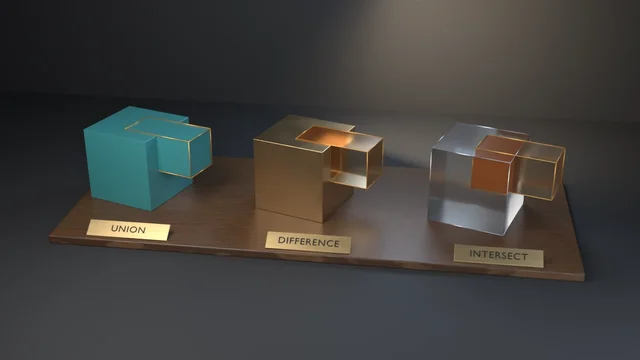
The Boolean modifier on the EXACT solver: union, difference and intersection of a cube and a slab whose top face is coplanar with the cube's, read back through the depsgraph and measured by the divergence theorem.
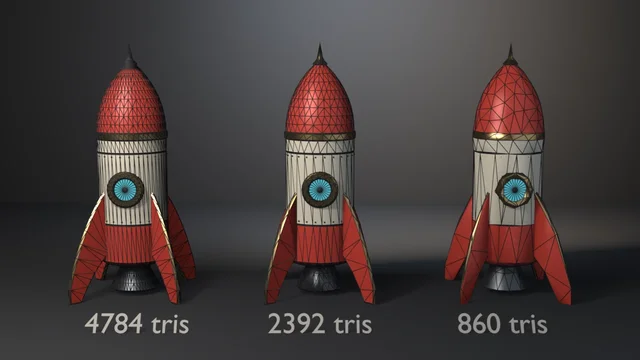
A retro rocket at LOD0/1/2 via the Decimate modifier evaluated through the depsgraph, with a wireframe of each evaluated mesh. The check proves the reduction is non-destructive, the triangle count hits ratio x base within bounds, and silhouette-critical dimensions survive.