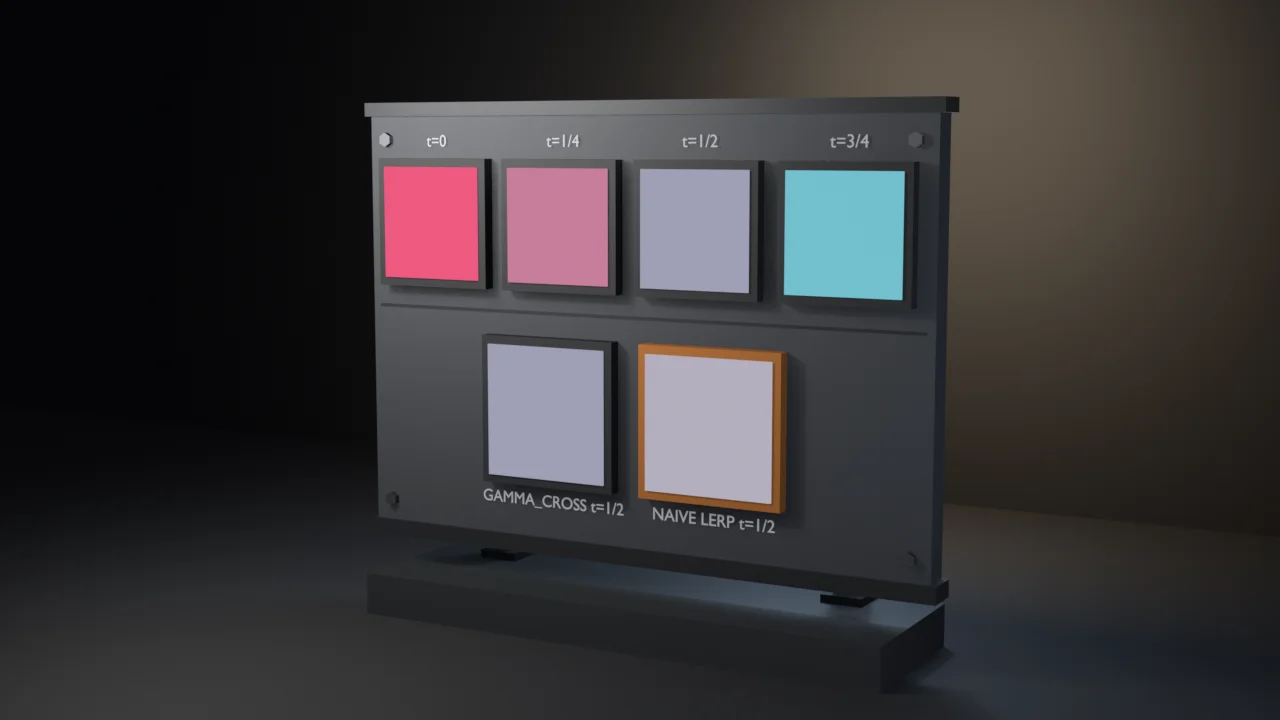
Rendered headless by the example itself — click to zoom.
blender --background --python examples/vse-gamma-cross/vse_gamma_cross.py --
A runnable follow-up to vse-cut-list: the check renders tiny frames across a GAMMA_CROSS between crimson and teal strips and asserts every sample against the fade's actual math — because AI-generated sequencer code assumes the cross is the naive linear mix, and it is not.
What it witnesses: the fade math and the frame convention behind it.
- The cross blends in a gamma-0.5 space. Not
(1-t)·A + t·Bbut((1-t)·√A + t·√B)²— the mid-cross dips below the sRGB lerp. From crimson(0.85, 0.10, 0.22)and teal(0.06, 0.75, 0.80)the midpoint is(0.341, 0.349, 0.463): 0.115 darker on red than the lerp(0.455, 0.425, 0.510). The check renders and asserts nine samples (t = 0, 1/8, …, 7/8, 31/32) within 5e-3 (2× the 8-bit quantization step + fit residual; measured 2.93e-3) and that the mid lerp deviation is material (≥0.05). t = (frame − start) / duration, and it never reaches 1 inside the effect. The last frame of the span blends at(duration−1)/duration; B arrives only when the effect ends. That final frame (frame 32, t = 31/32) is one of the nine asserted samples, so the convention is pixel-backed end to end. An endpoint-inclusive convention is off by a full frame-step (probe: exit 5 at t 0.129 vs 0.125).- The pixel witness demands
view_transform = 'Standard'— the factory default AgX tone-maps the samples and poisons the fit (measured 0.146 on the red channel during authoring), the same class of silent failure the gallery's render standard exists to prevent. Also caught: deleting a consumed input strip orphans-and-deletes the effect (Strip 'GC' not in scene) — remove effects before their inputs.
What each check catches on failure: asserting the naive lerp as the expectation (exit 6, deviation 0.1138 at mid), the endpoint-inclusive t convention (exit 5), and swapped cross inputs (exit 4, input1=T2).
Version witness: the blend math is identical on Blender 4.5 LTS and 5.1 — every sample matches to the quantization step. The creation contract from vse-cut-list still gates the timeline: strips (never .sequences), and new_effect ending in length= on 5.x vs frame_end= on 4.5.
The render is a calibration lightbox: the authentic fade as four backlit chips (t = 0, 1/4, 1/2, 3/4) set into bezels on a bolted steel swatch board — cap rails, panel seam, corner bolts, rear struts down to a plinth — shot at a 3/4 angle so it reads as a staged object. Below the fade row sits the contrast pair: the true mid chip directly beside the naive lerp mid, the impostor framed in hazard orange. The gamma dip reads as an adjacency contrast even at card scale: a naive-lerp cross would make the pair identical, so the still visibly breaks with the contract.
Run
# Correctness check (tiny per-frame sample renders) — the CI check:
blender --background --python vse_gamma_cross.py --

# Also render the calibration lightbox still (EEVEE on a GPU host; cycles on GPU-less):
blender --background --python vse_gamma_cross.py -- --output bench.png
blender --background --python vse_gamma_cross.py -- --output bench.png --engine cycles
It exits non-zero on failure (span drift, wrong inputs, t-convention drift, a sample off the closed form, or a missing gamma dip). The blender-smoke workflow runs the check on Blender 4.5 LTS and 5.1.
Source
"""The GAMMA_CROSS blend curve, asserted per frame — a runnable example.

Witnesses the fade math AI-generated sequencer code most often assumes
wrong: a GAMMA_CROSS between two strips is NOT the naive linear mix
``(1-t)*A + t*B``. It blends in a gamma-0.5 space:

    out = ((1-t)*sqrt(A) + t*sqrt(B))^2,   t = (frame - start) / duration

so the mid-cross dips below the sRGB lerp — from crimson (0.85, 0.10, 0.22)
and teal (0.06, 0.75, 0.80) the midpoint is (0.341, 0.349, 0.463), a full
0.115 darker on the red channel than the lerp (0.455, 0.425, 0.510). The
check renders tiny frames across the cross and asserts every sample against
the closed form, plus that the lerp deviation at mid is material.

Also witnessed: ``t`` never reaches 1 inside the effect — the last frame of
the span blends at (duration-1)/duration; B arrives only when the effect
ends. And the version-gated creation contract from vse-cut-list holds the
whole thing up: ``strips`` (never ``.sequences``), and ``new_effect`` ends
with ``length=`` on 5.x, ``frame_end=`` on 4.5.

The blend math is identical on Blender 4.5 LTS and 5.1 (every sample matches
to the quantization step).

By default it runs only the correctness check (no gallery render) — the CI
smoke check. Pass --output to also render a still:

    blender --background --python vse_gamma_cross.py --                 # check only
    blender --background --python vse_gamma_cross.py -- --output g.png  # + render
"""
import bpy, sys, os, math, argparse, tempfile, shutil

IS_5X = bpy.app.version >= (5, 0, 0)

A_RGB = (0.85, 0.10, 0.22)    # crimson
B_RGB = (0.06, 0.75, 0.80)    # teal
SPAN = (1, 33)                # 32 frames of cross
PXW, PXH = 64, 36             # tiny per-sample renders, CI-safe like vse-cut-list
Q_TOL = 5e-3                  # 2x the 8-bit quantization step + gamma-fit residual (measured 2.93e-3)
LERP_MID_MIN = 0.05           # the gamma dip must be material at t=0.5

# sample frames 1,5,9,...,29 -> t = 0, 1/8, ..., 7/8 exactly, plus the final
# frame of the span: t = (duration-1)/duration — B never arrives inside the
# effect, and that endpoint frame is rendered and asserted like the rest
SAMPLES = [(1 + 4 * k, k / 8) for k in range(8)] + [(32, 31 / 32)]


def strips_coll(se):
    """The only accessor on both supported versions: .strips, never
    .sequences — that rename is part of what this example witnesses."""
    return se.strips


def new_effect(coll, name, typ, ch, span, **kw):
    """Each version's only accepted end kwarg (vse-cut-list's contract)."""
    if IS_5X:
        return coll.new_effect(
            name=name, type=typ, channel=ch,
            frame_start=span[0], length=span[1] - span[0], **kw,
        )
    return coll.new_effect(
        name=name, type=typ, channel=ch,
        frame_start=span[0], frame_end=span[1], **kw,
    )


def strip_span(s):
    if IS_5X:
        return s.left_handle, s.right_handle, s.duration
    return s.frame_final_start, s.frame_final_end, s.frame_final_duration


def build_cross(sc):
    """The two-strip cross: T1/T2 consumed by the GAMMA_CROSS above them
    (effect strips consume inputs only from below — vse-cut-list's wiring)."""
    sc.frame_start = SPAN[0]
    sc.frame_end = SPAN[1]
    se = sc.sequence_editor or sc.sequence_editor_create()
    coll = strips_coll(se)
    t1 = new_effect(coll, "T1", "COLOR", 1, SPAN)
    t1.color = A_RGB
    t2 = new_effect(coll, "T2", "COLOR", 2, SPAN)
    t2.color = B_RGB
    gc = new_effect(coll, "GC", "GAMMA_CROSS", 3, SPAN, input1=t1, input2=t2)
    return gc


def closed_form(t, k):
    """The gamma-0.5 crossfade: mix in sqrt space, square back."""
    return ((1 - t) * math.sqrt(A_RGB[k]) + t * math.sqrt(B_RGB[k])) ** 2


def naive(t, k):
    return (1 - t) * A_RGB[k] + t * B_RGB[k]


def setup_render(sc, w, h):
    sc.render.engine = 'CYCLES'
    sc.cycles.samples = 1
    sc.cycles.use_denoising = False
    sc.render.resolution_x = w
    sc.render.resolution_y = h
    sc.render.resolution_percentage = 100
    sc.render.image_settings.file_format = 'PNG'
    # Standard keeps the strip colors exact (AgX would skew the fit)
    sc.view_settings.view_transform = 'Standard'


def sample_colors(sc, frames, tmp):
    """Render the cross at each frame and read the center pixel."""
    out = {}
    for f in frames:
        path = os.path.join(tmp, f"f{f:03d}.png")
        sc.render.filepath = path
        sc.frame_set(f)
        bpy.ops.render.render(write_still=True)
        img = bpy.data.images.load(path)
        i = ((PXH // 2) * PXW + PXW // 2) * 4
        out[f] = tuple(img.pixels[i:i + 3])
        bpy.data.images.remove(img)
    return out


def check(sc, gc):
    start, end, duration = strip_span(gc)
    if (start, end, duration) != (SPAN[0], SPAN[1], SPAN[1] - SPAN[0]):
        print(f"ERROR: GC span {(start, end, duration)} != closed form "
              f"{(SPAN[0], SPAN[1], SPAN[1] - SPAN[0])}", file=sys.stderr)
        return 3
    if gc.input_1.name != "T1" or gc.input_2.name != "T2":
        print("ERROR: GC inputs are not T1 -> T2", file=sys.stderr)
        return 4

    # the factory default is AgX — tone-mapped samples poison the fit
    # (measured 0.146 on the red channel during authoring); Standard is
    # mandatory for any pixel witness
    setup_render(sc, PXW, PXH)
    tmp = tempfile.mkdtemp(prefix="vse_gamma_")
    try:
        frames = [f for f, _t in SAMPLES]
        got = sample_colors(sc, frames, tmp)
    finally:
        shutil.rmtree(tmp, ignore_errors=True)

    q_err = 0.0
    lerp_mid = 0.0
    worst = None
    for f, t in SAMPLES:
        # t = (frame - start) / duration: never 1 inside the effect
        t_actual = (f - start) / duration
        if abs(t_actual - t) > 1e-12:
            print(f"ERROR: sample t {t_actual} != {t} — t convention drifted",
                  file=sys.stderr)
            return 5
        for k in range(3):
            e = abs(got[f][k] - closed_form(t_actual, k))
            if e > q_err:
                q_err = e
                worst = (f, k)
            if abs(t_actual - 0.5) < 1e-12:
                lerp_mid = max(lerp_mid,
                               abs(naive(t_actual, k) - closed_form(t_actual, k)))
    if q_err > Q_TOL:
        print(f"ERROR: cross sample deviates {q_err:.4f} from the gamma-0.5 "
              f"closed form at {worst} (tol {Q_TOL} — quantization-aware)",
              file=sys.stderr)
        return 6
    if lerp_mid < LERP_MID_MIN:
        print(f"ERROR: mid-cross lerp deviation only {lerp_mid:.4f} — the "
              "gamma dip is missing; the cross reads as a naive mix",
              file=sys.stderr)
        return 7

    print(f"samples={len(SAMPLES)} q_err={q_err:.2e} (tol {Q_TOL}) "
          f"lerp_mid_dev={lerp_mid:.3f} (min {LERP_MID_MIN})")
    mid = tuple(round(closed_form(0.5, k), 4) for k in range(3))
    print(f"mid(t=0.5) closed form {mid} vs lerp "
          f"{tuple(round(naive(0.5, k), 4) for k in range(3))}")
    return 0


# ------------------------------------------------------------- gallery ---

def eevee_engine_id():
    return 'BLENDER_EEVEE' if bpy.app.version >= (5, 0, 0) else 'BLENDER_EEVEE_NEXT'


def build_bench(sc, got):
    """The calibration lightbox: a swatch-booth fixture — glowing chips
    seated in bezels on a bolted steel board, held by rear struts over a
    plinth — shot at a 3/4 angle so it reads as a staged object, not a
    flat test chart. The authentic fade runs as four backlit chips across
    the top (t = 0, 1/4, 1/2, 3/4); the contrast pair is the centerpiece
    below: the true mid directly beside the naive lerp mid in its
    hazard-orange bezel, so the gamma dip reads as an adjacency contrast
    even at card scale. A naive-lerp cross would make the pair identical:
    the render visibly breaks with the contract."""
    import bmesh
    import mathutils
    import math as m

    def mat_principled(name, color, metallic, rough):
        mat = bpy.data.materials.new(name)
        mat.use_nodes = True
        bsdf = mat.node_tree.nodes["Principled BSDF"]
        bsdf.inputs["Base Color"].default_value = (*color, 1.0)
        bsdf.inputs["Metallic"].default_value = metallic
        bsdf.inputs["Roughness"].default_value = rough
        return mat

    # designed non-data surfaces: painted steel board, darker rail/frame
    # steel, dark polymer bezels, machined bolt heads — no Principled
    # defaults
    fixture = mat_principled("FixtureSteel", (0.11, 0.12, 0.14), 0.25, 0.55)
    rail_mat = mat_principled("RailSteel", (0.075, 0.08, 0.09), 0.6, 0.45)
    bezel_mat = mat_principled("BezelPolymer", (0.045, 0.048, 0.055), 0.0, 0.5)
    hot_mat = mat_principled("HotFrame", (0.80, 0.28, 0.06), 0.1, 0.5)
    bolt_mat = mat_principled("BoltSteel", (0.22, 0.23, 0.26), 0.9, 0.5)
    plinth_mat = mat_principled("PlinthSteel", (0.10, 0.11, 0.12), 0.6, 0.5)

    def box(name, dims, loc, mat, rot_x=0.0):
        me = bpy.data.meshes.new(name)
        bm = bmesh.new()
        try:
            bmesh.ops.create_cube(bm, size=1.0,
                                  matrix=mathutils.Matrix.Diagonal((*dims, 1.0)))
            bm.to_mesh(me)
        finally:
            bm.free()
        me.materials.append(mat)
        ob = bpy.data.objects.new(name, me)
        ob.location = loc
        ob.rotation_euler = (rot_x, 0.0, 0.0)
        sc.collection.objects.link(ob)

    def bolt(x, z):
        me = bpy.data.meshes.new("Bolt")
        bm = bmesh.new()
        try:
            bmesh.ops.create_cone(bm, cap_ends=True, cap_tris=False,
                                  segments=6, radius1=0.085, radius2=0.085,
                                  depth=0.07)
            bm.to_mesh(me)
        finally:
            bm.free()
        me.materials.append(bolt_mat)
        ob = bpy.data.objects.new("Bolt", me)
        ob.location = (x, -0.035, z)
        ob.rotation_euler = (m.radians(90), 0.0, 0.0)
        sc.collection.objects.link(ob)

    def swatch(name, rgb):
        # the data faces stay pure emission: exact values, no specular,
        # no texture — the image is a data display
        mat = bpy.data.materials.new(f"Swatch{name}")
        mat.use_nodes = True
        nt = mat.node_tree
        nt.nodes.clear()
        out = nt.nodes.new("ShaderNodeOutputMaterial")
        em = nt.nodes.new("ShaderNodeEmission")
        em.inputs["Color"].default_value = (*rgb, 1.0)
        em.inputs["Strength"].default_value = 1.0
        nt.links.new(em.outputs["Emission"], out.inputs["Surface"])
        return mat

    def chip(name, rgb, x, z, size, hot=False):
        # glowing chip seated proud of its bezel; the naive impostor keeps
        # the hazard-orange frame — a broken (naive) cross would make the
        # framed chip match its neighbor
        box(f"Bezel{name}", (size + 0.20, 0.16, size + 0.20),
            (x, -0.08, z), hot_mat if hot else bezel_mat)
        box(f"Chip{name}", (size, 0.12, size), (x, -0.13, z),
            swatch(name, rgb))

    # the booth: bolted board with cap rails, rear struts down to the plinth
    box("Board", (7.20, 0.34, 5.00), (0.0, 0.17, 3.50), fixture)
    box("RailTop", (7.34, 0.42, 0.16), (0.0, 0.17, 6.06), rail_mat)
    box("RailBottom", (7.34, 0.42, 0.20), (0.0, 0.17, 0.94), rail_mat)
    # panel seam between the fade row and the contrast pair
    box("Seam", (7.00, 0.02, 0.035), (0.0, -0.005, 3.70), rail_mat)
    for bx in (-3.36, 3.36):
        for bz in (1.30, 5.70):
            bolt(bx, bz)
    for sx in (-2.30, 2.30):
        box("Strut", (0.30, 0.34, 2.32), (sx, 0.70, 1.60), rail_mat,
            rot_x=m.radians(18))
        box("Foot", (0.50, 0.64, 0.10), (sx, 1.02, 0.55), rail_mat)
    box("Plinth", (6.60, 2.00, 0.50), (0.0, 0.35, 0.25), plinth_mat)

    by_t = {t: f for f, t in SAMPLES}
    # the authentic fade across the top, left to right
    top = [(0.0, "t=0"), (0.25, "t=1/4"), (0.5, "t=1/2"), (0.75, "t=3/4")]
    top_xs = [-2.625 + 1.75 * i for i in range(4)]
    for (t, _label), x in zip(top, top_xs):
        chip(f"t{t}", got[by_t[t]], x, z=4.72, size=1.32)
    # the contrast pair at center: true mid beside the naive mid
    chip("true_mid", got[by_t[0.5]], -1.05, z=2.55, size=1.55)
    chip("naive_mid", tuple(naive(0.5, k) for k in range(3)),
         1.05, z=2.55, size=1.55, hot=True)

    # captions: t-labels crown the fade chips; the pair is named beneath it
    cu_mat = bpy.data.materials.new("CaptionGrey")
    cu_mat.use_nodes = True
    cb = cu_mat.node_tree.nodes["Principled BSDF"]
    cb.inputs["Base Color"].default_value = (0.42, 0.44, 0.48, 1.0)
    cb.inputs["Metallic"].default_value = 0.2
    cb.inputs["Roughness"].default_value = 0.6
    sock = cb.inputs.get("Emission Color") or cb.inputs["Emission"]
    sock.default_value = (0.38, 0.40, 0.45, 1.0)
    cb.inputs["Emission Strength"].default_value = 0.5

    def caption(text, x, z, size, y=-0.03):
        cu = bpy.data.curves.new("Caption", 'FONT')
        cu.body = text
        cu.align_x = 'CENTER'
        cu.size = size
        cu.extrude = 0.004
        ob = bpy.data.objects.new("Caption", cu)
        ob.location = (x, y, z)
        ob.rotation_euler = (m.radians(90), 0.0, 0.0)
        ob.data.materials.append(cu_mat)
        sc.collection.objects.link(ob)

    for (_t, label), x in zip(top, top_xs):
        caption(label, x, 5.62, 0.20)
    caption("GAMMA_CROSS t=1/2", -1.05, 1.42, 0.20)
    caption("NAIVE LERP t=1/2", 1.05, 1.42, 0.20)


def render_still(sc, got, path, engine):
    scene = sc
    build_bench(scene, got)

    import mathutils, bmesh
    floor_me = bpy.data.meshes.new("Floor")
    bm = bmesh.new()
    try:
        bmesh.ops.create_grid(bm, x_segments=1, y_segments=1, size=30.0)
        bm.to_mesh(floor_me)
    finally:
        bm.free()
    fmat = bpy.data.materials.new("Studio")
    fmat.use_nodes = True
    fb = fmat.node_tree.nodes["Principled BSDF"]
    fb.inputs["Base Color"].default_value = (0.03, 0.032, 0.037, 1.0)
    fb.inputs["Roughness"].default_value = 0.7
    floor_me.materials.append(fmat)
    floor = bpy.data.objects.new("Floor", floor_me)
    scene.collection.objects.link(floor)
    wall = bpy.data.objects.new("Wall", floor_me.copy())
    wall.location = (0.0, 9.0, 0.0)
    wall.rotation_euler = (math.radians(90), 0.0, 0.0)
    scene.collection.objects.link(wall)

    world = bpy.data.worlds.new("World")
    world.use_nodes = True
    world.node_tree.nodes["Background"].inputs["Color"].default_value = (0.02, 0.021, 0.025, 1.0)
    scene.world = world

    def light(name, loc, energy, size, col, target):
        ld = bpy.data.lights.new(name, 'AREA')
        ld.energy = energy; ld.size = size; ld.color = col
        ob = bpy.data.objects.new(name, ld)
        ob.location = loc
        d = mathutils.Vector(target) - ob.location
        ob.rotation_euler = d.to_track_quat('-Z', 'Y').to_euler()
        scene.collection.objects.link(ob)

    # shaped warm key, faint cool fill, cool rim, and the signature warm
    # wedge between booth and wall raking a pool onto the backdrop — the
    # wall itself stays near-black outside the pool (docs/VISUAL-STYLE.md)
    light("Key", (-4.0, -4.5, 7.0), 460.0, 4.5, (1.0, 0.96, 0.9), (0.0, 0.2, 3.0))
    light("Fill", (6.0, -3.0, 3.0), 90.0, 9.0, (0.75, 0.85, 1.0), (0.5, 0.0, 2.8))
    light("Rim", (0.5, 4.5, 7.0), 320.0, 4.0, (0.6, 0.78, 1.0), (0.0, 0.3, 4.2))
    light("Wedge", (0.5, 5.5, 6.0), 420.0, 5.5, (1.0, 0.76, 0.5), (0.5, 9.0, 4.2))

    # 3/4 angle from the right: the booth shows face, side, and cast shadow
    cam_data = bpy.data.cameras.new("Cam")
    cam_data.lens = 50.0
    cam = bpy.data.objects.new("Cam", cam_data)
    cam.location = (9.7, -17.5, 5.7)
    scene.collection.objects.link(cam)
    target = bpy.data.objects.new("Aim", None)
    target.location = (0.0, 0.2, 3.2)
    scene.collection.objects.link(target)
    con = cam.constraints.new('TRACK_TO')
    con.target = target
    scene.camera = cam

    scene.render.engine = 'CYCLES' if engine == 'cycles' else eevee_engine_id()
    if engine == 'cycles':
        scene.cycles.samples = 32
    else:
        try:
            scene.eevee.taa_render_samples = 64
        except AttributeError:
            pass
    scene.render.resolution_x = 1280
    scene.render.resolution_y = 720
    scene.render.resolution_percentage = 100
    scene.render.image_settings.file_format = 'PNG'
    scene.render.filepath = path
    # Standard keeps the swatch colors true (docs/VISUAL-STYLE.md)
    scene.view_settings.view_transform = 'Standard'
    bpy.ops.render.render(write_still=True)
    return os.path.exists(path) and os.path.getsize(path) > 0


def main():
    argv = sys.argv[sys.argv.index("--") + 1:] if "--" in sys.argv else []
    p = argparse.ArgumentParser()
    p.add_argument("--output", default=None, help="optional: render a still PNG here")
    p.add_argument("--engine", default="eevee", choices=("eevee", "cycles"),
                   help="render engine for --output (cycles for GPU-less hosts)")
    args = p.parse_args(argv)

    bpy.ops.wm.read_factory_settings(use_empty=True)
    sc = bpy.context.scene
    gc = build_cross(sc)
    code = check(sc, gc)
    if code:
        return code

    if args.output:
        # re-sample the authentic cross colors for the bench panels
        setup_render(sc, PXW, PXH)
        tmp = tempfile.mkdtemp(prefix="vse_gamma_still_")
        try:
            got = sample_colors(sc, [f for f, _t in SAMPLES], tmp)
        finally:
            shutil.rmtree(tmp, ignore_errors=True)
        # the bench is a 3D scene: clear the timeline or the sequencer
        # composites the last cross frame over everything (a full-teal
        # still). Effects first: deleting inputs orphans-and-deletes the
        # effect ("Strip 'GC' not in scene" otherwise)
        coll = strips_coll(sc.sequence_editor)
        for s in reversed(list(coll)):
            coll.remove(s)
        if not render_still(sc, got, os.path.abspath(args.output), args.engine):
            print("ERROR: render produced no file", file=sys.stderr)
            return 8
        print(f"rendered still {args.output}")

    print("vse-gamma-cross OK")
    return 0


if __name__ == "__main__":
    try:
        sys.exit(main())
    except Exception as e:
        import traceback; traceback.print_exc(); print(f"FATAL: {e}", file=sys.stderr); sys.exit(1)