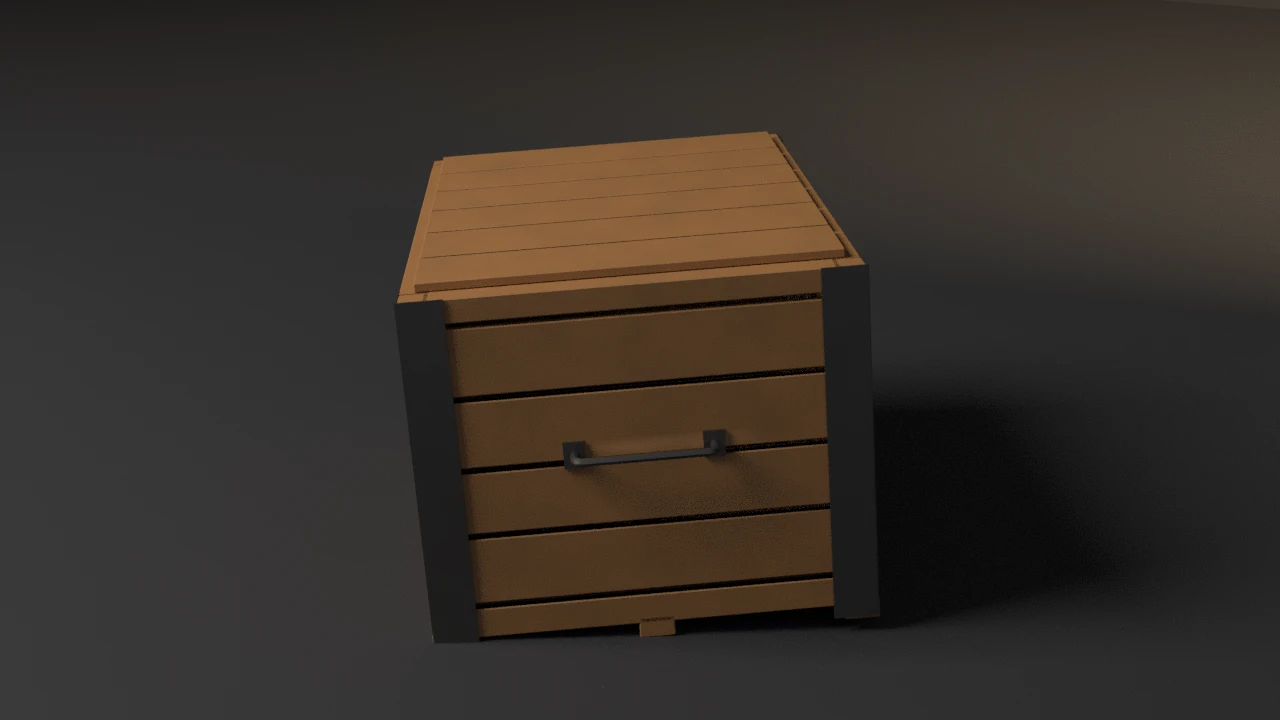
shipping-crate
A procedural shipping crate through UVs, bake, LOD, collider, and Unity glTF, asserting recomputed budgets rather than an API contract.
A procedural archery range target on a turf patch — a 1.10 m compressed-straw boss coiled from rope courses that show on its back and round its edge, bound with doubled jute twine drawn tight over the crests; an 80 cm ten-zone World Archery face in aged inks with ring lines, an X ring and a printed X, held by four target pins; a timber easel leaning it back 12° on toe skids with knee braces, a ledge with a stop lip on a bolted rail and gussets, a numbered butt board, a strap hinge pinned to a rear leg in a steel ferrule and foot, and a splay chain between eye bolts; five carbon arrows in the face with cresting, nocks and three vanes, one glancing into the straw edge, one snapped with its fletched half on the grass, and a leather quiver of arrows lying among grass tufts — through UVs, bake, LOD, collider, and Unity glTF, asserting recomputed budgets rather than an API contract.
Rendered headless by the showcase piece itself — click to zoom.
category Sports
blender --background --python showcase/archery-target/archery_target.py --
A showcase piece, not an example, and the fifth in the sports category. It builds a procedural archery range target on a turf patch:
The layout is solved from named constants. The boss's lowest edge course bites the ledge 2.5 mm and its back crests bite both front legs 2 mm; the legs are placed from the boss, not the other way round. Arrows are placed by where they hit the face and how far they went in. The half arrow and the quiver are levelled on their own lowest points and dropped onto the turf.
It asserts budget conformance of the generated result. It does not witness an API contract. "It rendered without error" is not a check.
Composes skills mesh-editing-and-bmesh, bake-high-to-low, depsgraph-and-evaluated-data, engine-export-presets, and snippets bake_normal_high_to_low.py, setup_bake_target_image.py, lod_chain.py / decimate_to_budget.py, convex_hull_collider.py, export_preset_unity.py (helpers copied inline, not imported).
Intended size: 2.01 m across the turf patch, 2.69 m front to back, 2.05 m to the top of the front legs. The turf sets the width and depth, the leg tops the height. The centre of the gold stands 1.30 m above the turf, the World Archery height.
Every budget is declared as a named constant. Every gate recomputes its value from the mesh, materials, UVs, evaluated LOD, collider, or export file.
| Axis | Declared | Measured (5.2.1) |
|---|---|---|
| Base triangles | 42000–44000 | 42908 |
| LOD1 ratio | 0.32–0.62 of base | 0.5000 |
| LOD2 ratio | 0.10–0.35 of base | 0.2200 |
| Materials | exactly 16 distinct; ≥4490 straw, ≥1760 twine, ≥1030 pine, ≥5970 steel, ≥495 white, ≥775 black, ≥120 blue, ≥120 red, ≥240 gold, ≥310 carbon, ≥475 vane, ≥285 cock vane, ≥1020 nock, ≥4960 grass, ≥270 soil, ≥730 leather faces | 16 slots; 4732 / 1856 / 1086 / 6288 / 522 / 816 / 128 / 128 / 254 / 326 / 500 / 300 / 1076 / 5230 / 286 / 768 |
| UVs | in 0..1, AABB overlap ≤ 1e-5 | in range, overlap 0 |
| Outer AABB | (2.0071, 2.6887, 2.0538) m ± 0.01 | (2.0071, 2.6887, 2.0538), zmin 0 |
| Collider tris | ≤ 1150 | 1083 |
| Export | written, size > 0, removed after measuring | 3288248 bytes |
The collider is the convex hull of the whole piece; its count is carried by the 96-segment turf outline.
Every falsifier leaves the triangle count at 42908 and the AABB unchanged: they move parts or change a length, never add or remove geometry.
DECIMATE COLLAPSE triangle counts are not identical across Blender series, so the LOD gate is a ratio band, not an exact count. Bake pixels are stochastic, so the bake gate is has_data plus operator FINISHED, not byte-identity. Construction uses only seeded random.Random streams; two default runs print identical measurements.
Recomputed from the generated mesh, not asserted about the script.
| Axis | Declared | Measured |
|---|---|---|
| Non-manifold edges | 0 | 0 |
| Loose verts / edges | 0 / 0 | 0 / 0 |
| Doubles merged at 1e-5 | 0 | 0 |
| Zero-area faces | 0 | 0 |
| N-gons | 0 | 0 |
| Coplanar cross-shell face pairs (KD range 0.05 m, plane ε 1e-4) | 0 | 0 |
Grounded: zmin | within 1e-4 of 0 | 0.0000 |
| Supports: both skids and the rear tread bedded into the turf (turf top read off the mesh) | 3 supports, 1–4 mm | 2.0 mm each |
The first draft measured 741 coplanar pairs, all fixed in the model. The two strands of each binding ended in caps on one plane (256): they now dive to different depths. The three vanes of each arrow had their rear edges on one plane square to the shaft (54): the rear edge is raked. The three quiver arrows' nocks ended on one plane and two of them shared vane angles (199): each tip bites the quiver floor a different depth and each lathe is turned by its arrow's roll. Pairs of domed bolt heads put side facets on one plane (232): heads are turned a quarter segment so no facet is square to the head's frame. The hinge leaf's edge sat on a knuckle's end face: the leaf is 2 mm narrower.
| Axis | Declared | Measured |
|---|---|---|
| Hinge: each of the 3 knuckles' centres (vertex mean of the ring) against the pin's axis (PCA) | 3 knuckles; ≤ 0.3 mm | 0.000 mm |
| Boss on its ledge: the ledge's top along the face's up axis minus the boss's lowest point, which must lie over the ledge; each front leg's front face minus the boss's back crests over that leg, along the face normal | seat 1–4 mm; lean 1–4 mm on both legs | 2.5 mm; 2.0, 2.0 mm |
| Regulation and size: gold centre above the turf; boss diameter and thickness about the face's axis; face diameter; tilt of the face normal | 1.30 ± 0.05 m; 1.100, 0.280 ± 0.004; 0.800 ± 0.002; 10–15° | 1.3000; 1.1000, 0.2800; 0.8000; 12.000° |
| Points buried: every shaft with a steel point whose tip is inside the boss; a ray back along the shaft to where it leaves the straw, and one forward to the straw left ahead | 7 arrows; 0.08–0.20 m; ahead ≥ 0.01 m | 7; 0.119–0.149 m; ≥ 0.051 m |
| Fletching clear: every vane's signed distance from the boss surface (BVH nearest, sign by the face normal) | ≥ 0.25 m | 0.419 m |
| Vanes at 120°: every vane assigned to the nearest shaft axis; its angle round that axis | 10 fletched shafts, 3 vanes each; gaps within 1° of 120° | as declared; 0.002° |
| Scoring rings: annuli of the paper's front read off the mesh; each ring line's centre radius, and every zone and line in the ink the table gives it | lines at 0.02, 0.04 … 0.36 m ± 0.5 mm; 0 wrong | 0.000 mm off; 0 |
| Stability: mass centre of boss, face, bindings, stand and hardware (shell volume × density: straw 160, pine 500, twine 500, paper 700, steel 7850 kg/m³) against the convex hull of the supports' contact points; forward tip angle over the front edge | inside; tip ≥ 20° | 73.85 kg, 0.349 m inside; 27.83° |
| One connected assembly (union of shells whose BVH trees overlap) | 1 component | 1 (722 shells) |
A boss is only safe on an easel if it sits on its ledge and against both legs. The gold height is the World Archery rule, measured from the turf read off the mesh. An arrow that has not buried its point falls out; one whose fletching reaches the face was shot through the boss. The scoring table is what makes the face a target face. An archer pulling arrows leans on the boss; the toe skids carry the stand's front edge forward of its mass centre, and the tip angle is what they buy.
Each falsifier violates one named budget. Every one was run on 5.2.1 and exited its declared code, with the triangle count and AABB unchanged and every budget checked before the target still green.
| Flag | Budget violated | Exit |
|---|---|---|
--skip-decimate | LOD1 ratio band (measured 1.0000) | 9 |
--stray-vert | loose vertex count is 0 (measured 1, placed inside the envelope) | 15 |
--lift-z | bounding box zmin is 0 (measured 0.05000) | 16 |
--float-foot | every support bedded in the turf (rear tread and ferrule 6 mm up: bite −0.004 m) | 16 |
--offset-hinge | hinge pin coaxial with its knuckles (pin 2.5 mm up the face: all three 0.0025 m off) | 17 |
--lift-boss | boss resting on its ledge (boss and all it carries 6 mm up the legs: seat −0.0035 m, lean unchanged) | 18 |
--high-boss | regulation gold height (boss, ledge, rail and gussets 80 mm up the legs: 1.3783 m) | 19 |
--shallow-arrow | every point buried (third arrow in 30 mm: 0.0287 m) | 20 |
--short-arrow | every fletching clear of the face (second arrow a 0.40 m shaft: a vane 0.1420 m from the straw) | 21 |
--skew-vane | vanes at 120° (one vane of the first arrow turned 15°: 15.000° off) | 22 |
--wide-gold | ring radii of the scoring table (gold/red line printed at 0.09 m) | 23 |
--short-skids | forward tip angle (skid toes cut back to 50 mm ahead of the legs: 15.20°, mass centre still 0.289 m inside) | 24 |
--loose-pin | one connected assembly (one target pin 75 mm out of the face: 2 components) | 25 |
--lift-boss moves the boss along the legs, so it still leans on both. --high-boss moves the ledge with the boss, so the seat holds and only the height fails. --shallow-arrow pushes the fletching further from the face. --short-arrow keeps the point's depth. --short-skids keeps both skids bedded and the mass centre inside the supports.
blender --background --python archery_target.py --
blender --background --python archery_target.py -- --skip-decimate
blender --background --python archery_target.py -- --stray-vert
blender --background --python archery_target.py -- --lift-z
blender --background --python archery_target.py -- --float-foot
blender --background --python archery_target.py -- --offset-hinge
blender --background --python archery_target.py -- --lift-boss
blender --background --python archery_target.py -- --high-boss
blender --background --python archery_target.py -- --shallow-arrow
blender --background --python archery_target.py -- --short-arrow
blender --background --python archery_target.py -- --skew-vane
blender --background --python archery_target.py -- --wide-gold
blender --background --python archery_target.py -- --short-skids
blender --background --python archery_target.py -- --loose-pin
blender --background --python archery_target.py -- --output target.png
Smoke passes no flags.
The hero turns the piece HERO_YAW_DEG (6°), so the face meets the camera at about a third of a right angle: the left edge with its glancing arrow, the bindings and the courses show, and the arrows in the face read at length. The wall stands 3.4 m behind the target, and the warm wedge pools on it.
File-local. 9 is a valid check code. 10 is reserved for gallery_framing.check_framing on the --output path. 15–19 are the hygiene and joint-fit family. 20–25 are file-local. 26 is the asset-quality floor on the render path: check_asset_quality returns 11, which this piece already spends on the collider ceiling, so the call site remaps it.
| Code | Meaning |
|---|---|
| 0 | Success |
| 1 | Uncaught exception (FATAL wrapper) |
| 2 | argparse / usage |
| 3 | Mesh did not build / no UV layer |
| 4 | Base triangle count outside range |
| 5 | Material count ≠ 16 distinct slots, or a face-count floor missed |
| 6 | UVs outside 0..1 |
| 7 | UV AABB overlap above tolerance |
| 8 | World AABB off declared outer size |
| 9 | LOD ratio band (--skip-decimate lands here) |
| 10 | Framing gate (render path only) |
| 11 | Collider triangle count above ceiling |
| 12 | Bake did not finish or image has no data |
| 13 | Export file missing or empty |
| 14 | --output produced no file |
| 15 | Mesh hygiene: loose, non-manifold, zero-area, doubles, n-gons, coplanar cross-shell pairs |
| 16 | Not grounded: bounding box zmin off 0, or a support not bedded 1–4 mm into the turf, or not 3 supports (--lift-z, --float-foot) |
| 17 | Hinge: not 3 knuckles, or one off the pin's axis (--offset-hinge) |
| 18 | Boss not resting on its ledge, or not leaning on both legs (--lift-boss) |
| 19 | Regulation: gold height, boss or face size, or tilt off (--high-boss) |
| 20 | Arrow points: not 7 in the boss, one buried outside its band, or through the back (--shallow-arrow) |
| 21 | Fletching: a vane closer to the boss than its clearance (--short-arrow) |
| 22 | Vanes: not 10 fletched shafts of 3, or spacing off 120° (--skew-vane) |
| 23 | Scoring rings: a line off the table, or a zone in the wrong ink (--wide-gold) |
| 24 | Stability: mass centre outside the supports, or forward tip angle under its floor (--short-skids) |
| 25 | Assembly: not one connected component (--loose-pin) |
| 26 | Asset-quality floor (render path only; remapped from 11) |
"""Game-ready archery range target — a showcase piece, not an example. Asserts budget conformance of a procedural archery range target after composing shipped pipeline pieces: bmesh construction, UVs, sixteen materials, high-to-low normal bake, LOD chain, convex collider, Unity glTF export. A 1.10 m compressed-straw boss, coiled from rope courses that show on its back and round its edge and bound with doubled jute twine, carries an 80 cm ten-zone paper face (gold, red, blue, black and white, with ring lines, an X ring and a printed X) held by four target pins. The boss leans back 12 degrees on a timber easel: two front legs on toe skids, a ledge on a rail and two gussets that the boss rests on, a numbered butt board, a head block, a strap hinge pinned to a single rear leg with a steel ferrule and foot, and a chain between two eye bolts that limits the splay. Five arrows stand in the face, a sixth glances into the straw edge, a seventh is snapped off in the black with its fletched half lying on the grass, and a leather quiver with three arrows lies on the turf patch among grass tufts. Budgets are declared below and recomputed from the generated result. They are not API-contract witnesses. Each falsifier violates one named budget: ``--skip-decimate`` the LOD-ratio band, ``--stray-vert`` mesh hygiene, ``--lift-z`` grounded zmin, ``--float-foot`` every support bedded in the turf, ``--offset-hinge`` the hinge pin coaxial with its knuckles, ``--lift-boss`` the boss resting on its ledge, ``--high-boss`` the regulation gold height, ``--shallow-arrow`` every point buried in the straw, ``--short-arrow`` every fletching clear of the face, ``--skew-vane`` the vanes at 120 degrees, ``--wide-gold`` the ring radii of the scoring table, ``--short-skids`` the forward tip angle, ``--loose-pin`` one connected assembly. No RNG beyond seeded ``random.Random`` streams. DECIMATE COLLAPSE triangle counts are not byte-identical across Blender versions — the LOD gate is a ratio band, not an exact count. blender --background --python archery_target.py -- blender --background --python archery_target.py -- --skip-decimate blender --background --python archery_target.py -- --output target.png """ import argparse import math import os import random import sys import tempfile import traceback import bmesh import bpy import numpy as np from mathutils import Matrix, Vector from mathutils.bvhtree import BVHTree from mathutils.kdtree import KDTree # Showcase lives at repo-root/showcase/, not under examples/. The framing # helper is the repo's only shared import and lives next to the examples; # resolve the repo root so we do not move gallery_framing.py. _REPO = os.path.abspath( os.path.join(os.path.dirname(os.path.abspath(__file__)), os.pardir, os.pardir) ) sys.path.insert(0, os.path.join(_REPO, "examples")) sys.dont_write_bytecode = True import gallery_framing # noqa: E402 import gallery_asset_quality # noqa: E402 # --- Frame (x across, y from the shooting line (-y) back, z up) ----------------- TILT_DEG = 12.0 # the boss leans back this far _T = math.radians(TILT_DEG) XV = Vector((1.0, 0.0, 0.0)) YAX = Vector((0.0, 1.0, 0.0)) ZAX = Vector((0.0, 0.0, 1.0)) UVEC = Vector((0.0, math.sin(_T), math.cos(_T))) # up the face NV = Vector((0.0, -math.cos(_T), math.sin(_T))) # face normal, toward the archer BOSS_ROT = Matrix((XV, UVEC, NV)).transposed() # lathe frame: local z along NV # --- Turf patch --------------------------------------------------------------------- TURF_TOP = 0.050 TURF_HX = 1.00 TURF_HY = 1.34 TURF_CY = 0.28 TURF_SEGS = 96 # --- Boss: coiled straw rope courses ---------------------------------------------- R_BOSS = 0.550 # to the crest of the edge courses H_BOSS = 0.280 # back crests to front-annulus crests COURSE_A = 0.007 # rope course relief COURSE_P = 0.050 # rope course pitch (target; fitted to a whole number) BOSS_SH = 0.035 # corner radius of the coil section BOSS_R0 = 0.030 FLAT_R = 0.430 # the face is pressed flat inside this radius FADE_R = 0.470 BOSS_SEGS = 64 GOLD_H = 1.300 # World Archery: centre of gold 130 cm above the ground # twine bindings: doubled strands over the edge at 8 stations TW_BANDS = 8 TW_R0 = 0.455 # where each binding dives into the face / back TW_R_A = 0.0035 TW_R_B = 0.0031 TW_SEP = 0.0068 TW_BITE = 0.0008 # --- Paper face: 80 cm, ten zones 4 cm wide ------------------------------------------- PAPER_R = 0.400 PAPER_R0 = 0.006 PAPER_T = 0.0015 PAPER_BITE = 0.0003 LINE_W = 0.0016 LINE_RADII = (0.02, 0.04, 0.08, 0.12, 0.16, 0.20, 0.24, 0.28, 0.32, 0.36) WIDE_GOLD_R = 0.09 # --wide-gold misprints the gold/red boundary here X_ARM = 0.0060 X_HALF = 0.0008 PIN_RING = 0.385 W_FLAT = 0.5 * H_BOSS - COURSE_A W_PB = W_FLAT - PAPER_BITE W_PF = W_PB + PAPER_T C_Z = TURF_TOP + GOLD_H - NV.z * W_PF C0 = Vector((0.0, 0.0, C_Z)) # --- Easel: front legs, skids, ledge ------------------------------------------------------ LEAN_BITE = 0.002 # back crests into the legs' front faces LEG_A = 0.330 LEG_HW = 0.035 LEG_HD = 0.0225 W_LF = -0.5 * H_BOSS + LEAN_BITE W_LC = W_LF - LEG_HD W_LB = W_LF - 2.0 * LEG_HD APEX_Z = 2.050 SKID_BITE = 0.002 SKID_H = 0.070 SKID_HW = 0.042 SKID_FRONT = 0.320 SKID_BACK = 0.220 SHORT_SKID_FRONT = 0.050 SKID_TOP = TURF_TOP - SKID_BITE + SKID_H LEG_TENON = 0.030 SEAT_BITE = 0.0025 # the lowest edge course presses into the ledge SHELF_T = 0.030 B_ST = -R_BOSS + SEAT_BITE B_SB = B_ST - SHELF_T SHELF_HA = 0.500 SHELF_W0 = W_LF - 0.012 SHELF_W1 = 0.5 * H_BOSS + 0.035 RAIL_HA = 0.440 RAIL_H = 0.090 RAIL_D = 0.040 RAIL_IN = 0.002 RAIL_BITE = 0.002 B_RT = B_SB + RAIL_BITE W_R0 = W_LF - RAIL_IN W_RF = W_R0 + RAIL_D GUSSET_A = 0.200 GUSSET_T = 0.028 LIP_H = 0.022 LIP_D = 0.022 BRACE_HW = 0.020 BRACE_HD = 0.016 BRACE_TOE = 0.230 # from the leg foot along the skid BRACE_TOE_Z = 0.420 # where it meets the leg BRACE_HEEL = 0.170 BRACE_HEEL_Z = 0.300 # number board, head, hinge BD_HA = 0.400 BD_H = 0.130 BD_D = 0.018 B_BD0 = R_BOSS + 0.020 W_BD0 = W_LF - 0.002 BUTT_NO = "12" HEAD_HA = 0.400 HEAD_H = 0.120 HEAD_D = 0.045 W_H0 = W_LB + 0.002 W_HB = W_H0 - HEAD_D KR = 0.011 # knuckle radius PIN_R = 0.004 LEAF_T = 0.005 LEAF_A_L = 0.085 LEAF_B_L = 0.110 REAR_DEG = 28.0 _R = math.radians(REAR_DEG) DR = Vector((0.0, math.sin(_R), -math.cos(_R))) # down the rear leg NR = Vector((0.0, -math.cos(_R), -math.sin(_R))) # rear leg's front face normal RL_HW = 0.030 RL_HD = 0.0225 RL_TOP_E = 0.020 RL_OFF = KR + 0.4 * LEAF_T + RL_HD RL_FOOT_Z = TURF_TOP + 0.050 FER_GAP = 0.003 FER_DOWN = 0.035 FER_UP = 0.070 FOOT_BITE = 0.002 TREAD_H = 0.036 TREAD_HX = 0.048 TREAD_HY = 0.050 # stretcher, eye bolts, chain STR_HA = 0.400 STR_H = 0.070 STR_D = 0.040 STR_Z = 0.400 EYE_Z = 0.440 EB_R = 0.0040 EB_STEM = 0.012 ER = 0.014 EW = 0.0032 CW = 0.0030 RL_LINK = 0.0070 CHAIN_BITE = 0.0006 CHAIN_SLRL = 0.019 # --- Arrows --------------------------------------------------------------------------------- ARROW_L = 0.740 SHORT_ARROW_L = 0.400 R_SHAFT = 0.0030 ARROW_SEGS = 10 VANE_S1 = 0.105 # vane front, from the nock end VANE_LEN = 0.065 VANE_H = 0.014 VANE_T = 0.0008 VANE_BITE = 0.0008 VANE_SKEW = 15.0 # (a, b on the face, yaw, pitch, penetration, roll) FACE_ARROWS = ( (0.030, 0.045, -8.0, -3.0, 0.140, 10.0), (-0.055, -0.020, -11.0, -4.5, 0.150, 50.0), (0.095, -0.085, -6.0, -2.0, 0.130, 95.0), (-0.020, 0.140, -9.5, -5.0, 0.145, 25.0), (0.175, 0.090, -5.0, -3.5, 0.135, 70.0), ) SHALLOW_PEN = 0.030 STUB = (-0.215, 0.205, -2.0, -4.0, 0.120, 0.240) # a, b, yaw, pitch, pen, length EDGE_ARROW = (140.0, 0.030, 0.35, -3.0, 0.120, 40.0) # phi, w, inward, pitch, pen, roll HALF_ARROW = (0.60, -0.62, 200.0, 0.460) # x, y, heading, length QUIVER = (-0.64, -0.46, -38.0) # x, y, mouth heading QL = 0.500 Q_BITE = 0.0015 Q_ARROWS = ((0.020, 0.010, 15.0), (0.022, -0.013, 55.0), (0.006, 0.001, 100.0)) TUFT_SEED = 11 TONE_SEED = 5 # --- Falsifier sizes ----------------------------------------------------------------------- FLOAT_FOOT = 0.006 OFFSET_HINGE = 0.0025 LIFT_BOSS = 0.006 HIGH_BOSS = 0.080 LOOSE_PIN = 0.075 BBOX_TOL = 0.01 # Fitted after locking geometry. Recomputed from bound_box. OUTER_SIZE = (2.0071, 2.6887, 2.0538) BASE_TRIS_MIN = 42000 BASE_TRIS_MAX = 44000 LOD1_RATIO_MIN = 0.32 LOD1_RATIO_MAX = 0.62 LOD2_RATIO_MIN = 0.10 LOD2_RATIO_MAX = 0.35 LOD1_TARGET = 0.50 LOD2_TARGET = 0.22 MATERIAL_COUNT = 16 UV_EPS = 1e-4 UV_OVERLAP_MAX = 1e-5 COLLIDER_TRIS_MAX = 1150 BAKE_RES = 1024 CAGE_EXTRUSION = 0.004 # face floors per slot, in slot order (straw, twine, timber, steel, white, black, # blue, red, gold, carbon, vane, cock vane, nock, grass, soil, leather) FACE_FLOORS = (4490, 1760, 1030, 5970, 495, 775, 120, 120, 240, 310, 475, 285, 1020, 4960, 270, 730) ZMIN_EPS = 1e-4 DOUBLES_EPS = 1e-5 AREA_EPS = 1e-10 COPLANAR_NORMAL_EPS = 1e-4 COPLANAR_PLANE_EPS = 1e-4 COPLANAR_CENTRE_MAX = 0.05 LIFT_Z = 0.05 # supports: two skids and the rear tread bedded in the turf SUPPORT_COUNT = 3 SUPPORT_BITE_MIN = 0.001 SUPPORT_BITE_MAX = 0.004 # hinge: one pin through three knuckles KNUCKLE_COUNT = 3 HINGE_AXIS_TOL = 0.0003 # boss rests on the ledge and leans on both legs SEAT_MIN = 0.001 SEAT_MAX = 0.004 LEAN_MIN = 0.001 LEAN_MAX = 0.004 # regulation and real-world size GOLD_TOL = 0.050 BOSS_D = 2.0 * R_BOSS BOSS_T = H_BOSS FACE_D = 2.0 * PAPER_R SIZE_TOL = 0.004 FACE_TOL = 0.002 TILT_MIN = 10.0 TILT_MAX = 15.0 # arrows EMBEDDED_COUNT = 7 DEPTH_MIN = 0.080 DEPTH_MAX = 0.200 AHEAD_MIN = 0.010 VANE_CLEAR_MIN = 0.250 FLETCHED_COUNT = 10 VANE_ANG_TOL = 1.0 # scoring table RING_TOL = 0.0005 # stability: centre of mass inside the supports, and the forward tip angle DENSITY = {"straw": 160.0, "twine": 500.0, "timber": 500.0, "steel": 7850.0, "paper": 700.0} TIP_FWD_MIN_DEG = 20.0 # Hero yaw: the face turned toward the camera, the left edge and its arrow in view. HERO_YAW_DEG = 6.0 WALL_Y = 3.4 STRAW_IDX = 0 TWINE_IDX = 1 TIMBER_IDX = 2 STEEL_IDX = 3 WHITE_IDX = 4 BLACK_IDX = 5 BLUE_IDX = 6 RED_IDX = 7 GOLD_IDX = 8 CARBON_IDX = 9 VANE_IDX = 10 COCK_IDX = 11 NOCK_IDX = 12 GRASS_IDX = 13 SOIL_IDX = 14 LEATHER_IDX = 15 PAPER_IDXS = (WHITE_IDX, BLACK_IDX, BLUE_IDX, RED_IDX, GOLD_IDX) ZONE_EDGES = (0.08, 0.16, 0.24, 0.32, 0.40) ZONE_MATS = (GOLD_IDX, RED_IDX, BLUE_IDX, BLACK_IDX, WHITE_IDX) # 3 x 5 numerals, top row first (copied from showcase/weight-rack). FONT = { "0": ("111", "101", "101", "101", "111"), "1": ("010", "110", "010", "010", "111"), "2": ("111", "001", "111", "100", "111"), "3": ("111", "001", "111", "001", "111"), "4": ("101", "101", "111", "001", "001"), "5": ("111", "100", "111", "001", "111"), "6": ("111", "100", "111", "101", "111"), "7": ("111", "001", "001", "001", "001"), "8": ("111", "101", "111", "101", "111"), "9": ("111", "101", "111", "001", "111"), } def eevee_engine_id(): return "BLENDER_EEVEE" if bpy.app.version >= (5, 0, 0) else "BLENDER_EEVEE_NEXT" def fail(msg, code): print(f"ERROR: {msg}", file=sys.stderr) return code def triangle_count(mesh): mesh.calc_loop_triangles() return len(mesh.loop_triangles) def evaluated_triangle_count(obj): # Duplicated from snippets/lod_chain.py / decimate_to_budget.py (not a package). depsgraph = bpy.context.evaluated_depsgraph_get() eval_obj = obj.evaluated_get(depsgraph) eval_mesh = eval_obj.to_mesh() try: eval_mesh.calc_loop_triangles() return len(eval_mesh.loop_triangles) finally: eval_obj.to_mesh_clear() def hashf(k): x = math.sin(k * 12.9898 + 78.233) * 43758.5453 return x - math.floor(x) # -------------------------------------------------------------------------- # Construction helpers (copied from showcase/weight-rack, not imported) # -------------------------------------------------------------------------- def _mark(faces, mat_idx): for f in faces: f.material_index = mat_idx def frame(ez, ex_hint): """Rotation whose local Z is ``ez`` and local X is ``ex_hint`` made orthogonal to it (columns ex, ey, ez; right-handed).""" ez = Vector(ez).normalized() ex = Vector(ex_hint) ex = (ex - ez * ex.dot(ez)).normalized() ey = ez.cross(ex) return Matrix((ex, ey, ez)).transposed() def cols(ex, ey, ez): return Matrix((Vector(ex), Vector(ey), Vector(ez))).transposed() def add_lathe(bm, profile, segs, mat_idx, center=(0.0, 0.0, 0.0), rot=None, phase=0.0, solid=False, seg_mats=None, cap_mats=None): """Revolve a profile [(r, z), ...] about local Z. ``solid``: the profile is an open polyline closed by n-gon caps at its two ends; otherwise it is a closed polygon revolved into a ring shell.""" c = Vector(center) m = rot if rot is not None else Matrix.Identity(3) rings = [] for i in range(segs): a = phase + 2.0 * math.pi * i / segs ca, sa = math.cos(a), math.sin(a) rings.append([bm.verts.new(c + m @ Vector((r * ca, r * sa, z))) for r, z in profile]) n = len(profile) last = n - 1 if solid else n for i in range(segs): r0, r1 = rings[i], rings[(i + 1) % segs] for j in range(last): k = (j + 1) % n f = bm.faces.new((r0[j], r1[j], r1[k], r0[k])) f.material_index = seg_mats[j] if seg_mats else mat_idx if solid: f0 = bm.faces.new([rings[i][0] for i in reversed(range(segs))]) f1 = bm.faces.new([rings[i][n - 1] for i in range(segs)]) f0.material_index = cap_mats[0] if cap_mats else mat_idx f1.material_index = cap_mats[1] if cap_mats else mat_idx return [v for ring in rings for v in ring] def rrect(ha, hb, rc, n_corner=4): """Rounded rectangle loop (counter-clockwise).""" rc = max(min(rc, ha - 1e-4, hb - 1e-4), 0.0006) pts = [] for k, (sx, sy) in enumerate(((1, 1), (-1, 1), (-1, -1), (1, -1))): cx, cy = sx * (ha - rc), sy * (hb - rc) a0 = 0.5 * math.pi * k for s in range(n_corner + 1): a = a0 + 0.5 * math.pi * s / n_corner pts.append((cx + rc * math.cos(a), cy + rc * math.sin(a))) return pts def add_rbox(bm, ha, hb, rc, profile, origin, rot, mat_idx, n_corner=4): """Loft of rounded rectangles along local Z: profile [(inset, z)], each loop inset from (ha, hb, rc); n-gon caps at both ends.""" o = Vector(origin) rings = [] for inset, z in profile: loop = rrect(ha - inset, hb - inset, rc - inset, n_corner) rings.append([bm.verts.new(o + rot @ Vector((x, y, z))) for x, y in loop]) n = len(rings[0]) faces = [] for r0, r1 in zip(rings, rings[1:]): for k in range(n): m = (k + 1) % n faces.append(bm.faces.new((r0[k], r0[m], r1[m], r1[k]))) faces.append(bm.faces.new(tuple(reversed(rings[0])))) faces.append(bm.faces.new(tuple(rings[-1]))) _mark(faces, mat_idx) return [v for ring in rings for v in ring] def beam(bm, p0, p1, ex_hint, hx, hy, rc, mat_idx, ch=0.004, ch0=None, n_corner=3): """Chamfered timber (or steel) member from ``p0`` to ``p1``; section half-sizes ``hx`` along ``ex_hint`` and ``hy`` across it.""" p0, p1 = Vector(p0), Vector(p1) d = p1 - p0 length = d.length c0 = ch if ch0 is None else ch0 prof = [(c0, 0.0), (0.0, c0), (0.0, length - ch), (ch, length)] return add_rbox(bm, hx, hy, rc, prof, p0, frame(d, ex_hint), mat_idx, n_corner) def add_prism(bm, outline, w0, w1, origin, rot, mat_idx): """Planar outline [(u, v)] extruded along local Z from w0 to w1.""" o = Vector(origin) a = [bm.verts.new(o + rot @ Vector((u, v, w0))) for u, v in outline] b = [bm.verts.new(o + rot @ Vector((u, v, w1))) for u, v in outline] n = len(outline) faces = [bm.faces.new((a[i], a[(i + 1) % n], b[(i + 1) % n], b[i])) for i in range(n)] faces.append(bm.faces.new(tuple(reversed(a)))) faces.append(bm.faces.new(tuple(b))) _mark(faces, mat_idx) return a + b def add_loop_tube(bm, pts, plane_n, radius, sides, mat_idx): """Closed tube along a planar closed centreline loop.""" pn = Vector(plane_n).normalized() n = len(pts) rings = [] for i in range(n): t = (pts[(i + 1) % n] - pts[i - 1]).normalized() nn = pn.cross(t).normalized() rings.append([bm.verts.new(pts[i] + nn * (radius * math.cos(2.0 * math.pi * k / sides)) + pn * (radius * math.sin(2.0 * math.pi * k / sides))) for k in range(sides)]) faces = [] for i in range(n): r0, r1 = rings[i], rings[(i + 1) % n] for k in range(sides): m = (k + 1) % sides faces.append(bm.faces.new((r0[k], r0[m], r1[m], r1[k]))) _mark(faces, mat_idx) def triangulate_ngons(bm): faces = [f for f in bm.faces if len(f.verts) > 4] if faces: bmesh.ops.triangulate(bm, faces=faces) def pack_uvs(bm, margin=0.08): uv = bm.loops.layers.uv.new("UVMap") faces = list(bm.faces) n = len(faces) ncol = max(1, math.ceil(math.sqrt(n))) rows = max(1, math.ceil(n / ncol)) cell_w = 1.0 / ncol cell_h = 1.0 / rows pad_u = margin * cell_w * 0.5 pad_v = margin * cell_h * 0.5 usable_w = cell_w - 2.0 * pad_u usable_h = cell_h - 2.0 * pad_v for i, face in enumerate(faces): col = i % ncol row = i // ncol nrm = face.normal ax, ay, az = abs(nrm.x), abs(nrm.y), abs(nrm.z) coords = [] for loop in face.loops: co = loop.vert.co if az >= ax and az >= ay: coords.append((co.x, co.y)) elif ax >= ay: coords.append((co.y, co.z)) else: coords.append((co.x, co.z)) xs = [c[0] for c in coords] ys = [c[1] for c in coords] minx, maxx = min(xs), max(xs) miny, maxy = min(ys), max(ys) dx = max(maxx - minx, 1e-8) dy = max(maxy - miny, 1e-8) origin_u = col * cell_w + pad_u origin_v = row * cell_h + pad_v for loop, (x, y) in zip(face.loops, coords): loop[uv].uv = ( origin_u + (x - minx) / dx * usable_w, origin_v + (y - miny) / dy * usable_h, ) def add_digit(bm, ch, origin, e_u, e_v, e_n, cell, proud, bite, mat_idx): """One raised numeral: the filled cells of a 3 x 5 grid, one manifold shell.""" filled = {(c, 4 - r) for r, row in enumerate(FONT[ch]) for c, x in enumerate(row) if x == "1"} top, bot = {}, {} def vt(i, j): if (i, j) not in top: top[(i, j)] = bm.verts.new(origin + e_u * (i * cell) + e_v * (j * cell) + e_n * proud) return top[(i, j)] def vb(i, j): if (i, j) not in bot: bot[(i, j)] = bm.verts.new(origin + e_u * (i * cell) + e_v * (j * cell) - e_n * bite) return bot[(i, j)] faces = [] for i, j in sorted(filled): faces.append(bm.faces.new((vt(i, j), vt(i + 1, j), vt(i + 1, j + 1), vt(i, j + 1)))) faces.append(bm.faces.new((vb(i, j + 1), vb(i + 1, j + 1), vb(i + 1, j), vb(i, j)))) for (di, dj), (a, b) in (((0, -1), ((i, j), (i + 1, j))), ((1, 0), ((i + 1, j), (i + 1, j + 1))), ((0, 1), ((i + 1, j + 1), (i, j + 1))), ((-1, 0), ((i, j + 1), (i, j)))): if (i + di, j + dj) not in filled: faces.append(bm.faces.new((vt(*a), vb(*a), vb(*b), vt(*b)))) _mark(faces, mat_idx) def add_number(bm, text, centre, e_u, e_v, e_n, cell, proud, bite, step, mat_idx): """A numeral string centred on ``centre``; each digit on its own plane.""" n = len(text) width = (4 * n - 1) * cell for d, ch in enumerate(text): o = centre + e_u * (-0.5 * width + 4 * d * cell) + e_v * (-2.5 * cell + d * 0.0003) add_digit(bm, ch, o, e_u, e_v, e_n, cell, proud + step * d, bite + step * d, mat_idx) def add_dome(bm, pos, axis, k, r=0.0105, segs=12): """Domed bolt or screw head seated on a face whose outward normal is ``axis``; ``k`` staggers heads of one group along the axis. Turned a quarter segment, so no facet normal is square to the head's frame and two heads side by side never put facets on one plane.""" axis = Vector(axis).normalized() ref = ZAX if abs(axis.z) < 0.9 else XV base = Vector(pos) - axis * (0.0003 + 0.00012 * k) add_lathe(bm, [(0.0035, 0.0), (r, 0.0), (r, 0.0015), (0.8 * r, 0.0040), (0.45 * r, 0.0056), (0.0015, 0.0062)], segs, STEEL_IDX, center=base, rot=frame(axis, ref), solid=True, phase=0.5 * math.pi / segs) def move_verts(verts, mat=None, pivot=None, shift=None): piv = Vector(pivot) if pivot is not None else Vector() for v in verts: co = v.co.copy() if mat is not None: co = piv + mat @ (co - piv) if shift is not None: co = co + Vector(shift) v.co = co # -------------------------------------------------------------------------- # Boss: coiled rope courses, twine bindings # -------------------------------------------------------------------------- def boss_profile(): """(points, arclengths, normals) of the boss section, back centre to front centre. A rounded rectangle carries a cosine rope-course relief whose crests sit on the back plane, the edge radius and the front annulus; inside FLAT_R the face is pressed flat for the paper.""" A = COURSE_A rb = R_BOSS - A wb = -0.5 * H_BOSS + A wf = 0.5 * H_BOSS - A sh = BOSS_SH l1 = (rb - sh) - BOSS_R0 lc = 0.5 * math.pi * sh le = (wf - sh) - (wb + sh) def base(s): if s <= l1: return (BOSS_R0 + s, wb), (0.0, -1.0) s -= l1 if s <= lc: a = -0.5 * math.pi + s / sh return (rb - sh + sh * math.cos(a), wb + sh + sh * math.sin(a)), (math.cos(a), math.sin(a)) s -= lc if s <= le: return (rb, wb + sh + s), (1.0, 0.0) s -= le if s <= lc: a = s / sh return (rb - sh + sh * math.cos(a), wf - sh + sh * math.sin(a)), (math.cos(a), math.sin(a)) s -= lc return (rb - sh - s, wf), (0.0, 1.0) s_front = l1 + 2.0 * lc + le s_flat = s_front + (rb - sh - FLAT_R) n_c = max(1, round(s_flat / COURSE_P)) period = s_flat / n_c pts, svals, crest = [], [], [] for k in range(4 * n_c + 1): s = k * period / 4.0 (r, w), (nr, nw) = base(s) env = 1.0 if s > s_front: t = min(max((r - FLAT_R) / (FADE_R - FLAT_R), 0.0), 1.0) env = t * t * (3.0 - 2.0 * t) bump = A * env * 0.5 * (1.0 + math.cos(2.0 * math.pi * s / period)) pts.append((r + nr * bump, w + nw * bump)) svals.append(s) # the envelope over the crests, with the base section's normal crest.append(((r + nr * A * env, w + nw * A * env), (nr, nw))) for r in (0.405, 0.300, 0.160, BOSS_R0): pts.append((r, wf)) svals.append(None) normals = [] for i in range(len(pts)): a = pts[max(i - 1, 0)] b = pts[min(i + 1, len(pts) - 1)] tx, tw = b[0] - a[0], b[1] - a[1] ln = math.hypot(tx, tw) normals.append((tw / ln, -tx / ln)) tw_s0 = l1 - (rb - sh - TW_R0) tw_s1 = s_front + (rb - sh - TW_R0) return pts, svals, crest, (tw_s0, tw_s1), period def add_boss(bm, C): prof, svals, crest, tw_span, _period = boss_profile() add_lathe(bm, prof, BOSS_SEGS, STRAW_IDX, center=C, rot=BOSS_ROT, solid=True) # Bindings are drawn tight over the courses: they lie on the envelope # over the crests (biting them) and bridge the grooves between. idx = [i for i, s in enumerate(svals) if s is not None and tw_span[0] <= s <= tw_span[1] and i % 2 == 0] step = BOSS_SEGS // TW_BANDS for band in range(TW_BANDS): phi = 2.0 * math.pi * (step // 2 + band * step) / BOSS_SEGS e_r = XV * math.cos(phi) + UVEC * math.sin(phi) e_t = -XV * math.sin(phi) + UVEC * math.cos(phi) for strand, (off, rad) in enumerate(((0.5 * TW_SEP, TW_R_A), (-0.5 * TW_SEP, TW_R_B))): path = [] for i in idx: (r, w), (nr, nw) = crest[i] n3 = e_r * nr + NV * nw path.append((C + e_r * r + NV * w + e_t * off + n3 * (rad - TW_BITE), n3)) for end in (0, -1): p, n3 = path[end] q = path[1][0] if end == 0 else path[-2][0] t = (p - q).normalized() # the two strands dive to different depths, so their buried # end caps never share a plane ext = (p + t * (0.004 + 0.002 * strand) - n3 * (rad + 0.006 + 0.002 * strand), n3) if end == 0: path.insert(0, ext) else: path.append(ext) rings = [] for p, n3 in path: rings.append([bm.verts.new(p + n3 * (rad * math.cos(math.pi * k / 3.0)) + e_t * (rad * math.sin(math.pi * k / 3.0))) for k in range(6)]) faces = [] for r0, r1 in zip(rings, rings[1:]): for k in range(6): m = (k + 1) % 6 faces.append(bm.faces.new((r0[k], r0[m], r1[m], r1[k]))) faces.append(bm.faces.new(tuple(reversed(rings[0])))) faces.append(bm.faces.new(tuple(rings[-1]))) _mark(faces, TWINE_IDX) def face_lines(wide_gold): return tuple(WIDE_GOLD_R if (wide_gold and r == 0.08) else r for r in LINE_RADII) def face_zone_edges(wide_gold): return (WIDE_GOLD_R if wide_gold else ZONE_EDGES[0],) + ZONE_EDGES[1:] def zone_mat(r, edges): for edge, mat in zip(edges, ZONE_MATS): if r < edge: return mat return WHITE_IDX def line_mat(r, edges): """Ring lines are black, except the one inside the black zone.""" return WHITE_IDX if edges[2] + 0.01 < r < edges[3] - 0.01 else BLACK_IDX def add_face(bm, C, wide_gold, pin_lift): lines = face_lines(wide_gold) edges = face_zone_edges(wide_gold) rs = sorted({PAPER_R0, PAPER_R - 0.0008} | {round(r + s * 0.5 * LINE_W, 6) for r in lines for s in (-1.0, 1.0)}) prof = [(r, W_PF) for r in rs] + [(PAPER_R, W_PF - 0.0005), (PAPER_R, W_PB), (PAPER_R0, W_PB)] mats = [] for j in range(len(prof) - 1): if j < len(rs) - 1: rm = 0.5 * (rs[j] + rs[j + 1]) line = next((r for r in lines if abs(rm - r) < 0.5 * LINE_W), None) mats.append(line_mat(line, edges) if line is not None else zone_mat(rm, edges)) else: mats.append(WHITE_IDX) add_lathe(bm, prof, BOSS_SEGS, WHITE_IDX, center=C, rot=BOSS_ROT, solid=True, seg_mats=mats, cap_mats=(GOLD_IDX, WHITE_IDX)) # the printed X in the centre of the X ring base = [(X_HALF, X_HALF), (X_ARM, X_HALF), (X_ARM, -X_HALF), (X_HALF, -X_HALF), (X_HALF, -X_ARM), (-X_HALF, -X_ARM), (-X_HALF, -X_HALF), (-X_ARM, -X_HALF), (-X_ARM, X_HALF), (-X_HALF, X_HALF), (-X_HALF, X_ARM), (X_HALF, X_ARM)] c = math.cos(math.pi / 4.0) outline = [(c * (x - y), c * (x + y)) for x, y in base] add_prism(bm, outline, W_PF - 0.0002, W_PF + 0.00025, C, BOSS_ROT, BLACK_IDX) # target pins through the white for k in range(4): ang = math.pi / 4.0 + 0.5 * math.pi * k lift = pin_lift if k == 0 else 0.0 o = C + XV * (PIN_RING * math.cos(ang)) + UVEC * (PIN_RING * math.sin(ang)) + NV * (W_PF + lift) add_lathe(bm, [(0.0014, -0.0003), (0.0072, -0.0003), (0.0080, 0.0006), (0.0080, 0.0028), (0.0068, 0.0046), (0.0036, 0.0058), (0.0014, 0.0060)], 16, NOCK_IDX, center=o, rot=BOSS_ROT, solid=True) add_lathe(bm, [(0.0003, -0.060), (0.0012, -0.055), (0.0012, 0.0035)], 6, STEEL_IDX, center=o, rot=BOSS_ROT, solid=True) # -------------------------------------------------------------------------- # Arrows # -------------------------------------------------------------------------- # The rear edge is raked, so the three vanes' rear faces do not share the # plane square to the shaft. VANE_OUTLINE = [(0.0, -VANE_BITE), (VANE_LEN, -VANE_BITE), (VANE_LEN - 0.0015, 0.0040), (VANE_LEN - 0.004, 0.0125), (VANE_LEN - 0.012, VANE_H), (0.55 * VANE_LEN, 0.0115), (0.25 * VANE_LEN, 0.0055), (0.004, 0.0012)] def arrow_profile(L, point, nock): pts, mats = [], [] def seg(p, m): pts.append(p) if len(pts) > 1: mats.append(m) if point: for p in ((0.0005, 0.0), (0.0016, 0.004), (0.0027, 0.013), (0.0033, 0.019), (0.0033, 0.023), (R_SHAFT, 0.0255)): seg(p, STEEL_IDX) else: seg((R_SHAFT, 0.0), CARBON_IDX) if nock: seg((R_SHAFT, L - 0.150), CARBON_IDX) seg((R_SHAFT, L - 0.135), VANE_IDX) seg((R_SHAFT, L - 0.130), CARBON_IDX) seg((R_SHAFT, L - 0.124), COCK_IDX) seg((R_SHAFT, L - 0.022), CARBON_IDX) for p in ((0.0033, L - 0.0205), (0.0036, L - 0.010), (0.0036, L - 0.004), (0.0030, L - 0.001), (0.0017, L)): seg(p, NOCK_IDX) else: seg((R_SHAFT, L), CARBON_IDX) return pts, mats def add_arrow(bm, tip, travel, L, roll_deg, point=True, nock=True, fletch=True, skew=0.0, jag=None): """Arrow from its tip (or broken front) back along ``-travel``: a turned point, carbon shaft with cresting and a nock in one lathe, and three vanes at 120 degrees, the cock vane first.""" tip = Vector(tip) ah = (-Vector(travel)).normalized() rot = frame(ah, ZAX if abs(ah.z) < 0.9 else XV) prof, mats = arrow_profile(L, point, nock) # each arrow's lathe turned by its roll, so the facets of neighbouring # parallel arrows (the quiver) are never parallel planes verts = add_lathe(bm, prof, ARROW_SEGS, CARBON_IDX, center=tip, rot=rot, solid=True, phase=math.radians(roll_deg), seg_mats=mats, cap_mats=(STEEL_IDX if point else CARBON_IDX, NOCK_IDX if nock else CARBON_IDX)) n = len(prof) if jag is not None: j = 0 if jag == "front" else n - 1 sgn = -1.0 if jag == "front" else 1.0 for i in range(ARROW_SEGS): d = 0.0045 * (0.5 + 0.5 * math.sin(2.7 * i + 0.9)) verts[i * n + j].co += ah * (sgn * d) vane_verts = [] if fletch: e1, e2 = rot.col[0].copy(), rot.col[1].copy() for k in range(3): th = math.radians(roll_deg + 120.0 * k + (skew if k == 2 else 0.0)) rd = e1 * math.cos(th) + e2 * math.sin(th) tau = ah.cross(rd) o = tip + ah * (L - VANE_S1) + rd * R_SHAFT vane_verts += add_prism(bm, VANE_OUTLINE, -0.5 * VANE_T, 0.5 * VANE_T, o, cols(ah, rd, tau), COCK_IDX if k == 0 else VANE_IDX) return verts, vane_verts def travel_dir(yaw_deg, pitch_deg): y, p = math.radians(yaw_deg), math.radians(pitch_deg) return Vector((math.sin(y) * math.cos(p), math.cos(y) * math.cos(p), math.sin(p))) def add_boss_arrows(bm, C, shallow, short, skew): for i, (a, b, yaw, pitch, pen, roll) in enumerate(FACE_ARROWS): d = travel_dir(yaw, pitch) if shallow and i == 2: pen = SHALLOW_PEN hit = C + XV * a + UVEC * b + NV * W_PF add_arrow(bm, hit + d * pen, d, SHORT_ARROW_L if (short and i == 1) else ARROW_L, roll, skew=VANE_SKEW if (skew and i == 0) else 0.0) a, b, yaw, pitch, pen, length = STUB d = travel_dir(yaw, pitch) hit = C + XV * a + UVEC * b + NV * W_PF add_arrow(bm, hit + d * pen, d, length, 0.0, nock=False, fletch=False, jag="back") phi, w, inward, pitch, pen, roll = EDGE_ARROW ph = math.radians(phi) e_r = XV * math.cos(ph) + UVEC * math.sin(ph) hit = C + e_r * (R_BOSS - 0.5 * COURSE_A) + NV * w d = (-e_r * inward + YAX + ZAX * math.sin(math.radians(pitch))).normalized() add_arrow(bm, hit + d * pen, d, ARROW_L, roll) def add_half_arrow(bm): """The fletched half of the snapped arrow, lying on the grass: resting on two vanes at the back and on its broken end at the front.""" x, y, heading, length = HALF_ARROW hd = math.radians(heading) fwd = Vector((math.cos(hd), math.sin(hd), 0.0)) front = Vector((x, y, TURF_TOP + 0.05)) + fwd * (0.5 * length) shaft, vanes = add_arrow(bm, front, fwd, length, 0.0, point=False, jag="front") allv = shaft + vanes vlow = min(vanes, key=lambda v: v.co.z).co.copy() near = [v for v in shaft if (v.co - front).dot(-fwd) < 0.02] flow = min(near, key=lambda v: v.co.z).co.copy() axis = fwd.cross(ZAX).normalized() best = None dh = abs((flow - vlow).dot(fwd)) for sgn in (1.0, -1.0): ang = sgn * math.atan2(flow.z - vlow.z, dh) m = Matrix.Rotation(ang, 3, axis) fz = (vlow + m @ (flow - vlow)).z if best is None or abs(fz - vlow.z) < best[0]: best = (abs(fz - vlow.z), m) move_verts(allv, best[1], vlow) zmin = min(v.co.z for v in allv) move_verts(allv, shift=(0.0, 0.0, TURF_TOP - 0.001 - zmin)) # -------------------------------------------------------------------------- # Quiver # -------------------------------------------------------------------------- Q_FLOOR = 0.0085 Q_PROF = [(0.004, 0.0), (0.036, 0.0), (0.041, 0.004), (0.043, 0.012), (0.052, 0.6 * QL), (0.056, QL - 0.012), (0.0595, QL - 0.009), (0.0612, QL - 0.004), (0.0600, QL - 0.0005), (0.0572, QL), (0.0535, QL - 0.004), (0.0525, QL - 0.012), (0.0485, 0.6 * QL), (0.0395, 0.014), (0.0360, Q_FLOOR), (0.004, Q_FLOOR)] def quiver_r(z): """Outer radius of the quiver body at height ``z`` (local).""" outer = [(0.043, 0.012), (0.052, 0.6 * QL), (0.056, QL - 0.012)] for (r0, z0), (r1, z1) in zip(outer, outer[1:]): if z0 <= z <= z1: return r0 + (r1 - r0) * (z - z0) / (z1 - z0) return outer[-1][0] def add_quiver(bm): """Leather quiver lying on the turf, mouth toward the front-right, three arrows inside with their tips on its floor.""" x, y, heading = QUIVER hd = math.radians(heading) q = Vector((math.cos(hd), math.sin(hd), 0.0)) base = Vector((x, y, TURF_TOP + 0.06)) rot = frame(q, -ZAX) # local x = world down, local z = the mouth heading body = add_lathe(bm, Q_PROF, 24, LEATHER_IDX, center=base, rot=rot, solid=True) allv = list(body) for z0, z1 in ((0.022, 0.046), (0.150, 0.175), (0.360, 0.385)): r0, r1 = quiver_r(z0), quiver_r(z1) allv += add_lathe(bm, [(r0 - 0.0008, z0), (r0 + 0.0022, z0 + 0.0008), (r1 + 0.0022, z1 - 0.0008), (r1 - 0.0008, z1)], 24, LEATHER_IDX, center=base, rot=rot, phase=math.pi / 24.0) # belt loop along the top of the lying quiver, under the two upper bands z0, z1 = 0.130, 0.395 t = 0.004 p0 = base + rot @ Vector((-(quiver_r(z0) + 0.5 * t - 0.0008), 0.0, z0)) p1 = base + rot @ Vector((-(quiver_r(z1) + 0.5 * t - 0.0008), 0.0, z1)) allv += beam(bm, p0, p1, rot @ Vector((1.0, 0.0, 0.0)), 0.5 * t, 0.018, 0.0015, LEATHER_IDX, ch=0.001) for k, (ox, oy, roll) in enumerate(Q_ARROWS): # each tip bites the floor a different depth, so the three nocks' # end caps stand on different planes tip = base + rot @ Vector((ox, oy, Q_FLOOR - 0.0008 * (k + 1))) d = rot @ Vector((-0.10 * ox, -0.10 * oy, -1.0)) sh, vn = add_arrow(bm, tip, d, ARROW_L, roll) allv += sh + vn lo = [v for v in body if (v.co - base).dot(q) < 0.3 * QL] hi = [v for v in body if (v.co - base).dot(q) > 0.7 * QL] v1 = min(lo, key=lambda v: v.co.z).co.copy() v2 = min(hi, key=lambda v: v.co.z).co.copy() axis = q.cross(ZAX).normalized() dh = abs((v2 - v1).dot(q)) best = None for sgn in (1.0, -1.0): m = Matrix.Rotation(sgn * math.atan2(v2.z - v1.z, dh), 3, axis) fz = (v1 + m @ (v2 - v1)).z if best is None or abs(fz - v1.z) < best[0]: best = (abs(fz - v1.z), m) move_verts(allv, best[1], v1) zmin = min(v.co.z for v in body) move_verts(allv, shift=(0.0, 0.0, TURF_TOP - Q_BITE - zmin)) # -------------------------------------------------------------------------- # Easel stand # -------------------------------------------------------------------------- def bpt(a, b, w, shift=0.0): return C0 + XV * a + UVEC * (b + shift) + NV * w def leg_b_at_z(z, w): return (z - C_Z - NV.z * w) / UVEC.z B_LEG_BOT = leg_b_at_z(SKID_TOP - LEG_TENON, W_LC) B_LEG_TOP = leg_b_at_z(APEX_Z, W_LC) B_HEAD1 = B_LEG_TOP - 0.020 B_HEAD0 = B_HEAD1 - HEAD_H B_K = B_HEAD1 - 0.012 W_K = W_HB - KR K0 = bpt(0.0, B_K, W_K) Q0 = K0 - NR * RL_OFF T_BOT = (RL_FOOT_Z - Q0.z) / DR.z B_STR = leg_b_at_z(STR_Z, W_LC) W_S0 = W_LB + 0.002 W_S1 = W_S0 - STR_D def eye_centres(): f1 = bpt(0.0, B_STR, W_S1) n1 = -NV t_e = (EYE_Z - Q0.z) / DR.z f2 = Q0 + DR * t_e + NR * RL_HD n2 = NR.copy() return (f1, n1, f1 + n1 * (EB_STEM + ER)), (f2, n2, f2 + n2 * (EB_STEM + ER)) def add_eyebolt(bm, face_pt, n): add_lathe(bm, [(0.0006, -0.022), (EB_R, -0.020), (EB_R, EB_STEM + 0.3 * EW)], 8, STEEL_IDX, center=face_pt, rot=frame(n, XV), solid=True) add_lathe(bm, [(EB_R - 0.0003, -0.0004), (0.0085, -0.0004), (0.0085, 0.0014), (0.0070, 0.0022), (EB_R - 0.0003, 0.0022)], 12, STEEL_IDX, center=face_pt, rot=frame(n, XV), phase=math.pi / 12.0) e = face_pt + n * (EB_STEM + ER) circ = [(ER + EW * math.cos(2.0 * math.pi * k / 8), EW * math.sin(2.0 * math.pi * k / 8)) for k in range(8)] add_lathe(bm, circ, 16, STEEL_IDX, center=e, rot=frame(XV, n)) def add_link(bm, c, d, q, sl, rl): pts = [] for s in range(7): a = -0.5 * math.pi + math.pi * s / 6.0 pts.append(c + d * (sl + rl * math.cos(a)) + q * (rl * math.sin(a))) for s in range(7): a = 0.5 * math.pi + math.pi * s / 6.0 pts.append(c + d * (-sl + rl * math.cos(a)) + q * (rl * math.sin(a))) add_loop_tube(bm, pts, d.cross(q), CW, 6, STEEL_IDX) def add_chain(bm, e1, e2): d = e2 - e1 dist = d.length d.normalize() q2 = d.cross(XV).normalized() total = dist - 2.0 * (ER - CW - EW + CHAIN_BITE) n = int(round((total - (2.0 * CW - CHAIN_BITE)) / (2.0 * CHAIN_SLRL - 2.0 * CW + CHAIN_BITE))) if n % 2 == 0: n += 1 slrl = (total + (n - 1) * (2.0 * CW - CHAIN_BITE)) / (2.0 * n) pitch = 2.0 * slrl - 2.0 * CW + CHAIN_BITE c1 = e1 + d * (ER - (CW + EW) + CHAIN_BITE + slrl) for k in range(n): ang = (0.5 * math.pi if k % 2 else 0.0) + math.radians(3.0) * ((k // 2) % 2) q = XV * math.cos(ang) + q2 * math.sin(ang) add_link(bm, c1 + d * (pitch * k), d, q, slrl - RL_LINK, RL_LINK) return n def add_stand(bm, bevel_verts, ledge_shift, float_foot, offset_hinge, short_skids): ls = ledge_shift for side in (-1.0, 1.0): a = side * LEG_A p_bot = bpt(a, B_LEG_BOT, W_LC) beam(bm, p_bot, bpt(a, B_LEG_TOP, W_LC), XV, LEG_HW, LEG_HD, 0.006, TIMBER_IDX) # toe skid under the leg, the leg tenoned into it front = p_bot.y - (SHORT_SKID_FRONT if short_skids else SKID_FRONT) back = p_bot.y + SKID_BACK zc = TURF_TOP - SKID_BITE + 0.5 * SKID_H beam(bm, (a, front, zc), (a, back, zc), XV, SKID_HW, 0.5 * SKID_H, 0.006, TIMBER_IDX, ch=0.006, ch0=0.018) for k, dy in enumerate((-0.020, 0.020)): add_dome(bm, (a + side * SKID_HW, p_bot.y + dy, zc + 0.005 * (1 - 2 * k)), (side, 0.0, 0.0), k) # knee braces: toe and heel of the skid up into the leg, each end # buried in its member (the leg's centre plane, below the skid top) for y_off, z_leg in ((-BRACE_TOE, BRACE_TOE_Z), (BRACE_HEEL, BRACE_HEEL_Z)): lo = Vector((a, p_bot.y + y_off, SKID_TOP - 0.020)) hi = bpt(a, leg_b_at_z(z_leg, W_LC), W_LC) beam(bm, lo, hi, XV, BRACE_HW, BRACE_HD, 0.004, TIMBER_IDX) # carriage bolts: rail, board, head, stretcher for k, db in enumerate((-0.022, 0.022)): add_dome(bm, bpt(a, B_RT - 0.5 * RAIL_H + db, W_RF, ls), NV, k) add_dome(bm, bpt(a, B_BD0 + 0.5 * BD_H, W_BD0 + BD_D), NV, 0, r=0.008) add_dome(bm, bpt(a, 0.5 * (B_HEAD0 + B_HEAD1), W_HB), -NV, 0) add_dome(bm, bpt(a, B_STR, W_S1), -NV, 1) # ledge: rail on the legs' front faces, shelf on the rail, two gussets b_rc = B_RT - 0.5 * RAIL_H w_rc = W_R0 + 0.5 * RAIL_D beam(bm, bpt(-RAIL_HA, b_rc, w_rc, ls), bpt(RAIL_HA, b_rc, w_rc, ls), UVEC, 0.5 * RAIL_H, 0.5 * RAIL_D, 0.005, TIMBER_IDX) w_sc = 0.5 * (SHELF_W0 + SHELF_W1) beam(bm, bpt(-SHELF_HA, B_SB + 0.5 * SHELF_T, w_sc, ls), bpt(SHELF_HA, B_SB + 0.5 * SHELF_T, w_sc, ls), UVEC, 0.5 * SHELF_T, 0.5 * (SHELF_W1 - SHELF_W0), 0.006, TIMBER_IDX) # stop lip along the ledge's front edge, clear of the boss's front face b_lc = B_ST + LIP_H * 0.5 - 0.002 w_lc = SHELF_W1 - 0.001 - LIP_D * 0.5 beam(bm, bpt(-SHELF_HA + 0.012, b_lc, w_lc, ls), bpt(SHELF_HA - 0.012, b_lc, w_lc, ls), UVEC, 0.5 * LIP_H, 0.5 * LIP_D, 0.004, TIMBER_IDX) gusset = [(W_RF - 0.002, B_SB + 0.0015), (W_RF + 0.200, B_SB + 0.0015), (W_RF + 0.200, B_SB - 0.014), (W_RF + 0.030, B_SB - 0.084), (W_RF - 0.002, B_SB - 0.084)] for side in (-1.0, 1.0): a = side * GUSSET_A bevel_verts += add_prism(bm, gusset, a - 0.5 * GUSSET_T, a + 0.5 * GUSSET_T, C0 + UVEC * ls, cols(NV, UVEC, XV), TIMBER_IDX) # numbered butt board above the boss b_bc = B_BD0 + 0.5 * BD_H beam(bm, bpt(-BD_HA, b_bc, W_BD0 + 0.5 * BD_D), bpt(BD_HA, b_bc, W_BD0 + 0.5 * BD_D), UVEC, 0.5 * BD_H, 0.5 * BD_D, 0.005, WHITE_IDX) add_number(bm, BUTT_NO, bpt(0.0, b_bc, W_BD0 + BD_D), XV, UVEC, NV, 0.015, 0.0005, 0.0003, 0.00013, BLACK_IDX) # head block behind the leg tops, stretcher low beam(bm, bpt(-HEAD_HA, 0.5 * (B_HEAD0 + B_HEAD1), W_H0 - 0.5 * HEAD_D), bpt(HEAD_HA, 0.5 * (B_HEAD0 + B_HEAD1), W_H0 - 0.5 * HEAD_D), UVEC, 0.5 * HEAD_H, 0.5 * HEAD_D, 0.006, TIMBER_IDX) beam(bm, bpt(-STR_HA, B_STR, W_S0 - 0.5 * STR_D), bpt(STR_HA, B_STR, W_S0 - 0.5 * STR_D), UVEC, 0.5 * STR_H, 0.5 * STR_D, 0.006, TIMBER_IDX) # strap hinge: leaf A on the head with the two outer knuckles, leaf B on # the rear leg with the middle one, a riveted pin through all three add_rbox(bm, 0.048, 0.5 * LEAF_A_L, 0.006, [(0.0, 0.0), (0.0, LEAF_T - 0.0003), (0.0008, LEAF_T + 0.0005)], bpt(0.0, B_K - 0.5 * LEAF_A_L, W_HB + 0.0005), frame(-NV, XV), STEEL_IDX) for k, (da, db) in enumerate(((-0.032, -0.030), (0.032, -0.030), (-0.032, -0.068), (0.032, -0.068))): add_dome(bm, bpt(da, B_K + db, W_HB - LEAF_T), -NV, k, r=0.0065, segs=10) krot = frame(XV, UVEC) for (a0, a1), ph in (((-0.050, -0.0175), 0.0), ((0.0175, 0.050), 0.0), ((-0.0155, 0.0155), math.pi / 16.0)): add_lathe(bm, [(PIN_R - 0.0002, a0), (KR - 0.0012, a0), (KR, a0 + 0.0012), (KR, a1 - 0.0012), (KR - 0.0012, a1), (PIN_R - 0.0002, a1)], 16, STEEL_IDX, center=K0, rot=krot, phase=ph) pin_c = K0 + (UVEC * OFFSET_HINGE if offset_hinge else Vector()) add_lathe(bm, [(0.0015, -0.056), (0.0062, -0.0555), (0.0068, -0.0530), (0.0068, -0.0505), (PIN_R, -0.0500), (PIN_R, 0.0500), (0.0068, 0.0505), (0.0068, 0.0530), (0.0062, 0.0555), (0.0015, 0.056)], 12, STEEL_IDX, center=pin_c, rot=krot, solid=True) add_rbox(bm, 0.015, 0.5 * LEAF_B_L, 0.005, [(0.0, 0.0), (0.0, LEAF_T - 0.0003), (0.0008, LEAF_T + 0.0005)], K0 - NR * (KR + 0.4 * LEAF_T + 0.0005) + DR * (0.5 * LEAF_B_L - 0.006), frame(NR, XV), STEEL_IDX) for k, t in enumerate((0.040, 0.080)): add_dome(bm, K0 - NR * (KR - 0.6 * LEAF_T) + DR * t, NR, k, r=0.0065, segs=10) # rear leg, ferrule and tread beam(bm, Q0 + DR * (-RL_TOP_E), Q0 + DR * T_BOT, XV, RL_HW, RL_HD, 0.006, TIMBER_IDX) lift = Vector((0.0, 0.0, FLOAT_FOOT if float_foot else 0.0)) fb = Q0 + DR * (T_BOT + FER_DOWN) fer = beam(bm, fb, Q0 + DR * (T_BOT - FER_UP), XV, RL_HW + FER_GAP, RL_HD + FER_GAP, 0.007, STEEL_IDX, ch=0.003) tread = add_rbox(bm, TREAD_HX, TREAD_HY, 0.010, [(0.004, 0.0), (0.0, 0.004), (0.0, TREAD_H - 0.004), (0.004, TREAD_H)], (fb.x, fb.y + 0.006, TURF_TOP - FOOT_BITE), Matrix.Identity(3), STEEL_IDX) move_verts(fer + tread, shift=lift) # splay chain between two eye bolts (f1, n1, e1), (f2, n2, e2) = eye_centres() add_eyebolt(bm, f1, n1) add_eyebolt(bm, f2, n2) return add_chain(bm, e1, e2) # -------------------------------------------------------------------------- # Turf and grass # -------------------------------------------------------------------------- def turf_outline(inset): pts = [] for i in range(TURF_SEGS): th = 2.0 * math.pi * i / TURF_SEGS c, s = math.cos(th), math.sin(th) x = TURF_HX * math.copysign(abs(c) ** 0.5, c) y = TURF_HY * math.copysign(abs(s) ** 0.5, s) k = 1.0 + 0.020 * math.cos(3.0 * th + 0.4) + 0.012 * math.sin(5.0 * th + 1.1) \ + 0.008 * math.cos(7.0 * th) r = math.hypot(x, y) * k rr = max(r - inset, 0.01) / max(r, 1e-6) pts.append((x * k * rr, TURF_CY + y * k * rr)) return pts def add_turf(bm): rings = [] for inset, z in ((0.020, 0.0), (0.004, 0.010), (0.0, TURF_TOP - 0.014), (0.012, TURF_TOP)): rings.append([bm.verts.new((x, y, z)) for x, y in turf_outline(inset)]) n = TURF_SEGS for j, (r0, r1) in enumerate(zip(rings, rings[1:])): for k in range(n): m = (k + 1) % n f = bm.faces.new((r0[k], r0[m], r1[m], r1[k])) f.material_index = GRASS_IDX if j == 2 else SOIL_IDX bm.faces.new(tuple(reversed(rings[0]))).material_index = SOIL_IDX bm.faces.new(tuple(rings[-1])).material_index = GRASS_IDX def tuft_sites(): """Tuft centres: tucked against the feet, the quiver and the half arrow, then scattered over the patch clear of every footprint.""" rng = random.Random(TUFT_SEED) y_lb = bpt(LEG_A, B_LEG_BOT, W_LC).y fb = Q0 + DR * (T_BOT + FER_DOWN) keep = [] for side in (-1.0, 1.0): a = side * LEG_A keep += [(a + side * 0.070, y_lb - 0.20), (a - side * 0.075, y_lb - 0.05), (a + side * 0.068, y_lb + 0.16), (a, y_lb - SKID_FRONT - 0.05)] keep += [(fb.x + 0.075, fb.y), (fb.x - 0.07, fb.y + 0.05), (fb.x, fb.y - 0.08)] keep += [(QUIVER[0] - 0.07, QUIVER[1] + 0.09), (QUIVER[0] + 0.12, QUIVER[1] - 0.14), (HALF_ARROW[0] + 0.05, HALF_ARROW[1] + 0.07), (HALF_ARROW[0] - 0.20, HALF_ARROW[1] - 0.05)] def clear(x, y): for side in (-1.0, 1.0): if abs(x - side * LEG_A) < SKID_HW + 0.03 and y_lb - SKID_FRONT - 0.03 < y < y_lb + SKID_BACK + 0.03: return False if abs(x - fb.x) < TREAD_HX + 0.03 and abs(y - fb.y) < TREAD_HY + 0.04: return False if math.hypot(x - QUIVER[0], y - QUIVER[1]) < 0.30: return False if math.hypot(x - HALF_ARROW[0], y - HALF_ARROW[1]) < 0.26: return False if abs(x) < 0.12 and 0.2 < y < fb.y: return False return True sites = [p for p in keep if clear(*p)] tries = 0 while len(sites) < 62 and tries < 6000: tries += 1 u, v = rng.uniform(-1.0, 1.0), rng.uniform(-1.0, 1.0) if u * u * u * u + v * v * v * v > 0.62: continue x, y = u * TURF_HX, TURF_CY + v * TURF_HY if clear(x, y) and all(math.hypot(x - p[0], y - p[1]) > 0.10 for p in sites): sites.append((x, y)) return sites def add_tufts(bm): rng = random.Random(TUFT_SEED + 1) for cx, cy in tuft_sites(): for _b in range(rng.randint(7, 11)): bx = cx + rng.uniform(-0.026, 0.026) by = cy + rng.uniform(-0.026, 0.026) h = rng.uniform(0.050, 0.120) az = rng.uniform(0.0, 2.0 * math.pi) lean = math.radians(rng.uniform(8.0, 38.0)) yaw = rng.uniform(0.0, 2.0 * math.pi) ld = Vector((math.cos(az), math.sin(az), 0.0)) wv = Vector((math.cos(yaw), math.sin(yaw), 0.0)) tv = ZAX.cross(wv) w, t = rng.uniform(0.0030, 0.0048), 0.0011 def ring(z, sc, off): c = Vector((bx, by, z)) + ld * off return [bm.verts.new(c + wv * (sc * w * 0.5)), bm.verts.new(c + tv * (sc * t)), bm.verts.new(c - wv * (sc * w * 0.5))] bot = bm.verts.new((bx, by, TURF_TOP - 0.008)) r0 = ring(TURF_TOP - 0.0025 - rng.uniform(0.0, 0.002), 1.0, 0.0) r1 = ring(TURF_TOP + 0.5 * h * math.cos(0.5 * lean), 0.8, 0.5 * h * math.sin(0.5 * lean) * 0.6) tip = bm.verts.new(Vector((bx, by, TURF_TOP + h * math.cos(lean))) + ld * (h * math.sin(lean))) faces = [] for k in range(3): m = (k + 1) % 3 faces.append(bm.faces.new((bot, r0[m], r0[k]))) faces.append(bm.faces.new((r0[k], r0[m], r1[m], r1[k]))) faces.append(bm.faces.new((r1[k], r1[m], tip))) _mark(faces, GRASS_IDX) # -------------------------------------------------------------------------- # Build # -------------------------------------------------------------------------- def set_grain(me, C): """Face attributes for the grain shaders: straw fibres run round the coil (tangent to the boss's circles), each rope course its own tone; every timber member takes its own long axis and tone.""" groups = shells(me) polys = shell_polys(me, groups) tone = [0.5] * len(me.polygons) grain = [(0.0, 0.0, 1.0)] * len(me.polygons) rng = random.Random(TONE_SEED) for g, ps in zip(groups, polys): if not ps: continue mats = {} for p in ps: mats[p.material_index] = mats.get(p.material_index, 0) + 1 dom = max(mats, key=mats.get) if dom == TIMBER_IDX: pts = [me.vertices[i].co for i in g] _c, ax = pca_axis(pts) t = 0.5 + rng.uniform(-0.16, 0.16) for p in ps: tone[p.index] = t grain[p.index] = tuple(ax) elif dom == LEATHER_IDX: # the quiver body is tan; its bands and belt loop darker hide t = 0.55 if len(g) > 300 else 0.12 for p in ps: tone[p.index] = t elif dom == STRAW_IDX: for p in ps: d = p.center - C w = d.dot(NV) r = (d - NV * w).length tone[p.index] = 0.5 + 0.34 * (hashf(math.floor((r - w + 1.0) / COURSE_P)) - 0.5) a = me.attributes.new("PlankTone", "FLOAT", "FACE") a.data.foreach_set("value", tone) b = me.attributes.new("GrainDir", "FLOAT_VECTOR", "FACE") b.data.foreach_set("vector", [c for v in grain for c in v]) # Straw fibres run round the coil: a continuous per-vertex coordinate # (cos, sin of the angle round the boss axis, and distance along the # section) that the straw shader stretches round the circle, seam-free. coil = [] for v in me.vertices: d = v.co - C w = d.dot(NV) rad = d - NV * w r = rad.length phi = math.atan2(rad.dot(UVEC), rad.dot(XV)) if r > 1e-9 else 0.0 coil.extend((math.cos(phi), math.sin(phi), r - w)) c = me.attributes.new("CoilCoord", "FLOAT_VECTOR", "POINT") c.data.foreach_set("vector", coil) def build_target_mesh(name, bevel_offset, bevel_segments, float_foot=False, offset_hinge=False, lift_boss=False, high_boss=False, shallow_arrow=False, short_arrow=False, skew_vane=False, wide_gold=False, short_skids=False, loose_pin=False): bm = bmesh.new() try: bevel_verts = [] boss_shift = LIFT_BOSS if lift_boss else (HIGH_BOSS if high_boss else 0.0) C = C0 + UVEC * boss_shift add_turf(bm) add_boss(bm, C) add_face(bm, C, wide_gold, LOOSE_PIN if loose_pin else 0.0) add_boss_arrows(bm, C, shallow_arrow, short_arrow, skew_vane) add_stand(bm, bevel_verts, HIGH_BOSS if high_boss else 0.0, float_foot, offset_hinge, short_skids) add_half_arrow(bm) add_quiver(bm) add_tufts(bm) if bevel_offset > 0.0: bm.edges.index_update() edges = sorted( {e for v in bevel_verts if v.is_valid for e in v.link_edges if len(e.link_faces) == 2 and all(f.material_index == TIMBER_IDX for f in e.link_faces) and e.calc_face_angle() > math.radians(60.0)}, key=lambda e: e.index, ) if edges: bmesh.ops.bevel(bm, geom=edges, offset=bevel_offset, segments=bevel_segments, profile=0.5, affect="EDGES", clamp_overlap=True, material=TIMBER_IDX) bmesh.ops.remove_doubles(bm, verts=list(bm.verts), dist=1e-5) bmesh.ops.dissolve_degenerate(bm, dist=1e-6) triangulate_ngons(bm) pack_uvs(bm) bmesh.ops.recalc_face_normals(bm, faces=list(bm.faces)) for face in bm.faces: face.smooth = True for edge in bm.edges: mats = {f.material_index for f in edge.link_faces} if len(mats) > 1 or not edge.is_manifold or len(edge.link_faces) != 2: edge.smooth = False else: edge.smooth = edge.calc_face_angle() < math.radians(35.0) me = bpy.data.meshes.new(name) bm.to_mesh(me) me.update() finally: bm.free() set_grain(me, C) obj = bpy.data.objects.new(name, me) bpy.context.collection.objects.link(obj) return obj # -------------------------------------------------------------------------- # Materials # -------------------------------------------------------------------------- def principled(name, color, metallic, roughness, roughness_var=0.0, mottle=0.0, noise_scale=14.0, coat=0.0, bump=0.0, bump_scale=400.0): mat = bpy.data.materials.new(name) mat.use_nodes = True nt = mat.node_tree bsdf = nt.nodes["Principled BSDF"] bsdf.inputs["Base Color"].default_value = color bsdf.inputs["Metallic"].default_value = metallic bsdf.inputs["Roughness"].default_value = roughness if coat > 0.0 and "Coat Weight" in bsdf.inputs: bsdf.inputs["Coat Weight"].default_value = coat bsdf.inputs["Coat Roughness"].default_value = 0.08 coord = None if roughness_var > 0.0 or mottle > 0.0 or bump > 0.0: coord = nt.nodes.new("ShaderNodeTexCoord") if roughness_var > 0.0 or mottle > 0.0: noise = nt.nodes.new("ShaderNodeTexNoise") noise.inputs["Scale"].default_value = noise_scale noise.inputs["Detail"].default_value = 6.0 nt.links.new(coord.outputs["Object"], noise.inputs["Vector"]) if roughness_var > 0.0: ramp = nt.nodes.new("ShaderNodeValToRGB") lo = max(0.03, roughness - roughness_var) hi = min(0.95, roughness + roughness_var) ramp.color_ramp.elements[0].position = 0.30 ramp.color_ramp.elements[0].color = (lo, lo, lo, 1.0) ramp.color_ramp.elements[1].position = 0.70 ramp.color_ramp.elements[1].color = (hi, hi, hi, 1.0) nt.links.new(noise.outputs["Fac"], ramp.inputs["Fac"]) nt.links.new(ramp.outputs["Color"], bsdf.inputs["Roughness"]) if mottle > 0.0: cramp = nt.nodes.new("ShaderNodeValToRGB") dark = tuple(c * (1.0 - mottle) for c in color[:3]) + (1.0,) cramp.color_ramp.elements[0].position = 0.35 cramp.color_ramp.elements[0].color = dark cramp.color_ramp.elements[1].position = 0.75 cramp.color_ramp.elements[1].color = color nt.links.new(noise.outputs["Fac"], cramp.inputs["Fac"]) nt.links.new(cramp.outputs["Color"], bsdf.inputs["Base Color"]) if bump > 0.0: tex = nt.nodes.new("ShaderNodeTexNoise") tex.inputs["Scale"].default_value = bump_scale tex.inputs["Detail"].default_value = 2.0 nt.links.new(coord.outputs["Object"], tex.inputs["Vector"]) bnode = nt.nodes.new("ShaderNodeBump") bnode.name = "SurfBump" bnode.inputs["Strength"].default_value = bump bnode.inputs["Distance"].default_value = 0.0004 nt.links.new(tex.outputs["Fac"], bnode.inputs["Height"]) nt.links.new(bnode.outputs["Normal"], bsdf.inputs["Normal"]) return mat def tone_by_attribute(mat, gain=(1.2, 0.4)): """Multiply the material's base colour by ``PlankTone`` (a per-shell tone).""" nt = mat.node_tree bsdf = nt.nodes["Principled BSDF"] sock = bsdf.inputs["Base Color"] tone = nt.nodes.new("ShaderNodeAttribute") tone.attribute_name = "PlankTone" g = nt.nodes.new("ShaderNodeMath") g.operation = "MULTIPLY_ADD" g.inputs[1].default_value = gain[0] g.inputs[2].default_value = gain[1] nt.links.new(tone.outputs["Fac"], g.inputs[0]) mix = nt.nodes.new("ShaderNodeMix") mix.data_type = "RGBA" mix.blend_type = "MULTIPLY" _sock(mix.inputs, "Factor_Float").default_value = 1.0 if sock.is_linked: nt.links.new(sock.links[0].from_socket, _sock(mix.inputs, "A_Color")) else: _sock(mix.inputs, "A_Color").default_value = sock.default_value nt.links.new(g.outputs["Value"], _sock(mix.inputs, "B_Color")) nt.links.new(_sock(mix.outputs, "Result_Color"), sock) return mat def _sock(sockets, identifier): """A Mix-node socket by identifier; its A/B/Result names repeat per type.""" return next(sk for sk in sockets if sk.identifier == identifier) def grain_material(name, dark, light, scale, squash, rough_lo, rough_hi, bump, gain=(1.1, 0.45), detail=6.0): """Noise stretched along each face's ``GrainDir`` and toned by its ``PlankTone`` (copied from showcase/anvil's wood material): wood grain along a member, straw fibres round the coil.""" mat = bpy.data.materials.new(name) mat.use_nodes = True nt = mat.node_tree bsdf = nt.nodes["Principled BSDF"] coord = nt.nodes.new("ShaderNodeTexCoord") gdir = nt.nodes.new("ShaderNodeAttribute") gdir.attribute_name = "GrainDir" tone = nt.nodes.new("ShaderNodeAttribute") tone.attribute_name = "PlankTone" dot = nt.nodes.new("ShaderNodeVectorMath") dot.operation = "DOT_PRODUCT" nt.links.new(coord.outputs["Object"], dot.inputs[0]) nt.links.new(gdir.outputs["Vector"], dot.inputs[1]) sq = nt.nodes.new("ShaderNodeMath") sq.operation = "MULTIPLY" sq.inputs[1].default_value = squash nt.links.new(dot.outputs["Value"], sq.inputs[0]) along = nt.nodes.new("ShaderNodeVectorMath") along.operation = "SCALE" nt.links.new(gdir.outputs["Vector"], along.inputs[0]) nt.links.new(sq.outputs["Value"], along.inputs["Scale"]) gco = nt.nodes.new("ShaderNodeVectorMath") gco.operation = "SUBTRACT" nt.links.new(coord.outputs["Object"], gco.inputs[0]) nt.links.new(along.outputs["Vector"], gco.inputs[1]) shift = nt.nodes.new("ShaderNodeVectorMath") shift.operation = "ADD" nt.links.new(gco.outputs["Vector"], shift.inputs[0]) nt.links.new(tone.outputs["Fac"], shift.inputs[1]) noise = nt.nodes.new("ShaderNodeTexNoise") noise.inputs["Scale"].default_value = scale noise.inputs["Detail"].default_value = detail noise.inputs["Roughness"].default_value = 0.62 nt.links.new(shift.outputs["Vector"], noise.inputs["Vector"]) ramp = nt.nodes.new("ShaderNodeValToRGB") ramp.color_ramp.elements[0].position = 0.30 ramp.color_ramp.elements[0].color = dark ramp.color_ramp.elements[1].position = 0.72 ramp.color_ramp.elements[1].color = light nt.links.new(noise.outputs["Fac"], ramp.inputs["Fac"]) g = nt.nodes.new("ShaderNodeMath") g.operation = "MULTIPLY_ADD" g.inputs[1].default_value = gain[0] g.inputs[2].default_value = gain[1] nt.links.new(tone.outputs["Fac"], g.inputs[0]) mix = nt.nodes.new("ShaderNodeMix") mix.data_type = "RGBA" mix.blend_type = "MULTIPLY" _sock(mix.inputs, "Factor_Float").default_value = 1.0 nt.links.new(ramp.outputs["Color"], _sock(mix.inputs, "A_Color")) nt.links.new(g.outputs["Value"], _sock(mix.inputs, "B_Color")) nt.links.new(_sock(mix.outputs, "Result_Color"), bsdf.inputs["Base Color"]) rough = nt.nodes.new("ShaderNodeMapRange") rough.inputs["To Min"].default_value = rough_hi rough.inputs["To Max"].default_value = rough_lo nt.links.new(noise.outputs["Fac"], rough.inputs["Value"]) nt.links.new(rough.outputs["Result"], bsdf.inputs["Roughness"]) bnode = nt.nodes.new("ShaderNodeBump") bnode.name = "SurfBump" bnode.inputs["Strength"].default_value = bump bnode.inputs["Distance"].default_value = 0.0006 nt.links.new(noise.outputs["Fac"], bnode.inputs["Height"]) nt.links.new(bnode.outputs["Normal"], bsdf.inputs["Normal"]) return mat def straw_material(): """Golden straw: fibres streaked round the coil from ``CoilCoord`` (few features round the circle, many across the section), toned per rope course by ``PlankTone``, with a fibre bump.""" mat = bpy.data.materials.new("BossStraw") mat.use_nodes = True nt = mat.node_tree bsdf = nt.nodes["Principled BSDF"] attr = nt.nodes.new("ShaderNodeAttribute") attr.attribute_name = "CoilCoord" tone = nt.nodes.new("ShaderNodeAttribute") tone.attribute_name = "PlankTone" scale = nt.nodes.new("ShaderNodeVectorMath") scale.operation = "MULTIPLY" scale.inputs[1].default_value = (0.9, 0.9, 38.0) nt.links.new(attr.outputs["Vector"], scale.inputs[0]) fib = nt.nodes.new("ShaderNodeTexNoise") fib.inputs["Scale"].default_value = 11.0 fib.inputs["Detail"].default_value = 7.0 fib.inputs["Roughness"].default_value = 0.65 nt.links.new(scale.outputs["Vector"], fib.inputs["Vector"]) ramp = nt.nodes.new("ShaderNodeValToRGB") ramp.color_ramp.elements[0].position = 0.32 ramp.color_ramp.elements[0].color = (0.25, 0.165, 0.060, 1.0) ramp.color_ramp.elements[1].position = 0.70 ramp.color_ramp.elements[1].color = (0.58, 0.44, 0.19, 1.0) nt.links.new(fib.outputs["Fac"], ramp.inputs["Fac"]) g = nt.nodes.new("ShaderNodeMath") g.operation = "MULTIPLY_ADD" g.inputs[1].default_value = 1.0 g.inputs[2].default_value = 0.5 nt.links.new(tone.outputs["Fac"], g.inputs[0]) mix = nt.nodes.new("ShaderNodeMix") mix.data_type = "RGBA" mix.blend_type = "MULTIPLY" _sock(mix.inputs, "Factor_Float").default_value = 1.0 nt.links.new(ramp.outputs["Color"], _sock(mix.inputs, "A_Color")) nt.links.new(g.outputs["Value"], _sock(mix.inputs, "B_Color")) nt.links.new(_sock(mix.outputs, "Result_Color"), bsdf.inputs["Base Color"]) rough = nt.nodes.new("ShaderNodeMapRange") rough.inputs["To Min"].default_value = 0.92 rough.inputs["To Max"].default_value = 0.66 nt.links.new(fib.outputs["Fac"], rough.inputs["Value"]) nt.links.new(rough.outputs["Result"], bsdf.inputs["Roughness"]) bnode = nt.nodes.new("ShaderNodeBump") bnode.name = "SurfBump" bnode.inputs["Strength"].default_value = 0.55 bnode.inputs["Distance"].default_value = 0.0010 nt.links.new(fib.outputs["Fac"], bnode.inputs["Height"]) nt.links.new(bnode.outputs["Normal"], bsdf.inputs["Normal"]) return mat def carbon_material(): mat = principled("ArrowCarbon", (0.030, 0.030, 0.034, 1.0), 0.3, 0.32) nt = mat.node_tree bsdf = nt.nodes["Principled BSDF"] coord = nt.nodes.new("ShaderNodeTexCoord") chk = nt.nodes.new("ShaderNodeTexChecker") chk.inputs["Scale"].default_value = 900.0 nt.links.new(coord.outputs["Object"], chk.inputs["Vector"]) bnode = nt.nodes.new("ShaderNodeBump") bnode.name = "SurfBump" bnode.inputs["Strength"].default_value = 0.25 bnode.inputs["Distance"].default_value = 0.0002 nt.links.new(chk.outputs["Fac"], bnode.inputs["Height"]) nt.links.new(bnode.outputs["Normal"], bsdf.inputs["Normal"]) return mat def target_materials(): """(straw, twine, timber, steel, white, black, blue, red, gold, carbon, vane, cock vane, nock, grass, soil, leather): shared by check and render. The boss is golden straw with fibres running round the coil and a tone per rope course; the bindings darker jute; the easel weathered pine with grain along each member; the hardware dark galvanised steel. The face is printed paper in slightly aged, muted inks. Shafts are carbon, the vanes a muted orange with an off-white cock vane, the nocks and pin heads green plastic. The patch is olive turf over dark soil; the quiver brown leather. """ straw = straw_material() twine = principled("BossTwine", (0.23, 0.15, 0.070, 1.0), 0.0, 0.85, roughness_var=0.06, mottle=0.30, noise_scale=320.0, bump=0.35, bump_scale=900.0) timber = grain_material("StandPine", (0.15, 0.095, 0.050, 1.0), (0.40, 0.28, 0.15, 1.0), 9.0, 0.94, 0.55, 0.80, 0.12) steel = principled("StandSteel", (0.22, 0.22, 0.23, 1.0), 0.85, 0.48, roughness_var=0.10, mottle=0.30, noise_scale=140.0, bump=0.15, bump_scale=500.0) white = principled("FaceWhite", (0.64, 0.62, 0.56, 1.0), 0.0, 0.82, roughness_var=0.05, mottle=0.08, noise_scale=60.0) black = principled("FaceBlack", (0.028, 0.028, 0.030, 1.0), 0.0, 0.78, roughness_var=0.05, mottle=0.10, noise_scale=60.0) blue = principled("FaceBlue", (0.075, 0.19, 0.34, 1.0), 0.0, 0.80, roughness_var=0.05, mottle=0.10, noise_scale=60.0) red = principled("FaceRed", (0.42, 0.075, 0.055, 1.0), 0.0, 0.80, roughness_var=0.05, mottle=0.10, noise_scale=60.0) gold = principled("FaceGold", (0.62, 0.46, 0.11, 1.0), 0.0, 0.78, roughness_var=0.05, mottle=0.10, noise_scale=60.0) carbon = carbon_material() vane = principled("ArrowVane", (0.56, 0.22, 0.060, 1.0), 0.0, 0.42) cock = principled("ArrowCockVane", (0.70, 0.69, 0.64, 1.0), 0.0, 0.42) nock = principled("ArrowNock", (0.10, 0.34, 0.14, 1.0), 0.0, 0.30) grass = principled("TurfGrass", (0.100, 0.125, 0.045, 1.0), 0.0, 0.88, roughness_var=0.05, mottle=0.50, noise_scale=18.0, bump=0.55, bump_scale=240.0) soil = principled("TurfSoil", (0.075, 0.050, 0.032, 1.0), 0.0, 0.94, mottle=0.35, noise_scale=40.0, bump=0.3, bump_scale=300.0) leather = tone_by_attribute(principled("QuiverLeather", (0.26, 0.12, 0.052, 1.0), 0.0, 0.58, roughness_var=0.10, mottle=0.28, noise_scale=90.0, bump=0.22, bump_scale=700.0)) return (straw, twine, timber, steel, white, black, blue, red, gold, carbon, vane, cock, nock, grass, soil, leather) def assign_slots(obj, wanted): # Do not materials.clear() — that resets polygon material_index to 0. mats = obj.data.materials for i, mat in enumerate(wanted): if i < len(mats): mats[i] = mat else: mats.append(mat) # -------------------------------------------------------------------------- # Audits # -------------------------------------------------------------------------- def world_bbox(obj): corners = [obj.matrix_world @ Vector(c) for c in obj.bound_box] xs = [c.x for c in corners] ys = [c.y for c in corners] zs = [c.z for c in corners] return (min(xs), min(ys), min(zs), max(xs), max(ys), max(zs)) def uv_stats(mesh): uv = mesh.uv_layers.active if uv is None: return 0.0, 0.0, 1.0, 1.0, 0, 1.0 data = uv.data us = [loop.uv[0] for loop in data] vs = [loop.uv[1] for loop in data] aabbs = [] for poly in mesh.polygons: pu = [data[i].uv[0] for i in poly.loop_indices] pv = [data[i].uv[1] for i in poly.loop_indices] aabbs.append((min(pu), min(pv), max(pu), max(pv))) aabbs.sort() overlap = 0.0 for i, a in enumerate(aabbs): for j in range(i + 1, len(aabbs)): b = aabbs[j] if b[0] >= a[2]: break x0 = max(a[0], b[0]) y0 = max(a[1], b[1]) x1 = min(a[2], b[2]) y1 = min(a[3], b[3]) overlap += max(0.0, x1 - x0) * max(0.0, y1 - y0) return min(us), min(vs), max(us), max(vs), overlap, len(aabbs) def face_area(me, poly): vs = [me.vertices[i].co for i in poly.vertices] if len(vs) < 3: return 0.0 v0 = vs[0] area = 0.0 for i in range(1, len(vs) - 1): area += (vs[i] - v0).cross(vs[i + 1] - v0).length * 0.5 return area def hygiene_audit(me): # Combinatorics match examples/mesh-hygiene-audit.audit (copied, not imported). ngons = sum(1 for p in me.polygons if len(p.vertices) > 4) zero_area = sum(1 for p in me.polygons if face_area(me, p) <= AREA_EPS) bm = bmesh.new() try: bm.from_mesh(me) loose_v = sum(1 for v in bm.verts if len(v.link_edges) == 0) loose_e = sum(1 for e in bm.edges if len(e.link_faces) == 0) nonman = sum(1 for e in bm.edges if not e.is_manifold) ret = bmesh.ops.find_doubles(bm, verts=list(bm.verts), dist=DOUBLES_EPS) doubles = len(ret.get("targetmap") or {}) finally: bm.free() return {"ngons": ngons, "loose_v": loose_v, "loose_e": loose_e, "nonman": nonman, "zero_area": zero_area, "doubles": doubles} def shells(me): neighbors = [[] for _ in range(len(me.vertices))] for edge in me.edges: a, b = edge.vertices neighbors[a].append(b) neighbors[b].append(a) seen = [False] * len(me.vertices) groups = [] for start in range(len(me.vertices)): if seen[start]: continue seen[start] = True stack = [start] group = [] while stack: cur = stack.pop() group.append(cur) for nxt in neighbors[cur]: if not seen[nxt]: seen[nxt] = True stack.append(nxt) groups.append(group) return groups def shell_polys(me, groups): owner = [0] * len(me.vertices) for si, g in enumerate(groups): for vi in g: owner[vi] = si polys = [[] for _ in groups] for p in me.polygons: polys[owner[p.vertices[0]]].append(p) return polys def zfight_pairs(me, groups): """Coplanar face pairs from *different shells* (copied from showcase/grindstone).""" owner = {} for si, g in enumerate(groups): for vi in g: owner[vi] = si faces = [(p.normal.copy(), p.center.copy(), owner.get(p.vertices[0], -1)) for p in me.polygons] kd = KDTree(len(faces)) for i, (_n, c, _s) in enumerate(faces): kd.insert(c, i) kd.balance() hits = 0 for i, (ni, ci, si) in enumerate(faces): for _co, j, _d in kd.find_range(ci, COPLANAR_CENTRE_MAX): if j <= i: continue nj, cj, sj = faces[j] if si == sj: continue if abs(abs(ni.dot(nj)) - 1.0) > COPLANAR_NORMAL_EPS: continue if abs(ni.dot(cj - ci)) > COPLANAR_PLANE_EPS: continue hits += 1 return hits class Shell: def __init__(self, me, idx, verts, polys): self.idx = idx self.verts = verts pts = [me.vertices[i].co.copy() for i in verts] self.pts = pts self.lo = Vector((min(p.x for p in pts), min(p.y for p in pts), min(p.z for p in pts))) self.hi = Vector((max(p.x for p in pts), max(p.y for p in pts), max(p.z for p in pts))) self.size = self.hi - self.lo self.centre = (self.lo + self.hi) * 0.5 self.mean = sum(pts, Vector()) / len(pts) mats = {} for p in polys: mats[p.material_index] = mats.get(p.material_index, 0) + 1 self.mat = max(mats, key=mats.get) if mats else None self.mats = set(mats) remap = {vi: n for n, vi in enumerate(verts)} self.tri_idx = [[remap[v] for v in p.vertices] for p in polys] self.tree = BVHTree.FromPolygons([tuple(p) for p in pts], self.tri_idx) self.polys = polys def pca_axis(pts, largest=True): p = np.array([tuple(v) for v in pts], dtype=np.float64) c = p.mean(axis=0) q = p - c _w, vecs = np.linalg.eigh(q.T @ q) return Vector(c), Vector(vecs[:, -1 if largest else 0]).normalized() def radial(p, c, a): d = p - c return (d - a * d.dot(a)).length def classify(me): groups = shells(me) polys = shell_polys(me, groups) parts = [Shell(me, i, g, polys[i]) for i, g in enumerate(groups)] out = {"all": parts, "groups": groups} out["turf"] = max((s for s in parts if SOIL_IDX in s.mats), key=lambda s: s.size.x, default=None) out["boss"] = max((s for s in parts if s.mat == STRAW_IDX), key=lambda s: s.size.x, default=None) out["paper"] = next((s for s in parts if GOLD_IDX in s.mats), None) timber = [s for s in parts if s.mat == TIMBER_IDX] out["shelf"] = max(timber, key=lambda s: s.size.x, default=None) legs = [s for s in timber if s.size.z > 1.5] out["front_legs"] = [] out["rear_legs"] = [] for s in legs: _c, ax = pca_axis(s.pts) (out["front_legs"] if abs(ax.dot(UVEC)) > 0.999 else out["rear_legs"]).append(s) out["skids"] = [s for s in timber if s.hi.z < 0.15 and s.size.y > 0.2] out["treads"] = [s for s in parts if s.mat == STEEL_IDX and CARBON_IDX not in s.mats and s.hi.z < 0.12 and s.size.x > 0.08 and s.size.y > 0.08] out["pin"] = next((s for s in parts if s.mat == STEEL_IDX and 0.09 < s.size.x < 0.15 and s.size.y < 0.03 and s.size.z < 0.03 and s.mean.z > 1.5), None) out["shafts"] = [s for s in parts if CARBON_IDX in s.mats and s.size.length > 0.15] out["vanes"] = [s for s in parts if s.mat in (VANE_IDX, COCK_IDX)] return out def hinge_audit(cls): pin = cls["pin"] if pin is None: return {"knuckles": 0, "offs": [9.0]} c, a = pca_axis(pin.pts) knuckles = [s for s in cls["all"] if s.mat == STEEL_IDX and s is not pin and s.size.x < 0.04 and radial(s.mean, c, a) < 0.01 and abs((s.mean - c).dot(a)) < 0.06 and max(s.size.y, s.size.z) > 0.018] return {"knuckles": len(knuckles), "offs": [radial(s.mean, c, a) for s in knuckles]} def face_frame(cls): paper = cls["paper"] _c, n = pca_axis(paper.pts, largest=False) if n.y > 0.0: n = -n u = n.cross(XV).normalized() return n, u def seat_audit(cls): """Bite of the boss's lowest course into the ledge (along the face's up axis) and of its back crests into each front leg (along its normal).""" n, u = face_frame(cls) boss = cls["boss"] shelf = cls["shelf"] shelf_top = max(p.dot(u) for p in shelf.pts) low = min(boss.pts, key=lambda p: p.dot(u)) over = (shelf.lo.x < low.x < shelf.hi.x and min(p.dot(n) for p in shelf.pts) < low.dot(n) < max(p.dot(n) for p in shelf.pts)) seat = shelf_top - low.dot(u) leans = [] for leg in cls["front_legs"]: lf = max(p.dot(n) for p in leg.pts) near = [p.dot(n) for p in boss.pts if leg.lo.x < p.x < leg.hi.x] leans.append(lf - min(near) if near else -9.0) return {"seat": seat, "over": over, "leans": leans} def size_audit(cls, turf_top): n, u = face_frame(cls) paper = cls["paper"] boss = cls["boss"] pc = paper.mean front = [p for p in paper.pts if (p - pc).dot(n) > 0.0] fcen = sum(front, Vector()) / len(front) bc = boss.mean boss_d = 2.0 * max(radial(p, bc, n) for p in boss.pts) boss_t = max(p.dot(n) for p in boss.pts) - min(p.dot(n) for p in boss.pts) face_d = 2.0 * max(radial(p, pc, n) for p in paper.pts) tilt = math.degrees(math.asin(max(-1.0, min(1.0, n.z)))) return {"gold_h": fcen.z - turf_top, "boss_d": boss_d, "boss_t": boss_t, "face_d": face_d, "tilt": tilt} def arrow_audit(cls): """Every shaft: its axis (PCA), and for a pointed one its tip. Arrows whose tip is in the boss: depth back along the shaft to where it leaves the straw, and straw left ahead of the tip. Every vane: its clearance from the boss surface, and its angle round the shaft it is assigned to.""" boss = cls["boss"] bc = boss.mean shafts = [] for s in cls["shafts"]: c, a = pca_axis(s.pts) steel = [s.pts[i] for p, tri in zip(s.polys, s.tri_idx) if p.material_index == STEEL_IDX for i in tri] tip = None if steel: sm = sum(steel, Vector()) / len(steel) if (sm - c).dot(a) < 0.0: a = -a tip = max(s.pts, key=lambda p: (p - c).dot(a)) shafts.append((s, c, a, tip)) depths, aheads = [], [] for s, c, a, tip in shafts: if tip is None or (tip - bc).length > R_BOSS + 0.02: continue hit = boss.tree.ray_cast(tip, -a) depths.append(hit[3] if hit[0] is not None else 0.0) fwd = boss.tree.ray_cast(tip, a) aheads.append(fwd[3] if fwd[0] is not None else 0.0) clears = [] assign = {} for v in cls["vanes"]: worst = 9.0 for p in v.pts: loc, nrm, _i, dist = boss.tree.find_nearest(p) if loc is None: continue sd = dist if (p - loc).dot(nrm) >= 0.0 else -dist worst = min(worst, sd) clears.append(worst) best = None for k, (s, c, a, _tip) in enumerate(shafts): t = (v.mean - c).dot(a) if abs(t) > 0.5 * max(s.size.length, 0.01) + 0.02: continue d = radial(v.mean, c, a) if d < 0.03 and (best is None or d < best[0]): best = (d, k) if best is not None: assign.setdefault(best[1], []).append(v) spacing = [] counts = [] for k, vs in sorted(assign.items()): s, c, a, _tip = shafts[k] counts.append(len(vs)) e1 = (ZAX - a * a.dot(ZAX)) if abs(a.z) < 0.9 else (XV - a * a.x) e1.normalize() e2 = a.cross(e1) angs = [] for v in vs: d = v.mean - c d = d - a * d.dot(a) angs.append(math.degrees(math.atan2(d.dot(e2), d.dot(e1))) % 360.0) angs.sort() gaps = [(angs[(i + 1) % len(angs)] - angs[i]) % 360.0 for i in range(len(angs))] spacing.append(max(abs(g - 120.0) for g in gaps) if len(angs) == 3 else 99.0) return {"embedded": len(depths), "depths": depths, "aheads": aheads, "clears": clears, "fletched": len(counts), "vane_counts": counts, "spacing": spacing, "unassigned": len(cls["vanes"]) - sum(counts)} def ring_audit(cls): """Annuli of the paper's front surface, read off the mesh: each ring line's centre radius against the scoring table, and each zone's ink.""" n, _u = face_frame(cls) paper = cls["paper"] front = [p for p in paper.pts if (p - paper.mean).dot(n) > 0.0] pc = sum(front, Vector()) / len(front) annuli = {} for poly, tri in zip(paper.polys, paper.tri_idx): if poly.normal.dot(n) < 0.999: continue rs = [radial(paper.pts[i], pc, n) for i in tri] key = (round(min(rs), 5), round(max(rs), 5)) annuli.setdefault(key, set()).add(poly.material_index) lines, wrong = [], 0 for (r0, r1), mats in sorted(annuli.items()): w = r1 - r0 if w < 1e-4: continue mid = 0.5 * (r0 + r1) if len(mats) != 1: wrong += 1 continue m = next(iter(mats)) if w < 0.003: lines.append(mid) if m != line_mat(mid, ZONE_EDGES): wrong += 1 elif m != zone_mat(mid, ZONE_EDGES): wrong += 1 offs = [abs(a - b) for a, b in zip(sorted(lines), LINE_RADII)] if len(lines) == len(LINE_RADII) \ else [9.0] return {"lines": sorted(lines), "offs": offs, "wrong": wrong} def shell_mass(s): vol = 0.0 mom = Vector() for tri in s.tri_idx: a = s.pts[tri[0]] for k in range(1, len(tri) - 1): b, c = s.pts[tri[k]], s.pts[tri[k + 1]] v = a.dot(b.cross(c)) / 6.0 vol += v mom += v * (a + b + c) / 4.0 return vol, (mom / vol if abs(vol) > 1e-15 else s.mean) def convex_hull_2d(pts): pts = sorted(set(pts)) if len(pts) < 3: return pts def cross(o, a, b): return (a[0] - o[0]) * (b[1] - o[1]) - (a[1] - o[1]) * (b[0] - o[0]) lower, upper = [], [] for p in pts: while len(lower) >= 2 and cross(lower[-2], lower[-1], p) <= 0: lower.pop() lower.append(p) for p in reversed(pts): while len(upper) >= 2 and cross(upper[-2], upper[-1], p) <= 0: upper.pop() upper.append(p) return lower[:-1] + upper[:-1] def stability_audit(cls, turf_top): """Mass centre of boss, face, bindings, stand and hardware (shell volume x density) against the convex hull of the supports' contact points: its margin inside, and the forward tip angle over the front edge.""" dens = {STRAW_IDX: DENSITY["straw"], TWINE_IDX: DENSITY["twine"], TIMBER_IDX: DENSITY["timber"], STEEL_IDX: DENSITY["steel"]} for m in PAPER_IDXS: dens[m] = DENSITY["paper"] total = 0.0 mom = Vector() for s in cls["all"]: if s.mat not in dens: continue vol, cen = shell_mass(s) m = abs(vol) * dens[s.mat] total += m mom += cen * m com = mom / total if total else Vector() pts = [] for s in cls["skids"] + cls["treads"]: pts += [(round(p.x, 6), round(p.y, 6)) for p in s.pts if p.z < turf_top - 0.0005] hull = convex_hull_2d(pts) margin, fwd = 9.0, None for i in range(len(hull)): ax, ay = hull[i] bx, by = hull[(i + 1) % len(hull)] ex, ey = bx - ax, by - ay ln = math.hypot(ex, ey) if ln < 1e-9: continue nx, ny = ey / ln, -ex / ln # outward for a counter-clockwise hull dist = -((com.x - ax) * nx + (com.y - ay) * ny) margin = min(margin, dist) if fwd is None or ny < fwd[0]: fwd = (ny, dist) h = com.z - turf_top tip = math.degrees(math.atan2(fwd[1], h)) if fwd else 0.0 return {"mass": total, "com": com, "margin": margin, "fwd": fwd[1] if fwd else 0.0, "tip": tip, "hull": len(hull)} def connected_components(cls): parts = cls["all"] n = len(parts) parent = list(range(n)) def find(i): while parent[i] != i: parent[i] = parent[parent[i]] i = parent[i] return i for i in range(n): a = parts[i] for j in range(i + 1, n): b = parts[j] if (a.lo.x > b.hi.x or b.lo.x > a.hi.x or a.lo.y > b.hi.y or b.lo.y > a.hi.y or a.lo.z > b.hi.z or b.lo.z > a.hi.z): continue if find(i) == find(j): continue if a.tree.overlap(b.tree): parent[find(i)] = find(j) roots = {find(i) for i in range(n)} sizes = {} for i in range(n): sizes[find(i)] = sizes.get(find(i), 0) + 1 return len(roots), sorted(sizes.values()) def add_stray_vert(me): bm = bmesh.new() try: bm.from_mesh(me) # inside the envelope, so only the hygiene budget can see it bm.verts.new((0.0, 0.3, 1.0)) bm.to_mesh(me) me.update() finally: bm.free() def make_lod(obj, name, ratio, skip_decimate): mesh = obj.data.copy() lod = bpy.data.objects.new(name, mesh) lod.matrix_world = obj.matrix_world.copy() bpy.context.scene.collection.objects.link(lod) if not skip_decimate and 0.0 < ratio < 1.0: mod = lod.modifiers.new("DecimateBudget", "DECIMATE") mod.decimate_type = "COLLAPSE" mod.ratio = ratio return lod def convex_hull_collider(obj, name): # Duplicated from snippets/convex_hull_collider.py (not a package). mesh = bpy.data.meshes.new(name) bm = bmesh.new() try: bm.from_mesh(obj.data) result = bmesh.ops.convex_hull(bm, input=list(bm.verts)) interior = result.get("geom_interior") or [] unused = result.get("geom_unused") or [] if interior: bmesh.ops.delete(bm, geom=interior, context="VERTS") if unused: bmesh.ops.delete(bm, geom=unused, context="VERTS") bm.to_mesh(mesh) mesh.update() finally: bm.free() collider = bpy.data.objects.new(name, mesh) bpy.context.collection.objects.link(collider) collider.matrix_world = obj.matrix_world.copy() return collider def setup_bake_image(obj, target_mat, size=BAKE_RES): # Adapted from snippets/setup_bake_target_image.py — do not replace slots. if not obj.data.uv_layers: return None, None img = bpy.data.images.new("TargetNrm", size, size, alpha=True, float_buffer=False) img.colorspace_settings.name = "Non-Color" nodes = target_mat.node_tree.nodes tex = nodes.new("ShaderNodeTexImage") tex.image = img nodes.active = tex tex.select = True obj.active_material_index = TIMBER_IDX return img, tex def bake_normal(high, low): # Duplicated from snippets/bake_normal_high_to_low.py (not a package). scene = bpy.context.scene scene.render.engine = "CYCLES" scene.cycles.device = "CPU" scene.cycles.samples = 1 scene.cycles.use_denoising = False for ob in bpy.context.view_layer.objects: ob.select_set(False) high.select_set(True) low.select_set(True) bpy.context.view_layer.objects.active = low return bpy.ops.object.bake( type="NORMAL", use_selected_to_active=True, cage_extrusion=CAGE_EXTRUSION, use_cage=False, normal_space="TANGENT", margin=4, margin_type="ADJACENT_FACES", use_clear=True, target="IMAGE_TEXTURES", ) def export_unity(path, objects): # Duplicated from snippets/export_preset_unity.py (not a package). for ob in bpy.context.view_layer.objects: ob.select_set(False) for ob in objects: ob.select_set(True) bpy.context.view_layer.objects.active = objects[0] bpy.ops.export_scene.gltf( filepath=path, use_selection=True, export_yup=True, export_apply=True, export_draco_mesh_compression_enable=False, export_animations=False, ) FLOOR_NAMES = ("straw", "twine", "timber", "steel", "white", "black", "blue", "red", "gold", "carbon", "vane", "cock vane", "nock", "grass", "soil", "leather") def check(skip_decimate, lift_z=False, stray_vert=False, **flags): bpy.ops.wm.read_factory_settings(use_empty=True) low = build_target_mesh("TargetLow", bevel_offset=0.0015, bevel_segments=1, **flags) high = build_target_mesh("TargetHigh", bevel_offset=0.0015, bevel_segments=3, **flags) mats = target_materials() assign_slots(low, mats) assign_slots(high, mats) # The bake targets the pine: the gussets are where the high mesh's # rounder chamfer differs from the low. target = mats[TIMBER_IDX] if stray_vert: add_stray_vert(low.data) if lift_z: for v in low.data.vertices: v.co.z += LIFT_Z low.data.update() none3 = (None, None, None) if low.data is None or len(low.data.polygons) < 6: return (fail("target mesh did not build", 3),) + none3 base_tris = triangle_count(low.data) slots = [s for s in low.data.materials if s is not None] nmat = len(slots) distinct_mats = len({id(s) for s in slots}) idx_counts = {} for poly in low.data.polygons: idx_counts[poly.material_index] = idx_counts.get(poly.material_index, 0) + 1 print(f"measured mat_index_counts={dict(sorted(idx_counts.items()))}") u0, v0, u1, v1, overlap, nfaces = uv_stats(low.data) bb = world_bbox(low) size_x, size_y, size_z = bb[3] - bb[0], bb[4] - bb[1], bb[5] - bb[2] hyg = hygiene_audit(low.data) cls = classify(low.data) zf = zfight_pairs(low.data, cls["groups"]) turf_top = max(p.z for p in cls["turf"].pts) if cls["turf"] else 9.0 sup = [turf_top - s.lo.z for s in cls["skids"] + cls["treads"]] hinge = hinge_audit(cls) ok_face = cls["paper"] is not None and cls["boss"] is not None and cls["shelf"] is not None seat = seat_audit(cls) if ok_face else {"seat": -9.0, "over": False, "leans": []} size = size_audit(cls, turf_top) if ok_face else None arrows = arrow_audit(cls) if cls["boss"] else None rings = ring_audit(cls) if cls["paper"] else {"lines": [], "offs": [9.0], "wrong": 99} stab = stability_audit(cls, turf_top) ncomp, comp_sizes = connected_components(cls) img, tex = setup_bake_image(low, target) if img is None: return (fail("target has no UV layer", 3),) + none3 bake_result = bake_normal(high, low) lod1 = make_lod(low, "TargetLOD1", LOD1_TARGET, skip_decimate) lod2 = make_lod(low, "TargetLOD2", LOD2_TARGET, skip_decimate) bpy.context.view_layer.update() lod1_tris = evaluated_triangle_count(lod1) lod2_tris = evaluated_triangle_count(lod2) r1 = lod1_tris / base_tris if base_tris else 0.0 r2 = lod2_tris / base_tris if base_tris else 0.0 collider_src = build_target_mesh("TargetColSrc", bevel_offset=0.0, bevel_segments=1) collider = convex_hull_collider(collider_src, "TargetCollider") bpy.data.objects.remove(collider_src, do_unlink=True) col_tris = triangle_count(collider.data) export_path = os.path.join(tempfile.gettempdir(), f"bdt_archery_target_{os.getpid()}.glb") if os.path.exists(export_path): os.remove(export_path) export_unity(export_path, [low, collider]) export_size = os.path.getsize(export_path) if os.path.isfile(export_path) else 0 if os.path.isfile(export_path): try: os.remove(export_path) except OSError: pass print(f"blender={tuple(bpy.app.version)} skip_decimate={skip_decimate}") print(f"measured base_tris={base_tris} lod1_tris={lod1_tris} " f"lod2_tris={lod2_tris} r1={r1:.4f} r2={r2:.4f}") print(f"measured nmat={nmat} uv=({u0:.4f},{v0:.4f})-({u1:.4f},{v1:.4f}) " f"overlap={overlap:.6f} nfaces={nfaces}") print(f"measured bbox=({size_x:.4f},{size_y:.4f},{size_z:.4f}) " f"outer={OUTER_SIZE} zmin={bb[2]:.4f} min=({bb[0]:.4f},{bb[1]:.4f})") print(f"measured collider_tris={col_tris} bake={bake_result} " f"bake_has_data={img.has_data} export_bytes={export_size}") print(f"measured hygiene loose_v={hyg['loose_v']} loose_e={hyg['loose_e']} " f"nonman={hyg['nonman']} zero_area={hyg['zero_area']} " f"doubles={hyg['doubles']} ngons={hyg['ngons']} zfight={zf}") print(f"measured shells={len(cls['all'])} turf_top={turf_top:.4f} " f"supports={[round(b, 5) for b in sup]}") print(f"measured hinge knuckles={hinge['knuckles']} off={[round(o, 6) for o in hinge['offs']]}") print(f"measured seat={seat['seat']:.5f} over={seat['over']} " f"leans={[round(x, 5) for x in seat['leans']]}") if size: print(f"measured gold_h={size['gold_h']:.4f} boss_d={size['boss_d']:.4f} " f"boss_t={size['boss_t']:.4f} face_d={size['face_d']:.4f} tilt={size['tilt']:.3f}") if arrows: print(f"measured embedded={arrows['embedded']} depths={[round(d, 4) for d in arrows['depths']]} " f"ahead={[round(d, 4) for d in arrows['aheads']]}") print(f"measured vanes={len(cls['vanes'])} clear_min={min(arrows['clears'], default=9.0):.4f} " f"fletched={arrows['fletched']} counts={arrows['vane_counts']} " f"unassigned={arrows['unassigned']} spacing_max={max(arrows['spacing'], default=99):.4f}") print(f"measured rings lines={[round(x, 5) for x in rings['lines']]} " f"off_max={max(rings['offs']):.6f} wrong={rings['wrong']}") print(f"measured mass={stab['mass']:.2f}kg com=({stab['com'].x:.4f},{stab['com'].y:.4f}," f"{stab['com'].z:.4f}) hull={stab['hull']} margin={stab['margin']:.4f} " f"fwd={stab['fwd']:.4f} tip={stab['tip']:.3f}") print(f"measured components={ncomp} sizes={comp_sizes[-5:]}") if not (BASE_TRIS_MIN <= base_tris <= BASE_TRIS_MAX): return (fail(f"base tris {base_tris} not in [{BASE_TRIS_MIN}, {BASE_TRIS_MAX}]", 4),) + none3 if nmat != MATERIAL_COUNT or distinct_mats != MATERIAL_COUNT: return (fail(f"material slots {nmat} distinct {distinct_mats} != {MATERIAL_COUNT}", 5),) + none3 for idx, (floor, label) in enumerate(zip(FACE_FLOORS, FLOOR_NAMES)): if idx_counts.get(idx, 0) < floor: return (fail(f"{label} faces {idx_counts.get(idx, 0)} < {floor}", 5),) + none3 if u0 < -UV_EPS or v0 < -UV_EPS or u1 > 1.0 + UV_EPS or v1 > 1.0 + UV_EPS: return (fail(f"UVs outside 0..1: ({u0:.4f},{v0:.4f})-({u1:.4f},{v1:.4f})", 6),) + none3 if overlap > UV_OVERLAP_MAX: return (fail(f"UV AABB overlap {overlap:.6f} > {UV_OVERLAP_MAX}", 7),) + none3 if (abs(size_x - OUTER_SIZE[0]) > BBOX_TOL or abs(size_y - OUTER_SIZE[1]) > BBOX_TOL or abs(size_z - OUTER_SIZE[2]) > BBOX_TOL): return (fail(f"bbox ({size_x:.4f},{size_y:.4f},{size_z:.4f}) off outer {OUTER_SIZE}", 8),) + none3 if not (LOD1_RATIO_MIN <= r1 <= LOD1_RATIO_MAX): return (fail(f"LOD1 ratio {r1:.4f} not in [{LOD1_RATIO_MIN}, {LOD1_RATIO_MAX}] " "(--skip-decimate is the designed fail)", 9),) + none3 if not (LOD2_RATIO_MIN <= r2 <= LOD2_RATIO_MAX): return (fail(f"LOD2 ratio {r2:.4f} not in [{LOD2_RATIO_MIN}, {LOD2_RATIO_MAX}]", 9),) + none3 if col_tris > COLLIDER_TRIS_MAX: return (fail(f"collider tris {col_tris} > {COLLIDER_TRIS_MAX}", 11),) + none3 if bake_result != {"FINISHED"} or not img.has_data: return (fail(f"bake failed result={bake_result} has_data={img.has_data}", 12),) + none3 if export_size <= 0: return (fail("export file missing or empty", 13),) + none3 if (hyg["loose_v"] or hyg["loose_e"] or hyg["nonman"] or hyg["zero_area"] or hyg["doubles"] or hyg["ngons"] or zf): return (fail(f"hygiene {hyg} zfight={zf}", 15),) + none3 if bb[2] > ZMIN_EPS: return (fail(f"grounded zmin={bb[2]:.5f}", 16),) + none3 if len(sup) != SUPPORT_COUNT or any(not (SUPPORT_BITE_MIN <= b <= SUPPORT_BITE_MAX) for b in sup): return (fail(f"supports: {len(sup)} (want {SUPPORT_COUNT}: two skids and the rear tread), " f"bedded {[round(b, 5) for b in sup]} m into the turf (band " f"{SUPPORT_BITE_MIN}-{SUPPORT_BITE_MAX})", 16),) + none3 if hinge["knuckles"] != KNUCKLE_COUNT or max(hinge["offs"], default=9.0) > HINGE_AXIS_TOL: return (fail(f"hinge: {hinge['knuckles']} knuckles (want {KNUCKLE_COUNT}), off the pin axis " f"{[round(o, 6) for o in hinge['offs']]} m (tol {HINGE_AXIS_TOL})", 17),) + none3 if (not seat["over"] or not (SEAT_MIN <= seat["seat"] <= SEAT_MAX) or len(seat["leans"]) != 2 or any(not (LEAN_MIN <= x <= LEAN_MAX) for x in seat["leans"])): return (fail(f"boss not resting on its ledge: seat {seat['seat']:.5f} m (band {SEAT_MIN}-" f"{SEAT_MAX}, over the ledge {seat['over']}), leaning on the legs " f"{[round(x, 5) for x in seat['leans']]} (band {LEAN_MIN}-{LEAN_MAX})", 18),) + none3 if (abs(size["gold_h"] - GOLD_H) > GOLD_TOL or abs(size["boss_d"] - BOSS_D) > SIZE_TOL or abs(size["boss_t"] - BOSS_T) > SIZE_TOL or abs(size["face_d"] - FACE_D) > FACE_TOL or not (TILT_MIN <= size["tilt"] <= TILT_MAX)): return (fail(f"regulation: gold centre {size['gold_h']:.4f} m above the turf (want {GOLD_H} " f"+- {GOLD_TOL}), boss {size['boss_d']:.4f} x {size['boss_t']:.4f} m, face " f"{size['face_d']:.4f} m, tilt {size['tilt']:.3f} deg", 19),) + none3 if (arrows["embedded"] != EMBEDDED_COUNT or any(not (DEPTH_MIN <= d <= DEPTH_MAX) for d in arrows["depths"]) or any(x < AHEAD_MIN for x in arrows["aheads"])): return (fail(f"arrow points: {arrows['embedded']} in the boss (want {EMBEDDED_COUNT}), buried " f"{[round(d, 4) for d in arrows['depths']]} m (band {DEPTH_MIN}-{DEPTH_MAX}), " f"straw ahead {[round(d, 4) for d in arrows['aheads']]} (min {AHEAD_MIN})", 20),) + none3 if min(arrows["clears"], default=-9.0) < VANE_CLEAR_MIN: return (fail(f"fletching: a vane {min(arrows['clears']):.4f} m from the boss surface " f"(min {VANE_CLEAR_MIN})", 21),) + none3 if (arrows["fletched"] != FLETCHED_COUNT or arrows["unassigned"] or any(c != 3 for c in arrows["vane_counts"]) or max(arrows["spacing"], default=99.0) > VANE_ANG_TOL): return (fail(f"vanes: {arrows['fletched']} fletched shafts (want {FLETCHED_COUNT}), counts " f"{arrows['vane_counts']}, {arrows['unassigned']} unassigned, spacing off 120 " f"by {max(arrows['spacing'], default=99.0):.3f} deg (tol {VANE_ANG_TOL})", 22),) + none3 if rings["wrong"] or max(rings["offs"]) > RING_TOL: return (fail(f"scoring rings: lines at {[round(x, 4) for x in rings['lines']]} m (table " f"{list(LINE_RADII)}, tol {RING_TOL}), {rings['wrong']} zones in the wrong ink", 23),) + none3 if stab["margin"] <= 0.0 or stab["tip"] < TIP_FWD_MIN_DEG: return (fail(f"stability: mass centre {stab['margin']:.4f} m inside the supports, forward " f"tip angle {stab['tip']:.2f} deg (min {TIP_FWD_MIN_DEG})", 24),) + none3 if ncomp != 1: return (fail(f"assembly splits into {ncomp} components (want 1) {comp_sizes}", 25),) + none3 return 0, low, target, tex def wire_normal(mat, tex): nt = mat.node_tree bnode = nt.nodes.get("SurfBump") nrm = nt.nodes.new("ShaderNodeNormalMap") nrm.inputs["Strength"].default_value = 1.0 nt.links.new(tex.outputs["Color"], nrm.inputs["Color"]) if bnode is not None: nt.links.new(nrm.outputs["Normal"], bnode.inputs["Normal"]) else: nt.links.new(nrm.outputs["Normal"], nt.nodes["Principled BSDF"].inputs["Normal"]) def render_still(low, target, tex, path, engine): scene = bpy.context.scene wire_normal(target, tex) for ob in list(scene.objects): if ob.type == "MESH" and ob != low: ob.hide_render = True ob.hide_viewport = True low.rotation_euler.z = math.radians(HERO_YAW_DEG) bpy.context.view_layer.update() bb = world_bbox(low) centre = Vector((0.5 * (bb[0] + bb[3]), 0.5 * (bb[1] + bb[4]), 0.5 * (bb[2] + bb[5]))) floor_me = bpy.data.meshes.new("Floor") bm = bmesh.new() try: bmesh.ops.create_grid(bm, x_segments=1, y_segments=1, size=60.0) bm.to_mesh(floor_me) finally: bm.free() fmat = bpy.data.materials.new("Floor") fmat.use_nodes = True fb = fmat.node_tree.nodes["Principled BSDF"] fb.inputs["Base Color"].default_value = (0.03, 0.032, 0.037, 1.0) fb.inputs["Roughness"].default_value = 0.7 floor_me.materials.append(fmat) floor = bpy.data.objects.new("Floor", floor_me) scene.collection.objects.link(floor) wall = bpy.data.objects.new("Wall", floor_me.copy()) wall.location = (0.0, centre.y + WALL_Y, 0.0) wall.rotation_euler = (math.radians(90), 0.0, 0.0) scene.collection.objects.link(wall) world = bpy.data.worlds.new("World") world.use_nodes = True world.node_tree.nodes["Background"].inputs["Color"].default_value = (0.02, 0.021, 0.025, 1.0) scene.world = world def light(name, offset, energy, size, col, target=None, spread=None): ld = bpy.data.lights.new(name, "AREA") ld.energy = energy ld.size = size ld.color = col if spread is not None: ld.spread = math.radians(spread) ob = bpy.data.objects.new(name, ld) ob.location = centre + Vector(offset) aim_at = centre if target is None else Vector(target) ob.rotation_euler = (aim_at - ob.location).normalized().to_track_quat("-Z", "Y").to_euler() scene.collection.objects.link(ob) # The house rig scaled to a 2 m target: warm key upper left, cool fill # low right, cool rim behind, warm wedge pooled on the back wall. light("Key", (-2.8, -3.2, 2.6), 192.0, 1.9, (1.0, 0.93, 0.84), spread=35.0) light("Fill", (3.4, -2.6, 0.4), 30.0, 3.6, (0.72, 0.82, 1.0)) light("Rim", (-1.5, 2.2, 1.8), 120.0, 1.6, (0.62, 0.78, 1.0)) light("Wedge", (1.7, 2.4, 0.4), 185.0, 2.5, (1.0, 0.68, 0.38), target=(centre.x + 2.3, centre.y + WALL_Y, 0.9)) cam_data = bpy.data.cameras.new("Cam") cam_data.lens = 50.0 cam = bpy.data.objects.new("Cam", cam_data) view = Vector((-0.45, -0.89, 0.0)).normalized() cam.location = centre + view * 7.2 + Vector((0.0, 0.0, 0.95)) scene.collection.objects.link(cam) aim = bpy.data.objects.new("Aim", None) aim.location = centre + Vector((0.0, 0.0, -0.10)) scene.collection.objects.link(aim) con = cam.constraints.new("TRACK_TO") con.target = aim con.track_axis = "TRACK_NEGATIVE_Z" con.up_axis = "UP_Y" scene.camera = cam scene.render.engine = "CYCLES" if engine == "cycles" else eevee_engine_id() if engine == "cycles": scene.cycles.samples = 32 scene.cycles.device = "CPU" else: try: scene.eevee.taa_render_samples = 64 except AttributeError: pass scene.render.resolution_x = 1280 scene.render.resolution_y = 720 scene.render.image_settings.file_format = "WEBP" if path.lower().endswith(".webp") else "PNG" if path.lower().endswith(".webp"): scene.render.image_settings.quality = 90 scene.render.filepath = path # Standard, not AgX: AgX washes the face's inks toward pastel scene.view_settings.view_transform = "Standard" fcode = gallery_framing.check_framing(scene, cam, hero=[low], elements=[low], stage=[floor, wall]) if fcode: return fcode # asset-quality floors return 11, which this piece spends on the # collider ceiling; remap at the call site if gallery_asset_quality.check_asset_quality(scene, cam, [low], stage=[floor, wall]): return 26 bpy.ops.render.render(write_still=True) if not (os.path.exists(path) and os.path.getsize(path) > 0): return fail("render produced no file", 14) return 0 FLAGS = ("float_foot", "offset_hinge", "lift_boss", "high_boss", "shallow_arrow", "short_arrow", "skew_vane", "wide_gold", "short_skids", "loose_pin") def main(): argv = sys.argv[sys.argv.index("--") + 1:] if "--" in sys.argv else [] p = argparse.ArgumentParser() p.add_argument("--output", default=None) p.add_argument("--engine", default="eevee", choices=("eevee", "cycles")) p.add_argument("--skip-decimate", action="store_true") p.add_argument("--stray-vert", action="store_true") p.add_argument("--lift-z", action="store_true") p.add_argument("--float-foot", action="store_true") p.add_argument("--offset-hinge", action="store_true") p.add_argument("--lift-boss", action="store_true") p.add_argument("--high-boss", action="store_true") p.add_argument("--shallow-arrow", action="store_true") p.add_argument("--short-arrow", action="store_true") p.add_argument("--skew-vane", action="store_true") p.add_argument("--wide-gold", action="store_true") p.add_argument("--short-skids", action="store_true") p.add_argument("--loose-pin", action="store_true") args = p.parse_args(argv) code, low, target, tex = check( args.skip_decimate, lift_z=args.lift_z, stray_vert=args.stray_vert, **{f: getattr(args, f) for f in FLAGS}, ) if code: return code if args.output: rcode = render_still(low, target, tex, os.path.abspath(args.output), args.engine) if rcode: return rcode print(f"rendered still {args.output}") print("archery-target OK") return 0 if __name__ == "__main__": try: sys.exit(main()) except Exception as e: traceback.print_exc() print(f"FATAL: {e}", file=sys.stderr) sys.exit(1)
A procedural shipping crate through UVs, bake, LOD, collider, and Unity glTF, asserting recomputed budgets rather than an API contract.
A procedural stone well through UVs, bake, LOD, collider, and Unity glTF, asserting recomputed budgets rather than an API contract.
A procedural wine-cask with boarded, croze-seated heads and chord-lofted hoops through UVs, bake, LOD, collider, and Unity glTF, asserting recomputed budgets rather than an API contract.