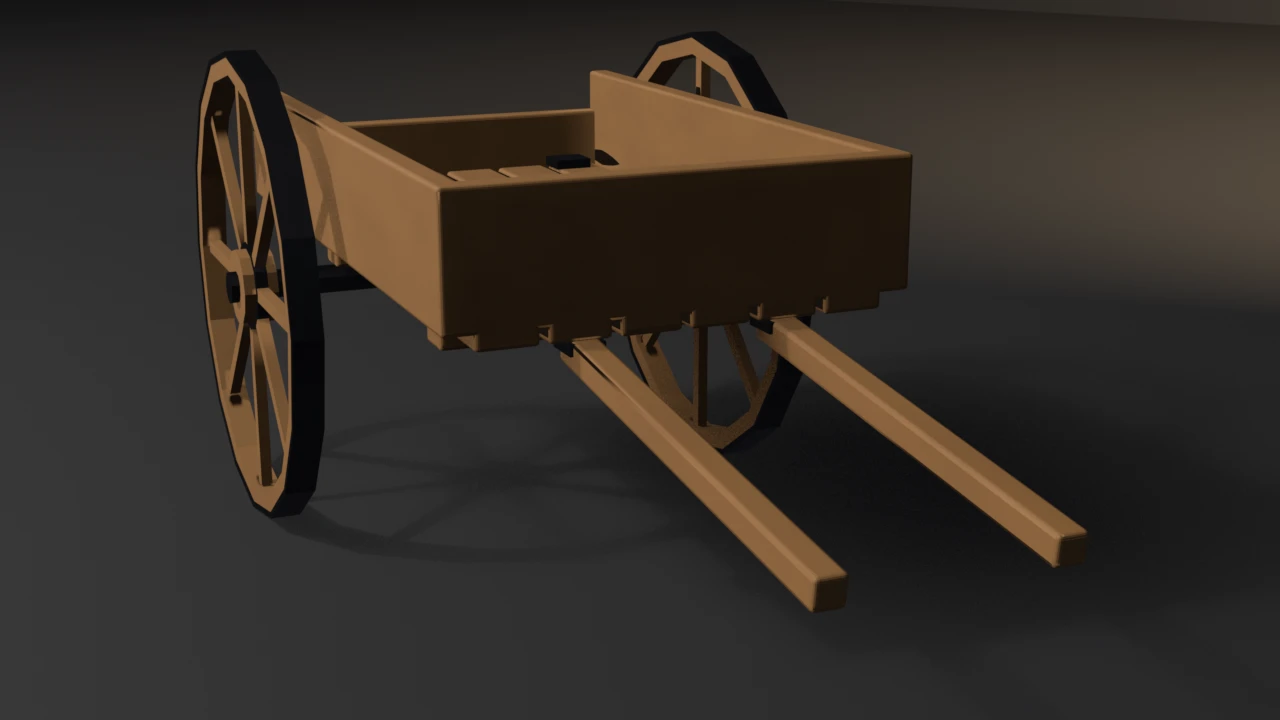
Rendered headless by the example itself — click to zoom.
blender --background --python showcase/cart/cart.py --
A showcase piece, not an example. Procedural two-wheel wooden cart (slatted bed, side walls, shafts, spoked wheels, iron hubs and axle) then the shipped pipeline: unique-cell UVs, Cycles high-to-low normal bake, LOD chain, convex collider, Unity glTF export.
It asserts budget conformance of the generated result. It does not witness an API contract. "It rendered without error" is not a check.
Composes skills mesh-editing-and-bmesh, bake-high-to-low, depsgraph-and-evaluated-data, engine-export-presets, and snippets bake_normal_high_to_low.py, setup_bake_target_image.py, lod_chain.py / decimate_to_budget.py, convex_hull_collider.py, export_preset_unity.py (helpers copied, not imported as a package).
Budgets
Declared as named constants; every gate recomputes from the mesh, materials, UVs, evaluated LOD, collider, or export file.
| Axis | Declared | Measured (4.5.11 / 5.1.2 / 5.2.1) | | --- | --- | --- | | Base triangles | 2470–2900 | 2600 / 2600 / 2600 | | LOD1 ratio | 0.32–0.62 of base | 0.5000 / 0.5000 / 0.5000 | | LOD2 ratio | 0.10–0.35 of base | 0.2200 / 0.2200 / 0.2154 | | Materials | exactly 2 distinct, metal ≥ 24, wood ≥ 800 faces | 2 slots, floors met | | UVs | in 0..1, AABB overlap ≤ 1e-5 | in range, overlap 0 | | Outer AABB | (1.539, 0.749, 0.640) m ± 0.01 | (1.5393, 0.7486, 0.6400) | | Grounded | bbox min Z within 1e-4 of 0 | 0.0000 / 0.0000 / 0.0000 | | Hygiene | loose V/E, non-manifold, zero-area, doubles @1e-5, n-gons: all 0 | 0 / 0 / 0 on every axis | | Material-island gap | metal↔wood min distance ≤ 0.008 m | 0.00000 / 0.00000 / 0.00000 | | Collider tris | ≤ 360 | 122 | | Export | written, size > 0 | 201048 / 201048 / 201032 bytes |
DECIMATE COLLAPSE triangle counts are not identical across series — 5.2.1 is more aggressive on LOD2. The gate is a ratio band, not an exact count. Bake pixels are stochastic; the gate is has_data plus operator FINISHED, not byte-identity. Construction uses no RNG. Export byte counts differ by 8 B on 5.2.1 (glTF serializer), not a gated axis.
--skip-decimate skips the LOD DECIMATE stage so LOD1 ratio is 1.0 and exit 9 fires. --lift-z raises the finished mesh 0.05 m so the grounded budget fails and exit 16 fires. Those are the named budgets the two falsifiers violate.
Run
blender --background --python cart.py --
blender --background --python cart.py -- --skip-decimate
blender --background --python cart.py -- --lift-z
blender --background --python cart.py -- --output cart.png
Smoke does not pass --output, --skip-decimate, or --lift-z.
Exit codes
File-local. 9 is a valid check code. 10 is reserved for gallery_framing.check_framing on the --output path.
| Code | Meaning | | --- | --- | | 0 | Success | | 1 | Uncaught exception (FATAL wrapper) | | 2 | argparse / usage | | 3 | Mesh did not build / no UV layer | | 4 | Base triangle count outside range | | 5 | Material count ≠ 2 distinct slots, or metal faces missing | | 6 | UVs outside 0..1 | | 7 | UV AABB overlap above tolerance | | 8 | World AABB off declared outer size | | 9 | LOD ratio band (--skip-decimate lands here) | | 10 | Framing gate (render path only) | | 11 | Collider triangle count above ceiling | | 12 | Bake did not finish or image has no data | | 13 | Export file missing or empty | | 14 | --output produced no file | | 15 | Hygiene: loose geometry, non-manifold, zero-area, doubles, or n-gons | | 16 | Bbox min Z not grounded (--lift-z lands here) | | 17 | Material-island gap above tolerance (parts meant to touch) |
Source
"""Game-ready two-wheel wooden cart — a showcase piece, not an example. Asserts budget conformance of a procedural cart (staved bed, side walls, shafts, spoked wheels, iron hubs and axle) after composing shipped pipeline pieces: bmesh construction, UVs, two materials, high-to-low normal bake, LOD chain, convex collider, Unity glTF export. Budgets are declared below and recomputed from the generated result. They are not API-contract witnesses. ``--skip-decimate`` skips the LOD DECIMATE stage so the LOD-ratio budget fails. ``--lift-z`` raises the mesh so the grounded-zmin hygiene budget fails. No RNG. Construction is closed-form. DECIMATE COLLAPSE triangle counts are not byte-identical across Blender versions — the LOD gate is a ratio band, not an exact count. blender --background --python cart.py -- blender --background --python cart.py -- --skip-decimate blender --background --python cart.py -- --lift-z blender --background --python cart.py -- --output cart.png """ import argparse import math import os import sys import tempfile import traceback import bmesh import bpy from mathutils import Euler, Vector from mathutils.bvhtree import BVHTree _REPO = os.path.abspath( os.path.join(os.path.dirname(os.path.abspath(__file__)), os.pardir, os.pardir) ) sys.path.insert(0, os.path.join(_REPO, "examples")) sys.dont_write_bytecode = True import gallery_framing # noqa: E402 RIM_MAJOR = 0.30 # Felloe ring: flat-tread box section, not a round tube — round torus rims # read as bicycle wheels. The iron tyre wraps the tread. RIM_RADIAL = 0.012 RIM_W = 0.036 TYRE_T = 0.008 TYRE_W = 0.040 TRACK = 0.68 AXLE_X = -0.16 AXLE_R = 0.020 HUB_R = 0.052 HUB_W = 0.046 N_SPOKES = 8 SPOKE_T = 0.018 BED_L = 0.92 BED_W = 0.50 BED_T = 0.038 WALL_H = 0.16 WALL_T = 0.032 TAILGATE_H = 0.10 SHAFT_L = 0.58 SHAFT_T = 0.034 SHAFT_PITCH = math.radians(7.0) N_SLATS = 6 IRON_T = 0.014 BOLSTER_H = 0.044 BBOX_TOL = 0.01 OUTER_SIZE = (1.539, 0.749, 0.640) BASE_TRIS_MIN = 2470 BASE_TRIS_MAX = 2900 ZMIN_EPS = 1e-4 DOUBLES_EPS = 1e-5 AREA_EPS = 1e-10 GAP_MAX = 0.008 LIFT_Z = 0.05 LOD1_RATIO_MIN = 0.32 LOD1_RATIO_MAX = 0.62 LOD2_RATIO_MIN = 0.10 LOD2_RATIO_MAX = 0.35 LOD1_TARGET = 0.50 LOD2_TARGET = 0.22 MATERIAL_COUNT = 2 UV_EPS = 1e-4 UV_OVERLAP_MAX = 1e-5 COLLIDER_TRIS_MAX = 360 BAKE_RES = 256 CAGE_EXTRUSION = 0.08 METAL_FACES_MIN = 24 WOOD_FACES_MIN = 800 WOOD_IDX = 0 METAL_IDX = 1 def eevee_engine_id(): return "BLENDER_EEVEE" if bpy.app.version >= (5, 0, 0) else "BLENDER_EEVEE_NEXT" def fail(msg, code): print(f"ERROR: {msg}", file=sys.stderr) return code def triangle_count(mesh): mesh.calc_loop_triangles() return len(mesh.loop_triangles) def evaluated_triangle_count(obj): depsgraph = bpy.context.evaluated_depsgraph_get() eval_obj = obj.evaluated_get(depsgraph) eval_mesh = eval_obj.to_mesh() try: eval_mesh.calc_loop_triangles() return len(eval_mesh.loop_triangles) finally: eval_obj.to_mesh_clear() def deselect_all(): for ob in list(bpy.context.view_layer.objects): if ob is None: continue ob.select_set(False) def add_box(bm, loc, scale, mat_idx, euler=(0.0, 0.0, 0.0)): geo = bmesh.ops.create_cube(bm, size=1.0) verts = geo["verts"] rot = Euler(euler).to_matrix() origin = Vector(loc) for v in verts: p = Vector((v.co.x * scale[0], v.co.y * scale[1], v.co.z * scale[2])) v.co = rot @ p + origin faces = {f for v in verts for f in v.link_faces} for f in faces: f.material_index = mat_idx return verts def add_cyl(bm, loc, radius, depth, segments, mat_idx, euler=(0.0, 0.0, 0.0)): geo = bmesh.ops.create_cone( bm, cap_ends=True, cap_tris=True, segments=segments, radius1=radius, radius2=radius, depth=depth, ) verts = geo["verts"] rot = Euler(euler).to_matrix() origin = Vector(loc) for v in verts: v.co = rot @ v.co + origin faces = {f for v in verts for f in v.link_faces} for f in faces: f.material_index = mat_idx return verts def add_ring(bm, loc, r_mid, radial_t, width, segments, mat_idx, euler=(0.0, 0.0, 0.0)): """Flat-sided ring with a box cross-section (felloe / tyre profile). Manifold: outer tread, inner surface, and two side annuli, all quads. Built in the XY plane, width along Z, then rotated/translated. """ r_in = r_mid - radial_t r_out = r_mid + radial_t hw = width / 2.0 rings = [] for i in range(segments): u = i * (2.0 * math.pi / segments) cu = math.cos(u) su = math.sin(u) rings.append( [ bm.verts.new((r_in * cu, r_in * su, -hw)), bm.verts.new((r_out * cu, r_out * su, -hw)), bm.verts.new((r_out * cu, r_out * su, hw)), bm.verts.new((r_in * cu, r_in * su, hw)), ] ) for i in range(segments): i2 = (i + 1) % segments a = rings[i] b = rings[i2] for quad in ( (a[1], b[1], b[2], a[2]), (a[3], b[3], b[0], a[0]), (a[2], b[2], b[3], a[3]), (a[0], b[0], b[1], a[1]), ): face = bm.faces.new(quad) face.material_index = mat_idx verts = [v for ring in rings for v in ring] rot = Euler(euler).to_matrix() origin = Vector(loc) for v in verts: v.co = rot @ v.co + origin return verts def pack_uvs(bm, margin=0.08): uv = bm.loops.layers.uv.new("UVMap") faces = list(bm.faces) n = len(faces) cols = max(1, math.ceil(math.sqrt(n))) rows = max(1, math.ceil(n / cols)) cell_w = 1.0 / cols cell_h = 1.0 / rows pad_u = margin * cell_w * 0.5 pad_v = margin * cell_h * 0.5 usable_w = cell_w - 2.0 * pad_u usable_h = cell_h - 2.0 * pad_v for i, face in enumerate(faces): col = i % cols row = i // cols nrm = face.normal ax = abs(nrm.x) ay = abs(nrm.y) az = abs(nrm.z) coords = [] for loop in face.loops: co = loop.vert.co if az >= ax and az >= ay: coords.append((co.x, co.y)) elif ax >= ay: coords.append((co.y, co.z)) else: coords.append((co.x, co.z)) xs = [c[0] for c in coords] ys = [c[1] for c in coords] minx, maxx = min(xs), max(xs) miny, maxy = min(ys), max(ys) dx = max(maxx - minx, 1e-8) dy = max(maxy - miny, 1e-8) origin_u = col * cell_w + pad_u origin_v = row * cell_h + pad_v for loop, (x, y) in zip(face.loops, coords): loop[uv].uv = ( origin_u + (x - minx) / dx * usable_w, origin_v + (y - miny) / dy * usable_h, ) def add_wheel(bm, loc, wood, metal): wood.extend( add_ring( bm, loc, RIM_MAJOR, RIM_RADIAL, RIM_W, 16, WOOD_IDX, euler=(math.pi / 2.0, 0.0, 0.0), ) ) metal.extend( add_ring( bm, loc, RIM_MAJOR + RIM_RADIAL + TYRE_T / 2.0, TYRE_T / 2.0, TYRE_W, 16, METAL_IDX, euler=(math.pi / 2.0, 0.0, 0.0), ) ) wood.extend( add_cyl( bm, loc, HUB_R, HUB_W, 12, WOOD_IDX, euler=(math.pi / 2.0, 0.0, 0.0), ) ) # Spokes root inside the hub and embed into the felloe ring — no # floating ends hidden by the hub band. inner = HUB_R * 0.4 outer = RIM_MAJOR - RIM_RADIAL + 0.008 mid_r = 0.5 * (inner + outer) slen = outer - inner for i in range(N_SPOKES): a = i * (2.0 * math.pi / N_SPOKES) dx = math.cos(a) dz = math.sin(a) cx = loc[0] + dx * mid_r cy = loc[1] cz = loc[2] + dz * mid_r wood.extend( add_box( bm, (cx, cy, cz), (slen, SPOKE_T * 0.85, SPOKE_T), WOOD_IDX, euler=(0.0, -a, 0.0), ) ) metal.extend( add_cyl( bm, loc, HUB_R + 0.010, 0.016, 12, METAL_IDX, euler=(math.pi / 2.0, 0.0, 0.0), ) ) metal.extend( add_cyl( bm, (loc[0], loc[1] + (HUB_W * 0.55 if loc[1] > 0 else -HUB_W * 0.55), loc[2]), 0.022, 0.018, 10, METAL_IDX, euler=(math.pi / 2.0, 0.0, 0.0), ) ) def build_cart_mesh(name, bevel_offset, bevel_segments): bm = bmesh.new() try: body = [] wood_wheels = [] metal = [] axle_z = RIM_MAJOR # The bed rides on the axle through a bolster: axle top -> bolster -> # bed bottom. Never let the axle interpenetrate the slats. bed_z = axle_z + AXLE_R + BOLSTER_H + BED_T / 2.0 bed_bottom = bed_z - BED_T / 2.0 bed_cx = 0.06 add_wheel(bm, (AXLE_X, TRACK / 2.0, axle_z), wood_wheels, metal) add_wheel(bm, (AXLE_X, -TRACK / 2.0, axle_z), wood_wheels, metal) metal.extend( add_cyl( bm, (AXLE_X, 0.0, axle_z), AXLE_R, TRACK + 0.06, 10, METAL_IDX, euler=(math.pi / 2.0, 0.0, 0.0), ) ) slat_w = BED_W / N_SLATS y0 = -BED_W / 2.0 + slat_w / 2.0 for i in range(N_SLATS): y = y0 + i * slat_w body.extend( add_box( bm, (bed_cx, y, bed_z), (BED_L, slat_w * 0.88, BED_T), WOOD_IDX, ) ) # Side walls and the front board finish flush at WALL_H; the back # board is a deliberately lower tailgate. for ysign in (-1.0, 1.0): body.extend( add_box( bm, (bed_cx, ysign * (BED_W / 2.0 + WALL_T / 2.0), bed_z + WALL_H / 2.0), (BED_L * 0.98, WALL_T, WALL_H), WOOD_IDX, ) ) body.extend( add_box( bm, (bed_cx + BED_L / 2.0 - WALL_T / 2.0, 0.0, bed_z + WALL_H / 2.0), (WALL_T, BED_W + WALL_T * 2.0, WALL_H), WOOD_IDX, ) ) body.extend( add_box( bm, (bed_cx - BED_L / 2.0 + WALL_T / 2.0, 0.0, bed_z + TAILGATE_H / 2.0), (WALL_T, BED_W + WALL_T * 2.0, TAILGATE_H), WOOD_IDX, ) ) # Bolsters: one sits on the axle, one forward; both carry the bed. for xj in (AXLE_X, bed_cx + BED_L * 0.28): body.extend( add_box( bm, (xj, 0.0, axle_z + AXLE_R + BOLSTER_H / 2.0), (0.055, BED_W * 0.92, BOLSTER_H), WOOD_IDX, ) ) # Shafts hang under the bed front: the back end embeds 6 mm into the # slat bottom and never pokes through the bed floor. shaft_x = bed_cx + BED_L / 2.0 + SHAFT_L / 2.0 - 0.04 shaft_z = ( bed_bottom + 0.006 - SHAFT_T / 2.0 - math.sin(SHAFT_PITCH) * (SHAFT_L / 2.0) ) for ysign in (-1.0, 1.0): body.extend( add_box( bm, (shaft_x, ysign * 0.12, shaft_z), (SHAFT_L, SHAFT_T, SHAFT_T), WOOD_IDX, euler=(0.0, SHAFT_PITCH, 0.0), ) ) metal.extend( add_box( bm, (bed_cx + BED_L / 2.0 - 0.02, ysign * 0.12, bed_bottom - IRON_T / 2.0), (0.05, 0.042, IRON_T), METAL_IDX, ) ) # Tie-down plates sit on top of the bed floor, fully inboard of the # walls — visible, not buried inside the slats. for sx, sy in ( (bed_cx - BED_L / 2.0 + 0.055, -BED_W / 2.0 + 0.055), (bed_cx - BED_L / 2.0 + 0.055, BED_W / 2.0 - 0.055), (bed_cx + BED_L / 2.0 - 0.055, -BED_W / 2.0 + 0.055), (bed_cx + BED_L / 2.0 - 0.055, BED_W / 2.0 - 0.055), ): metal.extend( add_box( bm, (sx, sy, bed_z + BED_T / 2.0 + IRON_T / 2.0), (0.055, 0.055, IRON_T), METAL_IDX, ) ) if bevel_offset > 0.0: edges = list({e for v in body for e in v.link_edges}) ret = bmesh.ops.bevel( bm, geom=edges, offset=bevel_offset, segments=bevel_segments, profile=0.5, affect="EDGES", clamp_overlap=True, ) for f in ret.get("faces") or []: f.material_index = WOOD_IDX xs = [v.co.x for v in bm.verts] ys = [v.co.y for v in bm.verts] zs = [v.co.z for v in bm.verts] cx = 0.5 * (min(xs) + max(xs)) cy = 0.5 * (min(ys) + max(ys)) zmin = min(zs) for v in bm.verts: v.co.x -= cx v.co.y -= cy v.co.z -= zmin if v.co.z < 0.0: v.co.z = 0.0 pack_uvs(bm) bmesh.ops.recalc_face_normals(bm, faces=list(bm.faces)) for face in bm.faces: face.smooth = False me = bpy.data.meshes.new(name) bm.to_mesh(me) me.update() for poly in me.polygons: poly.use_smooth = False finally: bm.free() out = bpy.data.objects.new(name, me) bpy.context.collection.objects.link(out) return out def principled(name, color, metallic, roughness, noise_scale=0.0, wear=None): mat = bpy.data.materials.new(name) mat.use_nodes = True nt = mat.node_tree bsdf = nt.nodes["Principled BSDF"] bsdf.inputs["Base Color"].default_value = color bsdf.inputs["Metallic"].default_value = metallic bsdf.inputs["Roughness"].default_value = roughness if noise_scale > 0.0 and wear is not None: tex = nt.nodes.new("ShaderNodeTexNoise") tex.inputs["Scale"].default_value = noise_scale tex.inputs["Detail"].default_value = 8.0 tex.inputs["Roughness"].default_value = 0.55 mix = nt.nodes.new("ShaderNodeMix") mix.data_type = "RGBA" mix.inputs["A"].default_value = color mix.inputs["B"].default_value = wear fac = mix.inputs.get("Factor") or mix.inputs.get("Fac") nt.links.new(tex.outputs["Fac"], fac) nt.links.new(mix.outputs["Result"], bsdf.inputs["Base Color"]) rmix = nt.nodes.new("ShaderNodeMix") rmix.data_type = "FLOAT" rmix.inputs["A"].default_value = roughness rmix.inputs["B"].default_value = min(1.0, roughness + 0.18) rfac = rmix.inputs.get("Factor") or rmix.inputs.get("Fac") nt.links.new(tex.outputs["Fac"], rfac) nt.links.new(rmix.outputs["Result"], bsdf.inputs["Roughness"]) return mat def assign_slots(obj, wood, metal): mats = obj.data.materials wanted = (wood, metal) for i, mat in enumerate(wanted): if i < len(mats): mats[i] = mat else: mats.append(mat) def world_bbox(obj): corners = [obj.matrix_world @ Vector(c) for c in obj.bound_box] xs = [c.x for c in corners] ys = [c.y for c in corners] zs = [c.z for c in corners] return (min(xs), min(ys), min(zs), max(xs), max(ys), max(zs)) def uv_stats(mesh): uv = mesh.uv_layers.active if uv is None: return 0.0, 0.0, 1.0, 1.0, 0, 1.0 data = uv.data us = [loop.uv[0] for loop in data] vs = [loop.uv[1] for loop in data] aabbs = [] for poly in mesh.polygons: pu = [data[i].uv[0] for i in poly.loop_indices] pv = [data[i].uv[1] for i in poly.loop_indices] aabbs.append((min(pu), min(pv), max(pu), max(pv))) overlap = 0.0 for i in range(len(aabbs)): a = aabbs[i] for j in range(i + 1, len(aabbs)): b = aabbs[j] x0 = max(a[0], b[0]) y0 = max(a[1], b[1]) x1 = min(a[2], b[2]) y1 = min(a[3], b[3]) overlap += max(0.0, x1 - x0) * max(0.0, y1 - y0) return min(us), min(vs), max(us), max(vs), overlap, len(aabbs) def face_area(me, poly): vs = [me.vertices[i].co for i in poly.vertices] if len(vs) < 3: return 0.0 v0 = vs[0] area = 0.0 for i in range(1, len(vs) - 1): area += (vs[i] - v0).cross(vs[i + 1] - v0).length * 0.5 return area def hygiene_audit(me): # Combinatorics match examples/mesh-hygiene-audit.audit (copied, not imported). nv, ne, nf = len(me.vertices), len(me.edges), len(me.polygons) ngons = sum(1 for p in me.polygons if len(p.vertices) > 4) areas = [face_area(me, p) for p in me.polygons] zero_area = sum(1 for a in areas if a <= AREA_EPS) bm = bmesh.new() try: bm.from_mesh(me) bm.verts.ensure_lookup_table() bm.edges.ensure_lookup_table() loose_v = sum(1 for v in bm.verts if len(v.link_edges) == 0) loose_e = sum(1 for e in bm.edges if len(e.link_faces) == 0) nonman = sum(1 for e in bm.edges if not e.is_manifold) ret = bmesh.ops.find_doubles(bm, verts=list(bm.verts), dist=DOUBLES_EPS) doubles = len(ret.get("targetmap") or {}) finally: bm.free() return { "nv": nv, "ne": ne, "nf": nf, "ngons": ngons, "loose_v": loose_v, "loose_e": loose_e, "nonman": nonman, "zero_area": zero_area, "doubles": doubles, "euler": nv - ne + nf, } def min_mat_distance(me, ia, ib): """Closest surface distance between two material islands via BVH. Vert-vert distance is the wrong metric for thin parts: a face interior can touch while its corner verts sit a radius apart. """ bm_a = bmesh.new() bm_b = bmesh.new() try: bm_a.from_mesh(me) bm_b.from_mesh(me) bm_a.faces.ensure_lookup_table() bm_b.faces.ensure_lookup_table() drop_a = [f for f in bm_a.faces if f.material_index != ia] drop_b = [f for f in bm_b.faces if f.material_index != ib] if drop_a: bmesh.ops.delete(bm_a, geom=drop_a, context="FACES") if drop_b: bmesh.ops.delete(bm_b, geom=drop_b, context="FACES") if not bm_a.faces or not bm_b.faces: return 1e9 tree = BVHTree.FromBMesh(bm_b) best = 1e9 for src in list(bm_a.verts) + list(bm_a.faces): co = src.co if hasattr(src, "co") else src.calc_center_median() hit = tree.find_nearest(co) if hit[0] is None: continue best = min(best, hit[3]) return best finally: bm_a.free() bm_b.free() def make_lod(obj, name, ratio, skip_decimate): mesh = obj.data.copy() lod = bpy.data.objects.new(name, mesh) lod.matrix_world = obj.matrix_world.copy() bpy.context.scene.collection.objects.link(lod) if not skip_decimate and 0.0 < ratio < 1.0: mod = lod.modifiers.new("DecimateBudget", "DECIMATE") mod.decimate_type = "COLLAPSE" mod.ratio = ratio return lod def convex_hull_collider(obj, name): mesh = bpy.data.meshes.new(name) bm = bmesh.new() try: bm.from_mesh(obj.data) result = bmesh.ops.convex_hull(bm, input=list(bm.verts)) interior = result.get("geom_interior") or [] unused = result.get("geom_unused") or [] if interior: bmesh.ops.delete(bm, geom=interior, context="VERTS") if unused: bmesh.ops.delete(bm, geom=unused, context="VERTS") bm.to_mesh(mesh) mesh.update() finally: bm.free() collider = bpy.data.objects.new(name, mesh) bpy.context.collection.objects.link(collider) collider.matrix_world = obj.matrix_world.copy() return collider def setup_bake_image(obj, target_mat, size=BAKE_RES): if not obj.data.uv_layers: return None, None img = bpy.data.images.new("CartNrm", size, size, alpha=True, float_buffer=False) img.colorspace_settings.name = "Non-Color" nodes = target_mat.node_tree.nodes tex = nodes.new("ShaderNodeTexImage") tex.image = img nodes.active = tex tex.select = True obj.active_material_index = WOOD_IDX return img, tex def bake_normal(high, low): scene = bpy.context.scene scene.render.engine = "CYCLES" scene.cycles.device = "CPU" scene.cycles.samples = 1 scene.cycles.use_denoising = False deselect_all() high.select_set(True) low.select_set(True) bpy.context.view_layer.objects.active = low return bpy.ops.object.bake( type="NORMAL", use_selected_to_active=True, cage_extrusion=CAGE_EXTRUSION, use_cage=False, normal_space="TANGENT", margin=4, margin_type="ADJACENT_FACES", use_clear=True, target="IMAGE_TEXTURES", ) def export_unity(path, objects): deselect_all() for ob in objects: ob.select_set(True) bpy.context.view_layer.objects.active = objects[0] bpy.ops.export_scene.gltf( filepath=path, use_selection=True, export_yup=True, export_apply=True, export_draco_mesh_compression_enable=False, export_animations=False, ) def check(skip_decimate, lift_z=False): bpy.ops.wm.read_factory_settings(use_empty=True) low = build_cart_mesh("CartLow", bevel_offset=0.005, bevel_segments=2) high = build_cart_mesh("CartHigh", bevel_offset=0.005, bevel_segments=4) wood = principled( "CartWood", (0.42, 0.22, 0.08, 1.0), 0.0, 0.58, noise_scale=7.0, wear=(0.26, 0.12, 0.04, 1.0), ) metal = principled( "CartIron", (0.13, 0.135, 0.15, 1.0), 1.0, 0.32, noise_scale=5.0, wear=(0.05, 0.05, 0.06, 1.0), ) assign_slots(low, wood, metal) assign_slots(high, wood, metal) if lift_z: for v in low.data.vertices: v.co.z += LIFT_Z low.data.update() if low.data is None or len(low.data.polygons) < 6: return fail("cart mesh did not build", 3), None, None, None, None, None base_tris = triangle_count(low.data) mats = [s for s in low.data.materials if s is not None] nmat = len(mats) distinct_mats = len({id(s) for s in mats}) idx_counts = {} for poly in low.data.polygons: idx_counts[poly.material_index] = idx_counts.get(poly.material_index, 0) + 1 print(f"measured mat_index_counts={idx_counts}") u0, v0, u1, v1, overlap, nfaces = uv_stats(low.data) bb = world_bbox(low) size_x = bb[3] - bb[0] size_y = bb[4] - bb[1] size_z = bb[5] - bb[2] img, tex = setup_bake_image(low, wood) if img is None: return fail("cart has no UV layer", 3), None, None, None, None, None bake_result = bake_normal(high, low) lod1 = make_lod(low, "CartLOD1", LOD1_TARGET, skip_decimate) lod2 = make_lod(low, "CartLOD2", LOD2_TARGET, skip_decimate) bpy.context.view_layer.update() lod1_tris = evaluated_triangle_count(lod1) lod2_tris = evaluated_triangle_count(lod2) r1 = lod1_tris / base_tris if base_tris else 0.0 r2 = lod2_tris / base_tris if base_tris else 0.0 collider_src = build_cart_mesh("CartColSrc", bevel_offset=0.0, bevel_segments=1) collider = convex_hull_collider(collider_src, "CartCollider") bpy.data.objects.remove(collider_src, do_unlink=True) col_tris = triangle_count(collider.data) export_path = os.path.join( tempfile.gettempdir(), f"bdt_cart_{os.getpid()}.glb", ) if os.path.exists(export_path): os.remove(export_path) export_unity(export_path, [low, collider]) export_size = os.path.getsize(export_path) if os.path.isfile(export_path) else 0 print(f"blender={tuple(bpy.app.version)} skip_decimate={skip_decimate}") print( f"measured base_tris={base_tris} lod1_tris={lod1_tris} " f"lod2_tris={lod2_tris} r1={r1:.4f} r2={r2:.4f}" ) print( f"measured nmat={nmat} uv=({u0:.4f},{v0:.4f})-({u1:.4f},{v1:.4f}) " f"overlap={overlap:.6f} nfaces={nfaces}" ) print( f"measured bbox=({size_x:.4f},{size_y:.4f},{size_z:.4f}) " f"outer={OUTER_SIZE} zmin={bb[2]:.4f}" ) print( f"measured collider_tris={col_tris} bake={bake_result} " f"bake_has_data={img.has_data} export_bytes={export_size}" ) hyg = hygiene_audit(low.data) gap_mw = min_mat_distance(low.data, METAL_IDX, WOOD_IDX) print( f"measured hygiene loose_v={hyg['loose_v']} loose_e={hyg['loose_e']} " f"nonman={hyg['nonman']} zero_area={hyg['zero_area']} " f"doubles={hyg['doubles']} ngons={hyg['ngons']} euler={hyg['euler']}" ) print(f"measured gap_metal_wood={gap_mw:.5f}") if not (BASE_TRIS_MIN <= base_tris <= BASE_TRIS_MAX): return fail( f"base tris {base_tris} not in [{BASE_TRIS_MIN}, {BASE_TRIS_MAX}]", 4, ), None, None, None, None, None if nmat != MATERIAL_COUNT or distinct_mats != MATERIAL_COUNT: return fail( f"material slots {nmat} distinct {distinct_mats} != {MATERIAL_COUNT}", 5, ), None, None, None, None, None if idx_counts.get(METAL_IDX, 0) < METAL_FACES_MIN: return fail( f"metal faces {idx_counts.get(METAL_IDX, 0)} < {METAL_FACES_MIN}", 5, ), None, None, None, None, None if idx_counts.get(WOOD_IDX, 0) < WOOD_FACES_MIN: return fail( f"wood faces {idx_counts.get(WOOD_IDX, 0)} < {WOOD_FACES_MIN}", 5, ), None, None, None, None, None if u0 < -UV_EPS or v0 < -UV_EPS or u1 > 1.0 + UV_EPS or v1 > 1.0 + UV_EPS: return fail( f"UVs outside 0..1: ({u0:.4f},{v0:.4f})-({u1:.4f},{v1:.4f})", 6, ), None, None, None, None, None if overlap > UV_OVERLAP_MAX: return fail( f"UV AABB overlap {overlap:.6f} > {UV_OVERLAP_MAX}", 7, ), None, None, None, None, None if ( abs(size_x - OUTER_SIZE[0]) > BBOX_TOL or abs(size_y - OUTER_SIZE[1]) > BBOX_TOL or abs(size_z - OUTER_SIZE[2]) > BBOX_TOL ): return fail( f"bbox ({size_x:.4f},{size_y:.4f},{size_z:.4f}) " f"off outer {OUTER_SIZE}", 8, ), None, None, None, None, None if not (LOD1_RATIO_MIN <= r1 <= LOD1_RATIO_MAX): return fail( f"LOD1 ratio {r1:.4f} not in [{LOD1_RATIO_MIN}, {LOD1_RATIO_MAX}] " "(--skip-decimate is the designed fail)", 9, ), None, None, None, None, None if not (LOD2_RATIO_MIN <= r2 <= LOD2_RATIO_MAX): return fail( f"LOD2 ratio {r2:.4f} not in [{LOD2_RATIO_MIN}, {LOD2_RATIO_MAX}]", 9, ), None, None, None, None, None if col_tris > COLLIDER_TRIS_MAX: return fail( f"collider tris {col_tris} > {COLLIDER_TRIS_MAX}", 11, ), None, None, None, None, None if bake_result != {"FINISHED"} or not img.has_data: return fail( f"bake failed result={bake_result} has_data={img.has_data}", 12, ), None, None, None, None, None if export_size <= 0: return fail("export file missing or empty", 13), None, None, None, None, None if ( hyg["loose_v"] or hyg["loose_e"] or hyg["nonman"] or hyg["zero_area"] or hyg["doubles"] or hyg["ngons"] ): return fail( f"hygiene loose_v={hyg['loose_v']} loose_e={hyg['loose_e']} " f"nonman={hyg['nonman']} zero_area={hyg['zero_area']} " f"doubles={hyg['doubles']} ngons={hyg['ngons']}", 15, ), None, None, None, None, None if abs(bb[2]) > ZMIN_EPS: return fail( f"zmin {bb[2]:.6f} not within {ZMIN_EPS} of 0 " "(--lift-z is the designed fail)", 16, ), None, None, None, None, None if gap_mw > GAP_MAX: return fail( f"metal-wood gap {gap_mw:.5f} > {GAP_MAX} " "(tyres, hubs, straps, and plates must touch the wood they mount to)", 17, ), None, None, None, None, None return 0, low, high, wood, tex, collider def wire_normal(mat, tex): nt = mat.node_tree bsdf = nt.nodes["Principled BSDF"] nrm = nt.nodes.new("ShaderNodeNormalMap") nrm.inputs["Strength"].default_value = 1.0 nt.links.new(tex.outputs["Color"], nrm.inputs["Color"]) nt.links.new(nrm.outputs["Normal"], bsdf.inputs["Normal"]) def render_still(low, wood, tex, path, engine): scene = bpy.context.scene wire_normal(wood, tex) for ob in list(scene.objects): if ob.type == "MESH" and ob != low: ob.hide_render = True ob.hide_viewport = True low.rotation_euler.z = math.radians(-28.0) low.rotation_euler.x = math.radians(0.0) floor_me = bpy.data.meshes.new("Floor") bm = bmesh.new() try: bmesh.ops.create_grid(bm, x_segments=1, y_segments=1, size=14.0) bm.to_mesh(floor_me) finally: bm.free() fmat = bpy.data.materials.new("Floor") fmat.use_nodes = True fb = fmat.node_tree.nodes["Principled BSDF"] fb.inputs["Base Color"].default_value = (0.03, 0.032, 0.037, 1.0) fb.inputs["Roughness"].default_value = 0.7 floor_me.materials.append(fmat) floor = bpy.data.objects.new("Floor", floor_me) scene.collection.objects.link(floor) wall = bpy.data.objects.new("Wall", floor_me.copy()) wall.location = (0.0, 8.5, 0.0) wall.rotation_euler = (math.radians(90), 0.0, 0.0) scene.collection.objects.link(wall) world = bpy.data.worlds.new("World") world.use_nodes = True world.node_tree.nodes["Background"].inputs["Color"].default_value = ( 0.02, 0.021, 0.025, 1.0, ) scene.world = world def light(name, loc, energy, size, col, rot): ld = bpy.data.lights.new(name, "AREA") ld.energy = energy ld.size = size ld.color = col ob = bpy.data.objects.new(name, ld) ob.location = loc ob.rotation_euler = tuple(math.radians(a) for a in rot) scene.collection.objects.link(ob) light("Key", (-3.4, -4.8, 5.4), 640.0, 4.0, (1.0, 0.94, 0.86), (50, 0, -36)) light("Fill", (4.8, -3.4, 2.4), 46.0, 8.0, (0.72, 0.82, 1.0), (62, 0, 50)) light("Wedge", (2.2, 4.0, 3.8), 600.0, 5.5, (1.0, 0.70, 0.40), (-70, 0, 198)) cam_data = bpy.data.cameras.new("Cam") cam_data.lens = 50.0 cam = bpy.data.objects.new("Cam", cam_data) cam.location = (1.34, -1.62, 0.88) scene.collection.objects.link(cam) aim = bpy.data.objects.new("Aim", None) aim.location = (0.05, 0.0, 0.30) scene.collection.objects.link(aim) con = cam.constraints.new("TRACK_TO") con.target = aim con.track_axis = "TRACK_NEGATIVE_Z" con.up_axis = "UP_Y" scene.camera = cam scene.render.engine = "CYCLES" if engine == "cycles" else eevee_engine_id() if engine == "cycles": scene.cycles.samples = 32 scene.cycles.device = "CPU" else: try: scene.eevee.taa_render_samples = 64 except AttributeError: pass scene.render.resolution_x = 1280 scene.render.resolution_y = 720 scene.render.image_settings.file_format = ( "WEBP" if path.lower().endswith(".webp") else "PNG" ) if path.lower().endswith(".webp"): scene.render.image_settings.quality = 90 scene.render.filepath = path scene.view_settings.view_transform = "Standard" fcode = gallery_framing.check_framing( scene, cam, hero=[low], elements=[low], stage=[floor, wall], ) if fcode: return fcode bpy.ops.render.render(write_still=True) if not (os.path.exists(path) and os.path.getsize(path) > 0): return fail("render produced no file", 14) return 0 def main(): argv = sys.argv[sys.argv.index("--") + 1:] if "--" in sys.argv else [] p = argparse.ArgumentParser() p.add_argument("--output", default=None) p.add_argument("--engine", default="eevee", choices=("eevee", "cycles")) p.add_argument( "--skip-decimate", action="store_true", help="falsification: skip the LOD DECIMATE stage", ) p.add_argument( "--lift-z", action="store_true", help="falsification: lift the mesh so zmin fails the grounded budget", ) args = p.parse_args(argv) code, low, _high, wood, tex, _col = check( args.skip_decimate, lift_z=args.lift_z ) if code: return code if args.output: rcode = render_still(low, wood, tex, os.path.abspath(args.output), args.engine) if rcode: return rcode print(f"rendered still {args.output}") print("cart OK") return 0 if __name__ == "__main__": try: sys.exit(main()) except Exception as e: traceback.print_exc() print(f"FATAL: {e}", file=sys.stderr) sys.exit(1)