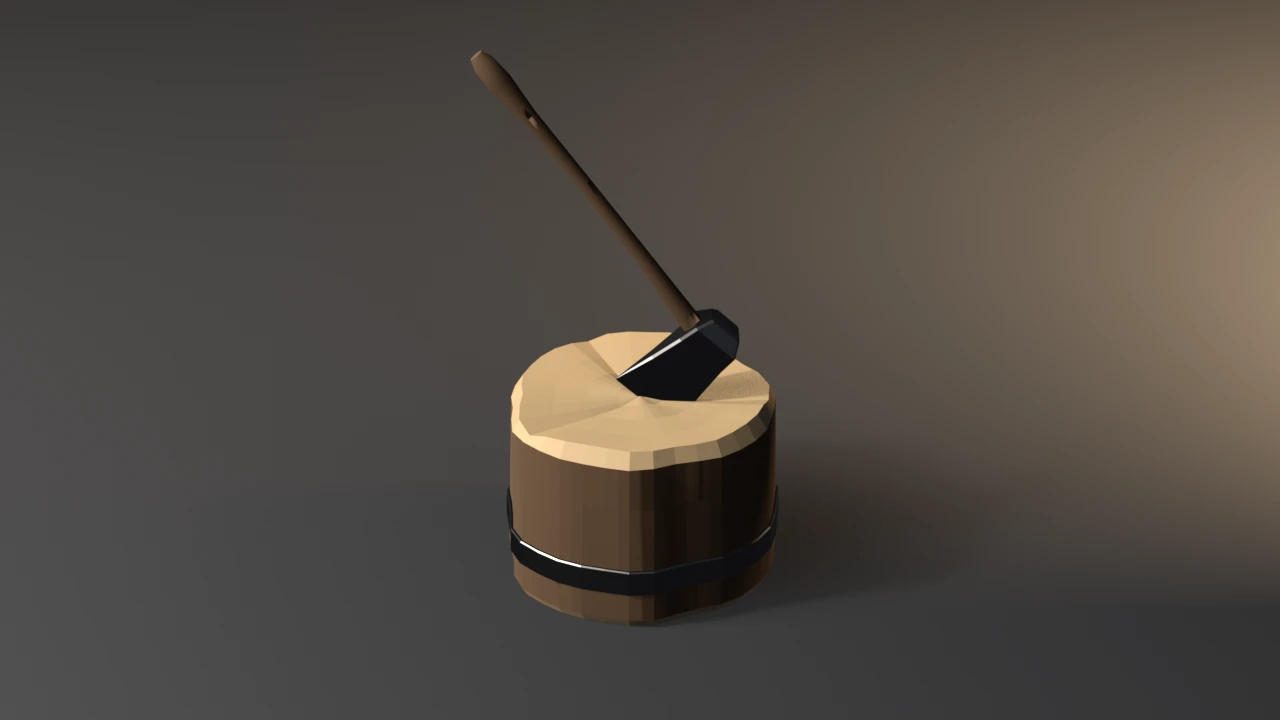
Rendered headless by the example itself — click to zoom.
blender --background --python showcase/chopping-block/chopping_block.py --
A showcase piece, not an example. Procedural chopping block (a hooped log round with a felling axe buried in the sawn face) then the shipped pipeline: unique-cell UVs, Cycles high-to-low normal bake, LOD chain, convex collider, Unity glTF export.
The log is an out-of-round loft whose radius is a closed-form function of angle and height; the hoop, the top rim and the drying checks are all generated from that same function, so they stay seated when a dimension changes. The axe head is one lofted shell from poll to bit with its chamfers modelled into the section profile, and the haft is swept through the eye rather than pushed into it.
It asserts budget conformance of the generated result. It does not witness an API contract. "It rendered without error" is not a check.
Composes skills mesh-editing-and-bmesh, bake-high-to-low, depsgraph-and-evaluated-data, engine-export-presets, and snippets bake_normal_high_to_low.py, setup_bake_target_image.py, lod_chain.py / decimate_to_budget.py, convex_hull_collider.py, export_preset_unity.py (helpers copied, not imported as a package).
Budgets
Declared as named constants; every gate recomputes from the mesh, materials, UVs, evaluated LOD, collider, or export file.
| Axis | Declared | Measured (4.5.11 / 5.1.2 / 5.2.1) | | --- | --- | --- | | Base triangles | 1410–1530 | 1472 / 1472 / 1472 | | LOD1 ratio | 0.32–0.62 of base | 0.5000 / 0.5000 / 0.5000 | | LOD2 ratio | 0.10–0.35 of base | 0.2188 / 0.2188 / 0.2188 | | Materials | exactly 3 distinct; ≥160 bark, ≥90 grain, ≥24 metal faces | 3 slots; 252 / 252 / 288 | | UVs | in 0..1, AABB overlap ≤ 1e-5 | in range, overlap 0 | | Outer AABB | (0.526, 0.526, 1.012) m ± 0.01 | (0.5264, 0.5264, 1.0117) | | Collider tris | ≤ 470 | 434 | | Export | written, size > 0 | 150784 / 150784 / 150776 bytes |
Hygiene
Recomputed from the generated mesh, not asserted about the script.
| Axis | Declared | Measured (all three) | | --- | --- | --- | | Non-manifold edges | 0 | 0 | | Loose verts / edges | 0 / 0 | 0 / 0 | | Doubles merged at 1e-5 | 0 | 0 | | Zero-area faces | 0 | 0 | | N-gons | 0 | 0 | | Coplanar disjoint face pairs | 0 | 0 | | Grounded: zmin | within 1e-5 of 0 | 0.0000 | | Log axis out of plumb | ≤ 2e-4 | 0.0000000 | | Log size | 0.535 × 0.360 m ± 0.03 / ± 0.02 | 0.5464 × 0.3600 |
Joint fit
Four shells that have to meet correctly: log, hoop, head, haft.
| Axis | Declared | Measured (all three) | | --- | --- | --- | | Shell count | exactly 4 | 4 | | Haft clearance inside the eye | ≥ 0.006 m | 0.01800 | | Haft engagement through the eye | ≥ 0.020 m | 0.08049 | | Haft breakout margin below the head | ≥ 0.006 m | 0.02351 | | Bit bury below the sawn top | ≥ 0.030 m | 0.07871 | | Bit inset from the rim | ≥ 0.030 m | 0.14647 | | Hoop bite into the log, every segment | 0.002–0.007 m | 0.00371–0.00400 | | Haft clearance above the log | ≥ 0.015 m, 0 verts inside | 0.07858, 0 |
The hoop bite is binned by angular segment against the log's own radius function. A single global midpoint radius misclassifies outer chamfer vertices as inner ones on an out-of-round log, which is how a hoop that visibly floated on one side still passed.
DECIMATE COLLAPSE triangle counts happen to agree across all three series here; the gate is still a ratio band, not an exact count. Bake pixels are stochastic; the gate is has_data plus operator FINISHED, not byte-identity. Construction uses no RNG. Export byte counts differ by 8 B on 5.2.1 (glTF serializer), not a gated axis.
Falsifiers
Each violates one named budget. All five were run on 4.5.11, 5.1.2 and 5.2.1 and returned the same code on each.
| Flag | Budget violated | Exit | | --- | --- | --- | | --skip-decimate | LOD1 ratio band | 9 | | --stray-vert | loose vertex count is 0 | 15 | | --lift-z | bounding box zmin is 0 | 16 | | --fat-haft | haft clearance inside the eye | 17 | | --round-band | hoop bite into the log | 18 |
Run
blender --background --python chopping_block.py --
blender --background --python chopping_block.py -- --skip-decimate
blender --background --python chopping_block.py -- --stray-vert
blender --background --python chopping_block.py -- --lift-z
blender --background --python chopping_block.py -- --fat-haft
blender --background --python chopping_block.py -- --round-band
blender --background --python chopping_block.py -- --output chopping-block.png
Smoke passes no flags.
Exit codes
File-local. 9 is a valid check code. 10 is reserved for gallery_framing.check_framing on the --output path. 15–19 are the hygiene and joint-fit family.
| Code | Meaning | | --- | --- | | 0 | Success | | 1 | Uncaught exception (FATAL wrapper) | | 2 | argparse / usage | | 3 | Mesh did not build / no UV layer | | 4 | Base triangle count outside range | | 5 | Material count ≠ 3 distinct slots, or a face-count floor missed | | 6 | UVs outside 0..1 | | 7 | UV AABB overlap above tolerance | | 8 | World AABB off declared outer size | | 9 | LOD ratio band (--skip-decimate lands here) | | 10 | Framing gate (render path only) | | 11 | Collider triangle count above ceiling | | 12 | Bake did not finish or image has no data | | 13 | Export file missing or empty | | 14 | --output produced no file | | 15 | Mesh hygiene: loose, non-manifold, zero-area, doubles, n-gons, z-fight | | 16 | Not grounded: bounding box zmin off 0 | | 17 | Axe joint fit: shell count, eye clearance, engagement, breakout, bury, inset | | 18 | Contact fit: hoop bite band, or haft fouling the log | | 19 | Log out of plumb, or off its stated real-world size |
Source
"""Game-ready chopping block — a showcase piece, not an example. Asserts budget conformance of a procedural splitting block (a hooped log round with a felling axe standing in it) after composing shipped pipeline pieces: bmesh construction, UVs, three materials, high-to-low normal bake, LOD chain, convex collider, Unity glTF export. Budgets are declared below and recomputed from the generated result. They are not API-contract witnesses. Each falsifier violates exactly one named budget: ``--skip-decimate`` skips the LOD DECIMATE stage so the LOD-ratio budget fails, ``--lift-z`` moves the mesh off the floor so the grounded budget fails, ``--stray-vert`` adds one unconnected vertex so the mesh-hygiene budget fails, ``--fat-haft`` widens the handle to the full thickness of the axe eye so the eye joint-fit budget fails, and ``--round-band`` generates the iron band on a circle instead of on the log's own surface so the band-seat budget fails. No RNG. The log's out-of-round profile is a closed-form sum of sines, so construction is deterministic. DECIMATE COLLAPSE triangle counts are not byte-identical across Blender versions — the LOD gate is a ratio band, not an exact count. blender --background --python chopping_block.py -- blender --background --python chopping_block.py -- --skip-decimate blender --background --python chopping_block.py -- --lift-z blender --background --python chopping_block.py -- --stray-vert blender --background --python chopping_block.py -- --fat-haft blender --background --python chopping_block.py -- --round-band blender --background --python chopping_block.py -- --output block.png """ import argparse import math import os import sys import tempfile import traceback import bmesh import bpy from mathutils import Matrix, Vector from mathutils.bvhtree import BVHTree # Showcase lives at repo-root/showcase/, not under examples/. The framing # helper is the repo's only shared import and lives next to the examples; # resolve the repo root so we do not move gallery_framing.py. _REPO = os.path.abspath( os.path.join(os.path.dirname(os.path.abspath(__file__)), os.pardir, os.pardir) ) sys.path.insert(0, os.path.join(_REPO, "examples")) sys.dont_write_bytecode = True import gallery_framing # noqa: E402 # A splitting block is a log round: 0.41 m across, 0.46 m tall, near-parallel # sides. The old piece was a truncated cone 0.44 m across and 0.36 m tall, # which reads as a pail. # A log round is wider than it is tall: 0.52 m across, 0.36 m high. At # 0.41 across and 0.46 high the silhouette was a cylinder as tall as it was # wide, which is a canister no matter what detail is put on its surface. BLOCK_R = 0.260 BLOCK_H = 0.36 BLOCK_SEGS = 36 BLOCK_TAPER = 0.052 # The bake's high-poly is the same construction at a higher detail level, so # what the normal map records is real rounding, not a second sculpt. HIGH_SEG_SCALE = 2 HIGH_CHAMFER_SEGS = 3 # Out-of-round profile, as (frequency, phase, amplitude). A perfect circle # reads as a turned bucket. Frequencies are chosen so that no sum or # difference with the rim-chip frequency lands on 1 or on 1 mod BLOCK_SEGS: # that is what keeps each ring's centroid exactly on the axis, which is in # turn what makes the plumb assertion meaningful rather than approximate. WOBBLE = ((3.0, 0.4, 0.030), (7.0, 2.1, 0.019), (11.0, 5.0, 0.011)) WOBBLE_TWIST = 0.10 # Stump hoop, low on the body. Generated from the log's own radius function, # so it seats uniformly on an out-of-round surface; a circular hoop # alternately sinks and floats, which is what the old torus did. Up under # the rim it read as the clamp ring of a lid. BAND_Z0 = 0.075 BAND_Z1 = 0.125 BAND_BITE = 0.004 BAND_PROUD = 0.006 BAND_CHAMFER = 0.0022 # (z, rim scale). The scaled rings are modelled chamfers: the rim of a sawn # log catches light, and modelling it costs less than bevelling 32 segments. # The band's own two heights are ring heights, so the hoop's inner face and # the log's facet interpolate identically between them and the seat cannot # open up between rings. BLOCK_RINGS = ( (0.000, 0.958), (0.018, 1.000), (BAND_Z0, 1.000), (BAND_Z1, 1.000), (0.250, 1.000), (BLOCK_H - 0.028, 1.000), (BLOCK_H, 0.955), ) # A block that gets split on reads as a canister with a lid unless the top # is dished and hacked, the rim is chipped, and the end grain has opened up # along radial checks. The cracks are the single strongest read. TOP_RIM_SCALE = 0.955 TOP_RIM_CHIP = 0.035 TOP_CAP_RINGS = (0.72, 0.44, 0.18) TOP_DISH = 0.0110 TOP_SCAR = 0.0110 # (angle, depth). Depth stays under the 28 mm top chamfer so a check can # notch the rim without pushing it below the chamfer ring and inverting it. TOP_CRACKS = ((0.55, 0.015), (2.60, 0.011), (4.35, 0.018)) TOP_CRACK_WIDTH = 0.15 # Felling axe. The head is a single lofted shell from poll to bit, not a # stack of boxes. Angles are measured in the XZ plane before the azimuth # spin; the 18 degrees between the head axis and the haft is the hang angle. HEAD_LEN = 0.225 HEAD_EYE_T = 0.26 AXE_BIT_ANGLE = math.radians(228.0) AXE_HAFT_ANGLE = math.radians(126.0) AXE_AZIMUTH = math.radians(34.0) BIT_CENTER = (0.010, 0.0, BLOCK_H - 0.030) # (t along poll to bit, half height along the edge, half thickness). The # first and last pairs are the lengthwise chamfers on the poll and the bit; # every corner of every section is chamfered by HEAD_CHAMFER. Modelling the # chamfer is what replaced a bmesh bevel here: bevelling a four-sided loft # left sixteen boundary edges and two doubles at the bit. # A felling axe is long and narrow: 225 mm poll to bit with a 148 mm edge. # At 155 mm with a 172 mm edge it read as a paddle; at 185 mm against a # 530 mm block it read as a trowel. The head is sized off the block, not # off an absolute idea of an axe -- half the block diameter is what makes # the two objects look like they belong in the same scene. HEAD_SECTIONS = ( (0.000, 0.0280, 0.0215), (0.028, 0.0340, 0.0270), (0.150, 0.0485, 0.0385), (0.330, 0.0520, 0.0280), (0.620, 0.0615, 0.0160), (0.870, 0.0710, 0.0062), (0.980, 0.0745, 0.0018), (1.000, 0.0728, 0.0013), ) HEAD_CHAMFER = 0.0042 HAFT_LEN = 0.68 HAFT_DROP = 0.024 HAFT_BOW = 0.020 HAFT_SEGS = 12 # (t along the haft, radius). The last two rings round the knob off, so the # haft needs no bevel of its own. The shoulder-waist-swell spread is wide on # purpose: a 0.68 m haft that runs 15 mm to 18 mm reads as dowel at any # distance a viewer will see it from. HAFT_SECTIONS = ( (0.00, 0.0192), (0.10, 0.0205), (0.32, 0.0150), (0.58, 0.0132), (0.80, 0.0150), (0.91, 0.0225), (0.97, 0.0206), (1.00, 0.0124), ) FAT_HAFT_SCALE = 1.85 # Four closed shells: log, iron band, axe head, axe haft. PART_COUNT = 4 BBOX_TOL = 0.012 # Fitted after locking geometry. Recomputed from bound_box. OUTER_SIZE = (0.526, 0.526, 1.012) # Stated real-world size of the block itself, checked separately from the # fitted AABB so a proportion drift is named rather than absorbed by it. BLOCK_DIAMETER = 0.535 BLOCK_HEIGHT = 0.360 BLOCK_DIAMETER_TOL = 0.030 BLOCK_HEIGHT_TOL = 0.010 PLUMB_EPS = 1e-5 # Joint contract, all recomputed from vertex positions in the axe's own # construction frame. EYE_CLEARANCE_MIN = 0.006 HAFT_ENGAGE_MIN = 0.020 HAFT_INSIDE_MIN = 0.006 BIT_BURY_MIN = 0.030 BIT_INSET_MIN = 0.030 BAND_BITE_MIN = 0.002 BAND_BITE_MAX = 0.007 HAFT_BLOCK_CLEAR_MIN = 0.015 ZMIN_EPS = 1e-4 DOUBLES_EPS = 1e-5 AREA_EPS = 1e-10 ZFIGHT_EPS = 0.0012 ZFIGHT_COS = 0.9995 LIFT_Z = 0.05 BASE_TRIS_MIN = 1410 BASE_TRIS_MAX = 1530 LOD1_RATIO_MIN = 0.32 LOD1_RATIO_MAX = 0.62 LOD2_RATIO_MIN = 0.10 LOD2_RATIO_MAX = 0.35 LOD1_TARGET = 0.50 LOD2_TARGET = 0.22 MATERIAL_COUNT = 3 UV_EPS = 1e-4 UV_OVERLAP_MAX = 1e-5 COLLIDER_TRIS_MAX = 470 BAKE_RES = 256 CAGE_EXTRUSION = 0.08 # Floors catch the slot-assignment wipe class and the bevel-inherits-slot-0 # class: the axe head's chamfers are claimed from the bevel op's own return, # so a regression there drops the metal count well below this floor. WOOD_FACES_MIN = 160 GRAIN_FACES_MIN = 90 METAL_FACES_MIN = 170 WOOD_IDX = 0 GRAIN_IDX = 1 METAL_IDX = 2 def eevee_engine_id(): return "BLENDER_EEVEE" if bpy.app.version >= (5, 0, 0) else "BLENDER_EEVEE_NEXT" def fail(msg, code): print(f"ERROR: {msg}", file=sys.stderr) return code def triangle_count(mesh): mesh.calc_loop_triangles() return len(mesh.loop_triangles) def evaluated_triangle_count(obj): # Duplicated from snippets/lod_chain.py / decimate_to_budget.py (not a package). depsgraph = bpy.context.evaluated_depsgraph_get() eval_obj = obj.evaluated_get(depsgraph) eval_mesh = eval_obj.to_mesh() try: eval_mesh.calc_loop_triangles() return len(eval_mesh.loop_triangles) finally: eval_obj.to_mesh_clear() def log_radius(u, z): """Radius of the log's side at angle u and height z. One function owns the surface. The iron band, the assertions and the mesh all evaluate it, so the band cannot drift off the wood when a dimension changes. """ zt = z / BLOCK_H taper = 1.0 - BLOCK_TAPER * zt wobble = 1.0 for freq, phase, amp in WOBBLE: wobble += amp * math.sin(freq * u + phase + WOBBLE_TWIST * freq * zt) return BLOCK_R * taper * wobble def rim_scale(u): """Chipped top rim. Always below 1.0, so the widest point of the block stays on the body and the rim cannot become the AABB.""" chip = 0.5 * (1.0 + math.sin(5.0 * u + 1.7)) return TOP_RIM_SCALE - TOP_RIM_CHIP * chip def top_dz(u, rr): """Dish, hack scarring and radial checks on the sawn top. Dish and scars vanish at the rim; the checks do not, because a drying check opens widest at the edge and notches it. """ scar = 0.5 * (1.0 + math.sin(3.0 * u + 0.9)) drop = TOP_DISH * (1.0 - rr * rr) + TOP_SCAR * scar * (1.0 - rr) for angle, depth in TOP_CRACKS: d = (u - angle + math.pi) % (2.0 * math.pi) - math.pi drop += ( depth * math.exp(-((d / TOP_CRACK_WIDTH) ** 2)) * (0.25 + 0.75 * rr) ) return -drop def fan_cap(bm, ring): center = Vector((0.0, 0.0, 0.0)) for v in ring: center += v.co center /= len(ring) hub = bm.verts.new(center) n = len(ring) faces = [bm.faces.new((hub, ring[i], ring[(i + 1) % n])) for i in range(n)] return hub, faces def loft(bm, rings, cap_start=True, cap_end=True): """Sweep equal-length vertex rings into a closed shell. Returns (verts, rows, caps): rows[i] holds the faces between ring i and ring i+1, so a caller can give the sawn rim a different material slot from the bark side without re-deriving which faces those are. """ vert_rings = [[bm.verts.new(p) for p in ring] for ring in rings] bm.verts.ensure_lookup_table() n = len(vert_rings[0]) rows = [] for a, b in zip(vert_rings, vert_rings[1:]): row = [] for i in range(n): j = (i + 1) % n row.append(bm.faces.new((a[i], a[j], b[j], b[i]))) rows.append(row) verts = [v for ring in vert_rings for v in ring] caps = [] if cap_start: hub, faces = fan_cap(bm, vert_rings[0]) verts.append(hub) caps.append(faces) if cap_end: hub, faces = fan_cap(bm, vert_rings[-1]) verts.append(hub) caps.append(faces) return verts, rows, caps def loft_cyclic(bm, sections): """Sweep a closed cross-section around a closed path (a hoop).""" vert_rings = [[bm.verts.new(p) for p in s] for s in sections] bm.verts.ensure_lookup_table() m = len(vert_rings) n = len(vert_rings[0]) faces = [] for k in range(m): a = vert_rings[k] b = vert_rings[(k + 1) % m] for i in range(n): j = (i + 1) % n faces.append(bm.faces.new((a[i], a[j], b[j], b[i]))) return [v for ring in vert_rings for v in ring], faces def chamfered_rect(he, hs, chamfer, segs): """Rectangle corner loop with quarter-arc corners, walked CCW. ``segs`` of 1 gives a flat chamfer; higher values round it, which is how the bake's high-poly differs from the shipped low-poly. """ c = max(1e-5, min(chamfer, 0.35 * he, 0.35 * hs)) corners = ( (he - c, hs - c, 0.0), (-(he - c), hs - c, 0.5 * math.pi), (-(he - c), -(hs - c), math.pi), (he - c, -(hs - c), 1.5 * math.pi), ) pts = [] for cx, cy, a0 in corners: for k in range(segs + 1): a = a0 + 0.5 * math.pi * (k / segs) pts.append((cx + c * math.cos(a), cy + c * math.sin(a))) return pts def build_log(bm, segs): """Log round: body, chamfered rims, and a dished, hacked top face. The top cap is a ring stack rather than a single fan so the sawn face can carry the dish and the hack scars. A flat pale disc up there is what made the old piece read as a lidded pail. """ us = [i * (2.0 * math.pi / segs) for i in range(segs)] rings = [] for z, scale in BLOCK_RINGS[:-1]: rings.append( [ Vector( ( log_radius(u, z) * scale * math.cos(u), log_radius(u, z) * scale * math.sin(u), z, ) ) for u in us ] ) rim = [log_radius(u, BLOCK_H) * rim_scale(u) for u in us] rings.append( [ Vector((r * math.cos(u), r * math.sin(u), BLOCK_H + top_dz(u, 1.0))) for r, u in zip(rim, us) ] ) body_rows = len(rings) - 1 for rr in TOP_CAP_RINGS: rings.append( [ Vector( ( r * rr * math.cos(u), r * rr * math.sin(u), BLOCK_H + top_dz(u, rr), ) ) for r, u in zip(rim, us) ] ) verts, rows, caps = loft(bm, rings) # Bark on the sides, pale end grain on both sawn faces and their rims. bark = [face for row in rows[1:body_rows - 1] for face in row] grain = list(rows[0]) + list(rows[body_rows - 1]) for row in rows[body_rows:]: grain.extend(row) for cap in caps: grain.extend(cap) return verts, bark, grain def build_band(bm, segs, round_band): """Iron hoop, generated on the log's own surface. ``round_band`` is the falsifier: the hoop is generated on a circle of the mean radius instead, which is exactly what made the old torus sink into the wood on one side and float off it on the other. """ mid_z = 0.5 * (BAND_Z0 + BAND_Z1) mean_r = sum( log_radius(i * (2.0 * math.pi / segs), mid_z) for i in range(segs) ) / segs sections = [] c = BAND_CHAMFER for i in range(segs): u = i * (2.0 * math.pi / segs) cu, su = math.cos(u), math.sin(u) if round_band: r0 = r1 = mean_r else: r0 = log_radius(u, BAND_Z0) r1 = log_radius(u, BAND_Z1) profile = ( (r0 - BAND_BITE, BAND_Z0), (r0 + BAND_PROUD - c, BAND_Z0), (r0 + BAND_PROUD, BAND_Z0 + c), (r1 + BAND_PROUD, BAND_Z1 - c), (r1 + BAND_PROUD - c, BAND_Z1), (r1 - BAND_BITE, BAND_Z1), ) sections.append([Vector((r * cu, r * su, z)) for r, z in profile]) return loft_cyclic(bm, sections) def axe_frame(): """Orthonormal head frame plus the haft direction. ``f`` runs poll to bit, ``s`` is the cheek normal and ``eh`` is the edge direction. The haft is deliberately not perpendicular to ``f``: the 18 degrees between them is the hang angle. """ f = Vector((math.cos(AXE_BIT_ANGLE), 0.0, math.sin(AXE_BIT_ANGLE))) s = Vector((0.0, 1.0, 0.0)) eh = s.cross(f).normalized() haft = Vector((math.cos(AXE_HAFT_ANGLE), 0.0, math.sin(AXE_HAFT_ANGLE))) bit = Vector(BIT_CENTER) poll = bit - f * HEAD_LEN eye = poll + f * (HEAD_EYE_T * HEAD_LEN) return f, s, eh, haft, poll, eye def build_head(bm, chamfer_segs): f, s, eh, _haft, poll, _eye = axe_frame() rings = [] for t, he, hs in HEAD_SECTIONS: center = poll + f * (t * HEAD_LEN) rings.append( [ center + eh * px + s * py for px, py in chamfered_rect(he, hs, HEAD_CHAMFER, chamfer_segs) ] ) verts, rows, caps = loft(bm, rings) faces = [face for row in rows for face in row] faces.extend(face for cap in caps for face in cap) return verts, faces def haft_rings(scale, segs): _f, s, _eh, haft, _poll, eye = axe_frame() start = eye - haft * HAFT_DROP end = eye + haft * HAFT_LEN # A straight stick reads as a broom. The bow is a quadratic Bezier # leaning away from the bit, the way a hung haft curves. bit_dir = Vector((math.cos(AXE_BIT_ANGLE), 0.0, math.sin(AXE_BIT_ANGLE))) mid = (start + end) * 0.5 - bit_dir * HAFT_BOW rings = [] for t, radius in HAFT_SECTIONS: omt = 1.0 - t p = start * (omt * omt) + mid * (2.0 * omt * t) + end * (t * t) dp = (mid - start) * (2.0 * omt) + (end - mid) * (2.0 * t) tangent = dp.normalized() side = s.cross(tangent).normalized() up = tangent.cross(side).normalized() r = radius * scale ring = [] for i in range(segs): a = i * (2.0 * math.pi / segs) ring.append(p + side * (r * math.cos(a)) + up * (r * math.sin(a))) rings.append(ring) return rings def build_haft(bm, scale, segs): verts, rows, caps = loft(bm, haft_rings(scale, segs)) faces = [face for row in rows for face in row] faces.extend(face for cap in caps for face in cap) return verts, faces def pack_uvs(bm, margin=0.08): uv = bm.loops.layers.uv.new("UVMap") faces = list(bm.faces) n = len(faces) cols = max(1, math.ceil(math.sqrt(n))) rows = max(1, math.ceil(n / cols)) cell_w = 1.0 / cols cell_h = 1.0 / rows pad_u = margin * cell_w * 0.5 pad_v = margin * cell_h * 0.5 usable_w = cell_w - 2.0 * pad_u usable_h = cell_h - 2.0 * pad_v for i, face in enumerate(faces): col = i % cols row = i // cols nrm = face.normal ax = abs(nrm.x) ay = abs(nrm.y) az = abs(nrm.z) coords = [] for loop in face.loops: co = loop.vert.co if az >= ax and az >= ay: coords.append((co.x, co.y)) elif ax >= ay: coords.append((co.y, co.z)) else: coords.append((co.x, co.z)) xs = [c[0] for c in coords] ys = [c[1] for c in coords] minx, maxx = min(xs), max(xs) miny, maxy = min(ys), max(ys) dx = max(maxx - minx, 1e-8) dy = max(maxy - miny, 1e-8) origin_u = col * cell_w + pad_u origin_v = row * cell_h + pad_v for loop, (x, y) in zip(face.loops, coords): loop[uv].uv = ( origin_u + (x - minx) / dx * usable_w, origin_v + (y - miny) / dy * usable_h, ) def build_chopping_block_mesh(name, detail=1, haft_scale=1.0, round_band=False): log_segs = BLOCK_SEGS * detail haft_segs = HAFT_SEGS * detail chamfer_segs = HIGH_CHAMFER_SEGS if detail > 1 else 1 bm = bmesh.new() try: _log_verts, bark_faces, grain_faces = build_log(bm, log_segs) _band_verts, band_faces = build_band(bm, log_segs, round_band) head_verts, head_faces = build_head(bm, chamfer_segs) haft_verts, haft_faces = build_haft(bm, haft_scale, haft_segs) # The axe is built in the XZ plane so the frame maths stays readable. spin = Matrix.Rotation(AXE_AZIMUTH, 3, "Z") for v in head_verts + haft_verts: v.co = spin @ v.co metal = set(band_faces) | set(head_faces) grain = set(grain_faces) # Only the haft is a turned surface. Everything else is faceted: the # log is flat-shaded so its out-of-round wobble and the checks in the # end grain each catch their own light. Smoothed, a 36-gon log is a # featureless drum and every bit of surface modelling is wasted -- # that is what made the round-2 block read as a canister. flat = set(band_faces) | set(head_faces) | set(bark_faces) | grain pack_uvs(bm) bmesh.ops.recalc_face_normals(bm, faces=list(bm.faces)) for face in bm.faces: if face in metal: face.material_index = METAL_IDX elif face in grain: face.material_index = GRAIN_IDX else: face.material_index = WOOD_IDX face.smooth = face not in flat for edge in bm.edges: edge.smooth = True if edge.is_manifold and len(edge.link_faces) == 2: if edge.calc_face_angle() > math.radians(40.0): edge.smooth = False me = bpy.data.meshes.new(name) bm.to_mesh(me) me.update() finally: bm.free() obj = bpy.data.objects.new(name, me) bpy.context.collection.objects.link(obj) return obj def principled(name, color, metallic, roughness): mat = bpy.data.materials.new(name) mat.use_nodes = True bsdf = mat.node_tree.nodes["Principled BSDF"] bsdf.inputs["Base Color"].default_value = color bsdf.inputs["Metallic"].default_value = metallic bsdf.inputs["Roughness"].default_value = roughness return mat def assign_slots(obj, *wanted): # Index-preserving: clearing the slot list resets every polygon's # material_index to 0 on some versions, which renders the piece # single-material while the slot count still passes. mats = obj.data.materials for i, mat in enumerate(wanted): if i < len(mats): mats[i] = mat else: mats.append(mat) def world_bbox(obj): corners = [obj.matrix_world @ Vector(c) for c in obj.bound_box] xs = [c.x for c in corners] ys = [c.y for c in corners] zs = [c.z for c in corners] return (min(xs), min(ys), min(zs), max(xs), max(ys), max(zs)) def face_area(me, poly): vs = [me.vertices[i].co for i in poly.vertices] if len(vs) < 3: return 0.0 v0 = vs[0] area = 0.0 for i in range(1, len(vs) - 1): area += (vs[i] - v0).cross(vs[i + 1] - v0).length * 0.5 return area def hygiene_audit(me): # Combinatorics match examples/mesh-hygiene-audit.audit (copied, not imported). nv, ne, nf = len(me.vertices), len(me.edges), len(me.polygons) ngons = sum(1 for p in me.polygons if len(p.vertices) > 4) zero_area = sum(1 for p in me.polygons if face_area(me, p) <= AREA_EPS) bm = bmesh.new() try: bm.from_mesh(me) bm.verts.ensure_lookup_table() bm.edges.ensure_lookup_table() loose_v = sum(1 for v in bm.verts if len(v.link_edges) == 0) loose_e = sum(1 for e in bm.edges if len(e.link_faces) == 0) nonman = sum(1 for e in bm.edges if not e.is_manifold) ret = bmesh.ops.find_doubles(bm, verts=list(bm.verts), dist=DOUBLES_EPS) doubles = len(ret.get("targetmap") or {}) finally: bm.free() return { "nv": nv, "ne": ne, "nf": nf, "ngons": ngons, "loose_v": loose_v, "loose_e": loose_e, "nonman": nonman, "zero_area": zero_area, "doubles": doubles, } def zfight_pairs(me): """Disjoint faces sharing a plane and a position, which z-fight. Faces that share a vertex are excluded: the triangles of one flat fan cap are coplanar and close-centred by construction, and counting those would make the budget unsatisfiable rather than meaningful. """ data = [ (p.center.copy(), p.normal.copy(), frozenset(p.vertices)) for p in me.polygons ] eps2 = ZFIGHT_EPS * ZFIGHT_EPS count = 0 for i in range(len(data)): ci, ni, vi = data[i] for j in range(i + 1, len(data)): cj, nj, vj = data[j] if (cj - ci).length_squared > eps2: continue if abs(ni.dot(nj)) <= ZFIGHT_COS: continue if vi & vj: continue count += 1 return count def shells(me): """Vertex-index groups, one per connected shell. The parts interpenetrate on purpose but share no vertices, so edge connectivity separates them. """ neighbors = [[] for _ in range(len(me.vertices))] for edge in me.edges: a, b = edge.vertices neighbors[a].append(b) neighbors[b].append(a) seen = [False] * len(me.vertices) groups = [] for start in range(len(me.vertices)): if seen[start]: continue seen[start] = True stack = [start] group = [] while stack: current = stack.pop() group.append(current) for nxt in neighbors[current]: if not seen[nxt]: seen[nxt] = True stack.append(nxt) groups.append(group) return groups def classify_shells(me, groups): """Name each shell from its own geometry, never from build order.""" co = [v.co for v in me.vertices] stats = [] for group in groups: pts = [co[i] for i in group] zs = [p.z for p in pts] stats.append( { "idx": group, "zmin": min(zs), "zmax": max(zs), "zspan": max(zs) - min(zs), } ) log = min(stats, key=lambda s: s["zmin"]) rest = [s for s in stats if s is not log] if len(rest) != 3: return {"log": log, "band": None, "head": None, "haft": None} band = min(rest, key=lambda s: s["zspan"]) rest = [s for s in rest if s is not band] haft = max(rest, key=lambda s: s["zmax"]) head = [s for s in rest if s is not haft][0] return {"log": log, "band": band, "head": head, "haft": haft} def block_bvh(me, group): """BVH over the log shell only, so contact is measured against the wood.""" member = set(group) verts = [tuple(v.co) for v in me.vertices] polys = [ tuple(p.vertices) for p in me.polygons if all(i in member for i in p.vertices) ] return BVHTree.FromPolygons(verts, polys, all_triangles=False, epsilon=0.0) def inside_block(bvh, point): """An odd hit count straight up means the point is inside the log.""" origin = Vector(point) direction = Vector((0.0, 0.0, 1.0)) hits = 0 for _ in range(16): hit = bvh.ray_cast(origin, direction) if hit[0] is None: break hits += 1 origin = hit[0] + direction * 1e-5 return hits % 2 == 1 def joint_audit(me, groups): """Every named joint minimum, recomputed from vertex positions.""" named = classify_shells(me, groups) out = { "parts": len(groups), "eye_clear": -1.0, "engage": -1.0, "inside": -1.0, "bury": -1.0, "bit_inset": -1.0, "band_bite_min": -1.0, "band_bite_max": 99.0, "haft_clear": -1.0, "haft_in_log": -1, "plumb": 99.0, } if any(named[k] is None for k in ("band", "head", "haft")): return out co = [v.co for v in me.vertices] log, band, head, haft = (named[k] for k in ("log", "band", "head", "haft")) # Plumb: the bottom and top quarters of the log must share an axis, or # the block leans. Measured over slabs, not over the exact zmax ring: a # notched rim has only a few vertices at its true maximum and their # centroid is meaningless. log_pts = [co[i] for i in log["idx"]] slab_h = 0.25 * (log["zmax"] - log["zmin"]) bottom = [p for p in log_pts if p.z < log["zmin"] + slab_h] top = [p for p in log_pts if p.z > log["zmax"] - slab_h] if bottom and top: bc = sum(bottom, Vector()) / len(bottom) tc = sum(top, Vector()) / len(top) out["plumb"] = math.hypot(bc.x - tc.x, bc.y - tc.y) # Axe measurements run in the construction frame, un-spun by the azimuth, # so the head's own AABB is not inflated by the presentation rotation. unspin = Matrix.Rotation(-AXE_AZIMUTH, 3, "Z") f, s, eh, _haft_dir, poll, eye = axe_frame() head_pts = [unspin @ co[i] for i in head["idx"]] haft_pts = [unspin @ co[i] for i in haft["idx"]] eye_f = (eye - poll).dot(f) slab = 0.025 head_slab = [p for p in head_pts if abs((p - poll).dot(f) - eye_f) < slab] haft_slab = [p for p in haft_pts if abs((p - poll).dot(f) - eye_f) < slab] if head_slab and haft_slab: out["eye_clear"] = max(abs(p.dot(s)) for p in head_slab) - max( abs(p.dot(s)) for p in haft_slab ) head_hi = max(p.dot(eh) for p in head_slab) head_lo = min(p.dot(eh) for p in head_slab) haft_lo = min(p.dot(eh) for p in haft_slab) out["engage"] = head_hi - haft_lo out["inside"] = haft_lo - head_lo # The bit has to be in the wood, and well in from the rim. top_z = log["zmax"] buried = [p for p in (co[i] for i in head["idx"]) if p.z < top_z] if buried: out["bury"] = top_z - min(p.z for p in buried) out["bit_inset"] = BLOCK_R - max(math.hypot(p.x, p.y) for p in buried) # Band seat, measured per angular bin. A radius midpoint cannot separate # the hoop's inner face from its outer one on an out-of-round log — the # thin side's outer vertices sit inside the fat side's inner ones — so # bin by angle and ask how deep the hoop bites the wood at each angle. bvh = block_bvh(me, log["idx"]) bins = [0.0] * BLOCK_SEGS step = 2.0 * math.pi / BLOCK_SEGS for i in band["idx"]: p = co[i] if not inside_block(bvh, p): continue b = int(round(math.atan2(p.y, p.x) / step)) % BLOCK_SEGS bins[b] = max(bins[b], bvh.find_nearest(p)[3]) out["band_bite_min"] = min(bins) out["band_bite_max"] = max(bins) haft_world = [co[i] for i in haft["idx"]] out["haft_clear"] = min(bvh.find_nearest(p)[3] for p in haft_world) out["haft_in_log"] = sum(1 for p in haft_world if inside_block(bvh, p)) return out def add_stray_vert(me): # Falsification only: one unconnected vertex, placed inside the existing # bounds so the bbox budget still passes and hygiene is the gate that fires. bm = bmesh.new() try: bm.from_mesh(me) bm.verts.new((0.0, 0.0, BLOCK_H * 0.5)) bm.to_mesh(me) me.update() finally: bm.free() def uv_stats(mesh): uv = mesh.uv_layers.active if uv is None: return 0.0, 0.0, 1.0, 1.0, 0, 1.0 data = uv.data us = [loop.uv[0] for loop in data] vs = [loop.uv[1] for loop in data] aabbs = [] for poly in mesh.polygons: pu = [data[i].uv[0] for i in poly.loop_indices] pv = [data[i].uv[1] for i in poly.loop_indices] aabbs.append((min(pu), min(pv), max(pu), max(pv))) overlap = 0.0 for i in range(len(aabbs)): a = aabbs[i] for j in range(i + 1, len(aabbs)): b = aabbs[j] x0 = max(a[0], b[0]) y0 = max(a[1], b[1]) x1 = min(a[2], b[2]) y1 = min(a[3], b[3]) overlap += max(0.0, x1 - x0) * max(0.0, y1 - y0) return min(us), min(vs), max(us), max(vs), overlap, len(aabbs) def make_lod(obj, name, ratio, skip_decimate): mesh = obj.data.copy() lod = bpy.data.objects.new(name, mesh) lod.matrix_world = obj.matrix_world.copy() bpy.context.scene.collection.objects.link(lod) if not skip_decimate and 0.0 < ratio < 1.0: mod = lod.modifiers.new("DecimateBudget", "DECIMATE") mod.decimate_type = "COLLAPSE" mod.ratio = ratio return lod def convex_hull_collider(obj, name): # Duplicated from snippets/convex_hull_collider.py (not a package). mesh = bpy.data.meshes.new(name) bm = bmesh.new() try: bm.from_mesh(obj.data) result = bmesh.ops.convex_hull(bm, input=list(bm.verts)) interior = result.get("geom_interior") or [] unused = result.get("geom_unused") or [] if interior: bmesh.ops.delete(bm, geom=interior, context="VERTS") if unused: bmesh.ops.delete(bm, geom=unused, context="VERTS") bm.to_mesh(mesh) mesh.update() finally: bm.free() collider = bpy.data.objects.new(name, mesh) bpy.context.collection.objects.link(collider) collider.matrix_world = obj.matrix_world.copy() return collider def setup_bake_image(obj, target_mat, size=BAKE_RES): # Adapted from snippets/setup_bake_target_image.py — do not replace slots. if not obj.data.uv_layers: return None, None img = bpy.data.images.new("ChopBlockNrm", size, size, alpha=True, float_buffer=False) img.colorspace_settings.name = "Non-Color" nodes = target_mat.node_tree.nodes tex = nodes.new("ShaderNodeTexImage") tex.image = img nodes.active = tex tex.select = True obj.active_material_index = WOOD_IDX return img, tex def deselect_all(): for ob in list(bpy.context.view_layer.objects): if ob is None: continue ob.select_set(False) def bake_normal(high, low): # Duplicated from snippets/bake_normal_high_to_low.py (not a package). scene = bpy.context.scene scene.render.engine = "CYCLES" scene.cycles.device = "CPU" scene.cycles.samples = 1 scene.cycles.use_denoising = False deselect_all() high.select_set(True) low.select_set(True) bpy.context.view_layer.objects.active = low return bpy.ops.object.bake( type="NORMAL", use_selected_to_active=True, cage_extrusion=CAGE_EXTRUSION, use_cage=False, normal_space="TANGENT", margin=4, margin_type="ADJACENT_FACES", use_clear=True, target="IMAGE_TEXTURES", ) def export_unity(path, objects): # Duplicated from snippets/export_preset_unity.py (not a package). deselect_all() for ob in objects: ob.select_set(True) bpy.context.view_layer.objects.active = objects[0] bpy.ops.export_scene.gltf( filepath=path, use_selection=True, export_yup=True, export_apply=True, export_draco_mesh_compression_enable=False, export_animations=False, ) def check(skip_decimate, lift_z=False, stray_vert=False, fat_haft=False, round_band=False): bpy.ops.wm.read_factory_settings(use_empty=True) haft_scale = FAT_HAFT_SCALE if fat_haft else 1.0 low = build_chopping_block_mesh( "ChopBlockLow", detail=1, haft_scale=haft_scale, round_band=round_band, ) high = build_chopping_block_mesh( "ChopBlockHigh", detail=HIGH_SEG_SCALE, haft_scale=haft_scale, round_band=round_band, ) if lift_z: low.location.z += LIFT_Z if stray_vert: add_stray_vert(low.data) # world_bbox reads matrix_world, which is evaluated data. Without this the # cached matrix hides a moved object and the grounded budget cannot fail. bpy.context.view_layer.update() # The bark has to sit well below the sawn face or a flat-shaded log round # reads as a turned wooden drum: the pale top is the whole point of the # silhouette and it needs something dark to be pale against. wood = principled("ChopBlockBark", (0.105, 0.058, 0.028, 1.0), 0.0, 0.86) grain = principled("ChopBlockGrain", (0.560, 0.400, 0.215, 1.0), 0.0, 0.62) metal = principled("ChopBlockIron", (0.20, 0.196, 0.196, 1.0), 1.0, 0.34) assign_slots(low, wood, grain, metal) assign_slots(high, wood, grain, metal) if low.data is None or len(low.data.polygons) < 6: return fail("chopping block mesh did not build", 3), None, None, None, None, None base_tris = triangle_count(low.data) mats = [s for s in low.data.materials if s is not None] nmat = len(mats) distinct_mats = len({id(s) for s in mats}) idx_counts = {} for poly in low.data.polygons: idx_counts[poly.material_index] = idx_counts.get(poly.material_index, 0) + 1 print(f"measured mat_index_counts={idx_counts}") u0, v0, u1, v1, overlap, nfaces = uv_stats(low.data) bb = world_bbox(low) size_x = bb[3] - bb[0] size_y = bb[4] - bb[1] size_z = bb[5] - bb[2] img, tex = setup_bake_image(low, wood) if img is None: return fail("chopping block has no UV layer", 3), None, None, None, None, None bake_result = bake_normal(high, low) lod1 = make_lod(low, "ChopBlockLOD1", LOD1_TARGET, skip_decimate) lod2 = make_lod(low, "ChopBlockLOD2", LOD2_TARGET, skip_decimate) bpy.context.view_layer.update() lod1_tris = evaluated_triangle_count(lod1) lod2_tris = evaluated_triangle_count(lod2) r1 = lod1_tris / base_tris if base_tris else 0.0 r2 = lod2_tris / base_tris if base_tris else 0.0 collider_src = build_chopping_block_mesh( "ChopBlockColSrc", detail=1, haft_scale=haft_scale, round_band=round_band, ) collider = convex_hull_collider(collider_src, "ChopBlockCollider") bpy.data.objects.remove(collider_src, do_unlink=True) col_tris = triangle_count(collider.data) export_path = os.path.join( tempfile.gettempdir(), f"bdt_chopping_block_{os.getpid()}.glb", ) if os.path.exists(export_path): os.remove(export_path) export_unity(export_path, [low, collider]) export_size = os.path.getsize(export_path) if os.path.isfile(export_path) else 0 print(f"blender={tuple(bpy.app.version)} skip_decimate={skip_decimate}") print( f"measured base_tris={base_tris} lod1_tris={lod1_tris} " f"lod2_tris={lod2_tris} r1={r1:.4f} r2={r2:.4f}" ) print( f"measured nmat={nmat} uv=({u0:.4f},{v0:.4f})-({u1:.4f},{v1:.4f}) " f"overlap={overlap:.6f} nfaces={nfaces}" ) print( f"measured bbox=({size_x:.4f},{size_y:.4f},{size_z:.4f}) " f"outer={OUTER_SIZE} zmin={bb[2]:.4f}" ) print( f"measured collider_tris={col_tris} bake={bake_result} " f"bake_has_data={img.has_data} export_bytes={export_size}" ) hyg = hygiene_audit(low.data) zfight = zfight_pairs(low.data) print( f"measured hygiene loose_v={hyg['loose_v']} loose_e={hyg['loose_e']} " f"nonman={hyg['nonman']} zero_area={hyg['zero_area']} " f"doubles={hyg['doubles']} ngons={hyg['ngons']} zfight={zfight}" ) groups = shells(low.data) joint = joint_audit(low.data, groups) log_stats = classify_shells(low.data, groups)["log"] log_pts = [low.data.vertices[i].co for i in log_stats["idx"]] log_dia = 2.0 * max(math.hypot(p.x, p.y) for p in log_pts) log_h = log_stats["zmax"] - log_stats["zmin"] print( f"measured joints parts={joint['parts']} eye_clear={joint['eye_clear']:.5f} " f"engage={joint['engage']:.5f} inside={joint['inside']:.5f} " f"bury={joint['bury']:.5f} bit_inset={joint['bit_inset']:.5f}" ) print( f"measured contact band_bite={joint['band_bite_min']:.5f}" f"..{joint['band_bite_max']:.5f} " f"haft_clear={joint['haft_clear']:.5f} " f"haft_in_log={joint['haft_in_log']} plumb={joint['plumb']:.7f}" ) print(f"measured log diameter={log_dia:.4f} height={log_h:.4f}") if not (BASE_TRIS_MIN <= base_tris <= BASE_TRIS_MAX): return fail( f"base tris {base_tris} not in [{BASE_TRIS_MIN}, {BASE_TRIS_MAX}]", 4, ), None, None, None, None, None if nmat != MATERIAL_COUNT or distinct_mats != MATERIAL_COUNT: return fail( f"material slots {nmat} distinct {distinct_mats} != {MATERIAL_COUNT}", 5, ), None, None, None, None, None if idx_counts.get(WOOD_IDX, 0) < WOOD_FACES_MIN: return fail( f"bark faces {idx_counts.get(WOOD_IDX, 0)} < {WOOD_FACES_MIN}", 5, ), None, None, None, None, None if idx_counts.get(GRAIN_IDX, 0) < GRAIN_FACES_MIN: return fail( f"end-grain faces {idx_counts.get(GRAIN_IDX, 0)} < {GRAIN_FACES_MIN}", 5, ), None, None, None, None, None if idx_counts.get(METAL_IDX, 0) < METAL_FACES_MIN: return fail( f"metal faces {idx_counts.get(METAL_IDX, 0)} < {METAL_FACES_MIN}", 5, ), None, None, None, None, None if u0 < -UV_EPS or v0 < -UV_EPS or u1 > 1.0 + UV_EPS or v1 > 1.0 + UV_EPS: return fail( f"UVs outside 0..1: ({u0:.4f},{v0:.4f})-({u1:.4f},{v1:.4f})", 6, ), None, None, None, None, None if overlap > UV_OVERLAP_MAX: return fail( f"UV AABB overlap {overlap:.6f} > {UV_OVERLAP_MAX}", 7, ), None, None, None, None, None if ( abs(size_x - OUTER_SIZE[0]) > BBOX_TOL or abs(size_y - OUTER_SIZE[1]) > BBOX_TOL or abs(size_z - OUTER_SIZE[2]) > BBOX_TOL ): return fail( f"bbox ({size_x:.4f},{size_y:.4f},{size_z:.4f}) " f"off outer {OUTER_SIZE}", 8, ), None, None, None, None, None if not (LOD1_RATIO_MIN <= r1 <= LOD1_RATIO_MAX): return fail( f"LOD1 ratio {r1:.4f} not in [{LOD1_RATIO_MIN}, {LOD1_RATIO_MAX}] " "(--skip-decimate is the designed fail)", 9, ), None, None, None, None, None if not (LOD2_RATIO_MIN <= r2 <= LOD2_RATIO_MAX): return fail( f"LOD2 ratio {r2:.4f} not in [{LOD2_RATIO_MIN}, {LOD2_RATIO_MAX}]", 9, ), None, None, None, None, None if col_tris > COLLIDER_TRIS_MAX: return fail( f"collider tris {col_tris} > {COLLIDER_TRIS_MAX}", 11, ), None, None, None, None, None if bake_result != {"FINISHED"} or not img.has_data: return fail( f"bake failed result={bake_result} has_data={img.has_data}", 12, ), None, None, None, None, None if export_size <= 0: return fail("export file missing or empty", 13), None, None, None, None, None if ( hyg["loose_v"] or hyg["loose_e"] or hyg["nonman"] or hyg["zero_area"] or hyg["doubles"] or hyg["ngons"] or zfight ): return fail( f"hygiene loose_v={hyg['loose_v']} loose_e={hyg['loose_e']} " f"nonman={hyg['nonman']} zero_area={hyg['zero_area']} " f"doubles={hyg['doubles']} ngons={hyg['ngons']} zfight={zfight} " "(--stray-vert is the designed fail)", 15, ), None, None, None, None, None if abs(bb[2]) > ZMIN_EPS: return fail( f"zmin {bb[2]:.6f} not within {ZMIN_EPS} of 0 " "(--lift-z is the designed fail)", 16, ), None, None, None, None, None if joint["parts"] != PART_COUNT: return fail( f"shell count {joint['parts']} != {PART_COUNT}", 17, ), None, None, None, None, None if joint["eye_clear"] < EYE_CLEARANCE_MIN: return fail( f"axe eye clearance {joint['eye_clear']:.5f} < {EYE_CLEARANCE_MIN} " "(--fat-haft is the designed fail)", 17, ), None, None, None, None, None if joint["engage"] < HAFT_ENGAGE_MIN: return fail( f"haft engagement {joint['engage']:.5f} < {HAFT_ENGAGE_MIN}", 17, ), None, None, None, None, None if joint["inside"] < HAFT_INSIDE_MIN: return fail( f"haft breakout margin {joint['inside']:.5f} < {HAFT_INSIDE_MIN}", 17, ), None, None, None, None, None if joint["bury"] < BIT_BURY_MIN: return fail( f"bit bury depth {joint['bury']:.5f} < {BIT_BURY_MIN}", 17, ), None, None, None, None, None if joint["bit_inset"] < BIT_INSET_MIN: return fail( f"bit inset from the rim {joint['bit_inset']:.5f} < {BIT_INSET_MIN}", 17, ), None, None, None, None, None if ( joint["band_bite_min"] < BAND_BITE_MIN or joint["band_bite_max"] > BAND_BITE_MAX ): return fail( f"band bite {joint['band_bite_min']:.5f}..{joint['band_bite_max']:.5f} " f"outside [{BAND_BITE_MIN}, {BAND_BITE_MAX}] " "(--round-band is the designed fail)", 18, ), None, None, None, None, None if joint["haft_clear"] < HAFT_BLOCK_CLEAR_MIN or joint["haft_in_log"]: return fail( f"haft-to-log clearance {joint['haft_clear']:.5f} < " f"{HAFT_BLOCK_CLEAR_MIN} or {joint['haft_in_log']} haft vertices " "inside the log", 18, ), None, None, None, None, None if joint["plumb"] > PLUMB_EPS: return fail( f"log axis out of plumb by {joint['plumb']:.7f} > {PLUMB_EPS}", 19, ), None, None, None, None, None if ( abs(log_dia - BLOCK_DIAMETER) > BLOCK_DIAMETER_TOL or abs(log_h - BLOCK_HEIGHT) > BLOCK_HEIGHT_TOL ): return fail( f"log ({log_dia:.4f} x {log_h:.4f}) off the stated " f"{BLOCK_DIAMETER} x {BLOCK_HEIGHT} chopping block", 19, ), None, None, None, None, None return 0, low, high, wood, tex, collider def wire_normal(mat, tex): nt = mat.node_tree bsdf = nt.nodes["Principled BSDF"] nrm = nt.nodes.new("ShaderNodeNormalMap") nrm.inputs["Strength"].default_value = 1.0 nt.links.new(tex.outputs["Color"], nrm.inputs["Color"]) nt.links.new(nrm.outputs["Normal"], bsdf.inputs["Normal"]) def render_still(low, wood, tex, path, engine): scene = bpy.context.scene wire_normal(wood, tex) for ob in list(scene.objects): if ob.type == "MESH" and ob != low: ob.hide_render = True ob.hide_viewport = True # Presentation spin. The head axis must land roughly square to the view # vector or the axe reads as a dark blob seen down its own length; the # haft then falls across frame as a diagonal instead of a vertical stick. low.rotation_euler.z = math.radians(2.0) floor_me = bpy.data.meshes.new("Floor") bm = bmesh.new() try: # Oversized so no edge of the set can enter frame at any framing. bmesh.ops.create_grid(bm, x_segments=1, y_segments=1, size=60.0) bm.to_mesh(floor_me) finally: bm.free() fmat = bpy.data.materials.new("Floor") fmat.use_nodes = True fb = fmat.node_tree.nodes["Principled BSDF"] fb.inputs["Base Color"].default_value = (0.03, 0.032, 0.037, 1.0) fb.inputs["Roughness"].default_value = 0.7 floor_me.materials.append(fmat) floor = bpy.data.objects.new("Floor", floor_me) scene.collection.objects.link(floor) wall = bpy.data.objects.new("Wall", floor_me.copy()) wall.location = (0.0, 8.5, 0.0) wall.rotation_euler = (math.radians(90), 0.0, 0.0) scene.collection.objects.link(wall) world = bpy.data.worlds.new("World") world.use_nodes = True world.node_tree.nodes["Background"].inputs["Color"].default_value = ( 0.02, 0.021, 0.025, 1.0, ) scene.world = world def light(name, loc, energy, size, col, rot): ld = bpy.data.lights.new(name, "AREA") ld.energy = energy ld.size = size ld.color = col ob = bpy.data.objects.new(name, ld) ob.location = loc ob.rotation_euler = tuple(math.radians(a) for a in rot) scene.collection.objects.link(ob) light("Key", (-3.1, -4.3, 4.6), 900.0, 3.4, (1.0, 0.94, 0.86), (46, 0, -36)) light("Fill", (5.0, -3.4, 2.4), 60.0, 8.0, (0.72, 0.82, 1.0), (62, 0, 50)) light("Wedge", (2.35, 2.5, 1.55), 900.0, 2.4, (1.0, 0.68, 0.38), (-64, 0, 218)) cam_data = bpy.data.cameras.new("Cam") cam_data.lens = 50.0 cam = bpy.data.objects.new("Cam", cam_data) cam.location = (1.72, -2.34, 1.96) scene.collection.objects.link(cam) aim = bpy.data.objects.new("Aim", None) aim.location = (0.0, 0.0, 0.42) scene.collection.objects.link(aim) con = cam.constraints.new("TRACK_TO") con.target = aim con.track_axis = "TRACK_NEGATIVE_Z" con.up_axis = "UP_Y" scene.camera = cam scene.render.engine = "CYCLES" if engine == "cycles" else eevee_engine_id() if engine == "cycles": scene.cycles.samples = 32 scene.cycles.device = "CPU" else: try: scene.eevee.taa_render_samples = 64 except AttributeError: pass scene.render.resolution_x = 1280 scene.render.resolution_y = 720 scene.render.image_settings.file_format = ( "WEBP" if path.lower().endswith(".webp") else "PNG" ) if path.lower().endswith(".webp"): scene.render.image_settings.quality = 90 scene.render.filepath = path scene.view_settings.view_transform = "Standard" fcode = gallery_framing.check_framing( scene, cam, hero=[low], elements=[low], stage=[floor, wall], ) if fcode: return fcode bpy.ops.render.render(write_still=True) if not (os.path.exists(path) and os.path.getsize(path) > 0): return fail("render produced no file", 14) return 0 def main(): argv = sys.argv[sys.argv.index("--") + 1:] if "--" in sys.argv else [] p = argparse.ArgumentParser() p.add_argument("--output", default=None) p.add_argument("--engine", default="eevee", choices=("eevee", "cycles")) p.add_argument( "--skip-decimate", action="store_true", help="falsification: skip the LOD DECIMATE stage", ) p.add_argument( "--lift-z", action="store_true", help="falsification: lift the mesh so zmin fails the grounded budget", ) p.add_argument( "--stray-vert", action="store_true", help="falsification: add a loose vertex so the hygiene budget fails", ) p.add_argument( "--fat-haft", action="store_true", help="falsification: a haft as thick as the eye, failing joint fit", ) p.add_argument( "--round-band", action="store_true", help="falsification: a circular hoop on an out-of-round log", ) args = p.parse_args(argv) code, low, _high, wood, tex, _col = check( args.skip_decimate, lift_z=args.lift_z, stray_vert=args.stray_vert, fat_haft=args.fat_haft, round_band=args.round_band, ) if code: return code if args.output: rcode = render_still(low, wood, tex, os.path.abspath(args.output), args.engine) if rcode: return rcode print(f"rendered still {args.output}") print("chopping-block OK") return 0 if __name__ == "__main__": try: sys.exit(main()) except Exception as e: traceback.print_exc() print(f"FATAL: {e}", file=sys.stderr) sys.exit(1)