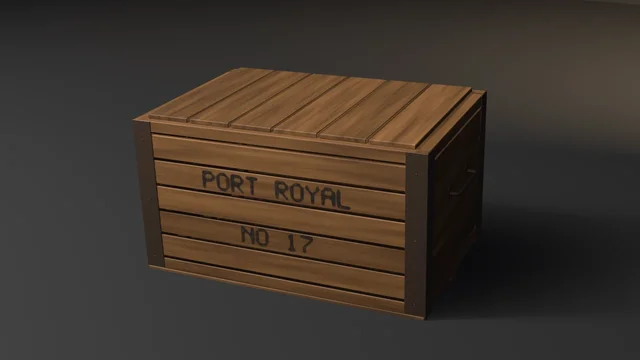
Shipping Crate
A procedural shipping crate through UVs, bake, LOD, collider, and Unity glTF, asserting recomputed budgets rather than an API contract.
showcase/terrain-scatter/
A Geometry Nodes hill tile with an embedded scatter of glacier-worn boulders of varied size through UVs, bake, LOD, collider, and Unity glTF, asserting recomputed budgets rather than an API contract.
Rendered headless by the showcase piece itself. Select it to enlarge.
category Terrain
blender --background --python showcase/terrain-scatter/terrain_scatter.py --
A showcase piece, not an example. Geometry Nodes sine-hill Mesh Grid with an Index-jittered Instance-on-Points scatter, realized cubes replaced by closed-form, glacier-worn boulders seated on sampled dirt Z, then the shipped pipeline: unique-cell UVs, Cycles high-to-low normal bake, LOD chain, convex collider, Unity glTF export.
GN still builds the hill, with two closed-form micro-relief terms on top of the sine, and the instance grid. After realize+slabify, whose rim is bevelled into the walls, cube islands are deleted and each centroid is reseated as a sized stone, sunk until the ground closes around it on every side, then clamped above the slab floor.
It asserts budget conformance of the generated result. It does not witness an API contract. "It rendered without error" is not a check.
Composes skills geometry-nodes-python, mesh-editing-and-bmesh, bake-high-to-low, depsgraph-and-evaluated-data, engine-export-presets, and snippets bake_normal_high_to_low.py, setup_bake_target_image.py, lod_chain.py / decimate_to_budget.py, convex_hull_collider.py, export_preset_unity.py (helpers copied, not imported as a package). Hygiene combinatorics match examples/mesh-hygiene-audit (copied, not imported).
Intended size: 1.80 m square hill tile, ~0.16 m sine amplitude, nine embedded stones from cobble to boulder; outer AABB 1.800 × 1.800 × 0.609 m.
Hero. The render path dresses the tile as a hand-made meadow diorama. None of it is part of the asset, its budgets or its export; the dressing is drawn with a fixed seed, parented to the tile, and the asset sheet judges TerrainLow alone.
The third pass found the stones read as placeholders at 100%: faceted grey icosphere blobs, one with a pure-black flat face. Glacial erratics, the boulders strewn across upland meadows, are sub-rounded to sub-angular blocks of granite or gneiss, rounded by transport in the ice with a few flat fracture and abrasion faces, lichen on their tops and moss where they meet the turf.
BLOCK_EXP = 2.6, which squares the shoulders into a block, with two closed-form low-frequency lumps of up to LUMP_AMP = 13% and four shallow cleaves (CLEAVE_DEPTH 0.68). STONE_R_BOUND grows by the superellipsoid's plan bulge and the lump amplitude, so the relaxation still spaces the stones by their real reach.STONE_SHARP_DEG = 48° kept sharp, so the fracture faces keep a crisp arris. Flat-shaded, the same stones read as low-poly placeholders.Declared as named constants; every gate recomputes from the mesh, materials, UVs, evaluated LOD, collider, or export file.
| Axis | Declared | Measured (4.5.11 / 5.1.2 / 5.2.1) |
|---|---|---|
| Base triangles | 2000–3800 | 2986 / 2986 / 2986 |
| LOD1 ratio | 0.32–0.62 of base | 0.4997 / 0.4997 / 0.4997 |
| LOD2 ratio | 0.10–0.35 of base | 0.2197 / 0.2197 / 0.2197 |
| Materials | exactly 2 distinct, ≥24 stone faces | 2 slots, 654 stone |
| UVs | in 0..1, AABB overlap ≤ 1e-5 | in range, overlap 0 |
| Outer AABB | (1.800, 1.800, 0.609) m ± 0.015 | (1.8000, 1.8008, 0.6085), zmin 0 |
| Collider tris | ≤ 120 | 54 |
| Export | written, size > 0 | 218868 / 218868 / 218860 bytes (4.5.11 / 5.1.2 / 5.2.1) |
Base triangles rose from 1194 to 1758 in the first quality pass: 9-vert hill became a 21-vert grid, and bevelled cubes became subdiv-2 icospheres. Outer Z dropped from 0.655 m (crate corners swinging through the slab) to 0.552 m of seated stone on the hill.
The second pass took them from 1758 to 2398: the four-segment rim bevel adds 640. The outer Z moved from 0.584 m to 0.570 m, because the stones now sink into the ground rather than perch on it, and the declared size was re-fitted to match. The collider fell from 72 to 36 triangles because it now hulls a coarse, unbevelled 9-vertex tile (COLLIDER_GRID): the chamfer and micro-relief are visual, and on the full-resolution tile they pushed the hull to 178, over its ceiling.
The third pass took them from 2398 to 2986, and the declared band was re-fitted from 1400–2800 to 2000–3800 around the new count, the same relative width. The 80-triangle icosphere stones became quad cube-spheres: 192 triangles for each of the four boulders, 108 for each of the five cobbles (1308 for the stones, against 720). At 80 triangles a 0.4 m boulder's silhouette showed its facets, and smooth shading cannot hide a polygonal outline. The outer Z rose from 0.570 m to 0.609 m: the blocky superellipsoid keeps more of its height than the cleaved ellipsoid did, and the declared size was re-centred on the measured 0.6085 m (the ± 0.015 tolerance is unchanged). The collider rose from 36 to 54 triangles, still under its ceiling of 120, because the rounder stones put a few more vertices on the hull.
DECIMATE COLLAPSE triangle counts are not guaranteed identical across series — the gate is a ratio band, not an exact count. This mesh matched on 4.5.11 / 5.1.2 / 5.2.1. Bake pixels are stochastic; the gate is has_data plus operator FINISHED, not byte-identity. Construction uses no RNG: jitter, cleave planes and relaxation are all closed form or fixed iteration. Export byte counts differ by 16 B on 5.2.1 (glTF serializer), not a gated axis.
Recomputed from the generated mesh, not asserted about the script.
| Axis | Declared | Measured (all three) |
|---|---|---|
| Non-manifold edges | 0 | 0 |
| Loose verts / edges | 0 / 0 | 0 / 0 |
| Doubles merged at 1e-5 | 0 | 0 |
| Zero-area faces | 0 | 0 |
| N-gons | 0 | 0 |
| Coplanar disjoint face pairs | 0 | 0 |
Grounded: zmin | within 1e-4 of 0 | 0.0000 |
| Stone shells | 9 | 9 |
| Per-stone faces | ≥ 40 | 54 (cobbles) / 96 (boulders) |
Stone floor zmin | ≥ 0.012 m | 0.08305 |
Seat offset (zmin − dirt Z) | ≤ 0.02 m | −0.03775 |
| Interpenetrating stone pairs (BVH overlap) | 0 | 0 |
| Sealed sectors per stone (buried vertex in each of 8) | 8 / 8 | 8 / 8 |
| Stone footprint ratio (largest / smallest) | ≥ 3.0 | 9.757 |
| Rim tilt step between adjacent dirt faces | ≤ 40° | 33.52° |
The committed stones were smooth-shaded, near-white ellipsoids with a gentle sine bump: eggs or marshmallows on a pale clay slab. Two pairs also interpenetrated, because the GN scatter jitters by up to 0.22 m on a 0.575 m grid, and no budget compared stone to stone.
N_CLEAVES planes whose normals and depths come from the stone's own centre, closed form. Every vertex beyond a plane is projected onto it, which leaves flat broken faces. The first pass shaded them flat, because smooth shading turned the cleaved ellipsoids back into eggs; the third pass replaced them with blocky superellipsoids that hold their shape smooth-shaded (above).ROCK_SCALE = 1.35×.2 × STONE_R_BOUND + STONE_CLEAR over a fixed number of symmetric passes, and clamped so each stone's bound stays on the tile. STONE_R_BOUND is derived from ROCK_SCALE and the largest semi-axis, bump and tilt, so scaling the stones widens the spacing with them. With today's numbers the unrelaxed scatter would also clear; the relaxation is what keeps that true when the scatter or the sizes change.The second pass inspected the tile in clay, wire, six orthos and ground-contact close-ups, and found the tile read as a slice of cake with pebbles dropped on it.
EMBED_SINK below it.STONE_SIZES gives each scatter point a factor from 0.55 to 1.45, boulders among cobbles, and the relaxation spaces each pair by the sum of their own bounds.stone_overlap_audit BVH-tests every stone pair. --pile-rocks skips the relaxation and draws the scatter in to 40% so neighbours collide: 8 pairs interpenetrate (7 with the second pass's stones), and the piece exits 20. Skipping the relaxation alone proved nothing in the second pass, because the cleaved stones missed each other unrelaxed.
Each violates one named budget. All were run on 4.5.11, 5.1.2 and 5.2.1 and returned the same code on each.
| Flag | Budget violated | Exit |
|---|---|---|
--skip-decimate | LOD1 ratio band | 9 |
--stray-vert | loose vertex count is 0 | 15 |
--lift-z | bounding box zmin is 0 | 16 |
--poke-rock | stone floor zmin | 17 |
--float-rocks | seat offset vs sampled dirt Z | 18 |
--box-rocks | per-stone face floor | 19 |
--pile-rocks | stone-to-stone interpenetration is 0 | 20 |
--perch-rocks | every stone sealed in 8/8 sectors (measures 4/8) | 21 |
--uniform-rocks | footprint ratio ≥ 3.0 (measures 2.317) | 22 |
--sharp-rim | rim tilt step ≤ 40° (measures 88.50°) | 23 |
blender --background --python terrain_scatter.py --
blender --background --python terrain_scatter.py -- --skip-decimate
blender --background --python terrain_scatter.py -- --stray-vert
blender --background --python terrain_scatter.py -- --lift-z
blender --background --python terrain_scatter.py -- --poke-rock
blender --background --python terrain_scatter.py -- --float-rocks
blender --background --python terrain_scatter.py -- --box-rocks
blender --background --python terrain_scatter.py -- --pile-rocks
blender --background --python terrain_scatter.py -- --perch-rocks
blender --background --python terrain_scatter.py -- --uniform-rocks
blender --background --python terrain_scatter.py -- --sharp-rim
blender --background --python terrain_scatter.py -- --output terrain.png
Smoke passes no flags.
File-local. 9 is a valid check code. 10 is reserved for gallery_framing.check_framing on the --output path. 15–19 are the hygiene and joint-fit family.
| Code | Meaning |
|---|---|
| 0 | Success |
| 1 | Uncaught exception (FATAL wrapper) |
| 2 | argparse / usage |
| 3 | Mesh did not build / no UV layer |
| 4 | Base triangle count outside range |
| 5 | Material count ≠ 2 distinct slots, or stone faces missing |
| 6 | UVs outside 0..1 |
| 7 | UV AABB overlap above tolerance |
| 8 | World AABB off declared outer size |
| 9 | LOD ratio band (--skip-decimate lands here) |
| 10 | Framing gate (render path only) |
| 11 | Collider triangle count above ceiling |
| 12 | Bake did not finish or image has no data |
| 13 | Export file missing or empty |
| 14 | --output produced no file |
| 15 | Hygiene (--stray-vert lands here) |
| 16 | Grounded zmin (--lift-z) |
| 17 | Stone floor poke (--poke-rock) |
| 18 | Float above host (--float-rocks) |
| 19 | Stone shell faces (--box-rocks) |
| 20 | Stone pairs interpenetrate (--pile-rocks) |
| 21 | A stone not sealed in every sector (--perch-rocks) |
| 22 | Stone footprint ratio below floor (--uniform-rocks) |
| 23 | Rim tilt step above ceiling (--sharp-rim) |
| 26 | Gallery asset-quality violation (render path; the floors' 11 is remapped here) |
A procedural shipping crate through UVs, bake, LOD, collider, and Unity glTF, asserting recomputed budgets rather than an API contract.
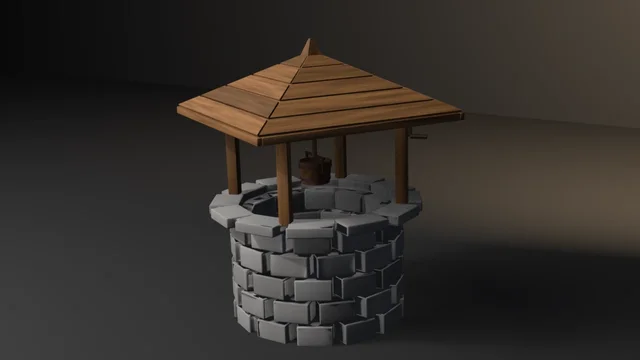
A procedural stone well through UVs, bake, LOD, collider, and Unity glTF, asserting recomputed budgets rather than an API contract.
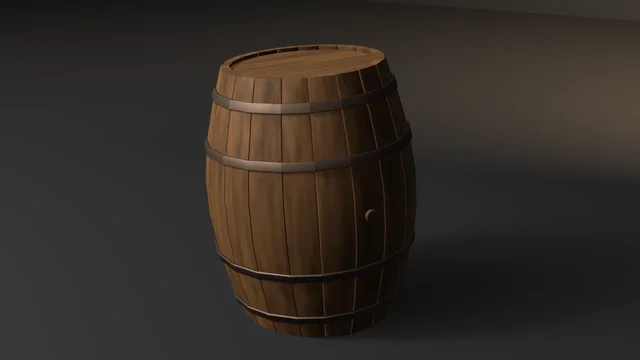
A procedural wine-cask with boarded, croze-seated heads and chord-lofted hoops through UVs, bake, LOD, collider, and Unity glTF, asserting recomputed budgets rather than an API contract.