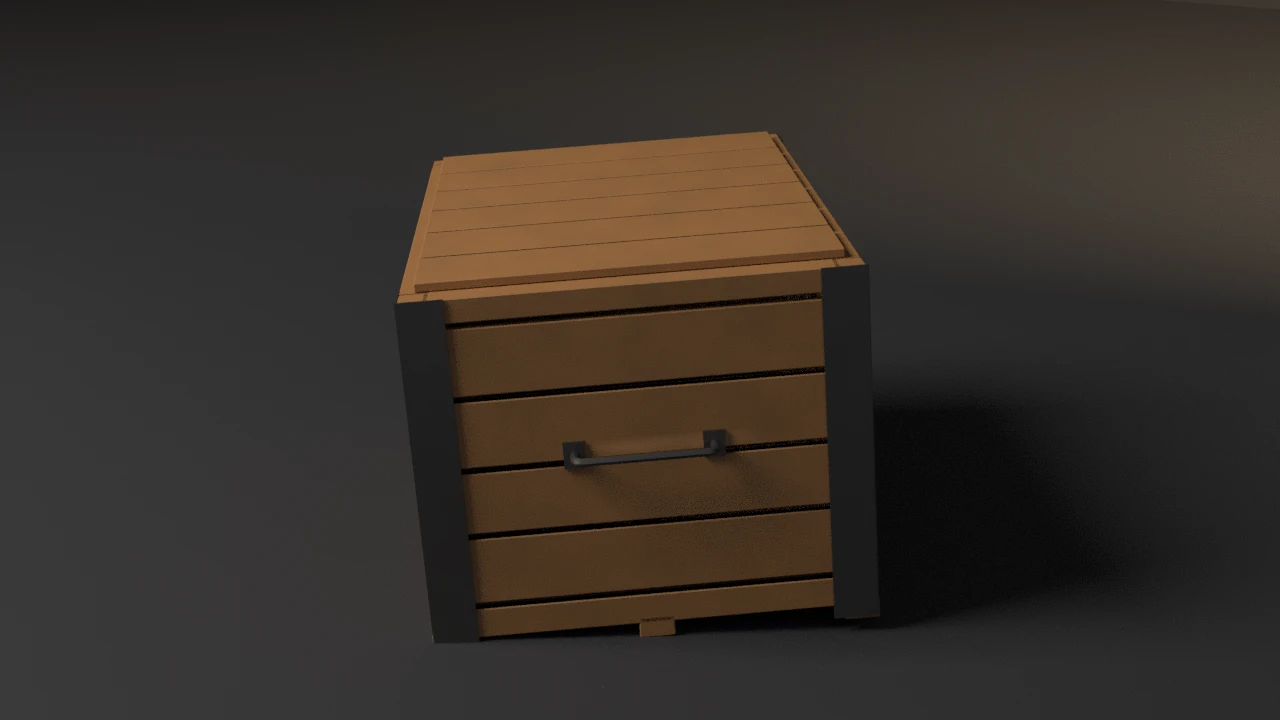
shipping-crate
A procedural shipping crate through UVs, bake, LOD, collider, and Unity glTF, asserting recomputed budgets rather than an API contract.
A procedural glacial boulder cluster — four boulders cut from ellipsoids by closed-form cleavage planes with weathered bevels, a speckled granite block, a banded sandstone boulder split in two with matching crack faces and bedding, a sandstone slab resting flat on a smaller granite boulder, lichen crusts and moss cushions on the tops and north faces — sunk into a soil mound with grass tufts, pebbles and wildflowers, through UVs, bake, LOD, collider, and Unity glTF, asserting recomputed budgets rather than an API contract.
Rendered headless by the showcase piece itself — click to zoom.
category Nature
blender --background --python showcase/boulder-cluster/boulder_cluster.py --
A showcase piece, not an example, and the third in the nature category. It builds a procedural, game-ready cluster of glacial erratics on a patch of ground:
Every draw comes from random.Random(SEED) in plan_cluster(), before anything is built: the boulders' waves and chips, the growth patches, and the candidate spots for every tuft, pebble and flower. Which candidates are used is decided against the default layout alone (Layout, finish_layout). No flag draws from the stream or changes the layout, so a falsifier changes only what it names.
Eight materials, one per substance: granite, sandstone, lichen, moss, grass, soil (glacial till), gravel and flower. A Cavity point attribute, computed from the finished rock mesh, darkens crevices and paler convex edges. A Strata point attribute, the position along the bed normal in the boulder's own frame, draws the sandstone bands; both halves share it, so the bands match across the crack. A Zone face attribute marks the crack faces, the rings of each crust and cushion, grass tips and the flower parts; every boulder, crust, cushion, blade, pebble and flower has a seeded Tone. Everything is smooth-shaded; every material boundary and every fold sharper than 60° is a hard edge.
It asserts budget conformance of the generated result. It does not witness an API contract. "It rendered without error" is not a check.
Composes skills mesh-editing-and-bmesh, bake-high-to-low, depsgraph-and-evaluated-data, engine-export-presets, and snippets bake_normal_high_to_low.py, setup_bake_target_image.py, lod_chain.py / decimate_to_budget.py, convex_hull_collider.py, export_preset_unity.py (helpers copied inline, not imported).
Intended size: a mound 4.44 × 3.22 m, the granite block's top 1.37 m off the ground. The outer AABB is 4.444 × 3.215 × 1.366 m. The soil sets X and Y, a moss cushion on the block's crown the top. The soil's underside is the ground. The collider is the convex hull of the five rocks alone, coarse: players walk through grass.
Every budget is declared as a named constant. Every gate recomputes its value from the mesh, materials, UVs, evaluated LOD, collider, or export file.
| Axis | Declared | Measured (5.2.1) |
|---|---|---|
| Base triangles | 39600–40900 | 40244 |
| LOD1 ratio | 0.32–0.62 of base | 0.5000 |
| LOD2 ratio | 0.10–0.35 of base | 0.2200 |
| Materials | exactly 8 distinct; ≥4000 granite, ≥3400 sandstone, ≥1960 lichen, ≥1580 moss, ≥4700 grass, ≥2460 soil, ≥1750 gravel, ≥1260 flower faces | 8 slots; 4440 / 3798 / 2184 / 1760 / 5251 / 2734 / 1944 / 1400 |
| UVs | in 0..1, AABB overlap ≤ 1e-5 | in range, overlap 0 |
| Outer AABB | (4.4442, 3.2153, 1.3657) m ± 0.01 | (4.4442, 3.2153, 1.3657), zmin 0 |
| Collider tris (rock hull) | ≤ 320 | 292 |
| Export | written, size > 0, removed after measuring | 3064548 bytes |
No falsifier changes the triangle count or the envelope: every falsifier run measured 40244 tris and the default's outer AABB to the tenth of a millimetre.
DECIMATE COLLAPSE triangle counts are not identical across Blender series, so the LOD gate is a ratio band, not an exact count. Bake pixels are stochastic, so the bake gate is has_data plus operator FINISHED, not byte-identity. The plan is seeded and nothing else is random; the geometry is pure Python math. Two default runs print identical measurements.
Recomputed from the generated mesh, not asserted about the script.
| Axis | Declared | Measured |
|---|---|---|
| Non-manifold edges | 0 | 0 |
| Loose verts / edges | 0 / 0 | 0 / 0 |
| Doubles merged at 1e-5 | 0 | 0 |
| Zero-area faces | 0 | 0 |
| N-gons | 0 | 0 |
| Coplanar cross-shell face pairs (KD range 0.05 m, plane ε 1e-4) | 0 | 0 |
Grounded: zmin | within 1e-4 of 0 | 0.0000 |
The coplanar budget did most of the work on this piece. The first draft measured 14 pairs: lichen laid on the smooth radial field sat a fixed height off it, but the shipped rock is chords of that field, up to 4 mm inside it on the bevels. Every crust and cushion point is now snapped to the built rock mesh. That left pairs on the sandstone, where the bedding ledges are parallel terraces a few millimetres apart; the ledges now fade out on bedding-plane tops, and growth on sandstone keeps to its tops. A domed crust still met a rock face now and then, because a skin tilted against the rock can land on the plane of a face on a nearby bevel. The crusts are now even skins, parallel to the faces under them, which on a convex patch of rock cannot reach the plane of any other face. Crust thicknesses and bites are staggered 0.5 mm apart, so two crusts pushed together by a falsifier cannot share a plane either.
A ray onto a non-planar quad lands on whichever diagonal the tree picks, and on the soil berms the two differ by centimetres: one grass blade was rooted by one tree and measured 16 mm off the ground by the other. Each soil cell is now split on its short diagonal where it is built.
These are the organic invariants. A boulder field has no joinery. What makes it read as one is that every boulder is sunk into the ground rather than set down on it, that the slab rests on the boulder under it and would not topple, that the split halves were once one stone, and that lichen and moss grow where the sun does not bake them.
| Axis | Declared | Measured |
|---|---|---|
| Embedding: per boulder (the granite block, each half, the front boulder), per 45° sector about its plan centroid, the deepest flank vertex (at least 0.6 of the sector's reach from the centroid) under the soil straight above it (a ray down onto the soil shell alone); and the deepest vertex of all | every sector ≥ 0.030 m; deepest ≤ 0.30 m | shallowest sector 0.0686 m (the block); deepest 0.1488 m |
| Slab seat: the slab's deepest vertex inside the front boulder, straight down | 0.004–0.030 m | 0.0100 |
| Slab balance: the slab's volume centroid inside the plan hull of its footprint (every vertex within 12 mm of its lowest gap to the boulder under it) | ≥ 0.03 m inside | 0.1571 (263 footprint vertices) |
| Split: the crack faces of each half (faces within 0.15 m of the other half and facing it): the angle between their area-weighted normals, the gap between them along that normal, their slide across it, and their areas | ≤ 3.0°; gap 0.050–0.100 m; slide ≤ 0.05 m; each ≥ 0.25 m² | 1.00°; 0.0775 m; 0.0092 m; 0.747 / 0.729 m² |
| Growth: of the lichen and moss top faces (facing away from the rock under them), the area fraction whose normal faces up (z > 0.35) or north into the shade (y > 0.5) | 26 crusts, 8 cushions, ≥ 0.85 | 26, 8; 0.9614 |
| Ground cover rooted: soil, grass blades, pebbles, flower stems, leaves, discs and petals, unioned by BVH overlap | every shell joined to the soil | 497 shells; 0 loose |
Each boulder is bedded where it is laid out: the builder raises or sinks it until its shallowest flank sector is 70 mm under the analytic soil, and the split halves are bedded as one unit. The budget reads the bed back off the shipped soil mesh by raycast. The slab is seated the same way, against the front boulder as that run built it, so a falsifier that moves the boulder carries the slab with it. The balance budget is the tip-over check: a slab resting only on its edge has a footprint whose hull misses its own centre of mass.
Each falsifier violates one named budget. Every one was run on 5.2.1 and exited its declared code. None moves the envelope: every run measured the same outer AABB and triangle count as the default, and every other budget stayed green.
| Flag | Budget violated | Exit |
|---|---|---|
--skip-decimate | LOD1 ratio band (measured 1.0000) | 9 |
--stray-vert | loose vertex count is 0 (measured 1, placed inside the envelope) | 15 |
--lift-z | bounding box zmin is 0 (measured 0.05000) | 16 |
--perch-boulder | embedding (the front boulder raised 90 mm off its bed: shallowest sector −0.0151 m, deepest vertex 0.0086 m) | 17 |
--float-slab | slab seat (the slab lifted 20 mm off the front boulder: deepest vertex −0.0100 m) | 18 |
--perch-slab | slab balance (the slab slid 0.36 m south across the boulder's top and re-seated: centroid 0.1170 m outside its 41-vertex footprint) | 19 |
--skew-half | split halves matching (the east half turned 6° about Z at its crack: faces 6.65° apart) | 20 |
--sunny-lichen | growth on up- and shade-facing surfaces (every crust turned by one rotation onto south faces: 0.6243) | 21 |
--float-cover | ground cover rooted (every blade, pebble and flower lifted 30 mm: 475 of 497 shells loose) | 22 |
--perch-boulder carries the slab with the boulder, so the slab still seats 10 mm deep and balances; only the embedding fails. --float-slab keeps the slab's footprint (read relative to its lowest gap), so balance still passes. --perch-slab re-seats the slab at the same 10 mm bite, so the seat passes and only the balance fails. --skew-half turns the half about its crack's own centre, so the gap (0.0779 m) and slide (0.0102 m) stay in band and the half stays bedded. --sunny-lichen moves the crusts only: a moss cushion on the block's crown is the top of the envelope, and moving it would move the box. It uses one rigid rotation for every crust, so crusts that were apart stay apart. --float-cover leaves 22 of the largest pebbles still touching, sunk deeper than 30 mm.
blender --background --python boulder_cluster.py --
blender --background --python boulder_cluster.py -- --skip-decimate
blender --background --python boulder_cluster.py -- --stray-vert
blender --background --python boulder_cluster.py -- --lift-z
blender --background --python boulder_cluster.py -- --perch-boulder
blender --background --python boulder_cluster.py -- --float-slab
blender --background --python boulder_cluster.py -- --perch-slab
blender --background --python boulder_cluster.py -- --skew-half
blender --background --python boulder_cluster.py -- --sunny-lichen
blender --background --python boulder_cluster.py -- --float-cover
blender --background --python boulder_cluster.py -- --output cluster.png
Smoke passes no flags.
The hero keeps the piece unturned (HERO_YAW_DEG 0°) and looks in from the south-south-west, a little above the block's top. The granite block stands on the left, the split boulder on the right with its crack running straight away from the camera, so the gap reads as a dark slot, and the front boulder and its slab sit between them. The fill is 0.797 × 0.800.
File-local. 9 is a valid check code. 10 is reserved for gallery_framing.check_framing on the --output path. 15–19 are the hygiene, grounding, contact and balance family. 20–22 are file-local. 23 is the asset-quality floor on the render path: check_asset_quality returns 11, which this piece already spends on the collider ceiling, so the call site remaps it.
| Code | Meaning |
|---|---|
| 0 | Success |
| 1 | Uncaught exception (FATAL wrapper) |
| 2 | argparse / usage |
| 3 | Mesh did not build, no UV layer, or the boulder or soil shells not found |
| 4 | Base triangle count outside range |
| 5 | Material count ≠ 8 distinct slots, or a face-count floor missed |
| 6 | UVs outside 0..1 |
| 7 | UV AABB overlap above tolerance |
| 8 | World AABB off declared outer size |
| 9 | LOD ratio band (--skip-decimate lands here) |
| 10 | Framing gate (render path only) |
| 11 | Collider triangle count above ceiling |
| 12 | Bake did not finish or image has no data |
| 13 | Export file missing or empty |
| 14 | --output produced no file |
| 15 | Mesh hygiene: loose, non-manifold, zero-area, doubles, n-gons, coplanar cross-shell pairs |
| 16 | Not grounded: bounding box zmin off 0 (--lift-z) |
| 17 | Embedding: a boulder's flank sector under 0.030 m into the soil, or a vertex deeper than 0.30 m (--perch-boulder) |
| 18 | Slab seat: the slab's deepest vertex in the boulder under it outside 0.004–0.030 m (--float-slab) |
| 19 | Slab balance: the slab's mass centre less than 0.03 m inside its footprint (--perch-slab) |
| 20 | Split: crack faces more than 3° apart, gap outside 0.050–0.100 m, slide above 0.05 m, or a face under 0.25 m² (--skew-half) |
| 21 | Growth: not 26 crusts and 8 cushions, or under 0.85 of their top area facing up or north (--sunny-lichen) |
| 22 | Ground cover: a grass, pebble or flower shell not joined to the soil (--float-cover) |
| 23 | Asset-quality floor (render path only; remapped from 11) |
"""Game-ready glacial boulder cluster — a showcase piece, not an example. Asserts budget conformance of a procedural boulder cluster after composing shipped pipeline pieces: bmesh construction, UVs, eight materials, high-to-low normal bake, LOD chain, convex cluster collider, Unity glTF export. Four erratic boulders of clearly different sizes lie part sunk in a soil mound. Each is an ellipsoid cut by closed-form cleavage planes, the cuts rounded off by a weathering bevel (a soft minimum in the radial field), then roughened by a seeded sum of waves. The largest is a 1.7 m granite block. A sandstone boulder has split in two along a crack; its halves stand 75 mm apart with matching faces and matching bedding bands. A 0.95 m granite boulder in front carries a 0.6 m sandstone slab resting flat on its top. Lichen crusts and moss cushions grow on the tops and north faces; grass tufts, pebbles and wildflowers stand in the gaps and round the bases, one tuft in the crack. Budgets are declared below and recomputed from the generated result. They are not API-contract witnesses. Each falsifier violates one named budget: ``--skip-decimate`` the LOD-ratio band, ``--stray-vert`` mesh hygiene, ``--lift-z`` grounded zmin, ``--perch-boulder`` every boulder embedded in the soil, ``--float-slab`` the slab seated on its support, ``--perch-slab`` the slab's mass centre over its footprint, ``--skew-half`` the split halves matching across the crack, ``--sunny-lichen`` lichen and moss on up- and shade-facing surfaces, ``--float-cover`` the ground cover rooted in the soil. Seeded, not random: ``random.Random(SEED)`` draws the whole plan before anything is built, so flags never shift the stream. DECIMATE COLLAPSE triangle counts are not byte-identical across Blender versions — the LOD gate is a ratio band, not an exact count. blender --background --python boulder_cluster.py -- blender --background --python boulder_cluster.py -- --skip-decimate blender --background --python boulder_cluster.py -- --output cluster.png """ import argparse import math import os import random import sys import tempfile import traceback import bmesh import bpy from mathutils import Matrix, Vector from mathutils.bvhtree import BVHTree from mathutils.kdtree import KDTree # Showcase lives at repo-root/showcase/, not under examples/. The framing # helper is the repo's only shared import and lives next to the examples; # resolve the repo root so we do not move gallery_framing.py. _REPO = os.path.abspath( os.path.join(os.path.dirname(os.path.abspath(__file__)), os.pardir, os.pardir) ) sys.path.insert(0, os.path.join(_REPO, "examples")) sys.dont_write_bytecode = True import gallery_framing # noqa: E402 import gallery_asset_quality # noqa: E402 SEED = 4127 TAU = 2.0 * math.pi UP = Vector((0.0, 0.0, 1.0)) # --- Boulders --------------------------------------------------------------- # Each boulder: an ellipsoid (semi-axes in its own frame, turned by yaw about # Z) cut by cleavage planes (normal in the boulder frame, offset as a # fraction of the ellipsoid's support along that normal, weathering bevel k). BOULDERS = { "A": {"kind": "granite", "xy": (-0.80, 0.44), "yaw": 16.0, "axes": (1.12, 0.80, 0.86), "planes": (((0.10, -0.18, 1.0), 0.66, 0.08), ((0.05, -1.0, 0.22), 0.68, 0.07), ((1.0, -0.15, 0.20), 0.66, 0.06), ((-1.0, 0.10, -0.10), 0.70, 0.08), ((-0.20, 1.0, 0.35), 0.70, 0.08), ((0.70, 0.60, 0.50), 0.70, 0.07), ((-0.60, -0.70, 0.45), 0.72, 0.07), ((0.0, 0.0, -1.0), 0.60, 0.08)), "chips": 6, "chip_f": (0.74, 0.84), "chip_k": 0.05, "amp": 0.030, "n": 22, "tone": 0.35}, "B": {"kind": "sandstone", "xy": (1.10, 0.24), "yaw": -8.0, "axes": (0.78, 0.62, 0.60), "planes": (((-0.10, 0.05, 1.0), 0.74, 0.035), ((1.0, 0.10, -0.15), 0.72, 0.04), ((-1.0, -0.10, 0.25), 0.74, 0.04), ((0.10, 1.0, 0.10), 0.76, 0.035), ((0.0, -1.0, 0.15), 0.78, 0.04), ((0.0, 0.0, -1.0), 0.60, 0.05)), "chips": 5, "chip_f": (0.78, 0.88), "chip_k": 0.03, "amp": 0.020, "n": 16, "tone": 0.55}, "C": {"kind": "granite", "xy": (0.02, -0.80), "yaw": 38.0, "axes": (0.56, 0.46, 0.44), "planes": (((0.12, -0.04, 1.0), 0.64, 0.05), ((1.0, 0.20, 0.10), 0.70, 0.06), ((-0.30, -1.0, 0.20), 0.68, 0.06), ((-1.0, 0.30, 0.0), 0.72, 0.06), ((0.40, -0.80, 0.60), 0.72, 0.05), ((0.10, 1.0, 0.30), 0.74, 0.06), ((0.0, 0.0, -1.0), 0.60, 0.07)), "chips": 4, "chip_f": (0.76, 0.86), "chip_k": 0.04, "amp": 0.024, "n": 16, "tone": 0.70}, "D": {"kind": "sandstone", "yaw": 24.0, "axes": (0.36, 0.26, 0.13), "planes": (((0.05, 0.10, 1.0), 0.72, 0.025), ((1.0, 0.0, 0.10), 0.80, 0.03), ((-1.0, 0.15, 0.0), 0.80, 0.03), ((0.1, -1.0, 0.1), 0.84, 0.03)), "chips": 3, "chip_f": (0.82, 0.90), "chip_k": 0.02, "amp": 0.010, "n": 11, "tone": 0.25}, } N_HIGH = 1.5 # the bake source's rock resolution factor GROOVE = 0.008 # sandstone bedding undulation depth, m STRATA_SPACING = 0.13 STRATA_AXIS = (0.16, 0.20, 1.0) CRACK_N = (0.967, -0.268, 0.05) # B's crack normal in B's frame CRACK_K = 0.018 # the crack's fresh edge: barely rounded CRACK_GAP = 0.075 # between the two halves HALF_ORIGIN = 0.36 # each half's origin, as a fraction of B's support along the crack SLAB_BOTTOM = 0.55 # D's flat underside, fraction of its support SLAB_OFFSET = (0.03, 0.02) SLAB_BITE = 0.010 # D's deepest vertex into C EMBED = 0.070 # every boulder's shallowest flank this far under the soil FLANK_R = 0.60 # flank vertices: at least this fraction of the sector's reach SECTORS = 8 # falsifiers PERCH_LIFT = 0.09 # --perch-boulder: C raised off its bed FLOAT_SLAB = 0.020 # --float-slab: D lifted off C PERCH_SLAB = 0.36 # --perch-slab: D slid south across C's top, then re-seated SKEW_DEG = 6.0 # --skew-half: the east half turned about Z at its crack FLOAT_COVER = 0.030 # --float-cover: every grass, pebble and flower lifted # --- Ground ----------------------------------------------------------------- SOIL_A = (2.18, 1.58) SOIL_Y0 = 0.08 SOIL_H0 = 0.20 SOIL_N = 36 SOIL_EDGE = 0.24 SOIL_FLOOR = 0.012 BERM_H = 0.090 BERM_W = 0.22 BERM_OFF = 0.07 N_TUFT_BASE = 26 N_TUFT_OPEN = 14 N_PEBBLES = 44 N_FLOWERS = 14 N_LICHEN = 26 N_MOSS = 8 BBOX_TOL = 0.01 # Fitted after locking geometry. Recomputed from bound_box. OUTER_SIZE = (4.4442, 3.2153, 1.3657) BASE_TRIS_MIN = 39600 BASE_TRIS_MAX = 40900 LOD1_RATIO_MIN = 0.32 LOD1_RATIO_MAX = 0.62 LOD2_RATIO_MIN = 0.10 LOD2_RATIO_MAX = 0.35 LOD1_TARGET = 0.50 LOD2_TARGET = 0.22 MATERIAL_COUNT = 8 UV_EPS = 1e-4 UV_OVERLAP_MAX = 1e-5 COLLIDER_TRIS_MAX = 320 BAKE_RES = 512 CAGE_EXTRUSION = 0.01 # granite, sandstone, lichen, moss, grass, soil, gravel, flower FACE_FLOORS = (4000, 3400, 1960, 1580, 4700, 2460, 1750, 1260) ZMIN_EPS = 1e-4 DOUBLES_EPS = 1e-5 AREA_EPS = 1e-10 COPLANAR_NORMAL_EPS = 1e-4 COPLANAR_PLANE_EPS = 1e-4 COPLANAR_CENTRE_MAX = 0.05 LIFT_Z = 0.05 # Embedding: per boulder, per 45-degree sector about its plan centroid, the # deepest flank vertex under the soil straight above it. FLANK_MIN = 0.030 DEEP_MAX = 0.30 # Slab seat: its deepest vertex inside C, straight down. SEAT_MIN = 0.004 SEAT_MAX = 0.030 # Slab balance: its footprint is every vertex within FOOT_EPS of its lowest # gap to C; its volume centroid must be inside the footprint's plan hull. FOOT_EPS = 0.012 BALANCE_MIN = 0.03 # Split: crack faces are the faces of a half within CRACK_REACH of the other # half and facing it. CRACK_REACH = 0.15 CRACK_FACING = 0.85 PARALLEL_MAX_DEG = 3.0 GAP_MIN = 0.050 GAP_MAX = 0.100 SLIDE_MAX = 0.05 CRACK_AREA_MIN = 0.25 # Lichen and moss: top faces (facing away from the rock) that face up or north. TOP_DOT = 0.3 UP_Z = 0.35 SHADE_Y = 0.5 GROWTH_FRAC_MIN = 0.85 HERO_YAW_DEG = 0.0 WALL_Y = 4.6 GRANITE_IDX = 0 SANDSTONE_IDX = 1 LICHEN_IDX = 2 MOSS_IDX = 3 GRASS_IDX = 4 SOIL_IDX = 5 GRAVEL_IDX = 6 FLOWER_IDX = 7 MAT_LABELS = ("granite", "sandstone", "lichen", "moss", "grass", "soil", "gravel", "flower") def eevee_engine_id(): return "BLENDER_EEVEE" if bpy.app.version >= (5, 0, 0) else "BLENDER_EEVEE_NEXT" def fail(msg, code): print(f"ERROR: {msg}", file=sys.stderr) return code def triangle_count(mesh): mesh.calc_loop_triangles() return len(mesh.loop_triangles) def evaluated_triangle_count(obj): # Duplicated from snippets/lod_chain.py / decimate_to_budget.py (not a package). depsgraph = bpy.context.evaluated_depsgraph_get() eval_obj = obj.evaluated_get(depsgraph) eval_mesh = eval_obj.to_mesh() try: eval_mesh.calc_loop_triangles() return len(eval_mesh.loop_triangles) finally: eval_obj.to_mesh_clear() def smoothstep(x, lo, hi): t = min(max((x - lo) / (hi - lo), 0.0), 1.0) return t * t * (3.0 - 2.0 * t) def smin(a, b, k): """Polynomial soft minimum: the weathering bevel where two cuts meet.""" if k <= 0.0: return min(a, b) h = max(k - abs(a - b), 0.0) / k return min(a, b) - h * h * k * 0.25 def rotz(deg): return Matrix.Rotation(math.radians(deg), 3, "Z") def perp_basis(d): ref = UP if abs(d.z) < 0.9 else Vector((1.0, 0.0, 0.0)) e1 = d.cross(ref).normalized() return e1, d.cross(e1).normalized() # -------------------------------------------------------------------------- # Boulder bodies: a star-shaped radial field about an interior origin # -------------------------------------------------------------------------- class Body: """One rock in its own frame. ``radius(d)`` is the distance from the origin ``o`` to the surface along ``d``: the ellipsoid, cut by each plane through a soft minimum, then displaced by the seeded waves. ``M`` maps the frame to the world.""" def __init__(self, name, spec, waves, origin=None, crack=None, strata=False, chips=()): self.name = name self.kind = spec["kind"] self.axes = Vector(spec["axes"]) self.amp = spec["amp"] self.n = spec["n"] self.tone = spec["tone"] self.waves = waves self.o = Vector(origin) if origin is not None else Vector((0.0, 0.0, 0.0)) self.planes = [] for nrm, f, k in tuple(spec["planes"]) + tuple(chips): n = Vector(nrm).normalized() self.planes.append((n, f * self.support(n), k, False)) if crack is not None: n, h = crack self.planes.append((n, h, CRACK_K, True)) self.strata = Vector(STRATA_AXIS).normalized() if strata else None self.M = Matrix.Identity(4) def support(self, n): a = self.axes return math.sqrt((a.x * n.x) ** 2 + (a.y * n.y) ** 2 + (a.z * n.z) ** 2) def fbm(self, p): return sum(a * math.sin(w.dot(p) + ph) for w, ph, a in self.waves) def sample(self, d): """(radius, on the crack face, strata value) along unit ``d``.""" a = self.axes qa = Vector((self.o.x / a.x, self.o.y / a.y, self.o.z / a.z)) wa = Vector((d.x / a.x, d.y / a.y, d.z / a.z)) A = wa.dot(wa) B = 2.0 * qa.dot(wa) C = qa.dot(qa) - 1.0 te = (-B + math.sqrt(max(B * B - 4.0 * A * C, 0.0))) / (2.0 * A) r = te tmin = 9.0 crack_t = 9.0 other_t = 9.0 for n, h, k, is_crack in self.planes: dn = n.dot(d) if dn <= 1e-6: continue t = (h - n.dot(self.o)) / dn if is_crack: crack_t = t else: other_t = min(other_t, t) tmin = min(tmin, t) r = smin(r, t, k) on_crack = crack_t < te - 0.01 and crack_t < other_t - 0.01 flat = smoothstep(te - tmin, 0.0, 0.06) p = self.o + d * r if on_crack: disp = 0.15 * self.amp * self.fbm(p) else: disp = self.amp * self.fbm(p) * (1.0 - 0.70 * flat) g = 0.0 if self.strata is not None: g = p.dot(self.strata) / STRATA_SPACING g += 0.30 * math.sin(1.7 * g + 0.4) # beds of uneven thickness if not on_crack: # bedding weathers out as ledges on the flanks only; a # bedding-plane top stays smooth side = 1.0 - smoothstep(abs(d.dot(self.strata)), 0.55, 0.80) disp -= GROOVE * side * (0.5 + 0.5 * math.cos(TAU * g)) ** 2 return r + disp, on_crack, g def local_point(self, d): return self.o + d * self.sample(d)[0] def world(self, p): return self.M @ p def point(self, d): return self.M @ self.local_point(d) def normal(self, d): e1, e2 = perp_basis(d) e = 0.01 pa = self.local_point((d + e1 * e).normalized()) - self.local_point((d - e1 * e).normalized()) pb = self.local_point((d + e2 * e).normalized()) - self.local_point((d - e2 * e).normalized()) n = pa.cross(pb).normalized() if n.dot(d) < 0.0: n = -n return (self.M.to_3x3() @ n).normalized() _CUBE = {} def cube_sphere(n): """Unit directions on a warped cube-sphere lattice and its quads.""" if n in _CUBE: return _CUBE[n] index = {} dirs = [] def vid(i, j, k): key = (i, j, k) if key not in index: q = [math.tan(math.pi / 4.0 * (2.0 * c / n - 1.0)) for c in key] index[key] = len(dirs) dirs.append(Vector(q).normalized()) return index[key] quads = [] for ax in range(3): b, c = (ax + 1) % 3, (ax + 2) % 3 for side in (0, n): for u in range(n): for v in range(n): corners = [] for du, dv in ((0, 0), (1, 0), (1, 1), (0, 1)): key = [0, 0, 0] key[ax] = side key[b] = u + du key[c] = v + dv corners.append(vid(*key)) quads.append(corners if side else corners[::-1]) _CUBE[n] = (dirs, quads) return _CUBE[n] class RockMesh: """A body sampled on its cube-sphere: world vertices, crack flags and strata values, before it is written into the bmesh.""" def __init__(self, body, n): self.body = body dirs, quads = cube_sphere(n) self.dirs = dirs self.quads = quads self.local = [] self.crack = [] self.strata = [] for d in dirs: r, c, g = body.sample(d) self.local.append(body.o + d * r) self.crack.append(c) self.strata.append(g) def world(self): return [self.body.M @ p for p in self.local] def tree(self): return BVHTree.FromPolygons([tuple(p) for p in self.world()], self.quads) # -------------------------------------------------------------------------- # The plan: every seeded draw happens here, before anything is built # -------------------------------------------------------------------------- def draw_waves(rng, size): waves = [] for freq, amp in ((1.9, 1.0), (2.9, 0.62), (4.3, 0.42), (6.1, 0.28), (8.7, 0.18), (12.3, 0.11), (17.0, 0.07), (23.0, 0.045)): w = Vector((rng.gauss(0, 1), rng.gauss(0, 1), rng.gauss(0, 1))).normalized() waves.append((w * (freq / max(size, 0.4)), rng.uniform(0.0, TAU), amp)) total = sum(a for _w, _p, a in waves) return [(w, p, a / total) for w, p, a in waves] def plan_cluster(): rng = random.Random(SEED) def u(a, b): return a + (b - a) * rng.random() plan = {"waves": {}, "chips": {}} for name in ("A", "B", "C", "D"): spec = BOULDERS[name] plan["waves"][name] = draw_waves(rng, max(spec["axes"])) # small broken facets at the corners, mostly facing out and up chips = [] for _k in range(spec["chips"]): n = Vector((rng.gauss(0, 1), rng.gauss(0, 1), abs(rng.gauss(0, 0.8)) + 0.15)) chips.append((tuple(n.normalized()), u(*spec["chip_f"]), spec["chip_k"])) plan["chips"][name] = chips def growth(n, up_frac): out = [] for k in range(n): if rng.random() < up_frac: d = Vector((rng.gauss(0, 0.45), rng.gauss(0, 0.45), 1.0)) else: d = Vector((rng.gauss(0, 0.35), 1.0, rng.gauss(0.25, 0.25))) out.append({"d": d.normalized(), "body": rng.random(), "size": rng.random(), "ph": u(0.0, TAU), "tone": rng.random() ** 1.3, "lobes": rng.choice((9, 11, 13))}) return out plan["lichen"] = growth(420, 0.66) plan["moss"] = growth(60, 0.55) def spot(): while True: x = u(-1.0, 1.0) y = u(-1.0, 1.0) if x * x + y * y <= 1.0: return x * SOIL_A[0] * 0.86, y * SOIL_A[1] * 0.86 + SOIL_Y0 tufts = [] for _k in range(420): x, y = spot() blades = [{"yaw": u(0.0, TAU), "h": u(0.55, 1.0), "lean": u(0.15, 0.55), "w": u(0.8, 1.2), "tw": u(-0.5, 0.5), "off": (u(-1, 1), u(-1, 1)), "tone": rng.random()} for _b in range(16)] tufts.append({"x": x, "y": y, "h": u(0.22, 0.42), "n": rng.choice((11, 13, 15, 16)), "spread": u(0.035, 0.07), "blades": blades, "tone": rng.random()}) plan["tufts"] = tufts plan["crack_blades"] = [{"yaw": u(-0.35, 0.35) + (0.0 if b % 2 else math.pi), "h": u(0.55, 1.0), "lean": u(0.1, 0.35), "w": u(0.7, 1.0), "tw": u(-0.3, 0.3), "off": (u(-1, 1), u(-0.3, 0.3)), "tone": rng.random()} for b in range(6)] pebbles = [] for _k in range(700): x, y = spot() pebbles.append({"x": x, "y": y, "r": 0.020 + 0.07 * rng.random() ** 2.2, "flat": u(0.45, 0.75), "long": u(1.0, 1.5), "yaw": u(0.0, TAU), "tilt": (u(-0.25, 0.25), u(-0.25, 0.25)), "tone": rng.random(), "waves": draw_waves(rng, 0.1), "near": rng.random()}) plan["pebbles"] = pebbles flowers = [] for _k in range(80): x, y = spot() flowers.append({"x": x, "y": y, "h": u(0.18, 0.34), "lean": (u(-0.25, 0.25), u(-0.35, 0.05)), "spin": u(0.0, TAU), "tone": rng.random(), "petal": u(0.030, 0.046), "tilt": u(0.25, 0.55), "leaf": u(0.0, TAU)}) plan["flowers"] = flowers return plan # -------------------------------------------------------------------------- # Layout: bodies placed and bedded, independent of every flag # -------------------------------------------------------------------------- def make_bodies(plan): bodies = {} for name in ("A", "C"): bodies[name] = Body(name, BOULDERS[name], plan["waves"][name], chips=plan["chips"][name]) spec = BOULDERS["B"] nb = Vector(CRACK_N).normalized() probe = Body("B", spec, plan["waves"]["B"]) e = HALF_ORIGIN * probe.support(nb) chips = plan["chips"]["B"] bodies["B1"] = Body("B1", spec, plan["waves"]["B"], origin=-nb * e, crack=(nb, 0.0), strata=True, chips=chips) bodies["B2"] = Body("B2", spec, plan["waves"]["B"], origin=nb * e, crack=(-nb, 0.0), strata=True, chips=chips) return bodies def hull2d(pts): pts = sorted(set((round(p[0], 6), round(p[1], 6)) for p in pts)) if len(pts) < 3: return pts def cross(o, a, b): return (a[0] - o[0]) * (b[1] - o[1]) - (a[1] - o[1]) * (b[0] - o[0]) lower = [] for p in pts: while len(lower) >= 2 and cross(lower[-2], lower[-1], p) <= 0: lower.pop() lower.append(p) upper = [] for p in reversed(pts): while len(upper) >= 2 and cross(upper[-2], upper[-1], p) <= 0: upper.pop() upper.append(p) return lower[:-1] + upper[:-1] def hull_margin(hull, x, y): """Signed distance of (x, y) inside a CCW hull (negative outside).""" if len(hull) < 3: return -9.0 best = 9.0 outside = 0.0 for a, b in zip(hull, hull[1:] + hull[:1]): ex, ey = b[0] - a[0], b[1] - a[1] ln = math.hypot(ex, ey) d = (ex * (y - a[1]) - ey * (x - a[0])) / ln best = min(best, d) if d < 0.0: # distance to the edge segment, for points outside t = min(max(((x - a[0]) * ex + (y - a[1]) * ey) / (ln * ln), 0.0), 1.0) outside = max(outside, math.hypot(x - a[0] - t * ex, y - a[1] - t * ey)) return best if best >= 0.0 else -outside class Layout: """Where every boulder sits by default. Ground cover, soil berms and the slab's seat are all derived from this, so a flag that moves one boulder later cannot move anything else.""" def __init__(self, plan): self.bodies = make_bodies(plan) for name, body in self.bodies.items(): spec = BOULDERS["B" if name.startswith("B") else name] body.M = Matrix.Translation(Vector((spec["xy"][0], spec["xy"][1], 0.0))) @ \ rotz(spec["yaw"]).to_4x4() self.crack_world = (self.bodies["B1"].M.to_3x3() @ Vector(CRACK_N)).normalized() for k, s in (("B1", -1.0), ("B2", 1.0)): self.bodies[k].M = Matrix.Translation(self.crack_world * (0.5 * CRACK_GAP * s)) @ self.bodies[k].M self.coarse = {k: RockMesh(b, 10) for k, b in self.bodies.items()} self.hulls = {k: hull2d([(p.x, p.y) for p in m.world()]) for k, m in self.coarse.items()} # bed each boulder (the split halves as one unit) in the soil for group in (("A",), ("B1", "B2"), ("C",)): meshes = [self.coarse[k] for k in group] dz = min(min(flank_bury(m.world(), lambda x, y: soil_height(x, y, self))) for m in meshes) for k in group: self.bodies[k].M = Matrix.Translation(Vector((0.0, 0.0, dz - EMBED))) @ self.bodies[k].M self.place_slab(plan) mats = {k: b.M for k, b in self.bodies.items()} self.bodies["D"].M = seat_slab(self, mats, BOULDERS["D"]["n"], BOULDERS["C"]["n"], False, False) def place_slab(self, plan): C = self.bodies["C"] top_n, top_h = C.planes[0][0], C.planes[0][1] n_world = (C.M.to_3x3() @ top_n).normalized() centre = C.M @ (top_n * top_h) spec = dict(BOULDERS["D"]) n_local = (rotz(-spec["yaw"]) @ n_world).normalized() spec["planes"] = spec["planes"] + ((tuple(-n_local), SLAB_BOTTOM, 0.03),) D = Body("D", spec, plan["waves"]["D"], strata=True, chips=plan["chips"]["D"]) D.M = Matrix.Translation(Vector((centre.x + SLAB_OFFSET[0], centre.y + SLAB_OFFSET[1], 0.0))) @ \ rotz(spec["yaw"]).to_4x4() self.bodies["D"] = D self.slab_plane = n_world def cover_ok(self, x, y, lo, hi): """Plan distance outside every boulder hull, inside [lo, hi].""" m = max(hull_margin(h, x, y) for h in self.hulls.values()) return -hi <= m <= -lo def flank_bury(pts, ground): """Per sector about the plan centroid, the deepest flank vertex below the ground straight above it. Flank: at least FLANK_R of the sector's plan reach from the centroid.""" cx = sum(p.x for p in pts) / len(pts) cy = sum(p.y for p in pts) / len(pts) reach = [0.0] * SECTORS polar = [] for p in pts: a = math.atan2(p.y - cy, p.x - cx) % TAU s = min(SECTORS - 1, int(a / TAU * SECTORS)) r = math.hypot(p.x - cx, p.y - cy) polar.append((s, r)) reach[s] = max(reach[s], r) best = [-9.0] * SECTORS for p, (s, r) in zip(pts, polar): if r >= FLANK_R * reach[s]: g = ground(p.x, p.y) if g is not None: best[s] = max(best[s], g - p.z) return best # -------------------------------------------------------------------------- # Ground # -------------------------------------------------------------------------- def soil_height(x, y, layout): ambient = (SOIL_H0 + 0.035 * math.sin(1.3 * x + 0.2) * math.cos(1.7 * y + 0.5) + 0.018 * math.sin(2.9 * x - 2.1 * y + 1.0) + 0.006 * math.sin(5.3 * x + 3.7 * y)) m = max(hull_margin(h, x, y) for h in layout.hulls.values()) # soil drifted against the boulders' feet, peaking just outside them ambient += BERM_H * math.exp(-((m + BERM_OFF) / BERM_W) ** 2) if m < -BERM_OFF else BERM_H return max(SOIL_FLOOR, ambient) def add_soil(bm, L, layout): """A soil mound: a squircle-mapped grid whose rim rolls down to a flat base at Z = 0. The base is one n-gon, triangulated later.""" n = SOIL_N grid = [] for i in range(n + 1): col = [] for k in range(n + 1): uu = -1.0 + 2.0 * i / n vv = -1.0 + 2.0 * k / n X = uu * math.sqrt(1.0 - vv * vv / 2.0) Y = vv * math.sqrt(1.0 - uu * uu / 2.0) r = min(1.0, math.hypot(X, Y)) th = math.atan2(Y, X) wob = (1.0 + 0.06 * math.sin(3.0 * th + 0.7) + 0.045 * math.sin(5.0 * th + 2.1) + 0.025 * math.sin(8.0 * th + 0.3)) x = SOIL_A[0] * X * wob y = SOIL_A[1] * Y * wob + SOIL_Y0 on_rim = i in (0, n) or k in (0, n) z = 0.0 if on_rim else soil_height(x, y, layout) * smoothstep(1.0 - r, 0.0, SOIL_EDGE) col.append(bm.verts.new((x, y, z))) grid.append(col) # Each cell is split on its short diagonal here, not left as a quad: a # ray onto a non-planar quad lands on whichever diagonal the tree picks, # and on the berms the two differ by centimetres. for i in range(n): for k in range(n): a, b, c, d = grid[i][k], grid[i + 1][k], grid[i + 1][k + 1], grid[i][k + 1] if (a.co - c.co).length <= (b.co - d.co).length: tris = ((a, b, c), (a, c, d)) else: tris = ((a, b, d), (b, c, d)) for tri in tris: new_face(bm, tri, SOIL_IDX, L, 0.5) rim = ([grid[i][0] for i in range(n)] + [grid[n][k] for k in range(n)] + [grid[i][n] for i in range(n, 0, -1)] + [grid[0][k] for k in range(n, 0, -1)]) new_face(bm, list(reversed(rim)), SOIL_IDX, L, 0.5) # -------------------------------------------------------------------------- # Construction helpers # -------------------------------------------------------------------------- def new_face(bm, verts, mat, L, tone, zone=0.0): out = [] for v in verts: if not out or out[-1] is not v: out.append(v) if len(out) > 1 and out[0] is out[-1]: out.pop() f = bm.faces.new(out) f.material_index = mat f[L["tone"]] = tone f[L["zone"]] = zone return f def add_rock(bm, rock, L, strata_layer): body = rock.body mat = GRANITE_IDX if body.kind == "granite" else SANDSTONE_IDX verts = [] for p, g in zip(rock.world(), rock.strata): v = bm.verts.new(p) v[strata_layer] = g verts.append(v) for q in rock.quads: crack = all(rock.crack[i] for i in q) new_face(bm, [verts[i] for i in q], mat, L, body.tone, 1.0 if crack else 0.0) def add_growth(bm, body, tree, g, L, mat, K, M, radius, thick, bite, edge_tuck, lobes, rot=None, crust=False): """A cushion or rosette laid on the rock: a lens over a patch of the surface, its rim tucked under the rock and its base inside it. Every point is snapped to the rock mesh as built (``tree``), so the offsets are from the shipped faces, not from the smooth field they chord.""" d0 = g["d"] if rot is None else rot e1, e2 = perp_basis(d0) r0 = body.sample(d0)[0] ph = g["ph"] def lump(th, rho): return (0.72 + 0.18 * math.sin(3.0 * th + ph) * math.cos(5.0 * rho + ph) + 0.12 * math.sin(7.0 * th + 2.0 * ph) * math.sin(9.0 * rho + ph)) top_rings = [] bot_rings = [] for k in range(1, K + 1): rho = k / K tr = [] br = [] for m in range(M): th = TAU * m / M edge = (1.0 + 0.16 * math.sin(2.0 * th + ph) + 0.12 * math.sin(3.0 * th + 2.0 * ph) + lobes[0] * math.sin(lobes[1] * th + ph) + 0.5 * lobes[0] * math.sin((2 * lobes[1] + 1) * th + 3.0 * ph)) rr = rho * edge * radius / r0 d = (d0 + e1 * (rr * math.cos(th)) + e2 * (rr * math.sin(th))).normalized() p = tree.find_nearest(body.point(d))[0] nrm = body.normal(d) if crust: # a crust: an even skin over the rock, so its faces run # parallel to the faces under them and a fixed height off # them (a tilted skin face can land on a rock face's plane) t = 0.0 if k == K else thick tv = bm.verts.new(p + nrm * (t - (edge_tuck if k == K else 0.0))) tr.append(tv) br.append(tv if k == K else bm.verts.new(p - nrm * bite)) else: t = thick * max(0.0, 1.0 - rho * rho) ** 0.5 * lump(th, rho) tv = bm.verts.new(p + nrm * (t - edge_tuck)) tr.append(tv) br.append(tv if k == K else bm.verts.new(p - nrm * (bite * (0.5 + 1.2 * (1.0 - rho))))) top_rings.append(tr) bot_rings.append(br) p0 = tree.find_nearest(body.point(d0))[0] n0 = body.normal(d0) if crust: ct = bm.verts.new(p0 + n0 * thick) cb = bm.verts.new(p0 - n0 * bite) else: # the crown stands a little proud, so the centre fan is never flat ct = bm.verts.new(p0 + n0 * (1.35 * thick * lump(0.0, 0.0) - edge_tuck)) cb = bm.verts.new(p0 - n0 * (1.7 * bite)) tone = g["tone"] for rings, centre, flip in ((top_rings, ct, False), (bot_rings, cb, True)): for m in range(M): q = (m + 1) % M tri = (rings[0][m], rings[0][q], centre) new_face(bm, tri[::-1] if flip else tri, mat, L, tone, 0.0 if not flip else 2.0) for kk, (r0_, r1_) in enumerate(zip(rings, rings[1:])): for m in range(M): q = (m + 1) % M quad = (r0_[m], r1_[m], r1_[q], r0_[q]) zone = 2.0 if flip else (kk + 1.5) / K new_face(bm, quad[::-1] if flip else quad, mat, L, tone, zone) def soil_hit(tree, x, y): loc, nrm, _i, _d = tree.ray_cast(Vector((x, y, 5.0)), Vector((0.0, 0.0, -1.0)), 20.0) if loc is None: return Vector((x, y, 0.0)), Vector((0.0, 0.0, 1.0)) if nrm.z < 0.0: nrm = -nrm return loc, nrm def add_blade(bm, base, yaw, height, lean, width, twist, L, tone, mat=GRASS_IDX, segs=3, thick=0.0012): """One grass blade: a closed diamond-section strip that curves over and tapers to a point. Its root starts under the soil.""" hd = Vector((math.cos(yaw), math.sin(yaw), 0.0)) pts = [] for i in range(segs + 1): t = i / segs pts.append(base + UP * (height * (t - 0.35 * lean * t * t)) + hd * (height * lean * t * t)) left, right, top, bot = [], [], [], [] for i in range(segs): t = i / segs tan = (pts[i + 1] - pts[i]).normalized() side = tan.cross(hd).normalized() side = (side * math.cos(twist * t) + tan.cross(side) * math.sin(twist * t)).normalized() nrm = side.cross(tan).normalized() w = 0.5 * width * (1.0 - 0.85 * t ** 1.4) th = thick * (1.0 - 0.6 * t) left.append(bm.verts.new(pts[i] - side * w)) right.append(bm.verts.new(pts[i] + side * w)) top.append(bm.verts.new(pts[i] + nrm * th)) bot.append(bm.verts.new(pts[i] - nrm * th)) tip = bm.verts.new(pts[-1]) new_face(bm, (left[0], bot[0], right[0], top[0]), mat, L, tone, 0.0) for i in range(segs - 1): z = (i + 0.5) / segs new_face(bm, (left[i], left[i + 1], top[i + 1], top[i]), mat, L, tone, z) new_face(bm, (top[i], top[i + 1], right[i + 1], right[i]), mat, L, tone, z) new_face(bm, (right[i], right[i + 1], bot[i + 1], bot[i]), mat, L, tone, z) new_face(bm, (bot[i], bot[i + 1], left[i + 1], left[i]), mat, L, tone, z) s = segs - 1 for a, b in ((left[s], top[s]), (top[s], right[s]), (right[s], bot[s]), (bot[s], left[s])): new_face(bm, (a, tip, b), mat, L, tone, 1.0) def add_tube(bm, pts, radii, sides, mat, L, tone, zone=0.0): pts = [Vector(p) for p in pts] tans = [] for i in range(len(pts)): a = pts[max(i - 1, 0)] b = pts[min(i + 1, len(pts) - 1)] tans.append((b - a).normalized()) nrm = perp_basis(tans[0])[0] rings = [] for p, t, r in zip(pts, tans, radii): nrm = (nrm - t * nrm.dot(t)).normalized() b = t.cross(nrm) rings.append([bm.verts.new(p + r * (nrm * math.cos(TAU * k / sides) + b * math.sin(TAU * k / sides))) for k in range(sides)]) for r0, r1 in zip(rings, rings[1:]): for k in range(sides): m = (k + 1) % sides new_face(bm, (r0[k], r0[m], r1[m], r1[k]), mat, L, tone, zone) new_face(bm, tuple(reversed(rings[0])), mat, L, tone, zone) new_face(bm, tuple(rings[-1]), mat, L, tone, zone) def add_lens(bm, outline, top, bottom, mat, L, tone, zone=0.0): ring = [bm.verts.new(p) for p in outline] vt = bm.verts.new(top) vb = bm.verts.new(bottom) n = len(ring) for k in range(n): m = (k + 1) % n new_face(bm, (ring[k], ring[m], vt), mat, L, tone, zone) new_face(bm, (ring[m], ring[k], vb), mat, L, tone, zone) def add_pebble(bm, tree, pb, L, lift): """A water-worn pebble: a flattened, seeded lump seated so its deepest vertex is under the soil.""" dirs, quads = cube_sphere(3) yaw = rotz(math.degrees(pb["yaw"])) tilt = Matrix.Rotation(pb["tilt"][0], 3, "X") @ Matrix.Rotation(pb["tilt"][1], 3, "Y") r = pb["r"] ax = Vector((r * pb["long"], r, r * pb["flat"])) pts = [] for d in dirs: q = Vector((d.x * ax.x, d.y * ax.y, d.z * ax.z)) q *= 1.0 + 0.12 * sum(a * math.sin(w.normalized().dot(d) * 3.0 + ph) for w, ph, a in pb["waves"][:4]) pts.append(yaw @ (tilt @ q) + Vector((pb["x"], pb["y"], 0.0))) gaps = [] for p in pts: hit, _n = soil_hit(tree, p.x, p.y) gaps.append(p.z - hit.z) # sunk by a third of its height, but never swallowed by a slope and # never perched: the top stands clear, the deepest vertex is under dz = max(-0.7 * ax.z - min(gaps), ax.z - max(gaps)) dz = min(dz, -0.003 - min(gaps)) + lift verts = [bm.verts.new(p + Vector((0.0, 0.0, dz))) for p in pts] for q in quads: new_face(bm, [verts[i] for i in q], GRAVEL_IDX, L, pb["tone"]) def add_flower(bm, tree, fl, L, lift): base, _n = soil_hit(tree, fl["x"], fl["y"]) base = base - Vector((0.0, 0.0, 0.025)) + Vector((0.0, 0.0, lift)) axis = Vector((fl["lean"][0], fl["lean"][1], 1.0)).normalized() h = fl["h"] + 0.025 pts = [] for k in range(6): t = k / 5.0 pts.append(base + UP * (h * t) + (axis - UP) * (h * t * t)) add_tube(bm, pts, [0.0034, 0.0030, 0.0027, 0.0025, 0.0023, 0.0022], 6, GRASS_IDX, L, 0.3 + 0.2 * fl["tone"], 0.3) top = pts[-1] head_axis = (pts[-1] - pts[-2]).normalized() head_axis = (head_axis + Vector((0.0, -fl["tilt"], 0.0))).normalized() # disc florets: a flattened dome rc = 0.30 * fl["petal"] + 0.002 e1, e2 = perp_basis(head_axis) ring = [] for k in range(10): a = fl["spin"] + TAU * k / 10 ring.append(bm.verts.new(top + head_axis * 0.002 + (e1 * math.cos(a) + e2 * math.sin(a)) * rc)) crown = bm.verts.new(top + head_axis * (0.45 * rc + 0.002)) under = bm.verts.new(top - head_axis * (0.50 * rc)) for k in range(10): m = (k + 1) % 10 new_face(bm, (ring[k], ring[m], crown), FLOWER_IDX, L, fl["tone"], 2.0) new_face(bm, (ring[m], ring[k], under), FLOWER_IDX, L, fl["tone"], 2.0) # five petals, each cupped up out of the disc P = fl["petal"] for k in range(5): a = fl["spin"] + TAU * (k + 0.5) / 5 rd = e1 * math.cos(a) + e2 * math.sin(a) sd = head_axis.cross(rd) # every petal cups and twists by its own step: no two share a plane cup = 0.22 + 0.07 * k out = (rd * math.cos(cup) + head_axis * math.sin(cup)).normalized() nrm = sd.cross(out).normalized() tw = 0.12 * (k - 2) nrm = (nrm * math.cos(tw) + out.cross(nrm) * math.sin(tw)).normalized() sd = nrm.cross(out).normalized() root = top + rd * (0.55 * rc) outline = [] for f, sg in ((0.0, 0.0), (0.15, 1.0), (0.45, 1.0), (0.80, 1.0), (1.0, 0.0), (0.80, -1.0), (0.45, -1.0), (0.15, -1.0)): wid = 0.36 * P * math.sin(math.pi * min(f, 0.9) / 0.9 * 0.5 + 0.35) if 0.0 < f < 1.0 else 0.0 outline.append(root + out * (f * P) + sd * (sg * wid * 0.5) + nrm * (0.18 * P * f * f)) mid = root + out * (0.45 * P) + nrm * (0.04 * P) add_lens(bm, outline, mid + nrm * 0.0009, mid - nrm * 0.0009, FLOWER_IDX, L, fl["tone"], 0.2 + 0.1 * (k % 2)) # two leaves at the foot for j in range(2): add_blade(bm, base + Vector((0.0, 0.0, 0.004 * j)), fl["leaf"] + math.pi * j + 0.3 * j, 0.08 + 0.02 * j, 0.9, 0.018, 0.2, L, 0.35 + 0.1 * j) # -------------------------------------------------------------------------- # Building # -------------------------------------------------------------------------- def body_frames(layout, perch_boulder=False, float_slab=False, perch_slab=False, skew_half=False): """World matrices for this run: the layout's, with the flag's one move.""" mats = {k: b.M.copy() for k, b in layout.bodies.items()} if perch_boulder: mats["C"] = Matrix.Translation(Vector((0.0, 0.0, PERCH_LIFT))) @ mats["C"] if skew_half: rock = RockMesh(layout.bodies["B2"], 10) pts = [p for p, c in zip(rock.world(), rock.crack) if c] pivot = sum(pts, Vector()) / len(pts) mats["B2"] = (Matrix.Translation(pivot) @ Matrix.Rotation(math.radians(SKEW_DEG), 4, "Z") @ Matrix.Translation(-pivot) @ mats["B2"]) return mats def seat_slab(layout, mats, n_d, n_c, float_slab, perch_slab): """Drop D straight down onto C (as C stands in this run) until its deepest vertex bites SLAB_BITE into C.""" D = layout.bodies["D"] C = layout.bodies["C"] saved_c = C.M C.M = mats["C"] c_tree = RockMesh(C, n_c).tree() C.M = saved_c M = mats["D"] if perch_slab: # slide south across C's top, along its top plane slide = Vector((0.0, -1.0, 0.0)) slide = (slide - layout.slab_plane * slide.dot(layout.slab_plane)).normalized() M = Matrix.Translation(slide * PERCH_SLAB) @ M # lift the slab clear of C before measuring the drop M = Matrix.Translation(Vector((0.0, 0.0, 3.0))) @ M saved = D.M D.M = M rock = RockMesh(D, n_d) gaps = [] for p in rock.world(): loc, _n, _i, _d = c_tree.ray_cast(p, Vector((0.0, 0.0, -1.0)), 10.0) if loc is not None: gaps.append(p.z - loc.z) D.M = saved dz = -SLAB_BITE - min(gaps) + (FLOAT_SLAB if float_slab else 0.0) return Matrix.Translation(Vector((0.0, 0.0, dz))) @ M def build_cluster_mesh(name, plan, layout, detail="low", perch_boulder=False, float_slab=False, perch_slab=False, skew_half=False, sunny_lichen=False, float_cover=False): scale = N_HIGH if detail == "high" else 1.0 mats = body_frames(layout, perch_boulder, float_slab, perch_slab, skew_half) def res(k): return int(round(BOULDERS["B" if k.startswith("B") else k]["n"] * scale)) mats["D"] = seat_slab(layout, mats, res("D"), res("C"), float_slab, perch_slab) saved = {k: b.M for k, b in layout.bodies.items()} for k, b in layout.bodies.items(): b.M = mats[k] bm = bmesh.new() try: L = {"tone": bm.faces.layers.float.new("Tone"), "zone": bm.faces.layers.float.new("Zone")} strata_layer = bm.verts.layers.float.new("Strata") cavity_layer = bm.verts.layers.float.new("Cavity") add_soil(bm, L, layout) bm.faces.ensure_lookup_table() bm.normal_update() # FromBMesh reads the stored face normals soil_tree = BVHTree.FromBMesh(bm) trees = {} for k in ("A", "B1", "B2", "C", "D"): rock = RockMesh(layout.bodies[k], res(k)) add_rock(bm, rock, L, strata_layer) trees[k] = rock.tree() for idx, g in enumerate(layout.lichen): body = layout.bodies[g["key"]] rot = sunny(g["d"], body) if sunny_lichen else None add_growth(bm, body, trees[g["key"]], g, L, LICHEN_IDX, 3, 14, g["radius"], 0.0022 + 0.0005 * (idx % 4), 0.0030 + 0.0005 * (idx % 5), 0.0006, (0.11, g["lobes"]), rot, crust=True) for idx, g in enumerate(layout.moss): # the moss stays put under --sunny-lichen: a cushion on A's crown # is the top of the envelope, and moving it would move the box body = layout.bodies[g["key"]] add_growth(bm, body, trees[g["key"]], g, L, MOSS_IDX, 5, 22, g["radius"], 0.042, 0.007 + 0.0011 * idx, 0.003, (0.10, 5)) lift = FLOAT_COVER if float_cover else 0.0 for tf in layout.tufts: base0, _n = soil_hit(soil_tree, tf["x"], tf["y"]) for bl in tf["blades"][:tf["n"]]: ox, oy = bl["off"] if tf.get("crack"): off = tf["t"] * (ox * tf["spread"]) + tf["nrm"] * (oy * 0.01) bx, by = tf["x"] + off.x, tf["y"] + off.y else: bx, by = tf["x"] + ox * tf["spread"], tf["y"] + oy * tf["spread"] b, _n = soil_hit(soil_tree, bx, by) b = b - Vector((0.0, 0.0, 0.02)) + Vector((0.0, 0.0, lift)) add_blade(bm, b, bl["yaw"] + tf.get("yaw0", 0.0), tf["h"] * bl["h"] + 0.02, bl["lean"], 0.0140 * bl["w"], bl["tw"], L, 0.6 * tf["tone"] + 0.4 * bl["tone"]) for pb in layout.pebbles: add_pebble(bm, soil_tree, pb, L, lift) for fl in layout.flowers: add_flower(bm, soil_tree, fl, L, lift) bmesh.ops.remove_doubles(bm, verts=list(bm.verts), dist=1e-5) bmesh.ops.dissolve_degenerate(bm, dist=1e-6) triangulate_ngons(bm) xs = [v.co.x for v in bm.verts] ys = [v.co.y for v in bm.verts] cx = 0.5 * (min(xs) + max(xs)) cy = 0.5 * (min(ys) + max(ys)) zmin = min(v.co.z for v in bm.verts) for v in bm.verts: v.co.x -= cx v.co.y -= cy v.co.z -= zmin pack_uvs(bm) bmesh.ops.recalc_face_normals(bm, faces=list(bm.faces)) bm.normal_update() rock_mats = (GRANITE_IDX, SANDSTONE_IDX) for v in bm.verts: if not v.link_faces or v.link_faces[0].material_index not in rock_mats: continue acc = 0.0 for e in v.link_edges: w = e.other_vert(v).co - v.co ln = w.length if ln > 1e-9: acc += w.dot(v.normal) / ln v[cavity_layer] = max(-1.0, min(1.0, 4.0 * acc / max(1, len(v.link_edges)))) # Rock and cushions smooth-shaded; the breaks read in the silhouette # and the bevels. Every material boundary and every fold sharper # than 60 degrees is a hard edge. for face in bm.faces: face.smooth = True for edge in bm.edges: mats_ = {f.material_index for f in edge.link_faces} if len(mats_) > 1 or not edge.is_manifold or len(edge.link_faces) != 2: edge.smooth = False else: edge.smooth = edge.calc_face_angle() < math.radians(60.0) me = bpy.data.meshes.new(name) bm.to_mesh(me) me.update() finally: bm.free() for k, b in layout.bodies.items(): b.M = saved[k] obj = bpy.data.objects.new(name, me) bpy.context.collection.objects.link(obj) return obj SUNNY = Matrix(((0.0, -math.sqrt(0.5), math.sqrt(0.5)), (0.0, -math.sqrt(0.5), -math.sqrt(0.5)), (1.0, 0.0, 0.0))) def sunny(d, body): """--sunny-lichen: every rosette turned by one rigid rotation that takes up to south-east and north to south-west. One rotation for all, so rosettes that were apart stay apart.""" R = body.M.to_3x3().normalized() return (R.transposed() @ (SUNNY @ (R @ d))).normalized() def finish_layout(layout, plan): """Pick the growth patches and ground cover from the plan's candidates, against the default layout only.""" ground = SoilProbe(layout) def patches(cands, count, r_lo, r_hi, spacing, avoid, keys): out = [] for g in cands: key = keys[min(len(keys) - 1, int(g["body"] * len(keys)))] body = layout.bodies[key] p = body.point(g["d"]) nrm = body.normal(g["d"]) if not (nrm.z > UP_Z + 0.1 or nrm.y > SHADE_Y + 0.1): continue # the sandstone's ledged flanks take no growth: tops only if body.strata is not None and nrm.z < UP_Z + 0.2: continue if p.z < ground(p.x, p.y) + 0.10: continue radius = r_lo + (r_hi - r_lo) * g["size"] if any(o["key"] == key and (o["p"] - p).length < spacing * (o["radius"] + radius) for o in out + avoid): continue dc = layout.bodies["D"].M.translation if key == "C" and math.hypot(p.x - dc.x, p.y - dc.y) < 0.42: continue gg = dict(g) gg.update({"key": key, "p": p, "radius": radius}) out.append(gg) if len(out) >= count: break return out layout.moss = patches(plan["moss"], N_MOSS, 0.09, 0.19, 1.15, [], ("A", "A", "A", "B1", "B2", "C", "C")) layout.lichen = patches(plan["lichen"], N_LICHEN, 0.035, 0.10, 1.10, layout.moss, ("A", "A", "A", "B1", "B2", "C", "C", "D")) placed = [] def free(x, y, r): return all(math.hypot(x - px, y - py) > r + pr for px, py, pr in placed) tufts = [] for tf in plan["tufts"]: base = len([t for t in tufts if t.get("base")]) opn = len(tufts) - base if base < N_TUFT_BASE and layout.cover_ok(tf["x"], tf["y"], 0.02, 0.26) \ and free(tf["x"], tf["y"], 0.12): t = dict(tf) t["base"] = True elif opn < N_TUFT_OPEN and layout.cover_ok(tf["x"], tf["y"], 0.35, 9.0) \ and free(tf["x"], tf["y"], 0.20): # out in the open the turf is grazed short t = dict(tf) t["h"] = 0.55 * tf["h"] t["n"] = 8 else: continue tufts.append(t) placed.append((t["x"], t["y"], 0.10)) # one tuft grows in the crack, at its south mouth rock = RockMesh(layout.bodies["B1"], 20) mouth = [p for p, c in zip(rock.world(), rock.crack) if c] lo = min(mouth, key=lambda p: p.y) n = layout.crack_world t = Vector((0.0, 0.0, 1.0)).cross(n).normalized() if t.y > 0.0: t = -t mouth = lo + n * (0.5 * CRACK_GAP) - t * 0.10 tufts.append({"x": mouth.x, "y": mouth.y, "h": 0.20, "n": 6, "spread": 0.07, "blades": plan["crack_blades"], "tone": 0.4, "crack": True, "t": t, "nrm": n, "yaw0": math.atan2(t.y, t.x)}) placed.append((mouth.x, mouth.y, 0.08)) layout.tufts = tufts # flowers come up through the turf, so they may stand among the tufts flowers = [] for fl in plan["flowers"]: if not layout.cover_ok(fl["x"], fl["y"], 0.10, 0.70) or not free(fl["x"], fl["y"], -0.06): continue if any(math.hypot(fl["x"] - o["x"], fl["y"] - o["y"]) < 0.12 for o in flowers): continue flowers.append(fl) if len(flowers) >= N_FLOWERS: break layout.flowers = flowers placed.extend((fl["x"], fl["y"], 0.05) for fl in flowers) pebbles = [] for pb in plan["pebbles"]: near = pb["near"] < 0.8 ok = layout.cover_ok(pb["x"], pb["y"], pb["r"] * 1.5 + 0.02, 0.30) if near \ else layout.cover_ok(pb["x"], pb["y"], 0.30, 9.0) if not ok or not free(pb["x"], pb["y"], pb["r"] * 1.5 + 0.01): continue pebbles.append(pb) placed.append((pb["x"], pb["y"], pb["r"] * 1.5)) if len(pebbles) >= N_PEBBLES: break layout.pebbles = pebbles class SoilProbe: def __init__(self, layout): self.layout = layout def __call__(self, x, y): return soil_height(x, y, self.layout) def build_collider_source(name, layout): """The boulders alone, coarse: players walk through grass.""" bm = bmesh.new() try: for k in ("A", "B1", "B2", "C", "D"): for p in RockMesh(layout.bodies[k], 5).world(): bm.verts.new(p) me = bpy.data.meshes.new(name) bm.to_mesh(me) me.update() finally: bm.free() obj = bpy.data.objects.new(name, me) bpy.context.collection.objects.link(obj) return obj def triangulate_ngons(bm): faces = [f for f in bm.faces if len(f.verts) > 4] if faces: bmesh.ops.triangulate(bm, faces=faces) def pack_uvs(bm, margin=0.08): uv = bm.loops.layers.uv.new("UVMap") faces = list(bm.faces) n = len(faces) cols = max(1, math.ceil(math.sqrt(n))) rows = max(1, math.ceil(n / cols)) cell_w = 1.0 / cols cell_h = 1.0 / rows pad_u = margin * cell_w * 0.5 pad_v = margin * cell_h * 0.5 usable_w = cell_w - 2.0 * pad_u usable_h = cell_h - 2.0 * pad_v for i, face in enumerate(faces): col = i % cols row = i // cols nrm = face.normal ax, ay, az = abs(nrm.x), abs(nrm.y), abs(nrm.z) coords = [] for loop in face.loops: co = loop.vert.co if az >= ax and az >= ay: coords.append((co.x, co.y)) elif ax >= ay: coords.append((co.y, co.z)) else: coords.append((co.x, co.z)) xs = [c[0] for c in coords] ys = [c[1] for c in coords] minx, maxx = min(xs), max(xs) miny, maxy = min(ys), max(ys) dx = max(maxx - minx, 1e-8) dy = max(maxy - miny, 1e-8) origin_u = col * cell_w + pad_u origin_v = row * cell_h + pad_v for loop, (x, y) in zip(face.loops, coords): loop[uv].uv = ( origin_u + (x - minx) / dx * usable_w, origin_v + (y - miny) / dy * usable_h, ) # -------------------------------------------------------------------------- # Materials # -------------------------------------------------------------------------- def enabled_socket(sockets, name): """The one enabled socket called ``name`` (Mix / Map Range carry one per data type under one name; identifiers changed in 5.2).""" for sock in sockets: if sock.name == name and sock.enabled: return sock return sockets[name] def surface(name): mat = bpy.data.materials.new(name) mat.use_nodes = True nt = mat.node_tree bsdf = nt.nodes["Principled BSDF"] bsdf.inputs["Metallic"].default_value = 0.0 coord = nt.nodes.new("ShaderNodeTexCoord").outputs["Object"] return mat, nt, bsdf, coord def mapping(nt, vec, scale=(1.0, 1.0, 1.0)): node = nt.nodes.new("ShaderNodeMapping") node.inputs["Scale"].default_value = scale nt.links.new(vec, node.inputs["Vector"]) return node.outputs["Vector"] def noise(nt, vec, scale, detail, roughness): node = nt.nodes.new("ShaderNodeTexNoise") node.inputs["Scale"].default_value = scale node.inputs["Detail"].default_value = detail node.inputs["Roughness"].default_value = roughness nt.links.new(vec, node.inputs["Vector"]) return node.outputs["Fac"] def voronoi_color(nt, vec, scale): node = nt.nodes.new("ShaderNodeTexVoronoi") node.inputs["Scale"].default_value = scale nt.links.new(vec, node.inputs["Vector"]) sep = nt.nodes.new("ShaderNodeSeparateColor") nt.links.new(node.outputs["Color"], sep.inputs["Color"]) return sep.outputs[0], sep.outputs[1], node.outputs["Distance"] def ramp(nt, fac, stops): node = nt.nodes.new("ShaderNodeValToRGB") els = node.color_ramp.elements els[0].position = stops[0][0] els[0].color = (*stops[0][1], 1.0) els[1].position = stops[-1][0] els[1].color = (*stops[-1][1], 1.0) for pos, rgb in stops[1:-1]: els.new(pos).color = (*rgb, 1.0) nt.links.new(fac, node.inputs["Fac"]) return node.outputs["Color"] def remap(nt, value, from_lo, from_hi, to_lo, to_hi): node = nt.nodes.new("ShaderNodeMapRange") nt.links.new(value, enabled_socket(node.inputs, "Value")) enabled_socket(node.inputs, "From Min").default_value = from_lo enabled_socket(node.inputs, "From Max").default_value = from_hi enabled_socket(node.inputs, "To Min").default_value = to_lo enabled_socket(node.inputs, "To Max").default_value = to_hi return enabled_socket(node.outputs, "Result") def math_node(nt, op, a, b): node = nt.nodes.new("ShaderNodeMath") node.operation = op for i, value in enumerate((a, b)): if isinstance(value, (int, float)): node.inputs[i].default_value = value else: nt.links.new(value, node.inputs[i]) return node.outputs[0] def mix_color(nt, a, b, fac): node = nt.nodes.new("ShaderNodeMix") node.data_type = "RGBA" if isinstance(fac, (int, float)): enabled_socket(node.inputs, "Factor").default_value = fac else: nt.links.new(fac, enabled_socket(node.inputs, "Factor")) for nm, value in (("A", a), ("B", b)): sock = enabled_socket(node.inputs, nm) if isinstance(value, tuple): sock.default_value = (*value, 1.0) else: nt.links.new(value, sock) return enabled_socket(node.outputs, "Result") def attr(nt, name): node = nt.nodes.new("ShaderNodeAttribute") node.attribute_type = "GEOMETRY" node.attribute_name = name return node.outputs["Fac"] def height(nt, coord): sep = nt.nodes.new("ShaderNodeSeparateXYZ") nt.links.new(coord, sep.inputs["Vector"]) return sep.outputs["Z"] def bump(nt, bsdf, h, strength, distance): node = nt.nodes.new("ShaderNodeBump") node.inputs["Strength"].default_value = strength node.inputs["Distance"].default_value = distance nt.links.new(h, node.inputs["Height"]) nt.links.new(node.outputs["Normal"], bsdf.inputs["Normal"]) def weather(nt, col, coord, dark, amount): """Crevices darken and the foot of every boulder is soil-stained; convex edges wear pale; rain streaks run down the faces.""" cav = attr(nt, "Cavity") col = mix_color(nt, col, dark, remap(nt, cav, 0.05, 0.45, 0.0, 0.75)) col = mix_color(nt, col, (0.62, 0.60, 0.56), remap(nt, cav, -0.10, -0.45, 0.0, 0.30)) streak = noise(nt, mapping(nt, coord, scale=(9.0, 9.0, 0.9)), 1.0, 4.0, 0.55) col = mix_color(nt, col, dark, remap(nt, streak, 0.55, 0.72, 0.0, 0.35)) fac = remap(nt, height(nt, coord), 0.10, 0.40, amount, 0.0) return mix_color(nt, col, (0.085, 0.066, 0.048), fac) def granite_material(): mat, nt, bsdf, coord = surface("Granite") tone = attr(nt, "Tone") mottle = noise(nt, coord, 2.4, 6.0, 0.6) col = ramp(nt, mottle, ((0.30, (0.20, 0.19, 0.18)), (0.50, (0.29, 0.27, 0.25)), (0.70, (0.36, 0.32, 0.29)))) # pink feldspar in some blocks, grey in others col = mix_color(nt, col, (0.38, 0.27, 0.23), remap(nt, tone, 0.3, 0.8, 0.0, 0.45)) # crystals: black biotite and milky quartz in a fine cellular speckle r, g, dist = voronoi_color(nt, coord, 95.0) col = mix_color(nt, col, (0.025, 0.025, 0.028), remap(nt, r, 0.80, 0.86, 0.0, 0.9)) col = mix_color(nt, col, (0.58, 0.57, 0.54), remap(nt, g, 0.86, 0.92, 0.0, 0.7)) fine = noise(nt, coord, 180.0, 2.0, 0.5) col = mix_color(nt, col, (0.10, 0.10, 0.10), remap(nt, fine, 0.35, 0.65, 0.35, 0.0)) col = weather(nt, col, coord, (0.07, 0.068, 0.066), 0.55) nt.links.new(col, bsdf.inputs["Base Color"]) nt.links.new(remap(nt, r, 0.8, 0.86, 0.82, 0.55), bsdf.inputs["Roughness"]) bump(nt, bsdf, math_node(nt, "ADD", math_node(nt, "MULTIPLY", mottle, 0.6), math_node(nt, "MULTIPLY", dist, 0.8)), 0.35, 0.01) return mat def sandstone_material(): mat, nt, bsdf, coord = surface("Sandstone") strata = attr(nt, "Strata") wob = noise(nt, coord, 3.0, 4.0, 0.55) s = math_node(nt, "ADD", strata, math_node(nt, "MULTIPLY", wob, 0.35)) bands = math_node(nt, "FRACT", math_node(nt, "MULTIPLY", s, 0.5), 0.0) col = ramp(nt, bands, ((0.00, (0.40, 0.28, 0.17)), (0.16, (0.50, 0.38, 0.24)), (0.30, (0.29, 0.17, 0.09)), (0.40, (0.43, 0.30, 0.18)), (0.52, (0.56, 0.46, 0.33)), (0.68, (0.45, 0.32, 0.19)), (0.80, (0.25, 0.14, 0.08)), (0.90, (0.38, 0.26, 0.15)), (1.00, (0.40, 0.28, 0.17)))) fine = noise(nt, mapping(nt, coord, scale=(1.0, 1.0, 1.0)), 110.0, 3.0, 0.6) col = mix_color(nt, col, (0.18, 0.12, 0.07), remap(nt, fine, 0.35, 0.65, 0.35, 0.0)) # the crack faces are fresh: paler, cleaner, unweathered zone = attr(nt, "Zone") col = weather(nt, col, coord, (0.10, 0.065, 0.040), 0.5) fresh = ramp(nt, bands, ((0.0, (0.60, 0.46, 0.30)), (0.5, (0.68, 0.54, 0.36)), (1.0, (0.60, 0.46, 0.30)))) col = mix_color(nt, col, fresh, remap(nt, zone, 0.5, 1.0, 0.0, 0.85)) nt.links.new(col, bsdf.inputs["Base Color"]) bsdf.inputs["Roughness"].default_value = 0.9 bump(nt, bsdf, math_node(nt, "ADD", fine, math_node(nt, "MULTIPLY", bands, 0.6)), 0.4, 0.008) return mat def lichen_material(): mat, nt, bsdf, coord = surface("Lichen") tone = attr(nt, "Tone") zone = attr(nt, "Zone") # sage crustose, orange Xanthoria and pale grey rosettes col = ramp(nt, tone, ((0.00, (0.24, 0.27, 0.19)), (0.30, (0.31, 0.34, 0.25)), (0.52, (0.38, 0.40, 0.33)), (0.62, (0.56, 0.31, 0.08)), (0.80, (0.62, 0.40, 0.12)), (0.90, (0.40, 0.41, 0.36)), (1.00, (0.46, 0.46, 0.42)))) # a mottled crust, not a painted disc: the rock shows through in flecks fleck = noise(nt, coord, 70.0, 3.0, 0.6) col = mix_color(nt, col, (0.20, 0.20, 0.19), remap(nt, fleck, 0.55, 0.70, 0.0, 0.55)) # older centres darker, growing rims a shade paler col = mix_color(nt, col, (0.16, 0.16, 0.12), remap(nt, zone, 0.5, 0.2, 0.0, 0.40)) col = mix_color(nt, col, (0.62, 0.62, 0.56), remap(nt, zone, 0.75, 0.95, 0.0, 0.15)) dots = voronoi_color(nt, coord, 260.0)[2] col = mix_color(nt, col, (0.10, 0.07, 0.04), remap(nt, dots, 0.12, 0.06, 0.0, 0.55)) nt.links.new(col, bsdf.inputs["Base Color"]) bsdf.inputs["Roughness"].default_value = 0.92 bump(nt, bsdf, dots, 0.3, 0.002) return mat def moss_material(): mat, nt, bsdf, coord = surface("Moss") tone = attr(nt, "Tone") base = ramp(nt, tone, ((0.0, (0.050, 0.100, 0.016)), (0.5, (0.085, 0.160, 0.024)), (1.0, (0.125, 0.210, 0.032)))) fuzz = noise(nt, coord, 140.0, 4.0, 0.7) tufts = noise(nt, coord, 26.0, 4.0, 0.6) patchy = noise(nt, coord, 6.0, 3.0, 0.5) col = mix_color(nt, base, (0.065, 0.075, 0.022), remap(nt, patchy, 0.40, 0.65, 0.55, 0.0)) col = mix_color(nt, col, (0.020, 0.042, 0.010), remap(nt, fuzz, 0.35, 0.65, 0.65, 0.0)) col = mix_color(nt, col, (0.26, 0.34, 0.06), remap(nt, tufts, 0.52, 0.72, 0.0, 0.80)) # dry brown tips where a cushion has browned off dry = noise(nt, coord, 11.0, 3.0, 0.5) col = mix_color(nt, col, (0.20, 0.15, 0.06), remap(nt, dry, 0.62, 0.72, 0.0, 0.55)) nt.links.new(col, bsdf.inputs["Base Color"]) bsdf.inputs["Roughness"].default_value = 0.92 bump(nt, bsdf, math_node(nt, "ADD", fuzz, math_node(nt, "MULTIPLY", tufts, 1.6)), 0.9, 0.008) return mat def grass_material(): mat, nt, bsdf, coord = surface("Grass") tone = attr(nt, "Tone") zone = attr(nt, "Zone") col = ramp(nt, tone, ((0.0, (0.090, 0.200, 0.030)), (0.5, (0.160, 0.290, 0.050)), (0.85, (0.240, 0.330, 0.070)), (1.0, (0.420, 0.380, 0.140)))) # tips bleached to straw, roots dark col = mix_color(nt, col, (0.58, 0.50, 0.24), remap(nt, zone, 0.55, 1.0, 0.0, 0.75)) col = mix_color(nt, col, (0.03, 0.05, 0.015), remap(nt, zone, 0.3, 0.0, 0.0, 0.6)) nt.links.new(col, bsdf.inputs["Base Color"]) bsdf.inputs["Roughness"].default_value = 0.6 return mat def soil_material(): mat, nt, bsdf, coord = surface("Till") clods = noise(nt, coord, 6.0, 6.0, 0.62) crumbs = noise(nt, coord, 70.0, 3.0, 0.6) col = ramp(nt, clods, ((0.30, (0.040, 0.031, 0.022)), (0.55, (0.075, 0.058, 0.040)), (0.80, (0.110, 0.088, 0.064)))) col = mix_color(nt, col, (0.020, 0.015, 0.011), remap(nt, crumbs, 0.35, 0.55, 0.6, 0.0)) # glacial till: pale grit grit = voronoi_color(nt, coord, 55.0)[0] col = mix_color(nt, col, (0.16, 0.145, 0.12), remap(nt, grit, 0.92, 0.95, 0.0, 0.45)) # thin turf in the hollows film = noise(nt, coord, 2.0, 4.0, 0.55) col = mix_color(nt, col, (0.050, 0.080, 0.022), remap(nt, film, 0.48, 0.62, 0.0, 0.8)) nt.links.new(col, bsdf.inputs["Base Color"]) bsdf.inputs["Roughness"].default_value = 0.96 bump(nt, bsdf, math_node(nt, "ADD", clods, math_node(nt, "MULTIPLY", crumbs, 0.6)), 0.6, 0.01) return mat def gravel_material(): mat, nt, bsdf, coord = surface("Gravel") tone = attr(nt, "Tone") col = ramp(nt, tone, ((0.0, (0.10, 0.10, 0.10)), (0.30, (0.20, 0.19, 0.17)), (0.55, (0.30, 0.22, 0.15)), (0.75, (0.34, 0.33, 0.30)), (0.90, (0.16, 0.15, 0.16)), (1.0, (0.08, 0.08, 0.09)))) speck = noise(nt, coord, 160.0, 2.0, 0.5) col = mix_color(nt, col, (0.06, 0.06, 0.06), remap(nt, speck, 0.60, 0.72, 0.0, 0.6)) fac = remap(nt, height(nt, coord), 0.10, 0.20, 0.45, 0.0) col = mix_color(nt, col, (0.08, 0.065, 0.05), fac) nt.links.new(col, bsdf.inputs["Base Color"]) bsdf.inputs["Roughness"].default_value = 0.62 bump(nt, bsdf, speck, 0.2, 0.002) return mat def flower_material(): mat, nt, bsdf, coord = surface("Flower") tone = attr(nt, "Tone") zone = attr(nt, "Zone") # white oxeye, yellow buttercup, violet harebell petal = ramp(nt, tone, ((0.00, (0.78, 0.76, 0.70)), (0.33, (0.80, 0.78, 0.72)), (0.40, (0.85, 0.62, 0.04)), (0.66, (0.88, 0.66, 0.05)), (0.72, (0.34, 0.16, 0.60)), (1.00, (0.40, 0.20, 0.66)))) heart = (0.80, 0.46, 0.03) col = mix_color(nt, petal, heart, remap(nt, zone, 1.0, 1.5, 0.0, 1.0)) nt.links.new(col, bsdf.inputs["Base Color"]) bsdf.inputs["Roughness"].default_value = 0.5 return mat def cluster_materials(): """Eight slots, in index order: shared by the check and the render.""" return (granite_material(), sandstone_material(), lichen_material(), moss_material(), grass_material(), soil_material(), gravel_material(), flower_material()) def assign_slots(obj, wanted): # Do not materials.clear() — that resets polygon material_index to 0. mats = obj.data.materials for i, mat in enumerate(wanted): if i < len(mats): mats[i] = mat else: mats.append(mat) # -------------------------------------------------------------------------- # Audits # -------------------------------------------------------------------------- def world_bbox(obj): corners = [obj.matrix_world @ Vector(c) for c in obj.bound_box] xs = [c.x for c in corners] ys = [c.y for c in corners] zs = [c.z for c in corners] return (min(xs), min(ys), min(zs), max(xs), max(ys), max(zs)) def uv_stats(mesh): uv = mesh.uv_layers.active if uv is None: return 0.0, 0.0, 1.0, 1.0, 0, 1.0 data = uv.data us = [loop.uv[0] for loop in data] vs = [loop.uv[1] for loop in data] aabbs = [] for poly in mesh.polygons: pu = [data[i].uv[0] for i in poly.loop_indices] pv = [data[i].uv[1] for i in poly.loop_indices] aabbs.append((min(pu), min(pv), max(pu), max(pv))) aabbs.sort() overlap = 0.0 for i, a in enumerate(aabbs): for j in range(i + 1, len(aabbs)): b = aabbs[j] if b[0] >= a[2]: break if b[1] >= a[3] or a[1] >= b[3]: continue x0 = max(a[0], b[0]) y0 = max(a[1], b[1]) x1 = min(a[2], b[2]) y1 = min(a[3], b[3]) overlap += max(0.0, x1 - x0) * max(0.0, y1 - y0) return min(us), min(vs), max(us), max(vs), overlap, len(aabbs) def face_area(me, poly): vs = [me.vertices[i].co for i in poly.vertices] if len(vs) < 3: return 0.0 v0 = vs[0] area = 0.0 for i in range(1, len(vs) - 1): area += (vs[i] - v0).cross(vs[i + 1] - v0).length * 0.5 return area def hygiene_audit(me): # Combinatorics match examples/mesh-hygiene-audit.audit (copied, not imported). ngons = sum(1 for p in me.polygons if len(p.vertices) > 4) zero_area = sum(1 for p in me.polygons if face_area(me, p) <= AREA_EPS) bm = bmesh.new() try: bm.from_mesh(me) loose_v = sum(1 for v in bm.verts if len(v.link_edges) == 0) loose_e = sum(1 for e in bm.edges if len(e.link_faces) == 0) nonman = sum(1 for e in bm.edges if not e.is_manifold) ret = bmesh.ops.find_doubles(bm, verts=list(bm.verts), dist=DOUBLES_EPS) doubles = len(ret.get("targetmap") or {}) finally: bm.free() return {"ngons": ngons, "loose_v": loose_v, "loose_e": loose_e, "nonman": nonman, "zero_area": zero_area, "doubles": doubles} def shells(me): neighbors = [[] for _ in range(len(me.vertices))] for edge in me.edges: a, b = edge.vertices neighbors[a].append(b) neighbors[b].append(a) seen = [False] * len(me.vertices) groups = [] for start in range(len(me.vertices)): if seen[start]: continue seen[start] = True stack = [start] group = [] while stack: cur = stack.pop() group.append(cur) for nxt in neighbors[cur]: if not seen[nxt]: seen[nxt] = True stack.append(nxt) groups.append(group) return groups def zfight_pairs(me, groups): """Coplanar face pairs from *different shells* (copied from showcase/grindstone).""" owner = {} for si, g in enumerate(groups): for vi in g: owner[vi] = si faces = [(p.normal.copy(), p.center.copy(), owner.get(p.vertices[0], -1)) for p in me.polygons] kd = KDTree(len(faces)) for i, (_n, c, _s) in enumerate(faces): kd.insert(c, i) kd.balance() hits = 0 for i, (ni, ci, si) in enumerate(faces): for _co, j, _d in kd.find_range(ci, COPLANAR_CENTRE_MAX): if j <= i: continue nj, cj, sj = faces[j] if si == sj: continue if abs(abs(ni.dot(nj)) - 1.0) > COPLANAR_NORMAL_EPS: continue if abs(ni.dot(cj - ci)) > COPLANAR_PLANE_EPS: continue hits += 1 return hits def shell_polys(me, groups): owner = [0] * len(me.vertices) for si, g in enumerate(groups): for vi in g: owner[vi] = si polys = [[] for _ in groups] for p in me.polygons: polys[owner[p.vertices[0]]].append(p) return polys class Shell: def __init__(self, me, idx, verts, polys): self.idx = idx self.verts = verts pts = [me.vertices[i].co.copy() for i in verts] self.pts = pts self.lo = Vector((min(p.x for p in pts), min(p.y for p in pts), min(p.z for p in pts))) self.hi = Vector((max(p.x for p in pts), max(p.y for p in pts), max(p.z for p in pts))) self.size = self.hi - self.lo mats = {} for p in polys: mats[p.material_index] = mats.get(p.material_index, 0) + 1 self.mat = max(mats, key=mats.get) if mats else None remap_ = {vi: n for n, vi in enumerate(verts)} self.tree = BVHTree.FromPolygons( [tuple(p) for p in pts], [[remap_[v] for v in p.vertices] for p in polys]) self.polys = polys self.centre = sum(pts, Vector()) / len(pts) def classify(me): groups = shells(me) polys = shell_polys(me, groups) parts = [Shell(me, i, g, polys[i]) for i, g in enumerate(groups)] out = {"all": parts, "groups": groups} rocks = [s for s in parts if s.mat in (GRANITE_IDX, SANDSTONE_IDX) and max(s.size) > 0.3] granite = sorted([s for s in rocks if s.mat == GRANITE_IDX], key=lambda s: -s.size.length) sand = sorted([s for s in rocks if s.mat == SANDSTONE_IDX], key=lambda s: -s.size.length) out["rocks"] = rocks out["A"] = granite[0] if granite else None out["C"] = granite[1] if len(granite) > 1 else None halves = sand[:2] out["D"] = sand[2] if len(sand) > 2 else None out["halves"] = sorted(halves, key=lambda s: s.centre.x) out["soil"] = [s for s in parts if s.mat == SOIL_IDX] out["lichen"] = [s for s in parts if s.mat == LICHEN_IDX] out["moss"] = [s for s in parts if s.mat == MOSS_IDX] out["cover"] = [s for s in parts if s.mat in (GRASS_IDX, GRAVEL_IDX, FLOWER_IDX)] return out def embed_audit(rock, soil): """Per sector: the deepest flank vertex under the soil straight above it (a ray down onto the soil shell alone); and the deepest vertex of all.""" down = Vector((0.0, 0.0, -1.0)) def ground(x, y): loc, _n, _i, _d = soil.tree.ray_cast(Vector((x, y, 5.0)), down, 20.0) return loc.z if loc is not None else None flank = flank_bury(rock.pts, ground) deep = -9.0 for p in rock.pts: g = ground(p.x, p.y) if g is not None: deep = max(deep, g - p.z) return flank, deep def volume_centroid(me, shell): vol = 0.0 acc = Vector((0.0, 0.0, 0.0)) for poly in shell.polys: vs = [me.vertices[i].co for i in poly.vertices] for k in range(1, len(vs) - 1): a, b, c = vs[0], vs[k], vs[k + 1] v6 = a.dot(b.cross(c)) vol += v6 acc += v6 * (a + b + c) return acc / (4.0 * vol), vol / 6.0 def slab_audit(me, slab, support): """The slab's deepest vertex inside its support, straight down; its footprint (vertices within FOOT_EPS of its lowest gap) and how far its volume centroid lies inside the footprint's plan hull.""" down = Vector((0.0, 0.0, -1.0)) gaps = [] for p in slab.pts: loc, _n, _i, _d = support.tree.ray_cast(p + Vector((0.0, 0.0, 2.0)), down, 10.0) # the first hit from above is the support's top, even for a vertex inside it if loc is not None: gaps.append((p, p.z - loc.z)) if not gaps: return -9.0, -9.0, 0, Vector() low = min(g for _p, g in gaps) foot = [p for p, g in gaps if g <= low + FOOT_EPS] centroid, _vol = volume_centroid(me, slab) margin = hull_margin(hull2d([(p.x, p.y) for p in foot]), centroid.x, centroid.y) return -low, margin, len(foot), centroid def crack_faces(me, half, other): towards = (other.centre - half.centre) towards.z = 0.0 towards.normalize() faces = [] for poly in half.polys: if poly.normal.dot(towards) < CRACK_FACING: continue loc, _n, _i, dist = other.tree.find_nearest(poly.center) if loc is not None and dist <= CRACK_REACH: faces.append(poly) area = sum(p.area for p in faces) if not faces: return None, None, 0.0 n = sum((p.normal * p.area for p in faces), Vector()).normalized() c = sum((p.center * p.area for p in faces), Vector()) / area return n, c, area def split_audit(me, halves): (h1, h2) = halves n1, c1, a1 = crack_faces(me, h1, h2) n2, c2, a2 = crack_faces(me, h2, h1) if n1 is None or n2 is None: return None ang = math.degrees(math.acos(max(-1.0, min(1.0, -n1.dot(n2))))) nm = (n1 - n2).normalized() gap = (c2 - c1).dot(nm) slide = ((c2 - c1) - nm * gap).length return {"angle": ang, "gap": gap, "slide": slide, "area": (a1, a2)} def growth_audit(growth, rock_tree): """Area fraction of lichen and moss top faces (facing away from the rock under them) whose normal faces up or north, into the shade.""" top = 0.0 good = 0.0 for m in growth: for poly in m.polys: loc, ln, _i, _d = rock_tree.find_nearest(poly.center) if loc is None or poly.normal.dot(ln) < TOP_DOT: continue a = poly.area top += a if poly.normal.z > UP_Z or poly.normal.y > SHADE_Y: good += a return (good / top if top else 0.0), top def union_components(parts): n = len(parts) parent = list(range(n)) def find(i): while parent[i] != i: parent[i] = parent[parent[i]] i = parent[i] return i order = sorted(range(n), key=lambda i: parts[i].lo.x) for oi, i in enumerate(order): a = parts[i] for j in order[oi + 1:]: b = parts[j] if b.lo.x > a.hi.x: break if (a.lo.y > b.hi.y or b.lo.y > a.hi.y or a.lo.z > b.hi.z or b.lo.z > a.hi.z): continue if find(i) == find(j): continue if a.tree.overlap(b.tree): parent[find(i)] = find(j) return [find(i) for i in range(n)] def cover_audit(cls): """Ground cover (grass blades, pebbles, flower stems, leaves, discs and petals) joined to the soil through BVH overlaps: how many shells are not.""" soil = cls["soil"][0] cover = cls["cover"] parts = [soil] + cover roots = union_components(parts) loose = [p for p, r in zip(parts[1:], roots[1:]) if r != roots[0]] return len(cover), len(loose) def add_stray_vert(me): bm = bmesh.new() try: bm.from_mesh(me) bm.verts.new((0.0, 0.0, 1.0)) bm.to_mesh(me) me.update() finally: bm.free() def make_lod(obj, name, ratio, skip_decimate): mesh = obj.data.copy() lod = bpy.data.objects.new(name, mesh) lod.matrix_world = obj.matrix_world.copy() bpy.context.scene.collection.objects.link(lod) if not skip_decimate and 0.0 < ratio < 1.0: mod = lod.modifiers.new("DecimateBudget", "DECIMATE") mod.decimate_type = "COLLAPSE" mod.ratio = ratio return lod def convex_hull_collider(obj, name): # Duplicated from snippets/convex_hull_collider.py (not a package). mesh = bpy.data.meshes.new(name) bm = bmesh.new() try: bm.from_mesh(obj.data) result = bmesh.ops.convex_hull(bm, input=list(bm.verts)) interior = result.get("geom_interior") or [] unused = result.get("geom_unused") or [] if interior: bmesh.ops.delete(bm, geom=interior, context="VERTS") # the source is a point cloud: a vertex can be both interior and unused unused = [v for v in unused if v.is_valid] if unused: bmesh.ops.delete(bm, geom=unused, context="VERTS") bm.to_mesh(mesh) mesh.update() finally: bm.free() collider = bpy.data.objects.new(name, mesh) bpy.context.collection.objects.link(collider) collider.matrix_world = obj.matrix_world.copy() return collider def setup_bake_image(obj, target_mat, size=BAKE_RES): # Adapted from snippets/setup_bake_target_image.py — do not replace slots. if not obj.data.uv_layers: return None, None img = bpy.data.images.new("ClusterNrm", size, size, alpha=True, float_buffer=False) img.colorspace_settings.name = "Non-Color" nodes = target_mat.node_tree.nodes tex = nodes.new("ShaderNodeTexImage") tex.image = img nodes.active = tex tex.select = True obj.active_material_index = GRANITE_IDX return img, tex def bake_normal(high, low): # Duplicated from snippets/bake_normal_high_to_low.py (not a package). scene = bpy.context.scene scene.render.engine = "CYCLES" scene.cycles.device = "CPU" scene.cycles.samples = 1 scene.cycles.use_denoising = False for ob in bpy.context.view_layer.objects: ob.select_set(False) high.select_set(True) low.select_set(True) bpy.context.view_layer.objects.active = low return bpy.ops.object.bake( type="NORMAL", use_selected_to_active=True, cage_extrusion=CAGE_EXTRUSION, use_cage=False, normal_space="TANGENT", margin=4, margin_type="ADJACENT_FACES", use_clear=True, target="IMAGE_TEXTURES", ) def export_unity(path, objects): # Duplicated from snippets/export_preset_unity.py (not a package). for ob in bpy.context.view_layer.objects: ob.select_set(False) for ob in objects: ob.select_set(True) bpy.context.view_layer.objects.active = objects[0] bpy.ops.export_scene.gltf( filepath=path, use_selection=True, export_yup=True, export_apply=True, export_draco_mesh_compression_enable=False, export_animations=False, ) def check(skip_decimate, lift_z=False, stray_vert=False, perch_boulder=False, float_slab=False, perch_slab=False, skew_half=False, sunny_lichen=False, float_cover=False): bpy.ops.wm.read_factory_settings(use_empty=True) plan = plan_cluster() layout = Layout(plan) finish_layout(layout, plan) flags = dict(perch_boulder=perch_boulder, float_slab=float_slab, perch_slab=perch_slab, skew_half=skew_half, sunny_lichen=sunny_lichen, float_cover=float_cover) low = build_cluster_mesh("ClusterLow", plan, layout, "low", **flags) high = build_cluster_mesh("ClusterHigh", plan, layout, "high", **flags) mats = cluster_materials() assign_slots(low, mats) assign_slots(high, mats) granite = mats[GRANITE_IDX] if stray_vert: add_stray_vert(low.data) if lift_z: for v in low.data.vertices: v.co.z += LIFT_Z low.data.update() none2 = (None, None) if low.data is None or len(low.data.polygons) < 6: return (fail("cluster mesh did not build", 3),) + none2 base_tris = triangle_count(low.data) slots = [s for s in low.data.materials if s is not None] nmat = len(slots) distinct_mats = len({id(s) for s in slots}) idx_counts = {} for poly in low.data.polygons: idx_counts[poly.material_index] = idx_counts.get(poly.material_index, 0) + 1 print(f"measured mat_index_counts={dict(sorted(idx_counts.items()))}") u0, v0, u1, v1, overlap, nfaces = uv_stats(low.data) bb = world_bbox(low) size_x, size_y, size_z = bb[3] - bb[0], bb[4] - bb[1], bb[5] - bb[2] hyg = hygiene_audit(low.data) cls = classify(low.data) zf = zfight_pairs(low.data, cls["groups"]) if (cls["A"] is None or cls["C"] is None or cls["D"] is None or len(cls["halves"]) != 2 or len(cls["soil"]) != 1): return (fail(f"boulder or soil shells not found: rocks {len(cls['rocks'])}, " f"soil {len(cls['soil'])}", 3),) + none2 soil = cls["soil"][0] beds = {} for label, rock in (("A", cls["A"]), ("B1", cls["halves"][0]), ("B2", cls["halves"][1]), ("C", cls["C"])): beds[label] = embed_audit(rock, soil) flank_min = min(min(f) for f, _d in beds.values()) deep_max = max(d for _f, d in beds.values()) seat, balance, nfoot, slab_c = slab_audit(low.data, cls["D"], cls["C"]) split = split_audit(low.data, cls["halves"]) rock_tree = BVHTree.FromPolygons( [tuple(v.co) for v in low.data.vertices], [tuple(p.vertices) for s in cls["rocks"] for p in s.polys]) growth_frac, growth_top = growth_audit(cls["lichen"] + cls["moss"], rock_tree) ncover, nloose = cover_audit(cls) img, tex = setup_bake_image(low, granite) if img is None: return (fail("cluster has no UV layer", 3),) + none2 bake_result = bake_normal(high, low) lod1 = make_lod(low, "ClusterLOD1", LOD1_TARGET, skip_decimate) lod2 = make_lod(low, "ClusterLOD2", LOD2_TARGET, skip_decimate) bpy.context.view_layer.update() lod1_tris = evaluated_triangle_count(lod1) lod2_tris = evaluated_triangle_count(lod2) r1 = lod1_tris / base_tris if base_tris else 0.0 r2 = lod2_tris / base_tris if base_tris else 0.0 collider_src = build_collider_source("ClusterColSrc", layout) collider = convex_hull_collider(collider_src, "ClusterCollider") bpy.data.objects.remove(collider_src, do_unlink=True) col_tris = triangle_count(collider.data) export_path = os.path.join(tempfile.gettempdir(), f"bdt_boulder_cluster_{os.getpid()}.glb") if os.path.exists(export_path): os.remove(export_path) export_unity(export_path, [low, collider]) export_size = os.path.getsize(export_path) if os.path.isfile(export_path) else 0 if os.path.isfile(export_path): try: os.remove(export_path) except OSError: pass expected_growth = (len(layout.lichen), len(layout.moss)) print(f"blender={tuple(bpy.app.version)} skip_decimate={skip_decimate}") print(f"measured base_tris={base_tris} lod1_tris={lod1_tris} " f"lod2_tris={lod2_tris} r1={r1:.4f} r2={r2:.4f}") print(f"measured nmat={nmat} uv=({u0:.4f},{v0:.4f})-({u1:.4f},{v1:.4f}) " f"overlap={overlap:.6f} nfaces={nfaces}") print(f"measured bbox=({size_x:.4f},{size_y:.4f},{size_z:.4f}) " f"outer={OUTER_SIZE} zmin={bb[2]:.4f}") print(f"measured collider_tris={col_tris} bake={bake_result} " f"bake_has_data={img.has_data} export_bytes={export_size}") print(f"measured hygiene loose_v={hyg['loose_v']} loose_e={hyg['loose_e']} " f"nonman={hyg['nonman']} zero_area={hyg['zero_area']} " f"doubles={hyg['doubles']} ngons={hyg['ngons']} zfight={zf}") print(f"measured shells={len(cls['all'])} rocks={len(cls['rocks'])} " f"lichen={len(cls['lichen'])} moss={len(cls['moss'])} cover={len(cls['cover'])} " f"A={tuple(round(x, 3) for x in cls['A'].size)} " f"B1={tuple(round(x, 3) for x in cls['halves'][0].size)} " f"B2={tuple(round(x, 3) for x in cls['halves'][1].size)} " f"C={tuple(round(x, 3) for x in cls['C'].size)} " f"D={tuple(round(x, 3) for x in cls['D'].size)}") for label, (flank, deep) in beds.items(): print(f"measured embed {label} flank min={min(flank):.4f} max={max(flank):.4f} " f"deepest={deep:.4f}") print(f"measured slab seat={seat:.4f} balance={balance:.4f} footprint={nfoot} " f"centroid=({slab_c.x:.4f},{slab_c.y:.4f},{slab_c.z:.4f})") if split: print(f"measured split angle={split['angle']:.3f} gap={split['gap']:.4f} " f"slide={split['slide']:.4f} area=({split['area'][0]:.3f},{split['area'][1]:.3f})") print(f"measured growth_up_shade={growth_frac:.4f} top_area={growth_top:.4f} " f"lichen={len(cls['lichen'])}/{expected_growth[0]} moss={len(cls['moss'])}/{expected_growth[1]}") print(f"measured cover={ncover} loose={nloose} tufts={len(layout.tufts)} " f"pebbles={len(layout.pebbles)} flowers={len(layout.flowers)}") if not (BASE_TRIS_MIN <= base_tris <= BASE_TRIS_MAX): return (fail(f"base tris {base_tris} not in [{BASE_TRIS_MIN}, {BASE_TRIS_MAX}]", 4),) + none2 if nmat != MATERIAL_COUNT or distinct_mats != MATERIAL_COUNT: return (fail(f"material slots {nmat} distinct {distinct_mats} != {MATERIAL_COUNT}", 5),) + none2 for idx, (floor, label) in enumerate(zip(FACE_FLOORS, MAT_LABELS)): if idx_counts.get(idx, 0) < floor: return (fail(f"{label} faces {idx_counts.get(idx, 0)} < {floor}", 5),) + none2 if u0 < -UV_EPS or v0 < -UV_EPS or u1 > 1.0 + UV_EPS or v1 > 1.0 + UV_EPS: return (fail(f"UVs outside 0..1: ({u0:.4f},{v0:.4f})-({u1:.4f},{v1:.4f})", 6),) + none2 if overlap > UV_OVERLAP_MAX: return (fail(f"UV AABB overlap {overlap:.6f} > {UV_OVERLAP_MAX}", 7),) + none2 if (abs(size_x - OUTER_SIZE[0]) > BBOX_TOL or abs(size_y - OUTER_SIZE[1]) > BBOX_TOL or abs(size_z - OUTER_SIZE[2]) > BBOX_TOL): return (fail(f"bbox ({size_x:.4f},{size_y:.4f},{size_z:.4f}) off outer {OUTER_SIZE}", 8),) + none2 if not (LOD1_RATIO_MIN <= r1 <= LOD1_RATIO_MAX): return (fail(f"LOD1 ratio {r1:.4f} not in [{LOD1_RATIO_MIN}, {LOD1_RATIO_MAX}] " "(--skip-decimate is the designed fail)", 9),) + none2 if not (LOD2_RATIO_MIN <= r2 <= LOD2_RATIO_MAX): return (fail(f"LOD2 ratio {r2:.4f} not in [{LOD2_RATIO_MIN}, {LOD2_RATIO_MAX}]", 9),) + none2 if col_tris > COLLIDER_TRIS_MAX: return (fail(f"collider tris {col_tris} > {COLLIDER_TRIS_MAX}", 11),) + none2 if bake_result != {"FINISHED"} or not img.has_data: return (fail(f"bake failed result={bake_result} has_data={img.has_data}", 12),) + none2 if export_size <= 0: return (fail("export file missing or empty", 13),) + none2 if (hyg["loose_v"] or hyg["loose_e"] or hyg["nonman"] or hyg["zero_area"] or hyg["doubles"] or hyg["ngons"] or zf): return (fail(f"hygiene {hyg} zfight={zf}", 15),) + none2 if bb[2] > ZMIN_EPS: return (fail(f"grounded zmin={bb[2]:.5f}", 16),) + none2 if flank_min < FLANK_MIN or deep_max > DEEP_MAX: return (fail(f"embedding: shallowest flank sector {flank_min:.4f} (min {FLANK_MIN}), " f"deepest vertex {deep_max:.4f} (max {DEEP_MAX})", 17),) + none2 if not (SEAT_MIN <= seat <= SEAT_MAX): return (fail(f"slab seat: deepest vertex {seat:.4f} m into its support, not in " f"[{SEAT_MIN}, {SEAT_MAX}]", 18),) + none2 if balance < BALANCE_MIN: return (fail(f"slab balance: mass centre {balance:.4f} m inside its footprint " f"(min {BALANCE_MIN}): it would topple", 19),) + none2 if (split is None or split["angle"] > PARALLEL_MAX_DEG or not (GAP_MIN <= split["gap"] <= GAP_MAX) or split["slide"] > SLIDE_MAX or min(split["area"]) < CRACK_AREA_MIN): return (fail(f"split halves: {split} (parallel <= {PARALLEL_MAX_DEG} deg, gap " f"[{GAP_MIN}, {GAP_MAX}], slide <= {SLIDE_MAX}, area >= {CRACK_AREA_MIN})", 20),) + none2 if (len(cls["lichen"]) != expected_growth[0] or len(cls["moss"]) != expected_growth[1] or growth_frac < GROWTH_FRAC_MIN): return (fail(f"lichen and moss: {len(cls['lichen'])}/{expected_growth[0]} rosettes, " f"{len(cls['moss'])}/{expected_growth[1]} cushions, {growth_frac:.4f} of " f"top area facing up or north (min {GROWTH_FRAC_MIN})", 21),) + none2 if nloose: return (fail(f"ground cover: {nloose} of {ncover} shells not rooted in the soil", 22),) + none2 return 0, low, granite def render_still(low, path, engine): scene = bpy.context.scene for ob in list(scene.objects): if ob.type == "MESH" and ob != low: ob.hide_render = True ob.hide_viewport = True low.rotation_euler.z = math.radians(HERO_YAW_DEG) bpy.context.view_layer.update() bb = world_bbox(low) centre = Vector((0.5 * (bb[0] + bb[3]), 0.5 * (bb[1] + bb[4]), 0.5 * (bb[2] + bb[5]))) floor_me = bpy.data.meshes.new("Floor") bm = bmesh.new() try: bmesh.ops.create_grid(bm, x_segments=1, y_segments=1, size=60.0) bm.to_mesh(floor_me) finally: bm.free() fmat = bpy.data.materials.new("Floor") fmat.use_nodes = True fb = fmat.node_tree.nodes["Principled BSDF"] fb.inputs["Base Color"].default_value = (0.03, 0.032, 0.037, 1.0) fb.inputs["Roughness"].default_value = 0.7 floor_me.materials.append(fmat) floor = bpy.data.objects.new("Floor", floor_me) scene.collection.objects.link(floor) wall = bpy.data.objects.new("Wall", floor_me.copy()) wall.location = (0.0, WALL_Y, 0.0) wall.rotation_euler = (math.radians(90), 0.0, 0.0) scene.collection.objects.link(wall) world = bpy.data.worlds.new("World") world.use_nodes = True world.node_tree.nodes["Background"].inputs["Color"].default_value = (0.02, 0.021, 0.025, 1.0) scene.world = world def light(name, offset, energy, size, col, target=None, spread=None): ld = bpy.data.lights.new(name, "AREA") ld.energy = energy ld.size = size ld.color = col if spread is not None: ld.spread = math.radians(spread) ob = bpy.data.objects.new(name, ld) ob.location = centre + Vector(offset) aim_at = centre if target is None else Vector(target) ob.rotation_euler = (aim_at - ob.location).normalized().to_track_quat("-Z", "Y").to_euler() scene.collection.objects.link(ob) # Key, fill, rim and the warm wedge, scaled for a 4.8 m mound. light("Key", (-4.5, -5.5, 7.0), 265.0, 3.0, (1.0, 0.95, 0.88), spread=12.0) light("Fill", (7.0, -4.0, 1.5), 8.0, 8.0, (0.72, 0.82, 1.0)) light("Rim", (-2.0, 4.5, 3.5), 170.0, 3.0, (0.62, 0.78, 1.0)) light("Wedge", (4.5, 1.5, 3.0), 420.0, 4.0, (1.0, 0.68, 0.38), target=(2.5, WALL_Y - 1.5, 0.0)) cam_data = bpy.data.cameras.new("Cam") cam_data.lens = 50.0 cam = bpy.data.objects.new("Cam", cam_data) view = Vector((-0.42, -0.91, 0.0)).normalized() cam.location = centre + view * 6.6 + Vector((0.0, 0.0, 2.5)) scene.collection.objects.link(cam) aim = bpy.data.objects.new("Aim", None) aim.location = centre + Vector((0.0, 0.0, -0.36)) scene.collection.objects.link(aim) con = cam.constraints.new("TRACK_TO") con.target = aim con.track_axis = "TRACK_NEGATIVE_Z" con.up_axis = "UP_Y" scene.camera = cam scene.render.engine = "CYCLES" if engine == "cycles" else eevee_engine_id() if engine == "cycles": scene.cycles.samples = 32 scene.cycles.device = "CPU" else: try: scene.eevee.taa_render_samples = 64 except AttributeError: pass scene.render.resolution_x = 1280 scene.render.resolution_y = 720 scene.render.image_settings.file_format = "WEBP" if path.lower().endswith(".webp") else "PNG" if path.lower().endswith(".webp"): scene.render.image_settings.quality = 90 scene.render.filepath = path # Standard, not AgX: AgX lifts the stage toward grey and pastels the lichen. scene.view_settings.view_transform = "Standard" fcode = gallery_framing.check_framing(scene, cam, hero=[low], elements=[low], stage=[floor, wall]) if fcode: return fcode # asset-quality floors return 11, which this piece spends on the # collider ceiling; remap at the call site if gallery_asset_quality.check_asset_quality(scene, cam, [low], stage=[floor, wall]): return 23 bpy.ops.render.render(write_still=True) if not (os.path.exists(path) and os.path.getsize(path) > 0): return fail("render produced no file", 14) return 0 def main(): argv = sys.argv[sys.argv.index("--") + 1:] if "--" in sys.argv else [] p = argparse.ArgumentParser() p.add_argument("--output", default=None) p.add_argument("--engine", default="eevee", choices=("eevee", "cycles")) p.add_argument("--skip-decimate", action="store_true") p.add_argument("--stray-vert", action="store_true") p.add_argument("--lift-z", action="store_true") p.add_argument("--perch-boulder", action="store_true") p.add_argument("--float-slab", action="store_true") p.add_argument("--perch-slab", action="store_true") p.add_argument("--skew-half", action="store_true") p.add_argument("--sunny-lichen", action="store_true") p.add_argument("--float-cover", action="store_true") args = p.parse_args(argv) code, low, _granite = check( args.skip_decimate, lift_z=args.lift_z, stray_vert=args.stray_vert, perch_boulder=args.perch_boulder, float_slab=args.float_slab, perch_slab=args.perch_slab, skew_half=args.skew_half, sunny_lichen=args.sunny_lichen, float_cover=args.float_cover, ) if code: return code if args.output: rcode = render_still(low, os.path.abspath(args.output), args.engine) if rcode: return rcode print(f"rendered still {args.output}") print("boulder-cluster OK") return 0 if __name__ == "__main__": try: sys.exit(main()) except Exception as e: traceback.print_exc() print(f"FATAL: {e}", file=sys.stderr) sys.exit(1)
A procedural shipping crate through UVs, bake, LOD, collider, and Unity glTF, asserting recomputed budgets rather than an API contract.
A procedural stone well through UVs, bake, LOD, collider, and Unity glTF, asserting recomputed budgets rather than an API contract.
A procedural wine-cask with boarded, croze-seated heads and chord-lofted hoops through UVs, bake, LOD, collider, and Unity glTF, asserting recomputed budgets rather than an API contract.