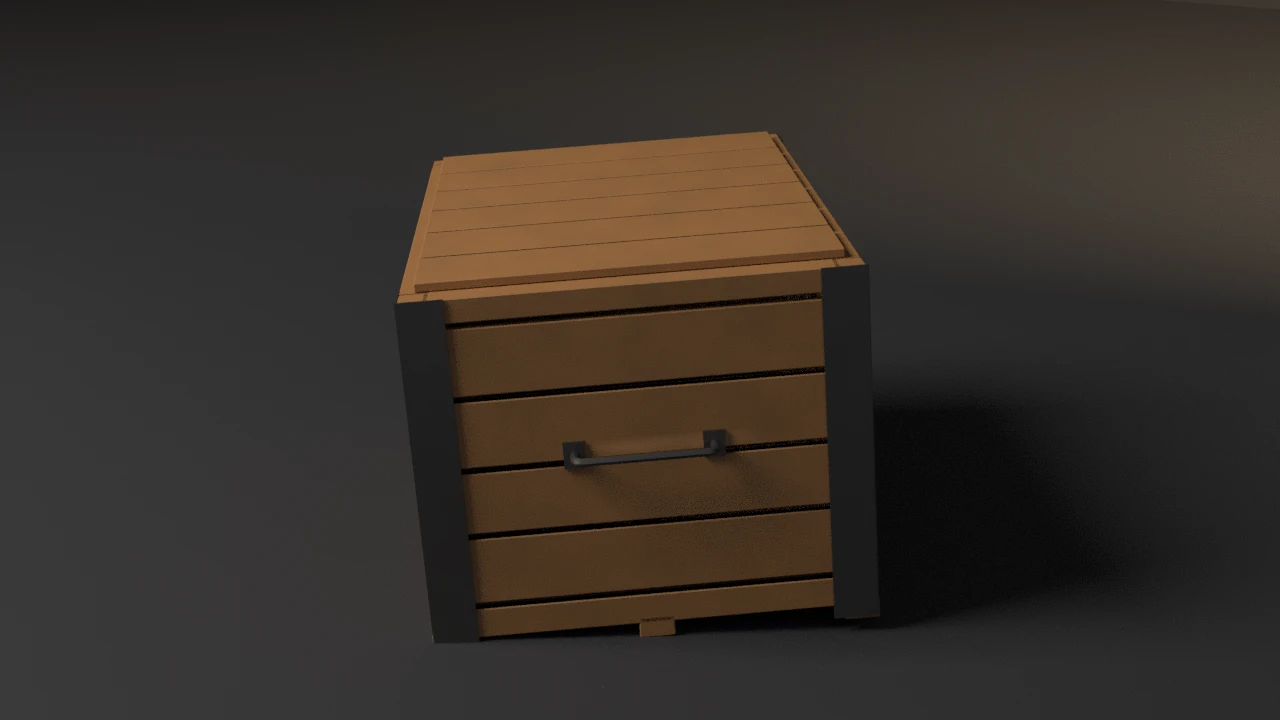
shipping-crate
A procedural shipping crate through UVs, bake, LOD, collider, and Unity glTF, asserting recomputed budgets rather than an API contract.
A procedural pin deck end of a ten-pin bowling lane — one laminated slab of 39 maple boards, 41.5 in across, each board's top edges chamfered into a V seam and crossed by the joint to a dark pin deck, ten pin spots inlaid on a 12 in equilateral triangle 34 3/16 in from the pit edge, a chevron of targeting arrows and a row of range dots, channel-profile gutters, cappings, kickbacks with sloped noses under mitred aluminium caps and phenolic kick plates, a steel pit-edge bullnose and five sleepers; ten pins lathe-turned from the regulation profile table (15 in tall, 4.766 in belly) with two red neck stripes and a crown band of red teeth; and an 8.5 in marbled resin ball drilled by an exact Boolean with a countersunk thumb hole and two parallel finger holes — through UVs, bake, LOD, collider, and Unity glTF, asserting recomputed budgets rather than an API contract.
Rendered headless by the showcase piece itself — click to zoom.
category Sports
blender --background --python showcase/bowling-pins/bowling_pins.py --
A showcase piece, not an example, and the fourth in the sports category. It builds the pin deck end of a ten-pin bowling lane: a section of lane with the ten pins racked on their spots and a ball resting on the approach.
The layout is solved from named constants. A section of real lane is 60 ft long; this one is 2.3 m, so the arrows and dots, which sit about 15 and 7 ft from the foul line on a real lane, are brought up to its near end. Every pin's base sits 0.6 mm below the deck face, inside its spot, and the ball's centre sits its radius less 0.6 mm above the lane. Inlays stand 0.25 mm proud of the lane and bite 0.5 mm into it. Neighbouring range dots stand 0.13 mm apart in height, so no two share a plane.
It asserts budget conformance of the generated result. It does not witness an API contract. "It rendered without error" is not a check.
Composes skills mesh-editing-and-bmesh, bake-high-to-low, depsgraph-and-evaluated-data, engine-export-presets, and snippets bake_normal_high_to_low.py, setup_bake_target_image.py, lod_chain.py / decimate_to_budget.py, convex_hull_collider.py, export_preset_unity.py (helpers copied inline, not imported).
Intended size: 1.64 m across the sleepers, 2.30 m from the lane's near end to the kickbacks' aluminium caps behind the pit edge, 0.52 m to the top of the caps. The origin is under the head spot at floor level.
Every budget is declared as a named constant. Every gate recomputes its value from the mesh, materials, UVs, evaluated LOD, collider, or export file.
| Axis | Declared | Measured (5.2.1) |
|---|---|---|
| Base triangles | 36400–37700 | 37078 |
| LOD1 ratio | 0.32–0.62 of base | 0.5000 |
| LOD2 ratio | 0.10–0.35 of base | 0.2200 |
| Materials | exactly 11 distinct; ≥330 maple, ≥330 pin deck, ≥12800 pin white, ≥1190 pin red, ≥1450 ball, ≥480 bore, ≥235 gutter/kick plate, ≥130 kickback laminate, ≥160 aluminium/steel, ≥1110 inlay, ≥350 sleeper faces | 11 slots; 358 / 358 / 13720 / 1280 / 1649 / 562 / 254 / 142 / 176 / 1197 / 380 |
| UVs | in 0..1, AABB overlap ≤ 1e-5 | in range, overlap 0 |
| Outer AABB | (1.640, 2.301, 0.523) m ± 0.01, read off the vertices | (1.6400, 2.3014, 0.5234), zmin 0 |
| Collider tris | ≤ 300 | 277 |
| Export | written, size > 0, removed after measuring | 2730012 bytes |
Every falsifier leaves the triangle count at 37078 and the envelope at (1.6400, 2.3014, 0.5234): they move or resize parts, never add or remove geometry.
DECIMATE COLLAPSE triangle counts are not identical across Blender series, so the LOD gate is a ratio band, not an exact count. The ball's Boolean may cut its sphere into a slightly different set of faces on another series; the triangle band and the ball and bore floors leave room for it. Bake pixels are stochastic, so the bake gate is has_data plus operator FINISHED, not byte-identity. Construction uses no RNG; two default runs print identical measurements.
Recomputed from the generated mesh, not asserted about the script.
| Axis | Declared | Measured |
|---|---|---|
| Non-manifold edges | 0 | 0 |
| Loose verts / edges | 0 / 0 | 0 / 0 |
| Doubles merged at 1e-5 | 0 | 0 |
| Zero-area faces | 0 | 0 |
| N-gons | 0 | 0 |
| Coplanar cross-shell face pairs (KD range 0.05 m, plane ε 1e-4) | 0 | 0 |
Grounded: zmin | within 1e-4 of 0 | 0.0000 |
Supports: each of the 5 sleepers has its own zmin | within 1e-4 of 0 | all 0 |
The first draft measured 206 coplanar pairs: the range dots on boards 3 and 5 (and their mirrors) are 54 mm apart, and their triangulated caps shared a plane within the 50 mm range. The dots now alternate 0.13 mm in height. It also had one zero-area face, a sliver the Boolean left where cut vertices fell in a line; the ball's faces are triangulated and its slivers dissolved before it joins the deck.
The lane is one shell, so its boards cannot z-fight each other; the seams are V-grooves in that shell. The Boolean does not carry material indices the same way on every version, so the ball's faces are classified afterwards by geometry: a face that lies on the sphere and faces straight out is shell, everything else is bore.
| Axis | Declared | Measured |
|---|---|---|
| Pins on spots: each pin's base centre (centroid of its bottom cap) against the nearest spot centre, in plan | 10 pins, 10 spots; ≤ 0.5 mm | 0.000 mm on all ten |
| Pins seated: base centre below the deck face under it (a ray onto the lane) | 0.3–1.0 mm | 0.6 mm on all ten |
| Plumb and size: axis (bottom cap to top cap) against vertical; height; belly (twice the largest radius) | tilt ≤ 0.05°; 0.381 m and 0.12106 m, ± 0.5 mm | 0.000°; 0.3810; 0.12106 |
| Spot lattice: nearest-neighbour edges (pairs under 1.2 pitches), rows across the lane, row pitch, head spot on the lane's centre line (read off the lane shell) | 18 edges at 12 in; rows 1, 2, 3, 4, each level; pitch 12·√3/2 in; all ± 0.5 mm | 18 at 0.000 mm off; 0.000 mm; 0.26396 m; 0.000 mm |
| Turned profile: each pin's radius at every one of the 15 table stations, from the vertices on that station | ± 0.2 mm | 0.000 mm |
| Ball resting: sphere fit to the ball's shell; its centre above the lane under it (a ray onto the lane), less its radius; its diameter | rest −0.9 to −0.3 mm; 0.2159 m ± 0.3 mm | −0.60 mm; 0.21590 |
| Finger holes: each hole's axis from its flat drilled bottom (the normal and centre of its bottom cap); depth from the bottom to where the axis leaves the sphere; bore from its straight run; span and bridge as arcs between the holes' entry points | 3 holes; thumb 58–68 mm, fingers 46–56 mm deep; bores 1.0 and 0.8 in ± 0.3 mm; span 4.4 in ± 2 mm; bridge 1.05 in ± 1 mm | 63.5, 50.8, 50.8 mm; 25.40, 20.32, 20.32 mm; 112.2 mm; 26.67 mm |
| Boards: flat board tops clustered across the lane; count; every top at one height; each board's edges straight down the lane; pitch between interior boards | 39; spread ≤ 0.2 mm; ≤ 0.1 mm; 41.5/39 in ± 0.1 mm | 39; 0.000; 0.000; 0.000 |
| One connected assembly (union of shells whose BVH trees overlap) | 1 component | 1 (55 shells) |
The span measures 112.2 mm against 4.4 in (111.8 mm): each finger's entry is turned half a bridge off the pair's mid-line, so the arc to it is a little longer than the arc to the mid-line.
Each falsifier violates one named budget. Every one was run on 5.2.1 and exited its declared code, with the triangle count and envelope unchanged and every budget checked before the target green.
| Flag | Budget violated | Exit |
|---|---|---|
--skip-decimate | LOD1 ratio band (measured 1.0000) | 9 |
--stray-vert | loose vertex count is 0 (measured 1, placed inside the envelope) | 15 |
--lift-z | bounding box zmin is 0 (measured 0.05000) | 16 |
--float-sleeper | every sleeper on the floor (the middle sleeper 3 mm up: its zmin 0.00300, the rest 0) | 16 |
--offset-pin | every pin centred on its spot (pin 5 moved 6 mm across the lane: 0.006 m off) | 17 |
--float-pin | every pin seated on the deck (pin 3 lifted 3 mm: base 2.4 mm above the deck face) | 18 |
--lean-pin | every pin plumb (pin 6 tipped 1.5° about its base centre: tilt 1.396°) | 19 |
--wide-rack | spots on the exact 12 in lattice (spots and pins spread 3% about the head spot: edges 9.1 mm long, rows 7.9 mm apart) | 20 |
--fat-neck | turned profile (the neck station 1.5 mm fatter: 1.5 mm off the table on every pin) | 21 |
--float-ball | ball resting on the lane (lifted 4 mm: rest +3.4 mm) | 22 |
--shallow-holes | finger holes (both fingers drilled 30 mm: depth 0.030 against 46–56 mm; bores, span and bridge unchanged) | 23 |
--proud-board | boards flush and parallel (board 18 raised 1.2 mm along its length: tops spread 1.2 mm) | 24 |
--lift-arrows | one connected assembly (the seven arrows lifted 1 mm off the lane: 8 components) | 25 |
--offset-pin, --float-pin and --lean-pin each move one pin and leave its spot, so the lattice holds. --lean-pin tips the pin about the centre of its base, so the base centre stays on its spot and at its seat; the tilt alone fails. The pin measures 1.396° rather than 1.5° because its axis runs from the bottom cap's centroid to the top cap's, and the top cap is a small flat, not a point. --wide-rack moves pins with their spots, so every pin stays centred and seated; the back row, 24 mm further back, is still on the deck. --fat-neck changes the neck only, so height and belly hold. --proud-board raises a board that carries no pin, spot, arrow, dot or the ball; pins read the deck face under themselves, not the lane's highest board, so their seat holds. --float-ball also splits the assembly, but the rest (22) is checked first.
Before the audits were settled, --lift-z exited 16 on the sleepers, not on the bounding box: bound_box is a cached copy that an in-place vertex edit does not refresh, so the AABB gate now reads the vertices. The first hole audit took each hole's axis from its vertices by principal components; a 30 mm hole is barely longer than it is wide, so the axis wandered and --shallow-holes also moved the bore and bridge. The axis now comes from the drilled bottom, and the flag moves the depth alone.
blender --background --python bowling_pins.py --
blender --background --python bowling_pins.py -- --skip-decimate
blender --background --python bowling_pins.py -- --stray-vert
blender --background --python bowling_pins.py -- --lift-z
blender --background --python bowling_pins.py -- --float-sleeper
blender --background --python bowling_pins.py -- --offset-pin
blender --background --python bowling_pins.py -- --float-pin
blender --background --python bowling_pins.py -- --lean-pin
blender --background --python bowling_pins.py -- --wide-rack
blender --background --python bowling_pins.py -- --fat-neck
blender --background --python bowling_pins.py -- --float-ball
blender --background --python bowling_pins.py -- --shallow-holes
blender --background --python bowling_pins.py -- --proud-board
blender --background --python bowling_pins.py -- --lift-arrows
blender --background --python bowling_pins.py -- --output pins.png
Smoke passes no flags.
The hero looks down the lane from behind the approach, 15° off its axis. That falls between the rack's 0° and 30° lines, so no pin hides behind another and the triangle reads whole. The ball rests to the left of the head pin's line with its grip turned to the lens. The wall stands 2.2 m behind the lane's centre, and the warm wedge pools on it. EEVEE ray tracing is on, so the lacquered deck reflects the pins.
File-local. 9 is a valid check code. 10 is reserved for gallery_framing.check_framing on the --output path. 15–19 are the hygiene and joint-fit family. 20–25 are file-local. 26 is the asset-quality floor on the render path: check_asset_quality returns 11, which this piece already spends on the collider ceiling, so the call site remaps it.
| Code | Meaning |
|---|---|
| 0 | Success |
| 1 | Uncaught exception (FATAL wrapper) |
| 2 | argparse / usage |
| 3 | Mesh did not build / no UV layer |
| 4 | Base triangle count outside range |
| 5 | Material count ≠ 11 distinct slots, or a face-count floor missed |
| 6 | UVs outside 0..1 |
| 7 | UV AABB overlap above tolerance |
| 8 | World AABB off declared outer size |
| 9 | LOD ratio band (--skip-decimate lands here) |
| 10 | Framing gate (render path only) |
| 11 | Collider triangle count above ceiling |
| 12 | Bake did not finish or image has no data |
| 13 | Export file missing or empty |
| 14 | --output produced no file |
| 15 | Mesh hygiene: loose, non-manifold, zero-area, doubles, n-gons, coplanar cross-shell pairs |
| 16 | Not grounded: bounding box zmin off 0, or a sleeper off the floor, or not 5 sleepers (--lift-z, --float-sleeper) |
| 17 | Pins on spots: not 10 pins and 10 spots, or a pin's base off its spot (--offset-pin) |
| 18 | A pin's base outside its seat band below the deck face (--float-pin) |
| 19 | A pin not plumb, or its height or belly off (--lean-pin) |
| 20 | Spots off the 12 in lattice: edges, rows, row pitch or head spot off the centre line (--wide-rack) |
| 21 | A pin's radius off the profile table at a station (--fat-neck) |
| 22 | Ball not resting on the lane at its radius, or its diameter off (--float-ball) |
| 23 | Finger holes: not 3, or a depth, bore, span or bridge outside its band (--shallow-holes) |
| 24 | Boards: not 39, tops not flush, edges not straight, or pitch off (--proud-board) |
| 25 | Assembly splits into more than one connected component (--lift-arrows) |
| 26 | Asset-quality floor (render path only; remapped from 11) |
"""Game-ready bowling pin deck — a showcase piece, not an example. Asserts budget conformance of a procedural section of a ten-pin bowling lane (the pin deck end, with its ten pins racked and a ball on the approach) after composing shipped pipeline pieces: bmesh construction, an exact Boolean, UVs, eleven materials, high-to-low normal bake, LOD chain, convex collider, Unity glTF export. The lane is one laminated slab of 39 maple boards, 41.5 in across, each board's top edges chamfered into a V seam, crossed by a joint where the approach meets the dark pin deck. Ten pin spots are inlaid in the deck on a 12 in equilateral triangle, the head spot 34 3/16 in from the pit edge. A row of seven targeting arrows and ten range dots are inlaid at the near end. Two gutters with a channel profile run the whole length; low cappings line them on the approach and two kickbacks with sloped noses and aluminium caps stand beside the deck; a steel bullnose finishes the pit edge. Five sleepers carry it all. Every pin is lathe-turned from the regulation profile table below (15 in tall, 4.766 in belly), white with two red neck stripes and a crown band, and stands on its spot. The ball is an 8.5 in sphere drilled by an exact Boolean with a thumb hole and two finger holes, each countersunk at its rim, and rests on the approach. Budgets are declared below and recomputed from the generated result. They are not API-contract witnesses. Each falsifier violates one named budget: ``--skip-decimate`` the LOD-ratio band, ``--stray-vert`` mesh hygiene, ``--lift-z`` grounded zmin, ``--float-sleeper`` every sleeper on the floor, ``--offset-pin`` every pin centred on its spot, ``--float-pin`` every pin seated on the deck, ``--lean-pin`` every pin plumb, ``--wide-rack`` the spots on an exact 12 in lattice, ``--fat-neck`` the turned profile, ``--float-ball`` the ball resting on the lane, ``--shallow-holes`` the finger holes' depth, ``--proud-board`` the boards flush and parallel, ``--lift-arrows`` one connected assembly. No RNG. Construction is closed-form. DECIMATE COLLAPSE triangle counts are not byte-identical across Blender versions — the LOD gate is a ratio band, not an exact count. blender --background --python bowling_pins.py -- blender --background --python bowling_pins.py -- --skip-decimate blender --background --python bowling_pins.py -- --output pins.png """ import argparse import math import os import sys import tempfile import traceback import bmesh import bpy import numpy as np from mathutils import Matrix, Vector from mathutils.bvhtree import BVHTree from mathutils.kdtree import KDTree # Showcase lives at repo-root/showcase/, not under examples/. The framing # helper is the repo's only shared import and lives next to the examples; # resolve the repo root so we do not move gallery_framing.py. _REPO = os.path.abspath( os.path.join(os.path.dirname(os.path.abspath(__file__)), os.pardir, os.pardir) ) sys.path.insert(0, os.path.join(_REPO, "examples")) sys.dont_write_bytecode = True import gallery_framing # noqa: E402 import gallery_asset_quality # noqa: E402 IN = 0.0254 # --- Lane (x across, y down the lane toward the pit, z up) -------------------- BOARD_N = 39 LANE_W = 41.5 * IN LANE_HALF = 0.5 * LANE_W BOARD_W = LANE_W / BOARD_N SEAM_C = 0.0006 # each board's top edge chamfer, into a V seam SEAM_G = 0.0006 # seam depth EDGE_C = 0.0015 # the lane's outer long edges JOINT_C = 0.0015 # approach / pin-deck joint JOINT_G = 0.0008 SLEEPER_H = 0.050 LANE_BITE = 0.0005 # the lane bites its sleepers LANE_Z0 = SLEEPER_H - LANE_BITE LANE_T = 2.75 * IN LANE_TOP = LANE_Z0 + LANE_T Y_NEAR = -1.40 # near (approach) end of the section DECK_Y = -0.16 # approach / pin-deck joint PIN_S = 12.0 * IN # pin spot pitch ROW_H = PIN_S * math.sqrt(3.0) / 2.0 Y_PIT = 34.1875 * IN # head spot to pit edge # --- Inlays ---------------------------------------------------------------------- INLAY_PROUD = 0.00025 INLAY_BITE = 0.0005 SPOT_R = 1.125 * IN SPOT_BITE = 0.0010 ARROW_BOARDS = (4, 9, 14, 19, 24, 29, 34) # boards 5, 10 ... 35 counted from 1 ARROW_Y = -0.98 # base of the centre arrow; each pair out steps back ARROW_STEP = 0.07 ARROW_L = 0.14 ARROW_W = 0.022 DOT_BOARDS = (2, 4, 7, 10, 13, 25, 28, 31, 34, 36) DOT_Y = -1.30 DOT_R = 0.0095 DOT_STEP = 0.00013 # neighbouring dots on their own planes # --- Gutters, cappings, kickbacks, pit edge ----------------------------------------- GUT_W = 9.25 * IN GUT_XI = LANE_HALF - 0.0005 # the gutter bites the lane's side GUT_XO = LANE_HALF + GUT_W GUT_LIP = LANE_TOP - 0.0025 GUT_DEPTH = 1.875 * IN GUT_Z0 = SLEEPER_H - 0.0008 CAP_XI = GUT_XO - 0.00045 CAP_XO = 0.803 CAP_TOP = LANE_TOP + 0.050 CAP_Z0 = SLEEPER_H - 0.0014 KB_XI = GUT_XO - 0.00085 KB_T = 0.0458 KB_Y0 = -0.45 KB_Y1 = Y_PIT + 0.030 KB_Z0 = SLEEPER_H - 0.0011 KB_ZF = LANE_TOP + 0.060 # top of the nose's vertical front KB_ZT = LANE_TOP + 0.400 KB_NOSE = 0.300 KP_H = 0.140 # phenolic kick plate on each kickback's inner face KP_T = 0.004 NOSE_Y1 = Y_PIT + 0.010 # pit-edge bullnose, behind the deck SLEEPER_X = 0.820 SLEEPER_HY = 0.045 SLEEPER_N = 5 # --- Pins -------------------------------------------------------------------------- # The regulation pin profile, (height, diameter) in inches from the base. PIN_TABLE = ( (0.000, 2.031), (0.750, 2.828), (2.250, 3.906), (3.375, 4.510), (4.500, 4.766), (5.875, 4.563), (7.250, 3.703), (8.625, 2.472), (9.375, 1.965), (10.000, 1.797), (10.875, 1.870), (11.750, 2.094), (12.625, 2.406), (13.500, 2.547), (14.375, 2.094), ) PIN_H = 15.0 * IN PIN_BELLY = 4.766 * IN NECK_STATION = 9 # PIN_TABLE index of the neck (10 in) PIN_TOP_R = 0.09 * IN PIN_SEGS = 32 PIN_STEP = 0.48 * IN STRIPES = ((9.45, 9.80), (10.30, 10.65)) CROWN = (11.95, 12.05, 12.45) # base line, then a row of teeth PIN_BITE = 0.0006 # each pin's base below the deck face (inside its spot) # --- Ball -------------------------------------------------------------------------- BALL_D = 8.5 * IN BALL_R = 0.5 * BALL_D BALL_BITE = 0.0006 BALL_XY = (-0.110, -0.780) BALL_SEGS = (48, 32) GRIP_TILT = 52.0 # the grip turned up toward the bowler, degrees GRIP_YAW = 15.0 THUMB_R = 0.5 * 1.000 * IN FINGER_R = 0.5 * 0.800 * IN THUMB_D = 2.50 * IN FINGER_D = 2.00 * IN SPAN = 4.40 * IN # thumb to finger centres, along the surface BRIDGE = 1.05 * IN # finger to finger centres, along the surface HOLE_BEVEL = 0.0015 HOLE_SEGS = 24 # --- Falsifier sizes --------------------------------------------------------------- FLOAT_SLEEPER = 0.003 OFFSET_PIN = 0.006 FLOAT_PIN = 0.003 LEAN_PIN_DEG = 1.5 WIDE_RACK = 1.03 FAT_NECK = 0.0015 FLOAT_BALL = 0.004 SHALLOW_D = 0.030 PROUD_BOARD = 0.0012 PROUD_BOARD_IDX = 17 LIFT_ARROWS = 0.001 BBOX_TOL = 0.01 # Fitted after locking geometry. Recomputed from bound_box. OUTER_SIZE = (1.640, 2.301, 0.523) BASE_TRIS_MIN = 36400 BASE_TRIS_MAX = 37700 LOD1_RATIO_MIN = 0.32 LOD1_RATIO_MAX = 0.62 LOD2_RATIO_MIN = 0.10 LOD2_RATIO_MAX = 0.35 LOD1_TARGET = 0.50 LOD2_TARGET = 0.22 MATERIAL_COUNT = 11 UV_EPS = 1e-4 UV_OVERLAP_MAX = 1e-5 COLLIDER_TRIS_MAX = 300 BAKE_RES = 1024 CAGE_EXTRUSION = 0.004 # face floors per slot, in slot order (maple, deck, pin white, pin red, ball, # bore, gutter, kickback, metal, inlay, sleeper) FACE_FLOORS = (330, 330, 12800, 1190, 1450, 480, 235, 130, 160, 1110, 350) ZMIN_EPS = 1e-4 DOUBLES_EPS = 1e-5 AREA_EPS = 1e-10 COPLANAR_NORMAL_EPS = 1e-4 COPLANAR_PLANE_EPS = 1e-4 COPLANAR_CENTRE_MAX = 0.05 LIFT_Z = 0.05 # Pins on their spots, seated and plumb, turned to the table. PIN_COUNT = 10 SPOT_COUNT = 10 PIN_CENTRE_TOL = 0.0005 PIN_SEAT_MIN = 0.0003 PIN_SEAT_MAX = 0.0010 TILT_MAX_DEG = 0.05 SIZE_TOL = 0.0005 PROFILE_TOL = 0.0002 PROFILE_BAND = 0.00005 # a vertex belongs to a station within this, axially # The spot lattice. LATTICE_TOL = 0.0005 LATTICE_EDGES = 18 ROW_SIZES = (1, 2, 3, 4) # Ball: resting on the lane at its radius, drilled to span. BALL_REST_MIN = -0.0009 BALL_REST_MAX = -0.0003 BALL_D_TOL = 0.0003 HOLE_COUNT = 3 THUMB_DEPTH_BAND = (0.058, 0.068) FINGER_DEPTH_BAND = (0.046, 0.056) BORE_TOL = 0.0003 SPAN_TOL = 0.002 BRIDGE_TOL = 0.001 # Boards flush and parallel. BOARD_FLUSH_MAX = 0.0002 BOARD_PARALLEL_MAX = 0.0001 BOARD_PITCH_TOL = 0.0001 COMPONENTS = 1 # Hero: the lane square to the wall; the camera looks down it from the approach. HERO_YAW_DEG = 0.0 WALL_Y = 2.2 # The camera stands behind the approach, 15 degrees off the lane's axis: # between the rack's 0 and 30 degree lines, so no pin hides behind another. CAM_VIEW = (0.259, -0.966) # from the aim, in plan CAM_DIST = 3.75 CAM_RISE = 1.15 AIM_OFF = (-0.10, -0.14, -0.13) MAPLE_IDX = 0 DECK_IDX = 1 PIN_WHITE_IDX = 2 PIN_RED_IDX = 3 BALL_IDX = 4 BORE_IDX = 5 GUTTER_IDX = 6 KICKBACK_IDX = 7 METAL_IDX = 8 INLAY_IDX = 9 SLEEPER_IDX = 10 LANE_IDXS = (MAPLE_IDX, DECK_IDX) PIN_IDXS = (PIN_WHITE_IDX, PIN_RED_IDX) ZAX = Vector((0.0, 0.0, 1.0)) XAX = Vector((1.0, 0.0, 0.0)) YAX = Vector((0.0, 1.0, 0.0)) def eevee_engine_id(): return "BLENDER_EEVEE" if bpy.app.version >= (5, 0, 0) else "BLENDER_EEVEE_NEXT" def fail(msg, code): print(f"ERROR: {msg}", file=sys.stderr) return code def triangle_count(mesh): mesh.calc_loop_triangles() return len(mesh.loop_triangles) def evaluated_triangle_count(obj): # Duplicated from snippets/lod_chain.py / decimate_to_budget.py (not a package). depsgraph = bpy.context.evaluated_depsgraph_get() eval_obj = obj.evaluated_get(depsgraph) eval_mesh = eval_obj.to_mesh() try: eval_mesh.calc_loop_triangles() return len(eval_mesh.loop_triangles) finally: eval_obj.to_mesh_clear() # -------------------------------------------------------------------------- # Construction helpers (copied from showcase/weight-rack, not imported) # -------------------------------------------------------------------------- def _mark(faces, mat_idx): for f in faces: f.material_index = mat_idx def frame(ez, ex_hint): """Rotation whose local Z is ``ez`` and local X is ``ex_hint`` made orthogonal to it (columns ex, ey, ez; right-handed).""" ez = Vector(ez).normalized() ex = Vector(ex_hint) ex = (ex - ez * ex.dot(ez)).normalized() ey = ez.cross(ex) return Matrix((ex, ey, ez)).transposed() def add_lathe(bm, profile, segs, mat_idx, center=(0.0, 0.0, 0.0), rot=None, phase=0.0, solid=False): """Revolve a profile [(r, z), ...] about local Z. ``solid``: the profile is an open polyline closed by n-gon caps at its two ends; otherwise it is a closed polygon revolved into a ring shell.""" c = Vector(center) m = rot if rot is not None else Matrix.Identity(3) rings = [] for i in range(segs): a = phase + 2.0 * math.pi * i / segs ca, sa = math.cos(a), math.sin(a) rings.append([bm.verts.new(c + m @ Vector((r * ca, r * sa, z))) for r, z in profile]) n = len(profile) last = n - 1 if solid else n faces = [] for i in range(segs): r0, r1 = rings[i], rings[(i + 1) % segs] for j in range(last): k = (j + 1) % n faces.append(bm.faces.new((r0[j], r1[j], r1[k], r0[k]))) if solid: faces.append(bm.faces.new([rings[i][0] for i in reversed(range(segs))])) faces.append(bm.faces.new([rings[i][n - 1] for i in range(segs)])) _mark(faces, mat_idx) return [v for ring in rings for v in ring] def rrect(ha, hb, rc, n_corner=4): """Rounded rectangle loop (counter-clockwise).""" rc = max(min(rc, ha - 1e-4, hb - 1e-4), 0.0006) pts = [] for k, (sx, sy) in enumerate(((1, 1), (-1, 1), (-1, -1), (1, -1))): cx, cy = sx * (ha - rc), sy * (hb - rc) a0 = 0.5 * math.pi * k for s in range(n_corner + 1): a = a0 + 0.5 * math.pi * s / n_corner pts.append((cx + rc * math.cos(a), cy + rc * math.sin(a))) return pts def add_rbox(bm, ha, hb, rc, profile, origin, rot, mat_idx, n_corner=4): """Loft of rounded rectangles along local Z: profile [(inset, z)], each loop inset from (ha, hb, rc); n-gon caps at both ends.""" o = Vector(origin) rings = [] for inset, z in profile: loop = rrect(ha - inset, hb - inset, rc - inset, n_corner) rings.append([bm.verts.new(o + rot @ Vector((x, y, z))) for x, y in loop]) n = len(rings[0]) faces = [] for r0, r1 in zip(rings, rings[1:]): for k in range(n): m = (k + 1) % n faces.append(bm.faces.new((r0[k], r0[m], r1[m], r1[k]))) faces.append(bm.faces.new(tuple(reversed(rings[0])))) faces.append(bm.faces.new(tuple(rings[-1]))) _mark(faces, mat_idx) return [v for ring in rings for v in ring] def add_prism(bm, outline, w0, w1, origin, rot, mat_idx): """Planar outline [(u, v)] extruded along local Z from w0 to w1.""" o = Vector(origin) a = [bm.verts.new(o + rot @ Vector((u, v, w0))) for u, v in outline] b = [bm.verts.new(o + rot @ Vector((u, v, w1))) for u, v in outline] n = len(outline) faces = [bm.faces.new((a[i], a[(i + 1) % n], b[(i + 1) % n], b[i])) for i in range(n)] faces.append(bm.faces.new(tuple(reversed(a)))) faces.append(bm.faces.new(tuple(b))) _mark(faces, mat_idx) return a + b def add_sweep(bm, pts, loop, side, mat_idx, voff=0.0): """A section loop [(u, v)] swept along a planar polyline, u along ``side`` (normal to the path's plane), v in the plane; interior stations are mitred. n-gon caps at both ends. One shell.""" side = Vector(side).normalized() pts = [Vector(p) for p in pts] n = len(pts) rings = [] for i, p in enumerate(pts): if i == 0: t, s = (pts[1] - pts[0]).normalized(), 1.0 elif i == n - 1: t, s = (pts[-1] - pts[-2]).normalized(), 1.0 else: t0 = (p - pts[i - 1]).normalized() t1 = (pts[i + 1] - p).normalized() t = (t0 + t1).normalized() s = 1.0 / max(t0.dot(t), 0.2) nrm = side.cross(t).normalized() rings.append([bm.verts.new(p + side * u + nrm * ((v + voff) * s)) for u, v in loop]) m = len(loop) faces = [] for r0, r1 in zip(rings, rings[1:]): for k in range(m): q = (k + 1) % m faces.append(bm.faces.new((r0[k], r0[q], r1[q], r1[k]))) faces.append(bm.faces.new(tuple(reversed(rings[0])))) faces.append(bm.faces.new(tuple(rings[-1]))) _mark(faces, mat_idx) return [v for ring in rings for v in ring] def triangulate_ngons(bm): faces = [f for f in bm.faces if len(f.verts) > 4] if faces: bmesh.ops.triangulate(bm, faces=faces) def pack_uvs(bm, margin=0.08): uv = bm.loops.layers.uv.new("UVMap") faces = list(bm.faces) n = len(faces) ncol = max(1, math.ceil(math.sqrt(n))) rows = max(1, math.ceil(n / ncol)) cell_w = 1.0 / ncol cell_h = 1.0 / rows pad_u = margin * cell_w * 0.5 pad_v = margin * cell_h * 0.5 usable_w = cell_w - 2.0 * pad_u usable_h = cell_h - 2.0 * pad_v for i, face in enumerate(faces): col = i % ncol row = i // ncol nrm = face.normal ax, ay, az = abs(nrm.x), abs(nrm.y), abs(nrm.z) coords = [] for loop in face.loops: co = loop.vert.co if az >= ax and az >= ay: coords.append((co.x, co.y)) elif ax >= ay: coords.append((co.y, co.z)) else: coords.append((co.x, co.z)) xs = [c[0] for c in coords] ys = [c[1] for c in coords] minx, maxx = min(xs), max(xs) miny, maxy = min(ys), max(ys) dx = max(maxx - minx, 1e-8) dy = max(maxy - miny, 1e-8) origin_u = col * cell_w + pad_u origin_v = row * cell_h + pad_v for loop, (x, y) in zip(face.loops, coords): loop[uv].uv = ( origin_u + (x - minx) / dx * usable_w, origin_v + (y - miny) / dy * usable_h, ) # -------------------------------------------------------------------------- # Lane: one laminated slab of boards, V-seamed, with the deck joint # -------------------------------------------------------------------------- def lane_section(proud_board=None): """Closed (x, z) section of the lane and the indices of its top points (board tops and seam roots), which the deck joint lowers.""" H, zt, zb = LANE_HALF, LANE_TOP, LANE_Z0 pts = [(-H, zb), (-H, zt - EDGE_C)] top = set() for i in range(BOARD_N): x0 = -H + i * BOARD_W x1 = x0 + BOARD_W dz = PROUD_BOARD if proud_board == i else 0.0 left = x0 + (EDGE_C if i == 0 else SEAM_C) right = x1 - (EDGE_C if i == BOARD_N - 1 else SEAM_C) top.add(len(pts)) pts.append((left, zt + dz)) top.add(len(pts)) pts.append((right, zt + dz)) if i < BOARD_N - 1: top.add(len(pts)) pts.append((x1, zt - SEAM_G)) pts += [(H, zt - EDGE_C), (H, zb)] return pts, top def add_lane(bm, proud_board): sec, top = lane_section(proud_board) ys = (Y_NEAR, DECK_Y - JOINT_C, DECK_Y, DECK_Y + JOINT_C, Y_PIT) rings = [] for k, y in enumerate(ys): ring = [] for j, (x, z) in enumerate(sec): if k == 2 and j in top: z = min(z, LANE_TOP - JOINT_G) ring.append(bm.verts.new((x, y, z))) rings.append(ring) n = len(sec) for k in range(len(ys) - 1): mat = MAPLE_IDX if k < 2 else DECK_IDX for j in range(n): m = (j + 1) % n bm.faces.new((rings[k][j], rings[k][m], rings[k + 1][m], rings[k + 1][j])).material_index = mat bm.faces.new(tuple(reversed(rings[0]))).material_index = MAPLE_IDX bm.faces.new(tuple(rings[-1])).material_index = DECK_IDX def spot_centres(wide): """The ten pin spots, head pin first, rows back toward the pit.""" s = PIN_S * (WIDE_RACK if wide else 1.0) h = s * math.sqrt(3.0) / 2.0 out = [] for row in range(4): for k in range(row + 1): out.append(Vector(((k - 0.5 * row) * s, row * h, 0.0))) return out def add_disc(bm, x, y, r, z0, z1, segs, mat_idx): add_lathe(bm, [(r, z0), (r, z1)], segs, mat_idx, center=(x, y, 0.0), solid=True) def add_inlays(bm, wide, lift): for c in spot_centres(wide): add_disc(bm, c.x, c.y, SPOT_R, LANE_TOP - SPOT_BITE, LANE_TOP + INLAY_PROUD, 24, INLAY_IDX) z0 = LANE_TOP - INLAY_BITE + lift z1 = LANE_TOP + INLAY_PROUD + lift for b in ARROW_BOARDS: xc = -LANE_HALF + (b + 0.5) * BOARD_W step = abs(b - 19) // 5 y0 = ARROW_Y - ARROW_STEP * step # a concave dart; five corners so its caps are n-gons and triangulate # on the right diagonal dart = [(0.0, ARROW_L), (-0.5 * ARROW_W, 0.0), (0.0, 0.26 * ARROW_L), (0.5 * ARROW_W, 0.0), (0.25 * ARROW_W, 0.5 * ARROW_L)] add_prism(bm, dart, z0, z1, (xc, y0, 0.0), Matrix.Identity(3), INLAY_IDX) for k, b in enumerate(DOT_BOARDS): xc = -LANE_HALF + (b + 0.5) * BOARD_W dz = DOT_STEP * (k % 2) add_disc(bm, xc, DOT_Y, DOT_R, LANE_TOP - INLAY_BITE + dz, LANE_TOP + INLAY_PROUD + dz, 16, INLAY_IDX) # -------------------------------------------------------------------------- # Gutters, cappings, kickbacks, pit edge, sleepers # -------------------------------------------------------------------------- def gutter_section(): """Closed (x, z) section of the right gutter: a solid body whose top is the channel, lipped at both edges.""" lip = 0.008 xa, xb = GUT_XI + lip, GUT_XO - lip xc, a = 0.5 * (xa + xb), 0.5 * (xb - xa) arc = [] n = 18 for k in range(n + 1): t = math.pi * k / n arc.append((xc - a * math.cos(t), GUT_LIP - GUT_DEPTH * math.sin(t))) pts = [(GUT_XI, GUT_Z0), (GUT_XO, GUT_Z0), (GUT_XO, GUT_LIP - 0.003), (GUT_XO - 0.003, GUT_LIP)] pts += list(reversed(arc)) pts += [(GUT_XI + 0.002, GUT_LIP), (GUT_XI, GUT_LIP - 0.002)] return pts def add_gutter(bm, side, bevel_verts): sec = gutter_section() y0, y1 = Y_NEAR + 0.003, Y_PIT + 0.012 rings = [[bm.verts.new((side * x, y, z)) for x, z in sec] for y in (y0, y1)] n = len(sec) faces = [bm.faces.new((rings[0][j], rings[0][(j + 1) % n], rings[1][(j + 1) % n], rings[1][j])) for j in range(n)] faces.append(bm.faces.new(tuple(reversed(rings[0])))) faces.append(bm.faces.new(tuple(rings[1]))) _mark(faces, GUTTER_IDX) bevel_verts += rings[0] + rings[1] def add_capping(bm, side): ha = 0.5 * (CAP_XO - CAP_XI) hb = 0.5 * (CAP_TOP - CAP_Z0) xc = side * 0.5 * (CAP_XI + CAP_XO) add_rbox(bm, ha, hb, 0.008, [(0.003, Y_NEAR + 0.006), (0.0, Y_NEAR + 0.009), (0.0, KB_Y0 + 0.002)], (xc, 0.0, CAP_Z0 + hb), frame(YAX, XAX), KICKBACK_IDX, n_corner=3) def add_kickback(bm, side, bevel_verts): xi, xo = KB_XI, KB_XI + KB_T w0, w1 = (xi, xo) if side > 0 else (-xo, -xi) outline = [(KB_Y0, KB_Z0), (KB_Y1, KB_Z0), (KB_Y1, KB_ZT), (KB_Y0 + KB_NOSE, KB_ZT), (KB_Y0, KB_ZF)] rot = frame(XAX, YAX) # local x along y, local y along z, local z along x bevel_verts += add_prism(bm, outline, w0, w1, (0.0, 0.0, 0.0), rot, KICKBACK_IDX) # aluminium cap over the nose and the top edge, one mitred sweep xc = 0.5 * (w0 + w1) p0 = Vector((xc, KB_Y0, KB_ZF)) p1 = Vector((xc, KB_Y0 + KB_NOSE, KB_ZT)) t0 = (p1 - p0).normalized() path = [p0 - t0 * 0.004, p1, Vector((xc, KB_Y1 + 0.003, KB_ZT))] loop = rrect(0.5 * KB_T + 0.003, 0.006, 0.003, 3) add_sweep(bm, path, loop, XAX, METAL_IDX, voff=-0.002) # phenolic kick plate on the inner face, biting it, clear of the gutter z0 = LANE_TOP + 0.004 ya = KB_Y0 + KB_NOSE * (z0 + KP_H - KB_ZF) / (KB_ZT - KB_ZF) + 0.015 yb = KB_Y1 - 0.010 xc = side * (KB_XI - 0.5 * KP_T + 0.00025) add_rbox(bm, 0.5 * KP_T + 0.00025, 0.5 * KP_H, 0.0015, [(0.001, ya), (0.0, ya + 0.001), (0.0, yb - 0.001), (0.001, yb)], (xc, 0.0, z0 + 0.5 * KP_H), frame(YAX, XAX), GUTTER_IDX, n_corner=2) def add_pit_edge(bm, bevel_verts): hy = 0.5 * (NOSE_Y1 - (Y_PIT - 0.0006)) hz = 0.5 * 0.064 yc = Y_PIT - 0.0006 + hy zc = LANE_TOP - 0.0009 - hz outline = rrect(hy, hz, 0.005, 4) bevel_verts += add_prism(bm, outline, -LANE_HALF + 0.0009, LANE_HALF - 0.0009, (0.0, yc, zc), frame(XAX, YAX), METAL_IDX) def sleeper_ys(): y0, y1 = Y_NEAR + 0.08, Y_PIT - 0.08 return [y0 + (y1 - y0) * k / (SLEEPER_N - 1) for k in range(SLEEPER_N)] def add_sleepers(bm, float_sleeper): hz = 0.5 * SLEEPER_H for k, y in enumerate(sleeper_ys()): lift = FLOAT_SLEEPER if (float_sleeper and k == 2) else 0.0 add_rbox(bm, SLEEPER_HY, hz, 0.004, [(0.003, -SLEEPER_X), (0.0, -SLEEPER_X + 0.003), (0.0, SLEEPER_X - 0.003), (0.003, SLEEPER_X)], (0.0, y, hz + lift), frame(XAX, YAX), SLEEPER_IDX, n_corner=3) # -------------------------------------------------------------------------- # Pins: lathe-turned from the table # -------------------------------------------------------------------------- def pchip(xs, ys): """Monotone piecewise-cubic interpolant (Fritsch-Carlson): no overshoot at the belly or the neck, and it passes every table station exactly.""" n = len(xs) h = [xs[i + 1] - xs[i] for i in range(n - 1)] d = [(ys[i + 1] - ys[i]) / h[i] for i in range(n - 1)] m = [0.0] * n m[0], m[-1] = d[0], d[-1] for i in range(1, n - 1): if d[i - 1] * d[i] <= 0.0: m[i] = 0.0 else: w1 = 2.0 * h[i] + h[i - 1] w2 = h[i] + 2.0 * h[i - 1] m[i] = (w1 + w2) / (w1 / d[i - 1] + w2 / d[i]) def f(x): i = max(0, min(n - 2, next((k for k in range(n - 1) if x <= xs[k + 1]), n - 2))) t = (x - xs[i]) / h[i] h00 = (1 + 2 * t) * (1 - t) ** 2 h10 = t * (1 - t) ** 2 h01 = t * t * (3 - 2 * t) h11 = t * t * (t - 1) return h00 * ys[i] + h10 * h[i] * m[i] + h01 * ys[i + 1] + h11 * h[i] * m[i + 1] return f def pin_table(fat_neck=False): """(z, r) in metres per table station; the fat-neck falsifier fattens the neck station alone.""" out = [] for k, (hgt, dia) in enumerate(PIN_TABLE): r = 0.5 * dia * IN + (FAT_NECK if (fat_neck and k == NECK_STATION) else 0.0) out.append((hgt * IN, r)) return out def pin_profile(fat_neck=False): """Stations [(r, z)] and a material per row: the table stations exactly, the stripe and crown bands as single rows, PCHIP between, and an elliptical crown above the last station.""" table = pin_table(fat_neck) f = pchip([z for z, _ in table], [r for _, r in table]) decal = [(a * IN, b * IN, PIN_RED_IDX) for a, b in STRIPES] decal.append((CROWN[0] * IN, CROWN[1] * IN, PIN_RED_IDX)) decal.append((CROWN[1] * IN, CROWN[2] * IN, -1)) # teeth row hard = sorted({z for z, _ in table} | {a for a, _, _ in decal} | {b for _, b, _ in decal}) zs = [] rows = [] for a, b in zip(hard, hard[1:]): band = next((m for lo, hi, m in decal if abs(lo - a) < 1e-9 and abs(hi - b) < 1e-9), None) nsub = 1 if band is not None else max(1, math.ceil((b - a) / PIN_STEP - 1e-9)) for k in range(nsub): zs.append(a + (b - a) * k / nsub) rows.append(band if band is not None else PIN_WHITE_IDX) zs.append(hard[-1]) stations = [(f(z), z) for z in zs] # crown: an ellipse centred on the head's widest station, through the last z_head, z_last = 13.5 * IN, hard[-1] r_last = stations[-1][0] semi = PIN_H - z_head a_e = r_last / math.sqrt(1.0 - ((z_last - z_head) / semi) ** 2) for zz in (14.62, 14.82, 14.93, 14.98): z = zz * IN rows.append(PIN_WHITE_IDX) stations.append((a_e * math.sqrt(1.0 - ((z - z_head) / semi) ** 2), z)) rows.append(PIN_WHITE_IDX) stations.append((PIN_TOP_R, PIN_H)) return stations, rows def add_pin(bm, base, profile, lean_deg=0.0): """One pin turned about its axis through ``base``; ``lean_deg`` tips it about the lane's axis through the centre of its base.""" stations, rows = profile rot = Matrix.Rotation(math.radians(lean_deg), 3, "Y") segs = PIN_SEGS rings = [] for i in range(segs): a = 2.0 * math.pi * i / segs ca, sa = math.cos(a), math.sin(a) rings.append([bm.verts.new(base + rot @ Vector((r * ca, r * sa, z))) for r, z in stations]) for i in range(segs): r0, r1 = rings[i], rings[(i + 1) % segs] for j, mat in enumerate(rows): a0, a1, b1, b0 = r0[j], r1[j], r1[j + 1], r0[j + 1] if mat == -1: # crown teeth: one red tooth over every two segments if i % 2 == 0: bm.faces.new((a0, a1, b1)).material_index = PIN_RED_IDX bm.faces.new((a0, b1, b0)).material_index = PIN_WHITE_IDX else: bm.faces.new((a0, a1, b0)).material_index = PIN_RED_IDX bm.faces.new((a1, b1, b0)).material_index = PIN_WHITE_IDX else: bm.faces.new((a0, a1, b1, b0)).material_index = mat n = len(stations) bm.faces.new([rings[i][0] for i in reversed(range(segs))]).material_index = PIN_WHITE_IDX bm.faces.new([rings[i][n - 1] for i in range(segs)]).material_index = PIN_WHITE_IDX def add_pins(bm, wide, offset_pin, float_pin, lean_pin, fat_neck): profile = pin_profile(fat_neck) for k, c in enumerate(spot_centres(wide)): base = Vector((c.x, c.y, LANE_TOP - PIN_BITE)) if offset_pin and k == 4: # pin 5 base.x += OFFSET_PIN if float_pin and k == 2: # pin 3 base.z += FLOAT_PIN add_pin(bm, base, profile, LEAN_PIN_DEG if (lean_pin and k == 5) else 0.0) # -------------------------------------------------------------------------- # Ball: a sphere drilled by an exact Boolean # -------------------------------------------------------------------------- def rot_toward(v, toward, ang): """Rotate unit ``v`` by ``ang`` radians toward ``toward``.""" ax = v.cross(toward).normalized() return (Matrix.Rotation(ang, 3, ax) @ v).normalized() def hole_axes(): """(entry direction, drill direction, bore radius, depth) for the thumb and the two finger holes, in the ball's frame: the grip centre turned up toward the bowler, the thumb toward the bowler, the two fingers down the lane, split across it. The thumb is drilled toward the centre; the two fingers are drilled parallel, along their pair's mid-axis, as a real grip is, so their bores stay one bridge apart all the way down instead of converging into each other.""" g = Matrix.Rotation(math.radians(GRIP_YAW), 3, "Z") @ ( Matrix.Rotation(math.radians(GRIP_TILT), 3, "X") @ ZAX) g = g.normalized() fwd = (YAX - g * YAX.dot(g)).normalized() lat = g.cross(fwd).normalized() half = 0.5 * SPAN / BALL_R thumb = rot_toward(g, -fwd, half) mid = rot_toward(g, fwd, half) lat_a = 0.5 * BRIDGE / BALL_R fa = rot_toward(mid, lat, lat_a) fb = rot_toward(mid, -lat, lat_a) return [(thumb, thumb, THUMB_R, THUMB_D), (fa, mid, FINGER_R, FINGER_D), (fb, mid, FINGER_R, FINGER_D)] def cutter_profile(r, depth): """(radius, depth) of a drill with a 45-degree countersink that meets the sphere HOLE_BEVEL outside the bore, and a chamfered flat bottom.""" b = HOLE_BEVEL + (r + HOLE_BEVEL) ** 2 / (2.0 * BALL_R) pts = [(r + b + 0.02, -0.02), (r, b)] for k in range(1, 5): pts.append((r, b + (depth - 0.002 - b) * k / 4.0)) pts.append((r - 0.002, depth)) return pts def build_ball_mesh(shallow): """The drilled ball as a temporary mesh, centred on the origin.""" made = [] try: bm = bmesh.new() try: bmesh.ops.create_uvsphere(bm, u_segments=BALL_SEGS[0], v_segments=BALL_SEGS[1], radius=BALL_R) for f in bm.faces: f.material_index = BALL_IDX me = bpy.data.meshes.new("BallCore") bm.to_mesh(me) finally: bm.free() ball = bpy.data.objects.new("BallCore", me) bpy.context.scene.collection.objects.link(ball) made.append(ball) for k, (e, a, r, depth) in enumerate(hole_axes()): if shallow and k > 0: depth = SHALLOW_D cbm = bmesh.new() try: add_lathe(cbm, cutter_profile(r, depth), HOLE_SEGS, BORE_IDX, center=e * BALL_R, rot=frame(-a, ZAX if abs(a.z) < 0.9 else XAX), solid=True) bmesh.ops.recalc_face_normals(cbm, faces=list(cbm.faces)) cme = bpy.data.meshes.new(f"BallDrill{k}") cbm.to_mesh(cme) finally: cbm.free() cut = bpy.data.objects.new(f"BallDrill{k}", cme) bpy.context.scene.collection.objects.link(cut) cut.hide_render = True made.append(cut) mod = ball.modifiers.new(f"Drill{k}", "BOOLEAN") mod.operation = "DIFFERENCE" mod.solver = "EXACT" mod.object = cut bpy.context.view_layer.update() dg = bpy.context.evaluated_depsgraph_get() out = bpy.data.meshes.new_from_object(ball.evaluated_get(dg)) finally: for ob in made: data = ob.data bpy.data.objects.remove(ob, do_unlink=True) if data is not None and data.users == 0: bpy.data.meshes.remove(data) bpy.context.view_layer.update() # Triangulate the Boolean's n-gons here and dissolve the slivers that # collinear cut vertices leave, before the ball joins the deck. bm = bmesh.new() try: bm.from_mesh(out) big = [f for f in bm.faces if len(f.verts) > 4] if big: bmesh.ops.triangulate(bm, faces=big) bmesh.ops.dissolve_degenerate(bm, dist=1e-5, edges=list(bm.edges)) bm.to_mesh(out) finally: bm.free() # The Boolean does not carry material indices the same way on every # version, so classify its faces by geometry instead: a face of the shell # faces straight out from the centre and lies on the sphere; everything # else (countersink, bore, bottom) is the drilled bore. for p in out.polygons: c = p.center on = c.length > BALL_R - 0.002 and p.normal.dot(c.normalized()) > 0.9 p.material_index = BALL_IDX if on else BORE_IDX return out def add_ball(bm, shallow, float_ball): me = build_ball_mesh(shallow) try: z = LANE_TOP + BALL_R - BALL_BITE + (FLOAT_BALL if float_ball else 0.0) me.transform(Matrix.Translation((BALL_XY[0], BALL_XY[1], z))) bm.from_mesh(me) finally: bpy.data.meshes.remove(me) def build_deck_mesh(name, bevel_offset, bevel_segments, float_sleeper=False, offset_pin=False, float_pin=False, lean_pin=False, wide_rack=False, fat_neck=False, float_ball=False, shallow_holes=False, proud_board=False, lift_arrows=False): bm = bmesh.new() try: add_ball(bm, shallow_holes, float_ball) bevel_verts = [] add_lane(bm, PROUD_BOARD_IDX if proud_board else None) add_inlays(bm, wide_rack, LIFT_ARROWS if lift_arrows else 0.0) add_pins(bm, wide_rack, offset_pin, float_pin, lean_pin, fat_neck) for side in (-1.0, 1.0): add_gutter(bm, side, bevel_verts) add_capping(bm, side) add_kickback(bm, side, bevel_verts) add_pit_edge(bm, bevel_verts) add_sleepers(bm, float_sleeper) if bevel_offset > 0.0: # Round the kickbacks', gutters' and pit edge's hard edges, one # pass per material with material= set, over sorted edges. for mat_idx in (KICKBACK_IDX, GUTTER_IDX, METAL_IDX): bm.edges.index_update() edges = sorted( {e for v in bevel_verts if v.is_valid for e in v.link_edges if len(e.link_faces) == 2 and all(f.material_index == mat_idx for f in e.link_faces) and e.calc_face_angle() > math.radians(60.0)}, key=lambda e: e.index, ) if edges: bmesh.ops.bevel(bm, geom=edges, offset=bevel_offset, segments=bevel_segments, profile=0.5, affect="EDGES", clamp_overlap=True, material=mat_idx) bmesh.ops.remove_doubles(bm, verts=list(bm.verts), dist=1e-5) bmesh.ops.dissolve_degenerate(bm, dist=1e-6) triangulate_ngons(bm) zmin = min(v.co.z for v in bm.verts) for v in bm.verts: v.co.z -= zmin if v.co.z < 0.0: v.co.z = 0.0 pack_uvs(bm) bmesh.ops.recalc_face_normals(bm, faces=list(bm.faces)) # Turned and round parts (pins, ball) are smooth; board seams, bores, # caps and chamfers stay crisp. A pin's stripes are print, not a # break in its surface, so they do not split its shading. for face in bm.faces: face.smooth = True for edge in bm.edges: mats = {f.material_index for f in edge.link_faces} if not edge.is_manifold or len(edge.link_faces) != 2: edge.smooth = False elif len(mats) > 1 and not mats <= set(PIN_IDXS): edge.smooth = False else: edge.smooth = edge.calc_face_angle() < math.radians(35.0) me = bpy.data.meshes.new(name) bm.to_mesh(me) me.update() finally: bm.free() obj = bpy.data.objects.new(name, me) bpy.context.collection.objects.link(obj) return obj # -------------------------------------------------------------------------- # Materials # -------------------------------------------------------------------------- def principled(name, color, metallic, roughness, roughness_var=0.0, mottle=0.0, noise_scale=14.0, coat=0.0, coat_rough=0.08, bump=0.0, bump_scale=400.0): mat = bpy.data.materials.new(name) mat.use_nodes = True nt = mat.node_tree bsdf = nt.nodes["Principled BSDF"] bsdf.inputs["Base Color"].default_value = color bsdf.inputs["Metallic"].default_value = metallic bsdf.inputs["Roughness"].default_value = roughness if coat > 0.0 and "Coat Weight" in bsdf.inputs: bsdf.inputs["Coat Weight"].default_value = coat bsdf.inputs["Coat Roughness"].default_value = coat_rough coord = None if roughness_var > 0.0 or mottle > 0.0 or bump > 0.0: coord = nt.nodes.new("ShaderNodeTexCoord") if roughness_var > 0.0 or mottle > 0.0: noise = nt.nodes.new("ShaderNodeTexNoise") noise.inputs["Scale"].default_value = noise_scale noise.inputs["Detail"].default_value = 6.0 nt.links.new(coord.outputs["Object"], noise.inputs["Vector"]) if roughness_var > 0.0: ramp = nt.nodes.new("ShaderNodeValToRGB") lo = max(0.03, roughness - roughness_var) hi = min(0.95, roughness + roughness_var) ramp.color_ramp.elements[0].position = 0.30 ramp.color_ramp.elements[0].color = (lo, lo, lo, 1.0) ramp.color_ramp.elements[1].position = 0.70 ramp.color_ramp.elements[1].color = (hi, hi, hi, 1.0) nt.links.new(noise.outputs["Fac"], ramp.inputs["Fac"]) nt.links.new(ramp.outputs["Color"], bsdf.inputs["Roughness"]) if mottle > 0.0: cramp = nt.nodes.new("ShaderNodeValToRGB") dark = tuple(c * (1.0 - mottle) for c in color[:3]) + (1.0,) cramp.color_ramp.elements[0].position = 0.35 cramp.color_ramp.elements[0].color = dark cramp.color_ramp.elements[1].position = 0.75 cramp.color_ramp.elements[1].color = color nt.links.new(noise.outputs["Fac"], cramp.inputs["Fac"]) nt.links.new(cramp.outputs["Color"], bsdf.inputs["Base Color"]) if bump > 0.0: tex = nt.nodes.new("ShaderNodeTexNoise") tex.inputs["Scale"].default_value = bump_scale tex.inputs["Detail"].default_value = 2.0 nt.links.new(coord.outputs["Object"], tex.inputs["Vector"]) bnode = nt.nodes.new("ShaderNodeBump") bnode.inputs["Strength"].default_value = bump bnode.inputs["Distance"].default_value = 0.0004 nt.links.new(tex.outputs["Fac"], bnode.inputs["Height"]) nt.links.new(bnode.outputs["Normal"], bsdf.inputs["Normal"]) return mat def wood_material(name, light, dark, roughness, coat, grain=(320.0, 5.0, 320.0), board=True, tone_amp=0.16, seam_dark=0.30): """Lacquered wood. With ``board``, each board of the lane takes its own tone and its own grain offset, from its index across the lane read off object-space x; grain runs along y. Faces that turn away from the top (the V seams, the joint, the end grain) are darkened, so the seams read.""" mat = bpy.data.materials.new(name) mat.use_nodes = True nt = mat.node_tree bsdf = nt.nodes["Principled BSDF"] bsdf.inputs["Roughness"].default_value = roughness if "Coat Weight" in bsdf.inputs: bsdf.inputs["Coat Weight"].default_value = coat bsdf.inputs["Coat Roughness"].default_value = 0.04 coord = nt.nodes.new("ShaderNodeTexCoord") vec = coord.outputs["Object"] tone = None if board: sep = nt.nodes.new("ShaderNodeSeparateXYZ") nt.links.new(coord.outputs["Object"], sep.inputs[0]) add = nt.nodes.new("ShaderNodeMath") add.operation = "ADD" add.inputs[1].default_value = LANE_HALF nt.links.new(sep.outputs["X"], add.inputs[0]) div = nt.nodes.new("ShaderNodeMath") div.operation = "DIVIDE" div.inputs[1].default_value = BOARD_W nt.links.new(add.outputs[0], div.inputs[0]) flo = nt.nodes.new("ShaderNodeMath") flo.operation = "FLOOR" nt.links.new(div.outputs[0], flo.inputs[0]) wn = nt.nodes.new("ShaderNodeTexWhiteNoise") wn.noise_dimensions = "1D" nt.links.new(flo.outputs[0], wn.inputs["W"]) tone = nt.nodes.new("ShaderNodeMapRange") tone.inputs["To Min"].default_value = 1.0 - tone_amp tone.inputs["To Max"].default_value = 1.0 + tone_amp nt.links.new(wn.outputs["Value"], tone.inputs["Value"]) off = nt.nodes.new("ShaderNodeCombineXYZ") off.inputs["Y"].default_value = 0.0 mul = nt.nodes.new("ShaderNodeMath") mul.operation = "MULTIPLY" mul.inputs[1].default_value = 3.7 nt.links.new(flo.outputs[0], mul.inputs[0]) nt.links.new(mul.outputs[0], off.inputs["Y"]) nt.links.new(mul.outputs[0], off.inputs["Z"]) vadd = nt.nodes.new("ShaderNodeVectorMath") vadd.operation = "ADD" nt.links.new(coord.outputs["Object"], vadd.inputs[0]) nt.links.new(off.outputs[0], vadd.inputs[1]) vec = vadd.outputs[0] scale = nt.nodes.new("ShaderNodeVectorMath") scale.operation = "MULTIPLY" scale.inputs[1].default_value = grain nt.links.new(vec, scale.inputs[0]) noise = nt.nodes.new("ShaderNodeTexNoise") noise.inputs["Scale"].default_value = 1.0 noise.inputs["Detail"].default_value = 8.0 noise.inputs["Roughness"].default_value = 0.62 noise.inputs["Distortion"].default_value = 0.6 nt.links.new(scale.outputs[0], noise.inputs["Vector"]) ramp = nt.nodes.new("ShaderNodeValToRGB") ramp.color_ramp.elements[0].position = 0.36 ramp.color_ramp.elements[0].color = dark ramp.color_ramp.elements[1].position = 0.66 ramp.color_ramp.elements[1].color = light nt.links.new(noise.outputs["Fac"], ramp.inputs["Fac"]) col = ramp.outputs["Color"] if tone is not None: sc = nt.nodes.new("ShaderNodeVectorMath") sc.operation = "SCALE" nt.links.new(col, sc.inputs[0]) nt.links.new(tone.outputs[0], sc.inputs["Scale"]) col = sc.outputs[0] geo = nt.nodes.new("ShaderNodeNewGeometry") gsep = nt.nodes.new("ShaderNodeSeparateXYZ") nt.links.new(geo.outputs["Normal"], gsep.inputs[0]) seam = nt.nodes.new("ShaderNodeMapRange") seam.inputs["From Min"].default_value = 0.90 seam.inputs["From Max"].default_value = 0.999 seam.inputs["To Min"].default_value = seam_dark seam.inputs["To Max"].default_value = 1.0 nt.links.new(gsep.outputs["Z"], seam.inputs["Value"]) sc2 = nt.nodes.new("ShaderNodeVectorMath") sc2.operation = "SCALE" nt.links.new(col, sc2.inputs[0]) nt.links.new(seam.outputs[0], sc2.inputs["Scale"]) nt.links.new(sc2.outputs[0], bsdf.inputs["Base Color"]) return mat def ball_material(): """Reactive resin: deep violet and electric blue marbled by a distorted wave, with thin pale veins, under a high-gloss coat.""" mat = bpy.data.materials.new("BallResin") mat.use_nodes = True nt = mat.node_tree bsdf = nt.nodes["Principled BSDF"] bsdf.inputs["Roughness"].default_value = 0.18 if "Coat Weight" in bsdf.inputs: bsdf.inputs["Coat Weight"].default_value = 1.0 bsdf.inputs["Coat Roughness"].default_value = 0.03 coord = nt.nodes.new("ShaderNodeTexCoord") wave = nt.nodes.new("ShaderNodeTexWave") wave.inputs["Scale"].default_value = 5.0 wave.inputs["Distortion"].default_value = 9.0 wave.inputs["Detail"].default_value = 3.0 wave.inputs["Detail Scale"].default_value = 1.2 nt.links.new(coord.outputs["Object"], wave.inputs["Vector"]) ramp = nt.nodes.new("ShaderNodeValToRGB") cr = ramp.color_ramp cr.elements[0].position = 0.10 cr.elements[0].color = (0.050, 0.010, 0.080, 1.0) cr.elements[1].position = 0.50 cr.elements[1].color = (0.018, 0.055, 0.240, 1.0) e = cr.elements.new(0.72) e.color = (0.120, 0.030, 0.190, 1.0) e = cr.elements.new(0.86) e.color = (0.060, 0.140, 0.380, 1.0) nt.links.new(wave.outputs["Fac"], ramp.inputs["Fac"]) nt.links.new(ramp.outputs["Color"], bsdf.inputs["Base Color"]) return mat def deck_materials(): """(maple, deck, pin white, pin red, ball, bore, gutter, kickback, metal, inlay, sleeper): shared by the check and the render. The approach is lacquered hard maple, board by board; the pin deck a dark lacquered walnut-toned hardwood; the pins glossy white lacquer with red neck stripes and crown; the ball a marbled violet resin with dark drilled bores; the gutters dark phenolic; the kickbacks and cappings a black-brown laminate under brushed aluminium caps and a steel pit edge; the arrows, dots and pin spots dark inlay; the sleepers black paint. """ maple = wood_material("LaneMaple", (0.64, 0.52, 0.35, 1.0), (0.48, 0.37, 0.24, 1.0), 0.30, 1.0) deck = wood_material("PinDeck", (0.25, 0.115, 0.050, 1.0), (0.14, 0.060, 0.025, 1.0), 0.30, 1.0) white = principled("PinWhite", (0.84, 0.83, 0.80, 1.0), 0.0, 0.32, roughness_var=0.05, noise_scale=60.0, coat=1.0, coat_rough=0.05) red = principled("PinRed", (0.62, 0.018, 0.020, 1.0), 0.0, 0.32, coat=1.0, coat_rough=0.05) ball = ball_material() bore = principled("BallBore", (0.018, 0.016, 0.022, 1.0), 0.0, 0.62) gutter = principled("GutterPhenolic", (0.040, 0.042, 0.046, 1.0), 0.25, 0.42, roughness_var=0.08, noise_scale=40.0) kick = wood_material("KickbackLaminate", (0.115, 0.070, 0.046, 1.0), (0.066, 0.040, 0.028, 1.0), 0.38, 0.4, grain=(90.0, 3.0, 90.0), board=False, seam_dark=0.8) metal = principled("BrushedAluminium", (0.62, 0.62, 0.64, 1.0), 1.0, 0.28, roughness_var=0.06, noise_scale=300.0) inlay = principled("LaneInlay", (0.040, 0.020, 0.014, 1.0), 0.0, 0.30, coat=1.0, coat_rough=0.04) sleeper = principled("SleeperPaint", (0.030, 0.028, 0.027, 1.0), 0.0, 0.72, roughness_var=0.08, noise_scale=30.0) return (maple, deck, white, red, ball, bore, gutter, kick, metal, inlay, sleeper) def assign_slots(obj, wanted): # Do not materials.clear() — that resets polygon material_index to 0. mats = obj.data.materials for i, mat in enumerate(wanted): if i < len(mats): mats[i] = mat else: mats.append(mat) # -------------------------------------------------------------------------- # Audits # -------------------------------------------------------------------------- def world_bbox(obj): """World AABB read off the mesh's own vertices (``bound_box`` is a cached copy that an in-place vertex edit does not refresh).""" me = obj.data co = np.empty(len(me.vertices) * 3, dtype=np.float64) me.vertices.foreach_get("co", co) co = co.reshape(-1, 3) mw = np.array(obj.matrix_world, dtype=np.float64) w = co @ mw[:3, :3].T + mw[:3, 3] lo, hi = w.min(axis=0), w.max(axis=0) return (lo[0], lo[1], lo[2], hi[0], hi[1], hi[2]) def uv_stats(mesh): uv = mesh.uv_layers.active if uv is None: return 0.0, 0.0, 1.0, 1.0, 0, 1.0 data = uv.data us = [loop.uv[0] for loop in data] vs = [loop.uv[1] for loop in data] aabbs = [] for poly in mesh.polygons: pu = [data[i].uv[0] for i in poly.loop_indices] pv = [data[i].uv[1] for i in poly.loop_indices] aabbs.append((min(pu), min(pv), max(pu), max(pv))) aabbs.sort() overlap = 0.0 for i, a in enumerate(aabbs): for j in range(i + 1, len(aabbs)): b = aabbs[j] if b[0] >= a[2]: break x0 = max(a[0], b[0]) y0 = max(a[1], b[1]) x1 = min(a[2], b[2]) y1 = min(a[3], b[3]) overlap += max(0.0, x1 - x0) * max(0.0, y1 - y0) return min(us), min(vs), max(us), max(vs), overlap, len(aabbs) def face_area(me, poly): vs = [me.vertices[i].co for i in poly.vertices] if len(vs) < 3: return 0.0 v0 = vs[0] area = 0.0 for i in range(1, len(vs) - 1): area += (vs[i] - v0).cross(vs[i + 1] - v0).length * 0.5 return area def hygiene_audit(me): # Combinatorics match examples/mesh-hygiene-audit.audit (copied, not imported). ngons = sum(1 for p in me.polygons if len(p.vertices) > 4) zero_area = sum(1 for p in me.polygons if face_area(me, p) <= AREA_EPS) bm = bmesh.new() try: bm.from_mesh(me) loose_v = sum(1 for v in bm.verts if len(v.link_edges) == 0) loose_e = sum(1 for e in bm.edges if len(e.link_faces) == 0) nonman = sum(1 for e in bm.edges if not e.is_manifold) ret = bmesh.ops.find_doubles(bm, verts=list(bm.verts), dist=DOUBLES_EPS) doubles = len(ret.get("targetmap") or {}) finally: bm.free() return {"ngons": ngons, "loose_v": loose_v, "loose_e": loose_e, "nonman": nonman, "zero_area": zero_area, "doubles": doubles} def shells(me): neighbors = [[] for _ in range(len(me.vertices))] for edge in me.edges: a, b = edge.vertices neighbors[a].append(b) neighbors[b].append(a) seen = [False] * len(me.vertices) groups = [] for start in range(len(me.vertices)): if seen[start]: continue seen[start] = True stack = [start] group = [] while stack: cur = stack.pop() group.append(cur) for nxt in neighbors[cur]: if not seen[nxt]: seen[nxt] = True stack.append(nxt) groups.append(group) return groups def zfight_pairs(me, groups): """Coplanar face pairs from *different shells* (copied from showcase/grindstone).""" owner = {} for si, g in enumerate(groups): for vi in g: owner[vi] = si faces = [(p.normal.copy(), p.center.copy(), owner.get(p.vertices[0], -1)) for p in me.polygons] kd = KDTree(len(faces)) for i, (_n, c, _s) in enumerate(faces): kd.insert(c, i) kd.balance() hits = 0 for i, (ni, ci, si) in enumerate(faces): for _co, j, _d in kd.find_range(ci, COPLANAR_CENTRE_MAX): if j <= i: continue nj, cj, sj = faces[j] if si == sj: continue if abs(abs(ni.dot(nj)) - 1.0) > COPLANAR_NORMAL_EPS: continue if abs(ni.dot(cj - ci)) > COPLANAR_PLANE_EPS: continue hits += 1 return hits def shell_polys(me, groups): owner = [0] * len(me.vertices) for si, g in enumerate(groups): for vi in g: owner[vi] = si polys = [[] for _ in groups] for p in me.polygons: polys[owner[p.vertices[0]]].append(p) return polys class Shell: def __init__(self, me, idx, verts, polys): self.idx = idx self.verts = verts pts = [me.vertices[i].co.copy() for i in verts] self.pts = pts self.lo = Vector((min(p.x for p in pts), min(p.y for p in pts), min(p.z for p in pts))) self.hi = Vector((max(p.x for p in pts), max(p.y for p in pts), max(p.z for p in pts))) self.size = self.hi - self.lo self.centre = (self.lo + self.hi) * 0.5 self.mean = sum(pts, Vector()) / len(pts) mats = {} for p in polys: mats[p.material_index] = mats.get(p.material_index, 0) + 1 self.mat = max(mats, key=mats.get) if mats else None self.mats = set(mats) remap = {vi: n for n, vi in enumerate(verts)} self.tri_idx = [[remap[v] for v in p.vertices] for p in polys] self.tree = BVHTree.FromPolygons([tuple(p) for p in pts], self.tri_idx) self.polys = polys def pca_axis(pts, largest=True): p = np.array([tuple(v) for v in pts], dtype=np.float64) c = p.mean(axis=0) q = p - c _w, vecs = np.linalg.eigh(q.T @ q) return Vector(c), Vector(vecs[:, -1 if largest else 0]).normalized() def classify(me): groups = shells(me) polys = shell_polys(me, groups) parts = [Shell(me, i, g, polys[i]) for i, g in enumerate(groups)] out = {"all": parts, "groups": groups} lanes = [s for s in parts if MAPLE_IDX in s.mats and DECK_IDX in s.mats] out["lane"] = max(lanes, key=lambda s: len(s.verts)) if lanes else None out["pins"] = [s for s in parts if s.mat == PIN_WHITE_IDX] out["ball"] = next((s for s in parts if s.mat == BALL_IDX), None) out["sleepers"] = [s for s in parts if s.mat == SLEEPER_IDX and s.size.x > 1.0] inl = [s for s in parts if s.mat == INLAY_IDX] out["arrows"] = [s for s in inl if s.size.y > 0.10] out["round_inlays"] = [s for s in inl if s.size.y <= 0.10] return out def lane_top_at(lane, x, y): """The lane's own surface under (x, y), by a ray straight down.""" hit, _n, idx, _d = lane.tree.ray_cast(Vector((x, y, LANE_TOP + 0.5)), Vector((0.0, 0.0, -1.0))) if hit is None: return None, None return hit.z, lane.polys[idx].material_index def split_inlays(cls): """Round inlays over the deck are pin spots; over the maple, range dots.""" spots, dots = [], [] lane = cls["lane"] for s in cls["round_inlays"]: _z, mat = lane_top_at(lane, s.mean.x, s.mean.y) (spots if mat == DECK_IDX else dots).append(s) return spots, dots def pin_axes(me, pin): """(base centre, top centre) from the pin's bottom and top caps.""" bot, top = set(), set() for p in pin.polys: if p.normal.z < -0.99: bot.update(p.vertices) elif p.normal.z > 0.99: top.update(p.vertices) b = sum((me.vertices[i].co for i in bot), Vector()) / max(1, len(bot)) t = sum((me.vertices[i].co for i in top), Vector()) / max(1, len(top)) return b, t def radial(p, c, a): d = p - c return (d - a * d.dot(a)).length def pin_audit(me, cls, spots): """Per pin: offset of its base centre from the nearest spot centre, its seat below the deck face under it, tilt, height, belly and its radius at every table station.""" lane = cls["lane"] table = pin_table() offs, seats, tilts, heights, bellies, prof = [], [], [], [], [], [] for pin in cls["pins"]: b, t = pin_axes(me, pin) a = (t - b).normalized() offs.append(min((math.hypot(b.x - s.mean.x, b.y - s.mean.y) for s in spots), default=9.0)) zdeck, _m = lane_top_at(lane, b.x, b.y) seats.append((zdeck - b.z) if zdeck is not None else 9.0) tilts.append(math.degrees(math.acos(max(-1.0, min(1.0, a.z))))) heights.append((t - b).length) bellies.append(2.0 * max(radial(p, b, a) for p in pin.pts)) worst = 0.0 for z, r in table: rs = [radial(p, b, a) for p in pin.pts if abs((p - b).dot(a) - z) < PROFILE_BAND] got = sum(rs) / len(rs) if rs else 9.0 worst = max(worst, abs(got - r)) prof.append(worst) return {"offs": offs, "seats": seats, "tilts": tilts, "heights": heights, "bellies": bellies, "profile": prof} def lattice_audit(cls, spots): """The spots' nearest-neighbour edges, rows and head spot on the lane's centre line.""" cs = [s.mean for s in spots] s = PIN_S edges = [] for i in range(len(cs)): for j in range(i + 1, len(cs)): d = math.hypot(cs[i].x - cs[j].x, cs[i].y - cs[j].y) if d < 1.2 * s: edges.append(d) ys = sorted(c.y for c in cs) rows = [[ys[0]]] for y in ys[1:]: if y - rows[-1][-1] > 0.25 * s: rows.append([y]) else: rows[-1].append(y) spread = max((max(r) - min(r) for r in rows), default=9.0) means = [sum(r) / len(r) for r in rows] pitch = [b - a for a, b in zip(means, means[1:])] lane = cls["lane"] mid = 0.5 * (lane.lo.x + lane.hi.x) head = min(cs, key=lambda c: c.y) if cs else Vector((9.0, 9.0, 9.0)) return {"edges": edges, "rows": [len(r) for r in rows], "spread": spread, "pitch": pitch, "head_x": head.x - mid} def sphere_fit(pts): p = np.array([tuple(v) for v in pts], dtype=np.float64) a = np.hstack([2.0 * p, np.ones((len(p), 1))]) b = (p * p).sum(axis=1) sol, *_ = np.linalg.lstsq(a, b, rcond=None) c = sol[:3] r = math.sqrt(sol[3] + c.dot(c)) return Vector(c), r def exit_t(m, a, c, r): """Where the line m + t a leaves the sphere (c, r), outward.""" d = m - c bq = d.dot(a) disc = bq * bq - (d.dot(d) - r * r) return -bq + math.sqrt(max(0.0, disc)) def ball_audit(me, cls): """Sphere fit to the ball's shell (refitted on the vertices lying on the sphere), its rest above the lane, and each drilled hole's axis, depth, bore and angular position.""" ball = cls["ball"] surf = set() bore_polys = [] for p in ball.polys: if p.material_index == BALL_IDX: surf.update(p.vertices) elif p.material_index == BORE_IDX: bore_polys.append(p) pts = [me.vertices[i].co.copy() for i in surf] c, r = sphere_fit(pts) on = [p for p in pts if abs((p - c).length - r) < 2e-5] c, r = sphere_fit(on) zl, _m = lane_top_at(cls["lane"], c.x, c.y) rest = (c.z - r - zl) if zl is not None else 9.0 # holes: bore faces grouped by shared vertices vert_faces = {} for k, p in enumerate(bore_polys): for v in p.vertices: vert_faces.setdefault(v, []).append(k) seen = [False] * len(bore_polys) holes = [] for k0 in range(len(bore_polys)): if seen[k0]: continue seen[k0] = True stack, vs, fs = [k0], set(), [k0] while stack: k = stack.pop() for v in bore_polys[k].vertices: vs.add(v) for q in vert_faces[v]: if not seen[q]: seen[q] = True stack.append(q) fs.append(q) hp = [me.vertices[i].co.copy() for i in vs] # the drill's flat bottom: the largest set of the hole's faces that # share one normal. That normal is the hole's axis, pointing out of # it, and the centre of the bottom lies on the axis. group = [bore_polys[k] for k in fs] bottom = max(group, key=lambda p: sum(1 for q in group if q.normal.dot(p.normal) > 0.99999)) cap = [q for q in group if q.normal.dot(bottom.normal) > 0.99999] cap_v = {v for q in cap for v in q.vertices} m = sum((me.vertices[i].co for i in cap_v), Vector()) / len(cap_v) a = bottom.normal.copy() t_exit = exit_t(m, a, c, r) t_bot = 0.0 mids = [radial(p, m, a) for p in hp if t_bot + 0.005 < (p - m).dot(a) < t_exit - 0.008] bore = 2.0 * (sum(mids) / len(mids)) if mids else 0.0 holes.append({"entry": (m + a * t_exit - c).normalized(), "depth": t_exit - t_bot, "bore": bore}) holes.sort(key=lambda h: -h["bore"]) span = [] bridge = 9.0 if len(holes) == 3: th = holes[0]["entry"] span = [r * math.acos(max(-1.0, min(1.0, th.dot(h["entry"])))) for h in holes[1:]] bridge = r * math.acos(max(-1.0, min(1.0, holes[1]["entry"].dot(holes[2]["entry"])))) return {"centre": c, "d": 2.0 * r, "rest": rest, "holes": holes, "span": span, "bridge": bridge} def board_audit(me, cls): """The lane's flat board tops clustered across the lane: count, pitch, every top at one height, every board's edges straight down the lane.""" lane = cls["lane"] tops = [p for p in lane.polys if p.material_index in LANE_IDXS and p.normal.z > 0.99999] tops.sort(key=lambda p: p.center.x) boards = [] for p in tops: if boards and p.center.x - boards[-1][-1].center.x < 0.002: boards[-1].append(p) else: boards.append([p]) zs, par, centres = [], 0.0, [] for b in boards: vs = {v for p in b for v in p.vertices} xs = [me.vertices[v].co.x for v in vs] zs += [me.vertices[v].co.z for v in vs] xmid = 0.5 * (min(xs) + max(xs)) left = [x for x in xs if x < xmid] right = [x for x in xs if x >= xmid] par = max(par, max(left) - min(left), max(right) - min(right)) centres.append(xmid) # the two edge boards carry the lane's wider edge chamfer, so their flat # tops sit off-centre; the pitch is read between interior boards inner = centres[1:-1] pitch = [b - a for a, b in zip(inner, inner[1:])] return {"n": len(boards), "flush": (max(zs) - min(zs)) if zs else 9.0, "parallel": par, "pitch_dev": max((abs(p - BOARD_W) for p in pitch), default=9.0)} def connected_components(cls): parts = cls["all"] n = len(parts) parent = list(range(n)) def find(i): while parent[i] != i: parent[i] = parent[parent[i]] i = parent[i] return i for i in range(n): a = parts[i] for j in range(i + 1, n): b = parts[j] if (a.lo.x > b.hi.x or b.lo.x > a.hi.x or a.lo.y > b.hi.y or b.lo.y > a.hi.y or a.lo.z > b.hi.z or b.lo.z > a.hi.z): continue if find(i) == find(j): continue if a.tree.overlap(b.tree): parent[find(i)] = find(j) roots = {find(i) for i in range(n)} sizes = {} for i in range(n): sizes[find(i)] = sizes.get(find(i), 0) + 1 return len(roots), sorted(sizes.values()) def add_stray_vert(me): bm = bmesh.new() try: bm.from_mesh(me) # inside the envelope, so only the hygiene budget can see it bm.verts.new((0.0, -1.0, 0.3)) bm.to_mesh(me) me.update() finally: bm.free() def make_lod(obj, name, ratio, skip_decimate): mesh = obj.data.copy() lod = bpy.data.objects.new(name, mesh) lod.matrix_world = obj.matrix_world.copy() bpy.context.scene.collection.objects.link(lod) if not skip_decimate and 0.0 < ratio < 1.0: mod = lod.modifiers.new("DecimateBudget", "DECIMATE") mod.decimate_type = "COLLAPSE" mod.ratio = ratio return lod def convex_hull_collider(obj, name): # Duplicated from snippets/convex_hull_collider.py (not a package). mesh = bpy.data.meshes.new(name) bm = bmesh.new() try: bm.from_mesh(obj.data) result = bmesh.ops.convex_hull(bm, input=list(bm.verts)) interior = result.get("geom_interior") or [] unused = result.get("geom_unused") or [] if interior: bmesh.ops.delete(bm, geom=interior, context="VERTS") if unused: bmesh.ops.delete(bm, geom=unused, context="VERTS") bm.to_mesh(mesh) mesh.update() finally: bm.free() collider = bpy.data.objects.new(name, mesh) bpy.context.collection.objects.link(collider) collider.matrix_world = obj.matrix_world.copy() return collider def setup_bake_image(obj, target_mat, size=BAKE_RES): # Adapted from snippets/setup_bake_target_image.py — do not replace slots. if not obj.data.uv_layers: return None, None img = bpy.data.images.new("DeckNrm", size, size, alpha=True, float_buffer=False) img.colorspace_settings.name = "Non-Color" nodes = target_mat.node_tree.nodes tex = nodes.new("ShaderNodeTexImage") tex.image = img nodes.active = tex tex.select = True obj.active_material_index = KICKBACK_IDX return img, tex def bake_normal(high, low): # Duplicated from snippets/bake_normal_high_to_low.py (not a package). scene = bpy.context.scene scene.render.engine = "CYCLES" scene.cycles.device = "CPU" scene.cycles.samples = 1 scene.cycles.use_denoising = False for ob in bpy.context.view_layer.objects: if ob is not None: ob.select_set(False) high.select_set(True) low.select_set(True) bpy.context.view_layer.objects.active = low return bpy.ops.object.bake( type="NORMAL", use_selected_to_active=True, cage_extrusion=CAGE_EXTRUSION, use_cage=False, normal_space="TANGENT", margin=4, margin_type="ADJACENT_FACES", use_clear=True, target="IMAGE_TEXTURES", ) def export_unity(path, objects): # Duplicated from snippets/export_preset_unity.py (not a package). for ob in bpy.context.view_layer.objects: if ob is not None: ob.select_set(False) for ob in objects: ob.select_set(True) bpy.context.view_layer.objects.active = objects[0] bpy.ops.export_scene.gltf( filepath=path, use_selection=True, export_yup=True, export_apply=True, export_draco_mesh_compression_enable=False, export_animations=False, ) FLOOR_NAMES = ("maple", "deck", "pin white", "pin red", "ball", "bore", "gutter", "kickback", "metal", "inlay", "sleeper") def r5(xs): return [round(x, 5) for x in xs] def check(skip_decimate, lift_z=False, stray_vert=False, **flags): bpy.ops.wm.read_factory_settings(use_empty=True) low = build_deck_mesh("PinDeckLow", bevel_offset=0.0015, bevel_segments=1, **flags) high = build_deck_mesh("PinDeckHigh", bevel_offset=0.0015, bevel_segments=3, **flags) mats = deck_materials() assign_slots(low, mats) assign_slots(high, mats) # The bake targets the kickback laminate: its nose, top and ends are # where the high mesh's rounder bevel differs from the low. target = mats[KICKBACK_IDX] if stray_vert: add_stray_vert(low.data) if lift_z: for v in low.data.vertices: v.co.z += LIFT_Z low.data.update() none3 = (None, None, None) if low.data is None or len(low.data.polygons) < 6: return (fail("deck mesh did not build", 3),) + none3 base_tris = triangle_count(low.data) slots = [s for s in low.data.materials if s is not None] nmat = len(slots) distinct_mats = len({id(s) for s in slots}) idx_counts = {} for poly in low.data.polygons: idx_counts[poly.material_index] = idx_counts.get(poly.material_index, 0) + 1 print(f"measured mat_index_counts={dict(sorted(idx_counts.items()))}") u0, v0, u1, v1, overlap, nfaces = uv_stats(low.data) bb = world_bbox(low) size_x, size_y, size_z = bb[3] - bb[0], bb[4] - bb[1], bb[5] - bb[2] hyg = hygiene_audit(low.data) cls = classify(low.data) zf = zfight_pairs(low.data, cls["groups"]) sleepers = [s.lo.z for s in cls["sleepers"]] spots, dots = split_inlays(cls) pins = pin_audit(low.data, cls, spots) lat = lattice_audit(cls, spots) ball = ball_audit(low.data, cls) if cls["ball"] else None boards = board_audit(low.data, cls) ncomp, comp_sizes = connected_components(cls) img, tex = setup_bake_image(low, target) if img is None: return (fail("deck has no UV layer", 3),) + none3 bake_result = bake_normal(high, low) lod1 = make_lod(low, "PinDeckLOD1", LOD1_TARGET, skip_decimate) lod2 = make_lod(low, "PinDeckLOD2", LOD2_TARGET, skip_decimate) bpy.context.view_layer.update() lod1_tris = evaluated_triangle_count(lod1) lod2_tris = evaluated_triangle_count(lod2) r1 = lod1_tris / base_tris if base_tris else 0.0 r2 = lod2_tris / base_tris if base_tris else 0.0 collider_src = build_deck_mesh("PinDeckColSrc", bevel_offset=0.0, bevel_segments=1) collider = convex_hull_collider(collider_src, "PinDeckCollider") bpy.data.objects.remove(collider_src, do_unlink=True) col_tris = triangle_count(collider.data) export_path = os.path.join(tempfile.gettempdir(), f"bdt_bowling_pins_{os.getpid()}.glb") if os.path.exists(export_path): os.remove(export_path) export_unity(export_path, [low, collider]) export_size = os.path.getsize(export_path) if os.path.isfile(export_path) else 0 if os.path.isfile(export_path): try: os.remove(export_path) except OSError: pass print(f"blender={tuple(bpy.app.version)} skip_decimate={skip_decimate}") print(f"measured base_tris={base_tris} lod1_tris={lod1_tris} " f"lod2_tris={lod2_tris} r1={r1:.4f} r2={r2:.4f}") print(f"measured nmat={nmat} uv=({u0:.4f},{v0:.4f})-({u1:.4f},{v1:.4f}) " f"overlap={overlap:.6f} nfaces={nfaces}") print(f"measured bbox=({size_x:.4f},{size_y:.4f},{size_z:.4f}) " f"outer={OUTER_SIZE} zmin={bb[2]:.4f} min=({bb[0]:.4f},{bb[1]:.4f})") print(f"measured collider_tris={col_tris} bake={bake_result} " f"bake_has_data={img.has_data} export_bytes={export_size}") print(f"measured hygiene loose_v={hyg['loose_v']} loose_e={hyg['loose_e']} " f"nonman={hyg['nonman']} zero_area={hyg['zero_area']} " f"doubles={hyg['doubles']} ngons={hyg['ngons']} zfight={zf}") print(f"measured shells={len(cls['all'])} sleepers={r5(sleepers)} spots={len(spots)} " f"dots={len(dots)} arrows={len(cls['arrows'])} pins={len(cls['pins'])}") print(f"measured pin_off={[round(o, 6) for o in pins['offs']]}") print(f"measured pin_seat={[round(s, 6) for s in pins['seats']]}") print(f"measured pin_tilt={[round(t, 4) for t in pins['tilts']]} " f"pin_h={r5(pins['heights'])} belly={r5(pins['bellies'])}") print(f"measured profile_dev={[round(p, 6) for p in pins['profile']]}") print(f"measured lattice edges={len(lat['edges'])} " f"dev={max((abs(e - PIN_S) for e in lat['edges']), default=9.0):.6f} " f"rows={lat['rows']} spread={lat['spread']:.6f} " f"pitch={r5(lat['pitch'])} head_x={lat['head_x']:.6f}") if ball: print(f"measured ball d={ball['d']:.5f} rest={ball['rest']:.6f} " f"holes={len(ball['holes'])} depth={r5([h['depth'] for h in ball['holes']])} " f"bore={r5([h['bore'] for h in ball['holes']])} span={r5(ball['span'])} " f"bridge={ball['bridge']:.5f}") print(f"measured boards n={boards['n']} flush={boards['flush']:.6f} " f"parallel={boards['parallel']:.6f} pitch_dev={boards['pitch_dev']:.6f}") print(f"measured components={ncomp} sizes={comp_sizes[-5:]}") if not (BASE_TRIS_MIN <= base_tris <= BASE_TRIS_MAX): return (fail(f"base tris {base_tris} not in [{BASE_TRIS_MIN}, {BASE_TRIS_MAX}]", 4),) + none3 if nmat != MATERIAL_COUNT or distinct_mats != MATERIAL_COUNT: return (fail(f"material slots {nmat} distinct {distinct_mats} != {MATERIAL_COUNT}", 5),) + none3 for idx, (floor, label) in enumerate(zip(FACE_FLOORS, FLOOR_NAMES)): if idx_counts.get(idx, 0) < floor: return (fail(f"{label} faces {idx_counts.get(idx, 0)} < {floor}", 5),) + none3 if u0 < -UV_EPS or v0 < -UV_EPS or u1 > 1.0 + UV_EPS or v1 > 1.0 + UV_EPS: return (fail(f"UVs outside 0..1: ({u0:.4f},{v0:.4f})-({u1:.4f},{v1:.4f})", 6),) + none3 if overlap > UV_OVERLAP_MAX: return (fail(f"UV AABB overlap {overlap:.6f} > {UV_OVERLAP_MAX}", 7),) + none3 if (abs(size_x - OUTER_SIZE[0]) > BBOX_TOL or abs(size_y - OUTER_SIZE[1]) > BBOX_TOL or abs(size_z - OUTER_SIZE[2]) > BBOX_TOL): return (fail(f"bbox ({size_x:.4f},{size_y:.4f},{size_z:.4f}) off outer {OUTER_SIZE}", 8),) + none3 if not (LOD1_RATIO_MIN <= r1 <= LOD1_RATIO_MAX): return (fail(f"LOD1 ratio {r1:.4f} not in [{LOD1_RATIO_MIN}, {LOD1_RATIO_MAX}] " "(--skip-decimate is the designed fail)", 9),) + none3 if not (LOD2_RATIO_MIN <= r2 <= LOD2_RATIO_MAX): return (fail(f"LOD2 ratio {r2:.4f} not in [{LOD2_RATIO_MIN}, {LOD2_RATIO_MAX}]", 9),) + none3 if col_tris > COLLIDER_TRIS_MAX: return (fail(f"collider tris {col_tris} > {COLLIDER_TRIS_MAX}", 11),) + none3 if bake_result != {"FINISHED"} or not img.has_data: return (fail(f"bake failed result={bake_result} has_data={img.has_data}", 12),) + none3 if export_size <= 0: return (fail("export file missing or empty", 13),) + none3 if (hyg["loose_v"] or hyg["loose_e"] or hyg["nonman"] or hyg["zero_area"] or hyg["doubles"] or hyg["ngons"] or zf): return (fail(f"hygiene {hyg} zfight={zf}", 15),) + none3 if bb[2] > ZMIN_EPS: return (fail(f"grounded zmin={bb[2]:.5f}", 16),) + none3 if len(sleepers) != SLEEPER_N or max(sleepers) > ZMIN_EPS: return (fail(f"supports: {len(sleepers)} sleepers (want {SLEEPER_N}) zmin " f"{r5(sleepers)} (each within {ZMIN_EPS} of 0)", 16),) + none3 if (len(cls["pins"]) != PIN_COUNT or len(spots) != SPOT_COUNT or max(pins["offs"], default=9.0) > PIN_CENTRE_TOL): return (fail(f"pins on spots: {len(cls['pins'])} pins (want {PIN_COUNT}), {len(spots)} " f"spots (want {SPOT_COUNT}), base centre off its spot " f"{[round(o, 5) for o in pins['offs']]} m (tol {PIN_CENTRE_TOL})", 17),) + none3 if any(not (PIN_SEAT_MIN <= s <= PIN_SEAT_MAX) for s in pins["seats"]): return (fail(f"pins not seated: base below the deck face {r5(pins['seats'])} m " f"(band {PIN_SEAT_MIN} to {PIN_SEAT_MAX})", 18),) + none3 if (max(pins["tilts"]) > TILT_MAX_DEG or any(abs(h - PIN_H) > SIZE_TOL for h in pins["heights"]) or any(abs(d - PIN_BELLY) > SIZE_TOL for d in pins["bellies"])): return (fail(f"pins not plumb or not to size: tilt {[round(t, 3) for t in pins['tilts']]} " f"deg (max {TILT_MAX_DEG}), height {r5(pins['heights'])} (want {PIN_H:.5f}), " f"belly {r5(pins['bellies'])} (want {PIN_BELLY:.5f}, tol {SIZE_TOL})", 19),) + none3 edge_dev = max((abs(e - PIN_S) for e in lat["edges"]), default=9.0) pitch_dev = max((abs(p - ROW_H) for p in lat["pitch"]), default=9.0) if (len(lat["edges"]) != LATTICE_EDGES or edge_dev > LATTICE_TOL or tuple(lat["rows"]) != ROW_SIZES or lat["spread"] > LATTICE_TOL or pitch_dev > LATTICE_TOL or abs(lat["head_x"]) > LATTICE_TOL): return (fail(f"spots off the 12 in lattice: {len(lat['edges'])} edges (want " f"{LATTICE_EDGES}) off pitch by {edge_dev:.5f}, rows {lat['rows']}, row " f"spread {lat['spread']:.5f}, row pitch off by {pitch_dev:.5f}, head spot " f"{lat['head_x']:.5f} off the centre line (tol {LATTICE_TOL})", 20),) + none3 if max(pins["profile"]) > PROFILE_TOL: return (fail(f"pin profile off the table: worst station " f"{[round(p, 5) for p in pins['profile']]} m (tol {PROFILE_TOL})", 21),) + none3 if (ball is None or not (BALL_REST_MIN <= ball["rest"] <= BALL_REST_MAX) or abs(ball["d"] - BALL_D) > BALL_D_TOL): got = (f"rest {ball['rest']:.5f}, diameter {ball['d']:.5f}") if ball else "no ball" return (fail(f"ball not resting on the lane at its radius: {got} (rest band " f"{BALL_REST_MIN} to {BALL_REST_MAX}, diameter {BALL_D:.5f} +- " f"{BALL_D_TOL})", 22),) + none3 holes = ball["holes"] hole_ok = len(holes) == HOLE_COUNT if hole_ok: th, fa, fb = holes hole_ok = (THUMB_DEPTH_BAND[0] <= th["depth"] <= THUMB_DEPTH_BAND[1] and all(FINGER_DEPTH_BAND[0] <= f["depth"] <= FINGER_DEPTH_BAND[1] for f in (fa, fb)) and abs(th["bore"] - 2.0 * THUMB_R) <= BORE_TOL and all(abs(f["bore"] - 2.0 * FINGER_R) <= BORE_TOL for f in (fa, fb)) and all(abs(s - SPAN) <= SPAN_TOL for s in ball["span"]) and abs(ball["bridge"] - BRIDGE) <= BRIDGE_TOL) if not hole_ok: return (fail(f"finger holes: {len(holes)} (want {HOLE_COUNT}), depth " f"{r5([h['depth'] for h in holes])} (thumb {THUMB_DEPTH_BAND}, fingers " f"{FINGER_DEPTH_BAND}), bore {r5([h['bore'] for h in holes])}, span " f"{r5(ball['span'])} (want {SPAN:.4f}), bridge {ball['bridge']:.4f} " f"(want {BRIDGE:.4f})", 23),) + none3 if (boards["n"] != BOARD_N or boards["flush"] > BOARD_FLUSH_MAX or boards["parallel"] > BOARD_PARALLEL_MAX or boards["pitch_dev"] > BOARD_PITCH_TOL): return (fail(f"boards: {boards['n']} (want {BOARD_N}), tops spread " f"{boards['flush']:.5f} m (max {BOARD_FLUSH_MAX}), edges off straight " f"{boards['parallel']:.5f} (max {BOARD_PARALLEL_MAX}), pitch off " f"{boards['pitch_dev']:.5f}", 24),) + none3 if ncomp != COMPONENTS: return (fail(f"assembly splits into {ncomp} components (want {COMPONENTS}) " f"{comp_sizes}", 25),) + none3 return 0, low, target, tex def wire_normal(mat, tex): nt = mat.node_tree bsdf = nt.nodes["Principled BSDF"] nrm = nt.nodes.new("ShaderNodeNormalMap") nrm.inputs["Strength"].default_value = 1.0 nt.links.new(tex.outputs["Color"], nrm.inputs["Color"]) nt.links.new(nrm.outputs["Normal"], bsdf.inputs["Normal"]) def render_still(low, target, tex, path, engine): scene = bpy.context.scene wire_normal(target, tex) for ob in list(scene.objects): if ob.type == "MESH" and ob != low: ob.hide_render = True ob.hide_viewport = True low.rotation_euler.z = math.radians(HERO_YAW_DEG) bpy.context.view_layer.update() bb = world_bbox(low) centre = Vector((0.5 * (bb[0] + bb[3]), 0.5 * (bb[1] + bb[4]), 0.5 * (bb[2] + bb[5]))) pins = low.matrix_world @ Vector((0.0, 0.40, LANE_TOP + 0.18)) floor_me = bpy.data.meshes.new("Floor") bm = bmesh.new() try: bmesh.ops.create_grid(bm, x_segments=1, y_segments=1, size=60.0) bm.to_mesh(floor_me) finally: bm.free() fmat = bpy.data.materials.new("Floor") fmat.use_nodes = True fb = fmat.node_tree.nodes["Principled BSDF"] fb.inputs["Base Color"].default_value = (0.03, 0.032, 0.037, 1.0) fb.inputs["Roughness"].default_value = 0.7 floor_me.materials.append(fmat) floor = bpy.data.objects.new("Floor", floor_me) scene.collection.objects.link(floor) wall = bpy.data.objects.new("Wall", floor_me.copy()) wall.location = (0.0, centre.y + WALL_Y, 0.0) wall.rotation_euler = (math.radians(90), 0.0, 0.0) scene.collection.objects.link(wall) world = bpy.data.worlds.new("World") world.use_nodes = True world.node_tree.nodes["Background"].inputs["Color"].default_value = (0.02, 0.021, 0.025, 1.0) scene.world = world def light(name, offset, energy, size, col, target=None, spread=None): ld = bpy.data.lights.new(name, "AREA") ld.energy = energy ld.size = size ld.color = col if spread is not None: ld.spread = math.radians(spread) ob = bpy.data.objects.new(name, ld) ob.location = centre + Vector(offset) aim_at = pins if target is None else Vector(target) ob.rotation_euler = (aim_at - ob.location).normalized().to_track_quat("-Z", "Y").to_euler() scene.collection.objects.link(ob) # The house rig scaled to a 2.6 m lane section: warm key upper left, cool # fill low right, cool rim behind the pins, warm wedge pooled on the wall. light("Key", (-2.2, -2.0, 2.3), 128.0, 1.6, (1.0, 0.97, 0.93), spread=40.0) light("Fill", (2.6, -2.2, 0.7), 12.0, 3.0, (0.72, 0.82, 1.0)) light("Rim", (-0.8, 2.4, 1.4), 90.0, 1.4, (0.62, 0.78, 1.0)) light("Wedge", (2.2, 2.0, 0.9), 200.0, 1.8, (1.0, 0.62, 0.30), target=(centre.x + 2.2, centre.y + WALL_Y, 0.55)) cam_data = bpy.data.cameras.new("Cam") cam_data.lens = 50.0 cam = bpy.data.objects.new("Cam", cam_data) view = Vector((CAM_VIEW[0], CAM_VIEW[1], 0.0)).normalized() cam.location = centre + view * CAM_DIST + Vector((0.0, 0.0, CAM_RISE)) scene.collection.objects.link(cam) aim = bpy.data.objects.new("Aim", None) aim.location = centre + Vector(AIM_OFF) scene.collection.objects.link(aim) con = cam.constraints.new("TRACK_TO") con.target = aim con.track_axis = "TRACK_NEGATIVE_Z" con.up_axis = "UP_Y" scene.camera = cam scene.render.engine = "CYCLES" if engine == "cycles" else eevee_engine_id() if engine == "cycles": scene.cycles.samples = 32 scene.cycles.device = "CPU" else: try: scene.eevee.taa_render_samples = 64 except AttributeError: pass # the lacquered lane reflects the pins try: scene.eevee.use_raytracing = True except AttributeError: pass scene.render.resolution_x = 1280 scene.render.resolution_y = 720 scene.render.image_settings.file_format = "WEBP" if path.lower().endswith(".webp") else "PNG" if path.lower().endswith(".webp"): scene.render.image_settings.quality = 90 scene.render.filepath = path # Standard, not AgX: AgX washes the maple and the red stripes toward grey scene.view_settings.view_transform = "Standard" fcode = gallery_framing.check_framing(scene, cam, hero=[low], elements=[low], stage=[floor, wall]) if fcode: return fcode # asset-quality floors return 11, which this piece spends on the # collider ceiling; remap at the call site if gallery_asset_quality.check_asset_quality(scene, cam, [low], stage=[floor, wall]): return 26 bpy.ops.render.render(write_still=True) if not (os.path.exists(path) and os.path.getsize(path) > 0): return fail("render produced no file", 14) return 0 def main(): argv = sys.argv[sys.argv.index("--") + 1:] if "--" in sys.argv else [] p = argparse.ArgumentParser() p.add_argument("--output", default=None) p.add_argument("--engine", default="eevee", choices=("eevee", "cycles")) p.add_argument("--skip-decimate", action="store_true") p.add_argument("--stray-vert", action="store_true") p.add_argument("--lift-z", action="store_true") p.add_argument("--float-sleeper", action="store_true") p.add_argument("--offset-pin", action="store_true") p.add_argument("--float-pin", action="store_true") p.add_argument("--lean-pin", action="store_true") p.add_argument("--wide-rack", action="store_true") p.add_argument("--fat-neck", action="store_true") p.add_argument("--float-ball", action="store_true") p.add_argument("--shallow-holes", action="store_true") p.add_argument("--proud-board", action="store_true") p.add_argument("--lift-arrows", action="store_true") args = p.parse_args(argv) code, low, target, tex = check( args.skip_decimate, lift_z=args.lift_z, stray_vert=args.stray_vert, float_sleeper=args.float_sleeper, offset_pin=args.offset_pin, float_pin=args.float_pin, lean_pin=args.lean_pin, wide_rack=args.wide_rack, fat_neck=args.fat_neck, float_ball=args.float_ball, shallow_holes=args.shallow_holes, proud_board=args.proud_board, lift_arrows=args.lift_arrows, ) if code: return code if args.output: rcode = render_still(low, target, tex, os.path.abspath(args.output), args.engine) if rcode: return rcode print(f"rendered still {args.output}") print("bowling-pins OK") return 0 if __name__ == "__main__": try: sys.exit(main()) except Exception as e: traceback.print_exc() print(f"FATAL: {e}", file=sys.stderr) sys.exit(1)
A procedural shipping crate through UVs, bake, LOD, collider, and Unity glTF, asserting recomputed budgets rather than an API contract.
A procedural stone well through UVs, bake, LOD, collider, and Unity glTF, asserting recomputed budgets rather than an API contract.
A procedural wine-cask with boarded, croze-seated heads and chord-lofted hoops through UVs, bake, LOD, collider, and Unity glTF, asserting recomputed budgets rather than an API contract.