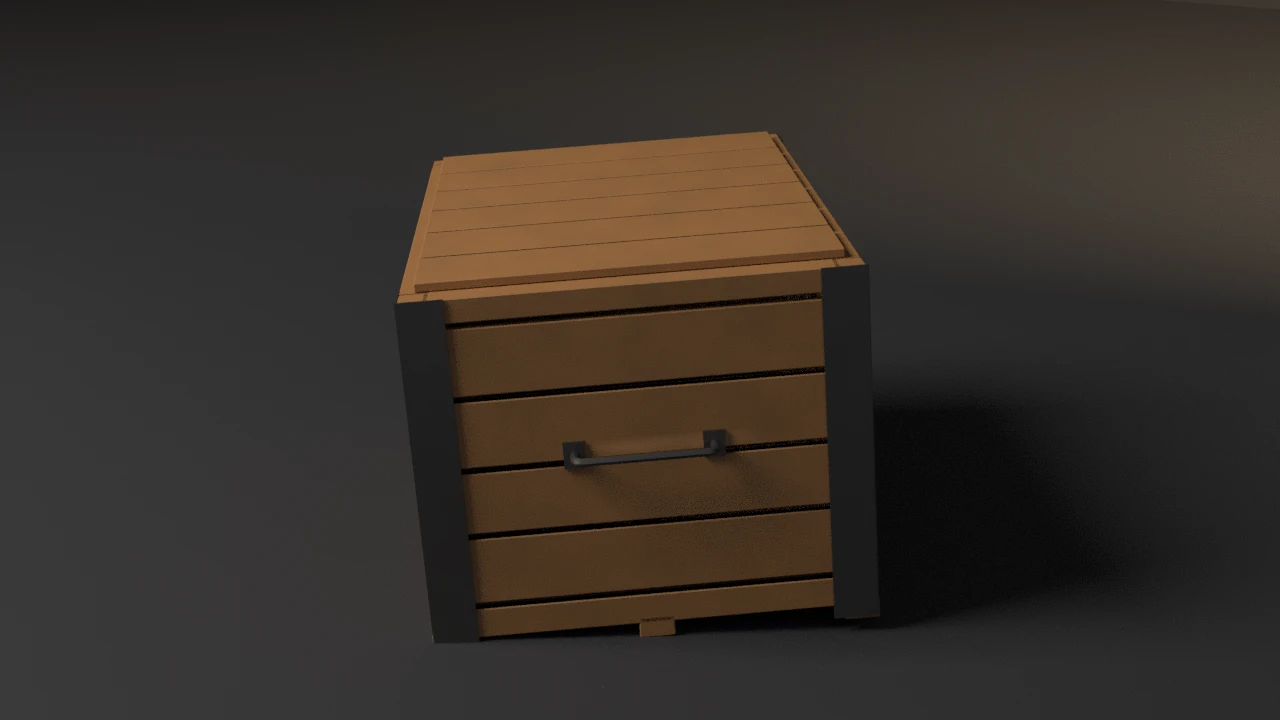
shipping-crate
A procedural shipping crate through UVs, bake, LOD, collider, and Unity glTF, asserting recomputed budgets rather than an API contract.
A procedural 1960s Italian step-through motor scooter — a pressed-steel tail lofted from superellipse sections with two bulbous side cowls (pressed louvres on the engine side, chrome belt trims), a floorboard with rubber runner strips and chrome edge trims pressed up into the tail and into a leg shield convex in plan, arched up into the headset and rimmed in a rolled chrome trim, with a horn cast and grille, a single-sided front end (a column raked 26 degrees, crown, fork leg, trailing link and coil spring) under a crested mudguard, a headset carrying the headlamp, speedometer, ribbed grips, levers and two mirrors, a two-tone dual saddle with piping and a grab strap, 10-inch split rims with five nuts and finned drums in block-tread tyres, an alloy engine case with a finned cylinder, header, silencer and kick-start, a luggage rack, tail lamp and plate, and a centre stand with rubber feet — through UVs, bake, LOD, collider, and Unity glTF, asserting recomputed budgets rather than an API contract.
Rendered headless by the showcase piece itself — click to zoom.
category Vehicles
blender --background --python showcase/motor-scooter/motor_scooter.py --
A showcase piece, not an example, and the third in the vehicles category. It builds a procedural 1960s Italian step-through motor scooter (no brand names or badges), parked upright on its centre stand:
The layout is solved from named constants. The steering axis is a line through the ground a design trail (75 mm) ahead of the front axle, raked 26 degrees: the column, crown, headset, collar and horn cast are all placed on it. The tyre's rings are placed so a ring points straight down, so the centre rib's lowest vertices are exactly one tyre radius below the axle and both tyres ground at the same height as the stand's feet. The tail's section parameter is symmetric about its crown, so the body is its own mirror image vertex for vertex.
It asserts budget conformance of the generated result. It does not witness an API contract. "It rendered without error" is not a check.
Composes skills mesh-editing-and-bmesh, bake-high-to-low, depsgraph-and-evaluated-data, engine-export-presets, and snippets bake_normal_high_to_low.py, setup_bake_target_image.py, lod_chain.py / decimate_to_budget.py, convex_hull_collider.py, export_preset_unity.py (helpers copied inline, not imported).
Intended size: 1.79 m from the mudguard's nose to the number plate, 0.73 m across the bar-end caps, 1.24 m to the mirror tops, with the saddle's top at 0.807 m and a 1.20 m wheelbase. The body's tail is 0.862 m long. The origin is under the scooter's centre, so it lands on its tyres and stand.
Every budget is declared as a named constant. Every gate recomputes its value from the mesh, materials, UVs, evaluated LOD, collider, or export file.
| Axis | Declared | Measured (5.2.1) |
|---|---|---|
| Base triangles | 44400–45700 | 45060 |
| LOD1 ratio | 0.32–0.62 of base | 0.5000 |
| LOD2 ratio | 0.10–0.35 of base | 0.2200 |
| Materials | exactly 9 distinct; ≥6440 paint, ≥4350 chrome, ≥3250 rubber, ≥1030 oxblood vinyl, ≥265 cream vinyl, ≥495 glass, ≥170 tail lens, ≥3620 alloy, ≥2060 black enamel faces | 9 slots; 7156 / 4638 / 3608 / 1147 / 297 / 550 / 188 / 4020 / 2292 |
| UVs | in 0..1, AABB overlap ≤ 1e-5 | in range, overlap 0 |
| Outer AABB | (1.790, 0.730, 1.244) m ± 0.01 | (1.7901, 0.7300, 1.2435), zmin 0 |
| Collider tris | ≤ 1850 | 1678 |
| Export | written, size > 0, removed after measuring | 3374040 bytes |
The collider is the convex hull of the whole scooter; the mudguard, the mirrors and the tail carry its outline.
Every falsifier leaves the triangle count at 45060 and the outer AABB unchanged: they move, turn or bend parts, never add or remove them.
DECIMATE COLLAPSE triangle counts are not identical across Blender series, so the LOD gate is a ratio band, not an exact count. Bake pixels are stochastic, so the bake gate is has_data plus operator FINISHED, not byte-identity. Construction uses no RNG; two default runs print identical measurements.
Recomputed from the generated mesh, not asserted about the script.
| Axis | Declared | Measured |
|---|---|---|
| Non-manifold edges | 0 | 0 |
| Loose verts / edges | 0 / 0 | 0 / 0 |
| Doubles merged at 1e-5 | 0 | 0 |
| Zero-area faces | 0 | 0 |
| N-gons | 0 | 0 |
| Coplanar cross-shell face pairs (KD range 0.05 m, plane ε 1e-4) | 0 | 0 |
Grounded: zmin | within 1e-4 of 0 | 0.0000 |
Supports: each of the 2 tyres and 2 stand feet has its own zmin | within 1e-4 of 0 | 0, 0; 0, 0 |
Parts laid out in a row share planes by construction. The first draft measured 525 coplanar cross-shell pairs: the seven runner strips' tops and end chamfers, the five rim nuts against each other and against the hub cap, the rack's cross bars' end caps, and the louvres' outer faces. The strips and nuts are now staggered 0.3 mm each (the strips grow in length as they rise, so their 45° end chamfers cannot re-align), the hub cap's base sits below every nut, the cross bars' ends are staggered 0.4 mm, and the louvres are graduated in length and laid along the cowl's own latitude, so each slat's face is tangent to a different part of the cowl.
| Axis | Declared | Measured |
|---|---|---|
| Wheel alignment: each tyre's axle (its least-variance PCA axis) horizontal, and the two axles parallel in plan | camber ≤ 0.3° each; toe ≤ 0.3° | 0.000°, 0.000°; 0.000° |
| Steering: the column's axis (principal PCA axis) meets the ground ahead of the front tyre's contact patch (its lowest ring of vertices), on its line | trail 0.055–0.090 m; ≤ 2 mm across | 0.0750 m (rake 26.000°); 0.000 mm |
| Body mirror symmetry: every vertex of the body shells (tail, both cowls, floorboard, both floor fillets, leg shield, horn cast, mudguard, headset) against its nearest vertex at (x, −y, z) | ≤ 0.5 mm | 0.000 mm |
| Size: the tail's length, the saddle's top | 0.862 m, 0.807 m, each ± 0.004 | 0.8624, 0.8068 |
| Wheelbase: the two tyres' centres (vertex means) apart in plan | 1.200 ± 0.004 m | 1.20000 m |
| Stance: mass centre (shell volumes × density per material) inside the convex polygon of both tyres' contact rings and both stand feet's soles | ≥ 0.080 m inside every edge | 0.1284 (101.6 kg, centre at x −0.278, y −0.036) |
| One connected assembly (union of shells whose BVH trees overlap) | 1 component | 1 (105 shells) |
| Shield seam: the leg shield's foot (its lowest ring) below the floorboard's top, both read off the mesh | 0.020–0.040 m deep | 0.0320 m |
The mirror audit excludes the engine side by construction: it reads only the body shells, all built symmetric, and not the louvres (the only paint shells under 0.15 m), the engine case, cylinder, exhaust, kick-start, brake pedal or the single-sided fork and link, which a scooter carries on one side only. The louvres, pressed into the right cowl alone, are separate shells for that reason.
The seam budget is the leg shield's joint with the floor. A shield that stops on or above the floor's top stands apart from it as a plank with daylight under its foot; one sunk too deep punches out of the floor's underside. The fillet sheets make the joint read as one pressing, but they would bridge a lifted shield just as well, so the budget reads the shield itself.
The steering axis and its trail are what keep a scooter going straight: the axis must meet the ground ahead of the tyre's contact, on the wheel's line, by a few centimetres. Too little trail and it wanders; too much and it will not turn. The wheel-alignment budget is its partner: the axles must be level and parallel, or the wheels fight each other. The densities are named constants (the pressed-steel body shells as hollow panels with their contents 300 kg/m³, chrome parts 2500, tyres and rubber 700, vinyl and foam 250, glass 2500, lens 1200, alloy castings and rims 2200, black-enamel steel parts 2600), and the volumes come from the mesh. The engine on the right puts the mass centre 36 mm right of the centreline; the stand's feet carry it.
Each falsifier violates one named budget. Every one was run on 5.2.1 and exited its declared code. None moves the envelope: every run measured the same outer AABB and triangle count as the default, and every budget checked before the target stayed green.
| Flag | Budget violated | Exit |
|---|---|---|
--skip-decimate | LOD1 ratio band (measured 1.0000) | 9 |
--stray-vert | loose vertex count is 0 (measured 1, placed inside the envelope) | 15 |
--lift-z | bounding box zmin is 0 (measured 0.05000) | 16 |
--float-tyre | both tyres and both stand feet on the ground (rear wheel 4 mm up: its zmin 0.00400, the rest 0) | 16 |
--toe-wheel | wheel alignment (front wheel steered 2.5° about its own vertical: toe 2.5000°) | 17 |
--steep-head | steering trail (column turned 6° steeper about its crown: rake 20.000°, trail 0.01683 m) | 18 |
--odd-body | body mirror symmetry (a 3.5 mm sideways bow in the tail, zero at both ends: deviation 0.00695 m) | 19 |
--short-wheelbase | wheelbase band (rear wheel 15 mm forward: 1.18500 m) | 20 |
--narrow-stand | stance (stand feet drawn in to ±0.060 m: margin 0.0424 m) | 21 |
--pop-speedo | one connected assembly (speedometer 30 mm out of the headset: 2 components) | 22 |
--lift-shield | shield seam (the shield's foot stood 4 mm above the floor's top: −0.00400 m) | 23 |
--float-tyre lifts the rear wheel while the front tyre and the stand ground the box. --toe-wheel turns the front wheel about the vertical through its axle, so its contact ring stays where it was and the trail does not move; the rim, drum and nuts turn with the tyre and stay in the link. --steep-head turns only the column, about its crown, so the headset and horn cast stay put. --odd-body bows the tail by sin²(π s) along its length, so both ends stay seated in the floorboard and under the tail lamp; its first draft, a plain sin bow with the luggage rack's rails riding past the tail's shoulder, laid one rail face in the plane of a bowed tail face and exited 15. The rails now follow the crown inside the shoulder, and the falsifier reaches 19. --narrow-stand keeps both feet on the ground; the first draft drew them in to ±0.035 m, where the two soles' faces came within the coplanar range of each other and exited 15, so it stops at ±0.060 m. --short-wheelbase moves the rear wheel inside the envelope; the plate and the mudguard still set the length. --pop-speedo lifts a part held by one joint only: the speedometer is seated in the headset and nothing else. Its first draft moved it 15 mm, which left its base still inside the headset's crown; it moves 30 mm. --lift-shield raises only the shield's foot, its top held, so the fillets follow it and the assembly stays one piece; only the seam budget sees the gap.
blender --background --python motor_scooter.py --
blender --background --python motor_scooter.py -- --skip-decimate
blender --background --python motor_scooter.py -- --stray-vert
blender --background --python motor_scooter.py -- --lift-z
blender --background --python motor_scooter.py -- --float-tyre
blender --background --python motor_scooter.py -- --toe-wheel
blender --background --python motor_scooter.py -- --steep-head
blender --background --python motor_scooter.py -- --odd-body
blender --background --python motor_scooter.py -- --short-wheelbase
blender --background --python motor_scooter.py -- --narrow-stand
blender --background --python motor_scooter.py -- --pop-speedo
blender --background --python motor_scooter.py -- --lift-shield
blender --background --python motor_scooter.py -- --output scooter.png
Smoke passes no flags.
The hero turns the piece HERO_YAW_DEG (−58°), so the nose, the front wheel's open face and the engine side come toward the lens: the louvres, the silencer, the split rim's nuts and the fork. The wall stands 2.6 m behind the scooter, and the warm wedge pools on it.
File-local. 9 is a valid check code. 10 is reserved for gallery_framing.check_framing on the --output path. 15–19 are the hygiene and joint-fit family. 20–23 are file-local. 24 is the asset-quality floor on the render path: check_asset_quality returns 11, which this piece already spends on the collider ceiling, so the call site remaps it.
| Code | Meaning |
|---|---|
| 0 | Success |
| 1 | Uncaught exception (FATAL wrapper) |
| 2 | argparse / usage |
| 3 | Mesh did not build / no UV layer |
| 4 | Base triangle count outside range |
| 5 | Material count ≠ 9 distinct slots, or a face-count floor missed |
| 6 | UVs outside 0..1 |
| 7 | UV AABB overlap above tolerance |
| 8 | World AABB off declared outer size |
| 9 | LOD ratio band (--skip-decimate lands here) |
| 10 | Framing gate (render path only) |
| 11 | Collider triangle count above ceiling |
| 12 | Bake did not finish or image has no data |
| 13 | Export file missing or empty |
| 14 | --output produced no file |
| 15 | Mesh hygiene: loose, non-manifold, zero-area, doubles, n-gons, coplanar cross-shell pairs |
| 16 | Not grounded: bounding box zmin off 0, or a tyre or stand foot off the ground, or not 2 tyres and 2 feet (--lift-z, --float-tyre) |
| 17 | Wheel alignment: a tyre's axle tilted (camber) or the axles not parallel in plan (toe) (--toe-wheel) |
| 18 | Steering: not 1 column, trail outside its band, or the axis off the front contact's line (--steep-head) |
| 19 | Body mirror symmetry, or the tail's length or saddle height off (--odd-body) |
| 20 | Wheelbase outside its band (--short-wheelbase) |
| 21 | Stance: mass centre within 0.080 m of the support polygon's edge (--narrow-stand) |
| 22 | Assembly splits into more than one connected component (--pop-speedo) |
| 23 | Leg shield's foot outside its seat band in the floorboard (--lift-shield) |
| 24 | Asset-quality floor (render path only; remapped from 11) |
"""Game-ready 1960s Italian motor scooter — a showcase piece, not an example. Asserts budget conformance of a procedural step-through motor scooter, parked upright on its centre stand, after composing shipped pipeline pieces: bmesh construction, UVs, nine materials, high-to-low normal bake, LOD chain, convex collider, Unity glTF export. The body is pressed steel: a central tail lofted from superellipse sections (a steep front face rising from the floorboard to the saddle, a flat back under it, and a tail sloping down over the rear wheel), two bulbous side cowls sunk into it (the right one, over the engine, carries six pressed louvres), a floorboard with rubber runner strips and chrome edge trims, and a leg shield curved back at its edges, rimmed in a chrome trim, with a horn cast and grille on its front. A front mudguard with a chrome crest turns with a single-sided fork: a steering column raked 22 degrees, a crown, a fork leg on the left and a trailing link with a coil spring. The headset carries the headlamp, the speedometer, grips, levers and two mirrors on stalks. A two-tone dual saddle (cream top, oxblood sides) has piping round its top panel and a grab strap across it. Both wheels are 10-inch split rims (two pressed halves, five nuts, a hub cap) in block-tread tyres, with a finned brake drum on the arm side. Under the right cowl an alloy engine case with a finned cylinder feeds a header pipe and a black silencer with a chrome tailpipe; a kick-start lever and a brake pedal sit on the right. A chrome luggage rack, a tail lamp and a blank number plate finish the tail. The centre stand's two rubber feet and both tyres stand on the ground. Budgets are declared below and recomputed from the generated result. They are not API-contract witnesses. Each falsifier violates one named budget: ``--skip-decimate`` the LOD-ratio band, ``--stray-vert`` mesh hygiene, ``--lift-z`` grounded zmin, ``--float-tyre`` both tyres and both stand feet on the ground, ``--toe-wheel`` the wheel axes horizontal and parallel, ``--steep-head`` the steering trail, ``--odd-body`` the body's mirror symmetry, ``--short-wheelbase`` the wheelbase band, ``--narrow-stand`` the mass centre inside the support polygon, ``--pop-speedo`` one connected assembly, ``--lift-shield`` the leg shield's foot seated in the floorboard. No RNG. Construction is closed-form. DECIMATE COLLAPSE triangle counts are not byte-identical across Blender versions — the LOD gate is a ratio band, not an exact count. blender --background --python motor_scooter.py -- blender --background --python motor_scooter.py -- --skip-decimate blender --background --python motor_scooter.py -- --output scooter.png """ import argparse import math import os import sys import tempfile import traceback import bmesh import bpy import numpy as np from mathutils import Matrix, Vector from mathutils.bvhtree import BVHTree from mathutils.kdtree import KDTree # Showcase lives at repo-root/showcase/, not under examples/. The framing # helper is the repo's only shared import and lives next to the examples; # resolve the repo root so we do not move gallery_framing.py. _REPO = os.path.abspath( os.path.join(os.path.dirname(os.path.abspath(__file__)), os.pardir, os.pardir) ) sys.path.insert(0, os.path.join(_REPO, "examples")) sys.dont_write_bytecode = True import gallery_framing # noqa: E402 import gallery_asset_quality # noqa: E402 # --- Wheels and steering (nose at +X, rider's left at +Y) -------------------- R_TYRE = 0.215 # tyre radius over the centre rib (10-inch rim, 3.50 tyre) AXLE_F = 0.600 # front axle x AXLE_R = -0.600 # rear axle x: a 1.20 m wheelbase TREAD_H = 0.0035 # tread block height TREAD_CYCLES = 16 # block pitches per revolution (even: a ring points down) TREAD_FRACS = (0.0, 0.06, 0.50, 0.56) RIM_SEGS = 32 HUB_Y = 0.105 # the fork leg / link plane (front, +Y); engine arm (rear, -Y) STEER_RAKE_DEG = 26.0 # steering axis from vertical TRAIL_DESIGN = 0.075 # steering axis meets the ground this far ahead of the contact CROWN_Z = 0.470 # fork crown on the column COLUMN_TOP_Z = 0.985 # the column ends inside the headset # --- Body ----------------------------------------------------------------------- SPINE_N = 2.6 SPINE_PART = 0.55 SPINE_SEGS = 36 SPINE_STATIONS = 30 SPINE_XE = (-0.905, -0.045) SPINE_TOP_KEYS = [(-0.905, 0.470), (-0.880, 0.545), (-0.840, 0.605), (-0.780, 0.655), (-0.700, 0.690), (-0.580, 0.705), (-0.400, 0.705), (-0.280, 0.690), (-0.200, 0.640), (-0.140, 0.540), (-0.100, 0.420), (-0.070, 0.310), (-0.045, 0.228)] SPINE_BOT_KEYS = [(-0.905, 0.430), (-0.840, 0.455), (-0.720, 0.472), (-0.480, 0.472), (-0.400, 0.440), (-0.340, 0.330), (-0.280, 0.215), (-0.045, 0.205)] SPINE_W_KEYS = [(-0.905, 0.055), (-0.860, 0.088), (-0.760, 0.125), (-0.550, 0.150), (-0.300, 0.150), (-0.140, 0.140), (-0.045, 0.115)] COWL_C = (-0.575, 0.178, 0.440) COWL_AX = 0.270 COWL_AY = 0.132 # outboard half-width; inboard is COWL_AY_IN COWL_AY_IN = 0.105 COWL_AZT = 0.225 COWL_AZB = 0.190 COWL_N = 2.5 COWL_TAPER = 0.35 COWL_RISE = 0.035 COWL_NU = 22 COWL_NV = 36 LOUVRES = 6 FLOOR_TOP = 0.232 SH_Z0 = 0.200 # leg shield foot (inside the floorboard) SH_Z0_LIFTED = 0.236 # --lift-shield: the foot stood 4 mm above the floor SH_X0 = 0.345 SH_Z1 = 0.935 # crown of the shield's top edge, inside the headset SH_X1 = 0.248 SH_ARCH = 0.075 # the top edge falls this much to its corners SH_HW0 = 0.205 # as wide as the floorboard at its foot SH_HW1 = 0.185 SH_SWEEP0 = 0.075 # edges swept back behind the centre, at the foot ... SH_SWEEP1 = 0.135 # ... and at the top: convex in plan SH_BULGE = 0.020 # forward bulge at mid-height SH_T = 0.010 FILLET_R = 0.045 # floorboard-to-shield and floorboard-to-tail radius FLOOR_HW = 0.215 FLOOR_X = (-0.060, 0.360) TIE_Z = (0.485, 0.925) # horn cast: from the fork crown up into the headset MG_R = 0.232 # mudguard edge radius about the front axle MG_H = 0.040 # crown rise over the edge MG_HW = 0.082 MG_T0 = -20.0 MG_T1 = 118.0 # --- Headset and saddle ------------------------------------------------------------ HS_N = 2.4 HS_Z = 0.985 HS_KEYS_A = [(0.0, 0.152), (0.07, 0.140), (0.13, 0.092), (0.19, 0.052), (0.25, 0.030)] HS_KEYS_B = [(0.0, 0.080), (0.07, 0.075), (0.13, 0.055), (0.19, 0.037), (0.25, 0.026)] HS_KEYS_X = [(0.0, 0.205), (0.12, 0.180), (0.25, 0.152)] GRIP_Y = (0.240, 0.350) SEAT_X0 = -0.740 SEAT_X1 = -0.190 SEAT_BITE = 0.012 SEAT_TOP_KEYS = [(-0.740, 0.782), (-0.700, 0.800), (-0.620, 0.808), (-0.540, 0.806), (-0.480, 0.795), (-0.420, 0.790), (-0.300, 0.792), (-0.230, 0.780), (-0.190, 0.745)] SEAT_W_KEYS = [(-0.740, 0.100), (-0.660, 0.128), (-0.500, 0.132), (-0.350, 0.134), (-0.240, 0.120), (-0.190, 0.084)] SEAT_PANEL = 0.95 # half-angle (rad) of the cream top panel in the section STRAP_X = -0.470 # --- Stand ------------------------------------------------------------------------- STAND_X = (-0.220, -0.300) # pivot x, foot x STAND_PIVOT_Z = 0.198 STAND_PIVOT_Y = 0.100 STAND_FOOT_Y = 0.150 STAND_FOOT_Y_NARROW = 0.060 # --narrow-stand STAND_R = 0.011 # --- Falsifier sizes ----------------------------------------------------------------- FLOAT_TYRE = 0.004 TOE_DEG = 2.5 STEEP_DEG = 6.0 ODD_BODY = 0.0035 SHORT_WB = 0.015 POP_SPEEDO = 0.030 BBOX_TOL = 0.01 # Fitted after locking geometry. Recomputed from bound_box. OUTER_SIZE = (1.790, 0.730, 1.244) BASE_TRIS_MIN = 44400 BASE_TRIS_MAX = 45700 LOD1_RATIO_MIN = 0.32 LOD1_RATIO_MAX = 0.62 LOD2_RATIO_MIN = 0.10 LOD2_RATIO_MAX = 0.35 LOD1_TARGET = 0.50 LOD2_TARGET = 0.22 MATERIAL_COUNT = 9 UV_EPS = 1e-4 UV_OVERLAP_MAX = 1e-5 COLLIDER_TRIS_MAX = 1850 BAKE_RES = 1024 CAGE_EXTRUSION = 0.004 PAINT_FACES_MIN = 6440 CHROME_FACES_MIN = 4350 RUBBER_FACES_MIN = 3250 SEAT_FACES_MIN = 1030 CREAM_FACES_MIN = 265 GLASS_FACES_MIN = 495 LAMP_FACES_MIN = 170 ALLOY_FACES_MIN = 3620 DARK_FACES_MIN = 2060 ZMIN_EPS = 1e-4 DOUBLES_EPS = 1e-5 AREA_EPS = 1e-10 COPLANAR_NORMAL_EPS = 1e-4 COPLANAR_PLANE_EPS = 1e-4 COPLANAR_CENTRE_MAX = 0.05 LIFT_Z = 0.05 TYRE_COUNT = 2 PAD_COUNT = 2 CONTACT_BAND = 2e-5 # a support's sole: its lowest ring of vertices # Wheel alignment: axles horizontal (camber) and parallel in plan (toe). CAMBER_MAX_DEG = 0.3 TOE_MAX_DEG = 0.3 # Steering: the column's axis meets the ground ahead of the front contact. TRAIL_MIN = 0.055 TRAIL_MAX = 0.090 TRAIL_Y_TOL = 0.002 # Body symmetry: every body vertex has a partner at its mirror position. MIRROR_EPS = 0.0005 BODY_LEN = 0.862 SEAT_HEIGHT = 0.807 SIZE_TOL = 0.004 WHEELBASE = 1.200 WHEELBASE_TOL = 0.004 # Stance: the mass centre stands this far inside the support polygon. DENSITY = (300.0, 2500.0, 700.0, 250.0, 250.0, 2500.0, 1200.0, 2200.0, 2600.0) STANCE_MARGIN = 0.080 # Seam: the leg shield's foot stands this deep in the floorboard's pressing. SEAM_MIN = 0.020 SEAM_MAX = 0.040 # Hero yaw: the nose turned toward the camera's right. HERO_YAW_DEG = -58.0 WALL_Y = 2.6 PAINT_IDX = 0 CHROME_IDX = 1 RUBBER_IDX = 2 SEAT_IDX = 3 CREAM_IDX = 4 GLASS_IDX = 5 LAMP_IDX = 6 ALLOY_IDX = 7 DARK_IDX = 8 ZAX = Vector((0.0, 0.0, 1.0)) YAX = Vector((0.0, 1.0, 0.0)) XAX = Vector((1.0, 0.0, 0.0)) TAN_RAKE = math.tan(math.radians(STEER_RAKE_DEG)) STEER_X0 = AXLE_F + TRAIL_DESIGN STEER_DIR = Vector((-math.sin(math.radians(STEER_RAKE_DEG)), 0.0, math.cos(math.radians(STEER_RAKE_DEG)))) def col_x(z): """The steering axis's x at height z.""" return STEER_X0 - z * TAN_RAKE def eevee_engine_id(): return "BLENDER_EEVEE" if bpy.app.version >= (5, 0, 0) else "BLENDER_EEVEE_NEXT" def fail(msg, code): print(f"ERROR: {msg}", file=sys.stderr) return code def triangle_count(mesh): mesh.calc_loop_triangles() return len(mesh.loop_triangles) def evaluated_triangle_count(obj): # Duplicated from snippets/lod_chain.py / decimate_to_budget.py (not a package). depsgraph = bpy.context.evaluated_depsgraph_get() eval_obj = obj.evaluated_get(depsgraph) eval_mesh = eval_obj.to_mesh() try: eval_mesh.calc_loop_triangles() return len(eval_mesh.loop_triangles) finally: eval_obj.to_mesh_clear() # -------------------------------------------------------------------------- # Construction helpers (copied from showcase/hover-bike, not imported) # -------------------------------------------------------------------------- def _mark(faces, mat_idx): for f in faces: f.material_index = mat_idx def frame(ez, ex_hint): """Rotation whose local Z is ``ez`` and local X is ``ex_hint`` made orthogonal to it (columns ex, ey, ez; right-handed).""" ez = Vector(ez).normalized() ex = Vector(ex_hint) ex = (ex - ez * ex.dot(ez)).normalized() ey = ez.cross(ex) return Matrix((ex, ey, ez)).transposed() def add_lathe(bm, profile, segs, mat_idx, center=(0.0, 0.0, 0.0), rot=None, phase=0.0, solid=False, seg_mats=None, cap_mats=None, rmod=None): """Revolve a profile [(r, z), ...] about local Z. ``solid``: the profile is an open polyline closed by n-gon caps at its two ends; otherwise it is a closed polygon revolved into a ring shell. ``rmod(i, j)`` scales the radius of profile point ``j`` on ring ``i``.""" c = Vector(center) m = rot if rot is not None else Matrix.Identity(3) rings = [] for i in range(segs): a = phase + 2.0 * math.pi * i / segs ca, sa = math.cos(a), math.sin(a) ring = [] for j, (r, z) in enumerate(profile): rr = r * (rmod(i, j) if rmod else 1.0) ring.append(bm.verts.new(c + m @ Vector((rr * ca, rr * sa, z)))) rings.append(ring) n = len(profile) last = n - 1 if solid else n for i in range(segs): r0, r1 = rings[i], rings[(i + 1) % segs] for j in range(last): k = (j + 1) % n f = bm.faces.new((r0[j], r1[j], r1[k], r0[k])) f.material_index = seg_mats[j] if seg_mats else mat_idx if solid: f0 = bm.faces.new([rings[i][0] for i in reversed(range(segs))]) f1 = bm.faces.new([rings[i][n - 1] for i in range(segs)]) f0.material_index = cap_mats[0] if cap_mats else mat_idx f1.material_index = cap_mats[1] if cap_mats else mat_idx return [v for ring in rings for v in ring] def add_tube(bm, pts, radius, sides, mat_idx, phase=0.0): """Capped round bar swept along a polyline (parallel-transport frames).""" pts = [Vector(p) for p in pts] tans = [] for i in range(len(pts)): a = pts[max(i - 1, 0)] b = pts[min(i + 1, len(pts) - 1)] tans.append((b - a).normalized()) ref = Vector((0.0, 0.0, 1.0)) if abs(tans[0].z) < 0.9 else Vector((1.0, 0.0, 0.0)) nrm = (ref - tans[0] * ref.dot(tans[0])).normalized() rings = [] for p, t in zip(pts, tans): nrm = (nrm - t * nrm.dot(t)).normalized() bi = t.cross(nrm) rings.append([ bm.verts.new(p + radius * (nrm * math.cos(phase + 2.0 * math.pi * k / sides) + bi * math.sin(phase + 2.0 * math.pi * k / sides))) for k in range(sides) ]) faces = [] for r0, r1 in zip(rings, rings[1:]): for k in range(sides): m = (k + 1) % sides faces.append(bm.faces.new((r0[k], r0[m], r1[m], r1[k]))) faces.append(bm.faces.new(tuple(reversed(rings[0])))) faces.append(bm.faces.new(tuple(rings[-1]))) _mark(faces, mat_idx) return [v for ring in rings for v in ring] def rrect(ha, hb, rc, n_corner=4): """Rounded rectangle loop (counter-clockwise).""" rc = max(min(rc, ha - 1e-4, hb - 1e-4), 0.0006) pts = [] for k, (sx, sy) in enumerate(((1, 1), (-1, 1), (-1, -1), (1, -1))): cx, cy = sx * (ha - rc), sy * (hb - rc) a0 = 0.5 * math.pi * k for s in range(n_corner + 1): a = a0 + 0.5 * math.pi * s / n_corner pts.append((cx + rc * math.cos(a), cy + rc * math.sin(a))) return pts def add_rbox(bm, ha, hb, rc, profile, origin, rot, mat_idx, n_corner=4): """Loft of rounded rectangles along local Z: profile [(inset, z)], each loop inset from (ha, hb, rc); n-gon caps at both ends.""" o = Vector(origin) rings = [] for inset, z in profile: loop = rrect(ha - inset, hb - inset, rc - inset, n_corner) rings.append([bm.verts.new(o + rot @ Vector((x, y, z))) for x, y in loop]) n = len(rings[0]) faces = [] for r0, r1 in zip(rings, rings[1:]): for k in range(n): m = (k + 1) % n faces.append(bm.faces.new((r0[k], r0[m], r1[m], r1[k]))) faces.append(bm.faces.new(tuple(reversed(rings[0])))) faces.append(bm.faces.new(tuple(rings[-1]))) _mark(faces, mat_idx) return [v for ring in rings for v in ring] def add_prism(bm, outline, w0, w1, origin, rot, mat_idx): """Planar outline [(u, v)] extruded along local Z from w0 to w1.""" o = Vector(origin) a = [bm.verts.new(o + rot @ Vector((u, v, w0))) for u, v in outline] b = [bm.verts.new(o + rot @ Vector((u, v, w1))) for u, v in outline] n = len(outline) faces = [bm.faces.new((a[i], a[(i + 1) % n], b[(i + 1) % n], b[i])) for i in range(n)] faces.append(bm.faces.new(tuple(reversed(a)))) faces.append(bm.faces.new(tuple(b))) _mark(faces, mat_idx) return a + b def fillet_path(pts, rf, steps=4): pts = [Vector(p) for p in pts] out = [pts[0]] for i in range(1, len(pts) - 1): a, p, b = pts[i - 1], pts[i], pts[i + 1] r = min(rf, (a - p).length * 0.45, (b - p).length * 0.45) p0 = p + (a - p).normalized() * r p1 = p + (b - p).normalized() * r for k in range(steps + 1): t = k / steps out.append((1 - t) ** 2 * p0 + 2 * (1 - t) * t * p + t * t * p1) out.append(pts[-1]) return out def fillet_corners(pts, rf, steps=4, min_deg=25.0): """Fillet only the vertices where the path turns by more than min_deg.""" pts = [Vector(p) for p in pts] out = [pts[0]] for i in range(1, len(pts) - 1): a, p, b = pts[i - 1], pts[i], pts[i + 1] if (p - a).angle(b - p, 0.0) < math.radians(min_deg): out.append(p) continue r = min(rf, (a - p).length * 0.45, (b - p).length * 0.45) p0 = p + (a - p).normalized() * r p1 = p + (b - p).normalized() * r for k in range(steps + 1): t = k / steps out.append((1 - t) ** 2 * p0 + 2 * (1 - t) * t * p + t * t * p1) out.append(pts[-1]) return out def add_bar(bm, pts, wax, half_w, half_t, rc, mat_idx, fillet=0.008, filleted=False): """Flat bar bent in the plane normal to ``wax``: its width lies along ``wax``, its thickness in the bending plane; rounded-rectangle section.""" pts = [Vector(p) for p in pts] if filleted else fillet_path(pts, fillet) wax = Vector(wax).normalized() sec = rrect(half_w, half_t, rc, 2) rings = [] for i, p in enumerate(pts): a = pts[max(i - 1, 0)] b = pts[min(i + 1, len(pts) - 1)] t = (b - a).normalized() w = (wax - t * wax.dot(t)).normalized() th = t.cross(w) rings.append([bm.verts.new(p + w * x + th * y) for x, y in sec]) n = len(sec) faces = [] for r0, r1 in zip(rings, rings[1:]): for k in range(n): m = (k + 1) % n faces.append(bm.faces.new((r0[k], r0[m], r1[m], r1[k]))) faces.append(bm.faces.new(tuple(reversed(rings[0])))) faces.append(bm.faces.new(tuple(rings[-1]))) _mark(faces, mat_idx) return [v for ring in rings for v in ring] def add_sheet(bm, surf, nu, nv, thick, mat_idx): """A closed plate: ``surf(u, v) -> (point, normal)`` over the unit square, offset ``thick`` back along the normal, rims stitched round the edge.""" front, back = [], [] for j in range(nv + 1): rf, rb = [], [] for i in range(nu + 1): p, n = surf(i / nu, j / nv) rf.append(bm.verts.new(p)) rb.append(bm.verts.new(p - n * thick)) front.append(rf) back.append(rb) faces = [] for j in range(nv): for i in range(nu): faces.append(bm.faces.new((front[j][i], front[j][i + 1], front[j + 1][i + 1], front[j + 1][i]))) faces.append(bm.faces.new((back[j][i], back[j + 1][i], back[j + 1][i + 1], back[j][i + 1]))) rim = ([(0, i) for i in range(nu + 1)] + [(j, nu) for j in range(1, nv + 1)] + [(nv, i) for i in reversed(range(nu))] + [(j, 0) for j in reversed(range(1, nv))]) for k in range(len(rim)): (ja, ia), (jb, ib) = rim[k], rim[(k + 1) % len(rim)] faces.append(bm.faces.new((front[jb][ib], front[ja][ia], back[ja][ia], back[jb][ib]))) _mark(faces, mat_idx) return [v for row in front + back for v in row] def add_loft(bm, rings_pts, mat_idx, seg_mats=None): """Closed loops [[Vector]] lofted in order, n-gon caps at both ends. ``seg_mats[k][j]`` is the material of the face between loop k and k+1 at loop point j.""" rings = [[bm.verts.new(p) for p in loop] for loop in rings_pts] n = len(rings[0]) faces = [] for k, (r0, r1) in enumerate(zip(rings, rings[1:])): for j in range(n): m = (j + 1) % n f = bm.faces.new((r0[j], r0[m], r1[m], r1[j])) f.material_index = seg_mats[k][j] if seg_mats else mat_idx faces.append(f) f0 = bm.faces.new(tuple(reversed(rings[0]))) f1 = bm.faces.new(tuple(rings[-1])) f0.material_index = mat_idx f1.material_index = mat_idx return [v for ring in rings for v in ring] def hull2d(pts): """Convex hull, counter-clockwise (monotone chain).""" pts = sorted(set((round(x, 9), round(z, 9)) for x, z in pts)) def cross(o, a, b): return (a[0] - o[0]) * (b[1] - o[1]) - (a[1] - o[1]) * (b[0] - o[0]) lower, upper = [], [] for p in pts: while len(lower) >= 2 and cross(lower[-2], lower[-1], p) <= 1e-12: lower.pop() lower.append(p) for p in reversed(pts): while len(upper) >= 2 and cross(upper[-2], upper[-1], p) <= 1e-12: upper.pop() upper.append(p) return lower[:-1] + upper[:-1] def comb_outline(half_len, base_lo, base_hi, ribs, rib_half, rib_top): """Grille section: a base strip with ``ribs`` teeth standing on it.""" pts = [(-half_len, base_lo), (half_len, base_lo), (half_len, base_hi)] pitch = 2.0 * half_len / ribs for k in reversed(range(ribs)): c = -half_len + pitch * (k + 0.5) pts += [(c + rib_half, base_hi), (c + rib_half, rib_top), (c - rib_half, rib_top), (c - rib_half, base_hi)] pts.append((-half_len, base_hi)) return pts def thick_profile(centre, t): """A closed (r, z) polygon: the polyline ``centre`` offset t/2 either side.""" pts = [Vector((r, z)) for r, z in centre] left, right = [], [] for i, p in enumerate(pts): a = pts[max(i - 1, 0)] b = pts[min(i + 1, len(pts) - 1)] d = (b - a).normalized() nrm = Vector((-d.y, d.x)) left.append(p + nrm * (0.5 * t)) right.append(p - nrm * (0.5 * t)) return [(p.x, p.y) for p in left] + [(p.x, p.y) for p in reversed(right)] def triangulate_ngons(bm): faces = [f for f in bm.faces if len(f.verts) > 4] if faces: bmesh.ops.triangulate(bm, faces=faces) def pack_uvs(bm, margin=0.08): uv = bm.loops.layers.uv.new("UVMap") faces = list(bm.faces) n = len(faces) cols = max(1, math.ceil(math.sqrt(n))) rows = max(1, math.ceil(n / cols)) cell_w = 1.0 / cols cell_h = 1.0 / rows pad_u = margin * cell_w * 0.5 pad_v = margin * cell_h * 0.5 usable_w = cell_w - 2.0 * pad_u usable_h = cell_h - 2.0 * pad_v for i, face in enumerate(faces): col = i % cols row = i // cols nrm = face.normal ax, ay, az = abs(nrm.x), abs(nrm.y), abs(nrm.z) coords = [] for loop in face.loops: co = loop.vert.co if az >= ax and az >= ay: coords.append((co.x, co.y)) elif ax >= ay: coords.append((co.y, co.z)) else: coords.append((co.x, co.z)) xs = [c[0] for c in coords] ys = [c[1] for c in coords] minx, maxx = min(xs), max(xs) miny, maxy = min(ys), max(ys) dx = max(maxx - minx, 1e-8) dy = max(maxy - miny, 1e-8) origin_u = col * cell_w + pad_u origin_v = row * cell_h + pad_v for loop, (x, y) in zip(face.loops, coords): loop[uv].uv = ( origin_u + (x - minx) / dx * usable_w, origin_v + (y - miny) / dy * usable_h, ) def pchip(keys): """Monotone cubic through (x, y) keys (Fritsch-Carlson): no overshoot.""" xs = [k[0] for k in keys] ys = [k[1] for k in keys] n = len(xs) h = [xs[i + 1] - xs[i] for i in range(n - 1)] d = [(ys[i + 1] - ys[i]) / h[i] for i in range(n - 1)] m = [d[0]] + [0.0] * (n - 2) + [d[-1]] for i in range(1, n - 1): if d[i - 1] * d[i] > 0.0: w1 = 2.0 * h[i] + h[i - 1] w2 = h[i] + 2.0 * h[i - 1] m[i] = (w1 + w2) / (w1 / d[i - 1] + w2 / d[i]) def f(x): x = min(max(x, xs[0]), xs[-1]) i = 0 while i < n - 2 and x > xs[i + 1]: i += 1 t = (x - xs[i]) / h[i] t2, t3 = t * t, t * t * t return ((2 * t3 - 3 * t2 + 1) * ys[i] + (t3 - 2 * t2 + t) * h[i] * m[i] + (-2 * t3 + 3 * t2) * ys[i + 1] + (t3 - t2) * h[i] * m[i + 1]) return f def _se(c, n): return math.copysign(abs(c) ** (2.0 / n), c) _SP_TOP = pchip(SPINE_TOP_KEYS) _SP_BOT = pchip(SPINE_BOT_KEYS) _SP_W = pchip(SPINE_W_KEYS) _SEAT_TOP = pchip(SEAT_TOP_KEYS) _SEAT_W = pchip(SEAT_W_KEYS) _HS_A = pchip(HS_KEYS_A) _HS_B = pchip(HS_KEYS_B) _HS_X = pchip(HS_KEYS_X) # -------------------------------------------------------------------------- # The body's closed forms # -------------------------------------------------------------------------- def spine_dims(x): """(parting-line height, half-width, crown height over it, belly depth).""" top, bot = _SP_TOP(x), _SP_BOT(x) zc = bot + SPINE_PART * (top - bot) return zc, _SP_W(x), top - zc, zc - bot def spine_top(x, y): zc, w, ht, _hb = spine_dims(x) a = min(1.0, abs(y) / w) return zc + ht * (1.0 - a ** SPINE_N) ** (1.0 / SPINE_N) def spine_F(p): zc, w, ht, hb = spine_dims(p.x) h = ht if p.z >= zc else hb return (abs(p.y) / w) ** SPINE_N + (abs(p.z - zc) / h) ** SPINE_N - 1.0 def spine_normal(p, eps=1e-5): g = Vector(( spine_F(p + Vector((eps, 0, 0))) - spine_F(p - Vector((eps, 0, 0))), spine_F(p + Vector((0, eps, 0))) - spine_F(p - Vector((0, eps, 0))), spine_F(p + Vector((0, 0, eps))) - spine_F(p - Vector((0, 0, eps))), )) return g.normalized() def add_spine(bm, odd_body): """The central tail: superellipse sections lofted along X, its parameter symmetric about the crown so the loop is its own mirror image.""" x0, x1 = SPINE_XE xs = [] for k in range(SPINE_STATIONS): s = k / (SPINE_STATIONS - 1) # denser at both ends, where the profile turns fastest xs.append(x0 + (x1 - x0) * (0.5 - 0.5 * math.cos(math.pi * s))) st = [(x0 - 0.0012, 0.0025)] + [(x, 0.0) for x in xs] + [(x1 + 0.0012, 0.0025)] loops = [] for x, inset in st: zc, w, ht, hb = spine_dims(max(x0, min(x1, x))) loop = [] for i in range(SPINE_SEGS): t = 2.0 * math.pi * i / SPINE_SEGS c, s = math.cos(t), math.sin(t) y = (w - inset) * _se(c, SPINE_N) z = zc + ((ht if s >= 0.0 else hb) - inset) * _se(s, SPINE_N) if odd_body: # a sideways bow, zero at both ends: an odd term in y y += ODD_BODY * math.sin(math.pi * (x - x0) / (x1 - x0)) ** 2 loop.append(Vector((x, y, z))) loops.append(loop) return add_loft(bm, loops, PAINT_IDX) def blob_point(c, ax, ay, azt, azb, n, taper, rise, u, v, side=1.0, ay_in=None): """A superquadric blob, narrowed and lifted toward its front (+X); its inboard half (toward y = 0) may be narrower than its outboard half.""" cu, su = math.cos(u), math.sin(u) cv, sv = math.cos(v), math.sin(v) X = _se(cu, n) * _se(cv, n) Y = _se(cu, n) * _se(sv, n) Z = _se(su, n) tf = max(0.0, X) x = c[0] + ax * X wy = ay if (Y >= 0.0 or ay_in is None) else ay_in y = side * c[1] + side * wy * Y * (1.0 - taper * tf * tf) z = c[2] + (azt if Z > 0.0 else azb) * Z * (1.0 - 0.5 * taper * tf * tf) + rise * tf * tf return Vector((x, y, z)) def add_blob(bm, c, ax, ay, azt, azb, n, taper, rise, nu, nv, mat_idx, side=1.0, ay_in=None): loops = [] d = 0.10 for k in range(nu): u = -0.5 * math.pi + d + (math.pi - 2.0 * d) * k / (nu - 1) loop = [blob_point(c, ax, ay, azt, azb, n, taper, rise, u, 2.0 * math.pi * j / nv, side, ay_in) for j in range(nv)] if side < 0.0: loop.reverse() loops.append(loop) return add_loft(bm, loops, mat_idx) def cowl_point(u, v, side): return blob_point(COWL_C, COWL_AX, COWL_AY, COWL_AZT, COWL_AZB, COWL_N, COWL_TAPER, COWL_RISE, u, v, side, COWL_AY_IN) def cowl_normal(u, v, side, eps=1e-4): du = cowl_point(u + eps, v, side) - cowl_point(u - eps, v, side) dv = cowl_point(u, v + eps, side) - cowl_point(u, v - eps, side) nrm = dv.cross(du).normalized() if nrm.y * side < 0.0: nrm = -nrm return nrm _SHIELD = {"z0": SH_Z0} # the foot height in force for this build def shield_x(z): return SH_X0 + (SH_X1 - SH_X0) * (z - SH_Z0) / (SH_Z1 - SH_Z0) def shield_point(u, v): """One pressed panel: its top edge arched up into the headset, its edges swept back round the rider's shins (convex in plan), a bulge forward at mid-height.""" uu = 2.0 * u - 1.0 z0 = _SHIELD["z0"] ztop = SH_Z1 - SH_ARCH * uu * uu z = z0 + (ztop - z0) * v hw = SH_HW0 + (SH_HW1 - SH_HW0) * v y = hw * uu sweep = SH_SWEEP0 + (SH_SWEEP1 - SH_SWEEP0) * v x = shield_x(z) - sweep * uu * uu + SH_BULGE * math.sin(math.pi * v) return Vector((x, y, z)) def shield_back(y, z): """The shield's rear face at (y, z), solved from its closed form.""" z0 = SH_Z0 u, v = 0.5, (z - z0) / (SH_Z1 - z0) for _ in range(8): hw = SH_HW0 + (SH_HW1 - SH_HW0) * v u = min(1.0, max(0.0, 0.5 * (y / hw + 1.0))) uu = 2.0 * u - 1.0 v = (z - z0) / (SH_Z1 - SH_ARCH * uu * uu - z0) p, n = shield_surf(u, v) return p - n * SH_T def spine_front_x(y, z): """Where the tail's steep front face stands at (y, z).""" lo, hi = -0.22, SPINE_XE[1] for _ in range(50): mid = 0.5 * (lo + hi) w = spine_dims(mid)[1] if abs(y) < w and spine_top(mid, y) > z: lo = mid else: hi = mid return 0.5 * (lo + hi) def bezier_fillet(a, k, b): """Quadratic fillet from ``a`` (on the floor) through corner ``k`` to ``b``.""" def pt(t): return (1 - t) ** 2 * a + 2 * (1 - t) * t * k + t * t * b return pt def add_fillet(bm, ends, span, mat_idx, thick=0.010, nu=14, nv=6): """A pressed fillet sheet between the floor and a rising face. ``ends(y, r) -> (a, k, b)``; the radius tapers to a sliver at +-span.""" def surf(u, v): y = span * (2.0 * u - 1.0) r = FILLET_R * max(0.12, (1.0 - abs(y / span) ** 4)) ** 0.5 pt = bezier_fillet(*ends(y, r)) p = pt(v) dv = pt(min(1.0, v + 1e-3)) - pt(max(0.0, v - 1e-3)) n = Vector((0.0, 1.0, 0.0)).cross(dv).normalized() if n.z < 0.0: n = -n return p, n return add_sheet(bm, surf, nu, nv, thick, mat_idx) def shield_surf(u, v, eps=1e-4): p = shield_point(u, v) du = shield_point(min(1.0, u + eps), v) - shield_point(max(0.0, u - eps), v) dv = shield_point(u, min(1.0, v + eps)) - shield_point(u, max(0.0, v - eps)) nrm = dv.cross(du).normalized() if nrm.x < 0.0: nrm = -nrm return p, nrm def mudguard_point(u, v): th = math.radians(MG_T0 + (MG_T1 - MG_T0) * v) phi = math.radians(100.0) * (2.0 * u - 1.0) r = MG_R + MG_H * math.cos(phi) y = MG_HW * math.sin(phi) return Vector((AXLE_F + r * math.cos(th), y, R_TYRE + r * math.sin(th))) def mudguard_surf(u, v, eps=1e-4): p = mudguard_point(u, v) du = mudguard_point(u + eps, v) - mudguard_point(u - eps, v) dv = mudguard_point(u, v + eps) - mudguard_point(u, v - eps) nrm = du.cross(dv).normalized() radial = Vector((p.x - AXLE_F, 0.0, p.z - R_TYRE)) if nrm.dot(radial) < 0.0: nrm = -nrm return p, nrm def headset_top(x, y): a, b, xc = _HS_A(abs(y)), _HS_B(abs(y)), _HS_X(abs(y)) q = min(1.0, abs(x - xc) / a) return HS_Z + b * (1.0 - q ** HS_N) ** (1.0 / HS_N) # -------------------------------------------------------------------------- # Assemblies # -------------------------------------------------------------------------- TYRE_PROFILE = [ (0.1250, -0.0330, "-"), (0.1360, -0.0400, "-"), (0.1600, -0.0468, "-"), (0.1830, -0.0455, "-"), (0.1980, -0.0390, "-"), (0.2045, -0.0310, "L"), (0.2085, -0.0200, "L"), (0.2105, -0.0095, "L"), (0.2115, -0.0030, "C"), (0.2115, 0.0030, "C"), (0.2105, 0.0095, "R"), (0.2085, 0.0200, "R"), (0.2045, 0.0310, "R"), (0.1980, 0.0390, "-"), (0.1830, 0.0455, "-"), (0.1600, 0.0468, "-"), (0.1360, 0.0400, "-"), (0.1250, 0.0330, "-"), ] # pressed-steel rim half: the centreline of the sheet from the hub hole out # over the dish, down the well and up the bead seat to the flange RIM_CENTRE = [(0.030, 0.0006), (0.082, 0.0028), (0.102, 0.0110), (0.1140, 0.0280), (0.1260, 0.0350), (0.1380, 0.0395), (0.1430, 0.0460)] RIM_T = 0.0036 def add_tyre(bm, centre): """Block-tread tyre: a continuous centre rib and staggered shoulder blocks, rings placed so the blocks' ends are near-vertical. A ring points straight down, so the centre rib's lowest vertices are exactly R_TYRE below the axle.""" c = Vector(centre) rot = frame(YAX, ZAX) # local x = +Z, local y = +X, local z = +Y rings = [] for k in range(TREAD_CYCLES): for q, f in enumerate(TREAD_FRACS): a = 2.0 * math.pi * (k + f) / TREAD_CYCLES + math.pi ca, sa = math.cos(a), math.sin(a) ring = [] for r, w, flag in TYRE_PROFILE: # left blocks stand on rings 1-2, right blocks on 3 and the # next cycle's 0: a ramp of 0.06 pitch at each block end up = (flag == "C" or (flag == "L" and q in (1, 2)) or (flag == "R" and q in (0, 3))) rr = r + (TREAD_H if up else 0.0) ring.append(bm.verts.new(c + rot @ Vector((rr * ca, rr * sa, w)))) rings.append(ring) n = len(TYRE_PROFILE) faces = [] for i in range(len(rings)): r0, r1 = rings[i], rings[(i + 1) % len(rings)] for j in range(n): k = (j + 1) % n faces.append(bm.faces.new((r0[j], r1[j], r1[k], r0[k]))) _mark(faces, RUBBER_IDX) return [v for ring in rings for v in ring] def add_wheel(bm, centre, hub_side): """Tyre, two rim halves, finned drum on the ``hub_side`` (+1 / -1 in Y), hub cap and five nuts on the open side. Returns every vertex.""" c = Vector(centre) vs = add_tyre(bm, c) rot = frame(YAX, ZAX) prof = thick_profile(RIM_CENTRE, RIM_T) for s in (1.0, -1.0): half = [(r, s * w) for r, w in prof] if s < 0.0: half.reverse() vs += add_lathe(bm, half, RIM_SEGS, ALLOY_IDX, center=c, rot=rot, phase=math.pi / RIM_SEGS) h = hub_side def fins(i, j): return 1.06 if (4 <= j <= 9 and j % 2 == 0) else 1.0 drum = [(0.026, -0.0020), (0.058, 0.0045), (0.066, 0.0110), (0.068, 0.0200), (0.068, 0.0300), (0.068, 0.0400), (0.068, 0.0500), (0.068, 0.0600), (0.068, 0.0700), (0.066, 0.0780), (0.058, 0.0840), (0.040, 0.0880), (0.026, 0.0960), (0.024, 0.1240)] vs += add_lathe(bm, [(r, h * w) for r, w in drum], 32, ALLOY_IDX, center=c, rot=rot, solid=True, rmod=fins) # axle nut outside the arm vs += add_lathe(bm, [(0.0150, h * 0.1200), (0.0165, h * 0.1240), (0.0165, h * 0.1330), (0.0120, h * 0.1370)], 6, CHROME_IDX, center=c, rot=rot, solid=True, phase=math.pi / 6.0) # open side: domed hub cap and the five split-rim nuts o = -h vs += add_lathe(bm, [(0.0290, o * -0.0035), (0.0320, o * 0.0060), (0.0290, o * 0.0130), (0.0190, o * 0.0180), (0.0060, o * 0.0200)], 32, CHROME_IDX, center=c, rot=rot, solid=True, phase=math.pi / 32.0) for k in range(5): a = 2.0 * math.pi * k / 5.0 + math.pi / 5.0 p = c + rot @ Vector((0.050 * math.cos(a), 0.050 * math.sin(a), 0.0)) e = 0.0003 * k # staggered, so no two nut faces share a plane vs += add_lathe(bm, [(0.0075, o * (-0.0005 - e)), (0.0080, o * (0.0060 + e)), (0.0065, o * (0.0090 + e)), (0.0030, o * (0.0100 + e))], 6, CHROME_IDX, center=p, rot=rot, solid=True, phase=a) return vs def add_front_end(bm, bevel_verts, toe_wheel, steep_head): """Front wheel, mudguard and crest, column, crown, fork leg, trailing link and spring.""" c = Vector((AXLE_F, 0.0, R_TYRE)) vs = add_wheel(bm, c, 1.0) if toe_wheel: m = Matrix.Rotation(math.radians(TOE_DEG), 3, "Z") for v in vs: v.co = c + m @ (v.co - c) add_sheet(bm, mudguard_surf, 12, 30, 0.004, PAINT_IDX) # chrome crest along the mudguard's crown crest = [] for k in range(9): th = math.radians(34.0 + 38.0 * k / 8.0) crest.append(Vector((AXLE_F + (MG_R + MG_H + 0.0035) * math.cos(th), 0.0, R_TYRE + (MG_R + MG_H + 0.0035) * math.sin(th)))) add_bar(bm, crest, YAX, 0.0055, 0.0060, 0.0035, CHROME_IDX, filleted=True) # steering column on the raked axis, from the crown into the headset base = Vector((col_x(CROWN_Z), 0.0, CROWN_Z)) d = STEER_DIR.copy() if steep_head: d = Matrix.Rotation(math.radians(STEEP_DEG), 3, "Y") @ d length = (COLUMN_TOP_Z - CROWN_Z) / STEER_DIR.z add_tube(bm, [base - d * 0.02, base + d * length], 0.021, 16, DARK_IDX) rot = frame(STEER_DIR, XAX) add_lathe(bm, [(0.020, -0.030), (0.034, -0.026), (0.038, -0.016), (0.038, 0.012), (0.032, 0.020), (0.020, 0.024)], 24, DARK_IDX, center=base, rot=rot, solid=True) # fork leg: out of the crown to the left, down beside the mudguard and # forward to the link pivot ahead of the axle pivot = Vector((AXLE_F + 0.100, HUB_Y, R_TYRE + 0.040)) leg = fillet_path([base + Vector((0.004, 0.010, -0.004)), Vector((base.x + 0.020, HUB_Y, CROWN_Z - 0.030)), Vector((AXLE_F - 0.060, HUB_Y, R_TYRE + 0.150)), pivot + Vector((-0.010, 0.0, 0.020))], 0.06, 6) add_tube(bm, leg, 0.019, 16, DARK_IDX) # pivot boss, link and axle boss add_lathe(bm, [(0.020, -0.018), (0.024, -0.014), (0.024, 0.014), (0.020, 0.018)], 20, DARK_IDX, center=pivot, rot=frame(YAX, ZAX), solid=True) axle = Vector((AXLE_F, HUB_Y, R_TYRE)) add_bar(bm, [pivot + Vector((0.004, 0.0, 0.0)), axle + Vector((-0.004, 0.0, 0.0))], YAX, 0.013, 0.017, 0.006, DARK_IDX) # coil spring from the link up to the leg, with a damper rod inside s0 = pivot + (axle - pivot) * 0.35 + Vector((0.0, 0.0, 0.012)) s1 = Vector((AXLE_F - 0.030, HUB_Y, R_TYRE + 0.170)) ax = (s1 - s0).normalized() add_tube(bm, [s0 - ax * 0.010, s1 + ax * 0.012], 0.0075, 12, CHROME_IDX) e1 = frame(ax, YAX) coil = [] turns = 7.0 for k in range(85): t = k / 84.0 a = 2.0 * math.pi * turns * t coil.append(s0 + ax * ((s1 - s0).length * (0.06 + 0.88 * t)) + e1 @ Vector((0.020 * math.cos(a), 0.020 * math.sin(a), 0.0))) add_tube(bm, coil, 0.0034, 6, DARK_IDX) for p in (s0, s1): add_lathe(bm, [(0.010, -0.004), (0.025, -0.003), (0.026, 0.001), (0.010, 0.003)], 20, DARK_IDX, center=p + ax * (0.010 if p is s0 else -0.010), rot=e1, solid=True) def add_rear_end(bm, float_tyre, short_wheelbase): """Rear wheel: its drum and arm on the engine side (-Y).""" c = Vector((AXLE_R + (SHORT_WB if short_wheelbase else 0.0), 0.0, R_TYRE)) vs = add_wheel(bm, c, -1.0) if float_tyre: for v in vs: v.co.z += FLOAT_TYRE def add_body(bm, bevel_verts, odd_body): """Spine, cowls with louvres and trims, floorboard, leg shield, horn cast.""" add_spine(bm, odd_body) for side in (1.0, -1.0): add_blob(bm, COWL_C, COWL_AX, COWL_AY, COWL_AZT, COWL_AZB, COWL_N, COWL_TAPER, COWL_RISE, COWL_NU, COWL_NV, PAINT_IDX, side, COWL_AY_IN) # chrome belt trim along the cowl's widest line pts = [] for k in range(15): # v = pi/2 is the cowl's outboard face on either side; smaller v # runs toward the nose v = 0.5 * math.pi + 0.55 - 1.30 * k / 14.0 u = 0.06 p = cowl_point(u, v, side) pts.append(p + cowl_normal(u, v, side) * 0.0010) add_bar(bm, pts, ZAX, 0.0045, 0.0030, 0.0018, CHROME_IDX, filleted=True) # louvres pressed into the engine-side (right, -Y) cowl side = -1.0 for k in range(LOUVRES): u = -0.40 + 0.065 * k # graduated: the middle slats longest, so no two slats end in one plane c = abs(k - 0.5 * (LOUVRES - 1)) v0, span = 0.18 + 0.030 * c, 0.58 - 0.045 * c pts = [] for j in range(9): v = 0.5 * math.pi - v0 - span * j / 8.0 p = cowl_point(u, v, side) pts.append(p + cowl_normal(u, v, side) * 0.0012) # the slat's width runs up the cowl, its thickness along the normal vm = 0.5 * math.pi - v0 - 0.5 * span wax = cowl_point(u + 1e-3, vm, side) - cowl_point(u - 1e-3, vm, side) bevel_verts += add_bar(bm, pts, wax, 0.0060, 0.0036, 0.0020, PAINT_IDX, filleted=True) # floorboard, as wide as the shield's foot and running back under the # tail's front face; runner strips and edge trims fx0, fx1 = FLOOR_X add_rbox(bm, 0.5 * (fx1 - fx0), FLOOR_HW, 0.060, [(0.004, FLOOR_TOP - 0.037), (0.0, FLOOR_TOP - 0.033), (0.0, FLOOR_TOP - 0.004), (0.004, FLOOR_TOP)], (0.5 * (fx0 + fx1), 0.0, 0.0), Matrix.Identity(3), PAINT_IDX, n_corner=6) for k in range(7): y = -0.150 + 0.050 * k e = 0.0003 * k # staggered, so no two strips' faces share a plane add_rbox(bm, 0.120 + e, 0.0065, 0.004, [(0.0, FLOOR_TOP - 0.0015 - e), (0.0, FLOOR_TOP + 0.0035 + e), (0.0022, FLOOR_TOP + 0.0055 + e)], (0.130, y, 0.0), Matrix.Identity(3), RUBBER_IDX, n_corner=2) for s in (1.0, -1.0): add_tube(bm, [(fx0 + 0.040, s * (FLOOR_HW + 0.0015), FLOOR_TOP - 0.006), (0.265, s * (FLOOR_HW + 0.0015), FLOOR_TOP - 0.006)], 0.0070, 12, CHROME_IDX) # fillets pressed into the floor: up into the shield's back ... def to_shield(y, r): k = shield_back(y, FLOOR_TOP) b = shield_back(y, FLOOR_TOP + r) return (Vector((k.x - r, y, FLOOR_TOP - 0.004)), Vector((k.x, y, FLOOR_TOP - 0.004)), b + Vector((0.004, 0.0, 0.0))) add_fillet(bm, to_shield, 0.190, PAINT_IDX) # ... and up into the tail's front face, so floor and body read as one def to_tail(y, r): xk = spine_front_x(y, FLOOR_TOP) xb = spine_front_x(y, FLOOR_TOP + r) return (Vector((xk + r, y, FLOOR_TOP - 0.004)), Vector((xk, y, FLOOR_TOP - 0.004)), Vector((xb - 0.004, y, FLOOR_TOP + r))) add_fillet(bm, to_tail, 0.105, PAINT_IDX) # leg shield and its rolled chrome edge trim add_sheet(bm, shield_surf, 20, 20, SH_T, PAINT_IDX) edge = [] for k in range(11): edge.append((0.0, k / 10.0)) for k in range(1, 18): edge.append((k / 18.0, 1.0)) for k in range(10, -1, -1): edge.append((1.0, k / 10.0)) path = [] for u, v in edge: p, n = shield_surf(u, v) path.append(p - n * (0.5 * SH_T)) path[0] = path[0] - ZAX * 0.004 path[-1] = path[-1] - ZAX * 0.004 add_tube(bm, fillet_corners(path, 0.03, 4), 0.0080, 10, CHROME_IDX) # horn cast: a fairing on the shield's front round the column's top loops = [] z0, z1 = TIE_Z zs = [z0 - 0.004, z0 - 0.0015] + [z0 + (z1 - z0) * k / 16.0 for k in range(17)] \ + [z1 + 0.0015, z1 + 0.004] insets = [0.010, 0.004] + [0.0] * 17 + [0.004, 0.010] for z, inset in zip(zs, insets): zz = max(z0, min(z1, z)) f = (zz - z0) / (z1 - z0) xf = col_x(zz) + 0.034 xb = shield_x(zz) - 0.030 xc, dd = 0.5 * (xf + xb), 0.5 * (xf - xb) - inset ww = 0.050 + 0.014 * math.sin(math.pi * min(1.0, 0.25 + f)) - inset loop = [] for i in range(28): t = 2.0 * math.pi * i / 28 loop.append(Vector((xc + dd * _se(math.cos(t), 3.2), ww * _se(math.sin(t), 3.2), z))) loops.append(loop) add_loft(bm, loops, PAINT_IDX) # horn grille on its front face zg = 0.800 up = Vector((-TAN_RAKE, 0.0, 1.0)).normalized() out = Vector((1.0, 0.0, TAN_RAKE)).normalized() rot = Matrix((up, out, up.cross(out))).transposed() g = Vector((col_x(zg) + 0.034, 0.0, zg)) bevel_verts += add_prism(bm, comb_outline(0.034, -0.008, 0.0008, 6, 0.0021, 0.0042), -0.024, 0.024, g, rot, CHROME_IDX) def add_headset(bm, bevel_verts, pop_speedo): """Headset loft across the bars, headlamp, speedometer, collar, grips, bar-end caps, levers and mirrors.""" ys = [] for k in range(23): s = -1.0 + 2.0 * k / 22.0 ys.append(0.250 * (0.55 * s + 0.45 * math.copysign(abs(s) ** 0.6, s))) st = [(-0.2515, 0.004), (-0.2505, 0.0015)] + [(y, 0.0) for y in ys] \ + [(0.2505, 0.0015), (0.2515, 0.004)] loops = [] for y, inset in st: yy = min(0.25, abs(y)) a, b, xc = _HS_A(yy) - inset, _HS_B(yy) - inset, _HS_X(yy) zc = HS_Z + 0.020 * yy loop = [] for i in range(28): t = 2.0 * math.pi * i / 28 loop.append(Vector((xc + a * _se(math.cos(t), HS_N), y, zc + b * _se(math.sin(t), HS_N)))) loops.append(loop) add_loft(bm, loops, PAINT_IDX) # headlamp: chrome bezel ring and a domed lens on the headset's nose lc = Vector((_HS_X(0.0) + _HS_A(0.0) - 0.012, 0.0, HS_Z - 0.004)) rot = frame(XAX, ZAX) add_lathe(bm, [(0.0500, -0.030), (0.0580, -0.012), (0.0625, 0.004), (0.0610, 0.013), (0.0550, 0.016), (0.0515, 0.010), (0.0490, -0.030)], 48, CHROME_IDX, center=lc, rot=rot, phase=math.pi / 48.0) add_lathe(bm, [(0.0525, 0.004), (0.0525, 0.011), (0.0470, 0.020), (0.0340, 0.027), (0.0160, 0.031), (0.0040, 0.032)], 48, GLASS_IDX, center=lc, rot=rot, solid=True) # speedometer on the headset's crown, facing the rider xs = _HS_X(0.0) - 0.062 ns = Vector((-0.45, 0.0, 1.0)).normalized() sc = Vector((xs, 0.0, headset_top(xs, 0.0) - 0.004)) if pop_speedo: sc = sc + ns * POP_SPEEDO add_lathe(bm, [(0.0400, -0.014), (0.0440, -0.004), (0.0460, 0.004), (0.0440, 0.010), (0.0385, 0.012), (0.0360, 0.008), (0.0300, 0.0090), (0.0150, 0.0100), (0.0040, 0.0105)], 40, CHROME_IDX, center=sc, rot=frame(ns, XAX), solid=True, seg_mats=[CHROME_IDX] * 5 + [GLASS_IDX] * 3, cap_mats=(CHROME_IDX, GLASS_IDX)) # chrome collar where the column enters the headset cz = 0.925 add_lathe(bm, [(0.0240, -0.012), (0.0330, -0.010), (0.0350, -0.004), (0.0350, 0.006), (0.0300, 0.012), (0.0240, 0.013)], 24, CHROME_IDX, center=(col_x(cz), 0.0, cz), rot=frame(STEER_DIR, XAX), solid=True) for s in (1.0, -1.0): gx, gz = _HS_X(0.25), HS_Z + 0.020 * 0.25 rot = frame((0.0, s, 0.0), ZAX) def rib(i, j): return 0.92 if (2 <= j <= 10 and i % 2) else 1.0 gprof = [(0.0120, 0.000), (0.0160, 0.004)] for k in range(9): gprof.append((0.0170, 0.012 + 0.011 * k)) gprof += [(0.0180, 0.106), (0.0175, 0.110)] add_lathe(bm, gprof, 20, RUBBER_IDX, center=(gx, s * GRIP_Y[0], gz), rot=rot, solid=True, rmod=rib) add_lathe(bm, [(0.0110, -0.002), (0.0165, 0.001), (0.0180, 0.008), (0.0150, 0.014), (0.0060, 0.017)], 20, CHROME_IDX, center=(gx, s * (GRIP_Y[0] + 0.108), gz), rot=rot, solid=True, phase=math.pi / 20.0) # lever: pivots on the headset's end and runs out ahead of the grip p0 = Vector((gx + 0.020, s * 0.222, gz - 0.004)) p1 = Vector((gx + 0.046, s * 0.258, gz - 0.010)) p2 = Vector((gx + 0.040, s * 0.338, gz - 0.016)) bevel_verts += add_bar(bm, [p0, p1, p2], ZAX, 0.0065, 0.0030, 0.0020, CHROME_IDX, fillet=0.020) # mirror on a stalk yb = 0.160 xb = _HS_X(yb) base = Vector((xb, s * yb, headset_top(xb, yb) - 0.010)) head = Vector((xb - 0.022, s * 0.285, 1.195)) stalk = fillet_path([base, base + Vector((0.0, s * 0.020, 0.050)), head + Vector((0.004, 0.0, -0.030))], 0.03, 5) add_tube(bm, stalk, 0.0060, 10, CHROME_IDX) mn = Vector((-1.0, 0.0, 0.15)).normalized() add_lathe(bm, [(0.012, -0.024), (0.034, -0.019), (0.046, -0.009), (0.0490, 0.000), (0.0470, 0.006), (0.0430, 0.0070)], 32, CHROME_IDX, center=head, rot=frame(mn, ZAX), solid=True, cap_mats=(CHROME_IDX, GLASS_IDX)) def add_seat(bm): """Dual saddle: underside a bite inside the spine's crown, cream top panel, oxblood sides, piping round the panel, a grab strap across it.""" xs = [] n_st = 30 for k in range(n_st): s = k / (n_st - 1) xs.append(SEAT_X0 + (SEAT_X1 - SEAT_X0) * (0.5 - 0.5 * math.cos(math.pi * s))) st = [(SEAT_X0 - 0.004, 0.010), (SEAT_X0 - 0.0015, 0.003)] + [(x, 0.0) for x in xs] \ + [(SEAT_X1 + 0.0015, 0.003), (SEAT_X1 + 0.004, 0.010)] m = 28 def section(x, inset=0.0): xc = max(SEAT_X0, min(SEAT_X1, x)) hw = _SEAT_W(xc) - inset top = _SEAT_TOP(xc) - inset _zc, w, _ht, _hb = spine_dims(xc) pts = [] for i in range(m): t = 2.0 * math.pi * (i + 0.5) / m a = _se(math.cos(t), 4.0) b = _se(math.sin(t), 4.0) y = hw * a zb = spine_top(xc, min(abs(y), 0.97 * w)) - SEAT_BITE zt = top - 0.026 * abs(a) ** 3 pts.append(Vector((x, y, zb + (zt - zb) * 0.5 * (b + 1.0)))) return pts loops = [section(x, inset) for x, inset in st] ts = [2.0 * math.pi * (i + 0.5) / m for i in range(m)] panel = [abs(0.5 * (ts[j] + ts[(j + 1) % m]) - 0.5 * math.pi) < SEAT_PANEL and j != m - 1 for j in range(m)] seg = [[CREAM_IDX if panel[j] else SEAT_IDX for j in range(m)] for _ in loops] add_loft(bm, loops, SEAT_IDX, seg_mats=seg) # piping round the panel: forward along one edge, across the nose, back # along the other; a second run closes it across the tail j0 = next(j for j in range(m) if panel[j]) j1 = max(j for j in range(m) if panel[j]) + 1 ks = list(range(3, len(loops) - 3, 2)) if ks[-1] != len(loops) - 4: ks.append(len(loops) - 4) rear, front = loops[ks[0]], loops[ks[-1]] edge0 = [loops[k][j0] for k in ks] edge1 = [loops[k][j1] for k in ks] u_path = edge0 + [front[jj] for jj in range(j0 + 1, j1)] + list(reversed(edge1)) add_tube(bm, fillet_corners(u_path, 0.012, 3), 0.0042, 6, SEAT_IDX) add_tube(bm, fillet_corners([rear[jj] for jj in range(j1, j0 - 1, -1)], 0.012, 3), 0.0042, 6, SEAT_IDX) # grab strap over the panel: an oxblood band a hair proud of the vinyl sec = section(STRAP_X) zmid = 0.5 * (min(p.z for p in sec) + max(p.z for p in sec)) band = [] for j in range(2, m // 2 - 1): p = sec[j] nrm = Vector((0.0, p.y, p.z - zmid)).normalized() band.append(p + nrm * 0.0015) add_bar(bm, band, XAX, 0.016, 0.0030, 0.0018, SEAT_IDX, filleted=True) def add_rear_details(bm, bevel_verts): """Engine case with finned cylinder, header pipe and silencer, kick-start, brake pedal, luggage rack, tail lamp and number plate.""" # engine case under the right cowl, carrying the rear drum add_blob(bm, (-0.405, 0.135, 0.238), 0.225, 0.064, 0.090, 0.086, 2.6, 0.15, 0.0, 18, 32, ALLOY_IDX, side=-1.0) rot = frame(XAX, ZAX) cyl = [(0.020, -0.060), (0.040, -0.056)] for k in range(6): z = -0.046 + 0.0150 * k cyl += [(0.042, z), (0.056, z + 0.003), (0.056, z + 0.0065), (0.042, z + 0.0095)] cyl += [(0.040, 0.046), (0.028, 0.052)] add_lathe(bm, cyl, 20, ALLOY_IDX, center=(-0.215, -0.118, 0.208), rot=rot, solid=True) # exhaust: header from the cylinder, silencer, chrome tailpipe head = [(-0.160, -0.118, 0.196), (-0.140, -0.130, 0.150), (-0.250, -0.160, 0.120), (-0.450, -0.168, 0.140)] add_tube(bm, fillet_path(head, 0.05, 6), 0.0165, 14, DARK_IDX) s0 = Vector((-0.460, -0.168, 0.150)) s1 = Vector((-0.800, -0.172, 0.178)) ax = (s1 - s0).normalized() ln = (s1 - s0).length sil = [(0.016, -0.010), (0.040, 0.004), (0.054, 0.030), (0.058, 0.070), (0.058, ln - 0.060), (0.054, ln - 0.020), (0.036, ln), (0.016, ln + 0.004)] add_lathe(bm, sil, 36, DARK_IDX, center=s0, rot=frame(ax, ZAX), solid=True) add_lathe(bm, [(0.018, -0.030), (0.0195, 0.000), (0.0195, 0.060), (0.0215, 0.066), (0.0215, 0.074), (0.0160, 0.076)], 20, CHROME_IDX, center=s1, rot=frame(ax, ZAX), solid=True) # silencer bracket to the engine case add_tube(bm, [(-0.560, -0.168, 0.200), (-0.560, -0.160, 0.250)], 0.010, 10, DARK_IDX) # kick-start lever with a rubber pedal k0 = Vector((-0.300, -0.192, 0.262)) k1 = Vector((-0.380, -0.212, 0.300)) k2 = Vector((-0.440, -0.232, 0.300)) bevel_verts += add_bar(bm, [k0 + Vector((0.0, 0.012, 0.0)), k0, k1, k2], ZAX, 0.0090, 0.0045, 0.0025, CHROME_IDX, fillet=0.02) add_lathe(bm, [(0.010, -0.004), (0.0130, 0.000), (0.0130, 0.040), (0.0100, 0.044)], 16, RUBBER_IDX, center=k2 + Vector((0.005, -0.004, 0.0)), rot=frame((0.0, -1.0, 0.0), ZAX), solid=True) # rear brake pedal on the right of the floorboard b0 = Vector((0.195, -0.110, FLOOR_TOP - 0.004)) b1 = Vector((0.285, -0.110, FLOOR_TOP + 0.032)) bevel_verts += add_bar(bm, [b0, b1], YAX, 0.009, 0.004, 0.0025, CHROME_IDX) add_rbox(bm, 0.024, 0.020, 0.006, [(0.0015, -0.002), (0.0, 0.001), (0.0, 0.008), (0.0015, 0.010)], b1 + Vector((0.004, 0.0, 0.0)), frame(Vector((-0.4, 0.0, 1.0)), XAX), RUBBER_IDX) # luggage rack over the tail def rz(x, y): # over the crown, never past the tail's shoulder return spine_top(x, min(abs(y), 0.80 * spine_dims(x)[1])) + 0.040 xr0, xr1, yr = -0.752, -0.872, 0.078 xs = [xr0 + (xr1 - xr0) * k / 6.0 for k in range(7)] rail = ([Vector((xr0, yr, rz(xr0, yr) - 0.050))] + [Vector((x, yr, rz(x, yr))) for x in xs] + [Vector((xr1 - 0.010, 0.0, rz(xr1, yr)))] + [Vector((x, -yr, rz(x, yr))) for x in reversed(xs)] + [Vector((xr0, -yr, rz(xr0, yr) - 0.050))]) add_tube(bm, fillet_corners(rail, 0.035, 5, 12.0), 0.0080, 10, CHROME_IDX) for k in range(3): x = xr0 - 0.030 - 0.030 * k z = rz(x, yr) - 0.002 e = 0.0004 * k add_tube(bm, [(x, -yr - 0.004 - e, z), (x, yr + 0.004 + e, z)], 0.0055, 10, CHROME_IDX, phase=math.pi / 10.0) for s in (1.0, -1.0): x = xr1 + 0.028 add_tube(bm, [(x, s * yr * 0.85, rz(x, yr) + 0.002), (x + 0.008, s * yr * 0.70, spine_top(x, yr * 0.7) - 0.02)], 0.0060, 10, CHROME_IDX) # tail lamp on the tail's rear slope, along the body's normal there xt = -0.884 p = Vector((xt, 0.0, spine_top(xt, 0.0) - 0.006)) rot = frame(spine_normal(p), ZAX) add_lathe(bm, [(0.030, -0.030), (0.043, -0.010), (0.047, 0.004), (0.045, 0.012), (0.040, 0.014), (0.038, 0.008), (0.030, 0.008)], 32, CHROME_IDX, center=p, rot=rot) add_lathe(bm, [(0.0395, 0.004), (0.0395, 0.012), (0.0340, 0.022), (0.0220, 0.028), (0.0080, 0.030)], 32, LAMP_IDX, center=p, rot=rot, solid=True, phase=math.pi / 32.0) # blank number plate under the tail, on a bracket add_rbox(bm, 0.050, 0.082, 0.010, [(0.0015, -0.003), (0.0, 0.000), (0.0, 0.004), (0.0015, 0.006)], (-0.905, 0.0, 0.395), frame(Vector((-1.0, 0.0, 0.10)), ZAX), ALLOY_IDX) add_tube(bm, [(-0.900, 0.0, 0.410), (-0.880, 0.0, 0.452)], 0.009, 10, DARK_IDX) def add_stand(bm, narrow): """Centre stand: one bent bar from foot to foot over the pivot, a brace, rubber feet flat on the ground.""" fy = STAND_FOOT_Y_NARROW if narrow else STAND_FOOT_Y xp, xf = STAND_X pts = [Vector((xf, fy, 0.012)), Vector((xp, STAND_PIVOT_Y, STAND_PIVOT_Z)), Vector((xp, -STAND_PIVOT_Y, STAND_PIVOT_Z)), Vector((xf, -fy, 0.012))] add_tube(bm, fillet_path(pts, 0.03, 6), STAND_R, 12, DARK_IDX) t = 0.30 a = pts[0] + (pts[1] - pts[0]) * t b = pts[3] + (pts[2] - pts[3]) * t add_tube(bm, [a + (a - b).normalized() * -0.004, b + (b - a).normalized() * -0.004], 0.0075, 10, DARK_IDX, phase=math.pi / 10.0) for s in (1.0, -1.0): add_lathe(bm, [(0.020, 0.000), (0.0235, 0.0025), (0.0240, 0.012), (0.0200, 0.018), (0.0140, 0.024), (0.0130, 0.028)], 20, RUBBER_IDX, center=(xf, s * fy, 0.0), solid=True) # pivot brackets: the pivot bar's ends in the body and the engine case for s in (1.0, -1.0): add_lathe(bm, [(0.012, -0.020), (0.018, -0.016), (0.018, 0.016), (0.012, 0.020)], 16, DARK_IDX, center=(xp, s * (STAND_PIVOT_Y - 0.016), STAND_PIVOT_Z), rot=frame(YAX, ZAX), solid=True, phase=math.pi / 16.0) def build_scooter_mesh(name, bevel_offset, bevel_segments, float_tyre=False, toe_wheel=False, steep_head=False, odd_body=False, short_wheelbase=False, narrow_stand=False, pop_speedo=False, lift_shield=False): bm = bmesh.new() _SHIELD["z0"] = SH_Z0_LIFTED if lift_shield else SH_Z0 try: bevel_verts = [] add_body(bm, bevel_verts, odd_body) add_front_end(bm, bevel_verts, toe_wheel, steep_head) add_rear_end(bm, float_tyre, short_wheelbase) add_headset(bm, bevel_verts, pop_speedo) add_seat(bm) add_rear_details(bm, bevel_verts) add_stand(bm, narrow_stand) if bevel_offset > 0.0: # Chamfer the grille, louvres, levers and pedals, one pass per # material with material= set, over sorted edges. for mat_idx in (PAINT_IDX, CHROME_IDX): bm.edges.index_update() edges = sorted( {e for v in bevel_verts if v.is_valid for e in v.link_edges if len(e.link_faces) == 2 and all(f.material_index == mat_idx for f in e.link_faces) and e.calc_face_angle() > math.radians(60.0)}, key=lambda e: e.index, ) if edges: bmesh.ops.bevel(bm, geom=edges, offset=bevel_offset, segments=bevel_segments, profile=0.5, affect="EDGES", clamp_overlap=True, material=mat_idx) bmesh.ops.remove_doubles(bm, verts=list(bm.verts), dist=1e-5) bmesh.ops.dissolve_degenerate(bm, dist=1e-6) triangulate_ngons(bm) zmin = min(v.co.z for v in bm.verts) for v in bm.verts: v.co.z -= zmin if v.co.z < 0.0: v.co.z = 0.0 pack_uvs(bm) bmesh.ops.recalc_face_normals(bm, faces=list(bm.faces)) # Pressed panels, tyres, lathes and tubes are smooth-shaded; grille # ribs, tread block ends and chamfers stay crisp through sharp edges. for face in bm.faces: face.smooth = True for edge in bm.edges: mats = {f.material_index for f in edge.link_faces} if len(mats) > 1 or not edge.is_manifold or len(edge.link_faces) != 2: edge.smooth = False else: edge.smooth = edge.calc_face_angle() < math.radians(35.0) me = bpy.data.meshes.new(name) bm.to_mesh(me) me.update() finally: bm.free() _SHIELD["z0"] = SH_Z0 obj = bpy.data.objects.new(name, me) bpy.context.collection.objects.link(obj) return obj # -------------------------------------------------------------------------- # Materials # -------------------------------------------------------------------------- def principled(name, color, metallic, roughness, roughness_var=0.0, mottle=0.0, noise_scale=14.0, coat=0.0): mat = bpy.data.materials.new(name) mat.use_nodes = True nt = mat.node_tree bsdf = nt.nodes["Principled BSDF"] bsdf.inputs["Base Color"].default_value = color bsdf.inputs["Metallic"].default_value = metallic bsdf.inputs["Roughness"].default_value = roughness if coat > 0.0 and "Coat Weight" in bsdf.inputs: bsdf.inputs["Coat Weight"].default_value = coat bsdf.inputs["Coat Roughness"].default_value = 0.06 if roughness_var > 0.0 or mottle > 0.0: coord = nt.nodes.new("ShaderNodeTexCoord") noise = nt.nodes.new("ShaderNodeTexNoise") noise.inputs["Scale"].default_value = noise_scale noise.inputs["Detail"].default_value = 6.0 nt.links.new(coord.outputs["Object"], noise.inputs["Vector"]) if roughness_var > 0.0: ramp = nt.nodes.new("ShaderNodeValToRGB") lo = max(0.03, roughness - roughness_var) hi = min(0.95, roughness + roughness_var) ramp.color_ramp.elements[0].position = 0.30 ramp.color_ramp.elements[0].color = (lo, lo, lo, 1.0) ramp.color_ramp.elements[1].position = 0.70 ramp.color_ramp.elements[1].color = (hi, hi, hi, 1.0) nt.links.new(noise.outputs["Fac"], ramp.inputs["Fac"]) nt.links.new(ramp.outputs["Color"], bsdf.inputs["Roughness"]) if mottle > 0.0: cramp = nt.nodes.new("ShaderNodeValToRGB") dark = tuple(c * (1.0 - mottle) for c in color[:3]) + (1.0,) cramp.color_ramp.elements[0].position = 0.35 cramp.color_ramp.elements[0].color = dark cramp.color_ramp.elements[1].position = 0.75 cramp.color_ramp.elements[1].color = color nt.links.new(noise.outputs["Fac"], cramp.inputs["Fac"]) nt.links.new(cramp.outputs["Color"], bsdf.inputs["Base Color"]) return mat def _emission(bsdf, color, strength): for key in ("Emission Color", "Emission"): if key in bsdf.inputs: bsdf.inputs[key].default_value = color break if "Emission Strength" in bsdf.inputs: bsdf.inputs["Emission Strength"].default_value = strength def scooter_materials(): """(paint, chrome, rubber, seat, cream, glass, lamp, alloy, dark): shared by the check and the render. The paint is a pastel sea-green enamel under a clear coat; chrome is bright but not mirror-perfect, so it catches the key; tyres, grips, runner strips and stand feet rubber; the saddle's sides and piping oxblood vinyl and its top panel cream vinyl; the headlamp lens, mirror faces and speedometer glass; the tail lamp a red lens with a faint glow; the rims, drums, engine case and plate painted alloy; the column, fork, link, spring, stand and silencer black enamel. """ paint = principled("ScooterPaint", (0.35, 0.57, 0.50, 1.0), 0.0, 0.26, roughness_var=0.05, noise_scale=30.0, coat=0.6) chrome = principled("ScooterChrome", (0.86, 0.86, 0.87, 1.0), 1.0, 0.16, roughness_var=0.04, noise_scale=120.0) rubber = principled("ScooterRubber", (0.024, 0.024, 0.026, 1.0), 0.0, 0.78, roughness_var=0.08, noise_scale=90.0) seat = principled("ScooterSeatVinyl", (0.19, 0.045, 0.035, 1.0), 0.0, 0.40, roughness_var=0.10, mottle=0.18, noise_scale=160.0) cream = principled("ScooterSeatCream", (0.62, 0.55, 0.42, 1.0), 0.0, 0.42, roughness_var=0.10, mottle=0.10, noise_scale=160.0) glass = principled("ScooterGlass", (0.62, 0.66, 0.68, 1.0), 0.0, 0.05, coat=1.0) lamp = principled("ScooterTailLens", (0.55, 0.025, 0.02, 1.0), 0.0, 0.14, coat=1.0) _emission(lamp.node_tree.nodes["Principled BSDF"], (1.0, 0.05, 0.03, 1.0), 0.35) alloy = principled("ScooterAlloy", (0.55, 0.56, 0.57, 1.0), 0.8, 0.36, roughness_var=0.08, noise_scale=70.0) dark = principled("ScooterBlackEnamel", (0.030, 0.030, 0.033, 1.0), 0.0, 0.34, roughness_var=0.06, noise_scale=80.0, coat=0.3) return paint, chrome, rubber, seat, cream, glass, lamp, alloy, dark def assign_slots(obj, wanted): # Do not materials.clear() — that resets polygon material_index to 0. mats = obj.data.materials for i, mat in enumerate(wanted): if i < len(mats): mats[i] = mat else: mats.append(mat) # -------------------------------------------------------------------------- # Audits # -------------------------------------------------------------------------- def world_bbox(obj): corners = [obj.matrix_world @ Vector(c) for c in obj.bound_box] xs = [c.x for c in corners] ys = [c.y for c in corners] zs = [c.z for c in corners] return (min(xs), min(ys), min(zs), max(xs), max(ys), max(zs)) def uv_stats(mesh): uv = mesh.uv_layers.active if uv is None: return 0.0, 0.0, 1.0, 1.0, 0, 1.0 data = uv.data us = [loop.uv[0] for loop in data] vs = [loop.uv[1] for loop in data] aabbs = [] for poly in mesh.polygons: pu = [data[i].uv[0] for i in poly.loop_indices] pv = [data[i].uv[1] for i in poly.loop_indices] aabbs.append((min(pu), min(pv), max(pu), max(pv))) aabbs.sort() overlap = 0.0 for i, a in enumerate(aabbs): for j in range(i + 1, len(aabbs)): b = aabbs[j] if b[0] >= a[2]: break x0 = max(a[0], b[0]) y0 = max(a[1], b[1]) x1 = min(a[2], b[2]) y1 = min(a[3], b[3]) overlap += max(0.0, x1 - x0) * max(0.0, y1 - y0) return min(us), min(vs), max(us), max(vs), overlap, len(aabbs) def face_area(me, poly): vs = [me.vertices[i].co for i in poly.vertices] if len(vs) < 3: return 0.0 v0 = vs[0] area = 0.0 for i in range(1, len(vs) - 1): area += (vs[i] - v0).cross(vs[i + 1] - v0).length * 0.5 return area def hygiene_audit(me): # Combinatorics match examples/mesh-hygiene-audit.audit (copied, not imported). ngons = sum(1 for p in me.polygons if len(p.vertices) > 4) zero_area = sum(1 for p in me.polygons if face_area(me, p) <= AREA_EPS) bm = bmesh.new() try: bm.from_mesh(me) loose_v = sum(1 for v in bm.verts if len(v.link_edges) == 0) loose_e = sum(1 for e in bm.edges if len(e.link_faces) == 0) nonman = sum(1 for e in bm.edges if not e.is_manifold) ret = bmesh.ops.find_doubles(bm, verts=list(bm.verts), dist=DOUBLES_EPS) doubles = len(ret.get("targetmap") or {}) finally: bm.free() return {"ngons": ngons, "loose_v": loose_v, "loose_e": loose_e, "nonman": nonman, "zero_area": zero_area, "doubles": doubles} def shells(me): neighbors = [[] for _ in range(len(me.vertices))] for edge in me.edges: a, b = edge.vertices neighbors[a].append(b) neighbors[b].append(a) seen = [False] * len(me.vertices) groups = [] for start in range(len(me.vertices)): if seen[start]: continue seen[start] = True stack = [start] group = [] while stack: cur = stack.pop() group.append(cur) for nxt in neighbors[cur]: if not seen[nxt]: seen[nxt] = True stack.append(nxt) groups.append(group) return groups def zfight_pairs(me, groups): """Coplanar face pairs from *different shells* (copied from showcase/grindstone).""" owner = {} for si, g in enumerate(groups): for vi in g: owner[vi] = si faces = [(p.normal.copy(), p.center.copy(), owner.get(p.vertices[0], -1)) for p in me.polygons] kd = KDTree(len(faces)) for i, (_n, c, _s) in enumerate(faces): kd.insert(c, i) kd.balance() hits = 0 for i, (ni, ci, si) in enumerate(faces): for _co, j, _d in kd.find_range(ci, COPLANAR_CENTRE_MAX): if j <= i: continue nj, cj, sj = faces[j] if si == sj: continue if abs(abs(ni.dot(nj)) - 1.0) > COPLANAR_NORMAL_EPS: continue if abs(ni.dot(cj - ci)) > COPLANAR_PLANE_EPS: continue hits += 1 return hits def shell_polys(me, groups): owner = [0] * len(me.vertices) for si, g in enumerate(groups): for vi in g: owner[vi] = si polys = [[] for _ in groups] for p in me.polygons: polys[owner[p.vertices[0]]].append(p) return polys class Shell: def __init__(self, me, idx, verts, polys): self.idx = idx self.verts = verts pts = [me.vertices[i].co.copy() for i in verts] self.pts = pts self.lo = Vector((min(p.x for p in pts), min(p.y for p in pts), min(p.z for p in pts))) self.hi = Vector((max(p.x for p in pts), max(p.y for p in pts), max(p.z for p in pts))) self.size = self.hi - self.lo self.centre = (self.lo + self.hi) * 0.5 self.mean = sum(pts, Vector()) / len(pts) mats = {} for p in polys: mats[p.material_index] = mats.get(p.material_index, 0) + 1 self.mat = max(mats, key=mats.get) if mats else None self.mats = set(mats) remap = {vi: n for n, vi in enumerate(verts)} self.tri_idx = [[remap[v] for v in p.vertices] for p in polys] self.tree = BVHTree.FromPolygons([tuple(p) for p in pts], self.tri_idx) self.polys = polys def pca(pts): """(mean, eigenvalues ascending, eigenvectors as columns).""" p = np.array([tuple(v) for v in pts], dtype=np.float64) c = p.mean(axis=0) q = p - c w, vecs = np.linalg.eigh(q.T @ q / len(p)) return Vector(c), w, vecs def classify(me): groups = shells(me) polys = shell_polys(me, groups) parts = [Shell(me, i, g, polys[i]) for i, g in enumerate(groups)] out = {"all": parts, "groups": groups} out["tyres"] = sorted((s for s in parts if s.mat == RUBBER_IDX and s.size.x > 0.40), key=lambda s: -s.mean.x) out["pads"] = [s for s in parts if s.mat == RUBBER_IDX and s.hi.z < 0.04] # the steering column: the one long, straight black bar cols = [] for s in parts: if s.mat != DARK_IDX or s.size.z < 0.30: continue _c, w, _v = pca(s.pts) if math.sqrt(max(w[1], 0.0) / w[2]) < 0.10: cols.append(s) out["columns"] = cols paint = [s for s in parts if s.mat == PAINT_IDX] out["spine"] = next((s for s in paint if s.size.x > 0.75), None) # the body the mirror audit reads: every paint shell but the louvres, # which are pressed into the engine-side cowl alone (declared exclusion) out["body"] = [s for s in paint if max(s.size) > 0.15] out["louvres"] = [s for s in paint if max(s.size) <= 0.15] out["shield"] = next((s for s in paint if s.size.y > 0.35 and s.size.x < 0.35 and s.hi.z > 0.8 and s.lo.z < 0.3), None) out["floor"] = next((s for s in paint if s.size.z < 0.06 and s.size.x > 0.35), None) out["seat"] = next((s for s in parts if CREAM_IDX in s.mats and SEAT_IDX in s.mats), None) return out def contact(s): pts = [p for p in s.pts if p.z < s.lo.z + CONTACT_BAND] return Vector((sum(p.x for p in pts) / len(pts), sum(p.y for p in pts) / len(pts), s.lo.z)) def wheel_audit(cls): """Axle axis of each tyre (least-variance PCA axis), camber (tilt from horizontal), toe (angle between the two axles in plan), wheelbase.""" res = {"camber": [], "toe": 90.0, "wheelbase": 0.0, "centres": []} if len(cls["tyres"]) != TYRE_COUNT: return res axes = [] for s in cls["tyres"]: c, _w, vecs = pca(s.pts) a = Vector(vecs[:, 0]) if a.y < 0.0: a = -a axes.append(a) res["camber"].append(math.degrees(math.asin(min(1.0, abs(a.z))))) res["centres"].append(c) p0 = Vector((axes[0].x, axes[0].y)).normalized() p1 = Vector((axes[1].x, axes[1].y)).normalized() res["toe"] = math.degrees(math.acos(max(-1.0, min(1.0, p0.dot(p1))))) c0, c1 = res["centres"] res["wheelbase"] = math.hypot(c0.x - c1.x, c0.y - c1.y) return res def steering_audit(cls): """The column's axis (principal PCA axis) against the front tyre's contact patch: trail along X, offset across Y.""" res = {"trail": 9.0, "offset": 9.0, "rake": 0.0} if len(cls["columns"]) != 1 or len(cls["tyres"]) != TYRE_COUNT: return res col = cls["columns"][0] c, _w, vecs = pca(col.pts) a = Vector(vecs[:, 2]) if a.z < 0.0: a = -a hit = c - a * (c.z / a.z) cp = contact(cls["tyres"][0]) res["trail"] = hit.x - cp.x res["offset"] = abs(hit.y - cp.y) res["rake"] = math.degrees(math.acos(min(1.0, a.z))) return res def mirror_audit(cls): """Every body vertex against its mirror partner across y = 0.""" pts = [p for s in cls["body"] for p in s.pts] if not pts: return 9.0 kd = KDTree(len(pts)) for i, p in enumerate(pts): kd.insert(p, i) kd.balance() worst = 0.0 for p in pts: _co, _i, d = kd.find(Vector((p.x, -p.y, p.z))) worst = max(worst, d) return worst def seam_audit(cls): """How deep the shield's foot (its lowest ring) stands in the floorboard, below the floor's top read off the mesh.""" sh, fl = cls["shield"], cls["floor"] if sh is None or fl is None: return -9.0 foot = max(p.z for p in sh.pts if p.z < sh.lo.z + 0.002) return fl.hi.z - foot def shell_mass(s): vol = 0.0 mom = Vector() for tri in s.tri_idx: a = s.pts[tri[0]] for k in range(1, len(tri) - 1): b, c = s.pts[tri[k]], s.pts[tri[k + 1]] v = a.dot(b.cross(c)) / 6.0 vol += v mom += v * (a + b + c) / 4.0 return vol, (mom / vol if abs(vol) > 1e-15 else s.mean) def stance_audit(cls): """Mass centre against the convex hull of the tyres' contact patches and the stand feet's soles.""" total = 0.0 mom = Vector() for s in cls["all"]: if s.mat is None: continue vol, cen = shell_mass(s) m = abs(vol) * DENSITY[s.mat] total += m mom += m * cen com = mom / total # every support's own sole, grounded or not: grounding is exit 16's job contact_pts = [(p.x, p.y) for sk in cls["tyres"] + cls["pads"] for p in sk.pts if p.z < sk.lo.z + CONTACT_BAND] margin = -1.0 if len(contact_pts) >= 3: hull = hull2d(contact_pts) margin = 9.0 for k in range(len(hull)): a, b = hull[k], hull[(k + 1) % len(hull)] ex, ey = b[0] - a[0], b[1] - a[1] ln = math.hypot(ex, ey) margin = min(margin, (ex * (com.y - a[1]) - ey * (com.x - a[0])) / ln) return {"mass": total, "com": com, "margin": margin} def connected_components(cls): parts = cls["all"] n = len(parts) parent = list(range(n)) def find(i): while parent[i] != i: parent[i] = parent[parent[i]] i = parent[i] return i for i in range(n): a = parts[i] for j in range(i + 1, n): b = parts[j] if (a.lo.x > b.hi.x or b.lo.x > a.hi.x or a.lo.y > b.hi.y or b.lo.y > a.hi.y or a.lo.z > b.hi.z or b.lo.z > a.hi.z): continue if find(i) == find(j): continue if a.tree.overlap(b.tree): parent[find(i)] = find(j) roots = {find(i) for i in range(n)} sizes = {} for i in range(n): sizes[find(i)] = sizes.get(find(i), 0) + 1 return len(roots), sorted(sizes.values()) def add_stray_vert(me): bm = bmesh.new() try: bm.from_mesh(me) # inside the envelope, so only the hygiene budget can see it bm.verts.new((0.0, 0.0, 0.5)) bm.to_mesh(me) me.update() finally: bm.free() def make_lod(obj, name, ratio, skip_decimate): mesh = obj.data.copy() lod = bpy.data.objects.new(name, mesh) lod.matrix_world = obj.matrix_world.copy() bpy.context.scene.collection.objects.link(lod) if not skip_decimate and 0.0 < ratio < 1.0: mod = lod.modifiers.new("DecimateBudget", "DECIMATE") mod.decimate_type = "COLLAPSE" mod.ratio = ratio return lod def convex_hull_collider(obj, name): # Duplicated from snippets/convex_hull_collider.py (not a package). mesh = bpy.data.meshes.new(name) bm = bmesh.new() try: bm.from_mesh(obj.data) result = bmesh.ops.convex_hull(bm, input=list(bm.verts)) interior = result.get("geom_interior") or [] unused = result.get("geom_unused") or [] if interior: bmesh.ops.delete(bm, geom=interior, context="VERTS") if unused: bmesh.ops.delete(bm, geom=unused, context="VERTS") bm.to_mesh(mesh) mesh.update() finally: bm.free() collider = bpy.data.objects.new(name, mesh) bpy.context.collection.objects.link(collider) collider.matrix_world = obj.matrix_world.copy() return collider def setup_bake_image(obj, target_mat, size=BAKE_RES): # Adapted from snippets/setup_bake_target_image.py — do not replace slots. if not obj.data.uv_layers: return None, None img = bpy.data.images.new("ScooterNrm", size, size, alpha=True, float_buffer=False) img.colorspace_settings.name = "Non-Color" nodes = target_mat.node_tree.nodes tex = nodes.new("ShaderNodeTexImage") tex.image = img nodes.active = tex tex.select = True obj.active_material_index = CHROME_IDX return img, tex def bake_normal(high, low): # Duplicated from snippets/bake_normal_high_to_low.py (not a package). scene = bpy.context.scene scene.render.engine = "CYCLES" scene.cycles.device = "CPU" scene.cycles.samples = 1 scene.cycles.use_denoising = False for ob in bpy.context.view_layer.objects: ob.select_set(False) high.select_set(True) low.select_set(True) bpy.context.view_layer.objects.active = low return bpy.ops.object.bake( type="NORMAL", use_selected_to_active=True, cage_extrusion=CAGE_EXTRUSION, use_cage=False, normal_space="TANGENT", margin=4, margin_type="ADJACENT_FACES", use_clear=True, target="IMAGE_TEXTURES", ) def export_unity(path, objects): # Duplicated from snippets/export_preset_unity.py (not a package). for ob in bpy.context.view_layer.objects: ob.select_set(False) for ob in objects: ob.select_set(True) bpy.context.view_layer.objects.active = objects[0] bpy.ops.export_scene.gltf( filepath=path, use_selection=True, export_yup=True, export_apply=True, export_draco_mesh_compression_enable=False, export_animations=False, ) def check(skip_decimate, lift_z=False, stray_vert=False, float_tyre=False, toe_wheel=False, steep_head=False, odd_body=False, short_wheelbase=False, narrow_stand=False, pop_speedo=False, lift_shield=False): bpy.ops.wm.read_factory_settings(use_empty=True) flags = dict(float_tyre=float_tyre, toe_wheel=toe_wheel, steep_head=steep_head, odd_body=odd_body, short_wheelbase=short_wheelbase, narrow_stand=narrow_stand, pop_speedo=pop_speedo, lift_shield=lift_shield) low = build_scooter_mesh("ScooterLow", bevel_offset=0.0006, bevel_segments=1, **flags) high = build_scooter_mesh("ScooterHigh", bevel_offset=0.0006, bevel_segments=3, **flags) mats = scooter_materials() assign_slots(low, mats) assign_slots(high, mats) # The bake targets the chrome: the grille, levers and pedals are where # the high mesh's rounder chamfer differs from the low. target = mats[CHROME_IDX] if stray_vert: add_stray_vert(low.data) if lift_z: for v in low.data.vertices: v.co.z += LIFT_Z low.data.update() none3 = (None, None, None) if low.data is None or len(low.data.polygons) < 6: return (fail("scooter mesh did not build", 3),) + none3 base_tris = triangle_count(low.data) slots = [s for s in low.data.materials if s is not None] nmat = len(slots) distinct_mats = len({id(s) for s in slots}) idx_counts = {} for poly in low.data.polygons: idx_counts[poly.material_index] = idx_counts.get(poly.material_index, 0) + 1 print(f"measured mat_index_counts={dict(sorted(idx_counts.items()))}") u0, v0, u1, v1, overlap, nfaces = uv_stats(low.data) bb = world_bbox(low) size_x, size_y, size_z = bb[3] - bb[0], bb[4] - bb[1], bb[5] - bb[2] hyg = hygiene_audit(low.data) cls = classify(low.data) zf = zfight_pairs(low.data, cls["groups"]) tyre_z = [s.lo.z for s in cls["tyres"]] pad_z = [s.lo.z for s in cls["pads"]] wheel = wheel_audit(cls) steer = steering_audit(cls) mirror = mirror_audit(cls) spine = cls["spine"] body_len = spine.size.x if spine else 0.0 seat_z = cls["seat"].hi.z if cls["seat"] else 0.0 stance = stance_audit(cls) ncomp, comp_sizes = connected_components(cls) seam = seam_audit(cls) img, tex = setup_bake_image(low, target) if img is None: return (fail("scooter has no UV layer", 3),) + none3 bake_result = bake_normal(high, low) lod1 = make_lod(low, "ScooterLOD1", LOD1_TARGET, skip_decimate) lod2 = make_lod(low, "ScooterLOD2", LOD2_TARGET, skip_decimate) bpy.context.view_layer.update() lod1_tris = evaluated_triangle_count(lod1) lod2_tris = evaluated_triangle_count(lod2) r1 = lod1_tris / base_tris if base_tris else 0.0 r2 = lod2_tris / base_tris if base_tris else 0.0 collider_src = build_scooter_mesh("ScooterColSrc", bevel_offset=0.0, bevel_segments=1) collider = convex_hull_collider(collider_src, "ScooterCollider") bpy.data.objects.remove(collider_src, do_unlink=True) col_tris = triangle_count(collider.data) export_path = os.path.join(tempfile.gettempdir(), f"bdt_motor_scooter_{os.getpid()}.glb") if os.path.exists(export_path): os.remove(export_path) export_unity(export_path, [low, collider]) export_size = os.path.getsize(export_path) if os.path.isfile(export_path) else 0 if os.path.isfile(export_path): try: os.remove(export_path) except OSError: pass print(f"blender={tuple(bpy.app.version)} skip_decimate={skip_decimate}") print(f"measured base_tris={base_tris} lod1_tris={lod1_tris} " f"lod2_tris={lod2_tris} r1={r1:.4f} r2={r2:.4f}") print(f"measured nmat={nmat} uv=({u0:.4f},{v0:.4f})-({u1:.4f},{v1:.4f}) " f"overlap={overlap:.6f} nfaces={nfaces}") print(f"measured bbox=({size_x:.4f},{size_y:.4f},{size_z:.4f}) " f"outer={OUTER_SIZE} zmin={bb[2]:.4f} min=({bb[0]:.4f},{bb[1]:.4f})") print(f"measured collider_tris={col_tris} bake={bake_result} " f"bake_has_data={img.has_data} export_bytes={export_size}") print(f"measured hygiene loose_v={hyg['loose_v']} loose_e={hyg['loose_e']} " f"nonman={hyg['nonman']} zero_area={hyg['zero_area']} " f"doubles={hyg['doubles']} ngons={hyg['ngons']} zfight={zf}") print(f"measured shells={len(cls['all'])} tyres={len(tyre_z)} pads={len(pad_z)} " f"tyre_zmin={[round(z, 5) for z in tyre_z]} pad_zmin={[round(z, 5) for z in pad_z]}") print(f"measured camber={[round(c, 4) for c in wheel['camber']]} toe={wheel['toe']:.4f} " f"wheelbase={wheel['wheelbase']:.5f}") print(f"measured columns={len(cls['columns'])} rake={steer['rake']:.3f} " f"trail={steer['trail']:.5f} offset={steer['offset']:.6f}") print(f"measured mirror={mirror:.6f} body_shells={len(cls['body'])} " f"louvres={len(cls['louvres'])} body_len={body_len:.4f} seat_z={seat_z:.4f}") print(f"measured mass={stance['mass']:.3f}kg com=({stance['com'].x:.4f}," f"{stance['com'].y:.4f},{stance['com'].z:.4f}) margin={stance['margin']:.4f}") print(f"measured components={ncomp} sizes={comp_sizes[-5:]}") print(f"measured shield_seat={seam:.5f}") if not (BASE_TRIS_MIN <= base_tris <= BASE_TRIS_MAX): return (fail(f"base tris {base_tris} not in [{BASE_TRIS_MIN}, {BASE_TRIS_MAX}]", 4),) + none3 if nmat != MATERIAL_COUNT or distinct_mats != MATERIAL_COUNT: return (fail(f"material slots {nmat} distinct {distinct_mats} != {MATERIAL_COUNT}", 5),) + none3 floors = ((PAINT_IDX, PAINT_FACES_MIN, "paint"), (CHROME_IDX, CHROME_FACES_MIN, "chrome"), (RUBBER_IDX, RUBBER_FACES_MIN, "rubber"), (SEAT_IDX, SEAT_FACES_MIN, "seat vinyl"), (CREAM_IDX, CREAM_FACES_MIN, "cream vinyl"), (GLASS_IDX, GLASS_FACES_MIN, "glass"), (LAMP_IDX, LAMP_FACES_MIN, "tail lens"), (ALLOY_IDX, ALLOY_FACES_MIN, "alloy"), (DARK_IDX, DARK_FACES_MIN, "black enamel")) for idx, floor, label in floors: if idx_counts.get(idx, 0) < floor: return (fail(f"{label} faces {idx_counts.get(idx, 0)} < {floor}", 5),) + none3 if u0 < -UV_EPS or v0 < -UV_EPS or u1 > 1.0 + UV_EPS or v1 > 1.0 + UV_EPS: return (fail(f"UVs outside 0..1: ({u0:.4f},{v0:.4f})-({u1:.4f},{v1:.4f})", 6),) + none3 if overlap > UV_OVERLAP_MAX: return (fail(f"UV AABB overlap {overlap:.6f} > {UV_OVERLAP_MAX}", 7),) + none3 if (abs(size_x - OUTER_SIZE[0]) > BBOX_TOL or abs(size_y - OUTER_SIZE[1]) > BBOX_TOL or abs(size_z - OUTER_SIZE[2]) > BBOX_TOL): return (fail(f"bbox ({size_x:.4f},{size_y:.4f},{size_z:.4f}) off outer {OUTER_SIZE}", 8),) + none3 if not (LOD1_RATIO_MIN <= r1 <= LOD1_RATIO_MAX): return (fail(f"LOD1 ratio {r1:.4f} not in [{LOD1_RATIO_MIN}, {LOD1_RATIO_MAX}] " "(--skip-decimate is the designed fail)", 9),) + none3 if not (LOD2_RATIO_MIN <= r2 <= LOD2_RATIO_MAX): return (fail(f"LOD2 ratio {r2:.4f} not in [{LOD2_RATIO_MIN}, {LOD2_RATIO_MAX}]", 9),) + none3 if col_tris > COLLIDER_TRIS_MAX: return (fail(f"collider tris {col_tris} > {COLLIDER_TRIS_MAX}", 11),) + none3 if bake_result != {"FINISHED"} or not img.has_data: return (fail(f"bake failed result={bake_result} has_data={img.has_data}", 12),) + none3 if export_size <= 0: return (fail("export file missing or empty", 13),) + none3 if (hyg["loose_v"] or hyg["loose_e"] or hyg["nonman"] or hyg["zero_area"] or hyg["doubles"] or hyg["ngons"] or zf): return (fail(f"hygiene {hyg} zfight={zf}", 15),) + none3 if bb[2] > ZMIN_EPS: return (fail(f"grounded zmin={bb[2]:.5f}", 16),) + none3 if (len(tyre_z) != TYRE_COUNT or len(pad_z) != PAD_COUNT or max(tyre_z + pad_z) > ZMIN_EPS): return (fail(f"supports: {len(tyre_z)} tyres (want {TYRE_COUNT}), {len(pad_z)} stand " f"feet (want {PAD_COUNT}), zmin per tyre {[round(z, 5) for z in tyre_z]}, " f"per foot {[round(z, 5) for z in pad_z]} (each within {ZMIN_EPS} of 0)", 16),) + none3 if (len(wheel["camber"]) != TYRE_COUNT or max(wheel["camber"]) > CAMBER_MAX_DEG or wheel["toe"] > TOE_MAX_DEG): return (fail(f"wheel alignment: camber {[round(c, 4) for c in wheel['camber']]} deg " f"(max {CAMBER_MAX_DEG}), toe {wheel['toe']:.4f} deg (max {TOE_MAX_DEG})", 17),) + none3 if (len(cls["columns"]) != 1 or not (TRAIL_MIN <= steer["trail"] <= TRAIL_MAX) or steer["offset"] > TRAIL_Y_TOL): return (fail(f"steering: {len(cls['columns'])} columns, trail {steer['trail']:.5f} m not " f"in [{TRAIL_MIN}, {TRAIL_MAX}] or axis {steer['offset']:.5f} m off the " f"contact's line (tol {TRAIL_Y_TOL}); rake {steer['rake']:.3f} deg", 18),) + none3 if (mirror > MIRROR_EPS or abs(body_len - BODY_LEN) > SIZE_TOL or abs(seat_z - SEAT_HEIGHT) > SIZE_TOL): return (fail(f"body mirror deviation {mirror:.5f} m (eps {MIRROR_EPS}), or size off: " f"body {body_len:.4f} m, seat {seat_z:.4f} m", 19),) + none3 if abs(wheel["wheelbase"] - WHEELBASE) > WHEELBASE_TOL: return (fail(f"wheelbase {wheel['wheelbase']:.5f} m off {WHEELBASE} +- {WHEELBASE_TOL}", 20),) + none3 if stance["margin"] < STANCE_MARGIN: return (fail(f"stance: mass centre {stance['margin']:.4f} m inside the support " f"polygon < {STANCE_MARGIN}", 21),) + none3 if ncomp != 1: return (fail(f"assembly splits into {ncomp} components {comp_sizes}", 22),) + none3 if not (SEAM_MIN <= seam <= SEAM_MAX): return (fail(f"leg shield's foot {seam:.5f} m into the floorboard, not in " f"[{SEAM_MIN}, {SEAM_MAX}]", 23),) + none3 return 0, low, target, tex def wire_normal(mat, tex): nt = mat.node_tree bsdf = nt.nodes["Principled BSDF"] nrm = nt.nodes.new("ShaderNodeNormalMap") nrm.inputs["Strength"].default_value = 1.0 nt.links.new(tex.outputs["Color"], nrm.inputs["Color"]) nt.links.new(nrm.outputs["Normal"], bsdf.inputs["Normal"]) def render_still(low, target, tex, path, engine): scene = bpy.context.scene wire_normal(target, tex) for ob in list(scene.objects): if ob.type == "MESH" and ob != low: ob.hide_render = True ob.hide_viewport = True low.rotation_euler.z = math.radians(HERO_YAW_DEG) bpy.context.view_layer.update() bb = world_bbox(low) centre = Vector((0.5 * (bb[0] + bb[3]), 0.5 * (bb[1] + bb[4]), 0.5 * (bb[2] + bb[5]))) floor_me = bpy.data.meshes.new("Floor") bm = bmesh.new() try: bmesh.ops.create_grid(bm, x_segments=1, y_segments=1, size=60.0) bm.to_mesh(floor_me) finally: bm.free() fmat = bpy.data.materials.new("Floor") fmat.use_nodes = True fb = fmat.node_tree.nodes["Principled BSDF"] fb.inputs["Base Color"].default_value = (0.03, 0.032, 0.037, 1.0) fb.inputs["Roughness"].default_value = 0.7 floor_me.materials.append(fmat) floor = bpy.data.objects.new("Floor", floor_me) scene.collection.objects.link(floor) wall = bpy.data.objects.new("Wall", floor_me.copy()) wall.location = (0.0, centre.y + WALL_Y, 0.0) wall.rotation_euler = (math.radians(90), 0.0, 0.0) scene.collection.objects.link(wall) world = bpy.data.worlds.new("World") world.use_nodes = True world.node_tree.nodes["Background"].inputs["Color"].default_value = (0.02, 0.021, 0.025, 1.0) scene.world = world def light(name, offset, energy, size, col, target=None, spread=None): ld = bpy.data.lights.new(name, "AREA") ld.energy = energy ld.size = size ld.color = col if spread is not None: ld.spread = math.radians(spread) ob = bpy.data.objects.new(name, ld) ob.location = centre + Vector(offset) aim_at = centre if target is None else Vector(target) ob.rotation_euler = (aim_at - ob.location).normalized().to_track_quat("-Z", "Y").to_euler() scene.collection.objects.link(ob) # The house rig scaled to a 1.8 m vehicle: warm key upper left, cool # fill low right, cool rim behind, warm wedge pooled on the back wall. light("Key", (-2.1, -2.5, 2.4), 57.0, 1.4, (1.0, 0.92, 0.82), spread=30.0) light("Fill", (2.6, -1.8, 0.6), 7.0, 3.0, (0.72, 0.82, 1.0)) light("Rim", (-1.0, 1.7, 1.6), 60.0, 1.2, (0.62, 0.78, 1.0)) light("Wedge", (2.3, 2.3, 1.0), 180.0, 1.8, (1.0, 0.62, 0.30), target=(centre.x + 2.4, centre.y + WALL_Y, 0.55)) cam_data = bpy.data.cameras.new("Cam") cam_data.lens = 50.0 cam = bpy.data.objects.new("Cam", cam_data) view = Vector((-0.55, -0.83, 0.0)).normalized() cam.location = centre + view * 3.72 + Vector((0.0, 0.0, 1.02)) scene.collection.objects.link(cam) aim = bpy.data.objects.new("Aim", None) aim.location = centre + Vector((0.0, 0.0, 0.0)) scene.collection.objects.link(aim) con = cam.constraints.new("TRACK_TO") con.target = aim con.track_axis = "TRACK_NEGATIVE_Z" con.up_axis = "UP_Y" scene.camera = cam scene.render.engine = "CYCLES" if engine == "cycles" else eevee_engine_id() if engine == "cycles": scene.cycles.samples = 32 scene.cycles.device = "CPU" else: try: scene.eevee.taa_render_samples = 64 except AttributeError: pass scene.render.resolution_x = 1280 scene.render.resolution_y = 720 scene.render.image_settings.file_format = "WEBP" if path.lower().endswith(".webp") else "PNG" if path.lower().endswith(".webp"): scene.render.image_settings.quality = 90 scene.render.filepath = path # Standard, not AgX: AgX washes the pastel paint and the oxblood vinyl grey scene.view_settings.view_transform = "Standard" fcode = gallery_framing.check_framing(scene, cam, hero=[low], elements=[low], stage=[floor, wall]) if fcode: return fcode # asset-quality floors return 11, which this piece spends on the # collider ceiling; remap at the call site if gallery_asset_quality.check_asset_quality(scene, cam, [low], stage=[floor, wall]): return 24 bpy.ops.render.render(write_still=True) if not (os.path.exists(path) and os.path.getsize(path) > 0): return fail("render produced no file", 14) return 0 def main(): argv = sys.argv[sys.argv.index("--") + 1:] if "--" in sys.argv else [] p = argparse.ArgumentParser() p.add_argument("--output", default=None) p.add_argument("--engine", default="eevee", choices=("eevee", "cycles")) p.add_argument("--skip-decimate", action="store_true") p.add_argument("--stray-vert", action="store_true") p.add_argument("--lift-z", action="store_true") p.add_argument("--float-tyre", action="store_true") p.add_argument("--toe-wheel", action="store_true") p.add_argument("--steep-head", action="store_true") p.add_argument("--odd-body", action="store_true") p.add_argument("--short-wheelbase", action="store_true") p.add_argument("--narrow-stand", action="store_true") p.add_argument("--pop-speedo", action="store_true") p.add_argument("--lift-shield", action="store_true") args = p.parse_args(argv) code, low, target, tex = check( args.skip_decimate, lift_z=args.lift_z, stray_vert=args.stray_vert, float_tyre=args.float_tyre, toe_wheel=args.toe_wheel, steep_head=args.steep_head, odd_body=args.odd_body, short_wheelbase=args.short_wheelbase, narrow_stand=args.narrow_stand, pop_speedo=args.pop_speedo, lift_shield=args.lift_shield, ) if code: return code if args.output: rcode = render_still(low, target, tex, os.path.abspath(args.output), args.engine) if rcode: return rcode print(f"rendered still {args.output}") print("motor-scooter OK") return 0 if __name__ == "__main__": try: sys.exit(main()) except Exception as e: traceback.print_exc() print(f"FATAL: {e}", file=sys.stderr) sys.exit(1)
A procedural shipping crate through UVs, bake, LOD, collider, and Unity glTF, asserting recomputed budgets rather than an API contract.
A procedural stone well through UVs, bake, LOD, collider, and Unity glTF, asserting recomputed budgets rather than an API contract.
A procedural wine-cask with boarded, croze-seated heads and chord-lofted hoops through UVs, bake, LOD, collider, and Unity glTF, asserting recomputed budgets rather than an API contract.