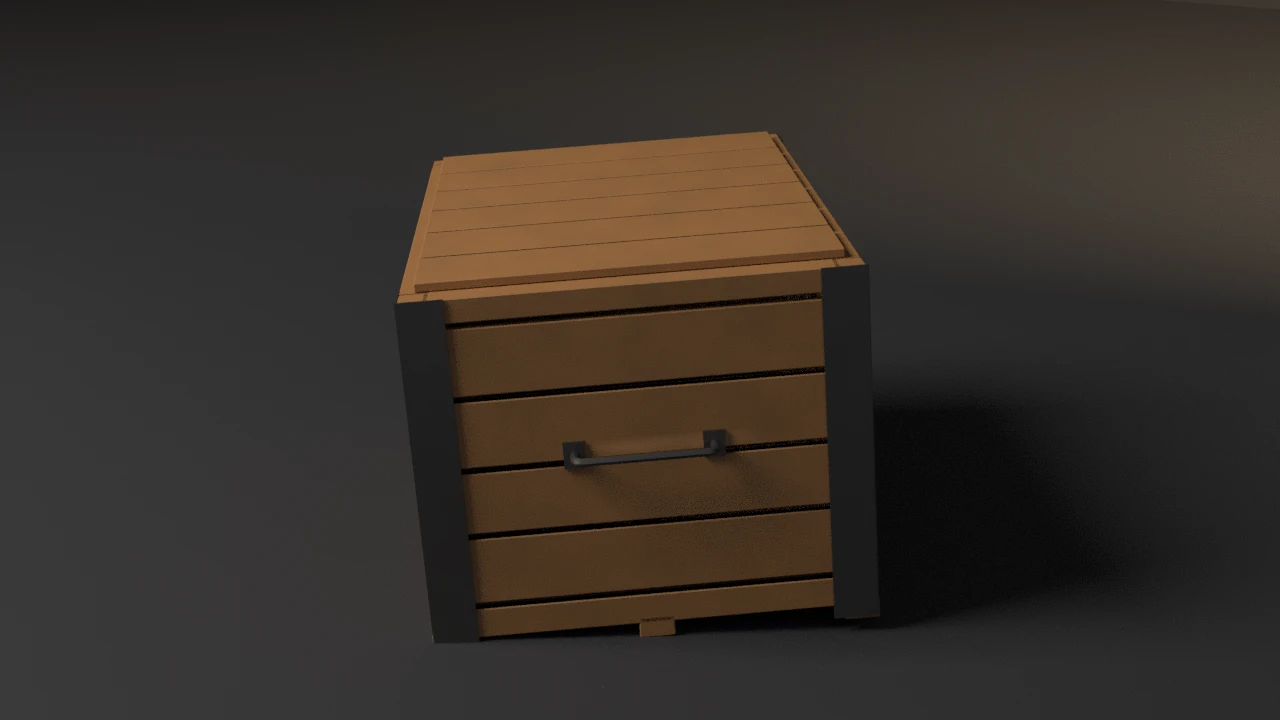
shipping-crate
A procedural shipping crate through UVs, bake, LOD, collider, and Unity glTF, asserting recomputed budgets rather than an API contract.
A procedural mature, open-grown English oak on a grassy mound — a massive, short trunk with broad flutes and deep-furrowed bark plates flaring through seven buttresses into surface roots bedded in the soil, a low fork into five zig-zag scaffold limbs (the low ones reaching out sideways nearly level) that divide three more times, every branch a tapered tube seated inside its parent and narrowing past each junction by its child's area (da Vinci's rule), a domed crown of 295 leaf-mass cushions — a hidden core on each carrier, faceted leaf clusters centred in it shaded as one billow by custom normals, small lobed oak leaves on the outer clusters — dead twigs, acorns (scaly cup and glossy nut) hanging on stalks and lying among leaf litter, twigs and tufts — through UVs, bake, LOD, collider, and Unity glTF, asserting recomputed budgets rather than an API contract.
Rendered headless by the showcase piece itself — click to zoom.
category Nature
blender --background --python showcase/broadleaf-oak/broadleaf_oak.py --
A showcase piece, not an example, and the eighth in the nature category. It builds a procedural game-ready mature, open-grown English oak (Quercus robur), about 9.0 m tall with a broad, domed crown about 11.5 × 11.7 m across, standing on a grassy mound:
Furrow point attribute darkens the furrows in the shader;Every branching draw comes from random.Random(SEED) in plan_tree(), before anything is built: root bearings and reach, scaffold area shares, which segments give off children, each child's share, azimuth and spread, the dead twigs, the acorn clusters and the ground cover. Scaffold bearings start at SCAFFOLD_YAW0 and elevations alternate low and steep round the bole. Per-cushion and per-leaf variety (sizes, jitter, roll, fold, droop, tone) comes from a closed-form hash of indices. No flag draws from the stream, so a falsifier changes only what it names.
Branch lengths are fitted to a crown envelope: a scaffold reaches 0.52–0.66 of the way from its base to an ellipsoid (6.3 × 5.7 m, 3.8 m above and 3.5 m below its centre), a first-order branch 0.66–0.84 and a second-order branch 0.70–0.92 of the way from its junction; twigs are 0.38–0.62 m. Low branches spread outward and high ones climb, so the cushions build a dome rather than five radial arms.
A real oak leaf is 8–12 cm; a closed lobed leaf costs 24 triangles, so the whole budget buys about 2500 of them, and a crown of 2500 leaves reads as a sapling (a first draft here did). The crown is built the way a painter builds one instead: lumpy leaf masses, lit on top and dark underneath, with gaps that show the limbs. Clusters are ten times as much canopy per triangle as leaves.
OakCanopy) breaks it into leaf-sized Voronoi cells, each its own green and each tilting the shading normal its own way, with dark gaps between, so at hero distance a cluster reads as a spray of small leaves.LEAF_WOB). Leaves are 0.24–0.32 m long (about 2.5× real), set on the outer clusters, rising out of them and turned out of them, and give the cushions a leafy fringe and sunlit flecks. A second UV map (LeafUV, not the baked UVMap) draws a pale midrib and lateral veins.69% of the triangles are foliage (45,040 in clusters and cores, 14,832 in leaves). The piece is heavier than pine-tree (86,700 against 45,852): a broadleaf crown is a closed dome of leaf mass, where a conifer's is open tiers of strands.
The bark is grey-brown, cut by long fissures into plates, with moss on the shaded (north, +Y) side of the foot. The pattern follows each tube: a Grain point attribute holds the tube's own tangent, and the shader squeezes object coordinates along it. Wood, soil, acorns and cluster cushions are smooth-shaded; leaves and grass stay faceted; every material boundary is a hard edge. Nine materials: bark, leaf, deadwood, nut, cup, soil (turf), grass, litter, canopy.
It asserts budget conformance of the generated result. It does not witness an API contract. "It rendered without error" is not a check.
Composes skills mesh-editing-and-bmesh, bake-high-to-low, depsgraph-and-evaluated-data, engine-export-presets, and snippets bake_normal_high_to_low.py, setup_bake_target_image.py, lod_chain.py / decimate_to_budget.py, convex_hull_collider.py, export_preset_unity.py (helpers copied inline, not imported).
The collider is the convex hull of the bole alone: a 14-sided frustum from under the soil to the fork and a point over the dome, without flutes, buttresses or roots, because players walk under the crown. The hull is built from points only; handed faces as well, it keeps them alongside its own.
Every budget is declared as a named constant. Every gate recomputes its value from the mesh, materials, UVs, evaluated LOD, collider, or export file.
| Axis | Declared | Measured (5.2.1) |
|---|---|---|
| Base triangles | 86250–87150 | 86700 |
| LOD1 ratio | 0.32–0.62 of base | 0.4995 |
| LOD2 ratio | 0.10–0.35 of base | 0.2167 |
| Materials | exactly 9 distinct; face floors bark ≥7110, leaf ≥14090, deadwood ≥240, nut ≥1480, cup ≥1210, soil ≥2600, grass ≥2730, litter ≥1590, canopy ≥41100 | 9 slots; 7481 / 14832 / 256 / 1566 / 1276 / 2734 / 2880 / 1680 / 43270 |
| UVs | in 0..1, AABB overlap ≤ 1e-5 | in range, overlap 0 |
| Outer AABB | (11.529, 11.716, 8.958) m ± 0.01 | (11.5288, 11.7164, 8.9575), zmin 0 |
| Collider tris (bole hull) | ≤ 60 | 54 |
| Export | written, size > 0, removed after measuring | 10351880 bytes |
DECIMATE COLLAPSE triangle counts are not identical across Blender series, so the LOD gate is a ratio band, not an exact count (4.5.11 and 5.1.2 decimate to 0.5000 / 0.2200). Bake pixels are stochastic, so the bake gate is has_data plus operator FINISHED, not byte-identity. The plan is seeded and nothing else is random; two default runs print identical measurements, and 4.5.11 and 5.1.2 print the same measurements as 5.2.1 apart from the LOD counts (the glTF differs by 20 bytes).
Recomputed from the generated mesh, not asserted about the script.
| Axis | Declared | Measured |
|---|---|---|
| Non-manifold edges | 0 | 0 |
| Loose verts / edges | 0 / 0 | 0 / 0 |
| Doubles merged at 1e-5 | 0 | 0 |
| Zero-area faces | 0 | 0 |
| N-gons | 0 | 0 |
| Coplanar cross-shell face pairs (KD range 0.05 m, plane ε 1e-4) | 0 | 0 |
Grounded: zmin | within 1e-4 of 0 | 0.0000 |
The soil disc's flat underside is the only geometry at Z = 0. Nothing is clamped to the floor plane. Ground cover is kept well inside the disc's rim, so no settled piece overhangs the roll-off.
A tree has no joinery. What makes it read as an oak is that each branch grows out of its parent and is thinner than it, that its foliage is on its branches, that it stands straight in the ground under its crown, and that its acorns hang on stalks and lie in the grass. Each face carries Part, Ident and Parent tags and each tube vertex a Ring tag, so a shell can be named and a tube's rings found; every measurement is then made on the shell's geometry.
| Axis | Declared | Measured |
|---|---|---|
| Branch seat: for each branch, the shallowest vertex of its base cap inside its parent (ray-parity signed depth), over the parent's local radius (the trunk's ring at that height, or the thinner ring of the parent segment its axis meets) | ≥ 0.10, and 155 branches found | 0.1926–0.5438, 155 |
| Taper (da Vinci): at every junction, (parent ring after² + child base²) / parent ring before², with the junction found where the child's first two ring centres meet the parent's axis | 0.94–1.02 | 0.9697–0.9898, 150 junctions |
| Taper: every child's base radius over its parent's ring before the junction | ≤ 0.72 | ≤ 0.6560 |
| Taper at the fork: the five scaffolds' summed base area over the trunk's last ring under them | 0.78–0.90 | 0.8347 |
| Nut seat: each nut's deepest vertex inside its own cup (hanging and fallen) | 0.005–0.013 m, 29 nuts | 0.0090 |
| Trunk plumb: least-squares lean of the level ring centroids from 0.35 m to 2.05 m above the soil | ≤ 1.0° | 0.570° |
| Crown balance: area centroid of the leaves and clusters off the trunk axis at 0.4 m, horizontally | ≤ 0.30 m | 0.2148 m (centroid at 5.32 m) |
| Diameter at breast height (ring nearest 1.3 m above the soil at the axis) | 1.110 m ± 0.020 | 1.1100 |
| Trunk sealed: sectors round its foot (8) holding a trunk vertex ≥ 5 mm under the soil straight above it | 8 of 8 | 8 |
| Roots bedded: each root's vertices outside the trunk binned every 0.25 m by distance from the axis; each bin's most-buried vertex under the soil | ≥ 0.020 m, 7 roots | ≥ 0.0437 |
Cushion on its carrier: each core's carrier (the branch tagged as its Parent), its deepest vertex inside the core | ≥ 0.040 m, 295 cores on 150 carriers | 0.0543–0.1807 |
| Cluster in its cushion: each cluster's centroid (the mean of its points) under its core's skin | ≥ 0.010 m, 2075 clusters | 0.0176–0.1292 |
Leaf in its cluster: each leaf's petiole (its Tip = 0 vertex) inside its own cluster | ≥ 0.010 m, 618 leaves | 0.0195–0.0300 |
| Hanging acorns: each stalk's deepest vertex inside its branch; each pedicel's inside its stalk and inside its cup | stalk ≥ 0.010, pedicel in stalk ≥ 0.002, in cup ≥ 0.006 m; 6 stalks, 17 pedicels | 0.0204 / 0.0037 / 0.0106 |
| Ground cover: most-buried vertex under the soil straight above it, per piece (a fallen cup and nut together) | tufts 0.045–0.080 m, leaves, acorns and sticks 0.003–0.030 m; 108 pieces | tufts 0.0588–0.0647, others 0.0080 |
| Ground cover joined to the soil (union of shells whose BVH trees overlap) | every cover shell in the soil's component | 120 of 120 |
The trunk's two foot rings follow the soil read back by a ray under each vertex, the lowest 45 mm under it; the level rings above start 0.17 m over the soil at the axis and keep a fixed count, so a falsifier that moves the foot keeps the topology. Soil is heaped 0.12 m over the root flare, so a foot set flat from the soil at the axis is open all round.
The plan places every leaf and cluster against the built skin of its host, read by a ray from the host's centre over both splits of each quad, so a jittered lump never leaves a petiole outside it. A first measure of the cluster seat took the deepest vertex of either lump inside the other, and read −0.09 m for clusters that plainly overlapped their flattened core (a thin plate through a ball, neither's vertices inside the other); the centroid depth replaced it.
The branch seat is normalised by the parent's own radius, so a 0.5 m trunk and a 9 mm twig tip are held to the same fraction. With two twigs per second-order branch the share rule first made twigs as wide as their parent (seat −0.048); twigs now take 0.7 of the share.
Each falsifier violates one named budget. Every one was run on 5.2.1 and 4.5.11 and exited its declared code. The envelope and the triangle count were unchanged in every run.
| Flag | Budget violated | Exit |
|---|---|---|
--skip-decimate | LOD1 ratio band (measured 1.0000) | 9 |
--stray-vert | loose vertex count is 0 (measured 1) | 15 |
--lift-z | bounding box zmin is 0 (measured 0.05000) | 16 |
--float-branches | branch seat (every tube starts 1.3 parent radii plus its own radius along its path, or 0.85 of its first segment: shallowest −1.5494) | 17 |
--pop-nuts | nut seat (hanging nuts pushed 35 mm out along the cup's axis: −0.0248 m) | 18 |
--lean-crown | trunk plumb (bole bent x += 0.040 (z − 0.55)² up to 1.95 m above the soil, the crown carried over rigidly: lean 2.908°) | 19 |
--fat-twigs | taper (every twig 1.8× thicker: junction ratio up to 1.7240, a child 1.0413 of its parent) | 20 |
--perch-trunk | trunk sealed (foot rings set from the soil at the axis alone: 0 of 8 sectors) | 21 |
--arch-roots | roots bedded (each root's middle lifted clear of the soil: shallowest station −0.1555 m) | 21 |
--orphan-clump | cushion on its carrier (the cushion on the live twig nearest the crown's centre dropped 0.55 m off it: −0.1063 m) | 22 |
--scatter-clusters | cluster in its cushion (the clusters of cushions inside crown_q 0.70 pushed 0.25 m out along their bearing: −0.1894 m) | 22 |
--shed-leaves | leaf in its cluster (leaves inside crown_q 0.85 slid 0.9 m in toward the crown's centre: −0.8680 m) | 22 |
--drop-acorns | hanging acorns (cups and nuts lowered 60 mm off their pedicels: pedicel in cup −0.0491 m) | 23 |
--float-cover | ground cover (tufts, fallen leaves, fallen acorns and sticks lifted 60 mm: 100 shells not joined, tufts 0.0010–0.0047 m) | 24 |
--float-branches keeps each branch's path, so its tip and everything carried on it stay put; only the tube's first ring moves. --fat-twigs also bursts twigs out of their parents, so the taper (20) is checked before the seat (17) and names the cause. --lean-crown bends only the bole under the fork and carries the crown over rigidly, so the envelope keeps its size. The three foliage falsifiers move only interior cushions, clusters or leaves (and carry what hangs on them), so nothing at the envelope moves; --shed-leaves slides leaves inward because pushed outward the outermost ones grew the envelope 0.11 m and would have exited 8.
blender --background --python broadleaf_oak.py --
blender --background --python broadleaf_oak.py -- --skip-decimate
blender --background --python broadleaf_oak.py -- --stray-vert
blender --background --python broadleaf_oak.py -- --lift-z
blender --background --python broadleaf_oak.py -- --float-branches
blender --background --python broadleaf_oak.py -- --pop-nuts
blender --background --python broadleaf_oak.py -- --lean-crown
blender --background --python broadleaf_oak.py -- --fat-twigs
blender --background --python broadleaf_oak.py -- --perch-trunk
blender --background --python broadleaf_oak.py -- --arch-roots
blender --background --python broadleaf_oak.py -- --orphan-clump
blender --background --python broadleaf_oak.py -- --scatter-clusters
blender --background --python broadleaf_oak.py -- --shed-leaves
blender --background --python broadleaf_oak.py -- --drop-acorns
blender --background --python broadleaf_oak.py -- --float-cover
blender --background --python broadleaf_oak.py -- --output oak.png
Smoke passes no flags.
The hero keeps the tree at HERO_YAW_DEG (0°) and looks at it from the front left, a little below the crown's middle, so the low limbs reach out to both sides under the dome, the fork and the crooked limbs show through the gaps, and the short massive bole, buttresses, roots and mound read below. Framing measures fill x 0.534, y 0.850. A warm wedge pools on the floor behind and to the right and washes the wall above it.
File-local. 9 is a valid check code. 10 is reserved for gallery_framing.check_framing on the --output path. 15–19 are the hygiene, grounded, joint-fit (branch seat), seat-conformance (nut in cup) and plumb family. 20–24 are file-local; 20 is checked before 17. 25 is the asset-quality floor on the render path: check_asset_quality returns 11, which this piece already spends on the collider ceiling, so the call site remaps it.
| Code | Meaning |
|---|---|
| 0 | Success |
| 1 | Uncaught exception (FATAL wrapper) |
| 2 | argparse / usage |
| 3 | Mesh did not build, no UV layer, or not one trunk and one soil shell |
| 4 | Base triangle count outside range |
| 5 | Material count ≠ 9 distinct slots, or a face-count floor missed |
| 6 | UVs outside 0..1 |
| 7 | UV AABB overlap above tolerance |
| 8 | World AABB off declared outer size |
| 9 | LOD ratio band (--skip-decimate lands here) |
| 10 | Framing gate (render path only) |
| 11 | Collider triangle count above ceiling |
| 12 | Bake did not finish or image has no data |
| 13 | Export file missing or empty |
| 14 | --output produced no file |
| 15 | Mesh hygiene: loose, non-manifold, zero-area, doubles, n-gons, coplanar cross-shell pairs |
| 16 | Not grounded: bounding box zmin off 0 |
| 17 | Branch seat: a branch's base cap not inside its parent, or not 155 branches (--float-branches) |
| 18 | Nut seat: a nut out of its depth band in its cup, or not 29 nuts (--pop-nuts) |
| 19 | Trunk plumb, crown balance or breast-height diameter out of band (--lean-crown) |
| 20 | Taper: a junction's area ratio out of band, a child too wide for its parent, or the fork's area ratio out of band (--fat-twigs) |
| 21 | Sealed: the trunk open in a sector round its foot, or a root station not bedded (--perch-trunk, --arch-roots) |
| 22 | Leaf clumps: a cushion's carrier not inside its core, a cluster not centred in its core, or a leaf's petiole not inside its cluster; or not 295 cores, 2075 clusters and 618 leaves (--orphan-clump, --scatter-clusters, --shed-leaves) |
| 23 | Hanging acorns: a stalk not in its branch, a pedicel not in its stalk or its cup (--drop-acorns) |
| 24 | Ground cover: a piece out of its depth band under the soil or not joined to it, or not 108 pieces (--float-cover) |
| 25 | Asset-quality floor (render path only; remapped from 11) |
"""Game-ready English oak — a showcase piece, not an example. Asserts budget conformance of a procedural mature, open-grown English oak (Quercus robur) after composing shipped pipeline pieces: bmesh construction, UVs, nine materials, high-to-low normal bake, LOD chain, convex trunk collider, Unity glTF export. The trunk is one massive lathe from a buttressed, fluted, deeply plated foot bedded in a grassy mound to a low fork. Seven surface roots leave the buttresses and dive into the soil. Five heavy, zig-zag scaffold limbs rise out of the fork, the low ones reaching out sideways nearly level, and divide three more times; every branch is a tapered tube that starts inside its parent, and a parent narrows past each junction by the area of the child it gives off (da Vinci's rule). The crown is built of cushions: on every live branch end, and along the outer part of every branch that carries twigs, a small hidden core holds the carrier, a ring of faceted leaf clusters bites into the core, and the outer clusters carry small lobed oak leaves. Cluster shading follows its cushion (custom normals), so the dome reads as lit billows over dark gaps. A few twigs are dead. Acorns hang on stalks under the crown, and more lie in the grass among fallen leaves, twigs and tufts. Budgets are declared below and recomputed from the generated result. They are not API-contract witnesses. Each falsifier violates one named budget: ``--skip-decimate`` the LOD-ratio band, ``--stray-vert`` mesh hygiene, ``--lift-z`` grounded zmin, ``--float-branches`` every branch seated in its parent, ``--pop-nuts`` every nut seated in its cup, ``--lean-crown`` trunk plumb, ``--fat-twigs`` the taper and area rule, ``--perch-trunk`` / ``--arch-roots`` the trunk and roots sealed in the soil, ``--orphan-clump`` / ``--scatter-clusters`` / ``--shed-leaves`` every cushion on its carrier, every cluster in its core and every leaf in its cluster, ``--drop-acorns`` the hanging acorns on their stalks, ``--float-cover`` the ground cover bedded in the soil. Seeded, not random: ``random.Random(SEED)`` draws the whole plan before anything is built, so flags never shift the stream. DECIMATE COLLAPSE triangle counts are not byte-identical across Blender versions — the LOD gate is a ratio band, not an exact count. blender --background --python broadleaf_oak.py -- blender --background --python broadleaf_oak.py -- --skip-decimate blender --background --python broadleaf_oak.py -- --output oak.png """ import argparse import math import os import random import sys import tempfile import traceback import bmesh import bpy from mathutils import Matrix, Vector from mathutils.bvhtree import BVHTree from mathutils.geometry import intersect_line_line, intersect_ray_tri from mathutils.kdtree import KDTree # Showcase lives at repo-root/showcase/, not under examples/. The framing # helper is the repo's only shared import and lives next to the examples; # resolve the repo root so we do not move gallery_framing.py. _REPO = os.path.abspath( os.path.join(os.path.dirname(os.path.abspath(__file__)), os.pardir, os.pardir) ) sys.path.insert(0, os.path.join(_REPO, "examples")) sys.dont_write_bytecode = True import gallery_framing # noqa: E402 import gallery_asset_quality # noqa: E402 SEED = 1802 TAU = 2.0 * math.pi UP = Vector((0.0, 0.0, 1.0)) # --- Ground ------------------------------------------------------------------ SOIL_A = (4.40, 4.10) # soil disc half-axes before the wobble, m SOIL_N = 36 SOIL_H0 = 0.34 # the mound's crown, at the trunk SOIL_RIM_H = 0.06 # the mound's height where the rim starts to roll off SLOPE = 0.030 # and it rises a little toward the back (+Y), m per m FLARE_HEAP = 0.12 # soil heaped over the root flare round the bole FLARE_HEAP_R = 1.40 SOIL_EDGE = 0.09 # the rim rolls down over this fraction of the radius SOIL_FLOOR = 0.02 # --- Trunk ------------------------------------------------------------------- FORK_Z = 2.15 # the fork, above the soil at the axis TRUNK_R0 = 0.600 # nominal radius at the soil (above the flare) TRUNK_RF = 0.500 # and at the fork TRUNK_SIDES = 84 TRUNK_SIDES_HIGH = 144 COLLIDER_SIDES = 14 FLUTES = 8 # broad flutes round the bole FLUTE_AMP = 0.085 RIDGES = 21 # bark plates between deep furrows RIDGE_AMP = 0.034 FLARE_R = 0.72 # buttress reach at the soil, on a root's bearing FLARE_H = 0.42 FLARE_W = 0.27 # buttress half-width, rad FOOT_OFFS = (-0.045, 0.030) # foot rings, off the soil under each vertex UPPER_Z0 = 0.17 # the first level ring above the soil at the axis UPPER_STEP = 0.15 DOME = ((0.10, 0.94), (0.20, 0.80), (0.29, 0.58), (0.35, 0.30)) # (dz, r factor) SWAY = (0.016, 0.012) # --- Roots ------------------------------------------------------------------- ROOTS = 7 ROOT_SIDES = 8 ROOT_RINGS = 18 ROOT_REACH = (1.90, 2.80) ROOT_R = (0.300, 0.045) # --- Crown ------------------------------------------------------------------- CROWN_C = Vector((0.0, 0.10, 5.20)) # the crown's envelope centre (absolute) CROWN_RX = 6.30 CROWN_RY = 5.70 CROWN_RZ = (3.80, 3.50) # above and below the centre SCAFFOLDS = 5 SCAFFOLD_ELEV = (8.0, 22.0, 38.0, 55.0, 76.0) SCAFFOLD_YAW0 = 190.0 # the first (lowest) scaffold's bearing: the low limbs reach out sideways to the hero SCAFFOLD_AREA = 0.92 # sum of scaffold areas over the trunk's area at the fork SCAFFOLD_F = (0.52, 0.66) # per generation: rings, sides, children, child segments (lo), length # fraction of the envelope, child radius ratio, crook GEN_RINGS = (11, 8, 6, 4) GEN_SIDES = (12, 8, 5, 4) GEN_SIDES_HIGH = (20, 12, 8, 4) GEN_KIDS = (3, 3, 2, 0) GEN_SEG_LO = (2, 1, 1, 0) GEN_F = (None, (0.66, 0.84), (0.70, 0.92), None) GEN_LMIN = (None, 0.90, 0.60, None) KEEP = 0.30 # area a parent keeps for its own tip, past its last child GEN_SHARE = (1.0, 1.0, 0.70) # of the rest, the share its children take (twigs stay thin) GEN_CROOK = (0.30, 0.34, 0.34, 0.24) TWIG_L = (0.38, 0.62) TAPER = 0.10 # natural thinning along a branch, as area R_TIP = 0.008 DEAD_TWIGS = 5 # --- Foliage ------------------------------------------------------------------- # Every live branch end carries a clump: a dark, lumpy leaf-mass core # flattened toward the light, with small lobed leaves set in it. # Half an oak leaf, petiole to apex: (x along, y across) as fractions of # its length, lobe tips and sinuses alternating. LEAF_SIDE = ((0.16, 0.100), (0.29, 0.080), (0.44, 0.180), (0.60, 0.100), (0.77, 0.170)) LEAF_WID = 1.0 LEAF_C = 0.50 # the blade's centre (top and bottom apex), along it LEAF_WOB = 0.08 # per-lobe width jitter; the rim stays star-shaped from LEAF_C LEAF_L = (0.24, 0.32) CORE_R = (0.28, 0.40) # core radius, interior to outer clumps CORE_FLAT = 0.62 # along its axis (out of the crown and up) CORE_JIT = 0.18 BULGE_MIX = 0.60 # a lump's shading normal: out of its cushion, the rest out of the crown CORE_N = 1 # a core is a jittered cube, hidden in its clusters SAT_N = (5, 11) # clusters round a core, interior to outer SAT_R = (0.25, 0.36) SAT_OUT = -0.25 # a cluster's centre this many of its radii outside the core's skin LEAF_P = (0.1, 0.8, 0.5) # leaves per cluster: int(a + b * exposure + c * hash) FILLERS = {0: ((6, 1.00), (8, 0.90)), 1: ((2, 1.00), (4, 0.85), (6, 0.90)), 2: ((2, 0.75), (4, 0.85))} FILLER_RMAX = 0.36 # a filler core is at least this many times as wide as its branch there CORE_SEAT = 0.0 # the carrier's tip this many core radii behind its centre CLUMP_LEAVES = (5, 12) # interior to outer LEAF_DEPTH = 0.030 # a leaf's petiole this far under its core's skin LEAF_LIFT = 1.60 # a blade rises out of the skin this steeply (tan) CLUMP_ZMIN = -0.50 # leaves cover the core from its pole down to this cos # --- Acorns ------------------------------------------------------------------ ACORN_S = 1.00 CUP_PROF = ((0.010, 0.000), (0.026, 0.010), (0.032, 0.024), (0.029, 0.032), (0.014, 0.027)) NUT_PROF = ((0.012, 0.000), (0.024, 0.010), (0.026, 0.030), (0.022, 0.052), (0.013, 0.066), (0.005, 0.074)) NUT_APEX = 0.080 NUT_SEAT = 0.018 # the nut's foot this far along the axis from the cup's base ACORN_SIDES = 8 ACORN_CLUSTERS = 6 STALK_L = (0.17, 0.26) # --- Ground cover -------------------------------------------------------------- TUFTS = 20 LITTER = 70 FALLEN_ACORNS = 12 # fallen twigs: (from, to, radius); a fork is (index of its stick, station, to, radius) STICKS = (((1.75, -1.55), (2.75, -0.85), 0.024), ((-2.55, -0.70), (-1.60, -1.70), 0.020), ((0.55, -2.70), (1.55, -2.95), 0.016), ((-1.30, 2.10), (-0.35, 2.75), 0.018)) STICK_FORKS = ((0, 0.45, (2.05, -0.55), 0.012), (1, 0.55, (-1.70, -1.05), 0.011)) REST_SINK = 0.008 # a lying body's most-buried vertex this far under the soil TUFT_BURY = 0.020 BBOX_TOL = 0.01 # Fitted after locking geometry. Recomputed from bound_box. OUTER_SIZE = (11.529, 11.716, 8.958) BASE_TRIS_MIN = 86250 BASE_TRIS_MAX = 87150 LOD1_RATIO_MIN = 0.32 LOD1_RATIO_MAX = 0.62 LOD2_RATIO_MIN = 0.10 LOD2_RATIO_MAX = 0.35 LOD1_TARGET = 0.50 LOD2_TARGET = 0.22 MATERIAL_COUNT = 9 UV_EPS = 1e-4 UV_OVERLAP_MAX = 1e-5 COLLIDER_TRIS_MAX = 60 BAKE_RES = 512 CAGE_EXTRUSION = 0.01 # face floors: bark, leaf, deadwood, nut, cup, soil, grass, litter, canopy FACE_FLOORS = (7110, 14090, 240, 1480, 1210, 2600, 2730, 1590, 41100) ZMIN_EPS = 1e-4 DOUBLES_EPS = 1e-5 AREA_EPS = 1e-10 COPLANAR_NORMAL_EPS = 1e-4 COPLANAR_PLANE_EPS = 1e-4 COPLANAR_CENTRE_MAX = 0.05 LIFT_Z = 0.05 # Branch seat: every vertex of a branch's base cap inside its parent, the # shallowest at least SEAT_MIN of the parent's local radius under its skin. SEAT_MIN = 0.10 FLOAT_BRANCHES = 1.30 # --float-branches starts each tube this many parent radii out # Taper: at every junction (r_after^2 + r_child^2) / r_before^2 in band, # every child no wider than CHILD_MAX of its parent there; at the fork the # scaffolds' summed area over the trunk's. AREA_BAND = (0.94, 1.02) FORK_BAND = (0.78, 0.90) CHILD_MAX = 0.72 FAT_TWIGS = 1.80 # Nut in cup: the nut's deepest vertex inside its cup. NUT_BITE = (0.005, 0.013) POP_NUTS = 0.035 # Plumb and balance. LEAN_MAX_DEG = 1.0 BALANCE_MAX = 0.30 DBH = 1.110 DBH_TOL = 0.020 LEAN_BEND = 0.040 # --lean-crown bends the bole x += k (z - z0)^2, z0 <= z <= zc LEAN_Z0 = 0.55 # above the soil at the axis LEAN_ZC = 1.95 # Sealed: in each sector round the trunk some trunk vertex SEAL_EPS under the # soil; every root station's most-buried vertex ROOT_BED_MIN under it. SEAL_SECTORS = 8 SEAL_EPS = 0.005 ROOT_STATION = 0.25 ROOT_BED_MIN = 0.020 ARCH_LIFT = 0.060 # Leaf clumps: every core's carrier this deep inside the core, and every # leaf's petiole this deep inside its own core. CORE_BITE_MIN = 0.040 LUMP_BITE_MIN = 0.010 LEAF_BITE_MIN = 0.010 ORPHAN_DROP = 0.55 SHED_Q = 0.85 # --shed-leaves slides in the leaves inside this crown_q SCATTER_Q = 0.70 # --scatter-clusters pushes out the clusters of clumps inside this crown_q SHED_IN = 0.90 SCATTER_OUT = 0.25 # --scatter-clusters pushes those clusters this far out along their bearing # Hanging acorns: stalk in branch, pedicel in stalk and in cup. STALK_BITE_MIN = 0.010 PEDICEL_BITE_MIN = 0.002 CUP_BITE_MIN = 0.006 DROP_ACORNS = 0.060 # Ground cover: most-buried vertex under the soil straight above it. REST_BAND = (0.003, 0.030) TUFT_BAND = (0.045, 0.080) FLOAT_COVER = 0.060 # Hero yaw about Z only (level on the stage). HERO_YAW_DEG = 0.0 WALL_Y = 10.5 CAM_DIST = 29.0 CAM_DZ = -1.2 BARK_IDX = 0 LEAF_IDX = 1 DEAD_IDX = 2 NUT_IDX = 3 CUP_IDX = 4 SOIL_IDX = 5 GRASS_IDX = 6 LITTER_IDX = 7 CANOPY_IDX = 8 MAT_LABELS = ("bark", "leaf", "deadwood", "nut", "cup", "soil", "grass", "litter", "canopy") # part tags, one per face, so the audits can name a shell's role P_TRUNK, P_ROOT, P_LIMB, P_TWIG, P_DEAD, P_LEAF = 1, 2, 3, 4, 5, 6 P_STALK, P_PEDICEL, P_CUP, P_NUT = 7, 8, 9, 10 P_SOIL, P_TUFT, P_LITTER, P_FCUP, P_FNUT, P_STICK = 11, 12, 13, 14, 15, 16 P_CORE = 17 P_LUMP = 18 WOOD_PARTS = (P_TRUNK, P_LIMB, P_TWIG, P_DEAD) BRANCH_PARTS = (P_LIMB, P_TWIG, P_DEAD) TREE_PARTS = (P_TRUNK, P_LIMB, P_TWIG, P_DEAD, P_LEAF, P_CORE, P_LUMP, P_STALK, P_PEDICEL, P_CUP, P_NUT) COVER_PARTS = (P_TUFT, P_LITTER, P_FCUP, P_FNUT, P_STICK) def eevee_engine_id(): return "BLENDER_EEVEE" if bpy.app.version >= (5, 0, 0) else "BLENDER_EEVEE_NEXT" def fail(msg, code): print(f"ERROR: {msg}", file=sys.stderr) return code def triangle_count(mesh): mesh.calc_loop_triangles() return len(mesh.loop_triangles) def evaluated_triangle_count(obj): # Duplicated from snippets/lod_chain.py / decimate_to_budget.py (not a package). depsgraph = bpy.context.evaluated_depsgraph_get() eval_obj = obj.evaluated_get(depsgraph) eval_mesh = eval_obj.to_mesh() try: eval_mesh.calc_loop_triangles() return len(eval_mesh.loop_triangles) finally: eval_obj.to_mesh_clear() def smoothstep(x, lo, hi): t = min(max((x - lo) / (hi - lo), 0.0), 1.0) return t * t * (3.0 - 2.0 * t) def hash01(a, b, c): """A closed-form draw in [0, 1) from three indices: per-part variety that no flag can shift.""" x = math.sin(a * 12.9898 + b * 78.233 + c * 37.719 + SEED * 0.0137) * 43758.5453 return x - math.floor(x) def wrap(a): return (a + math.pi) % TAU - math.pi def hor(v): return Vector((v.x, v.y, 0.0)) def perp(d): s = d.cross(UP) if s.length < 1e-4: s = d.cross(Vector((1.0, 0.0, 0.0))) return s.normalized() # -------------------------------------------------------------------------- # The ground as a function of plan position # -------------------------------------------------------------------------- def disc_wobble(th): return (1.0 + 0.05 * math.sin(3.0 * th + 0.7) + 0.03 * math.sin(5.0 * th + 2.1) + 0.02 * math.sin(8.0 * th + 0.3)) def soil_height(x, y): """A grassy mound, highest round the trunk where the roots have lifted it, rising a little toward the back, with low swells.""" q = min(1.0, (x / SOIL_A[0]) ** 2 + (y / SOIL_A[1]) ** 2) h = (SOIL_RIM_H + (SOIL_H0 - SOIL_RIM_H) * (1.0 - q) ** 1.6 + SLOPE * y + FLARE_HEAP * math.exp(-(x * x + y * y) / FLARE_HEAP_R ** 2) + 0.030 * math.sin(1.1 * x + 0.3) * math.cos(1.4 * y + 0.9) + 0.012 * math.sin(2.7 * x - 2.1 * y + 1.2) + 0.005 * math.sin(6.3 * x + 4.9 * y)) return max(SOIL_FLOOR, h) class Ground: """The built soil, sampled by a ray straight down, so everything seated on it sits on the faces actually shipped (the rim roll-off included).""" def __init__(self, tree): self.tree = tree def hit(self, x, y): loc, nrm, _i, _d = self.tree.ray_cast(Vector((x, y, 5.0)), Vector((0.0, 0.0, -1.0)), 20.0) if loc is None: return Vector((x, y, 0.0)), Vector((0.0, 0.0, 1.0)) if nrm.z < 0.0: nrm = -nrm return loc, nrm def z(self, x, y): return self.hit(x, y)[0].z # -------------------------------------------------------------------------- # Trunk shape # -------------------------------------------------------------------------- def trunk_radius(zrel): t = min(max(zrel / FORK_Z, 0.0), 1.0) return TRUNK_RF + (TRUNK_R0 - TRUNK_RF) * (1.0 - t) ** 1.4 def axis_at(zrel, lean=0.0): """Trunk axis offset at height zrel above the soil: a closed-form sway, zero at the ground.""" x = SWAY[0] * (math.sin(1.1 * zrel + 0.3) - math.sin(0.3)) y = SWAY[1] * (math.sin(0.8 * zrel + 1.9) - math.sin(1.9)) return Vector((x + bend(zrel, lean), y, 0.0)) def bend(zrel, lean): if not lean: return 0.0 return lean * (min(max(zrel, LEAN_Z0), LEAN_ZC) - LEAN_Z0) ** 2 def buttress(a, yaws): return sum(math.exp(-(wrap(a - y) / FLARE_W) ** 2) for y in yaws) def trunk_r(zrel, a, yaws, collider=False): r = trunk_radius(zrel) flare = math.exp(-max(zrel, 0.0) / FLARE_H) r += FLARE_R * flare * (0.18 + 0.82 * min(1.0, buttress(a, yaws))) if not collider: r *= 1.0 + FLUTE_AMP * math.cos(FLUTES * a + 0.35 * math.sin(1.3 * zrel + 0.4)) \ * (0.4 + 0.6 * smoothstep(zrel, 0.0, 0.8)) c2 = math.cos(34.0 * a - 1.3 * math.sin(2.7 * zrel + a)) r *= 1.0 + RIDGE_AMP * (2.0 * bark_plate(zrel, a) - 1.0 + 0.25 * c2) return r def bark_plate(zrel, a): """Rugged plates round the bole: 1 on a plate's broad flat top, 0 down a narrow deep furrow; the furrows wander and fork up the bole.""" c = math.cos(RIDGES * a + 0.9 * math.sin(1.9 * zrel + 2.0 * a) + 0.45 * math.sin(4.3 * zrel - 3.0 * a)) return ((1.0 + c) * 0.5) ** 0.35 # -------------------------------------------------------------------------- # Crown envelope # -------------------------------------------------------------------------- def crown_q(p): d = p - CROWN_C rz = CROWN_RZ[0] if d.z >= 0.0 else CROWN_RZ[1] return math.sqrt((d.x / CROWN_RX) ** 2 + (d.y / CROWN_RY) ** 2 + (d.z / rz) ** 2) def env_dist(p, d): """Distance from ``p`` along unit ``d`` to the crown envelope.""" if crown_q(p) >= 1.0: return 0.0 lo, hi = 0.0, 20.0 for _ in range(40): mid = 0.5 * (lo + hi) if crown_q(p + d * mid) < 1.0: lo = mid else: hi = mid return lo def core_shape(cl): """A clump core's points and triangles: a lumpy cube-sphere ``r`` across, flattened along its axis toward the light. A closed-form hash jitters each point, so the plan knows the built skin exactly.""" dirs, quads = lump_mesh(cl["n"]) a = cl["axis"] e1 = perp(a) e2 = a.cross(e1) r = cl["r"] pts = [] for i, d in enumerate(dirs): j = 1.0 + CORE_JIT * (2.0 * hash01(cl["key"], i, 9) - 1.0) pts.append(cl["c"] + (e1 * (d.x * r) + e2 * (d.y * r) + a * (d.z * r * CORE_FLAT)) * j) tris = [] for q in quads: if len(q) == 3: tris.append(tuple(q)) continue # both diagonals of every quad: the built skin lies between them tris += [(q[0], q[1], q[2]), (q[0], q[2], q[3]), (q[1], q[2], q[3]), (q[3], q[0], q[1])] return pts, tris def core_skin(cl, d): """Distance from a lump's centre along unit ``d`` to its skin (the nearer of either split of each quad).""" best = 9.0 pts = cl["pts"] for tri in cl["tris"]: hit = intersect_ray_tri(pts[tri[0]], pts[tri[1]], pts[tri[2]], d, cl["c"], True) if hit is not None and (hit - cl["c"]).dot(d) > 0.0: best = min(best, (hit - cl["c"]).length) return best def leaf_frame(host, d, lk): """A leaf set in lump ``host`` toward unit ``d``: its petiole LEAF_DEPTH under the lump's built skin, the blade rising out of it and turned out of it, rolled a hashed way and a little to the light.""" c = host["c"] base = c + d * (core_skin(host, d) - LEAF_DEPTH) swing = perp(d) swing = (swing * math.cos(TAU * hash01(lk, 1, 2)) + d.cross(swing) * math.sin(TAU * hash01(lk, 1, 2))) away = d * d.dot(host["axis"]) - host["axis"] tan = (away.normalized() * 0.5 if away.length > 0.2 else Vector()) + swing tan = (tan - d * tan.dot(d)).normalized() e1 = (tan + d * LEAF_LIFT).normalized() e3 = d - e1 * d.dot(e1) e3.normalize() roll = math.radians(70.0) * (hash01(lk, 1, 3) - 0.5) e3 = e3 * math.cos(roll) + e1.cross(e3) * math.sin(roll) e3 = e3 + UP * 0.30 e3 = (e3 - e1 * e3.dot(e1)).normalized() return {"base": base, "d": d, "e1": e1, "e3": e3, "L": LEAF_L[0] + (LEAF_L[1] - LEAF_L[0]) * hash01(lk, 3, 1), "key": lk} # -------------------------------------------------------------------------- # The plan: every seeded draw happens here, before anything is built # -------------------------------------------------------------------------- def frames(pts): """Parallel-transported (tangent, normal, binormal) along a polyline.""" tans = [] for i in range(len(pts)): a = pts[max(i - 1, 0)] b = pts[min(i + 1, len(pts) - 1)] tans.append((b - a).normalized()) ref = Vector((0.0, 0.0, 1.0)) if abs(tans[0].z) < 0.9 else Vector((1.0, 0.0, 0.0)) nrm = (ref - tans[0] * ref.dot(tans[0])).normalized() out = [] for t in tans: nrm = (nrm - t * nrm.dot(t)).normalized() out.append((t, nrm, t.cross(nrm))) return out def branch_path(base, d, L, steps, crook, rise, droop, ph): """A crooked centreline: out along ``d``, lifting early (``rise``) and sagging late (``droop``), kinked side to side and up and down.""" side = perp(d) up2 = side.cross(d).normalized() pts = [base.copy()] p = base.copy() step = L / (steps - 1) for i in range(1, steps): s = (i - 0.5) / (steps - 1) # the oak's zig-zag: each segment kinks the other way from the last alt = (1.0 if i % 2 else -1.0) * (0.55 + 0.45 * hash01(ph * 31.0, i, 5)) alt2 = (1.0 if (i // 2) % 2 else -1.0) * (0.4 + 0.6 * hash01(ph * 31.0, i, 6)) dirv = (d + side * (crook * (0.5 * math.sin(TAU * 1.2 * s + ph) + 0.7 * alt)) + up2 * (crook * (0.4 * math.sin(TAU * 0.9 * s + 2.0 * ph) + 0.35 * alt2)) + UP * (rise * (1.0 - s) - droop * s)) p = p + dirv.normalized() * step pts.append(p) return pts def plan_tree(): rng = random.Random(SEED) def u(a, b): return a + (b - a) * rng.random() soil0 = soil_height(0.0, 0.0) root_yaws = [] a0 = u(0.0, TAU) for k in range(ROOTS): root_yaws.append(a0 + TAU * k / ROOTS + u(-0.22, 0.22)) roots = [{"yaw": y, "reach": u(*ROOT_REACH), "tone": rng.random(), "wig": u(-1.0, 1.0)} for y in root_yaws] branches = [] def new_branch(gen, parent, seg, base, d, L, r0, crook, rise, droop): br = {"id": len(branches) + 1, "gen": gen, "parent": parent, "seg": seg, "tone": rng.random(), "ph": u(0.0, TAU), "dead": False, "kids": []} br["pts"] = branch_path(base, d, L, GEN_RINGS[gen], crook, rise, droop, br["ph"]) br["r0"] = r0 br["L"] = L branches.append(br) return br rf = trunk_radius(FORK_Z) ws = [u(0.7, 1.3) for _ in range(SCAFFOLDS)] # low, long limbs alternate with steep ones round the bole, so the # crown stands balanced over it elevs = [SCAFFOLD_ELEV[i] for i in (0, 3, 1, 4, 2)] yaw0 = math.radians(SCAFFOLD_YAW0) scaff = [] for k in range(SCAFFOLDS): yaw = yaw0 + TAU * k / SCAFFOLDS + u(-0.22, 0.22) e = math.radians(elevs[k] + u(-4.0, 4.0)) d = Vector((math.cos(e) * math.cos(yaw), math.cos(e) * math.sin(yaw), math.sin(e))) r0 = rf * math.sqrt(SCAFFOLD_AREA * ws[k] / sum(ws)) zrel = FORK_Z - 0.30 + 0.20 * (elevs[k] - SCAFFOLD_ELEV[0]) / (SCAFFOLD_ELEV[-1] - SCAFFOLD_ELEV[0]) base = Vector((0.0, 0.0, soil0 + zrel)) + axis_at(zrel) L = u(*SCAFFOLD_F) * env_dist(base, d) low = 1.0 - (elevs[k] - SCAFFOLD_ELEV[0]) / (SCAFFOLD_ELEV[-1] - SCAFFOLD_ELEV[0]) br = new_branch(0, 0, -1, base, d, L, r0, GEN_CROOK[0], 0.16 + 0.22 * (1.0 - low), 0.10 + 0.42 * low) br["zrel"] = zrel scaff.append(br) def radii_of(br, kids): """Ring radii: natural taper as area, less each child's area past its junction; the last ring is the tip.""" n = GEN_RINGS[br["gen"]] r0 = br["r0"] out = [] for j in range(n): a2 = r0 * r0 * (1.0 - TAPER * j / (n - 1)) for seg, rc in kids: if seg < j: a2 -= rc * rc out.append(math.sqrt(max(a2, R_TIP * R_TIP))) out[-1] = R_TIP return out queue = list(scaff) while queue: br = queue.pop(0) g = br["gen"] n = GEN_RINGS[g] nk = GEN_KIDS[g] if nk == 0: br["radii"] = [br["r0"] * (1.0 - (1.0 - R_TIP / br["r0"] * 0.8) * j / (n - 1)) for j in range(n)] continue segs = sorted(rng.sample(range(GEN_SEG_LO[g], n - 2), nk)) # da Vinci: the children share the parent's area, less what it keeps # for its own tip and its natural thinning ws = [u(0.7, 1.3) for _ in segs] share = GEN_SHARE[g] * (1.0 - KEEP - TAPER) * br["r0"] * br["r0"] phi0 = u(0.0, TAU) kids = [(seg, math.sqrt(share * w / sum(ws))) for seg, w in zip(segs, ws)] br["radii"] = radii_of(br, kids) fr = frames(br["pts"]) for m, (seg, rc) in enumerate(kids): c0, c1 = br["pts"][seg], br["pts"][seg + 1] p = c0.lerp(c1, 0.5) t = (c1 - c0).normalized() _t, nn, bb = fr[seg] phi = phi0 + m * 2.40 + u(-0.3, 0.3) w = nn * math.cos(phi) + bb * math.sin(phi) al = math.radians(u(44.0, 68.0)) d = t * math.cos(al) + w * math.sin(al) # out of the crown and up into it: the lower the branch the more # it spreads, the higher the more it climbs hf = min(1.0, max(0.0, (p.z - CROWN_C.z + CROWN_RZ[1]) / (CROWN_RZ[0] + CROWN_RZ[1]))) out_h = hor(p) if out_h.length > 1e-4: d = d + out_h.normalized() * (0.30 - 0.18 * hf) d = (d + UP * (0.10 + 0.35 * hf)).normalized() if d.z < -0.30: d.z = -0.30 d.normalize() cg = g + 1 if cg == 3: L = u(*TWIG_L) rise, droop = 0.10, 0.10 else: L = max(GEN_LMIN[cg], u(*GEN_F[cg]) * env_dist(p, d)) rise, droop = 0.12, 0.18 child = new_branch(cg, br["id"], seg, p, d, L, rc, GEN_CROOK[cg], rise, droop) br["kids"].append(child["id"]) queue.append(child) by_id = {b["id"]: b for b in branches} twigs = [b for b in branches if b["gen"] == 3] # the lowest twigs are dead: shaded out under the crown for b in sorted(twigs, key=lambda b: b["pts"][-1].z)[:DEAD_TWIGS]: b["dead"] = True # clumps: a leaf-mass core on the end of every live branch, flattened # toward the light, with lobed leaves set in it and turned out of it clumps = [] sats = [] leaves = [] carriers = [] stations = [] for b in branches: if b["dead"]: continue pts = b["pts"] stations.append((b, len(pts) - 1, 1.0)) # the lumps of a cushion: more cores along the outer part of every # branch that carries twigs, so the tips' lumps run together for j, f in FILLERS.get(b["gen"], ()): stations.append((b, j, f)) for b, j, rfac in stations: pts = b["pts"] tip = pts[j] t = (pts[j] - pts[j - 1]).normalized() out = tip - CROWN_C out = out.normalized() if out.length > 1e-4 else UP.copy() # exposure: 0 deep in the crown, 1 on its skin ex = min(1.0, max(0.0, (crown_q(tip) - 0.55) / 0.40)) key = b["id"] * 17.0 + j * 0.37 axis = (out * 0.6 + UP + perp(out) * (0.5 * hash01(key, 8, 2) - 0.25)).normalized() r = rfac * (CORE_R[0] + (CORE_R[1] - CORE_R[0]) * ex) * (0.80 + 0.40 * hash01(key, 8, 1)) # a filler round a thick limb is widened to hold it r = max(r, b["radii"][j] / FILLER_RMAX) # a tip's core sits past the tip; a filler's is centred on its ring, # lifted a little above the branch c = tip + t * (CORE_SEAT * r) if j == len(pts) - 1 else tip.copy() cl = {"id": len(clumps), "carrier": b["id"], "c": c, "axis": axis, "r": r, "n": CORE_N, "key": key, "ex": ex, "tone": b["tone"], "sats": []} cl["pts"], cl["tris"] = core_shape(cl) clumps.append(cl) carriers.append(b["id"]) # the cushion: small faceted leaf clusters set round the core, each # biting into it, most on the side out of the crown and up e1a = perp(axis) e2a = axis.cross(e1a) n = max(2, int(round((SAT_N[0] + (SAT_N[1] - SAT_N[0]) * ex) * rfac * rfac))) for i in range(n): sk = key + i + 1.0 z = 1.0 - (1.0 - CLUMP_ZMIN) * (i + 0.5) / n phi = i * 2.39996 + b["ph"] + 0.5 * (hash01(sk, 1, 1) - 0.5) d = (axis * z + (e1a * math.cos(phi) + e2a * math.sin(phi)) * math.sqrt(max(0.0, 1.0 - z * z))).normalized() rs = (SAT_R[0] + (SAT_R[1] - SAT_R[0]) * hash01(sk, 2, 1)) * (0.85 + 0.3 * ex) # its centre SAT_BITE of its radius outside the core's built skin # (read by a ray from the core's centre), so it bites into it sc = c + d * (core_skin(cl, d) + SAT_OUT * rs) sax = (d + UP * 0.6).normalized() sat = {"id": len(sats), "clump": cl["id"], "c": sc, "axis": sax, "r": rs, "n": 0, "key": sk * 3.1, "ex": ex, "tone": b["tone"], "d": d, "leaves": []} sat["pts"], sat["tris"] = core_shape(sat) sats.append(sat) cl["sats"].append(sat) nl = int(LEAF_P[0] + LEAF_P[1] * ex + LEAF_P[2] * hash01(sk, 2, 2)) for m in range(nl): lk = sk * 7.0 + m # out of the cluster, away from the core dl = (d * 1.0 + perp(d) * (1.2 * hash01(lk, 1, 4) - 0.6) + d.cross(perp(d)) * (1.2 * hash01(lk, 1, 5) - 0.6)).normalized() lf = leaf_frame(sat, dl, lk) lf.update({"sat": sat["id"], "carrier": b["id"], "tone": b["tone"], "ex": ex}) sat["leaves"].append(lf) leaves.append(lf) # hanging acorns: under low, outer second-order branches, spread round # the crown cands = [b for b in branches if b["gen"] == 2] picked = [] for k in range(ACORN_CLUSTERS): lo_a = -math.pi + TAU * k / ACORN_CLUSTERS hi_a = lo_a + TAU / ACORN_CLUSTERS pool = [b for b in cands if lo_a <= math.atan2(b["pts"][2].y, b["pts"][2].x) < hi_a and hor(b["pts"][2]).length > 1.6] if pool: picked.append(min(pool, key=lambda b: b["pts"][2].z)) acorns = [] for b in picked: seg = 2 p = b["pts"][seg].lerp(b["pts"][seg + 1], 0.5) n_ac = 2 + (1 if rng.random() < 0.5 else 0) acorns.append({"branch": b["id"], "p": p, "L": u(*STALK_L), "n": n_ac, "spin": u(0.0, TAU), "tone": [rng.random() for _ in range(3)], "sway": u(-1.0, 1.0)}) # ground cover, rejection-sampled on the disc away from the trunk and # the roots def root_clear(x, y, clear): for rt in roots: h = Vector((math.cos(rt["yaw"]), math.sin(rt["yaw"]), 0.0)) q = Vector((x, y, 0.0)) s = max(0.0, min(rt["reach"], q.dot(h))) if (q - h * s).length < clear: return False return True def scatter(count, rlo, rhi, spacing, clear, taken): out = [] tries = 0 while len(out) < count and tries < 20000: tries += 1 a = u(0.0, TAU) r = math.sqrt(u((rlo / rhi) ** 2, 1.0)) * rhi x, y = r * math.cos(a), r * math.sin(a) * SOIL_A[1] / SOIL_A[0] if not root_clear(x, y, clear): continue if any(math.hypot(x - px, y - py) < spacing for px, py, _s in taken + out): continue out.append((x, y, spacing * 0.5)) return out taken = [] tufts = scatter(TUFTS, 1.30, 3.30, 0.46, 0.20, taken) taken += tufts litter = scatter(LITTER, 1.00, 3.20, 0.22, 0.14, []) fallen = scatter(FALLEN_ACORNS, 1.05, 2.90, 0.24, 0.16, taken) cover = { "tufts": [(x, y, u(0.24, 0.46), rng.random(), u(0.0, TAU)) for x, y, _s in tufts], "litter": [(x, y, u(0.0, TAU), u(0.20, 0.27), rng.random(), u(-0.12, 0.12)) for x, y, _s in litter], "fallen": [(x, y, u(0.0, TAU), rng.random(), u(-0.25, 0.25)) for x, y, _s in fallen], "sticks": [rng.random() for _s in STICKS + STICK_FORKS], } return {"soil0": soil0, "roots": roots, "root_yaws": root_yaws, "branches": branches, "by_id": by_id, "leaves": leaves, "clumps": clumps, "sats": sats, "carriers": carriers, "acorns": acorns, "cover": cover} def orphan_clump(plan): """The clump on the live twig whose tip is nearest the crown's centre.""" by_id = plan["by_id"] twig = [cl for cl in plan["clumps"] if by_id[cl["carrier"]]["gen"] == 3] return min(twig, key=lambda cl: (cl["c"] - CROWN_C).length)["id"] # -------------------------------------------------------------------------- # Construction helpers # -------------------------------------------------------------------------- class Builder: """The bmesh plus its layers: Tone (shading variety), Part (the shell's role), Ident and Parent (who is carried by whom), Cap (1 on a tube's base cap, 2 on its end cap), Ring (a tube vertex's ring) and Tip (0 at a leaf's petiole, 1 at its apex).""" def __init__(self, bm): self.bm = bm self.tone = bm.faces.layers.float.new("Tone") self.part = bm.faces.layers.int.new("Part") self.ident = bm.faces.layers.int.new("Ident") self.parent = bm.faces.layers.int.new("Parent") self.cap = bm.faces.layers.int.new("Cap") self.ring = bm.verts.layers.int.new("Ring") self.tip = bm.verts.layers.float.new("Tip") self.grain = bm.verts.layers.float_vector.new("Grain") self.furrow = bm.verts.layers.float.new("Furrow") self.bulge = bm.verts.layers.float_vector.new("Bulge") # the packed UVMap first, so it stays the active (baked, exported) map; # LeafUV runs across (x) and along (y) each leaf for its veins self.uv = bm.loops.layers.uv.new("UVMap") self.luv = bm.loops.layers.uv.new("LeafUV") self.leaf_uv = {} def vert(self, co, ring=-1, tip=0.0, grain=UP, furrow=0.35): v = self.bm.verts.new(co) v[self.ring] = ring v[self.tip] = tip v[self.grain] = grain v[self.furrow] = furrow return v def face(self, verts, mat, tone, part, ident=0, parent=-1, cap=0, smooth=None): f = self.bm.faces.new(verts) f.material_index = mat f[self.tone] = tone f[self.part] = part f[self.ident] = ident f[self.parent] = parent f[self.cap] = cap if smooth is not None: f.smooth = smooth return f def add_tube(B, pts, radii, sides, mat, tone, part, ident=0, parent=-1, phase=0.0, jag=None, squash=1.0): """Capped round bar swept along a polyline with a radius per point. ``jag``: per-vertex (radial factor, axial offset) for the last ring.""" pts = [Vector(p) for p in pts] rings = [] for idx, (p, (t, n, b)) in enumerate(zip(pts, frames(pts))): ring = [] for k in range(sides): a = phase + TAU * k / sides r = radii[idx] off = Vector((0.0, 0.0, 0.0)) if jag is not None and idx == len(pts) - 1: r *= jag[k % len(jag)][0] off = t * jag[k % len(jag)][1] ring.append(B.vert(p + off + r * (n * (squash * math.cos(a)) + b * math.sin(a)), ring=idx, grain=t)) rings.append(ring) for r0, r1 in zip(rings, rings[1:]): for k in range(sides): m = (k + 1) % sides B.face((r0[k], r0[m], r1[m], r1[k]), mat, tone, part, ident, parent) B.face(tuple(reversed(rings[0])), mat, tone, part, ident, parent, cap=1) B.face(tuple(rings[-1]), mat, tone, part, ident, parent, cap=2) return [v for ring in rings for v in ring] def lathe(B, origin, axis, prof, sides, spin, mat, tone, part, ident, parent, apex=None): """Closed body of revolution from ``origin`` along ``axis``: profile (r, h) rings, an n-gon base, and an n-gon top or an apex point.""" axis = axis.normalized() ref = Vector((0.0, 0.0, 1.0)) if abs(axis.z) < 0.9 else Vector((1.0, 0.0, 0.0)) e1 = axis.cross(ref).normalized() e2 = axis.cross(e1) rings = [] for k, (r, h) in enumerate(prof): ring = [] for j in range(sides): a = spin + TAU * j / sides ring.append(B.vert(origin + axis * (h * ACORN_S) + (r * ACORN_S) * (e1 * math.cos(a) + e2 * math.sin(a)))) rings.append(ring) verts = [v for r in rings for v in r] for r0, r1 in zip(rings, rings[1:]): for j in range(sides): m = (j + 1) % sides B.face((r0[j], r0[m], r1[m], r1[j]), mat, tone, part, ident, parent) B.face(tuple(reversed(rings[0])), mat, tone, part, ident, parent, cap=1) if apex is None: B.face(tuple(rings[-1]), mat, tone, part, ident, parent, cap=2) else: top = B.vert(origin + axis * (apex * ACORN_S)) verts.append(top) for j in range(sides): m = (j + 1) % sides B.face((rings[-1][j], rings[-1][m], top), mat, tone, part, ident, parent, cap=2) return verts def zipper(A, M, xa, xm): """Triangles between a rim run ``A`` and a midrib run ``M`` that share their first and last vertex, advancing whichever is behind in x.""" tris = [(A[0], A[1], M[1])] i, j = 1, 1 na, nm = len(A) - 2, len(M) - 2 while i < na or j < nm: if j >= nm or (i < na and xa[i + 1] <= xm[j + 1]): tris.append((A[i], A[i + 1], M[j])) i += 1 else: tris.append((A[i], M[j + 1], M[j])) j += 1 tris.append((A[na], A[na + 1], M[nm])) return tris def add_leaf(B, base, e1, e3, L, tone, part, parent, key, mat, droop=0.10, fold=0.22, bottom=0.006, ident=0): """A lobed oak leaf: one closed, thin shell of 24 triangles. The rim (petiole, three lobes a side, the terminal lobe) is fanned to a top and a bottom centre over the same point of the blade, so every rim edge has one face above and one below and the two never cross. The blade folds up from its midrib and droops toward its apex.""" e2 = e3.cross(e1) wob = [1.0 + LEAF_WOB * (2.0 * hash01(key, 7, k) - 1.0) for k in range(10)] def P(x, y, lift=0.0): return base + e1 * (x * L) + e2 * (y * L) + e3 * ((fold * abs(y) - droop * x * x + lift) * L) ymax = max(y for _x, y in LEAF_SIDE) * LEAF_WID vb = B.vert(base, tip=0.0) va = B.vert(P(1.0, 0.0), tip=1.0) B.leaf_uv[vb] = (0.5, 0.0) B.leaf_uv[va] = (0.5, 1.0) sides = [] for sg, off in ((1.0, 0), (-1.0, 5)): run = [] for k, (x, y) in enumerate(LEAF_SIDE): yy = sg * y * LEAF_WID * wob[k + off] v = B.vert(P(x, yy), tip=x) B.leaf_uv[v] = (0.5 + 0.5 * yy / ymax, x) run.append(v) sides.append(run) rim = [vb] + sides[0] + [va] + list(reversed(sides[1])) top = B.vert(P(LEAF_C, 0.0, 0.014), tip=LEAF_C) bot = B.vert(P(LEAF_C, 0.0, -bottom), tip=LEAF_C) B.leaf_uv[top] = (0.5, LEAF_C) B.leaf_uv[bot] = (0.5, LEAF_C) faces = [] n = len(rim) for k in range(n): a, b = rim[k], rim[(k + 1) % n] faces.append(B.face((a, b, top), mat, tone, part, ident, parent, smooth=False)) faces.append(B.face((b, a, bot), mat, tone, part, ident, parent, smooth=False)) for f in faces: for loop in f.loops: loop[B.luv].uv = B.leaf_uv.get(loop.vert, (0.5, 0.5)) return rim + [top, bot] def add_core(B, cl, shift, tone, ident, parent, part, mass_c): """A leaf-mass lump: one closed, jittered cube-sphere ``r`` across and flattened along its axis toward the light, from its planned points.""" _dirs, quads = lump_mesh(cl["n"]) verts = [] for p in cl["pts"]: v = B.vert(p + shift) a = p - mass_c b = p - CROWN_C v[B.bulge] = (a.normalized() * BULGE_MIX + b.normalized() * (1.0 - BULGE_MIX)).normalized() verts.append(v) for q in quads: B.face([verts[i] for i in q], CANOPY_IDX, tone, part, ident, parent) return verts _CUBE = {} def cube_sphere(n): """Unit directions on a warped cube-sphere lattice and its quads.""" if n in _CUBE: return _CUBE[n] index = {} dirs = [] def vid(i, j, k): key = (i, j, k) if key not in index: q = [math.tan(math.pi / 4.0 * (2.0 * c / n - 1.0)) for c in key] index[key] = len(dirs) dirs.append(Vector(q).normalized()) return index[key] quads = [] for ax in range(3): b, c = (ax + 1) % 3, (ax + 2) % 3 for side in (0, n): for uu in range(n): for vv in range(n): corners = [] for du, dv in ((0, 0), (1, 0), (1, 1), (0, 1)): key = [0, 0, 0] key[ax] = side key[b] = uu + du key[c] = vv + dv corners.append(vid(*key)) quads.append(corners if side else corners[::-1]) _CUBE[n] = (dirs, quads) return _CUBE[n] _ICO = [] def icosahedron(): """Unit directions of an icosahedron's 12 points and its 20 triangles, wound outward.""" if _ICO: return _ICO[0] g = (1.0 + math.sqrt(5.0)) / 2.0 raw = [(-1, g, 0), (1, g, 0), (-1, -g, 0), (1, -g, 0), (0, -1, g), (0, 1, g), (0, -1, -g), (0, 1, -g), (g, 0, -1), (g, 0, 1), (-g, 0, -1), (-g, 0, 1)] dirs = [Vector(p).normalized() for p in raw] faces = [(0, 11, 5), (0, 5, 1), (0, 1, 7), (0, 7, 10), (0, 10, 11), (1, 5, 9), (5, 11, 4), (11, 10, 2), (10, 7, 6), (7, 1, 8), (3, 9, 4), (3, 4, 2), (3, 2, 6), (3, 6, 8), (3, 8, 9), (4, 9, 5), (2, 4, 11), (6, 2, 10), (8, 6, 7), (9, 8, 1)] _ICO.append((dirs, faces)) return _ICO[0] def lump_mesh(n): """A lump's unit directions and faces: an icosahedron (``n`` = 0) or a cube-sphere ``n`` quads a side.""" return icosahedron() if n == 0 else cube_sphere(n) def add_tuft(B, G, x, y, h, tone, yaw, key, lift): """A grass tuft: one closed shell. A small squat core buried in the soil has every facet split in two, and each half drawn out into one tapered blade — up and splaying from the upper facets, a short spur into the soil from the lower ones.""" c = Vector((x, y, G.z(x, y) - TUFT_BURY + lift)) dirs, quads = cube_sphere(2) rot = Matrix.Rotation(yaw, 3, "Z") core = [] for i, d in enumerate(dirs): s = 1.0 + 0.25 * (hash01(key, i, 1) - 0.5) core.append(B.vert(c + rot @ Vector((d.x * 0.034, d.y * 0.034, d.z * 0.024)) * s)) verts = list(core) def blade(corners, k): ctr = sum((v.co for v in corners), Vector()) / 3.0 o = (ctr - c).normalized() if o.z > -0.25: sc = Vector((hash01(key, k, 3) - 0.5, hash01(key, k, 4) - 0.5, 0.0)) * 1.1 d = (o * 0.70 + UP * 1.0 + sc).normalized() ln = h * (0.45 + 0.55 * hash01(key, k, 6)) else: d = o ln = 0.025 apex = B.vert(ctr + d * ln, tip=1.0) verts.append(apex) for e in range(3): B.face((corners[e], corners[(e + 1) % 3], apex), GRASS_IDX, tone, P_TUFT, int(key), -1, smooth=False) for k, q in enumerate(quads): o = k % 2 qv = [core[i] for i in q] blade((qv[o], qv[o + 1], qv[(o + 2) % 4]), 2 * k) blade((qv[o], qv[(o + 2) % 4], qv[(o + 3) % 4]), 2 * k + 1) return verts def settle(verts, G, sink): """Drop a lying body so its most-buried vertex is ``sink`` under the soil.""" lift = min(v.co.z - G.z(v.co.x, v.co.y) for v in verts) for v in verts: v.co.z -= lift + sink def add_soil(B): """A soil disc: a squircle-mapped grid whose rim rolls down to a flat base at Z = 0, each cell split on its short diagonal.""" n = SOIL_N grid = [] for i in range(n + 1): col = [] for k in range(n + 1): uu = -1.0 + 2.0 * i / n vv = -1.0 + 2.0 * k / n X = uu * math.sqrt(1.0 - vv * vv / 2.0) Y = vv * math.sqrt(1.0 - uu * uu / 2.0) r = min(1.0, math.hypot(X, Y)) wob = disc_wobble(math.atan2(Y, X)) x = SOIL_A[0] * X * wob y = SOIL_A[1] * Y * wob on_rim = i in (0, n) or k in (0, n) z = 0.0 if on_rim else soil_height(x, y) * smoothstep(1.0 - r, 0.0, SOIL_EDGE) col.append(B.vert((x, y, z))) grid.append(col) for i in range(n): for k in range(n): a, b, c, d = grid[i][k], grid[i + 1][k], grid[i + 1][k + 1], grid[i][k + 1] tris = ((a, b, c), (a, c, d)) if (a.co - c.co).length <= (b.co - d.co).length \ else ((a, b, d), (b, c, d)) for tri in tris: B.face(tri, SOIL_IDX, 0.5, P_SOIL) rim = ([grid[i][0] for i in range(n)] + [grid[n][k] for k in range(n)] + [grid[i][n] for i in range(n, 0, -1)] + [grid[0][k] for k in range(n, 0, -1)]) B.face(list(reversed(rim)), SOIL_IDX, 0.5, P_SOIL) def trunk_levels(): """Level ring heights (above the soil at the axis): a fixed count, so a falsifier that moves the foot keeps the topology.""" n_up = int(math.ceil((FORK_Z - UPPER_Z0) / UPPER_STEP)) zs = [UPPER_Z0 + (FORK_Z - UPPER_Z0) * i / n_up for i in range(n_up + 1)] return zs def add_trunk(B, plan, G, sides, lean, perch, collider=False): """One lathe from the bedded foot to a dome over the fork. The foot rings follow the soil under each vertex (``perch``: from the soil at the axis alone, which leaves the downhill side open).""" soil0 = G.z(0.0, 0.0) yaws = plan["root_yaws"] angles = [TAU * j / sides for j in range(sides)] grid = [] for off in FOOT_OFFS: ring = [] for a in angles: r = trunk_r(0.0, a, yaws, collider) x, y = r * math.cos(a), r * math.sin(a) z = (soil0 if perch else G.z(x, y)) + off ring.append(Vector((x, y, z))) grid.append(ring) for zrel in trunk_levels(): c = axis_at(zrel, lean) ring = [] for a in angles: r = trunk_r(zrel, a, yaws, collider) ring.append(Vector((c.x + r * math.cos(a), c.y + r * math.sin(a), soil0 + zrel))) grid.append(ring) for dz, f in DOME: zrel = FORK_Z + dz c = axis_at(zrel, lean) ring = [] for a in angles: r = trunk_r(FORK_Z, a, yaws, collider) * f ring.append(Vector((c.x + r * math.cos(a), c.y + r * math.sin(a), soil0 + zrel))) grid.append(ring) zrels = [0.0] * len(FOOT_OFFS) + trunk_levels() + [FORK_Z] * len(DOME) verts = [[B.vert(p, ring=i, furrow=1.0 - bark_plate(zrels[i], a)) for p, a in zip(ring, angles)] for i, ring in enumerate(grid)] for r0, r1 in zip(verts, verts[1:]): for j in range(sides): m = (j + 1) % sides B.face((r0[j], r0[m], r1[m], r1[j]), BARK_IDX, 0.2, P_TRUNK, 0) B.face(tuple(reversed(verts[0])), BARK_IDX, 0.2, P_TRUNK, 0, cap=1) B.face(tuple(verts[-1]), BARK_IDX, 0.2, P_TRUNK, 0, cap=2) return [v for ring in verts for v in ring] def add_roots(B, plan, G, arch): """Surface roots: from inside a buttress, out along the soil and down into it; ``arch`` lifts the middle of each clear of the ground.""" for k, rt in enumerate(plan["roots"]): h = Vector((math.cos(rt["yaw"]), math.sin(rt["yaw"]), 0.0)) s = Vector((-h.y, h.x, 0.0)) reach = rt["reach"] pts, radii = [], [] for i in range(ROOT_RINGS): t = i / (ROOT_RINGS - 1) q = h * (0.22 + (reach - 0.22) * t) + s * (0.10 * rt["wig"] * math.sin(math.pi * t)) r = ROOT_R[0] + (ROOT_R[1] - ROOT_R[0]) * t ** 0.8 dz = 0.22 * (1.0 - t) ** 3 + 0.36 * r - 0.06 * t * t if arch: dz += (r + ARCH_LIFT) * math.sin(math.pi * min(1.0, max(0.0, (t - 0.30) / 0.45))) ** 2 pts.append(Vector((q.x, q.y, G.z(q.x, q.y) + dz))) radii.append(r) # a surface root is wider than it is deep add_tube(B, pts, radii, ROOT_SIDES, BARK_IDX, 0.3 + 0.4 * rt["tone"], P_ROOT, 900 + k, squash=0.70) def build_tree(B, plan, G, detail, flags, tree_verts): lean = LEAN_BEND if flags["lean_crown"] else 0.0 by_id = plan["by_id"] orphan = orphan_clump(plan) if flags["orphan_clump"] else None for br in plan["branches"]: g = br["gen"] sides = (GEN_SIDES_HIGH if detail == "high" else GEN_SIDES)[g] pts = [p.copy() for p in br["pts"]] radii = list(br["radii"]) if g == 3 and flags["fat_twigs"]: radii = [r * FAT_TWIGS for r in radii] if flags["float_branches"]: # the tube starts outside its parent; the path, and so the tip # and everything hung on it, is unchanged if br["parent"] == 0: r_p = trunk_radius(br["zrel"]) else: par = by_id[br["parent"]] r_p = par["radii"][br["seg"]] d0 = (pts[1] - pts[0]) k = min(0.85 * d0.length, FLOAT_BRANCHES * r_p + radii[0]) pts[0] = pts[0] + d0.normalized() * k dead = br["dead"] jag = None if dead: jag = [(0.85, 0.010), (1.0, -0.006), (0.70, 0.016), (0.95, -0.008), (0.80, 0.012)] part = P_DEAD if dead else (P_TWIG if g == 3 else P_LIMB) tone = 0.35 + 0.5 * br["tone"] tree_verts += add_tube(B, pts, radii, sides, DEAD_IDX if dead else BARK_IDX, tone, part, br["id"], br["parent"], phase=br["ph"], jag=jag) for cl in plan["clumps"]: shift = -UP * ORPHAN_DROP if cl["id"] == orphan else Vector() cid = 20000 + cl["id"] high = min(1.0, max(0.0, (cl["c"].z - CROWN_C.z + CROWN_RZ[1]) / (CROWN_RZ[0] + CROWN_RZ[1]))) # outer and higher lumps and leaves are lighter; the crown's heart # is shaded tone = min(1.0, 0.10 + 0.45 * cl["ex"] + 0.25 * high + 0.15 * cl["tone"]) tree_verts += add_core(B, cl, shift, tone, cid, cl["carrier"], P_CORE, cl["c"]) shed = flags["shed_leaves"] for sat in cl["sats"]: sid_ = 40000 + sat["id"] stone = min(1.0, tone + 0.25 * (hash01(sat["key"], 4, 2) - 0.4) + 0.15 * sat["d"].z) # --scatter-clusters: an interior cushion's clusters (and their # leaves) pushed out of its core sshift = shift + (sat["d"] * SCATTER_OUT if flags["scatter_clusters"] and crown_q(cl["c"]) < SCATTER_Q else Vector()) tree_verts += add_core(B, sat, sshift, max(0.0, stone), sid_, cid, P_LUMP, cl["c"]) for lf in sat["leaves"]: base = lf["base"] + sshift if shed and crown_q(base) < SHED_Q: # --shed-leaves: an inner leaf slid in toward the crown's # centre, clear through and out of its cluster base = base + (CROWN_C - base).normalized() * SHED_IN ltone = min(1.0, 0.05 + 0.30 * hash01(lf["key"], 4, 1) + 0.35 * lf["ex"] + 0.25 * high + 0.05 * lf["tone"]) tree_verts += add_leaf(B, base, lf["e1"], lf["e3"], lf["L"], ltone, P_LEAF, sid_, lf["key"], LEAF_IDX, droop=0.06 + 0.10 * hash01(lf["key"], 5, 1), fold=0.12 + 0.16 * hash01(lf["key"], 5, 2)) # hanging acorns: a stalk from inside the branch, two or three pedicels # from inside its end, a cup on each and a nut seated in each cup sid = 3000 aid = 4000 for ac in plan["acorns"]: br = by_id[ac["branch"]] p = ac["p"] out = hor(p).normalized() L = ac["L"] spts = [p, p - UP * (0.35 * L) + out * (0.04 * ac["sway"]), p - UP * (0.70 * L) + out * (0.07 * ac["sway"] + 0.02), p - UP * L + out * 0.05] tree_verts += add_tube(B, spts, [0.010, 0.0095, 0.009, 0.0088], 5, BARK_IDX, 0.6, P_STALK, sid, br["id"]) end = spts[-1] axis_s = (spts[-1] - spts[-2]).normalized() for m in range(ac["n"]): a = ac["spin"] + TAU * m / ac["n"] side = perp(axis_s) * math.cos(a) + perp(axis_s).cross(axis_s) * math.sin(a) hang = (side * 0.75 - UP * 0.65).normalized() cup0 = end + hang * (0.050 + 0.008 * m) ax = (hang * 0.35 - UP).normalized() ppts = [end - axis_s * 0.010, end + hang * 0.025, cup0 + ax * (0.010 * ACORN_S)] tree_verts += add_tube(B, ppts, [0.0042, 0.0040, 0.0038], 4, BARK_IDX, 0.6, P_PEDICEL, aid, sid) drop = -UP * DROP_ACORNS if flags["drop_acorns"] else Vector() nut0 = cup0 + ax * (NUT_SEAT * ACORN_S) if flags["pop_nuts"]: nut0 = nut0 + ax * POP_NUTS tone = ac["tone"][m] tree_verts += lathe(B, cup0 + drop, ax, CUP_PROF, ACORN_SIDES, a, CUP_IDX, tone, P_CUP, aid, sid) tree_verts += lathe(B, nut0 + drop, ax, NUT_PROF, ACORN_SIDES, a + 0.3, NUT_IDX, tone, P_NUT, aid, sid, apex=NUT_APEX) aid += 1 sid += 1 if lean: soil0 = plan["soil0"] # the bole bends; the crown above it is carried over rigidly, so the # envelope keeps its size and only the plumb budget can see it for v in tree_verts: v.co.x += bend(v.co.z - soil0, lean) def build_cover(B, plan, G, flags): cov = plan["cover"] lift = FLOAT_COVER if flags["float_cover"] else 0.0 for k, (x, y, h, tone, yaw) in enumerate(cov["tufts"]): add_tuft(B, G, x, y, h, tone, yaw, 5000 + k, lift) for k, (x, y, yaw, L, tone, tilt) in enumerate(cov["litter"]): c, nrm = G.hit(x, y) e1 = Vector((math.cos(yaw), math.sin(yaw), 0.0)) e1 = (e1 - nrm * e1.dot(nrm)).normalized() # a leaf never lies dead flat: it rolls a few degrees about its midrib e3 = (nrm * math.cos(tilt) + nrm.cross(e1) * math.sin(tilt)).normalized() base = c - e1 * (0.45 * L) + e3 * 0.002 vs = add_leaf(B, base, e1, e3, L, tone, P_LITTER, -1, 6000.0 + k, LITTER_IDX, droop=-0.16, fold=0.30, bottom=0.012) # bed it: the most-buried vertex REST_SINK under the soil settle(vs, G, REST_SINK - lift) for k, (x, y, yaw, tone, tilt) in enumerate(cov["fallen"]): c, nrm = G.hit(x, y) ax = Vector((math.cos(yaw), math.sin(yaw), tilt)).normalized() cup0 = c + UP * 0.05 - ax * (0.045 * ACORN_S) vs = lathe(B, cup0, ax, CUP_PROF, ACORN_SIDES, yaw, CUP_IDX, tone, P_FCUP, 7000 + k, -1) vs += lathe(B, cup0 + ax * (NUT_SEAT * ACORN_S), ax, NUT_PROF, ACORN_SIDES, yaw + 0.3, NUT_IDX, tone, P_FNUT, 7000 + k, -1, apex=NUT_APEX) settle(vs, G, REST_SINK - lift) def stick_path(a, b, r, tone): pts = [] for i in range(6): t = i / 5.0 p = a.lerp(b, t) side = Vector((-(b - a).y, (b - a).x, 0.0)).normalized() p += side * (0.03 * math.sin(2.8 * t * math.pi + tone * 6.0)) pts.append(Vector((p.x, p.y, G.z(p.x, p.y) + r * 0.6))) return pts tones = cov["sticks"] paths = [] for k, ((ax_, ay), (bx, by), r) in enumerate(STICKS): pts = stick_path(Vector((ax_, ay, 0.0)), Vector((bx, by, 0.0)), r, tones[k]) paths.append(pts) vs = add_tube(B, pts, [r * (1.0 - 0.45 * i / 5.0) for i in range(6)], 5, DEAD_IDX, 0.4 + 0.4 * tones[k], P_STICK, 8000 + k) settle(vs, G, REST_SINK - lift) # a side twig forks off two of the sticks, from inside them for m, (si, st, (bx, by), r) in enumerate(STICK_FORKS): k = len(STICKS) + m src = paths[si] x = st * 5.0 j = int(x) p0 = src[j].lerp(src[j + 1], x - j) pts = stick_path(Vector((p0.x, p0.y, 0.0)), Vector((bx, by, 0.0)), r, tones[k]) vs = add_tube(B, pts, [r * (1.0 - 0.5 * i / 5.0) for i in range(6)], 5, DEAD_IDX, 0.4 + 0.4 * tones[k], P_STICK, 8000 + k) settle(vs, G, REST_SINK - lift) def build_oak_mesh(name, plan, detail="low", **flags): bm = bmesh.new() try: B = Builder(bm) add_soil(B) # a temp tree for ray casts needs face normals first bm.normal_update() G = Ground(BVHTree.FromBMesh(bm)) sides = TRUNK_SIDES_HIGH if detail == "high" else TRUNK_SIDES add_trunk(B, plan, G, sides, LEAN_BEND if flags["lean_crown"] else 0.0, flags["perch_trunk"]) add_roots(B, plan, G, flags["arch_roots"]) build_tree(B, plan, G, detail, flags, []) build_cover(B, plan, G, flags) triangulate_ngons(bm) pack_uvs(bm) bmesh.ops.recalc_face_normals(bm, faces=list(bm.faces)) # Wood, soil, acorns and clump cores are smooth-shaded (their facets # carry in the silhouette); leaves and grass stay faceted, and every material # boundary is a hard edge. soft = {BARK_IDX, DEAD_IDX, SOIL_IDX, NUT_IDX, CUP_IDX, CANOPY_IDX} for face in bm.faces: if face.material_index in soft: face.smooth = True for edge in bm.edges: mats = {f.material_index for f in edge.link_faces} if len(mats) > 1 or not edge.is_manifold or len(edge.link_faces) != 2: edge.smooth = False elif mats <= soft: edge.smooth = edge.calc_face_angle() < math.radians(62.0) else: edge.smooth = False me = bpy.data.meshes.new(name) bm.to_mesh(me) me.update() me.uv_layers.active = me.uv_layers["UVMap"] me.uv_layers["UVMap"].active_render = True finally: bm.free() mass_normals(me) obj = bpy.data.objects.new(name, me) bpy.context.collection.objects.link(obj) return obj def mass_normals(me): """Leaf-mass lumps shade as part of their cushion, not as balls of their own: every canopy corner takes the vertex's Bulge (out of the cushion's centre and out of the crown) as a custom normal. Every other corner keeps the normal it has. Bulge is dropped once used.""" n_loops = len(me.loops) normals = [0.0] * (3 * n_loops) me.corner_normals.foreach_get("vector", normals) bulge = [0.0] * (3 * len(me.vertices)) me.attributes["Bulge"].data.foreach_get("vector", bulge) loop_vert = [0] * n_loops me.loops.foreach_get("vertex_index", loop_vert) for poly in me.polygons: if poly.material_index != CANOPY_IDX: continue for li in poly.loop_indices: vi = loop_vert[li] normals[3 * li:3 * li + 3] = bulge[3 * vi:3 * vi + 3] me.normals_split_custom_set([normals[3 * i:3 * i + 3] for i in range(n_loops)]) me.attributes.remove(me.attributes["Bulge"]) def add_collider_trunk(B, G): """A frustum from under the soil to the fork and a point over the dome: the bole's girth without its flutes, buttresses or ridges.""" soil0 = G.z(0.0, 0.0) rings = [(-0.10, TRUNK_R0 + 0.24), (FORK_Z, TRUNK_RF)] verts = [] for zrel, r in rings: c = axis_at(max(zrel, 0.0)) verts.append([B.vert(Vector((c.x + r * math.cos(TAU * j / COLLIDER_SIDES), c.y + r * math.sin(TAU * j / COLLIDER_SIDES), soil0 + zrel))) for j in range(COLLIDER_SIDES)]) B.vert(axis_at(FORK_Z) + Vector((0.0, 0.0, soil0 + FORK_Z + DOME[-1][0]))) def build_collider_source(name, plan): """The trunk alone, without flutes or ridges: players walk under the crown.""" bm = bmesh.new() try: soil = bmesh.new() try: add_soil(Builder(soil)) soil.normal_update() G = Ground(BVHTree.FromBMesh(soil)) add_collider_trunk(Builder(bm), G) finally: soil.free() triangulate_ngons(bm) me = bpy.data.meshes.new(name) bm.to_mesh(me) me.update() finally: bm.free() obj = bpy.data.objects.new(name, me) bpy.context.collection.objects.link(obj) return obj def triangulate_ngons(bm): bm.faces.index_update() faces = sorted((f for f in bm.faces if len(f.verts) > 4), key=lambda f: f.index) if faces: bmesh.ops.triangulate(bm, faces=faces) def pack_uvs(bm, margin=0.08): uv = bm.loops.layers.uv.get("UVMap") or bm.loops.layers.uv.new("UVMap") faces = list(bm.faces) n = len(faces) cols = max(1, math.ceil(math.sqrt(n))) rows = max(1, math.ceil(n / cols)) cell_w = 1.0 / cols cell_h = 1.0 / rows pad_u = margin * cell_w * 0.5 pad_v = margin * cell_h * 0.5 usable_w = cell_w - 2.0 * pad_u usable_h = cell_h - 2.0 * pad_v for i, face in enumerate(faces): col = i % cols row = i // cols nrm = face.normal ax, ay, az = abs(nrm.x), abs(nrm.y), abs(nrm.z) coords = [] for loop in face.loops: co = loop.vert.co if az >= ax and az >= ay: coords.append((co.x, co.y)) elif ax >= ay: coords.append((co.y, co.z)) else: coords.append((co.x, co.z)) xs = [c[0] for c in coords] ys = [c[1] for c in coords] minx, maxx = min(xs), max(xs) miny, maxy = min(ys), max(ys) dx = max(maxx - minx, 1e-8) dy = max(maxy - miny, 1e-8) origin_u = col * cell_w + pad_u origin_v = row * cell_h + pad_v for loop, (x, y) in zip(face.loops, coords): loop[uv].uv = ( origin_u + (x - minx) / dx * usable_w, origin_v + (y - miny) / dy * usable_h, ) # -------------------------------------------------------------------------- # Materials # -------------------------------------------------------------------------- def enabled_socket(sockets, name): """The one enabled socket called ``name`` (Mix / Map Range carry one per data type under one name; identifiers changed in 5.2).""" for sock in sockets: if sock.name == name and sock.enabled: return sock return sockets[name] def surface(name): mat = bpy.data.materials.new(name) mat.use_nodes = True nt = mat.node_tree bsdf = nt.nodes["Principled BSDF"] bsdf.inputs["Metallic"].default_value = 0.0 coord = nt.nodes.new("ShaderNodeTexCoord").outputs["Object"] return mat, nt, bsdf, coord def mapping(nt, vec, scale=(1.0, 1.0, 1.0), rot=(0.0, 0.0, 0.0)): node = nt.nodes.new("ShaderNodeMapping") node.inputs["Scale"].default_value = scale node.inputs["Rotation"].default_value = rot nt.links.new(vec, node.inputs["Vector"]) return node.outputs["Vector"] def noise(nt, vec, scale, detail, roughness): node = nt.nodes.new("ShaderNodeTexNoise") node.inputs["Scale"].default_value = scale node.inputs["Detail"].default_value = detail node.inputs["Roughness"].default_value = roughness nt.links.new(vec, node.inputs["Vector"]) return node.outputs["Fac"] def voronoi_edge(nt, vec, scale): node = nt.nodes.new("ShaderNodeTexVoronoi") node.feature = "DISTANCE_TO_EDGE" node.inputs["Scale"].default_value = scale nt.links.new(vec, node.inputs["Vector"]) return node.outputs["Distance"] def ramp(nt, fac, stops): node = nt.nodes.new("ShaderNodeValToRGB") els = node.color_ramp.elements els[0].position = stops[0][0] els[0].color = (*stops[0][1], 1.0) els[1].position = stops[-1][0] els[1].color = (*stops[-1][1], 1.0) for pos, rgb in stops[1:-1]: els.new(pos).color = (*rgb, 1.0) nt.links.new(fac, node.inputs["Fac"]) return node.outputs["Color"] def remap(nt, value, from_lo, from_hi, to_lo, to_hi): node = nt.nodes.new("ShaderNodeMapRange") nt.links.new(value, enabled_socket(node.inputs, "Value")) enabled_socket(node.inputs, "From Min").default_value = from_lo enabled_socket(node.inputs, "From Max").default_value = from_hi enabled_socket(node.inputs, "To Min").default_value = to_lo enabled_socket(node.inputs, "To Max").default_value = to_hi return enabled_socket(node.outputs, "Result") def math_node(nt, op, a, b): node = nt.nodes.new("ShaderNodeMath") node.operation = op for i, value in enumerate((a, b)): if isinstance(value, (int, float)): node.inputs[i].default_value = value else: nt.links.new(value, node.inputs[i]) return node.outputs[0] def mix_color(nt, a, b, fac): node = nt.nodes.new("ShaderNodeMix") node.data_type = "RGBA" if isinstance(fac, (int, float)): enabled_socket(node.inputs, "Factor").default_value = fac else: nt.links.new(fac, enabled_socket(node.inputs, "Factor")) for nm, value in (("A", a), ("B", b)): sock = enabled_socket(node.inputs, nm) if isinstance(value, tuple): sock.default_value = (*value, 1.0) else: nt.links.new(value, sock) return enabled_socket(node.outputs, "Result") def attr(nt, name): node = nt.nodes.new("ShaderNodeAttribute") node.attribute_type = "GEOMETRY" node.attribute_name = name return node.outputs["Fac"] def normal_xyz(nt): geo = nt.nodes.new("ShaderNodeNewGeometry") sep = nt.nodes.new("ShaderNodeSeparateXYZ") nt.links.new(geo.outputs["Normal"], sep.inputs["Vector"]) return sep.outputs def coord_z(nt, coord): sep = nt.nodes.new("ShaderNodeSeparateXYZ") nt.links.new(coord, sep.inputs["Vector"]) return sep.outputs["Z"] def add_bump(nt, bsdf, height, strength, distance): bump = nt.nodes.new("ShaderNodeBump") bump.inputs["Strength"].default_value = strength bump.inputs["Distance"].default_value = distance nt.links.new(height, bump.inputs["Height"]) nt.links.new(bump.outputs["Normal"], bsdf.inputs["Normal"]) def along(nt, coord, across, length): """Object coordinates scaled by ``across`` everywhere except along the Grain vector, which is scaled by ``length``: p*A + g (p.g) (L - A).""" g = nt.nodes.new("ShaderNodeAttribute") g.attribute_type = "GEOMETRY" g.attribute_name = "Grain" dot = nt.nodes.new("ShaderNodeVectorMath") dot.operation = "DOT_PRODUCT" nt.links.new(coord, dot.inputs[0]) nt.links.new(g.outputs["Vector"], dot.inputs[1]) k = math_node(nt, "MULTIPLY", dot.outputs["Value"], length - across) sg = nt.nodes.new("ShaderNodeVectorMath") sg.operation = "SCALE" nt.links.new(g.outputs["Vector"], sg.inputs[0]) nt.links.new(k, sg.inputs["Scale"]) sp = nt.nodes.new("ShaderNodeVectorMath") sp.operation = "SCALE" nt.links.new(coord, sp.inputs[0]) sp.inputs["Scale"].default_value = across add = nt.nodes.new("ShaderNodeVectorMath") add.operation = "ADD" nt.links.new(sp.outputs["Vector"], add.inputs[0]) nt.links.new(sg.outputs["Vector"], add.inputs[1]) return add.outputs["Vector"] def bark_material(): mat, nt, bsdf, coord = surface("OakBark") # Oak bark: grey-brown ridges cut into long blocks by deep vertical # fissures. Voronoi cells stretched up the stem give the blocks; their # edges are the fissures. Moss greens the foot on the shaded (north, +Y) # side and on upward faces. # the pattern runs along each tube: object coordinates squeezed along # the Grain point attribute (the tube's own tangent; up the trunk) ridge = noise(nt, along(nt, coord, 24.0, 1.4), 1.0, 4.0, 0.55) cells = voronoi_edge(nt, along(nt, coord, 13.0, 1.7), 1.0) grain = noise(nt, along(nt, coord, 30.0, 7.0), 1.0, 6.0, 0.6) fiss = math_node(nt, "MINIMUM", remap(nt, cells, 0.0, 0.035, 0.30, 1.0), remap(nt, ridge, 0.40, 0.53, 0.0, 1.0)) col = ramp(nt, grain, ((0.25, (0.050, 0.044, 0.037)), (0.55, (0.112, 0.098, 0.082)), (0.85, (0.180, 0.160, 0.135)))) col = mix_color(nt, (0.018, 0.014, 0.011), col, fiss) # the bole's own furrows (Furrow: 0 on a plate, 1 down a furrow) dark # and deep between the grey plates furrow = attr(nt, "Furrow") col = mix_color(nt, col, (0.012, 0.010, 0.008), remap(nt, furrow, 0.30, 0.85, 0.0, 0.92)) tone = attr(nt, "Tone") col = mix_color(nt, col, (0.070, 0.055, 0.040), remap(nt, tone, 0.0, 1.0, 0.0, 0.35)) nx = normal_xyz(nt) patch = noise(nt, coord, 3.5, 4.0, 0.6) low = remap(nt, coord_z(nt, coord), 0.55, 1.45, 1.0, 0.0) face = remap(nt, nx["Y"], 0.05, 0.75, 0.0, 1.0) moss_m = math_node(nt, "MULTIPLY", math_node(nt, "MULTIPLY", low, face), remap(nt, patch, 0.38, 0.58, 0.0, 1.0)) moss = ramp(nt, grain, ((0.3, (0.030, 0.055, 0.012)), (0.8, (0.075, 0.115, 0.022)))) col = mix_color(nt, col, moss, math_node(nt, "MINIMUM", moss_m, 0.9)) nt.links.new(col, bsdf.inputs["Base Color"]) bsdf.inputs["Roughness"].default_value = 0.9 add_bump(nt, bsdf, math_node(nt, "SUBTRACT", math_node(nt, "ADD", fiss, math_node(nt, "MULTIPLY", grain, 0.3)), furrow), 0.9, 0.03) return mat def leaf_material(): mat, nt, bsdf, coord = surface("OakLeaf") # Deep oak green: each leaf takes its own tone (lighter outside and # high, shaded in the crown's heart); a pale midrib and lateral veins # run from LeafUV; the upper faces carry a faint sheen. tone = attr(nt, "Tone") base = ramp(nt, tone, ((0.0, (0.016, 0.038, 0.010)), (0.45, (0.040, 0.085, 0.018)), (1.0, (0.095, 0.160, 0.032)))) speck = noise(nt, coord, 40.0, 3.0, 0.6) col = mix_color(nt, base, (0.030, 0.055, 0.012), remap(nt, speck, 0.3, 0.7, 0.0, 0.35)) luv = nt.nodes.new("ShaderNodeUVMap") luv.uv_map = "LeafUV" sep = nt.nodes.new("ShaderNodeSeparateXYZ") nt.links.new(luv.outputs["UV"], sep.inputs["Vector"]) across = math_node(nt, "ABSOLUTE", math_node(nt, "SUBTRACT", sep.outputs["X"], 0.5), 0.0) mid = remap(nt, across, 0.0, 0.035, 1.0, 0.0) lat = math_node(nt, "SINE", math_node(nt, "MULTIPLY", math_node(nt, "SUBTRACT", sep.outputs["Y"], math_node(nt, "MULTIPLY", across, 1.1)), TAU * 4.5), 0.0) vein = math_node(nt, "MAXIMUM", mid, remap(nt, lat, 0.82, 1.0, 0.0, 0.55)) col = mix_color(nt, col, (0.120, 0.170, 0.050), math_node(nt, "MULTIPLY", vein, 0.55)) nt.links.new(col, bsdf.inputs["Base Color"]) bsdf.inputs["Roughness"].default_value = 0.62 bsdf.inputs["Specular IOR Level"].default_value = 0.20 add_bump(nt, bsdf, vein, 0.25, 0.01) return mat def deadwood_material(): mat, nt, bsdf, coord = surface("OakDeadwood") # Weathered, barkless: silver-grey with dark checks along the grain. streak = noise(nt, along(nt, coord, 30.0, 4.0), 2.0, 6.0, 0.6) col = ramp(nt, streak, ((0.35, (0.065, 0.058, 0.052)), (0.55, (0.170, 0.160, 0.142)), (0.80, (0.260, 0.245, 0.220)))) nt.links.new(col, bsdf.inputs["Base Color"]) bsdf.inputs["Roughness"].default_value = 0.85 return mat def nut_material(): mat, nt, bsdf, coord = surface("AcornNut") # A glossy nut, green-brown to chestnut, with faint streaks down it. tone = attr(nt, "Tone") base = ramp(nt, tone, ((0.0, (0.120, 0.090, 0.030)), (0.5, (0.200, 0.120, 0.040)), (1.0, (0.240, 0.140, 0.050)))) streak = noise(nt, mapping(nt, coord, scale=(90.0, 90.0, 12.0)), 1.0, 3.0, 0.5) col = mix_color(nt, base, (0.090, 0.055, 0.020), remap(nt, streak, 0.45, 0.7, 0.0, 0.5)) nt.links.new(col, bsdf.inputs["Base Color"]) bsdf.inputs["Roughness"].default_value = 0.32 return mat def cup_material(): mat, nt, bsdf, coord = surface("AcornCup") # A scaly grey-brown cupule: small overlapping scales from Voronoi cells. cells = voronoi_edge(nt, coord, 160.0) col = ramp(nt, remap(nt, cells, 0.0, 0.25, 0.0, 1.0), ((0.0, (0.035, 0.028, 0.020)), (0.6, (0.120, 0.100, 0.070)), (1.0, (0.170, 0.145, 0.105)))) nt.links.new(col, bsdf.inputs["Base Color"]) bsdf.inputs["Roughness"].default_value = 0.85 add_bump(nt, bsdf, cells, 0.8, 0.01) return mat def soil_material(): mat, nt, bsdf, coord = surface("OakTurf") # Dark soil under a short sward: green on the upward faces broken by # bare earth, and a fringe of fine grass streaks. dirt = noise(nt, coord, 6.0, 6.0, 0.6) earth = ramp(nt, dirt, ((0.30, (0.020, 0.014, 0.010)), (0.70, (0.050, 0.036, 0.024)))) sward = noise(nt, coord, 2.2, 5.0, 0.62) fine = noise(nt, mapping(nt, coord, scale=(140.0, 140.0, 20.0)), 1.0, 2.0, 0.5) grass = ramp(nt, fine, ((0.30, (0.022, 0.042, 0.010)), (0.70, (0.060, 0.098, 0.022)))) nx = normal_xyz(nt) mask = math_node(nt, "MULTIPLY", remap(nt, sward, 0.36, 0.52, 0.0, 1.0), remap(nt, nx["Z"], 0.5, 0.9, 0.0, 1.0)) col = mix_color(nt, earth, grass, mask) # last year's leaves drift thick under the crown near the bole: leaf- # sized cells, each its own brown, thinning out into the grass lit = nt.nodes.new("ShaderNodeTexVoronoi") lit.inputs["Scale"].default_value = 9.0 nt.links.new(noise_warp(nt, coord), lit.inputs["Vector"]) lcell = nt.nodes.new("ShaderNodeSeparateColor") nt.links.new(lit.outputs["Color"], lcell.inputs["Color"]) brown = ramp(nt, lcell.outputs[0], ((0.0, (0.045, 0.026, 0.012)), (0.5, (0.110, 0.066, 0.028)), (0.8, (0.095, 0.078, 0.034)), (1.0, (0.150, 0.098, 0.044)))) sep = nt.nodes.new("ShaderNodeSeparateXYZ") nt.links.new(coord, sep.inputs["Vector"]) rad = math_node(nt, "SQRT", math_node(nt, "ADD", math_node(nt, "MULTIPLY", sep.outputs["X"], sep.outputs["X"]), math_node(nt, "MULTIPLY", sep.outputs["Y"], sep.outputs["Y"])), 0.0) drift = math_node(nt, "MULTIPLY", remap(nt, rad, 1.0, 3.2, 1.0, 0.0), remap(nt, noise(nt, coord, 1.6, 3.0, 0.6), 0.30, 0.60, 0.35, 1.0)) drift = math_node(nt, "MULTIPLY", drift, remap(nt, lcell.outputs[1], 0.15, 0.35, 0.0, 1.0)) col = mix_color(nt, col, brown, drift) nt.links.new(col, bsdf.inputs["Base Color"]) bsdf.inputs["Roughness"].default_value = 0.93 add_bump(nt, bsdf, math_node(nt, "ADD", math_node(nt, "ADD", dirt, math_node(nt, "MULTIPLY", fine, 0.5)), math_node(nt, "MULTIPLY", drift, 0.4)), 0.4, 0.02) return mat def grass_material(): mat, nt, bsdf, coord = surface("OakGrass") tone = attr(nt, "Tone") base = ramp(nt, tone, ((0.0, (0.030, 0.060, 0.012)), (1.0, (0.070, 0.115, 0.025)))) tip = attr(nt, "Tip") col = mix_color(nt, (0.012, 0.022, 0.006), base, remap(nt, tip, 0.0, 0.5, 0.2, 1.0)) col = mix_color(nt, col, (0.130, 0.140, 0.055), remap(nt, tip, 0.6, 1.0, 0.0, 0.5)) nt.links.new(col, bsdf.inputs["Base Color"]) bsdf.inputs["Roughness"].default_value = 0.7 return mat def litter_material(): mat, nt, bsdf, coord = surface("OakLitter") # Last year's leaves: dull brown to olive, darker where they are rotting. tone = attr(nt, "Tone") base = ramp(nt, tone, ((0.0, (0.040, 0.026, 0.014)), (0.5, (0.078, 0.048, 0.022)), (0.8, (0.070, 0.060, 0.028)), (1.0, (0.100, 0.065, 0.030)))) blot = noise(nt, coord, 25.0, 3.0, 0.6) col = mix_color(nt, base, (0.030, 0.022, 0.014), remap(nt, blot, 0.55, 0.75, 0.0, 0.6)) nt.links.new(col, bsdf.inputs["Base Color"]) bsdf.inputs["Roughness"].default_value = 0.8 return mat def canopy_material(): mat, nt, bsdf, coord = surface("OakCanopy") # The leaf mass inside a clump: small leaf-sized cells, each its own # green, with dark gaps between them; darker in the crown's heart and # on the clump's underside, lighter where it faces the sky. tone = attr(nt, "Tone") # leaf-sized cells, each its own green and each turned its own way (a # hashed tilt of the shading normal per cell), with dark gaps between wv = noise_warp(nt, coord) vor = nt.nodes.new("ShaderNodeTexVoronoi") vor.inputs["Scale"].default_value = 18.0 vor.inputs["Randomness"].default_value = 1.0 nt.links.new(wv, vor.inputs["Vector"]) cell = nt.nodes.new("ShaderNodeSeparateColor") nt.links.new(vor.outputs["Color"], cell.inputs["Color"]) gap = remap(nt, voronoi_edge(nt, wv, 18.0), 0.0, 0.07, 1.0, 0.0) patch = noise(nt, coord, 3.0, 3.0, 0.6) fac = math_node(nt, "ADD", math_node(nt, "MULTIPLY", tone, 0.60), math_node(nt, "ADD", math_node(nt, "MULTIPLY", cell.outputs[0], 0.28), remap(nt, patch, 0.35, 0.65, -0.10, 0.12))) col = ramp(nt, fac, ((0.0, (0.006, 0.015, 0.004)), (0.40, (0.018, 0.042, 0.009)), (0.75, (0.040, 0.080, 0.016)), (1.0, (0.075, 0.125, 0.026)))) col = mix_color(nt, col, (0.003, 0.007, 0.002), math_node(nt, "MULTIPLY", gap, 0.8)) # the lit top of a lump against its dark underside, and dark crevices # where lumps crowd each other nx = normal_xyz(nt) sky = remap(nt, nx["Z"], -0.6, 0.8, 0.25, 1.0) ao = nt.nodes.new("ShaderNodeAmbientOcclusion") ao.inputs["Distance"].default_value = 0.6 shade = math_node(nt, "MULTIPLY", sky, remap(nt, ao.outputs["AO"], 0.2, 1.0, 0.25, 1.0)) col = mix_color(nt, (0.002, 0.005, 0.002), col, shade) nt.links.new(col, bsdf.inputs["Base Color"]) bsdf.inputs["Roughness"].default_value = 0.85 bsdf.inputs["Specular IOR Level"].default_value = 0.10 tilt = nt.nodes.new("ShaderNodeVectorMath") tilt.operation = "MULTIPLY_ADD" nt.links.new(vor.outputs["Color"], tilt.inputs[0]) tilt.inputs[1].default_value = (1.2, 1.2, 1.2) tilt.inputs[2].default_value = (-0.6, -0.6, -0.6) geo = nt.nodes.new("ShaderNodeNewGeometry") nsum = nt.nodes.new("ShaderNodeVectorMath") nsum.operation = "ADD" nt.links.new(tilt.outputs["Vector"], nsum.inputs[0]) nt.links.new(geo.outputs["Normal"], nsum.inputs[1]) nrm = nt.nodes.new("ShaderNodeVectorMath") nrm.operation = "NORMALIZE" nt.links.new(nsum.outputs["Vector"], nrm.inputs[0]) nt.links.new(nrm.outputs["Vector"], bsdf.inputs["Normal"]) return mat def noise_warp(nt, coord): """Object coordinates nudged by a low noise, so leaf cells are not laid out on a lattice.""" node = nt.nodes.new("ShaderNodeTexNoise") node.inputs["Scale"].default_value = 2.0 node.inputs["Detail"].default_value = 2.0 nt.links.new(coord, node.inputs["Vector"]) add = nt.nodes.new("ShaderNodeVectorMath") add.operation = "MULTIPLY_ADD" nt.links.new(node.outputs["Color"], add.inputs[0]) add.inputs[1].default_value = (0.15, 0.15, 0.15) nt.links.new(coord, add.inputs[2]) return add.outputs["Vector"] def oak_materials(): """(bark, leaf, deadwood, nut, cup, soil, grass, litter, canopy): shared by the check and the render.""" return (bark_material(), leaf_material(), deadwood_material(), nut_material(), cup_material(), soil_material(), grass_material(), litter_material(), canopy_material()) def assign_slots(obj, wanted): # Do not materials.clear() — that resets polygon material_index to 0. mats = obj.data.materials for i, mat in enumerate(wanted): if i < len(mats): mats[i] = mat else: mats.append(mat) # -------------------------------------------------------------------------- # Audits # -------------------------------------------------------------------------- def world_bbox(obj): corners = [obj.matrix_world @ Vector(c) for c in obj.bound_box] xs = [c.x for c in corners] ys = [c.y for c in corners] zs = [c.z for c in corners] return (min(xs), min(ys), min(zs), max(xs), max(ys), max(zs)) def uv_stats(mesh): uv = mesh.uv_layers.active if uv is None: return 0.0, 0.0, 1.0, 1.0, 0, 1.0 data = uv.data us = [loop.uv[0] for loop in data] vs = [loop.uv[1] for loop in data] aabbs = [] for poly in mesh.polygons: pu = [data[i].uv[0] for i in poly.loop_indices] pv = [data[i].uv[1] for i in poly.loop_indices] aabbs.append((min(pu), min(pv), max(pu), max(pv))) aabbs.sort() overlap = 0.0 for i, a in enumerate(aabbs): for j in range(i + 1, len(aabbs)): b = aabbs[j] if b[0] >= a[2]: break if b[1] >= a[3] or a[1] >= b[3]: continue x0 = max(a[0], b[0]) y0 = max(a[1], b[1]) x1 = min(a[2], b[2]) y1 = min(a[3], b[3]) overlap += max(0.0, x1 - x0) * max(0.0, y1 - y0) return min(us), min(vs), max(us), max(vs), overlap, len(aabbs) def face_area(me, poly): vs = [me.vertices[i].co for i in poly.vertices] if len(vs) < 3: return 0.0 v0 = vs[0] area = 0.0 for i in range(1, len(vs) - 1): area += (vs[i] - v0).cross(vs[i + 1] - v0).length * 0.5 return area def hygiene_audit(me): # Combinatorics match examples/mesh-hygiene-audit.audit (copied, not imported). ngons = sum(1 for p in me.polygons if len(p.vertices) > 4) zero_area = sum(1 for p in me.polygons if face_area(me, p) <= AREA_EPS) bm = bmesh.new() try: bm.from_mesh(me) loose_v = sum(1 for v in bm.verts if len(v.link_edges) == 0) loose_e = sum(1 for e in bm.edges if len(e.link_faces) == 0) nonman = sum(1 for e in bm.edges if not e.is_manifold) ret = bmesh.ops.find_doubles(bm, verts=list(bm.verts), dist=DOUBLES_EPS) doubles = len(ret.get("targetmap") or {}) finally: bm.free() return {"ngons": ngons, "loose_v": loose_v, "loose_e": loose_e, "nonman": nonman, "zero_area": zero_area, "doubles": doubles} def shells(me): neighbors = [[] for _ in range(len(me.vertices))] for edge in me.edges: a, b = edge.vertices neighbors[a].append(b) neighbors[b].append(a) seen = [False] * len(me.vertices) groups = [] for start in range(len(me.vertices)): if seen[start]: continue seen[start] = True stack = [start] group = [] while stack: cur = stack.pop() group.append(cur) for nxt in neighbors[cur]: if not seen[nxt]: seen[nxt] = True stack.append(nxt) groups.append(group) return groups def zfight_pairs(me, groups): """Coplanar face pairs from *different shells* (copied from showcase/grindstone).""" owner = {} for si, g in enumerate(groups): for vi in g: owner[vi] = si faces = [(p.normal.copy(), p.center.copy(), owner.get(p.vertices[0], -1)) for p in me.polygons] kd = KDTree(len(faces)) for i, (_n, c, _s) in enumerate(faces): kd.insert(c, i) kd.balance() hits = 0 for i, (ni, ci, si) in enumerate(faces): for _co, j, _d in kd.find_range(ci, COPLANAR_CENTRE_MAX): if j <= i: continue nj, cj, sj = faces[j] if si == sj: continue if abs(abs(ni.dot(nj)) - 1.0) > COPLANAR_NORMAL_EPS: continue if abs(ni.dot(cj - ci)) > COPLANAR_PLANE_EPS: continue hits += 1 return hits def face_ints(me, name): vals = [0] * len(me.polygons) me.attributes[name].data.foreach_get("value", vals) return vals def vert_vals(me, name, kind=int): vals = [kind(0)] * len(me.vertices) me.attributes[name].data.foreach_get("value", vals) return vals class Shell: def __init__(self, me, verts, polys, part_of, ident_of, parent_of): self.verts = verts pts = [me.vertices[i].co.copy() for i in verts] self.pts = pts self.lo = Vector((min(p.x for p in pts), min(p.y for p in pts), min(p.z for p in pts))) self.hi = Vector((max(p.x for p in pts), max(p.y for p in pts), max(p.z for p in pts))) parts = {} for p in polys: parts[part_of[p.index]] = parts.get(part_of[p.index], 0) + 1 self.part = max(parts, key=parts.get) if parts else 0 self.ident = ident_of[polys[0].index] if polys else -1 self.parent = parent_of[polys[0].index] if polys else -1 remap_ = {vi: n for n, vi in enumerate(verts)} self.tree = BVHTree.FromPolygons( [tuple(p) for p in pts], [[remap_[v] for v in p.vertices] for p in polys]) self.polys = polys def holds(self, q, pad=0.0): return (self.lo.x - pad <= q.x <= self.hi.x + pad and self.lo.y - pad <= q.y <= self.hi.y + pad and self.lo.z - pad <= q.z <= self.hi.z + pad) class TrunkAxis: """Trunk ring centroids read off the mesh: every level lathe ring shares one z (the foot rings follow the soil and are left out).""" def __init__(self, trunk): rings = {} for p in trunk.pts: rings.setdefault(round(p.z, 5), []).append(p) full = max(len(v) for v in rings.values()) self.rings = [] for z in sorted(rings): ps = rings[z] if len(ps) != full: continue c = sum(ps, Vector()) / len(ps) r = sum(((q - c).to_2d().length for q in ps)) / len(ps) self.rings.append((z, c, r)) def radius(self, z): rs = self.rings if z <= rs[0][0]: return rs[0][2] for (z0, _c0, r0), (z1, _c1, r1) in zip(rs, rs[1:]): if z <= z1: return r0 + (r1 - r0) * (z - z0) / (z1 - z0) return rs[-1][2] def centre(self, z): rs = self.rings if z <= rs[0][0]: return rs[0][1].copy() for (z0, c0, _r0), (z1, c1, _r1) in zip(rs, rs[1:]): if z <= z1: return c0.lerp(c1, (z - z0) / (z1 - z0)) return rs[-1][1].copy() def classify(me): groups = shells(me) owner = [0] * len(me.vertices) for si, g in enumerate(groups): for vi in g: owner[vi] = si polys = [[] for _ in groups] for p in me.polygons: polys[owner[p.vertices[0]]].append(p) part_of = face_ints(me, "Part") ident_of = face_ints(me, "Ident") parent_of = face_ints(me, "Parent") cap_of = face_ints(me, "Cap") parts = [Shell(me, g, polys[i], part_of, ident_of, parent_of) for i, g in enumerate(groups)] out = {"all": parts, "groups": groups, "cap_of": cap_of} def of(*kinds): return [s for s in parts if s.part in kinds] for key, kinds in (("trunk", (P_TRUNK,)), ("roots", (P_ROOT,)), ("branches", BRANCH_PARTS), ("leaves", (P_LEAF,)), ("cores", (P_CORE,)), ("lumps", (P_LUMP,)), ("stalks", (P_STALK,)), ("pedicels", (P_PEDICEL,)), ("cups", (P_CUP,)), ("nuts", (P_NUT,)), ("soil", (P_SOIL,)), ("cover", COVER_PARTS)): out[key] = of(*kinds) out["wood"] = {s.ident: s for s in out["trunk"] + out["branches"]} if len(out["trunk"]) == 1: out["axis"] = TrunkAxis(out["trunk"][0]) return out def cap_verts(me, s, cap_of, which=1): ids = set() for p in s.polys: if cap_of[p.index] == which: ids.update(p.vertices) return [me.vertices[i].co.copy() for i in ids] class Rings: """A tube's ring centroids and radii, read off the mesh by its Ring tag.""" def __init__(self, me, s, ring_of): by = {} for vi in s.verts: by.setdefault(ring_of[vi], []).append(me.vertices[vi].co) self.c, self.r = [], [] for k in sorted(by): ps = by[k] c = sum(ps, Vector()) / len(ps) self.c.append(c) self.r.append(sum((q - c).length for q in ps) / len(ps)) def junction(self, p0, p1): """Index of the ring pair whose segment passes nearest the line through ``p0`` and ``p1`` (a child's first two ring centres): where the child's axis meets this one.""" best, bi = 9e9, 0 for i in range(len(self.c) - 1): a, b = self.c[i], self.c[i + 1] hit = intersect_line_line(a, b, p0, p1) if hit is None: continue ab = b - a t = min(max((hit[0] - a).dot(ab) / max(ab.length_squared, 1e-12), 0.0), 1.0) q = a + ab * t d1 = p1 - p0 s = (q - p0).dot(d1) / max(d1.length_squared, 1e-12) d = (p0 + d1 * s - q).length if d < best: best, bi = d, i return bi PARITY_DIRS = (Vector((0.31, 0.47, 0.83)).normalized(), Vector((-0.62, 0.21, -0.75)).normalized(), Vector((0.55, -0.79, 0.27)).normalized()) def inside(tree, p): """Ray parity, by majority over three directions: an odd number of crossings out of a closed shell.""" votes = 0 for d in PARITY_DIRS: count, o = 0, p.copy() for _ in range(64): loc, _n, _i, _d = tree.ray_cast(o, d, 30.0) if loc is None: break count += 1 o = loc + d * 1e-6 votes += count % 2 return votes >= 2 def signed_depth(tree, p): """How far ``p`` lies inside the closed shell of ``tree`` (negative outside).""" loc, _nrm, _i, dist = tree.find_nearest(p) if loc is None: return -9.0 return dist if inside(tree, p) else -dist def deepest(host, pts): """The deepest of ``pts`` inside the closed shell ``host`` (negative: the nearest one's distance outside).""" return max(signed_depth(host.tree, q) for q in pts) def branch_audits(me, cls): """Seat: per branch, the shallowest base-cap vertex inside its parent over the parent's local radius. Taper: per junction the area ratio and the child's radius over the parent's; at the fork the scaffolds' summed area over the trunk's.""" ring_of = vert_vals(me, "Ring") cap_of = cls["cap_of"] wood = cls["wood"] ax = cls["axis"] rings = {s.ident: Rings(me, s, ring_of) for s in cls["branches"]} seats, missing = [], 0 junctions = {} scaffold_a = 0.0 scaffold_zmin = 9.0 widths = [] for s in cls["branches"]: par = wood.get(s.parent) cap = cap_verts(me, s, cap_of, 1) if par is None or not cap: missing += 1 continue bc = sum(cap, Vector()) / len(cap) rc = sum((q - bc).length for q in cap) / len(cap) if par.part == P_TRUNK: r_local = ax.radius(bc.z) scaffold_a += rc * rc scaffold_zmin = min(scaffold_zmin, bc.z) else: pr = rings[par.ident] own = rings[s.ident] i = pr.junction(own.c[0], own.c[1]) r_local = min(pr.r[i], pr.r[i + 1]) junctions.setdefault((par.ident, i), []).append(rc) widths.append(rc / pr.r[i]) seats.append(min(signed_depth(par.tree, q) for q in cap) / r_local) areas = [] for (pid, i), rcs in junctions.items(): pr = rings[pid] areas.append((pr.r[i + 1] ** 2 + sum(r * r for r in rcs)) / pr.r[i] ** 2) below = [r for z, _c, r in ax.rings if z < scaffold_zmin] fork = scaffold_a / (below[-1] ** 2) if below else 0.0 return seats, missing, areas, widths, fork def plumb_audit(me, cls, soil0): """Trunk lean (line fit to ring centroids), foliage balance (leaves and leaf clusters, by area) over the base, and breast-height diameter above the soil.""" ax = cls["axis"] rings = [(z, c) for z, c, _r in ax.rings if soil0 + 0.35 <= z <= soil0 + FORK_Z - 0.1] n = len(rings) mz = sum(z for z, _c in rings) / n mx = sum(c.x for _z, c in rings) / n my = sum(c.y for _z, c in rings) / n szz = sum((z - mz) ** 2 for z, _c in rings) sx = sum((z - mz) * (c.x - mx) for z, c in rings) / szz sy = sum((z - mz) * (c.y - my) for z, c in rings) / szz lean = math.degrees(math.atan(math.hypot(sx, sy))) base = ax.centre(soil0 + 0.4) area = 0.0 acc = Vector((0.0, 0.0, 0.0)) for p in me.polygons: if p.material_index in (LEAF_IDX, CANOPY_IDX): a = p.area area += a acc += p.center * a centroid = acc / area if area else Vector() balance = (centroid - base).to_2d().length zsoil = ray_down(cls["soil"][0].tree, base.x, base.y) or 0.0 dbh_ring = min(ax.rings, key=lambda r: abs(r[0] - (zsoil + 1.3))) return lean, balance, 2.0 * dbh_ring[2], centroid.z def ray_down(tree, x, y): loc, _n, _i, _d = tree.ray_cast(Vector((x, y, 12.0)), Vector((0.0, 0.0, -1.0)), 30.0) return None if loc is None else loc.z def seal_audit(cls): """Sectors round the trunk's foot holding a trunk vertex at least SEAL_EPS under the soil straight above it; per root, its shallowest station outside the trunk.""" soil = cls["soil"][0] trunk = cls["trunk"][0] low = [p for p in trunk.pts if p.z < min(q.z for q in trunk.pts) + 0.6] cx = sum(p.x for p in low) / len(low) cy = sum(p.y for p in low) / len(low) sealed = set() for p in low: g = ray_down(soil.tree, p.x, p.y) if g is not None and g - p.z >= SEAL_EPS: a = math.atan2(p.y - cy, p.x - cx) + math.pi sealed.add(int(a / TAU * SEAL_SECTORS) % SEAL_SECTORS) worst = [] for rt in cls["roots"]: bins = {} joint = set() for p in rt.pts: k = int(round(math.hypot(p.x - cx, p.y - cy) / ROOT_STATION)) if trunk.holds(p) and inside(trunk.tree, p): joint.add(k) continue g = ray_down(soil.tree, p.x, p.y) if g is not None: bins[k] = max(bins.get(k, -9.0), g - p.z) free = [b for k, b in bins.items() if k not in joint] worst.append(min(free) if free else -9.0) return len(sealed), worst def leaf_audit(me, cls): """Per clump core: its carrier's (the branch tagged as its Parent) deepest vertex inside it. Per leaf: its petiole's depth inside its own core (tagged as its Parent).""" tip = vert_vals(me, "Tip", float) wood = cls["wood"] cores = {s.ident: s for s in cls["cores"]} seats = [] carriers = set() for s in cls["cores"]: host = wood.get(s.parent) if host is None: seats.append(-9.0) continue carriers.add(s.parent) seats.append(deepest(s, [q for q in host.pts if s.holds(q)] or host.pts[:1])) lumps = {s.ident: s for s in cls["lumps"]} bites_l = [] for s in cls["lumps"]: host = cores.get(s.parent) # the cluster's centroid (the mean of its points) under its core's skin cen = sum(s.pts, Vector()) / len(s.pts) bites_l.append(-9.0 if host is None else signed_depth(host.tree, cen)) bites = [] for s in cls["leaves"]: host = lumps.get(s.parent) if host is None: bites.append(-9.0) continue vi = min(s.verts, key=lambda i: tip[i]) bites.append(signed_depth(host.tree, me.vertices[vi].co)) return seats, bites_l, bites, carriers def acorn_audit(cls): """Nut in cup; stalk in branch; pedicel in stalk and in cup.""" wood = cls["wood"] stalks = {s.ident: s for s in cls["stalks"]} cups = {s.ident: s for s in cls["cups"]} nuts = [deepest(cups[s.ident], s.pts) if s.ident in cups else -9.0 for s in cls["nuts"]] stalk_bites = [deepest(wood[s.parent], s.pts) if s.parent in wood else -9.0 for s in cls["stalks"]] ped_stalk, ped_cup = [], [] for s in cls["pedicels"]: ped_stalk.append(deepest(stalks[s.parent], s.pts) if s.parent in stalks else -9.0) ped_cup.append(deepest(cups[s.ident], s.pts) if s.ident in cups else -9.0) return nuts, stalk_bites, ped_stalk, ped_cup def fallen_nut_audit(cls): cups = {s.ident: s for s in cls["cover"] if s.part == P_FCUP} return [deepest(cups[s.ident], s.pts) if s.ident in cups else -9.0 for s in cls["cover"] if s.part == P_FNUT] def union_components(parts): n = len(parts) parent = list(range(n)) def find(i): while parent[i] != i: parent[i] = parent[parent[i]] i = parent[i] return i order = sorted(range(n), key=lambda i: parts[i].lo.x) for oi, i in enumerate(order): a = parts[i] for j in order[oi + 1:]: b = parts[j] if b.lo.x > a.hi.x: break if (a.lo.y > b.hi.y or b.lo.y > a.hi.y or a.lo.z > b.hi.z or b.lo.z > a.hi.z): continue if find(i) == find(j): continue if a.tree.overlap(b.tree): parent[find(i)] = find(j) return [find(i) for i in range(n)] def cover_audit(cls): """Per cover shell (or fallen acorn, cup and nut together) its most buried vertex under the soil; and the cover joined to the soil.""" soil = cls["soil"][0] rests = {} fallen = {} for s in cls["cover"]: deep = -9.0 for p in s.pts: g = ray_down(soil.tree, p.x, p.y) if g is not None: deep = max(deep, g - p.z) if s.part in (P_FCUP, P_FNUT): fallen[s.ident] = max(fallen.get(s.ident, -9.0), deep) else: rests.setdefault(s.part, []).append(deep) rests[P_FNUT] = list(fallen.values()) parts = [soil] + cls["cover"] roots = union_components(parts) loose = sum(1 for r in roots[1:] if r != roots[0]) return rests, loose def add_stray_vert(me): bm = bmesh.new() try: bm.from_mesh(me) bm.verts.new((0.0, 0.0, 1.0)) bm.to_mesh(me) me.update() finally: bm.free() def make_lod(obj, name, ratio, skip_decimate): mesh = obj.data.copy() lod = bpy.data.objects.new(name, mesh) lod.matrix_world = obj.matrix_world.copy() bpy.context.scene.collection.objects.link(lod) if not skip_decimate and 0.0 < ratio < 1.0: mod = lod.modifiers.new("DecimateBudget", "DECIMATE") mod.decimate_type = "COLLAPSE" mod.ratio = ratio return lod def convex_hull_collider(obj, name): # Duplicated from snippets/convex_hull_collider.py (not a package). mesh = bpy.data.meshes.new(name) bm = bmesh.new() try: bm.from_mesh(obj.data) result = bmesh.ops.convex_hull(bm, input=list(bm.verts)) interior = [g for g in (result.get("geom_interior") or []) if g.is_valid] if interior: bmesh.ops.delete(bm, geom=interior, context="VERTS") unused = [g for g in (result.get("geom_unused") or []) if g.is_valid] if unused: bmesh.ops.delete(bm, geom=unused, context="VERTS") bm.to_mesh(mesh) mesh.update() finally: bm.free() collider = bpy.data.objects.new(name, mesh) bpy.context.collection.objects.link(collider) collider.matrix_world = obj.matrix_world.copy() return collider def setup_bake_image(obj, target_mat, size=BAKE_RES): # Adapted from snippets/setup_bake_target_image.py — do not replace slots. if not obj.data.uv_layers: return None, None img = bpy.data.images.new("OakNrm", size, size, alpha=True, float_buffer=False) img.colorspace_settings.name = "Non-Color" nodes = target_mat.node_tree.nodes tex = nodes.new("ShaderNodeTexImage") tex.image = img nodes.active = tex tex.select = True obj.active_material_index = BARK_IDX return img, tex def bake_normal(high, low): # Duplicated from snippets/bake_normal_high_to_low.py (not a package). scene = bpy.context.scene scene.render.engine = "CYCLES" scene.cycles.device = "CPU" scene.cycles.samples = 1 scene.cycles.use_denoising = False for ob in bpy.context.view_layer.objects: ob.select_set(False) high.select_set(True) low.select_set(True) bpy.context.view_layer.objects.active = low return bpy.ops.object.bake( type="NORMAL", use_selected_to_active=True, cage_extrusion=CAGE_EXTRUSION, use_cage=False, normal_space="TANGENT", margin=4, margin_type="ADJACENT_FACES", use_clear=True, target="IMAGE_TEXTURES", ) def export_unity(path, objects): # Duplicated from snippets/export_preset_unity.py (not a package). for ob in bpy.context.view_layer.objects: ob.select_set(False) for ob in objects: ob.select_set(True) bpy.context.view_layer.objects.active = objects[0] bpy.ops.export_scene.gltf( filepath=path, use_selection=True, export_yup=True, export_apply=True, export_draco_mesh_compression_enable=False, export_animations=False, ) def check(skip_decimate, lift_z=False, stray_vert=False, **flags): bpy.ops.wm.read_factory_settings(use_empty=True) plan = plan_tree() low = build_oak_mesh("OakLow", plan, "low", **flags) high = build_oak_mesh("OakHigh", plan, "high", **flags) mats = oak_materials() assign_slots(low, mats) assign_slots(high, mats) bark = mats[BARK_IDX] if stray_vert: add_stray_vert(low.data) if lift_z: for v in low.data.vertices: v.co.z += LIFT_Z low.data.update() none2 = (None, None) if low.data is None or len(low.data.polygons) < 6: return (fail("oak mesh did not build", 3),) + none2 base_tris = triangle_count(low.data) slots = [s for s in low.data.materials if s is not None] nmat = len(slots) distinct_mats = len({id(s) for s in slots}) idx_counts = {} for poly in low.data.polygons: idx_counts[poly.material_index] = idx_counts.get(poly.material_index, 0) + 1 print(f"measured mat_index_counts={dict(sorted(idx_counts.items()))}") u0, v0, u1, v1, overlap, nfaces = uv_stats(low.data) bb = world_bbox(low) size_x, size_y, size_z = bb[3] - bb[0], bb[4] - bb[1], bb[5] - bb[2] hyg = hygiene_audit(low.data) cls = classify(low.data) zf = zfight_pairs(low.data, cls["groups"]) if len(cls["trunk"]) != 1 or len(cls["soil"]) != 1: return (fail(f"trunk/soil not found: {len(cls['trunk'])}/{len(cls['soil'])} shells", 3),) + none2 soil0 = ray_down(cls["soil"][0].tree, 0.0, 0.0) n_branch = len(plan["branches"]) n_leaves = len(plan["leaves"]) n_carriers = len(set(plan["carriers"])) n_cores = len(plan["clumps"]) n_hang = sum(a["n"] for a in plan["acorns"]) expected_cover = TUFTS + LITTER + 2 * FALLEN_ACORNS + len(STICKS) + len(STICK_FORKS) seats, seat_missing, areas, widths, fork = branch_audits(low.data, cls) lean, balance, dbh, mass_z = plumb_audit(low.data, cls, soil0) sealed, root_beds = seal_audit(cls) core_seats, lump_bites, leaf_bites, carriers = leaf_audit(low.data, cls) n_lumps = len(plan["sats"]) nuts, stalk_bites, ped_stalk, ped_cup = acorn_audit(cls) fnuts = fallen_nut_audit(cls) rests, loose = cover_audit(cls) img, tex = setup_bake_image(low, bark) if img is None: return (fail("oak has no UV layer", 3),) + none2 bake_result = bake_normal(high, low) lod1 = make_lod(low, "OakLOD1", LOD1_TARGET, skip_decimate) lod2 = make_lod(low, "OakLOD2", LOD2_TARGET, skip_decimate) bpy.context.view_layer.update() lod1_tris = evaluated_triangle_count(lod1) lod2_tris = evaluated_triangle_count(lod2) r1 = lod1_tris / base_tris if base_tris else 0.0 r2 = lod2_tris / base_tris if base_tris else 0.0 collider_src = build_collider_source("OakColSrc", plan) collider = convex_hull_collider(collider_src, "OakCollider") bpy.data.objects.remove(collider_src, do_unlink=True) col_tris = triangle_count(collider.data) export_path = os.path.join(tempfile.gettempdir(), f"bdt_broadleaf_oak_{os.getpid()}.glb") if os.path.exists(export_path): os.remove(export_path) export_unity(export_path, [low, collider]) export_size = os.path.getsize(export_path) if os.path.isfile(export_path) else 0 if os.path.isfile(export_path): try: os.remove(export_path) except OSError: pass all_nuts = nuts + fnuts print(f"blender={tuple(bpy.app.version)} skip_decimate={skip_decimate}") print(f"measured base_tris={base_tris} lod1_tris={lod1_tris} " f"lod2_tris={lod2_tris} r1={r1:.4f} r2={r2:.4f}") print(f"measured nmat={nmat} uv=({u0:.4f},{v0:.4f})-({u1:.4f},{v1:.4f}) " f"overlap={overlap:.6f} nfaces={nfaces}") print(f"measured bbox=({size_x:.4f},{size_y:.4f},{size_z:.4f}) " f"outer={OUTER_SIZE} zmin={bb[2]:.4f}") print(f"measured collider_tris={col_tris} bake={bake_result} " f"bake_has_data={img.has_data} export_bytes={export_size}") print(f"measured hygiene loose_v={hyg['loose_v']} loose_e={hyg['loose_e']} " f"nonman={hyg['nonman']} zero_area={hyg['zero_area']} " f"doubles={hyg['doubles']} ngons={hyg['ngons']} zfight={zf}") print(f"measured shells={len(cls['all'])} branches={len(cls['branches'])}/{n_branch} " f"leaves={len(cls['leaves'])}/{n_leaves} carriers={len(carriers)}/{n_carriers} " f"roots={len(cls['roots'])} stalks={len(cls['stalks'])} cups={len(cls['cups'])} " f"nuts={len(cls['nuts'])}/{n_hang} cover={len(cls['cover'])}/{expected_cover}") print(f"measured seat min={min(seats):.4f} max={max(seats):.4f} n={len(seats)} " f"missing={seat_missing}") print(f"measured taper area min={min(areas):.4f} max={max(areas):.4f} n={len(areas)} " f"child_width max={max(widths):.4f} fork={fork:.4f}") print(f"measured nut_bite min={min(all_nuts):.4f} max={max(all_nuts):.4f} n={len(all_nuts)}") print(f"measured lean_deg={lean:.3f} balance={balance:.4f} mass_z={mass_z:.3f} dbh={dbh:.4f}") print(f"measured sealed={sealed}/{SEAL_SECTORS} root_bed min={min(root_beds):.4f} " f"n={len(root_beds)}") print(f"measured core_seat min={min(core_seats):.4f} max={max(core_seats):.4f} " f"n={len(core_seats)} lump_bite min={min(lump_bites):.4f} max={max(lump_bites):.4f} " f"n={len(lump_bites)} leaf_bite min={min(leaf_bites):.4f} max={max(leaf_bites):.4f} " f"n={len(leaf_bites)}") print(f"measured stalk_bite min={min(stalk_bites):.4f} pedicel_in_stalk " f"min={min(ped_stalk):.4f} pedicel_in_cup min={min(ped_cup):.4f} n={len(ped_cup)}") print(f"measured cover rest " + " ".join( f"{k}:{min(v):.4f}..{max(v):.4f}/{len(v)}" for k, v in sorted(rests.items())) + f" loose={loose}") if not (BASE_TRIS_MIN <= base_tris <= BASE_TRIS_MAX): return (fail(f"base tris {base_tris} not in [{BASE_TRIS_MIN}, {BASE_TRIS_MAX}]", 4),) + none2 if nmat != MATERIAL_COUNT or distinct_mats != MATERIAL_COUNT: return (fail(f"material slots {nmat} distinct {distinct_mats} != {MATERIAL_COUNT}", 5),) + none2 for idx, floor in enumerate(FACE_FLOORS): if idx_counts.get(idx, 0) < floor: return (fail(f"{MAT_LABELS[idx]} faces {idx_counts.get(idx, 0)} < {floor}", 5),) + none2 if u0 < -UV_EPS or v0 < -UV_EPS or u1 > 1.0 + UV_EPS or v1 > 1.0 + UV_EPS: return (fail(f"UVs outside 0..1: ({u0:.4f},{v0:.4f})-({u1:.4f},{v1:.4f})", 6),) + none2 if overlap > UV_OVERLAP_MAX: return (fail(f"UV AABB overlap {overlap:.6f} > {UV_OVERLAP_MAX}", 7),) + none2 if (abs(size_x - OUTER_SIZE[0]) > BBOX_TOL or abs(size_y - OUTER_SIZE[1]) > BBOX_TOL or abs(size_z - OUTER_SIZE[2]) > BBOX_TOL): return (fail(f"bbox ({size_x:.4f},{size_y:.4f},{size_z:.4f}) off outer {OUTER_SIZE}", 8),) + none2 if not (LOD1_RATIO_MIN <= r1 <= LOD1_RATIO_MAX): return (fail(f"LOD1 ratio {r1:.4f} not in [{LOD1_RATIO_MIN}, {LOD1_RATIO_MAX}] " "(--skip-decimate is the designed fail)", 9),) + none2 if not (LOD2_RATIO_MIN <= r2 <= LOD2_RATIO_MAX): return (fail(f"LOD2 ratio {r2:.4f} not in [{LOD2_RATIO_MIN}, {LOD2_RATIO_MAX}]", 9),) + none2 if col_tris > COLLIDER_TRIS_MAX: return (fail(f"collider tris {col_tris} > {COLLIDER_TRIS_MAX}", 11),) + none2 if bake_result != {"FINISHED"} or not img.has_data: return (fail(f"bake failed result={bake_result} has_data={img.has_data}", 12),) + none2 if export_size <= 0: return (fail("export file missing or empty", 13),) + none2 if (hyg["loose_v"] or hyg["loose_e"] or hyg["nonman"] or hyg["zero_area"] or hyg["doubles"] or hyg["ngons"] or zf): return (fail(f"hygiene {hyg} zfight={zf}", 15),) + none2 if bb[2] > ZMIN_EPS: return (fail(f"grounded zmin={bb[2]:.5f}", 16),) + none2 # the taper is checked before the seat: a fat twig also bursts out of # its parent, and the budget it breaks first is the taper if (min(areas) < AREA_BAND[0] or max(areas) > AREA_BAND[1] or max(widths) > CHILD_MAX or not (FORK_BAND[0] <= fork <= FORK_BAND[1])): return (fail(f"taper: junction area ratio {min(areas):.4f}..{max(areas):.4f} (band " f"{AREA_BAND}), widest child {max(widths):.4f} of its parent (max " f"{CHILD_MAX}), fork {fork:.4f} (band {FORK_BAND})", 20),) + none2 if (len(cls["branches"]) != n_branch or seat_missing or len(seats) != n_branch or min(seats) < SEAT_MIN): return (fail(f"branch seat: {len(seats)}/{n_branch} branches seated, shallowest base " f"vertex {min(seats):.4f} of the parent's radius inside it (min {SEAT_MIN})", 17),) + none2 if (len(all_nuts) != n_hang + FALLEN_ACORNS or min(all_nuts) < NUT_BITE[0] or max(all_nuts) > NUT_BITE[1]): return (fail(f"nut seat: {len(all_nuts)}/{n_hang + FALLEN_ACORNS} nuts, depth in cup " f"{min(all_nuts):.4f}..{max(all_nuts):.4f} (band {NUT_BITE})", 18),) + none2 if lean > LEAN_MAX_DEG or balance > BALANCE_MAX or abs(dbh - DBH) > DBH_TOL: return (fail(f"plumb/balance: lean {lean:.3f} deg (max {LEAN_MAX_DEG}), balance " f"{balance:.4f} m (max {BALANCE_MAX}), dbh {dbh:.4f} " f"(want {DBH} +/- {DBH_TOL})", 19),) + none2 if sealed < SEAL_SECTORS or len(root_beds) != ROOTS or min(root_beds) < ROOT_BED_MIN: return (fail(f"sealed: trunk in {sealed}/{SEAL_SECTORS} sectors, {len(root_beds)}/{ROOTS} " f"roots, shallowest root station {min(root_beds):.4f} (min {ROOT_BED_MIN})", 21),) + none2 if (len(leaf_bites) != n_leaves or len(core_seats) != n_cores or len(lump_bites) != n_lumps or len(carriers) != n_carriers or min(core_seats) < CORE_BITE_MIN or min(lump_bites) < LUMP_BITE_MIN or min(leaf_bites) < LEAF_BITE_MIN): return (fail(f"leaf clumps: {len(core_seats)}/{n_cores} cores on {len(carriers)} " f"carriers, shallowest carrier {min(core_seats):.4f} m inside its core (min " f"{CORE_BITE_MIN}); {len(lump_bites)}/{n_lumps} clusters, shallowest " f"{min(lump_bites):.4f} m into its core (min {LUMP_BITE_MIN}); " f"{len(leaf_bites)}/{n_leaves} leaves, shallowest petiole " f"{min(leaf_bites):.4f} m inside its cluster (min {LEAF_BITE_MIN})", 22),) + none2 if (len(cls["stalks"]) != len(plan["acorns"]) or len(ped_cup) != n_hang or min(stalk_bites) < STALK_BITE_MIN or min(ped_stalk) < PEDICEL_BITE_MIN or min(ped_cup) < CUP_BITE_MIN): return (fail(f"hanging acorns: {len(cls['stalks'])} stalks, {len(ped_cup)}/{n_hang} " f"pedicels; stalk in branch {min(stalk_bites):.4f} (min {STALK_BITE_MIN}), " f"pedicel in stalk {min(ped_stalk):.4f} (min {PEDICEL_BITE_MIN}), pedicel " f"in cup {min(ped_cup):.4f} (min {CUP_BITE_MIN})", 23),) + none2 bands = {P_TUFT: TUFT_BAND, P_LITTER: REST_BAND, P_FNUT: REST_BAND, P_STICK: REST_BAND} bad = [(k, round(v, 4)) for k, vs in rests.items() for v in vs if not (bands[k][0] <= v <= bands[k][1])] n_cover = sum(len(v) for v in rests.values()) if n_cover != TUFTS + LITTER + FALLEN_ACORNS + len(STICKS) + len(STICK_FORKS) or bad or loose: return (fail(f"ground cover: {n_cover} pieces, out of band {bad[:6]}, {loose} shells " f"not joined to the soil", 24),) + none2 return 0, low, bark def render_still(low, path, engine): scene = bpy.context.scene for ob in list(scene.objects): if ob.type == "MESH" and ob != low: ob.hide_render = True ob.hide_viewport = True low.rotation_euler.z = math.radians(HERO_YAW_DEG) bpy.context.view_layer.update() bb = world_bbox(low) centre = Vector((0.5 * (bb[0] + bb[3]), 0.5 * (bb[1] + bb[4]), 0.5 * (bb[2] + bb[5]))) floor_me = bpy.data.meshes.new("Floor") bm = bmesh.new() try: bmesh.ops.create_grid(bm, x_segments=1, y_segments=1, size=60.0) bm.to_mesh(floor_me) finally: bm.free() fmat = bpy.data.materials.new("Floor") fmat.use_nodes = True fb = fmat.node_tree.nodes["Principled BSDF"] fb.inputs["Base Color"].default_value = (0.03, 0.032, 0.037, 1.0) fb.inputs["Roughness"].default_value = 0.7 floor_me.materials.append(fmat) floor = bpy.data.objects.new("Floor", floor_me) floor.location.z = -0.0005 scene.collection.objects.link(floor) wall = bpy.data.objects.new("Wall", floor_me.copy()) wall.location = (0.0, WALL_Y, 0.0) wall.rotation_euler = (math.radians(90), 0.0, 0.0) scene.collection.objects.link(wall) world = bpy.data.worlds.new("World") world.use_nodes = True world.node_tree.nodes["Background"].inputs["Color"].default_value = (0.031, 0.033, 0.038, 1.0) scene.world = world def light(name, offset, energy, size, col, target=None, spread=None): ld = bpy.data.lights.new(name, "AREA") ld.energy = energy ld.size = size ld.color = col if spread is not None: ld.spread = math.radians(spread) ob = bpy.data.objects.new(name, ld) ob.location = centre + Vector(offset) aim_at = centre if target is None else Vector(target) ob.rotation_euler = (aim_at - ob.location).normalized().to_track_quat("-Z", "Y").to_euler() scene.collection.objects.link(ob) # Key, fill, rim and the warm wedge, scaled for an 8 m tree. The key's # spread keeps it on the crown instead of flooding the near floor. light("Key", (-12.0, -15.0, 10.0), 7200.0, 5.0, (1.0, 0.95, 0.88), spread=30.0) light("Fill", (15.0, -10.0, 1.0), 1150.0, 18.0, (0.72, 0.82, 1.0)) light("Rim", (-4.0, 7.0, 6.0), 900.0, 5.0, (0.62, 0.78, 1.0)) light("Wedge", (8.5, 3.0, 3.5), 2100.0, 7.0, (1.0, 0.70, 0.42), target=(5.0, WALL_Y - 4.0, 0.0)) cam_data = bpy.data.cameras.new("Cam") cam_data.lens = 50.0 cam = bpy.data.objects.new("Cam", cam_data) view = Vector((-0.42, -0.91, 0.0)).normalized() cam.location = centre + view * CAM_DIST + Vector((0.0, 0.0, CAM_DZ)) scene.collection.objects.link(cam) aim = bpy.data.objects.new("Aim", None) aim.location = centre + Vector((0.0, 0.0, 0.05)) scene.collection.objects.link(aim) con = cam.constraints.new("TRACK_TO") con.target = aim con.track_axis = "TRACK_NEGATIVE_Z" con.up_axis = "UP_Y" scene.camera = cam scene.render.engine = "CYCLES" if engine == "cycles" else eevee_engine_id() if engine == "cycles": scene.cycles.samples = 32 scene.cycles.device = "CPU" else: try: scene.eevee.taa_render_samples = 64 except AttributeError: pass scene.render.resolution_x = 1280 scene.render.resolution_y = 720 scene.render.image_settings.file_format = "WEBP" if path.lower().endswith(".webp") else "PNG" if path.lower().endswith(".webp"): scene.render.image_settings.quality = 90 scene.render.filepath = path # Standard, not AgX: AgX lifts the stage toward grey and pastels the leaves. scene.view_settings.view_transform = "Standard" fcode = gallery_framing.check_framing(scene, cam, hero=[low], elements=[low], stage=[floor, wall]) if fcode: return fcode # asset-quality floors return 11, which this piece spends on the # collider ceiling; remap at the call site if gallery_asset_quality.check_asset_quality(scene, cam, [low], stage=[floor, wall]): return 25 bpy.ops.render.render(write_still=True) if not (os.path.exists(path) and os.path.getsize(path) > 0): return fail("render produced no file", 14) return 0 FLAG_NAMES = ("float_branches", "pop_nuts", "lean_crown", "fat_twigs", "perch_trunk", "arch_roots", "orphan_clump", "scatter_clusters", "shed_leaves", "drop_acorns", "float_cover") def main(): argv = sys.argv[sys.argv.index("--") + 1:] if "--" in sys.argv else [] p = argparse.ArgumentParser() p.add_argument("--output", default=None) p.add_argument("--engine", default="eevee", choices=("eevee", "cycles")) p.add_argument("--skip-decimate", action="store_true") p.add_argument("--stray-vert", action="store_true") p.add_argument("--lift-z", action="store_true") p.add_argument("--float-branches", action="store_true") p.add_argument("--pop-nuts", action="store_true") p.add_argument("--lean-crown", action="store_true") p.add_argument("--fat-twigs", action="store_true") p.add_argument("--perch-trunk", action="store_true") p.add_argument("--arch-roots", action="store_true") p.add_argument("--orphan-clump", action="store_true") p.add_argument("--scatter-clusters", action="store_true") p.add_argument("--shed-leaves", action="store_true") p.add_argument("--drop-acorns", action="store_true") p.add_argument("--float-cover", action="store_true") args = p.parse_args(argv) code, low, _bark = check( args.skip_decimate, lift_z=args.lift_z, stray_vert=args.stray_vert, **{k: getattr(args, k) for k in FLAG_NAMES}, ) if code: return code if args.output: rcode = render_still(low, os.path.abspath(args.output), args.engine) if rcode: return rcode print(f"rendered still {args.output}") print("broadleaf-oak OK") return 0 if __name__ == "__main__": try: sys.exit(main()) except Exception as e: traceback.print_exc() print(f"FATAL: {e}", file=sys.stderr) sys.exit(1)
A procedural shipping crate through UVs, bake, LOD, collider, and Unity glTF, asserting recomputed budgets rather than an API contract.
A procedural stone well through UVs, bake, LOD, collider, and Unity glTF, asserting recomputed budgets rather than an API contract.
A procedural wine-cask with boarded, croze-seated heads and chord-lofted hoops through UVs, bake, LOD, collider, and Unity glTF, asserting recomputed budgets rather than an API contract.