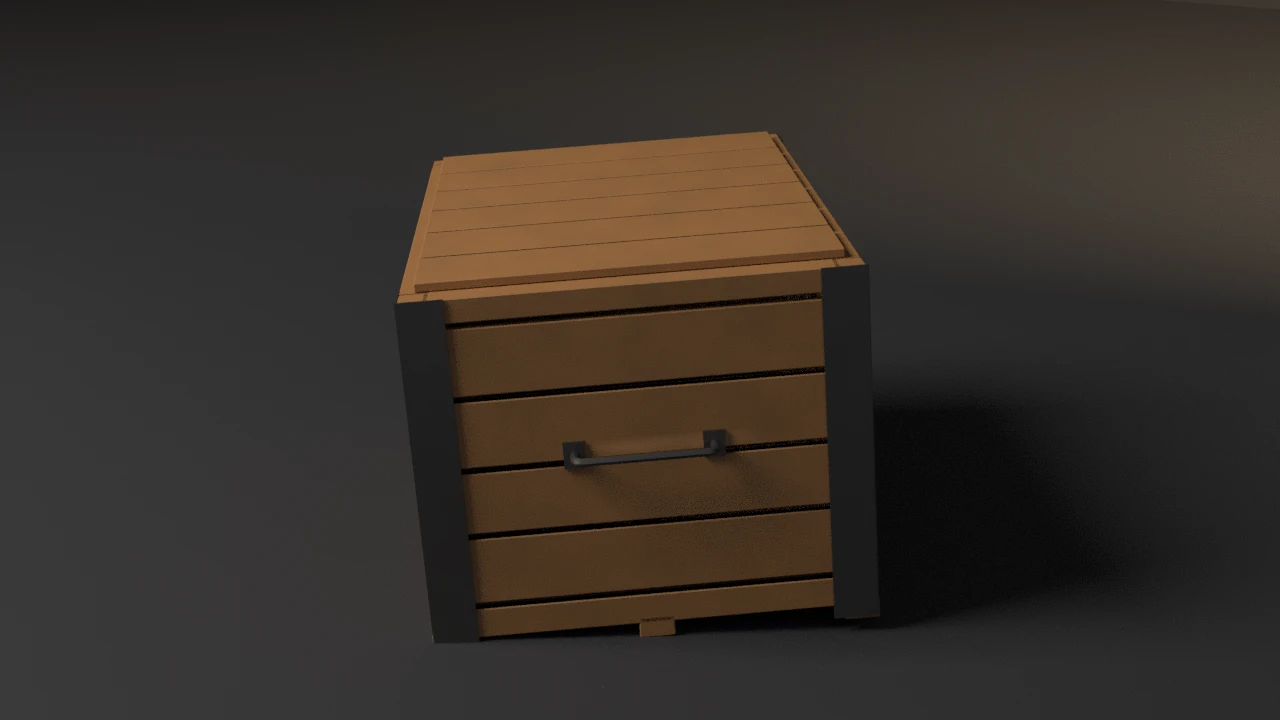
shipping-crate
A procedural shipping crate through UVs, bake, LOD, collider, and Unity glTF, asserting recomputed budgets rather than an API contract.
A procedural rental go-kart on a patch of kart-track asphalt against a red and white kerb — a 30 mm tube chassis whose main loop is one bar swept round every bend, cross tubes ending inside the rails with welded gussets, bearing hangers and kingpin C-brackets; spindles on kingpin bolts with 14° caster, a raked column in a bushing, a steering plate and two tie rods on rod-end eyes; blue moulded bodywork — a nose cone with a raised hump and lipped shoulders, pods with a crest, a ribbed deck and a groove, a front panel leaning back from the hump with a white number plate — on ten strap brackets welded to the tubes and bolted to the mouldings; a moulded seat on stays, a floor tray, pedals, a brake master cylinder with its hose to the caliper, a throttle cable, a strapped fuel tank and a lead ballast block; a finned four-stroke clamped to the rail driving the live rear axle through a clutch, an 88-link chain solved to a whole number of pitches and a 60-tooth sprocket, bearing carriers, a brake disc and caliper; and four loaded slicks on split rims with valve stems, the fronts narrower than the rears — through UVs, bake, LOD, collider, and Unity glTF, asserting recomputed budgets rather than an API contract.
Rendered headless by the showcase piece itself — click to zoom.
category Vehicles
blender --background --python showcase/go-kart/go_kart.py --
A showcase piece, not an example, and the eighth in the vehicles category: things that move. It builds a rental/racing go-kart (generic, no marks or text) parked on a patch of kart-track asphalt:
It asserts budget conformance of the generated result. It does not witness an API contract. "It rendered without error" is not a check.
Composes skills mesh-editing-and-bmesh, bake-high-to-low, depsgraph-and-evaluated-data, engine-export-presets, and snippets bake_normal_high_to_low.py, setup_bake_target_image.py, lod_chain.py / decimate_to_budget.py, convex_hull_collider.py, export_preset_unity.py (helpers copied inline, not imported).
Intended size: wheelbase 1.040 m, front track 1.100 m and rear track 1.200 m (tyre centre to tyre centre); overall 1.75 × 1.40 m, the seat back 0.47 m over the asphalt. The patch with its kerb is 1.90 × 1.77 m; the top of the envelope is the seat back at 0.64 m. The origin is under the patch centre at the slab's underside.
Every budget is declared as a named constant. Every gate recomputes its value from the mesh, materials, UVs, evaluated LOD, collider, or export file. Shells are found by a part face attribute; every measured value is read from their vertices.
| Axis | Declared | Measured (5.2.1) |
|---|---|---|
| Base triangles | 81000–82700 | 81854 |
| LOD1 ratio | 0.32–0.62 of base | 0.5000 |
| LOD2 ratio | 0.10–0.35 of base | 0.2200 |
| Materials | exactly 14 distinct; ≥2910 frame paint, ≥6430 chrome, ≥7530 rubber, ≥3410 bodywork, ≥1420 seat, ≥11650 aluminium, ≥1760 engine casting, ≥3790 steel, ≥1550 black plastic, ≥158 fuel tank, ≥154 lead, ≥590 asphalt, ≥115 kerb paint, ≥114 number plate faces | 14 slots; 3168 / 6994 / 8188 / 3708 / 1548 / 12666 / 1920 / 4130 / 1686 / 172 / 168 / 646 / 126 / 124 |
| UVs | in 0..1, AABB overlap ≤ 1e-5 | in range, overlap 0 |
| Outer AABB | (1.8950, 1.7738, 0.6397) m ± 0.01, read off the vertices | (1.8950, 1.7738, 0.6397), zmin 0 |
| Collider tris | ≤ 900 | 816 |
| Export | written, size > 0, removed after measuring | 6084452 bytes |
Every falsifier leaves the triangle count at 81854 and the envelope at (1.8950, 1.7738, 0.6397): they move parts, never add or remove them.
DECIMATE COLLAPSE triangle counts are not identical across Blender series, so the LOD gate is a ratio band, not an exact count. Bake pixels are stochastic, so the bake gate is has_data plus operator FINISHED, not byte-identity. Construction uses no RNG; two default runs print identical measurements, and 4.5.11 and 5.1.2 print the same measurements as 5.2.1 (the export differs by 76 bytes).
| Axis | Declared | Measured |
|---|---|---|
| Non-manifold edges | 0 | 0 |
| Loose verts / edges | 0 / 0 | 0 / 0 |
| Doubles merged at 1e-5 | 0 | 0 |
| Zero-area faces | 0 | 0 |
| N-gons | 0 | 0 |
| Coplanar cross-shell face pairs (KD range 0.05 m, plane ε 1e-4) | 0 | 0 |
Grounded: zmin | within 1e-4 of 0 | 0.0000 |
| Tyres: each tyre's lowest vertex under the asphalt's top read off the slab, the four patches in one plane | 4 tyres; 0.8–3.0 mm; spread ≤ 0.1 mm | 4; 1.5 mm each; 0 |
The first draft measured 725 coplanar pairs, none of them in a part: hex heads turned by the bolt circle's own angle step, so every head in a ring put its flats on its neighbours' planes (each head is now turned a further, non-commensurate step); the axle's end cap on the plane of the rear split bolts' heads; equal 19.5 mm bores on the axle sharing facet planes (every axle part is now turned a further step); stacked ballast plates of one size; a brake carrier's face on the caliper's; gussets' edges on one plane along their cross tube; a clamp face on a cross tube's end cap; and a sprocket root flat on the plane of the chain's waist face. Mirrored rays onto the bodywork also hit 2.3 mm apart until its lofts were triangulated on their short diagonals: a fixed split is not mirror-symmetric, and a fastener aimed at one triangulation floated over the other.
| Axis | Declared | Measured |
|---|---|---|
| Joint fit: each front hub against its stub axle and each rear hub and bearing against the axle (the part's axis of revolution and centre against the host's principal axis) | 4 hubs, 2 bearings; ≤ 0.3 mm off, ≤ 0.3° | 4, 2; 0.0 mm, 0.0° |
| Joint fit: each tie-rod eye on its pin (plan offset) and biting the plate under it (a ray down onto the steering arm or plate) | 4 eyes; ≤ 0.5 mm; bite 0.2–1.5 mm | 4; 0.0 mm; 0.3 / 0.5 mm |
| Tyre seat: per tyre, per angular segment, the bead vertices against the rim's bead seat (a ray toward the axis along each vertex's own radial) | 4 tyres, each on a rim; 0.4–2.0 mm | 0.864–1.000 mm |
| Chain seat: per sprocket, one bin per tooth over the middle half of the wrap, the tooth-root circle less the chain's inner edge; the chain's plane against the sprocket's | 2 sprockets; 0.8–3.0 mm; ≤ 0.5 mm | 1.911 and 1.943–1.946 mm; 0.005 / 0.006 mm |
| Mirror: every frame-paint and bodywork vertex (nose, panel, pods, grip ribs) against its partner across the loop's centre plane (KD-tree) | ≤ 0.5 mm | 0.043 mm |
| Wheels: front and rear tyres paired, centres and extents compared | ≤ 0.5 mm | 0.0001 mm |
| Size: wheelbase and both tracks from the tyres' own centres | 1.040 / 1.100 / 1.200 m ± 4 mm | 1.0400 / 1.1000 / 1.2000 |
| Caster: each kingpin sleeve's principal axis, tilt back in plan | 2 kingpins; 10–18° | 14.0°, 14.0° |
| Stance: mass centre (per-shell volume × a per-material density) inside the convex hull of the four contact patches | ≥ 0.312 m (30 % of the wheelbase) | 0.3735 m (88.6 kg) |
| One connected assembly (union of shells whose BVH trees overlap, the patch included) | 1 component | 1 (330 shells) |
| Bodywork brackets: per strap, its bite into every moulding or tube it meets (the deepest strap vertex inside that shell: nearest-face distance, signed by a three-ray parity vote); the two deepest are its two joints | 10 brackets; both joints 0.5–2.5 mm | 10; welded ends 0.90–1.99 mm, tabs 1.00–1.47 mm |
Densities are effective: tubes, rims and tyres are modelled solid but are hollow, so each material carries a density that makes its mass plausible.
The bracket bite is signed by ray parity, not by the nearest face's normal: beside the panel's 4 mm rim the nearest face is the rim strip, and its normal read the tab's back face, 2 mm behind the panel, as 1.96 mm inside. Each panel tab's width follows the panel's own across-direction: laid along world Y, the wrapped sides tipped one edge of the tab off the panel. Measuring it also found the nose inside out: recalc_face_normals had turned it, so every closed island is now oriented by its signed volume before shipping.
Each falsifier violates one named budget. Every one was run on 5.2.1, 4.5.11 and 5.1.2 and exited its declared code, with the triangle count and envelope unchanged and every budget checked before the target green.
| Flag | Budget violated | Exit |
|---|---|---|
--skip-decimate | LOD1 ratio band (measured 1.0000) | 9 |
--stray-vert | loose vertex count is 0 (measured 1, placed inside the envelope) | 15 |
--lift-z | bounding box zmin is 0 (measured 0.05000) | 16 |
--float-tyre | every tyre pressed into the asphalt in one plane (the left front lifted 4 mm: −2.5 mm, the rest 1.5 mm) | 16 |
--cock-hub | hubs coaxial (the left rear hub 1.5 mm off the axle: 1.5 mm) | 17 |
--drop-bearing | axle through both bearings (the right bearing and carrier 2 mm low: 2.0 mm) | 17 |
--short-tierod | tie-rod eyes on their pins (the left rod 6 mm short: 6.0 mm) | 17 |
--sink-tyre | tyre bead seat (the right rear bead 3 mm into its seat: 3.000 mm) | 18 |
--lift-chain | chain seated on its sprockets (the chain 4 mm off both: −2.089 and −2.060 mm) | 18 |
--toe-wheel | wheels mirrored (the left front corner turned 1.5°: 4.539 mm) | 19 |
--wide-track | rear track at its stated size (each rear wheel 4 mm out: 1.2080 m) | 19 |
--odd-frame | chassis mirror symmetry (the left rail bowed 3 mm out: 1.819 mm) | 19 |
--no-caster | caster band (kingpins vertical: 0.0°) | 19 |
--aft-ballast | stance (the 8 kg ballast moved behind the axle: 0.2887 m) | 20 |
--loose-ballast | one connected assembly (the ballast lifted 3 mm off the tray: 2 components, 5 and 325 shells) | 21 |
--float-nose | bodywork brackets (the nose and its bolts slid 3 mm forward: both nose brackets' tabs −2.0 mm) | 23 |
--float-tyre lifts the tyre alone, after the patch is flattened, while the slab still grounds the box. --toe-wheel turns the whole corner (spindle, hub, rim and tyre) about the vertical through the kingpin, and the tie rod is rebuilt to the moved arm, so the hubs stay coaxial and the eye stays on its pin; a turn about the raked kingpin itself would have dropped the patch out of its band first. --lift-chain moves the chain alone, keeping the tooth phase of the seated chain: phasing the teeth to the lifted pins, and lifts of 1.7, 2.0, 2.5, 3.0 and 3.5 mm, each put a chain face within 0.1 mm of a tooth flat's plane and exited 15. The assembly falsifier first lifted a side pod, which broke the bodywork's mirror and exited 19; the ballast stack is measured by nothing else. --float-nose moves the nose along X only, so the mirror holds, the nose stays on its bumper bars and on the panel's foot (one assembly), and the slab still sets the envelope.
blender --background --python go_kart.py --
blender --background --python go_kart.py -- --skip-decimate
blender --background --python go_kart.py -- --stray-vert
blender --background --python go_kart.py -- --lift-z
blender --background --python go_kart.py -- --float-tyre
blender --background --python go_kart.py -- --cock-hub
blender --background --python go_kart.py -- --drop-bearing
blender --background --python go_kart.py -- --short-tierod
blender --background --python go_kart.py -- --sink-tyre
blender --background --python go_kart.py -- --lift-chain
blender --background --python go_kart.py -- --toe-wheel
blender --background --python go_kart.py -- --wide-track
blender --background --python go_kart.py -- --odd-frame
blender --background --python go_kart.py -- --no-caster
blender --background --python go_kart.py -- --aft-ballast
blender --background --python go_kart.py -- --loose-ballast
blender --background --python go_kart.py -- --float-nose
blender --background --python go_kart.py -- --output kart.png
Smoke passes no flags.
The hero looks from the front right and above, so the nose, the front panel with its plate and the right-hand wheels lead, the engine, chain and silencer show over the right pod, and the kerb runs behind. The wall stands 5 m behind the patch and the warm wedge pools on it behind the kart. Default stage; no deviation.
Lathed parts, tubes, tyres, the seat and the bodywork are smooth-shaded; chamfers, fins, teeth and every material boundary stay crisp through sharp edges above 35°. Every part carries a PartTone face attribute that moves it between two tones, so the four tyres and the ballast plates differ, and the kerb's stripes are the same attribute picking red or white. Grime rises from the asphalt on every part and scuffs are sparse. Chrome, aluminium, steel and the casting carry a studio reflection term so they do not read as grey plastic on a dark stage; the track asphalt is streaked darker along the racing line. The bodywork's lower half carries dark tyre-rubber streaks and light scratches, both stretched fore and aft; the frame is scratched through to steel low down; the frame, casting, aluminium, steel and chrome darken with oily grime toward the engine.
The livery is blue with a white number plate, so the warm notes are the red frame and the kerb. The yellow livery the piece first shipped with filled the lower half of the hero and measured a wedge warmth of +0.288, out of the calibration band (−0.144 to +0.105); blue measures −0.094.
File-local. 9 is a valid check code. 10 is reserved for gallery_framing.check_framing on the --output path. 15–19 are the hygiene and joint-fit family. 20, 21 and 23 are file-local. 22 is the asset-quality floor on the render path: check_asset_quality returns 11, which this piece already spends on the collider ceiling, so the call site remaps it.
| Code | Meaning |
|---|---|
| 0 | Success |
| 1 | Uncaught exception (FATAL wrapper) |
| 2 | argparse / usage |
| 3 | Mesh did not build / no UV layer |
| 4 | Base triangle count outside range |
| 5 | Material count ≠ 14 distinct slots, or a face-count floor missed |
| 6 | UVs outside 0..1 |
| 7 | UV AABB overlap above tolerance |
| 8 | World AABB off declared outer size |
| 9 | LOD ratio band (--skip-decimate lands here) |
| 10 | Framing gate (render path only) |
| 11 | Collider triangle count above ceiling |
| 12 | Bake did not finish or image has no data |
| 13 | Export file missing or empty |
| 14 | --output produced no file |
| 15 | Mesh hygiene: loose, non-manifold, zero-area, doubles, n-gons, coplanar cross-shell pairs |
| 16 | Not grounded: bounding box zmin off 0, or a tyre outside its band, the patches out of one plane, or not 4 tyres (--lift-z, --float-tyre) |
| 17 | Joint fit: a hub or bearing off its axle, a tie-rod eye off its pin or out of its bite band, or a part missing (--cock-hub, --drop-bearing, --short-tierod) |
| 18 | Seat: a tyre bead out of its seat band, the chain off its sprockets' roots or out of line, or a part missing (--sink-tyre, --lift-chain) |
| 19 | Mirror, size and angle: frame or bodywork not mirrored, wheels not mirrored, wheelbase or a track off, caster out of band (--toe-wheel, --wide-track, --odd-frame, --no-caster) |
| 20 | Stance: the mass centre too near an edge of the support polygon (--aft-ballast) |
| 21 | Assembly splits into more than one connected component (--loose-ballast) |
| 22 | Asset-quality floor (render path only; remapped from 11) |
| 23 | Bodywork brackets: not 10 straps, or a strap's weld or tab out of its bite band (--float-nose) |
"""Game-ready go-kart on a patch of kart track - a showcase piece, not an example. Asserts budget conformance of a procedural rental/racing go-kart after composing shipped pipeline pieces: bmesh construction, UVs, fourteen materials, high-to-low normal bake, LOD chain, convex collider, Unity glTF export. A patch of kart-track asphalt, broken on three edges, runs up to a red and white kerb along the fourth. On it stands a go-kart (generic, no marks or text): a bent-tube chassis whose main loop is one bar swept through every bend, cross tubes that end inside the rails, welded gussets, bearing hangers, kingpin brackets and a steering-column support; a floor tray; a moulded seat on stays; a steering wheel on a raked column in a bushing, a steering plate and two tie rods to the spindles' arms; spindles on kingpins with caster; blue moulded bodywork: a nose cone on bumper bars ahead of the front axle (a raised hump, lipped shoulders, a rounded chin), a curved front panel leaning back from the hump with a plain white number plate, and two side pods (a raised outer crest, a stepped deck with grip ribs, a groove along the wall) on nerf bars; ten flat strap brackets welded to the tubes and bolted flat to the mouldings; a tubular rear bumper; a small engine (finned cylinder, fan shroud and pull-start, air-box, exhaust and silencer) clamped to the right rail, driving a live rear axle through a clutch, a chain and a sprocket; bearing carriers, a brake disc and caliper, a master cylinder pushed by the brake pedal with its hose along the left rail to the caliper, the throttle cable along the right rail to the carburettor, a fuel tank with its line, a lead ballast block; and four slick tyres on split rims with valve stems, the fronts narrower than the rears. Budgets are declared below and recomputed from the generated result. They are not API-contract witnesses. Each falsifier violates one named budget: ``--skip-decimate`` the LOD band, ``--stray-vert`` mesh hygiene, ``--lift-z`` and ``--float-tyre`` grounding, ``--cock-hub``, ``--drop-bearing`` and ``--short-tierod`` joint fit, ``--sink-tyre`` and ``--lift-chain`` seat conformance, ``--toe-wheel``, ``--wide-track``, ``--odd-frame`` and ``--no-caster`` mirror, size and angle, ``--aft-ballast`` the stance, ``--loose-ballast`` one connected assembly and ``--float-nose`` the bodywork brackets. No RNG. Construction is closed-form. DECIMATE COLLAPSE triangle counts are not byte-identical across Blender versions - the LOD gate is a ratio band. blender --background --python go_kart.py -- blender --background --python go_kart.py -- --skip-decimate blender --background --python go_kart.py -- --output kart.png """ import argparse import math import os import sys import tempfile import traceback import bmesh import bpy import numpy as np from mathutils import Matrix, Vector from mathutils.bvhtree import BVHTree from mathutils.kdtree import KDTree # Showcase lives at repo-root/showcase/, not under examples/. The framing # helper is the repo's only shared import and lives next to the examples; # resolve the repo root so we do not move gallery_framing.py. _REPO = os.path.abspath( os.path.join(os.path.dirname(os.path.abspath(__file__)), os.pardir, os.pardir) ) sys.path.insert(0, os.path.join(_REPO, "examples")) sys.dont_write_bytecode = True import gallery_framing # noqa: E402 import gallery_asset_quality # noqa: E402 # --- Track patch (world frame) ------------------------------------------------- SLAB_T = 0.060 SLAB_X = 0.935 # half length SLAB_Y0 = -0.850 # front edge (broken) SLAB_Y1 = 0.650 # back edge: straight, against the kerb SLAB_CORNER = 0.120 SLAB_PERIM = 132 SLAB_JITTER = 0.016 SLAB_TOP_CH = 0.008 SLAB_BOT_CH = 0.004 KERB_HALF_L = 0.925 # stops short of the slab's sides: no shared end plane KERB_W = 0.260 KERB_H = 0.032 # crest above the asphalt KERB_BITE = 0.012 # the kerb's foot runs this far under the asphalt edge KERB_STRIPES = 6 KERB_Z0 = 0.002 # underside: off the slab's underside plane # --- Kart layout (kart frame: x forward, y left, z up from the asphalt top) ----- KART_X = -0.050 KART_Y = -0.100 WHEELBASE = 1.040 TRACK_F = 1.100 # tyre centre to tyre centre TRACK_R = 1.200 AX_F = 0.5 * WHEELBASE AX_R = -0.5 * WHEELBASE R_TF, R_TR = 0.128, 0.140 # 10 in front, 11 in rear slick W_TF, W_TR = 0.061, 0.098 # half width over the sidewall bulge WF_F, WF_R = 0.055, 0.092 # rim flange inner face, half width DISC_F = (-0.006, 0.006) # rim centre disc, w from the tyre's mid-plane (+ outboard) DISC_R = (-0.064, -0.052) BORE_F, BORE_R = 0.0215, 0.0285 RS = 0.0635 # 5 in bead seat RFL = 0.0715 # flange top RD = 0.0580 # drop well RIM_T = 0.0035 TYRE_BITE = 0.0010 # tyre bead hooped this far onto the bead seat SINK = 0.0015 # contact patch pressed into the asphalt FLAT = 0.0040 # tyre deflection under load: a flat patch TYRE_SEGS = 64 RIM_SEGS = 48 Z_AF = R_TF - FLAT - SINK Z_AR = R_TR - FLAT - SINK AXLE_R = 0.020 # 40 mm live axle AXLE_W = 0.5505 TUBE_R = 0.015 # 30 mm chassis tube TUBE_SIDES = 16 Z_F = 0.052 LOOP_PTS = ((-0.66, 0.30), (-0.22, 0.30), (0.02, 0.235), (0.34, 0.235), (0.44, 0.33), (0.60, 0.33)) LOOP_FILLET = 0.07 LOOP_STEPS = 7 CROSS_R = 0.0125 X_MID = -0.120 # the seat's cross tube X_COLX = 0.460 # the column's cross tube HANGER_Y = 0.300 HANGER_T = 0.006 KP_Y = 0.400 # kingpin centre, from the kart's centre line CASTER_DEG = 14.0 KP_R = 0.013 KP_HALF = 0.040 WEB_Y = 0.346 ARM_END = (0.440, 0.365) ARM_Z = 0.097 TAB_HOLE = (0.415, 0.038) EYE_Z0 = ARM_Z + 0.0025 # eye bottom: 0.5 mm into the plate under it EYE_H = 0.010 COL_B = Vector((0.460, 0.0, 0.080)) COL_T = Vector((0.130, 0.0, 0.470)) COL_R = 0.010 WHEEL_R = 0.145 SEAT_Y = 0.040 CHAIN_Y = -0.445 PITCH = 0.009525 # 3/8 in chain N_ENG, N_AXLE = 12, 60 Z_ENG = 0.180 LINKS = 88 CH_PIN, CH_MID = 0.0045, 0.0034 # plate half heights at a pin and between pins CH_IN, CH_OUT = 0.0050, 0.0064 # inner and outer link half widths SPR_HALF_T = 0.0020 CYL_DEG = 25.0 BALLAST = (0.070, 0.250, 0.115, 0.205) # x0, x1, y0, y1 on the floor tray BALLAST_AFT = (-0.800, -0.620, 0.020, 0.110) BALLAST_PLATES = 3 BALLAST_T = 0.015 # --- Falsifier sizes ------------------------------------------------------------- FLOAT_TYRE = 0.004 # --float-tyre: left front tyre COCK_HUB = 0.0015 # --cock-hub: left rear hub off the axle DROP_BEARING = 0.0020 # --drop-bearing: right bearing and carrier SHORT_TIEROD = 0.006 # --short-tierod: left tie rod's outer eye SINK_BITE = 0.0030 # --sink-tyre: right rear tyre's bead LIFT_CHAIN = 0.0040 # --lift-chain: the chain off both sprockets (1.7, 2.0, 2.5, # 3.0 and 3.5 mm each put a chain face within 0.1 mm of a # tooth flat's plane and exited 15) TOE_DEG = 1.5 # --toe-wheel: left front corner WIDE_TRACK = 0.0040 # --wide-track: each rear wheel outward ODD_FRAME = 0.0030 # --odd-frame: left rail bowed outward LOOSE_BALLAST = 0.0030 # --loose-ballast: the ballast stack lifted off the tray FLOAT_NOSE = 0.0030 # --float-nose: the nose and its bolts slid forward off its brackets # Bodywork brackets: flat straps welded to a tube at one end and bolted flat # against a moulding at the other. BRACKET_T = 0.0030 # strap thickness TUBE_BITE = 0.0020 # a strap's welded end sunk into its tube TAB_BITE = 0.0010 # a strap's tab pressed into the moulding it is bolted to BBOX_TOL = 0.01 # Fitted after locking geometry. Recomputed from the vertices. OUTER_SIZE = (1.8950, 1.7738, 0.6397) BASE_TRIS_MIN = 81000 BASE_TRIS_MAX = 82700 LOD1_RATIO_MIN = 0.32 LOD1_RATIO_MAX = 0.62 LOD2_RATIO_MIN = 0.10 LOD2_RATIO_MAX = 0.35 LOD1_TARGET = 0.50 LOD2_TARGET = 0.22 MATERIAL_COUNT = 14 UV_EPS = 1e-4 UV_OVERLAP_MAX = 1e-5 COLLIDER_TRIS_MAX = 900 BAKE_RES = 1024 CAGE_EXTRUSION = 0.006 ZMIN_EPS = 1e-4 DOUBLES_EPS = 1e-5 AREA_EPS = 1e-10 COPLANAR_NORMAL_EPS = 1e-4 COPLANAR_PLANE_EPS = 1e-4 COPLANAR_CENTRE_MAX = 0.05 LIFT_Z = 0.05 # Supports: four tyres, each pressed into the asphalt in a band, contact # patches in one plane. TYRE_COUNT = 4 SINK_MIN = 0.0008 SINK_MAX = 0.0030 PATCH_PLANE_MAX = 0.0001 # Joint fit: hubs coaxial with their stub axles and the axle; the axle # through both bearings; each tie-rod eye on its pin and bearing on its plate. COAX_MAX = 0.0003 COAX_DEG_MAX = 0.3 HUBS = 4 BEARINGS = 2 EYES = 4 EYE_OFF_MAX = 0.0005 EYE_BITE_MIN = 0.0002 EYE_BITE_MAX = 0.0015 # Seat conformance: tyre beads on the bead seats; the chain on its sprockets. TYRE_SEAT_MIN = 0.0004 TYRE_SEAT_MAX = 0.0020 CHAIN_SEAT_MIN = 0.0008 CHAIN_SEAT_MAX = 0.0030 CHAINLINE_MAX = 0.0005 SPROCKETS = 2 # Mirror, size and angle. MIRROR_EPS = 0.0005 WHEEL_MIRROR_EPS = 0.0005 SIZE_TOL = 0.004 CASTER_MIN = 10.0 CASTER_MAX = 18.0 KINGPINS = 2 # Bodywork brackets: every strap bites both the tube it is welded to and the # moulding it is bolted to. BRACKETS = 10 BRACKET_BITE_MIN = 0.0005 BRACKET_BITE_MAX = 0.0025 # Stance: the mass centre stands inside the tyres' support polygon by at # least 30 % of the wheelbase. STANCE_MARGIN = 0.30 * WHEELBASE DENSITY = (1900.0, 3000.0, 450.0, 120.0, 1700.0, 1600.0, 1500.0, 5000.0, 250.0, 500.0, 11340.0, 0.0, 0.0, 950.0) HERO_YAW_DEG = 0.0 CAM_VIEW = (0.62, -0.78) CAM_DIST = 3.95 CAM_LENS = 50.0 CAM_LIFT = 1.75 AIM_OFFSET = (0.0, 0.0, -0.26) WALL_Y = 5.0 PAINT_IDX = 0 CHROME_IDX = 1 RUBBER_IDX = 2 BODY_IDX = 3 SEAT_IDX = 4 ALU_IDX = 5 CASTING_IDX = 6 STEEL_IDX = 7 BLACK_IDX = 8 TANK_IDX = 9 LEAD_IDX = 10 ASPHALT_IDX = 11 KERB_IDX = 12 PLATE_IDX = 13 FACE_FLOORS = { PAINT_IDX: 2910, CHROME_IDX: 6430, RUBBER_IDX: 7530, BODY_IDX: 3410, SEAT_IDX: 1420, ALU_IDX: 11650, CASTING_IDX: 1760, STEEL_IDX: 3790, BLACK_IDX: 1550, TANK_IDX: 158, LEAD_IDX: 154, ASPHALT_IDX: 590, KERB_IDX: 115, PLATE_IDX: 114, } MAT_LABELS = ("frame paint", "chrome", "rubber", "bodywork", "seat", "aluminium", "engine casting", "steel", "black plastic", "fuel tank", "lead", "asphalt", "kerb paint", "number plate") # Part tags: a face attribute naming which part a face belongs to, so the # audits can find the shells they measure. Every measured value is read from # the vertices, never from these constants. (T_NONE, T_SLAB, T_KERB, T_LOOP, T_FRAME, T_TYRE, T_RIM, T_HUB_F, T_HUB_R, T_STUB, T_AXLE, T_BEARING, T_KINGPIN, T_ARM, T_TAB, T_PIN, T_EYE, T_CHAIN, T_SPROCKET, T_BODY, T_BALLAST, T_SEAT, T_BAR, T_BRACKET) = range(24) X = Vector((1.0, 0.0, 0.0)) Y = Vector((0.0, 1.0, 0.0)) Z = Vector((0.0, 0.0, 1.0)) TONE = "PartTone" def eevee_engine_id(): return "BLENDER_EEVEE" if bpy.app.version >= (5, 0, 0) else "BLENDER_EEVEE_NEXT" def fail(msg, code): print(f"ERROR: {msg}", file=sys.stderr) return code def triangle_count(mesh): mesh.calc_loop_triangles() return len(mesh.loop_triangles) def evaluated_triangle_count(obj): # Duplicated from snippets/lod_chain.py / decimate_to_budget.py (not a package). depsgraph = bpy.context.evaluated_depsgraph_get() eval_obj = obj.evaluated_get(depsgraph) eval_mesh = eval_obj.to_mesh() try: eval_mesh.calc_loop_triangles() return len(eval_mesh.loop_triangles) finally: eval_obj.to_mesh_clear() # -------------------------------------------------------------------------- # Construction helpers (copied from showcase/road-bicycle and # showcase/traffic-cones, not imported) # -------------------------------------------------------------------------- class Build: """The bmesh under construction, its part-tag and tone layers and named vertex groups (for the falsifiers that move one assembly).""" def __init__(self, bm): self.bm = bm self.tag = bm.faces.layers.int.new("part") self.tone = bm.faces.layers.float.new(TONE) self.groups = {} def part(self, tag=T_NONE, tone=0.5, *groups): return _Part(self, tag, tone, groups) def verts(self, *names): out = [] for n in names: out.extend(self.groups.get(n, [])) return out class _Part: def __init__(self, b, tag, tone, groups): self.b, self.t, self.tone, self.g = b, tag, tone, groups def __enter__(self): self.nf = len(self.b.bm.faces) self.nv = len(self.b.bm.verts) return self def __exit__(self, *exc): bm = self.b.bm bm.faces.ensure_lookup_table() bm.verts.ensure_lookup_table() for i in range(self.nf, len(bm.faces)): bm.faces[i][self.b.tag] = self.t bm.faces[i][self.b.tone] = self.tone vs = [bm.verts[i] for i in range(self.nv, len(bm.verts))] for g in self.g: self.b.groups.setdefault(g, []).extend(vs) return False def _mark(faces, mat_idx): for f in faces: f.material_index = mat_idx return faces def frame(ez, ex_hint): """Rotation whose local Z is ``ez`` and local X is ``ex_hint`` made orthogonal to it (columns ex, ey, ez; right-handed).""" ez = Vector(ez).normalized() ex = Vector(ex_hint) ex = (ex - ez * ex.dot(ez)).normalized() ey = ez.cross(ex) return Matrix((ex, ey, ez)).transposed() def any_perp(v): v = Vector(v).normalized() return X if abs(v.x) < 0.9 else Y def add_lathe(bm, profile, segs, mat_idx, center=(0.0, 0.0, 0.0), rot=None, phase=0.0, solid=False): """Revolve a profile [(r, z), ...] about local Z. ``solid``: an open polyline closed by n-gon caps at its two ends; otherwise a closed polygon revolved into a ring shell.""" c = Vector(center) m = rot if rot is not None else Matrix.Identity(3) rings = [] for i in range(segs): a = phase + 2.0 * math.pi * i / segs ca, sa = math.cos(a), math.sin(a) rings.append([bm.verts.new(c + m @ Vector((r * ca, r * sa, z))) for r, z in profile]) n = len(profile) last = n - 1 if solid else n faces = [] for i in range(segs): r0, r1 = rings[i], rings[(i + 1) % segs] for j in range(last): k = (j + 1) % n faces.append(bm.faces.new((r0[j], r1[j], r1[k], r0[k]))) if solid: faces.append(bm.faces.new([rings[i][0] for i in reversed(range(segs))])) faces.append(bm.faces.new([rings[i][n - 1] for i in range(segs)])) _mark(faces, mat_idx) return [v for ring in rings for v in ring] def lathe_on(bm, profile, segs, mat_idx, center, axis, phase=0.0, solid=True, ref=None): axis = Vector(axis).normalized() return add_lathe(bm, profile, segs, mat_idx, center=center, rot=frame(axis, ref if ref is not None else any_perp(axis)), phase=phase, solid=solid) _HEX = [0] def add_hex(bm, center, axis, a, b, r, mat_idx, phase=0.0): """A hex head or nut on ``axis`` from a to b, its top edge chamfered. Every head is turned a further step: identical heads in a row would otherwise put their flats on shared planes.""" _HEX[0] += 1 ch = min(0.0008, 0.25 * (b - a)) return lathe_on(bm, [(r, a), (r, b - ch), (r * 0.86, b)], 6, mat_idx, center, axis, phase=phase + math.pi / 6.0 + 0.2113 * _HEX[0]) def add_dome(bm, center, axis, mat_idx, r=0.0065, h=0.0038, sink=0.0008, segs=12): """Button-head fastener: base sunk into the host, domed head.""" prof = [(r, -sink), (r, 0.0008), (r * 0.86, 0.0022), (r * 0.55, 0.0033), (r * 0.18, h)] return lathe_on(bm, prof, segs, mat_idx, center, axis) def add_rod(bm, center, axis, a, b, r, mat_idx, segs=12): return lathe_on(bm, [(r, a), (r, b)], segs, mat_idx, center, axis) def add_tube(bm, pts, radius, sides, mat_idx, phase=0.0, ref=None): """Capped round bar swept along a polyline (parallel-transport frames).""" pts = [Vector(p) for p in pts] tans = [] for i in range(len(pts)): a = pts[max(i - 1, 0)] b = pts[min(i + 1, len(pts) - 1)] tans.append((b - a).normalized()) if ref is None: ref = Z if abs(tans[0].z) < 0.9 else X nrm = (Vector(ref) - tans[0] * Vector(ref).dot(tans[0])).normalized() rings = [] for p, t in zip(pts, tans): nrm = (nrm - t * nrm.dot(t)).normalized() bi = t.cross(nrm) rings.append([ bm.verts.new(p + radius * (nrm * math.cos(phase + 2.0 * math.pi * k / sides) + bi * math.sin(phase + 2.0 * math.pi * k / sides))) for k in range(sides) ]) faces = [] for r0, r1 in zip(rings, rings[1:]): for k in range(sides): m = (k + 1) % sides faces.append(bm.faces.new((r0[k], r0[m], r1[m], r1[k]))) faces.append(bm.faces.new(tuple(reversed(rings[0])))) faces.append(bm.faces.new(tuple(rings[-1]))) _mark(faces, mat_idx) return [v for ring in rings for v in ring] def add_tube_loop_xy(bm, pts, radius, sides, mat_idx): """A closed round bar swept round a loop lying in a level plane: every ring is framed by the level normal and the loop's own tangent.""" pts = [Vector(p) for p in pts] n = len(pts) rings = [] for i, p in enumerate(pts): t = (pts[(i + 1) % n] - pts[i - 1]).normalized() side = t.cross(Z).normalized() rings.append([bm.verts.new(p + radius * (Z * math.cos(2.0 * math.pi * k / sides) + side * math.sin(2.0 * math.pi * k / sides))) for k in range(sides)]) faces = [] for i in range(n): r0, r1 = rings[i], rings[(i + 1) % n] for k in range(sides): m = (k + 1) % sides faces.append(bm.faces.new((r0[k], r0[m], r1[m], r1[k]))) _mark(faces, mat_idx) return [v for ring in rings for v in ring] def rrect(ha, hb, rc, n_corner=4): """Rounded rectangle loop (counter-clockwise).""" rc = max(min(rc, ha - 1e-4, hb - 1e-4), 0.0006) pts = [] for k, (sx, sy) in enumerate(((1, 1), (-1, 1), (-1, -1), (1, -1))): cx, cy = sx * (ha - rc), sy * (hb - rc) a0 = 0.5 * math.pi * k for s in range(n_corner + 1): a = a0 + 0.5 * math.pi * s / n_corner pts.append((cx + rc * math.cos(a), cy + rc * math.sin(a))) return pts def add_rbox(bm, ha, hb, rc, profile, origin, rot, mat_idx, n_corner=4): """Loft of rounded rectangles along local Z: profile [(inset, z)], each loop inset from (ha, hb, rc); n-gon caps at both ends.""" o = Vector(origin) rings = [] for inset, z in profile: loop = rrect(ha - inset, hb - inset, rc - inset, n_corner) rings.append([bm.verts.new(o + rot @ Vector((x, y, z))) for x, y in loop]) n = len(rings[0]) faces = [] for r0, r1 in zip(rings, rings[1:]): for k in range(n): m = (k + 1) % n faces.append(bm.faces.new((r0[k], r0[m], r1[m], r1[k]))) faces.append(bm.faces.new(tuple(reversed(rings[0])))) faces.append(bm.faces.new(tuple(rings[-1]))) _mark(faces, mat_idx) return [v for ring in rings for v in ring] def chamfered(h, c): """A slab profile [(inset, z)] from 0 to h with chamfer c at both faces.""" return [(c, 0.0), (0.0, c), (0.0, h - c), (c, h)] def add_prism(bm, outline, w0, w1, origin, rot, mat_idx, ch=0.0): """Planar outline [(u, v)] extruded along local Z from w0 to w1, both faces chamfered by ``ch`` (an inset ring) when it is non-zero.""" o = Vector(origin) if ch > 0.0: inner = inset_poly(outline, ch) layers = [(inner, w0), (outline, w0 + ch), (outline, w1 - ch), (inner, w1)] else: layers = [(outline, w0), (outline, w1)] rings = [[bm.verts.new(o + rot @ Vector((u, v, w))) for u, v in loop] for loop, w in layers] n = len(outline) faces = [] for r0, r1 in zip(rings, rings[1:]): for i in range(n): faces.append(bm.faces.new((r0[i], r0[(i + 1) % n], r1[(i + 1) % n], r1[i]))) faces.append(bm.faces.new(tuple(reversed(rings[0])))) faces.append(bm.faces.new(tuple(rings[-1]))) _mark(faces, mat_idx) return [v for ring in rings for v in ring] def poly_area(poly): n = len(poly) return 0.5 * sum(poly[i][0] * poly[(i + 1) % n][1] - poly[(i + 1) % n][0] * poly[i][1] for i in range(n)) def inset_poly(poly, d): """Every vertex of a (convex-ish) polygon moved ``d`` inward along its bisector.""" n = len(poly) sgn = 1.0 if poly_area(poly) > 0.0 else -1.0 out = [] for i in range(n): a, p, b = Vector(poly[i - 1]), Vector(poly[i]), Vector(poly[(i + 1) % n]) e0 = (p - a).normalized() e1 = (b - p).normalized() n0 = Vector((-e0.y, e0.x)) * sgn n1 = Vector((-e1.y, e1.x)) * sgn bis = (n0 + n1) if bis.length < 1e-9: bis = n0 bis.normalize() cosh = max(0.3, bis.dot(n0)) q = p + bis * (d / cosh) out.append((q.x, q.y)) return out def fillet_path(pts, rf, steps=4): pts = [Vector(p) for p in pts] out = [pts[0]] for i in range(1, len(pts) - 1): a, p, b = pts[i - 1], pts[i], pts[i + 1] r = min(rf, (a - p).length * 0.45, (b - p).length * 0.45) p0 = p + (a - p).normalized() * r p1 = p + (b - p).normalized() * r for k in range(steps + 1): t = k / steps out.append((1 - t) ** 2 * p0 + 2 * (1 - t) * t * p + t * t * p1) out.append(pts[-1]) return out def fillet_loop(pts, rf, steps=4): pts = [Vector(p) for p in pts] n = len(pts) out = [] for i in range(n): a, p, b = pts[i - 1], pts[i], pts[(i + 1) % n] r = min(rf, (a - p).length * 0.45, (b - p).length * 0.45) p0 = p + (a - p).normalized() * r p1 = p + (b - p).normalized() * r for k in range(steps + 1): t = k / steps out.append((1 - t) ** 2 * p0 + 2 * (1 - t) * t * p + t * t * p1) return out def add_bar(bm, pts, wax, half_w, half_t, rc, mat_idx, fillet=0.008, filleted=False): """Flat bar: its width lies along ``wax``, its thickness across it; rounded-rectangle section.""" pts = [Vector(p) for p in pts] if filleted else fillet_path(pts, fillet) if not isinstance(wax, list): wax = Vector(wax).normalized() sec = rrect(half_w, half_t, rc, 2) waxes = [Vector(w).normalized() for w in wax] if isinstance(wax, list) else None rings = [] for i, p in enumerate(pts): a = pts[max(i - 1, 0)] b = pts[min(i + 1, len(pts) - 1)] t = (b - a).normalized() if waxes is not None: wax = waxes[i] w = (wax - t * wax.dot(t)).normalized() th = t.cross(w) rings.append([bm.verts.new(p + w * x + th * y) for x, y in sec]) n = len(sec) faces = [] for r0, r1 in zip(rings, rings[1:]): for k in range(n): m = (k + 1) % n faces.append(bm.faces.new((r0[k], r0[m], r1[m], r1[k]))) faces.append(bm.faces.new(tuple(reversed(rings[0])))) faces.append(bm.faces.new(tuple(rings[-1]))) _mark(faces, mat_idx) return [v for ring in rings for v in ring] def rpoly(pts, r, n): """A convex polygon with every corner rounded by a quadratic fillet of ``n`` steps (n + 1 points per corner).""" pts = [Vector(p) for p in pts] m = len(pts) out = [] for i in range(m): a, p, b = pts[i - 1], pts[i], pts[(i + 1) % m] rr = min(r, (a - p).length * 0.45, (b - p).length * 0.45) p0 = p + (a - p).normalized() * rr p1 = p + (b - p).normalized() * rr for k in range(n + 1): t = k / n q = (1 - t) ** 2 * p0 + 2 * (1 - t) * t * p + t * t * p1 out.append((q.x, q.y)) return out def tri_short(bm, faces): """Split non-planar quads along their short diagonals: a fixed split is not mirror-symmetric, and a fastener aimed at one triangulation floats over the other.""" quads = [f for f in faces if f.is_valid and len(f.verts) == 4] if quads: bmesh.ops.triangulate(bm, faces=quads, quad_method="SHORT_EDGE") def add_loft(bm, loops, mat_idx): """Closed loops [[Vector]] of equal length lofted in order, n-gon caps.""" rings = [[bm.verts.new(p) for p in loop] for loop in loops] n = len(rings[0]) faces = [] for r0, r1 in zip(rings, rings[1:]): for j in range(n): m = (j + 1) % n faces.append(bm.faces.new((r0[j], r0[m], r1[m], r1[j]))) faces.append(bm.faces.new(tuple(reversed(rings[0])))) faces.append(bm.faces.new(tuple(rings[-1]))) _mark(faces, mat_idx) return [v for ring in rings for v in ring] def add_sheet(bm, surf, nu, nv, thick, mat_idx): """A closed plate: ``surf(u, v) -> (point, normal)`` over the unit square, offset ``thick`` back along the normal, rims stitched round the edge.""" front, back = [], [] for j in range(nv + 1): rf, rb = [], [] for i in range(nu + 1): p, n = surf(i / nu, j / nv) rf.append(bm.verts.new(p)) rb.append(bm.verts.new(p - n * thick)) front.append(rf) back.append(rb) faces = [] for j in range(nv): for i in range(nu): faces.append(bm.faces.new((front[j][i], front[j][i + 1], front[j + 1][i + 1], front[j + 1][i]))) faces.append(bm.faces.new((back[j][i], back[j + 1][i], back[j + 1][i + 1], back[j][i + 1]))) rim = ([(0, i) for i in range(nu + 1)] + [(j, nu) for j in range(1, nv + 1)] + [(nv, i) for i in reversed(range(nu))] + [(j, 0) for j in reversed(range(1, nv))]) for k in range(len(rim)): (ja, ia), (jb, ib) = rim[k], rim[(k + 1) % len(rim)] faces.append(bm.faces.new((front[jb][ib], front[ja][ia], back[ja][ia], back[jb][ib]))) _mark(faces, mat_idx) return [v for row in front + back for v in row] def hull2d(pts): """Convex hull, counter-clockwise (monotone chain).""" pts = sorted(set((round(x, 9), round(z, 9)) for x, z in pts)) def cross(o, a, b): return (a[0] - o[0]) * (b[1] - o[1]) - (a[1] - o[1]) * (b[0] - o[0]) lower, upper = [], [] for p in pts: while len(lower) >= 2 and cross(lower[-2], lower[-1], p) <= 1e-12: lower.pop() lower.append(p) for p in reversed(pts): while len(upper) >= 2 and cross(upper[-2], upper[-1], p) <= 1e-12: upper.pop() upper.append(p) return lower[:-1] + upper[:-1] def circles_hull(circles, n=16): pts = [] for u, v, r in circles: for k in range(n): a = 2.0 * math.pi * (k + 0.5) / n pts.append((u + r * math.cos(a), v + r * math.sin(a))) return hull2d(pts) def triangulate_ngons(bm): faces = [f for f in bm.faces if len(f.verts) > 4] if faces: bmesh.ops.triangulate(bm, faces=faces) def pack_uvs(bm, margin=0.08): uv = bm.loops.layers.uv.new("UVMap") faces = list(bm.faces) n = len(faces) cols = max(1, math.ceil(math.sqrt(n))) rows = max(1, math.ceil(n / cols)) cell_w = 1.0 / cols cell_h = 1.0 / rows pad_u = margin * cell_w * 0.5 pad_v = margin * cell_h * 0.5 usable_w = cell_w - 2.0 * pad_u usable_h = cell_h - 2.0 * pad_v for i, face in enumerate(faces): col = i % cols row = i // cols nrm = face.normal ax, ay, az = abs(nrm.x), abs(nrm.y), abs(nrm.z) coords = [] for loop in face.loops: co = loop.vert.co if az >= ax and az >= ay: coords.append((co.x, co.y)) elif ax >= ay: coords.append((co.y, co.z)) else: coords.append((co.x, co.z)) xs = [c[0] for c in coords] ys = [c[1] for c in coords] minx, maxx = min(xs), max(xs) miny, maxy = min(ys), max(ys) dx = max(maxx - minx, 1e-8) dy = max(maxy - miny, 1e-8) origin_u = col * cell_w + pad_u origin_v = row * cell_h + pad_v for loop, (x, y) in zip(face.loops, coords): loop[uv].uv = ( origin_u + (x - minx) / dx * usable_w, origin_v + (y - miny) / dy * usable_h, ) def pchip(keys): """Monotone cubic through (x, y) keys (Fritsch-Carlson): no overshoot.""" xs = [k[0] for k in keys] ys = [k[1] for k in keys] n = len(xs) h = [xs[i + 1] - xs[i] for i in range(n - 1)] d = [(ys[i + 1] - ys[i]) / h[i] for i in range(n - 1)] m = [d[0]] + [0.0] * (n - 2) + [d[-1]] for i in range(1, n - 1): if d[i - 1] * d[i] > 0.0: w1 = 2.0 * h[i] + h[i - 1] w2 = h[i] + 2.0 * h[i - 1] m[i] = (w1 + w2) / (w1 / d[i - 1] + w2 / d[i]) def f(x): x = min(max(x, xs[0]), xs[-1]) i = 0 while i < n - 2 and x > xs[i + 1]: i += 1 t = (x - xs[i]) / h[i] t2, t3 = t * t, t * t * t return ((2 * t3 - 3 * t2 + 1) * ys[i] + (t3 - 2 * t2 + t) * h[i] * m[i] + (-2 * t3 + 3 * t2) * ys[i + 1] + (t3 - t2) * h[i] * m[i + 1]) return f def resample(pts, n): """``n`` points evenly spaced by arc length along a polyline.""" pts = [Vector(p) for p in pts] seg = [(pts[i], pts[i + 1]) for i in range(len(pts) - 1)] lens = [(b - a).length for a, b in seg] total = sum(lens) out = [] for k in range(n): s = total * k / (n - 1) acc = 0.0 for (a, b), ln in zip(seg, lens): if acc + ln >= s - 1e-12 or ln == lens[-1]: t = 0.0 if ln < 1e-12 else min(1.0, max(0.0, (s - acc) / ln)) out.append(a + (b - a) * t) break acc += ln return out # -------------------------------------------------------------------------- # The track patch and the kerb (world frame) # -------------------------------------------------------------------------- def _edge(a, b, n): return [a + (b - a) * (k / n) for k in range(n)] def slab_outline(): """Counter-clockwise from the back-left corner: the left side, the rounded front corners and the front edge, the right side, then the straight back edge. A closed-form jitter pushes the three open edges along their normal and fades to nothing toward the kerb, so the back edge and both back corners stay exact.""" x0, x1, y0, y1, rc = -SLAB_X, SLAB_X, SLAB_Y0, SLAB_Y1, SLAB_CORNER pts = _edge(Vector((x0, y1)), Vector((x0, y0 + rc)), 22) for k in range(9): a = math.pi + 0.5 * math.pi * k / 8.0 pts.append(Vector((x0 + rc + rc * math.cos(a), y0 + rc + rc * math.sin(a)))) pts += _edge(Vector((x0 + rc, y0)), Vector((x1 - rc, y0)), 40)[1:] for k in range(9): a = 1.5 * math.pi + 0.5 * math.pi * k / 8.0 pts.append(Vector((x1 - rc + rc * math.cos(a), y0 + rc + rc * math.sin(a)))) pts += _edge(Vector((x1, y0 + rc)), Vector((x1, y1)), 22)[1:] pts.append(Vector((x1, y1))) pts += _edge(Vector((x1, y1)), Vector((x0, y1)), 30)[1:] n = len(pts) out = [] for k, p in enumerate(pts): t = (pts[(k + 1) % n] - pts[k - 1]).normalized() nrm = Vector((t.y, -t.x)) s = k / n fade = min(1.0, max(0.0, (y1 - 0.02 - p.y) / 0.30)) j = SLAB_JITTER * fade * (0.50 * math.sin(2 * math.pi * 3 * s + 0.4) + 0.30 * math.sin(2 * math.pi * 7 * s + 1.3) + 0.20 * math.sin(2 * math.pi * 19 * s + 2.1)) out.append(p + nrm * j) return out def inset_ring(base, inset): out = [] n = len(base) sgn = 1.0 if poly_area([(p.x, p.y) for p in base]) > 0.0 else -1.0 for k, p in enumerate(base): t = (base[(k + 1) % n] - base[k - 1]).normalized() nrm = Vector((-t.y, t.x)) * sgn out.append(p + nrm * inset) return out def build_slab(b): base = slab_outline() with b.part(T_SLAB, 0.5): rings_2d = [(inset_ring(base, SLAB_BOT_CH), 0.0), (base, SLAB_BOT_CH), (base, SLAB_T - SLAB_TOP_CH), (inset_ring(base, SLAB_TOP_CH), SLAB_T)] loops = [[Vector((p.x, p.y, z)) for p in ring] for ring, z in rings_2d] add_loft(b.bm, loops, ASPHALT_IDX) def kerb_profile(): """The kerb's section (y, z) in world: a foot tucked under the asphalt's chamfered edge, a smooth ramp to a rounded crest, a short fall to the grass side.""" y1, t, h = SLAB_Y1, SLAB_T, KERB_H return [(y1 - KERB_BITE, KERB_Z0), (y1 + KERB_W, KERB_Z0), (y1 + KERB_W, t - 0.014), (y1 + KERB_W - 0.006, t + 0.004), (y1 + KERB_W - 0.020, t + 0.016), (y1 + KERB_W - 0.050, t + h * 0.86), (y1 + KERB_W - 0.090, t + h), (y1 + 0.160, t + h * 0.93), (y1 + 0.110, t + h * 0.74), (y1 + 0.060, t + h * 0.42), (y1 + 0.020, t + 0.0055), (y1 - 0.004, t + 0.0008), (y1 - KERB_BITE, t - 0.004)] def build_kerb(b): prof = kerb_profile() xs = [-KERB_HALF_L + 2.0 * KERB_HALF_L * k / KERB_STRIPES for k in range(KERB_STRIPES + 1)] bm = b.bm # the ends are chamfered by a pulled-in ring cy = sum(p[0] for p in prof) / len(prof) cz = sum(p[1] for p in prof) / len(prof) def ring(x, pull=0.0): return [bm.verts.new((x, y + (cy - y) * pull, z + (cz - z) * pull)) for y, z in prof] stations = [(-KERB_HALF_L, 0.06), (-KERB_HALF_L + 0.004, 0.0)] stations += [(x, 0.0) for x in xs[1:-1]] stations += [(KERB_HALF_L - 0.004, 0.0), (KERB_HALF_L, 0.06)] painted = [] with b.part(T_KERB, 0.5): rings = [ring(x, pull) for x, pull in stations] n = len(prof) for k, (r0, r1) in enumerate(zip(rings, rings[1:])): xm = 0.5 * (stations[k][0] + stations[k + 1][0]) stripe = min(KERB_STRIPES - 1, int((xm + KERB_HALF_L) / (2.0 * KERB_HALF_L) * KERB_STRIPES)) for j in range(n): m = (j + 1) % n f = bm.faces.new((r0[j], r0[m], r1[m], r1[j])) f.material_index = KERB_IDX painted.append((f, 0.0 if stripe % 2 == 0 else 1.0)) for f, stripe in ((bm.faces.new(tuple(reversed(rings[0]))), 0.0), (bm.faces.new(tuple(rings[-1])), 1.0)): f.material_index = KERB_IDX painted.append((f, stripe)) # the part context stamped every face with its tone: paint the stripes for f, stripe in painted: f[b.tone] = stripe # -------------------------------------------------------------------------- # Chassis # -------------------------------------------------------------------------- def loop_path(odd=0.0): left = [Vector((x, y, Z_F)) for x, y in LOOP_PTS] right = [Vector((x, -y, Z_F)) for x, y in reversed(LOOP_PTS)] pts = fillet_loop(left + right, LOOP_FILLET, LOOP_STEPS) # drop consecutive duplicates the fillets leave where arcs meet out = [] for p in pts: if not out or (p - out[-1]).length > 1e-6: out.append(p) if (out[0] - out[-1]).length < 1e-6: out.pop() if odd: # --odd-frame: the left rail bowed outward over a short run for p in out: if p.y > 0.0 and -0.22 < p.x < 0.02: p.y += odd * math.cos(math.pi * (p.x + 0.10) / 0.24) ** 2 return out _LOOP = None def rail_y(x): """The left rail's centre line at station ``x`` (default frame).""" global _LOOP if _LOOP is None: _LOOP = loop_path() pts = _LOOP n = len(pts) best = None for i in range(n): a, b = pts[i], pts[(i + 1) % n] if a.y <= 0.05 or b.y <= 0.05: continue if (a.x - x) * (b.x - x) <= 0.0 and abs(b.x - a.x) > 1e-9: t = (x - a.x) / (b.x - a.x) y = a.y + (b.y - a.y) * t if best is None or y > best: best = y return best def build_frame(b, flags): bm = b.bm with b.part(T_LOOP, 0.5, "kart"): add_tube_loop_xy(bm, loop_path(ODD_FRAME if flags["odd_frame"] else 0.0), TUBE_R, TUBE_SIDES, PAINT_IDX) # cross tubes end on the rails' centre lines: their caps are inside the rails for x in (X_MID, X_COLX): ry = rail_y(x) with b.part(T_FRAME, 0.5, "kart"): add_tube(bm, [Vector((x, -ry, Z_F)), Vector((x, ry, Z_F))], CROSS_R, 14, PAINT_IDX) # welded gussets in the corners, level with the tube centres; the # fore and aft plates sit 0.2 mm apart in height for s in (-1.0, 1.0): for fore in (1.0, -1.0): xa = x + fore * 0.050 ya = rail_y(xa) xe_ = x + fore * 0.003 tri = [(xe_, ry), (xa, ya), (xe_, ry - 0.050)] tri = [(u, s * v) for u, v in tri] if poly_area(tri) < 0.0: tri.reverse() dz = 0.0001 * fore with b.part(T_FRAME, 0.5, "kart"): add_prism(bm, tri, Z_F - 0.0015 + dz, Z_F + 0.0015 + dz, (0.0, 0.0, 0.0), Matrix.Identity(3), PAINT_IDX) # bearing hangers: plates on the rear rails, carrying the axle for s in (-1.0, 1.0): outline = circles_hull([(-0.585, Z_F - 0.004, 0.002), (-0.455, Z_F - 0.004, 0.002), (AX_R, Z_AR, 0.057)], 24) rot = Matrix(((1.0, 0.0, 0.0), (0.0, 0.0, 1.0), (0.0, 1.0, 0.0))) # (u, v, w) -> (x, w, v) with b.part(T_FRAME, 0.5, "kart"): add_prism(bm, outline, s * HANGER_Y - HANGER_T / 2, s * HANGER_Y + HANGER_T / 2, (0.0, 0.0, 0.0), rot, PAINT_IDX, ch=0.0008) # steering-column support: an inverted U off the rails ry = rail_y(0.300) u_pts = [Vector((0.300, ry, Z_F)), Vector((0.290, ry - 0.020, 0.140)), Vector((0.282, 0.120, 0.212)), Vector((0.282, -0.120, 0.212)), Vector((0.290, -(ry - 0.020), 0.140)), Vector((0.300, -ry, Z_F))] with b.part(T_FRAME, 0.5, "kart"): add_tube(bm, fillet_path(u_pts, 0.045, 6), CROSS_R, 14, PAINT_IDX) def col_dir(): return (COL_T - COL_B).normalized() def col_point_x(x): d = col_dir() s = (x - COL_B.x) / d.x return COL_B + d * s def col_point_z(z): d = col_dir() s = (z - COL_B.z) / d.z return COL_B + d * s def build_steering_column(b): bm = b.bm d = col_dir() L = (COL_T - COL_B).length with b.part(T_NONE, 0.5, "kart"): lathe_on(bm, [(COL_R * 0.8, -0.010), (COL_R, -0.008), (COL_R, L + 0.004), (COL_R * 0.8, L + 0.006)], 16, CHROME_IDX, COL_B, d) # lower bearing block on the column cross tube with b.part(T_NONE, 0.5, "kart"): lathe_on(bm, [(COL_R - 0.0005, -0.014), (0.018, -0.014), (0.020, -0.012), (0.020, 0.012), (0.018, 0.014), (COL_R - 0.0005, 0.014)], 20, BLACK_IDX, COL_B, d, solid=False) # bushing on the support: a bracket plate up from the U's top bar pb = col_point_x(0.282) rot = Matrix(((1.0, 0.0, 0.0), (0.0, 0.0, 1.0), (0.0, 1.0, 0.0))) outline = circles_hull([(0.282, 0.212, 0.010), (pb.x, pb.z, 0.017)], 16) with b.part(T_FRAME, 0.5, "kart"): add_prism(bm, outline, -0.003, 0.003, (0.0, 0.0, 0.0), rot, PAINT_IDX, ch=0.0006) with b.part(T_NONE, 0.5, "kart"): lathe_on(bm, [(COL_R - 0.0005, -0.022), (0.019, -0.022), (0.022, -0.019), (0.022, 0.019), (0.019, 0.022), (COL_R - 0.0005, 0.022)], 20, BLACK_IDX, pb, d, solid=False) # steering plate at the column's foot pz = col_point_z(ARM_Z) outline = circles_hull([(pz.x, 0.0, 0.017), (TAB_HOLE[0], TAB_HOLE[1], 0.012), (TAB_HOLE[0], -TAB_HOLE[1], 0.012)], 16) with b.part(T_TAB, 0.5, "kart"): add_prism(bm, outline, ARM_Z - 0.003, ARM_Z + 0.003, (0.0, 0.0, 0.0), Matrix.Identity(3), CHROME_IDX, ch=0.0006) # the wheel: a dished three-spoke wheel, grip, hub boss and its bolts c = COL_T + d * 0.004 up = (Z - d * Z.dot(d)).normalized() rt = up.cross(d) with b.part(T_NONE, 0.5, "kart"): lathe_on(bm, [(COL_R - 0.0005, -0.036), (0.024, -0.036), (0.030, -0.030), (0.032, -0.004), (0.030, 0.002), (0.020, 0.004), (COL_R - 0.0005, 0.004)], 24, ALU_IDX, c, d, solid=False, ref=up) grip = [] for k in range(12): a = 2.0 * math.pi * k / 12 grip.append((WHEEL_R + 0.0105 * math.cos(a), 0.0145 * math.sin(a))) with b.part(T_NONE, 0.35, "kart"): add_lathe(bm, grip, 48, RUBBER_IDX, center=c, rot=frame(d, up)) for ang in (0.0, 180.0, 270.0): a = math.radians(ang) rad = up * math.sin(a) + rt * math.cos(a) tan = d.cross(rad) with b.part(T_NONE, 0.5, "kart"): add_bar(bm, [c + rad * 0.026 - d * 0.018, c + rad * 0.080 - d * 0.010, c + rad * (WHEEL_R - 0.004)], tan, 0.013, 0.0035, 0.002, ALU_IDX, fillet=0.02) for k in range(6): a = 2.0 * math.pi * k / 6 + 0.3 p = c + (up * math.sin(a) + rt * math.cos(a)) * 0.022 + d * (0.0032 + 0.0002 * k) with b.part(T_NONE, 0.5, "kart"): add_hex(bm, p, d, -0.0010, 0.0035, 0.0042, CHROME_IDX, phase=a) def kp_axis(caster): c = math.radians(caster) return Vector((-math.sin(c), 0.0, math.cos(c))) def kp_centre(s): return Vector((AX_F, s * KP_Y, Z_AF)) def arm_end(s): return Vector((ARM_END[0], s * ARM_END[1], ARM_Z)) def build_kingpin_brackets(b, caster): """C-brackets on the frame's front corners: a web welded to the rail and two lugs square to the kingpin; the kingpin bolt through them.""" bm = b.bm a = kp_axis(caster) for s in (-1.0, 1.0): K = kp_centre(s) rot_web = Matrix(((1.0, 0.0, 0.0), (0.0, 0.0, 1.0), (0.0, 1.0, 0.0))) web = rpoly([(0.486, Z_F - 0.006), (0.562, Z_F - 0.006), (0.552, 0.180), (0.472, 0.180)], 0.012, 3) if poly_area(web) < 0.0: web.reverse() with b.part(T_FRAME, 0.5, "kart"): add_prism(bm, web, s * WEB_Y - 0.003, s * WEB_Y + 0.003, (0.0, 0.0, 0.0), rot_web, PAINT_IDX, ch=0.0007) rot = frame(a, Y) # local u along world Y u_web = s * (WEB_Y - KP_Y) - s * 0.0045 lug = circles_hull([(0.0, 0.0, 0.019), (u_web, 0.026, 0.004), (u_web, -0.026, 0.004)], 20) for sgn in (1.0, -1.0): s0 = sgn * (KP_HALF - 0.0005) s1 = sgn * (KP_HALF + 0.0055) with b.part(T_FRAME, 0.5, "kart"): add_prism(bm, lug, min(s0, s1), max(s0, s1), K, rot, PAINT_IDX, ch=0.0006) with b.part(T_NONE, 0.5, "kart"): add_rod(bm, K, a, -(KP_HALF + 0.0160), KP_HALF + 0.0100, 0.0055, CHROME_IDX) with b.part(T_NONE, 0.5, "kart"): add_hex(bm, K, a, KP_HALF + 0.0053, KP_HALF + 0.0125, 0.0105, CHROME_IDX) with b.part(T_NONE, 0.5, "kart"): add_hex(bm, K, -a, KP_HALF + 0.0053, KP_HALF + 0.0122, 0.0105, CHROME_IDX) def tyre_profile(R, W, Wf, bite): rs = RS - bite half = [(R, W * 0.35), (R, W - 0.026), (R - 0.0015, W - 0.019), (R - 0.004, W - 0.013), (R - 0.010, W - 0.0062), (R - 0.020, W - 0.0012), (RFL + 0.016, W), (RFL + 0.006, W - 0.004), (RFL + 0.0015, Wf - 0.0006), (RS + 0.003, Wf - 0.0012), (rs, Wf - 0.004), (rs, Wf - 0.015)] minus = [(r, -w) for r, w in reversed(half)] return half + minus def rim_profile(Wf, d0, d1, rb): t = RIM_T Wo = Wf + 0.004 ws = 0.5 * (d0 + d1) plus = [(RFL - 0.0012, Wo), (RFL, Wo - 0.0012), (RFL, Wf + 0.0008), (RFL - 0.0010, Wf), (RS + 0.0020, Wf), (RS, Wf - 0.0020), (RS, Wf - 0.0180), (RS - 0.0020, Wf - 0.0205), (RD, Wf - 0.0250)] minus = [(r, -w) for r, w in reversed(plus)] outer = plus + [(RD, ws + 0.0025), (RD - 0.0012, ws), (RD, ws - 0.0025)] + minus ri = RD - t inner = [(RS - t, -Wo), (ri, -(Wf - 0.025)), (ri, d0 - 0.004), (ri - 0.004, d0), (rb + 0.004, d0), (rb, d0 + 0.002), (rb, d1 - 0.002), (rb + 0.004, d1), (ri - 0.004, d1), (ri, d1 + 0.004), (ri, Wf - 0.025), (RS - t, Wo)] return outer + inner def build_wheel(b, centre, side, front, tag_groups, tyre_group, bite=TYRE_BITE, tone=0.5): """Tyre, split rim with its bolts, studs and valve. ``side`` +1 left, -1 right: the rim's +w is outboard.""" bm = b.bm c = Vector(centre) ax = Y * side R, W, Wf = (R_TF, W_TF, WF_F) if front else (R_TR, W_TR, WF_R) d0, d1 = DISC_F if front else DISC_R rb = BORE_F if front else BORE_R rot = frame(ax, Z) with b.part(T_TYRE, tone, *tag_groups, "tyres", tyre_group): # a ring of vertices points straight down, so the patch is centred add_lathe(bm, tyre_profile(R, W, Wf, bite), TYRE_SEGS, RUBBER_IDX, center=c, rot=rot, phase=0.5 * math.pi * 0.0 + math.pi) with b.part(T_RIM, 0.5, *tag_groups): add_lathe(bm, rim_profile(Wf, d0, d1, rb), RIM_SEGS, ALU_IDX, center=c, rot=rot, phase=math.pi / RIM_SEGS) # split-rim bolts through the disc: heads outboard, nuts inboard nb, rbc = (6, 0.040) if front else (6, 0.048) for k in range(nb): a = 2.0 * math.pi * k / nb + (0.0 if front else math.pi / 6.0) p = c + rot @ Vector((rbc * math.cos(a), rbc * math.sin(a), 0.0)) e = 0.0002 * k with b.part(T_NONE, 0.5, *tag_groups): add_hex(bm, p, ax, d1 - 0.0004 - e, d1 + 0.0040 + e, 0.0048, CHROME_IDX, phase=a) if front: # the rear's nuts would sit inside the hub flange behind the disc with b.part(T_NONE, 0.5, *tag_groups): add_hex(bm, p, -ax, -d0 - 0.0004 - e, -d0 + 0.0036 + e, 0.0048, CHROME_IDX, phase=a) if not front: # three hub studs and nuts for k in range(3): a = 2.0 * math.pi * k / 3 + 0.25 p = c + rot @ Vector((0.038 * math.cos(a), 0.038 * math.sin(a), 0.0)) e = 0.0002 * k with b.part(T_NONE, 0.5, *tag_groups): add_rod(bm, p, ax, d0 - 0.006, d1 + 0.0105 + e, 0.0040, STEEL_IDX, segs=10) with b.part(T_NONE, 0.5, *tag_groups): add_hex(bm, p, ax, d1 - 0.0003 - e, d1 + 0.0078 + e, 0.0072, CHROME_IDX, phase=a) # valve stem through the barrel, into the dish, outboard side wv = 0.030 if front else 0.018 av = math.radians(38.0) base = c + rot @ Vector((0.0, RD - RIM_T * 0.5, wv)) vdir = rot @ Vector((0.0, -math.sin(av), math.cos(av))) with b.part(T_NONE, 0.5, *tag_groups): lathe_on(bm, [(0.0030, 0.0), (0.0032, 0.004), (0.0026, 0.016), (0.0026, 0.019)], 10, RUBBER_IDX, base, vdir) with b.part(T_NONE, 0.5, *tag_groups): lathe_on(bm, [(0.0037, 0.0175), (0.0040, 0.019), (0.0040, 0.026), (0.0030, 0.0275)], 10, CHROME_IDX, base, vdir) def build_front_corner(b, s, caster, toe): """Spindle (sleeve, stub axle, steering arm, arm pin), spacer, hub and the wheel, all in group ``cornerL``/``cornerR``; toe turns the group about the vertical through the kingpin centre.""" bm = b.bm g = "cornerL" if s > 0 else "cornerR" a = kp_axis(caster) K = kp_centre(s) ax = Y * s with b.part(T_KINGPIN, 0.5, "kart", g): lathe_on(bm, [(KP_R - 0.0015, -KP_HALF), (KP_R, -KP_HALF + 0.0015), (KP_R, KP_HALF - 0.0015), (KP_R - 0.0015, KP_HALF)], 20, CHROME_IDX, K, a) w0 = KP_Y - 0.008 with b.part(T_STUB, 0.5, "kart", g): lathe_on(bm, [(0.0085, w0), (0.0085, 0.6095), (0.0070, 0.6120)], 16, CHROME_IDX, Vector((AX_F, 0.0, Z_AF)), ax) with b.part(T_NONE, 0.5, "kart", g): lathe_on(bm, [(0.0080, KP_Y + KP_R - 0.0008), (0.0125, KP_Y + KP_R - 0.0008), (0.0125, 0.5005), (0.0080, 0.5005)], 16, CHROME_IDX, Vector((AX_F, 0.0, Z_AF)), ax, solid=False) with b.part(T_HUB_F, 0.5, "kart", g): lathe_on(bm, [(0.0080, 0.500), (0.0200, 0.500), (0.0220, 0.502), (0.0220, 0.598), (0.0200, 0.600), (0.0080, 0.600)], 24, ALU_IDX, Vector((AX_F, 0.0, Z_AF)), ax, solid=False) with b.part(T_NONE, 0.5, "kart", g): add_hex(bm, Vector((AX_F, 0.0, Z_AF)), ax, 0.5995, 0.6075, 0.0110, CHROME_IDX) build_wheel(b, (AX_F, s * TRACK_F / 2, Z_AF), s, True, ("kart", g), "tyre_" + g, tone=0.45 if s > 0 else 0.60) # steering arm: from the kingpin at arm height back to the pin s_arm = (ARM_Z - K.z) / a.z root = K + a * s_arm E = arm_end(s) dirn = (E - root).normalized() wax = Vector((-dirn.y, dirn.x, 0.0)) with b.part(T_ARM, 0.5, "kart", g): add_bar(bm, [root, E + dirn * 0.012], wax, 0.011, 0.003, 0.0025, CHROME_IDX) with b.part(T_PIN, 0.5, "kart", g): lathe_on(bm, [(0.0040, ARM_Z - 0.011), (0.0040, EYE_Z0 + EYE_H + 0.004)], 10, CHROME_IDX, Vector((E.x, E.y, 0.0)), Z) with b.part(T_NONE, 0.5, "kart", g): add_hex(bm, Vector((E.x, E.y, 0.0)), Z, EYE_Z0 + EYE_H - 0.0002, EYE_Z0 + EYE_H + 0.0055, 0.0075, CHROME_IDX) with b.part(T_NONE, 0.5, "kart", g): add_hex(bm, Vector((E.x, E.y, 0.0)), -Z, -(ARM_Z - 0.0028), -(ARM_Z - 0.0090), 0.0075, CHROME_IDX) if toe: # --toe-wheel: the whole corner turned about the vertical through K R3 = Matrix.Rotation(math.radians(toe), 3, "Z") for v in b.groups[g]: v.co = K + R3 @ (v.co - K) E = K + R3 @ (E - K) return E def build_tie_rods(b, ends, short): bm = b.bm for s in (-1.0, 1.0): E = ends[s] H = Vector((TAB_HOLE[0], s * TAB_HOLE[1], 0.0)) zc = EYE_Z0 + 0.5 * EYE_H dz = 0.0002 if s < 0 else 0.0 hc = Vector((H.x, H.y, zc)) ec = Vector((E.x, E.y, zc)) dirn = (ec - hc).normalized() if short and s > 0: ec = ec - dirn * SHORT_TIEROD for p in (hc, ec): with b.part(T_EYE, 0.5, "kart"): lathe_on(bm, [(0.0085, EYE_Z0 + dz), (0.0105, EYE_Z0 + 0.002 + dz), (0.0105, EYE_Z0 + EYE_H - 0.002 + dz), (0.0085, EYE_Z0 + EYE_H + dz)], 16, CHROME_IDX, Vector((p.x, p.y, 0.0)), Z) with b.part(T_NONE, 0.5, "kart"): add_tube(bm, [hc + dirn * 0.005, ec - dirn * 0.005], 0.0055, 12, CHROME_IDX) for p, sg in ((hc, 1.0), (ec, -1.0)): with b.part(T_NONE, 0.5, "kart"): add_hex(bm, p + dirn * sg * 0.022, dirn, -0.003, 0.003, 0.0080, CHROME_IDX) # the steering plate's pins with b.part(T_PIN, 0.5, "kart"): lathe_on(bm, [(0.0040, ARM_Z - 0.011), (0.0040, EYE_Z0 + EYE_H + 0.004)], 10, CHROME_IDX, Vector((H.x, H.y, 0.0)), Z) with b.part(T_NONE, 0.5, "kart"): add_hex(bm, Vector((H.x, H.y, 0.0)), Z, EYE_Z0 + EYE_H - 0.0002 + dz, EYE_Z0 + EYE_H + 0.0055 + dz, 0.0075, CHROME_IDX) with b.part(T_NONE, 0.5, "kart"): add_hex(bm, Vector((H.x, H.y, 0.0)), -Z, -(ARM_Z - 0.0028), -(ARM_Z - 0.0090), 0.0075, CHROME_IDX) # -------------------------------------------------------------------------- # Rear axle, drivetrain, brake # -------------------------------------------------------------------------- _AXL = [0] def axle_lathe(bm, profile, segs, mat, s, phase=0.0, solid=False): """A lathe on the rear axle's line; profile (r, w) with w = |y|. Every part is turned a further, non-commensurate step: equal bores on one axle would otherwise share their facet planes.""" _AXL[0] += 1 return lathe_on(bm, profile, segs, mat, Vector((AX_R, 0.0, Z_AR)), Y * s, phase=phase + 0.0371 * _AXL[0], solid=solid, ref=X) def build_rear(b, flags): bm = b.bm with b.part(T_AXLE, 0.5, "kart"): lathe_on(bm, [(AXLE_R - 0.0015, -AXLE_W), (AXLE_R, -AXLE_W + 0.0015), (AXLE_R, AXLE_W - 0.0015), (AXLE_R - 0.0015, AXLE_W)], 24, STEEL_IDX, Vector((AX_R, 0.0, Z_AR)), Y, ref=X) for s in (-1.0, 1.0): side = "L" if s > 0 else "R" # bearing carrier: three-lobed flange and boss bolted to the hanger gb = "bearing" + side w_face = HANGER_Y + HANGER_T / 2 lobes = [(0.042 * math.cos(math.radians(90 + 120 * k)), 0.042 * math.sin(math.radians(90 + 120 * k)), 0.013) for k in range(3)] outline = circles_hull(lobes + [(0.0, 0.0, 0.034)], 16) rot = frame(Y * s, X) with b.part(T_NONE, 0.5, "kart", gb): add_prism(bm, outline, w_face - 0.0005, w_face + 0.0085, Vector((AX_R, 0.0, Z_AR)), rot if s > 0 else frame(-Y, X), ALU_IDX, ch=0.0008) with b.part(T_NONE, 0.5, "kart", gb): axle_lathe(bm, [(0.0280, w_face + 0.004), (0.0335, w_face + 0.004), (0.0345, w_face + 0.008), (0.0345, w_face + 0.030), (0.0325, w_face + 0.033), (0.0280, w_face + 0.033)], 32, ALU_IDX, s) with b.part(T_BEARING, 0.5, "kart", gb): axle_lathe(bm, [(AXLE_R - 0.0005, w_face - 0.002), (0.0285, w_face - 0.002), (0.0285, w_face + 0.031), (AXLE_R - 0.0005, w_face + 0.031)], 32, STEEL_IDX, s) for k, (u, v, _r) in enumerate(lobes): p = Vector((AX_R, 0.0, Z_AR)) + (rot if s > 0 else frame(-Y, X)) @ Vector((u, v, 0.0)) with b.part(T_NONE, 0.5, "kart", gb): add_hex(bm, p, Y * s, w_face + 0.0083 - 0.0002 * k, w_face + 0.0140 + 0.0002 * k, 0.0070, CHROME_IDX) # locking collar outboard of the bearing with b.part(T_NONE, 0.5, "kart"): axle_lathe(bm, [(AXLE_R - 0.0005, w_face + 0.0325), (0.0290, w_face + 0.0325), (0.0300, w_face + 0.0335), (0.0300, w_face + 0.0435), (0.0290, w_face + 0.0445), (AXLE_R - 0.0005, w_face + 0.0445)], 32, ALU_IDX, s) if s < 0 and flags["drop_bearing"]: for v in b.groups[gb]: v.co.z -= DROP_BEARING # hub and wheel gh = "hub" + side gw = "wheel" + side with b.part(T_HUB_R, 0.5, "kart", gh, gw): axle_lathe(bm, [(AXLE_R - 0.0005, 0.468), (0.0315, 0.468), (0.0330, 0.4695), (0.0330, 0.5250), (0.0500, 0.5260), (0.0520, 0.5280), (0.0520, 0.5365), (0.0290, 0.5365), (0.0290, 0.5420), (AXLE_R - 0.0005, 0.5420)], 32, ALU_IDX, s) for k in range(2): a = math.radians(60.0 + 180.0 * k) p = Vector((AX_R + 0.030 * math.cos(a), s * 0.492, Z_AR + 0.030 * math.sin(a))) with b.part(T_NONE, 0.5, "kart", gh, gw): add_hex(bm, p, Vector((math.cos(a), 0.0, math.sin(a))), -0.004, 0.0045 + 0.0002 * k, 0.0062, CHROME_IDX) bite = SINK_BITE if (flags["sink_tyre"] and s < 0) else TYRE_BITE build_wheel(b, (AX_R, s * TRACK_R / 2, Z_AR), s, False, ("kart", gw), "tyre_" + gw, bite=bite, tone=0.30 if s > 0 else 0.75) if s > 0 and flags["cock_hub"]: for v in b.groups[gh]: v.co.z += COCK_HUB if flags["wide_track"]: for v in b.groups[gw]: v.co.y += s * WIDE_TRACK # brake: disc on a carrier, caliper on a bracket from the rear crossmember s = 1.0 wd = 0.228 with b.part(T_NONE, 0.5, "kart"): axle_lathe(bm, [(AXLE_R - 0.0005, wd - 0.026), (0.0300, wd - 0.026), (0.0310, wd - 0.025), (0.0310, wd - 0.0055), (0.0560, wd - 0.0055), (0.0560, wd - 0.0045), (AXLE_R - 0.0005, wd - 0.0045)], 32, ALU_IDX, s) disc = [(0.0500, wd - 0.005), (0.0890, wd - 0.005), (0.0905, wd - 0.0035), (0.0905, wd + 0.0035), (0.0890, wd + 0.005), (0.0500, wd + 0.005)] with b.part(T_NONE, 0.5, "kart"): axle_lathe(bm, disc, 48, STEEL_IDX, s) for k in range(6): a = 2.0 * math.pi * k / 6 p = Vector((AX_R + 0.053 * math.cos(a), 0.0, Z_AR + 0.053 * math.sin(a))) with b.part(T_NONE, 0.5, "kart"): add_hex(bm, p, Y, wd + 0.0048 - 0.0002 * k, wd + 0.0098 + 0.0002 * k, 0.0050, CHROME_IDX, phase=a) ca = math.radians(140.0) cc = Vector((AX_R + 0.074 * math.cos(ca), wd, Z_AR + 0.074 * math.sin(ca))) rot = frame(Y, Vector((-math.sin(ca), 0.0, math.cos(ca)))) with b.part(T_NONE, 0.5, "kart"): add_rbox(bm, 0.036, 0.022, 0.008, [(0.002, -0.024), (0.0, -0.022), (0.0, 0.022), (0.002, 0.024)], cc, rot, ALU_IDX, n_corner=3) rear_cross = Vector((-0.660, wd, Z_F)) with b.part(T_NONE, 0.5, "kart"): add_bar(bm, [cc + Vector((-0.010, 0.0, -0.012)), rear_cross + Vector((0.004, 0.0, 0.006))], Y, 0.012, 0.003, 0.002, ALU_IDX) return wd def chain_tangent(ca, ra, cb, rb): d = cb - ca dist = d.length dh = d / dist dp = Vector((-dh.y, dh.x)) k = (rb - ra) / dist s = math.sqrt(max(0.0, 1.0 - k * k)) n = dh * k + dp * s return ca - n * ra, cb - n * rb def chain_path(circles): """Open-belt path round two circles [(centre2d, r)], anticlockwise: (segments, total length).""" n = len(circles) deps, arrs = [None] * n, [None] * n for i in range(n): ca, ra = circles[i] cb, rb = circles[(i + 1) % n] pa, pb = chain_tangent(ca, ra, cb, rb) deps[i] = pa arrs[(i + 1) % n] = pb segs = [] for i in range(n): c, r = circles[i] a0 = math.atan2(arrs[i].y - c.y, arrs[i].x - c.x) a1 = math.atan2(deps[i].y - c.y, deps[i].x - c.x) sweep = (a1 - a0) % (2.0 * math.pi) segs.append(("arc", c, r, a0, sweep, i)) segs.append(("line", deps[i], arrs[(i + 1) % n], None, None, i)) total = sum(sweep_len(sg) for sg in segs) return segs, total def sweep_len(sg): if sg[0] == "arc": return abs(sg[4]) * sg[2] return (sg[2] - sg[1]).length def r_pitch(n): return PITCH / (2.0 * math.sin(math.pi / n)) def engine_x(): """The engine sprocket's station that makes the chain a whole number of 3/8 in pitches round both sprockets.""" A = Vector((AX_R, Z_AR)) def length(xe): return chain_path([(A, r_pitch(N_AXLE)), (Vector((xe, Z_ENG)), r_pitch(N_ENG))])[1] target = LINKS * PITCH lo, hi = AX_R + 0.14, AX_R + 0.40 for _ in range(80): mid = 0.5 * (lo + hi) if length(mid) < target: lo = mid else: hi = mid return 0.5 * (lo + hi) def chain_pins(xe, lift): A = Vector((AX_R, Z_AR)) E = Vector((xe, Z_ENG)) segs, total = chain_path([(A, r_pitch(N_AXLE) + lift), (E, r_pitch(N_ENG) + lift)]) pitch = total / LINKS lens = [sweep_len(sg) for sg in segs] pins = [] for k in range(LINKS): s = k * pitch i = 0 while i < len(segs) - 1 and s > lens[i]: s -= lens[i] i += 1 sg = segs[i] if sg[0] == "arc": _, c, r, a0, _sw, ci = sg a = a0 + s / r pins.append((c + Vector((math.cos(a), math.sin(a))) * r, ci, a)) else: _, p0, p1, _, _, ci = sg d = (p1 - p0).normalized() pins.append((p0 + d * s, None, None)) return pins def add_sprocket(bm, cx, cz, y, n, phase, r_in, half_t, mat_idx): """A toothed annulus in the XZ plane at ``y`` (after road-bicycle).""" r_p = r_pitch(n) step = 2.0 * math.pi / n r_f = r_p - 0.0026 r_t = r_p + 0.0040 g = min(0.0031 / r_f, 0.35 * step) w1 = 0.5 * step - g w2 = min(0.0012 / r_p, 0.8 * w1) outer, inner = [], [] tooth = ((-w1, r_f), (-w2, r_t), (w2, r_t), (w1, r_f)) for j in range(n): a = phase + j * step for da, r in tooth: outer.append((a + da, r)) inner.append((a, r_in)) def v(ar, yy): a, r = ar return bm.verts.new((cx + r * math.cos(a), yy, cz + r * math.sin(a))) ot = [v(p, y + half_t) for p in outer] ob = [v(p, y - half_t) for p in outer] it = [v(p, y + half_t) for p in inner] ib = [v(p, y - half_t) for p in inner] faces = [] m = len(outer) for j in range(n): o = [4 * j + q for q in range(4)] + [(4 * j + 4) % m] jn = (j + 1) % n faces.append(bm.faces.new([it[j]] + [ot[q] for q in o] + [it[jn]])) faces.append(bm.faces.new([ib[jn]] + [ob[q] for q in reversed(o)] + [ib[j]])) faces.append(bm.faces.new((it[jn], ib[jn], ib[j], it[j]))) for q in range(m): k = (q + 1) % m faces.append(bm.faces.new((ot[q], ob[q], ob[k], ot[k]))) _mark(faces, mat_idx) def build_chain(b, pins): """The chain as one closed sweep: rings either side of every pin framed by the bisector of the two links that meet there, a waist between pins, inner and outer links alternately narrow and wide.""" bm = b.bm n = len(pins) P = [Vector((p.x, CHAIN_Y, p.y)) for p, _c, _a in pins] rings = [] def ring(c, t, hh, hw): t = t.normalized() nrm = Vector((-t.z, 0.0, t.x)) return [bm.verts.new(c + Y * x + nrm * y) for x, y in rrect(hw, hh, 0.0014, 1)] for k in range(n): a, bb = P[k], P[(k + 1) % n] prev = P[k - 1] nxt = P[(k + 2) % n] t = bb - a ta = (t.normalized() + (a - prev).normalized()) tb = (t.normalized() + (nxt - bb).normalized()) hw = CH_IN if k % 2 == 0 else CH_OUT rings.append(ring(a + t * 0.02, ta, CH_PIN, hw)) rings.append(ring(a + t * 0.5, t, CH_MID, hw)) rings.append(ring(a + t * 0.98, tb, CH_PIN, hw)) m = len(rings) faces = [] for i in range(m): r0, r1 = rings[i], rings[(i + 1) % m] k = len(r0) for j in range(k): jj = (j + 1) % k faces.append(bm.faces.new((r0[j], r0[jj], r1[jj], r1[j]))) _mark(faces, STEEL_IDX) def sprocket_phase(pins, ci, n): angs = [a for (_p, c, a) in pins if c == ci] if not angs: return 0.0 return angs[len(angs) // 2] - math.pi / n def build_drivetrain(b, flags): bm = b.bm xe = engine_x() # the teeth are phased to the seated chain; --lift-chain moves the chain alone seated = chain_pins(xe, 0.0) pins = chain_pins(xe, LIFT_CHAIN) if flags["lift_chain"] else seated ph_a = sprocket_phase(seated, 0, N_AXLE) ph_e = sprocket_phase(seated, 1, N_ENG) s = -1.0 wc = -CHAIN_Y # axle sprocket on its carrier, bolted with b.part(T_NONE, 0.5, "kart"): axle_lathe(bm, [(AXLE_R - 0.0005, wc - 0.027), (0.0295, wc - 0.027), (0.0300, wc - 0.0265), (0.0300, wc - 0.0085), (0.0635, wc - 0.0085), (0.0640, wc - 0.0080), (0.0640, wc - 0.0015), (0.0240, wc - 0.0015), (AXLE_R - 0.0005, wc - 0.0050)], 32, ALU_IDX, s) with b.part(T_SPROCKET, 0.5, "kart"): add_sprocket(bm, AX_R, Z_AR, CHAIN_Y, N_AXLE, ph_a, 0.0560, SPR_HALF_T, ALU_IDX) for k in range(6): a = 2.0 * math.pi * k / 6 + 0.2 p = Vector((AX_R + 0.060 * math.cos(a), 0.0, Z_AR + 0.060 * math.sin(a))) with b.part(T_NONE, 0.5, "kart"): add_hex(bm, p, -Y, wc + SPR_HALF_T - 0.0003 - 0.0002 * k, wc + SPR_HALF_T + 0.0048 + 0.0002 * k, 0.0052, CHROME_IDX, phase=a) # engine sprocket on the clutch drum C = Vector((xe, 0.0, Z_ENG)) with b.part(T_NONE, 0.5, "kart"): lathe_on(bm, [(0.020, 0.394), (0.030, 0.397), (0.046, 0.401), (0.048, 0.406), (0.048, 0.428), (0.044, 0.433), (0.016, 0.4355)], 32, STEEL_IDX, C, -Y, ref=X) with b.part(T_NONE, 0.5, "kart"): lathe_on(bm, [(0.013, 0.434), (0.013, 0.4510)], 20, STEEL_IDX, C, -Y, ref=X) with b.part(T_SPROCKET, 0.5, "kart"): add_sprocket(bm, xe, Z_ENG, CHAIN_Y, N_ENG, ph_e, 0.0105, SPR_HALF_T, STEEL_IDX) with b.part(T_NONE, 0.5, "kart"): add_hex(bm, C, -Y, 0.4503, 0.4568, 0.0100, CHROME_IDX) with b.part(T_CHAIN, 0.5, "kart"): build_chain(b, pins) return xe def build_engine(b, xe): """A small four-stroke: crankcase on a plate clamped to the right rail, a finned cylinder and head leaning forward, fan shroud with pull-start on the seat side, air-box ahead, exhaust header to a silencer behind.""" bm = b.bm ry = -HANGER_Y I3 = Matrix.Identity(3) # mount plate on the rail and two clamps round it with b.part(T_NONE, 0.5, "kart"): add_rbox(bm, 0.150, 0.100, 0.014, chamfered(0.0080, 0.0012), (xe, ry, Z_F + TUBE_R - 0.0005), I3, ALU_IDX, n_corner=3) for k, dx in enumerate((-0.112, 0.112)): with b.part(T_NONE, 0.5, "kart"): add_rbox(bm, 0.016, 0.0255, 0.008, chamfered(0.0400, 0.0015), (xe + dx, ry, Z_F - 0.023 + 0.0003 * k), I3, ALU_IDX, n_corner=3) plate_top = Z_F + TUBE_R - 0.0005 + 0.0080 for k, (dx, dy) in enumerate(((-0.132, 0.080), (0.132, 0.080), (-0.132, -0.080), (0.132, -0.080))): with b.part(T_NONE, 0.5, "kart"): add_hex(bm, Vector((xe + dx, ry + dy, 0.0)), Z, plate_top - 0.0003 - 0.00015 * k, plate_top + 0.0055 + 0.0002 * k, 0.0070, CHROME_IDX) # crankcase cz0 = plate_top - 0.001 with b.part(T_NONE, 0.45, "kart"): add_rbox(bm, 0.118, 0.090, 0.030, [(0.006, 0.0), (0.0, 0.006), (0.0, 0.164), (0.010, 0.170)], (xe + 0.004, -0.305, cz0), I3, CASTING_IDX, n_corner=4) # PTO-side bearing cover and its bolts, oil filler and drain plug with b.part(T_NONE, 0.40, "kart"): lathe_on(bm, [(0.062, -0.002), (0.064, 0.002), (0.064, 0.006), (0.058, 0.009), (0.034, 0.010)], 32, CASTING_IDX, Vector((xe, -0.393, Z_ENG)), -Y, ref=X) for k in range(6): a = 2.0 * math.pi * k / 6 + 0.3 p = Vector((xe + 0.056 * math.cos(a), -0.393, Z_ENG + 0.056 * math.sin(a))) with b.part(T_NONE, 0.5, "kart"): add_hex(bm, p, -Y, 0.0070 - 0.0002 * k, 0.0135 + 0.0002 * k, 0.0048, CHROME_IDX) with b.part(T_NONE, 0.5, "kart"): lathe_on(bm, [(0.014, -0.004), (0.016, 0.004), (0.016, 0.014), (0.012, 0.018), (0.005, 0.019)], 16, BLACK_IDX, Vector((xe - 0.080, -0.360, cz0 + 0.1695)), Z) with b.part(T_NONE, 0.5, "kart"): add_hex(bm, Vector((xe + 0.070, -0.395, cz0 + 0.020)), -Y, -0.002, 0.006, 0.0075, CHROME_IDX) # cylinder and head, leaning forward cyl = Vector((math.sin(math.radians(CYL_DEG)), 0.0, math.cos(math.radians(CYL_DEG)))) C = Vector((xe, -0.305, Z_ENG)) rot = frame(cyl, X) prof = [(0.016, 0.060), (0.016, 0.078)] for k in range(9): z0 = 0.082 + k * 0.012 prof += [(0.004, z0), (0.0, z0 + 0.0015), (0.0, z0 + 0.0035), (0.004, z0 + 0.005), (0.017, z0 + 0.0055), (0.017, z0 + 0.0115)] prof += [(0.004, 0.190), (0.0, 0.1915), (0.0, 0.196), (0.004, 0.198)] with b.part(T_NONE, 0.40, "kart"): add_rbox(bm, 0.060, 0.064, 0.018, prof, C, rot, CASTING_IDX, n_corner=3) hprof = [(0.010, 0.194)] for k in range(4): z0 = 0.199 + k * 0.012 hprof += [(0.004, z0), (0.0, z0 + 0.0015), (0.0, z0 + 0.0040), (0.004, z0 + 0.0055), (0.014, z0 + 0.006), (0.014, z0 + 0.0115)] hprof += [(0.004, 0.248), (0.0, 0.250), (0.0, 0.256), (0.006, 0.260)] with b.part(T_NONE, 0.55, "kart"): add_rbox(bm, 0.066, 0.070, 0.020, hprof, C, rot, CASTING_IDX, n_corner=3) with b.part(T_NONE, 0.5, "kart"): add_rbox(bm, 0.050, 0.054, 0.016, [(0.0, 0.2585), (0.0, 0.272), (0.006, 0.280), (0.016, 0.283)], C, rot, BLACK_IDX, n_corner=3) # spark plug and its boot on the head's front ex = rot @ X pp = C + cyl * 0.228 + ex * 0.064 pax = (ex * math.cos(math.radians(25)) + cyl * math.sin(math.radians(25))).normalized() with b.part(T_NONE, 0.5, "kart"): add_hex(bm, pp, pax, -0.004, 0.006, 0.0095, CHROME_IDX) with b.part(T_NONE, 0.5, "kart"): lathe_on(bm, [(0.0060, 0.0055), (0.0105, 0.010), (0.0110, 0.030), (0.0090, 0.040), (0.0045, 0.046)], 14, RUBBER_IDX, pp, pax) lead_start = pp + pax * 0.043 with b.part(T_NONE, 0.5, "kart"): add_tube(bm, fillet_path([lead_start - pax * 0.004, lead_start + pax * 0.030, Vector((xe + 0.02, -0.230, 0.330)), Vector((xe - 0.02, -0.212, 0.300))], 0.03, 5), 0.0035, 8, RUBBER_IDX) # fan shroud and recoil starter on the seat side with b.part(T_NONE, 0.5, "kart"): add_rbox(bm, 0.128, 0.130, 0.045, [(0.004, 0.0), (0.0, 0.004), (0.0, 0.020), (0.006, 0.026)], (xe - 0.004, -0.2170, Z_ENG + 0.030), frame(Y, X), BLACK_IDX, n_corner=4) with b.part(T_NONE, 0.5, "kart"): lathe_on(bm, [(0.075, 0.000), (0.075, 0.006), (0.069, 0.013), (0.048, 0.018), (0.020, 0.020)], 32, CASTING_IDX, Vector((xe, -0.1915, Z_ENG)), Y, ref=X) hp = Vector((xe - 0.040, -0.2030, Z_ENG + 0.030 + 0.130 + 0.010)) with b.part(T_NONE, 0.5, "kart"): lathe_on(bm, [(0.004, -0.045), (0.009, -0.043), (0.011, -0.036), (0.011, 0.036), (0.009, 0.043), (0.004, 0.045)], 12, BLACK_IDX, hp, X) with b.part(T_NONE, 0.5, "kart"): add_tube(bm, fillet_path([Vector((xe - 0.050, -0.1905, Z_ENG + 0.060)), Vector((xe - 0.052, -0.1890, Z_ENG + 0.110)), hp + Vector((-0.012, 0.004, -0.004))], 0.02, 4), 0.0022, 8, BLACK_IDX) # air-box ahead of the cylinder and the carburettor into the barrel abx = xe + 0.212 with b.part(T_NONE, 0.5, "kart"): add_rbox(bm, 0.048, 0.072, 0.022, [(0.006, 0.0), (0.0, 0.006), (0.0, 0.124), (0.008, 0.132)], (abx, -0.312, 0.190), I3, BLACK_IDX, n_corner=4) with b.part(T_NONE, 0.5, "kart"): lathe_on(bm, [(0.011, 0.0), (0.016, 0.004), (0.016, 0.010), (0.004, 0.014)], 16, ALU_IDX, Vector((abx, -0.3825, 0.256)), -Y, ref=X) carb0 = C + cyl * 0.120 + ex * 0.052 carb1 = Vector((abx - 0.045, -0.312, carb0.z)) with b.part(T_NONE, 0.5, "kart"): add_tube(bm, [Vector((carb0.x, -0.312, carb0.z)), carb1], 0.0155, 16, ALU_IDX) # exhaust: header from the head's outboard face to a silencer behind port = C + cyl * 0.212 + Vector((0.0, -0.066, 0.0)) mz, my, mx0 = 0.336, -0.300, xe - 0.118 header = [port + Vector((0.0, 0.006, 0.0)), port + Vector((0.0, -0.030, 0.004)), Vector((port.x - 0.070, -0.392, port.z - 0.010)), Vector((mx0 + 0.010, -0.330, mz)), Vector((mx0 - 0.020, my, mz))] with b.part(T_NONE, 0.5, "kart"): add_tube(bm, fillet_path(header, 0.035, 6), 0.0135, 14, STEEL_IDX) with b.part(T_NONE, 0.5, "kart"): lathe_on(bm, [(0.030, 0.0), (0.044, 0.006), (0.049, 0.018), (0.049, 0.222), (0.044, 0.234), (0.030, 0.240)], 32, STEEL_IDX, Vector((mx0, my, mz)), -X) with b.part(T_NONE, 0.5, "kart"): add_tube(bm, fillet_path([Vector((mx0 - 0.200, my - 0.010, mz - 0.012)), Vector((mx0 - 0.262, my - 0.010, mz - 0.016)), Vector((mx0 - 0.300, my - 0.010, mz - 0.040))], 0.03, 5), 0.0115, 12, STEEL_IDX) with b.part(T_NONE, 0.5, "kart"): add_bar(bm, [Vector((mx0 - 0.060, my, mz - 0.040)), Vector((xe - 0.105, my, 0.232))], Y, 0.012, 0.0025, 0.0015, STEEL_IDX) return C # -------------------------------------------------------------------------- # Seat, bodywork, pedals, tank, ballast, bumpers # -------------------------------------------------------------------------- SEAT_SPINE = [(0.050, 0.150), (0.010, 0.092), (-0.060, 0.070), (-0.130, 0.066), (-0.230, 0.072), (-0.310, 0.110), (-0.380, 0.200), (-0.440, 0.300), (-0.490, 0.400), (-0.520, 0.470)] _SEAT_W = pchip([(0.0, 0.140), (0.2, 0.165), (0.45, 0.175), (0.75, 0.178), (0.92, 0.160), (1.0, 0.130)]) _SEAT_D = pchip([(0.0, 0.030), (0.15, 0.080), (0.35, 0.110), (0.55, 0.125), (0.80, 0.110), (0.93, 0.070), (1.0, 0.040)]) _SEAT_E = pchip([(0.0, 3.0), (0.4, 3.4), (0.7, 2.6), (1.0, 2.2)]) SEAT_NU, SEAT_NV = 24, 30 SEAT_THICK = 0.006 def seat_spine(): pts = fillet_path([Vector((x, 0.0, z)) for x, z in SEAT_SPINE], 0.06, 6) dense = resample(pts, 241) return dense _SPINE = None def seat_point(u, v, lift=0.0): """The seat's outer surface at (u along the spine, v across the U).""" global _SPINE if _SPINE is None: _SPINE = seat_spine() sp = _SPINE f = u * (len(sp) - 1) i = min(int(f), len(sp) - 2) t = f - i p = sp[i] * (1 - t) + sp[i + 1] * t tg = (sp[i + 1] - sp[i]).normalized() nrm = Vector((tg.z, 0.0, -tg.x)) if nrm.z < 0.0 and u < 0.5: nrm = -nrm th = (v - 0.5) * math.pi c, s = math.sin(th), math.cos(th) ex = _SEAT_E(u) w = _SEAT_W(u) dd = _SEAT_D(u) yy = w * math.copysign(abs(c) ** (2.0 / ex), c) nn = dd * (1.0 - abs(s) ** (2.0 / ex)) return p + Vector((0.0, SEAT_Y + yy, lift)) + nrm * nn def seat_surf(u, v, eps=1e-4): p = seat_point(u, v) pu = seat_point(min(1.0, u + eps), v) - seat_point(max(0.0, u - eps), v) pv = seat_point(u, min(1.0, v + eps)) - seat_point(u, max(0.0, v - eps)) return p, pu.cross(pv).normalized() def build_seat(b): bm = b.bm # the sheet is offset against its normal: make the normal point out of # the shell (down under the pan), so the thickness goes into the seat _p0, n0 = seat_surf(0.4, 0.5) flip = n0.z > 0.0 def surf(u, v): p, n = seat_surf(u, v) return p, (-n if flip else n) with b.part(T_SEAT, 0.5, "kart"): vs = add_sheet(bm, surf, SEAT_NU, SEAT_NV, SEAT_THICK, SEAT_IDX) # seat on its cross tube: lowest point 1 mm into the tube's top zlow = min(v.co.z for v in vs) dz = (Z_F + CROSS_R - 0.001) - zlow for v in vs: v.co.z += dz return dz def build_seat_mounts(b, dz): bm = b.bm # stays from the back's upper sides down to the hangers' tops for s in (-1.0, 1.0): v = 0.5 + s * 0.46 p = seat_point(0.80, v) + Vector((0.0, 0.0, dz)) # 2.5 mm outside the side wall: the stay's face bites the wall top = p + Vector((0.0, s * 0.0005, 0.0)) foot = Vector((AX_R + 0.024, s * (HANGER_Y - HANGER_T / 2 - 0.0022), Z_AR + 0.044)) d = (foot - top).normalized() wax = d.cross(Y).normalized() with b.part(T_NONE, 0.5, "kart"): add_bar(bm, [top - d * 0.012, top + d * 0.10, foot + d * 0.012], wax, 0.012, 0.0028, 0.0015, CHROME_IDX, fillet=0.05) with b.part(T_NONE, 0.5, "kart"): add_dome(bm, foot + d * 0.004 + Y * (-s) * 0.0028, -Y * s, CHROME_IDX, r=0.0068) # front brackets from the pan's sides down to the rails for s in (-1.0, 1.0): v = 0.5 + s * 0.49 top = seat_point(0.24, v) + Vector((0.0, 0.0, dz)) foot = Vector((top.x, s * rail_y(top.x), Z_F + 0.004)) top_out = top + Vector((0.0, s * 0.0015, 0.0)) with b.part(T_NONE, 0.5, "kart"): add_bar(bm, [top_out + Vector((0.0, 0.0, 0.015)), top_out, foot], X, 0.011, 0.0025, 0.0015, CHROME_IDX, fillet=0.02) def pod_section(y_in, y_out, zb, zt_in, zt_out, n): """A moulded pod's section (left pod, y outward): a flat floor, an outer wall with a moulded groove along it and a slight bulge, a raised outer crest, a step down to the inner deck, and a plain inner wall.""" h = zt_out - zb hi = zt_in - zb pts = [(y_in, zb + 0.14 * hi), (y_in + 0.012, zb), (y_out - 0.024, zb), (y_out - 0.002, zb + 0.28 * h), (y_out - 0.001, zb + 0.44 * h), (y_out - 0.006, zb + 0.48 * h), (y_out, zb + 0.52 * h), (y_out + 0.003, zb + 0.72 * h), (y_out - 0.010, zt_out), (y_out - 0.034, zt_out - 0.003), (y_out - 0.046, zt_in + 0.002), (y_in + 0.022, zt_in), (y_in, zt_in - 0.16 * hi)] return rpoly(pts, 0.009, n) # (x, y inner, y outer, bottom, inner deck, outer crest): the front tapers in # and down toward the front wheel, the rear rises and flares ahead of the rear # tyre POD_ST = [(-0.330, 0.478, 0.656, 0.090, 0.184, 0.198), (-0.322, 0.472, 0.664, 0.083, 0.190, 0.208), (-0.295, 0.470, 0.670, 0.081, 0.192, 0.214), (-0.230, 0.470, 0.670, 0.081, 0.188, 0.210), (-0.140, 0.470, 0.667, 0.081, 0.181, 0.204), (-0.030, 0.470, 0.662, 0.081, 0.177, 0.200), (0.080, 0.470, 0.657, 0.081, 0.176, 0.198), (0.170, 0.470, 0.648, 0.081, 0.172, 0.192), (0.235, 0.471, 0.634, 0.082, 0.162, 0.180), (0.282, 0.474, 0.614, 0.084, 0.148, 0.164), (0.314, 0.478, 0.594, 0.087, 0.136, 0.150), (0.330, 0.484, 0.580, 0.092, 0.128, 0.140)] POD_RIB_X = (-0.140, -0.100, -0.060, -0.020, 0.020, 0.060, 0.100) POD_RIB_H = 0.0044 # grip rib height over the deck POD_RIB_BITE = 0.0006 # (x, half width, bottom, shoulder, hump half width, hump top): a low nose # cone ahead of the front axle, a raised centre hump that carries the front # panel's foot, lipped shoulders toward the wheels and a rounded chin NOSE_ST = [(0.650, 0.394, 0.081, 0.160, 0.204, 0.209), (0.657, 0.400, 0.075, 0.166, 0.210, 0.215), (0.700, 0.412, 0.074, 0.165, 0.208, 0.214), (0.760, 0.418, 0.074, 0.160, 0.202, 0.205), (0.820, 0.414, 0.075, 0.150, 0.192, 0.188), (0.870, 0.402, 0.077, 0.138, 0.180, 0.166), (0.900, 0.386, 0.080, 0.128, 0.170, 0.148), (0.918, 0.366, 0.084, 0.120, 0.162, 0.134), (0.928, 0.346, 0.090, 0.114, 0.154, 0.124)] def nose_section(hw, zb, zs, hc, zc, n): """The nose's section: flat floor, outer wall to a lip along each shoulder, the shoulder falling into a valley, a ramp up to the hump.""" right = [(hw - 0.022, zb), (hw, zb + 0.022), (hw, zs - 0.014), (hw - 0.010, zs + 0.010), (hw - 0.028, zs + 0.002), (hc + 0.045, zs + 0.004), (hc, zc - 0.008), (hc - 0.030, zc)] left = [(-y, z) for y, z in reversed(right)] return rpoly(right + left, 0.012, n) def surface_hit(tree, x, y, z_top=1.0): """The top surface under (x, y) and its outward (upward) normal.""" hit, nrm, _i, _d = tree.ray_cast(Vector((x, y, z_top)), Vector((0.0, 0.0, -1.0)), 2.0) if nrm is not None and nrm.z < 0.0: nrm = -nrm return hit, nrm def loft_tree(loops): tmp = bmesh.new() try: add_loft(tmp, loops, BODY_IDX) tri_short(tmp, list(tmp.faces)) tmp.normal_update() return BVHTree.FromBMesh(tmp) finally: tmp.free() def add_loft_short(bm, loops, mat_idx): nf = len(bm.faces) vs = add_loft(bm, loops, mat_idx) bm.faces.ensure_lookup_table() tri_short(bm, [bm.faces[i] for i in range(nf, len(bm.faces))]) return vs def panel_point(u, v): """The front panel's front face, u across (-1..1), v up (0..1): a moulding leaning back 40 deg from its foot in the nose's hump toward the column, bulged forward, its sides wrapped back and its top corners rounded down.""" vv = v * (1.0 - 0.16 * u ** 4) x = 0.705 - 0.180 * vv + 0.028 * math.sin(math.pi * vv) - (0.030 + 0.030 * vv) * u * u y = (0.185 - 0.030 * vv) * u z = 0.200 + 0.200 * vv + 0.012 * u * u * vv return Vector((x, y, z)) PANEL_T = 0.004 def panel_surf(u, v, eps=1e-4): """Point and forward normal of the panel's front face at (u, v).""" p = panel_point(u, v) du = panel_point(min(1.0, u + eps), v) - panel_point(max(-1.0, u - eps), v) dv = panel_point(u, min(1.0, v + eps)) - panel_point(u, max(0.0, v - eps)) n = du.cross(dv).normalized() if n.x < 0.0: n = -n return p, n def panel_back(u, v, off): """A point ``off`` behind the panel's back face at (u, v).""" p, n = panel_surf(u, v) return p - n * (PANEL_T + off) def add_strap(bm, pts, wax, mat_idx=None, fillet=0.006): """A bodywork bracket: 20 mm flat strap, BRACKET_T thick.""" if not isinstance(wax, list): pts = fillet_path(pts, fillet, 2) return add_bar(bm, pts, wax, 0.010, 0.5 * BRACKET_T, 0.0010, ALU_IDX if mat_idx is None else mat_idx, filleted=True) def panel_du(u, v, eps=1e-4): """The panel's across-direction at (u, v): a tab's width must follow it, or the wrapped sides tip one edge of the tab off the panel.""" return (panel_point(min(1.0, u + eps), v) - panel_point(max(-1.0, u - eps), v)).normalized() def weld_end(axis_pt, axis_dir, towards, r_host): """The welded end of a strap on a tube: on the tube's surface line facing ``towards``, TUBE_BITE under the surface.""" a = Vector(axis_dir).normalized() d = Vector(towards) - Vector(axis_pt) d = (d - a * d.dot(a)).normalized() return Vector(axis_pt) + d * (r_host - TUBE_BITE) def build_body(b, n_corner, flags): """A moulded nose on bumper bars, two moulded pods on nerf bars and a curved front panel with a number plate; every moulding bolted to flat strap brackets welded to the tubes.""" bm = b.bm half_t = 0.5 * BRACKET_T tab = half_t - TAB_BITE # a tab's centre plane behind the face it bites # bumper bars from the front crossmember forward into the nose for s in (-1.0, 1.0): with b.part(T_BAR, 0.5, "kart"): add_tube(bm, fillet_path([Vector((0.600, s * 0.140, Z_F)), Vector((0.636, s * 0.140, 0.104)), Vector((0.860, s * 0.160, 0.112))], 0.04, 5), 0.0110, 12, CHROME_IDX) # the nose loops = [] for k, (x, hw, zb, zs, hc, zc) in enumerate(NOSE_ST): loops.append([Vector((x, u, v)) for u, v in nose_section(hw, zb, zs, hc, zc, n_corner)]) nose_tree = loft_tree(loops) with b.part(T_BODY, 0.5, "kart", "nose"): add_loft_short(bm, loops, BODY_IDX) for k, (x, y) in enumerate(((0.720, 0.330), (0.720, -0.330), (0.850, 0.300), (0.850, -0.300))): hit, nrm = surface_hit(nose_tree, x, y) if hit is not None: with b.part(T_NONE, 0.5, "kart", "nose"): add_dome(bm, hit - nrm * 0.0002 * k, nrm, CHROME_IDX, r=0.0075, h=0.0042) # nose brackets: straps welded on the front crossmember, their tabs bolted # flat to the nose's back face x_back = NOSE_ST[0][0] for s in (-1.0, 1.0): y = s * 0.215 xt = x_back - tab p0 = weld_end(Vector((0.600, y, Z_F)), Y, Vector((0.612, y, 0.100)), TUBE_R) with b.part(T_BRACKET, 0.5, "kart"): add_strap(bm, [p0, Vector((0.614, y, 0.098)), Vector((xt, y, 0.118)), Vector((xt, y, 0.166))], Y) with b.part(T_NONE, 0.5, "kart"): add_hex(bm, Vector((xt, y, 0.146)), -X, half_t - 0.0003, half_t + 0.0045, 0.0055, CHROME_IDX) # the front panel, its foot sunk in the nose's hump with b.part(T_BODY, 0.5, "kart"): add_sheet(bm, lambda uu, vv: panel_surf(2.0 * uu - 1.0, vv), 14, 12, PANEL_T, BODY_IDX) # a plain number plate on its face, pressed 1 mm into it u0, u1, v0, v1 = -0.72, 0.72, 0.24, 0.74 def plate(uu, vv): p, n = panel_surf(u0 + (u1 - u0) * uu, v0 + (v1 - v0) * vv) return p + n * 0.0015, n with b.part(T_NONE, 0.5, "kart"): add_sheet(bm, plate, 8, 6, 0.0025, PLATE_IDX) # upper brackets: straps welded on the column support's top bar, their # feet bent down flat against the panel's back for s in (-1.0, 1.0): u = s * 0.40 tabs = [panel_back(u, v, tab) for v in (0.94, 0.90, 0.86, 0.82, 0.78)] y = tabs[0].y p0 = weld_end(Vector((0.282, y, 0.212)), Y, tabs[0], CROSS_R) with b.part(T_BRACKET, 0.5, "kart"): add_strap(bm, [p0] + tabs, panel_du(u, 0.86)) p, n = panel_surf(u, 0.86) with b.part(T_NONE, 0.5, "kart"): add_dome(bm, p + n * 0.0002, n, CHROME_IDX, r=0.0068, h=0.0040) with b.part(T_NONE, 0.5, "kart"): add_hex(bm, tabs[2], -n, half_t - 0.0003, half_t + 0.0040, 0.0052, CHROME_IDX) # lower brackets: an angle strap in the wedge behind the panel's foot, one # leg bolted to the panel, the other to the nose's hump for s in (-1.0, 1.0): u = s * 0.55 def seat_z(q): hit, _nrm = surface_hit(nose_tree, q.x, q.y) return hit.z + tab if hit is not None else -1.0 lo_v, hi_v = 0.0, 0.14 for _ in range(40): mid = 0.5 * (lo_v + hi_v) q = panel_back(u, mid, tab) if q.z < seat_z(q): lo_v = mid else: hi_v = mid corner = panel_back(u, hi_v, tab) leg = [panel_back(u, v, tab) for v in (0.25, 0.20, 0.15)] foot = [] for dx in (0.012, 0.024): q = Vector((corner.x - dx, corner.y, 0.0)) q.z = seat_z(q) foot.append(q) path = fillet_path(leg + [corner] + foot, 0.004, 3) du = panel_du(u, 0.20) waxes = [Y if q.x < corner.x - 0.0015 else du for q in path] with b.part(T_BRACKET, 0.5, "kart"): add_strap(bm, path, waxes) p, n = panel_surf(u, 0.20) with b.part(T_NONE, 0.5, "kart"): add_dome(bm, p + n * 0.0002, n, CHROME_IDX, r=0.0062, h=0.0036) fb = foot[-1] + Vector((0.004, 0.0, 0.0)) with b.part(T_NONE, 0.5, "kart"): add_hex(bm, Vector((fb.x, fb.y, 0.0)), Z, fb.z + half_t - 0.0003, fb.z + half_t + 0.0042, 0.0050, CHROME_IDX) # nerf bars, pods, their grip ribs, bolts and brackets for s in (-1.0, 1.0): gp = "podL" if s > 0 else "podR" for k, x in enumerate((0.160, -0.220)): ry = rail_y(x) with b.part(T_BAR, 0.5, "kart"): # level under the pod, its top 1.5 mm into the pod's floor add_tube(bm, fillet_path([Vector((x, s * ry, Z_F)), Vector((x, s * 0.400, 0.0715)), Vector((x, s * 0.630, 0.0715))], 0.05, 5), 0.0110, 12, CHROME_IDX) loops = [] for x, yi, yo, zb, zti, zto in POD_ST: sec = pod_section(yi, yo, zb, zti, zto, n_corner) if s < 0: sec = [(-u, v) for u, v in reversed(sec)] loops.append([Vector((x, u, v)) for u, v in sec]) tree = loft_tree(loops) with b.part(T_BODY, 0.5, "kart", gp): add_loft_short(bm, loops, BODY_IDX) for k, (x, y) in enumerate(((0.130, 0.560), (0.190, 0.560), (-0.250, 0.560), (-0.190, 0.560))): hit, nrm = surface_hit(tree, x, s * y) if hit is not None: with b.part(T_NONE, 0.5, "kart", gp): add_dome(bm, hit - nrm * 0.0002 * k, nrm, CHROME_IDX, r=0.0070, h=0.0040) # moulded grip ribs across the deck, following its surface # (each rib a little taller and deeper than the last, its ends staggered: # ribs on one flat deck would otherwise share their top, bottom and end # planes) for i, x in enumerate(POD_RIB_X): h = POD_RIB_H + 0.00031 * i bite = POD_RIB_BITE + 0.00017 * i y0, y1 = 0.500 + 0.0011 * i, 0.600 - 0.0013 * i pts = [] for k in range(3): y = y0 + (y1 - y0) * k / 2.0 hit, nrm = surface_hit(tree, x, s * y) if hit is not None: pts.append(hit + nrm * (0.5 * h - bite)) if len(pts) == 3: with b.part(T_NONE, 0.5, "kart", gp): add_bar(bm, pts, X, 0.0050, 0.5 * h, 0.0018, BODY_IDX, filleted=True) # pod brackets: straps welded on the nerf bars, their tabs bolted flat # to the pod's inner wall for k, x in enumerate((0.160, -0.220)): y_in = 0.470 yt = s * (y_in - tab) # the strap stands across the bar: sunk until its corners are under # the bar's surface p0 = Vector((x, s * 0.452, 0.0715 + 0.0040)) with b.part(T_BRACKET, 0.5, "kart"): add_strap(bm, [p0, Vector((x, s * 0.452, 0.094)), Vector((x, yt, 0.104)), Vector((x, yt, 0.150))], X) with b.part(T_NONE, 0.5, "kart"): add_dome(bm, Vector((x, yt - s * (half_t - 0.0008), 0.132)), -Y * s, CHROME_IDX, r=0.0060, h=0.0034) if flags["float_nose"]: for v in b.groups["nose"]: v.co.x += FLOAT_NOSE def build_rear_bumper(b): bm = b.bm zt, zl, xb = 0.150, 0.078, -0.810 top = [Vector((-0.700, 0.680, zt)), Vector((-0.790, 0.640, zt)), Vector((xb, 0.500, zt)), Vector((xb, -0.500, zt)), Vector((-0.790, -0.640, zt)), Vector((-0.700, -0.680, zt))] with b.part(T_NONE, 0.5, "kart"): add_tube(bm, fillet_path(top, 0.07, 7), 0.0140, 14, CHROME_IDX) for s in (-1.0, 1.0): with b.part(T_NONE, 0.5, "kart"): lathe_on(bm, [(0.0125, -0.004), (0.0150, 0.000), (0.0150, 0.010), (0.0110, 0.016)], 14, BLACK_IDX, Vector((-0.700, s * 0.680, zt)), (Vector((-0.700, s * 0.680, zt)) - Vector((-0.790, s * 0.640, zt))).normalized()) with b.part(T_NONE, 0.5, "kart"): add_tube(bm, [Vector((xb + 0.004, -0.400, zl)), Vector((xb + 0.004, 0.400, zl))], 0.0120, 14, CHROME_IDX) for s in (-1.0, 1.0): with b.part(T_NONE, 0.5, "kart"): add_tube(bm, [Vector((xb, s * 0.300, zt - 0.006)), Vector((xb + 0.004, s * 0.300, zl - 0.004))], 0.0100, 12, CHROME_IDX) with b.part(T_NONE, 0.5, "kart"): add_tube(bm, fillet_path([Vector((-0.660, s * 0.200, Z_F)), Vector((-0.740, s * 0.225, 0.100)), Vector((xb + 0.006, s * 0.260, zt - 0.004))], 0.05, 5), 0.0120, 12, CHROME_IDX) def build_floor_and_pedals(b): bm = b.bm ztop = Z_F - TUBE_R + 0.0008 left = [(-0.100, 0.292), (0.020, 0.252), (0.340, 0.252), (0.440, 0.344), (0.560, 0.344)] outline = [(x, y) for x, y in left] + [(x, -y) for x, y in reversed(left)] outline = [(x, y) for x, y in outline] if poly_area(outline) < 0.0: outline.reverse() with b.part(T_NONE, 0.5, "kart"): add_prism(bm, outline, ztop - 0.003, ztop, (0.0, 0.0, 0.0), Matrix.Identity(3), ALU_IDX, ch=0.0006) # pedals: pivot plates off the front crossmember, arms leaning back for s in (-1.0, 1.0): yc = s * 0.120 piv = Vector((0.540, yc, 0.088)) rot = Matrix(((1.0, 0.0, 0.0), (0.0, 0.0, 1.0), (0.0, 1.0, 0.0))) plate = circles_hull([(piv.x, piv.z, 0.014), (0.590, Z_F, 0.010), (0.610, Z_F, 0.010)], 16) yp = yc + s * 0.020 with b.part(T_FRAME, 0.5, "kart"): add_prism(bm, plate, yp - 0.0025, yp + 0.0025, (0.0, 0.0, 0.0), rot, PAINT_IDX, ch=0.0005) with b.part(T_NONE, 0.5, "kart"): add_rod(bm, piv, Y * s, -0.020, 0.026, 0.0055, CHROME_IDX) with b.part(T_NONE, 0.5, "kart"): lathe_on(bm, [(0.0050, -0.014), (0.0110, -0.014), (0.0120, -0.012), (0.0120, 0.012), (0.0110, 0.014), (0.0050, 0.014)], 16, ALU_IDX, piv, Y, solid=False) top = Vector((0.462, yc, 0.246)) with b.part(T_NONE, 0.5, "kart"): add_bar(bm, [piv + Vector((0.0, 0.0, 0.002)), Vector((0.522, yc, 0.150)), top], Y, 0.009, 0.004, 0.002, ALU_IDX, fillet=0.03) back = Vector((-0.55, 0.0, 0.83)).normalized() rotp = frame(back, Y) with b.part(T_NONE, 0.5, "kart"): add_rbox(bm, 0.038, 0.030, 0.008, chamfered(0.006, 0.0012), top - back * 0.004, rotp, ALU_IDX, n_corner=3) with b.part(T_NONE, 0.35, "kart"): add_rbox(bm, 0.034, 0.026, 0.007, chamfered(0.0030, 0.0008), top + back * 0.0015, rotp, RUBBER_IDX, n_corner=3) def build_tank(b, xe): bm = b.bm ztray = Z_F - TUBE_R + 0.0008 x0, x1 = 0.180, 0.340 with b.part(T_NONE, 0.5, "kart"): add_rbox(bm, 0.5 * (x1 - x0), 0.075, 0.030, [(0.010, 0.0), (0.0, 0.010), (0.0, 0.112), (0.016, 0.126)], (0.5 * (x0 + x1), 0.0, ztray - 0.001), Matrix.Identity(3), TANK_IDX, n_corner=4) top = ztray - 0.001 + 0.126 with b.part(T_NONE, 0.5, "kart"): lathe_on(bm, [(0.022, -0.004), (0.024, 0.004), (0.024, 0.014), (0.020, 0.018), (0.010, 0.019)], 20, BLACK_IDX, Vector((0.290, 0.022, top)), Z) # hold-down strap over the tank, its feet bolted to the tray xs = 0.225 strap = [Vector((xs, -0.102, ztray + 0.0006)), Vector((xs, -0.0755, ztray + 0.0006)), Vector((xs, -0.0755, top - 0.014)), Vector((xs, -0.058, top + 0.0010)), Vector((xs, 0.058, top + 0.0010)), Vector((xs, 0.0755, top - 0.014)), Vector((xs, 0.0755, ztray + 0.0006)), Vector((xs, 0.102, ztray + 0.0006))] with b.part(T_NONE, 0.5, "kart"): add_bar(bm, fillet_path(strap, 0.006, 3), X, 0.012, 0.0014, 0.0008, BLACK_IDX, filleted=True) for k, yy in enumerate((-0.093, 0.093)): with b.part(T_NONE, 0.5, "kart"): add_hex(bm, Vector((xs, yy, 0.0)), Z, ztray + 0.0016, ztray + 0.0062 + 0.0002 * k, 0.0060, CHROME_IDX) # fuel line from the tank's foot to the carburettor line = [Vector((0.188, -0.050, ztray + 0.014)), Vector((0.120, -0.090, ztray + 0.008)), Vector((0.010, -0.190, ztray + 0.008)), Vector((-0.080, -0.205, ztray + 0.010)), Vector((xe + 0.150, -0.214, 0.120)), Vector((xe + 0.140, -0.262, 0.240)), Vector((xe + 0.128, -0.300, 0.262))] with b.part(T_NONE, 0.5, "kart"): add_tube(bm, fillet_path(line, 0.04, 5), 0.0038, 8, RUBBER_IDX) def rail_run(s, x_hi, x_lo, bumps=(0.160, -0.220)): """Points along the top outer shoulder of the left (s=+1) or right rail from ``x_hi`` back to ``x_lo``, for a line clipped to the rail; lifted over the nerf bars' roots.""" pts = [p for p in loop_path() if p.y * s > 0.05 and x_lo <= p.x <= x_hi] pts.sort(key=lambda p: -p.x) out = [] for i, p in enumerate(pts): a = pts[max(i - 1, 0)] c = pts[min(i + 1, len(pts) - 1)] t = (c - a).normalized() o = Vector((-t.y, t.x, 0.0)) if o.y * s < 0.0: o = -o q = p + (o + Z) * (0.7071 * (TUBE_R + 0.0032)) for xb in bumps: q.z += 0.0040 * max(0.0, 1.0 - abs(p.x - xb) / 0.030) out.append(q) return out def build_controls(b, xe, wd): """Brake master cylinder on the tray, pushed by the left pedal, its hose clipped along the left rail to the caliper; the throttle cable from the right pedal along the right rail and up to the carburettor.""" bm = b.bm ztray = Z_F - TUBE_R + 0.0008 mc = Vector((0.400, 0.170, 0.072)) with b.part(T_NONE, 0.5, "kart"): lathe_on(bm, [(0.0105, -0.035), (0.0125, -0.032), (0.0125, 0.030), (0.0105, 0.035)], 20, ALU_IDX, mc, X) with b.part(T_NONE, 0.35, "kart"): lathe_on(bm, [(0.0080, 0.034), (0.0092, 0.038), (0.0078, 0.042), (0.0090, 0.046), (0.0050, 0.050)], 14, RUBBER_IDX, mc, X) with b.part(T_NONE, 0.5, "kart"): add_rbox(bm, 0.016, 0.019, 0.004, chamfered(mc.z - 0.0115 - ztray + 0.001, 0.0010), (mc.x + 0.0037, mc.y, ztray - 0.001), Matrix.Identity(3), ALU_IDX, n_corner=2) ztop = mc.z - 0.0115 for k, (dx, dy) in enumerate(((-0.009, 0.0148), (0.009, -0.0148))): with b.part(T_NONE, 0.5, "kart"): add_hex(bm, Vector((mc.x + 0.0037 + dx, mc.y + dy, 0.0)), Z, ztop - 0.0003 - 0.00015 * k, ztop + 0.0040 + 0.0002 * k, 0.0038, CHROME_IDX) res = mc + Vector((-0.012, 0.0, 0.0115)) with b.part(T_NONE, 0.5, "kart"): lathe_on(bm, [(0.0090, -0.002), (0.0095, 0.004), (0.0095, 0.028), (0.0085, 0.031)], 16, TANK_IDX, res, Z) with b.part(T_NONE, 0.5, "kart"): lathe_on(bm, [(0.0102, 0.0295), (0.0108, 0.031), (0.0108, 0.037), (0.0060, 0.040)], 16, BLACK_IDX, res, Z) # pushrod from the boot to the brake pedal's arm with b.part(T_NONE, 0.5, "kart"): add_rod(bm, mc, (Vector((0.528, 0.120, 0.130)) - mc).normalized(), 0.044, (Vector((0.528, 0.120, 0.130)) - mc).length, 0.0035, STEEL_IDX, segs=10) # brake hose: out of the cylinder's back, along the left rail, up to the caliper ca = math.radians(140.0) cc = Vector((AX_R + 0.074 * math.cos(ca), wd, Z_AR + 0.074 * math.sin(ca))) run = rail_run(1.0, 0.300, -0.400) hose = ([mc + Vector((-0.030, 0.0, 0.0)), mc + Vector((-0.050, 0.004, -0.002)), Vector((0.330, 0.215, run[0].z + 0.004))] + run + [Vector((-0.430, 0.286, 0.100)), Vector((-0.470, 0.268, 0.165)), Vector((-0.520, 0.262, 0.212)), Vector((-0.550, 0.255, 0.214)), cc + Vector((0.011, 0.016, 0.018))]) with b.part(T_NONE, 0.5, "kart"): add_tube(bm, fillet_path(hose, 0.03, 2), 0.0040, 8, RUBBER_IDX) # throttle cable: from the right pedal's arm, along the right rail, up # inboard of the air-box and down onto the carburettor run = rail_run(-1.0, 0.330, 0.000) cable = ([Vector((0.528, -0.120, 0.130)), Vector((0.500, -0.160, 0.100)), Vector((0.440, -0.205, 0.080))] + run + [Vector((-0.030, -0.226, 0.150)), Vector((-0.060, -0.222, 0.300)), Vector((-0.095, -0.226, 0.345)), Vector((xe + 0.163, -0.255, 0.352)), Vector((xe + 0.153, -0.300, 0.318)), Vector((xe + 0.153, -0.310, 0.278))]) with b.part(T_NONE, 0.5, "kart"): add_tube(bm, fillet_path(cable, 0.03, 2), 0.0025, 6, BLACK_IDX) def build_ballast(b, aft, loose): """Lead plates stacked on the floor tray and bolted through it.""" bm = b.bm x0, x1, y0, y1 = BALLAST_AFT if aft else BALLAST z = (Z_F - TUBE_R + 0.0008) if not aft else (Z_F + CROSS_R + 0.010) for k in range(BALLAST_PLATES): zk = z - 0.0005 + k * (BALLAST_T - 0.0005) with b.part(T_BALLAST, 0.3 + 0.2 * k, "kart", "ballast"): # each plate 0.6 mm smaller all round: stacked copies share side planes sh = 0.0006 * k add_rbox(bm, 0.5 * (x1 - x0) - sh, 0.5 * (y1 - y0) - sh, 0.006 - 0.5 * sh, chamfered(BALLAST_T, 0.0012), (0.5 * (x0 + x1), 0.5 * (y0 + y1), zk), Matrix.Identity(3), LEAD_IDX, n_corner=2) ztop = z - 0.0005 + BALLAST_PLATES * (BALLAST_T - 0.0005) + 0.0005 for k, dx in enumerate((-0.060, 0.060)): with b.part(T_NONE, 0.5, "kart", "ballast"): add_hex(bm, Vector((0.5 * (x0 + x1) + dx, 0.5 * (y0 + y1), 0.0)), Z, ztop - 0.0004, ztop + 0.0060 + 0.0002 * k, 0.0080, CHROME_IDX) if loose: for v in b.groups["ballast"]: v.co.z += LOOSE_BALLAST def orient_islands(bm): """Outward normals on every closed island, by its signed volume: the heuristic in recalc_face_normals turned the nose inside out.""" bm.faces.index_update() seen = [False] * len(bm.faces) for f0 in bm.faces: if seen[f0.index]: continue seen[f0.index] = True stack, isl = [f0], [] while stack: f = stack.pop() isl.append(f) for e in f.edges: for g in e.link_faces: if not seen[g.index]: seen[g.index] = True stack.append(g) vol = 0.0 for f in isl: vs = [lp.vert.co for lp in f.loops] for k in range(1, len(vs) - 1): vol += vs[0].dot(vs[k].cross(vs[k + 1])) if vol < 0.0: bmesh.ops.reverse_faces(bm, faces=isl) def build_mesh(name, n_corner, flags): bm = bmesh.new() _HEX[0] = 0 _AXL[0] = 0 try: b = Build(bm) build_slab(b) build_kerb(b) build_frame(b, flags) caster = 0.0 if flags["no_caster"] else CASTER_DEG build_kingpin_brackets(b, caster) ends = {} for s in (-1.0, 1.0): ends[s] = build_front_corner(b, s, caster, TOE_DEG if (flags["toe_wheel"] and s > 0) else 0.0) build_steering_column(b) build_tie_rods(b, ends, flags["short_tierod"]) wd = build_rear(b, flags) xe = build_drivetrain(b, flags) build_engine(b, xe) dz = build_seat(b) build_seat_mounts(b, dz) build_body(b, n_corner, flags) build_rear_bumper(b) build_floor_and_pedals(b) build_tank(b, xe) build_controls(b, xe, wd) build_ballast(b, flags["aft_ballast"], flags["loose_ballast"]) # loaded tyres: every tread vertex under the contact plane lies on it zc = -SINK for v in b.groups["tyres"]: if v.co.z < zc: v.co.z = zc if flags["float_tyre"]: for v in b.groups["tyre_cornerL"]: v.co.z += FLOAT_TYRE # place the kart on the patch for v in set(b.groups["kart"]): v.co += Vector((KART_X, KART_Y, SLAB_T)) bmesh.ops.remove_doubles(bm, verts=list(bm.verts), dist=DOUBLES_EPS) bmesh.ops.dissolve_degenerate(bm, dist=1e-6) triangulate_ngons(bm) pack_uvs(bm) bmesh.ops.recalc_face_normals(bm, faces=list(bm.faces)) orient_islands(bm) for face in bm.faces: face.smooth = True for edge in bm.edges: mats = {f.material_index for f in edge.link_faces} if len(mats) > 1 or not edge.is_manifold or len(edge.link_faces) != 2: edge.smooth = False else: edge.smooth = edge.calc_face_angle() < math.radians(35.0) me = bpy.data.meshes.new(name) bm.to_mesh(me) me.update() finally: bm.free() obj = bpy.data.objects.new(name, me) bpy.context.collection.objects.link(obj) return obj # -------------------------------------------------------------------------- # Materials # -------------------------------------------------------------------------- def _node(nt, kind, **inputs): n = nt.nodes.new(kind) for k, v in inputs.items(): n.inputs[k].default_value = v return n def _ramp(nt, a, ca, b, cb): r = nt.nodes.new("ShaderNodeValToRGB") r.color_ramp.elements[0].position = a r.color_ramp.elements[0].color = ca r.color_ramp.elements[1].position = b r.color_ramp.elements[1].color = cb return r def _mix(nt, fac_socket, c1, c2): mx = nt.nodes.new("ShaderNodeMixRGB") mx.blend_type = "MIX" nt.links.new(fac_socket, mx.inputs[0]) for i, c in ((1, c1), (2, c2)): if isinstance(c, tuple): mx.inputs[i].default_value = c else: nt.links.new(c, mx.inputs[i]) return mx.outputs[0] def _gray(v): return (v, v, v, 1.0) def weathered(name, col_a, col_b, rough, dirt_col, dirt_top, dirt_amt, scuff_col, scuff_amt, scuff_scale=38.0, metallic=0.0, rough_var=0.08, bump=0.0, bump_scale=600.0, coat=0.0, wear=0.0, wear_col=(0.5, 0.5, 0.5, 1.0), streak=0.0, hot=None): """A designed surface (after traffic-cones): a per-part tone between two colours (the PartTone face attribute), grime rising from the asphalt to ``dirt_top``, sparse scuffs, roughness breakup and an optional fine bump.""" mat = bpy.data.materials.new(name) mat.use_nodes = True nt = mat.node_tree bsdf = nt.nodes["Principled BSDF"] bsdf.inputs["Metallic"].default_value = metallic if coat > 0.0 and "Coat Weight" in bsdf.inputs: bsdf.inputs["Coat Weight"].default_value = coat coord = nt.nodes.new("ShaderNodeTexCoord") attr = nt.nodes.new("ShaderNodeAttribute") attr.attribute_name = TONE tone = _mix(nt, attr.outputs["Fac"], col_a, col_b) sep = nt.nodes.new("ShaderNodeSeparateXYZ") nt.links.new(coord.outputs["Object"], sep.inputs[0]) hmap = _node(nt, "ShaderNodeMapRange") hmap.inputs["From Min"].default_value = SLAB_T hmap.inputs["From Max"].default_value = SLAB_T + dirt_top hmap.inputs["To Min"].default_value = dirt_amt hmap.inputs["To Max"].default_value = 0.0 nt.links.new(sep.outputs["Z"], hmap.inputs["Value"]) dn = _node(nt, "ShaderNodeTexNoise", Scale=4.0, Detail=6.0) nt.links.new(coord.outputs["Object"], dn.inputs["Vector"]) dr = _ramp(nt, 0.35, _gray(0.25), 0.70, _gray(1.0)) nt.links.new(dn.outputs["Fac"], dr.inputs["Fac"]) dm = nt.nodes.new("ShaderNodeMath") dm.operation = "MULTIPLY" nt.links.new(hmap.outputs["Result"], dm.inputs[0]) nt.links.new(dr.outputs["Color"], dm.inputs[1]) grime = _mix(nt, dm.outputs["Value"], tone, dirt_col) sn = _node(nt, "ShaderNodeTexNoise", Scale=scuff_scale, Detail=10.0) nt.links.new(coord.outputs["Object"], sn.inputs["Vector"]) sr = _ramp(nt, 0.60, _gray(0.0), 0.70, _gray(scuff_amt)) nt.links.new(sn.outputs["Fac"], sr.inputs["Fac"]) col = _mix(nt, sr.outputs["Color"], grime, scuff_col) if hot is not None: # oily grime round the engine: distance from its centre, broken up hc, hr, hcol, hamt = hot dist = nt.nodes.new("ShaderNodeVectorMath") dist.operation = "DISTANCE" dist.inputs[1].default_value = hc nt.links.new(coord.outputs["Object"], dist.inputs[0]) hm = _node(nt, "ShaderNodeMapRange") hm.inputs["From Min"].default_value = 0.0 hm.inputs["From Max"].default_value = hr hm.inputs["To Min"].default_value = hamt hm.inputs["To Max"].default_value = 0.0 nt.links.new(dist.outputs["Value"], hm.inputs["Value"]) hn = _node(nt, "ShaderNodeTexNoise", Scale=14.0, Detail=8.0) nt.links.new(coord.outputs["Object"], hn.inputs["Vector"]) hr_ = _ramp(nt, 0.30, _gray(0.35), 0.62, _gray(1.0)) nt.links.new(hn.outputs["Fac"], hr_.inputs["Fac"]) hmul = nt.nodes.new("ShaderNodeMath") hmul.operation = "MULTIPLY" hmul.use_clamp = True nt.links.new(hm.outputs["Result"], hmul.inputs[0]) nt.links.new(hr_.outputs["Color"], hmul.inputs[1]) col = _mix(nt, hmul.outputs["Value"], col, hcol) if streak > 0.0 or wear > 0.0: # the lower half of a moulding takes the knocks: tyre rubber rubbed on # in dark streaks, and light scratches through the surface, both # stretched fore and aft low = _node(nt, "ShaderNodeMapRange") low.inputs["From Min"].default_value = SLAB_T + 0.09 low.inputs["From Max"].default_value = SLAB_T + 0.20 low.inputs["To Min"].default_value = 1.0 low.inputs["To Max"].default_value = 0.20 nt.links.new(sep.outputs["Z"], low.inputs["Value"]) for amt, scale, lo_, hi_, mark in ((streak, (0.9, 9.0, 12.0), 0.56, 0.70, (0.022, 0.021, 0.021, 1.0)), (wear, (1.4, 34.0, 34.0), 0.63, 0.67, wear_col)): if amt <= 0.0: continue mp = nt.nodes.new("ShaderNodeMapping") mp.inputs["Scale"].default_value = scale nt.links.new(coord.outputs["Object"], mp.inputs["Vector"]) stn = _node(nt, "ShaderNodeTexNoise", Scale=3.0, Detail=8.0) nt.links.new(mp.outputs["Vector"], stn.inputs["Vector"]) str_ = _ramp(nt, lo_, _gray(0.0), hi_, _gray(amt)) nt.links.new(stn.outputs["Fac"], str_.inputs["Fac"]) smul = nt.nodes.new("ShaderNodeMath") smul.operation = "MULTIPLY" nt.links.new(str_.outputs["Color"], smul.inputs[0]) nt.links.new(low.outputs["Result"], smul.inputs[1]) col = _mix(nt, smul.outputs["Value"], col, mark) nt.links.new(col, bsdf.inputs["Base Color"]) rr = _ramp(nt, 0.30, _gray(max(0.03, rough - rough_var)), 0.70, _gray(min(0.95, rough + rough_var))) nt.links.new(dn.outputs["Fac"], rr.inputs["Fac"]) radd = nt.nodes.new("ShaderNodeMath") radd.operation = "ADD" radd.use_clamp = True nt.links.new(rr.outputs["Color"], radd.inputs[0]) nt.links.new(dm.outputs["Value"], radd.inputs[1]) nt.links.new(radd.outputs["Value"], bsdf.inputs["Roughness"]) if bump > 0.0: vor = nt.nodes.new("ShaderNodeTexVoronoi") vor.inputs["Scale"].default_value = bump_scale nt.links.new(coord.outputs["Object"], vor.inputs["Vector"]) bp = _node(nt, "ShaderNodeBump", Strength=bump) bp.inputs["Distance"].default_value = 0.0005 nt.links.new(vor.outputs["Distance"], bp.inputs["Height"]) nt.links.new(bp.outputs["Normal"], bsdf.inputs["Normal"]) return mat def add_studio(mat, color, env, stops): """A studio carried in the material (after espresso-machine): the world-space reflection vector looks up a soft band of softboxes round the horizon, brighter on the key's side, added as emission. A metal on a dark stage mirrors the dark stage and reads as grey plastic without it.""" nt = mat.node_tree bsdf = nt.nodes["Principled BSDF"] out = nt.nodes["Material Output"] coord = nt.nodes.new("ShaderNodeTexCoord") sep = nt.nodes.new("ShaderNodeSeparateXYZ") nt.links.new(coord.outputs["Reflection"], sep.inputs[0]) mz = nt.nodes.new("ShaderNodeMapRange") mz.inputs["From Min"].default_value = -1.0 mz.inputs["From Max"].default_value = 1.0 nt.links.new(sep.outputs["Z"], mz.inputs["Value"]) ramp = nt.nodes.new("ShaderNodeValToRGB") cr = ramp.color_ramp cr.elements[0].position, cr.elements[0].color = stops[0][0], (stops[0][1],) * 3 + (1.0,) cr.elements[1].position, cr.elements[1].color = stops[-1][0], (stops[-1][1],) * 3 + (1.0,) for pos, val in stops[1:-1]: e = cr.elements.new(pos) e.color = (val, val, val, 1.0) nt.links.new(mz.outputs["Result"], ramp.inputs["Fac"]) mx = nt.nodes.new("ShaderNodeMapRange") mx.inputs["From Min"].default_value = -1.0 mx.inputs["From Max"].default_value = 1.0 mx.inputs["To Min"].default_value = 1.0 mx.inputs["To Max"].default_value = 0.40 nt.links.new(sep.outputs["X"], mx.inputs["Value"]) side = nt.nodes.new("ShaderNodeMath") side.operation = "MULTIPLY" nt.links.new(mx.outputs["Result"], side.inputs[0]) side.inputs[1].default_value = env tint = nt.nodes.new("ShaderNodeMixRGB") tint.blend_type = "MULTIPLY" tint.inputs[0].default_value = 1.0 tint.inputs[2].default_value = color nt.links.new(ramp.outputs["Color"], tint.inputs[1]) em = nt.nodes.new("ShaderNodeEmission") nt.links.new(tint.outputs[0], em.inputs["Color"]) nt.links.new(side.outputs["Value"], em.inputs["Strength"]) add = nt.nodes.new("ShaderNodeAddShader") nt.links.new(bsdf.outputs["BSDF"], add.inputs[0]) nt.links.new(em.outputs["Emission"], add.inputs[1]) nt.links.new(add.outputs["Shader"], out.inputs["Surface"]) return mat STUDIO = [(0.0, 0.02), (0.30, 0.05), (0.42, 0.45), (0.50, 1.0), (0.62, 0.30), (1.0, 0.12)] def asphalt_material(): """Kart-track asphalt: a dark binder with fine light aggregate, darker rubbered-in streaks along the racing line, and the aggregate as a bump.""" mat = bpy.data.materials.new("TrackAsphalt") mat.use_nodes = True nt = mat.node_tree bsdf = nt.nodes["Principled BSDF"] coord = nt.nodes.new("ShaderNodeTexCoord") vor = nt.nodes.new("ShaderNodeTexVoronoi") vor.inputs["Scale"].default_value = 170.0 nt.links.new(coord.outputs["Object"], vor.inputs["Vector"]) agg = _ramp(nt, 0.0, (0.140, 0.136, 0.130, 1.0), 0.30, (0.026, 0.026, 0.026, 1.0)) nt.links.new(vor.outputs["Distance"], agg.inputs["Fac"]) stones = nt.nodes.new("ShaderNodeTexVoronoi") stones.inputs["Scale"].default_value = 70.0 nt.links.new(coord.outputs["Object"], stones.inputs["Vector"]) coarse = _ramp(nt, 0.0, (0.112, 0.108, 0.100, 1.0), 0.20, (0.026, 0.026, 0.026, 1.0)) nt.links.new(stones.outputs["Distance"], coarse.inputs["Fac"]) light = nt.nodes.new("ShaderNodeMixRGB") light.blend_type = "LIGHTEN" light.inputs[0].default_value = 1.0 nt.links.new(agg.outputs["Color"], light.inputs[1]) nt.links.new(coarse.outputs["Color"], light.inputs[2]) # rubber laid down in streaks along X (the racing line) sep = nt.nodes.new("ShaderNodeSeparateXYZ") nt.links.new(coord.outputs["Object"], sep.inputs[0]) comb = nt.nodes.new("ShaderNodeCombineXYZ") mul_x = nt.nodes.new("ShaderNodeMath") mul_x.operation = "MULTIPLY" mul_x.inputs[1].default_value = 0.08 nt.links.new(sep.outputs["X"], mul_x.inputs[0]) nt.links.new(mul_x.outputs["Value"], comb.inputs["X"]) mul_y = nt.nodes.new("ShaderNodeMath") mul_y.operation = "MULTIPLY" mul_y.inputs[1].default_value = 3.0 nt.links.new(sep.outputs["Y"], mul_y.inputs[0]) nt.links.new(mul_y.outputs["Value"], comb.inputs["Y"]) streak = _node(nt, "ShaderNodeTexNoise", Scale=2.2, Detail=5.0) nt.links.new(comb.outputs["Vector"], streak.inputs["Vector"]) sr = _ramp(nt, 0.40, _gray(1.0), 0.66, _gray(0.52)) nt.links.new(streak.outputs["Fac"], sr.inputs["Fac"]) mul = nt.nodes.new("ShaderNodeMixRGB") mul.blend_type = "MULTIPLY" mul.inputs[0].default_value = 1.0 nt.links.new(light.outputs[0], mul.inputs[1]) nt.links.new(sr.outputs["Color"], mul.inputs[2]) nt.links.new(mul.outputs[0], bsdf.inputs["Base Color"]) rr = _ramp(nt, 0.40, _gray(0.86), 0.66, _gray(0.62)) nt.links.new(streak.outputs["Fac"], rr.inputs["Fac"]) nt.links.new(rr.outputs["Color"], bsdf.inputs["Roughness"]) hsum = nt.nodes.new("ShaderNodeMath") hsum.operation = "ADD" nt.links.new(vor.outputs["Distance"], hsum.inputs[0]) nt.links.new(stones.outputs["Distance"], hsum.inputs[1]) bp = _node(nt, "ShaderNodeBump", Strength=0.35) bp.inputs["Distance"].default_value = 0.002 nt.links.new(hsum.outputs["Value"], bp.inputs["Height"]) nt.links.new(bp.outputs["Normal"], bsdf.inputs["Normal"]) return mat def kerb_material(): """Kerb paint: the stripe tone picks red or white, worn through to the concrete on the crest and streaked with tyre rubber.""" mat = bpy.data.materials.new("KerbPaint") mat.use_nodes = True nt = mat.node_tree bsdf = nt.nodes["Principled BSDF"] coord = nt.nodes.new("ShaderNodeTexCoord") attr = nt.nodes.new("ShaderNodeAttribute") attr.attribute_name = TONE paint = _mix(nt, attr.outputs["Fac"], (0.78, 0.77, 0.74, 1.0), (0.62, 0.035, 0.028, 1.0)) wear = _node(nt, "ShaderNodeTexNoise", Scale=16.0, Detail=9.0) nt.links.new(coord.outputs["Object"], wear.inputs["Vector"]) wr = _ramp(nt, 0.30, _gray(1.0), 0.36, _gray(0.0)) nt.links.new(wear.outputs["Fac"], wr.inputs["Fac"]) worn = _mix(nt, wr.outputs["Color"], paint, (0.20, 0.19, 0.18, 1.0)) rub = _node(nt, "ShaderNodeTexNoise", Scale=5.0, Detail=4.0) nt.links.new(coord.outputs["Object"], rub.inputs["Vector"]) rbr = _ramp(nt, 0.52, _gray(0.0), 0.70, _gray(0.55)) nt.links.new(rub.outputs["Fac"], rbr.inputs["Fac"]) col = _mix(nt, rbr.outputs["Color"], worn, (0.03, 0.03, 0.03, 1.0)) nt.links.new(col, bsdf.inputs["Base Color"]) bsdf.inputs["Roughness"].default_value = 0.62 vor = nt.nodes.new("ShaderNodeTexVoronoi") vor.inputs["Scale"].default_value = 120.0 nt.links.new(coord.outputs["Object"], vor.inputs["Vector"]) bp = _node(nt, "ShaderNodeBump", Strength=0.2) bp.inputs["Distance"].default_value = 0.0015 nt.links.new(vor.outputs["Distance"], bp.inputs["Height"]) nt.links.new(bp.outputs["Normal"], bsdf.inputs["Normal"]) return mat def principled(name, color, metallic, roughness): mat = bpy.data.materials.new(name) mat.use_nodes = True bsdf = mat.node_tree.nodes["Principled BSDF"] bsdf.inputs["Base Color"].default_value = color bsdf.inputs["Metallic"].default_value = metallic bsdf.inputs["Roughness"].default_value = roughness return mat def set_materials(): """Slot order: frame paint, chrome/zinc, rubber, bodywork, seat, aluminium, engine casting, dark steel, black plastic, fuel tank, lead, asphalt, kerb paint, number plate. Shared by the check and the render. The bodywork is blue with a white plate, so the warm accents are the red frame and kerb: the yellow livery this piece first shipped with filled the lower half of the hero and pushed the wedge warmth to +0.288, out of the calibration band.""" eng = Vector((engine_x() + KART_X, -0.305 + KART_Y, Z_ENG + SLAB_T)) oil = (0.030, 0.025, 0.020, 1.0) paint = weathered("FramePaint", (0.58, 0.035, 0.022, 1.0), (0.50, 0.030, 0.026, 1.0), 0.30, (0.12, 0.08, 0.05, 1.0), 0.10, 0.6, (0.20, 0.17, 0.15, 1.0), 0.45, scuff_scale=30.0, coat=0.35, wear=0.75, wear_col=(0.26, 0.25, 0.24, 1.0), hot=(eng, 0.34, oil, 0.80)) add_studio(paint, (0.55, 0.20, 0.18, 1.0), 0.10, STUDIO) chrome = weathered("Chrome", (0.80, 0.80, 0.82, 1.0), (0.74, 0.75, 0.77, 1.0), 0.14, (0.25, 0.22, 0.19, 1.0), 0.08, 0.5, (0.45, 0.44, 0.42, 1.0), 0.3, metallic=1.0, rough_var=0.05, scuff_scale=40.0, hot=(eng, 0.30, oil, 0.55)) add_studio(chrome, (0.70, 0.72, 0.76, 1.0), 0.75, STUDIO) rubber = weathered("TyreRubber", (0.034, 0.033, 0.032, 1.0), (0.046, 0.044, 0.042, 1.0), 0.72, (0.13, 0.12, 0.11, 1.0), 0.02, 0.5, (0.075, 0.072, 0.07, 1.0), 0.8, scuff_scale=26.0, bump=0.15, bump_scale=700.0) body = weathered("Bodywork", (0.018, 0.090, 0.36, 1.0), (0.014, 0.072, 0.30, 1.0), 0.34, (0.030, 0.034, 0.042, 1.0), 0.08, 0.40, (0.030, 0.085, 0.24, 1.0), 0.45, scuff_scale=30.0, coat=0.35, wear=0.45, wear_col=(0.30, 0.36, 0.48, 1.0), streak=0.75) seat = weathered("SeatGlass", (0.060, 0.064, 0.074, 1.0), (0.070, 0.074, 0.084, 1.0), 0.30, (0.12, 0.11, 0.10, 1.0), 0.05, 0.3, (0.16, 0.16, 0.17, 1.0), 0.15, scuff_scale=18.0, coat=1.0, wear=0.5, wear_col=(0.20, 0.20, 0.21, 1.0)) alu = weathered("Aluminium", (0.70, 0.71, 0.72, 1.0), (0.62, 0.63, 0.64, 1.0), 0.38, (0.26, 0.23, 0.20, 1.0), 0.08, 0.6, (0.50, 0.50, 0.50, 1.0), 0.35, metallic=1.0, rough_var=0.10, scuff_scale=36.0, hot=(eng, 0.30, oil, 0.60)) add_studio(alu, (0.62, 0.64, 0.67, 1.0), 0.30, STUDIO) casting = weathered("EngineCasting", (0.50, 0.50, 0.48, 1.0), (0.42, 0.42, 0.41, 1.0), 0.58, (0.18, 0.15, 0.12, 1.0), 0.30, 0.55, (0.30, 0.28, 0.26, 1.0), 0.55, metallic=0.85, rough_var=0.10, scuff_scale=30.0, bump=0.35, bump_scale=500.0, hot=(eng + Vector((0.0, 0.0, -0.08)), 0.22, oil, 0.55)) add_studio(casting, (0.50, 0.50, 0.50, 1.0), 0.18, STUDIO) steel = weathered("DarkSteel", (0.22, 0.21, 0.20, 1.0), (0.17, 0.16, 0.15, 1.0), 0.40, (0.14, 0.10, 0.07, 1.0), 0.10, 0.5, (0.30, 0.22, 0.15, 1.0), 0.5, metallic=1.0, rough_var=0.10, scuff_scale=24.0, hot=(eng, 0.30, oil, 0.60)) add_studio(steel, (0.45, 0.45, 0.46, 1.0), 0.30, STUDIO) black = weathered("BlackPlastic", (0.024, 0.024, 0.026, 1.0), (0.034, 0.034, 0.036, 1.0), 0.46, (0.14, 0.13, 0.11, 1.0), 0.05, 0.3, (0.11, 0.11, 0.11, 1.0), 0.5) tank = weathered("TankPlastic", (0.80, 0.78, 0.72, 1.0), (0.74, 0.72, 0.66, 1.0), 0.36, (0.30, 0.24, 0.16, 1.0), 0.06, 0.4, (0.55, 0.50, 0.42, 1.0), 0.35, scuff_scale=30.0) lead = weathered("LeadBallast", (0.31, 0.32, 0.33, 1.0), (0.26, 0.27, 0.28, 1.0), 0.70, (0.14, 0.13, 0.12, 1.0), 0.03, 0.3, (0.44, 0.45, 0.46, 1.0), 0.4, metallic=0.6, scuff_scale=40.0) asphalt = asphalt_material() kerb = kerb_material() plate = weathered("NumberPlate", (0.86, 0.86, 0.84, 1.0), (0.82, 0.82, 0.80, 1.0), 0.32, (0.30, 0.26, 0.20, 1.0), 0.05, 0.3, (0.55, 0.53, 0.50, 1.0), 0.25, scuff_scale=24.0, coat=0.35, wear=0.5, wear_col=(0.48, 0.47, 0.45, 1.0), streak=0.35) return (paint, chrome, rubber, body, seat, alu, casting, steel, black, tank, lead, asphalt, kerb, plate) def assign_slots(obj, wanted): # Do not materials.clear() - that resets polygon material_index to 0. mats = obj.data.materials for i, mat in enumerate(wanted): if i < len(mats): mats[i] = mat else: mats.append(mat) # -------------------------------------------------------------------------- # Audits # -------------------------------------------------------------------------- def vert_bbox(me): # read the vertices: bound_box is cached and an in-place edit does not refresh it co = np.empty(len(me.vertices) * 3) me.vertices.foreach_get("co", co) co = co.reshape(-1, 3) lo, hi = co.min(axis=0), co.max(axis=0) return (lo[0], lo[1], lo[2], hi[0], hi[1], hi[2]) def uv_stats(mesh): uv = mesh.uv_layers.active if uv is None: return 0.0, 0.0, 1.0, 1.0, 0, 1.0 data = uv.data us = [loop.uv[0] for loop in data] vs = [loop.uv[1] for loop in data] aabbs = [] for poly in mesh.polygons: pu = [data[i].uv[0] for i in poly.loop_indices] pv = [data[i].uv[1] for i in poly.loop_indices] aabbs.append((min(pu), min(pv), max(pu), max(pv))) aabbs.sort() overlap = 0.0 for i, a in enumerate(aabbs): for j in range(i + 1, len(aabbs)): b = aabbs[j] if b[0] >= a[2]: break x0 = max(a[0], b[0]) y0 = max(a[1], b[1]) x1 = min(a[2], b[2]) y1 = min(a[3], b[3]) overlap += max(0.0, x1 - x0) * max(0.0, y1 - y0) return min(us), min(vs), max(us), max(vs), overlap, len(aabbs) def face_area(me, poly): vs = [me.vertices[i].co for i in poly.vertices] if len(vs) < 3: return 0.0 v0 = vs[0] area = 0.0 for i in range(1, len(vs) - 1): area += (vs[i] - v0).cross(vs[i + 1] - v0).length * 0.5 return area def hygiene_audit(me): # Combinatorics match examples/mesh-hygiene-audit.audit (copied, not imported). ngons = sum(1 for p in me.polygons if len(p.vertices) > 4) zero_area = sum(1 for p in me.polygons if face_area(me, p) <= AREA_EPS) bm = bmesh.new() try: bm.from_mesh(me) loose_v = sum(1 for v in bm.verts if len(v.link_edges) == 0) loose_e = sum(1 for e in bm.edges if len(e.link_faces) == 0) nonman = sum(1 for e in bm.edges if not e.is_manifold) ret = bmesh.ops.find_doubles(bm, verts=list(bm.verts), dist=DOUBLES_EPS) doubles = len(ret.get("targetmap") or {}) finally: bm.free() return {"ngons": ngons, "loose_v": loose_v, "loose_e": loose_e, "nonman": nonman, "zero_area": zero_area, "doubles": doubles} def shells(me): neighbors = [[] for _ in range(len(me.vertices))] for edge in me.edges: a, b = edge.vertices neighbors[a].append(b) neighbors[b].append(a) seen = [False] * len(me.vertices) groups = [] for start in range(len(me.vertices)): if seen[start]: continue seen[start] = True stack = [start] group = [] while stack: cur = stack.pop() group.append(cur) for nxt in neighbors[cur]: if not seen[nxt]: seen[nxt] = True stack.append(nxt) groups.append(group) return groups def zfight_pairs(me, groups): """Coplanar face pairs from *different shells* (copied from showcase/grindstone).""" owner = {} for si, g in enumerate(groups): for vi in g: owner[vi] = si faces = [(p.normal.copy(), p.center.copy(), owner.get(p.vertices[0], -1)) for p in me.polygons] kd = KDTree(len(faces)) for i, (_n, c, _s) in enumerate(faces): kd.insert(c, i) kd.balance() hits = 0 for i, (ni, ci, si) in enumerate(faces): for _co, j, _d in kd.find_range(ci, COPLANAR_CENTRE_MAX): if j <= i: continue nj, cj, sj = faces[j] if si == sj: continue if abs(abs(ni.dot(nj)) - 1.0) > COPLANAR_NORMAL_EPS: continue if abs(ni.dot(cj - ci)) > COPLANAR_PLANE_EPS: continue hits += 1 return hits def shell_polys(me, groups): owner = [0] * len(me.vertices) for si, g in enumerate(groups): for vi in g: owner[vi] = si polys = [[] for _ in groups] for p in me.polygons: polys[owner[p.vertices[0]]].append(p) return polys class Shell: def __init__(self, me, idx, verts, polys, tags): self.idx = idx self.verts = verts pts = [me.vertices[i].co.copy() for i in verts] self.pts = pts self.lo = Vector((min(p.x for p in pts), min(p.y for p in pts), min(p.z for p in pts))) self.hi = Vector((max(p.x for p in pts), max(p.y for p in pts), max(p.z for p in pts))) self.size = self.hi - self.lo self.centre = (self.lo + self.hi) * 0.5 self.mean = sum(pts, Vector()) / len(pts) mats, tg = {}, {} for p in polys: mats[p.material_index] = mats.get(p.material_index, 0) + 1 t = tags[p.index] tg[t] = tg.get(t, 0) + 1 self.mat = max(mats, key=mats.get) if mats else None self.mats = set(mats) self.tag = max(tg, key=tg.get) if tg else T_NONE remap = {vi: n for n, vi in enumerate(verts)} self.tri_idx = [[remap[v] for v in p.vertices] for p in polys] self.tree = BVHTree.FromPolygons([tuple(p) for p in pts], self.tri_idx) self.polys = polys def pca(pts): """(mean, eigenvalues ascending, eigenvectors as columns).""" p = np.array([tuple(v) for v in pts], dtype=np.float64) c = p.mean(axis=0) q = p - c w, vecs = np.linalg.eigh(q.T @ q / len(p)) return Vector(c), w, vecs def lathe_axis(pts): """A body of revolution's axis: the eigenvector whose eigenvalue stands apart from the other two (the two radial ones are equal).""" c, w, vecs = pca(pts) k = 2 if (w[1] - w[0]) < (w[2] - w[1]) else 0 a = Vector(vecs[:, k]) return c, a.normalized() def classify(me): groups = shells(me) polys = shell_polys(me, groups) attr = me.attributes.get("part") tags = [0] * len(me.polygons) if attr is not None: tags = [d.value for d in attr.data] parts = [Shell(me, i, g, polys[i], tags) for i, g in enumerate(groups)] out = {"all": parts, "groups": groups} for key, t in (("slab", T_SLAB), ("kerb", T_KERB), ("loop", T_LOOP), ("tyres", T_TYRE), ("rims", T_RIM), ("hubs_f", T_HUB_F), ("hubs_r", T_HUB_R), ("stubs", T_STUB), ("axles", T_AXLE), ("bearings", T_BEARING), ("kingpins", T_KINGPIN), ("arms", T_ARM), ("tabs", T_TAB), ("pins", T_PIN), ("eyes", T_EYE), ("chains", T_CHAIN), ("sprockets", T_SPROCKET), ("ballast", T_BALLAST), ("brackets", T_BRACKET)): out[key] = [s for s in parts if s.tag == t] out["slab_top"] = max(s.hi.z for s in out["slab"]) if out["slab"] else 0.0 out["kart"] = [s for s in parts if s.tag not in (T_SLAB, T_KERB)] loop = out["loop"][0] if out["loop"] else None out["y_mid"] = 0.5 * (loop.lo.y + loop.hi.y) if loop else 0.0 return out def support_audit(cls): """Each tyre's lowest vertex under the asphalt's top, read off the slab.""" top = cls["slab_top"] return [top - t.lo.z for t in cls["tyres"]] def coax(host_pts, part_pts): hc, ha = pca_line(host_pts) pc, pa = lathe_axis(part_pts) if pa.dot(ha) < 0.0: pa = -pa rel = pc - hc off = (rel - ha * rel.dot(ha)).length ang = math.degrees(math.acos(min(1.0, abs(pa.dot(ha))))) return off, ang def pca_line(pts): c, _w, vecs = pca(pts) return c, Vector(vecs[:, 2]).normalized() def nearest(shells_, p): return min(shells_, key=lambda s: (s.mean - p).length) if shells_ else None def joint_audit(cls): """Hubs coaxial with their stubs and the axle; bearings coaxial with the axle; tie-rod eyes on their pins and bearing on their plates.""" res = {"hubs": [], "bearings": [], "eyes": []} axle = cls["axles"][0] if len(cls["axles"]) == 1 else None for h in cls["hubs_f"]: st = nearest(cls["stubs"], h.mean) if st is not None: res["hubs"].append(("front",) + coax(st.pts, h.pts)) for h in cls["hubs_r"]: if axle is not None: res["hubs"].append(("rear",) + coax(axle.pts, h.pts)) for bg in cls["bearings"]: if axle is not None: res["bearings"].append(coax(axle.pts, bg.pts)) plates = cls["arms"] + cls["tabs"] for e in cls["eyes"]: pin = min(cls["pins"], key=lambda p: math.hypot(p.mean.x - e.mean.x, p.mean.y - e.mean.y)) \ if cls["pins"] else None off = math.hypot(pin.mean.x - e.mean.x, pin.mean.y - e.mean.y) if pin else 9.0 under = [p for p in plates if p.lo.x - 0.002 <= e.mean.x <= p.hi.x + 0.002 and p.lo.y - 0.002 <= e.mean.y <= p.hi.y + 0.002 and p.hi.z <= e.hi.z] if under: pl = max(under, key=lambda p: p.hi.z) # the plate's top face under the eye, read by a ray down onto the plate hit = pl.tree.ray_cast(Vector((e.mean.x, e.mean.y, e.hi.z + 0.01)), Vector((0.0, 0.0, -1.0)), 0.1)[0] bite = (hit.z - e.lo.z) if hit is not None else -9.0 else: bite = -9.0 res["eyes"].append((off, bite)) return res def rim_host_radius(rim, c, a, p): """The rim's outer surface at the vertex's own station and angle: a ray from outside toward the axis, along the vertex's radial.""" rel = p - c s = rel.dot(a) q = rel - a * s rho = q.length if rho < 1e-6: return None, rho u = q / rho origin = c + a * s + u * (rho + 0.03) hit, _n, _i, _d = rim.tree.ray_cast(origin, -u, 0.06) if hit is None: return None, rho return (hit - (c + a * s)).length, rho def tyre_seat_audit(cls): """Per tyre, per angular segment, the innermost vertices (the bead) against the rim's bead seat read by rays: the seat depth.""" seats, orphans = [], 0 for t in cls["tyres"]: rim = nearest(cls["rims"], t.mean) if rim is None: orphans += 1 continue c, a = lathe_axis(rim.pts) e1 = (any_perp(a) - a * any_perp(a).dot(a)).normalized() e2 = a.cross(e1) bins = {} for p in t.pts: rel = p - c q = rel - a * rel.dot(a) ang = math.atan2(q.dot(e2), q.dot(e1)) key = round(ang / (2.0 * math.pi / TYRE_SEGS)) % TYRE_SEGS bins.setdefault(key, []).append((q.length, p)) for key, lst in bins.items(): rmin = min(r for r, _p in lst) for r, p in lst: if r > rmin + 0.0002: continue hr, rho = rim_host_radius(rim, c, a, p) if hr is None: orphans += 1 continue seats.append(hr - rho) return seats, orphans def chain_audit(cls): """Per sprocket: the chain's inner edge against the tooth root circle (both read off the mesh) over the middle half of the wrap, and the chain's plane against the sprocket's.""" res = [] if len(cls["chains"]) != 1: return res ch = cls["chains"][0] for sp in cls["sprockets"]: c, a = lathe_axis(sp.pts) e1 = (any_perp(a) - a * any_perp(a).dot(a)).normalized() e2 = a.cross(e1) # a sprocket's vertices lie on three circles: the bore, the tooth # roots and the tooth tips rho = sorted({round((p - c - a * (p - c).dot(a)).length, 5) for p in sp.pts}) r_root = rho[1] if len(rho) >= 3 else 9.0 r_tip = rho[-1] # one bin per tooth: four tip vertices per tooth (two per face) nb = max(3, sum(1 for p in sp.pts if (p - c - a * (p - c).dot(a)).length > r_tip - 1e-5) // 4) mins = [None] * nb for p in ch.pts: rel = p - c q = rel - a * rel.dot(a) r = q.length if r > r_tip + 0.01: continue k = int(((math.atan2(q.dot(e2), q.dot(e1)) + math.pi) / (2.0 * math.pi)) * nb) % nb if mins[k] is None or r < mins[k]: mins[k] = r wrap = [m is not None and m < r_tip for m in mins] # the longest circular run of wrapped bins, trimmed to its middle half best = (0, 0) for start in range(nb): if wrap[start] and not wrap[start - 1]: ln = 0 while ln < nb and wrap[(start + ln) % nb]: ln += 1 best = max(best, (ln, start)) ln, start = best core = [mins[(start + i) % nb] for i in range(ln // 4, ln - ln // 4)] seat = [r_root - m for m in core if m is not None] line = abs(ch.mean.dot(a) - sp.mean.dot(a)) res.append({"root": r_root, "tip": r_tip, "wrap_deg": ln * 360.0 / nb, "seat_min": min(seat) if seat else -9.0, "seat_max": max(seat) if seat else 9.0, "line": line}) return res def mirror_audit(cls): """Every frame and bodywork vertex against its mirror partner across the loop's centre plane.""" y0 = cls["y_mid"] pts = [p for s in cls["kart"] if s.mat in (PAINT_IDX, BODY_IDX) for p in s.pts] if not pts: return 9.0, 0 kd = KDTree(len(pts)) for i, p in enumerate(pts): kd.insert(p, i) kd.balance() worst = 0.0 for p in pts: _co, _i, d = kd.find(Vector((p.x, 2.0 * y0 - p.y, p.z))) worst = max(worst, d) return worst, len(pts) def wheel_audit(cls): """Tyres paired front and rear: mirror of the pair, wheelbase and both tracks from the tyres' own centres.""" y0 = cls["y_mid"] ty = cls["tyres"] res = {"mirror": 9.0, "wheelbase": 0.0, "track_f": 0.0, "track_r": 0.0} if len(ty) != TYRE_COUNT: return res xs = sorted(ty, key=lambda s: s.centre.x) rear, front = xs[:2], xs[2:] worst = 0.0 for pair in (front, rear): L, R = sorted(pair, key=lambda s: -s.centre.y) worst = max(worst, abs((L.centre.y - y0) - (y0 - R.centre.y)), abs(L.centre.x - R.centre.x), abs(L.lo.z - R.lo.z), abs(L.size.x - R.size.x), abs(L.size.y - R.size.y), abs(L.size.z - R.size.z)) res["mirror"] = worst res["wheelbase"] = (0.5 * (front[0].centre.x + front[1].centre.x) - 0.5 * (rear[0].centre.x + rear[1].centre.x)) res["track_f"] = abs(front[0].centre.y - front[1].centre.y) res["track_r"] = abs(rear[0].centre.y - rear[1].centre.y) return res def caster_audit(cls): out = [] for k in cls["kingpins"]: _c, a = pca_line(k.pts) if a.z < 0.0: a = -a out.append(math.degrees(math.atan2(-a.x, a.z))) return out _RAYS = (Vector((0.5774, 0.5774, 0.5774)), Vector((-0.6247, 0.3123, 0.7158)), Vector((0.2673, -0.8018, 0.5345))) def is_inside(tree, p): """Ray parity, majority of three rays: a nearest-face normal misreads a point beside a thin plate's rim.""" votes = 0 for d in _RAYS: n = 0 o = Vector(p) for _ in range(64): hit = tree.ray_cast(o, d)[0] if hit is None: break n += 1 o = hit + d * 1e-6 votes += n % 2 return votes >= 2 def inside_depth(host, p): """How far ``p`` lies inside the closed shell ``host`` (negative: its distance outside): the distance to the nearest face, signed by parity.""" loc, _nrm, _i, d = host.tree.find_nearest(p) if loc is None: return -9.0 return d if is_inside(host.tree, p) else -d def bracket_audit(cls): """Per bracket strap, its bite into each moulding or tube it meets (the deepest strap vertex inside that shell, read by nearest-face signed distance); the two deepest are the two joints the strap makes.""" hosts = [s for s in cls["all"] if s.tag in (T_BODY, T_LOOP, T_FRAME, T_BAR) and len(s.pts) > 64] out = [] for br in cls["brackets"]: lo, hi = br.lo - Vector((0.01, 0.01, 0.01)), br.hi + Vector((0.01, 0.01, 0.01)) bites = [] for h in hosts: if (h.lo.x > hi.x or h.hi.x < lo.x or h.lo.y > hi.y or h.hi.y < lo.y or h.lo.z > hi.z or h.hi.z < lo.z): continue bites.append(max(inside_depth(h, p) for p in br.pts)) bites.sort(reverse=True) bites += [-9.0, -9.0] out.append((bites[0], bites[1])) return out def shell_mass(s): vol = 0.0 mom = Vector() for tri in s.tri_idx: a = s.pts[tri[0]] for k in range(1, len(tri) - 1): b, c = s.pts[tri[k]], s.pts[tri[k + 1]] v = a.dot(b.cross(c)) / 6.0 vol += v mom += v * (a + b + c) / 4.0 return vol, (mom / vol if abs(vol) > 1e-15 else s.mean) def stance_audit(cls): """Mass centre against the convex hull of the tyres' contact patches.""" total = 0.0 mom = Vector() for s in cls["kart"]: if s.mat is None: continue vol, cen = shell_mass(s) m = abs(vol) * DENSITY[s.mat] total += m mom += m * cen com = mom / total if total > 0.0 else Vector() contact = [(p.x, p.y) for t in cls["tyres"] for p in t.pts if p.z < t.lo.z + 1e-5] margin = -1.0 if len(contact) >= 3: hull = hull2d(contact) margin = 9.0 for k in range(len(hull)): a, b = hull[k], hull[(k + 1) % len(hull)] ex, ey = b[0] - a[0], b[1] - a[1] ln = math.hypot(ex, ey) margin = min(margin, (ex * (com.y - a[1]) - ey * (com.x - a[0])) / ln) return {"mass": total, "com": com, "margin": margin} def connected_components(cls): parts = cls["all"] n = len(parts) parent = list(range(n)) def find(i): while parent[i] != i: parent[i] = parent[parent[i]] i = parent[i] return i for i in range(n): a = parts[i] for j in range(i + 1, n): b = parts[j] if (a.lo.x > b.hi.x or b.lo.x > a.hi.x or a.lo.y > b.hi.y or b.lo.y > a.hi.y or a.lo.z > b.hi.z or b.lo.z > a.hi.z): continue if find(i) == find(j): continue if a.tree.overlap(b.tree): parent[find(i)] = find(j) roots = {find(i) for i in range(n)} sizes = {} for i in range(n): sizes[find(i)] = sizes.get(find(i), 0) + 1 return len(roots), sorted(sizes.values()) def add_stray_vert(me): bm = bmesh.new() try: bm.from_mesh(me) # inside the envelope, so only the hygiene budget can see it bm.verts.new((0.0, 0.0, 0.5)) bm.to_mesh(me) me.update() finally: bm.free() def make_lod(obj, name, ratio, skip_decimate): mesh = obj.data.copy() lod = bpy.data.objects.new(name, mesh) lod.matrix_world = obj.matrix_world.copy() bpy.context.scene.collection.objects.link(lod) if not skip_decimate and 0.0 < ratio < 1.0: mod = lod.modifiers.new("DecimateBudget", "DECIMATE") mod.decimate_type = "COLLAPSE" mod.ratio = ratio return lod def convex_hull_collider(obj, name): # Duplicated from snippets/convex_hull_collider.py (not a package). mesh = bpy.data.meshes.new(name) bm = bmesh.new() try: bm.from_mesh(obj.data) result = bmesh.ops.convex_hull(bm, input=list(bm.verts)) interior = result.get("geom_interior") or [] unused = result.get("geom_unused") or [] if interior: bmesh.ops.delete(bm, geom=interior, context="VERTS") # a loose vertex inside the hull is both interior and unused unused = [g for g in unused if g.is_valid] if unused: bmesh.ops.delete(bm, geom=unused, context="VERTS") bm.to_mesh(mesh) mesh.update() finally: bm.free() collider = bpy.data.objects.new(name, mesh) bpy.context.collection.objects.link(collider) collider.matrix_world = obj.matrix_world.copy() return collider def setup_bake_image(obj, target_mat, size=BAKE_RES): # Adapted from snippets/setup_bake_target_image.py - do not replace slots. if not obj.data.uv_layers: return None, None img = bpy.data.images.new("KartNrm", size, size, alpha=True, float_buffer=False) img.colorspace_settings.name = "Non-Color" nodes = target_mat.node_tree.nodes tex = nodes.new("ShaderNodeTexImage") tex.image = img nodes.active = tex tex.select = True obj.active_material_index = BODY_IDX return img, tex def bake_normal(high, low): # Duplicated from snippets/bake_normal_high_to_low.py (not a package). scene = bpy.context.scene scene.render.engine = "CYCLES" scene.cycles.device = "CPU" scene.cycles.samples = 1 scene.cycles.use_denoising = False for ob in bpy.context.view_layer.objects: ob.select_set(False) high.select_set(True) low.select_set(True) bpy.context.view_layer.objects.active = low return bpy.ops.object.bake( type="NORMAL", use_selected_to_active=True, cage_extrusion=CAGE_EXTRUSION, use_cage=False, normal_space="TANGENT", margin=4, margin_type="ADJACENT_FACES", use_clear=True, target="IMAGE_TEXTURES", ) def export_unity(path, objects): # Duplicated from snippets/export_preset_unity.py (not a package). for ob in bpy.context.view_layer.objects: ob.select_set(False) for ob in objects: ob.select_set(True) bpy.context.view_layer.objects.active = objects[0] bpy.ops.export_scene.gltf( filepath=path, use_selection=True, export_yup=True, export_apply=True, export_draco_mesh_compression_enable=False, export_animations=False, ) def check(skip_decimate, lift_z=False, stray_vert=False, **flags): bpy.ops.wm.read_factory_settings(use_empty=True) low = build_mesh("KartLow", n_corner=2, flags=flags) high = build_mesh("KartHigh", n_corner=4, flags=flags) mats = set_materials() assign_slots(low, mats) assign_slots(high, mats) # The bake targets the bodywork: its rounded corners are where the high # mesh's fillets differ from the low mesh's. target = mats[BODY_IDX] if stray_vert: add_stray_vert(low.data) if lift_z: for v in low.data.vertices: v.co.z += LIFT_Z low.data.update() none3 = (None, None, None) if low.data is None or len(low.data.polygons) < 6: return (fail("mesh did not build", 3),) + none3 base_tris = triangle_count(low.data) slots = [s for s in low.data.materials if s is not None] nmat = len(slots) distinct_mats = len({id(s) for s in slots}) idx_counts = {} for poly in low.data.polygons: idx_counts[poly.material_index] = idx_counts.get(poly.material_index, 0) + 1 print(f"measured mat_index_counts={dict(sorted(idx_counts.items()))}") u0, v0, u1, v1, overlap, nfaces = uv_stats(low.data) bb = vert_bbox(low.data) size_x, size_y, size_z = bb[3] - bb[0], bb[4] - bb[1], bb[5] - bb[2] hyg = hygiene_audit(low.data) cls = classify(low.data) zf = zfight_pairs(low.data, cls["groups"]) sinks = support_audit(cls) joints = joint_audit(cls) seats, orphans = tyre_seat_audit(cls) chain = chain_audit(cls) mirror, nmirror = mirror_audit(cls) wheels = wheel_audit(cls) casters = caster_audit(cls) stance = stance_audit(cls) ncomp, comp_sizes = connected_components(cls) brackets = bracket_audit(cls) img, tex = setup_bake_image(low, target) if img is None: return (fail("mesh has no UV layer", 3),) + none3 bake_result = bake_normal(high, low) lod1 = make_lod(low, "KartLOD1", LOD1_TARGET, skip_decimate) lod2 = make_lod(low, "KartLOD2", LOD2_TARGET, skip_decimate) bpy.context.view_layer.update() lod1_tris = evaluated_triangle_count(lod1) lod2_tris = evaluated_triangle_count(lod2) r1 = lod1_tris / base_tris if base_tris else 0.0 r2 = lod2_tris / base_tris if base_tris else 0.0 collider = convex_hull_collider(low, "KartCollider") col_tris = triangle_count(collider.data) export_path = os.path.join(tempfile.gettempdir(), f"bdt_go_kart_{os.getpid()}.glb") if os.path.exists(export_path): os.remove(export_path) export_unity(export_path, [low, collider]) export_size = os.path.getsize(export_path) if os.path.isfile(export_path) else 0 if os.path.isfile(export_path): try: os.remove(export_path) except OSError: pass hubs = joints["hubs"] brg = joints["bearings"] eyes = joints["eyes"] print(f"blender={tuple(bpy.app.version)} skip_decimate={skip_decimate}") print(f"measured base_tris={base_tris} lod1_tris={lod1_tris} " f"lod2_tris={lod2_tris} r1={r1:.4f} r2={r2:.4f}") print(f"measured nmat={nmat} uv=({u0:.4f},{v0:.4f})-({u1:.4f},{v1:.4f}) " f"overlap={overlap:.6f} nfaces={nfaces}") print(f"measured bbox=({size_x:.4f},{size_y:.4f},{size_z:.4f}) " f"outer={OUTER_SIZE} zmin={bb[2]:.5f} min=({bb[0]:.4f},{bb[1]:.4f})") print(f"measured collider_tris={col_tris} bake={bake_result} " f"bake_has_data={img.has_data} export_bytes={export_size}") print(f"measured hygiene loose_v={hyg['loose_v']} loose_e={hyg['loose_e']} " f"nonman={hyg['nonman']} zero_area={hyg['zero_area']} " f"doubles={hyg['doubles']} ngons={hyg['ngons']} zfight={zf}") print(f"measured shells={len(cls['all'])} slab_top={cls['slab_top']:.5f} " f"tyres={len(cls['tyres'])} sink_mm={[round(s * 1000, 3) for s in sinks]}") print(f"measured hubs={[(h[0], round(h[1] * 1000, 4), round(h[2], 4)) for h in hubs]} " f"bearings={[(round(o * 1000, 4), round(a, 4)) for o, a in brg]}") print(f"measured eyes={[(round(o * 1000, 3), round(bt * 1000, 3)) for o, bt in eyes]}") if seats: print(f"measured tyre_seat_mm=({min(seats) * 1000:.3f},{max(seats) * 1000:.3f}) " f"n={len(seats)} orphans={orphans} rims={len(cls['rims'])}") for c in chain: print(f"measured chain root={c['root']:.5f} tip={c['tip']:.5f} wrap={c['wrap_deg']:.1f} " f"seat_mm=({c['seat_min'] * 1000:.3f},{c['seat_max'] * 1000:.3f}) " f"line_mm={c['line'] * 1000:.4f}") print(f"measured mirror_mm={mirror * 1000:.4f} (n={nmirror}) wheel_mirror_mm=" f"{wheels['mirror'] * 1000:.4f} wheelbase={wheels['wheelbase']:.5f} " f"track_f={wheels['track_f']:.5f} track_r={wheels['track_r']:.5f} " f"caster={[round(c, 3) for c in casters]}") print(f"measured mass={stance['mass']:.2f}kg com=({stance['com'].x:.4f},{stance['com'].y:.4f}," f"{stance['com'].z:.4f}) margin={stance['margin']:.4f}") print(f"measured components={ncomp} sizes={comp_sizes[-5:]}") print(f"measured brackets={len(brackets)} bites_mm=" f"{[(round(a * 1000, 3), round(c * 1000, 3)) for a, c in brackets]}") if not (BASE_TRIS_MIN <= base_tris <= BASE_TRIS_MAX): return (fail(f"base tris {base_tris} not in [{BASE_TRIS_MIN}, {BASE_TRIS_MAX}]", 4),) + none3 if nmat != MATERIAL_COUNT or distinct_mats != MATERIAL_COUNT: return (fail(f"material slots {nmat} distinct {distinct_mats} != {MATERIAL_COUNT}", 5),) + none3 for idx, floor in FACE_FLOORS.items(): if idx_counts.get(idx, 0) < floor: return (fail(f"{MAT_LABELS[idx]} faces {idx_counts.get(idx, 0)} < {floor}", 5),) + none3 if u0 < -UV_EPS or v0 < -UV_EPS or u1 > 1.0 + UV_EPS or v1 > 1.0 + UV_EPS: return (fail(f"UVs outside 0..1: ({u0:.4f},{v0:.4f})-({u1:.4f},{v1:.4f})", 6),) + none3 if overlap > UV_OVERLAP_MAX: return (fail(f"UV AABB overlap {overlap:.6f} > {UV_OVERLAP_MAX}", 7),) + none3 if (abs(size_x - OUTER_SIZE[0]) > BBOX_TOL or abs(size_y - OUTER_SIZE[1]) > BBOX_TOL or abs(size_z - OUTER_SIZE[2]) > BBOX_TOL): return (fail(f"bbox ({size_x:.4f},{size_y:.4f},{size_z:.4f}) off outer {OUTER_SIZE}", 8),) + none3 if not (LOD1_RATIO_MIN <= r1 <= LOD1_RATIO_MAX): return (fail(f"LOD1 ratio {r1:.4f} not in [{LOD1_RATIO_MIN}, {LOD1_RATIO_MAX}] " "(--skip-decimate is the designed fail)", 9),) + none3 if not (LOD2_RATIO_MIN <= r2 <= LOD2_RATIO_MAX): return (fail(f"LOD2 ratio {r2:.4f} not in [{LOD2_RATIO_MIN}, {LOD2_RATIO_MAX}]", 9),) + none3 if col_tris > COLLIDER_TRIS_MAX: return (fail(f"collider tris {col_tris} > {COLLIDER_TRIS_MAX}", 11),) + none3 if bake_result != {"FINISHED"} or not img.has_data: return (fail(f"bake failed result={bake_result} has_data={img.has_data}", 12),) + none3 if export_size <= 0: return (fail("export file missing or empty", 13),) + none3 if (hyg["loose_v"] or hyg["loose_e"] or hyg["nonman"] or hyg["zero_area"] or hyg["doubles"] or hyg["ngons"] or zf): return (fail(f"hygiene {hyg} zfight={zf}", 15),) + none3 if bb[2] > ZMIN_EPS or bb[2] < -ZMIN_EPS: return (fail(f"grounded zmin={bb[2]:.5f}", 16),) + none3 if (len(sinks) != TYRE_COUNT or any(not (SINK_MIN <= s <= SINK_MAX) for s in sinks) or max(sinks) - min(sinks) > PATCH_PLANE_MAX): return (fail(f"tyres: {len(sinks)} (want {TYRE_COUNT}), pressed into the asphalt " f"{[round(s * 1000, 3) for s in sinks]} mm (band [{SINK_MIN * 1000}, " f"{SINK_MAX * 1000}], patches within {PATCH_PLANE_MAX * 1000} mm of one " "plane)", 16),) + none3 if (len(hubs) != HUBS or len(brg) != BEARINGS or len(eyes) != EYES or any(o > COAX_MAX or a > COAX_DEG_MAX for _k, o, a in hubs) or any(o > COAX_MAX or a > COAX_DEG_MAX for o, a in brg) or any(o > EYE_OFF_MAX or not (EYE_BITE_MIN <= bt <= EYE_BITE_MAX) for o, bt in eyes)): return (fail(f"joint fit: hubs {[(k, round(o * 1000, 3), round(a, 3)) for k, o, a in hubs]}, " f"bearings {[(round(o * 1000, 3), round(a, 3)) for o, a in brg]} (off the axis " f"<= {COAX_MAX * 1000} mm, {COAX_DEG_MAX} deg); eyes " f"{[(round(o * 1000, 3), round(bt * 1000, 3)) for o, bt in eyes]} (off the pin " f"<= {EYE_OFF_MAX * 1000} mm, bite [{EYE_BITE_MIN * 1000}, " f"{EYE_BITE_MAX * 1000}] mm)", 17),) + none3 if (len(cls["tyres"]) != TYRE_COUNT or orphans or not seats or min(seats) < TYRE_SEAT_MIN or max(seats) > TYRE_SEAT_MAX or len(chain) != SPROCKETS or any(c["seat_min"] < CHAIN_SEAT_MIN or c["seat_max"] > CHAIN_SEAT_MAX or c["line"] > CHAINLINE_MAX for c in chain)): return (fail(f"seat: tyre beads {min(seats) * 1000 if seats else 0:.3f}.." f"{max(seats) * 1000 if seats else 0:.3f} mm (band [{TYRE_SEAT_MIN * 1000}, " f"{TYRE_SEAT_MAX * 1000}]), orphans {orphans}; chain " f"{[(round(c['seat_min'] * 1000, 3), round(c['seat_max'] * 1000, 3), round(c['line'] * 1000, 3)) for c in chain]}" f" mm (band [{CHAIN_SEAT_MIN * 1000}, {CHAIN_SEAT_MAX * 1000}], line <= " f"{CHAINLINE_MAX * 1000})", 18),) + none3 if (mirror > MIRROR_EPS or wheels["mirror"] > WHEEL_MIRROR_EPS or abs(wheels["wheelbase"] - WHEELBASE) > SIZE_TOL or abs(wheels["track_f"] - TRACK_F) > SIZE_TOL or abs(wheels["track_r"] - TRACK_R) > SIZE_TOL or len(casters) != KINGPINS or any(not (CASTER_MIN <= c <= CASTER_MAX) for c in casters)): return (fail(f"mirror/size/angle: frame mirror {mirror * 1000:.3f} mm, wheels " f"{wheels['mirror'] * 1000:.3f} mm (eps {MIRROR_EPS * 1000}), wheelbase " f"{wheels['wheelbase']:.4f}, tracks {wheels['track_f']:.4f} / " f"{wheels['track_r']:.4f} (+- {SIZE_TOL}), caster " f"{[round(c, 3) for c in casters]} deg (band [{CASTER_MIN}, {CASTER_MAX}])", 19),) + none3 if stance["margin"] < STANCE_MARGIN: return (fail(f"stance: mass centre {stance['margin']:.4f} m inside the support polygon " f"< {STANCE_MARGIN:.4f}", 20),) + none3 if ncomp != 1: return (fail(f"assembly splits into {ncomp} components {comp_sizes}", 21),) + none3 if (len(brackets) != BRACKETS or any(not (BRACKET_BITE_MIN <= v <= BRACKET_BITE_MAX) for pair in brackets for v in pair)): return (fail(f"brackets: {len(brackets)} (want {BRACKETS}), bites " f"{[(round(a * 1000, 3), round(c * 1000, 3)) for a, c in brackets]} mm " f"(band [{BRACKET_BITE_MIN * 1000}, {BRACKET_BITE_MAX * 1000}])", 23),) + none3 return 0, low, target, tex def wire_normal(mat, tex): nt = mat.node_tree bsdf = nt.nodes["Principled BSDF"] nrm = nt.nodes.new("ShaderNodeNormalMap") nrm.inputs["Strength"].default_value = 1.0 nt.links.new(tex.outputs["Color"], nrm.inputs["Color"]) nt.links.new(nrm.outputs["Normal"], bsdf.inputs["Normal"]) def render_still(low, target, tex, path, engine): scene = bpy.context.scene wire_normal(target, tex) for ob in list(scene.objects): if ob.type == "MESH" and ob != low: ob.hide_render = True ob.hide_viewport = True low.rotation_euler.z = math.radians(HERO_YAW_DEG) bpy.context.view_layer.update() corners = [low.matrix_world @ Vector(c) for c in low.bound_box] lo = Vector((min(c.x for c in corners), min(c.y for c in corners), min(c.z for c in corners))) hi = Vector((max(c.x for c in corners), max(c.y for c in corners), max(c.z for c in corners))) centre = (lo + hi) * 0.5 floor_me = bpy.data.meshes.new("Floor") bm = bmesh.new() try: bmesh.ops.create_grid(bm, x_segments=1, y_segments=1, size=60.0) bm.to_mesh(floor_me) finally: bm.free() fmat = bpy.data.materials.new("Floor") fmat.use_nodes = True fb = fmat.node_tree.nodes["Principled BSDF"] fb.inputs["Base Color"].default_value = (0.03, 0.032, 0.037, 1.0) fb.inputs["Roughness"].default_value = 0.7 floor_me.materials.append(fmat) floor = bpy.data.objects.new("Floor", floor_me) floor.location.z = -0.001 scene.collection.objects.link(floor) wall = bpy.data.objects.new("Wall", floor_me.copy()) wall.location = (0.0, WALL_Y, 0.0) wall.rotation_euler = (math.radians(90), 0.0, 0.0) scene.collection.objects.link(wall) world = bpy.data.worlds.new("World") world.use_nodes = True world.node_tree.nodes["Background"].inputs["Color"].default_value = (0.02, 0.021, 0.025, 1.0) scene.world = world def light(name, offset, energy, size, col, target=None, spread=None): ld = bpy.data.lights.new(name, "AREA") ld.energy = energy ld.size = size ld.color = col if spread is not None: ld.spread = math.radians(spread) ob = bpy.data.objects.new(name, ld) ob.location = centre + Vector(offset) aim_at = centre if target is None else Vector(target) ob.rotation_euler = (aim_at - ob.location).normalized().to_track_quat("-Z", "Y").to_euler() scene.collection.objects.link(ob) # Key from the camera's left and high, a cool fill low right, a cool rim # behind to lift the kart off the wall, and the warm wedge pooled on the # back wall. light("Key", (-1.6, -3.8, 3.6), 156.0, 2.6, (1.0, 0.95, 0.90), spread=34.0) light("Fill", (4.2, -2.2, 1.0), 34.0, 6.0, (0.72, 0.82, 1.0)) light("Rim", (-1.8, 2.6, 2.4), 100.0, 2.2, (0.62, 0.78, 1.0)) light("Wedge", (-1.4, 2.8, 1.8), 165.0, 3.6, (1.0, 0.76, 0.50), target=(centre.x - 0.8, WALL_Y, 0.5)) cam_data = bpy.data.cameras.new("Cam") cam_data.lens = CAM_LENS cam = bpy.data.objects.new("Cam", cam_data) view = Vector((CAM_VIEW[0], CAM_VIEW[1], 0.0)).normalized() cam.location = centre + view * CAM_DIST + Vector((0.0, 0.0, CAM_LIFT)) scene.collection.objects.link(cam) aim = bpy.data.objects.new("Aim", None) aim.location = centre + Vector(AIM_OFFSET) scene.collection.objects.link(aim) con = cam.constraints.new("TRACK_TO") con.target = aim con.track_axis = "TRACK_NEGATIVE_Z" con.up_axis = "UP_Y" scene.camera = cam scene.render.engine = "CYCLES" if engine == "cycles" else eevee_engine_id() if engine == "cycles": scene.cycles.samples = 32 scene.cycles.device = "CPU" else: try: scene.eevee.taa_render_samples = 64 except AttributeError: pass scene.render.resolution_x = 1280 scene.render.resolution_y = 720 scene.render.image_settings.file_format = "WEBP" if path.lower().endswith(".webp") else "PNG" if path.lower().endswith(".webp"): scene.render.image_settings.quality = 90 scene.render.filepath = path # Standard, not AgX: AgX washes the blue bodywork and the red paint grey scene.view_settings.view_transform = "Standard" fcode = gallery_framing.check_framing(scene, cam, hero=[low], elements=[low], stage=[floor, wall]) if fcode: return fcode # asset-quality floors return 11, which this piece spends on the # collider ceiling; remap at the call site if gallery_asset_quality.check_asset_quality(scene, cam, [low], stage=[floor, wall]): return 22 bpy.ops.render.render(write_still=True) if not (os.path.exists(path) and os.path.getsize(path) > 0): return fail("render produced no file", 14) return 0 def main(): argv = sys.argv[sys.argv.index("--") + 1:] if "--" in sys.argv else [] p = argparse.ArgumentParser() p.add_argument("--output", default=None) p.add_argument("--engine", default="eevee", choices=("eevee", "cycles")) p.add_argument("--skip-decimate", action="store_true") p.add_argument("--stray-vert", action="store_true") p.add_argument("--lift-z", action="store_true") p.add_argument("--float-tyre", action="store_true") p.add_argument("--cock-hub", action="store_true") p.add_argument("--drop-bearing", action="store_true") p.add_argument("--short-tierod", action="store_true") p.add_argument("--sink-tyre", action="store_true") p.add_argument("--lift-chain", action="store_true") p.add_argument("--toe-wheel", action="store_true") p.add_argument("--wide-track", action="store_true") p.add_argument("--odd-frame", action="store_true") p.add_argument("--no-caster", action="store_true") p.add_argument("--aft-ballast", action="store_true") p.add_argument("--loose-ballast", action="store_true") p.add_argument("--float-nose", action="store_true") args = p.parse_args(argv) code, low, target, tex = check( args.skip_decimate, lift_z=args.lift_z, stray_vert=args.stray_vert, float_tyre=args.float_tyre, cock_hub=args.cock_hub, drop_bearing=args.drop_bearing, short_tierod=args.short_tierod, sink_tyre=args.sink_tyre, lift_chain=args.lift_chain, toe_wheel=args.toe_wheel, wide_track=args.wide_track, odd_frame=args.odd_frame, no_caster=args.no_caster, aft_ballast=args.aft_ballast, loose_ballast=args.loose_ballast, float_nose=args.float_nose, ) if code: return code if args.output: rcode = render_still(low, target, tex, os.path.abspath(args.output), args.engine) if rcode: return rcode print(f"rendered still {args.output}") print("go-kart OK") return 0 if __name__ == "__main__": try: sys.exit(main()) except Exception as e: traceback.print_exc() print(f"FATAL: {e}", file=sys.stderr) sys.exit(1)
A procedural shipping crate through UVs, bake, LOD, collider, and Unity glTF, asserting recomputed budgets rather than an API contract.
A procedural stone well through UVs, bake, LOD, collider, and Unity glTF, asserting recomputed budgets rather than an API contract.
A procedural wine-cask with boarded, croze-seated heads and chord-lofted hoops through UVs, bake, LOD, collider, and Unity glTF, asserting recomputed budgets rather than an API contract.