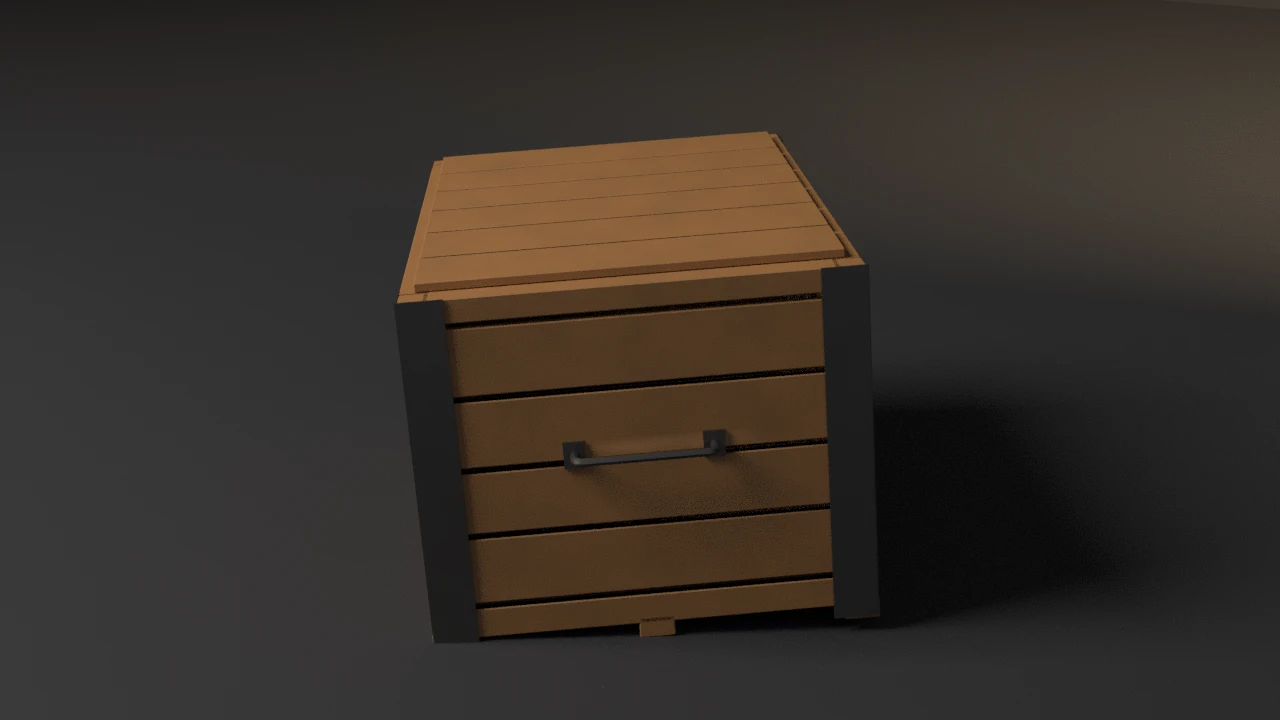
shipping-crate
A procedural shipping crate through UVs, bake, LOD, collider, and Unity glTF, asserting recomputed budgets rather than an API contract.
A procedural shaded woodland corner on a sloping soil bank — a gritstone boulder cut by deep cleavage planes into broad flat fracture faces meeting at crisp, weathered arrises, pitted, lichened and damp at its foot, split down its front by a deep crack and sunk into the bank all round; lobed moss cushions and satellite tufts laid on it as conforming shells, deepest in its hollows and feathering to nothing at the rim, tucked over the crack's lip, with bare patches; a male fern's shuttlecock crown of bipinnate fronds (alternate pinnae cut into pinnules, tapering to the tip) with fiddleheads unrolling as true spirals from a scaly rootstock bedded in the soil, a small fern growing out of the crack, beech litter, pebbles, a twig and wood sorrel — through UVs, bake, LOD, collider, and Unity glTF, asserting recomputed budgets rather than an API contract.
Rendered headless by the showcase piece itself — click to zoom.
category Nature
blender --background --python showcase/fern-mossy-rock/fern_mossy_rock.py --
A showcase piece, not an example, and the ninth in the nature category. It builds a procedural game-ready shaded woodland corner, about 2.29 × 1.90 m across and 1.11 m high, on a soil bank that rises toward the back:
MossD point attribute, each stone vertex's distance to the nearest moss), a dark damp band where the soil wicks up the foot (SoilH, height over the bank), and a black throat to the crack;Every seeded draw comes from random.Random(SEED) in plan_scene(), before anything is built: the boulder's waves and chips, each frond's bearing, age, length, arch and twist, each pinna's length, angle and rise, the fiddleheads, the stipe bases and the ground cover. Per-pinnule and per-leaf variety comes from a closed-form hash of indices. No flag draws from the stream, so a falsifier changes only what it names.
A frond that would run into the boulder or the bank as planned is stood up steeper and arched less, three degrees at a time, until it and its pinnae clear both. That is why the fronds on the boulder's side are the upright ones.
The pinnules are geometry. A pinna is one closed, thin shell: a costa from the pinna's base (inside the rachis) to its apex, curving toward the frond's tip, and on each side of it oblong lobes cut to within a few millimetres of it, shared by a top and a bottom surface each fanned from its own costa vertices, so every rim edge has one face above and one below. Leaves this dense are a coplanar hazard: along one rachis the pinnae are translated copies in one blade plane, and on the first build 216 pairs of their faces shared a plane (211 of them within one frond). Each pinna is therefore flat (its faces within a few degrees of its own plane, the costa standing 0.12% of the pinna's length proud of the rim), its neighbours are turned about their own axes in a three-step cycle (±0.20 rad), and the plan turns each one further, in 0.04 rad steps, until its plane is 8° off the plane of every pinna whose faces can come within the coplanar range of its own. All 434 clear. The sorrel leaflets, which share a point at the top of their petiole, are turned apart the same way (14°).
Everything is smooth-shaded, with every material boundary and every fold sharper than its crease (38° on the stone, 55° on leaves, 62° elsewhere) a hard edge, so a pinna's rim stays crisp while a stipe stays round. A Zone face attribute marks a leaf's underside (paler, with rusty sori beside the costa), a moss face's height in its hummocks, and the fresh faces of the crack; a Crack point attribute darkens the cleft. The frond and sorrel materials mix in a translucent lobe, so a shaded underside reads green, not black. Ten materials: stone (the boulder and pebbles), moss, frond, stipe, crozier, rootstock, soil, beech litter, twig, wood sorrel.
It asserts budget conformance of the generated result. It does not witness an API contract. "It rendered without error" is not a check.
Composes skills mesh-editing-and-bmesh, bake-high-to-low, depsgraph-and-evaluated-data, engine-export-presets, and snippets bake_normal_high_to_low.py, setup_bake_target_image.py, lod_chain.py / decimate_to_budget.py, convex_hull_collider.py, export_preset_unity.py (helpers copied inline, not imported).
The collider is the convex hull of the boulder alone, sampled coarsely, because players walk through ferns. It is built from points only.
The piece is 86,740 triangles, 58% of them pinnae; the boulder's lattice went from 28 to 36 cells a side (16,224 stone faces) so its arrises are resolved at a 16–20 mm weathering radius instead of hidden in 40–110 mm bevels. A fern is its pinnae, and the whole point of this one is pinnule detail that holds up at hero size.
Every budget is declared as a named constant. Every gate recomputes its value from the mesh, materials, UVs, evaluated LOD, collider, or export file.
| Axis | Declared | Measured (5.2.1) |
|---|---|---|
| Base triangles | 86300–87200 | 86740 |
| LOD1 ratio | 0.32–0.62 of base | 0.5000 |
| LOD2 ratio | 0.10–0.35 of base | 0.2200 |
| Materials | exactly 10 distinct; face floors stone ≥15600, moss ≥4360, frond ≥48400, stipe ≥1480, crozier ≥750, rootstock ≥290, soil ≥2350, litter ≥1660, twig ≥64, sorrel ≥2060 | 10 slots; 16224 / 4548 / 50428 / 1545 / 780 / 303 / 2446 / 1728 / 66 / 2150 |
| UVs | in 0..1, AABB overlap ≤ 1e-5 | in range, overlap 0 |
| Outer AABB | (2.2872, 1.9008, 1.1111) m ± 0.01 | (2.2872, 1.9008, 1.1111), zmin 0 |
| Collider tris (boulder hull) | ≤ 200 | 130 |
| Export | written, size > 0, removed after measuring | 10731436 bytes |
DECIMATE COLLAPSE triangle counts are not identical across Blender series, so the LOD gate is a ratio band, not an exact count. Bake pixels are stochastic, so the bake gate is has_data plus operator FINISHED, not byte-identity. The plan is seeded and nothing else is random; two default runs print identical measurements, and 4.5.11 and 5.1.2 print the same measurements as 5.2.1 (the glTF differs by 12 bytes).
Recomputed from the generated mesh, not asserted about the script.
| Axis | Declared | Measured |
|---|---|---|
| Non-manifold edges | 0 | 0 |
| Loose verts / edges | 0 / 0 | 0 / 0 |
| Doubles merged at 1e-5 | 0 | 0 |
| Zero-area faces | 0 | 0 |
| N-gons | 0 | 0 |
| Coplanar cross-shell face pairs (KD range 0.05 m, plane ε 1e-4) | 0 | 0 |
Grounded: zmin | within 1e-4 of 0 | 0.0000 |
The soil disc's flat underside is the only geometry at Z = 0. The boulder's buried underside is cut flat 40 mm above it, inside the soil; a first draft sank the boulder 0.28 m through the bottom of the disc. The coplanar budget caught more than the pinnae on the way: a beech leaf lying in the plane of a soil face (every leaf is now rolled 0.20–0.32 rad about its midrib, one edge bedded and the other lifted), sorrel leaflets of neighbouring leaves in one plane, a rachis face in the plane of a pinna and of a fiddlehead, and, under a first --sunny-moss that turned every cushion rigidly round the boulder, two cushions overlapping, so it exited 15 instead of 21. It now moves the main cushion alone.
A fern and a boulder have no joinery. What makes this read as a woodland corner is that the fern grows out of its rootstock and the rootstock out of the soil, that the moss lies on the stone and grows where the stone is shaded, that the boulder is sunk into the bank rather than set on it, that the small fern grows in the crack, that a fern frond is built the way ferns are (alternate pinnae, longest low on the blade, a pointed tip) and unrolls as a spiral, and that the leaves and stones at its foot lie in the soil. Each face carries Part, Ident and Parent tags and each vertex a Ring and a Tip, so a shell can be named, a tube's rings found and a pinna's base and apex told apart; every measurement is then made on the shell's geometry.
| Axis | Declared | Measured |
|---|---|---|
| Rooted: every stipe, fiddlehead and old stipe base's shallowest base-cap vertex inside its rootstock (ray-parity signed depth) | ≥ 0.004 m, 25 stalks | ≥ 0.0085 |
Rooted: every pinna's base (its Tip 0 vertex) inside the rachis tagged as its Parent | ≥ 0.0004 m, 434 pinnae on 15 fronds | ≥ 0.0013 |
| Rooted: the crown's rootstock sealed in the soil: in each of 8 sectors round it, its most-buried flank vertex (≥ 0.90 of the sector's reach) under the soil straight above it | ≥ 0.010 m in 8 of 8 | worst 0.0320, 8 of 8 |
| Moss seat: every moss top vertex inside the rim (bare-patch vertices excepted, see below), its height over the stone along the normal of the stone's nearest face | 0.001–0.055 m, 13 cushions and tufts | 0.0016–0.0463 |
| Moss seat: every rim, underside and bare-patch vertex inside the stone, by the same measure | ≥ 0.001 m | ≥ 0.0020 |
| Moss rim feathers: every cushion's last ring before its tucked rim, its height over the stone by the same measure | ≤ 0.010 m | ≤ 0.0069 |
| Boulder sealed: in each of 8 sectors round it, its most-buried flank vertex under the soil straight above it | ≥ 0.020 m in 8 of 8 | worst 0.0399, 8 of 8 |
| Moss facing: area share of cushion top faces whose stone (the normal of its nearest face) faces up (z ≥ 0.55) or into the shade (−y ≥ 0.45) | ≥ 0.85 | 0.8918 |
| Cleaved: of the turning between neighbouring stone faces more than 20 mm over the soil (dihedral angle × edge length, the crack left out), the share taken in arrises sharper than 20° | ≥ 0.42 | 0.4856 (turning 15.24) |
| Crack fern: its rootstock's deepest vertex inside the stone (wedged against the crack walls); its centre outside the stone with stone within reach on two opposite sides of 12 horizontal rays | bite ≥ 0.004 m, walls ≤ 0.060 m | bite 0.0159, in the cleft, walls 0.0126 |
| Pinnae alternate: per frond, pinnae sorted by station along the rachis (base projected on the rachis's ring centroids) lie on alternate sides, and each gap to the next over the same-side spacing | every pair alternate, gaps 0.25–0.75, 15 fronds | all alternate, 0.442–0.575 |
| Pinnae taper: per frond, where the longest pinna stands on the blade; the pinnae in its top fifth over the longest; the two lowest over the longest | peak 0.10–0.60, tip ≤ 0.40, base ≤ 0.88 | peak 0.223–0.468, tip ≤ 0.326, base ≤ 0.647 |
| Fiddleheads: per crozier, the centreline from its ring centroids; the coil's turning from where it first bends 30° to its tip, and the mean curvature of its inner third over its outer third, by arc length | ≥ 1.20 turns, ratio ≥ 1.80, 3 fiddleheads | 1.697–1.722 turns, ratio ≥ 2.901 |
| Ground cover: most-buried vertex under the soil straight above it, per piece | leaves, pebbles, twig 0.003–0.030 m, sorrel petioles 0.015–0.060 m; 89 pieces | 0.0040, sorrel 0.0302–0.0308 |
| Ground cover joined to the soil (union of shells whose BVH trees overlap, the sorrel leaflets included) | every cover shell in the soil's component | 164 of 164 |
The boulder is bedded on the lattice it ships with, sector by sector: the bank rises 190 mm per metre, so a boulder bedded against the soil height at its centre alone is buried uphill and open downhill. The rootstock is audited the same way. The moss's thickness is measured on the shipped stone, not the field that shaped it: the seat audit found a draft cushion whose spokes aimed at the crack had been floored at a quarter of their length, which put top vertices down the V and 27 mm inside the far block's wall. The outline now shrinks every spoke until each ring on it clears the lip.
The first release of this piece shipped a boulder that read as a smooth grey lump (ten cuts at 0.64–0.72 of the ellipsoid through 35–110 mm bevels, the waves at 40% on every face) under a moss slab whose front edge was a hard vertical wall: its height held near full to the last ring before the rim, so it dropped 20–30 mm in one ring spacing. Both are now budgets. The rim budget reads the height of each cushion's last ring before the rim; a bare patch's vertices are tagged in the Ring layer at build time and are measured with the rim and underside, inside the stone, not with the top. The cleavage budget needs no tags: it is the share of the stone's turning concentrated in sharp arrises. A count of flat regions did not separate the two recipes (the old lump, whose waves are long and low, had as many 0.03 m² planar regions as the new stone); where the turning happens did (0.49 against 0.29). Two tufts that landed on the same flat fracture face as a cushion's rim put two faces in one plane; each shell is now tucked to its own depth (5 mm plus 0.5 mm per shell).
Each falsifier violates one named budget. Every one was run on 5.2.1 and 4.5.11 and exited its declared code. The envelope and the triangle count were unchanged in every run.
| Flag | Budget violated | Exit |
|---|---|---|
--skip-decimate | LOD1 ratio band (measured 1.0000) | 9 |
--stray-vert | loose vertex count is 0 (measured 1) | 15 |
--lift-z | bounding box zmin is 0 (measured 0.05000) | 16 |
--smooth-rock | cleaved (the shipped recipe: shallow cuts through broad bevels, full waves on the faces, the ellipsoid drawn 0.90 smaller to keep its size: 0.2892 of the turning in sharp arrises) | 27 |
--float-fronds | rooted (every frond's stipe starts 60 mm out along its path, which is otherwise unchanged: shallowest base −0.0503 m) | 17 |
--lift-crown | rooted (the rootstock alone raised 50 mm: worst sector −0.0180 m, 1 of 8) | 17 |
--float-moss | moss seat (every cushion lifted 40 mm along the stone's normal: top up to 0.0858 m, rim −0.0380 m) | 18 |
--slab-moss | moss rim feathers (the shipped profile, near full height to the last ring: 0.0189 m) | 28 |
--perch-rock | boulder sealed (bedded against the soil height at its centre alone: worst sector −0.0321 m, 7 of 8) | 20 |
--sunny-moss | moss facing (the main cushion laid on the boulder's sunny back face: 0.5986) | 21 |
--perch-crack-fern | crack fern (slid 100 mm sideways out of the cleft into the wall: centre not in the cleft, walls 0.1576 m) | 22 |
--flat-taper | pinnae taper (one frond's pinnae all 0.80 of its longest: tip 0.996) | 23 |
--opposite-pinnae | pinnae alternate (one frond's lower-side pinnae moved level with the upper side's: gaps 0.0013–0.9987) | 23 |
--open-crozier | fiddleheads (each coil a circular arc of the spiral's length: 0.932 turns, ratio 1.128) | 24 |
--float-cover | ground cover (leaves, pebbles, twig and sorrel lifted 50 mm: −0.046 m, 164 shells loose) | 25 |
The crack fern is the top of the envelope, so --float-moss and --perch-rock (which lifts the boulder with its moss) cannot move the box; the soil disc sets the left and back, frond tips the right and front, so --smooth-rock (a different stone, re-bedded, cutting its own flat foot) leaves it too. --slab-moss keeps every cushion's outline, thickness and windows' places and changes only the height profile. --flat-taper and --opposite-pinnae reshape only the crown frond held furthest inside the envelope. --perch-crack-fern moves the small fern level, never up. --lift-crown moves the rootstock alone; the stalks stay inside it.
blender --background --python fern_mossy_rock.py --
blender --background --python fern_mossy_rock.py -- --skip-decimate
blender --background --python fern_mossy_rock.py -- --stray-vert
blender --background --python fern_mossy_rock.py -- --lift-z
blender --background --python fern_mossy_rock.py -- --smooth-rock
blender --background --python fern_mossy_rock.py -- --float-fronds
blender --background --python fern_mossy_rock.py -- --lift-crown
blender --background --python fern_mossy_rock.py -- --float-moss
blender --background --python fern_mossy_rock.py -- --slab-moss
blender --background --python fern_mossy_rock.py -- --perch-rock
blender --background --python fern_mossy_rock.py -- --sunny-moss
blender --background --python fern_mossy_rock.py -- --perch-crack-fern
blender --background --python fern_mossy_rock.py -- --flat-taper
blender --background --python fern_mossy_rock.py -- --opposite-pinnae
blender --background --python fern_mossy_rock.py -- --open-crozier
blender --background --python fern_mossy_rock.py -- --float-cover
blender --background --python fern_mossy_rock.py -- --output fern.png
Smoke passes no flags.
The hero turns the piece −50° about Z only (HERO_YAW_DEG), so the boulder's draped front and the crack, with the small fern growing out of it, face the camera left of the main fern, and looks at it from the front left, a little above the boulder's crown, from 3.55 m. Framing measures fill x 0.822, y 0.878. A warm wedge pools on the floor and wall behind the right of the bank.
File-local. 9 is a valid check code. 10 is reserved for gallery_framing.check_framing on the --output path. 15–18 are the hygiene, grounded, joint-fit (rooted) and seat-conformance (moss seat) family; 19 is not used, since nothing here is plumb or dressed to a stated size. 20–25, 27 and 28 are file-local. 26 is the asset-quality floor on the render path: check_asset_quality returns 11, which this piece already spends on the collider ceiling, so the call site remaps it.
| Code | Meaning |
|---|---|
| 0 | Success |
| 1 | Uncaught exception (FATAL wrapper) |
| 2 | argparse / usage |
| 3 | Mesh did not build, no UV layer, or not one boulder, soil and rootstock shell |
| 4 | Base triangle count outside range |
| 5 | Material count ≠ 10 distinct slots, or a face-count floor missed |
| 6 | UVs outside 0..1 |
| 7 | UV AABB overlap above tolerance |
| 8 | World AABB off declared outer size |
| 9 | LOD ratio band (--skip-decimate lands here) |
| 10 | Framing gate (render path only) |
| 11 | Collider triangle count above ceiling |
| 12 | Bake did not finish or image has no data |
| 13 | Export file missing or empty |
| 14 | --output produced no file |
| 15 | Mesh hygiene: loose, non-manifold, zero-area, doubles, n-gons, coplanar cross-shell pairs |
| 16 | Not grounded: bounding box zmin off 0 |
| 17 | Rooted: a stalk not in its rootstock, a pinna not in its rachis, or the rootstock not sealed in the soil (--float-fronds, --lift-crown) |
| 18 | Moss seat: a cushion's top out of its band over the stone, or its rim, underside or bare patches not inside it (--float-moss) |
| 20 | Boulder sealed: a sector round it not bedded in the soil (--perch-rock) |
| 21 | Moss facing: too little of the moss on stone that faces up or into the shade (--sunny-moss) |
| 22 | Crack fern: its rootstock not wedged in the cleft (--perch-crack-fern) |
| 23 | Pinnae: a frond's pinnae not alternate, or not tapering (--flat-taper, --opposite-pinnae) |
| 24 | Fiddleheads: a coil short of its turns, or its curvature not rising toward the centre (--open-crozier) |
| 25 | Ground cover: a piece out of its depth band under the soil or not joined to it, or not 89 pieces (--float-cover) |
| 26 | Asset-quality floor (render path only; remapped from 11) |
| 27 | Cleaved: too little of the stone's turning in sharp arrises — a rounded lump (--smooth-rock) |
| 28 | Moss rim: a cushion's last ring before its rim stands too high over the stone — a slab edge (--slab-moss) |
"""Game-ready fern and mossy rock — a showcase piece, not an example. Asserts budget conformance of a procedural shaded woodland corner after composing shipped pipeline pieces: bmesh construction, UVs, ten materials, high-to-low normal bake, LOD chain, convex boulder collider, Unity glTF export. A gritstone boulder, cleaved by deep planes into broad flat fracture faces that meet at crisp, slightly weathered arrises, with two stepped ledges broken out of it and a deep crack splitting it down its front, is sunk into a soil bank that rises toward the back. A moss cushion lies over its larger block and drapes down its shaded front: a conforming shell with a lobed outline, deepest in the stone's hollows, feathering to nothing at its edge and tucked into the stone and over the crack's lip, with bare patches where the stone shows through. Smaller cushions and nine satellite tufts sit round it. The stone is warm buff and grey, pitted, rain-streaked, spotted with lichen, stained green round the moss and dark where the soil wicks up its foot. Beside it a male fern's shuttlecock crown rises from a scaly rootstock bedded in the soil: eleven arching bipinnate fronds, each a tapering rachis carrying alternate pinnae cut into pinnules, with three fiddleheads unrolling at the centre and old stipe bases round the rootstock. A smaller fern grows out of the crack. Beech litter, pebbles, a fallen twig and wood sorrel lie at the foot. Budgets are declared below and recomputed from the generated result. They are not API-contract witnesses. Each falsifier violates one named budget: ``--skip-decimate`` the LOD-ratio band, ``--stray-vert`` mesh hygiene, ``--lift-z`` grounded zmin, ``--smooth-rock`` the stone's turning concentrated in crisp arrises, ``--float-fronds`` / ``--lift-crown`` every frond rooted in its crown and the crown bedded in the soil, ``--float-moss`` the moss cushion's thickness band on the rock, ``--slab-moss`` the cushion feathering out at its rim, ``--perch-rock`` the boulder sealed all round, ``--sunny-moss`` moss facing up or into the shade, ``--perch-crack-fern`` the crack fern rooted in the crack, ``--flat-taper`` / ``--opposite-pinnae`` pinnae alternating and tapering along the rachis, ``--open-crozier`` every fiddlehead a real spiral, ``--float-cover`` the ground cover bedded in the soil. Seeded, not random: ``random.Random(SEED)`` draws the whole plan before anything is built, so flags never shift the stream. DECIMATE COLLAPSE triangle counts are not byte-identical across Blender versions — the LOD gate is a ratio band, not an exact count. blender --background --python fern_mossy_rock.py -- blender --background --python fern_mossy_rock.py -- --skip-decimate blender --background --python fern_mossy_rock.py -- --output fern.png """ import argparse import math import os import random import sys import tempfile import traceback import bmesh import bpy from mathutils import Matrix, Vector from mathutils.bvhtree import BVHTree from mathutils.kdtree import KDTree # Showcase lives at repo-root/showcase/, not under examples/. The framing # helper is the repo's only shared import and lives next to the examples; # resolve the repo root so we do not move gallery_framing.py. _REPO = os.path.abspath( os.path.join(os.path.dirname(os.path.abspath(__file__)), os.pardir, os.pardir) ) sys.path.insert(0, os.path.join(_REPO, "examples")) sys.dont_write_bytecode = True import gallery_framing # noqa: E402 import gallery_asset_quality # noqa: E402 SEED = 3719 TAU = 2.0 * math.pi UP = Vector((0.0, 0.0, 1.0)) # The bank faces away from the light: its downhill front (-Y) is the shaded # side, where the moss drapes and the ferns grow. SHADE = Vector((0.0, -1.0, 0.0)) # --- Ground ------------------------------------------------------------------ SOIL_A = (0.95, 0.78) # soil disc half-axes before the wobble, m SOIL_C = (0.16, 0.12) # its centre, drawn toward the fern so no bare soil is spare SOIL_N = 34 SOIL_H0 = 0.20 SLOPE = 0.19 # the bank rises toward the back (+Y), m per m SOIL_EDGE = 0.16 # the rim rolls down over this fraction of the radius SOIL_FLOOR = 0.02 # --- Boulder ----------------------------------------------------------------- ROCK_XY = (-0.10, 0.20) ROCK_YAW = 12.0 ROCK_AXES = (0.74, 0.60, 0.80) ROCK_O = (0.02, -0.04, 0.02) # the radial field's origin; the crack plane passes through it # cleavage planes (normal, offset as a fraction of the ellipsoid's support, # weathering bevel): deep cuts, so broad flat fracture faces meet at crisp, # slightly rounded arrises — a tilted top, a broad front face, oblique # shoulders and the flanks ROCK_PLANES = (((0.16, -0.26, 1.0), 0.50, 0.018), ((0.04, -1.0, 0.06), 0.55, 0.020), ((-1.0, 0.14, 0.06), 0.56, 0.020), ((0.30, 1.0, 0.12), 0.56, 0.020), ((1.0, -0.12, 0.16), 0.58, 0.018), ((-0.62, -0.58, 0.40), 0.56, 0.016), ((0.10, -0.74, 0.70), 0.56, 0.016), ((0.66, -0.66, 0.30), 0.58, 0.018), ((-0.52, 0.52, 0.66), 0.58, 0.016), ((0.60, 0.50, 0.60), 0.58, 0.016), ((-0.75, -0.15, -0.35), 0.70, 0.030), ((0.20, -0.80, -0.30), 0.72, 0.030)) # stepped ledges: a block broken out of an arris, the region beyond both # planes (normal, offset fraction) removed; the step's own bevel ROCK_NOTCHES = ((((0.0, 0.0, 1.0), 0.30), ((-1.0, 0.10, 0.10), 0.40), 0.016), (((0.10, -1.0, 0.0), 0.44), ((0.95, 0.0, 0.30), 0.42), 0.016)) # --smooth-rock: the recipe that shipped first and read as a smooth lump SMOOTH_SCALE = 0.90 SMOOTH_PLANES = (((0.10, -0.22, 1.0), 0.52, 0.110), ((0.06, -1.0, 0.18), 0.64, 0.070), ((-1.0, 0.10, 0.20), 0.64, 0.045), ((0.45, 0.90, 0.20), 0.66, 0.040), ((0.92, -0.28, 0.38), 0.66, 0.035), ((-0.55, -0.62, 0.52), 0.64, 0.040), ((-0.40, 0.75, 0.55), 0.66, 0.040), ((0.30, -0.70, 0.75), 0.66, 0.035), ((-0.75, -0.15, -0.35), 0.70, 0.045), ((0.20, -0.80, -0.30), 0.72, 0.045)) ROCK_CHIPS = 7 ROCK_AMP = 0.034 ROCK_FLAT = 0.90 # how much of the waves the flat fracture faces lose ROCK_N = 36 ROCK_N_HIGH = 52 ROCK_FOOT = 0.040 # the buried underside is cut flat this far over Z = 0 COLLIDER_N = 4 # the crack: a V cut along a plane through the origin, ``CRACK_W`` half-wide # at the surface and ``CRACK_D`` deep, closing low on the flanks CRACK_N = (0.95, 0.24, 0.10) CRACK_W = 0.062 CRACK_D = 0.22 CRACK_LOW = -0.32 CRACK_A = 0.45 # directions this near the crack plane (rad) are drawn in toward it CRACK_Q = 2.2 EMBED = 0.040 # every sector's most-buried flank vertex this far under the soil FLANK_R = 0.90 # flank: at least this fraction of the sector's plan reach SECTORS = 8 # --- Moss -------------------------------------------------------------------- # (centre direction from the rock frame's origin, radius m, stretch down # the drape, thickness m, rings, segments, drape direction, reach toward # the far flank as a fraction). The main cushion sits on the larger # block's crown and drapes down its shaded front. MOSS = (((-0.66, -0.42, 0.62), 0.40, 1.75, 0.042, 16, 72, (0.10, -1.0, -0.55), 0.70), ((0.46, 0.10, 0.88), 0.16, 1.15, 0.030, 10, 40, (0.0, -1.0, -0.5), 1.0), ((-0.52, -0.80, 0.12), 0.14, 1.30, 0.028, 10, 40, (0.0, -1.0, -0.5), 1.0), ((0.44, -0.80, 0.30), 0.13, 1.25, 0.026, 10, 40, (0.0, -1.0, -0.5), 1.0)) # satellite tufts round the cushions and in the stone's hollows MOSS_TUFTS = (((-0.28, -0.58, 0.76), 0.060), ((-0.60, -0.70, 0.40), 0.055), ((-0.62, -0.76, -0.02), 0.050), ((0.62, -0.62, 0.50), 0.050), ((-0.45, 0.20, 0.87), 0.065), ((0.42, -0.84, 0.34), 0.045), ((0.80, -0.50, 0.10), 0.045), ((-0.70, 0.30, 0.64), 0.055), ((0.10, 0.62, 0.78), 0.050)) TUFT_THICK = 0.011 MOSS_TUCK = 0.005 # the cushion's rim this far inside the stone MOSS_BITE = 0.006 MOSS_CLEAR = 0.020 # rim kept this far over the soil MOSS_CRACK_CLEAR = -0.030 # and it may run this far past the crack's lip MOSS_EDGE = 0.42 # the cushion feathers to nothing over this outer share of its radius MOSS_HOLLOW_STEP = 0.07 # rad: the ring of stone a hollow is judged against MOSS_HOLLOW_FULL = 0.012 # m below its ring for the full extra depth MOSS_HOLLOW_GAIN = 0.8 MOSS_WINDOWS = 2 # bare patches in a large cushion MOSS_WIN_DEPTH = 0.0035 MOSS_TOP_MIN = 0.0015 SUNNY_D = (0.32, 0.92, 0.22) # --sunny-moss: the main cushion's centre on the sunny back face # --- Fern crown -------------------------------------------------------------- CROWN_XY = (0.66, -0.22) KNOB_R = (0.080, 0.074, 0.056) # rootstock half-axes KNOB_SINK = 0.034 # its centre this far under the soil FRONDS = 11 FROND_L = (0.96, 1.14) STIPE_F = 0.22 # the stipe's share of the frond FROND_E0 = (54.0, 77.0) # elevation where it leaves the crown, deg FROND_ETIP = (-40.0, -10.0) FROND_RINGS = 22 FROND_SIDES = 5 FROND_SIDES_HIGH = 8 R_STIPE = 0.0046 R_RACHIS_TIP = 0.0014 PINNAE = 15 # per side on a crown frond PINNA_LMAX = (0.118, 0.136) PINNULES_MAX = 5 # Neighbouring pinnae are turned about their own axes in a three-step # cycle: along a rachis they are otherwise translated copies in one blade # plane, and their faces land on shared planes. PINNA_TWIST = 0.20 # ...and each pinna turns further, in steps, until its plane clears the # plane of every pinna whose faces can come within the coplanar range. PINNA_SEP = math.radians(8.0) PINNA_STEP = 0.04 CROSIERS = 3 CROSIER_TURNS = 1.65 CROSIER_R0 = 0.034 CROSIER_B = 0.135 # log-spiral rate: r = R0 exp(-b phi) CROSIER_RINGS = (6, 36) # stipe, coil STUBS = 7 # --- Crack fern -------------------------------------------------------------- CRACK_FRONDS = 4 CRACK_FROND_L = (0.44, 0.56) CRACK_PINNAE = 13 CRACK_PINNULES_MAX = 4 CKNOB_R = 0.030 CKNOB_DEPTH = 0.52 # its centre this fraction of the crack's depth down # --- Ground cover ------------------------------------------------------------ LITTER = 48 PEBBLES = 14 SORREL = 7 TWIGS = 1 LEAFLET_SEP = math.radians(14.0) # sorrel leaflets' planes kept this far apart REST_SINK = 0.004 # a lying body's most-buried vertex this far under the soil SORREL_BURY = 0.030 BBOX_TOL = 0.01 # Fitted after locking geometry. Recomputed from bound_box. OUTER_SIZE = (2.2872, 1.9008, 1.1111) BASE_TRIS_MIN = 86300 BASE_TRIS_MAX = 87200 LOD1_RATIO_MIN = 0.32 LOD1_RATIO_MAX = 0.62 LOD2_RATIO_MIN = 0.10 LOD2_RATIO_MAX = 0.35 LOD1_TARGET = 0.50 LOD2_TARGET = 0.22 MATERIAL_COUNT = 10 UV_EPS = 1e-4 UV_OVERLAP_MAX = 1e-5 COLLIDER_TRIS_MAX = 200 BAKE_RES = 512 CAGE_EXTRUSION = 0.01 # face floors: rock, moss, frond, stipe, crozier, rootstock, soil, litter, twig, sorrel FACE_FLOORS = (15600, 4360, 48400, 1480, 750, 290, 2350, 1660, 64, 2060) ZMIN_EPS = 1e-4 DOUBLES_EPS = 1e-5 AREA_EPS = 1e-10 COPLANAR_NORMAL_EPS = 1e-4 COPLANAR_PLANE_EPS = 1e-4 COPLANAR_CENTRE_MAX = 0.05 LIFT_Z = 0.05 # Rooted: every stipe's base cap inside its rootstock, every pinna's base # inside its rachis, the crown's rootstock sealed in the soil. STIPE_BITE_MIN = 0.004 PINNA_BITE_MIN = 0.0004 KNOB_SEAL_EPS = 0.010 FLOAT_FRONDS = 0.060 # --float-fronds starts each stipe this far out along its path LIFT_CROWN = 0.050 # --lift-crown raises the rootstock alone # Moss seat: the cushion's thickness over the stone along the stone's normal MOSS_BAND = (0.001, 0.055) MOSS_IN_MIN = 0.001 # rim and underside at least this far inside the stone FLOAT_MOSS = 0.040 MOSS_RIM_MAX = 0.010 # the last ring before the tucked rim at most this far over the stone # Cleaved: the share of the stone's turning taken in arrises sharper than # CRISP_ANG (faces at least FACET_CLEAR over the soil, the crack left out) CRISP_ANG = 20.0 FACET_CLEAR = 0.020 CRISP_MIN = 0.42 # Sealed: every sector's most-buried flank vertex under the soil SEAL_EPS = 0.020 # Moss facing: area share of cushion faces facing up or into the shade UP_MIN = 0.55 SHADE_MIN = 0.45 FACING_MIN = 0.85 # Crack fern: its rootstock bites the crack walls and sits in the cleft CKNOB_BITE_MIN = 0.004 CRACK_REACH = 0.060 CRACK_SHIFT = 0.100 # --perch-crack-fern slides the crack fern sideways out of the cleft # Pinnae: alternate along the rachis, longest low on the blade, tapering to the tip ALT_BAND = (0.25, 0.75) # gap to the next pinna over the same-side spacing PEAK_BAND = (0.10, 0.60) TIP_RATIO_MAX = 0.40 BASE_RATIO_MAX = 0.88 # Fiddleheads: turning and curvature rising toward the centre SPIRAL_TURNS_MIN = 1.20 SPIRAL_RATIO_MIN = 1.80 # Ground cover: most-buried vertex under the soil straight above it REST_BAND = (0.003, 0.030) SORREL_BAND = (0.015, 0.060) FLOAT_COVER = 0.050 # Hero yaw about Z only (level on the stage). HERO_YAW_DEG = -50.0 WALL_Y = 4.2 ROCK_IDX = 0 MOSS_IDX = 1 FROND_IDX = 2 STIPE_IDX = 3 CROZIER_IDX = 4 ROOT_IDX = 5 SOIL_IDX = 6 LITTER_IDX = 7 TWIG_IDX = 8 SORREL_IDX = 9 MAT_LABELS = ("rock", "moss", "frond", "stipe", "crozier", "rootstock", "soil", "litter", "twig", "sorrel") # part tags, one per face, so the audits can name a shell's role P_SOIL, P_ROCK, P_MOSS, P_KNOB, P_STIPE, P_PINNA, P_CROSIER, P_STUB = 1, 2, 3, 4, 5, 6, 7, 8 P_CKNOB, P_LITTER, P_PEBBLE, P_TWIG, P_SORREL, P_LEAFLET = 9, 10, 11, 12, 13, 14 COVER_PARTS = (P_LITTER, P_PEBBLE, P_TWIG, P_SORREL) KNOB_ID = 100 CKNOB_ID = 200 def eevee_engine_id(): return "BLENDER_EEVEE" if bpy.app.version >= (5, 0, 0) else "BLENDER_EEVEE_NEXT" def fail(msg, code): print(f"ERROR: {msg}", file=sys.stderr) return code def triangle_count(mesh): mesh.calc_loop_triangles() return len(mesh.loop_triangles) def evaluated_triangle_count(obj): # Duplicated from snippets/lod_chain.py / decimate_to_budget.py (not a package). depsgraph = bpy.context.evaluated_depsgraph_get() eval_obj = obj.evaluated_get(depsgraph) eval_mesh = eval_obj.to_mesh() try: eval_mesh.calc_loop_triangles() return len(eval_mesh.loop_triangles) finally: eval_obj.to_mesh_clear() def smoothstep(x, lo, hi): t = min(max((x - lo) / (hi - lo), 0.0), 1.0) return t * t * (3.0 - 2.0 * t) def smin(a, b, k): """Polynomial soft minimum: the weathering bevel where two cuts meet.""" if k <= 0.0: return min(a, b) h = max(k - abs(a - b), 0.0) / k return min(a, b) - h * h * k * 0.25 def hash01(a, b, c): """A closed-form draw in [0, 1) from three indices: per-part variety that no flag can shift.""" x = math.sin(a * 12.9898 + b * 78.233 + c * 37.719 + SEED * 0.0137) * 43758.5453 return x - math.floor(x) def perp_basis(d): ref = UP if abs(d.z) < 0.9 else Vector((1.0, 0.0, 0.0)) e1 = d.cross(ref).normalized() return e1, d.cross(e1).normalized() def rotz(deg): return Matrix.Rotation(math.radians(deg), 4, "Z") def rotate_about(v, axis, ang): return Matrix.Rotation(ang, 3, axis) @ v # -------------------------------------------------------------------------- # The ground as a function of plan position # -------------------------------------------------------------------------- def disc_wobble(th): return (1.0 + 0.05 * math.sin(3.0 * th + 0.7) + 0.03 * math.sin(5.0 * th + 2.1) + 0.02 * math.sin(8.0 * th + 0.3)) def soil_height(x, y): """A woodland bank rising toward the back, with low swells.""" h = (SOIL_H0 + SLOPE * y + 0.018 * math.sin(2.1 * x + 0.4) * math.cos(1.7 * y + 0.8) + 0.008 * math.sin(4.3 * x - 3.1 * y + 1.1) + 0.004 * math.sin(8.3 * x + 6.9 * y)) return max(SOIL_FLOOR, h) def disc_frac(x, y): """How far out (x, y) lies on the soil disc, 1 at the rim.""" x, y = x - SOIL_C[0], y - SOIL_C[1] th = math.atan2(y / SOIL_A[1], x / SOIL_A[0]) return math.hypot(x / SOIL_A[0], y / SOIL_A[1]) / disc_wobble(th) class Ground: """The built soil, sampled by a ray straight down, so everything seated on it sits on the faces actually shipped.""" def __init__(self, tree): self.tree = tree def hit(self, x, y): loc, nrm, _i, _d = self.tree.ray_cast(Vector((x, y, 5.0)), Vector((0.0, 0.0, -1.0)), 20.0) if loc is None: return Vector((x, y, 0.0)), Vector((0.0, 0.0, 1.0)) if nrm.z < 0.0: nrm = -nrm return loc, nrm def z(self, x, y): return self.hit(x, y)[0].z # -------------------------------------------------------------------------- # The boulder: a star-shaped radial field about an interior origin # -------------------------------------------------------------------------- def draw_waves(rng, size): waves = [] for freq, amp in ((1.9, 1.0), (2.9, 0.62), (4.3, 0.42), (6.1, 0.28), (8.7, 0.18), (12.3, 0.11), (17.0, 0.07), (23.0, 0.045)): w = Vector((rng.gauss(0, 1), rng.gauss(0, 1), rng.gauss(0, 1))).normalized() waves.append((w * (freq / max(size, 0.4)), rng.uniform(0.0, TAU), amp)) total = sum(a for _w, _p, a in waves) return [(w, p, a / total) for w, p, a in waves] class Rock: """The boulder in its own frame. ``sample(d)`` is the distance from the origin ``o`` to the surface along unit ``d``: the ellipsoid, cut by each cleavage plane through a soft minimum, displaced by seeded waves, then notched by the crack. ``M`` maps the frame to the world.""" def __init__(self, plan): self.smooth = plan.get("smooth_rock", False) # --smooth-rock: its shallow cuts leave more of the ellipsoid, so it # is drawn smaller to keep the stone's size self.axes = Vector(ROCK_AXES) * (SMOOTH_SCALE if self.smooth else 1.0) self.o = Vector(ROCK_O) self.waves = plan["rock_waves"] self.planes = [] self.notches = [] cuts = tuple(ROCK_PLANES) + tuple(plan["rock_chips"]) if self.smooth: # --smooth-rock: the shipped recipe — shallow cuts through broad # bevels, the waves at full height on every face cuts = SMOOTH_PLANES for nrm, f, k in cuts: n = Vector(nrm).normalized() self.planes.append((n, f * self.support(n), k)) if not self.smooth: for (n1, f1), (n2, f2), k in ROCK_NOTCHES: a, b = Vector(n1).normalized(), Vector(n2).normalized() self.notches.append((a, f1 * self.support(a), b, f2 * self.support(b), k)) self.nc = Vector(CRACK_N).normalized() # --smooth-rock sits at its own depth, so it cuts its own flat foot self.bottom = None if self.smooth else plan.get("rock_bottom") self.M = Matrix.Identity(4) self.Mi = Matrix.Identity(4) def set_matrix(self, M): self.M = M.copy() self.Mi = M.inverted() def support(self, n): a = self.axes return math.sqrt((a.x * n.x) ** 2 + (a.y * n.y) ** 2 + (a.z * n.z) ** 2) def fbm(self, p): return sum(a * math.sin(w.dot(p) + ph) for w, ph, a in self.waves) def whole(self, d): """Radius along ``d`` before the crack.""" a = self.axes qa = Vector((self.o.x / a.x, self.o.y / a.y, self.o.z / a.z)) wa = Vector((d.x / a.x, d.y / a.y, d.z / a.z)) A = wa.dot(wa) B = 2.0 * qa.dot(wa) C = qa.dot(qa) - 1.0 te = (-B + math.sqrt(max(B * B - 4.0 * A * C, 0.0))) / (2.0 * A) r = te tmin = te for n, h, k in self.planes: dn = n.dot(d) if dn <= 1e-6: continue t = (h - n.dot(self.o)) / dn tmin = min(tmin, t) r = smin(r, t, k) for n1, h1, n2, h2, k in self.notches: d1, d2 = n1.dot(d), n2.dot(d) if d1 <= 1e-6 or d2 <= 1e-6: continue t = -smin(-(h1 - n1.dot(self.o)) / d1, -(h2 - n2.dot(self.o)) / d2, k) tmin = min(tmin, t) r = smin(r, t, k) if self.bottom is not None and d.z < -1e-6: r = smin(r, (self.bottom - self.o.z) / d.z, 0.04) flat = smoothstep(te - tmin, 0.0, 0.06) p = self.o + d * r keep = 0.4 if self.smooth else 1.0 - ROCK_FLAT return r + ROCK_AMP * self.fbm(p) * (1.0 - (1.0 - keep) * flat) def crack_depth(self, d, r0): dist = abs(self.nc.dot(d)) * r0 if dist >= CRACK_W: return 0.0 m = smoothstep(d.z, CRACK_LOW, CRACK_LOW + 0.34) return CRACK_D * m * (1.0 - dist / CRACK_W) ** 2 def sample(self, d): """(radius, whole radius, crack depth) along unit ``d``.""" r0 = self.whole(d) c = self.crack_depth(d, r0) return r0 - c, r0, c def local_point(self, d): return self.o + d * self.sample(d)[0] def point(self, d): return self.M @ self.local_point(d) def normal(self, d): e1, e2 = perp_basis(d) e = 0.004 pa = self.local_point((d + e1 * e).normalized()) - self.local_point((d - e1 * e).normalized()) pb = self.local_point((d + e2 * e).normalized()) - self.local_point((d - e2 * e).normalized()) n = pa.cross(pb).normalized() if n.dot(d) < 0.0: n = -n return (self.M.to_3x3() @ n).normalized() def contains(self, p, margin=0.0): """World point ``p`` inside the boulder (grown by ``margin``).""" q = self.Mi @ p v = q - self.o ln = v.length if ln < 1e-9: return True return ln < self.sample(v / ln)[0] + margin _CUBE = {} def cube_sphere(n): """Unit directions on a warped cube-sphere lattice and its quads.""" if n in _CUBE: return _CUBE[n] index = {} dirs = [] def vid(i, j, k): key = (i, j, k) if key not in index: q = [math.tan(math.pi / 4.0 * (2.0 * c / n - 1.0)) for c in key] index[key] = len(dirs) dirs.append(Vector(q).normalized()) return index[key] quads = [] for ax in range(3): b, c = (ax + 1) % 3, (ax + 2) % 3 for side in (0, n): for uu in range(n): for vv in range(n): corners = [] for du, dv in ((0, 0), (1, 0), (1, 1), (0, 1)): key = [0, 0, 0] key[ax] = side key[b] = uu + du key[c] = vv + dv corners.append(vid(*key)) quads.append(corners if side else corners[::-1]) _CUBE[n] = (dirs, quads) return _CUBE[n] def crack_dirs(dirs, nc): """Turn the lattice so one family of its lines runs along the crack plane, then draw it in toward the plane so the narrow V is resolved: angle a off the plane goes to A (|a| / A)^Q inside A.""" R = Vector((1.0, 0.0, 0.0)).rotation_difference(nc).to_matrix() out = [] for d in dirs: d = R @ d s = max(-1.0, min(1.0, nc.dot(d))) a = math.asin(s) if abs(a) < CRACK_A: par = d - nc * s if par.length > 1e-9: a2 = math.copysign(CRACK_A * (abs(a) / CRACK_A) ** CRACK_Q, a) d = par.normalized() * math.cos(a2) + nc * math.sin(a2) out.append(d.normalized()) return out class RockMesh: """The boulder sampled on its crack-drawn cube-sphere.""" def __init__(self, rock, n): self.rock = rock dirs, quads = cube_sphere(n) self.dirs = crack_dirs(dirs, rock.nc) self.quads = quads self.local = [] self.crack = [] for d in self.dirs: r, _r0, c = rock.sample(d) self.local.append(rock.o + d * r) self.crack.append(c) def world(self): return [self.rock.M @ p for p in self.local] def tree(self): return BVHTree.FromPolygons([tuple(p) for p in self.world()], self.quads) def flank_bury(pts, ground): """Per sector about the plan centroid, the deepest flank vertex below the ground straight above it. Flank: at least FLANK_R of the sector's plan reach from the centroid.""" cx = sum(p.x for p in pts) / len(pts) cy = sum(p.y for p in pts) / len(pts) reach = [0.0] * SECTORS polar = [] for p in pts: a = math.atan2(p.y - cy, p.x - cx) % TAU s = min(SECTORS - 1, int(a / TAU * SECTORS)) r = math.hypot(p.x - cx, p.y - cy) polar.append((s, r)) reach[s] = max(reach[s], r) best = [-9.0] * SECTORS for p, (s, r) in zip(pts, polar): if r >= FLANK_R * reach[s]: g = ground(p.x, p.y) if g is not None: best[s] = max(best[s], g - p.z) return best def place_rock(rock, perch): """Bed the boulder: sink it until every sector's most-buried flank vertex is EMBED under the soil. ``perch`` beds it against the soil height at its centre alone, as if the bank were level.""" M0 = Matrix.Translation(Vector((ROCK_XY[0], ROCK_XY[1], 0.0))) @ rotz(ROCK_YAW) for _pass in range(2): rock.set_matrix(M0) pts = RockMesh(rock, ROCK_N).world() if perch: cz = soil_height(ROCK_XY[0], ROCK_XY[1]) best = flank_bury(pts, lambda x, y: cz) else: best = flank_bury(pts, soil_height) dz = min(best) - EMBED rock.set_matrix(Matrix.Translation(Vector((0.0, 0.0, dz))) @ M0) if rock.bottom is not None: break # the buried underside is cut flat above the soil disc's base (the # frame turns only about Z, so a local height is a world height) rock.bottom = ROCK_FOOT - dz return rock def rock_hull(rock): pts = RockMesh(rock, 10).world() return hull2d([(p.x, p.y) for p in pts]) def hull2d(pts): pts = sorted(set((round(p[0], 6), round(p[1], 6)) for p in pts)) if len(pts) < 3: return pts def cross(o, a, b): return (a[0] - o[0]) * (b[1] - o[1]) - (a[1] - o[1]) * (b[0] - o[0]) lower = [] for p in pts: while len(lower) >= 2 and cross(lower[-2], lower[-1], p) <= 0: lower.pop() lower.append(p) upper = [] for p in reversed(pts): while len(upper) >= 2 and cross(upper[-2], upper[-1], p) <= 0: upper.pop() upper.append(p) return lower[:-1] + upper[:-1] def hull_margin(hull, x, y): """Signed distance of (x, y) inside a CCW hull (negative outside).""" best = 9.0 outside = 0.0 for a, b in zip(hull, hull[1:] + hull[:1]): ex, ey = b[0] - a[0], b[1] - a[1] ln = math.hypot(ex, ey) d = (ex * (y - a[1]) - ey * (x - a[0])) / ln best = min(best, d) if d < 0.0: t = min(max(((x - a[0]) * ex + (y - a[1]) * ey) / (ln * ln), 0.0), 1.0) outside = max(outside, math.hypot(x - a[0] - t * ex, y - a[1] - t * ey)) return best if best >= 0.0 else -outside # -------------------------------------------------------------------------- # Fronds: a rachis path, blade frames and the pinnae hung on it # -------------------------------------------------------------------------- def frond_dir(fr, s): th = fr["e0"] + (fr["etip"] - fr["e0"]) * s ** fr["curv"] ps = fr["az"] + fr["lat"] * s * s return Vector((math.cos(th) * math.cos(ps), math.cos(th) * math.sin(ps), math.sin(th))) def frond_path(fr): """Rachis points, tangents and blade side vectors (horizontal, left of the heading, turned by the frond's twist).""" n = fr["rings"] step = fr["L"] / (n - 1) p = fr["base"].copy() pts = [p.copy()] for i in range(1, n): s = (i - 0.5) / (n - 1) p = p + frond_dir(fr, s) * step pts.append(p.copy()) tans, sides = [], [] for i in range(n): a = pts[max(i - 1, 0)] b = pts[min(i + 1, n - 1)] t = (b - a).normalized() s = i / (n - 1) ps = fr["az"] + fr["lat"] * s * s sv = Vector((-math.sin(ps), math.cos(ps), 0.0)) sv = (sv - t * sv.dot(t)).normalized() sv = rotate_about(sv, t, fr["twist"] * s) tans.append(t) sides.append(sv) return pts, tans, sides def rachis_radius(fr, s): return R_RACHIS_TIP + (fr["r0"] - R_RACHIS_TIP) * (1.0 - s) ** 0.75 def at(path, s): pts, tans, sides = path n = len(pts) x = min(max(s, 0.0), 1.0) * (n - 1) j = min(int(x), n - 2) f = x - j p = pts[j].lerp(pts[j + 1], f) t = (pts[j + 1] - pts[j]).normalized() sv = sides[j].lerp(sides[j + 1], f) sv = (sv - t * sv.dot(t)).normalized() return p, t, sv def pinna_profile(u, peak): """Pinna length along the blade (0 at its base, 1 at the tip): the lowest pinnae shorter, the longest a third of the way up, tapering to a point.""" if u < peak: return 0.50 + 0.50 * math.sin(0.5 * math.pi * u / peak) return 0.06 + 0.94 * math.cos(0.5 * math.pi * min(1.0, (u - peak) / (1.0 - peak))) ** 1.15 def plan_pinnae(fr, n_side, lmax, npin_max, key0, rng_u): """Alternate pinnae: stations on the two sides interleave by half a spacing, crowding a little toward the tip.""" peak = fr["peak"] out = [] for side, off in ((1.0, 0.0), (-1.0, 0.5)): for i in range(n_side): u = 0.015 + 0.955 * ((i + off + 0.25) / n_side) ** 0.94 ell = lmax * pinna_profile(u, peak) * (0.94 + 0.12 * hash01(key0, i, side)) npin = max(1, min(npin_max, int(round(ell / 0.0165)))) k = key0 * 1000.0 + i * 2 + (0 if side > 0 else 1) out.append({"u": u, "i": i, "side": side, "ell": ell, "npin": npin, "key": k, "beta": math.radians(78.0 - 26.0 * u + 6.0 * (hash01(k, 1, 1) - 0.5)), "roll": PINNA_TWIST * ((i % 3) - 1) + 0.03 * (hash01(k, 1, 2) - 0.5), "droop": 0.004 + 0.006 * hash01(k, 1, 3), "sweep": 0.05 + 0.08 * hash01(k, 1, 4), "rise": 0.08 + 0.08 * hash01(k, 1, 7)}) return out def pinna_frame(fr, pn, path, uu=None): """Where a pinna leaves the rachis and how it is set: its station, the rachis point, the rachis tangent, the blade normal, the pinna's axis and its unturned normal.""" if uu is None: uu = pn["u"] s = fr["sb"] + uu * (0.985 - fr["sb"]) p, t, sv = at(path, s) nb = t.cross(sv).normalized() sg = pn["side"] be = pn["beta"] e1 = (t * math.cos(be) + sv * (sg * math.sin(be)) + nb * pn["rise"]).normalized() e30 = (nb - e1 * nb.dot(e1)).normalized() return s, p, t, nb, e1, e30 def separate_pinnae(fronds): """Turn each pinna about its own axis, in PINNA_STEP steps either side of its planned twist, until its normal is PINNA_SEP off the normal of every pinna already set whose faces can come within COPLANAR_CENTRE_MAX of its own. Returns how many could not be cleared.""" placed = [] cos_sep = math.cos(PINNA_SEP) failed = 0 for fr in fronds: path = frond_path(fr) for pn in sorted(fr["pinnae"], key=lambda q: (q["u"], q["side"])): _s, p, _t, _nb, e1, e30 = pinna_frame(fr, pn, path) half = 0.5 * pn["ell"] c = p + e1 * half near = [n for q, n, h in placed if (q - c).length < half + h + COPLANAR_CENTRE_MAX] r0 = pn["roll"] best = None for k in range(61): r = r0 + ((k + 1) // 2) * PINNA_STEP * (1.0 if k % 2 else -1.0) n = rotate_about(e30, e1, r) if all(abs(n.dot(m)) < cos_sep for m in near): best = r break if best is None: failed += 1 best = r0 pn["roll"] = best placed.append((c, rotate_about(e30, e1, best), half)) return failed def frond_clear(fr, rock, extra_pts=()): """True if the frond keeps off the boulder and above the soil.""" path = frond_path(fr) pts, tans, sides = path for i, p in enumerate(pts): s = i / (len(pts) - 1) # a crack fern's stipe climbs out of the cleft: held off the walls # only, not the margin the open blade keeps if rock.contains(p, 0.0 if (fr["crack"] and s < fr["sb"]) else 0.035): return False if i > 2 and p.z < soil_height(p.x, p.y) + 0.05: return False if s >= fr["sb"]: u = (s - fr["sb"]) / (1.0 - fr["sb"]) half = fr["lmax"] * pinna_profile(u, fr["peak"]) for sg in (1.0, -1.0): q = p + sides[i] * (sg * half) if rock.contains(q, 0.030): return False if q.z < soil_height(q.x, q.y) + 0.04: return False return True # -------------------------------------------------------------------------- # The plan: every seeded draw happens here, before anything is built # -------------------------------------------------------------------------- def plan_scene(): rng = random.Random(SEED) def u(a, b): return a + (b - a) * rng.random() plan = {"rock_waves": draw_waves(rng, max(ROCK_AXES))} chips = [] for _k in range(ROCK_CHIPS): n = Vector((rng.gauss(0, 1), rng.gauss(0, 1), abs(rng.gauss(0, 0.8)) + 0.15)) chips.append((tuple(n.normalized()), u(0.74, 0.84), 0.025)) plan["rock_chips"] = chips rock = place_rock(Rock(plan), False) plan["rock_M"] = rock.M.copy() plan["rock_bottom"] = rock.bottom # --- the crown: a rootstock bedded at the boulder's downhill foot cx, cy = CROWN_XY knob_c = Vector((cx, cy, soil_height(cx, cy) - KNOB_SINK)) plan["knob_c"] = knob_c plan["knob_lumps"] = [u(-1.0, 1.0) for _ in range(160)] fronds = [] az0 = u(0.0, TAU) order = list(range(FRONDS)) rng.shuffle(order) for k in range(FRONDS): az = az0 + TAU * k / FRONDS + u(-0.20, 0.20) age = order[k] / (FRONDS - 1) # 0 youngest (upright) .. 1 oldest (spread) L = u(*FROND_L) * (0.92 + 0.10 * age) ring_r = 0.30 + 0.25 * age base = knob_c + Vector((math.cos(az) * KNOB_R[0] * ring_r, math.sin(az) * KNOB_R[1] * ring_r, KNOB_R[2] * 0.55)) fr = {"id": 300 + k, "parent": KNOB_ID, "base": base, "az": az, "L": L, "e0": math.radians(FROND_E0[1] - (FROND_E0[1] - FROND_E0[0]) * age + u(-2.0, 2.0)), "etip": math.radians(FROND_ETIP[1] - (FROND_ETIP[1] - FROND_ETIP[0]) * age + u(-4.0, 4.0)), "curv": u(1.5, 1.9), "lat": u(-0.30, 0.30), "twist": u(-0.35, 0.35), "rings": FROND_RINGS, "sb": STIPE_F + u(-0.02, 0.02), "r0": R_STIPE * u(0.92, 1.08), "lmax": u(*PINNA_LMAX) * L / 0.9, "peak": u(0.26, 0.38), "tone": rng.random(), "n_side": PINNAE, "npin_max": PINNULES_MAX, "crack": False} # a frond that would run into the boulder or the bank stands up # steeper and arches less until it clears for _t in range(16): if frond_clear(fr, rock): break fr["e0"] = min(fr["e0"] + math.radians(3.0), math.radians(84.0)) fr["etip"] = fr["etip"] + math.radians(5.0) fr["pinnae"] = plan_pinnae(fr, PINNAE, fr["lmax"], PINNULES_MAX, fr["id"], u) fronds.append(fr) # --- the crack fern: a small rootstock wedged down the cleft nc = rock.nc v = Vector((0.0, -0.55, 0.83)) v = (v - nc * v.dot(nc)).normalized() r, r0, c = rock.sample(v) ck_local = rock.o + v * (r0 - CKNOB_DEPTH * CRACK_D) ck = rock.M @ ck_local plan["cknob_c"] = ck plan["cknob_lumps"] = [u(-1.0, 1.0) for _ in range(60)] along = (rock.M.to_3x3() @ nc.cross(v)).normalized() out_w = (rock.M.to_3x3() @ v).normalized() plan["crack_frame"] = (along, out_w, (rock.M.to_3x3() @ nc).normalized()) for k in range(CRACK_FRONDS): sgn = 1.0 if k % 2 == 0 else -1.0 h = along * (sgn * (0.35 + 0.65 * (k // 2) / 2.0)) + out_w * 0.35 az = math.atan2(h.y, h.x) + u(-0.25, 0.25) L = u(*CRACK_FROND_L) base = ck + out_w * (0.25 * CKNOB_R) + along * (sgn * 0.15 * CKNOB_R * (k // 2)) fr = {"id": 400 + k, "parent": CKNOB_ID, "base": base, "az": az, "L": L, "e0": math.radians(u(68.0, 80.0)), "etip": math.radians(u(-12.0, 10.0)), "curv": u(1.4, 1.8), "lat": u(-0.25, 0.25), "twist": u(-0.3, 0.3), "rings": 16, "sb": 0.30 + u(-0.02, 0.02), "r0": 0.0036 * u(0.9, 1.1), "lmax": u(0.050, 0.062) * L / 0.35, "peak": u(0.26, 0.36), "tone": rng.random(), "n_side": CRACK_PINNAE, "npin_max": CRACK_PINNULES_MAX, "crack": True} for _t in range(16): if frond_clear(fr, rock): break fr["e0"] = min(fr["e0"] + math.radians(3.0), math.radians(86.0)) fr["etip"] = fr["etip"] + math.radians(5.0) fr["pinnae"] = plan_pinnae(fr, CRACK_PINNAE, fr["lmax"], CRACK_PINNULES_MAX, fr["id"], u) fronds.append(fr) plan["fronds"] = fronds plan["sep_failed"] = separate_pinnae(fronds) # --- fiddleheads at the crown's heart crosiers = [] for k in range(CROSIERS): a = az0 + 0.9 + TAU * k / CROSIERS + u(-0.3, 0.3) lean = u(0.10, 0.24) crosiers.append({"id": 500 + k, "az": a, "lean": lean, "h": u(0.09, 0.19), "r0": CROSIER_R0 * u(0.85, 1.10), "tone": rng.random(), "base": knob_c + Vector((math.cos(a) * 0.012, math.sin(a) * 0.012, KNOB_R[2] * 0.55))}) plan["crosiers"] = crosiers stubs = [] for k in range(STUBS): a = az0 + 0.3 + TAU * (k + 0.5) / STUBS + u(-0.2, 0.2) stubs.append({"id": 600 + k, "az": a, "e": math.radians(u(35.0, 60.0)), "L": u(0.045, 0.075), "tone": rng.random()}) plan["stubs"] = stubs # --- ground cover, rejection-sampled on the disc, off the boulder and the crown hull = rock_hull(rock) plan["rock_hull"] = hull taken = [] def spot(rmax, lo, hi, clear_knob, spacing): for _t in range(4000): x = SOIL_C[0] + u(-SOIL_A[0], SOIL_A[0]) y = SOIL_C[1] + u(-SOIL_A[1], SOIL_A[1]) if disc_frac(x, y) > rmax: continue m = hull_margin(hull, x, y) if not (-hi <= m <= -lo): continue if math.hypot(x - cx, y - cy) < clear_knob: continue if any(math.hypot(x - px, y - py) < spacing + pr for px, py, pr in taken): continue return x, y return None twigs = [] for _k in range(TWIGS): s = spot(0.72, 0.12, 9.0, 0.30, 0.10) if s is None: continue twigs.append((s[0], s[1], u(0.0, TAU), u(0.34, 0.42), rng.random())) taken.append((s[0], s[1], 0.20)) sorrel = [] for _k in range(SORREL): s = spot(0.74, 0.10, 9.0, 0.20, 0.10) if s is None: continue leaves = [{"az": u(0.0, TAU), "h": u(0.045, 0.085), "lean": u(0.10, 0.45), "L": u(0.021, 0.029), "spin": u(0.0, TAU), "tone": rng.random()} for _l in range(3 + (1 if rng.random() < 0.6 else 0))] sorrel.append((s[0], s[1], leaves)) taken.append((s[0], s[1], 0.08)) pebbles = [] for k in range(PEBBLES): near = k < PEBBLES * 0.6 s = spot(0.78, 0.02, 0.22 if near else 9.0, 0.14, 0.02) if s is None: continue r = 0.018 + 0.030 * rng.random() ** 1.6 pebbles.append((s[0], s[1], r, u(0.0, TAU), rng.random(), [u(-1, 1) for _ in range(26)])) taken.append((s[0], s[1], r * 1.3)) litter = [] for k in range(LITTER): # most of it drifts against the boulder's foot; the rest lies open s = spot(0.84, 0.03, 0.40, 0.12, 0.012) if k % 3 else spot(0.84, 0.03, 9.0, 0.12, 0.012) if s is None: continue litter.append((s[0], s[1], u(0.0, TAU), u(0.090, 0.125), rng.random(), (1.0 if rng.random() < 0.5 else -1.0) * u(0.20, 0.32))) taken.append((s[0], s[1], 0.030)) plan["cover"] = {"litter": litter, "pebbles": pebbles, "sorrel": sorrel, "twigs": twigs} return plan def taper_frond(plan): """The crown frond held furthest inside the envelope: --flat-taper and --opposite-pinnae reshape it alone, so the bounding box cannot move.""" crown = [f for f in plan["fronds"] if not f["crack"]] tips = [frond_path(f)[0] for f in crown] lo = Vector((min(p.x for ps in tips for p in ps), min(p.y for ps in tips for p in ps), min(p.z for ps in tips for p in ps))) hi = Vector((max(p.x for ps in tips for p in ps), max(p.y for ps in tips for p in ps), max(p.z for ps in tips for p in ps))) def margin(ps): return min(min(p.x - lo.x, hi.x - p.x, p.y - lo.y, hi.y - p.y, hi.z - p.z) for p in ps) k = max(range(len(crown)), key=lambda i: margin(tips[i])) return crown[k]["id"] # -------------------------------------------------------------------------- # Construction helpers # -------------------------------------------------------------------------- class Builder: """The bmesh plus its layers: Tone (shading variety), Part (the shell's role), Ident and Parent (who is carried by whom), Cap (1 on a tube's base cap, 2 on its end cap), Zone (the moss's top, a leaf's underside, a crack face), Ring (a tube vertex's ring, a cushion vertex's ring) and Tip (0 at a pinna's or leaf's base, 1 at its apex; along a frond on its stalk).""" def __init__(self, bm): self.bm = bm self.tone = bm.faces.layers.float.new("Tone") self.zone = bm.faces.layers.float.new("Zone") self.part = bm.faces.layers.int.new("Part") self.ident = bm.faces.layers.int.new("Ident") self.parent = bm.faces.layers.int.new("Parent") self.cap = bm.faces.layers.int.new("Cap") self.ring = bm.verts.layers.int.new("Ring") self.tip = bm.verts.layers.float.new("Tip") self.crack = bm.verts.layers.float.new("Crack") self.soil_h = bm.verts.layers.float.new("SoilH") self.moss_d = bm.verts.layers.float.new("MossD") # the packed UVMap first, so it stays the active (baked, exported) map; # LeafUV runs across (x) and along (y) each pinna and leaf for its veins self.uv = bm.loops.layers.uv.new("UVMap") self.luv = bm.loops.layers.uv.new("LeafUV") self.leaf_uv = {} def vert(self, co, ring=-1, tip=0.0, luv=None): v = self.bm.verts.new(co) v[self.ring] = ring v[self.tip] = tip if luv is not None: self.leaf_uv[v] = luv return v def face(self, verts, mat, tone, part, ident=0, parent=-1, cap=0, zone=0.0): f = self.bm.faces.new(verts) f.material_index = mat f[self.tone] = tone f[self.part] = part f[self.ident] = ident f[self.parent] = parent f[self.cap] = cap f[self.zone] = zone return f def finish_luv(self, faces): for f in faces: for loop in f.loops: loop[self.luv].uv = self.leaf_uv.get(loop.vert, (0.5, 0.5)) def frames(pts): """Parallel-transported (tangent, normal, binormal) along a polyline.""" tans = [] for i in range(len(pts)): a = pts[max(i - 1, 0)] b = pts[min(i + 1, len(pts) - 1)] tans.append((b - a).normalized()) ref = Vector((0.0, 0.0, 1.0)) if abs(tans[0].z) < 0.9 else Vector((1.0, 0.0, 0.0)) nrm = (ref - tans[0] * ref.dot(tans[0])).normalized() out = [] for t in tans: nrm = (nrm - t * nrm.dot(t)).normalized() out.append((t, nrm, t.cross(nrm))) return out def add_tube(B, pts, radii, sides, mat, tone, part, ident=0, parent=-1, phase=0.0, jag=None, squash=1.0, tips=None): """Capped round bar swept along a polyline with a radius per point. ``jag``: per-vertex (radial factor, axial offset) for the last ring.""" pts = [Vector(p) for p in pts] rings = [] for idx, (p, (t, n, b)) in enumerate(zip(pts, frames(pts))): ring = [] for k in range(sides): a = phase + TAU * k / sides r = radii[idx] off = Vector((0.0, 0.0, 0.0)) if jag is not None and idx == len(pts) - 1: r *= jag[k % len(jag)][0] off = t * jag[k % len(jag)][1] tip = tips[idx] if tips is not None else idx / (len(pts) - 1) ring.append(B.vert(p + off + r * (n * (squash * math.cos(a)) + b * math.sin(a)), ring=idx, tip=tip)) rings.append(ring) for r0, r1 in zip(rings, rings[1:]): for k in range(sides): m = (k + 1) % sides B.face((r0[k], r0[m], r1[m], r1[k]), mat, tone, part, ident, parent) B.face(tuple(reversed(rings[0])), mat, tone, part, ident, parent, cap=1) B.face(tuple(rings[-1]), mat, tone, part, ident, parent, cap=2) return [v for ring in rings for v in ring] def add_blob(B, centre, axes, n, lumps, mat, tone, part, ident, parent=-1): """A lumpy closed body on a cube-sphere lattice.""" dirs, quads = cube_sphere(n) verts = [] for i, d in enumerate(dirs): s = 1.0 + 0.16 * lumps[i % len(lumps)] verts.append(B.vert(centre + Vector((d.x * axes[0], d.y * axes[1], d.z * axes[2])) * s)) for q in quads: a, b, c, e = (verts[i] for i in q) # split on the short diagonal so the lumps stay convex-ish and planar if (a.co - c.co).length <= (b.co - e.co).length: B.face((a, b, c), mat, tone, part, ident, parent) B.face((a, c, e), mat, tone, part, ident, parent) else: B.face((a, b, e), mat, tone, part, ident, parent) B.face((b, c, e), mat, tone, part, ident, parent) return verts def fan_strip(B, P, run, faces, mat, tone, part, parent, zone): """Triangles from outline vertex ``P`` over the costa ``run``.""" for c0, c1 in zip(run, run[1:]): faces.append(B.face((c0, P, c1), mat, tone, part, 0, parent, zone=zone)) def add_pinna(B, base, e1, e2, e3, ell, pn, tone, parent, mat=FROND_IDX, part=P_PINNA, flat=False): """A pinna cut into pinnules: one closed, thin shell. A costa runs from the base (inside the rachis) to the apex, curving toward the frond's tip; alternate oblong pinnules on its two sides are lobes cut almost to the costa. The rim is shared by a top and a bottom surface, each fanned from its own costa vertices, so every rim edge has one face above and one below. Pinnules rise off the costa and curl down at their tips.""" npin = pn["npin"] sweep, droop = pn["sweep"], pn["droop"] key = pn["key"] lam0 = 0.150 wing0 = 0.028 alpha = math.radians(70.0) # a thin blade: the costa stands this proud of the rim above and below, # in pinna lengths, so a small pinna's faces tilt no more than a large one's lift_t = max(0.0012, 0.000012 / ell) lift_b = max(0.0010, 0.000010 / ell) def frame(x): a = Vector((1.0, 2.0 * sweep * x)).normalized() return a, Vector((-a.y, a.x)) def cpt(x): return Vector((x, sweep * x * x)) def world(q2, lat, x, lift=0.0): z = -droop * x * x + lift return base + e1 * (q2.x * ell) + e2 * (q2.y * ell) + e3 * (z * ell) x0, x1 = 0.07, 0.90 dx = (x1 - x0) / npin lobes = {1.0: [], -1.0: []} stations = [] for sg, off in ((1.0, 0.25), (-1.0, 0.75)): for j in range(npin): xj = x0 + (j + off) * dx stations.append((xj, sg, j)) stations.sort() top, bot = {}, {} for xj, sg, j in stations: a, b = frame(xj) c = cpt(xj) lift = (1.0 - 0.7 * xj) top[(sg, j)] = B.vert(world(c, 0.0, xj, lift_t * lift), tip=min(0.99, xj), luv=(0.5, xj)) bot[(sg, j)] = B.vert(world(c, 0.0, xj, -lift_b * lift), tip=min(0.99, xj), luv=(0.5, xj)) vb = B.vert(base, tip=0.0, luv=(0.5, 0.0)) va = B.vert(world(cpt(1.0), 0.0, 1.0), tip=1.0, luv=(0.5, 1.0)) reach = lam0 + wing0 * 2.0 for sg in (1.0, -1.0): for j in range(npin): xj = x0 + (j + (0.25 if sg > 0 else 0.75)) * dx a, b = frame(xj) c = cpt(xj) k2 = key * 7.0 + j * 2 + (0 if sg > 0 else 1) lam = lam0 * (1.0 - 0.60 * xj) * (1.0 if sg > 0 else 0.90) * (0.90 + 0.20 * hash01(k2, 3, 1)) if flat: lam = lam0 * 0.62 w = 0.80 * dx wing = wing0 * (1.0 + 0.8 * xj) ca, sa = math.cos(alpha), math.sin(alpha) B1 = Vector((-0.5 * w, wing)) B2 = Vector((0.5 * w, wing)) T = Vector((lam * ca + 0.15 * w, wing + lam * sa)) + Vector(((hash01(k2, 3, 2) - 0.5) * 0.2 * w, 0.0)) e_p = (T - B1).normalized() e_d = (T - B2).normalized() E1 = B1 * 0.35 + T * 0.65 + Vector((-e_p.y, e_p.x)) * (0.22 * w) E2 = B2 * 0.35 + T * 0.65 + Vector((e_d.y, -e_d.x)) * (0.22 * w) run = [] for q in (B1, E1, T, E2, B2): q2 = c + a * q.x + b * (sg * q.y) run.append(B.vert(world(q2, q.y, xj + q.x), tip=min(0.99, max(0.01, xj + q.x)), luv=(0.5 + 0.5 * sg * q.y / reach, xj + q.x))) lobes[sg].append(run) faces = [] for sg in (1.0, -1.0): mine = [(xj, j) for xj, s2, j in stations if s2 == sg] for surf, zone in ((top, 0.0), (bot, 1.0)): costa = [(0.0, vb)] + [(xj, surf[(s2, j)]) for xj, s2, j in stations] + [(1.0, va)] idx = {id(v): i for i, (_x, v) in enumerate(costa)} cv = [v for _x, v in costa] prev = 0 for (xj, j), run in zip(mine, lobes[sg]): m = surf[(sg, j)] mi = idx[id(m)] # the gap before this lobe gap = cv[prev:mi + 1] if prev == 0: fan_strip(B, run[0], gap, faces, mat, tone, part, parent, zone) else: P = lobes[sg][mine.index((xj, j)) - 1][-1] h = (len(gap) - 1) // 2 fan_strip(B, P, gap[:h + 1], faces, mat, tone, part, parent, zone) faces.append(B.face((gap[h], P, run[0]), mat, tone, part, 0, parent, zone=zone)) fan_strip(B, run[0], gap[h:], faces, mat, tone, part, parent, zone) for q0, q1 in zip(run, run[1:]): faces.append(B.face((m, q0, q1), mat, tone, part, 0, parent, zone=zone)) prev = mi fan_strip(B, lobes[sg][-1][-1], cv[prev:], faces, mat, tone, part, parent, zone) B.finish_luv(faces) return faces def add_frond(B, fr, flags, taper_id, detail): """A stipe and rachis as one tapering tube, and its pinnae.""" path = frond_path(fr) pts, tans, sides = path n = len(pts) radii = [rachis_radius(fr, i / (n - 1)) for i in range(n)] tpts = [p.copy() for p in pts] if flags["float_fronds"]: # the tube starts outside its rootstock; the path, and so every # pinna hung on it, is unchanged tpts[0] = tpts[0] + tans[0] * FLOAT_FRONDS sides_n = FROND_SIDES_HIGH if detail == "high" else FROND_SIDES tone = fr["tone"] add_tube(B, tpts, radii, sides_n, STIPE_IDX, tone, P_STIPE, fr["id"], fr["parent"], phase=fr["az"], tips=[i / (n - 1) for i in range(n)]) flat = flags["flat_taper"] and fr["id"] == taper_id opposite = flags["opposite_pinnae"] and fr["id"] == taper_id sb = fr["sb"] lmax = fr["lmax"] for pn in fr["pinnae"]: uu = pn["u"] if opposite and pn["side"] < 0: # the lower side's pinnae moved level with the upper side's uu = 0.015 + 0.955 * ((pn["i"] + 0.27) / fr["n_side"]) ** 0.94 s, p, t, nb, e1, e30 = pinna_frame(fr, pn, path, uu) e3 = rotate_about(e30, e1, pn["roll"]) e2 = e3.cross(e1).normalized() if e2.dot(t) < 0.0: e2 = -e2 ell = pn["ell"] if flat: ell = 0.80 * lmax r_here = rachis_radius(fr, s) k = pn["key"] base = p + t * ((hash01(k, 2, 2) - 0.5) * 0.8 * r_here) ptone = min(1.0, max(0.0, tone * 0.6 + 0.4 * hash01(k, 4, 1))) add_pinna(B, base, e1, e2, e3, ell, pn, ptone, fr["id"], flat=flat) def crosier_path(cr, open_): """A fiddlehead: a stipe rising from the rootstock with a little lean, then a coil in the plane of that lean, rolling over outward and in on itself as a logarithmic spiral (radius R0 exp(-b phi), so its curvature rises toward the centre). ``open_``: a circular arc of the same length instead.""" lean = Vector((math.cos(cr["az"]), math.sin(cr["az"]), 0.0)) v = (UP + lean * cr["lean"]).normalized() h = (lean - v * lean.dot(v)).normalized() ns, nc_ = CROSIER_RINGS pts = [] base = cr["base"] top = base + v * cr["h"] for i in range(ns): t = i / ns pts.append(base.lerp(top, t) + h * (0.010 * math.sin(math.pi * t))) R0 = cr["r0"] b = CROSIER_B total = CROSIER_TURNS * TAU # arc length of the spiral, for the open falsifier's circle arc = R0 * math.sqrt(1.0 + b * b) * (1.0 - math.exp(-b * total)) / b C = top + h * R0 for i in range(nc_ + 1): phi = total * i / nc_ if open_: ang = (arc / R0) * i / nc_ p = C + (h * (-math.cos(ang)) + v * math.sin(ang)) * R0 else: r = R0 * math.exp(-b * phi) p = C + (h * (-math.cos(phi)) + v * math.sin(phi)) * r pts.append(p) return pts def add_crosier(B, cr, flags, detail): pts = crosier_path(cr, flags["open_crozier"]) ns = CROSIER_RINGS[0] n = len(pts) radii = [] for i in range(n): if i < ns: radii.append(0.0052 - 0.0006 * i / ns) else: f = (i - ns) / (n - 1 - ns) r = 0.0068 * (1.0 - f) + 0.0030 * f # the coiled pinnae swell the coil into a beaded roll radii.append(r * (1.0 + 0.20 * abs(math.sin(9.0 * math.pi * f)))) sides = 8 if detail == "high" else 6 add_tube(B, pts, radii, sides, CROZIER_IDX, cr["tone"], P_CROSIER, cr["id"], KNOB_ID, phase=cr["az"] + 0.4) def add_stub(B, st, knob_c): d = Vector((math.cos(st["az"]) * math.cos(st["e"]), math.sin(st["az"]) * math.cos(st["e"]), math.sin(st["e"]))) base = knob_c + Vector((math.cos(st["az"]) * KNOB_R[0] * 0.45, math.sin(st["az"]) * KNOB_R[1] * 0.45, KNOB_R[2] * 0.50)) pts = [base + d * (st["L"] * i / 3.0) for i in range(4)] jag = [(0.80, 0.004), (1.0, -0.003), (0.65, 0.006), (0.95, -0.002), (0.75, 0.005)] add_tube(B, pts, [0.0062, 0.0058, 0.0055, 0.0050], 5, ROOT_IDX, st["tone"], P_STUB, st["id"], KNOB_ID, phase=st["az"], jag=jag) def moss_height(thick, rho, lump, hollow, window, slab): """The cushion's height over the stone at ring fraction ``rho``: full in the middle, feathering to nothing over the outer MOSS_EDGE of the radius, deeper in the stone's hollows; dipping under the stone in a window. ``slab``: the shipped profile, near full height to the last ring before the rim.""" if slab: return thick * max(0.0, 1.0 - rho * rho) ** 0.35 * lump t = thick * smoothstep(1.0 - rho, 0.0, MOSS_EDGE) * lump * (1.0 + MOSS_HOLLOW_GAIN * hollow) f = smoothstep(window, 0.02, 0.85) t = t * (1.0 - f) - MOSS_WIN_DEPTH * f if t < MOSS_TOP_MIN: return max(min(t, -MOSS_IN_MIN * 2.0), -MOSS_WIN_DEPTH) return t def add_moss(B, rock, tree, spec, idx, ground, lift=0.0, sunny=False, slab=False): """A moss cushion laid on the stone: a lens over a patch of the surface, stretched down the fall line, its rim tucked into the stone and its base inside it. Its outline stops short of the crack lip and of the soil. Every point is snapped to the stone as built (``tree``).""" dvec, radius, stretch, thick, K, Mseg, drape, far = spec d0 = Vector(dvec).normalized() if sunny and idx == 0: # the main cushion moved round to the boulder's sunny back face d0 = Vector(SUNNY_D).normalized() # the drape: its direction across the patch in the rock frame down = Vector(drape).normalized() e1 = (down - d0 * down.dot(d0)) if e1.length < 1e-3: e1 = Vector((0.0, -1.0, 0.0)) - d0 * (-d0.y) e1.normalize() e2 = d0.cross(e1).normalized() r0 = rock.sample(d0)[1] sgn0 = 1.0 if rock.nc.dot(d0) > 0.0 else -1.0 ph = hash01(idx, 9, 1) * TAU def ok(d): r, rr0, _c = rock.sample(d) ragged = 0.5 + 0.5 * math.sin(37.0 * d.y + 23.0 * d.z + ph) * math.cos(19.0 * d.z - 11.0 * d.y) # the rim runs, on a ragged line, over the crack's lip and a little # way down into it if sgn0 * rock.nc.dot(d) * rr0 < CRACK_W + MOSS_CRACK_CLEAR + 0.05 * ragged: return False p = rock.M @ (rock.o + d * r) return p.z > ground(p.x, p.y) + MOSS_CLEAR def dir_at(th, rho): # a lobed outline: broad lobes and deep inlets, finer scallops edge = (1.0 + 0.16 * math.sin(2.0 * th + ph) + 0.13 * math.sin(3.0 * th + 2.0 * ph) + 0.12 * math.sin(5.0 * th + 4.0 * ph) + 0.09 * math.sin(7.0 * th + ph) + 0.06 * math.sin(11.0 * th + 3.0 * ph) + 0.04 * math.sin(17.0 * th + 5.0 * ph) + 0.025 * math.sin(23.0 * th + 5.0 * ph)) ax = math.cos(th) * (stretch if math.cos(th) > 0.0 else 1.0) ay = math.sin(th) * (far if math.sin(th) < 0.0 else 1.0) rr = rho * max(edge, 0.35) * radius / r0 return (d0 + e1 * (rr * ax) + e2 * (rr * ay)).normalized() def hollow(d): """How far the stone at ``d`` lies below its neighbours round it: a hollow or furrow, where moss gathers deepest.""" r = rock.sample(d)[1] a1, a2 = perp_basis(d) h = 0.0 for v in (a1, -a1, a2, -a2): h += rock.sample((d + v * MOSS_HOLLOW_STEP).normalized())[1] return max(0.0, min(1.0, (0.25 * h - r) / MOSS_HOLLOW_FULL)) wins = [] if slab else [ (TAU * (hash01(idx, 11, 0) + 0.5 * w), 0.38 + 0.25 * hash01(idx, 12, w), 0.19 + 0.05 * hash01(idx, 13, w)) for w in range(MOSS_WINDOWS if K >= 14 else 0)] def window(th, rho): """Bare patches where the stone shows through: 1 at a window's heart.""" x, y = rho * math.cos(th), rho * math.sin(th) w = 0.0 for wt, wr, ws in wins: dx, dy = x - wr * math.cos(wt), y - wr * math.sin(wt) w = max(w, math.exp(-(dx * dx + dy * dy) / (ws * ws))) return w # the outline: shrink each spoke until every ring on it clears the # crack and the soil fracs = [k / K for k in range(1, K + 1)] limit = [] for m in range(Mseg): th = TAU * m / Mseg lo, hi = 0.0, 1.0 if all(ok(dir_at(th, f)) for f in fracs): limit.append(1.0) continue for _ in range(24): mid = 0.5 * (lo + hi) if all(ok(dir_at(th, mid * f)) for f in fracs): lo = mid else: hi = mid limit.append(max(lo, 0.02)) def lump(th, rho): """Hummocks: the cushion's height over the stone, 0.5..1.2 of its nominal thickness.""" f = smoothstep(rho, 0.0, 0.45) return (0.80 + 0.13 * math.sin(3.0 * th + ph) * math.cos(6.0 * rho + ph) + f * (0.11 * math.sin(7.0 * th + 2.0 * ph) * math.sin(9.0 * rho + ph) + 0.10 * math.sin(13.0 * th + ph) * math.cos(17.0 * rho + 2.0 * ph) + 0.07 * math.sin(21.0 * th + 3.0 * ph) * math.sin(26.0 * rho))) Rm = rock.M.to_3x3() tone = hash01(idx, 9, 2) # each shell tucked to its own depth: two rims on one flat fracture face # at the same depth would lie in one plane tuck = MOSS_TUCK + 0.0005 * idx bite = MOSS_BITE * (1.0 + 0.06 * idx) top_rings, bot_rings, lumps = [], [], [] for k in range(1, K + 1): rho = k / K tr, br, lr = [], [], [] for m in range(Mseg): th = TAU * m / Mseg d = dir_at(th, rho * limit[m]) p, fn, _i, _dd = tree.find_nearest(rock.point(d)) nrm = rock.normal(d) if fn.dot(nrm) < 0.0: fn = -fn nrm = (nrm + fn).normalized() lr.append(lump(th, rho) if k < K else 0.5) if k == K: v = B.vert(p + nrm * (lift - tuck), ring=k) tr.append(v) br.append(v) else: t, rk = moss_height(thick, rho, lump(th, rho), hollow(d), window(th, rho), slab), k if t < 0.0: rk = -2 # a window: this top vertex lies inside the stone tr.append(B.vert(p + nrm * (t + lift), ring=rk)) if k in (K // 2, K - 1): br.append(B.vert(p - nrm * (bite * (0.6 + 1.2 * (1.0 - rho)) - lift), ring=-1)) else: br.append(None) top_rings.append(tr) bot_rings.append(br) lumps.append(lr) p0, f0, _i, _dd = tree.find_nearest(rock.point(d0)) n0 = rock.normal(d0) if f0.dot(n0) < 0.0: f0 = -f0 n0 = (n0 + f0).normalized() t0 = moss_height(thick, 0.0, lump(0.0, 0.0), hollow(d0), window(0.0, 0.0), slab) ct = B.vert(p0 + n0 * (t0 + lift), ring=0) cb = B.vert(p0 - n0 * (1.8 * bite - lift), ring=-1) ident = 700 + idx def zone(a, b): # a top face's zone: 0.5 in a hollow to 1 on a hummock (0 marks the # underside), so the shader darkens the cushion into its hollows return 0.5 + 0.5 * min(1.0, max(0.0, (0.5 * (a + b) - 0.55) / 0.55)) for m in range(Mseg): q = (m + 1) % Mseg B.face((top_rings[0][m], top_rings[0][q], ct), MOSS_IDX, tone, P_MOSS, ident, zone=zone(lumps[0][m], lumps[0][q])) for kk, (r0_, r1_) in enumerate(zip(top_rings, top_rings[1:])): for m in range(Mseg): q = (m + 1) % Mseg B.face((r0_[m], r1_[m], r1_[q], r0_[q]), MOSS_IDX, tone, P_MOSS, ident, zone=zone(lumps[kk][m], lumps[kk + 1][q])) bots = [br for br in bot_rings if br[0] is not None] for m in range(Mseg): q = (m + 1) % Mseg B.face((bots[0][q], bots[0][m], cb), MOSS_IDX, tone, P_MOSS, ident, zone=0.0) for r0_, r1_ in zip(bots, bots[1:]): for m in range(Mseg): q = (m + 1) % Mseg B.face((r0_[q], r1_[q], r1_[m], r0_[m]), MOSS_IDX, tone, P_MOSS, ident, zone=0.0) def moss_specs(): """The cushions, then the satellite tufts (seeded sizes, closed-form).""" out = list(MOSS) for k, (d, r) in enumerate(MOSS_TUFTS): out.append((d, r * (0.85 + 0.3 * hash01(k, 21, 1)), 1.15, TUFT_THICK * (0.8 + 0.4 * hash01(k, 21, 2)), 6, 20, (0.0, -1.0, -0.5), 1.0)) return out def add_soil(B): """A soil disc: a squircle-mapped grid whose rim rolls down to a flat base at Z = 0, each cell split on its short diagonal.""" n = SOIL_N grid = [] for i in range(n + 1): col = [] for k in range(n + 1): uu = -1.0 + 2.0 * i / n vv = -1.0 + 2.0 * k / n X = uu * math.sqrt(1.0 - vv * vv / 2.0) Y = vv * math.sqrt(1.0 - uu * uu / 2.0) r = min(1.0, math.hypot(X, Y)) wob = disc_wobble(math.atan2(Y, X)) x = SOIL_C[0] + SOIL_A[0] * X * wob y = SOIL_C[1] + SOIL_A[1] * Y * wob on_rim = i in (0, n) or k in (0, n) z = 0.0 if on_rim else soil_height(x, y) * smoothstep(1.0 - r, 0.0, SOIL_EDGE) col.append(B.vert((x, y, z))) grid.append(col) for i in range(n): for k in range(n): a, b, c, d = grid[i][k], grid[i + 1][k], grid[i + 1][k + 1], grid[i][k + 1] tris = ((a, b, c), (a, c, d)) if (a.co - c.co).length <= (b.co - d.co).length \ else ((a, b, d), (b, c, d)) for tri in tris: B.face(tri, SOIL_IDX, 0.5, P_SOIL) rim = ([grid[i][0] for i in range(n)] + [grid[n][k] for k in range(n)] + [grid[i][n] for i in range(n, 0, -1)] + [grid[0][k] for k in range(n, 0, -1)]) B.face(list(reversed(rim)), SOIL_IDX, 0.5, P_SOIL) def add_rock(B, rock_mesh, tone): verts = [] for p, c in zip(rock_mesh.world(), rock_mesh.crack): v = B.vert(p) v[B.crack] = min(1.0, c / CRACK_D) # height over the bank, for the damp band the soil wicks up the foot v[B.soil_h] = p.z - soil_height(p.x, p.y) verts.append(v) for q in rock_mesh.quads: a, b, c, d = (verts[i] for i in q) crack = sum(rock_mesh.crack[i] > 0.02 for i in q) >= 3 z = 1.0 if crack else 0.0 # split on the short diagonal: a flat facet, and a ray lands on the # face actually shipped if (a.co - c.co).length <= (b.co - d.co).length: B.face((a, b, c), ROCK_IDX, tone, P_ROCK, 1, zone=z) B.face((a, c, d), ROCK_IDX, tone, P_ROCK, 1, zone=z) else: B.face((a, b, d), ROCK_IDX, tone, P_ROCK, 1, zone=z) B.face((b, c, d), ROCK_IDX, tone, P_ROCK, 1, zone=z) return verts def stain_rock(B, rock_verts, moss_verts): """Each stone vertex's distance to the nearest moss: the shader greens and darkens the stone round a cushion, so its edge feathers out.""" kd = KDTree(len(moss_verts)) for i, v in enumerate(moss_verts): kd.insert(v.co, i) kd.balance() for v in rock_verts: v[B.moss_d] = min(1.0, kd.find(v.co)[2]) LITTER_SIDE = ((0.07, 0.10), (0.18, 0.21), (0.32, 0.28), (0.48, 0.30), (0.64, 0.27), (0.78, 0.20), (0.90, 0.11)) LITTER_MID = (0.35, 0.68) def zipper(A, M, xa, xm): """Triangles between a rim run ``A`` and a midrib run ``M`` that share their first and last vertex, advancing whichever is behind in x.""" tris = [(A[0], A[1], M[1])] i, j = 1, 1 na, nm = len(A) - 2, len(M) - 2 while i < na or j < nm: if j >= nm or (i < na and xa[i + 1] <= xm[j + 1]): tris.append((A[i], A[i + 1], M[j])) i += 1 else: tris.append((A[i], M[j + 1], M[j])) j += 1 tris.append((A[na], A[na + 1], M[nm])) return tris def add_leaf(B, base, e1, e3, L, tone, part, key, mat, droop, fold, bottom=0.010, curlup=0.0): """A beech leaf: one closed, thin shell. Its wavy ovate rim is shared by a top and a bottom surface, each zipped to its own midrib.""" e2 = e3.cross(e1) wob = [0.88 + 0.24 * hash01(key, 7, k) for k in range(16)] def P(x, y, lift=0.0): return base + e1 * (x * L) + e2 * (y * L) + e3 * ((fold * abs(y) + curlup * y * y - droop * x * x + lift) * L) vb = B.vert(base, tip=0.0, luv=(0.5, 0.0)) va = B.vert(P(1.0, 0.0), tip=1.0, luv=(0.5, 1.0)) sides = [] for sg, off in ((1.0, 0), (-1.0, 8)): run = [] for k, (x, y) in enumerate(LITTER_SIDE): yy = sg * y * wob[k + off] * (1.0 + 0.06 * math.sin(9.0 * x + key)) run.append(B.vert(P(x, yy), tip=x, luv=(0.5 + yy, x))) sides.append(run) mids = [] for lift in (0.010, -bottom): mids.append([B.vert(P(x, 0.0, lift), tip=x, luv=(0.5, x)) for x in LITTER_MID]) xa = [0.0] + [x for x, _y in LITTER_SIDE] + [1.0] xm = [0.0] + list(LITTER_MID) + [1.0] faces = [] for run in sides: A = [vb] + run + [va] for mi, mid in enumerate(mids): M = [vb] + mid + [va] for tri in zipper(A, M, xa, xm): faces.append(B.face(tri, mat, tone, part, int(key), -1, zone=float(mi))) B.finish_luv(faces) return [vb, va] + [v for run in sides for v in run] + [v for run in mids for v in run] def add_leaflet(B, base, e1, e3, L, tone, ident, parent, key): """A wood-sorrel leaflet: a heart, notched at its tip, folded down its midrib. One closed shell fanned from a centre vertex above and below.""" e2 = e3.cross(e1) outline = ((0.10, 0.10), (0.30, 0.34), (0.55, 0.50), (0.80, 0.52), (0.97, 0.30)) notch = (0.86, 0.0) def P(x, y, lift=0.0): return base + e1 * (x * L) + e2 * (y * L) + e3 * ((-0.06 * abs(y) + lift) * L) loop = [B.vert(base)] loop += [B.vert(P(x, y * (0.95 + 0.1 * hash01(key, k, 1)))) for k, (x, y) in enumerate(outline)] loop.append(B.vert(P(*notch))) loop += [B.vert(P(x, -y * (0.95 + 0.1 * hash01(key, k, 2)))) for k, (x, y) in reversed(list(enumerate(outline)))] ct = B.vert(P(0.50, 0.0, 0.015)) cb = B.vert(P(0.50, 0.0, -0.012)) for i in range(len(loop)): a, b = loop[i], loop[(i + 1) % len(loop)] B.face((a, b, ct), SORREL_IDX, tone, P_LEAFLET, ident, parent, zone=0.0) B.face((b, a, cb), SORREL_IDX, tone, P_LEAFLET, ident, parent, zone=1.0) return loop + [ct, cb] def settle(verts, G, sink): """Drop a lying body so its most-buried vertex is ``sink`` under the soil.""" lift = min(v.co.z - G.z(v.co.x, v.co.y) for v in verts) for v in verts: v.co.z -= lift + sink def build_cover(B, plan, G, flags): cov = plan["cover"] lift = FLOAT_COVER if flags["float_cover"] else 0.0 for k, (x, y, yaw, L, tone, tilt) in enumerate(cov["litter"]): c, nrm = G.hit(x, y) e1 = Vector((math.cos(yaw), math.sin(yaw), 0.0)) e1 = (e1 - nrm * e1.dot(nrm)).normalized() e3 = (nrm * math.cos(tilt) + nrm.cross(e1) * math.sin(tilt)).normalized() base = c - e1 * (0.45 * L) + e3 * 0.002 vs = add_leaf(B, base, e1, e3, L, tone, P_LITTER, 1000 + k, LITTER_IDX, droop=-0.05 + 0.08 * hash01(k, 5, 1), fold=0.05 + 0.08 * hash01(k, 5, 2), curlup=0.25 * hash01(k, 5, 3)) settle(vs, G, REST_SINK - lift) for k, (x, y, r, yaw, tone, lumps) in enumerate(cov["pebbles"]): c = Vector((x, y, G.z(x, y))) ax = (r * 1.25, r * 0.95, r * 0.62) vs = add_blob(B, c, ax, 2, lumps, ROCK_IDX, 0.2 + 0.6 * tone, P_PEBBLE, 1100 + k) rot = Matrix.Rotation(yaw, 3, "Z") for v in vs: v.co = c + rot @ (v.co - c) settle(vs, G, REST_SINK - lift) for v in vs: # a pebble is damp only where it touches the soil v[B.soil_h] = 0.06 + 4.0 * (v.co.z - c.z) v[B.moss_d] = 1.0 set_leaflets = [] cos_sep = math.cos(LEAFLET_SEP) for k, (x, y, leaves) in enumerate(cov["sorrel"]): for m, lf in enumerate(leaves): ident = 1200 + 10 * k + m a = lf["az"] hd = Vector((math.cos(a), math.sin(a), 0.0)) x0 = x + hd.x * 0.012 * m y0 = y + hd.y * 0.012 * m g = G.z(x0, y0) b0 = Vector((x0, y0, g - SORREL_BURY + lift)) top = Vector((x0, y0, g)) + (UP + hd * lf["lean"]).normalized() * lf["h"] mid = b0.lerp(top, 0.6) + hd * (0.012 + 0.01 * lf["lean"]) pts = [b0, b0.lerp(mid, 0.5), mid, top] add_tube(B, pts, [0.0013, 0.0012, 0.0011, 0.0010], 4, SORREL_IDX, lf["tone"], P_SORREL, ident, -1, phase=a) for j in range(3): ang = lf["spin"] + TAU * j / 3.0 d = Vector((math.cos(ang), math.sin(ang), -0.10 - 0.22 * j - 0.08 * hash01(ident, j, 3))).normalized() e30 = (UP - d * UP.dot(d)).normalized() r0 = 0.12 * (j - 1) + 0.05 * hash01(ident, j, 4) c = top + d * (0.5 * lf["L"]) near = [n for q, n in set_leaflets if (q - c).length < 0.08] for step in range(41): r = r0 + ((step + 1) // 2) * 0.05 * (1.0 if step % 2 else -1.0) e3 = rotate_about(e30, d, r) if all(abs(e3.dot(n)) < cos_sep for n in near): break set_leaflets.append((c, e3)) add_leaflet(B, top - UP * 0.0020 - d * 0.0004, d, e3, lf["L"], lf["tone"], ident * 10 + j, ident, ident * 10.0 + j) for k, (x, y, yaw, L, tone) in enumerate(cov["twigs"]): h = Vector((math.cos(yaw), math.sin(yaw), 0.0)) s = Vector((-h.y, h.x, 0.0)) pts, main_pts = [], [] for i in range(8): t = i / 7.0 q = Vector((x, y, 0.0)) + h * (L * (t - 0.5)) + s * (0.025 * math.sin(2.6 * t * math.pi + tone)) main_pts.append(Vector((q.x, q.y, G.z(q.x, q.y) + 0.010))) vs = add_tube(B, main_pts, [0.011 * (1.0 - 0.5 * i / 7.0) for i in range(8)], 6, TWIG_IDX, tone, P_TWIG, 1300 + k, jag=[(0.8, 0.004), (1.0, -0.002), (0.7, 0.005)]) b0 = main_pts[3] side = [b0, b0 + (h * 0.5 + s * 0.9).normalized() * 0.05, b0 + (h * 0.7 + s * 0.8).normalized() * 0.11] side = [side[0]] + [Vector((p.x, p.y, G.z(p.x, p.y) + 0.002)) for p in side[1:]] settle(vs, G, REST_SINK - lift) vs = add_tube(B, side, [0.0070, 0.0055, 0.0040], 5, TWIG_IDX, tone, P_TWIG, 1300 + k) settle(vs, G, REST_SINK - lift) # -------------------------------------------------------------------------- # The whole mesh # -------------------------------------------------------------------------- def build_mesh(name, plan, detail="low", **flags): bm = bmesh.new() try: B = Builder(bm) add_soil(B) # a temp tree for ray casts needs face normals first bm.normal_update() G = Ground(BVHTree.FromBMesh(bm)) rock = Rock(dict(plan, smooth_rock=flags["smooth_rock"])) place_rock(rock, flags["perch_rock"]) rm = RockMesh(rock, ROCK_N_HIGH if detail == "high" else ROCK_N) rock_verts = add_rock(B, rm, 0.45) n_before = len(bm.verts) # the moss snaps to the stone as built: a tree of the shipped faces tri_pts = rm.world() tri = [] for q in rm.quads: a, b, c, d = q if (tri_pts[a] - tri_pts[c]).length <= (tri_pts[b] - tri_pts[d]).length: tri += [(a, b, c), (a, c, d)] else: tri += [(a, b, d), (b, c, d)] rtree = BVHTree.FromPolygons([tuple(p) for p in tri_pts], tri) lift = FLOAT_MOSS if flags["float_moss"] else 0.0 for i, spec in enumerate(moss_specs()): add_moss(B, rock, rtree, spec, i, soil_height, lift, flags["sunny_moss"], flags["slab_moss"]) bm.verts.ensure_lookup_table() stain_rock(B, rock_verts, [bm.verts[i] for i in range(n_before, len(bm.verts))]) # the crown kc = plan["knob_c"] + (UP * LIFT_CROWN if flags["lift_crown"] else Vector()) add_blob(B, kc, KNOB_R, 3, plan["knob_lumps"], ROOT_IDX, 0.4, P_KNOB, KNOB_ID) for st in plan["stubs"]: add_stub(B, st, plan["knob_c"]) taper_id = taper_frond(plan) shift = Vector() if flags["perch_crack_fern"]: n = plan["crack_frame"][2] shift = Vector((n.x, n.y, 0.0)).normalized() * CRACK_SHIFT add_blob(B, plan["cknob_c"] + shift, (CKNOB_R, CKNOB_R, CKNOB_R * 0.8), 2, plan["cknob_lumps"], ROOT_IDX, 0.6, P_CKNOB, CKNOB_ID) for fr in plan["fronds"]: if fr["crack"] and shift.length: fr = dict(fr) fr["base"] = fr["base"] + shift add_frond(B, fr, flags, taper_id, detail) for cr in plan["crosiers"]: add_crosier(B, cr, flags, detail) build_cover(B, plan, G, flags) triangulate_ngons(bm) pack_uvs(bm) bmesh.ops.recalc_face_normals(bm, faces=list(bm.faces)) bm.normal_update() cav = bm.verts.layers.float.new("Cavity") for v in bm.verts: if not v.link_faces or v.link_faces[0].material_index != ROCK_IDX: continue acc = 0.0 for e in v.link_edges: w = e.other_vert(v).co - v.co ln = w.length if ln > 1e-9: acc += w.dot(v.normal) / ln v[cav] = max(-1.0, min(1.0, 4.0 * acc / max(1, len(v.link_edges)))) # Everything smooth-shaded, with every material boundary and every # fold sharper than its crease a hard edge: the stone's cleavage # edges and crack lips, a pinna's rim where its two surfaces meet. crease = {ROCK_IDX: 38.0, FROND_IDX: 55.0, LITTER_IDX: 55.0, SORREL_IDX: 55.0} for face in bm.faces: face.smooth = True for edge in bm.edges: mats = {f.material_index for f in edge.link_faces} if len(mats) > 1 or not edge.is_manifold or len(edge.link_faces) != 2: edge.smooth = False else: edge.smooth = edge.calc_face_angle() < math.radians(crease.get(mats.pop(), 62.0)) me = bpy.data.meshes.new(name) bm.to_mesh(me) me.update() me.uv_layers.active = me.uv_layers["UVMap"] me.uv_layers["UVMap"].active_render = True finally: bm.free() obj = bpy.data.objects.new(name, me) bpy.context.collection.objects.link(obj) return obj def build_collider_source(name, plan): """The boulder alone, coarse: players walk through the ferns.""" bm = bmesh.new() try: rock = Rock(plan) rock.set_matrix(plan["rock_M"]) for p in RockMesh(rock, COLLIDER_N).world(): bm.verts.new(p) me = bpy.data.meshes.new(name) bm.to_mesh(me) me.update() finally: bm.free() obj = bpy.data.objects.new(name, me) bpy.context.collection.objects.link(obj) return obj def triangulate_ngons(bm): bm.faces.index_update() faces = sorted((f for f in bm.faces if len(f.verts) > 4), key=lambda f: f.index) if faces: bmesh.ops.triangulate(bm, faces=faces) def pack_uvs(bm, margin=0.08): uv = bm.loops.layers.uv.get("UVMap") or bm.loops.layers.uv.new("UVMap") faces = list(bm.faces) n = len(faces) cols = max(1, math.ceil(math.sqrt(n))) rows = max(1, math.ceil(n / cols)) cell_w = 1.0 / cols cell_h = 1.0 / rows pad_u = margin * cell_w * 0.5 pad_v = margin * cell_h * 0.5 usable_w = cell_w - 2.0 * pad_u usable_h = cell_h - 2.0 * pad_v for i, face in enumerate(faces): col = i % cols row = i // cols nrm = face.normal ax, ay, az = abs(nrm.x), abs(nrm.y), abs(nrm.z) coords = [] for loop in face.loops: co = loop.vert.co if az >= ax and az >= ay: coords.append((co.x, co.y)) elif ax >= ay: coords.append((co.y, co.z)) else: coords.append((co.x, co.z)) xs = [c[0] for c in coords] ys = [c[1] for c in coords] minx, maxx = min(xs), max(xs) miny, maxy = min(ys), max(ys) dx = max(maxx - minx, 1e-8) dy = max(maxy - miny, 1e-8) origin_u = col * cell_w + pad_u origin_v = row * cell_h + pad_v for loop, (x, y) in zip(face.loops, coords): loop[uv].uv = ( origin_u + (x - minx) / dx * usable_w, origin_v + (y - miny) / dy * usable_h, ) # -------------------------------------------------------------------------- # Materials # -------------------------------------------------------------------------- def enabled_socket(sockets, name): """The one enabled socket called ``name`` (Mix / Map Range carry one per data type under one name; identifiers changed in 5.2).""" for sock in sockets: if sock.name == name and sock.enabled: return sock return sockets[name] def surface(name): mat = bpy.data.materials.new(name) mat.use_nodes = True nt = mat.node_tree bsdf = nt.nodes["Principled BSDF"] bsdf.inputs["Metallic"].default_value = 0.0 coord = nt.nodes.new("ShaderNodeTexCoord").outputs["Object"] return mat, nt, bsdf, coord def mapping(nt, vec, scale=(1.0, 1.0, 1.0)): node = nt.nodes.new("ShaderNodeMapping") node.inputs["Scale"].default_value = scale nt.links.new(vec, node.inputs["Vector"]) return node.outputs["Vector"] def noise(nt, vec, scale, detail, roughness): node = nt.nodes.new("ShaderNodeTexNoise") node.inputs["Scale"].default_value = scale node.inputs["Detail"].default_value = detail node.inputs["Roughness"].default_value = roughness nt.links.new(vec, node.inputs["Vector"]) return node.outputs["Fac"] def voronoi(nt, vec, scale, feature="F1"): node = nt.nodes.new("ShaderNodeTexVoronoi") node.feature = feature node.inputs["Scale"].default_value = scale nt.links.new(vec, node.inputs["Vector"]) return node.outputs["Distance"] def ramp(nt, fac, stops): node = nt.nodes.new("ShaderNodeValToRGB") els = node.color_ramp.elements els[0].position = stops[0][0] els[0].color = (*stops[0][1], 1.0) els[1].position = stops[-1][0] els[1].color = (*stops[-1][1], 1.0) for pos, rgb in stops[1:-1]: els.new(pos).color = (*rgb, 1.0) nt.links.new(fac, node.inputs["Fac"]) return node.outputs["Color"] def remap(nt, value, from_lo, from_hi, to_lo, to_hi): node = nt.nodes.new("ShaderNodeMapRange") nt.links.new(value, enabled_socket(node.inputs, "Value")) enabled_socket(node.inputs, "From Min").default_value = from_lo enabled_socket(node.inputs, "From Max").default_value = from_hi enabled_socket(node.inputs, "To Min").default_value = to_lo enabled_socket(node.inputs, "To Max").default_value = to_hi return enabled_socket(node.outputs, "Result") def math_node(nt, op, a, b): node = nt.nodes.new("ShaderNodeMath") node.operation = op for i, value in enumerate((a, b)): if isinstance(value, (int, float)): node.inputs[i].default_value = value else: nt.links.new(value, node.inputs[i]) return node.outputs[0] def mix_color(nt, a, b, fac): node = nt.nodes.new("ShaderNodeMix") node.data_type = "RGBA" if isinstance(fac, (int, float)): enabled_socket(node.inputs, "Factor").default_value = fac else: nt.links.new(fac, enabled_socket(node.inputs, "Factor")) for nm, value in (("A", a), ("B", b)): sock = enabled_socket(node.inputs, nm) if isinstance(value, tuple): sock.default_value = (*value, 1.0) else: nt.links.new(value, sock) return enabled_socket(node.outputs, "Result") def attr(nt, name): node = nt.nodes.new("ShaderNodeAttribute") node.attribute_type = "GEOMETRY" node.attribute_name = name return node.outputs["Fac"] def coord_z(nt, coord): sep = nt.nodes.new("ShaderNodeSeparateXYZ") nt.links.new(coord, sep.inputs["Vector"]) return sep.outputs["Z"] def normal_xyz(nt): geo = nt.nodes.new("ShaderNodeNewGeometry") sep = nt.nodes.new("ShaderNodeSeparateXYZ") nt.links.new(geo.outputs["Normal"], sep.inputs["Vector"]) return sep.outputs def leaf_uv(nt): luv = nt.nodes.new("ShaderNodeUVMap") luv.uv_map = "LeafUV" sep = nt.nodes.new("ShaderNodeSeparateXYZ") nt.links.new(luv.outputs["UV"], sep.inputs["Vector"]) return sep.outputs def add_bump(nt, bsdf, height, strength, distance): bump = nt.nodes.new("ShaderNodeBump") bump.inputs["Strength"].default_value = strength bump.inputs["Distance"].default_value = distance nt.links.new(height, bump.inputs["Height"]) nt.links.new(bump.outputs["Normal"], bsdf.inputs["Normal"]) def translucent(nt, bsdf, rgb, amount): """Mix a translucent lobe under the surface: a thin leaf lit from the other side.""" out = nt.nodes["Material Output"] tr = nt.nodes.new("ShaderNodeBsdfTranslucent") tr.inputs["Color"].default_value = (*rgb, 1.0) mix = nt.nodes.new("ShaderNodeMixShader") mix.inputs["Fac"].default_value = amount nt.links.new(bsdf.outputs["BSDF"], mix.inputs[1]) nt.links.new(tr.outputs["BSDF"], mix.inputs[2]) nt.links.new(mix.outputs["Shader"], out.inputs["Surface"]) def rock_material(): mat, nt, bsdf, coord = surface("Gritstone") # A warm buff woodland gritstone: isotropic mottling from grey to buff, # coarse quartz grains driving roughness and a pitted bump, a seeded tone # per stone (the pebbles share it), rain streaks broken down the steep # faces, green algae in the hollows, pale sage and orange lichen spots on # the upper faces, a dark damp band where the soil wicks up the foot, and # a black throat to the crack. tone = attr(nt, "Tone") mottle = noise(nt, coord, 2.4, 6.0, 0.62) col = ramp(nt, mottle, ((0.28, (0.125, 0.102, 0.072)), (0.50, (0.225, 0.180, 0.118)), (0.74, (0.300, 0.245, 0.160)))) col = mix_color(nt, col, (0.150, 0.136, 0.115), remap(nt, tone, 0.2, 0.9, 0.30, 0.0)) # weathered grey rind over broad patches, fresher buff stone between rind = noise(nt, coord, 1.1, 3.0, 0.5) col = mix_color(nt, col, (0.092, 0.087, 0.078), remap(nt, rind, 0.46, 0.62, 0.0, 0.65)) blot = noise(nt, coord, 6.5, 4.0, 0.6) col = mix_color(nt, col, (0.070, 0.064, 0.055), remap(nt, blot, 0.50, 0.68, 0.0, 0.55)) # quartz grit: dark and pale grains, isotropic grit = voronoi(nt, coord, 150.0) grain = noise(nt, coord, 170.0, 2.0, 0.5) col = mix_color(nt, col, (0.050, 0.046, 0.040), remap(nt, grain, 0.42, 0.68, 0.50, 0.0)) col = mix_color(nt, col, (0.34, 0.30, 0.22), remap(nt, grit, 0.10, 0.02, 0.0, 0.35)) # pitting: weathered-out grains, dark little hollows pits = voronoi(nt, mapping(nt, coord, scale=(1.0, 1.0, 1.0)), 38.0) pitmask = math_node(nt, "MULTIPLY", remap(nt, pits, 0.09, 0.03, 0.0, 1.0), remap(nt, noise(nt, coord, 4.0, 2.0, 0.5), 0.40, 0.58, 0.2, 1.0)) col = mix_color(nt, col, (0.030, 0.027, 0.023), math_node(nt, "MULTIPLY", pitmask, 0.8)) nx = normal_xyz(nt) steep = remap(nt, math_node(nt, "ABSOLUTE", nx["Z"], 0.0), 0.55, 0.20, 0.0, 1.0) # rain streaks: broken dark runs down the steep faces only streak = noise(nt, mapping(nt, coord, scale=(9.0, 9.0, 1.6)), 1.0, 4.0, 0.55) runs = math_node(nt, "MULTIPLY", remap(nt, streak, 0.52, 0.68, 0.0, 0.55), math_node(nt, "MULTIPLY", steep, remap(nt, noise(nt, coord, 3.2, 2.0, 0.5), 0.42, 0.60, 0.0, 1.0))) col = mix_color(nt, col, (0.045, 0.043, 0.038), runs) cav = attr(nt, "Cavity") algae = math_node(nt, "MAXIMUM", remap(nt, cav, 0.05, 0.40, 0.0, 0.75), math_node(nt, "MULTIPLY", remap(nt, nx["Y"], -0.3, -0.9, 0.0, 0.40), remap(nt, noise(nt, coord, 5.0, 4.0, 0.6), 0.42, 0.62, 0.0, 1.0))) col = mix_color(nt, col, (0.060, 0.078, 0.034), algae) up = remap(nt, nx["Z"], 0.15, 0.65, 0.0, 1.0) # lichen: pale sage rosettes, orange spots and dark crust dots, upper faces ros = voronoi(nt, coord, 9.0) sage = math_node(nt, "MULTIPLY", remap(nt, ros, 0.16, 0.09, 0.0, 0.9), remap(nt, noise(nt, coord, 3.0, 2.0, 0.5), 0.44, 0.58, 0.0, 1.0)) col = mix_color(nt, col, (0.26, 0.29, 0.20), math_node(nt, "MULTIPLY", sage, remap(nt, nx["Z"], -0.3, 0.4, 0.3, 1.0))) ros2 = voronoi(nt, mapping(nt, coord, scale=(1.3, 1.1, 1.2)), 15.0) ora = math_node(nt, "MULTIPLY", remap(nt, ros2, 0.10, 0.05, 0.0, 0.95), remap(nt, noise(nt, coord, 2.2, 2.0, 0.5), 0.54, 0.62, 0.0, 1.0)) col = mix_color(nt, col, (0.46, 0.25, 0.05), math_node(nt, "MULTIPLY", ora, up)) ros3 = voronoi(nt, mapping(nt, coord, scale=(0.9, 1.2, 1.0)), 24.0) crust = math_node(nt, "MULTIPLY", remap(nt, ros3, 0.08, 0.04, 0.0, 0.85), remap(nt, noise(nt, coord, 2.8, 2.0, 0.5), 0.50, 0.60, 0.0, 1.0)) col = mix_color(nt, col, (0.030, 0.030, 0.026), crust) # the damp band: the stone darkens and greens where it meets the soil damp = remap(nt, math_node(nt, "ADD", attr(nt, "SoilH"), math_node(nt, "MULTIPLY", noise(nt, coord, 7.0, 3.0, 0.6), 0.06)), 0.07, 0.17, 1.0, 0.0) col = mix_color(nt, col, (0.032, 0.034, 0.020), math_node(nt, "MULTIPLY", damp, 0.85)) # moss stain: the stone greens and darkens round each cushion stain = math_node(nt, "MULTIPLY", remap(nt, attr(nt, "MossD"), 0.0, 0.09, 1.0, 0.0), remap(nt, noise(nt, coord, 9.0, 3.0, 0.6), 0.30, 0.60, 0.35, 1.0)) col = mix_color(nt, col, (0.040, 0.056, 0.022), math_node(nt, "MULTIPLY", stain, 0.85)) crack = attr(nt, "Crack") col = mix_color(nt, col, (0.012, 0.011, 0.010), remap(nt, crack, 0.25, 0.80, 0.0, 0.95)) nt.links.new(col, bsdf.inputs["Base Color"]) rough = remap(nt, grain, 0.3, 0.7, 0.70, 0.92) nt.links.new(math_node(nt, "SUBTRACT", rough, math_node(nt, "MULTIPLY", damp, 0.25)), bsdf.inputs["Roughness"]) height = math_node(nt, "ADD", math_node(nt, "MULTIPLY", mottle, 0.4), math_node(nt, "ADD", math_node(nt, "MULTIPLY", grain, 0.30), math_node(nt, "MULTIPLY", pitmask, -0.8))) add_bump(nt, bsdf, height, 0.40, 0.01) return mat def moss_material(): mat, nt, bsdf, coord = surface("Moss") # A deep, velvety cushion: bright new tips over dark stems, lumpier # green in hummocks, a few browned patches, the underside dark. tone = attr(nt, "Tone") base = ramp(nt, tone, ((0.0, (0.040, 0.085, 0.012)), (0.5, (0.060, 0.115, 0.016)), (1.0, (0.080, 0.140, 0.020)))) fuzz = noise(nt, coord, 420.0, 3.0, 0.7) tufts = noise(nt, coord, 90.0, 4.0, 0.6) patchy = noise(nt, coord, 9.0, 3.0, 0.5) col = mix_color(nt, base, (0.050, 0.060, 0.018), remap(nt, patchy, 0.40, 0.65, 0.45, 0.0)) col = mix_color(nt, col, (0.014, 0.028, 0.006), remap(nt, fuzz, 0.30, 0.70, 0.75, 0.0)) col = mix_color(nt, col, (0.12, 0.20, 0.030), remap(nt, tufts, 0.50, 0.75, 0.0, 0.55)) dry = noise(nt, coord, 16.0, 3.0, 0.5) col = mix_color(nt, col, (0.13, 0.10, 0.04), remap(nt, dry, 0.66, 0.76, 0.0, 0.35)) # the cushion darkens into its hollows (the lumps' own height over the stone) # small hummocks: cells domed up, dark crevices between them warp = nt.nodes.new("ShaderNodeTexNoise") warp.inputs["Scale"].default_value = 5.0 warp.inputs["Detail"].default_value = 2.0 nt.links.new(coord, warp.inputs["Vector"]) wv = nt.nodes.new("ShaderNodeVectorMath") wv.operation = "MULTIPLY_ADD" nt.links.new(warp.outputs["Color"], wv.inputs[0]) wv.inputs[1].default_value = (0.09, 0.09, 0.09) nt.links.new(coord, wv.inputs[2]) big = voronoi(nt, wv.outputs["Vector"], 11.0, "F1") small = voronoi(nt, wv.outputs["Vector"], 29.0, "F1") cells = math_node(nt, "MINIMUM", math_node(nt, "MULTIPLY", big, 1.25), small) dome = remap(nt, cells, 0.0, 0.62, 1.0, 0.0) col = mix_color(nt, (0.016, 0.026, 0.008), col, remap(nt, cells, 0.62, 0.30, 0.35, 1.0)) col = mix_color(nt, col, (0.09, 0.15, 0.024), remap(nt, cells, 0.22, 0.0, 0.0, 0.18)) col = mix_color(nt, (0.020, 0.028, 0.010), col, attr(nt, "Zone")) nt.links.new(col, bsdf.inputs["Base Color"]) bsdf.inputs["Roughness"].default_value = 0.95 height = math_node(nt, "ADD", math_node(nt, "MULTIPLY", dome, 2.5), math_node(nt, "ADD", fuzz, math_node(nt, "MULTIPLY", tufts, 0.8))) add_bump(nt, bsdf, height, 1.0, 0.006) return mat def frond_material(): mat, nt, bsdf, coord = surface("Frond") # A fern's pinnae: rich green on top with a waxy sheen, each frond and # pinna its own shade, paler at the pinnule tips; the underside paler # still with rows of rusty sori beside the costa. tone = attr(nt, "Tone") top = ramp(nt, tone, ((0.0, (0.030, 0.085, 0.012)), (0.5, (0.050, 0.125, 0.018)), (1.0, (0.085, 0.165, 0.026)))) uvs = leaf_uv(nt) across = math_node(nt, "ABSOLUTE", math_node(nt, "SUBTRACT", uvs["X"], 0.5), 0.0) col = mix_color(nt, top, (0.13, 0.22, 0.045), remap(nt, across, 0.18, 0.46, 0.0, 0.45)) vein = remap(nt, across, 0.0, 0.03, 1.0, 0.0) col = mix_color(nt, col, (0.10, 0.17, 0.05), math_node(nt, "MULTIPLY", vein, 0.6)) speck = noise(nt, coord, 60.0, 3.0, 0.6) col = mix_color(nt, col, (0.025, 0.060, 0.010), remap(nt, speck, 0.35, 0.7, 0.0, 0.35)) under = ramp(nt, tone, ((0.0, (0.090, 0.150, 0.040)), (1.0, (0.130, 0.195, 0.060)))) sori = voronoi(nt, coord, 260.0) band = math_node(nt, "MULTIPLY", remap(nt, across, 0.05, 0.10, 0.0, 1.0), remap(nt, across, 0.18, 0.13, 0.0, 1.0)) under = mix_color(nt, under, (0.20, 0.10, 0.035), math_node(nt, "MULTIPLY", band, remap(nt, sori, 0.25, 0.12, 0.0, 0.9))) col = mix_color(nt, col, under, attr(nt, "Zone")) nt.links.new(col, bsdf.inputs["Base Color"]) bsdf.inputs["Roughness"].default_value = 0.48 bsdf.inputs["Specular IOR Level"].default_value = 0.35 add_bump(nt, bsdf, vein, 0.2, 0.004) translucent(nt, bsdf, (0.10, 0.20, 0.03), 0.28) return mat def stipe_material(): mat, nt, bsdf, coord = surface("Stipe") # The stalk: dark and densely clad in rusty scales at the base, green up # the rachis, grooved above. tip = attr(nt, "Tip") tone = attr(nt, "Tone") green = ramp(nt, tone, ((0.0, (0.060, 0.120, 0.020)), (1.0, (0.095, 0.160, 0.032)))) scales = noise(nt, coord, 320.0, 2.0, 0.6) brown = ramp(nt, scales, ((0.35, (0.050, 0.025, 0.010)), (0.65, (0.230, 0.120, 0.045)))) col = mix_color(nt, brown, green, remap(nt, tip, 0.06, 0.20, 0.0, 1.0)) nt.links.new(col, bsdf.inputs["Base Color"]) bsdf.inputs["Roughness"].default_value = 0.55 return mat def crozier_material(): mat, nt, bsdf, coord = surface("Crozier") # A young frond still rolled: pale green, furred with golden-brown # scales thickest on the coil. tip = attr(nt, "Tip") scales = noise(nt, coord, 260.0, 3.0, 0.6) col = mix_color(nt, (0.11, 0.19, 0.04), (0.30, 0.17, 0.06), remap(nt, tip, 0.05, 0.25, 0.25, 0.75)) col = mix_color(nt, col, (0.10, 0.05, 0.015), remap(nt, scales, 0.45, 0.70, 0.0, 0.7)) nt.links.new(col, bsdf.inputs["Base Color"]) bsdf.inputs["Roughness"].default_value = 0.7 add_bump(nt, bsdf, scales, 0.5, 0.003) return mat def rootstock_material(): mat, nt, bsdf, coord = surface("Rootstock") # The crown's rootstock and old stipe bases: dark, fibrous, shaggy with # papery brown scales. fib = noise(nt, mapping(nt, coord, scale=(40.0, 40.0, 140.0)), 1.0, 4.0, 0.6) col = ramp(nt, fib, ((0.30, (0.030, 0.018, 0.010)), (0.60, (0.120, 0.070, 0.030)), (0.85, (0.250, 0.150, 0.065)))) nt.links.new(col, bsdf.inputs["Base Color"]) bsdf.inputs["Roughness"].default_value = 0.8 add_bump(nt, bsdf, fib, 0.7, 0.004) return mat def soil_material(): mat, nt, bsdf, coord = surface("Humus") # Dark woodland humus: crumbs, leaf fragments and a film of moss in the # hollows. clods = noise(nt, coord, 6.0, 6.0, 0.62) crumbs = noise(nt, coord, 90.0, 3.0, 0.6) col = ramp(nt, clods, ((0.30, (0.030, 0.022, 0.015)), (0.55, (0.060, 0.043, 0.028)), (0.80, (0.095, 0.070, 0.046)))) col = mix_color(nt, col, (0.015, 0.011, 0.008), remap(nt, crumbs, 0.35, 0.55, 0.6, 0.0)) frags = voronoi(nt, coord, 40.0) col = mix_color(nt, col, (0.16, 0.085, 0.035), remap(nt, frags, 0.06, 0.02, 0.0, 0.55)) film = noise(nt, coord, 2.4, 4.0, 0.55) col = mix_color(nt, col, (0.040, 0.066, 0.018), remap(nt, film, 0.50, 0.64, 0.0, 0.7)) nt.links.new(col, bsdf.inputs["Base Color"]) bsdf.inputs["Roughness"].default_value = 0.95 add_bump(nt, bsdf, math_node(nt, "ADD", clods, math_node(nt, "MULTIPLY", crumbs, 0.6)), 0.5, 0.01) return mat def litter_material(): mat, nt, bsdf, coord = surface("BeechLitter") # Last autumn's beech leaves: copper to russet, darker where rotting, # parallel veins from LeafUV. tone = attr(nt, "Tone") base = ramp(nt, tone, ((0.0, (0.040, 0.024, 0.012)), (0.35, (0.080, 0.042, 0.018)), (0.65, (0.150, 0.066, 0.022)), (0.85, (0.190, 0.090, 0.028)), (1.0, (0.150, 0.110, 0.045)))) blot = noise(nt, coord, 30.0, 3.0, 0.6) col = mix_color(nt, base, (0.05, 0.030, 0.015), remap(nt, blot, 0.55, 0.75, 0.0, 0.6)) uvs = leaf_uv(nt) across = math_node(nt, "ABSOLUTE", math_node(nt, "SUBTRACT", uvs["X"], 0.5), 0.0) lat = math_node(nt, "SINE", math_node(nt, "MULTIPLY", math_node( nt, "SUBTRACT", uvs["Y"], math_node(nt, "MULTIPLY", across, 0.9)), TAU * 5.0), 0.0) vein = math_node(nt, "MAXIMUM", remap(nt, across, 0.0, 0.02, 1.0, 0.0), remap(nt, lat, 0.85, 1.0, 0.0, 0.5)) col = mix_color(nt, col, (0.08, 0.04, 0.015), math_node(nt, "MULTIPLY", vein, 0.6)) nt.links.new(col, bsdf.inputs["Base Color"]) bsdf.inputs["Roughness"].default_value = 0.75 add_bump(nt, bsdf, vein, 0.3, 0.004) return mat def twig_material(): mat, nt, bsdf, coord = surface("Twig") streak = noise(nt, mapping(nt, coord, scale=(60.0, 60.0, 60.0)), 1.0, 5.0, 0.6) col = ramp(nt, streak, ((0.35, (0.050, 0.035, 0.024)), (0.65, (0.125, 0.092, 0.062)))) nt.links.new(col, bsdf.inputs["Base Color"]) bsdf.inputs["Roughness"].default_value = 0.85 add_bump(nt, bsdf, streak, 0.4, 0.004) return mat def sorrel_material(): mat, nt, bsdf, coord = surface("WoodSorrel") # Wood sorrel: fresh, light green, a purple flush under the leaflets. tone = attr(nt, "Tone") top = ramp(nt, tone, ((0.0, (0.090, 0.200, 0.040)), (1.0, (0.140, 0.260, 0.055)))) col = mix_color(nt, top, (0.13, 0.06, 0.10), math_node(nt, "MULTIPLY", attr(nt, "Zone"), 0.6)) nt.links.new(col, bsdf.inputs["Base Color"]) bsdf.inputs["Roughness"].default_value = 0.55 translucent(nt, bsdf, (0.12, 0.24, 0.05), 0.25) return mat def piece_materials(): """Ten slots, in index order: shared by the check and the render.""" return (rock_material(), moss_material(), frond_material(), stipe_material(), crozier_material(), rootstock_material(), soil_material(), litter_material(), twig_material(), sorrel_material()) def assign_slots(obj, wanted): # Do not materials.clear() — that resets polygon material_index to 0. mats = obj.data.materials for i, mat in enumerate(wanted): if i < len(mats): mats[i] = mat else: mats.append(mat) # -------------------------------------------------------------------------- # Audits # -------------------------------------------------------------------------- def world_bbox(obj): corners = [obj.matrix_world @ Vector(c) for c in obj.bound_box] xs = [c.x for c in corners] ys = [c.y for c in corners] zs = [c.z for c in corners] return (min(xs), min(ys), min(zs), max(xs), max(ys), max(zs)) def uv_stats(mesh): uv = mesh.uv_layers.active if uv is None: return 0.0, 0.0, 1.0, 1.0, 0, 1.0 data = uv.data us = [loop.uv[0] for loop in data] vs = [loop.uv[1] for loop in data] aabbs = [] for poly in mesh.polygons: pu = [data[i].uv[0] for i in poly.loop_indices] pv = [data[i].uv[1] for i in poly.loop_indices] aabbs.append((min(pu), min(pv), max(pu), max(pv))) aabbs.sort() overlap = 0.0 for i, a in enumerate(aabbs): for j in range(i + 1, len(aabbs)): b = aabbs[j] if b[0] >= a[2]: break if b[1] >= a[3] or a[1] >= b[3]: continue x0 = max(a[0], b[0]) y0 = max(a[1], b[1]) x1 = min(a[2], b[2]) y1 = min(a[3], b[3]) overlap += max(0.0, x1 - x0) * max(0.0, y1 - y0) return min(us), min(vs), max(us), max(vs), overlap, len(aabbs) def face_area(me, poly): vs = [me.vertices[i].co for i in poly.vertices] if len(vs) < 3: return 0.0 v0 = vs[0] area = 0.0 for i in range(1, len(vs) - 1): area += (vs[i] - v0).cross(vs[i + 1] - v0).length * 0.5 return area def hygiene_audit(me): # Combinatorics match examples/mesh-hygiene-audit.audit (copied, not imported). ngons = sum(1 for p in me.polygons if len(p.vertices) > 4) zero_area = sum(1 for p in me.polygons if face_area(me, p) <= AREA_EPS) bm = bmesh.new() try: bm.from_mesh(me) loose_v = sum(1 for v in bm.verts if len(v.link_edges) == 0) loose_e = sum(1 for e in bm.edges if len(e.link_faces) == 0) nonman = sum(1 for e in bm.edges if not e.is_manifold) ret = bmesh.ops.find_doubles(bm, verts=list(bm.verts), dist=DOUBLES_EPS) doubles = len(ret.get("targetmap") or {}) finally: bm.free() return {"ngons": ngons, "loose_v": loose_v, "loose_e": loose_e, "nonman": nonman, "zero_area": zero_area, "doubles": doubles} def shells(me): neighbors = [[] for _ in range(len(me.vertices))] for edge in me.edges: a, b = edge.vertices neighbors[a].append(b) neighbors[b].append(a) seen = [False] * len(me.vertices) groups = [] for start in range(len(me.vertices)): if seen[start]: continue seen[start] = True stack = [start] group = [] while stack: cur = stack.pop() group.append(cur) for nxt in neighbors[cur]: if not seen[nxt]: seen[nxt] = True stack.append(nxt) groups.append(group) return groups def zfight_pairs(me, groups): """Coplanar face pairs from *different shells* (copied from showcase/grindstone).""" owner = {} for si, g in enumerate(groups): for vi in g: owner[vi] = si faces = [(p.normal.copy(), p.center.copy(), owner.get(p.vertices[0], -1)) for p in me.polygons] kd = KDTree(len(faces)) for i, (_n, c, _s) in enumerate(faces): kd.insert(c, i) kd.balance() hits = 0 for i, (ni, ci, si) in enumerate(faces): for _co, j, _d in kd.find_range(ci, COPLANAR_CENTRE_MAX): if j <= i: continue nj, cj, sj = faces[j] if si == sj: continue if abs(abs(ni.dot(nj)) - 1.0) > COPLANAR_NORMAL_EPS: continue if abs(ni.dot(cj - ci)) > COPLANAR_PLANE_EPS: continue hits += 1 return hits def face_vals(me, name, kind=int): vals = [kind(0)] * len(me.polygons) me.attributes[name].data.foreach_get("value", vals) return vals def vert_vals(me, name, kind=int): vals = [kind(0)] * len(me.vertices) me.attributes[name].data.foreach_get("value", vals) return vals class Shell: def __init__(self, me, verts, polys, part_of, ident_of, parent_of): self.verts = verts pts = [me.vertices[i].co.copy() for i in verts] self.pts = pts self.lo = Vector((min(p.x for p in pts), min(p.y for p in pts), min(p.z for p in pts))) self.hi = Vector((max(p.x for p in pts), max(p.y for p in pts), max(p.z for p in pts))) parts = {} for p in polys: parts[part_of[p.index]] = parts.get(part_of[p.index], 0) + 1 self.part = max(parts, key=parts.get) if parts else 0 self.ident = ident_of[polys[0].index] if polys else -1 self.parent = parent_of[polys[0].index] if polys else -1 remap_ = {vi: n for n, vi in enumerate(verts)} self.tree = BVHTree.FromPolygons( [tuple(p) for p in pts], [[remap_[v] for v in p.vertices] for p in polys]) self.polys = polys def holds(self, q, pad=0.0): return (self.lo.x - pad <= q.x <= self.hi.x + pad and self.lo.y - pad <= q.y <= self.hi.y + pad and self.lo.z - pad <= q.z <= self.hi.z + pad) def classify(me): groups = shells(me) owner = [0] * len(me.vertices) for si, g in enumerate(groups): for vi in g: owner[vi] = si polys = [[] for _ in groups] for p in me.polygons: polys[owner[p.vertices[0]]].append(p) part_of = face_vals(me, "Part") ident_of = face_vals(me, "Ident") parent_of = face_vals(me, "Parent") parts = [Shell(me, g, polys[i], part_of, ident_of, parent_of) for i, g in enumerate(groups)] out = {"all": parts, "groups": groups, "cap_of": face_vals(me, "Cap"), "zone_of": face_vals(me, "Zone", float)} def of(*kinds): return [s for s in parts if s.part in kinds] for key, kinds in (("soil", (P_SOIL,)), ("rock", (P_ROCK,)), ("moss", (P_MOSS,)), ("knob", (P_KNOB,)), ("cknob", (P_CKNOB,)), ("stipes", (P_STIPE,)), ("pinnae", (P_PINNA,)), ("crosiers", (P_CROSIER,)), ("stubs", (P_STUB,)), ("cover", COVER_PARTS), ("leaflets", (P_LEAFLET,))): out[key] = of(*kinds) return out PARITY_DIRS = (Vector((0.31, 0.47, 0.83)).normalized(), Vector((-0.62, 0.21, -0.75)).normalized(), Vector((0.55, -0.79, 0.27)).normalized()) def inside(tree, p): """Ray parity, by majority over three directions: an odd number of crossings out of a closed shell.""" votes = 0 for d in PARITY_DIRS: count, o = 0, p.copy() for _ in range(64): loc, _n, _i, _d = tree.ray_cast(o, d, 30.0) if loc is None: break count += 1 o = loc + d * 1e-6 votes += count % 2 return votes >= 2 def signed_depth(tree, p): """How far ``p`` lies inside the closed shell of ``tree`` (negative outside).""" loc, _nrm, _i, dist = tree.find_nearest(p) if loc is None: return -9.0 return dist if inside(tree, p) else -dist def ray_down(tree, x, y): loc, _n, _i, _d = tree.ray_cast(Vector((x, y, 12.0)), Vector((0.0, 0.0, -1.0)), 30.0) return None if loc is None else loc.z def sector_seal(pts, soil): """Per sector about the plan centroid, the most-buried flank vertex under the soil straight above it (flank: at least FLANK_R of the sector's plan reach).""" return flank_bury(pts, lambda x, y: ray_down(soil.tree, x, y)) def rooted_audit(me, cls): """Stipes, crosiers and stubs: the shallowest base-cap vertex inside their rootstock. Pinnae: the base (Tip 0) vertex inside the rachis tagged as its Parent. The crown's rootstock sealed in the soil.""" cap_of = cls["cap_of"] tip = vert_vals(me, "Tip", float) knobs = {s.ident: s for s in cls["knob"] + cls["cknob"]} stalk_bites = [] for s in cls["stipes"] + cls["crosiers"] + cls["stubs"]: host = knobs.get(s.parent) cap = set() for p in s.polys: if cap_of[p.index] == 1: cap.update(p.vertices) if host is None or not cap: stalk_bites.append(-9.0) continue stalk_bites.append(min(signed_depth(host.tree, me.vertices[i].co) for i in cap)) rachis = {s.ident: s for s in cls["stipes"]} pinna_bites = [] for s in cls["pinnae"]: host = rachis.get(s.parent) if host is None: pinna_bites.append(-9.0) continue vi = min(s.verts, key=lambda i: tip[i]) pinna_bites.append(signed_depth(host.tree, me.vertices[vi].co)) knob_seal = [-9.0] if cls["knob"]: knob_seal = sector_seal(cls["knob"][0].pts, cls["soil"][0]) return stalk_bites, pinna_bites, knob_seal def moss_audit(me, cls): """Per moss vertex, its height over the stone along the stone's normal at the nearest point: the top surface (rings inside the rim) in the band; the rim and the underside inside the stone. Facing: the area share of top faces whose stone, under the face, faces up or into the shade (the hummocks' own facets face every way).""" rock = cls["rock"][0] ring = vert_vals(me, "Ring") zone_of = cls["zone_of"] tops, ins, rims = [], [], [] area = 0.0 good = 0.0 for s in cls["moss"]: top_v = set() rim_v = set() for p in s.polys: if zone_of[p.index] > 0.25: top_v.update(p.vertices) a = p.area area += a n = rock.tree.find_nearest(p.center)[1] if n.dot(UP) >= UP_MIN or n.dot(SHADE) >= SHADE_MIN: good += a kmax = max(ring[i] for i in s.verts) for i in s.verts: co = me.vertices[i].co loc, nrm, _f, _d = rock.tree.find_nearest(co) h = (co - loc).dot(nrm) if i in top_v and 0 <= ring[i] < kmax: tops.append(h) if ring[i] == kmax - 1: # the last ring before the tucked rim: the cushion's edge rims.append(h) else: ins.append(-h) if ring[i] == kmax: rim_v.add(i) return tops, ins, rims, (good / area if area else 0.0) def facet_audit(me, cls): """How broken the boulder reads: of all the turning between neighbouring stone faces above the soil (dihedral angle times edge length, the crack left out), the share taken in arrises sharper than CRISP_ANG. Broad flat fracture faces meeting at tight arrises put most of it there; a rounded lump spreads it thin over many shallow folds.""" rock = cls["rock"][0] soil = cls["soil"][0] crack = vert_vals(me, "Crack", float) by = {p.index: p for p in rock.polys} above = {} for p in rock.polys: g = ray_down(soil.tree, p.center.x, p.center.y) above[p.index] = g is None or p.center.z > g + FACET_CLEAR edge_faces = {} for p in rock.polys: for ek in p.edge_keys: edge_faces.setdefault(ek, []).append(p.index) total = crisp = 0.0 lim = math.radians(CRISP_ANG) for (a, b), fs in edge_faces.items(): if len(fs) != 2 or not (above[fs[0]] and above[fs[1]]): continue if crack[a] > 0.02 or crack[b] > 0.02: continue ang = by[fs[0]].normal.angle(by[fs[1]].normal, 0.0) w = ang * (me.vertices[a].co - me.vertices[b].co).length total += w if ang > lim: crisp += w return crisp / total if total > 0.0 else 0.0, total def crack_fern_audit(cls): """The crack fern's rootstock: its deepest vertex inside the stone, and its centre in the cleft — outside the stone, with stone within reach on two opposite sides.""" if not cls["cknob"]: return -9.0, False, 9.0 ck = cls["cknob"][0] rock = cls["rock"][0] bite = max(signed_depth(rock.tree, q) for q in ck.pts) c = sum(ck.pts, Vector()) / len(ck.pts) in_void = not inside(rock.tree, c) best = 9.0 for k in range(12): a = math.pi * k / 12.0 d = Vector((math.cos(a), math.sin(a), 0.0)) h1 = rock.tree.ray_cast(c, d, 1.0) h2 = rock.tree.ray_cast(c, -d, 1.0) if h1[0] is not None and h2[0] is not None: best = min(best, max(h1[3], h2[3])) return bite, in_void, best def pinna_audit(me, cls): """Per frond: its pinnae sorted by station along the rachis (the base vertex projected on the rachis's ring centroids). Alternation: every pair of neighbours on opposite sides, and each gap over the same-side spacing in band. Taper: where the longest pinna stands on the blade, the tip pinnae's mean length and the lowest pinnae's over the longest.""" ring = vert_vals(me, "Ring") tip = vert_vals(me, "Tip", float) by_frond = {} for s in cls["pinnae"]: by_frond.setdefault(s.parent, []).append(s) out = [] for st in cls["stipes"]: pins = by_frond.get(st.ident, []) if len(pins) < 6: out.append({"n": len(pins)}) continue rings = {} for vi in st.verts: rings.setdefault(ring[vi], []).append(me.vertices[vi].co) cs = [sum(rings[k], Vector()) / len(rings[k]) for k in sorted(rings)] acc = [0.0] for a, b in zip(cs, cs[1:]): acc.append(acc[-1] + (b - a).length) rows = [] for s in pins: vb = min(s.verts, key=lambda i: tip[i]) va = max(s.verts, key=lambda i: tip[i]) pb = me.vertices[vb].co pa = me.vertices[va].co best, arc, tan = 9e9, 0.0, Vector((0.0, 0.0, 1.0)) for i in range(len(cs) - 1): ab = cs[i + 1] - cs[i] t = min(max((pb - cs[i]).dot(ab) / max(ab.length_squared, 1e-12), 0.0), 1.0) d = (cs[i] + ab * t - pb).length if d < best: best, arc, tan = d, acc[i] + ab.length * t, ab.normalized() ch = pa - pb lat = ch - tan * ch.dot(tan) rows.append((arc, (pa - pb).length, lat.normalized() if lat.length > 1e-9 else lat)) rows.sort(key=lambda r: r[0]) alt_ok = all(a[2].dot(b[2]) < 0.0 for a, b in zip(rows, rows[1:])) gaps = [] for i in range(len(rows) - 2): span = rows[i + 2][0] - rows[i][0] gaps.append((rows[i + 1][0] - rows[i][0]) / span if span > 1e-9 else 0.0) s0, s1 = rows[0][0], rows[-1][0] lens = [r[1] for r in rows] lmax = max(lens) ui = [(r[0] - s0) / (s1 - s0) for r in rows] peak = ui[lens.index(lmax)] tipm = [ln for ln, uu in zip(lens, ui) if uu >= 0.8] out.append({"n": len(pins), "alt": alt_ok, "gap_lo": min(gaps), "gap_hi": max(gaps), "peak": peak, "tip": sum(tipm) / len(tipm) / lmax, "base": 0.5 * (lens[0] + lens[1]) / lmax}) return out def spiral_audit(me, cls): """Per fiddlehead: the centreline from its ring centroids; the total turning of the coil (from where it first bends past 30 degrees to its tip), and the mean curvature of the coil's inner third over its outer third, by arc length.""" ring = vert_vals(me, "Ring") out = [] for s in cls["crosiers"]: rings = {} for vi in s.verts: rings.setdefault(ring[vi], []).append(me.vertices[vi].co) cs = [sum(rings[k], Vector()) / len(rings[k]) for k in sorted(rings)] turn, kap, seg = [], [], [] for a, b, c in zip(cs, cs[1:], cs[2:]): u1, u2 = (b - a), (c - b) ang = u1.angle(u2, 0.0) ln = 0.5 * (u1.length + u2.length) turn.append(ang) kap.append(ang / ln) seg.append(ln) cum = 0.0 start = len(turn) for i, a in enumerate(turn): cum += a if cum > math.radians(30.0): start = max(0, i - 1) break coil_t = sum(turn[start:]) / TAU arcs = [] acc = 0.0 for ln in seg[start:]: acc += ln arcs.append(acc) total = arcs[-1] if arcs else 1.0 k = kap[start:] outer = [kk for kk, a in zip(k, arcs) if a <= total / 3.0] inner = [kk for kk, a in zip(k, arcs) if a >= 2.0 * total / 3.0] ratio = (sum(inner) / len(inner)) / (sum(outer) / len(outer)) if inner and outer else 0.0 out.append((coil_t, ratio)) return out def union_components(parts): n = len(parts) parent = list(range(n)) def find(i): while parent[i] != i: parent[i] = parent[parent[i]] i = parent[i] return i order = sorted(range(n), key=lambda i: parts[i].lo.x) for oi, i in enumerate(order): a = parts[i] for j in order[oi + 1:]: b = parts[j] if b.lo.x > a.hi.x: break if (a.lo.y > b.hi.y or b.lo.y > a.hi.y or a.lo.z > b.hi.z or b.lo.z > a.hi.z): continue if find(i) == find(j): continue if a.tree.overlap(b.tree): parent[find(i)] = find(j) return [find(i) for i in range(n)] def cover_audit(cls): """Per cover shell its most-buried vertex under the soil; and the cover (sorrel leaflets included) joined to the soil.""" soil = cls["soil"][0] rests = {} for s in cls["cover"]: deep = -9.0 for p in s.pts: g = ray_down(soil.tree, p.x, p.y) if g is not None: deep = max(deep, g - p.z) rests.setdefault(s.part, []).append(deep) parts = [soil] + cls["cover"] + cls["leaflets"] roots = union_components(parts) loose = sum(1 for r in roots[1:] if r != roots[0]) return rests, loose def add_stray_vert(me): bm = bmesh.new() try: bm.from_mesh(me) bm.verts.new((0.0, 0.0, 0.5)) bm.to_mesh(me) me.update() finally: bm.free() def make_lod(obj, name, ratio, skip_decimate): mesh = obj.data.copy() lod = bpy.data.objects.new(name, mesh) lod.matrix_world = obj.matrix_world.copy() bpy.context.scene.collection.objects.link(lod) if not skip_decimate and 0.0 < ratio < 1.0: mod = lod.modifiers.new("DecimateBudget", "DECIMATE") mod.decimate_type = "COLLAPSE" mod.ratio = ratio return lod def convex_hull_collider(obj, name): # Duplicated from snippets/convex_hull_collider.py (not a package). mesh = bpy.data.meshes.new(name) bm = bmesh.new() try: bm.from_mesh(obj.data) result = bmesh.ops.convex_hull(bm, input=list(bm.verts)) interior = [g for g in (result.get("geom_interior") or []) if g.is_valid] if interior: bmesh.ops.delete(bm, geom=interior, context="VERTS") unused = [g for g in (result.get("geom_unused") or []) if g.is_valid] if unused: bmesh.ops.delete(bm, geom=unused, context="VERTS") bm.to_mesh(mesh) mesh.update() finally: bm.free() collider = bpy.data.objects.new(name, mesh) bpy.context.collection.objects.link(collider) collider.matrix_world = obj.matrix_world.copy() return collider def setup_bake_image(obj, target_mat, size=BAKE_RES): # Adapted from snippets/setup_bake_target_image.py — do not replace slots. if not obj.data.uv_layers: return None, None img = bpy.data.images.new("RockNrm", size, size, alpha=True, float_buffer=False) img.colorspace_settings.name = "Non-Color" nodes = target_mat.node_tree.nodes tex = nodes.new("ShaderNodeTexImage") tex.image = img nodes.active = tex tex.select = True obj.active_material_index = ROCK_IDX return img, tex def bake_normal(high, low): # Duplicated from snippets/bake_normal_high_to_low.py (not a package). scene = bpy.context.scene scene.render.engine = "CYCLES" scene.cycles.device = "CPU" scene.cycles.samples = 1 scene.cycles.use_denoising = False for ob in bpy.context.view_layer.objects: ob.select_set(False) high.select_set(True) low.select_set(True) bpy.context.view_layer.objects.active = low return bpy.ops.object.bake( type="NORMAL", use_selected_to_active=True, cage_extrusion=CAGE_EXTRUSION, use_cage=False, normal_space="TANGENT", margin=4, margin_type="ADJACENT_FACES", use_clear=True, target="IMAGE_TEXTURES", ) def export_unity(path, objects): # Duplicated from snippets/export_preset_unity.py (not a package). for ob in bpy.context.view_layer.objects: ob.select_set(False) for ob in objects: ob.select_set(True) bpy.context.view_layer.objects.active = objects[0] bpy.ops.export_scene.gltf( filepath=path, use_selection=True, export_yup=True, export_apply=True, export_draco_mesh_compression_enable=False, export_animations=False, ) def check(skip_decimate, lift_z=False, stray_vert=False, **flags): bpy.ops.wm.read_factory_settings(use_empty=True) plan = plan_scene() low = build_mesh("FernRockLow", plan, "low", **flags) high = build_mesh("FernRockHigh", plan, "high", **flags) mats = piece_materials() assign_slots(low, mats) assign_slots(high, mats) rock_mat = mats[ROCK_IDX] if stray_vert: add_stray_vert(low.data) if lift_z: for v in low.data.vertices: v.co.z += LIFT_Z low.data.update() none2 = (None, None) if low.data is None or len(low.data.polygons) < 6: return (fail("mesh did not build", 3),) + none2 base_tris = triangle_count(low.data) slots = [s for s in low.data.materials if s is not None] nmat = len(slots) distinct_mats = len({id(s) for s in slots}) idx_counts = {} for poly in low.data.polygons: idx_counts[poly.material_index] = idx_counts.get(poly.material_index, 0) + 1 print(f"measured mat_index_counts={dict(sorted(idx_counts.items()))}") u0, v0, u1, v1, overlap, nfaces = uv_stats(low.data) bb = world_bbox(low) size_x, size_y, size_z = bb[3] - bb[0], bb[4] - bb[1], bb[5] - bb[2] hyg = hygiene_audit(low.data) cls = classify(low.data) zf = zfight_pairs(low.data, cls["groups"]) if len(cls["rock"]) != 1 or len(cls["soil"]) != 1 or len(cls["knob"]) != 1: return (fail(f"rock/soil/rootstock not found: {len(cls['rock'])}/{len(cls['soil'])}/" f"{len(cls['knob'])} shells", 3),) + none2 n_fronds = len(plan["fronds"]) n_pinnae = sum(len(f["pinnae"]) for f in plan["fronds"]) n_stalks = n_fronds + CROSIERS + STUBS cov = plan["cover"] n_cover = len(cov["litter"]) + len(cov["pebbles"]) + sum(len(s[2]) for s in cov["sorrel"]) \ + 2 * len(cov["twigs"]) stalk_bites, pinna_bites, knob_seal = rooted_audit(low.data, cls) moss_tops, moss_ins, moss_rims, facing = moss_audit(low.data, cls) facets = facet_audit(low.data, cls) rock_seal = sector_seal(cls["rock"][0].pts, cls["soil"][0]) ck_bite, ck_void, ck_reach = crack_fern_audit(cls) pins = pinna_audit(low.data, cls) spirals = spiral_audit(low.data, cls) rests, loose = cover_audit(cls) img, tex = setup_bake_image(low, rock_mat) if img is None: return (fail("no UV layer", 3),) + none2 bake_result = bake_normal(high, low) lod1 = make_lod(low, "FernRockLOD1", LOD1_TARGET, skip_decimate) lod2 = make_lod(low, "FernRockLOD2", LOD2_TARGET, skip_decimate) bpy.context.view_layer.update() lod1_tris = evaluated_triangle_count(lod1) lod2_tris = evaluated_triangle_count(lod2) r1 = lod1_tris / base_tris if base_tris else 0.0 r2 = lod2_tris / base_tris if base_tris else 0.0 collider_src = build_collider_source("FernRockColSrc", plan) collider = convex_hull_collider(collider_src, "FernRockCollider") bpy.data.objects.remove(collider_src, do_unlink=True) col_tris = triangle_count(collider.data) export_path = os.path.join(tempfile.gettempdir(), f"bdt_fern_mossy_rock_{os.getpid()}.glb") if os.path.exists(export_path): os.remove(export_path) export_unity(export_path, [low, collider]) export_size = os.path.getsize(export_path) if os.path.isfile(export_path) else 0 if os.path.isfile(export_path): try: os.remove(export_path) except OSError: pass fp = [p for p in pins if p.get("n", 0) >= 6] print(f"blender={tuple(bpy.app.version)} skip_decimate={skip_decimate}") print(f"measured base_tris={base_tris} lod1_tris={lod1_tris} " f"lod2_tris={lod2_tris} r1={r1:.4f} r2={r2:.4f}") print(f"measured nmat={nmat} uv=({u0:.4f},{v0:.4f})-({u1:.4f},{v1:.4f}) " f"overlap={overlap:.6f} nfaces={nfaces}") print(f"measured bbox=({size_x:.4f},{size_y:.4f},{size_z:.4f}) " f"outer={OUTER_SIZE} zmin={bb[2]:.4f} lo=({bb[0]:.3f},{bb[1]:.3f}) hi=({bb[3]:.3f},{bb[4]:.3f},{bb[5]:.3f})") print(f"measured collider_tris={col_tris} bake={bake_result} " f"bake_has_data={img.has_data} export_bytes={export_size}") print(f"measured hygiene loose_v={hyg['loose_v']} loose_e={hyg['loose_e']} " f"nonman={hyg['nonman']} zero_area={hyg['zero_area']} " f"doubles={hyg['doubles']} ngons={hyg['ngons']} zfight={zf}") print(f"measured shells={len(cls['all'])} stipes={len(cls['stipes'])}/{n_fronds} " f"pinnae={len(cls['pinnae'])}/{n_pinnae} crosiers={len(cls['crosiers'])} " f"stubs={len(cls['stubs'])} moss={len(cls['moss'])} cover={len(cls['cover'])}/{n_cover} " f"leaflets={len(cls['leaflets'])} pinnae_unturned={plan['sep_failed']}") print(f"measured rooted stalk_bite min={min(stalk_bites):.4f} n={len(stalk_bites)} " f"pinna_bite min={min(pinna_bites):.4f} n={len(pinna_bites)} " f"knob_seal min={min(knob_seal):.4f} sectors={sum(1 for b in knob_seal if b >= KNOB_SEAL_EPS)}") print(f"measured moss top min={min(moss_tops):.4f} max={max(moss_tops):.4f} n={len(moss_tops)} " f"inside min={min(moss_ins):.4f} n={len(moss_ins)} facing={facing:.4f}") print(f"measured moss rim max={max(moss_rims):.4f} n={len(moss_rims)} " f"crisp={facets[0]:.4f} turning={facets[1]:.3f}") print(f"measured rock_seal min={min(rock_seal):.4f} sectors={sum(1 for b in rock_seal if b >= SEAL_EPS)}" f" all={[round(b, 3) for b in rock_seal]}") print(f"measured crack_fern bite={ck_bite:.4f} in_void={ck_void} walls={ck_reach:.4f}") if fp: print(f"measured pinnae fronds={len(fp)} alt={all(p['alt'] for p in fp)} " f"gap={min(p['gap_lo'] for p in fp):.3f}..{max(p['gap_hi'] for p in fp):.3f} " f"peak={min(p['peak'] for p in fp):.3f}..{max(p['peak'] for p in fp):.3f} " f"tip max={max(p['tip'] for p in fp):.3f} base max={max(p['base'] for p in fp):.3f}") print(f"measured spirals " + " ".join(f"{t:.3f}/{r:.3f}" for t, r in spirals)) print(f"measured cover rest " + " ".join( f"{k}:{min(v):.4f}..{max(v):.4f}/{len(v)}" for k, v in sorted(rests.items())) + f" loose={loose}") if not (BASE_TRIS_MIN <= base_tris <= BASE_TRIS_MAX): return (fail(f"base tris {base_tris} not in [{BASE_TRIS_MIN}, {BASE_TRIS_MAX}]", 4),) + none2 if nmat != MATERIAL_COUNT or distinct_mats != MATERIAL_COUNT: return (fail(f"material slots {nmat} distinct {distinct_mats} != {MATERIAL_COUNT}", 5),) + none2 for idx, floor in enumerate(FACE_FLOORS): if idx_counts.get(idx, 0) < floor: return (fail(f"{MAT_LABELS[idx]} faces {idx_counts.get(idx, 0)} < {floor}", 5),) + none2 if u0 < -UV_EPS or v0 < -UV_EPS or u1 > 1.0 + UV_EPS or v1 > 1.0 + UV_EPS: return (fail(f"UVs outside 0..1: ({u0:.4f},{v0:.4f})-({u1:.4f},{v1:.4f})", 6),) + none2 if overlap > UV_OVERLAP_MAX: return (fail(f"UV AABB overlap {overlap:.6f} > {UV_OVERLAP_MAX}", 7),) + none2 if (abs(size_x - OUTER_SIZE[0]) > BBOX_TOL or abs(size_y - OUTER_SIZE[1]) > BBOX_TOL or abs(size_z - OUTER_SIZE[2]) > BBOX_TOL): return (fail(f"bbox ({size_x:.4f},{size_y:.4f},{size_z:.4f}) off outer {OUTER_SIZE}", 8),) + none2 if not (LOD1_RATIO_MIN <= r1 <= LOD1_RATIO_MAX): return (fail(f"LOD1 ratio {r1:.4f} not in [{LOD1_RATIO_MIN}, {LOD1_RATIO_MAX}] " "(--skip-decimate is the designed fail)", 9),) + none2 if not (LOD2_RATIO_MIN <= r2 <= LOD2_RATIO_MAX): return (fail(f"LOD2 ratio {r2:.4f} not in [{LOD2_RATIO_MIN}, {LOD2_RATIO_MAX}]", 9),) + none2 if col_tris > COLLIDER_TRIS_MAX: return (fail(f"collider tris {col_tris} > {COLLIDER_TRIS_MAX}", 11),) + none2 if bake_result != {"FINISHED"} or not img.has_data: return (fail(f"bake failed result={bake_result} has_data={img.has_data}", 12),) + none2 if export_size <= 0: return (fail("export file missing or empty", 13),) + none2 if (hyg["loose_v"] or hyg["loose_e"] or hyg["nonman"] or hyg["zero_area"] or hyg["doubles"] or hyg["ngons"] or zf): return (fail(f"hygiene {hyg} zfight={zf}", 15),) + none2 if bb[2] > ZMIN_EPS: return (fail(f"grounded zmin={bb[2]:.5f}", 16),) + none2 if facets[0] < CRISP_MIN: return (fail(f"cleaved: {facets[0]:.4f} of the stone's turning in arrises sharper than " f"{CRISP_ANG} deg (min {CRISP_MIN}) — a rounded lump, not broken stone", 27),) + none2 if (len(cls["stipes"]) != n_fronds or len(pinna_bites) != n_pinnae or len(stalk_bites) != n_stalks or min(stalk_bites) < STIPE_BITE_MIN or min(pinna_bites) < PINNA_BITE_MIN or min(knob_seal) < KNOB_SEAL_EPS): return (fail(f"rooted: {len(cls['stipes'])}/{n_fronds} fronds, {len(pinna_bites)}/" f"{n_pinnae} pinnae, {len(stalk_bites)}/{n_stalks} stalks; shallowest stalk " f"base {min(stalk_bites):.4f} m inside its rootstock (min {STIPE_BITE_MIN}), " f"shallowest pinna base {min(pinna_bites):.4f} inside its rachis (min " f"{PINNA_BITE_MIN}), rootstock's worst sector {min(knob_seal):.4f} under the " f"soil (min {KNOB_SEAL_EPS})", 17),) + none2 if (len(cls["moss"]) != len(moss_specs()) or min(moss_tops) < MOSS_BAND[0] or max(moss_tops) > MOSS_BAND[1] or min(moss_ins) < MOSS_IN_MIN): return (fail(f"moss seat: {len(cls['moss'])}/{len(moss_specs())} cushions, top " f"{min(moss_tops):.4f}..{max(moss_tops):.4f} m over the stone (band " f"{MOSS_BAND}), rim and underside {min(moss_ins):.4f} inside it (min " f"{MOSS_IN_MIN})", 18),) + none2 if max(moss_rims) > MOSS_RIM_MAX: return (fail(f"moss rim: the cushions' last ring before the rim stands {max(moss_rims):.4f} m " f"over the stone (max {MOSS_RIM_MAX}) — a slab edge, not a feathered one", 28),) + none2 if min(rock_seal) < SEAL_EPS: return (fail(f"boulder sealed: worst sector {min(rock_seal):.4f} m under the soil (min " f"{SEAL_EPS}); {sum(1 for b in rock_seal if b >= SEAL_EPS)}/{SECTORS} sectors", 20),) + none2 if facing < FACING_MIN: return (fail(f"moss facing: {facing:.4f} of the cushion faces up or into the shade (min " f"{FACING_MIN})", 21),) + none2 if ck_bite < CKNOB_BITE_MIN or not ck_void or ck_reach > CRACK_REACH: return (fail(f"crack fern: rootstock bites the stone {ck_bite:.4f} m (min {CKNOB_BITE_MIN})," f" centre in the cleft {ck_void}, walls within {ck_reach:.4f} m (max " f"{CRACK_REACH})", 22),) + none2 bad = [p for p in pins if p.get("n", 0) < 6 or not p["alt"] or not (ALT_BAND[0] <= p["gap_lo"] and p["gap_hi"] <= ALT_BAND[1]) or not (PEAK_BAND[0] <= p["peak"] <= PEAK_BAND[1]) or p["tip"] > TIP_RATIO_MAX or p["base"] > BASE_RATIO_MAX] if len(pins) != n_fronds or bad: b = bad[0] if bad else {} return (fail(f"pinnae: {len(bad)} of {len(pins)} fronds out of arrangement; first: {b} " f"(gap band {ALT_BAND}, peak {PEAK_BAND}, tip <= {TIP_RATIO_MAX}, base <= " f"{BASE_RATIO_MAX})", 23),) + none2 if (len(spirals) != CROSIERS or min(t for t, _r in spirals) < SPIRAL_TURNS_MIN or min(r for _t, r in spirals) < SPIRAL_RATIO_MIN): return (fail(f"fiddleheads: {len(spirals)}/{CROSIERS}, coil turns " f"{min(t for t, _r in spirals):.3f} (min {SPIRAL_TURNS_MIN}), inner/outer " f"curvature {min(r for _t, r in spirals):.3f} (min {SPIRAL_RATIO_MIN})", 24),) + none2 bands = {P_LITTER: REST_BAND, P_PEBBLE: REST_BAND, P_TWIG: REST_BAND, P_SORREL: SORREL_BAND} badc = [(k, round(v, 4)) for k, vs in rests.items() for v in vs if not (bands[k][0] <= v <= bands[k][1])] got = sum(len(v) for v in rests.values()) if got != n_cover or badc or loose: return (fail(f"ground cover: {got}/{n_cover} pieces, out of band {badc[:6]}, {loose} shells " f"not joined to the soil", 25),) + none2 return 0, low, rock_mat def render_still(low, path, engine): scene = bpy.context.scene for ob in list(scene.objects): if ob.type == "MESH" and ob != low: ob.hide_render = True ob.hide_viewport = True low.rotation_euler.z = math.radians(HERO_YAW_DEG) bpy.context.view_layer.update() bb = world_bbox(low) centre = Vector((0.5 * (bb[0] + bb[3]), 0.5 * (bb[1] + bb[4]), 0.5 * (bb[2] + bb[5]))) floor_me = bpy.data.meshes.new("Floor") bm = bmesh.new() try: bmesh.ops.create_grid(bm, x_segments=1, y_segments=1, size=60.0) bm.to_mesh(floor_me) finally: bm.free() fmat = bpy.data.materials.new("Floor") fmat.use_nodes = True fb = fmat.node_tree.nodes["Principled BSDF"] fb.inputs["Base Color"].default_value = (0.03, 0.032, 0.037, 1.0) fb.inputs["Roughness"].default_value = 0.7 floor_me.materials.append(fmat) floor = bpy.data.objects.new("Floor", floor_me) floor.location.z = -0.0005 scene.collection.objects.link(floor) wall = bpy.data.objects.new("Wall", floor_me.copy()) wall.location = (0.0, WALL_Y, 0.0) wall.rotation_euler = (math.radians(90), 0.0, 0.0) scene.collection.objects.link(wall) world = bpy.data.worlds.new("World") world.use_nodes = True world.node_tree.nodes["Background"].inputs["Color"].default_value = (0.02, 0.021, 0.025, 1.0) scene.world = world def light(name, offset, energy, size, col, target=None, spread=None): ld = bpy.data.lights.new(name, "AREA") ld.energy = energy ld.size = size ld.color = col if spread is not None: ld.spread = math.radians(spread) ob = bpy.data.objects.new(name, ld) ob.location = centre + Vector(offset) aim_at = centre if target is None else Vector(target) ob.rotation_euler = (aim_at - ob.location).normalized().to_track_quat("-Z", "Y").to_euler() scene.collection.objects.link(ob) # Key, fill, rim and the warm wedge. The key's spread keeps it on the # piece instead of flooding the stage. light("Key", (-3.2, -4.0, 4.6), 232.0, 4.0, (1.0, 0.95, 0.88), spread=40.0) light("Fill", (4.6, -3.0, 0.8), 38.0, 8.0, (0.72, 0.82, 1.0)) light("Rim", (-1.2, 3.0, 2.8), 140.0, 3.0, (0.62, 0.78, 1.0)) light("Wedge", (2.8, 1.6, 1.4), 204.0, 5.0, (1.0, 0.72, 0.44), target=(1.6, WALL_Y - 1.2, 0.0)) cam_data = bpy.data.cameras.new("Cam") cam_data.lens = 50.0 cam = bpy.data.objects.new("Cam", cam_data) view = Vector((-0.50, -0.86, 0.0)).normalized() cam.location = centre + view * 3.55 + Vector((0.0, 0.0, 0.72)) scene.collection.objects.link(cam) aim = bpy.data.objects.new("Aim", None) aim.location = centre + Vector((0.0, 0.0, -0.08)) scene.collection.objects.link(aim) con = cam.constraints.new("TRACK_TO") con.target = aim con.track_axis = "TRACK_NEGATIVE_Z" con.up_axis = "UP_Y" scene.camera = cam scene.render.engine = "CYCLES" if engine == "cycles" else eevee_engine_id() if engine == "cycles": scene.cycles.samples = 32 scene.cycles.device = "CPU" else: try: scene.eevee.taa_render_samples = 64 except AttributeError: pass scene.render.resolution_x = 1280 scene.render.resolution_y = 720 scene.render.image_settings.file_format = "WEBP" if path.lower().endswith(".webp") else "PNG" if path.lower().endswith(".webp"): scene.render.image_settings.quality = 90 scene.render.filepath = path # Standard, not AgX: AgX lifts the stage toward grey and pastels the fronds. scene.view_settings.view_transform = "Standard" fcode = gallery_framing.check_framing(scene, cam, hero=[low], elements=[low], stage=[floor, wall]) if fcode: return fcode # asset-quality floors return 11, which this piece spends on the # collider ceiling; remap at the call site if gallery_asset_quality.check_asset_quality(scene, cam, [low], stage=[floor, wall]): return 26 bpy.ops.render.render(write_still=True) if not (os.path.exists(path) and os.path.getsize(path) > 0): return fail("render produced no file", 14) return 0 FLAG_NAMES = ("float_fronds", "lift_crown", "float_moss", "perch_rock", "sunny_moss", "perch_crack_fern", "flat_taper", "opposite_pinnae", "open_crozier", "float_cover", "smooth_rock", "slab_moss") def main(): argv = sys.argv[sys.argv.index("--") + 1:] if "--" in sys.argv else [] p = argparse.ArgumentParser() p.add_argument("--output", default=None) p.add_argument("--engine", default="eevee", choices=("eevee", "cycles")) p.add_argument("--skip-decimate", action="store_true") p.add_argument("--stray-vert", action="store_true") p.add_argument("--lift-z", action="store_true") p.add_argument("--float-fronds", action="store_true") p.add_argument("--lift-crown", action="store_true") p.add_argument("--float-moss", action="store_true") p.add_argument("--perch-rock", action="store_true") p.add_argument("--sunny-moss", action="store_true") p.add_argument("--perch-crack-fern", action="store_true") p.add_argument("--flat-taper", action="store_true") p.add_argument("--opposite-pinnae", action="store_true") p.add_argument("--open-crozier", action="store_true") p.add_argument("--float-cover", action="store_true") p.add_argument("--smooth-rock", action="store_true") p.add_argument("--slab-moss", action="store_true") args = p.parse_args(argv) code, low, _rock = check( args.skip_decimate, lift_z=args.lift_z, stray_vert=args.stray_vert, **{k: getattr(args, k) for k in FLAG_NAMES}, ) if code: return code if args.output: rcode = render_still(low, os.path.abspath(args.output), args.engine) if rcode: return rcode print(f"rendered still {args.output}") print("fern-mossy-rock OK") return 0 if __name__ == "__main__": try: sys.exit(main()) except Exception as e: traceback.print_exc() print(f"FATAL: {e}", file=sys.stderr) sys.exit(1)
A procedural shipping crate through UVs, bake, LOD, collider, and Unity glTF, asserting recomputed budgets rather than an API contract.
A procedural stone well through UVs, bake, LOD, collider, and Unity glTF, asserting recomputed budgets rather than an API contract.
A procedural wine-cask with boarded, croze-seated heads and chord-lofted hoops through UVs, bake, LOD, collider, and Unity glTF, asserting recomputed budgets rather than an API contract.