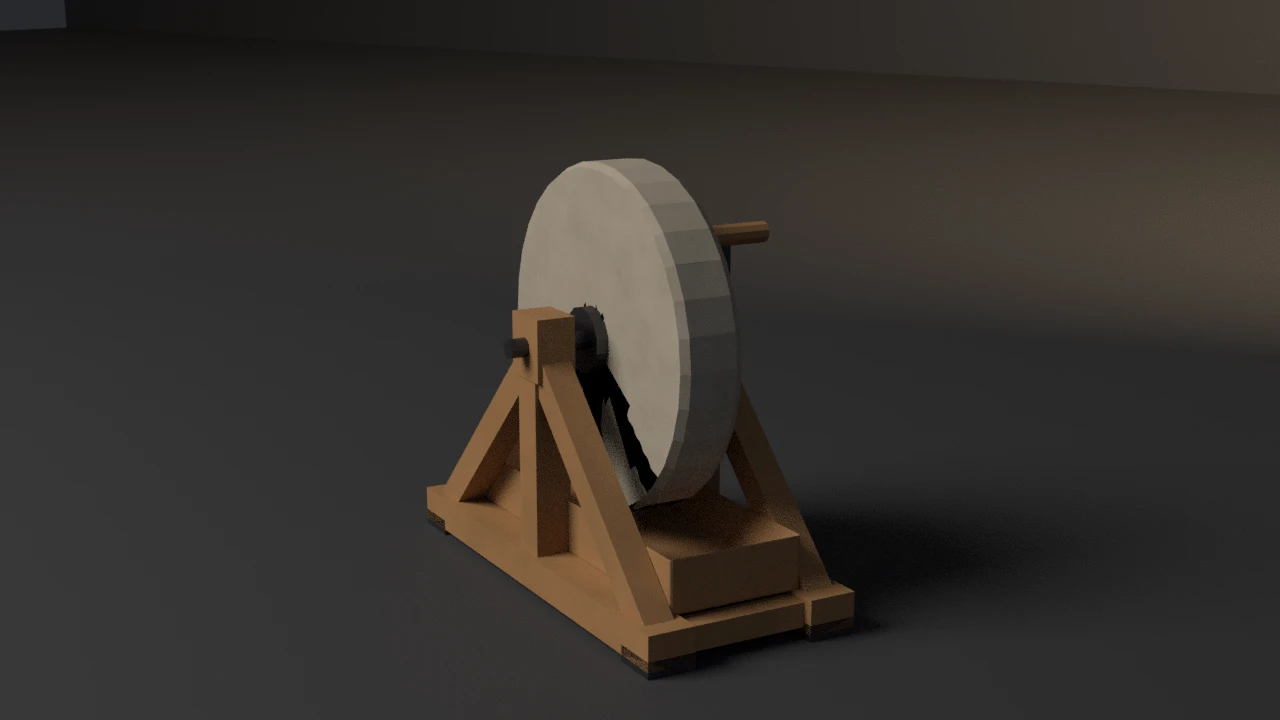
Rendered headless by the example itself — click to zoom.
blender --background --python showcase/grindstone/grindstone.py --
A showcase piece, not an example. Procedural grindstone (sandstone wheel, timber A-frame trestle, iron shoes/axle/hubs/crank, open water trough) then the shipped pipeline: unique-cell UVs, Cycles high-to-low normal bake, LOD chain, convex collider, Unity glTF export.
The A-frame is a king post with diagonals tenoning into a fatter sill, not two sticks meeting at a point. The trough is one manifold basin seated into those sills. Iron shoes bury a short wood tenon so the angled leg end-cap cannot pierce Z=0.
It asserts budget conformance of the generated result. It does not witness an API contract. "It rendered without error" is not a check.
Composes skills mesh-editing-and-bmesh, bake-high-to-low, depsgraph-and-evaluated-data, engine-export-presets, and snippets bake_normal_high_to_low.py, setup_bake_target_image.py, lod_chain.py / decimate_to_budget.py, convex_hull_collider.py, export_preset_unity.py (helpers copied, not imported as a package).
Budgets
Declared as named constants; every gate recomputes from the mesh, materials, UVs, evaluated LOD, collider, or export file.
| Axis | Declared | Measured (4.5.11 / 5.1.2 / 5.2.1) | | --- | --- | --- | | Base triangles | 700–1000 | 928 / 928 / 928 | | LOD1 ratio | 0.32–0.62 of base | 0.5000 / 0.5000 / 0.5000 | | LOD2 ratio | 0.10–0.35 of base | 0.2198 / 0.2198 / 0.1897 | | Materials | exactly 3 distinct; ≥80 wood, stone, metal faces | 3 slots; 216 / 160 / 180 | | UVs | in 0..1, AABB overlap ≤ 1e-5 | in range, overlap 0 | | Outer AABB | (0.710, 0.419, 0.610) m ± 0.015 | (0.7100, 0.4185, 0.6100), zmin 0 | | Collider tris | ≤ 240 | 198 | | Export | written, size > 0 | 89316 / 89316 / 89312 bytes |
Hygiene
Recomputed from the generated mesh, not asserted about the script.
| Axis | Declared | Measured (all three) | | --- | --- | --- | | Non-manifold edges | 0 | 0 | | Loose verts / edges | 0 / 0 | 0 / 0 | | Doubles merged at 1e-5 | 0 | 0 | | Zero-area faces | 0 | 0 | | N-gons | 0 | 0 | | Coplanar disjoint face pairs | 0 | 0 | | Grounded: zmin | within 1e-4 of 0 | 0.0000 | | Named supports: 4 shoes | each zmin ≤ 1e-3 | 4, shoe_z 0.00000 | | Stone size | 0.500 m dia × 0.095 m thick ± 0.02 / ± 0.015 | 0.5000 × 0.0950 |
Joint fit and seat
| Axis | Declared | Measured (all three) | | --- | --- | --- | | Crank-axle gap | ≤ 0.008 m | 0.00418 | | Shoe-wood BVH gap | ≤ 0.008 m (overlap is 0) | 0.00000 | | Trough-sill per-side gap | ≤ 0.008 m (overlap is 0) | 0.00000 | | Stone dip into trough | 0.015–0.045 m | 0.02570 | | Trough floor zmin | ≥ 0.040 m | 0.05800 |
DECIMATE COLLAPSE triangle counts are not identical across series — 5.2.1 is leaner on LOD2. The gate is a ratio band, not an exact count. Bake pixels are stochastic; the gate is has_data plus operator FINISHED, not byte-identity. Construction uses no RNG. Export byte counts differ by 4 B on 5.2.1 (glTF serializer), not a gated axis.
Falsifiers
Each violates one named budget. All nine were run on 4.5.11, 5.1.2 and 5.2.1 and returned the same code on each.
| Flag | Budget violated | Exit | | --- | --- | --- | | --skip-decimate | LOD1 ratio band | 9 | | --stray-vert | loose vertex count is 0 | 15 | | --lift-z | bounding box zmin is 0 | 16 | | --short-legs | named shoe supports at Z=0 | 16 | | --float-crank | crank-axle gap | 17 | | --float-legs | shoe-wood join | 17 | | --no-dip | stone dip band | 18 | | --narrow-trough | trough-sill seat | 18 |
Run
blender --background --python grindstone.py --
blender --background --python grindstone.py -- --skip-decimate
blender --background --python grindstone.py -- --stray-vert
blender --background --python grindstone.py -- --lift-z
blender --background --python grindstone.py -- --short-legs
blender --background --python grindstone.py -- --float-crank
blender --background --python grindstone.py -- --float-legs
blender --background --python grindstone.py -- --no-dip
blender --background --python grindstone.py -- --narrow-trough
blender --background --python grindstone.py -- --output grindstone.png
Smoke passes no flags.
Exit codes
File-local. 9 is a valid check code. 10 is reserved for gallery_framing.check_framing on the --output path. 15–19 are the hygiene and joint-fit family.
| Code | Meaning | | --- | --- | | 0 | Success | | 1 | Uncaught exception (FATAL wrapper) | | 2 | argparse / usage | | 3 | Mesh did not build / no UV layer | | 4 | Base triangle count outside range | | 5 | Material count ≠ 3 distinct slots, or a face-count floor missed | | 6 | UVs outside 0..1 | | 7 | UV AABB overlap above tolerance | | 8 | World AABB off declared outer size | | 9 | LOD ratio band (--skip-decimate lands here) | | 10 | Framing gate (render path only) | | 11 | Collider triangle count above ceiling | | 12 | Bake did not finish or image has no data | | 13 | Export file missing or empty | | 14 | --output produced no file | | 15 | Mesh hygiene: loose, non-manifold, zero-area, doubles, n-gons, z-fight | | 16 | Not grounded: bounding box zmin off 0, or a named shoe floats | | 17 | Joint fit: crank-axle gap, or shoe-wood join | | 18 | Seat: trough-sill gap, stone dip band, or trough sitting on the dirt | | 19 | Stone diameter or thickness off the stated real-world size |
Source
"""Game-ready grindstone — a showcase piece, not an example. Asserts budget conformance of a procedural grindstone (thick sandstone wheel, timber A-frame, open water trough, iron axle/hubs/crank) after composing shipped pipeline pieces: bmesh construction, UVs, three materials, high-to-low normal bake, LOD chain, convex collider, Unity glTF export. Budgets are declared below and recomputed from the generated result. They are not API-contract witnesses. ``--skip-decimate`` skips the LOD DECIMATE stage so the LOD-ratio budget fails. ``--stray-vert`` adds a loose vertex so the mesh-hygiene budget fails. ``--lift-z`` raises the mesh so the grounded-zmin budget fails. ``--float-crank`` offsets the crank from the axle so joint-fit fails. ``--no-dip`` raises the stone clear of the trough so the seat-conformance dip band fails. ``--short-legs`` raises the iron shoes and plants a dummy so the named support budget fails while AABB zmin still passes. ``--float-legs`` lifts the A-frame timber off the shoes so the shoe-wood join fails. ``--narrow-trough`` shrinks the tub so it no longer seats in the sills. No RNG. Construction is closed-form. DECIMATE COLLAPSE triangle counts are not byte-identical across Blender versions — the LOD gate is a ratio band, not an exact count. blender --background --python grindstone.py -- blender --background --python grindstone.py -- --skip-decimate blender --background --python grindstone.py -- --output grindstone.png """ import argparse import math import os import sys import tempfile import traceback import bmesh import bpy from mathutils import Euler, Vector from mathutils.bvhtree import BVHTree _REPO = os.path.abspath( os.path.join(os.path.dirname(os.path.abspath(__file__)), os.pardir, os.pardir) ) sys.path.insert(0, os.path.join(_REPO, "examples")) sys.dont_write_bytecode = True import gallery_framing # noqa: E402 STONE_R = 0.250 STONE_T = 0.095 STONE_SEGS = 32 CHAMFER = 0.012 TROUGH_H = 0.080 TROUGH_WALL = 0.018 DIP = 0.028 HUB_R = 0.048 HUB_T = 0.022 HUB_SEAT = 0.004 FRAME_Y = STONE_T / 2.0 + HUB_T + 0.055 LEG_SPREAD = 0.32 LEG_XY = (0.044, 0.044) # Sill and king are fatter in Y than the diagonals so the braces # tenon *into* the frame. Matching Y-thickness puts coplanar faces # on the camera side and reads as a black hole in the timber. SILL_Y = 0.070 KING_Y = 0.054 # Seat the tub into the sill inner faces. Deriving from LEG_XY left a # daylight slot once the sill was fattened to nest the diagonals. TROUGH_SEAT = 0.012 TROUGH_W = 2.0 * (FRAME_Y - SILL_Y / 2.0 + TROUGH_SEAT) TROUGH_L = 2.0 * (LEG_SPREAD - 0.010) TROUGH_Z0 = 0.058 AXLE_R = 0.014 AXLE_OVER = 0.055 CRANK_ARM = 0.13 HANDLE_L = 0.11 SHOE_H = 0.024 SHOE_XY = (0.070, 0.070) BBOX_TOL = 0.015 OUTER_SIZE = (0.710, 0.419, 0.610) STONE_DIA = 2.0 * STONE_R STONE_DIA_TOL = 0.02 STONE_T_TOL = 0.015 BASE_TRIS_MIN = 700 BASE_TRIS_MAX = 1000 LOD1_RATIO_MIN = 0.32 LOD1_RATIO_MAX = 0.62 LOD2_RATIO_MIN = 0.10 LOD2_RATIO_MAX = 0.35 LOD1_TARGET = 0.50 LOD2_TARGET = 0.22 MATERIAL_COUNT = 3 UV_EPS = 1e-4 UV_OVERLAP_MAX = 1e-5 COLLIDER_TRIS_MAX = 240 BAKE_RES = 256 CAGE_EXTRUSION = 0.08 METAL_FACES_MIN = 80 WOOD_FACES_MIN = 80 STONE_FACES_MIN = 80 ZMIN_EPS = 1e-4 DOUBLES_EPS = 1e-5 AREA_EPS = 1e-10 ZFIGHT_EPS = 1e-4 ZFIGHT_COS = 0.999 LIFT_Z = 0.05 CRANK_JOIN = 0.008 SHOE_JOIN = 0.008 TROUGH_SILL_JOIN = 0.008 DIP_MIN = 0.015 DIP_MAX = 0.045 SHOE_Z_MAX = 1e-3 TROUGH_FLOOR_Z_MIN = 0.040 WOOD_IDX = 0 STONE_IDX = 1 METAL_IDX = 2 def eevee_engine_id(): return "BLENDER_EEVEE" if bpy.app.version >= (5, 0, 0) else "BLENDER_EEVEE_NEXT" def fail(msg, code): print(f"ERROR: {msg}", file=sys.stderr) return code def triangle_count(mesh): mesh.calc_loop_triangles() return len(mesh.loop_triangles) def evaluated_triangle_count(obj): depsgraph = bpy.context.evaluated_depsgraph_get() eval_obj = obj.evaluated_get(depsgraph) eval_mesh = eval_obj.to_mesh() try: eval_mesh.calc_loop_triangles() return len(eval_mesh.loop_triangles) finally: eval_obj.to_mesh_clear() def deselect_all(): for ob in list(bpy.context.view_layer.objects): if ob is None: continue ob.select_set(False) def add_box(bm, loc, scale, mat_idx, euler=(0.0, 0.0, 0.0)): geo = bmesh.ops.create_cube(bm, size=1.0) verts = geo["verts"] rot = Euler(euler).to_matrix() origin = Vector(loc) for v in verts: p = Vector((v.co.x * scale[0], v.co.y * scale[1], v.co.z * scale[2])) v.co = rot @ p + origin faces = {f for v in verts for f in v.link_faces} for f in faces: f.material_index = mat_idx return verts def add_oriented_box(bm, a, b, scale_xy, mat_idx): a = Vector(a) b = Vector(b) delta = b - a length = delta.length if length < 1e-8: return [] quat = Vector((0.0, 0.0, 1.0)).rotation_difference(delta.normalized()) eul = quat.to_euler("XYZ") return add_box( bm, ((a + b) * 0.5), (scale_xy[0], scale_xy[1], length), mat_idx, euler=(eul.x, eul.y, eul.z), ) def add_cyl(bm, loc, radius, depth, segments, mat_idx, euler=(0.0, 0.0, 0.0)): geo = bmesh.ops.create_cone( bm, cap_ends=True, cap_tris=True, segments=segments, radius1=radius, radius2=radius, depth=depth, ) verts = geo["verts"] rot = Euler(euler).to_matrix() origin = Vector(loc) for v in verts: v.co = rot @ v.co + origin faces = {f for v in verts for f in v.link_faces} for f in faces: f.material_index = mat_idx return verts def add_basin(bm, loc, size, wall, mat_idx): """One manifold open tub. Five overlapping boxes bevel into degenerates.""" geo = bmesh.ops.create_cube(bm, size=1.0) verts = list(geo["verts"]) origin = Vector(loc) sx, sy, sz = size for v in verts: v.co = Vector((v.co.x * sx, v.co.y * sy, v.co.z * sz)) + origin faces = {f for v in verts for f in v.link_faces} for f in faces: f.material_index = mat_idx top = max(faces, key=lambda f: f.calc_center_median().z) bmesh.ops.inset_region( bm, faces=[top], thickness=wall, depth=-(sz - wall), use_boundary=True, use_even_offset=True, ) for f in {f for v in verts for f in v.link_faces}: f.material_index = mat_idx seen = set(verts) stack = list(verts) while stack: v = stack.pop() for e in v.link_edges: o = e.other_vert(v) if o not in seen: seen.add(o) stack.append(o) return list(seen) def add_stone(bm, loc, axle_z): """Ring-stack wheel: slight face inset so the rim reads thick, tris caps.""" hw = STONE_T / 2.0 rings_yz = [ (-hw, STONE_R * 0.97), (-hw + CHAMFER, STONE_R), (hw - CHAMFER, STONE_R), (hw, STONE_R * 0.97), ] rings = [] for y_off, radius in rings_yz: ring = [] for i in range(STONE_SEGS): a = 2.0 * math.pi * i / STONE_SEGS ring.append( bm.verts.new( ( loc[0] + radius * math.cos(a), loc[1] + y_off, axle_z + radius * math.sin(a), ) ) ) rings.append(ring) for i in range(len(rings) - 1): a, b = rings[i], rings[i + 1] for k in range(STONE_SEGS): kn = (k + 1) % STONE_SEGS face = bm.faces.new((a[k], a[kn], b[kn], b[k])) face.material_index = STONE_IDX for ring, y_off, inward in ( (rings[0], rings_yz[0][0], True), (rings[-1], rings_yz[-1][0], False), ): c = bm.verts.new((loc[0], loc[1] + y_off, axle_z)) for k in range(STONE_SEGS): kn = (k + 1) % STONE_SEGS if inward: face = bm.faces.new((c, ring[kn], ring[k])) else: face = bm.faces.new((c, ring[k], ring[kn])) face.material_index = STONE_IDX return [v for ring in rings for v in ring] def pack_uvs(bm, margin=0.08): uv = bm.loops.layers.uv.new("UVMap") faces = list(bm.faces) n = len(faces) cols = max(1, math.ceil(math.sqrt(n))) rows = max(1, math.ceil(n / cols)) cell_w = 1.0 / cols cell_h = 1.0 / rows pad_u = margin * cell_w * 0.5 pad_v = margin * cell_h * 0.5 usable_w = cell_w - 2.0 * pad_u usable_h = cell_h - 2.0 * pad_v for i, face in enumerate(faces): col = i % cols row = i // cols nrm = face.normal ax = abs(nrm.x) ay = abs(nrm.y) az = abs(nrm.z) coords = [] for loop in face.loops: co = loop.vert.co if az >= ax and az >= ay: coords.append((co.x, co.y)) elif ax >= ay: coords.append((co.y, co.z)) else: coords.append((co.x, co.z)) xs = [c[0] for c in coords] ys = [c[1] for c in coords] minx, maxx = min(xs), max(xs) miny, maxy = min(ys), max(ys) dx = max(maxx - minx, 1e-8) dy = max(maxy - miny, 1e-8) origin_u = col * cell_w + pad_u origin_v = row * cell_h + pad_v for loop, (x, y) in zip(face.loops, coords): loop[uv].uv = ( origin_u + (x - minx) / dx * usable_w, origin_v + (y - miny) / dy * usable_h, ) def build_grindstone_mesh( name, bevel_offset, bevel_segments, float_crank=False, no_dip=False, short_legs=False, float_legs=False, narrow_trough=False, ): bm = bmesh.new() try: wood = [] metal = [] dip = DIP tub_z0 = TROUGH_Z0 - (0.040 if no_dip else 0.0) trough_top = TROUGH_Z0 + TROUGH_H stone_bottom = trough_top - dip axle_z = STONE_R + stone_bottom axle_len = 2.0 * FRAME_Y + 2.0 * AXLE_OVER axle_end = axle_len / 2.0 # Inward, not proud: an outward offset grows the Y AABB and # trips exit 8 before the crank-join budget. crank_y = axle_end - (0.022 if float_crank else 0.012) shoe_z = 0.05 if short_legs else 0.0 bearing_h = 0.090 bearing_xz = (0.078, bearing_h) king_xy = (0.052, KING_Y) # Diagonals *are* the legs. A tall stump beside an angled timber # paints a see-through triangle on the stump face. Bury a short # tenon in the shoe (never proud of the iron) and start the # diagonal on the shoe top so the angled end-cap cannot pierce # Z=0. tenon_z = shoe_z + SHOE_H * 0.50 diag_z = shoe_z + SHOE_H + 0.008 if float_legs: tenon_z = shoe_z + SHOE_H + 0.070 diag_z = shoe_z + SHOE_H + 0.070 sill_h = 0.050 sill_bottom = ( shoe_z + SHOE_H + 0.055 if float_legs else shoe_z + SHOE_H * 0.40 ) sill_z = sill_bottom + sill_h / 2.0 for y in (-FRAME_Y, FRAME_Y): # King post fills the A-crotch so the bearing is not a cube # perched on two sticks with a triangular hole under it. wood.extend( add_oriented_box( bm, (0.0, y, sill_z), (0.0, y, axle_z + bearing_h * 0.35), king_xy, WOOD_IDX, ) ) wood.extend( add_box( bm, (0.0, y, axle_z), (bearing_xz[0], 0.058, bearing_xz[1]), WOOD_IDX, ) ) # Tie beam sits on the shoes and occupies the A-foot. wood.extend( add_box( bm, (0.0, y, sill_z), (LEG_SPREAD * 2.0 + SHOE_XY[0], SILL_Y, sill_h), WOOD_IDX, ) ) for x in (-LEG_SPREAD, LEG_SPREAD): if not float_legs: wood.extend( add_box( bm, (x, y, tenon_z), (LEG_XY[0] * 0.92, LEG_XY[1] * 0.92, SHOE_H * 0.90), WOOD_IDX, ) ) wood.extend( add_oriented_box( bm, (x, y, diag_z), (0.0, y, axle_z - 0.010), LEG_XY, WOOD_IDX, ) ) metal.extend( add_box( bm, (x, y, shoe_z + SHOE_H / 2.0), (SHOE_XY[0], SHOE_XY[1], SHOE_H), METAL_IDX, ) ) for x in (-LEG_SPREAD, LEG_SPREAD): # End stretchers tenon through both sills at sill height. # A higher independent Z left them floating as extra cubes. wood.extend( add_box( bm, (x, 0.0, sill_z), (0.038, FRAME_Y * 2.0, sill_h * 0.70), WOOD_IDX, ) ) tw = TROUGH_W * (0.58 if narrow_trough else 1.0) chamfer = [] basin_verts = add_basin( bm, (0.0, 0.0, tub_z0 + TROUGH_H / 2.0), (TROUGH_L, tw, TROUGH_H), TROUGH_WALL, WOOD_IDX, ) chamfer.extend(basin_verts) chamfer.extend( add_cyl( bm, (0.0, crank_y + HANDLE_L * 0.15, axle_z + CRANK_ARM), 0.016, HANDLE_L, 10, WOOD_IDX, euler=(math.pi / 2.0, 0.0, 0.0), ) ) wood.extend(chamfer) add_stone(bm, (0.0, 0.0), axle_z) metal.extend( add_cyl( bm, (0.0, 0.0, axle_z), AXLE_R, axle_len, 12, METAL_IDX, euler=(math.pi / 2.0, 0.0, 0.0), ) ) for ysign in (-1.0, 1.0): metal.extend( add_cyl( bm, (0.0, ysign * (STONE_T / 2.0 + HUB_T / 2.0 - HUB_SEAT), axle_z), HUB_R, HUB_T, 14, METAL_IDX, euler=(math.pi / 2.0, 0.0, 0.0), ) ) metal.extend( add_box( bm, (0.0, crank_y, axle_z + CRANK_ARM / 2.0), (0.018, 0.018, CRANK_ARM + 0.02), METAL_IDX, ) ) metal.extend( add_cyl( bm, (0.0, crank_y, axle_z + CRANK_ARM), 0.010, HANDLE_L * 0.55, 10, METAL_IDX, euler=(math.pi / 2.0, 0.0, 0.0), ) ) if short_legs: metal.extend( add_box( bm, (0.0, 0.0, 0.005), (0.020, 0.020, 0.010), METAL_IDX, ) ) xs = [v.co.x for v in bm.verts] ys = [v.co.y for v in bm.verts] cx = 0.5 * (min(xs) + max(xs)) cy = 0.5 * (min(ys) + max(ys)) for v in bm.verts: v.co.x -= cx v.co.y -= cy if bevel_offset > 0.0: edges = [] trough_verts = set(basin_verts) for e in {e for v in trough_verts for e in v.link_edges}: if min(v.co.z for v in e.verts) < tub_z0 - 0.002: continue if any(f.material_index != WOOD_IDX for f in e.link_faces): continue edges.append(e) if edges: ret = bmesh.ops.bevel( bm, geom=edges, offset=bevel_offset, segments=bevel_segments, profile=0.5, affect="EDGES", clamp_overlap=True, ) for f in ret.get("faces") or []: f.material_index = WOOD_IDX pack_uvs(bm) bmesh.ops.recalc_face_normals(bm, faces=list(bm.faces)) for face in bm.faces: face.smooth = False me = bpy.data.meshes.new(name) bm.to_mesh(me) me.update() for poly in me.polygons: poly.use_smooth = False finally: bm.free() out = bpy.data.objects.new(name, me) bpy.context.collection.objects.link(out) return out def principled(name, color, metallic, roughness, noise_scale=0.0, wear=None): mat = bpy.data.materials.new(name) mat.use_nodes = True nt = mat.node_tree bsdf = nt.nodes["Principled BSDF"] bsdf.inputs["Base Color"].default_value = color bsdf.inputs["Metallic"].default_value = metallic bsdf.inputs["Roughness"].default_value = roughness if noise_scale > 0.0 and wear is not None: tex = nt.nodes.new("ShaderNodeTexNoise") tex.inputs["Scale"].default_value = noise_scale tex.inputs["Detail"].default_value = 8.0 tex.inputs["Roughness"].default_value = 0.55 mix = nt.nodes.new("ShaderNodeMix") mix.data_type = "RGBA" mix.inputs["A"].default_value = color mix.inputs["B"].default_value = wear fac = mix.inputs.get("Factor") or mix.inputs.get("Fac") nt.links.new(tex.outputs["Fac"], fac) nt.links.new(mix.outputs["Result"], bsdf.inputs["Base Color"]) rmix = nt.nodes.new("ShaderNodeMix") rmix.data_type = "FLOAT" rmix.inputs["A"].default_value = roughness rmix.inputs["B"].default_value = min(1.0, roughness + 0.18) rfac = rmix.inputs.get("Factor") or rmix.inputs.get("Fac") nt.links.new(tex.outputs["Fac"], rfac) nt.links.new(rmix.outputs["Result"], bsdf.inputs["Roughness"]) return mat def assign_slots(obj, wood, stone, metal): mats = obj.data.materials wanted = (wood, stone, metal) for i, mat in enumerate(wanted): if i < len(mats): mats[i] = mat else: mats.append(mat) def world_bbox(obj): corners = [obj.matrix_world @ Vector(c) for c in obj.bound_box] xs = [c.x for c in corners] ys = [c.y for c in corners] zs = [c.z for c in corners] return (min(xs), min(ys), min(zs), max(xs), max(ys), max(zs)) def uv_stats(mesh): uv = mesh.uv_layers.active if uv is None: return 0.0, 0.0, 1.0, 1.0, 0, 1.0 data = uv.data us = [loop.uv[0] for loop in data] vs = [loop.uv[1] for loop in data] aabbs = [] for poly in mesh.polygons: pu = [data[i].uv[0] for i in poly.loop_indices] pv = [data[i].uv[1] for i in poly.loop_indices] aabbs.append((min(pu), min(pv), max(pu), max(pv))) overlap = 0.0 for i in range(len(aabbs)): a = aabbs[i] for j in range(i + 1, len(aabbs)): b = aabbs[j] x0 = max(a[0], b[0]) y0 = max(a[1], b[1]) x1 = min(a[2], b[2]) y1 = min(a[3], b[3]) overlap += max(0.0, x1 - x0) * max(0.0, y1 - y0) return min(us), min(vs), max(us), max(vs), overlap, len(aabbs) def face_area(me, poly): vs = [me.vertices[i].co for i in poly.vertices] if len(vs) < 3: return 0.0 v0 = vs[0] area = 0.0 for i in range(1, len(vs) - 1): area += (vs[i] - v0).cross(vs[i + 1] - v0).length * 0.5 return area def hygiene_audit(me): nv, ne, nf = len(me.vertices), len(me.edges), len(me.polygons) ngons = sum(1 for p in me.polygons if len(p.vertices) > 4) zero_area = sum(1 for p in me.polygons if face_area(me, p) <= AREA_EPS) bm = bmesh.new() try: bm.from_mesh(me) bm.verts.ensure_lookup_table() bm.edges.ensure_lookup_table() loose_v = sum(1 for v in bm.verts if len(v.link_edges) == 0) loose_e = sum(1 for e in bm.edges if len(e.link_faces) == 0) nonman = sum(1 for e in bm.edges if not e.is_manifold) ret = bmesh.ops.find_doubles(bm, verts=list(bm.verts), dist=DOUBLES_EPS) doubles = len(ret.get("targetmap") or {}) finally: bm.free() return { "nv": nv, "ne": ne, "nf": nf, "ngons": ngons, "loose_v": loose_v, "loose_e": loose_e, "nonman": nonman, "zero_area": zero_area, "doubles": doubles, "euler": nv - ne + nf, } def zfight_pairs(me): data = [ (p.center.copy(), p.normal.copy(), frozenset(p.vertices)) for p in me.polygons ] eps2 = ZFIGHT_EPS * ZFIGHT_EPS count = 0 for i in range(len(data)): ci, ni, vi = data[i] for j in range(i + 1, len(data)): cj, nj, vj = data[j] if (cj - ci).length_squared > eps2: continue if abs(ni.dot(nj)) <= ZFIGHT_COS: continue if vi & vj: continue count += 1 return count def shells(me): neighbors = [[] for _ in range(len(me.vertices))] for edge in me.edges: a, b = edge.vertices neighbors[a].append(b) neighbors[b].append(a) seen = [False] * len(me.vertices) groups = [] for start in range(len(me.vertices)): if seen[start]: continue seen[start] = True stack = [start] group = [] while stack: current = stack.pop() group.append(current) for nxt in neighbors[current]: if not seen[nxt]: seen[nxt] = True stack.append(nxt) groups.append(group) return groups def shell_aabb(me, group): pts = [me.vertices[i].co for i in group] return ( min(p.x for p in pts), min(p.y for p in pts), min(p.z for p in pts), max(p.x for p in pts), max(p.y for p in pts), max(p.z for p in pts), ) def mat_of(me, group): member = set(group) for p in me.polygons: if all(i in member for i in p.vertices): return p.material_index return None def support_audit(me): groups = shells(me) shoes = [] for g in groups: if mat_of(me, g) != METAL_IDX: continue a = shell_aabb(me, g) if a[5] < 0.08 and (a[4] - a[1]) > 0.04 and (a[3] - a[0]) > 0.04: shoes.append(a) shoe_z = min((a[2] for a in shoes), default=99.0) return {"shoes": len(shoes), "shoe_z": shoe_z} def trough_floor_z(me): """Z of the wide shallow wood shell (the trough floor).""" groups = shells(me) best = 99.0 for g in groups: if mat_of(me, g) != WOOD_IDX: continue a = shell_aabb(me, g) dx, dy, dz = a[3] - a[0], a[4] - a[1], a[5] - a[2] if dx > TROUGH_L * 0.7 and dy > TROUGH_W * 0.55: best = min(best, a[2]) return best def stone_audit(me): stone_pts = [] groups = shells(me) for g in groups: if mat_of(me, g) != STONE_IDX: continue stone_pts.extend(me.vertices[i].co for i in g) if not stone_pts: return { "dia": 0.0, "thick": 0.0, "zmin": 99.0, "dip": -1.0, "trough_z": 99.0, } xs = [p.x for p in stone_pts] ys = [p.y for p in stone_pts] zs = [p.z for p in stone_pts] dia = max(max(xs) - min(xs), max(zs) - min(zs)) thick = max(ys) - min(ys) zmin = min(zs) tb = None for g in groups: if mat_of(me, g) != WOOD_IDX: continue a = shell_aabb(me, g) dx, dy = a[3] - a[0], a[4] - a[1] if abs(dx - TROUGH_L) < 0.08 and dy > 0.08 and a[2] < 0.15: tb = a break trough_z = tb[2] if tb else trough_floor_z(me) trough_top = tb[5] if tb else (TROUGH_Z0 + TROUGH_H) return { "dia": dia, "thick": thick, "zmin": zmin, "dip": trough_top - zmin, "trough_z": trough_z, } def crank_join(me): """Gap from crank-arm verts to the axle shell.""" groups = shells(me) axle = None crank = None for g in groups: if mat_of(me, g) != METAL_IDX: continue a = shell_aabb(me, g) dy, dx, dz = a[4] - a[1], a[3] - a[0], a[5] - a[2] if dy > 0.30 and dx < 0.06 and dz < 0.06: axle = g if dz > CRANK_ARM * 0.6 and dy < 0.05 and dx < 0.05: crank = g if axle is None or crank is None: return 99.0 axle_pts = [me.vertices[i].co for i in axle] crank_pts = [me.vertices[i].co for i in crank] best = 99.0 for c in crank_pts: d = min((c - a).length for a in axle_pts) if d < best: best = d return best def trough_sill_gap(me): """Daylight in Y between the trough and each A-frame sill. Per-side, not a mixed max. The crank handle makes the mesh AABB asymmetric, so a global |ymin|/ymax vs min(sill inner) compares the trough's long side against the opposite sill and reports overlap while the other side shows daylight. Overlap on a side is 0. Missing shells return 99. """ groups = shells(me) trough = None plus_sill = None minus_sill = None for g in groups: if mat_of(me, g) != WOOD_IDX: continue a = shell_aabb(me, g) dx, dy, dz = a[3] - a[0], a[4] - a[1], a[5] - a[2] cy = 0.5 * (a[1] + a[4]) if abs(dx - TROUGH_L) < 0.08 and dy > 0.08 and a[2] < 0.15: trough = a if ( dx > LEG_SPREAD * 1.2 and dy > SILL_Y * 0.55 and abs(cy) > FRAME_Y * 0.40 and a[5] < 0.14 ): if cy > 0.0: plus_sill = a else: minus_sill = a if trough is None or plus_sill is None or minus_sill is None: return 99.0 gap_plus = plus_sill[1] - trough[4] gap_minus = trough[1] - minus_sill[4] return max(0.0, gap_plus, gap_minus) def shoe_wood_gap(me): """Worst gap from an iron shoe to wood. Overlapping solids count as 0. Vert-vert and shoe-corner-to-surface both lie about a shoe-width away even when a tenon is buried in the iron; overlap is the join. """ groups = shells(me) shoes = [] for g in groups: if mat_of(me, g) != METAL_IDX: continue a = shell_aabb(me, g) if a[5] < 0.08 and (a[4] - a[1]) > 0.04 and (a[3] - a[0]) > 0.04: shoes.append(g) if not shoes: return 99.0 bm_wood = bmesh.new() try: bm_wood.from_mesh(me) drop = [f for f in bm_wood.faces if f.material_index != WOOD_IDX] if drop: bmesh.ops.delete(bm_wood, geom=drop, context="FACES") if not bm_wood.faces: return 99.0 tree_wood = BVHTree.FromBMesh(bm_wood) worst = 0.0 for g in shoes: bm_s = bmesh.new() try: bm_s.from_mesh(me) member = set(g) drop_s = [ f for f in bm_s.faces if not all(v.index in member for v in f.verts) ] if drop_s: bmesh.ops.delete(bm_s, geom=drop_s, context="FACES") if not bm_s.faces: worst = max(worst, 99.0) continue tree_s = BVHTree.FromBMesh(bm_s) if tree_wood.overlap(tree_s): continue best = 99.0 for i in g: hit = tree_wood.find_nearest(me.vertices[i].co) if hit[0] is None: continue best = min(best, hit[3]) if best > worst: worst = best finally: bm_s.free() return worst finally: bm_wood.free() def add_stray_vert(me): bm = bmesh.new() try: bm.from_mesh(me) bm.verts.new((0.0, 0.0, STONE_R)) bm.to_mesh(me) me.update() finally: bm.free() def make_lod(obj, name, ratio, skip_decimate): mesh = obj.data.copy() lod = bpy.data.objects.new(name, mesh) lod.matrix_world = obj.matrix_world.copy() bpy.context.scene.collection.objects.link(lod) if not skip_decimate and 0.0 < ratio < 1.0: mod = lod.modifiers.new("DecimateBudget", "DECIMATE") mod.decimate_type = "COLLAPSE" mod.ratio = ratio return lod def convex_hull_collider(obj, name): mesh = bpy.data.meshes.new(name) bm = bmesh.new() try: bm.from_mesh(obj.data) result = bmesh.ops.convex_hull(bm, input=list(bm.verts)) interior = result.get("geom_interior") or [] unused = result.get("geom_unused") or [] if interior: bmesh.ops.delete(bm, geom=interior, context="VERTS") if unused: bmesh.ops.delete(bm, geom=unused, context="VERTS") bm.to_mesh(mesh) mesh.update() finally: bm.free() collider = bpy.data.objects.new(name, mesh) bpy.context.collection.objects.link(collider) collider.matrix_world = obj.matrix_world.copy() return collider def setup_bake_image(obj, target_mat, size=BAKE_RES): if not obj.data.uv_layers: return None, None img = bpy.data.images.new("GrindstoneNrm", size, size, alpha=True, float_buffer=False) img.colorspace_settings.name = "Non-Color" nodes = target_mat.node_tree.nodes tex = nodes.new("ShaderNodeTexImage") tex.image = img nodes.active = tex tex.select = True obj.active_material_index = STONE_IDX return img, tex def bake_normal(high, low): scene = bpy.context.scene scene.render.engine = "CYCLES" scene.cycles.device = "CPU" scene.cycles.samples = 1 scene.cycles.use_denoising = False deselect_all() high.select_set(True) low.select_set(True) bpy.context.view_layer.objects.active = low return bpy.ops.object.bake( type="NORMAL", use_selected_to_active=True, cage_extrusion=CAGE_EXTRUSION, use_cage=False, normal_space="TANGENT", margin=4, margin_type="ADJACENT_FACES", use_clear=True, target="IMAGE_TEXTURES", ) def export_unity(path, objects): deselect_all() for ob in objects: ob.select_set(True) bpy.context.view_layer.objects.active = objects[0] bpy.ops.export_scene.gltf( filepath=path, use_selection=True, export_yup=True, export_apply=True, export_draco_mesh_compression_enable=False, export_animations=False, ) def check( skip_decimate, lift_z=False, stray_vert=False, float_crank=False, no_dip=False, short_legs=False, float_legs=False, narrow_trough=False, ): bpy.ops.wm.read_factory_settings(use_empty=True) flags = dict( float_crank=float_crank, no_dip=no_dip, short_legs=short_legs, float_legs=float_legs, narrow_trough=narrow_trough, ) low = build_grindstone_mesh("GrindstoneLow", 0.004, 2, **flags) high = build_grindstone_mesh("GrindstoneHigh", 0.004, 4, **flags) wood = principled( "GrindstoneWood", (0.38, 0.20, 0.08, 1.0), 0.0, 0.62, noise_scale=6.5, wear=(0.22, 0.11, 0.04, 1.0), ) stone = principled( "GrindstoneStone", (0.40, 0.36, 0.30, 1.0), 0.0, 0.92, noise_scale=14.0, wear=(0.28, 0.24, 0.18, 1.0), ) metal = principled( "GrindstoneIron", (0.14, 0.145, 0.155, 1.0), 1.0, 0.38, noise_scale=5.0, wear=(0.05, 0.05, 0.06, 1.0), ) assign_slots(low, wood, stone, metal) assign_slots(high, wood, stone, metal) if stray_vert: add_stray_vert(low.data) if lift_z: for v in low.data.vertices: v.co.z += LIFT_Z low.data.update() bpy.context.view_layer.update() if low.data is None or len(low.data.polygons) < 6: return fail("grindstone mesh did not build", 3), None, None, None, None, None base_tris = triangle_count(low.data) mats = [s for s in low.data.materials if s is not None] nmat = len(mats) distinct_mats = len({id(s) for s in mats}) idx_counts = {} for poly in low.data.polygons: idx_counts[poly.material_index] = idx_counts.get(poly.material_index, 0) + 1 print(f"measured mat_index_counts={idx_counts}") u0, v0, u1, v1, overlap, nfaces = uv_stats(low.data) bb = world_bbox(low) size_x = bb[3] - bb[0] size_y = bb[4] - bb[1] size_z = bb[5] - bb[2] img, tex = setup_bake_image(low, stone) if img is None: return fail("grindstone has no UV layer", 3), None, None, None, None, None bake_result = bake_normal(high, low) lod1 = make_lod(low, "GrindstoneLOD1", LOD1_TARGET, skip_decimate) lod2 = make_lod(low, "GrindstoneLOD2", LOD2_TARGET, skip_decimate) bpy.context.view_layer.update() lod1_tris = evaluated_triangle_count(lod1) lod2_tris = evaluated_triangle_count(lod2) r1 = lod1_tris / base_tris if base_tris else 0.0 r2 = lod2_tris / base_tris if base_tris else 0.0 collider_src = build_grindstone_mesh("GrindstoneColSrc", 0.0, 1, **flags) collider = convex_hull_collider(collider_src, "GrindstoneCollider") bpy.data.objects.remove(collider_src, do_unlink=True) col_tris = triangle_count(collider.data) export_path = os.path.join( tempfile.gettempdir(), f"bdt_grindstone_{os.getpid()}.glb", ) if os.path.exists(export_path): os.remove(export_path) export_unity(export_path, [low, collider]) export_size = os.path.getsize(export_path) if os.path.isfile(export_path) else 0 hyg = hygiene_audit(low.data) zf = zfight_pairs(low.data) sup = support_audit(low.data) st = stone_audit(low.data) cj = crank_join(low.data) sw = shoe_wood_gap(low.data) ts = trough_sill_gap(low.data) print(f"blender={tuple(bpy.app.version)} skip_decimate={skip_decimate}") print( f"measured base_tris={base_tris} lod1_tris={lod1_tris} " f"lod2_tris={lod2_tris} r1={r1:.4f} r2={r2:.4f}" ) print( f"measured nmat={nmat} uv=({u0:.4f},{v0:.4f})-({u1:.4f},{v1:.4f}) " f"overlap={overlap:.6f} nfaces={nfaces}" ) print( f"measured bbox=({size_x:.4f},{size_y:.4f},{size_z:.4f}) " f"outer={OUTER_SIZE} zmin={bb[2]:.4f}" ) print( f"measured collider_tris={col_tris} bake={bake_result} " f"bake_has_data={img.has_data} export_bytes={export_size}" ) print( f"measured hygiene loose_v={hyg['loose_v']} loose_e={hyg['loose_e']} " f"nonman={hyg['nonman']} zero_area={hyg['zero_area']} " f"doubles={hyg['doubles']} ngons={hyg['ngons']} zfight={zf}" ) print( f"measured supports shoes={sup['shoes']} shoe_z={sup['shoe_z']:.5f} " f"stone_dia={st['dia']:.4f} stone_t={st['thick']:.4f} " f"dip={st['dip']:.5f} trough_z={st['trough_z']:.5f} " f"crank_join={cj:.5f} shoe_wood={sw:.5f} trough_sill={ts:.5f}" ) if not (BASE_TRIS_MIN <= base_tris <= BASE_TRIS_MAX): return fail( f"base tris {base_tris} not in [{BASE_TRIS_MIN}, {BASE_TRIS_MAX}]", 4, ), None, None, None, None, None if nmat != MATERIAL_COUNT or distinct_mats != MATERIAL_COUNT: return fail( f"material slots {nmat} distinct {distinct_mats} != {MATERIAL_COUNT}", 5, ), None, None, None, None, None if idx_counts.get(METAL_IDX, 0) < METAL_FACES_MIN: return fail( f"metal faces {idx_counts.get(METAL_IDX, 0)} < {METAL_FACES_MIN}", 5, ), None, None, None, None, None if idx_counts.get(STONE_IDX, 0) < STONE_FACES_MIN: return fail( f"stone faces {idx_counts.get(STONE_IDX, 0)} < {STONE_FACES_MIN}", 5, ), None, None, None, None, None if idx_counts.get(WOOD_IDX, 0) < WOOD_FACES_MIN: return fail( f"wood faces {idx_counts.get(WOOD_IDX, 0)} < {WOOD_FACES_MIN}", 5, ), None, None, None, None, None if u0 < -UV_EPS or v0 < -UV_EPS or u1 > 1.0 + UV_EPS or v1 > 1.0 + UV_EPS: return fail( f"UVs outside 0..1: ({u0:.4f},{v0:.4f})-({u1:.4f},{v1:.4f})", 6, ), None, None, None, None, None if overlap > UV_OVERLAP_MAX: return fail( f"UV AABB overlap {overlap:.6f} > {UV_OVERLAP_MAX}", 7, ), None, None, None, None, None if ( abs(size_x - OUTER_SIZE[0]) > BBOX_TOL or abs(size_y - OUTER_SIZE[1]) > BBOX_TOL or abs(size_z - OUTER_SIZE[2]) > BBOX_TOL ): return fail( f"bbox ({size_x:.4f},{size_y:.4f},{size_z:.4f}) " f"off outer {OUTER_SIZE}", 8, ), None, None, None, None, None if not (LOD1_RATIO_MIN <= r1 <= LOD1_RATIO_MAX): return fail( f"LOD1 ratio {r1:.4f} not in [{LOD1_RATIO_MIN}, {LOD1_RATIO_MAX}] " "(--skip-decimate is the designed fail)", 9, ), None, None, None, None, None if not (LOD2_RATIO_MIN <= r2 <= LOD2_RATIO_MAX): return fail( f"LOD2 ratio {r2:.4f} not in [{LOD2_RATIO_MIN}, {LOD2_RATIO_MAX}]", 9, ), None, None, None, None, None if col_tris > COLLIDER_TRIS_MAX: return fail( f"collider tris {col_tris} > {COLLIDER_TRIS_MAX}", 11, ), None, None, None, None, None if bake_result != {"FINISHED"} or not img.has_data: return fail( f"bake failed result={bake_result} has_data={img.has_data}", 12, ), None, None, None, None, None if export_size <= 0: return fail("export file missing or empty", 13), None, None, None, None, None if ( hyg["loose_v"] or hyg["loose_e"] or hyg["nonman"] or hyg["zero_area"] or hyg["doubles"] or hyg["ngons"] or zf ): return fail( f"hygiene loose_v={hyg['loose_v']} loose_e={hyg['loose_e']} " f"nonman={hyg['nonman']} zero_area={hyg['zero_area']} " f"doubles={hyg['doubles']} ngons={hyg['ngons']} zfight={zf}", 15, ), None, None, None, None, None if abs(bb[2]) > ZMIN_EPS: return fail( f"zmin {bb[2]:.6f} not within {ZMIN_EPS} of 0 " "(--lift-z is the designed fail)", 16, ), None, None, None, None, None if sup["shoes"] < 4 or sup["shoe_z"] > SHOE_Z_MAX: return fail( f"shoe supports {sup['shoes']} shoe_z={sup['shoe_z']:.5f} " "(--short-legs is the designed fail)", 16, ), None, None, None, None, None if cj > CRANK_JOIN: return fail( f"crank-axle gap {cj:.5f} > {CRANK_JOIN} " "(--float-crank is the designed fail)", 17, ), None, None, None, None, None if sw > SHOE_JOIN: return fail( f"shoe-wood gap {sw:.5f} > {SHOE_JOIN} " "(--float-legs is the designed fail)", 17, ), None, None, None, None, None if ts > TROUGH_SILL_JOIN: return fail( f"trough-sill gap {ts:.5f} > {TROUGH_SILL_JOIN} " "(--narrow-trough is the designed fail)", 18, ), None, None, None, None, None if not (DIP_MIN <= st["dip"] <= DIP_MAX): return fail( f"stone dip {st['dip']:.5f} not in [{DIP_MIN}, {DIP_MAX}] " "(--no-dip is the designed fail)", 18, ), None, None, None, None, None if st["trough_z"] < TROUGH_FLOOR_Z_MIN: return fail( f"trough floor zmin {st['trough_z']:.5f} < {TROUGH_FLOOR_Z_MIN} " "(tub must sit on the frame, not the dirt)", 18, ), None, None, None, None, None if abs(st["dia"] - STONE_DIA) > STONE_DIA_TOL: return fail( f"stone diameter {st['dia']:.4f} off {STONE_DIA}", 19, ), None, None, None, None, None if abs(st["thick"] - STONE_T) > STONE_T_TOL: return fail( f"stone thickness {st['thick']:.4f} off {STONE_T}", 19, ), None, None, None, None, None return 0, low, high, stone, tex, collider def wire_normal(mat, tex): nt = mat.node_tree bsdf = nt.nodes["Principled BSDF"] nrm = nt.nodes.new("ShaderNodeNormalMap") nrm.inputs["Strength"].default_value = 1.0 nt.links.new(tex.outputs["Color"], nrm.inputs["Color"]) nt.links.new(nrm.outputs["Normal"], bsdf.inputs["Normal"]) def render_still(low, wood, tex, path, engine): scene = bpy.context.scene wire_normal(wood, tex) for ob in list(scene.objects): if ob.type == "MESH" and ob != low: ob.hide_render = True ob.hide_viewport = True low.rotation_euler.z = math.radians(-22.0) low.rotation_euler.x = math.radians(0.0) floor_me = bpy.data.meshes.new("Floor") bm = bmesh.new() try: bmesh.ops.create_grid(bm, x_segments=1, y_segments=1, size=14.0) bm.to_mesh(floor_me) finally: bm.free() fmat = bpy.data.materials.new("Floor") fmat.use_nodes = True fb = fmat.node_tree.nodes["Principled BSDF"] fb.inputs["Base Color"].default_value = (0.03, 0.032, 0.037, 1.0) fb.inputs["Roughness"].default_value = 0.7 floor_me.materials.append(fmat) floor = bpy.data.objects.new("Floor", floor_me) scene.collection.objects.link(floor) wall = bpy.data.objects.new("Wall", floor_me.copy()) wall.location = (0.0, 8.5, 0.0) wall.rotation_euler = (math.radians(90), 0.0, 0.0) scene.collection.objects.link(wall) world = bpy.data.worlds.new("World") world.use_nodes = True world.node_tree.nodes["Background"].inputs["Color"].default_value = ( 0.02, 0.021, 0.025, 1.0, ) scene.world = world def light(name, loc, energy, size, col, rot): ld = bpy.data.lights.new(name, "AREA") ld.energy = energy ld.size = size ld.color = col ob = bpy.data.objects.new(name, ld) ob.location = loc ob.rotation_euler = tuple(math.radians(a) for a in rot) scene.collection.objects.link(ob) light("Key", (-3.6, -5.0, 5.4), 660.0, 4.0, (1.0, 0.94, 0.86), (50, 0, -36)) light("Fill", (5.0, -3.4, 2.4), 46.0, 8.0, (0.72, 0.82, 1.0), (62, 0, 50)) light("Wedge", (2.2, 4.0, 3.8), 600.0, 5.5, (1.0, 0.70, 0.40), (-70, 0, 198)) cam_data = bpy.data.cameras.new("Cam") cam_data.lens = 50.0 cam = bpy.data.objects.new("Cam", cam_data) cam.location = (1.55, -1.95, 0.92) scene.collection.objects.link(cam) aim = bpy.data.objects.new("Aim", None) aim.location = (0.0, 0.0, 0.32) scene.collection.objects.link(aim) con = cam.constraints.new("TRACK_TO") con.target = aim con.track_axis = "TRACK_NEGATIVE_Z" con.up_axis = "UP_Y" scene.camera = cam scene.render.engine = "CYCLES" if engine == "cycles" else eevee_engine_id() if engine == "cycles": scene.cycles.samples = 32 scene.cycles.device = "CPU" else: try: scene.eevee.taa_render_samples = 64 except AttributeError: pass scene.render.resolution_x = 1280 scene.render.resolution_y = 720 scene.render.image_settings.file_format = ( "WEBP" if path.lower().endswith(".webp") else "PNG" ) if path.lower().endswith(".webp"): scene.render.image_settings.quality = 90 scene.render.filepath = path scene.view_settings.view_transform = "Standard" fcode = gallery_framing.check_framing( scene, cam, hero=[low], elements=[low], stage=[floor, wall], ) if fcode: return fcode bpy.ops.render.render(write_still=True) if not (os.path.exists(path) and os.path.getsize(path) > 0): return fail("render produced no file", 14) return 0 def main(): argv = sys.argv[sys.argv.index("--") + 1:] if "--" in sys.argv else [] p = argparse.ArgumentParser() p.add_argument("--output", default=None) p.add_argument("--engine", default="eevee", choices=("eevee", "cycles")) p.add_argument("--skip-decimate", action="store_true") p.add_argument("--lift-z", action="store_true") p.add_argument("--stray-vert", action="store_true") p.add_argument("--float-crank", action="store_true") p.add_argument("--no-dip", action="store_true") p.add_argument("--short-legs", action="store_true") p.add_argument("--float-legs", action="store_true") p.add_argument("--narrow-trough", action="store_true") args = p.parse_args(argv) code, low, _high, hero_mat, tex, _col = check( args.skip_decimate, lift_z=args.lift_z, stray_vert=args.stray_vert, float_crank=args.float_crank, no_dip=args.no_dip, short_legs=args.short_legs, float_legs=args.float_legs, narrow_trough=args.narrow_trough, ) if code: return code if args.output: rcode = render_still(low, hero_mat, tex, os.path.abspath(args.output), args.engine) if rcode: return rcode print(f"rendered still {args.output}") print("grindstone OK") return 0 if __name__ == "__main__": try: sys.exit(main()) except Exception as e: traceback.print_exc() print(f"FATAL: {e}", file=sys.stderr) sys.exit(1)