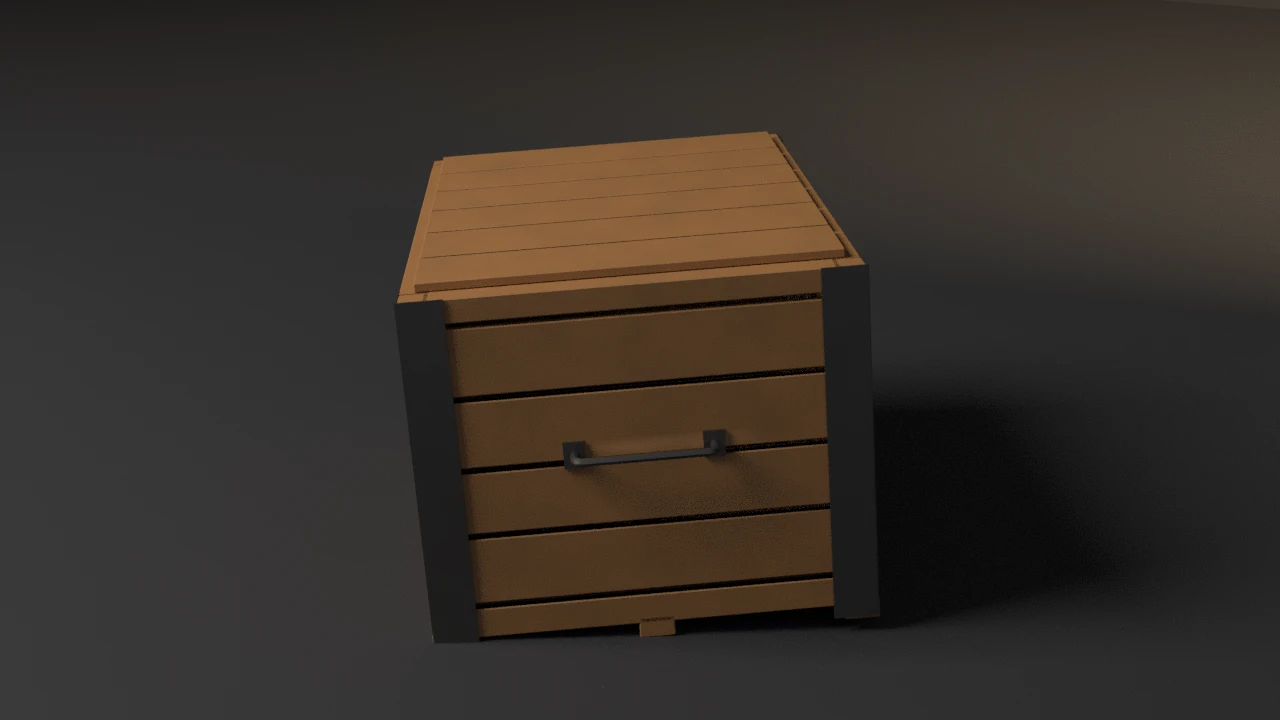
shipping-crate
A procedural shipping crate through UVs, bake, LOD, collider, and Unity glTF, asserting recomputed budgets rather than an API contract.
A procedural sci-fi hover bike — a sculpted two-tone fuselage with panel seams, gasketed access panels with hex fasteners, a belly service plate, decal plate, hinged charge-port door, heat sink, intake grilles, grab rail and tail light, a stitched pleated saddle, a twin-stanchion fork through sculpted triple clamps with clip-ons, switch pods, pivoted levers and a visored instrument cluster, two glowing exhaust nozzles, two ducted fans with canted stator vanes and handed seven-blade rotors, aerofoil pylons flared into the shrouds with fastener rows and a conduit, and landing gear of twin-plate pressed links and oleo shocks on sixteen pinned joints carrying ski-section skids on wear strips — through UVs, bake, LOD, collider, and Unity glTF, asserting recomputed budgets rather than an API contract.
Rendered headless by the showcase piece itself — click to zoom.
category Vehicles
blender --background --python showcase/hover-bike/hover_bike.py --
A showcase piece, not an example, and the second in the vehicles category. It builds a procedural sci-fi hover bike, parked on its landing gear:
The layout is solved from named constants. Every blade section is wrapped onto its own cylinder about the fan axis, so the tip is exactly BLADE_TIP from it and the clearance to the throat is a design number (10 mm), not a side effect of a flat section's corners. Grilles, fins, panels and plates are laid on the fuselage's closed-form surface along its own normal. The hull's section parameter is symmetric about its crown, so the hull is its own mirror image vertex for vertex. The gear's pins, bushings, barrels, rods and wear strips carry a part face tag (role and unit), so the joint, shock and ground audits read the parts they mean rather than guessing them from shape.
It asserts budget conformance of the generated result. It does not witness an API contract. "It rendered without error" is not a check.
Composes skills mesh-editing-and-bmesh, bake-high-to-low, depsgraph-and-evaluated-data, engine-export-presets, and snippets bake_normal_high_to_low.py, setup_bake_target_image.py, lod_chain.py / decimate_to_budget.py, convex_hull_collider.py, export_preset_unity.py (helpers copied inline, not imported).
Intended size: 2.23 m long, 0.66 m across the bar ends, 1.11 m to the top of the cluster's visor, with the saddle's top at 0.852 m. The shrouds set the length, the bar-end weights the width and the visor the top. The fuselage is 1.033 × 0.344 m. The origin is under the bike's centre, so it lands on the soles of its wear strips.
Every budget is declared as a named constant. Every gate recomputes its value from the mesh, materials, UVs, evaluated LOD, collider, or export file.
| Axis | Declared | Measured (5.2.1) |
|---|---|---|
| Base triangles | 45000–46000 | 45796 |
| LOD1 ratio | 0.32–0.62 of base | 0.5000 |
| LOD2 ratio | 0.10–0.35 of base | 0.2197 |
| Materials | exactly 10 distinct; ≥3490 livery, ≥5365 composite, ≥5525 gunmetal, ≥1200 rubber, ≥1620 leather, ≥490 light, ≥460 glass, ≥2565 anodised, ≥1235 carbon, ≥1215 chrome faces | 10 slots; 3796 / 5832 / 6008 / 1304 / 1760 / 532 / 476 / 2788 / 1344 / 1320 |
| UVs | in 0..1, AABB overlap ≤ 1e-5 | in range, overlap 0 |
| Outer AABB | (2.234, 0.660, 1.112) m ± 0.01 | (2.2338, 0.6598, 1.1124), zmin 0 |
| Collider tris | ≤ 1990 | 1890 |
| Export | written, size > 0, removed after measuring | 3504016 bytes |
The collider is the convex hull of the whole bike. Its count is carried by the two 72-segment shroud lips, which are the hull's outline in plan.
Every falsifier leaves the triangle count at 45796: they move, scale or bend parts, never add or remove them.
DECIMATE COLLAPSE triangle counts are not identical across Blender series, so the LOD gate is a ratio band, not an exact count. Bake pixels are stochastic, so the bake gate is has_data plus operator FINISHED, not byte-identity. Construction uses no RNG; two default runs print identical measurements.
Recomputed from the generated mesh, not asserted about the script.
| Axis | Declared | Measured |
|---|---|---|
| Non-manifold edges | 0 | 0 |
| Loose verts / edges | 0 / 0 | 0 / 0 |
| Doubles merged at 1e-5 | 0 | 0 |
| Zero-area faces | 0 | 0 |
| N-gons | 0 | 0 |
| Coplanar cross-shell face pairs (KD range 0.05 m, plane ε 1e-4) | 0 | 0 |
Grounded: zmin | within 1e-4 of 0 | 0.0000 |
Skids: each of the 2 wear strips has its own zmin | within 1e-4 of 0 | 0, 0 |
Coplanar pairs are kept at zero by staggering parts, not by widening the band. The two bosses and the eye on a joint are turned to three different phases, so their bores never share a face plane; the two plates of a link and the two cheeks of a clevis differ by 0.4 mm; hex heads are turned 15°, so a row or a column of them never shares a flat; skin, gasket and panel faces sit at least 1 mm apart, front and back.
| Axis | Declared | Measured |
|---|---|---|
| Fans coaxial: each rotor hub and motor can (vertex mean) on its shroud's axis (vertex mean of the lathe); shrouds level (PCA); fan axes 1.60 m apart on the centreline | hub and can within 1 mm of the axis; tilt ≤ 0.3°; pitch 1.600 ± 0.002 m, axes within 1 mm of y = 0 | 0.001 mm; 0°; 1.60000 m |
| Blade-tip clearance: from the shroud axis, a level ray through each outer blade vertex to the shroud's inner wall, minus the vertex's radius; every blade overlaps its hub | 0.006–0.014 m | 0.0098 m on both fans; 0 unseated |
| Hull mirror symmetry: every fuselage vertex against its nearest vertex at (x, −y, z) | ≤ 0.5 mm | 0.000 mm |
| Size: fuselage length and width, saddle top | 1.033 × 0.344 m, 0.852 m, each ± 0.004 | 1.0330 × 0.3437, 0.8520 |
| Blade spacing: blades per rotor, and the angular gaps between them about the rotor hub's own axis | 7 per rotor; each gap 360/7° ± 0.3° | 7 and 7; worst 0.0001° |
| Stance: mass centre (shell volumes × density per material) inside the convex polygon of both wear strips' soles | ≥ 0.200 m inside every edge | 0.2515 (148.5 kg, centre at x −0.019) |
| One connected assembly (union of shells whose BVH trees overlap) | 1 component | 1 (322 shells) |
| Joints: 16, each one pin through three bushings; every bushing's centre on its pin's axis (PCA of the turned part), its axis parallel, its centre inside the pin's span | offset ≤ 0.3 mm, tilt ≤ 0.3° | 16 joints; 0.000 mm, 0.000° |
| Shocks: 4, the rod on its barrel's axis; the rod's length out of the gland, and its length still inside the barrel | offset ≤ 0.3 mm, tilt ≤ 0.3°; exposed 0.100–0.140 m; engaged ≥ 0.045 m | 0.000 mm, 0.010°; 0.1233 m; 0.065 m |
A ducted fan is only as good as its tip gap: the thrust a duct adds comes from the blade tips running close to the wall. Too wide and it is an open propeller in a ring; the blade touches the wall if the gap is zero. The clearance budget measures that gap along the ray the tip travels on. The coaxiality budget is its precondition, since a rotor off its shroud's axis closes the gap on one side. Blade spacing is the rotor's balance, measured about the rotor's own hub, so a rotor shifted off the shroud axis fails coaxiality alone. A pinned joint binds if its pin is off its bushings' axis, and a shock tops out if its rod is not engaged in the barrel, so the gear carries the same two checks as the loader's rams (showcase/cargo-loader). The densities are named constants (composite shells 1600 kg/m³, the fuselage as a hollow monocoque with its internals 250, aluminium 2700, rubber and lights 1200, leather and foam 300, glass 2500, carbon 1600, chrome-plated steel 7800), and the volumes come from the mesh.
Each falsifier violates one named budget. Every one was run on 5.2.1 and exited its declared code. None moves the envelope: every run measured the same outer AABB and triangle count as the default, and every budget checked before the target stayed green.
| Flag | Budget violated | Exit |
|---|---|---|
--skip-decimate | LOD1 ratio band (measured 1.0000) | 9 |
--stray-vert | loose vertex count is 0 (measured 1, placed inside the envelope) | 15 |
--lift-z | bounding box zmin is 0 (measured 0.05000) | 16 |
--float-skid | both skids on the ground (the y+ shoe, strip, caps and bolts 4 mm up: its zmin 0.004, the other 0) | 16 |
--offset-hub | fans coaxial (rear rotor 2.5 mm off its shroud's axis: 0.00250 m) | 17 |
--long-blades | blade-tip clearance band (rear blades 12 mm longer: clearance −0.0022 m) | 18 |
--odd-hull | hull mirror symmetry (a 4 mm sideways bow, zero at both ends: deviation 0.00799 m) | 19 |
--skew-blade | blade spacing (one rear blade turned 4°: worst gap error 4.000°) | 20 |
--narrow-skids | stance (shoes drawn in to ±0.150 m: margin 0.1715 m) | 21 |
--pop-lens | one connected assembly (headlight lens 20 mm out of its housing: 2 components) | 22 |
--offset-pin | joints (the near front link's foot pin 1.5 mm along x: 0.001500 m off its bushings' axis) | 24 |
--skew-rod | shocks (the near rear rod 1.5 mm across its axis: 0.001500 m off its barrel's) | 25 |
--short-rod | shocks (the near rear rod's inner end drawn out 45 mm: engaged 0.020 m, floor 0.045) | 25 |
The rear fan is the one --offset-hub, --long-blades and --skew-blade change, because nothing inside a shroud sets the envelope. --offset-hub leaves the tip clearance inside its band and the blade gaps exact, so only coaxiality sees it. --long-blades pushes the tips 2.2 mm into the wall, and every blade still sits in its hub. --odd-hull bows the fuselage by cos(πx / 2·0.515), so both ends stay inside their shroud walls, and it bows everything laid on the skin with it: when only the hull bowed, a panel met a hull facet at a shared plane and the run stopped at hygiene (15) instead. --float-skid lifts one skid's own parts while the other grounds the box; its first draft lifted the skid lug's pin too, which slid a pin face onto a boss's plane and also stopped at 15, so the lug and its pin now stay with the gear. --pop-lens first stopped at 15 because the lens (36 segments) and its housing (32) had faces within 0.6° of parallel; both are now 32 segments turned half a step apart. --narrow-skids keeps both strips on the ground and the envelope unchanged; only the contact polygon shrinks. --offset-pin moves a pin and no bushing; --skew-rod and --short-rod move a rod and no pin, so each fails its own budget alone.
blender --background --python hover_bike.py --
blender --background --python hover_bike.py -- --skip-decimate
blender --background --python hover_bike.py -- --stray-vert
blender --background --python hover_bike.py -- --lift-z
blender --background --python hover_bike.py -- --float-skid
blender --background --python hover_bike.py -- --offset-hub
blender --background --python hover_bike.py -- --long-blades
blender --background --python hover_bike.py -- --odd-hull
blender --background --python hover_bike.py -- --skew-blade
blender --background --python hover_bike.py -- --narrow-skids
blender --background --python hover_bike.py -- --pop-lens
blender --background --python hover_bike.py -- --offset-pin
blender --background --python hover_bike.py -- --skew-rod
blender --background --python hover_bike.py -- --short-rod
blender --background --python hover_bike.py -- --output bike.png
Smoke passes no flags.
The hero turns the piece HERO_YAW_DEG (−62°), so the nose, headlight and front fan come toward the lens on the right, and the near side's gear, panels and decal face it. The camera stands high enough to look into both shrouds, where the blades and spinners show. The wall stands 2.8 m behind the bike, and the warm wedge pools on it. Gunmetal and chrome carry a studio reflection term (after showcase/road-bicycle), so the gear reads as metal on the dark stage.
File-local. 9 is a valid check code. 10 is reserved for gallery_framing.check_framing on the --output path. 15–19 are the hygiene and joint-fit family. 20–25 are file-local. 23 is the asset-quality floor on the render path: check_asset_quality returns 11, which this piece already spends on the collider ceiling, so the call site remaps it.
| Code | Meaning |
|---|---|
| 0 | Success |
| 1 | Uncaught exception (FATAL wrapper) |
| 2 | argparse / usage |
| 3 | Mesh did not build / no UV layer |
| 4 | Base triangle count outside range |
| 5 | Material count ≠ 10 distinct slots, or a face-count floor missed |
| 6 | UVs outside 0..1 |
| 7 | UV AABB overlap above tolerance |
| 8 | World AABB off declared outer size |
| 9 | LOD ratio band (--skip-decimate lands here) |
| 10 | Framing gate (render path only) |
| 11 | Collider triangle count above ceiling |
| 12 | Bake did not finish or image has no data |
| 13 | Export file missing or empty |
| 14 | --output produced no file |
| 15 | Mesh hygiene: loose, non-manifold, zero-area, doubles, n-gons, coplanar cross-shell pairs |
| 16 | Not grounded: bounding box zmin off 0, or a skid's wear strip off the ground, or not 2 skids (--lift-z, --float-skid) |
| 17 | Fans not coaxial: a rotor hub or motor can off its shroud's axis, a shroud tilted, the fan pitch off, or not 2 shrouds, hubs and cans (--offset-hub) |
| 18 | Blade-tip clearance outside its band, or a blade not in its hub (--long-blades) |
| 19 | Hull mirror symmetry, or fuselage length, width or saddle height off (--odd-hull) |
| 20 | Blade spacing: not 7 blades per rotor, or a gap off 360/7° (--skew-blade) |
| 21 | Stance: mass centre within 0.200 m of the skids' contact-polygon edge (--narrow-skids) |
| 22 | Assembly splits into more than one connected component (--pop-lens) |
| 23 | Asset-quality floor (render path only; remapped from 11) |
| 24 | Joints: not 16, a joint without one pin and three bushings, or a bushing off its pin's axis or span (--offset-pin) |
| 25 | Shocks: not 4, a rod off its barrel's axis, its exposed length outside 0.100–0.140 m, or engaged under 0.045 m (--skew-rod, --short-rod) |
"""Game-ready sci-fi hover bike — a showcase piece, not an example. Asserts budget conformance of a procedural hover bike (a speeder parked on its landing skids) after composing shipped pipeline pieces: bmesh construction, UVs, ten materials, high-to-low normal bake, LOD chain, convex collider, Unity glTF export. The bike rides on two ducted fans, one ahead of the rider and one behind. Between them a sculpted fuselage is lofted from superellipse sections along the bike's length: a painted livery canopy over a dark belly, a parting-line groove along both flanks and three transverse panel seams. On it: intake grilles, tail vents, a crown vent, cooling fins and a finned heat sink; access panels (a panel proud of a dark gasket by an even seam, hex fasteners at the corners), an alloy service plate on the belly, a decal plate, a hinged charge-port door; a pillion grab rail over the tail and a tail-light cluster between the exhaust nozzles. A headlight pod sits on the tank's front slope, a low fly screen behind it. Twin chrome stanchions in pleated boots run through two sculpted triple clamps to fork caps; clip-on clamps carry the bars with switch pods, lever perches, levers on pivot bolts, ribbed grips and bar-end weights; an instrument cluster with an emissive screen stands on a bracket under a small visor. A stitched, pleated saddle is draped over the crown. Each fan is a shroud (an airfoil-section ring: livery outside, dark inside, with an accent band and a marker light) around a static motor can on four canted stator vanes, a rotor hub, a spinner and seven twisted, lofted blades. The two rotors are handed. Two aerofoil pylons (chord vertical in the downwash) run from shroud to shroud, flared into both shroud walls, tied into the belly by fairing webs, with a fastener row, a conduit in P-clips along the crest and a foot peg. Under each pylon, at both ends, a twin-plate pressed link hangs from a pylon lug to a skid lug, and an oleo shock (anodised barrel, preload collar, boot, chrome rod) runs from a pylon clevis to the link's middle: every joint a headed pin through two bosses and one eye. The links carry two ski-section skid shoes on replaceable wear strips, with bolted end caps, tied by two cross braces. Budgets are declared below and recomputed from the generated result. They are not API-contract witnesses. Each falsifier violates one named budget: ``--skip-decimate`` the LOD-ratio band, ``--stray-vert`` mesh hygiene, ``--lift-z`` grounded zmin, ``--float-skid`` both skids on the ground, ``--offset-hub`` the fan hubs coaxial with their shrouds, ``--long-blades`` the blade-tip clearance band, ``--odd-hull`` the hull's mirror symmetry, ``--skew-blade`` equal blade spacing, ``--narrow-skids`` the mass centre inside the skids' support polygon, ``--pop-lens`` one connected assembly, ``--offset-pin`` every pin coaxial with its bushings, ``--skew-rod`` and ``--short-rod`` every shock rod coaxial with its barrel and inside its stroke band. No RNG. Construction is closed-form. DECIMATE COLLAPSE triangle counts are not byte-identical across Blender versions — the LOD gate is a ratio band, not an exact count. blender --background --python hover_bike.py -- blender --background --python hover_bike.py -- --skip-decimate blender --background --python hover_bike.py -- --output bike.png """ import argparse import math import os import sys import tempfile import traceback import bmesh import bpy import numpy as np from mathutils import Matrix, Vector from mathutils.bvhtree import BVHTree from mathutils.kdtree import KDTree # Showcase lives at repo-root/showcase/, not under examples/. The framing # helper is the repo's only shared import and lives next to the examples; # resolve the repo root so we do not move gallery_framing.py. _REPO = os.path.abspath( os.path.join(os.path.dirname(os.path.abspath(__file__)), os.pardir, os.pardir) ) sys.path.insert(0, os.path.join(_REPO, "examples")) sys.dont_write_bytecode = True import gallery_framing # noqa: E402 import gallery_asset_quality # noqa: E402 # --- Fuselage: superellipse sections lofted along X (nose at +X) ------------- HULL_XE = 0.515 # hull ends, each inside its shroud's wall HULL_N = 2.6 # section superellipse exponent HULL_PART = 0.60 # parting line (the shoulder), as a fraction of belly-to-crown HULL_SEGS = 56 HULL_STATIONS = 46 GROOVE = 0.0016 # panel-seam depth PANEL_X = (-0.44, 0.02, 0.36) CAP_CHAMFER = 0.002 # (x, value) keys for the crown height, belly height and half-width TOP_KEYS = [(-0.515, 0.472), (-0.49, 0.540), (-0.45, 0.660), (-0.40, 0.760), (-0.34, 0.795), (-0.27, 0.786), (-0.14, 0.782), (-0.02, 0.795), (0.10, 0.845), (0.20, 0.862), (0.28, 0.852), (0.36, 0.800), (0.43, 0.700), (0.48, 0.595), (0.515, 0.472)] BOT_KEYS = [(-0.515, 0.374), (-0.40, 0.366), (0.00, 0.360), (0.40, 0.366), (0.515, 0.374)] W_KEYS = [(-0.515, 0.082), (-0.45, 0.110), (-0.34, 0.142), (-0.18, 0.152), (0.02, 0.160), (0.16, 0.172), (0.30, 0.160), (0.42, 0.122), (0.515, 0.082)] # --- Ducted fans --------------------------------------------------------------- DUCT_X = 0.80 # fan axes at x = +-0.80 on the centreline DUCT_Z0 = 0.30 # shroud trailing edge DUCT_SEGS = 72 # shroud section (r, dz): throat 0.262 m, lip crown at dz 0.219, closed ring DUCT_PROFILE = [ (0.2700, 0.000), (0.2648, 0.030), (0.2627, 0.070), (0.2620, 0.110), (0.2630, 0.150), (0.2665, 0.180), (0.2730, 0.200), (0.2820, 0.2130), (0.2930, 0.2190), (0.3040, 0.2150), (0.3110, 0.2030), (0.3140, 0.1850), (0.3140, 0.0400), (0.3100, 0.0150), (0.3000, 0.0030), (0.2860, 0.000), ] # segment j runs from point j to j+1: inner wall dark, lip and outside livery DUCT_SEG_DARK = {0, 1, 2, 3, 4, 5, 14, 15} BLADES_PER_FAN = 7 BLADE_ROOT = 0.058 BLADE_TIP = 0.252 ROTOR_DZ = 0.110 SPIN = {1: 1.0, -1: -1.0} # front rotor counter-clockwise from above, rear clockwise # (fraction root->tip, chord, max thickness, blade angle deg) BLADE_STATIONS = [ (0.00, 0.042, 0.0065, 46.0), (0.08, 0.050, 0.0060, 43.0), (0.18, 0.060, 0.0055, 39.0), (0.30, 0.066, 0.0050, 35.0), (0.45, 0.068, 0.0045, 31.0), (0.60, 0.066, 0.0040, 28.0), (0.75, 0.062, 0.0036, 26.0), (0.88, 0.057, 0.0032, 24.5), (1.00, 0.046, 0.0028, 23.0), ] AIRFOIL_X = (1.0, 0.72, 0.45, 0.22, 0.07, 0.0, 0.07, 0.22, 0.45, 0.72) BLADE_CAMBER = 0.045 BLADE_PIVOT = 0.40 VANE_DEG = (45.0, 135.0, 225.0, 315.0) VANE_CANT = 12.0 # --- Pylons: aerofoil fairings from shroud to shroud, chord vertical --------------- PYLON_Y = 0.230 PYLON_Z = 0.370 # half-chord height PYLON_X = 0.625 # ends, inside the shroud walls PYLON_CHORD = 0.074 PYLON_T = 0.34 # thickness / chord PYLON_FLARE_X = 0.440 # the fillet into the shroud starts here PYLON_FLARE = 1.45 # section growth at the shroud PYLON_TE = 0.97 # blunt trailing edge (the underside), fraction of chord PYLON_SEC = (0.02, 0.07, 0.16, 0.30, 0.46, 0.64, 0.82, PYLON_TE) PYLON_BOLTS = (-0.39, -0.24, -0.05, 0.10, 0.24, 0.39) WEB_X = (-0.20, 0.20) # fairing webs from the pylons into the belly WEB_Z = 0.415 WEB_SEC = (0.05, 0.20, 0.45, 0.72, 0.96) PEG_X = -0.12 # --- Landing gear: per corner a twin-plate link and an oleo shock ----------------- # (|x|, z) of the pins (the wear strips' soles are the floor, z = 0); the # gear lies in the vertical planes y = +-GEAR_Y under the pylons, pins along y. GEAR_Y = PYLON_Y LINK_TOP = (0.505, 0.292) # pin A: pylon lug, link top LINK_BOT = (0.640, 0.074) # pin B: skid lug, link foot SHOCK_TOP = (0.330, 0.300) # pin C: pylon clevis, shock top eye SHOCK_AT = 0.56 # pin E, the shock's foot, along the link A -> B PAD_Z = (0.322, 0.348) # mount pads engulfing the pylon's trailing edge PIN_R = 0.0060 BUSH_RI = 0.0055 # a bushing's bore bites 0.5 mm into its pin EYE_HALF = 0.0085 # a member eye's half-width along its pin EYE_RO = 0.0125 CHEEK_Y = 0.0140 # cheek / link-plate mid-plane, off the joint's centre BOSS_HALF = 0.0035 BOSS_RO = 0.0140 PLATE_HALF = 0.0025 PIN_BITE = 0.0005 # pin head and nut seat inside the outer bosses JOINT_SEGS = 8 # shock stations along its axis from pin C (s = 0) to pin E (s = L) CYL_S = (0.010, 0.150) # body from the top eye's neck to the gland CYL_R = 0.0220 ROD_R = 0.0085 ROD_IN = 0.085 # the rod's inner end inside the barrel BOOT_S = (0.146, 0.188) # --- Skids ------------------------------------------------------------------------ SKID_Y = GEAR_Y SKID_Y_NARROW = 0.150 # --narrow-skids SKID_W = 0.033 # shoe half-width: a ski, flat below and domed above SKID_HT = 0.020 # crown over the section's centre line SKID_HB = 0.008 # sole under it STRIP_T = 0.0100 # wear strip thickness; the shoe rides this far up STRIP_HW = 0.024 STRIP_X = 0.700 SKID_X = 0.76 SKID_TIP = (0.93, 0.098) BRACE_X = 0.585 BRACE_R = 0.0085 FLOAT_SKID = 0.004 # --float-skid # --- Cockpit ---------------------------------------------------------------------- RISER_X = 0.250 CLAMP_Z = 0.985 FORK_Y = 0.058 FORK_R = 0.0165 FORK_TOP = 1.012 BAR_Z = 0.996 BAR_HALF = 0.31 HEAD_Z = 0.600 # headlight axis height SEAT_X0 = -0.330 SEAT_X1 = 0.000 SEAT_BITE = 0.012 SEAT_PITCH = 0.042 SEAT_SEAMS = 6 SEAT_SEAM0 = -0.290 SEAT_PUFF = 0.0035 SEAT_GROOVE = 0.003 SEAT_TOP_KEYS = [(-0.330, 0.840), (-0.290, 0.850), (-0.160, 0.846), (-0.060, 0.846), (0.000, 0.852)] SEAT_W_KEYS = [(-0.330, 0.112), (-0.250, 0.128), (-0.110, 0.120), (0.000, 0.098)] NOZZLE_Y = 0.085 NOZZLE_Z = 0.640 NOZZLE_X = -0.400 # --- Falsifier sizes --------------------------------------------------------------- FALSIFY_FAN = -1 # the rear fan: nothing in it sets the envelope OFFSET_HUB = 0.0025 LONG_BLADES = 0.012 ODD_HULL = 0.004 SKEW_DEG = 4.0 POP_LENS = 0.020 OFFSET_PIN = 0.0015 # --offset-pin: the front-left link's foot pin, along x SKEW_ROD = 0.0015 # --skew-rod: the rear-left rod, across its axis SHORT_ROD = 0.045 # --short-rod: the rear-left rod's inner end, drawn out BBOX_TOL = 0.01 # Fitted after locking geometry. Recomputed from bound_box. OUTER_SIZE = (2.234, 0.660, 1.112) BASE_TRIS_MIN = 45000 BASE_TRIS_MAX = 46000 LOD1_RATIO_MIN = 0.32 LOD1_RATIO_MAX = 0.62 LOD2_RATIO_MIN = 0.10 LOD2_RATIO_MAX = 0.35 LOD1_TARGET = 0.50 LOD2_TARGET = 0.22 MATERIAL_COUNT = 10 UV_EPS = 1e-4 UV_OVERLAP_MAX = 1e-5 COLLIDER_TRIS_MAX = 1990 BAKE_RES = 1024 CAGE_EXTRUSION = 0.004 LIVERY_FACES_MIN = 3490 GRAPHITE_FACES_MIN = 5365 METAL_FACES_MIN = 5525 RUBBER_FACES_MIN = 1200 LEATHER_FACES_MIN = 1620 LIGHT_FACES_MIN = 490 GLASS_FACES_MIN = 460 ACCENT_FACES_MIN = 2565 CARBON_FACES_MIN = 1235 CHROME_FACES_MIN = 1215 ZMIN_EPS = 1e-4 DOUBLES_EPS = 1e-5 AREA_EPS = 1e-10 COPLANAR_NORMAL_EPS = 1e-4 COPLANAR_PLANE_EPS = 1e-4 COPLANAR_CENTRE_MAX = 0.05 LIFT_Z = 0.05 SKID_COUNT = 2 # Fans: hub and motor can on the shroud axis, the shroud level. FAN_COUNT = 2 HUB_AXIS_TOL = 0.001 AXIS_TILT_MAX_DEG = 0.3 FAN_PITCH_TOL = 0.002 # fan axes 1.60 m apart on the hull's centreline # Tip clearance: blade tip to the shroud's inner wall, along the radial ray. CLEAR_MIN = 0.006 CLEAR_MAX = 0.014 # Hull symmetry: every hull vertex has a partner at its mirror position. MIRROR_EPS = 0.0005 HULL_LEN = 1.033 HULL_WIDTH = 0.344 SEAT_HEIGHT = 0.852 SIZE_TOL = 0.004 # Blade spacing: seven blades per rotor, equal gaps. SPACING_TOL_DEG = 0.3 # Stance: the mass centre stands this far inside the skids' contact polygon. DENSITY = (1600.0, 1400.0, 2700.0, 1200.0, 300.0, 1200.0, 2500.0, 2700.0, 1600.0, 7800.0) HULL_DENSITY = 250.0 # the fuselage is a hollow monocoque with its internals STANCE_MARGIN = 0.200 # Joints: every pin through three bushings (two outer bosses, one eye). JOINT_COUNT = 16 JOINT_BUSHINGS = 3 PIN_OFFSET_MAX = 0.0003 PIN_TILT_MAX_DEG = 0.3 # Shocks: the rod on the barrel's axis; its travel inside the stroke band. SHOCK_COUNT = 4 ROD_OFFSET_MAX = 0.0003 ROD_TILT_MAX_DEG = 0.3 EXPOSED_MIN = 0.100 # rod out of the gland EXPOSED_MAX = 0.140 ENGAGE_MIN = 0.045 # rod still inside the barrel # Face tags ("part" = role * 100 + unit) for the parts the audits read. R_STRIP = 1 R_PIN = 2 R_BUSH = 3 R_CYL = 4 R_ROD = 5 # Hero yaw: the nose turned toward the camera's right. HERO_YAW_DEG = -62.0 WALL_Y = 2.8 LIVERY_IDX = 0 GRAPHITE_IDX = 1 METAL_IDX = 2 RUBBER_IDX = 3 LEATHER_IDX = 4 LIGHT_IDX = 5 GLASS_IDX = 6 ACCENT_IDX = 7 CARBON_IDX = 8 CHROME_IDX = 9 ZAX = Vector((0.0, 0.0, 1.0)) YAX = Vector((0.0, 1.0, 0.0)) XAX = Vector((1.0, 0.0, 0.0)) def eevee_engine_id(): return "BLENDER_EEVEE" if bpy.app.version >= (5, 0, 0) else "BLENDER_EEVEE_NEXT" def fail(msg, code): print(f"ERROR: {msg}", file=sys.stderr) return code def triangle_count(mesh): mesh.calc_loop_triangles() return len(mesh.loop_triangles) def evaluated_triangle_count(obj): # Duplicated from snippets/lod_chain.py / decimate_to_budget.py (not a package). depsgraph = bpy.context.evaluated_depsgraph_get() eval_obj = obj.evaluated_get(depsgraph) eval_mesh = eval_obj.to_mesh() try: eval_mesh.calc_loop_triangles() return len(eval_mesh.loop_triangles) finally: eval_obj.to_mesh_clear() # -------------------------------------------------------------------------- # Construction helpers (copied from showcase/quad-drone, not imported) # -------------------------------------------------------------------------- def _mark(faces, mat_idx): for f in faces: f.material_index = mat_idx def frame(ez, ex_hint): """Rotation whose local Z is ``ez`` and local X is ``ex_hint`` made orthogonal to it (columns ex, ey, ez; right-handed).""" ez = Vector(ez).normalized() ex = Vector(ex_hint) ex = (ex - ez * ex.dot(ez)).normalized() ey = ez.cross(ex) return Matrix((ex, ey, ez)).transposed() def add_lathe(bm, profile, segs, mat_idx, center=(0.0, 0.0, 0.0), rot=None, phase=0.0, solid=False, seg_mats=None, cap_mats=None, rmod=None): """Revolve a profile [(r, z), ...] about local Z. ``solid``: the profile is an open polyline closed by n-gon caps at its two ends; otherwise it is a closed polygon revolved into a ring shell. ``rmod(i, j)`` scales the radius of profile point ``j`` on ring ``i``.""" c = Vector(center) m = rot if rot is not None else Matrix.Identity(3) rings = [] for i in range(segs): a = phase + 2.0 * math.pi * i / segs ca, sa = math.cos(a), math.sin(a) ring = [] for j, (r, z) in enumerate(profile): rr = r * (rmod(i, j) if rmod else 1.0) ring.append(bm.verts.new(c + m @ Vector((rr * ca, rr * sa, z)))) rings.append(ring) n = len(profile) last = n - 1 if solid else n for i in range(segs): r0, r1 = rings[i], rings[(i + 1) % segs] for j in range(last): k = (j + 1) % n f = bm.faces.new((r0[j], r1[j], r1[k], r0[k])) f.material_index = seg_mats[j] if seg_mats else mat_idx if solid: f0 = bm.faces.new([rings[i][0] for i in reversed(range(segs))]) f1 = bm.faces.new([rings[i][n - 1] for i in range(segs)]) f0.material_index = cap_mats[0] if cap_mats else mat_idx f1.material_index = cap_mats[1] if cap_mats else mat_idx return [v for ring in rings for v in ring] def add_tube(bm, pts, radius, sides, mat_idx, phase=0.0): """Capped round bar swept along a polyline (parallel-transport frames).""" pts = [Vector(p) for p in pts] tans = [] for i in range(len(pts)): a = pts[max(i - 1, 0)] b = pts[min(i + 1, len(pts) - 1)] tans.append((b - a).normalized()) ref = Vector((0.0, 0.0, 1.0)) if abs(tans[0].z) < 0.9 else Vector((1.0, 0.0, 0.0)) nrm = (ref - tans[0] * ref.dot(tans[0])).normalized() rings = [] for p, t in zip(pts, tans): nrm = (nrm - t * nrm.dot(t)).normalized() bi = t.cross(nrm) rings.append([ bm.verts.new(p + radius * (nrm * math.cos(phase + 2.0 * math.pi * k / sides) + bi * math.sin(phase + 2.0 * math.pi * k / sides))) for k in range(sides) ]) faces = [] for r0, r1 in zip(rings, rings[1:]): for k in range(sides): m = (k + 1) % sides faces.append(bm.faces.new((r0[k], r0[m], r1[m], r1[k]))) faces.append(bm.faces.new(tuple(reversed(rings[0])))) faces.append(bm.faces.new(tuple(rings[-1]))) _mark(faces, mat_idx) return [v for ring in rings for v in ring] def rrect(ha, hb, rc, n_corner=4): """Rounded rectangle loop (counter-clockwise).""" rc = max(min(rc, ha - 1e-4, hb - 1e-4), 0.0006) pts = [] for k, (sx, sy) in enumerate(((1, 1), (-1, 1), (-1, -1), (1, -1))): cx, cy = sx * (ha - rc), sy * (hb - rc) a0 = 0.5 * math.pi * k for s in range(n_corner + 1): a = a0 + 0.5 * math.pi * s / n_corner pts.append((cx + rc * math.cos(a), cy + rc * math.sin(a))) return pts def add_rbox(bm, ha, hb, rc, profile, origin, rot, mat_idx, n_corner=4): """Loft of rounded rectangles along local Z: profile [(inset, z)], each loop inset from (ha, hb, rc); n-gon caps at both ends.""" o = Vector(origin) rings = [] for inset, z in profile: loop = rrect(ha - inset, hb - inset, rc - inset, n_corner) rings.append([bm.verts.new(o + rot @ Vector((x, y, z))) for x, y in loop]) n = len(rings[0]) faces = [] for r0, r1 in zip(rings, rings[1:]): for k in range(n): m = (k + 1) % n faces.append(bm.faces.new((r0[k], r0[m], r1[m], r1[k]))) faces.append(bm.faces.new(tuple(reversed(rings[0])))) faces.append(bm.faces.new(tuple(rings[-1]))) _mark(faces, mat_idx) return [v for ring in rings for v in ring] def add_prism(bm, outline, w0, w1, origin, rot, mat_idx): """Planar outline [(u, v)] extruded along local Z from w0 to w1.""" o = Vector(origin) a = [bm.verts.new(o + rot @ Vector((u, v, w0))) for u, v in outline] b = [bm.verts.new(o + rot @ Vector((u, v, w1))) for u, v in outline] n = len(outline) faces = [bm.faces.new((a[i], a[(i + 1) % n], b[(i + 1) % n], b[i])) for i in range(n)] faces.append(bm.faces.new(tuple(reversed(a)))) faces.append(bm.faces.new(tuple(b))) _mark(faces, mat_idx) return a + b def fillet_path(pts, rf, steps=4): pts = [Vector(p) for p in pts] out = [pts[0]] for i in range(1, len(pts) - 1): a, p, b = pts[i - 1], pts[i], pts[i + 1] r = min(rf, (a - p).length * 0.45, (b - p).length * 0.45) p0 = p + (a - p).normalized() * r p1 = p + (b - p).normalized() * r for k in range(steps + 1): t = k / steps out.append((1 - t) ** 2 * p0 + 2 * (1 - t) * t * p + t * t * p1) out.append(pts[-1]) return out def add_bar(bm, pts, wax, half_w, half_t, rc, mat_idx, fillet=0.008): """Flat bar bent in the plane normal to ``wax``: its width lies along ``wax``, its thickness in the bending plane; rounded-rectangle section.""" pts = fillet_path(pts, fillet) wax = Vector(wax).normalized() sec = rrect(half_w, half_t, rc, 2) rings = [] for i, p in enumerate(pts): a = pts[max(i - 1, 0)] b = pts[min(i + 1, len(pts) - 1)] t = (b - a).normalized() w = (wax - t * wax.dot(t)).normalized() th = t.cross(w) rings.append([bm.verts.new(p + w * x + th * y) for x, y in sec]) n = len(sec) faces = [] for r0, r1 in zip(rings, rings[1:]): for k in range(n): m = (k + 1) % n faces.append(bm.faces.new((r0[k], r0[m], r1[m], r1[k]))) faces.append(bm.faces.new(tuple(reversed(rings[0])))) faces.append(bm.faces.new(tuple(rings[-1]))) _mark(faces, mat_idx) return [v for ring in rings for v in ring] def add_sheet(bm, surf, nu, nv, thick, mat_idx): """A closed plate: ``surf(u, v) -> (point, normal)`` over the unit square, offset ``thick`` back along the normal, rims stitched round the edge.""" front, back = [], [] for j in range(nv + 1): rf, rb = [], [] for i in range(nu + 1): p, n = surf(i / nu, j / nv) rf.append(bm.verts.new(p)) rb.append(bm.verts.new(p - n * thick)) front.append(rf) back.append(rb) faces = [] for j in range(nv): for i in range(nu): faces.append(bm.faces.new((front[j][i], front[j][i + 1], front[j + 1][i + 1], front[j + 1][i]))) faces.append(bm.faces.new((back[j][i], back[j + 1][i], back[j + 1][i + 1], back[j][i + 1]))) rim = ([(0, i) for i in range(nu + 1)] + [(j, nu) for j in range(1, nv + 1)] + [(nv, i) for i in reversed(range(nu))] + [(j, 0) for j in reversed(range(1, nv))]) for k in range(len(rim)): (ja, ia), (jb, ib) = rim[k], rim[(k + 1) % len(rim)] faces.append(bm.faces.new((front[jb][ib], front[ja][ia], back[ja][ia], back[jb][ib]))) _mark(faces, mat_idx) def hull2d(pts): """Convex hull, counter-clockwise (monotone chain).""" pts = sorted(set((round(x, 9), round(z, 9)) for x, z in pts)) def cross(o, a, b): return (a[0] - o[0]) * (b[1] - o[1]) - (a[1] - o[1]) * (b[0] - o[0]) lower, upper = [], [] for p in pts: while len(lower) >= 2 and cross(lower[-2], lower[-1], p) <= 1e-12: lower.pop() lower.append(p) for p in reversed(pts): while len(upper) >= 2 and cross(upper[-2], upper[-1], p) <= 1e-12: upper.pop() upper.append(p) return lower[:-1] + upper[:-1] def comb_outline(half_len, base_lo, base_hi, ribs, rib_half, rib_top): """Grille section: a base strip with ``ribs`` teeth standing on it.""" pts = [(-half_len, base_lo), (half_len, base_lo), (half_len, base_hi)] pitch = 2.0 * half_len / ribs for k in reversed(range(ribs)): c = -half_len + pitch * (k + 0.5) pts += [(c + rib_half, base_hi), (c + rib_half, rib_top), (c - rib_half, rib_top), (c - rib_half, base_hi)] pts.append((-half_len, base_hi)) return pts def triangulate_ngons(bm): faces = [f for f in bm.faces if len(f.verts) > 4] if faces: bmesh.ops.triangulate(bm, faces=faces) def pack_uvs(bm, margin=0.08): uv = bm.loops.layers.uv.new("UVMap") faces = list(bm.faces) n = len(faces) cols = max(1, math.ceil(math.sqrt(n))) rows = max(1, math.ceil(n / cols)) cell_w = 1.0 / cols cell_h = 1.0 / rows pad_u = margin * cell_w * 0.5 pad_v = margin * cell_h * 0.5 usable_w = cell_w - 2.0 * pad_u usable_h = cell_h - 2.0 * pad_v for i, face in enumerate(faces): col = i % cols row = i // cols nrm = face.normal ax, ay, az = abs(nrm.x), abs(nrm.y), abs(nrm.z) coords = [] for loop in face.loops: co = loop.vert.co if az >= ax and az >= ay: coords.append((co.x, co.y)) elif ax >= ay: coords.append((co.y, co.z)) else: coords.append((co.x, co.z)) xs = [c[0] for c in coords] ys = [c[1] for c in coords] minx, maxx = min(xs), max(xs) miny, maxy = min(ys), max(ys) dx = max(maxx - minx, 1e-8) dy = max(maxy - miny, 1e-8) origin_u = col * cell_w + pad_u origin_v = row * cell_h + pad_v for loop, (x, y) in zip(face.loops, coords): loop[uv].uv = ( origin_u + (x - minx) / dx * usable_w, origin_v + (y - miny) / dy * usable_h, ) # -------------------------------------------------------------------------- # The fuselage's closed form # -------------------------------------------------------------------------- def pchip(keys): """Monotone cubic through (x, y) keys (Fritsch-Carlson): no overshoot, so a crown key is the crown.""" xs = [k[0] for k in keys] ys = [k[1] for k in keys] n = len(xs) h = [xs[i + 1] - xs[i] for i in range(n - 1)] d = [(ys[i + 1] - ys[i]) / h[i] for i in range(n - 1)] m = [d[0]] + [0.0] * (n - 2) + [d[-1]] for i in range(1, n - 1): if d[i - 1] * d[i] > 0.0: w1 = 2.0 * h[i] + h[i - 1] w2 = h[i] + 2.0 * h[i - 1] m[i] = (w1 + w2) / (w1 / d[i - 1] + w2 / d[i]) def f(x): x = min(max(x, xs[0]), xs[-1]) i = 0 while i < n - 2 and x > xs[i + 1]: i += 1 t = (x - xs[i]) / h[i] t2, t3 = t * t, t * t * t return ((2 * t3 - 3 * t2 + 1) * ys[i] + (t3 - 2 * t2 + t) * h[i] * m[i] + (-2 * t3 + 3 * t2) * ys[i + 1] + (t3 - t2) * h[i] * m[i + 1]) return f _TOP = pchip(TOP_KEYS) _BOT = pchip(BOT_KEYS) _WID = pchip(W_KEYS) _SEAT_TOP = pchip(SEAT_TOP_KEYS) _SEAT_W = pchip(SEAT_W_KEYS) def hull_dims(x): """(parting-line height, half-width, crown height over it, belly depth).""" top, bot = _TOP(x), _BOT(x) zc = bot + HULL_PART * (top - bot) return zc, _WID(x), top - zc, zc - bot def _se(c, n=HULL_N): return math.copysign(abs(c) ** (2.0 / n), c) def hull_top(x, y): zc, w, ht, _hb = hull_dims(x) a = min(1.0, abs(y) / w) return zc + ht * (1.0 - a ** HULL_N) ** (1.0 / HULL_N) def hull_side_y(x, z): zc, w, ht, hb = hull_dims(x) h = ht if z >= zc else hb a = min(1.0, abs(z - zc) / h) return w * (1.0 - a ** HULL_N) ** (1.0 / HULL_N) def hull_F(p): zc, w, ht, hb = hull_dims(p.x) h = ht if p.z >= zc else hb return (abs(p.y) / w) ** HULL_N + (abs(p.z - zc) / h) ** HULL_N - 1.0 def hull_normal(p, eps=1e-5): g = Vector(( hull_F(p + Vector((eps, 0, 0))) - hull_F(p - Vector((eps, 0, 0))), hull_F(p + Vector((0, eps, 0))) - hull_F(p - Vector((0, eps, 0))), hull_F(p + Vector((0, 0, eps))) - hull_F(p - Vector((0, 0, eps))), )) return g.normalized() def hull_ring(x, inset=0.0): """One section loop: points [(y, z)] and per-segment material. The ring's parameter is symmetric about t = pi/2, so the loop is its own mirror.""" zc, w, ht, hb = hull_dims(x) step = 2.0 * math.pi / HULL_SEGS du = min(math.asin(min(1.0, (GROOVE / ht) ** (HULL_N / 2.0))), 0.4 * step) dl = min(math.asin(min(1.0, (GROOVE / hb) ** (HULL_N / 2.0))), 0.4 * step) half = HULL_SEGS // 2 ts = [(0.0, True), (du, False)] ts += [(step * i, False) for i in range(1, half)] ts += [(math.pi - du, False), (math.pi, True), (math.pi + dl, False)] ts += [(step * i, False) for i in range(half + 1, HULL_SEGS)] ts += [(2.0 * math.pi - dl, False)] pts = [] grooved = [] for t, g in ts: c, s = math.cos(t), math.sin(t) y = w * _se(c) z = zc + (ht if s >= 0.0 else hb) * _se(s) if g: y -= math.copysign(GROOVE, c) grooved.append(g) pts.append((y, z)) if inset > 0.0: out = [] for y, z in pts: d = math.hypot(y, z - zc) k = 1.0 - inset / d out.append((y * k, zc + (z - zc) * k)) pts = out n = len(pts) # the belly below the parting line is dark composite, the canopy livery seg_mats = [GRAPHITE_IDX if (grooved[j] or grooved[(j + 1) % n] or pts[j][1] + pts[(j + 1) % n][1] < 2.0 * zc) else LIVERY_IDX for j in range(n)] return pts, seg_mats def hull_stations(): xs = [] for k in range(HULL_STATIONS): s = -1.0 + 2.0 * k / (HULL_STATIONS - 1) xs.append(HULL_XE * (0.35 * math.sin(0.5 * math.pi * s) + 0.65 * s)) xs = [x for x in xs if all(abs(x - g) > 0.006 for g in PANEL_X)] st = [(x, 0.0, False) for x in xs] for g in PANEL_X: st += [(g - 0.0016, 0.0, False), (g, GROOVE, True), (g + 0.0016, 0.0, False)] st.sort() st = [(-HULL_XE - 0.0015, CAP_CHAMFER, False)] + st + [(HULL_XE + 0.0015, CAP_CHAMFER, False)] return st def add_hull(bm): rings, ring_mats, dark = [], [], [] for x, inset, is_groove in hull_stations(): pts, seg_mats = hull_ring(max(-HULL_XE, min(HULL_XE, x)), inset) rings.append([bm.verts.new((x, y, z)) for y, z in pts]) ring_mats.append(seg_mats) dark.append(is_groove) n = len(rings[0]) for k, (r0, r1) in enumerate(zip(rings, rings[1:])): for j in range(n): m = (j + 1) % n f = bm.faces.new((r0[j], r0[m], r1[m], r1[j])) f.material_index = GRAPHITE_IDX if (dark[k] or dark[k + 1]) else ring_mats[k][j] f0 = bm.faces.new(tuple(reversed(rings[0]))) f1 = bm.faces.new(tuple(rings[-1])) f0.material_index = GRAPHITE_IDX f1.material_index = GRAPHITE_IDX def bow(verts): """--odd-hull: a sideways bow, zero at both hull ends: an odd term in y.""" for v in verts: x = max(-HULL_XE, min(HULL_XE, v.co.x)) v.co.y += ODD_HULL * math.cos(0.5 * math.pi * x / HULL_XE) def surface_frame(p, along): """Frame on the hull at ``p``: local Z the outward normal, local X ``along`` laid into the tangent plane.""" return frame(hull_normal(p), along) def grille_frame(p, along): rot = surface_frame(p, along) return Matrix((rot.col[0], rot.col[2], -rot.col[1])).transposed() # u along, v out, w across # -------------------------------------------------------------------------- # Assemblies # -------------------------------------------------------------------------- def naca_half(x, t): return 5.0 * t * (0.2969 * math.sqrt(x) - 0.1260 * x - 0.3516 * x * x + 0.2843 * x ** 3 - 0.1036 * x ** 4) def add_blade(bm, axis, e_r, spin, tip): """One lofted fan blade, every section wrapped onto its own cylinder so the tip is exactly ``tip`` from the axis: twisted, cambered, handed.""" e_t = ZAX.cross(e_r) * spin secs = [] for f, chord, thick, beta_deg in BLADE_STATIONS: r = BLADE_ROOT + f * (tip - BLADE_ROOT) beta = math.radians(beta_deg) ring = [] for k, xc in enumerate(AIRFOIL_X): upper = k < 5 camber = BLADE_CAMBER * chord * 4.0 * xc * (1.0 - xc) yt = naca_half(xc, thick) yy = camber + (yt if upper else -yt) s = (xc - BLADE_PIVOT) * chord t_off = -math.cos(beta) * s - math.sin(beta) * yy z_off = -math.sin(beta) * s + math.cos(beta) * yy a = t_off / r p = axis + ZAX * (ROTOR_DZ + z_off) + r * (e_r * math.cos(a) + e_t * math.sin(a)) ring.append(bm.verts.new(p)) secs.append(ring) n = len(AIRFOIL_X) faces = [] for r0, r1 in zip(secs, secs[1:]): for k in range(n): m = (k + 1) % n faces.append(bm.faces.new((r0[k], r0[m], r1[m], r1[k]))) faces.append(bm.faces.new(tuple(reversed(secs[0])))) faces.append(bm.faces.new(tuple(secs[-1]))) _mark(faces, CARBON_IDX) return [v for s in secs for v in s] def add_fan(bm, side, bevel_verts, offset_hub=False, long_blades=False, skew_blade=False): """Shroud, accent band, marker light, motor can, stator vanes, rotor hub, spinner and blades of the fan at x = side * DUCT_X.""" base = Vector((side * DUCT_X, 0.0, DUCT_Z0)) add_lathe(bm, DUCT_PROFILE, DUCT_SEGS, LIVERY_IDX, center=base, seg_mats=[GRAPHITE_IDX if j in DUCT_SEG_DARK else LIVERY_IDX for j in range(len(DUCT_PROFILE))]) # accent band hooped onto the cylindrical outer wall (inner 3 mm inside it) add_lathe(bm, [(0.3110, 0.100), (0.3172, 0.1025), (0.3172, 0.1325), (0.3110, 0.1350)], DUCT_SEGS, ACCENT_IDX, center=base, phase=math.pi / DUCT_SEGS) # marker light on the shroud's nose (front) or tail (rear) e = Vector((side, 0.0, 0.0)) rot = frame(e, (0.0, 1.0, 0.0)) bevel_verts += add_prism(bm, rrect(0.036, 0.0075, 0.005), -0.006, 0.0022, base + e * 0.314 + ZAX * 0.066, rot, LIGHT_IDX) # motor can on four canted stator vanes add_lathe(bm, [(0.020, -0.014), (0.046, -0.002), (0.062, 0.018), (0.0655, 0.040), (0.0655, 0.090), (0.0625, 0.095)], 32, GRAPHITE_IDX, center=base, solid=True) for k, deg in enumerate(VANE_DEG): a = math.radians(deg) e_r = Vector((math.cos(a), math.sin(a), 0.0)) e_t = ZAX.cross(e_r) cant = math.radians(VANE_CANT) * side ev = ZAX * math.cos(cant) + e_t * math.sin(cant) rot = Matrix((e_r, ev, e_r.cross(ev))).transposed() ol = [(0.050, -0.019), (0.273, -0.019), (0.273, 0.019), (0.050, 0.019)] bevel_verts += add_prism(bm, ol, -0.0045 - 0.0002 * k, 0.0045 + 0.0002 * k, base + ZAX * 0.049, rot, METAL_IDX) # rotor: hub, spinner, blades shift = Vector((0.0, OFFSET_HUB, 0.0)) if offset_hub else Vector() axis = base + shift add_lathe(bm, [(0.0700, 0.088), (0.0780, 0.092), (0.0780, 0.126), (0.0740, 0.130)], 32, METAL_IDX, center=axis, solid=True, phase=math.pi / 32.0) add_lathe(bm, [(0.0660, 0.124), (0.0685, 0.128), (0.0620, 0.145), (0.0480, 0.160), (0.0280, 0.170), (0.0080, 0.174)], 32, ACCENT_IDX, center=axis, solid=True) tip = BLADE_TIP + (LONG_BLADES if long_blades else 0.0) park = math.radians(10.0 if side > 0 else 35.0) for b in range(BLADES_PER_FAN): a = park + 2.0 * math.pi * b / BLADES_PER_FAN if skew_blade and b == 0: a += math.radians(SKEW_DEG) e_r = Vector((math.cos(a), math.sin(a), 0.0)) add_blade(bm, axis, e_r, SPIN[side], tip) class Tagger: """Face tags for the parts the audits read: ``part`` = role * 100 + unit. Everything else keeps 0.""" def __init__(self, bm): self.bm = bm self.layer = bm.faces.layers.int.new("part") def __call__(self, role, unit=0): return _Tag(self, role * 100 + unit) class _Tag: def __init__(self, tg, code): self.tg, self.code = tg, code def __enter__(self): self.n0 = len(self.tg.bm.faces) return self def __exit__(self, *exc): bm = self.tg.bm bm.faces.ensure_lookup_table() for i in range(self.n0, len(bm.faces)): bm.faces[i][self.tg.layer] = self.code return False def add_loft(bm, rings, mat_idx): """Closed loops of equal length joined in order, n-gon caps.""" vs = [[bm.verts.new(p) for p in r] for r in rings] n = len(vs[0]) faces = [] for r0, r1 in zip(vs, vs[1:]): for k in range(n): m = (k + 1) % n faces.append(bm.faces.new((r0[k], r0[m], r1[m], r1[k]))) faces.append(bm.faces.new(tuple(reversed(vs[0])))) faces.append(bm.faces.new(tuple(vs[-1]))) _mark(faces, mat_idx) return [v for r in vs for v in r] def smooth01(t): t = min(1.0, max(0.0, t)) return t * t * (3.0 - 2.0 * t) def circle_pts(c, r, n=12, phase=0.0): return [(c[0] + r * math.cos(phase + 2.0 * math.pi * k / n), c[1] + r * math.sin(phase + 2.0 * math.pi * k / n)) for k in range(n)] def aerofoil_loop(chord, t, sec=PYLON_SEC): """Symmetric section, leading edge first: [(u, w)], u metres along the chord from the leading edge, w across it; the trailing edge is blunt.""" pts = [(0.0, 0.0)] pts += [(f * chord, naca_half(f, t) * chord) for f in sec] pts += [(f * chord, -naca_half(f, t) * chord) for f in reversed(sec)] return pts def add_hex(bm, base, nrm, r, h, mat_idx, bury=0.001): """Hex bolt head standing on ``base`` along ``nrm``, its foot buried.""" n = Vector(nrm).normalized() hint = XAX if abs(n.x) < 0.9 else YAX return add_lathe(bm, [(r, -bury), (r, h), (0.72 * r, h + 0.0012)], 6, mat_idx, center=base, rot=frame(n, hint), solid=True, phase=math.pi / 12.0) def add_xz_plate(bm, outline, y, half, mat_idx): """Planar outline [(x, z)] extruded across y from y - half to y + half.""" rot = Matrix(((1.0, 0.0, 0.0), (0.0, 0.0, 1.0), (0.0, 1.0, 0.0))) return add_prism(bm, outline, -half, half, (0.0, y, 0.0), rot, mat_idx) def pylon_scale(x): return 1.0 + (PYLON_FLARE - 1.0) * smooth01( (abs(x) - PYLON_FLARE_X) / (PYLON_X - PYLON_FLARE_X)) def pylon_ring(x, y0): c = PYLON_CHORD * pylon_scale(x) top = PYLON_Z + 0.5 * c return [(x, y0 + w, top - u) for u, w in aerofoil_loop(c, PYLON_T)] def add_pylons(bm, bevel_verts): """Two aerofoil pylons from shroud to shroud, chord vertical in the fans' downwash, flared into both shroud walls and tied into the belly by two fairing webs each; a fastener row on the outer face, a conduit in P-clips along the crest, a foot peg.""" xs = [-PYLON_X, -0.595, -0.555, -0.515, -0.475, -PYLON_FLARE_X] xs = xs + [-x for x in reversed(xs)] zb = PYLON_Z + 0.5 * PYLON_CHORD - 0.30 * PYLON_CHORD yb = PYLON_Y + naca_half(0.30, PYLON_T) * PYLON_CHORD zc = PYLON_Z + 0.5 * PYLON_CHORD + 0.0040 for s in (1.0, -1.0): y0 = s * PYLON_Y add_loft(bm, [pylon_ring(x, y0) for x in xs], LIVERY_IDX) # fastener row along the thickest line of the outer face for x in PYLON_BOLTS: add_hex(bm, Vector((x, s * yb, zb)), (0.0, s, 0.0), 0.0042, 0.0028, METAL_IDX) # conduit along the crest, its ends running into the flares add_tube(bm, [(-0.560, y0, zc), (0.560, y0, zc)], 0.0048, 8, RUBBER_IDX, phase=math.pi / 8.0) for x in (-0.30, 0.0, 0.30): add_lathe(bm, [(0.0044, -0.0030), (0.0064, -0.0030), (0.0064, 0.0030), (0.0044, 0.0030)], 8, METAL_IDX, center=(x, y0, zc), rot=frame(XAX, ZAX), phase=math.pi / 8.0) # fairing webs into the belly: chord along the bike, flaring at the skin for x in WEB_X: yh = hull_side_y(x, WEB_Z) - 0.010 p0 = Vector((x, s * (PYLON_Y + 0.004), PYLON_Z + 0.006)) p1 = Vector((x, s * yh, WEB_Z)) rings = [] for t, k in ((0.0, 1.0), (0.55, 1.0), (0.80, 1.10), (0.92, 1.28), (1.0, 1.45)): p = p0 + (p1 - p0) * t c = 0.055 * k rings.append([(p.x + 0.5 * c - u, p.y, p.z + w) for u, w in aerofoil_loop(c, 0.30, WEB_SEC)]) add_loft(bm, rings, GRAPHITE_IDX) # foot peg: a ribbed rubber tread on a boss, accent end cap rot = frame((0.0, s, 0.0), (1.0, 0.0, 0.0)) def ribs(ii, j): return 0.90 if (j in (2, 3) and ii % 2) else 1.0 add_lathe(bm, [(0.0130, 0.006), (0.0165, 0.010), (0.0175, 0.016), (0.0175, 0.074), (0.0165, 0.078), (0.0140, 0.080)], 16, RUBBER_IDX, center=(PEG_X, y0, PYLON_Z), rot=rot, solid=True, rmod=ribs) add_lathe(bm, [(0.0105, 0.077), (0.0150, 0.0795), (0.0155, 0.087), (0.0105, 0.091)], 16, ACCENT_IDX, center=(PEG_X, y0, PYLON_Z), rot=rot, solid=True, phase=math.pi / 16.0) def corner_pins(e): """Pins A (link top), B (link foot), C (shock top), E (shock foot) of the corner at the front (e = 1) or rear (e = -1), in the plane y = 0.""" a = Vector((e * LINK_TOP[0], 0.0, LINK_TOP[1])) b = Vector((e * LINK_BOT[0], 0.0, LINK_BOT[1])) c = Vector((e * SHOCK_TOP[0], 0.0, SHOCK_TOP[1])) return a, b, c, a + (b - a) * SHOCK_AT def add_ring(bm, tg, unit, c, z0, z1, ro, phase, mat_idx=METAL_IDX): """One bushing on a joint (a boss or an eye), about the pin's axis (y). The three on a joint are turned to different phases, so their bores never share a face plane.""" with tg(R_BUSH, unit): add_lathe(bm, [(BUSH_RI, z0), (ro, z0), (ro, z1), (BUSH_RI, z1)], JOINT_SEGS, mat_idx, center=c, rot=frame(YAX, XAX), phase=phase) def add_bosses(bm, tg, unit, c): for sy in (1.0, -1.0): z0, z1 = sy * (CHEEK_Y - BOSS_HALF), sy * (CHEEK_Y + BOSS_HALF) add_ring(bm, tg, unit, c, min(z0, z1), max(z0, z1), BOSS_RO, 0.0 if sy > 0 else 0.5 * math.pi / JOINT_SEGS) def add_pin(bm, tg, unit, c): """Headed pin with a nut, through two bosses and the eye between them.""" zo = CHEEK_Y + BOSS_HALF - PIN_BITE prof = [(0.0095, -zo - 0.0032), (0.0095, -zo), (PIN_R, -zo), (PIN_R, zo), (0.0098, zo), (0.0098, zo + 0.0036)] with tg(R_PIN, unit): add_lathe(bm, prof, JOINT_SEGS, CHROME_IDX, center=c, rot=frame(YAX, XAX), solid=True) def add_gear(bm, tg, bevel_verts, offset_pin, skew_rod, short_rod): """Four corners, each a twin-plate pressed link from a pylon lug (A) to a skid lug (B) and an oleo shock from a pylon clevis (C) to the link's middle (E): every joint a pin through two bosses and one eye.""" for s in (1.0, -1.0): yc = s * GEAR_Y dy = Vector((0.0, yc, 0.0)) for e in (1.0, -1.0): k = (0 if s > 0 else 2) + (0 if e > 0 else 1) a, b, c, pe = [p + dy for p in corner_pins(e)] ua, ub, uc, ue = 4 * k, 4 * k + 1, 4 * k + 2, 4 * k + 3 top = PAD_Z[0] + 0.008 # mount pads engulfing the pylon's trailing edge for p in (a, c): bevel_verts += add_rbox(bm, 0.024, 0.0200, 0.005, [(0.002, PAD_Z[0]), (0.0, PAD_Z[0] + 0.003), (0.0, PAD_Z[1])], (p.x, yc, 0.0), Matrix.Identity(3), GRAPHITE_IDX, n_corner=2) # pylon lug at A: a single eye between the link plates ol = hull2d(circle_pts((a.x, a.z), 0.0115, 8) + [(a.x - 0.016, top), (a.x + 0.016, top)]) add_xz_plate(bm, ol, yc, 0.0075, METAL_IDX) add_ring(bm, tg, ua, a, -EYE_HALF, EYE_HALF, EYE_RO, math.pi / JOINT_SEGS) add_pin(bm, tg, ua, a) # pylon clevis at C: two cheeks straddling the shock's top eye for sy in (1.0, -1.0): g = 0.0004 if sy > 0 else 0.0 ol = hull2d(circle_pts((c.x, c.z), 0.0120 + g, 8) + [(c.x - 0.017 - g, top + g), (c.x + 0.017 + g, top + g)]) add_xz_plate(bm, ol, yc + sy * CHEEK_Y, PLATE_HALF, METAL_IDX) add_bosses(bm, tg, uc, c) add_ring(bm, tg, uc, c, -EYE_HALF, EYE_HALF, EYE_RO, math.pi / JOINT_SEGS) add_pin(bm, tg, uc, c) # twin pressed link plates A -> E -> B with bosses, a spacer between for sy in (1.0, -1.0): g = 0.0004 if sy > 0 else 0.0 ol = hull2d(circle_pts((a.x, a.z), 0.0210 + g, 10) + circle_pts((pe.x, pe.z), 0.0200 + g, 10) + circle_pts((b.x, b.z), 0.0190 + g, 10)) bevel_verts += add_xz_plate(bm, ol, yc + sy * CHEEK_Y, PLATE_HALF, METAL_IDX) for p, u in ((a, ua), (pe, ue), (b, ub)): add_bosses(bm, tg, u, p) add_lathe(bm, [(0.0065, -CHEEK_Y), (0.0065, CHEEK_Y)], 8, METAL_IDX, center=(a + pe) * 0.5, rot=frame(YAX, XAX), solid=True) # skid lug at B on a pad clamped round the shoe's crown bl = b shoe_top = STRIP_T - 0.001 + SKID_HB + SKID_HT bevel_verts += add_rbox(bm, 0.032, 0.0230, 0.006, [(0.0, shoe_top - 0.006), (0.0, shoe_top + 0.004), (0.002, shoe_top + 0.006)], (b.x, yc, 0.0), Matrix.Identity(3), GRAPHITE_IDX, n_corner=2) ol = hull2d(circle_pts((bl.x, bl.z), 0.0115, 8) + [(bl.x - 0.019, shoe_top + 0.001), (bl.x + 0.019, shoe_top + 0.001)]) add_xz_plate(bm, ol, yc, 0.0075, METAL_IDX) add_ring(bm, tg, ub, bl, -EYE_HALF, EYE_HALF, EYE_RO, math.pi / JOINT_SEGS) shift = Vector((OFFSET_PIN, 0.0, 0.0)) if (offset_pin and k == 2) else Vector() add_pin(bm, tg, ub, bl + shift) add_pin(bm, tg, ue, pe) # the shock: barrel with a preload collar, chrome rod, boot, rod eye ax = (pe - c).normalized() ln = (pe - c).length rot = frame(ax, YAX) with tg(R_CYL, k): add_lathe(bm, [(0.0075, CYL_S[0]), (0.0150, CYL_S[0] + 0.008), (CYL_R, CYL_S[0] + 0.016), (CYL_R, CYL_S[1] - 0.012), (CYL_R - 0.003, CYL_S[1] - 0.006), (0.0140, CYL_S[1] - 0.003), (0.0140, CYL_S[1])], 12, ACCENT_IDX, center=c, rot=rot, solid=True) add_lathe(bm, [(CYL_R - 0.0005, 0.034), (0.0250, 0.0355), (0.0250, 0.0505), (CYL_R - 0.0005, 0.052)], 12, GRAPHITE_IDX, center=c, rot=rot, phase=math.pi / 12.0) r_in = ROD_IN + (SHORT_ROD if (short_rod and k == 3) else 0.0) rc = c + (ax.cross(YAX).normalized() * SKEW_ROD if (skew_rod and k == 3) else Vector()) with tg(R_ROD, k): add_lathe(bm, [(ROD_R, r_in), (ROD_R, ln - 0.013), (0.0065, ln - 0.009)], 10, CHROME_IDX, center=rc, rot=rot, solid=True) prof = [(0.0125, BOOT_S[0])] ds = (BOOT_S[1] - BOOT_S[0] - 0.004) / 3.0 for i in range(3): prof += [(0.0165, BOOT_S[0] + 0.002 + ds * (i + 0.25)), (0.0138, BOOT_S[0] + 0.002 + ds * (i + 0.75))] prof += [(0.0105, BOOT_S[1])] add_lathe(bm, prof, 10, RUBBER_IDX, center=c, rot=rot, solid=True, phase=math.pi / 10.0) add_ring(bm, tg, ue, pe, -EYE_HALF, EYE_HALF, EYE_RO, math.pi / JOINT_SEGS) def add_skids(bm, tg, bevel_verts, narrow, float_skid): """Two painted skid shoes (a ski section: flat sole, domed crown, upturned tips) on replaceable wear strips, bolted end caps and side bolts; two cross braces.""" sy_abs = SKID_Y_NARROW if narrow else SKID_Y zc0 = STRIP_T - 0.001 + SKID_HB nsec = 14 for side, s in enumerate((1.0, -1.0)): yc = s * sy_abs lift = FLOAT_SKID if (float_skid and s > 0) else 0.0 zc = zc0 + lift path = fillet_path([(-SKID_TIP[0], yc, SKID_TIP[1] + lift), (-SKID_X, yc, zc), (SKID_X, yc, zc), (SKID_TIP[0], yc, SKID_TIP[1] + lift)], 0.10, 7) rings = [] for i, p in enumerate(path): t = (path[min(i + 1, len(path) - 1)] - path[max(i - 1, 0)]).normalized() up = t.cross(YAX).normalized() kk = 1.0 - 0.15 * smooth01((abs(p.x) - SKID_X) / (SKID_TIP[0] - SKID_X)) ring = [] for q in range(nsec): a = 2.0 * math.pi * q / nsec sa = math.sin(a) n = 2.4 if sa >= 0.0 else 5.0 h = SKID_HT if sa >= 0.0 else SKID_HB ring.append(p + YAX * (SKID_W * kk * _se(math.cos(a), n)) + up * (h * kk * _se(sa, n))) rings.append(ring) add_loft(bm, rings, LIVERY_IDX) with tg(R_STRIP, side): add_rbox(bm, STRIP_HW, 0.5 * STRIP_T, 0.0025, [(0.003, -STRIP_X), (0.0, -STRIP_X + 0.006), (0.0, STRIP_X - 0.006), (0.003, STRIP_X)], (0.0, yc, 0.5 * STRIP_T + lift), frame(XAX, YAX), GRAPHITE_IDX, n_corner=2) # bolted end caps over the upturned tips for p_end, p_prev in ((path[0], path[1]), (path[-1], path[-2])): d = (p_end - p_prev).normalized() rot = frame(d, YAX) bevel_verts += add_rbox(bm, 0.85 * SKID_W + 0.003, 0.85 * SKID_HT + 0.003, 0.009, [(0.0, -0.028), (0.0, 0.002), (0.004, 0.008), (0.010, 0.011)], p_end, rot, ACCENT_IDX, n_corner=2) for sy in (1.0, -1.0): add_hex(bm, p_end - d * 0.013 + YAX * (sy * (0.85 * SKID_W + 0.003)), (0.0, sy, 0.0), 0.0035, 0.0024, METAL_IDX) # the wear strip's through-bolts, heads on the shoe's outer side for x in (-0.46, -0.16, 0.16, 0.46): add_hex(bm, Vector((x, yc + s * (SKID_W - 0.0008), zc)), (0.0, s, 0.0), 0.0036, 0.0024, METAL_IDX, bury=0.0012) # cross braces tying the two shoes, collars at the shoes for e in (1.0, -1.0): x = e * BRACE_X z = zc0 + 0.006 add_tube(bm, [(x, -(sy_abs - 0.006), z), (x, sy_abs - 0.006, z)], BRACE_R, 10, METAL_IDX) for sy in (1.0, -1.0): add_lathe(bm, [(BRACE_R - 0.0005, -0.004), (0.0125, -0.004), (0.0125, 0.004), (BRACE_R - 0.0005, 0.004)], 10, ACCENT_IDX, center=(x, sy * (sy_abs - SKID_W - 0.002), z), rot=frame(YAX, XAX), phase=math.pi / 10.0) def clamp_outline(k): """A triple clamp in plan: bosses round both stanchions and the stem.""" return hull2d(circle_pts((RISER_X, FORK_Y), 0.0265 * k, 12) + circle_pts((RISER_X, -FORK_Y), 0.0265 * k, 12) + circle_pts((RISER_X + 0.030, 0.0), 0.024 * k, 12)) def add_cockpit(bm, bevel_verts, pop_lens): """Fork, triple clamps, clip-ons, bars, grips, levers, switch pods, cluster, windscreen, headlight.""" ident = Matrix.Identity(3) # twin chrome stanchions in pleated boots, through two triple clamps for s in (1.0, -1.0): fc = Vector((RISER_X, s * FORK_Y, 0.0)) zt = hull_top(RISER_X, s * FORK_Y) add_lathe(bm, [(FORK_R, zt - 0.030), (FORK_R, FORK_TOP - 0.002), (FORK_R - 0.002, FORK_TOP)], 16, CHROME_IDX, center=fc, solid=True) prof = [(0.0260, zt - 0.020)] for k in range(4): z = zt + 0.004 + 0.012 * k prof += [(0.0255 - 0.0012 * k, z), (0.0205 - 0.0012 * k, z + 0.006)] prof += [(0.0200, zt + 0.054), (0.0170, zt + 0.057)] add_lathe(bm, prof, 12, RUBBER_IDX, center=fc, solid=True, phase=math.pi / 12.0) # fork cap (preload adjuster) and the clip-on clamp under it add_lathe(bm, [(0.0150, FORK_TOP - 0.004), (0.0172, FORK_TOP), (0.0172, FORK_TOP + 0.010), (0.0125, FORK_TOP + 0.014)], 12, ACCENT_IDX, center=fc, solid=True) add_lathe(bm, [(FORK_R - 0.0005, BAR_Z - 0.011), (0.0250, BAR_Z - 0.011), (0.0250, BAR_Z + 0.011), (FORK_R - 0.0005, BAR_Z + 0.011)], 16, METAL_IDX, center=fc, phase=math.pi / 16.0) for k, (z0, z1) in enumerate(((0.903, 0.925), (0.962, 0.982))): bevel_verts += add_prism(bm, clamp_outline(1.0 - 0.06 * k), z0, z1, (0.0, 0.0, 0.0), ident, METAL_IDX) # pinch bolts on the clamp's rear face, one per stanchion for s in (1.0, -1.0): add_hex(bm, Vector((RISER_X - 0.0265 * (1.0 - 0.06 * k) + 0.0008, s * (FORK_Y + 0.006), 0.5 * (z0 + z1))), (-1.0, 0.0, 0.0), 0.0040, 0.0028, CHROME_IDX) # steering stem between the clamps and its nut on top sc = (RISER_X + 0.030, 0.0, 0.0) add_lathe(bm, [(0.0135, 0.918), (0.0135, 0.969)], 12, CHROME_IDX, center=sc, solid=True) add_lathe(bm, [(0.0125, 0.9795), (0.0125, 0.9905), (0.0090, 0.9925)], 6, ACCENT_IDX, center=sc, solid=True) for s in (1.0, -1.0): p0 = Vector((RISER_X, s * (FORK_Y + 0.020), BAR_Z)) p1 = Vector((RISER_X + 0.004, s * 0.150, BAR_Z)) p2 = Vector((RISER_X - 0.036, s * BAR_HALF, BAR_Z + 0.022)) pts = fillet_path([p0, p1, p2], 0.05, 6) add_tube(bm, pts, 0.0110, 12, METAL_IDX) d0 = (p1 - p0).normalized() # clip-on boss where the bar leaves the clamp add_lathe(bm, [(0.0145, -0.004), (0.0145, 0.016), (0.0120, 0.020)], 12, METAL_IDX, center=p0, rot=frame(d0, ZAX), solid=True) # switch pod: housing on the bar, two buttons facing the rider pp = p1 - d0 * 0.046 rot = frame(d0, ZAX) add_rbox(bm, 0.0135, 0.0165, 0.006, [(0.002, -0.012), (0.0, -0.010), (0.0, 0.010), (0.002, 0.012)], pp, rot, GRAPHITE_IDX, n_corner=2) back = -rot.col[1] if rot.col[1].x > 0.0 else rot.col[1] for q, mat, h in ((1.0, ACCENT_IDX, 0.0025), (-1.0, CHROME_IDX, 0.0019)): add_lathe(bm, [(0.0040, -0.0015 - h), (0.0040, h), (0.0030, h + 0.0010)], 8, mat, center=pp + back * 0.0160 + ZAX * (q * 0.0055), rot=frame(back, ZAX), solid=True, phase=(0.0 if q > 0 else math.pi / 8.0)) d = (p2 - p1).normalized() g0 = p1 + d * 0.050 def grip(ii, j): return 0.93 if (2 <= j <= 9 and ii % 2) else 1.0 gprof = [(0.0140, 0.000), (0.0165, 0.004)] for k in range(8): gprof.append((0.0165, 0.012 + 0.012 * k)) gprof += [(0.0175, 0.106), (0.0175, 0.112), (0.0160, 0.115)] grip_len = (p2 - g0).length rot = frame(d, ZAX) add_lathe(bm, gprof, 12, RUBBER_IDX, center=g0, rot=rot, solid=True, rmod=grip) add_lathe(bm, [(0.0120, 0.000), (0.0170, 0.004), (0.0180, 0.014), (0.0130, 0.021)], 16, ACCENT_IDX, center=g0 + d * (grip_len - 0.004), rot=rot, solid=True, phase=math.pi / 16.0) # brake-lever perch, lever on its pivot bolt perch = p1 + d * 0.028 add_lathe(bm, [(0.0145, 0.000), (0.0190, 0.002), (0.0190, 0.016), (0.0145, 0.018)], 16, METAL_IDX, center=perch, rot=rot, solid=True, phase=math.pi / 32.0) fwd = d.cross(ZAX).normalized() if fwd.x < 0.0: fwd = -fwd lv0 = perch + d * 0.009 + fwd * 0.010 - ZAX * 0.004 lv1 = lv0 + fwd * 0.030 lv2 = lv1 + d * 0.105 - fwd * 0.004 bevel_verts += add_bar(bm, [lv0, lv1, lv2], ZAX, 0.0060, 0.0028, 0.0018, ACCENT_IDX, fillet=0.012) add_lathe(bm, [(0.0042, -0.0065), (0.0042, 0.0060), (0.0030, 0.0072)], 8, CHROME_IDX, center=lv0 + fwd * 0.004, solid=True, phase=math.pi / 16.0) # instrument cluster facing the rider, emissive screen on its face, # on a bracket from the top clamp n_c = Vector((-1.0, 0.0, 1.25)).normalized() c = Vector((RISER_X + 0.060, 0.0, CLAMP_Z + 0.045)) rot = frame(n_c, (0.0, 1.0, 0.0)) add_rbox(bm, 0.070, 0.036, 0.012, [(0.003, -0.044), (0.0, -0.041), (0.0, -0.003), (0.003, 0.0)], c, rot, GRAPHITE_IDX, n_corner=4) bevel_verts += add_prism(bm, rrect(0.054, 0.025, 0.005), -0.0015, 0.0012, c, rot, LIGHT_IDX) add_bar(bm, [Vector((RISER_X + 0.034, 0.0, 0.976)), Vector((RISER_X + 0.058, 0.0, 0.996)), c - n_c * 0.030], YAX, 0.012, 0.0045, 0.002, METAL_IDX, fillet=0.010) # visor: a small tinted screen rising off the cluster's front edge ex, ey = rot.col[0], rot.col[1] d_v = Vector((0.55, 0.0, 1.0)).normalized() def visor(u, v): uu = 2.0 * u - 1.0 p = (c + ex * (0.074 * (1.0 - 0.18 * v * v) * uu) + ey * -0.030 - n_c * 0.006 + d_v * (0.078 * v) + XAX * (0.014 * (1.0 - uu * uu) * math.sin(0.5 * math.pi * v))) return p, Vector((1.0, -0.25 * uu, 0.55)).normalized() add_sheet(bm, visor, 10, 4, 0.003, GLASS_IDX) # fly screen: a low tinted fairing from the tank's crown to the clamps ws_hw = 0.118 def screen(u, v): uu = 2.0 * u - 1.0 y = ws_hw * (1.0 - 0.30 * v * v) * uu xb = 0.440 - 0.030 * uu * uu zb = hull_top(xb, y) - 0.026 xt = 0.392 - 0.022 * uu * uu zt_ = 0.958 - 0.024 * uu * uu p = Vector((xb + (xt - xb) * v + 0.014 * math.sin(math.pi * v), y, zb + (zt_ - zb) * v)) nrm = Vector((1.0, -0.20 * uu, 0.55)).normalized() return p, nrm add_sheet(bm, screen, 12, 6, 0.004, GLASS_IDX) # headlight pod on the tank's front slope lo, hi = 0.36, HULL_XE for _ in range(60): mid = 0.5 * (lo + hi) if hull_top(mid, 0.0) > HEAD_Z: lo = mid else: hi = mid xh = 0.5 * (lo + hi) + 0.004 ax = Vector((1.0, 0.0, 0.0)) rot = frame(ax, ZAX) hc = Vector((xh, 0.0, HEAD_Z)) add_lathe(bm, [(0.0540, -0.090), (0.0575, -0.030), (0.0585, 0.024), (0.0560, 0.034), (0.0470, 0.036), (0.0440, 0.030), (0.0430, 0.012)], 32, LIVERY_IDX, center=hc, rot=rot, solid=True, seg_mats=[LIVERY_IDX, LIVERY_IDX, METAL_IDX, METAL_IDX, METAL_IDX, METAL_IDX], cap_mats=(LIVERY_IDX, METAL_IDX)) add_lathe(bm, [(0.0400, 0.008), (0.0400, 0.016), (0.0300, 0.020), (0.0120, 0.023)], 24, LIGHT_IDX, center=hc, rot=rot, solid=True, phase=math.pi / 48.0) lens = hc + ax * (POP_LENS if pop_lens else 0.0) add_lathe(bm, [(0.0445, 0.020), (0.0450, 0.029), (0.0405, 0.039), (0.0260, 0.046), (0.0090, 0.049)], 32, GLASS_IDX, center=lens, rot=rot, solid=True, phase=math.pi / 32.0) def add_seat(bm): """Saddle draped over the crown: its underside follows the hull a bite inside it, its top carries puffed pleats between stitched seams.""" seams = [SEAT_SEAM0 + SEAT_PITCH * k for k in range(SEAT_SEAMS + 1)] xs = [] n_st = 44 for k in range(n_st): x = SEAT_X0 + (SEAT_X1 - SEAT_X0) * k / (n_st - 1) if all(abs(x - g) > 0.004 for g in seams): xs.append((x, 0.0, False)) for g in seams: xs += [(g - 0.0025, 0.0, False), (g, 0.0, True), (g + 0.0025, 0.0, False)] xs.sort() xs = ([(SEAT_X0 - 0.004, 0.010, False), (SEAT_X0 - 0.0015, 0.003, False)] + xs + [(SEAT_X1 + 0.0015, 0.003, False), (SEAT_X1 + 0.004, 0.010, False)]) m = 28 rings = [] for x, inset, seam in xs: xc = max(SEAT_X0, min(SEAT_X1, x)) hw = _SEAT_W(xc) - inset top = _SEAT_TOP(xc) - inset if seams[0] <= xc <= seams[-1]: ph = math.pi * (xc - seams[0]) / SEAT_PITCH top += SEAT_PUFF * math.sin(ph) ** 2 if seam: top -= SEAT_GROOVE ring = [] for i in range(m): t = 2.0 * math.pi * (i + 0.5) / m a = math.copysign(abs(math.cos(t)) ** 0.5, math.cos(t)) b = math.copysign(abs(math.sin(t)) ** 0.5, math.sin(t)) y = hw * a zb = hull_top(xc, y) - SEAT_BITE zt = top - 0.030 * abs(a) ** 3 ring.append(bm.verts.new((x, y, zb + (zt - zb) * 0.5 * (b + 1.0)))) rings.append(ring) faces = [] for r0, r1 in zip(rings, rings[1:]): for i in range(m): k = (i + 1) % m faces.append(bm.faces.new((r0[i], r0[k], r1[k], r1[i]))) faces.append(bm.faces.new(tuple(reversed(rings[0])))) faces.append(bm.faces.new(tuple(rings[-1]))) _mark(faces, LEATHER_IDX) def hull_patch(bm, s, x0, x1, f0, f1, proud, depth, mat_idx, nu=4, nv=4, below=False): """A plate conforming to the fuselage's flank: x from x0 to x1, height f0..f1 as fractions of the crown's height over the parting line (or, ``below``, of the belly's depth under it); its face ``proud`` off the skin, its back ``depth`` inside it.""" def surf(u, v): x = x0 + (x1 - x0) * u zc, _w, ht, hb = hull_dims(x) f = f0 + (f1 - f0) * v z = zc - hb * f if below else zc + ht * f p = Vector((x, s * hull_side_y(x, z), z)) n = hull_normal(p) return p + n * proud, n add_sheet(bm, surf, nu, nv, proud + depth, mat_idx) return surf def flank_point(s, x, f, proud=0.0, below=False): zc, _w, ht, hb = hull_dims(x) z = zc - hb * f if below else zc + ht * f p = Vector((x, s * hull_side_y(x, z), z)) n = hull_normal(p) return p + n * proud, n def access_panel(bm, s, x0, x1, f0, f1, face_mat, bolts=True, below=False, gasket=GRAPHITE_IDX): """A removable panel: a dark gasket proud of the skin, the panel proud of the gasket inset by an even seam, hex fasteners at the corners.""" _zc, _w, ht, hb = hull_dims(0.5 * (x0 + x1)) h = hb if below else ht g = 0.0040 # skin, gasket and panel faces each at least 1 mm apart, fronts and backs hull_patch(bm, s, x0, x1, f0, f1, 0.0010, 0.0040, gasket, below=below) hull_patch(bm, s, x0 + g, x1 - g, f0 + g / h, f1 - g / h, 0.0025, 0.0015, face_mat, below=below) if bolts: ix, iz = 0.009, 0.009 / h for x in (x0 + ix, x1 - ix): for f in (f0 + iz, f1 - iz): p, n = flank_point(s, x, f, 0.0025, below) add_hex(bm, p, n, 0.0032, 0.0018, METAL_IDX) def add_details(bm, bevel_verts): """Intake grilles, tail vents, cooling fins, a heat sink, access panels, a decal plate, a charge-port door, crown vent, grab rail, tail light, exhaust nozzles.""" for s in (1.0, -1.0): # intake grille on the tank flank x = 0.200 zc, _w, ht, _hb = hull_dims(x) z = zc + 0.30 * ht p = Vector((x, s * hull_side_y(x, z), z)) bevel_verts += add_prism(bm, comb_outline(0.050, -0.007, 0.0008, 7, 0.0022, 0.0042), -0.021, 0.021, p, grille_frame(p, (1.0, 0.0, 0.0)), GRAPHITE_IDX) # louvred vent on the tail flank x = -0.250 zc, _w, ht, _hb = hull_dims(x) z = zc + 0.30 * ht p = Vector((x, s * hull_side_y(x, z), z)) bevel_verts += add_prism(bm, comb_outline(0.036, -0.007, 0.0008, 5, 0.0020, 0.0036), -0.016, 0.016, p, grille_frame(p, (1.0, 0.0, 0.0)), GRAPHITE_IDX) # cooling fins on the dark flank under the rider's knee x = 0.085 zc, _w, _ht, hb = hull_dims(x) z = zc - 0.46 * hb p = Vector((x, s * hull_side_y(x, z), z)) bevel_verts += add_prism(bm, comb_outline(0.040, -0.008, 0.0008, 6, 0.0026, 0.0060), -0.070, 0.070, p, grille_frame(p, (0.0, 0.0, 1.0)), METAL_IDX) # heat sink near the tail: upright fins across the rear flank x = -0.335 zc, _w, _ht, hb = hull_dims(x) z = zc - 0.36 * hb p = Vector((x, s * hull_side_y(x, z), z)) bevel_verts += add_prism(bm, comb_outline(0.052, -0.010, 0.0008, 7, 0.0022, 0.0105), -0.032, 0.032, p, grille_frame(p, (1.0, 0.0, 0.0)), METAL_IDX) # access panel on the tank flank, fore of the grille access_panel(bm, s, 0.040, 0.136, 0.08, 0.50, LIVERY_IDX) # alloy service plate on the dark belly, between heat sink and fins access_panel(bm, s, -0.215, -0.040, 0.14, 0.44, METAL_IDX, below=True, gasket=RUBBER_IDX) # decal plate under the saddle's edge: a dark board, an anodised field hull_patch(bm, s, -0.188, -0.058, 0.07, 0.42, 0.0010, 0.0040, GRAPHITE_IDX) _zc, _w, ht, _hb = hull_dims(-0.123) g = 0.0060 hull_patch(bm, s, -0.188 + g, -0.058 - g, 0.07 + g / ht, 0.42 - g / ht, 0.0022, 0.0015, ACCENT_IDX) if s > 0: # a second panel where the near side has its charge port access_panel(bm, s, 0.262, 0.344, 0.12, 0.46, LIVERY_IDX) # charge-port door on the near (y-) flank: hinged along its top edge, # an anodised latch tab at its foot s = -1.0 x0, x1, f0, f1 = 0.270, 0.336, 0.16, 0.44 access_panel(bm, s, x0, x1, f0, f1, LIVERY_IDX, bolts=False) _zc, _w, ht, _hb = hull_dims(0.5 * (x0 + x1)) pa, _n = flank_point(s, x0 + 0.006, f1 - 0.004 / ht, 0.0040) pb, _n = flank_point(s, x1 - 0.006, f1 - 0.004 / ht, 0.0040) add_tube(bm, [pa, pb], 0.0032, 8, METAL_IDX) pl, nl = flank_point(s, 0.5 * (x0 + x1), f0 + 0.010 / ht, 0.0024) bevel_verts += add_prism(bm, rrect(0.009, 0.004, 0.002), -0.0010, 0.0028, pl, frame(nl, XAX), ACCENT_IDX) # crown vent ahead of the saddle x = 0.100 p = Vector((x, 0.0, hull_top(x, 0.0))) bevel_verts += add_prism(bm, comb_outline(0.032, -0.008, 0.0008, 6, 0.0020, 0.0036), -0.045, 0.045, p, grille_frame(p, (1.0, 0.0, 0.0)), GRAPHITE_IDX) # pillion grab rail: a bent bar from both flanks, arching over the tail yf = hull_side_y(-0.355, 0.745) - 0.006 rail = [] for s in (-1.0, 1.0): half = [(-0.355, yf, 0.745), (-0.366, 0.132, 0.790), (-0.430, 0.112, 0.806), (-0.472, 0.052, 0.806)] pts = [Vector((x, s * y, z)) for x, y, z in half] rail += pts if s < 0 else list(reversed(pts)) add_tube(bm, fillet_path(rail, 0.030, 3), 0.0105, 8, METAL_IDX, phase=math.pi / 8.0) for s in (1.0, -1.0): p, n = flank_point(s, -0.355, (0.745 - hull_dims(-0.355)[0]) / hull_dims(-0.355)[2]) add_lathe(bm, [(0.0150, -0.004), (0.0150, 0.004), (0.0110, 0.007)], 12, METAL_IDX, center=p, rot=frame(n, XAX), solid=True) # tail light cluster on the tail's rear slope: housing, lamp, dividers lo, hi = -HULL_XE, -0.36 for _ in range(60): mid = 0.5 * (lo + hi) if hull_top(mid, 0.0) < 0.700: lo = mid else: hi = mid p = Vector((0.5 * (lo + hi), 0.0, 0.700)) rot = frame(hull_normal(p), YAX) bevel_verts += add_rbox(bm, 0.048, 0.017, 0.008, [(0.002, -0.014), (0.0, -0.011), (0.0, 0.004), (0.002, 0.006)], p, rot, GRAPHITE_IDX, n_corner=3) add_prism(bm, rrect(0.040, 0.010, 0.006), 0.0040, 0.0066, p, rot, LIGHT_IDX) for q, h in ((-0.013, 0.0075), (0.013, 0.0079)): add_prism(bm, rrect(0.0014, 0.0115 + h - 0.0075, 0.0006), h - 0.0025, h, p + rot.col[0] * q, rot, GRAPHITE_IDX) # exhaust nozzles out of the tail flanks, over the rear fan ax = Vector((-1.0, 0.0, 0.0)) rot = frame(ax, ZAX) for k, s in enumerate((1.0, -1.0)): c = Vector((NOZZLE_X, s * NOZZLE_Y, NOZZLE_Z)) def petals(ii, j): return 0.965 if (j in (2, 3) and ii % 2 == 0) else 1.0 # a cup: closed at its buried back, its bore floored at the glow add_lathe(bm, [(0.0480, -0.160), (0.0505, 0.020), (0.0540, 0.160), (0.0520, 0.193), (0.0470, 0.198), (0.0395, 0.188), (0.0355, 0.160), (0.0355, 0.120)], 24, METAL_IDX, center=c, rot=rot, solid=True, rmod=petals) add_lathe(bm, [(0.0505, 0.090), (0.0575, 0.093), (0.0575, 0.135), (0.0505, 0.138)], 24, ACCENT_IDX, center=c, rot=rot, phase=math.pi / 24.0) add_lathe(bm, [(0.0365, 0.114), (0.0365, 0.124), (0.0300, 0.128), (0.0100, 0.130)], 20, LIGHT_IDX, center=c, rot=rot, solid=True, phase=k * math.pi / 40.0) add_lathe(bm, [(0.0160, 0.122), (0.0150, 0.150), (0.0100, 0.168), (0.0040, 0.180), (0.0010, 0.182)], 12, METAL_IDX, center=c, rot=rot, solid=True, phase=math.pi / 12.0) def build_bike_mesh(name, bevel_offset, bevel_segments, float_skid=False, offset_hub=False, long_blades=False, odd_hull=False, skew_blade=False, narrow_skids=False, pop_lens=False, offset_pin=False, skew_rod=False, short_rod=False): bm = bmesh.new() try: bevel_verts = [] tg = Tagger(bm) add_hull(bm) n_hull = len(bm.verts) for side in (1, -1): f = side == FALSIFY_FAN add_fan(bm, side, bevel_verts, offset_hub=offset_hub and f, long_blades=long_blades and f, skew_blade=skew_blade and f) add_pylons(bm, bevel_verts) add_gear(bm, tg, bevel_verts, offset_pin, skew_rod, short_rod) add_skids(bm, tg, bevel_verts, narrow_skids, float_skid) add_cockpit(bm, bevel_verts, pop_lens) add_seat(bm) n_det = len(bm.verts) add_details(bm, bevel_verts) if odd_hull: # the fuselage bows, and everything laid on its skin with it bm.verts.ensure_lookup_table() bow([bm.verts[i] for i in range(n_hull)] + [bm.verts[i] for i in range(n_det, len(bm.verts))]) if bevel_offset > 0.0: # Chamfer the prism plates' rims, one pass per material with # material= set, over sorted edges. for mat_idx in (GRAPHITE_IDX, METAL_IDX, ACCENT_IDX, LIGHT_IDX): bm.edges.index_update() edges = sorted( {e for v in bevel_verts if v.is_valid for e in v.link_edges if len(e.link_faces) == 2 and all(f.material_index == mat_idx for f in e.link_faces) and e.calc_face_angle() > math.radians(60.0)}, key=lambda e: e.index, ) if edges: bmesh.ops.bevel(bm, geom=edges, offset=bevel_offset, segments=bevel_segments, profile=0.5, affect="EDGES", clamp_overlap=True, material=mat_idx) bmesh.ops.remove_doubles(bm, verts=list(bm.verts), dist=1e-5) bmesh.ops.dissolve_degenerate(bm, dist=1e-6) triangulate_ngons(bm) zmin = min(v.co.z for v in bm.verts) for v in bm.verts: v.co.z -= zmin if v.co.z < 0.0: v.co.z = 0.0 pack_uvs(bm) bmesh.ops.recalc_face_normals(bm, faces=list(bm.faces)) # Fuselage, shrouds, tubes, blades and lathes are smooth-shaded; # grilles, chamfers, pleat seams and ribs stay crisp through sharp edges. for face in bm.faces: face.smooth = True for edge in bm.edges: mats = {f.material_index for f in edge.link_faces} if len(mats) > 1 or not edge.is_manifold or len(edge.link_faces) != 2: edge.smooth = False else: edge.smooth = edge.calc_face_angle() < math.radians(35.0) me = bpy.data.meshes.new(name) bm.to_mesh(me) me.update() finally: bm.free() obj = bpy.data.objects.new(name, me) bpy.context.collection.objects.link(obj) return obj # -------------------------------------------------------------------------- # Materials # -------------------------------------------------------------------------- def principled(name, color, metallic, roughness, roughness_var=0.0, mottle=0.0, noise_scale=14.0, coat=0.0): mat = bpy.data.materials.new(name) mat.use_nodes = True nt = mat.node_tree bsdf = nt.nodes["Principled BSDF"] bsdf.inputs["Base Color"].default_value = color bsdf.inputs["Metallic"].default_value = metallic bsdf.inputs["Roughness"].default_value = roughness if coat > 0.0 and "Coat Weight" in bsdf.inputs: bsdf.inputs["Coat Weight"].default_value = coat bsdf.inputs["Coat Roughness"].default_value = 0.06 if roughness_var > 0.0 or mottle > 0.0: coord = nt.nodes.new("ShaderNodeTexCoord") noise = nt.nodes.new("ShaderNodeTexNoise") noise.inputs["Scale"].default_value = noise_scale noise.inputs["Detail"].default_value = 6.0 nt.links.new(coord.outputs["Object"], noise.inputs["Vector"]) if roughness_var > 0.0: ramp = nt.nodes.new("ShaderNodeValToRGB") lo = max(0.03, roughness - roughness_var) hi = min(0.95, roughness + roughness_var) ramp.color_ramp.elements[0].position = 0.30 ramp.color_ramp.elements[0].color = (lo, lo, lo, 1.0) ramp.color_ramp.elements[1].position = 0.70 ramp.color_ramp.elements[1].color = (hi, hi, hi, 1.0) nt.links.new(noise.outputs["Fac"], ramp.inputs["Fac"]) nt.links.new(ramp.outputs["Color"], bsdf.inputs["Roughness"]) if mottle > 0.0: cramp = nt.nodes.new("ShaderNodeValToRGB") dark = tuple(c * (1.0 - mottle) for c in color[:3]) + (1.0,) cramp.color_ramp.elements[0].position = 0.35 cramp.color_ramp.elements[0].color = dark cramp.color_ramp.elements[1].position = 0.75 cramp.color_ramp.elements[1].color = color nt.links.new(noise.outputs["Fac"], cramp.inputs["Fac"]) nt.links.new(cramp.outputs["Color"], bsdf.inputs["Base Color"]) return mat def _emission(bsdf, color, strength): for key in ("Emission Color", "Emission"): if key in bsdf.inputs: bsdf.inputs[key].default_value = color break if "Emission Strength" in bsdf.inputs: bsdf.inputs["Emission Strength"].default_value = strength def _math(nt, op, a, b=None): n = nt.nodes.new("ShaderNodeMath") n.operation = op if isinstance(a, float): n.inputs[0].default_value = a else: nt.links.new(a, n.inputs[0]) if b is not None: if isinstance(b, float): n.inputs[1].default_value = b else: nt.links.new(b, n.inputs[1]) return n.outputs["Value"] def metal(name, color, roughness, env, stops, roughness_var=0.06, noise_scale=60.0): """Metal with a studio carried in the material (copied from showcase/road-bicycle, after espresso-machine). On a dark stage a metal mirrors the dark stage and reads as grey plastic; here the world-space reflection vector looks up a soft studio — a bright horizon band, a dim ceiling, the floor dark only straight down, the key's side brighter — added as emission, so gunmetal and chrome read as metal in the hero and on the asset sheet alike.""" mat = principled(name, color, 1.0, roughness, roughness_var=roughness_var, noise_scale=noise_scale) nt = mat.node_tree bsdf = nt.nodes["Principled BSDF"] out = nt.nodes["Material Output"] coord = nt.nodes.new("ShaderNodeTexCoord") sep = nt.nodes.new("ShaderNodeSeparateXYZ") nt.links.new(coord.outputs["Reflection"], sep.inputs[0]) mz = nt.nodes.new("ShaderNodeMapRange") mz.inputs["From Min"].default_value = -1.0 mz.inputs["From Max"].default_value = 1.0 nt.links.new(sep.outputs["Z"], mz.inputs["Value"]) ramp = nt.nodes.new("ShaderNodeValToRGB") cr = ramp.color_ramp cr.interpolation = "EASE" cr.elements[0].position, cr.elements[0].color = stops[0][0], (stops[0][1],) * 3 + (1.0,) cr.elements[1].position, cr.elements[1].color = stops[-1][0], (stops[-1][1],) * 3 + (1.0,) for pos, val in stops[1:-1]: e = cr.elements.new(pos) e.color = (val, val, val, 1.0) nt.links.new(mz.outputs["Result"], ramp.inputs["Fac"]) mx = nt.nodes.new("ShaderNodeMapRange") mx.inputs["From Min"].default_value = -1.0 mx.inputs["From Max"].default_value = 1.0 mx.inputs["To Min"].default_value = 1.0 mx.inputs["To Max"].default_value = 0.40 nt.links.new(sep.outputs["X"], mx.inputs["Value"]) side = nt.nodes.new("ShaderNodeMath") side.operation = "MULTIPLY" nt.links.new(mx.outputs["Result"], side.inputs[0]) side.inputs[1].default_value = env tint = nt.nodes.new("ShaderNodeMixRGB") tint.blend_type = "MULTIPLY" tint.inputs[0].default_value = 1.0 tint.inputs[2].default_value = color nt.links.new(ramp.outputs["Color"], tint.inputs[1]) em = nt.nodes.new("ShaderNodeEmission") nt.links.new(tint.outputs[0], em.inputs["Color"]) nt.links.new(side.outputs["Value"], em.inputs["Strength"]) add = nt.nodes.new("ShaderNodeAddShader") nt.links.new(bsdf.outputs["BSDF"], add.inputs[0]) nt.links.new(em.outputs["Emission"], add.inputs[1]) nt.links.new(add.outputs["Shader"], out.inputs["Surface"]) return mat # a muted teal: the fleet's contact-sheet saturation band holds it LIVERY_RGB = (0.058, 0.196, 0.208, 1.0) def bike_materials(): """(livery, graphite, metal, rubber, leather, light, glass, accent, carbon, chrome): shared by the check and the render. The livery is a muted teal metallic paint under a clear coat, with twin pearl racing stripes either side of the centreline (object-space Y); the belly, inner shroud walls, grilles, pads, gaskets and wear strips a dark composite; the gear, skid shoes, vanes and clamps gunmetal with the studio term; grips, boots, conduits and pegs rubber; the saddle espresso leather; the lights emit by object-space X: warm white at the headlight, cyan on the screen, blue plasma in the nozzles, red on the rear shroud and — by object-space |Y| as well — on the tail light between the nozzles; the lens and windscreen smoked glass; spinners, levers, caps, collars and bands orange anodised aluminium; the blades glossy carbon; stanchions, shock rods and pins chrome. """ livery = principled("BikeLivery", LIVERY_RGB, 0.45, 0.30, roughness_var=0.05, noise_scale=24.0, coat=0.7) nt = livery.node_tree bsdf = nt.nodes["Principled BSDF"] coord = nt.nodes.new("ShaderNodeTexCoord") sep = nt.nodes.new("ShaderNodeSeparateXYZ") nt.links.new(coord.outputs["Object"], sep.inputs["Vector"]) ay = _math(nt, "ABSOLUTE", sep.outputs["Y"]) stripe = _math(nt, "MULTIPLY", _math(nt, "GREATER_THAN", ay, 0.014), _math(nt, "LESS_THAN", ay, 0.042)) mix = nt.nodes.new("ShaderNodeMix") mix.data_type = "RGBA" mix.inputs[6].default_value = LIVERY_RGB mix.inputs[7].default_value = (0.78, 0.78, 0.75, 1.0) nt.links.new(stripe, mix.inputs[0]) nt.links.new(mix.outputs[2], bsdf.inputs["Base Color"]) graphite = principled("BikeComposite", (0.042, 0.044, 0.050, 1.0), 0.0, 0.46, roughness_var=0.08, mottle=0.15, noise_scale=70.0) gunmetal = metal("BikeGunmetal", (0.36, 0.37, 0.39, 1.0), 0.30, 0.34, [(0.0, 0.03), (0.18, 0.05), (0.30, 0.20), (0.40, 0.60), (0.48, 1.0), (0.60, 0.40), (0.80, 0.25), (1.0, 0.18)], noise_scale=90.0) rubber = principled("BikeRubber", (0.021, 0.021, 0.023, 1.0), 0.0, 0.74, roughness_var=0.08, noise_scale=80.0) leather = principled("BikeSaddle", (0.040, 0.030, 0.026, 1.0), 0.0, 0.46, roughness_var=0.12, mottle=0.30, noise_scale=140.0) light = principled("BikeLights", (1.0, 1.0, 1.0, 1.0), 0.0, 0.25) nt = light.node_tree bsdf = nt.nodes["Principled BSDF"] _emission(bsdf, (1.0, 1.0, 1.0, 1.0), 7.0) coord = nt.nodes.new("ShaderNodeTexCoord") sep = nt.nodes.new("ShaderNodeSeparateXYZ") nt.links.new(coord.outputs["Object"], sep.inputs["Vector"]) fac = _math(nt, "MULTIPLY_ADD", sep.outputs["X"], 1.0 / 2.4) nt.nodes[-1].inputs[2].default_value = 0.5 ramp = nt.nodes.new("ShaderNodeValToRGB") ramp.color_ramp.interpolation = "CONSTANT" els = ramp.color_ramp.elements els[0].position = 0.0 els[0].color = (1.0, 0.05, 0.03, 1.0) # rear marker, x < -0.9 els[1].position = 0.125 els[1].color = (0.20, 0.55, 1.0, 1.0) # nozzle plasma e2 = els.new(0.5833) e2.color = (0.30, 0.92, 1.0, 1.0) # screen e3 = els.new(0.675) e3.color = (1.0, 0.93, 0.80, 1.0) # headlight and front marker nt.links.new(fac, ramp.inputs["Fac"]) # the tail light sits between the nozzles: aft of x -0.30 and inside # |y| 0.046, where no nozzle core reaches (theirs start at |y| 0.0485) tail = _math(nt, "MULTIPLY", _math(nt, "LESS_THAN", sep.outputs["X"], -0.30), _math(nt, "LESS_THAN", _math(nt, "ABSOLUTE", sep.outputs["Y"]), 0.046)) red = nt.nodes.new("ShaderNodeMix") red.data_type = "RGBA" nt.links.new(tail, red.inputs[0]) nt.links.new(ramp.outputs["Color"], red.inputs[6]) red.inputs[7].default_value = (1.0, 0.05, 0.03, 1.0) nt.links.new(red.outputs[2], bsdf.inputs["Base Color"]) for key in ("Emission Color", "Emission"): if key in bsdf.inputs: nt.links.new(red.outputs[2], bsdf.inputs[key]) break glass = principled("BikeSmokedGlass", (0.040, 0.075, 0.095, 1.0), 0.25, 0.03, coat=1.0) accent = principled("BikeAnodised", (0.88, 0.25, 0.025, 1.0), 1.0, 0.30, roughness_var=0.06, noise_scale=60.0) carbon = principled("BikeCarbon", (0.026, 0.027, 0.030, 1.0), 0.0, 0.26, roughness_var=0.06, mottle=0.12, noise_scale=160.0, coat=0.8) chrome = metal("BikeChrome", (0.90, 0.90, 0.92, 1.0), 0.10, 0.80, [(0.0, 0.01), (0.30, 0.02), (0.38, 0.90), (0.47, 1.0), (0.53, 0.06), (0.66, 0.08), (0.74, 0.75), (0.88, 0.60), (1.0, 0.20)], roughness_var=0.03, noise_scale=70.0) return livery, graphite, gunmetal, rubber, leather, light, glass, accent, carbon, chrome def assign_slots(obj, wanted): # Do not materials.clear() — that resets polygon material_index to 0. mats = obj.data.materials for i, mat in enumerate(wanted): if i < len(mats): mats[i] = mat else: mats.append(mat) # -------------------------------------------------------------------------- # Audits # -------------------------------------------------------------------------- def world_bbox(obj): corners = [obj.matrix_world @ Vector(c) for c in obj.bound_box] xs = [c.x for c in corners] ys = [c.y for c in corners] zs = [c.z for c in corners] return (min(xs), min(ys), min(zs), max(xs), max(ys), max(zs)) def uv_stats(mesh): uv = mesh.uv_layers.active if uv is None: return 0.0, 0.0, 1.0, 1.0, 0, 1.0 data = uv.data us = [loop.uv[0] for loop in data] vs = [loop.uv[1] for loop in data] aabbs = [] for poly in mesh.polygons: pu = [data[i].uv[0] for i in poly.loop_indices] pv = [data[i].uv[1] for i in poly.loop_indices] aabbs.append((min(pu), min(pv), max(pu), max(pv))) aabbs.sort() overlap = 0.0 for i, a in enumerate(aabbs): for j in range(i + 1, len(aabbs)): b = aabbs[j] if b[0] >= a[2]: break x0 = max(a[0], b[0]) y0 = max(a[1], b[1]) x1 = min(a[2], b[2]) y1 = min(a[3], b[3]) overlap += max(0.0, x1 - x0) * max(0.0, y1 - y0) return min(us), min(vs), max(us), max(vs), overlap, len(aabbs) def face_area(me, poly): vs = [me.vertices[i].co for i in poly.vertices] if len(vs) < 3: return 0.0 v0 = vs[0] area = 0.0 for i in range(1, len(vs) - 1): area += (vs[i] - v0).cross(vs[i + 1] - v0).length * 0.5 return area def hygiene_audit(me): # Combinatorics match examples/mesh-hygiene-audit.audit (copied, not imported). ngons = sum(1 for p in me.polygons if len(p.vertices) > 4) zero_area = sum(1 for p in me.polygons if face_area(me, p) <= AREA_EPS) bm = bmesh.new() try: bm.from_mesh(me) loose_v = sum(1 for v in bm.verts if len(v.link_edges) == 0) loose_e = sum(1 for e in bm.edges if len(e.link_faces) == 0) nonman = sum(1 for e in bm.edges if not e.is_manifold) ret = bmesh.ops.find_doubles(bm, verts=list(bm.verts), dist=DOUBLES_EPS) doubles = len(ret.get("targetmap") or {}) finally: bm.free() return {"ngons": ngons, "loose_v": loose_v, "loose_e": loose_e, "nonman": nonman, "zero_area": zero_area, "doubles": doubles} def shells(me): neighbors = [[] for _ in range(len(me.vertices))] for edge in me.edges: a, b = edge.vertices neighbors[a].append(b) neighbors[b].append(a) seen = [False] * len(me.vertices) groups = [] for start in range(len(me.vertices)): if seen[start]: continue seen[start] = True stack = [start] group = [] while stack: cur = stack.pop() group.append(cur) for nxt in neighbors[cur]: if not seen[nxt]: seen[nxt] = True stack.append(nxt) groups.append(group) return groups def zfight_pairs(me, groups): """Coplanar face pairs from *different shells* (copied from showcase/grindstone).""" owner = {} for si, g in enumerate(groups): for vi in g: owner[vi] = si faces = [(p.normal.copy(), p.center.copy(), owner.get(p.vertices[0], -1)) for p in me.polygons] kd = KDTree(len(faces)) for i, (_n, c, _s) in enumerate(faces): kd.insert(c, i) kd.balance() hits = 0 for i, (ni, ci, si) in enumerate(faces): for _co, j, _d in kd.find_range(ci, COPLANAR_CENTRE_MAX): if j <= i: continue nj, cj, sj = faces[j] if si == sj: continue if abs(abs(ni.dot(nj)) - 1.0) > COPLANAR_NORMAL_EPS: continue if abs(ni.dot(cj - ci)) > COPLANAR_PLANE_EPS: continue hits += 1 return hits def shell_polys(me, groups): owner = [0] * len(me.vertices) for si, g in enumerate(groups): for vi in g: owner[vi] = si polys = [[] for _ in groups] for p in me.polygons: polys[owner[p.vertices[0]]].append(p) return polys class Shell: def __init__(self, me, idx, verts, polys, tags=None): self.idx = idx codes = {} for p in polys: c = tags[p.index] if tags else 0 codes[c] = codes.get(c, 0) + 1 code = max(codes, key=codes.get) if codes else 0 self.role, self.unit = code // 100, code % 100 self.verts = verts pts = [me.vertices[i].co.copy() for i in verts] self.pts = pts self.lo = Vector((min(p.x for p in pts), min(p.y for p in pts), min(p.z for p in pts))) self.hi = Vector((max(p.x for p in pts), max(p.y for p in pts), max(p.z for p in pts))) self.size = self.hi - self.lo self.centre = (self.lo + self.hi) * 0.5 self.mean = sum(pts, Vector()) / len(pts) mats = {} for p in polys: mats[p.material_index] = mats.get(p.material_index, 0) + 1 self.mat = max(mats, key=mats.get) if mats else None self.mats = set(mats) remap = {vi: n for n, vi in enumerate(verts)} self.tri_idx = [[remap[v] for v in p.vertices] for p in polys] self.tree = BVHTree.FromPolygons([tuple(p) for p in pts], self.tri_idx) self.polys = polys def pca_axis(pts, largest=True): p = np.array([tuple(v) for v in pts], dtype=np.float64) c = p.mean(axis=0) q = p - c _w, vecs = np.linalg.eigh(q.T @ q) axis = vecs[:, -1] if largest else vecs[:, 0] if axis[2] < 0.0: axis = -axis return c, axis def _annulus_about_mean(s, r_min, r_max): d = [math.hypot(p.x - s.mean.x, p.y - s.mean.y) for p in s.pts] return min(d) > r_min and max(d) < r_max def lathe_axis(pts): """A turned part's axis (copied from showcase/cargo-loader): the eigenvector whose eigenvalue stands apart from the other two (its radial pair is equal by symmetry), so it holds for a long pin and a short, wide bushing alike.""" p = np.array([tuple(v) for v in pts], dtype=np.float64) c = p.mean(axis=0) q = p - c w, vecs = np.linalg.eigh(q.T @ q / len(p)) if (w[2] - w[1]) > (w[1] - w[0]): return Vector(c), Vector(vecs[:, 2]) return Vector(c), Vector(vecs[:, 0]) def classify(me): groups = shells(me) polys = shell_polys(me, groups) tags = [0] * len(me.polygons) if "part" in me.attributes: me.attributes["part"].data.foreach_get("value", tags) parts = [Shell(me, i, g, polys[i], tags) for i, g in enumerate(groups)] out = {"all": parts, "groups": groups} # the fuselage: the long two-tone shell; the shrouds: the two rings out["hull"] = next((s for s in parts if LIVERY_IDX in s.mats and GRAPHITE_IDX in s.mats and 0.9 < s.size.x < 1.2), None) out["shrouds"] = sorted((s for s in parts if LIVERY_IDX in s.mats and GRAPHITE_IDX in s.mats and 0.55 < s.size.x < 0.70 and 0.55 < s.size.y < 0.70 and s.size.z < 0.30), key=lambda s: -s.mean.x) # a turned hub's vertices all lie in an annulus about its own axis; a # 45-degree vane, whose AABB is just as square, reaches 0.11 m from its mean out["hubs"] = [s for s in parts if s.mat == METAL_IDX and 0.14 < s.size.x < 0.17 and abs(s.size.x - s.size.y) < 0.004 and s.size.z < 0.05 and _annulus_about_mean(s, 0.05, 0.085)] out["cans"] = [s for s in parts if s.mat == GRAPHITE_IDX and 0.12 < s.size.x < 0.14 and abs(s.size.x - s.size.y) < 0.004 and _annulus_about_mean(s, 0.015, 0.07)] out["blades"] = [s for s in parts if s.mat == CARBON_IDX] # the skids' ground contact is their wear strips out["skids"] = sorted((s for s in parts if s.role == R_STRIP), key=lambda s: s.unit) out["seat"] = next((s for s in parts if s.mat == LEATHER_IDX), None) for key, role in (("pins", R_PIN), ("bushings", R_BUSH), ("cyls", R_CYL), ("rods", R_ROD)): out[key] = {} for s in parts: if s.role == role: out[key].setdefault(s.unit, []).append(s) return out def joint_audit(cls): """Every joint: one pin through three bushings; each bushing's centre on the pin's axis, its axis parallel to the pin's, its centre within the pin's span (after showcase/cargo-loader).""" worst_off, worst_tilt, bad = 0.0, 0.0, [] units = sorted(set(cls["pins"]) | set(cls["bushings"])) for u in units: pins = cls["pins"].get(u, []) bush = cls["bushings"].get(u, []) if len(pins) != 1 or len(bush) != JOINT_BUSHINGS: bad.append((u, len(pins), len(bush))) continue pc, pa = lathe_axis(pins[0].pts) proj = [(p - pc).dot(pa) for p in pins[0].pts] lo, hi = min(proj), max(proj) for b in bush: bc, ba = lathe_axis(b.pts) r = bc - pc along = r.dot(pa) worst_off = max(worst_off, (r - pa * along).length) worst_tilt = max(worst_tilt, math.degrees(math.acos(min(1.0, abs(ba.dot(pa)))))) if not (lo < along < hi): bad.append((u, "span", round(along, 4))) return {"joints": len(units), "offset": worst_off, "tilt": worst_tilt, "bad": bad} def shock_audit(cls): """Each shock: the rod coaxial with its barrel; the rod's length out of the gland, and its length still inside the barrel.""" res = {"shocks": 0, "offset": 0.0, "tilt": 0.0, "exposed": [], "engage": []} for u in sorted(set(cls["cyls"]) | set(cls["rods"])): cyl = cls["cyls"].get(u, []) rod = cls["rods"].get(u, []) if len(cyl) != 1 or len(rod) != 1: continue res["shocks"] += 1 cc, ca = lathe_axis(cyl[0].pts) rc, ra = lathe_axis(rod[0].pts) if ca.dot(rc - cc) < 0.0: ca = -ca r = rc - cc res["offset"] = max(res["offset"], (r - ca * r.dot(ca)).length) res["tilt"] = max(res["tilt"], math.degrees(math.acos(min(1.0, abs(ra.dot(ca)))))) cyl_hi = max((p - cc).dot(ca) for p in cyl[0].pts) rod_proj = [(p - cc).dot(ca) for p in rod[0].pts] res["exposed"].append(max(rod_proj) - cyl_hi) res["engage"].append(cyl_hi - min(rod_proj)) return res def fan_audit(cls): """Per fan: shroud axis (vertex mean of the lathe) and plumb (PCA), the rotor hub and motor can on that axis; blade tip clearance along the radial ray from the shroud axis to its inner wall; blades seated in the hub; blade count and angular gaps about the hub's own axis.""" res = {"fans": len(cls["shrouds"]), "hub_axis": 9.0, "tilt": 90.0, "pitch": 0.0, "clear": [], "unseated": 0, "counts": [], "gap_err": [], "angles": [], "axis_y": 9.0} if len(cls["shrouds"]) != FAN_COUNT: return res offs, tilts, axes = [], [], [] owned = [[] for _ in cls["shrouds"]] for bl in cls["blades"]: k = min(range(FAN_COUNT), key=lambda q: math.hypot( bl.mean.x - cls["shrouds"][q].mean.x, bl.mean.y - cls["shrouds"][q].mean.y)) owned[k].append(bl) for k, sh in enumerate(cls["shrouds"]): cx, cy = sh.mean.x, sh.mean.y axes.append((cx, cy)) _c, ax = pca_axis(sh.pts, largest=False) tilts.append(math.degrees(math.acos(min(1.0, abs(float(ax[2])))))) near = [h for h in cls["hubs"] + cls["cans"] if math.hypot(h.mean.x - cx, h.mean.y - cy) < 0.1] if len(near) != 2: offs.append(9.0) for h in near: offs.append(math.hypot(h.mean.x - cx, h.mean.y - cy)) hub = min(cls["hubs"], key=lambda h: math.hypot(h.mean.x - cx, h.mean.y - cy), default=None) clear = 9.0 angs = [] for bl in owned[k]: if hub is None or not bl.tree.overlap(hub.tree): res["unseated"] += 1 for p in bl.pts: o = Vector((cx, cy, p.z)) d = Vector((p.x - cx, p.y - cy, 0.0)) r = d.length if r < 0.18: continue hit, _n, _i, dist = sh.tree.ray_cast(o, d.normalized()) wall = dist if hit is not None else 9.0 clear = min(clear, wall - r) # spacing is the rotor's own: angles about its hub's axis, so a # rotor shifted off the shroud axis is exit 17's alone hx, hy = (hub.mean.x, hub.mean.y) if hub is not None else (cx, cy) angs.append(math.degrees(math.atan2(bl.mean.y - hy, bl.mean.x - hx)) % 360.0) angs.sort() n = len(angs) gaps = [((angs[(q + 1) % n] - angs[q]) % 360.0) for q in range(n)] if n else [] res["clear"].append(clear) res["counts"].append(n) res["gap_err"].append(max((abs(g - 360.0 / BLADES_PER_FAN) for g in gaps), default=0.0)) res["angles"].append([round(a, 3) for a in angs]) res["hub_axis"] = max(offs) res["tilt"] = max(tilts) res["pitch"] = math.hypot(axes[0][0] - axes[1][0], axes[0][1] - axes[1][1]) res["axis_y"] = max(abs(a[1]) for a in axes) return res def mirror_audit(cls): """Every hull vertex against its mirror partner across y = 0.""" hull = cls["hull"] if hull is None: return 9.0 kd = KDTree(len(hull.pts)) for i, p in enumerate(hull.pts): kd.insert(p, i) kd.balance() worst = 0.0 for p in hull.pts: _co, _i, d = kd.find(Vector((p.x, -p.y, p.z))) worst = max(worst, d) return worst def shell_mass(s): vol = 0.0 mom = Vector() for tri in s.tri_idx: a = s.pts[tri[0]] for k in range(1, len(tri) - 1): b, c = s.pts[tri[k]], s.pts[tri[k + 1]] v = a.dot(b.cross(c)) / 6.0 vol += v mom += v * (a + b + c) / 4.0 return vol, (mom / vol if abs(vol) > 1e-15 else s.mean) def stance_audit(cls): """Mass centre against the convex hull of both skids' soles.""" total = 0.0 mom = Vector() for s in cls["all"]: if s.mat is None: continue vol, cen = shell_mass(s) m = abs(vol) * (HULL_DENSITY if s is cls["hull"] else DENSITY[s.mat]) total += m mom += m * cen com = mom / total # each skid's own sole (its lowest vertices), whether or not it is # grounded: grounding is exit 16's job, the polygon's shape is this one's contact = [(p.x, p.y) for sk in cls["skids"] for p in sk.pts if p.z < sk.lo.z + 0.0005] margin = -1.0 if len(contact) >= 3: hull = hull2d(contact) margin = 9.0 for k in range(len(hull)): a, b = hull[k], hull[(k + 1) % len(hull)] ex, ey = b[0] - a[0], b[1] - a[1] ln = math.hypot(ex, ey) margin = min(margin, (ex * (com.y - a[1]) - ey * (com.x - a[0])) / ln) return {"mass": total, "com": com, "margin": margin} def connected_components(cls): parts = cls["all"] n = len(parts) parent = list(range(n)) def find(i): while parent[i] != i: parent[i] = parent[parent[i]] i = parent[i] return i for i in range(n): a = parts[i] for j in range(i + 1, n): b = parts[j] if (a.lo.x > b.hi.x or b.lo.x > a.hi.x or a.lo.y > b.hi.y or b.lo.y > a.hi.y or a.lo.z > b.hi.z or b.lo.z > a.hi.z): continue if find(i) == find(j): continue if a.tree.overlap(b.tree): parent[find(i)] = find(j) roots = {find(i) for i in range(n)} sizes = {} for i in range(n): sizes[find(i)] = sizes.get(find(i), 0) + 1 return len(roots), sorted(sizes.values()) def add_stray_vert(me): bm = bmesh.new() try: bm.from_mesh(me) # inside the envelope, so only the hygiene budget can see it bm.verts.new((0.0, 0.0, 0.5)) bm.to_mesh(me) me.update() finally: bm.free() def make_lod(obj, name, ratio, skip_decimate): mesh = obj.data.copy() lod = bpy.data.objects.new(name, mesh) lod.matrix_world = obj.matrix_world.copy() bpy.context.scene.collection.objects.link(lod) if not skip_decimate and 0.0 < ratio < 1.0: mod = lod.modifiers.new("DecimateBudget", "DECIMATE") mod.decimate_type = "COLLAPSE" mod.ratio = ratio return lod def convex_hull_collider(obj, name): # Duplicated from snippets/convex_hull_collider.py (not a package). mesh = bpy.data.meshes.new(name) bm = bmesh.new() try: bm.from_mesh(obj.data) result = bmesh.ops.convex_hull(bm, input=list(bm.verts)) interior = result.get("geom_interior") or [] unused = result.get("geom_unused") or [] if interior: bmesh.ops.delete(bm, geom=interior, context="VERTS") if unused: bmesh.ops.delete(bm, geom=unused, context="VERTS") bm.to_mesh(mesh) mesh.update() finally: bm.free() collider = bpy.data.objects.new(name, mesh) bpy.context.collection.objects.link(collider) collider.matrix_world = obj.matrix_world.copy() return collider def setup_bake_image(obj, target_mat, size=BAKE_RES): # Adapted from snippets/setup_bake_target_image.py — do not replace slots. if not obj.data.uv_layers: return None, None img = bpy.data.images.new("BikeNrm", size, size, alpha=True, float_buffer=False) img.colorspace_settings.name = "Non-Color" nodes = target_mat.node_tree.nodes tex = nodes.new("ShaderNodeTexImage") tex.image = img nodes.active = tex tex.select = True obj.active_material_index = GRAPHITE_IDX return img, tex def bake_normal(high, low): # Duplicated from snippets/bake_normal_high_to_low.py (not a package). scene = bpy.context.scene scene.render.engine = "CYCLES" scene.cycles.device = "CPU" scene.cycles.samples = 1 scene.cycles.use_denoising = False for ob in bpy.context.view_layer.objects: ob.select_set(False) high.select_set(True) low.select_set(True) bpy.context.view_layer.objects.active = low return bpy.ops.object.bake( type="NORMAL", use_selected_to_active=True, cage_extrusion=CAGE_EXTRUSION, use_cage=False, normal_space="TANGENT", margin=4, margin_type="ADJACENT_FACES", use_clear=True, target="IMAGE_TEXTURES", ) def export_unity(path, objects): # Duplicated from snippets/export_preset_unity.py (not a package). for ob in bpy.context.view_layer.objects: ob.select_set(False) for ob in objects: ob.select_set(True) bpy.context.view_layer.objects.active = objects[0] bpy.ops.export_scene.gltf( filepath=path, use_selection=True, export_yup=True, export_apply=True, export_draco_mesh_compression_enable=False, export_animations=False, ) def check(skip_decimate, lift_z=False, stray_vert=False, float_skid=False, offset_hub=False, long_blades=False, odd_hull=False, skew_blade=False, narrow_skids=False, pop_lens=False, offset_pin=False, skew_rod=False, short_rod=False): bpy.ops.wm.read_factory_settings(use_empty=True) flags = dict(float_skid=float_skid, offset_hub=offset_hub, long_blades=long_blades, odd_hull=odd_hull, skew_blade=skew_blade, narrow_skids=narrow_skids, pop_lens=pop_lens, offset_pin=offset_pin, skew_rod=skew_rod, short_rod=short_rod) low = build_bike_mesh("HoverBikeLow", bevel_offset=0.0006, bevel_segments=1, **flags) high = build_bike_mesh("HoverBikeHigh", bevel_offset=0.0006, bevel_segments=3, **flags) mats = bike_materials() assign_slots(low, mats) assign_slots(high, mats) # The bake targets the composite: the grilles and pads are where the # high mesh's rounder chamfer differs from the low. target = mats[GRAPHITE_IDX] if stray_vert: add_stray_vert(low.data) if lift_z: for v in low.data.vertices: v.co.z += LIFT_Z low.data.update() none3 = (None, None, None) if low.data is None or len(low.data.polygons) < 6: return (fail("bike mesh did not build", 3),) + none3 base_tris = triangle_count(low.data) slots = [s for s in low.data.materials if s is not None] nmat = len(slots) distinct_mats = len({id(s) for s in slots}) idx_counts = {} for poly in low.data.polygons: idx_counts[poly.material_index] = idx_counts.get(poly.material_index, 0) + 1 print(f"measured mat_index_counts={dict(sorted(idx_counts.items()))}") u0, v0, u1, v1, overlap, nfaces = uv_stats(low.data) bb = world_bbox(low) size_x, size_y, size_z = bb[3] - bb[0], bb[4] - bb[1], bb[5] - bb[2] hyg = hygiene_audit(low.data) cls = classify(low.data) zf = zfight_pairs(low.data, cls["groups"]) skids = [s.lo.z for s in cls["skids"]] fan = fan_audit(cls) mirror = mirror_audit(cls) hull = cls["hull"] hull_size = (hull.size.x, hull.size.y) if hull else (0.0, 0.0) seat_z = cls["seat"].hi.z if cls["seat"] else 0.0 stance = stance_audit(cls) ncomp, comp_sizes = connected_components(cls) joints = joint_audit(cls) shocks = shock_audit(cls) img, tex = setup_bake_image(low, target) if img is None: return (fail("bike has no UV layer", 3),) + none3 bake_result = bake_normal(high, low) lod1 = make_lod(low, "HoverBikeLOD1", LOD1_TARGET, skip_decimate) lod2 = make_lod(low, "HoverBikeLOD2", LOD2_TARGET, skip_decimate) bpy.context.view_layer.update() lod1_tris = evaluated_triangle_count(lod1) lod2_tris = evaluated_triangle_count(lod2) r1 = lod1_tris / base_tris if base_tris else 0.0 r2 = lod2_tris / base_tris if base_tris else 0.0 collider_src = build_bike_mesh("HoverBikeColSrc", bevel_offset=0.0, bevel_segments=1) collider = convex_hull_collider(collider_src, "HoverBikeCollider") bpy.data.objects.remove(collider_src, do_unlink=True) col_tris = triangle_count(collider.data) export_path = os.path.join(tempfile.gettempdir(), f"bdt_hover_bike_{os.getpid()}.glb") if os.path.exists(export_path): os.remove(export_path) export_unity(export_path, [low, collider]) export_size = os.path.getsize(export_path) if os.path.isfile(export_path) else 0 if os.path.isfile(export_path): try: os.remove(export_path) except OSError: pass print(f"blender={tuple(bpy.app.version)} skip_decimate={skip_decimate}") print(f"measured base_tris={base_tris} lod1_tris={lod1_tris} " f"lod2_tris={lod2_tris} r1={r1:.4f} r2={r2:.4f}") print(f"measured nmat={nmat} uv=({u0:.4f},{v0:.4f})-({u1:.4f},{v1:.4f}) " f"overlap={overlap:.6f} nfaces={nfaces}") print(f"measured bbox=({size_x:.4f},{size_y:.4f},{size_z:.4f}) " f"outer={OUTER_SIZE} zmin={bb[2]:.4f} min=({bb[0]:.4f},{bb[1]:.4f})") print(f"measured collider_tris={col_tris} bake={bake_result} " f"bake_has_data={img.has_data} export_bytes={export_size}") print(f"measured hygiene loose_v={hyg['loose_v']} loose_e={hyg['loose_e']} " f"nonman={hyg['nonman']} zero_area={hyg['zero_area']} " f"doubles={hyg['doubles']} ngons={hyg['ngons']} zfight={zf}") print(f"measured shells={len(cls['all'])} skids={len(skids)} " f"skid_zmin={[round(z, 5) for z in skids]}") print(f"measured fans={fan['fans']} hubs={len(cls['hubs'])} cans={len(cls['cans'])} " f"hub_axis={fan['hub_axis']:.6f} tilt={fan['tilt']:.4f} pitch={fan['pitch']:.5f}") print(f"measured blades={fan['counts']} unseated={fan['unseated']} " f"clear={[round(c, 5) for c in fan['clear']]} " f"gap_err={[round(g, 4) for g in fan['gap_err']]}") print(f"measured mirror={mirror:.6f} hull=({hull_size[0]:.4f},{hull_size[1]:.4f}) " f"seat_z={seat_z:.4f}") print(f"measured mass={stance['mass']:.3f}kg com=({stance['com'].x:.4f}," f"{stance['com'].y:.4f},{stance['com'].z:.4f}) margin={stance['margin']:.4f}") print(f"measured components={ncomp} sizes={comp_sizes[-5:]}") print(f"measured joints={joints['joints']} pin_offset={joints['offset']:.6f} " f"pin_tilt={joints['tilt']:.4f} bad={joints['bad'][:4]}") print(f"measured shocks={shocks['shocks']} rod_offset={shocks['offset']:.6f} " f"rod_tilt={shocks['tilt']:.4f} exposed={[round(e, 4) for e in shocks['exposed']]} " f"engage={[round(e, 4) for e in shocks['engage']]}") if not (BASE_TRIS_MIN <= base_tris <= BASE_TRIS_MAX): return (fail(f"base tris {base_tris} not in [{BASE_TRIS_MIN}, {BASE_TRIS_MAX}]", 4),) + none3 if nmat != MATERIAL_COUNT or distinct_mats != MATERIAL_COUNT: return (fail(f"material slots {nmat} distinct {distinct_mats} != {MATERIAL_COUNT}", 5),) + none3 floors = ((LIVERY_IDX, LIVERY_FACES_MIN, "livery"), (GRAPHITE_IDX, GRAPHITE_FACES_MIN, "composite"), (METAL_IDX, METAL_FACES_MIN, "gunmetal"), (RUBBER_IDX, RUBBER_FACES_MIN, "rubber"), (LEATHER_IDX, LEATHER_FACES_MIN, "leather"), (LIGHT_IDX, LIGHT_FACES_MIN, "light"), (GLASS_IDX, GLASS_FACES_MIN, "glass"), (ACCENT_IDX, ACCENT_FACES_MIN, "anodised"), (CARBON_IDX, CARBON_FACES_MIN, "carbon"), (CHROME_IDX, CHROME_FACES_MIN, "chrome")) for idx, floor, label in floors: if idx_counts.get(idx, 0) < floor: return (fail(f"{label} faces {idx_counts.get(idx, 0)} < {floor}", 5),) + none3 if u0 < -UV_EPS or v0 < -UV_EPS or u1 > 1.0 + UV_EPS or v1 > 1.0 + UV_EPS: return (fail(f"UVs outside 0..1: ({u0:.4f},{v0:.4f})-({u1:.4f},{v1:.4f})", 6),) + none3 if overlap > UV_OVERLAP_MAX: return (fail(f"UV AABB overlap {overlap:.6f} > {UV_OVERLAP_MAX}", 7),) + none3 if (abs(size_x - OUTER_SIZE[0]) > BBOX_TOL or abs(size_y - OUTER_SIZE[1]) > BBOX_TOL or abs(size_z - OUTER_SIZE[2]) > BBOX_TOL): return (fail(f"bbox ({size_x:.4f},{size_y:.4f},{size_z:.4f}) off outer {OUTER_SIZE}", 8),) + none3 if not (LOD1_RATIO_MIN <= r1 <= LOD1_RATIO_MAX): return (fail(f"LOD1 ratio {r1:.4f} not in [{LOD1_RATIO_MIN}, {LOD1_RATIO_MAX}] " "(--skip-decimate is the designed fail)", 9),) + none3 if not (LOD2_RATIO_MIN <= r2 <= LOD2_RATIO_MAX): return (fail(f"LOD2 ratio {r2:.4f} not in [{LOD2_RATIO_MIN}, {LOD2_RATIO_MAX}]", 9),) + none3 if col_tris > COLLIDER_TRIS_MAX: return (fail(f"collider tris {col_tris} > {COLLIDER_TRIS_MAX}", 11),) + none3 if bake_result != {"FINISHED"} or not img.has_data: return (fail(f"bake failed result={bake_result} has_data={img.has_data}", 12),) + none3 if export_size <= 0: return (fail("export file missing or empty", 13),) + none3 if (hyg["loose_v"] or hyg["loose_e"] or hyg["nonman"] or hyg["zero_area"] or hyg["doubles"] or hyg["ngons"] or zf): return (fail(f"hygiene {hyg} zfight={zf}", 15),) + none3 if bb[2] > ZMIN_EPS: return (fail(f"grounded zmin={bb[2]:.5f}", 16),) + none3 if len(skids) != SKID_COUNT or max(skids) > ZMIN_EPS: return (fail(f"skids: {len(skids)} (want {SKID_COUNT}), zmin per skid " f"{[round(z, 5) for z in skids]} (each must be within {ZMIN_EPS} of 0)", 16),) + none3 if (fan["fans"] != FAN_COUNT or len(cls["hubs"]) != FAN_COUNT or len(cls["cans"]) != FAN_COUNT or fan["hub_axis"] > HUB_AXIS_TOL or fan["tilt"] > AXIS_TILT_MAX_DEG or abs(fan["pitch"] - 2.0 * DUCT_X) > FAN_PITCH_TOL or fan["axis_y"] > HUB_AXIS_TOL): return (fail(f"fans not coaxial: hub/can off the shroud axis {fan['hub_axis']:.5f} m " f"(tol {HUB_AXIS_TOL}), shroud tilt {fan['tilt']:.3f} deg, fan pitch " f"{fan['pitch']:.5f} m, {fan['fans']} shrouds, {len(cls['hubs'])} hubs, " f"{len(cls['cans'])} cans", 17),) + none3 if fan["unseated"] or any(not (CLEAR_MIN <= c <= CLEAR_MAX) for c in fan["clear"]): return (fail(f"blade tip clearance {[round(c, 5) for c in fan['clear']]} not in " f"[{CLEAR_MIN}, {CLEAR_MAX}], or {fan['unseated']} blades not in their hub", 18),) + none3 if (mirror > MIRROR_EPS or abs(hull_size[0] - HULL_LEN) > SIZE_TOL or abs(hull_size[1] - HULL_WIDTH) > SIZE_TOL or abs(seat_z - SEAT_HEIGHT) > SIZE_TOL): return (fail(f"hull mirror deviation {mirror:.5f} m (eps {MIRROR_EPS}), or size off: " f"hull {hull_size[0]:.4f} x {hull_size[1]:.4f}, seat {seat_z:.4f}", 19),) + none3 if (any(n != BLADES_PER_FAN for n in fan["counts"]) or any(g > SPACING_TOL_DEG for g in fan["gap_err"])): return (fail(f"blade spacing: counts {fan['counts']} (want {BLADES_PER_FAN}), worst gap " f"error {[round(g, 3) for g in fan['gap_err']]} deg (tol {SPACING_TOL_DEG})", 20),) + none3 if stance["margin"] < STANCE_MARGIN: return (fail(f"stance: mass centre {stance['margin']:.4f} m inside the skids' contact " f"polygon < {STANCE_MARGIN}", 21),) + none3 if ncomp != 1: return (fail(f"assembly splits into {ncomp} components {comp_sizes}", 22),) + none3 if (joints["joints"] != JOINT_COUNT or joints["bad"] or joints["offset"] > PIN_OFFSET_MAX or joints["tilt"] > PIN_TILT_MAX_DEG): return (fail(f"joints: {joints['joints']} (want {JOINT_COUNT}), {joints['bad'][:4]}, a " f"bushing {joints['offset']:.6f} m off its pin's axis (cap {PIN_OFFSET_MAX}), " f"tilt {joints['tilt']:.4f} deg (cap {PIN_TILT_MAX_DEG})", 24),) + none3 if (shocks["shocks"] != SHOCK_COUNT or shocks["offset"] > ROD_OFFSET_MAX or shocks["tilt"] > ROD_TILT_MAX_DEG or any(not (EXPOSED_MIN <= e <= EXPOSED_MAX) for e in shocks["exposed"]) or any(g < ENGAGE_MIN for g in shocks["engage"])): return (fail(f"shocks: {shocks['shocks']} (want {SHOCK_COUNT}), rod " f"{shocks['offset']:.6f} m off its barrel's axis (cap {ROD_OFFSET_MAX}), tilt " f"{shocks['tilt']:.4f} deg; exposed rod {[round(e, 4) for e in shocks['exposed']]} " f"m (band {EXPOSED_MIN}-{EXPOSED_MAX}), engaged " f"{[round(g, 4) for g in shocks['engage']]} m (floor {ENGAGE_MIN})", 25),) + none3 return 0, low, target, tex def wire_normal(mat, tex): nt = mat.node_tree bsdf = nt.nodes["Principled BSDF"] nrm = nt.nodes.new("ShaderNodeNormalMap") nrm.inputs["Strength"].default_value = 1.0 nt.links.new(tex.outputs["Color"], nrm.inputs["Color"]) nt.links.new(nrm.outputs["Normal"], bsdf.inputs["Normal"]) def render_still(low, target, tex, path, engine): scene = bpy.context.scene wire_normal(target, tex) for ob in list(scene.objects): if ob.type == "MESH" and ob != low: ob.hide_render = True ob.hide_viewport = True low.rotation_euler.z = math.radians(HERO_YAW_DEG) bpy.context.view_layer.update() bb = world_bbox(low) centre = Vector((0.5 * (bb[0] + bb[3]), 0.5 * (bb[1] + bb[4]), 0.5 * (bb[2] + bb[5]))) floor_me = bpy.data.meshes.new("Floor") bm = bmesh.new() try: bmesh.ops.create_grid(bm, x_segments=1, y_segments=1, size=60.0) bm.to_mesh(floor_me) finally: bm.free() fmat = bpy.data.materials.new("Floor") fmat.use_nodes = True fb = fmat.node_tree.nodes["Principled BSDF"] fb.inputs["Base Color"].default_value = (0.03, 0.032, 0.037, 1.0) fb.inputs["Roughness"].default_value = 0.7 floor_me.materials.append(fmat) floor = bpy.data.objects.new("Floor", floor_me) scene.collection.objects.link(floor) wall = bpy.data.objects.new("Wall", floor_me.copy()) wall.location = (0.0, centre.y + WALL_Y, 0.0) wall.rotation_euler = (math.radians(90), 0.0, 0.0) scene.collection.objects.link(wall) world = bpy.data.worlds.new("World") world.use_nodes = True world.node_tree.nodes["Background"].inputs["Color"].default_value = (0.02, 0.021, 0.025, 1.0) scene.world = world def light(name, offset, energy, size, col, target=None, spread=None): ld = bpy.data.lights.new(name, "AREA") ld.energy = energy ld.size = size ld.color = col if spread is not None: ld.spread = math.radians(spread) ob = bpy.data.objects.new(name, ld) ob.location = centre + Vector(offset) aim_at = centre if target is None else Vector(target) ob.rotation_euler = (aim_at - ob.location).normalized().to_track_quat("-Z", "Y").to_euler() scene.collection.objects.link(ob) # The house rig scaled to a 2.2 m vehicle: warm key upper left, cool # fill low right, cool rim behind, warm wedge pooled on the back wall. light("Key", (-2.2, -2.6, 2.6), 90.0, 1.4, (1.0, 0.93, 0.84), spread=30.0) light("Fill", (2.8, -1.9, 0.6), 17.0, 3.2, (0.72, 0.82, 1.0)) light("Rim", (-1.0, 1.8, 1.6), 90.0, 1.2, (0.62, 0.78, 1.0)) light("Wedge", (2.4, 2.4, 1.0), 180.0, 2.0, (1.0, 0.68, 0.38), target=(centre.x + 2.6, centre.y + WALL_Y, 0.55)) cam_data = bpy.data.cameras.new("Cam") cam_data.lens = 50.0 cam = bpy.data.objects.new("Cam", cam_data) view = Vector((-0.55, -0.83, 0.0)).normalized() cam.location = centre + view * 3.55 + Vector((0.0, 0.0, 1.55)) scene.collection.objects.link(cam) aim = bpy.data.objects.new("Aim", None) aim.location = centre + Vector((0.0, 0.0, -0.07)) scene.collection.objects.link(aim) con = cam.constraints.new("TRACK_TO") con.target = aim con.track_axis = "TRACK_NEGATIVE_Z" con.up_axis = "UP_Y" scene.camera = cam scene.render.engine = "CYCLES" if engine == "cycles" else eevee_engine_id() if engine == "cycles": scene.cycles.samples = 32 scene.cycles.device = "CPU" else: try: scene.eevee.taa_render_samples = 64 except AttributeError: pass scene.render.resolution_x = 1280 scene.render.resolution_y = 720 scene.render.image_settings.file_format = "WEBP" if path.lower().endswith(".webp") else "PNG" if path.lower().endswith(".webp"): scene.render.image_settings.quality = 90 scene.render.filepath = path # Standard, not AgX: AgX washes the teal livery and orange anodising toward pastel scene.view_settings.view_transform = "Standard" fcode = gallery_framing.check_framing(scene, cam, hero=[low], elements=[low], stage=[floor, wall]) if fcode: return fcode # asset-quality floors return 11, which this piece spends on the # collider ceiling; remap at the call site if gallery_asset_quality.check_asset_quality(scene, cam, [low], stage=[floor, wall]): return 23 bpy.ops.render.render(write_still=True) if not (os.path.exists(path) and os.path.getsize(path) > 0): return fail("render produced no file", 14) return 0 def main(): argv = sys.argv[sys.argv.index("--") + 1:] if "--" in sys.argv else [] p = argparse.ArgumentParser() p.add_argument("--output", default=None) p.add_argument("--engine", default="eevee", choices=("eevee", "cycles")) p.add_argument("--skip-decimate", action="store_true") p.add_argument("--stray-vert", action="store_true") p.add_argument("--lift-z", action="store_true") p.add_argument("--float-skid", action="store_true") p.add_argument("--offset-hub", action="store_true") p.add_argument("--long-blades", action="store_true") p.add_argument("--odd-hull", action="store_true") p.add_argument("--skew-blade", action="store_true") p.add_argument("--narrow-skids", action="store_true") p.add_argument("--pop-lens", action="store_true") p.add_argument("--offset-pin", action="store_true") p.add_argument("--skew-rod", action="store_true") p.add_argument("--short-rod", action="store_true") args = p.parse_args(argv) code, low, target, tex = check( args.skip_decimate, lift_z=args.lift_z, stray_vert=args.stray_vert, float_skid=args.float_skid, offset_hub=args.offset_hub, long_blades=args.long_blades, odd_hull=args.odd_hull, skew_blade=args.skew_blade, narrow_skids=args.narrow_skids, pop_lens=args.pop_lens, offset_pin=args.offset_pin, skew_rod=args.skew_rod, short_rod=args.short_rod, ) if code: return code if args.output: rcode = render_still(low, target, tex, os.path.abspath(args.output), args.engine) if rcode: return rcode print(f"rendered still {args.output}") print("hover-bike OK") return 0 if __name__ == "__main__": try: sys.exit(main()) except Exception as e: traceback.print_exc() print(f"FATAL: {e}", file=sys.stderr) sys.exit(1)
A procedural shipping crate through UVs, bake, LOD, collider, and Unity glTF, asserting recomputed budgets rather than an API contract.
A procedural stone well through UVs, bake, LOD, collider, and Unity glTF, asserting recomputed budgets rather than an API contract.
A procedural wine-cask with boarded, croze-seated heads and chord-lofted hoops through UVs, bake, LOD, collider, and Unity glTF, asserting recomputed budgets rather than an API contract.