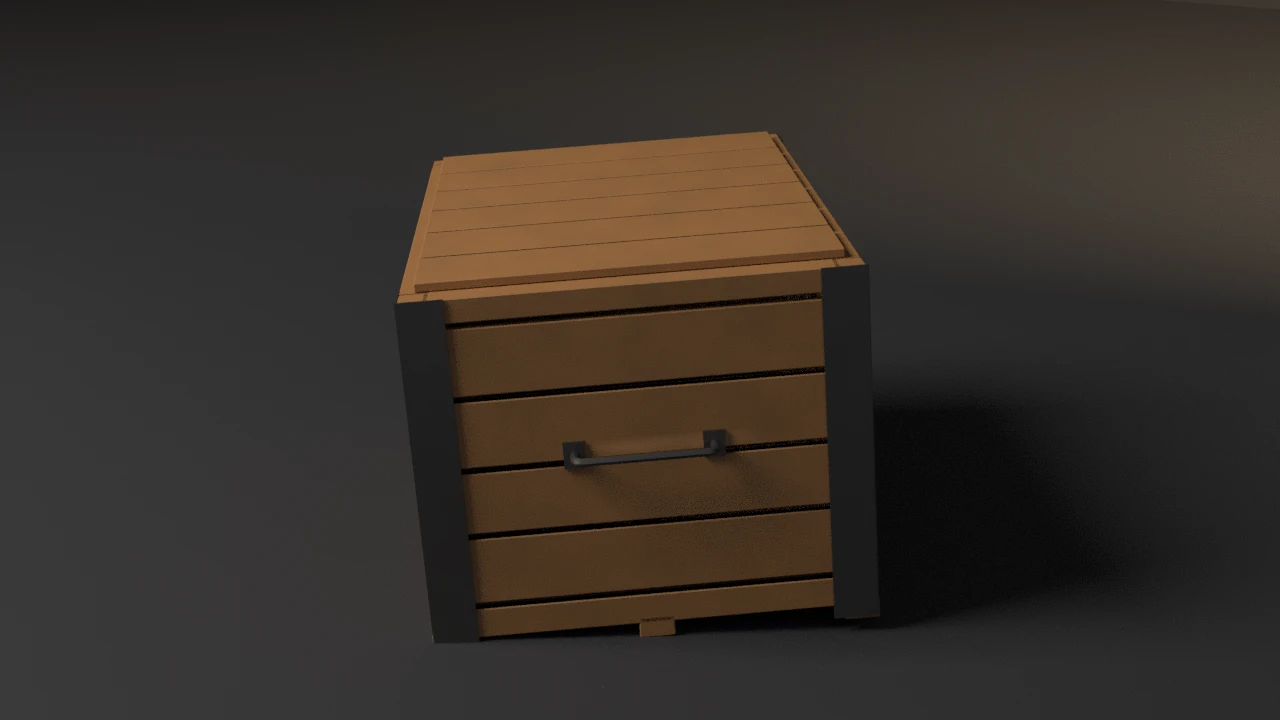
shipping-crate
A procedural shipping crate through UVs, bake, LOD, collider, and Unity glTF, asserting recomputed budgets rather than an API contract.
A procedural ergonomic task chair on a chair mat at a desk corner — a polished aluminium five-star base with ribbed spokes and five swivelled hooded twin-wheel casters pressed into a smoked polycarbonate mat, a chrome gas lift in a telescoping cover under a synchro-tilt mechanism with tension knob and paddles, a moulded shell cupping a two-tone sculpted cushion with thigh channels, a waterfall front and two piped welts, an elastomeric mesh back on a graphite frame with an S-curved lumbar pad on sliders, a mesh headrest, 4D armrests, and a snake plant in a stone planter — through UVs, bake, LOD, collider, and Unity glTF, asserting recomputed budgets rather than an API contract.
Rendered headless by the showcase piece itself — click to zoom.
category Household
blender --background --python showcase/office-chair/office_chair.py --
A showcase piece, not an example, and the second in the household category. It builds a procedural ergonomic task chair standing on a chair mat at the corner of a desk, with a potted plant beside it:
Everything is placed from named stations. The casters hang on caster_frame(k): a stem on the 0.305 m swivel circle at the spoke's own bearing, the axle 30 mm behind it along the caster's yaw. The chair is built on the floor and lifted by CHAIR_Z = MAT_T - MAT_SINK, so every wheel sits 0.6 mm into the sheet. The back is one surface function, back_point(u, v, off), that the frame, mesh, lumbar pad, straps, sliders, cross bar, hub plate, spine, headrest stem, headrest frame and headrest mesh all read, so a change of recline or wrap moves every part of the back together. The seat is one plan (seat_plan) and one sculpting function (seat_contour, every term even in x) that the cushion rings and both welts read.
Four things the coplanar budget shaped before it could fire:
Shading follows what each part is. Moulded, turned and upholstered surfaces are smooth-shaded; the mechanism's chamfers, the knob's knurl, the seams and every material boundary stay crisp through sharp edges. The upholstery is a heathered yarn over an undistorted plain weave (distorted bands read as wood grain). The mesh lets the light through its open cells, so the spine and headrest stem show behind it. Aluminium, chrome, the mechanism, the graphite plastics and the mat carry the studio reflection term (after espresso-machine): a metal on the dark stage mirrors the stage and reads as grey plastic without it.
It asserts budget conformance of the generated result. It does not witness an API contract. "It rendered without error" is not a check.
Composes skills mesh-editing-and-bmesh, bake-high-to-low, depsgraph-and-evaluated-data, engine-export-presets, and snippets bake_normal_high_to_low.py, setup_bake_target_image.py, lod_chain.py / decimate_to_budget.py, convex_hull_collider.py, export_preset_unity.py (helpers copied inline, not imported).
Intended size: seat 0.50 m high, a 0.66 m star, armrests 0.20 m over the seat, headrest top 1.32 m; a 1.20 × 1.28 m mat plus its 0.20 m lip; a planter 0.29 m tall with leaves to 0.96 m. The outer AABB is 1.635 × 1.480 × 1.317 m. The mat sets −X and ±Y, the plant sets +X, the headrest sets the top. The origin is under the hub, so the chair and its mat drop onto a floor together.
Every budget is declared as a named constant. Every gate recomputes its value from the mesh, materials, UVs, evaluated LOD, collider, or export file. Parts are told apart by a part face attribute written at build time; every position, depth, angle and mass is read off the mesh.
| Axis | Declared | Measured (5.2.1) |
|---|---|---|
| Base triangles | 43700–45200 | 44440 |
| LOD1 ratio | 0.32–0.62 of base | 0.5000 |
| LOD2 ratio | 0.10–0.35 of base | 0.2200 |
| Materials | exactly 14 distinct; ≥1330 fabric, ≥1450 mesh, ≥3260 shell, ≥4100 nylon, ≥3950 aluminium, ≥1370 chrome, ≥1820 tread, ≥1600 leatherette, ≥510 steel, ≥1060 border, ≥790 mat, ≥750 ceramic, ≥220 soil, ≥715 leaf faces | 14 slots; 1402 / 1534 / 3440 / 4322 / 4167 / 1450 / 1920 / 1688 / 538 / 1118 / 836 / 796 / 236 / 756 |
| UVs | in 0..1, AABB overlap ≤ 1e-5 | in range, overlap 0 |
| Outer AABB | (1.635, 1.480, 1.317) m ± 0.01 | (1.6350, 1.4800, 1.3169), zmin 0 |
| Collider tris | ≤ 580 | 551 |
| Export | written, size > 0, removed after measuring | 3294736 bytes |
No falsifier changes the triangle count, so the band is narrow and centred on the measurement. DECIMATE COLLAPSE triangle counts are not identical across Blender series, so the LOD gate is a ratio band, not an exact count. Bake pixels are stochastic, so the bake gate is has_data plus operator FINISHED, not byte-identity. Construction uses no RNG; the plant's per-blade variation is closed-form from the blade index. Two default runs print identical measurements.
Recomputed from the generated mesh, not asserted about the script.
| Axis | Declared | Measured |
|---|---|---|
| Non-manifold edges | 0 | 0 |
| Loose verts / edges | 0 / 0 | 0 / 0 |
| Doubles merged at 1e-5 | 0 | 0 |
| Zero-area faces | 0 | 0 |
| N-gons | 0 | 0 |
| Coplanar cross-shell face pairs (KD range 0.05 m, plane ε 1e-4) | 0 | 0 |
Grounded: zmin | within 1e-4 of 0 | 0.0000 |
| Axis | Declared | Measured |
|---|---|---|
| Mat flat on the floor: highest vertex of the mat's downward faces | ≤ 1e-4 | 0.0000 (120 vertices) |
| Named supports: every wheel pressed into the mat, measured against the mat's own surface by a ray straight down from the wheel's lowest vertex | 10 wheels, 0.3–1.0 mm each | 10; 0.6–0.6 mm |
| Pot on the floor | zmin ≤ 1e-4 | 0.0000 |
| Five-star geometry: spoke bearings and boss bearings (shell centroids) round the hub | 72° apart ± 0.25° | 0.00001° worst gap error |
| Bosses and swivel stems on one circle | radius spread ≤ 1 mm each | 0.305 / 0.305 m, spread 0 |
| Stems plumb (bottom- and top-slab centroids), coaxial with their bosses, seated in them | tilt ≤ 0.2°; axis ≤ 0.3 mm off the boss's; seat 25–40 mm | 0.000°; 0.0000 mm; 34 mm each |
| Gas lift: the column's axis through the hub's and the socket's axes | ≤ 0.3 mm at each; tilt ≤ 0.2° | 0.0000 / 0.0000 mm; 0.000° |
| Column inserted into the hub / the socket | 40–65 mm / 20–40 mm | 52 / 28 mm |
| Armrests: bracket, cover, post, height button, pivot button, pad plate and pad paired left to right, mirrored in X and level in Y and Z | ≤ 0.5 mm, 7 pairs | 0.0000 mm |
| Seat height (cushion top), armrest height over the seat | 0.44–0.50 m, 0.17–0.26 m | 0.4965, 0.1974 m |
| Star diameter (outer boss reach ×2) | 0.660 m ± 0.005 | 0.6599 |
| Stance: the chair's mass centre (shell volumes × density per material; the mat and plant excluded) inside the hull of the ten wheels' contacts | ≥ 0.12 m inside every edge | 0.2149 (34.24 kg, centre at y 0.035) |
| One connected chair (union of the chair's shells whose BVH trees overlap; the mat and plant are not part of it) | 1 component | 1 (89 shells) |
| Lumbar sliders clamped on the frame: distance from every slider vertex to the frame tube's surface | 2 sliders, 2.0–6.5 mm | 2; 3.5–5.2 mm |
| Plant rooted: each leaf's base depth under the soil's own surface straight above it; base clear of the pot wall | 9 leaves, 15–45 mm; ≥ 10 mm | 9; 24.5–31.6 mm; 66 mm |
The densities are named constants: 50 for seat foam, 300 for the leatherette pads, 400 for the mesh, 1150 for nylon and the graphite plastics, 1200 for the treads, 2700 for aluminium, 7850 for chrome steel, and an effective 3000 for the mechanism, a pressed-steel housing modelled solid. The five spokes are measured by bearing, not by index: rotating any one breaks two of the five gaps. The chair's connectivity excludes the mat because the casters press into it: counted with the mat, a wheel slid off its axle would still be joined to the chair through the sheet.
Each falsifier violates one named budget. Every one was run on 5.2.1 and exited its declared code with every earlier budget green. None moves the envelope or the triangle count: every run measured the default's outer AABB and 44440 triangles.
| Flag | Budget violated | Exit |
|---|---|---|
--skip-decimate | LOD1 ratio band (measured 1.0000) | 9 |
--stray-vert | loose vertex count is 0 (measured 1, placed inside the envelope) | 15 |
--lift-z | bounding box zmin is 0 (measured 0.05000) | 16 |
--float-caster | every wheel pressed into the mat (caster 3's body lifted 5 mm up its stem: its wheels 4.4 mm over the sheet, the other eight still pressed 0.6 mm in) | 16 |
--curl-mat | mat flat on the floor (its back-left corner curled 6 mm up: underside rises to 0.00600 m, clear of every wheel) | 16 |
--skew-spoke | five-star geometry (spoke 0 and its caster turned 3°: worst gap off 72° by 3.000°) | 17 |
--offset-column | gas lift coaxial (column moved 3 mm in X: 0.00300 m off both the hub's and the socket's axes) | 18 |
--uneven-arms | armrests mirrored and level (right post, buttons, plate and pad raised 10 mm in the cover: 0.01000 m) | 19 |
--loose-wheel | one connected chair (caster 0's outer wheel slid 24 mm off its axle end: 2 components) | 20 |
--float-lumbar | lumbar sliders clamped on the frame (pad, straps and sliders floated 6 mm forward: gap 0.07–11.0 mm) | 21 |
--float-leaves | leaves rooted in the soil (every blade lifted 40 mm: depth −15.5 to −8.4 mm) | 22 |
--float-caster lifts the caster body, not the stem, so the stem only rides deeper into the web and the star budget still passes. --curl-mat curls only the corner where −x + y is largest, which no wheel reaches, so the wheels stay seated and the mat-flat budget is the one that fires. --offset-column leaves the column seated 52 mm and 28 mm deep and plumb, so only the coaxial budget sees it. --uneven-arms slides the arm up its own cover, as the height adjuster does, so the chair stays connected and the envelope holds; the seat and armrest heights stay in band. --loose-wheel slides a wheel along its own axle, so it still presses into the mat and the named-supports budget passes; it is attached by one joint, the axle, which is why it is the part that splits. --float-lumbar moves the lumbar unit less than a slider's wall is deep past the frame, so the sliders still bite the frame and the chair stays one component; only the clamp band sees it. --float-leaves lifts the blades inside the envelope: the headrest, not the plant, sets the top.
blender --background --python office_chair.py --
blender --background --python office_chair.py -- --skip-decimate
blender --background --python office_chair.py -- --stray-vert
blender --background --python office_chair.py -- --lift-z
blender --background --python office_chair.py -- --float-caster
blender --background --python office_chair.py -- --curl-mat
blender --background --python office_chair.py -- --skew-spoke
blender --background --python office_chair.py -- --offset-column
blender --background --python office_chair.py -- --uneven-arms
blender --background --python office_chair.py -- --loose-wheel
blender --background --python office_chair.py -- --float-lumbar
blender --background --python office_chair.py -- --float-leaves
blender --background --python office_chair.py -- --output chair.png
Smoke passes no flags.
The hero turns the whole vignette HERO_YAW_DEG (18°), so the seat and arms face the camera's right, the mat's lip points toward the camera and the plant stands to the chair's right. The camera stands low (0.72 m over the vignette's centre): the mat foreshortens, the chair fills more of the frame's height, and the mesh back and headrest read against the dark back wall, with the floor/wall seam behind the seat rather than through the mesh. The warm wedge pools on the floor to the plant's right, not behind the back. The mat and plant widen the composition: fill 0.49 of the frame's width (was 0.27) and 0.84 of its height, which meets the framing band.
File-local. 9 is a valid check code. 10 is reserved for gallery_framing.check_framing on the --output path. 15–19 are the hygiene and joint-fit family. 20–22 are file-local. 23 is the asset-quality floor on the render path: check_asset_quality returns 11, which this piece already spends on the collider ceiling, so the call site remaps it.
| Code | Meaning |
|---|---|
| 0 | Success |
| 1 | Uncaught exception (FATAL wrapper) |
| 2 | argparse / usage |
| 3 | Mesh did not build / no UV layer |
| 4 | Base triangle count outside range |
| 5 | Material count ≠ 14 distinct slots, or a face-count floor missed |
| 6 | UVs outside 0..1 |
| 7 | UV AABB overlap above tolerance |
| 8 | World AABB off declared outer size |
| 9 | LOD ratio band (--skip-decimate lands here) |
| 10 | Framing gate (render path only) |
| 11 | Collider triangle count above ceiling |
| 12 | Bake did not finish or image has no data |
| 13 | Export file missing or empty |
| 14 | --output produced no file |
| 15 | Mesh hygiene: loose, non-manifold, zero-area, doubles, n-gons, coplanar cross-shell pairs |
| 16 | Not grounded: bounding box zmin off 0, the mat not flat on the floor, a wheel not pressed into the mat within its band or not 10 wheels, or the pot off the floor (--lift-z, --curl-mat, --float-caster) |
| 17 | Five-star geometry: spokes or bosses off 72° spacing, bosses or stems off one circle, a stem tilted, off its boss's axis or outside its seat band (--skew-spoke) |
| 18 | Gas lift: column off the hub's or the socket's axis, tilted, or inserted outside its bands (--offset-column) |
| 19 | Stance and size: armrests not mirrored and level, seat or armrest height, star diameter, or the mass centre within 0.12 m of the caster contact hull's edge (--uneven-arms) |
| 20 | The chair splits into more than one connected component (--loose-wheel) |
| 21 | Lumbar sliders not clamped on the back frame within their gap band (--float-lumbar) |
| 22 | Plant: a leaf's base outside its depth band in the soil, too near the pot wall, or not 9 leaves (--float-leaves) |
| 23 | Asset-quality floor (render path only; remapped from 11) |
"""Game-ready ergonomic task chair on a chair mat — a showcase piece, not an example. Asserts budget conformance of a procedural task chair and its desk-corner floor vignette after composing shipped pipeline pieces: bmesh construction, UVs, fourteen materials, high-to-low normal bake, LOD chain, convex collider, Unity glTF export. The chair stands on a polished aluminium five-star base: five lofted spokes, each a crowned section with two channels and a centre rib on its underside, running from a moulded hub out to a socket boss. A hooded twin-wheel caster hangs from every boss on a plumb swivel stem, each swivelled its own way, and every wheel presses into a smoked polycarbonate chair mat with a bevelled edge and a lip that runs forward under a desk. A chrome gas-lift column rises out of the hub through a two-stage telescoping cover into the socket of a synchro-tilt mechanism: tilt-spring housing, a knurled tension knob and two lever paddles. The seat is a moulded graphite shell cupping a two-tone upholstered cushion: a woven muted-teal centre panel sculpted with a rear dish and two thigh channels that rolls over a waterfall front, mid-grey knit side panels, a piped welt in the seam groove between them and another on the top edge. An aluminium spine sweeps from the mechanism up behind a reclined mesh back: an elastomeric weave stretched over a graphite frame that thickens toward its foot, a cross bar and hub plate behind it, and an S-curved lumbar pad on straps whose ends clamp the frame's sides as sliders. A headrest of the same mesh in its own frame rides on an aluminium stem. Two 4D armrests rise from aluminium brackets under the shell: a telescoping post cover, a post with a height button and a pivot button, a pad plate and a soft pad. A snake plant in a speckled stone pot stands on the floor beside the mat. Budgets are declared below and recomputed from the generated result. They are not API-contract witnesses. Each falsifier violates one named budget: ``--skip-decimate`` the LOD-ratio band, ``--stray-vert`` mesh hygiene, ``--lift-z`` grounded zmin, ``--float-caster`` every wheel pressed into the mat, ``--curl-mat`` the mat flat on the floor, ``--skew-spoke`` the five-star geometry, ``--offset-column`` the gas lift coaxial with hub and socket, ``--uneven-arms`` mirrored level armrests, ``--loose-wheel`` one connected chair, ``--float-lumbar`` the lumbar sliders clamped on the back frame, ``--float-leaves`` every leaf rooted in the pot's soil. No RNG. Construction is closed-form. DECIMATE COLLAPSE triangle counts are not byte-identical across Blender versions — the LOD gate is a ratio band, not an exact count. blender --background --python office_chair.py -- blender --background --python office_chair.py -- --skip-decimate blender --background --python office_chair.py -- --output chair.png """ import argparse import math import os import sys import tempfile import traceback import bmesh import bpy from mathutils import Matrix, Vector from mathutils.bvhtree import BVHTree from mathutils.kdtree import KDTree # Showcase lives at repo-root/showcase/, not under examples/. The framing # helper is the repo's only shared import and lives next to the examples; # resolve the repo root so we do not move gallery_framing.py. _REPO = os.path.abspath( os.path.join(os.path.dirname(os.path.abspath(__file__)), os.pardir, os.pardir) ) sys.path.insert(0, os.path.join(_REPO, "examples")) sys.dont_write_bytecode = True import gallery_framing # noqa: E402 import gallery_asset_quality # noqa: E402 X_AX = Vector((1.0, 0.0, 0.0)) Y_AX = Vector((0.0, 1.0, 0.0)) Z_AX = Vector((0.0, 0.0, 1.0)) # --- Five-star base (front of the chair is -Y) ---------------------------- SPOKES = 5 SPOKE0_DEG = 90.0 # spoke 0 points straight back R_STEM = 0.305 # caster swivel axis radius SPOKE_R0 = 0.030 # spoke root, buried in the hub SPOKE_STATIONS = 12 SPOKE_W = (0.054, 0.040) # section width, root -> tip SPOKE_H = (0.040, 0.028) # section height SPOKE_ZB = (0.106, 0.088) # section underside SPOKE_ARCH = 0.004 HUB_PROFILE = [(0.030, 0.088), (0.046, 0.092), (0.052, 0.102), (0.052, 0.158), (0.048, 0.166), (0.040, 0.170)] BOSS_R = 0.025 BOSS_PROFILE = [(0.018, 0.084), (0.024, 0.086), (0.025, 0.090), (0.025, 0.118), (0.023, 0.124), (0.017, 0.127)] # --- Casters ----------------------------------------------------------------- WHEEL_R = 0.030 TRAIL = 0.030 # axle behind the swivel axis # Caster yaw: trail direction, relative to the spoke's own bearing. Casters # on a chair that has been rolled about point every which way. CASTER_YAW = (160.0, 20.0, -115.0, 205.0, 70.0) WHEEL_SEGS = 24 # (r, y) along the axle: nylon hub face, tyre sidewall, crowned tread, # sidewall, dished nylon hub cap. No segment keeps r constant, so the # caster's mirrored twin wheel never shares a tread plane with it. WHEEL_PROFILE = [(0.0046, 0.0093), (0.0195, 0.0093), (0.0212, 0.0099), (0.0262, 0.0103), (0.0288, 0.0118), (0.0297, 0.0145), (0.0300, 0.0177), (0.0297, 0.0210), (0.0288, 0.0237), (0.0262, 0.0252), (0.0212, 0.0256), (0.0195, 0.0262), (0.0120, 0.0266), (0.0046, 0.0262)] WHEEL_TYRE_SEGS = range(2, 10) AXLE_PROFILE = [(0.0025, -0.0290), (0.0040, -0.0283), (0.0040, 0.0283), (0.0025, 0.0290)] WEB_HALF = 0.0085 HOOD_PROFILE = [(0.0336, -0.0282), (0.0360, -0.0282), (0.0366, -0.0276), (0.0366, 0.0276), (0.0360, 0.0282), (0.0336, 0.0282)] HOOD_ARC = (10.0, -150.0) # degrees about the axle; -90 is over the top STEM_PROFILE = [(0.0040, 0.062), (0.0055, 0.0635), (0.0055, 0.116), (0.0040, 0.118)] WASHER_PROFILE = [(0.0052, 0.0770), (0.0105, 0.0770), (0.0110, 0.0775), (0.0110, 0.0845), (0.0052, 0.0845)] # --- Gas lift and mechanism ------------------------------------------------------ COLUMN_PROFILE = [(0.022, 0.118), (0.025, 0.121), (0.025, 0.368), (0.023, 0.372)] SLEEVES = ( [(0.0285, 0.164), (0.0335, 0.164), (0.0340, 0.166), (0.0340, 0.228), (0.0330, 0.231), (0.0285, 0.231)], [(0.0258, 0.222), (0.0312, 0.222), (0.0316, 0.224), (0.0316, 0.278), (0.0306, 0.281), (0.0248, 0.281)], ) SOCKET_PROFILE = [(0.020, 0.344), (0.030, 0.347), (0.034, 0.356), (0.036, 0.384)] MECH_C = (0.0, 0.010, 0.398) MECH_SIZE = (0.170, 0.240, 0.040) # top 1 mm under the cushion's floor TILT_C = (0.0, -0.070, 0.386) TILT_R = 0.020 TILT_HALF = 0.100 KNOB_C = (0.0, -0.105, 0.388) KNOB_PROFILE = [(0.006, -0.005), (0.019, -0.005), (0.021, -0.003), (0.021, 0.028), (0.0195, 0.034), (0.013, 0.038), (0.005, 0.040)] LEVERS = ( [(0.060, 0.000, 0.392), (0.150, -0.020, 0.388), (0.205, -0.055, 0.385)], [(-0.060, -0.020, 0.390), (-0.140, -0.040, 0.386), (-0.190, -0.070, 0.383)], ) # --- Seat ---------------------------------------------------------------------- SEAT_HX = 0.250 SEAT_HY = 0.240 SEAT_RC = 0.100 SEAT_RMIN = 0.010 SEAT_CY = -0.030 SEAT_TAPER = 0.05 # back edge this much narrower than the front SEAT_BULGE = 0.035 # sides bow out this much at mid-depth SEAT_Z0 = 0.425 # the sculpting fades in from here ... SEAT_ZFULL = 0.050 # ... over this rise, so no ring folds past another SEAT_RING = dict(nc=8, nsx=12, nsy=12) # (inset, z): bottom inside the shell, boxing side, a rounded top edge, the # grey knit side panel, a seam groove, then the teal centre panel crowned in SEAT_PROFILE = [(0.014, 0.419), (0.006, 0.4205), (0.001, 0.428), (0.000, 0.440), (0.000, 0.452), (0.002, 0.462), (0.006, 0.4700), (0.012, 0.4770), (0.020, 0.4815), (0.030, 0.4840), (0.042, 0.4852), (0.052, 0.4856), (0.058, 0.4846), (0.062, 0.4826), (0.066, 0.4846), (0.072, 0.4860), (0.084, 0.4872), (0.098, 0.4882), (0.112, 0.4889), (0.126, 0.4894), (0.140, 0.4897), (0.156, 0.4899), (0.174, 0.4900), (0.194, 0.4900), (0.214, 0.4900)] SEAM_RING = 13 # the groove bottom: centre panel from here in SEAT_DISH = 0.012 SEAT_WATERFALL = 0.024 SEAT_CHANNEL = 0.011 # thigh channels either side of the centre line SEAT_CHANNEL_X = 0.095 SEAT_BOLSTER = 0.009 PIPE_R = 0.0032 PIPE_AT = (7, 8) # the edge welt runs on the seam between these rings PIPE_OUT = 0.0016 # centre outside the surface, so it bites by R - OUT GROOVE_R = 0.0024 # a second welt laid in the seam groove GROOVE_UP = 0.0010 WELT_PHASE = math.pi / 6.0 # a hexagon with a vertex on top: no welt face lies flat PAN_HX = 0.254 PAN_HY = 0.244 PAN_RC = 0.100 PAN_PROFILE = [(0.020, 0.398), (0.008, 0.4005), (0.002, 0.406), (0.000, 0.416), (0.001, 0.425), (0.004, 0.4290), (0.009, 0.4300)] # --- Back ---------------------------------------------------------------------- BACK_O = Vector((0.0, 0.235, 0.530)) BACK_RECLINE_DEG = 12.0 BACK_HX = 0.235 BACK_HY = 0.290 # outline half height; v runs 0 .. 2 * BACK_HY BACK_RC = 0.090 BACK_TAPER0 = 0.84 # outline width scale at the bottom (1.0 at top) BACK_ARCH = 0.036 # the top edge rises this much at the centre BACK_WRAP = 0.060 LUMBAR_V = 0.170 LUMBAR_SIG = 0.090 LUMBAR_BULGE = 0.022 MESH_T = 0.003 MESH_INSETS = (0.000, 0.014, 0.040, 0.080, 0.130, 0.190) FRAME_HA = 0.0150 # frame tube half depth (along the surface normal) FRAME_HB = (0.0125, 0.0195) # half width in the back's plane: top rail, foot FRAME_THICK_V = (0.46, 0.10) # the frame swells from the first v to the second CROSS_V = 0.260 CROSS_OFF = -0.0115 CROSS_R = 0.0085 PAD_HX = 0.165 PAD_HY = 0.052 PAD_RC = 0.040 PAD_S = 0.0055 # S-curve amplitude across the lumbar pad's face PAD_PROFILE = [(0.010, -0.0005), (0.003, 0.0020), (0.000, 0.0070), (0.002, 0.0120), (0.008, 0.0155), (0.018, 0.0170), (0.030, 0.0175)] STRAP_U = (0.150, BACK_HX - 0.006) # from inside the pad to inside the slider STRAP_HV = 0.020 STRAP_OFF = (0.0010, 0.0042) SLIDER_HV = 0.030 # slider half length along the frame SLIDER_WALL = 0.004 # clamp wall over the frame tube HEAD_V = 0.725 # headrest centre, on the back's surface HEAD_OFF = 0.018 # carried this far forward of the back's surface HEAD_HX = 0.140 HEAD_HY = 0.062 HEAD_RC = 0.050 HEAD_INSETS = (0.000, 0.010, 0.028, 0.048) HEAD_FRAME = (0.011, 0.010) # --- Arms (right arm at +X; the left is its mirror) ----------------------------- ARM_X = 0.273 ARM_Y = 0.030 PAD_Y = 0.000 BRACKET_PTS = [(0.100, 0.401), (0.200, 0.401), (0.245, 0.404), (0.266, 0.418), (0.273, 0.440), (0.273, 0.500), (0.273, 0.600)] BRACKET_HALF = (0.006, 0.025) POST_PROFILE = [(0.003, 0.505), (0.000, 0.509), (0.000, 0.646), (0.003, 0.650)] COVER_PROFILE = [(0.004, 0.496), (0.000, 0.500), (0.000, 0.584), (0.003, 0.588)] SUPPORT_PROFILE = [(0.003, 0.645), (0.000, 0.648), (0.000, 0.657), (0.003, 0.660)] ARMPAD_PROFILE = [(0.008, 0.6555), (0.002, 0.6580), (0.000, 0.6660), (0.002, 0.6780), (0.008, 0.6860), (0.018, 0.6895), (0.030, 0.6905)] # --- Floor vignette: a chair mat under the casters, a potted plant beside it -- MAT_T = 0.004 # polycarbonate sheet thickness MAT_SINK = 0.0006 # the casters press this far into the sheet CHAIR_Z = MAT_T - MAT_SINK # so the chair is built this far off the floor MAT_HX = 0.600 MAT_HY = 0.640 MAT_CY = 0.060 MAT_RC = 0.060 MAT_TONGUE = 0.200 # the lip that runs forward under a desk MAT_TONGUE_HX = 0.250 MAT_TONGUE_SHOULDER = 0.090 MAT_RING = dict(nc=6, nsx=36, nsy=12) # (inset, z): a chamfered foot, a short wall and a bevelled top edge MAT_PROFILE = [(0.0015, 0.0), (0.0, 0.0008), (0.0, 0.0014), (0.005, 0.0031), (0.011, 0.0039), (0.016, MAT_T)] PLANT_C = (0.880, -0.080) POT_SEGS = 40 # a planter with a foot, a swelling belly, a waist and a rolled lip POT_PROFILE = [(0.004, 0.000), (0.092, 0.000), (0.100, 0.003), (0.103, 0.012), (0.100, 0.022), (0.116, 0.060), (0.136, 0.130), (0.146, 0.200), (0.143, 0.250), (0.141, 0.266), (0.150, 0.274), (0.152, 0.284), (0.148, 0.292), (0.140, 0.291), (0.132, 0.280), (0.126, 0.200), (0.110, 0.060), (0.090, 0.040), (0.004, 0.036)] # soil biting the pot's inner wall by 1.2 mm, crowned toward the middle SOIL_PROFILE = [(0.004, 0.215), (0.1283, 0.215), (0.1313, 0.255), (0.085, 0.2575), (0.004, 0.2595)] SOIL_TOP = 0.2595 LEAF_COUNT = 9 LEAF_STATIONS = 10 LEAF_ROOT = 0.025 # blade bases buried at least this far under the crown LEAF_ROOT_STEP = 0.001 # and each 1 mm deeper than the last, so no two base caps share a plane # --- Budgets ------------------------------------------------------------------------ BBOX_TOL = 0.01 # Fitted after locking geometry. Recomputed from bound_box. OUTER_SIZE = (1.635, 1.480, 1.317) BASE_TRIS_MIN = 43700 BASE_TRIS_MAX = 45200 LOD1_RATIO_MIN = 0.32 LOD1_RATIO_MAX = 0.62 LOD2_RATIO_MIN = 0.10 LOD2_RATIO_MAX = 0.35 LOD1_TARGET = 0.50 LOD2_TARGET = 0.22 MATERIAL_COUNT = 14 UV_EPS = 1e-4 UV_OVERLAP_MAX = 1e-5 COLLIDER_TRIS_MAX = 580 BAKE_RES = 1024 CAGE_EXTRUSION = 0.004 FACE_FLOORS = (("fabric", 1330), ("mesh", 1450), ("shell", 3260), ("nylon", 4100), ("aluminium", 3950), ("chrome", 1370), ("rubber", 1820), ("leatherette", 1600), ("steel", 510), ("border", 1060), ("mat", 790), ("ceramic", 750), ("soil", 220), ("leaf", 715)) ZMIN_EPS = 1e-4 DOUBLES_EPS = 1e-5 AREA_EPS = 1e-10 COPLANAR_NORMAL_EPS = 1e-4 COPLANAR_PLANE_EPS = 1e-4 COPLANAR_CENTRE_MAX = 0.05 LIFT_Z = 0.05 # Named supports: every wheel pressed into the mat, the mat's underside flat # on the floor, the pot on the floor. WHEEL_COUNT = 10 WHEEL_SINK = (0.0003, 0.0010) FLOAT_CASTER = 3 FLOAT_LIFT = 0.005 MAT_FLAT_EPS = 1e-4 CURL_MAT = 0.006 # the back-left corner of the mat curled up # Five-star geometry: spokes and bosses 72 degrees apart, bosses and swivel # stems on one circle, stems plumb, coaxial with their bosses, and seated in # them to a banded depth. SPACING_TOL_DEG = 0.25 RADIUS_RANGE_MAX = 0.001 STEM_TILT_MAX_DEG = 0.2 STEM_COAX_MAX = 0.0003 STEM_SEAT = (0.025, 0.040) SKEW_SPOKE = 0 SKEW_DEG = 3.0 # Gas lift: the column's axis through the hub's and the socket's axes, plumb, # and inserted into each to a banded depth. COLUMN_COAX_MAX = 0.0003 COLUMN_TILT_MAX_DEG = 0.2 HUB_BITE = (0.040, 0.065) SOCKET_BITE = (0.020, 0.040) OFFSET_COLUMN = 0.003 # Stance and size: the armrests a mirrored, level pair; seat height, armrest # height over the seat and star diameter in band; the mass centre inside the # caster contact polygon. ARM_MIRROR_EPS = 0.0005 UNEVEN_ARM = 0.010 SEAT_HEIGHT = (0.44, 0.50) ARM_OVER_SEAT = (0.17, 0.26) STAR_DIAMETER = 0.660 STAR_TOL = 0.005 STANCE_MARGIN = 0.12 # Densities by material slot (kg/m^3). Foam cushions and pads are light; # the mechanism is a pressed-steel housing modelled solid, so steel takes # an effective density. The mat and the plant are not part of the chair's # mass. DENSITY = (50.0, 400.0, 1150.0, 1150.0, 2700.0, 7850.0, 1200.0, 300.0, 3000.0, 50.0, 1200.0, 2000.0, 1300.0, 700.0) # Connected chair: one wheel slid off its axle end. LOOSE_CASTER = 0 LOOSE_SLIDE = 0.024 # Lumbar sliders clamp the frame: every slider vertex a banded distance off # the frame tube it rides on. SLIDER_GAP = (0.0020, 0.0065) FLOAT_LUMBAR = 0.006 # Plant: every leaf's base buried in the soil to a banded depth, inside the pot. LEAF_DEPTH = (0.015, 0.045) LEAF_WALL_CLEAR = 0.010 FLOAT_LEAVES = 0.040 HERO_YAW_DEG = 18.0 WALL_Y = 3.2 CAM_LENS = 50.0 CAM_VIEW = (-0.55, -0.83) CAM_DIST = 4.75 CAM_LIFT = 0.72 AIM_OFFSET = (0.0, 0.0, -0.13) FABRIC_IDX = 0 MESH_IDX = 1 SHELL_IDX = 2 NYLON_IDX = 3 ALU_IDX = 4 CHROME_IDX = 5 RUBBER_IDX = 6 LEATHER_IDX = 7 STEEL_IDX = 8 BORDER_IDX = 9 MAT_IDX = 10 CERAMIC_IDX = 11 SOIL_IDX = 12 LEAF_IDX = 13 # Part tags (face attribute "part" = kind * 100 + index). Measurements read # positions off the mesh; the tag only says which shell is which part. (SPOKE, BOSS, STEM, WHEEL, AXLE, WEB, HOOD, WASHER, HUB, COLUMN, SLEEVE, SOCKET, MECH, TILT, KNOB, LEVER, PADDLE, PAN, CUSHION, PIPING, FRAME, MESHPANEL, LUMBAR, STRAP, CROSSBAR, BACKHUB, SPINE, BRACKET, POST, SUPPORT, ARMPAD, BUTTON, HEADSTEM, HEADFRAME, HEADMESH, HEADHUB, SLIDER, COVER, PIVOT, MAT, POT, SOIL, LEAF) = range(1, 44) ARM_KINDS = (BRACKET, POST, SUPPORT, ARMPAD, BUTTON, COVER, PIVOT) VIGNETTE_KINDS = (MAT, POT, SOIL, LEAF) def eevee_engine_id(): return "BLENDER_EEVEE" if bpy.app.version >= (5, 0, 0) else "BLENDER_EEVEE_NEXT" def fail(msg, code): print(f"ERROR: {msg}", file=sys.stderr) return code def triangle_count(mesh): mesh.calc_loop_triangles() return len(mesh.loop_triangles) def evaluated_triangle_count(obj): # Duplicated from snippets/lod_chain.py / decimate_to_budget.py (not a package). depsgraph = bpy.context.evaluated_depsgraph_get() eval_obj = obj.evaluated_get(depsgraph) eval_mesh = eval_obj.to_mesh() try: eval_mesh.calc_loop_triangles() return len(eval_mesh.loop_triangles) finally: eval_obj.to_mesh_clear() # -------------------------------------------------------------------------- # Construction helpers # -------------------------------------------------------------------------- def _mark(faces, mat_idx): for f in faces: f.material_index = mat_idx def tag(bm, verts, kind, idx=0): layer = bm.faces.layers.int.get("part") for f in {f for v in verts for f in v.link_faces}: f[layer] = kind * 100 + idx def add_box(bm, loc, scale, mat_idx): geo = bmesh.ops.create_cube(bm, size=1.0) verts = geo["verts"] origin = Vector(loc) for v in verts: v.co = Vector((v.co.x * scale[0], v.co.y * scale[1], v.co.z * scale[2])) + origin _mark({f for v in verts for f in v.link_faces}, mat_idx) return list(verts) def add_lathe(bm, profile, segs, mat_idx, center=(0.0, 0.0, 0.0), rot=None, phase=0.0, solid=False, seg_mats=None, cap_mats=None, rmod=None, arc=None): """Revolve a profile [(r, z), ...] about local Z. ``solid``: the profile is an open polyline closed by n-gon caps at its two ends; otherwise it is a closed polygon revolved into a ring shell. ``arc`` = (a0, a1) in radians revolves a closed profile over part of a turn and caps its two ends. ``seg_mats`` gives a material per profile segment, ``cap_mats`` the (start, end) caps, and ``rmod(i, j)`` scales the radius of profile point ``j`` on ring ``i``.""" c = Vector(center) m = rot if rot is not None else Matrix.Identity(3) n_rings = segs + 1 if arc else segs rings = [] for i in range(n_rings): if arc: a = arc[0] + (arc[1] - arc[0]) * i / segs else: a = phase + 2.0 * math.pi * i / segs ca, sa = math.cos(a), math.sin(a) ring = [] for j, (r, z) in enumerate(profile): rr = r * (rmod(i, j) if rmod else 1.0) ring.append(bm.verts.new(c + m @ Vector((rr * ca, rr * sa, z)))) rings.append(ring) n = len(profile) last = n - 1 if solid else n faces = [] for i in range(segs): r0, r1 = rings[i], rings[(i + 1) % n_rings] for j in range(last): k = (j + 1) % n f = bm.faces.new((r0[j], r1[j], r1[k], r0[k])) f.material_index = seg_mats[j] if seg_mats else mat_idx faces.append(f) if solid: f0 = bm.faces.new([rings[i][0] for i in reversed(range(segs))]) f1 = bm.faces.new([rings[i][n - 1] for i in range(segs)]) f0.material_index = cap_mats[0] if cap_mats else mat_idx f1.material_index = cap_mats[1] if cap_mats else mat_idx if arc: for ring in (rings[0], rings[-1]): f = bm.faces.new(ring) f.material_index = mat_idx return [v for ring in rings for v in ring] def add_loft(bm, rings_co, mat_idx, closed=False, caps=True, band_mats=None, cap_mats=None): """Rings of points (each a closed loop, equal counts) joined in order. ``closed`` joins the last ring back to the first (a torus-like tube); otherwise ``caps`` closes both ends with n-gons. ``band_mats(i)`` gives the material of the band between rings ``i`` and ``i + 1``.""" rings = [[bm.verts.new(p) for p in ring] for ring in rings_co] n = len(rings) m = len(rings[0]) for i in range(n if closed else n - 1): r0, r1 = rings[i], rings[(i + 1) % n] mat = band_mats(i) if band_mats else mat_idx for k in range(m): k1 = (k + 1) % m bm.faces.new((r0[k], r0[k1], r1[k1], r1[k])).material_index = mat if not closed and caps: c0, c1 = cap_mats if cap_mats else (mat_idx, mat_idx) bm.faces.new(tuple(reversed(rings[0]))).material_index = c0 bm.faces.new(tuple(rings[-1])).material_index = c1 return [v for ring in rings for v in ring] def sweep_rings(pts, section, normals=None, side=None, closed=False): """Section [(a, b), ...] placed along a polyline: ``a`` along the frame normal, ``b`` along the binormal. ``section`` may be a function of the point index, for a member whose section changes along its length. The normal comes from ``normals`` (a surface), from a fixed ``side`` axis (a planar path), or by parallel transport.""" pts = [Vector(p) for p in pts] n = len(pts) rings = [] prev = None for i, p in enumerate(pts): if closed: a, b = pts[i - 1], pts[(i + 1) % n] else: a, b = pts[max(i - 1, 0)], pts[min(i + 1, n - 1)] t = (b - a).normalized() if normals is not None: nv = Vector(normals[i]) nv = (nv - t * nv.dot(t)).normalized() bv = t.cross(nv) elif side is not None: bv = Vector(side) bv = (bv - t * bv.dot(t)).normalized() nv = bv.cross(t) else: if prev is None: ref = X_AX if abs(t.x) < 0.9 else Z_AX prev = (ref - t * ref.dot(t)).normalized() nv = (prev - t * prev.dot(t)).normalized() prev = nv bv = t.cross(nv) sec = section(i) if callable(section) else section rings.append([p + nv * sa + bv * sb for sa, sb in sec]) return rings def add_sweep(bm, pts, section, mat_idx, normals=None, side=None, closed=False): return add_loft(bm, sweep_rings(pts, section, normals, side, closed), mat_idx, closed=closed) def circle_section(r, n, phase=0.0): return [(r * math.cos(phase + 2.0 * math.pi * k / n), r * math.sin(phase + 2.0 * math.pi * k / n)) for k in range(n)] def superellipse_section(ha, hb, n, p): out = [] for k in range(n): t = 2.0 * math.pi * (k + 0.5) / n c, s = math.cos(t), math.sin(t) out.append((ha * math.copysign(abs(c) ** (2.0 / p), c), hb * math.copysign(abs(s) ** (2.0 / p), s))) return out def rect_section(ha, hb, c): return [(ha, -hb + c), (ha, hb - c), (ha - c, hb), (-ha + c, hb), (-ha, hb - c), (-ha, -hb + c), (-ha + c, -hb), (ha - c, -hb)] def rrect_loop(hx, hy, r, nc=8, nsx=6, nsy=6): """Rounded rectangle, counter-clockwise, with ``nsx`` / ``nsy`` spans on the straight sides so a loop can bend over a curved surface.""" corners = ((1, 1), (-1, 1), (-1, -1), (1, -1)) pts = [] for k, (sx, sy) in enumerate(corners): cx, cy = sx * (hx - r), sy * (hy - r) a0 = 0.5 * math.pi * k for s in range(nc + 1): a = a0 + 0.5 * math.pi * s / nc pts.append((cx + r * math.cos(a), cy + r * math.sin(a))) a1 = a0 + 0.5 * math.pi nx, ny = corners[(k + 1) % 4] p0 = (cx + r * math.cos(a1), cy + r * math.sin(a1)) p1 = (nx * (hx - r) + r * math.cos(a1), ny * (hy - r) + r * math.sin(a1)) nside = nsx if k in (0, 2) else nsy for s in range(1, nside): t = s / nside pts.append((p0[0] + (p1[0] - p0[0]) * t, p0[1] + (p1[1] - p0[1]) * t)) return pts def rrect_rings(hx, hy, rc, rmin, profile, xform, nc=8, nsx=6, nsy=6): rings = [] for d, z in profile: r = max(rc - d, rmin) rings.append([xform(x, y, z) for x, y in rrect_loop(hx - d, hy - d, r, nc, nsx, nsy)]) return rings def triangulate_ngons(bm): faces = [f for f in bm.faces if len(f.verts) > 4] if faces: bmesh.ops.triangulate(bm, faces=faces) def pack_uvs(bm, margin=0.08): uv = bm.loops.layers.uv.new("UVMap") faces = list(bm.faces) n = len(faces) cols = max(1, math.ceil(math.sqrt(n))) rows = max(1, math.ceil(n / cols)) cell_w = 1.0 / cols cell_h = 1.0 / rows pad_u = margin * cell_w * 0.5 pad_v = margin * cell_h * 0.5 usable_w = cell_w - 2.0 * pad_u usable_h = cell_h - 2.0 * pad_v for i, face in enumerate(faces): col = i % cols row = i // cols nrm = face.normal ax, ay, az = abs(nrm.x), abs(nrm.y), abs(nrm.z) coords = [] for loop in face.loops: co = loop.vert.co if az >= ax and az >= ay: coords.append((co.x, co.y)) elif ax >= ay: coords.append((co.y, co.z)) else: coords.append((co.x, co.z)) xs = [c[0] for c in coords] ys = [c[1] for c in coords] minx, maxx = min(xs), max(xs) miny, maxy = min(ys), max(ys) dx = max(maxx - minx, 1e-8) dy = max(maxy - miny, 1e-8) origin_u = col * cell_w + pad_u origin_v = row * cell_h + pad_v for loop, (x, y) in zip(face.loops, coords): loop[uv].uv = ( origin_u + (x - minx) / dx * usable_w, origin_v + (y - miny) / dy * usable_h, ) def frame_from(axis, ref): """Rotation whose local Z is ``axis`` and local X lies toward ``ref``.""" z = Vector(axis).normalized() x = Vector(ref) x = (x - z * x.dot(z)).normalized() y = z.cross(x) return Matrix((x, y, z)).transposed() def catmull(pts, per=6): pts = [Vector(p) for p in pts] ext = [pts[0] * 2.0 - pts[1]] + pts + [pts[-1] * 2.0 - pts[-2]] out = [] for i in range(1, len(ext) - 2): p0, p1, p2, p3 = ext[i - 1], ext[i], ext[i + 1], ext[i + 2] for k in range(per): t = k / per out.append(0.5 * ((2.0 * p1) + (-p0 + p2) * t + (2.0 * p0 - 5.0 * p1 + 4.0 * p2 - p3) * t * t + (-p0 + 3.0 * p1 - 3.0 * p2 + p3) * t * t * t)) out.append(pts[-1]) return out def smooth01(t): t = min(1.0, max(0.0, t)) return t * t * (3.0 - 2.0 * t) def frac(x): return x - math.floor(x) # -------------------------------------------------------------------------- # Parts # -------------------------------------------------------------------------- def spoke_section(): """Crowned top, straight sides, two underside channels either side of a centre rib: (a across in -1..1, b up in 0..1).""" right = [(0.93, 0.0), (1.0, 0.08), (1.0, 0.40)] crown = [] for i in range(1, 10): phi = math.pi * i / 10.0 c, s = math.cos(phi), math.sin(phi) crown.append((math.copysign(abs(c) ** (2.0 / 3.0), c), 0.40 + 0.60 * abs(s) ** (2.0 / 3.0))) under = [(-1.0, 0.40), (-1.0, 0.08), (-0.93, 0.0), (-0.74, 0.0), (-0.68, 0.06), (-0.68, 0.52), (-0.62, 0.58), (-0.20, 0.58), (-0.14, 0.52), (-0.14, 0.10), (-0.08, 0.03), (0.08, 0.03), (0.14, 0.10), (0.14, 0.52), (0.20, 0.58), (0.62, 0.58), (0.68, 0.52), (0.68, 0.06), (0.74, 0.0)] return right + crown + under def add_spoke(bm, bearing): er = Vector((math.cos(bearing), math.sin(bearing), 0.0)) et = Vector((-math.sin(bearing), math.cos(bearing), 0.0)) sec = spoke_section() rings = [] for i in range(SPOKE_STATIONS): t = i / (SPOKE_STATIONS - 1) r = SPOKE_R0 + (R_STEM - SPOKE_R0) * t w = SPOKE_W[0] + (SPOKE_W[1] - SPOKE_W[0]) * t h = SPOKE_H[0] + (SPOKE_H[1] - SPOKE_H[0]) * t zb = SPOKE_ZB[0] + (SPOKE_ZB[1] - SPOKE_ZB[0]) * t + SPOKE_ARCH * math.sin(math.pi * t) rings.append([er * r + et * (a * 0.5 * w) + Z_AX * (zb + b * h) for a, b in sec]) return add_loft(bm, rings, ALU_IDX) def caster_frame(k, skew=0.0): """Stem position and the caster's (trail, axle) directions.""" bearing = math.radians(SPOKE0_DEG + 360.0 * k / SPOKES) + skew stem = Vector((R_STEM * math.cos(bearing), R_STEM * math.sin(bearing), 0.0)) yaw = bearing + math.radians(CASTER_YAW[k]) xl = Vector((math.cos(yaw), math.sin(yaw), 0.0)) yl = Vector((-math.sin(yaw), math.cos(yaw), 0.0)) return bearing, stem, xl, yl def add_caster(bm, k, skew=0.0, lift=0.0, slide=0.0): """Twin-wheel caster on spoke k's swivel axis. ``lift`` raises the caster body (not the stem); ``slide`` pushes the +axle wheel along the axle.""" _bearing, stem, xl, yl = caster_frame(k, skew) up = Z_AX * lift # stem, washer: plumb about the swivel axis tag(bm, add_lathe(bm, STEM_PROFILE, 12, CHROME_IDX, center=stem, solid=True), STEM, k) tag(bm, add_lathe(bm, WASHER_PROFILE, 14, CHROME_IDX, center=stem + up), WASHER, k) # axle frame: local Z along the axle, local X along the trail axle_c = stem + xl * TRAIL + Z_AX * WHEEL_R + up rot = Matrix((xl, -Z_AX, yl)).transposed() # a ring at angle +90 degrees points straight down: the contact vertex phase = 0.5 * math.pi seg_mats = [RUBBER_IDX if j in WHEEL_TYRE_SEGS else NYLON_IDX for j in range(len(WHEEL_PROFILE) - 1)] tag(bm, add_lathe(bm, WHEEL_PROFILE, WHEEL_SEGS, NYLON_IDX, center=axle_c + yl * slide, rot=rot, phase=phase, solid=True, seg_mats=seg_mats), WHEEL, k) mirrored = [(r, -y) for r, y in reversed(WHEEL_PROFILE)] tag(bm, add_lathe(bm, mirrored, WHEEL_SEGS, NYLON_IDX, center=axle_c, rot=rot, phase=phase, solid=True, seg_mats=list(reversed(seg_mats))), WHEEL, k) tag(bm, add_lathe(bm, AXLE_PROFILE, 12, CHROME_IDX, center=axle_c, rot=rot, solid=True), AXLE, k) # nylon web between the wheels: hull of the axle boss and the stem lug circles = [(TRAIL, WHEEL_R, 0.0135), (0.0, 0.070, 0.012)] pts = [] for cx, cz, r in circles: for i in range(20): a = 2.0 * math.pi * (i + 0.5) / 20 pts.append((cx + r * math.cos(a), cz + r * math.sin(a))) outline = hull2d(pts) base = stem + up a = [bm.verts.new(base + xl * x + Z_AX * z - yl * WEB_HALF) for x, z in outline] b = [bm.verts.new(base + xl * x + Z_AX * z + yl * WEB_HALF) for x, z in outline] n = len(outline) faces = [bm.faces.new((a[i], b[i], b[(i + 1) % n], a[(i + 1) % n])) for i in range(n)] faces.append(bm.faces.new(tuple(reversed(a)))) faces.append(bm.faces.new(tuple(b))) _mark(faces, NYLON_IDX) tag(bm, a + b, WEB, k) # hood over both wheels tag(bm, add_lathe(bm, HOOD_PROFILE, 14, NYLON_IDX, center=axle_c, rot=rot, arc=(math.radians(HOOD_ARC[0]) + phase - 0.5 * math.pi, math.radians(HOOD_ARC[1]) + phase - 0.5 * math.pi)), HOOD, k) return a + b def hull2d(pts): """Convex hull, counter-clockwise (monotone chain).""" pts = sorted(set((round(x, 9), round(z, 9)) for x, z in pts)) def cross(o, a, b): return (a[0] - o[0]) * (b[1] - o[1]) - (a[1] - o[1]) * (b[0] - o[0]) lower, upper = [], [] for p in pts: while len(lower) >= 2 and cross(lower[-2], lower[-1], p) <= 1e-12: lower.pop() lower.append(p) for p in reversed(pts): while len(upper) >= 2 and cross(upper[-2], upper[-1], p) <= 1e-12: upper.pop() upper.append(p) return lower[:-1] + upper[:-1] def seat_contour(x, y): """Top-surface sculpting: a dish toward the back, two thigh channels along the front half, a waterfall that rolls the front edge down, bolsters at the sides. Every term is even in x.""" ax = abs(x) dish = -SEAT_DISH * math.exp(-((x / 0.15) ** 2 + ((y - 0.04) / 0.13) ** 2)) channel = (-SEAT_CHANNEL * math.exp(-((ax - SEAT_CHANNEL_X) / 0.036) ** 2) * smooth01((0.06 - y) / 0.12)) fall = -SEAT_WATERFALL * smooth01((-0.09 - y) / 0.15) bolster = SEAT_BOLSTER * smooth01((ax - 0.13) / 0.09) return dish + channel + fall + bolster def seat_plan(x, y): """Plan scale: narrower at the back, sides bowed out at mid-depth.""" taper = 1.0 - SEAT_TAPER * (y + SEAT_HY) / (2.0 * SEAT_HY) return taper * (1.0 + SEAT_BULGE * math.cos(0.5 * math.pi * y / SEAT_HY) ** 2) def seat_xform(x, y, z): zf = smooth01((z - SEAT_Z0) / SEAT_ZFULL) return Vector((x * seat_plan(x, y), y + SEAT_CY, z + zf * seat_contour(x, y))) def pan_xform(x, y, z): # the shell follows the cushion's plan but not its contour return Vector((x * seat_plan(x, y), y + SEAT_CY, z)) def welt_ring(d0, z0, d1, z1, out): """A cord's centre on the seam between two profile points, pushed ``out`` along the profile's outward normal.""" ln = math.hypot(d1 - d0, z1 - z0) dp = 0.5 * (d0 + d1) - out * (z1 - z0) / ln zp = 0.5 * (z0 + z1) + out * (d1 - d0) / ln return [seat_xform(x, y, zp) for x, y in rrect_loop(SEAT_HX - dp, SEAT_HY - dp, max(SEAT_RC - dp, SEAT_RMIN), **SEAT_RING)] def add_seat(bm): tag(bm, add_loft(bm, rrect_rings(PAN_HX, PAN_HY, PAN_RC, SEAT_RMIN, PAN_PROFILE, pan_xform, **SEAT_RING), SHELL_IDX), PAN) # two-tone cushion: grey knit side panels out to the groove, teal centre rings = rrect_rings(SEAT_HX, SEAT_HY, SEAT_RC, SEAT_RMIN, SEAT_PROFILE, seat_xform, **SEAT_RING) tag(bm, add_loft(bm, rings, FABRIC_IDX, band_mats=lambda i: FABRIC_IDX if i >= SEAM_RING else BORDER_IDX, cap_mats=(BORDER_IDX, FABRIC_IDX)), CUSHION) # piped welt along the top edge, biting the cushion by PIPE_R - PIPE_OUT (d0, z0), (d1, z1) = SEAT_PROFILE[PIPE_AT[0]], SEAT_PROFILE[PIPE_AT[1]] tag(bm, add_sweep(bm, welt_ring(d0, z0, d1, z1, PIPE_OUT), circle_section(PIPE_R, 6, WELT_PHASE), LEATHER_IDX, side=Z_AX, closed=True), PIPING, 0) # a second welt laid in the seam groove, its centre GROOVE_UP over the # groove bottom so it bites the bottom and sits between the walls dg, zg = SEAT_PROFILE[SEAM_RING] groove = [seat_xform(x, y, zg + GROOVE_UP) for x, y in rrect_loop(SEAT_HX - dg, SEAT_HY - dg, max(SEAT_RC - dg, SEAT_RMIN), **SEAT_RING)] tag(bm, add_sweep(bm, groove, circle_section(GROOVE_R, 6, WELT_PHASE), LEATHER_IDX, side=Z_AX, closed=True), PIPING, 1) def back_axes(): rec = math.radians(BACK_RECLINE_DEG) vdir = Vector((0.0, math.sin(rec), math.cos(rec))) ndir = Vector((0.0, -math.cos(rec), math.sin(rec))) # toward the sitter return vdir, ndir def back_point(u, v, off=0.0): """The back's surface: outline coordinate u (scaled by a taper that narrows the bottom), height v along the recline, offset ``off`` along the back's forward normal. Wrapped round the sitter and bulged forward at the lumbar.""" vdir, ndir = back_axes() s = BACK_TAPER0 + (1.0 - BACK_TAPER0) * v / (2.0 * BACK_HY) ux = u * s w = (-BACK_WRAP * (ux / BACK_HX) ** 2 + LUMBAR_BULGE * math.exp(-((v - LUMBAR_V) / LUMBAR_SIG) ** 2)) return BACK_O + X_AX * ux + vdir * v + ndir * (w + off) def back_normal(u, v): e = 1e-4 du = back_point(u + e, v) - back_point(u - e, v) dv = back_point(u, v + e) - back_point(u, v - e) n = du.cross(dv).normalized() return n if n.dot(back_axes()[1]) > 0.0 else -n def back_loop(d, nc=10, nsx=10, nsy=12): """Outline (u, v) at an inset: a rounded rectangle whose top edge is arched, even in u.""" r = max(BACK_RC - d, 0.012) out = [] for x, y in rrect_loop(BACK_HX - d, BACK_HY - d, r, nc, nsx, nsy): v = y + BACK_HY rise = BACK_ARCH * (1.0 - (x / BACK_HX) ** 2) * smooth01((v - 0.6 * BACK_HY) / BACK_HY) out.append((x, v + rise)) return out def frame_hb(v): """The frame's half width in the back's plane: slim along the top rail, swelling toward the foot where it takes the load.""" return FRAME_HB[0] + (FRAME_HB[1] - FRAME_HB[0]) * smooth01( (FRAME_THICK_V[0] - v) / (FRAME_THICK_V[0] - FRAME_THICK_V[1])) def frame_section(v, grow=0.0): return superellipse_section(FRAME_HA + grow, frame_hb(v) + grow, 12, 2.8) def add_mesh_panel(bm, loops, point, kind): """A stretched mesh: front and back skins MESH_T apart on a surface, lofted from its outermost loop (the frame's centreline) inward.""" front = [[point(u, v, 0.5 * MESH_T) for u, v in lp] for lp in loops] back = [[point(u, v, -0.5 * MESH_T) for u, v in lp] for lp in loops] tag(bm, add_loft(bm, list(reversed(front)) + back, MESH_IDX), kind) def add_back(bm, lumbar_shift=0.0): # frame: a closed moulded tube on the outline, slim at the top rail and # swelling toward the foot outline = back_loop(0.0) pts = [back_point(u, v) for u, v in outline] nrm = [back_normal(u, v) for u, v in outline] tag(bm, add_sweep(bm, pts, lambda i: frame_section(outline[i][1]), SHELL_IDX, normals=nrm, closed=True), FRAME) # elastomeric mesh stretched from the frame's centreline in add_mesh_panel(bm, [back_loop(d) for d in MESH_INSETS], back_point, MESHPANEL) # lumbar: an S-curved pad on the mesh, straps out to two sliders that # clamp the frame's sides; ``lumbar_shift`` floats the whole unit forward _vdir, ndir = back_axes() shift = ndir * lumbar_shift def pad_point(x, y, z): s = PAD_S * math.sin(math.pi * y / PAD_HY) * max(0.0, z) / PAD_PROFILE[-1][1] return back_point(x, y + LUMBAR_V, z + s) + shift tag(bm, add_loft(bm, rrect_rings(PAD_HX, PAD_HY, PAD_RC, 0.008, PAD_PROFILE, pad_point, nc=6, nsx=10, nsy=6), FABRIC_IDX), LUMBAR) sec = rect_section(STRAP_HV, 0.5 * (STRAP_OFF[1] - STRAP_OFF[0]), 0.0008) mid = 0.5 * (STRAP_OFF[0] + STRAP_OFF[1]) for side in (-1.0, 1.0): rings = [] for i in range(7): u = side * (STRAP_U[0] + (STRAP_U[1] - STRAP_U[0]) * i / 6) rings.append([back_point(u, LUMBAR_V + sv, mid + so) + shift for sv, so in sec]) if side < 0: rings = [list(reversed(r)) for r in rings] tag(bm, add_loft(bm, rings, SHELL_IDX), STRAP, 0 if side > 0 else 1) # slider: a sleeve on the frame's own section, SLIDER_WALL proud of it vs = [LUMBAR_V - SLIDER_HV + 2.0 * SLIDER_HV * i / 4 for i in range(5)] spts = [back_point(side * BACK_HX, v) + shift for v in vs] snrm = [back_normal(side * BACK_HX, v) for v in vs] tag(bm, add_sweep(bm, spts, lambda i: frame_section(vs[i], SLIDER_WALL), NYLON_IDX, normals=snrm), SLIDER, 0 if side > 0 else 1) # cross bar and hub plate behind the panel cross = [back_point(-0.241 + 0.482 * i / 15, CROSS_V, CROSS_OFF) for i in range(16)] tag(bm, add_sweep(bm, cross, circle_section(CROSS_R, 12), SHELL_IDX), CROSSBAR) hub_c = back_point(0.0, CROSS_V, -0.006) tag(bm, add_lathe(bm, [(0.036, 0.0), (0.040, 0.003), (0.040, 0.020), (0.036, 0.024)], 32, SHELL_IDX, center=hub_c, rot=frame_from(-ndir, X_AX), solid=True), BACKHUB) # aluminium spine: out of the mechanism's rear, down under the back and # up behind the panel into the hub plate ctrl = [Vector((0.0, 0.060, 0.398)), Vector((0.0, 0.150, 0.398)), Vector((0.0, 0.232, 0.404)), Vector((0.0, 0.268, 0.432)), Vector((0.0, 0.284, 0.478)), back_point(0.0, 0.03, -0.036), back_point(0.0, 0.14, -0.030), back_point(0.0, CROSS_V, -0.020)] tag(bm, add_sweep(bm, catmull(ctrl, per=4), superellipse_section(0.008, 0.026, 20, 4.0), ALU_IDX, side=X_AX), SPINE) # headrest: an aluminium stem up the back from the hub plate, clear of # the frame's top rail, into a hub behind a framed mesh pad carried # HEAD_OFF forward of the back's surface def head_point(u, v, off=0.0): return back_point(u, v, HEAD_OFF + off) ctrl = [back_point(0.0, CROSS_V + 0.014, -0.019), back_point(0.0, 0.42, -0.028), back_point(0.0, 0.60, -0.036), back_point(0.0, 0.672, -0.018), head_point(0.0, HEAD_V, -0.008)] tag(bm, add_sweep(bm, catmull(ctrl, per=5), superellipse_section(0.006, 0.019, 16, 4.0), ALU_IDX, side=X_AX), HEADSTEM) hc = head_point(0.0, HEAD_V, -0.0055) tag(bm, add_lathe(bm, [(0.026, -0.0020), (0.030, 0.0), (0.030, 0.0030), (0.027, 0.0040)], 28, SHELL_IDX, center=hc, rot=frame_from(back_normal(0.0, HEAD_V), X_AX), solid=True), HEADHUB) def head_loop(d): return [(x, y + HEAD_V) for x, y in rrect_loop(HEAD_HX - d, HEAD_HY - d, max(HEAD_RC - d, 0.008), 6, 10, 3)] outline = head_loop(0.0) tag(bm, add_sweep(bm, [head_point(u, v) for u, v in outline], superellipse_section(HEAD_FRAME[0], HEAD_FRAME[1], 10, 2.8), SHELL_IDX, normals=[back_normal(u, v) for u, v in outline], closed=True), HEADFRAME) add_mesh_panel(bm, [head_loop(d) for d in HEAD_INSETS], head_point, HEADMESH) def add_arm(bm, side, raise_=0.0): s = 1.0 if side == 0 else -1.0 up = Vector((0.0, 0.0, raise_)) path = catmull([Vector((s * x, ARM_Y, z)) for x, z in BRACKET_PTS], per=4) tag(bm, add_sweep(bm, path, rect_section(BRACKET_HALF[0], BRACKET_HALF[1], 0.0022), ALU_IDX, side=Y_AX), BRACKET, side) def at(cx, cy, dz): return lambda x, y, z: Vector((cx + x, cy + y, z + dz)) # telescoping cover fixed on the bracket; the post slides in it cover = rrect_rings(0.025, 0.039, 0.016, 0.004, COVER_PROFILE, at(s * ARM_X, ARM_Y, 0.0), nc=5, nsx=2, nsy=3) tag(bm, add_loft(bm, cover, SHELL_IDX), COVER, side) post = rrect_rings(0.020, 0.034, 0.012, 0.004, POST_PROFILE, at(s * ARM_X, ARM_Y, raise_), nc=5, nsx=2, nsy=3) tag(bm, add_loft(bm, post, NYLON_IDX), POST, side) btn_prof = [(0.0065, 0.0), (0.0065, 0.0030), (0.0055, 0.0048), (0.0020, 0.0053)] btn = Vector((s * ARM_X, ARM_Y - 0.034 + 0.001, 0.622)) + up tag(bm, add_lathe(bm, btn_prof, 20, CHROME_IDX, center=btn, rot=frame_from(-Y_AX, X_AX), solid=True), BUTTON, side) # the pivot / width button on the post's outer face piv = Vector((s * (ARM_X + 0.020 - 0.001), ARM_Y + 0.004, 0.628)) + up tag(bm, add_lathe(bm, btn_prof, 20, CHROME_IDX, center=piv, rot=frame_from(X_AX * s, Z_AX), solid=True), PIVOT, side) sup = rrect_rings(0.028, 0.110, 0.024, 0.004, SUPPORT_PROFILE, at(s * ARM_X, PAD_Y, raise_), nc=6, nsx=2, nsy=6) tag(bm, add_loft(bm, sup, SHELL_IDX), SUPPORT, side) pad = rrect_rings(0.042, 0.128, 0.036, 0.004, ARMPAD_PROFILE, at(s * ARM_X, PAD_Y, raise_), nc=6, nsx=3, nsy=8) tag(bm, add_loft(bm, pad, LEATHER_IDX), ARMPAD, side) def mat_loop(d): """The mat's plan at an inset: a rounded rectangle whose front edge carries a lip forward under the desk, even in x.""" r = max(MAT_RC - d, 0.010) out = [] for x, y in rrect_loop(MAT_HX - d, MAT_HY - d, r, **MAT_RING): if y < 0.0: y -= MAT_TONGUE * smooth01( (MAT_TONGUE_HX + MAT_TONGUE_SHOULDER - abs(x)) / MAT_TONGUE_SHOULDER) out.append((x, y + MAT_CY)) return out def add_mat(bm, curl=False): rings = [] for d, z in MAT_PROFILE: ring = [] for x, y in mat_loop(d): zz = z if curl: zz += CURL_MAT * smooth01(((-x) + (y - MAT_CY) - 0.72) / 0.40) ring.append(Vector((x, y, zz))) rings.append(ring) tag(bm, add_loft(bm, rings, MAT_IDX), MAT) def add_plant(bm, lift=0.0): c = Vector((PLANT_C[0], PLANT_C[1], 0.0)) tag(bm, add_lathe(bm, POT_PROFILE, POT_SEGS, CERAMIC_IDX, center=c, solid=True), POT) tag(bm, add_lathe(bm, SOIL_PROFILE, POT_SEGS, SOIL_IDX, center=c, phase=math.pi / POT_SEGS, solid=True), SOIL) # snake-plant blades: a folded V section, lanceolate in width, leaning # out and turning slowly, every base buried LEAF_ROOT under the crown for i in range(LEAF_COUNT): a = 0.4 + i * 2.39996323 rb = 0.014 + 0.048 * math.sqrt((i + 0.5) / LEAF_COUNT) h = 0.44 + 0.30 * frac(i * 0.618034 + 0.27) w = 0.058 + 0.024 * frac(i * 0.414214 + 0.61) lean = math.radians(2.0 + 8.0 * (rb - 0.014) / 0.048 + 3.0 * frac(i * 0.732051 + 0.2)) twist = math.radians(-35.0 + 70.0 * frac(i * 0.259921 + 0.13)) er = Vector((math.cos(a), math.sin(a), 0.0)) et = Vector((-math.sin(a), math.cos(a), 0.0)) base = c + er * rb + Z_AX * (SOIL_TOP - LEAF_ROOT - LEAF_ROOT_STEP * i + lift) reach = h * math.tan(lean) rings = [] for s in range(LEAF_STATIONS): t = s / (LEAF_STATIONS - 1) p = base + Z_AX * (h * t) + er * (reach * t ** 1.6) tang = (Z_AX * h + er * (reach * 1.6 * t ** 0.6)).normalized() ang = twist * t across = et * math.cos(ang) + er * math.sin(ang) across = (across - tang * across.dot(tang)).normalized() depth = tang.cross(across) hw = max(0.0025, 0.5 * w * math.sin(math.pi * (0.10 + 0.90 * t)) ** 0.7) fold = 0.30 * hw th = 0.0008 + 0.0030 * (1.0 - t) sec = [(-1.0, fold), (-0.5, 0.25 * fold), (0.0, 0.0), (0.5, 0.25 * fold), (1.0, fold), (0.5, 0.25 * fold - th), (0.0, -th), (-0.5, 0.25 * fold - th)] rings.append([p + across * (u * hw) + depth * dd for u, dd in sec]) tag(bm, add_loft(bm, rings, LEAF_IDX), LEAF, i) # -------------------------------------------------------------------------- # The chair # -------------------------------------------------------------------------- def build_chair_mesh(name, bevel_offset, bevel_segments, skew_spoke=False, float_caster=False, offset_column=False, uneven_arms=False, loose_wheel=False, float_lumbar=False, curl_mat=False, float_leaves=False): bm = bmesh.new() try: bm.faces.layers.int.new("part") bevel_verts = [] # --- five-star base tag(bm, add_lathe(bm, HUB_PROFILE, 40, NYLON_IDX, solid=True), HUB) for k in range(SPOKES): skew = math.radians(SKEW_DEG) if (skew_spoke and k == SKEW_SPOKE) else 0.0 bearing, stem, _xl, _yl = caster_frame(k, skew) tag(bm, add_spoke(bm, bearing), SPOKE, k) tag(bm, add_lathe(bm, BOSS_PROFILE, 24, ALU_IDX, center=stem, solid=True), BOSS, k) bevel_verts += add_caster( bm, k, skew, lift=FLOAT_LIFT if (float_caster and k == FLOAT_CASTER) else 0.0, slide=LOOSE_SLIDE if (loose_wheel and k == LOOSE_CASTER) else 0.0) # --- gas lift: chrome column in a two-stage telescoping cover col_c = Vector((OFFSET_COLUMN if offset_column else 0.0, 0.0, 0.0)) tag(bm, add_lathe(bm, COLUMN_PROFILE, 32, CHROME_IDX, center=col_c, solid=True), COLUMN) for i, prof in enumerate(SLEEVES): tag(bm, add_lathe(bm, prof, 36, NYLON_IDX, phase=math.pi / 36.0 * i), SLEEVE, i) # --- synchro-tilt mechanism tag(bm, add_lathe(bm, SOCKET_PROFILE, 32, STEEL_IDX, solid=True), SOCKET) mech = add_box(bm, MECH_C, MECH_SIZE, STEEL_IDX) tag(bm, mech, MECH) bevel_verts += mech tc = Vector(TILT_C) tag(bm, add_lathe(bm, [(0.012, -TILT_HALF), (TILT_R - 0.002, -TILT_HALF), (TILT_R, -TILT_HALF + 0.002), (TILT_R, TILT_HALF - 0.002), (TILT_R - 0.002, TILT_HALF), (0.012, TILT_HALF)], 24, STEEL_IDX, center=tc, rot=frame_from(X_AX, Z_AX), solid=True), TILT) tag(bm, add_lathe(bm, KNOB_PROFILE, 36, NYLON_IDX, center=KNOB_C, rot=frame_from(-Y_AX, X_AX), solid=True, rmod=lambda i, j: 0.92 if (j in (2, 3) and i % 2) else 1.0), KNOB) for i, ctrl in enumerate(LEVERS): path = catmull([Vector(p) for p in ctrl], per=4) tag(bm, add_sweep(bm, path, circle_section(0.0042, 10), STEEL_IDX), LEVER, i) d = (path[-1] - path[-4]).normalized() paddle = add_lathe(bm, [(0.003, -0.006), (0.010, -0.002), (0.0125, 0.010), (0.0125, 0.030), (0.0090, 0.040), (0.0030, 0.043)], 20, NYLON_IDX, center=path[-1], rot=frame_from(d, Z_AX), solid=True) c = path[-1] for v in paddle: off = v.co - c v.co = c + off - Z_AX * (off.z * 0.55) tag(bm, paddle, PADDLE, i) # --- seat shell, cushion and welts; back, spine, headrest; arms add_seat(bm) add_back(bm, FLOAT_LUMBAR if float_lumbar else 0.0) add_arm(bm, 0, UNEVEN_ARM if uneven_arms else 0.0) add_arm(bm, 1) if bevel_offset > 0.0: # Chamfer the mechanism housing and the caster webs, one pass per # material with material= set, over sorted edges (a set of BMEdges # iterates in memory order). for mat_idx, off in ((STEEL_IDX, 2.0 * bevel_offset), (NYLON_IDX, bevel_offset)): bm.edges.index_update() edges = sorted( {e for v in bevel_verts if v.is_valid for e in v.link_edges if len(e.link_faces) == 2 and all(f.material_index == mat_idx for f in e.link_faces) and e.calc_face_angle() > math.radians(60.0)}, key=lambda e: e.index, ) if edges: bmesh.ops.bevel(bm, geom=edges, offset=off, segments=bevel_segments, profile=0.5, affect="EDGES", clamp_overlap=True, material=mat_idx) # the chair stands on the mat: wheels CHAIR_Z off the floor, which # leaves them MAT_SINK into the sheet for v in bm.verts: v.co.z += CHAIR_Z add_mat(bm, curl=curl_mat) add_plant(bm, FLOAT_LEAVES if float_leaves else 0.0) bmesh.ops.remove_doubles(bm, verts=list(bm.verts), dist=1e-5) bmesh.ops.dissolve_degenerate(bm, dist=1e-6) triangulate_ngons(bm) zmin = min(v.co.z for v in bm.verts) for v in bm.verts: v.co.z -= zmin if v.co.z < 0.0: v.co.z = 0.0 pack_uvs(bm) bmesh.ops.recalc_face_normals(bm, faces=list(bm.faces)) # Everything moulded, turned or upholstered is smooth-shaded; chamfers, # knurls, seams and material boundaries stay crisp through sharp edges. for face in bm.faces: face.smooth = True for edge in bm.edges: mats = {f.material_index for f in edge.link_faces} if len(mats) > 1 or not edge.is_manifold or len(edge.link_faces) != 2: edge.smooth = False else: edge.smooth = edge.calc_face_angle() < math.radians(35.0) me = bpy.data.meshes.new(name) bm.to_mesh(me) me.update() finally: bm.free() obj = bpy.data.objects.new(name, me) bpy.context.collection.objects.link(obj) return obj # -------------------------------------------------------------------------- # Materials # -------------------------------------------------------------------------- def _set(bsdf, key, value): if key in bsdf.inputs: bsdf.inputs[key].default_value = value def principled(name, color, metallic, roughness, roughness_var=0.0, mottle=0.0, noise_scale=14.0, coat=0.0): mat = bpy.data.materials.new(name) mat.use_nodes = True nt = mat.node_tree bsdf = nt.nodes["Principled BSDF"] bsdf.inputs["Base Color"].default_value = color bsdf.inputs["Metallic"].default_value = metallic bsdf.inputs["Roughness"].default_value = roughness if coat > 0.0 and "Coat Weight" in bsdf.inputs: bsdf.inputs["Coat Weight"].default_value = coat bsdf.inputs["Coat Roughness"].default_value = 0.1 if roughness_var > 0.0 or mottle > 0.0: coord = nt.nodes.new("ShaderNodeTexCoord") noise = nt.nodes.new("ShaderNodeTexNoise") noise.inputs["Scale"].default_value = noise_scale noise.inputs["Detail"].default_value = 6.0 nt.links.new(coord.outputs["Object"], noise.inputs["Vector"]) if roughness_var > 0.0: ramp = nt.nodes.new("ShaderNodeValToRGB") lo = max(0.05, roughness - roughness_var) hi = min(0.95, roughness + roughness_var) ramp.color_ramp.elements[0].position = 0.30 ramp.color_ramp.elements[0].color = (lo, lo, lo, 1.0) ramp.color_ramp.elements[1].position = 0.70 ramp.color_ramp.elements[1].color = (hi, hi, hi, 1.0) nt.links.new(noise.outputs["Fac"], ramp.inputs["Fac"]) nt.links.new(ramp.outputs["Color"], bsdf.inputs["Roughness"]) if mottle > 0.0: cramp = nt.nodes.new("ShaderNodeValToRGB") dark = tuple(c * (1.0 - mottle) for c in color[:3]) + (1.0,) cramp.color_ramp.elements[0].position = 0.35 cramp.color_ramp.elements[0].color = dark cramp.color_ramp.elements[1].position = 0.75 cramp.color_ramp.elements[1].color = color nt.links.new(noise.outputs["Fac"], cramp.inputs["Fac"]) nt.links.new(cramp.outputs["Color"], bsdf.inputs["Base Color"]) return mat def add_studio(mat, color, env, stops): """A studio carried in the material (after espresso-machine): the world-space reflection vector looks up a soft band of softboxes round the horizon, brighter on the key's side, added as emission. A metal on a dark stage mirrors the dark stage and reads as grey plastic without it.""" nt = mat.node_tree bsdf = nt.nodes["Principled BSDF"] out = nt.nodes["Material Output"] coord = nt.nodes.new("ShaderNodeTexCoord") sep = nt.nodes.new("ShaderNodeSeparateXYZ") nt.links.new(coord.outputs["Reflection"], sep.inputs[0]) mz = nt.nodes.new("ShaderNodeMapRange") mz.inputs["From Min"].default_value = -1.0 mz.inputs["From Max"].default_value = 1.0 nt.links.new(sep.outputs["Z"], mz.inputs["Value"]) ramp = nt.nodes.new("ShaderNodeValToRGB") cr = ramp.color_ramp cr.elements[0].position, cr.elements[0].color = stops[0][0], (stops[0][1],) * 3 + (1.0,) cr.elements[1].position, cr.elements[1].color = stops[-1][0], (stops[-1][1],) * 3 + (1.0,) for pos, val in stops[1:-1]: e = cr.elements.new(pos) e.color = (val, val, val, 1.0) nt.links.new(mz.outputs["Result"], ramp.inputs["Fac"]) mx = nt.nodes.new("ShaderNodeMapRange") mx.inputs["From Min"].default_value = -1.0 mx.inputs["From Max"].default_value = 1.0 mx.inputs["To Min"].default_value = 1.0 mx.inputs["To Max"].default_value = 0.40 nt.links.new(sep.outputs["X"], mx.inputs["Value"]) side = nt.nodes.new("ShaderNodeMath") side.operation = "MULTIPLY" nt.links.new(mx.outputs["Result"], side.inputs[0]) side.inputs[1].default_value = env tint = nt.nodes.new("ShaderNodeMixRGB") tint.blend_type = "MULTIPLY" tint.inputs[0].default_value = 1.0 tint.inputs[2].default_value = color nt.links.new(ramp.outputs["Color"], tint.inputs[1]) em = nt.nodes.new("ShaderNodeEmission") nt.links.new(tint.outputs[0], em.inputs["Color"]) nt.links.new(side.outputs["Value"], em.inputs["Strength"]) add = nt.nodes.new("ShaderNodeAddShader") surface = out.inputs["Surface"].links[0].from_socket if out.inputs["Surface"].links \ else bsdf.outputs["BSDF"] nt.links.new(surface, add.inputs[0]) nt.links.new(em.outputs["Emission"], add.inputs[1]) nt.links.new(add.outputs["Shader"], out.inputs["Surface"]) return mat STUDIO_METAL = [(0.0, 0.03), (0.28, 0.08), (0.40, 0.55), (0.48, 1.0), (0.60, 0.35), (1.0, 0.20)] STUDIO_SATIN = [(0.0, 0.02), (0.30, 0.04), (0.42, 0.40), (0.50, 1.0), (0.62, 0.30), (1.0, 0.12)] def bands(nt, coord, axis, scale, profile="SIN", distortion=0.0): wv = nt.nodes.new("ShaderNodeTexWave") wv.wave_type = "BANDS" wv.bands_direction = axis wv.wave_profile = profile wv.inputs["Scale"].default_value = scale wv.inputs["Distortion"].default_value = distortion nt.links.new(coord.outputs["Object"], wv.inputs["Vector"]) return wv def math_node(nt, op, a, b): m = nt.nodes.new("ShaderNodeMath") m.operation = op for i, x in enumerate((a, b)): if isinstance(x, (int, float)): m.inputs[i].default_value = x else: nt.links.new(x, m.inputs[i]) return m.outputs["Value"] def woven(name, dark, light, weave_scale, bump_strength, heather_scale=160.0, sheen=0.5): """Upholstery: a heathered yarn tone over a plain weave. The weave is the product of crossed sine bands on two object axes (the third axis added in, so the sloped lumbar pad weaves too), carried mostly in the bump and a little in the tone. Undistorted: distorted bands read as wood grain.""" mat = principled(name, light, 0.0, 0.82) nt = mat.node_tree bsdf = nt.nodes["Principled BSDF"] coord = nt.nodes.new("ShaderNodeTexCoord") heather = nt.nodes.new("ShaderNodeTexNoise") heather.inputs["Scale"].default_value = heather_scale heather.inputs["Detail"].default_value = 8.0 nt.links.new(coord.outputs["Object"], heather.inputs["Vector"]) bx = bands(nt, coord, "X", weave_scale) by = bands(nt, coord, "Y", weave_scale) bz = bands(nt, coord, "Z", weave_scale) warp = math_node(nt, "MULTIPLY", math_node(nt, "ADD", by.outputs["Fac"], bz.outputs["Fac"]), 0.5) cloth = math_node(nt, "MULTIPLY", bx.outputs["Fac"], warp) tone = math_node(nt, "ADD", math_node(nt, "MULTIPLY", heather.outputs["Fac"], 0.8), math_node(nt, "MULTIPLY", cloth, 0.30)) ramp = nt.nodes.new("ShaderNodeValToRGB") ramp.color_ramp.elements[0].position = 0.30 ramp.color_ramp.elements[0].color = dark ramp.color_ramp.elements[1].position = 0.80 ramp.color_ramp.elements[1].color = light nt.links.new(tone, ramp.inputs["Fac"]) nt.links.new(ramp.outputs["Color"], bsdf.inputs["Base Color"]) bump = nt.nodes.new("ShaderNodeBump") bump.inputs["Strength"].default_value = bump_strength bump.inputs["Distance"].default_value = 0.0006 nt.links.new(cloth, bump.inputs["Height"]) nt.links.new(bump.outputs["Normal"], bsdf.inputs["Normal"]) _set(bsdf, "Sheen Weight", sheen) return mat def mesh_material(): """Elastomeric mesh: horizontal elastomer ribs over fine vertical strands, open between them. The open cells are transparent, so the frame, spine and stage show through, and the ribs catch the light.""" mat = principled("ChairMesh", (0.19, 0.19, 0.20, 1.0), 0.0, 0.48) nt = mat.node_tree bsdf = nt.nodes["Principled BSDF"] coord = nt.nodes.new("ShaderNodeTexCoord") ribs = math_node(nt, "GREATER_THAN", bands(nt, coord, "Z", MESH_RIB_SCALE).outputs["Fac"], 0.58) strands = math_node(nt, "GREATER_THAN", bands(nt, coord, "X", MESH_STRAND_SCALE).outputs["Fac"], 0.55) solid = math_node(nt, "MAXIMUM", ribs, math_node(nt, "MULTIPLY", strands, 0.75)) tone = nt.nodes.new("ShaderNodeMixRGB") tone.inputs["Color1"].default_value = (0.085, 0.086, 0.090, 1.0) tone.inputs["Color2"].default_value = (0.25, 0.25, 0.26, 1.0) nt.links.new(ribs, tone.inputs["Fac"]) nt.links.new(tone.outputs["Color"], bsdf.inputs["Base Color"]) bump = nt.nodes.new("ShaderNodeBump") bump.inputs["Strength"].default_value = 0.5 bump.inputs["Distance"].default_value = 0.0008 nt.links.new(ribs, bump.inputs["Height"]) nt.links.new(bump.outputs["Normal"], bsdf.inputs["Normal"]) out = nt.nodes["Material Output"] transp = nt.nodes.new("ShaderNodeBsdfTransparent") mixs = nt.nodes.new("ShaderNodeMixShader") nt.links.new(solid, mixs.inputs["Fac"]) nt.links.new(transp.outputs["BSDF"], mixs.inputs[1]) nt.links.new(bsdf.outputs["BSDF"], mixs.inputs[2]) nt.links.new(mixs.outputs["Shader"], out.inputs["Surface"]) return mat MESH_RIB_SCALE = 42.0 MESH_STRAND_SCALE = 120.0 def leaf_material(): """Sansevieria: dark green with the paler wavy cross-bands the plant is known by, waxy.""" mat = principled("PlantLeaf", (0.030, 0.070, 0.034, 1.0), 0.0, 0.42, coat=0.25) nt = mat.node_tree bsdf = nt.nodes["Principled BSDF"] coord = nt.nodes.new("ShaderNodeTexCoord") wv = bands(nt, coord, "Z", 7.0, distortion=16.0) wv.inputs["Detail"].default_value = 4.0 wv.inputs["Detail Scale"].default_value = 2.0 ramp = nt.nodes.new("ShaderNodeValToRGB") ramp.color_ramp.elements[0].position = 0.35 ramp.color_ramp.elements[0].color = (0.018, 0.044, 0.022, 1.0) ramp.color_ramp.elements[1].position = 0.75 ramp.color_ramp.elements[1].color = (0.050, 0.085, 0.042, 1.0) nt.links.new(wv.outputs["Fac"], ramp.inputs["Fac"]) nt.links.new(ramp.outputs["Color"], bsdf.inputs["Base Color"]) return mat def chair_materials(): """Slot order: fabric, mesh, shell, nylon, aluminium, chrome, rubber, leatherette, steel, border, mat, ceramic, soil, leaf. Shared by the check and the render. The seat's centre panel and the lumbar pad are a muted-teal woven upholstery, the seat's side panels a mid-grey knit; the back and headrest are a grey elastomeric mesh in graphite frames; the seat shell, arm plates and covers are graphite plastic with a satin sheen; the casters, hub, posts, sliders and sleeves black nylon; the star, spine, headrest stem and arm brackets polished aluminium; the column, stems, axles and buttons chrome; the treads grey polyurethane; the arm pads and welts black leatherette; the mechanism graphite-painted steel. The mat is a smoked polycarbonate sheet; the pot a speckled stone ceramic. """ fabric = woven("ChairFabric", (0.060, 0.105, 0.120, 1.0), (0.150, 0.250, 0.275, 1.0), 110.0, 0.35) mesh = mesh_material() shell = principled("ChairShell", (0.040, 0.041, 0.045, 1.0), 0.0, 0.36, roughness_var=0.05, mottle=0.08, noise_scale=40.0) add_studio(shell, (0.55, 0.57, 0.62, 1.0), 0.10, STUDIO_SATIN) nylon = principled("ChairNylon", (0.022, 0.022, 0.025, 1.0), 0.0, 0.42, roughness_var=0.08, noise_scale=70.0) add_studio(nylon, (0.55, 0.57, 0.62, 1.0), 0.05, STUDIO_SATIN) alu = principled("ChairAluminium", (0.88, 0.89, 0.91, 1.0), 1.0, 0.20, roughness_var=0.05, noise_scale=120.0) add_studio(alu, (0.80, 0.81, 0.83, 1.0), 0.60, STUDIO_METAL) chrome = principled("ChairChrome", (0.93, 0.93, 0.95, 1.0), 1.0, 0.07) add_studio(chrome, (0.90, 0.90, 0.92, 1.0), 0.80, STUDIO_METAL) rubber = principled("ChairTread", (0.115, 0.115, 0.12, 1.0), 0.0, 0.62, roughness_var=0.06, noise_scale=90.0) leather = principled("ChairLeatherette", (0.030, 0.029, 0.029, 1.0), 0.0, 0.38, roughness_var=0.10, mottle=0.25, noise_scale=260.0) steel = principled("ChairSteel", (0.060, 0.062, 0.068, 1.0), 0.6, 0.42, roughness_var=0.08, noise_scale=60.0) add_studio(steel, (0.55, 0.60, 0.68, 1.0), 0.14, STUDIO_SATIN) border = woven("ChairBorderFabric", (0.045, 0.047, 0.052, 1.0), (0.105, 0.108, 0.116, 1.0), 200.0, 0.25, heather_scale=300.0, sheen=0.3) mat = principled("MatPolycarbonate", (0.050, 0.053, 0.058, 1.0), 0.0, 0.32, roughness_var=0.08, noise_scale=8.0, coat=0.25) add_studio(mat, (0.55, 0.57, 0.62, 1.0), 0.05, STUDIO_SATIN) ceramic = principled("PotCeramic", (0.200, 0.192, 0.180, 1.0), 0.0, 0.64, roughness_var=0.08, mottle=0.35, noise_scale=320.0) soil = principled("PotSoil", (0.034, 0.025, 0.018, 1.0), 0.0, 0.94, mottle=0.45, noise_scale=180.0) leaf = leaf_material() return (fabric, mesh, shell, nylon, alu, chrome, rubber, leather, steel, border, mat, ceramic, soil, leaf) def assign_slots(obj, wanted): # Do not materials.clear() — that resets polygon material_index to 0. mats = obj.data.materials for i, mat in enumerate(wanted): if i < len(mats): mats[i] = mat else: mats.append(mat) # -------------------------------------------------------------------------- # Audits # -------------------------------------------------------------------------- def world_bbox(obj): corners = [obj.matrix_world @ Vector(c) for c in obj.bound_box] xs = [c.x for c in corners] ys = [c.y for c in corners] zs = [c.z for c in corners] return (min(xs), min(ys), min(zs), max(xs), max(ys), max(zs)) def uv_stats(mesh): uv = mesh.uv_layers.active if uv is None: return 0.0, 0.0, 1.0, 1.0, 0, 1.0 data = uv.data us = [loop.uv[0] for loop in data] vs = [loop.uv[1] for loop in data] aabbs = [] for poly in mesh.polygons: pu = [data[i].uv[0] for i in poly.loop_indices] pv = [data[i].uv[1] for i in poly.loop_indices] aabbs.append((min(pu), min(pv), max(pu), max(pv))) # sweep along u: only pairs whose u spans overlap are compared aabbs.sort() overlap = 0.0 for i, a in enumerate(aabbs): for j in range(i + 1, len(aabbs)): b = aabbs[j] if b[0] >= a[2]: break x0 = max(a[0], b[0]) y0 = max(a[1], b[1]) x1 = min(a[2], b[2]) y1 = min(a[3], b[3]) overlap += max(0.0, x1 - x0) * max(0.0, y1 - y0) return min(us), min(vs), max(us), max(vs), overlap, len(aabbs) def face_area(me, poly): vs = [me.vertices[i].co for i in poly.vertices] if len(vs) < 3: return 0.0 v0 = vs[0] area = 0.0 for i in range(1, len(vs) - 1): area += (vs[i] - v0).cross(vs[i + 1] - v0).length * 0.5 return area def hygiene_audit(me): # Combinatorics match examples/mesh-hygiene-audit.audit (copied, not imported). ngons = sum(1 for p in me.polygons if len(p.vertices) > 4) zero_area = sum(1 for p in me.polygons if face_area(me, p) <= AREA_EPS) bm = bmesh.new() try: bm.from_mesh(me) loose_v = sum(1 for v in bm.verts if len(v.link_edges) == 0) loose_e = sum(1 for e in bm.edges if len(e.link_faces) == 0) nonman = sum(1 for e in bm.edges if not e.is_manifold) ret = bmesh.ops.find_doubles(bm, verts=list(bm.verts), dist=DOUBLES_EPS) doubles = len(ret.get("targetmap") or {}) finally: bm.free() return {"ngons": ngons, "loose_v": loose_v, "loose_e": loose_e, "nonman": nonman, "zero_area": zero_area, "doubles": doubles} def shells(me): neighbors = [[] for _ in range(len(me.vertices))] for edge in me.edges: a, b = edge.vertices neighbors[a].append(b) neighbors[b].append(a) seen = [False] * len(me.vertices) groups = [] for start in range(len(me.vertices)): if seen[start]: continue seen[start] = True stack = [start] group = [] while stack: cur = stack.pop() group.append(cur) for nxt in neighbors[cur]: if not seen[nxt]: seen[nxt] = True stack.append(nxt) groups.append(group) return groups def zfight_pairs(me, groups): """Coplanar face pairs from *different shells* (copied from showcase/grindstone).""" owner = {} for si, g in enumerate(groups): for vi in g: owner[vi] = si faces = [(p.normal.copy(), p.center.copy(), owner.get(p.vertices[0], -1)) for p in me.polygons] kd = KDTree(len(faces)) for i, (_n, c, _s) in enumerate(faces): kd.insert(c, i) kd.balance() hits = 0 for i, (ni, ci, si) in enumerate(faces): for _co, j, _d in kd.find_range(ci, COPLANAR_CENTRE_MAX): if j <= i: continue nj, cj, sj = faces[j] if si == sj: continue if abs(abs(ni.dot(nj)) - 1.0) > COPLANAR_NORMAL_EPS: continue if abs(ni.dot(cj - ci)) > COPLANAR_PLANE_EPS: continue hits += 1 return hits class Shell: def __init__(self, me, idx, verts, polys, part_attr): self.idx = idx self.verts = verts pts = [me.vertices[i].co.copy() for i in verts] self.pts = pts self.lo = Vector((min(p.x for p in pts), min(p.y for p in pts), min(p.z for p in pts))) self.hi = Vector((max(p.x for p in pts), max(p.y for p in pts), max(p.z for p in pts))) self.size = self.hi - self.lo self.mean = sum(pts, Vector()) / len(pts) mats, tags = {}, {} for p in polys: mats[p.material_index] = mats.get(p.material_index, 0) + 1 t = part_attr[p.index].value tags[t] = tags.get(t, 0) + 1 self.mat = max(mats, key=mats.get) if mats else None tg = max(tags, key=tags.get) if tags else 0 self.kind, self.part = tg // 100, tg % 100 remap = {vi: n for n, vi in enumerate(verts)} self.tri_idx = [[remap[v] for v in p.vertices] for p in polys] self.down = [p.normal.z < -0.99 for p in polys] self.tree = BVHTree.FromPolygons([tuple(p) for p in pts], self.tri_idx) def classify(me): groups = shells(me) owner = [0] * len(me.vertices) for si, g in enumerate(groups): for vi in g: owner[vi] = si polys = [[] for _ in groups] for p in me.polygons: polys[owner[p.vertices[0]]].append(p) attr = me.attributes["part"].data parts = [Shell(me, i, g, polys[i], attr) for i, g in enumerate(groups)] by = {} for s in parts: by.setdefault(s.kind, []).append(s) for v in by.values(): v.sort(key=lambda s: s.part) chair = [s for s in parts if s.kind not in VIGNETTE_KINDS] return {"all": parts, "chair": chair, "groups": groups, "by": by} def slab_axis(s, frac_=0.1): """Axis of a turned part from the XY centroids of its bottom and top slabs.""" z0 = s.lo.z + frac_ * s.size.z z1 = s.hi.z - frac_ * s.size.z bot = [p for p in s.pts if p.z <= z0] top = [p for p in s.pts if p.z >= z1] a = sum(bot, Vector()) / len(bot) b = sum(top, Vector()) / len(top) return a, (b - a).normalized() def axis_at(origin, direction, z): t = (z - origin.z) / direction.z return origin + direction * t def tilt_deg(direction): return math.degrees(math.acos(min(1.0, abs(direction.z)))) def surface_below(tree, x, y, z_from): """Height of a shell's surface straight below (x, y), by a ray cast on that shell's own tree; None when the ray misses it.""" hit = tree.ray_cast(Vector((x, y, z_from)), Vector((0.0, 0.0, -1.0))) return None if hit[0] is None else hit[0].z def support_audit(by): """Named supports: the mat's underside flat on the floor, every wheel pressed into the mat under it, the pot on the floor.""" out = {} mats = by.get(MAT, []) pots = by.get(POT, []) wheels = by.get(WHEEL, []) out["mats"], out["pots"], out["wheels"] = len(mats), len(pots), len(wheels) if len(mats) != 1 or len(pots) != 1: return out mat = mats[0] under = set() for tri, down in zip(mat.tri_idx, mat.down): if down: under.update(tri) out["mat_under_n"] = len(under) out["mat_under_z"] = max(mat.pts[i].z for i in under) if under else 9.0 sinks = [] for w in wheels: low = min(w.pts, key=lambda p: p.z) top = surface_below(mat.tree, low.x, low.y, low.z + 0.05) sinks.append(-9.0 if top is None else top - low.z) out["wheel_sink"] = (min(sinks), max(sinks)) if sinks else (0.0, 0.0) out["pot_z"] = pots[0].lo.z return out def star_audit(by): """Spoke and boss bearings 72 degrees apart; bosses and stems on one circle; stems plumb, coaxial with their bosses and seated in them.""" spokes, bosses, stems = by.get(SPOKE, []), by.get(BOSS, []), by.get(STEM, []) out = {"spokes": len(spokes), "bosses": len(bosses), "stems": len(stems)} if not (len(spokes) == len(bosses) == len(stems) == SPOKES): return out worst = 0.0 for group in (spokes, bosses): b = sorted(math.degrees(math.atan2(s.mean.y, s.mean.x)) % 360.0 for s in group) gaps = [(b[(i + 1) % SPOKES] - b[i]) % 360.0 for i in range(SPOKES)] worst = max(worst, max(abs(g - 360.0 / SPOKES) for g in gaps)) out["spacing"] = worst br = [math.hypot(s.mean.x, s.mean.y) for s in bosses] out["boss_r"] = (min(br), max(br)) tilts, coax, seats, sr = [], [], [], [] for stem, boss in zip(stems, bosses): o, d = slab_axis(stem) tilts.append(tilt_deg(d)) p = axis_at(o, d, boss.mean.z) coax.append(math.hypot(p.x - boss.mean.x, p.y - boss.mean.y)) seats.append(stem.hi.z - boss.lo.z) sr.append(math.hypot(o.x, o.y)) out["stem_tilt"] = max(tilts) out["stem_coax"] = max(coax) out["stem_seat"] = (min(seats), max(seats)) out["stem_r"] = (min(sr), max(sr)) out["star_d"] = 2.0 * sum(max(math.hypot(p.x, p.y) for p in s.pts) for s in bosses) / SPOKES return out def column_audit(by): cols, hubs, sockets = by.get(COLUMN, []), by.get(HUB, []), by.get(SOCKET, []) if not (len(cols) == len(hubs) == len(sockets) == 1): return None col, hub, sock = cols[0], hubs[0], sockets[0] o, d = slab_axis(col) ph = axis_at(o, d, hub.mean.z) ps = axis_at(o, d, sock.mean.z) return {"coax_hub": math.hypot(ph.x - hub.mean.x, ph.y - hub.mean.y), "coax_socket": math.hypot(ps.x - sock.mean.x, ps.y - sock.mean.y), "tilt": tilt_deg(d), "hub_bite": hub.hi.z - col.lo.z, "socket_bite": col.hi.z - sock.lo.z} def shell_mass(s): """Volume and centroid of one closed shell (divergence theorem over a fan triangulation of its faces).""" vol = 0.0 mom = Vector() for tri in s.tri_idx: a = s.pts[tri[0]] for k in range(1, len(tri) - 1): b, c = s.pts[tri[k]], s.pts[tri[k + 1]] v = a.dot(b.cross(c)) / 6.0 vol += v mom += v * (a + b + c) / 4.0 return vol, (mom / vol if abs(vol) > 1e-15 else s.mean) def stance_audit(cls): """Armrests mirrored and level; seat, armrest and star sizes; the chair's mass centre inside the polygon of the wheels' contacts.""" by = cls["by"] out = {} worst = 0.0 pairs = 0 for kind in ARM_KINDS: group = by.get(kind, []) right = [s for s in group if s.part == 0] left = [s for s in group if s.part == 1] if len(right) != 1 or len(left) != 1: return None r, lft = right[0], left[0] pairs += 1 worst = max(worst, abs(r.lo.x + lft.hi.x), abs(r.hi.x + lft.lo.x), abs(r.lo.y - lft.lo.y), abs(r.hi.y - lft.hi.y), abs(r.lo.z - lft.lo.z), abs(r.hi.z - lft.hi.z)) out["arm_pairs"] = pairs out["arm_mirror"] = worst cushion = by.get(CUSHION, []) if len(cushion) != 1: return None out["seat_h"] = cushion[0].hi.z out["arm_over"] = min(s.hi.z for s in by[ARMPAD]) - cushion[0].hi.z total = 0.0 mom = Vector() for s in cls["chair"]: if s.mat is None: continue vol, cen = shell_mass(s) m = abs(vol) * DENSITY[s.mat] total += m mom += m * cen com = mom / total contacts = [] for w in by.get(WHEEL, []): contacts += [(p.x, p.y) for p in w.pts if p.z <= w.lo.z + 1e-4] hull = hull2d(contacts) margin = 9.0 for i in range(len(hull)): ax, ay = hull[i] bx, by_ = hull[(i + 1) % len(hull)] ex, ey = bx - ax, by_ - ay ln = math.hypot(ex, ey) # counter-clockwise hull: inside is to the left of every edge margin = min(margin, (ex * (com.y - ay) - ey * (com.x - ax)) / ln) out.update({"mass": total, "com": com, "margin": margin, "hull_n": len(hull)}) return out def connected_components(parts): n = len(parts) parent = list(range(n)) def find(i): while parent[i] != i: parent[i] = parent[parent[i]] i = parent[i] return i for i in range(n): a = parts[i] for j in range(i + 1, n): b = parts[j] if (a.lo.x > b.hi.x or b.lo.x > a.hi.x or a.lo.y > b.hi.y or b.lo.y > a.hi.y or a.lo.z > b.hi.z or b.lo.z > a.hi.z): continue if find(i) == find(j): continue if a.tree.overlap(b.tree): parent[find(i)] = find(j) roots = {find(i) for i in range(n)} sizes = {} for i in range(n): sizes[find(i)] = sizes.get(find(i), 0) + 1 return len(roots), sorted(sizes.values()) def lumbar_audit(by): """Each slider hugs the frame tube it rides on: every slider vertex a banded distance off the frame's surface, all round.""" sliders, frames = by.get(SLIDER, []), by.get(FRAME, []) if len(sliders) != 2 or len(frames) != 1: return None frame = frames[0] gaps = [] for s in sliders: d = [(frame.tree.find_nearest(p)[0] - p).length for p in s.pts] gaps.append((min(d), max(d))) return {"sliders": len(sliders), "gap": (min(g[0] for g in gaps), max(g[1] for g in gaps))} def leaf_audit(by): """Every leaf's base buried in the soil to a banded depth, measured against the soil's own surface straight above it, and inside the pot.""" leaves, soils = by.get(LEAF, []), by.get(SOIL, []) if len(soils) != 1: return None soil = soils[0] axis = Vector((0.5 * (soil.lo.x + soil.hi.x), 0.5 * (soil.lo.y + soil.hi.y), 0.0)) soil_r = 0.5 * max(soil.size.x, soil.size.y) depths, reach = [], [] for lf in leaves: base = [p for p in lf.pts if p.z <= lf.lo.z + 0.002] b = sum(base, Vector()) / len(base) top = surface_below(soil.tree, b.x, b.y, soil.hi.z + 0.05) depths.append(-9.0 if top is None else top - lf.lo.z) reach.append(max(math.hypot(p.x - axis.x, p.y - axis.y) for p in base)) return {"leaves": len(leaves), "depth": (min(depths), max(depths)) if depths else (0, 0), "wall_clear": soil_r - max(reach) if reach else -9.0} def add_stray_vert(me): bm = bmesh.new() try: bm.from_mesh(me) # inside the envelope, so only the hygiene budget can see it bm.verts.new((0.0, 0.0, 0.6)) bm.to_mesh(me) me.update() finally: bm.free() def make_lod(obj, name, ratio, skip_decimate): mesh = obj.data.copy() lod = bpy.data.objects.new(name, mesh) lod.matrix_world = obj.matrix_world.copy() bpy.context.scene.collection.objects.link(lod) if not skip_decimate and 0.0 < ratio < 1.0: mod = lod.modifiers.new("DecimateBudget", "DECIMATE") mod.decimate_type = "COLLAPSE" mod.ratio = ratio return lod def convex_hull_collider(obj, name): # Duplicated from snippets/convex_hull_collider.py (not a package). mesh = bpy.data.meshes.new(name) bm = bmesh.new() try: bm.from_mesh(obj.data) result = bmesh.ops.convex_hull(bm, input=list(bm.verts)) interior = result.get("geom_interior") or [] unused = result.get("geom_unused") or [] if interior: bmesh.ops.delete(bm, geom=interior, context="VERTS") if unused: bmesh.ops.delete(bm, geom=unused, context="VERTS") bm.to_mesh(mesh) mesh.update() finally: bm.free() collider = bpy.data.objects.new(name, mesh) bpy.context.collection.objects.link(collider) collider.matrix_world = obj.matrix_world.copy() return collider def setup_bake_image(obj, target_mat, size=BAKE_RES): # Adapted from snippets/setup_bake_target_image.py — do not replace slots. if not obj.data.uv_layers: return None, None img = bpy.data.images.new("ChairNrm", size, size, alpha=True, float_buffer=False) img.colorspace_settings.name = "Non-Color" nodes = target_mat.node_tree.nodes tex = nodes.new("ShaderNodeTexImage") tex.image = img nodes.active = tex tex.select = True obj.active_material_index = STEEL_IDX return img, tex def bake_normal(high, low): # Duplicated from snippets/bake_normal_high_to_low.py (not a package). scene = bpy.context.scene scene.render.engine = "CYCLES" scene.cycles.device = "CPU" scene.cycles.samples = 1 scene.cycles.use_denoising = False for ob in bpy.context.view_layer.objects: ob.select_set(False) high.select_set(True) low.select_set(True) bpy.context.view_layer.objects.active = low return bpy.ops.object.bake( type="NORMAL", use_selected_to_active=True, cage_extrusion=CAGE_EXTRUSION, use_cage=False, normal_space="TANGENT", margin=4, margin_type="ADJACENT_FACES", use_clear=True, target="IMAGE_TEXTURES", ) def export_unity(path, objects): # Duplicated from snippets/export_preset_unity.py (not a package). for ob in bpy.context.view_layer.objects: ob.select_set(False) for ob in objects: ob.select_set(True) bpy.context.view_layer.objects.active = objects[0] bpy.ops.export_scene.gltf( filepath=path, use_selection=True, export_yup=True, export_apply=True, export_draco_mesh_compression_enable=False, export_animations=False, ) def _r(v): return tuple(round(x, 5) for x in v) if isinstance(v, tuple) else round(v, 5) def check(skip_decimate, lift_z=False, stray_vert=False, float_caster=False, skew_spoke=False, offset_column=False, uneven_arms=False, loose_wheel=False, float_lumbar=False, curl_mat=False, float_leaves=False): bpy.ops.wm.read_factory_settings(use_empty=True) flags = dict(skew_spoke=skew_spoke, float_caster=float_caster, offset_column=offset_column, uneven_arms=uneven_arms, loose_wheel=loose_wheel, float_lumbar=float_lumbar, curl_mat=curl_mat, float_leaves=float_leaves) low = build_chair_mesh("ChairLow", bevel_offset=0.0008, bevel_segments=1, **flags) high = build_chair_mesh("ChairHigh", bevel_offset=0.0008, bevel_segments=3, **flags) mats = chair_materials() assign_slots(low, mats) assign_slots(high, mats) # The bake targets the mechanism's painted steel: its housing is where # the high mesh's rounder chamfer differs most from the low. steel = mats[STEEL_IDX] if stray_vert: add_stray_vert(low.data) if lift_z: for v in low.data.vertices: v.co.z += LIFT_Z low.data.update() none1 = (None,) if low.data is None or len(low.data.polygons) < 6: return (fail("chair mesh did not build", 3),) + none1 base_tris = triangle_count(low.data) slots = [s for s in low.data.materials if s is not None] nmat = len(slots) distinct_mats = len({id(s) for s in slots}) idx_counts = {} for poly in low.data.polygons: idx_counts[poly.material_index] = idx_counts.get(poly.material_index, 0) + 1 print(f"measured mat_index_counts={dict(sorted(idx_counts.items()))}") u0, v0, u1, v1, overlap, nfaces = uv_stats(low.data) bb = world_bbox(low) size_x, size_y, size_z = bb[3] - bb[0], bb[4] - bb[1], bb[5] - bb[2] hyg = hygiene_audit(low.data) cls = classify(low.data) zf = zfight_pairs(low.data, cls["groups"]) sup = support_audit(cls["by"]) star = star_audit(cls["by"]) column = column_audit(cls["by"]) stance = stance_audit(cls) ncomp, comp_sizes = connected_components(cls["chair"]) lumbar = lumbar_audit(cls["by"]) leaves = leaf_audit(cls["by"]) img, tex = setup_bake_image(low, steel) if img is None: return (fail("chair has no UV layer", 3),) + none1 bake_result = bake_normal(high, low) lod1 = make_lod(low, "ChairLOD1", LOD1_TARGET, skip_decimate) lod2 = make_lod(low, "ChairLOD2", LOD2_TARGET, skip_decimate) bpy.context.view_layer.update() lod1_tris = evaluated_triangle_count(lod1) lod2_tris = evaluated_triangle_count(lod2) r1 = lod1_tris / base_tris if base_tris else 0.0 r2 = lod2_tris / base_tris if base_tris else 0.0 collider_src = build_chair_mesh("ChairColSrc", bevel_offset=0.0, bevel_segments=1) collider = convex_hull_collider(collider_src, "ChairCollider") bpy.data.objects.remove(collider_src, do_unlink=True) col_tris = triangle_count(collider.data) export_path = os.path.join(tempfile.gettempdir(), f"bdt_office_chair_{os.getpid()}.glb") if os.path.exists(export_path): os.remove(export_path) export_unity(export_path, [low, collider]) export_size = os.path.getsize(export_path) if os.path.isfile(export_path) else 0 if os.path.isfile(export_path): try: os.remove(export_path) except OSError: pass print(f"blender={tuple(bpy.app.version)} skip_decimate={skip_decimate}") print(f"measured base_tris={base_tris} lod1_tris={lod1_tris} " f"lod2_tris={lod2_tris} r1={r1:.4f} r2={r2:.4f}") print(f"measured nmat={nmat} uv=({u0:.4f},{v0:.4f})-({u1:.4f},{v1:.4f}) " f"overlap={overlap:.6f} nfaces={nfaces}") print(f"measured bbox=({size_x:.4f},{size_y:.4f},{size_z:.4f}) " f"outer={OUTER_SIZE} zmin={bb[2]:.4f} min=({bb[0]:.4f},{bb[1]:.4f}) " f"max=({bb[3]:.4f},{bb[4]:.4f})") print(f"measured collider_tris={col_tris} bake={bake_result} " f"bake_has_data={img.has_data} export_bytes={export_size}") print(f"measured hygiene loose_v={hyg['loose_v']} loose_e={hyg['loose_e']} " f"nonman={hyg['nonman']} zero_area={hyg['zero_area']} " f"doubles={hyg['doubles']} ngons={hyg['ngons']} zfight={zf}") print(f"measured shells={len(cls['all'])} chair_shells={len(cls['chair'])} " f"supports={ {k: _r(v) for k, v in sup.items()} }") print(f"measured star={ {k: _r(v) for k, v in star.items()} }") if column: print(f"measured column coax_hub={column['coax_hub']:.6f} " f"coax_socket={column['coax_socket']:.6f} tilt={column['tilt']:.4f} " f"hub_bite={column['hub_bite']:.4f} socket_bite={column['socket_bite']:.4f}") if stance: print(f"measured arm_pairs={stance['arm_pairs']} arm_mirror={stance['arm_mirror']:.6f} " f"seat_h={stance['seat_h']:.4f} arm_over={stance['arm_over']:.4f} " f"mass={stance['mass']:.2f}kg com=({stance['com'].x:.4f},{stance['com'].y:.4f}," f"{stance['com'].z:.4f}) margin={stance['margin']:.4f} hull_n={stance['hull_n']}") print(f"measured components={ncomp} sizes={comp_sizes[-5:]}") if lumbar: print(f"measured lumbar sliders={lumbar['sliders']} gap={_r(lumbar['gap'])}") if leaves: print(f"measured leaves={leaves['leaves']} depth={_r(leaves['depth'])} " f"wall_clear={leaves['wall_clear']:.4f}") if not (BASE_TRIS_MIN <= base_tris <= BASE_TRIS_MAX): return (fail(f"base tris {base_tris} not in [{BASE_TRIS_MIN}, {BASE_TRIS_MAX}]", 4),) + none1 if nmat != MATERIAL_COUNT or distinct_mats != MATERIAL_COUNT: return (fail(f"material slots {nmat} distinct {distinct_mats} != {MATERIAL_COUNT}", 5),) + none1 for idx, (label, floor) in enumerate(FACE_FLOORS): if idx_counts.get(idx, 0) < floor: return (fail(f"{label} faces {idx_counts.get(idx, 0)} < {floor}", 5),) + none1 if u0 < -UV_EPS or v0 < -UV_EPS or u1 > 1.0 + UV_EPS or v1 > 1.0 + UV_EPS: return (fail(f"UVs outside 0..1: ({u0:.4f},{v0:.4f})-({u1:.4f},{v1:.4f})", 6),) + none1 if overlap > UV_OVERLAP_MAX: return (fail(f"UV AABB overlap {overlap:.6f} > {UV_OVERLAP_MAX}", 7),) + none1 if (abs(size_x - OUTER_SIZE[0]) > BBOX_TOL or abs(size_y - OUTER_SIZE[1]) > BBOX_TOL or abs(size_z - OUTER_SIZE[2]) > BBOX_TOL): return (fail(f"bbox ({size_x:.4f},{size_y:.4f},{size_z:.4f}) off outer {OUTER_SIZE}", 8),) + none1 if not (LOD1_RATIO_MIN <= r1 <= LOD1_RATIO_MAX): return (fail(f"LOD1 ratio {r1:.4f} not in [{LOD1_RATIO_MIN}, {LOD1_RATIO_MAX}] " "(--skip-decimate is the designed fail)", 9),) + none1 if not (LOD2_RATIO_MIN <= r2 <= LOD2_RATIO_MAX): return (fail(f"LOD2 ratio {r2:.4f} not in [{LOD2_RATIO_MIN}, {LOD2_RATIO_MAX}]", 9),) + none1 if col_tris > COLLIDER_TRIS_MAX: return (fail(f"collider tris {col_tris} > {COLLIDER_TRIS_MAX}", 11),) + none1 if bake_result != {"FINISHED"} or not img.has_data: return (fail(f"bake failed result={bake_result} has_data={img.has_data}", 12),) + none1 if export_size <= 0: return (fail("export file missing or empty", 13),) + none1 if (hyg["loose_v"] or hyg["loose_e"] or hyg["nonman"] or hyg["zero_area"] or hyg["doubles"] or hyg["ngons"] or zf): return (fail(f"hygiene {hyg} zfight={zf}", 15),) + none1 if bb[2] > ZMIN_EPS: return (fail(f"grounded zmin={bb[2]:.5f}", 16),) + none1 if sup["mats"] != 1 or sup["pots"] != 1: return (fail(f"supports: {sup['mats']} mats, {sup['pots']} pots (want 1 and 1)", 16),) + none1 if sup["mat_under_z"] > MAT_FLAT_EPS: return (fail(f"mat not flat on the floor: underside rises to {sup['mat_under_z']:.5f} " f"> {MAT_FLAT_EPS}", 16),) + none1 if (sup["wheels"] != WHEEL_COUNT or not (WHEEL_SINK[0] <= sup["wheel_sink"][0] and sup["wheel_sink"][1] <= WHEEL_SINK[1])): return (fail(f"wheels: {sup['wheels']} (want {WHEEL_COUNT}), pressed into the mat " f"{_r(sup['wheel_sink'])} outside {WHEEL_SINK}", 16),) + none1 if sup["pot_z"] > ZMIN_EPS: return (fail(f"pot off the floor: {sup['pot_z']:.5f}", 16),) + none1 if ("spacing" not in star or star["spacing"] > SPACING_TOL_DEG or star["boss_r"][1] - star["boss_r"][0] > RADIUS_RANGE_MAX or star["stem_r"][1] - star["stem_r"][0] > RADIUS_RANGE_MAX or star["stem_tilt"] > STEM_TILT_MAX_DEG or star["stem_coax"] > STEM_COAX_MAX or not (STEM_SEAT[0] <= star["stem_seat"][0] and star["stem_seat"][1] <= STEM_SEAT[1])): return (fail(f"five-star geometry: {star}", 17),) + none1 if (column is None or column["coax_hub"] > COLUMN_COAX_MAX or column["coax_socket"] > COLUMN_COAX_MAX or column["tilt"] > COLUMN_TILT_MAX_DEG or not (HUB_BITE[0] <= column["hub_bite"] <= HUB_BITE[1]) or not (SOCKET_BITE[0] <= column["socket_bite"] <= SOCKET_BITE[1])): return (fail(f"gas lift not coaxial or not seated: {column}", 18),) + none1 if (stance is None or stance["arm_pairs"] != len(ARM_KINDS) or stance["arm_mirror"] > ARM_MIRROR_EPS or not (SEAT_HEIGHT[0] <= stance["seat_h"] <= SEAT_HEIGHT[1]) or not (ARM_OVER_SEAT[0] <= stance["arm_over"] <= ARM_OVER_SEAT[1]) or abs(star["star_d"] - STAR_DIAMETER) > STAR_TOL or stance["margin"] < STANCE_MARGIN): return (fail(f"stance and size: {stance}, star diameter {star.get('star_d')}", 19),) + none1 if ncomp != 1: return (fail(f"chair splits into {ncomp} components {comp_sizes}", 20),) + none1 if (lumbar is None or not (SLIDER_GAP[0] <= lumbar["gap"][0] and lumbar["gap"][1] <= SLIDER_GAP[1])): return (fail(f"lumbar sliders not clamped on the frame: {lumbar} (band {SLIDER_GAP})", 21),) + none1 if (leaves is None or leaves["leaves"] != LEAF_COUNT or not (LEAF_DEPTH[0] <= leaves["depth"][0] and leaves["depth"][1] <= LEAF_DEPTH[1]) or leaves["wall_clear"] < LEAF_WALL_CLEAR): return (fail(f"leaves not rooted in the soil: {leaves} (depth band {LEAF_DEPTH}, " f"wall clear >= {LEAF_WALL_CLEAR})", 22),) + none1 return 0, low def render_still(low, path, engine): scene = bpy.context.scene for ob in list(scene.objects): if ob.type == "MESH" and ob != low: ob.hide_render = True ob.hide_viewport = True low.rotation_euler.z = math.radians(HERO_YAW_DEG) bpy.context.view_layer.update() bb = world_bbox(low) centre = Vector((0.5 * (bb[0] + bb[3]), 0.5 * (bb[1] + bb[4]), 0.5 * (bb[2] + bb[5]))) floor_me = bpy.data.meshes.new("Floor") bm = bmesh.new() try: bmesh.ops.create_grid(bm, x_segments=1, y_segments=1, size=60.0) bm.to_mesh(floor_me) finally: bm.free() fmat = bpy.data.materials.new("Floor") fmat.use_nodes = True fb = fmat.node_tree.nodes["Principled BSDF"] fb.inputs["Base Color"].default_value = (0.03, 0.032, 0.037, 1.0) fb.inputs["Roughness"].default_value = 0.7 floor_me.materials.append(fmat) floor = bpy.data.objects.new("Floor", floor_me) floor.location.z = -0.001 scene.collection.objects.link(floor) wall = bpy.data.objects.new("Wall", floor_me.copy()) wall.location = (0.0, centre.y + WALL_Y, 0.0) wall.rotation_euler = (math.radians(90), 0.0, 0.0) scene.collection.objects.link(wall) world = bpy.data.worlds.new("World") world.use_nodes = True world.node_tree.nodes["Background"].inputs["Color"].default_value = (0.02, 0.021, 0.025, 1.0) scene.world = world def light(name, offset, energy, size, col, target=None, spread=None): ld = bpy.data.lights.new(name, "AREA") ld.energy = energy ld.size = size ld.color = col if spread is not None: ld.spread = math.radians(spread) ob = bpy.data.objects.new(name, ld) ob.location = centre + Vector(offset) aim_at = centre if target is None else Vector(target) ob.rotation_euler = (aim_at - ob.location).normalized().to_track_quat("-Z", "Y").to_euler() scene.collection.objects.link(ob) # The house rig scaled to the vignette: warm key upper left, cool fill # low right, cool rim behind, warm wedge pooled on the back wall. for name, offset, energy, size, col, target, spread in LIGHTS: light(name, offset, energy, size, col, None if target is None else centre + Vector(target), spread) cam_data = bpy.data.cameras.new("Cam") cam_data.lens = CAM_LENS cam = bpy.data.objects.new("Cam", cam_data) view = Vector((CAM_VIEW[0], CAM_VIEW[1], 0.0)).normalized() cam.location = centre + view * CAM_DIST + Vector((0.0, 0.0, CAM_LIFT)) scene.collection.objects.link(cam) aim = bpy.data.objects.new("Aim", None) aim.location = centre + Vector(AIM_OFFSET) scene.collection.objects.link(aim) con = cam.constraints.new("TRACK_TO") con.target = aim con.track_axis = "TRACK_NEGATIVE_Z" con.up_axis = "UP_Y" scene.camera = cam scene.render.engine = "CYCLES" if engine == "cycles" else eevee_engine_id() if engine == "cycles": scene.cycles.samples = 32 scene.cycles.device = "CPU" else: try: scene.eevee.taa_render_samples = 64 except AttributeError: pass scene.render.resolution_x = 1280 scene.render.resolution_y = 720 scene.render.image_settings.file_format = "WEBP" if path.lower().endswith(".webp") else "PNG" if path.lower().endswith(".webp"): scene.render.image_settings.quality = 90 scene.render.filepath = path scene.view_settings.view_transform = "Standard" fcode = gallery_framing.check_framing(scene, cam, hero=[low], elements=[low], stage=[floor, wall]) if fcode: return fcode # asset-quality floors return 11, which this piece spends on the # collider ceiling; remap at the call site if gallery_asset_quality.check_asset_quality(scene, cam, [low], stage=[floor, wall]): return 23 bpy.ops.render.render(write_still=True) if not (os.path.exists(path) and os.path.getsize(path) > 0): return fail("render produced no file", 14) return 0 # (name, offset from the vignette centre, energy, size, colour, target # offset or None for the centre, spread) LIGHTS = ( ("Key", (-2.4, -2.9, 2.6), 118.0, 1.4, (1.0, 0.95, 0.90), None, 28.0), ("Fill", (3.0, -2.0, 0.6), 18.0, 3.4, (0.72, 0.82, 1.0), None, None), ("Rim", (-1.0, 1.8, 1.6), 80.0, 1.2, (0.62, 0.78, 1.0), None, None), ("Wedge", (3.0, 1.6, 1.6), 140.0, 2.0, (1.0, 0.68, 0.38), (3.2, WALL_Y - 0.9, -0.66), None), ) def main(): argv = sys.argv[sys.argv.index("--") + 1:] if "--" in sys.argv else [] p = argparse.ArgumentParser() p.add_argument("--output", default=None) p.add_argument("--engine", default="eevee", choices=("eevee", "cycles")) p.add_argument("--skip-decimate", action="store_true") p.add_argument("--stray-vert", action="store_true") p.add_argument("--lift-z", action="store_true") p.add_argument("--float-caster", action="store_true") p.add_argument("--curl-mat", action="store_true") p.add_argument("--skew-spoke", action="store_true") p.add_argument("--offset-column", action="store_true") p.add_argument("--uneven-arms", action="store_true") p.add_argument("--loose-wheel", action="store_true") p.add_argument("--float-lumbar", action="store_true") p.add_argument("--float-leaves", action="store_true") args = p.parse_args(argv) code, low = check( args.skip_decimate, lift_z=args.lift_z, stray_vert=args.stray_vert, float_caster=args.float_caster, skew_spoke=args.skew_spoke, offset_column=args.offset_column, uneven_arms=args.uneven_arms, loose_wheel=args.loose_wheel, float_lumbar=args.float_lumbar, curl_mat=args.curl_mat, float_leaves=args.float_leaves, ) if code: return code if args.output: rcode = render_still(low, os.path.abspath(args.output), args.engine) if rcode: return rcode print(f"rendered still {args.output}") print("office-chair OK") return 0 if __name__ == "__main__": try: sys.exit(main()) except Exception as e: traceback.print_exc() print(f"FATAL: {e}", file=sys.stderr) sys.exit(1)
A procedural shipping crate through UVs, bake, LOD, collider, and Unity glTF, asserting recomputed budgets rather than an API contract.
A procedural stone well through UVs, bake, LOD, collider, and Unity glTF, asserting recomputed budgets rather than an API contract.
A procedural wine-cask with boarded, croze-seated heads and chord-lofted hoops through UVs, bake, LOD, collider, and Unity glTF, asserting recomputed budgets rather than an API contract.