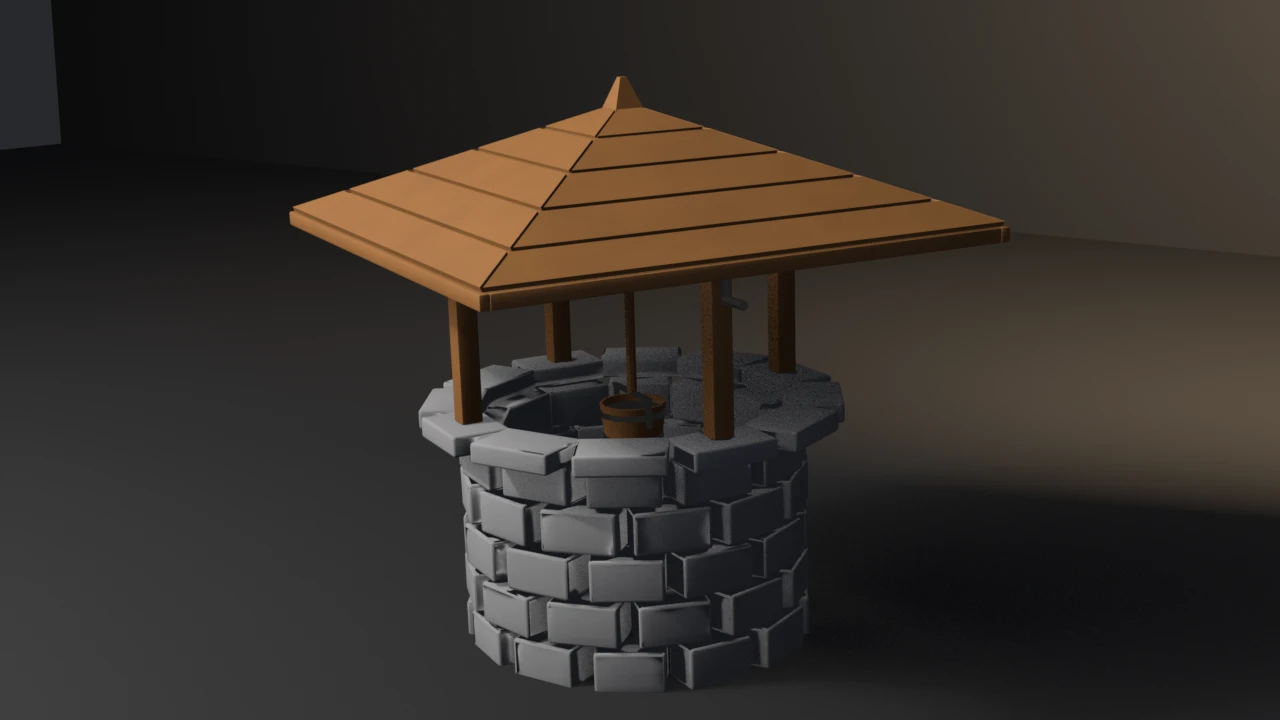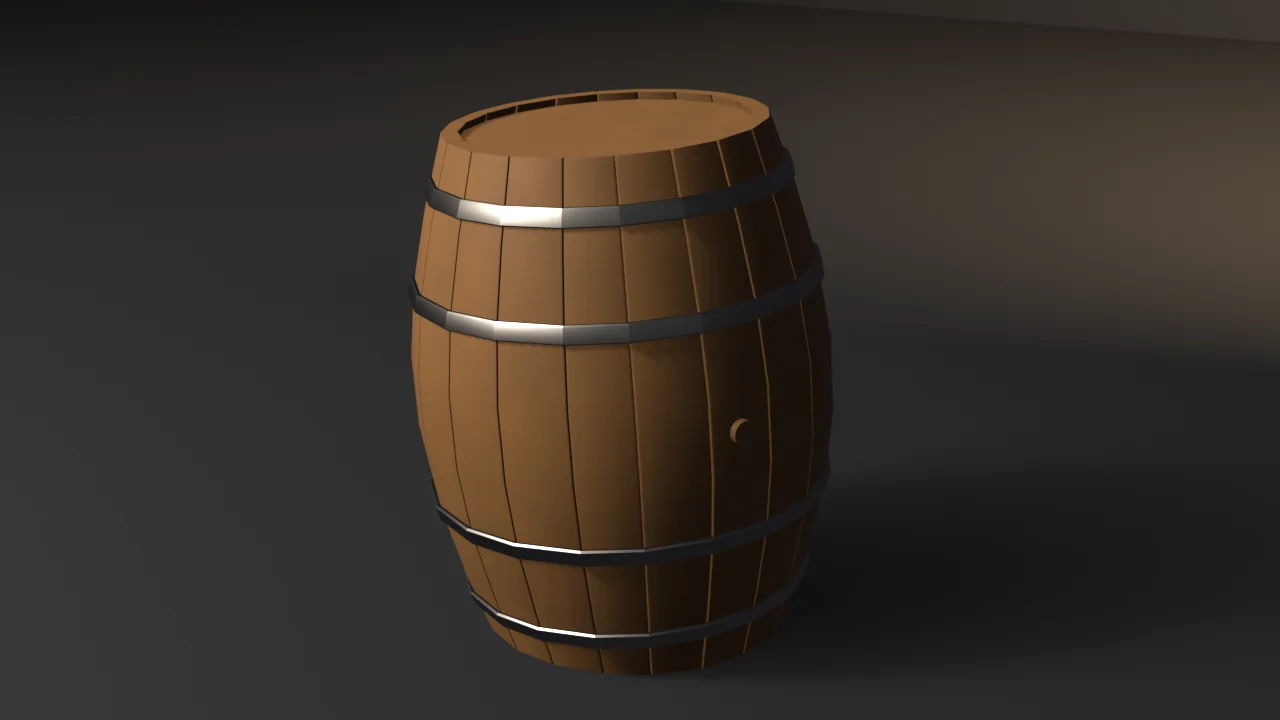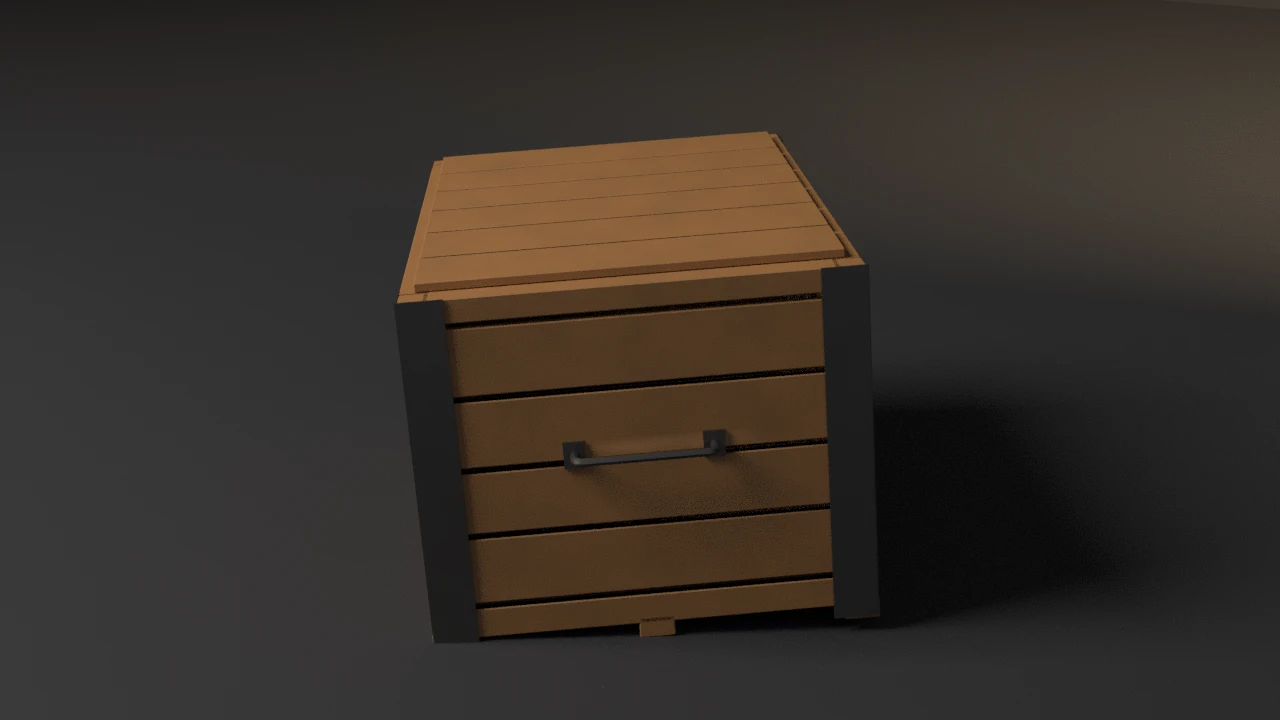
shipping-crate
A procedural shipping crate through UVs, bake, LOD, collider, and Unity glTF, asserting recomputed budgets rather than an API contract.
A procedural backyard quarter-pipe, 1.2 m high on a 1.8 m transition and 2.44 m wide, with a skateboard on its deck — five plywood transition templates (curved bands with a solid toe and an arm under the deck) on 2x4 sills with studs and a back post sistered to their faces, nine 2x4 stringers under a two-layer 12 mm plywood skin whose joints are offset between layers and land on stringers, 143 screws in rows over the stringers, a 60 mm steel coping pipe standing proud of the transition on five welded, bolted tabs, a steel kicker plate ground to a lip at the toe on a timber toe block, a worn stencilled roundel and wheel marks on the riding face; the skateboard a seven-ply maple deck with concave and kicktails under grip tape, two trucks (baseplate, raked kingpin, bushings, hanger, pivot arm, axle) and four urethane wheels on bearings — through UVs, bake, LOD, collider, and Unity glTF, asserting recomputed budgets rather than an API contract.
Rendered headless by the showcase piece itself — click to zoom.
category Sports
blender --background --python showcase/skate-ramp/skate_ramp.py --
A showcase piece, not an example, and the sixth in the sports category. It builds a backyard quarter-pipe, 1.2 m high on a 1.8 m transition and 2.44 m wide (an 8 ft sheet), with a skateboard resting on its deck by the coping.
The transition is a circle of radius R about a centre R above the toe, so it is tangent to the ground. Every sheet, template and stringer is placed on that circle from named radii: the inner layer bites the top layer 0.5 mm, the stringers bite the inner layer 0.5 mm, each template's curved edge bites it 0.9 mm, each template sits 2 mm into its sill. Neighbouring sheets' side edges stand 0.6 mm apart, and neighbouring stringers' end cuts 0.3 mm, so no two parts share a plane.
It asserts budget conformance of the generated result. It does not witness an API contract. "It rendered without error" is not a check.
Composes skills mesh-editing-and-bmesh, bake-high-to-low, depsgraph-and-evaluated-data, engine-export-presets, and snippets bake_normal_high_to_low.py, setup_bake_target_image.py, lod_chain.py / decimate_to_budget.py, convex_hull_collider.py, export_preset_unity.py (helpers copied inline, not imported).
Intended size: 2.53 m from the kicker plate's toe to the back of the deck, 2.44 m across, 1.34 m to the top of the skateboard's kicktail (the deck is at 1.20 m). The origin is under the transition's toe at floor level.
Every budget is declared as a named constant. Every gate recomputes its value from the mesh, materials, UVs, evaluated LOD, collider, or export file.
| Axis | Declared | Measured (5.2.1) |
|---|---|---|
| Base triangles | 30600–31700 | 31164 |
| LOD1 ratio | 0.32–0.62 of base | 0.5000 |
| LOD2 ratio | 0.10–0.35 of base | 0.2200 |
| Materials | exactly 9 distinct; ≥3100 plywood, ≥1400 framing, ≥1030 steel, ≥6940 hardware, ≥1045 maple, ≥855 grip, ≥1460 urethane, ≥850 alloy, ≥440 bushing faces | 9 slots; 3268 / 1479 / 1086 / 7304 / 1100 / 900 / 1536 / 892 / 464 |
| UVs | in 0..1, AABB overlap ≤ 1e-5 | in range, overlap 0 |
| Outer AABB | (2.529, 2.440, 1.339) m ± 0.01, read off the vertices | (2.5293, 2.4400, 1.3389), zmin 0 |
| Collider tris | ≤ 380 | 350 |
| Export | written, size > 0, removed after measuring | 2376604 bytes |
DECIMATE COLLAPSE triangle counts are not identical across Blender series, so the LOD gate is a ratio band, not an exact count. Bake pixels are stochastic, so the bake gate is has_data plus operator FINISHED, not byte-identity. Construction uses no RNG; two default runs print identical measurements.
Recomputed from the generated mesh, not asserted about the script.
| Axis | Declared | Measured |
|---|---|---|
| Non-manifold edges | 0 | 0 |
| Loose verts / edges | 0 / 0 | 0 / 0 |
| Doubles merged at 1e-5 | 0 | 0 |
| Zero-area faces | 0 | 0 |
| N-gons | 0 | 0 |
| Coplanar cross-shell face pairs (KD range 0.05 m, plane ε 1e-4) | 0 | 0 |
Grounded: zmin | within 1e-4 of 0 | 0.0000 |
Supports: each of the 5 sills, the toe block and the kicker plate has its own zmin | within 1e-4 of 0 | all 0 |
The first draft measured 1531 coplanar pairs. Every sheet in a layer had its side edge on one plane, so each joint put two sheets' side faces on it (the edges now alternate 0.6 mm); neighbouring stringers' end cuts shared the plane of the joists' ends; the two carriage bolts on each tab sat at one height; and the skateboard's concave faded out through the kicktails, which twisted the deck until 28 grip faces shared planes with deck faces. The concave now runs through the kicks, a translational surface, and the grip's outline is the deck's outline offset along its normal, with the round ends kept concentric.
| Axis | Declared | Measured |
|---|---|---|
| Transition: a circle fitted (algebraic fit, then refit) to the top layer's riding face, clear of every sheet's chamfered ends and sides; its radius, the largest radial deviation of any sample, its lowest point (tangent to the ground), the deck's height | R 1.800 ± 5 mm; ≤ 1.0 mm; 0 ± 2 mm; 1.200 ± 5 mm | 1.80000 (98 samples); 0.000 mm; 0.000 mm; 1.20000 |
| Templates: count; each seated on its sill (the sill's top above the template's bottom); each curved edge inside the inner layer's underside (a circle fitted to it), per 0.01 rad bin across the layer's span | 5; 1–6 mm; 0.3–2.5 mm | 5; 2.00 mm; 0.90–0.91 mm |
| Coping: station centres of the pipe's outer face; straight (off their line); parallel to the ramp's width; its reveal, standing proud of the fitted transition; its top above the deck | ≤ 0.5 mm; ≤ 0.2°; 2–8 mm; 0–8 mm | 0.000 mm; 0.000°; 5.00 mm; 3.86 mm |
| Kicker plate: its top at its upper end against the first top sheet's top at its lower end, radially; the height of its toe | step ≤ 0.6 mm; toe ≤ 1.2 mm | 0.01 mm; 0.80 mm |
| Seams: the gaps between consecutive sheets of each layer, as arc length; every top seam from every inner seam; every seam over a stringer (clearance to its nearer edge); 9 stringers | stagger ≥ 0.30 m; ≥ 15 mm | top 0.84, 1.84, inner 1.24; 0.400 m; 43.9 mm |
| Screws: every skin screw's head over a stringer (clearance to its nearer edge, along the arc) and inside one top sheet | ≥ 8 mm; ≥ 5 mm | 143 screws; 17.4 mm; 17.0 mm |
| Wheels on the deck: count; each wheel's lowest point below the deck's top | 4; 0.2–1.2 mm | 4; 0.50 mm |
| Trucks: each wheel's centre off its axle's line; its axis against the axle's; wheels per axle | ≤ 0.3 mm; ≤ 0.5°; 2 and 2 | 0.000 mm; 0.014°; 2 and 2 |
| One connected assembly (union of shells whose BVH trees overlap) | 1 component | 1 (309 shells) |
The coping stands 3.86 mm above the deck rather than the 4 mm it was built to: its 32-sided section is turned half a facet, so no vertex sits on its crown. The arc fit reads the riding face alone: a face's vertices sit on the circle, while the chamfers' vertices on the end and side faces sit 1.5 mm behind it, so the fit keeps clear of both.
Each falsifier violates one named budget. Every one was run on 5.2.1 and exited its declared code with the triangle count at 31164, the envelope at (2.5293, 2.4400, 1.3389) (--lift-grip raises its top 1 mm, inside the tolerance) and every budget checked before the target green. The script prints budget_fails after every run, listing each piece budget that fails; each of the ten piece falsifiers lists its own budget and nothing else.
| Flag | Budget violated | Exit |
|---|---|---|
--skip-decimate | LOD1 ratio band (measured 1.0000) | 9 |
--stray-vert | loose vertex count is 0 (measured 1, placed inside the envelope) | 15 |
--lift-z | bounding box zmin is 0 (measured 0.05000) | 16 |
--float-sill | every sill on the floor (the middle sill 3 mm up: its zmin 0.003, the rest 0) | 16 |
--short-rib | every template seated under the skin (the middle template's curved edge 4 mm short: bite −3.10 mm) | 17 |
--small-wheel | every wheel on the deck (one wheel 2 mm smaller: bite −1.50 mm) | 18 |
--sag-skin | transition on its circle (the middle top sheet 4 mm down mid-span: radius 1.77073, deviation 1.55 mm, lowest point 5.65 mm) | 19 |
--sink-coping | coping reveal (the pipe 6 mm deeper into the ramp: reveal −1.00 mm) | 20 |
--proud-plate | kicker plate flush (its top 3 mm proud at the joint, ramped to 0 at the toe: step 2.99 mm, toe still 0.80 mm) | 21 |
--stack-seams | seams staggered (the inner joint moved 10 mm from a top joint: stagger 0.010 m, still over its stringer) | 22 |
--miss-screws | screws over stringers (the row at 1.44 m moved 60 mm along the arc: 20.6 mm past a stringer's edge) | 23 |
--skew-wheel | wheels coaxial (one wheel 2 mm along the deck: 2.00 mm off its axle) | 24 |
--lift-grip | one connected assembly (grip tape and its eight bolt heads lifted 1 mm: 2 components) | 25 |
--stray-vert also leaves the stray vertex as a second component and --lift-z also moves the fitted arc and the plate's toe off the ground; both fail their target first. --float-sill lifts only the sill: its template, still standing where it was, sits 5 mm into it, inside the seat band. --sag-skin sags the sheet as sin², level with its neighbours at both joints; the screws follow the sheet they hold down, so they stay seated. --stack-seams moves the inner joint rather than a top one: moving a top joint moved sheet corners onto the collider's side faces and tripped its ceiling (exit 11) first. --small-wheel shrinks one wheel's tread and keeps its bore, so it stays on its bearings and coaxial; --skew-wheel slides one along the deck and keeps its lowest point, so it stays on the deck.
blender --background --python skate_ramp.py --
blender --background --python skate_ramp.py -- --skip-decimate
blender --background --python skate_ramp.py -- --stray-vert
blender --background --python skate_ramp.py -- --lift-z
blender --background --python skate_ramp.py -- --float-sill
blender --background --python skate_ramp.py -- --short-rib
blender --background --python skate_ramp.py -- --small-wheel
blender --background --python skate_ramp.py -- --sag-skin
blender --background --python skate_ramp.py -- --sink-coping
blender --background --python skate_ramp.py -- --proud-plate
blender --background --python skate_ramp.py -- --stack-seams
blender --background --python skate_ramp.py -- --miss-screws
blender --background --python skate_ramp.py -- --skew-wheel
blender --background --python skate_ramp.py -- --lift-grip
blender --background --python skate_ramp.py -- --output ramp.png
Smoke passes no flags.
The hero looks up the transition from in front and to the left of its toe, from 1.85 m above the ramp's centre, so the riding face, the coping and the deck with the skateboard all show, and the open side shows its templates, studs and sills against the back wall. The key comes from the front left; the warm wedge pools on the wall to the right of the deck.
File-local. 9 is a valid check code. 10 is reserved for gallery_framing.check_framing on the --output path. 15–19 are the hygiene and joint-fit family. 20–25 are file-local. 26 is the asset-quality floor on the render path: check_asset_quality returns 11, which this piece already spends on the collider ceiling, so the call site remaps it.
| Code | Meaning |
|---|---|
| 0 | Success |
| 1 | Uncaught exception (FATAL wrapper) |
| 2 | argparse / usage |
| 3 | Mesh did not build / no UV layer |
| 4 | Base triangle count outside range |
| 5 | Material count ≠ 9 distinct slots, or a face-count floor missed |
| 6 | UVs outside 0..1 |
| 7 | UV AABB overlap above tolerance |
| 8 | World AABB off declared outer size |
| 9 | LOD ratio band (--skip-decimate lands here) |
| 10 | Framing gate (render path only) |
| 11 | Collider triangle count above ceiling |
| 12 | Bake did not finish or image has no data |
| 13 | Export file missing or empty |
| 14 | --output produced no file |
| 15 | Mesh hygiene: loose, non-manifold, zero-area, doubles, n-gons, coplanar cross-shell pairs |
| 16 | Not grounded: bounding box zmin off 0, or a sill, the toe block or the plate off the floor (--lift-z, --float-sill) |
| 17 | Templates: not 5, one off its sill's seat band, or its curved edge outside its band under the skin (--short-rib) |
| 18 | Wheels: not 4, or one outside its bite band on the deck (--small-wheel) |
| 19 | Transition off its circle: radius, deviation, not tangent to the ground, or the deck off its height (--sag-skin) |
| 20 | Coping: not straight, not parallel to the width, reveal or height above the deck outside its band (--sink-coping) |
| 21 | Kicker plate: step to the skin or toe height too large (--proud-plate) |
| 22 | Seams: a top seam too near an inner seam, a seam off its stringer, or not 9 stringers (--stack-seams) |
| 23 | Screws: a head off its stringer or across a sheet joint (--miss-screws) |
| 24 | Trucks: a wheel off its axle's line or axis, or not two wheels per axle (--skew-wheel) |
| 25 | Assembly splits into more than one connected component (--lift-grip) |
| 26 | Asset-quality floor (render path only; remapped from 11) |
"""Game-ready backyard quarter-pipe with a skateboard — a showcase piece, not an example. Asserts budget conformance of a procedural 1.2 m skateboard quarter-pipe on a 1.8 m transition, with a complete skateboard resting on its deck, after composing shipped pipeline pieces: bmesh construction, UVs, nine materials, high-to-low normal bake, LOD chain, convex collider, Unity glTF export. The frame is five transition templates cut from plywood — each a curved band with a solid toe and an arm under the deck — standing on 2x4 sills, with studs and a back post sistered to their faces, a lip joist behind the coping and a rim joist at the back. Nine 2x4 stringers run across the templates under the skin. The skin is two layers of 12 mm plywood in full-width sheets, their seams offset between layers and every seam landing on a stringer; a row of screws runs over each stringer, doubled where two sheets meet. A steel coping pipe sits at the lip, standing a few millimetres proud of the transition, with five bracket tabs welded to it and bolted to the deck; a steel kicker plate, ground to a lip at its toe, carries the transition down onto the ground over a timber toe block. A skateboard rests on the deck near the coping: a seven-ply maple deck with concave and two kicktails under grip tape, two trucks (baseplate, kingpin, bushings, cup washer and nut, hanger with pivot arm, axle), four urethane wheels on bearings, and eight mounting bolts through the grip. Budgets are declared below and recomputed from the generated result. They are not API-contract witnesses. Each falsifier violates one named budget: ``--skip-decimate`` the LOD-ratio band, ``--stray-vert`` mesh hygiene, ``--lift-z`` grounded zmin, ``--float-sill`` every sill on the ground, ``--short-rib`` every template seated on its sill and under the skin, ``--small-wheel`` every wheel on the deck, ``--sag-skin`` the transition's circular arc, ``--sink-coping`` the coping's reveal, ``--proud-plate`` the kicker plate flush with the skin, ``--stack-seams`` the staggered seams, ``--miss-screws`` every screw over a stringer, ``--skew-wheel`` the wheels coaxial with their axles, ``--lift-grip`` one connected assembly. No RNG. Construction is closed-form. DECIMATE COLLAPSE triangle counts are not byte-identical across Blender versions — the LOD gate is a ratio band, not an exact count. blender --background --python skate_ramp.py -- blender --background --python skate_ramp.py -- --skip-decimate blender --background --python skate_ramp.py -- --output ramp.png """ import argparse import math import os import sys import tempfile import traceback import bmesh import bpy import numpy as np from mathutils import Matrix, Vector from mathutils.bvhtree import BVHTree from mathutils.kdtree import KDTree # Showcase lives at repo-root/showcase/, not under examples/. The framing # helper is the repo's only shared import and lives next to the examples; # resolve the repo root so we do not move gallery_framing.py. _REPO = os.path.abspath( os.path.join(os.path.dirname(os.path.abspath(__file__)), os.pardir, os.pardir) ) sys.path.insert(0, os.path.join(_REPO, "examples")) sys.dont_write_bytecode = True import gallery_framing # noqa: E402 import gallery_asset_quality # noqa: E402 # -------------------------------------------------------------------------- # Design (metres). X runs up the ramp, Y across it, Z up. The transition is # a circle of radius R about C = (0, R) in XZ, tangent to the ground at X=0. # -------------------------------------------------------------------------- R = 1.80 # transition radius: the riding surface DECK_TOP = 1.200 # deck height TH_TOP = 0.012 # top plywood layer TH_IN = 0.012 # inner plywood layer PLY_BITE = 0.0005 # inner layer bites the top layer; stringers bite the inner R_IN0 = R + TH_TOP - PLY_BITE # inner layer, concave face R_IN1 = R_IN0 + TH_IN # inner layer, convex face (the underside) R_STR = R_IN1 - PLY_BITE # stringer faces under the skin STR_DEPTH = 0.038 # 2x4 laid flat: 38 mm radial, 89 mm along the arc STR_HALF = 0.0445 RIB_BITE = 0.0009 # template edge into the inner layer's underside R_RIB = R_IN1 - RIB_BITE RIB_BAND = 0.22 # depth of each template's curved band RIB_T = 0.018 # 18 mm plywood templates SHEET_W = 1.220 # skin half width (8 ft sheets across the ramp) FACET = 0.035 # arc facet length: every facet over 1 degree S_PLATE = 0.40 # arc length of the kicker plate PLATE_T = 0.006 PLATE_HALF = 1.200 TOE_LIP = 0.0008 # plate toe ground to this height S_TOE_BACK = 0.56 # toe block's back, as arc length STRINGER_S = (0.64, 0.84, 1.04, 1.24, 1.44, 1.64, 1.84, 2.04, 2.12) TOP_SEAMS = (0.84, 1.84) INNER_SEAMS = (1.24,) SEAM_GAP = 0.0010 SEAM_ROW = 0.022 # screw rows either side of a seam SCREW_Y = tuple(-1.14 + 0.19 * i for i in range(13)) SCREW_R = 0.0045 PIPE_R = 0.030 # 2-3/8 in coping PIPE_RI = 0.0245 PIPE_HALF = 1.215 PIPE_PROUD = 0.004 # coping top above the deck REVEAL = 0.005 # coping stands this far proud of the transition PIPE_SEGS = 32 PIPE_STATIONS = 9 DECK_T = 0.018 X_BACK = 2.58 ARM_BITE = 0.0007 ARM_TOP = DECK_TOP - DECK_T + ARM_BITE ARM_DEPTH = 0.22 SILL_H = 0.038 SILL_W = 0.089 RIB_BOT = SILL_H - 0.002 STUD_BOT = SILL_H - 0.0025 RIB_Y = (-1.2075, -0.60, 0.0, 0.60, 1.2075) RIB_OUT = 1.2165 # outer templates' outer faces TAB_Y = (-0.96, -0.48, 0.0, 0.48, 0.96) DECK_SCREW_X = tuple(1.84 + 0.12 * i for i in range(7)) # Skateboard (local frame: U along the deck, V across it, Z up from the ramp deck) BOARD_POS = (2.00, -0.35) BOARD_YAW_DEG = 72.0 BOARD_L = 0.80 BOARD_W = 0.205 BOARD_T = 0.011 CONCAVE = 0.008 U_KICK = 0.232 KICK_DEG = 19.0 KICK_BLEND = 0.05 RW = 0.027 # wheel radius (54 mm) WHEEL_BITE = 0.0005 # wheel into the deck AXLE_Z = RW - WHEEL_BITE TRUCK_U = 0.190 WHEEL_V = 0.088 BP_BOT = AXLE_Z + 0.047 # baseplate underside BP_T = 0.006 BOARD_BOT = BP_BOT + BP_T - 0.0004 BOARD_Z = BOARD_BOT + BOARD_T KINGPIN_DEG = 35.0 # Falsifier displacements FLOAT_SILL = 0.003 SHORT_RIB = 0.004 SMALL_WHEEL = 0.002 SAG_SKIN = 0.004 SINK_COPING = 0.006 PROUD_PLATE = 0.003 MISS_SCREWS = 0.060 SKEW_WHEEL = 0.002 LIFT_GRIP = 0.001 BBOX_TOL = 0.01 # Fitted after locking geometry. Recomputed from the vertices. OUTER_SIZE = (2.529, 2.440, 1.339) BASE_TRIS_MIN = 30600 BASE_TRIS_MAX = 31700 LOD1_RATIO_MIN = 0.32 LOD1_RATIO_MAX = 0.62 LOD2_RATIO_MIN = 0.10 LOD2_RATIO_MAX = 0.35 LOD1_TARGET = 0.50 LOD2_TARGET = 0.22 MATERIAL_COUNT = 9 UV_EPS = 1e-4 UV_OVERLAP_MAX = 1e-5 COLLIDER_TRIS_MAX = 380 BAKE_RES = 1024 CAGE_EXTRUSION = 0.003 # per slot: ply, framing, steel, hardware, maple, grip, urethane, alloy, bushing FACE_FLOORS = (3100, 1400, 1030, 6940, 1045, 855, 1460, 850, 440) ZMIN_EPS = 1e-4 DOUBLES_EPS = 1e-5 AREA_EPS = 1e-10 COPLANAR_NORMAL_EPS = 1e-4 COPLANAR_PLANE_EPS = 1e-4 COPLANAR_CENTRE_MAX = 0.05 LIFT_Z = 0.05 # Templates: seated on their sills, and their curved edge under the skin. RIB_SEAT_MIN = 0.0010 RIB_SEAT_MAX = 0.0060 RIB_BITE_MIN = 0.0003 RIB_BITE_MAX = 0.0025 # Wheels on the deck. WHEEL_BITE_MIN = 0.0002 WHEEL_BITE_MAX = 0.0012 # Transition: a circle of the declared radius, tangent to the ground. RADIUS_TOL = 0.005 ARC_DEV_MAX = 0.0010 TANGENT_TOL = 0.002 HEIGHT_TOL = 0.005 # Coping. REVEAL_MIN = 0.002 REVEAL_MAX = 0.008 PROUD_MIN = 0.0 PROUD_MAX = 0.008 STRAIGHT_TOL = 0.0005 PARALLEL_MAX_DEG = 0.2 # Kicker plate. STEP_MAX = 0.0006 TOE_MAX = 0.0012 # Seams and screws. SEAM_STAGGER_MIN = 0.30 SEAM_ON_STRINGER = 0.015 SCREW_EDGE_MIN = 0.008 SCREW_SHEET_MIN = 0.005 # Trucks. COAX_TOL = 0.0003 COAX_ANGLE_MAX_DEG = 0.5 HERO_YAW_DEG = -2.0 WALL_Y = 3.2 PLY_IDX, FRAME_IDX, STEEL_IDX, HW_IDX, MAPLE_IDX = 0, 1, 2, 3, 4 GRIP_IDX, URETHANE_IDX, ALLOY_IDX, BUSHING_IDX = 5, 6, 7, 8 BEVEL_BY_MAT = {PLY_IDX: 0.0015, FRAME_IDX: 0.0020, STEEL_IDX: 0.0008, MAPLE_IDX: 0.0012, ALLOY_IDX: 0.0006} # Part tags: a face attribute naming which part a face belongs to, so the # audits can find the shells they measure. Every measured value is read from # the vertices, never from these constants. (T_NONE, T_TOP, T_INNER, T_RIB, T_STRINGER, T_SILL, T_STUD, T_TOE, T_PLATE, T_COPING, T_DECK, T_JOIST, T_TAB, T_SCREW, T_FASTENER, T_BOARD, T_GRIP, T_WHEEL, T_AXLE, T_TRUCK, T_BEARING, T_BUSHING) = range(22) ZAX = Vector((0.0, 0.0, 1.0)) YAX = Vector((0.0, 1.0, 0.0)) XAX = Vector((1.0, 0.0, 0.0)) # local (u, v, w) -> world (x, z, y): outlines drawn in the side view, extruded across XZY = Matrix(((1.0, 0.0, 0.0), (0.0, 0.0, 1.0), (0.0, 1.0, 0.0))) def arc_pt(r, ph, y=0.0): return Vector((r * math.sin(ph), y, R - r * math.cos(ph))) def radial(ph): """Outward from the centre (into the ramp).""" return Vector((math.sin(ph), 0.0, -math.cos(ph))) def tangent(ph): return Vector((math.cos(ph), 0.0, math.sin(ph))) def phis(ph0, ph1, r): n = max(2, int(math.ceil(abs(ph1 - ph0) * r / FACET))) return [ph0 + (ph1 - ph0) * i / n for i in range(n + 1)] def _coping_axis(sink): d = R + PIPE_R - REVEAL + sink z = DECK_TOP + PIPE_PROUD - PIPE_R return Vector((math.sqrt(d * d - (z - R) ** 2), 0.0, z)) PIPE_A = _coping_axis(0.0) def _end_angle(): """Where the riding surface enters the coping 3 mm deep (bisection).""" a = PIPE_A ph_a = math.atan2(a.x, R - a.z) lo, hi = ph_a - 0.08, ph_a for _ in range(80): mid = 0.5 * (lo + hi) if (arc_pt(R, mid) - a).length > PIPE_R - 0.003: lo = mid else: hi = mid return 0.5 * (lo + hi) PH_END = _end_angle() PH_PLATE = S_PLATE / R PH_TOE = math.acos((R - TOE_LIP) / R) def eevee_engine_id(): return "BLENDER_EEVEE" if bpy.app.version >= (5, 0, 0) else "BLENDER_EEVEE_NEXT" def fail(msg, code): print(f"ERROR: {msg}", file=sys.stderr) return code def triangle_count(mesh): mesh.calc_loop_triangles() return len(mesh.loop_triangles) def evaluated_triangle_count(obj): # Duplicated from snippets/lod_chain.py / decimate_to_budget.py (not a package). depsgraph = bpy.context.evaluated_depsgraph_get() eval_obj = obj.evaluated_get(depsgraph) eval_mesh = eval_obj.to_mesh() try: eval_mesh.calc_loop_triangles() return len(eval_mesh.loop_triangles) finally: eval_obj.to_mesh_clear() # -------------------------------------------------------------------------- # Construction helpers (copied from showcase/road-bicycle, not imported) # -------------------------------------------------------------------------- class Build: """The bmesh under construction, its part-tag layer, named vertex groups (for the falsifiers that move one assembly) and the bevel set.""" def __init__(self, bm): self.bm = bm self.tag = bm.faces.layers.int.new("part") self.ply = bm.verts.layers.float.new("plyfrac") self.bev = bm.verts.layers.int.new("bev") self.groups = {} def mark_bevel(self, verts): for v in verts: v[self.bev] = 1 def part(self, tag=T_NONE, *groups, bevel=False): return _Part(self, tag, groups, bevel) class _Part: def __init__(self, b, tag, groups, bevel): self.b, self.t, self.g, self.bevel = b, tag, groups, bevel def __enter__(self): self.nf = len(self.b.bm.faces) self.nv = len(self.b.bm.verts) return self def __exit__(self, *exc): bm = self.b.bm bm.faces.ensure_lookup_table() bm.verts.ensure_lookup_table() for i in range(self.nf, len(bm.faces)): bm.faces[i][self.b.tag] = self.t vs = [bm.verts[i] for i in range(self.nv, len(bm.verts))] for g in self.g: self.b.groups.setdefault(g, []).extend(vs) if self.bevel: self.b.mark_bevel(vs) return False def _mark(faces, mat_idx): for f in faces: f.material_index = mat_idx def frame(ez, ex_hint): """Rotation whose local Z is ``ez`` and local X is ``ex_hint`` made orthogonal to it (columns ex, ey, ez; right-handed).""" ez = Vector(ez).normalized() ex = Vector(ex_hint) ex = (ex - ez * ex.dot(ez)).normalized() ey = ez.cross(ex) return Matrix((ex, ey, ez)).transposed() def add_lathe(bm, profile, segs, mat_idx, center=(0.0, 0.0, 0.0), rot=None, phase=0.0, solid=False): """Revolve a profile [(r, z), ...] about local Z. ``solid``: the profile is an open polyline closed by n-gon caps at its two ends; otherwise it is a closed polygon revolved into a ring shell.""" c = Vector(center) m = rot if rot is not None else Matrix.Identity(3) rings = [] for i in range(segs): a = phase + 2.0 * math.pi * i / segs ca, sa = math.cos(a), math.sin(a) rings.append([bm.verts.new(c + m @ Vector((r * ca, r * sa, z))) for r, z in profile]) n = len(profile) last = n - 1 if solid else n for i in range(segs): r0, r1 = rings[i], rings[(i + 1) % segs] for j in range(last): k = (j + 1) % n bm.faces.new((r0[j], r1[j], r1[k], r0[k])).material_index = mat_idx if solid: bm.faces.new([rings[i][0] for i in reversed(range(segs))]).material_index = mat_idx bm.faces.new([rings[i][n - 1] for i in range(segs)]).material_index = mat_idx return [v for ring in rings for v in ring] def lathe_on(bm, profile, segs, mat_idx, center, axis, ref=XAX, solid=True, phase=0.0): if abs(Vector(axis).normalized().dot(Vector(ref))) > 0.9: ref = ZAX if abs(Vector(axis).normalized().z) < 0.9 else YAX return add_lathe(bm, profile, segs, mat_idx, center=center, rot=frame(axis, ref), solid=solid, phase=phase) def add_sweep(bm, pts, radius, sides, mat_idx, phase=0.0, ref=None): """Capped tube swept along a polyline with parallel-transport frames.""" pts = [Vector(p) for p in pts] n = len(pts) tans = [(pts[min(i + 1, n - 1)] - pts[max(i - 1, 0)]).normalized() for i in range(n)] if ref is None: ref = ZAX if abs(tans[0].z) < 0.9 else XAX nrm = (Vector(ref) - tans[0] * Vector(ref).dot(tans[0])).normalized() rings = [] for p, t in zip(pts, tans): nrm = (nrm - t * nrm.dot(t)).normalized() bi = t.cross(nrm) rings.append([bm.verts.new(p + radius * (nrm * math.cos(phase + 2.0 * math.pi * k / sides) + bi * math.sin(phase + 2.0 * math.pi * k / sides))) for k in range(sides)]) for r0, r1 in zip(rings, rings[1:]): for k in range(sides): m = (k + 1) % sides bm.faces.new((r0[k], r0[m], r1[m], r1[k])).material_index = mat_idx bm.faces.new(tuple(reversed(rings[0]))).material_index = mat_idx bm.faces.new(tuple(rings[-1])).material_index = mat_idx return [v for ring in rings for v in ring] def rrect(ha, hb, rc, n_corner=2): """Rounded rectangle loop (counter-clockwise).""" rc = max(min(rc, ha - 1e-4, hb - 1e-4), 0.0003) pts = [] for k, (sx, sy) in enumerate(((1, 1), (-1, 1), (-1, -1), (1, -1))): cx, cy = sx * (ha - rc), sy * (hb - rc) a0 = 0.5 * math.pi * k for s in range(n_corner + 1): a = a0 + 0.5 * math.pi * s / n_corner pts.append((cx + rc * math.cos(a), cy + rc * math.sin(a))) return pts def add_rbox(bm, ha, hb, rc, profile, origin, rot, mat_idx, n_corner=2): """Loft of rounded rectangles along local Z: profile [(inset, z)].""" o = Vector(origin) rings = [] for inset, z in profile: loop = rrect(ha - inset, hb - inset, rc - inset, n_corner) rings.append([bm.verts.new(o + rot @ Vector((x, y, z))) for x, y in loop]) n = len(rings[0]) faces = [] for r0, r1 in zip(rings, rings[1:]): for k in range(n): m = (k + 1) % n faces.append(bm.faces.new((r0[k], r0[m], r1[m], r1[k]))) faces.append(bm.faces.new(tuple(reversed(rings[0])))) faces.append(bm.faces.new(tuple(rings[-1]))) _mark(faces, mat_idx) return [v for ring in rings for v in ring] def add_prism(bm, outline, w0, w1, origin, rot, mat_idx): """Planar outline [(u, v)] extruded along local Z from w0 to w1.""" o = Vector(origin) a = [bm.verts.new(o + rot @ Vector((u, v, w0))) for u, v in outline] b = [bm.verts.new(o + rot @ Vector((u, v, w1))) for u, v in outline] n = len(outline) faces = [bm.faces.new((a[i], a[(i + 1) % n], b[(i + 1) % n], b[i])) for i in range(n)] faces.append(bm.faces.new(tuple(reversed(a)))) faces.append(bm.faces.new(tuple(b))) _mark(faces, mat_idx) return a + b def add_loft(bm, rings_pts, mat_idx): """Closed loops [[Vector]] lofted in order, n-gon caps at both ends.""" rings = [[bm.verts.new(p) for p in loop] for loop in rings_pts] n = len(rings[0]) faces = [] for r0, r1 in zip(rings, rings[1:]): for j in range(n): m = (j + 1) % n faces.append(bm.faces.new((r0[j], r0[m], r1[m], r1[j]))) faces.append(bm.faces.new(tuple(reversed(rings[0])))) faces.append(bm.faces.new(tuple(rings[-1]))) _mark(faces, mat_idx) return [v for ring in rings for v in ring] def add_sheet(bm, surf, nu, nv, thick, mat_idx): """A closed plate: ``surf(u, v) -> (point, normal)`` over the unit square, offset ``thick`` back along the normal, rims stitched round the edge. Returns (front verts, back verts).""" front, back = [], [] for j in range(nv + 1): rf, rb = [], [] for i in range(nu + 1): p, n = surf(i / nu, j / nv) rf.append(bm.verts.new(p)) rb.append(bm.verts.new(p - n * thick)) front.append(rf) back.append(rb) faces = [] for j in range(nv): for i in range(nu): faces.append(bm.faces.new((front[j][i], front[j][i + 1], front[j + 1][i + 1], front[j + 1][i]))) faces.append(bm.faces.new((back[j][i], back[j + 1][i], back[j + 1][i + 1], back[j][i + 1]))) rim = ([(0, i) for i in range(nu + 1)] + [(j, nu) for j in range(1, nv + 1)] + [(nv, i) for i in reversed(range(nu))] + [(j, 0) for j in reversed(range(1, nv))]) for k in range(len(rim)): (ja, ia), (jb, ib) = rim[k], rim[(k + 1) % len(rim)] faces.append(bm.faces.new((front[jb][ib], front[ja][ia], back[ja][ia], back[jb][ib]))) _mark(faces, mat_idx) return [v for row in front for v in row], [v for row in back for v in row] def triangulate_ngons(bm): faces = [f for f in bm.faces if len(f.verts) > 4] if faces: bmesh.ops.triangulate(bm, faces=faces) def pack_uvs(bm, margin=0.08): uv = bm.loops.layers.uv.new("UVMap") faces = list(bm.faces) n = len(faces) cols = max(1, math.ceil(math.sqrt(n))) rows = max(1, math.ceil(n / cols)) cell_w = 1.0 / cols cell_h = 1.0 / rows pad_u = margin * cell_w * 0.5 pad_v = margin * cell_h * 0.5 usable_w = cell_w - 2.0 * pad_u usable_h = cell_h - 2.0 * pad_v for i, face in enumerate(faces): col = i % cols row = i // cols nrm = face.normal ax, ay, az = abs(nrm.x), abs(nrm.y), abs(nrm.z) coords = [] for loop in face.loops: co = loop.vert.co if az >= ax and az >= ay: coords.append((co.x, co.y)) elif ax >= ay: coords.append((co.y, co.z)) else: coords.append((co.x, co.z)) xs = [c[0] for c in coords] ys = [c[1] for c in coords] minx, maxx = min(xs), max(xs) miny, maxy = min(ys), max(ys) dx = max(maxx - minx, 1e-8) dy = max(maxy - miny, 1e-8) origin_u = col * cell_w + pad_u origin_v = row * cell_h + pad_v for loop, (x, y) in zip(face.loops, coords): loop[uv].uv = ( origin_u + (x - minx) / dx * usable_w, origin_v + (y - miny) / dy * usable_h, ) # -------------------------------------------------------------------------- # The ramp # -------------------------------------------------------------------------- def arc_slab(bm, ph0, ph1, r_in, r_out, y0, y1, mat_idx, clamp=False): """A curved sheet between radii ``r_in(ph)`` (the face toward the centre) and ``r_out(ph)``, from angle ph0 to ph1, across y0..y1.""" rings = [] for ph in phis(ph0, ph1, R): ri, ro = r_in(ph), r_out(ph) pts = [arc_pt(ri, ph, y0), arc_pt(ro, ph, y0), arc_pt(ro, ph, y1), arc_pt(ri, ph, y1)] if clamp: pts = [Vector((p.x, p.y, max(p.z, 0.0))) for p in pts] rings.append(pts) return add_loft(bm, rings, mat_idx) def sheet_spans(seams, s0, s1): edges = [s0] + [s for s in seams] + [s1] spans = [] for k in range(len(edges) - 1): a = edges[k] + (SEAM_GAP * 0.5 if k > 0 else 0.0) b = edges[k + 1] - (SEAM_GAP * 0.5 if k + 1 < len(edges) - 1 else 0.0) spans.append((a, b)) return spans def add_skin(b, sag_skin, top_seams, inner_seams): s_end = PH_END * R top = sheet_spans(top_seams, S_PLATE + 0.001, s_end) faces = [] for k, (s0, s1) in enumerate(top): sag = sag_skin and k == 1 def r_in(ph, s0=s0, s1=s1, sag=sag): if not sag: return R # sin^2: level with its neighbours at both ends, 4 mm down mid-sheet return R + SAG_SKIN * math.sin(math.pi * (ph * R - s0) / (s1 - s0)) ** 2 def r_out(ph, r_in=r_in): return r_in(ph) + TH_TOP # neighbouring sheets' side edges stand 0.3 mm apart: never one plane w = SHEET_W - 0.0006 * (k % 2) with b.part(T_TOP, "top", bevel=True): arc_slab(b.bm, s0 / R, s1 / R, r_in, r_out, -w, w, PLY_IDX) faces.append((s0, s1, r_in)) inner = sheet_spans(inner_seams, S_PLATE + 0.003, s_end + 0.0026) for k, (s0, s1) in enumerate(inner): w = SHEET_W - 0.0012 - 0.0006 * (k % 2) with b.part(T_INNER, "inner", bevel=True): arc_slab(b.bm, s0 / R, s1 / R, lambda ph: R_IN0, lambda ph: R_IN1, -w, w, PLY_IDX) return faces def add_plate(b, proud_plate): """Kicker plate: its top flush with the riding surface, its bottom on the toe block, clamped to the ground where the offset surface dips below it so the toe is ground to a lip.""" def r_in(ph): if not proud_plate: return R return R - PROUD_PLATE * max(0.0, (ph - PH_TOE) / (PH_PLATE - PH_TOE)) with b.part(T_PLATE, "plate"): vs = arc_slab(b.bm, PH_TOE, PH_PLATE, r_in, lambda ph: R + PLATE_T, -PLATE_HALF, PLATE_HALF, STEEL_IDX, clamp=True) # every chamfer but the toe's (0.8 mm: nothing to chamfer) b.mark_bevel(vs[4:]) # two rows of countersunk screws into the toe block for s in (0.20, 0.34): ph = s / R for y in (-1.05, -0.75, -0.45, -0.15, 0.15, 0.45, 0.75, 1.05): with b.part(T_FASTENER): lathe_on(b.bm, [(0.0050, -0.0020), (0.0050, 0.0), (0.0038, 0.00025)], 8, HW_IDX, arc_pt(r_in(ph), ph, y), -radial(ph)) def add_toe_block(b): r1 = R + PLATE_T - 0.0004 # under the plate r2 = R_IN1 - PLY_BITE # under the inner layer ph_a = math.acos((R - 0.003) / r1) ph_step = (S_PLATE + 0.002) / R ph_w = S_TOE_BACK / R x_w = r2 * math.sin(ph_w) out = [(r1 * math.sin(ph_a), 0.0), (x_w, 0.0)] for ph in reversed(phis(ph_step, ph_w, r2)): p = arc_pt(r2, ph) out.append((p.x, p.z)) for ph in reversed(phis(ph_a, ph_step, r1)): p = arc_pt(r1, ph) out.append((p.x, p.z)) out[-1] = (out[0][0], out[-1][1]) with b.part(T_TOE, "toe", bevel=True): add_prism(b.bm, out, -1.21, 1.21, (0.0, 0.0, 0.0), XZY, FRAME_IDX) return x_w def rib_outline(x_toe, extra=0.0): r_in = R_RIB + extra r_out = R_RIB + RIB_BAND ph0 = math.asin(x_toe / r_in) ph1 = math.acos((R - ARM_TOP) / r_in) pts = [(x_toe, RIB_BOT)] for ph in phis(ph0, ph1, r_in): p = arc_pt(r_in, ph) pts.append((p.x, p.z)) pts.append((X_BACK - 0.010, ARM_TOP)) z_arm = ARM_TOP - ARM_DEPTH pts.append((X_BACK - 0.010, z_arm)) ph_a = math.acos((R - z_arm) / r_out) ph_b = math.acos((R - RIB_BOT) / r_out) for ph in phis(ph_a, ph_b, r_out): p = arc_pt(r_out, ph) pts.append((p.x, p.z)) return pts def z_outer(x): r_out = R_RIB + RIB_BAND if x >= r_out: return 9.0 return R - math.sqrt(r_out * r_out - x * x) def add_frame(b, x_toe_block, short_rib, float_sill): x_toe = x_toe_block - 0.004 for k, yc in enumerate(RIB_Y): outer = abs(yc) > 1.0 y0, y1 = yc - RIB_T * 0.5, yc + RIB_T * 0.5 extra = SHORT_RIB if (short_rib and k == 2) else 0.0 with b.part(T_RIB, f"rib{k}", bevel=True): add_prism(b.bm, rib_outline(x_toe, extra), y0, y1, (0.0, 0.0, 0.0), XZY, PLY_IDX) # studs and a back post sistered to the template's inboard face side = -math.copysign(1.0, yc) if outer else -1.0 face = y0 if side < 0 else y1 sy0, sy1 = sorted((face + side * 0.036, face - side * 0.002)) for xs in (1.30, 1.62, 2.10): xa, xb = xs - 0.0445, xs + 0.0445 top_a = min(z_outer(xa), ARM_TOP - ARM_DEPTH) + 0.05 top_b = min(z_outer(xb), ARM_TOP - ARM_DEPTH) + 0.05 with b.part(T_STUD, bevel=True): add_prism(b.bm, [(xa, STUD_BOT), (xb, STUD_BOT), (xb, top_b), (xa, top_a)], sy0, sy1, (0.0, 0.0, 0.0), XZY, FRAME_IDX) with b.part(T_STUD, bevel=True): add_prism(b.bm, [(X_BACK - 0.125, STUD_BOT), (X_BACK - 0.036, STUD_BOT), (X_BACK - 0.036, DECK_TOP - DECK_T + 0.0002), (X_BACK - 0.125, DECK_TOP - DECK_T + 0.0002)], sy0, sy1, (0.0, 0.0, 0.0), XZY, FRAME_IDX) # the sill under template and studs if outer: s_out = math.copysign(RIB_OUT - 0.003, yc) ya, yb = sorted((s_out, s_out - math.copysign(SILL_W, yc))) else: # centred under template and stud together ya, yb = y0 - 0.0545, y0 + 0.0345 lift = FLOAT_SILL if (float_sill and k == 2) else 0.0 xa, xb = x_toe_block - 0.010, X_BACK - 0.005 with b.part(T_SILL, "sill_mid" if k == 2 else "sill", bevel=True): add_rbox(b.bm, 0.5 * (xb - xa), 0.5 * SILL_H, 0.004, [(0.0, ya), (0.0, yb)], (0.5 * (xa + xb), 0.0, 0.5 * SILL_H + lift), XZY, FRAME_IDX) # stringers across the templates, ends buried in the outer ones for k, s in enumerate(STRINGER_S): ph = s / R # neighbours' end cuts 0.3 mm apart, so no two share a plane end = RIB_OUT - 0.005 - 0.0003 * (k % 2) with b.part(T_STRINGER, bevel=True): add_rbox(b.bm, STR_HALF, 0.5 * STR_DEPTH, 0.003, [(0.0, -end), (0.0, end)], arc_pt(R_STR + 0.5 * STR_DEPTH, ph), frame(YAX, tangent(ph)), FRAME_IDX) # lip joist behind the coping and rim joist at the back, under the deck deck_bot = DECK_TOP - DECK_T for x0, x1 in ((PIPE_A.x + 0.022, PIPE_A.x + 0.060), (X_BACK - 0.038, X_BACK)): with b.part(T_JOIST, bevel=True): add_rbox(b.bm, 0.5 * (x1 - x0), 0.070, 0.004, [(0.0, -(RIB_OUT - 0.0058)), (0.0, RIB_OUT - 0.0058)], (0.5 * (x0 + x1), 0.0, deck_bot + 0.0004 - 0.070), XZY, FRAME_IDX) def add_deck(b): x0 = PIPE_A.x + 0.016 x1 = X_BACK + 0.003 with b.part(T_DECK, "deck", bevel=True): add_prism(b.bm, [(x0, -1.2185), (x1, -1.2185), (x1, 1.2185), (x0, 1.2185)], DECK_TOP - DECK_T, DECK_TOP, (0.0, 0.0, 0.0), Matrix.Identity(3), PLY_IDX) # deck screws along every template's arm for yc in RIB_Y: for x in DECK_SCREW_X: with b.part(T_FASTENER): lathe_on(b.bm, [(SCREW_R, -0.0015), (SCREW_R, 0.0001), (0.0032, 0.0004)], 8, HW_IDX, (x, yc, DECK_TOP), ZAX) def add_coping(b, sink_coping): a = _coping_axis(SINK_COPING if sink_coping else 0.0) prof = [(PIPE_R, -PIPE_HALF + 2 * PIPE_HALF * i / (PIPE_STATIONS - 1)) for i in range(PIPE_STATIONS)] prof += [(PIPE_RI, z) for _r, z in reversed(prof)] with b.part(T_COPING, "coping", bevel=True): add_lathe(b.bm, prof, PIPE_SEGS, STEEL_IDX, center=(a.x, 0.0, a.z), rot=frame(YAX, XAX), phase=math.pi / PIPE_SEGS) # bracket tabs welded to the pipe's back and bolted down to the deck for yt in TAB_Y: with b.part(T_TAB, bevel=True): add_rbox(b.bm, 0.0365, 0.030, 0.006, [(0.0, DECK_TOP - 0.0004), (0.0, DECK_TOP + 0.0036)], (PIPE_A.x + 0.0485, yt, 0.0), Matrix.Identity(3), STEEL_IDX) for n, dx in enumerate((0.046, 0.070)): dz = 0.0002 * n with b.part(T_FASTENER): lathe_on(b.bm, [(0.0080, -0.0005 + dz), (0.0080, 0.0008 + dz), (0.0066, 0.0026 + dz), (0.0040, 0.0038 + dz), (0.0015, 0.0042 + dz)], 12, HW_IDX, (PIPE_A.x + dx, yt, DECK_TOP + 0.0036), ZAX, phase=n * math.pi / 12) def add_skin_screws(b, top_seams, miss_screws, sheets): """A row over every stringer, two where sheets meet; each head is set into the face of the sheet it holds down (``sheets``: (s0, s1, r_in)).""" rows = [] for s in STRINGER_S: if any(abs(s - t) < 1e-6 for t in top_seams): rows += [s - SEAM_ROW, s + SEAM_ROW] else: rows.append(s + (MISS_SCREWS if (miss_screws and abs(s - 1.44) < 1e-6) else 0.0)) for s in rows: ph = s / R r_face = next(r_in for s0, s1, r_in in sheets if s0 <= s <= s1)(ph) for y in SCREW_Y: with b.part(T_SCREW): lathe_on(b.bm, [(SCREW_R, -0.0015), (SCREW_R, 0.0001), (0.0032, 0.0004)], 8, HW_IDX, arc_pt(r_face, ph, y), -radial(ph)) # -------------------------------------------------------------------------- # The skateboard (built in its own frame, then set on the deck) # -------------------------------------------------------------------------- def board_half_width(u, inset=0.0): """The deck's plan outline, or that outline offset ``inset`` inward (the round ends stay concentric, so the grip's edge follows the rail).""" rn = 0.5 * BOARD_W - inset d = abs(u) - 0.5 * (BOARD_L - BOARD_W) if d <= 0.0: return rn return math.sqrt(max(rn * rn - d * d, 0.0)) def board_top(u, v): d = abs(u) - U_KICK kt = math.tan(math.radians(KICK_DEG)) if d <= 0.0: kick = 0.0 elif d < KICK_BLEND: kick = kt * d * d / (2.0 * KICK_BLEND) else: kick = kt * (d - 0.5 * KICK_BLEND) # the concave runs through the kicks: a translational surface, so the # grip's faces never share a plane with the deck's (a fading concave # twists the kicks and lined up 28 grip-deck face pairs) conc = CONCAVE * (2.0 * v / BOARD_W) ** 2 return BOARD_Z + kick + conc def board_surf(inset, lift): half = 0.5 * BOARD_L - 0.0015 - inset def surf(a, bb): u = half * math.sin((2.0 * a - 1.0) * 0.5 * math.pi) w = max(board_half_width(u, inset), 0.004) v = (2.0 * bb - 1.0) * w e = 1e-4 z = board_top(u, v) du = (board_top(u + e, v) - board_top(u - e, v)) / (2 * e) dv = (board_top(u, v + e) - board_top(u, v - e)) / (2 * e) n = Vector((-du, -dv, 1.0)).normalized() return Vector((u, v, z + lift)), n return surf def add_wheel(b, centre, small, tag_group): shrink = SMALL_WHEEL if small else 0.0 prof = [(0.0106, -0.0150), (0.0200, -0.0160), (0.0238, -0.0158), (0.0258, -0.0148), (0.0268, -0.0128), (0.0270, -0.0100), (0.0270, 0.0100), (0.0268, 0.0128), (0.0258, 0.0148), (0.0238, 0.0158), (0.0200, 0.0160), (0.0106, 0.0150)] prof = [(r - shrink * (r - 0.0106) / (RW - 0.0106), z) for r, z in prof] with b.part(T_WHEEL, tag_group): add_lathe(b.bm, prof, 32, URETHANE_IDX, center=centre, rot=frame(YAX, XAX)) for sgn in (-1.0, 1.0): bp = [(0.0036, sgn * 0.0145), (0.0110, sgn * 0.0145), (0.0110, sgn * 0.0075), (0.0036, sgn * 0.0075)] if sgn > 0: bp = list(reversed(bp)) with b.part(T_BEARING): add_lathe(b.bm, bp, 16, HW_IDX, center=centre, rot=frame(YAX, XAX), phase=(math.pi / 16 if sgn > 0 else 0.0)) def add_truck(b, sgn, small_wheel, skew_wheel): """One truck at u = sgn * TRUCK_U; its kingpin on the inboard side.""" uc = sgn * TRUCK_U with b.part(T_TRUCK, bevel=True): add_rbox(b.bm, 0.034, 0.030, 0.008, [(0.0, BP_BOT), (0.0, BP_BOT + BP_T)], (uc, 0.0, 0.0), Matrix.Identity(3), ALLOY_IDX) k = Vector((-sgn * math.sin(math.radians(KINGPIN_DEG)), 0.0, -math.cos(math.radians(KINGPIN_DEG)))) k0 = Vector((uc - sgn * 0.020, 0.0, BP_BOT + 0.002)) with b.part(T_FASTENER): lathe_on(b.bm, [(0.0035, -0.004), (0.0035, 0.050)], 12, HW_IDX, k0, k) with b.part(T_BUSHING): lathe_on(b.bm, [(0.0080, 0.001), (0.0112, 0.0025), (0.0118, 0.0080), (0.0112, 0.0135), (0.0090, 0.0145)], 20, BUSHING_IDX, k0, k) with b.part(T_BUSHING): lathe_on(b.bm, [(0.0085, 0.0240), (0.0102, 0.0252), (0.0106, 0.0290), (0.0100, 0.0328), (0.0085, 0.0338)], 20, BUSHING_IDX, k0, k) with b.part(T_FASTENER): lathe_on(b.bm, [(0.0060, 0.0332), (0.0125, 0.0336), (0.0128, 0.0352), (0.0060, 0.0356)], 20, HW_IDX, k0, k) with b.part(T_FASTENER): lathe_on(b.bm, [(0.0068, 0.0352), (0.0068, 0.0420), (0.0050, 0.0428)], 6, HW_IDX, k0, k) seat = k0 + k * 0.019 with b.part(T_TRUCK, bevel=True): lathe_on(b.bm, [(0.0140, 0.0130), (0.0148, 0.0140), (0.0148, 0.0240), (0.0140, 0.0250)], 20, ALLOY_IDX, k0, k) # hanger: axle housing, a tapered body up to the kingpin seat, pivot arm ax = Vector((uc, 0.0, AXLE_Z)) with b.part(T_TRUCK): lathe_on(b.bm, [(0.0082, -0.0690), (0.0100, -0.0660), (0.0106, -0.0560), (0.0106, 0.0560), (0.0100, 0.0660), (0.0082, 0.0690)], 20, ALLOY_IDX, ax, YAX, ref=XAX) d = (seat - ax) axis = d.normalized() w = YAX.cross(axis).normalized() rings = [] for t, hv, hw in ((0.0, 0.050, 0.0095), (0.45, 0.030, 0.0105), (0.85, 0.016, 0.0112)): c = ax + d * t rings.append([c + YAX * x + w * y for x, y in rrect(hv, hw, 0.004, 2)]) with b.part(T_TRUCK, bevel=True): add_loft(b.bm, rings, ALLOY_IDX) pivot = Vector((uc + sgn * 0.024, 0.0, BP_BOT + 0.001)) arm0 = ax + Vector((sgn * 0.004, 0.0, 0.006)) with b.part(T_TRUCK): add_sweep(b.bm, [arm0, arm0.lerp(pivot, 0.5), pivot], 0.0055, 12, ALLOY_IDX) with b.part(T_TRUCK): lathe_on(b.bm, [(0.0085, -0.0100), (0.0085, 0.0015)], 16, ALLOY_IDX, pivot, (pivot - arm0).normalized()) # axle, nuts, wheels with b.part(T_AXLE, "axle"): lathe_on(b.bm, [(0.0040, -0.108), (0.0040, 0.108)], 12, HW_IDX, ax, YAX, ref=XAX) for vs in (-1.0, 1.0): with b.part(T_FASTENER): lathe_on(b.bm, [(0.0036, vs * 0.1036), (0.0068, vs * 0.1036), (0.0068, vs * 0.1096), (0.0036, vs * 0.1096)] if vs < 0 else [(0.0036, 0.1096), (0.0068, 0.1096), (0.0068, 0.1036), (0.0036, 0.1036)], 6, HW_IDX, ax, YAX, ref=XAX, solid=False) for vs in (-1.0, 1.0): idx = (0 if sgn > 0 else 2) + (0 if vs < 0 else 1) c = Vector((uc, vs * WHEEL_V, AXLE_Z)) if skew_wheel and idx == 0: c.x += SKEW_WHEEL add_wheel(b, c, small_wheel and idx == 0, f"wheel{idx}") def add_skateboard(b, small_wheel, skew_wheel, lift_grip): bm = b.bm nv0 = len(bm.verts) with b.part(T_BOARD, bevel=True): front, back = add_sheet(bm, board_surf(0.0, 0.0), 40, 10, BOARD_T, MAPLE_IDX) for v in front: v[b.ply] = 1.0 for v in back: v[b.ply] = 0.0 lg = LIFT_GRIP if lift_grip else 0.0 with b.part(T_GRIP, "grip"): add_sheet(bm, board_surf(0.002, 0.0005 + lg), 40, 10, 0.0008, GRIP_IDX) for sgn in (-1.0, 1.0): uc = sgn * TRUCK_U for n, (du, dv) in enumerate(((-0.027, -0.0205), (-0.027, 0.0205), (0.027, -0.0205), (0.027, 0.0205))): u, v = uc + du, dv # each head 0.15 mm higher than the last: no two tops share a plane; # they bite the grip only, never the deck under it dz = 0.00015 * n p = Vector((u, v, board_top(u, v) + 0.0005 + lg)) with b.part(T_FASTENER, "grip"): lathe_on(bm, [(0.0042, -0.00055 + dz), (0.0042, 0.0004 + dz), (0.0030, 0.0007 + dz)], 8, HW_IDX, p, ZAX, phase=0.2 * n) add_truck(b, sgn, small_wheel, skew_wheel) m = (Matrix.Translation((BOARD_POS[0], BOARD_POS[1], DECK_TOP)) @ Matrix.Rotation(math.radians(BOARD_YAW_DEG), 4, "Z")) bm.verts.ensure_lookup_table() for i in range(nv0, len(bm.verts)): bm.verts[i].co = m @ bm.verts[i].co def build_ramp_mesh(name, bevel_scale, bevel_segments, float_sill=False, short_rib=False, small_wheel=False, sag_skin=False, sink_coping=False, proud_plate=False, stack_seams=False, miss_screws=False, skew_wheel=False, lift_grip=False): bm = bmesh.new() try: b = Build(bm) # the inner joint 10 mm from the top one: stacked, still on its stringer inner_seams = (0.85,) if stack_seams else INNER_SEAMS sheets = add_skin(b, sag_skin, TOP_SEAMS, inner_seams) add_plate(b, proud_plate) x_w = add_toe_block(b) add_frame(b, x_w, short_rib, float_sill) add_deck(b) add_coping(b, sink_coping) add_skin_screws(b, TOP_SEAMS, miss_screws, sheets) add_skateboard(b, small_wheel, skew_wheel, lift_grip) # consistent winding and fresh normals, or every dihedral reads 0 bmesh.ops.recalc_face_normals(bm, faces=list(bm.faces)) bm.normal_update() if bevel_scale > 0.0: for mat_idx, off in sorted(BEVEL_BY_MAT.items()): bm.edges.index_update() edges = sorted( {e for e in bm.edges if e.verts[0][b.bev] and e.verts[1][b.bev] and len(e.link_faces) == 2 and all(f.material_index == mat_idx for f in e.link_faces) and e.calc_face_angle() > math.radians(60.0)}, key=lambda e: e.index, ) if edges: bmesh.ops.bevel(bm, geom=edges, offset=off * bevel_scale, segments=bevel_segments, profile=0.5, affect="EDGES", clamp_overlap=True, material=mat_idx) bm.verts.layers.int.remove(b.bev) bmesh.ops.remove_doubles(bm, verts=list(bm.verts), dist=1e-6) bmesh.ops.dissolve_degenerate(bm, dist=1e-7) triangulate_ngons(bm) zmin = min(v.co.z for v in bm.verts) for v in bm.verts: v.co.z -= zmin if v.co.z < 0.0: v.co.z = 0.0 pack_uvs(bm) bmesh.ops.recalc_face_normals(bm, faces=list(bm.faces)) for face in bm.faces: face.smooth = True for edge in bm.edges: mats = {f.material_index for f in edge.link_faces} if len(mats) > 1 or not edge.is_manifold or len(edge.link_faces) != 2: edge.smooth = False else: edge.smooth = edge.calc_face_angle() < math.radians(40.0) me = bpy.data.meshes.new(name) bm.to_mesh(me) me.update() finally: bm.free() paint_attributes(me) obj = bpy.data.objects.new(name, me) bpy.context.collection.objects.link(obj) return obj # -------------------------------------------------------------------------- # Surface attributes for the shaders # -------------------------------------------------------------------------- def _long_axis(pts): p = np.array([tuple(v) for v in pts], dtype=np.float64) q = p - p.mean(axis=0) w, vecs = np.linalg.eigh(q.T @ q / len(p)) v = Vector(vecs[:, 2]).normalized() return v if (v.x + v.y + v.z) >= 0.0 else -v def paint_attributes(me): """Per-shell ``PlankTone`` and ``GrainDir`` for every sheet and stick of timber (grain along its own long axis), and ``Ride`` on the riding surface's sheets, where the shader lays wheel marks and the stencil.""" tags = [0] * len(me.polygons) attr = me.attributes.get("part") if attr is not None: attr.data.foreach_get("value", tags) tone = [0.5] * len(me.polygons) grain = [(0.0, 1.0, 0.0)] * len(me.polygons) ride = [0.0] * len(me.polygons) owner = {} for n, g in enumerate(shells(me)): pts = [me.vertices[i].co for i in g] d = _long_axis(pts) if len(pts) > 2 else YAX t = 0.5 + 0.28 * math.sin(n * 2.399 + 0.7) * math.cos(n * 0.913) for i in g: owner[i] = (t, tuple(d)) for poly in me.polygons: t, d = owner[poly.vertices[0]] tone[poly.index] = t grain[poly.index] = d ride[poly.index] = 1.0 if tags[poly.index] == T_TOP else 0.0 a = me.attributes.new("PlankTone", "FLOAT", "FACE") a.data.foreach_set("value", tone) g = me.attributes.new("GrainDir", "FLOAT_VECTOR", "FACE") g.data.foreach_set("vector", [c for v in grain for c in v]) r = me.attributes.new("Ride", "FLOAT", "FACE") r.data.foreach_set("value", ride) # -------------------------------------------------------------------------- # Materials # -------------------------------------------------------------------------- def _sock(sockets, identifier): """A Mix-node socket by identifier; its A/B/Result names repeat per type.""" return next(sk for sk in sockets if sk.identifier == identifier) def _mix(nt, a, b, fac, blend="MIX"): mix = nt.nodes.new("ShaderNodeMix") mix.data_type = "RGBA" mix.blend_type = blend if isinstance(fac, float): _sock(mix.inputs, "Factor_Float").default_value = fac else: nt.links.new(fac, _sock(mix.inputs, "Factor_Float")) for sock, val in (("A_Color", a), ("B_Color", b)): if isinstance(val, tuple): _sock(mix.inputs, sock).default_value = val else: nt.links.new(val, _sock(mix.inputs, sock)) return _sock(mix.outputs, "Result_Color") def _math(nt, op, a, b=None): m = nt.nodes.new("ShaderNodeMath") m.operation = op for i, val in enumerate((a, b)): if val is None: continue if isinstance(val, float): m.inputs[i].default_value = val else: nt.links.new(val, m.inputs[i]) return m.outputs["Value"] def principled(name, color, metallic, roughness, roughness_var=0.0, mottle=0.0, noise_scale=14.0, coat=0.0, stretch=None): mat = bpy.data.materials.new(name) mat.use_nodes = True nt = mat.node_tree bsdf = nt.nodes["Principled BSDF"] bsdf.inputs["Base Color"].default_value = color bsdf.inputs["Metallic"].default_value = metallic bsdf.inputs["Roughness"].default_value = roughness if coat > 0.0 and "Coat Weight" in bsdf.inputs: bsdf.inputs["Coat Weight"].default_value = coat bsdf.inputs["Coat Roughness"].default_value = 0.06 if roughness_var > 0.0 or mottle > 0.0: coord = nt.nodes.new("ShaderNodeTexCoord") noise = nt.nodes.new("ShaderNodeTexNoise") noise.inputs["Scale"].default_value = noise_scale noise.inputs["Detail"].default_value = 6.0 if stretch: mp = nt.nodes.new("ShaderNodeMapping") mp.inputs["Scale"].default_value = stretch nt.links.new(coord.outputs["Object"], mp.inputs["Vector"]) nt.links.new(mp.outputs["Vector"], noise.inputs["Vector"]) else: nt.links.new(coord.outputs["Object"], noise.inputs["Vector"]) if roughness_var > 0.0: ramp = nt.nodes.new("ShaderNodeValToRGB") lo = max(0.03, roughness - roughness_var) hi = min(0.95, roughness + roughness_var) ramp.color_ramp.elements[0].position = 0.30 ramp.color_ramp.elements[0].color = (lo, lo, lo, 1.0) ramp.color_ramp.elements[1].position = 0.70 ramp.color_ramp.elements[1].color = (hi, hi, hi, 1.0) nt.links.new(noise.outputs["Fac"], ramp.inputs["Fac"]) nt.links.new(ramp.outputs["Color"], bsdf.inputs["Roughness"]) if mottle > 0.0: cramp = nt.nodes.new("ShaderNodeValToRGB") dark = tuple(c * (1.0 - mottle) for c in color[:3]) + (1.0,) cramp.color_ramp.elements[0].position = 0.35 cramp.color_ramp.elements[0].color = dark cramp.color_ramp.elements[1].position = 0.75 cramp.color_ramp.elements[1].color = color nt.links.new(noise.outputs["Fac"], cramp.inputs["Fac"]) nt.links.new(cramp.outputs["Color"], bsdf.inputs["Base Color"]) return mat def metal(name, color, roughness, env, stops, interp="EASE", roughness_var=0.04, noise_scale=40.0, stretch=None): """Metal with a studio carried in the material (copied from showcase/road-bicycle). On a dark stage a metal mirrors the dark stage and reads as grey plastic; here the world-space reflection vector looks up a soft studio — a bright horizon band, a dim ceiling, the floor dark only straight down, the key's side brighter — added as emission.""" mat = principled(name, color, 1.0, roughness, roughness_var=roughness_var, noise_scale=noise_scale, stretch=stretch) nt = mat.node_tree bsdf = nt.nodes["Principled BSDF"] out = nt.nodes["Material Output"] coord = nt.nodes.new("ShaderNodeTexCoord") sep = nt.nodes.new("ShaderNodeSeparateXYZ") nt.links.new(coord.outputs["Reflection"], sep.inputs[0]) mz = nt.nodes.new("ShaderNodeMapRange") mz.inputs["From Min"].default_value = -1.0 mz.inputs["From Max"].default_value = 1.0 nt.links.new(sep.outputs["Z"], mz.inputs["Value"]) ramp = nt.nodes.new("ShaderNodeValToRGB") cr = ramp.color_ramp cr.interpolation = interp cr.elements[0].position, cr.elements[0].color = stops[0][0], (stops[0][1],) * 3 + (1.0,) cr.elements[1].position, cr.elements[1].color = stops[-1][0], (stops[-1][1],) * 3 + (1.0,) for pos, val in stops[1:-1]: e = cr.elements.new(pos) e.color = (val, val, val, 1.0) nt.links.new(mz.outputs["Result"], ramp.inputs["Fac"]) mx = nt.nodes.new("ShaderNodeMapRange") mx.inputs["From Min"].default_value = -1.0 mx.inputs["From Max"].default_value = 1.0 mx.inputs["To Min"].default_value = 1.0 mx.inputs["To Max"].default_value = 0.40 nt.links.new(sep.outputs["X"], mx.inputs["Value"]) side = _math(nt, "MULTIPLY", mx.outputs["Result"], env) tint = _mix(nt, ramp.outputs["Color"], color, 1.0, "MULTIPLY") em = nt.nodes.new("ShaderNodeEmission") nt.links.new(tint, em.inputs["Color"]) nt.links.new(side, em.inputs["Strength"]) add = nt.nodes.new("ShaderNodeAddShader") nt.links.new(bsdf.outputs["BSDF"], add.inputs[0]) nt.links.new(em.outputs["Emission"], add.inputs[1]) nt.links.new(add.outputs["Shader"], out.inputs["Surface"]) return mat def wood(name, dark, light, grain_scale, rough=(0.74, 0.56), ride=False): """Grain along each sheet and stick (``GrainDir``), tone per piece (``PlankTone``); on the riding sheets (``Ride``) a worn stencilled roundel and wheel marks running up the transition.""" mat = bpy.data.materials.new(name) mat.use_nodes = True nt = mat.node_tree bsdf = nt.nodes["Principled BSDF"] coord = nt.nodes.new("ShaderNodeTexCoord") gdir = nt.nodes.new("ShaderNodeAttribute") gdir.attribute_name = "GrainDir" tone = nt.nodes.new("ShaderNodeAttribute") tone.attribute_name = "PlankTone" dot = nt.nodes.new("ShaderNodeVectorMath") dot.operation = "DOT_PRODUCT" nt.links.new(coord.outputs["Object"], dot.inputs[0]) nt.links.new(gdir.outputs["Vector"], dot.inputs[1]) along = nt.nodes.new("ShaderNodeVectorMath") along.operation = "SCALE" nt.links.new(gdir.outputs["Vector"], along.inputs[0]) nt.links.new(_math(nt, "MULTIPLY", dot.outputs["Value"], 0.94), along.inputs["Scale"]) grain_co = nt.nodes.new("ShaderNodeVectorMath") grain_co.operation = "SUBTRACT" nt.links.new(coord.outputs["Object"], grain_co.inputs[0]) nt.links.new(along.outputs["Vector"], grain_co.inputs[1]) shift = nt.nodes.new("ShaderNodeVectorMath") shift.operation = "ADD" nt.links.new(grain_co.outputs["Vector"], shift.inputs[0]) nt.links.new(tone.outputs["Fac"], shift.inputs[1]) noise = nt.nodes.new("ShaderNodeTexNoise") noise.inputs["Scale"].default_value = grain_scale noise.inputs["Detail"].default_value = 6.0 noise.inputs["Roughness"].default_value = 0.62 nt.links.new(shift.outputs["Vector"], noise.inputs["Vector"]) ramp = nt.nodes.new("ShaderNodeValToRGB") ramp.color_ramp.elements[0].position = 0.30 ramp.color_ramp.elements[0].color = dark + (1.0,) ramp.color_ramp.elements[1].position = 0.72 ramp.color_ramp.elements[1].color = light + (1.0,) nt.links.new(noise.outputs["Fac"], ramp.inputs["Fac"]) gain = _math(nt, "MULTIPLY_ADD", tone.outputs["Fac"], 0.55) gain.node.inputs[2].default_value = 0.72 col = _mix(nt, ramp.outputs["Color"], gain, 1.0, "MULTIPLY") rough_n = nt.nodes.new("ShaderNodeMapRange") rough_n.inputs["To Min"].default_value = rough[0] rough_n.inputs["To Max"].default_value = rough[1] nt.links.new(noise.outputs["Fac"], rough_n.inputs["Value"]) rough_out = rough_n.outputs["Result"] if ride: rattr = nt.nodes.new("ShaderNodeAttribute") rattr.attribute_name = "Ride" sep = nt.nodes.new("ShaderNodeSeparateXYZ") nt.links.new(coord.outputs["Object"], sep.inputs[0]) # stencilled roundel, seen square-on from the front: a ring and a dot comb = nt.nodes.new("ShaderNodeCombineXYZ") nt.links.new(sep.outputs["Y"], comb.inputs["Y"]) nt.links.new(sep.outputs["Z"], comb.inputs["Z"]) dist = nt.nodes.new("ShaderNodeVectorMath") dist.operation = "DISTANCE" nt.links.new(comb.outputs["Vector"], dist.inputs[0]) dist.inputs[1].default_value = (0.0, -0.42, 0.66) d = dist.outputs["Value"] ring = _math(nt, "MULTIPLY", _math(nt, "GREATER_THAN", d, 0.215), _math(nt, "LESS_THAN", d, 0.275)) dotm = _math(nt, "LESS_THAN", d, 0.085) bar = _math(nt, "MULTIPLY", _math(nt, "LESS_THAN", _math(nt, "ABSOLUTE", _math(nt, "SUBTRACT", sep.outputs["Z"], 0.66)), 0.022), _math(nt, "LESS_THAN", d, 0.215)) bar = _math(nt, "MULTIPLY", bar, _math(nt, "GREATER_THAN", d, 0.12)) paint = _math(nt, "MINIMUM", _math(nt, "ADD", _math(nt, "ADD", ring, dotm), bar), 1.0) wnoise = nt.nodes.new("ShaderNodeTexNoise") wnoise.inputs["Scale"].default_value = 14.0 wnoise.inputs["Detail"].default_value = 8.0 nt.links.new(coord.outputs["Object"], wnoise.inputs["Vector"]) wear = _math(nt, "GREATER_THAN", wnoise.outputs["Fac"], 0.36) paint = _math(nt, "MULTIPLY", _math(nt, "MULTIPLY", paint, wear), rattr.outputs["Fac"]) paint = _math(nt, "MULTIPLY", paint, 0.88) col = _mix(nt, col, (0.40, 0.085, 0.06, 1.0), paint) # wheel marks: streaks that run up the ramp, thin across it mp = nt.nodes.new("ShaderNodeMapping") mp.inputs["Scale"].default_value = (1.2, 16.0, 1.2) nt.links.new(coord.outputs["Object"], mp.inputs["Vector"]) snoise = nt.nodes.new("ShaderNodeTexNoise") snoise.inputs["Scale"].default_value = 2.2 snoise.inputs["Detail"].default_value = 3.0 nt.links.new(mp.outputs["Vector"], snoise.inputs["Vector"]) sramp = nt.nodes.new("ShaderNodeMapRange") sramp.inputs["From Min"].default_value = 0.55 sramp.inputs["From Max"].default_value = 0.76 nt.links.new(snoise.outputs["Fac"], sramp.inputs["Value"]) lateral = nt.nodes.new("ShaderNodeMapRange") lateral.inputs["From Min"].default_value = 1.05 lateral.inputs["From Max"].default_value = 0.35 nt.links.new(_math(nt, "ABSOLUTE", sep.outputs["Y"]), lateral.inputs["Value"]) skid = _math(nt, "MULTIPLY", _math(nt, "MULTIPLY", sramp.outputs["Result"], lateral.outputs["Result"]), rattr.outputs["Fac"]) col = _mix(nt, col, (0.07, 0.055, 0.045, 1.0), _math(nt, "MULTIPLY", skid, 0.38)) nt.links.new(col, bsdf.inputs["Base Color"]) nt.links.new(rough_out, bsdf.inputs["Roughness"]) return mat def maple_material(): """Seven plies showing on the rails (from the ``plyfrac`` point attribute, 0 at the bottom face and 1 under the grip), glue lines between them, and a painted bottom.""" mat = bpy.data.materials.new("BoardMaple") mat.use_nodes = True nt = mat.node_tree bsdf = nt.nodes["Principled BSDF"] attr = nt.nodes.new("ShaderNodeAttribute") attr.attribute_name = "plyfrac" f = attr.outputs["Fac"] stripe = _math(nt, "LESS_THAN", _math(nt, "FRACT", _math(nt, "MULTIPLY", f, 7.0)), 0.16) dyed = _math(nt, "MULTIPLY", _math(nt, "GREATER_THAN", f, 0.43), _math(nt, "LESS_THAN", f, 0.57)) col = _mix(nt, (0.60, 0.43, 0.25, 1.0), (0.10, 0.20, 0.30, 1.0), dyed) col = _mix(nt, col, (0.20, 0.12, 0.06, 1.0), stripe) col = _mix(nt, col, (0.08, 0.19, 0.32, 1.0), _math(nt, "LESS_THAN", f, 0.02)) nt.links.new(col, bsdf.inputs["Base Color"]) bsdf.inputs["Roughness"].default_value = 0.48 return mat def ramp_materials(): """Shared by the check and the render, in slot order.""" ply = wood("Plywood", (0.29, 0.20, 0.11), (0.57, 0.44, 0.28), 7.0, rough=(0.88, 0.74), ride=True) framing = wood("FramingPine", (0.24, 0.165, 0.080), (0.54, 0.41, 0.23), 11.0, rough=(0.80, 0.62)) steel = metal("Steel", (0.46, 0.47, 0.49, 1.0), 0.38, 0.15, [(0.0, 0.03), (0.30, 0.10), (0.42, 0.55), (0.50, 0.90), (0.62, 0.30), (1.0, 0.15)], roughness_var=0.07, noise_scale=5.0, stretch=(0.6, 9.0, 0.6)) hardware = metal("ZincHardware", (0.30, 0.30, 0.31, 1.0), 0.45, 0.06, [(0.0, 0.03), (0.30, 0.10), (0.42, 0.55), (0.50, 0.90), (0.62, 0.30), (1.0, 0.15)], roughness_var=0.05, noise_scale=90.0) maple = maple_material() grip = principled("GripTape", (0.030, 0.030, 0.032, 1.0), 0.0, 0.92, roughness_var=0.05, noise_scale=900.0) urethane = principled("Urethane", (0.78, 0.71, 0.54, 1.0), 0.0, 0.40, roughness_var=0.06, mottle=0.05, noise_scale=120.0, coat=0.2) alloy = metal("TruckAlloy", (0.80, 0.80, 0.81, 1.0), 0.24, 0.40, [(0.0, 0.03), (0.18, 0.05), (0.30, 0.20), (0.40, 0.60), (0.48, 1.0), (0.60, 0.40), (0.80, 0.25), (1.0, 0.18)], roughness_var=0.06, noise_scale=60.0) bushing = principled("Bushing", (0.66, 0.16, 0.045, 1.0), 0.0, 0.50, roughness_var=0.06, noise_scale=80.0) return ply, framing, steel, hardware, maple, grip, urethane, alloy, bushing def assign_slots(obj, wanted): # Do not materials.clear() — that resets polygon material_index to 0. mats = obj.data.materials for i, mat in enumerate(wanted): if i < len(mats): mats[i] = mat else: mats.append(mat) # -------------------------------------------------------------------------- # Audits # -------------------------------------------------------------------------- def vert_bbox(obj): """World AABB read off the vertices (``bound_box`` is a cached copy that an in-place vertex edit does not refresh).""" mw = obj.matrix_world pts = [mw @ v.co for v in obj.data.vertices] return (min(p.x for p in pts), min(p.y for p in pts), min(p.z for p in pts), max(p.x for p in pts), max(p.y for p in pts), max(p.z for p in pts)) def world_bbox(obj): corners = [obj.matrix_world @ Vector(c) for c in obj.bound_box] xs = [c.x for c in corners] ys = [c.y for c in corners] zs = [c.z for c in corners] return (min(xs), min(ys), min(zs), max(xs), max(ys), max(zs)) def uv_stats(mesh): uv = mesh.uv_layers.active if uv is None: return 0.0, 0.0, 1.0, 1.0, 0, 1.0 data = uv.data us = [loop.uv[0] for loop in data] vs = [loop.uv[1] for loop in data] aabbs = [] for poly in mesh.polygons: pu = [data[i].uv[0] for i in poly.loop_indices] pv = [data[i].uv[1] for i in poly.loop_indices] aabbs.append((min(pu), min(pv), max(pu), max(pv))) aabbs.sort() overlap = 0.0 for i, a in enumerate(aabbs): for j in range(i + 1, len(aabbs)): b = aabbs[j] if b[0] >= a[2]: break x0 = max(a[0], b[0]) y0 = max(a[1], b[1]) x1 = min(a[2], b[2]) y1 = min(a[3], b[3]) overlap += max(0.0, x1 - x0) * max(0.0, y1 - y0) return min(us), min(vs), max(us), max(vs), overlap, len(aabbs) def face_area(me, poly): vs = [me.vertices[i].co for i in poly.vertices] if len(vs) < 3: return 0.0 v0 = vs[0] area = 0.0 for i in range(1, len(vs) - 1): area += (vs[i] - v0).cross(vs[i + 1] - v0).length * 0.5 return area def hygiene_audit(me): # Combinatorics match examples/mesh-hygiene-audit.audit (copied, not imported). ngons = sum(1 for p in me.polygons if len(p.vertices) > 4) zero_area = sum(1 for p in me.polygons if face_area(me, p) <= AREA_EPS) bm = bmesh.new() try: bm.from_mesh(me) loose_v = sum(1 for v in bm.verts if len(v.link_edges) == 0) loose_e = sum(1 for e in bm.edges if len(e.link_faces) == 0) nonman = sum(1 for e in bm.edges if not e.is_manifold) ret = bmesh.ops.find_doubles(bm, verts=list(bm.verts), dist=DOUBLES_EPS) doubles = len(ret.get("targetmap") or {}) finally: bm.free() return {"ngons": ngons, "loose_v": loose_v, "loose_e": loose_e, "nonman": nonman, "zero_area": zero_area, "doubles": doubles} def shells(me): neighbors = [[] for _ in range(len(me.vertices))] for edge in me.edges: a, b = edge.vertices neighbors[a].append(b) neighbors[b].append(a) seen = [False] * len(me.vertices) groups = [] for start in range(len(me.vertices)): if seen[start]: continue seen[start] = True stack = [start] group = [] while stack: cur = stack.pop() group.append(cur) for nxt in neighbors[cur]: if not seen[nxt]: seen[nxt] = True stack.append(nxt) groups.append(group) return groups def zfight_pairs(me, groups, report=None): """Coplanar face pairs from *different shells* (copied from showcase/grindstone).""" owner = {} for si, g in enumerate(groups): for vi in g: owner[vi] = si faces = [(p.normal.copy(), p.center.copy(), owner.get(p.vertices[0], -1)) for p in me.polygons] kd = KDTree(len(faces)) for i, (_n, c, _s) in enumerate(faces): kd.insert(c, i) kd.balance() hits = 0 for i, (ni, ci, si) in enumerate(faces): for _co, j, _d in kd.find_range(ci, COPLANAR_CENTRE_MAX): if j <= i: continue nj, cj, sj = faces[j] if si == sj: continue if abs(abs(ni.dot(nj)) - 1.0) > COPLANAR_NORMAL_EPS: continue if abs(ni.dot(cj - ci)) > COPLANAR_PLANE_EPS: continue hits += 1 if report is not None: report.append((si, sj, tuple(round(x, 4) for x in ci), i, j)) return hits class Shell: def __init__(self, me, idx, verts, polys, tags): self.idx = idx self.verts = verts pts = [me.vertices[i].co.copy() for i in verts] self.pts = pts self.lo = Vector((min(p.x for p in pts), min(p.y for p in pts), min(p.z for p in pts))) self.hi = Vector((max(p.x for p in pts), max(p.y for p in pts), max(p.z for p in pts))) self.mean = sum(pts, Vector()) / len(pts) tg = {} for p in polys: t = tags[p.index] tg[t] = tg.get(t, 0) + 1 self.tag = max(tg, key=tg.get) if tg else T_NONE remap = {vi: n for n, vi in enumerate(verts)} self.tri_idx = [[remap[v] for v in p.vertices] for p in polys] self.tree = BVHTree.FromPolygons([tuple(p) for p in pts], self.tri_idx) def pca(pts): """(mean, eigenvalues ascending, eigenvectors as columns).""" p = np.array([tuple(v) for v in pts], dtype=np.float64) c = p.mean(axis=0) q = p - c w, vecs = np.linalg.eigh(q.T @ q / len(p)) return Vector(c), w, vecs def classify(me): groups = shells(me) owner = [0] * len(me.vertices) for si, g in enumerate(groups): for vi in g: owner[vi] = si polys = [[] for _ in groups] for p in me.polygons: polys[owner[p.vertices[0]]].append(p) tags = [0] * len(me.polygons) attr = me.attributes.get("part") if attr is not None: attr.data.foreach_get("value", tags) parts = [Shell(me, i, g, polys[i], tags) for i, g in enumerate(groups)] by = {} for s in parts: by.setdefault(s.tag, []).append(s) return {"all": parts, "groups": groups, "by": by} def tagged(cls, tag): return cls["by"].get(tag, []) def kasa(xz): """Algebraic circle fit (x, z) -> (cx, cz, r).""" p = np.array(xz, dtype=np.float64) a = np.column_stack((p[:, 0], p[:, 1], np.ones(len(p)))) rhs = -(p[:, 0] ** 2 + p[:, 1] ** 2) (d, e, f), *_ = np.linalg.lstsq(a, rhs, rcond=None) cx, cz = -0.5 * d, -0.5 * e return cx, cz, math.sqrt(max(cx * cx + cz * cz - f, 0.0)) def polar(p, cx, cz): """(angle, radius) about (cx, cz) in the construction's own convention.""" return math.atan2(p.x - cx, cz - p.z), math.hypot(p.x - cx, p.z - cz) def arc_fit(sheets, concave): """Fit a circle to one face of a layer of curved sheets: the face toward the centre (``concave``) or away from it. Pass 1 fits every vertex of the layer (the faces are concentric); pass 2 keeps the chosen face's vertices, clear of each sheet's ends and sides (where the chamfers are), and refits. Returns (cx, cz, r, max radial deviation, samples).""" pts = [p for s in sheets for p in s.pts] if len(pts) < 8: return 0.0, 0.0, 0.0, 9.0, 0 cx, cz, _r = kasa([(p.x, p.z) for p in pts]) keep = [] for s in sheets: pol = [polar(p, cx, cz) for p in s.pts] a0 = min(a for a, _ in pol) a1 = max(a for a, _ in pol) r_mid = 0.5 * (min(r for _, r in pol) + max(r for _, r in pol)) m = 0.006 / max(_r, 0.1) for p, (a, r) in zip(s.pts, pol): if not (a0 + m < a < a1 - m): continue if not (s.lo.y + 0.0005 < p.y < s.hi.y - 0.0005): continue if (r < r_mid) == concave: keep.append(p) if len(keep) < 8: return cx, cz, _r, 9.0, len(keep) cx, cz, r = kasa([(p.x, p.z) for p in keep]) dev = max(abs(math.hypot(p.x - cx, p.z - cz) - r) for p in keep) return cx, cz, r, dev, len(keep) def ang_range(s, cx, cz): a = [polar(p, cx, cz)[0] for p in s.pts] return min(a), max(a) def rib_audit(cls, fit_in): """Each template: seated on its sill (the sill's top above the template's bottom, read off both shells) and its curved edge a band inside the inner layer's underside, per angular bin, across the inner layer's span.""" res = {"ribs": 0, "seat": [9.0, -9.0], "bite": [9.0, -9.0]} ribs, sills, inner = tagged(cls, T_RIB), tagged(cls, T_SILL), tagged(cls, T_INNER) res["ribs"] = len(ribs) cx, cz, r_under = fit_in[0], fit_in[1], fit_in[2] if not ribs or not inner: return res lo = min(ang_range(s, cx, cz)[0] for s in inner) + 0.02 hi = max(ang_range(s, cx, cz)[1] for s in inner) - 0.02 for rib in ribs: under = [s for s in sills if s.lo.y - 1e-4 <= rib.mean.y <= s.hi.y + 1e-4] if len(under) != 1: res["seat"][0] = -9.0 continue seat = under[0].hi.z - rib.lo.z res["seat"][0] = min(res["seat"][0], seat) res["seat"][1] = max(res["seat"][1], seat) bins = {} for p in rib.pts: a, r = polar(p, cx, cz) if lo < a < hi and r < r_under + 0.02: k = round(a / 0.01) bins[k] = min(bins.get(k, 9.0), r) for r in bins.values(): res["bite"][0] = min(res["bite"][0], r_under - r) res["bite"][1] = max(res["bite"][1], r_under - r) return res def wheel_audit(cls): wheels, decks = tagged(cls, T_WHEEL), tagged(cls, T_DECK) res = {"wheels": len(wheels), "bite": [9.0, -9.0]} if len(decks) != 1: return res top = decks[0].hi.z for w in wheels: bite = top - w.lo.z res["bite"][0] = min(res["bite"][0], bite) res["bite"][1] = max(res["bite"][1], bite) return res def coping_audit(cls, fit_top): """Station centres of the pipe's outer surface: straight, parallel to the ramp's width, and standing a band proud of the transition and of the deck.""" res = {"pipes": 0, "straight": 9.0, "angle": 90.0, "reveal": [9.0, -9.0], "proud": -9.0} pipes, decks = tagged(cls, T_COPING), tagged(cls, T_DECK) res["pipes"] = len(pipes) if len(pipes) != 1 or len(decks) != 1: return res p = pipes[0] c, _w, vecs = pca(p.pts) ax = Vector(vecs[:, 2]).normalized() rad = [(q - c - ax * (q - c).dot(ax)).length for q in p.pts] r_split = 0.5 * (min(rad) + max(rad)) stations = {} for q, r in zip(p.pts, rad): if r < r_split or not (p.lo.y + 0.01 < q.y < p.hi.y - 0.01): continue stations.setdefault(round(q.y, 4), []).append(q) centres = [] for ys, qs in sorted(stations.items()): if len(qs) < 8: continue cc = sum(qs, Vector()) / len(qs) rr = sum((q - cc).length for q in qs) / len(qs) centres.append((cc, rr)) if len(centres) < 3: return res c2, _w2, v2 = pca([cc for cc, _ in centres]) ax2 = Vector(v2[:, 2]).normalized() res["straight"] = max((cc - c2 - ax2 * (cc - c2).dot(ax2)).length for cc, _ in centres) res["angle"] = math.degrees(math.acos(min(1.0, abs(ax2.dot(YAX))))) cx, cz, r_fit = fit_top[0], fit_top[1], fit_top[2] for cc, rr in centres: rev = r_fit - (math.hypot(cc.x - cx, cc.z - cz) - rr) res["reveal"][0] = min(res["reveal"][0], rev) res["reveal"][1] = max(res["reveal"][1], rev) res["proud"] = p.hi.z - decks[0].hi.z return res def plate_audit(cls, fit_top): """The plate's top at its upper end against the first top sheet's top at its lower end (both read off the mesh, radially about the fitted centre), and the height of its toe.""" res = {"plates": 0, "step": 9.0, "toe": 9.0} plates, tops = tagged(cls, T_PLATE), tagged(cls, T_TOP) res["plates"] = len(plates) if len(plates) != 1 or not tops: return res cx, cz, r_fit = fit_top[0], fit_top[1], fit_top[2] pl = plates[0] pol = [polar(q, cx, cz) for q in pl.pts] a1 = max(a for a, _ in pol) end = [r for (a, r), q in zip(pol, pl.pts) if a > a1 - 0.004 / r_fit and abs(q.y) < pl.hi.y - 0.0005] first = min(tops, key=lambda s: ang_range(s, cx, cz)[0]) pol2 = [polar(q, cx, cz) for q in first.pts] b0 = min(a for a, _ in pol2) start = [r for (a, r), q in zip(pol2, first.pts) if a < b0 + 0.004 / r_fit and abs(q.y) < first.hi.y - 0.0005] if end and start: res["step"] = abs(min(end) - min(start)) res["toe"] = max(q.z for q in pl.pts if q.x < pl.lo.x + 0.002) return res def seam_audit(cls, fit_top): """Seams (the gap mid-points between consecutive sheets of a layer, as arc length); every top seam this far from every inner seam, and every seam over a stringer.""" res = {"top": [], "inner": [], "stringers": 0, "stagger": -9.0, "on": -9.0} cx, cz, r_fit = fit_top[0], fit_top[1], fit_top[2] for key, tag in (("top", T_TOP), ("inner", T_INNER)): rs = sorted(ang_range(s, cx, cz) for s in tagged(cls, tag)) res[key] = [0.5 * (rs[k][1] + rs[k + 1][0]) * r_fit for k in range(len(rs) - 1)] strs = [tuple(a * r_fit for a in ang_range(s, cx, cz)) for s in tagged(cls, T_STRINGER)] res["stringers"] = len(strs) if res["top"] and res["inner"]: res["stagger"] = min(abs(a - b) for a in res["top"] for b in res["inner"]) seams = res["top"] + res["inner"] if seams and strs: res["on"] = min(max(min(sm - s0, s1 - sm) for s0, s1 in strs) for sm in seams) return res def screw_audit(cls, fit_top): """Every skin screw's head over a stringer (clearance to the stringer's nearer edge, along the arc) and inside one top sheet.""" res = {"screws": 0, "edge": 9.0, "sheet": 9.0} cx, cz, r_fit = fit_top[0], fit_top[1], fit_top[2] screws = tagged(cls, T_SCREW) res["screws"] = len(screws) strs = [tuple(a * r_fit for a in ang_range(s, cx, cz)) for s in tagged(cls, T_STRINGER)] sheets = [(tuple(a * r_fit for a in ang_range(s, cx, cz)), s) for s in tagged(cls, T_TOP)] if not screws or not strs or not sheets: return res for sc in screws: s0, s1 = (a * r_fit for a in ang_range(sc, cx, cz)) res["edge"] = min(res["edge"], max(min(s0 - a, b - s1) for a, b in strs)) best = -9.0 for (a, b), sh in sheets: if sh.lo.y <= sc.lo.y and sc.hi.y <= sh.hi.y: best = max(best, min(s0 - a, b - s1)) res["sheet"] = min(res["sheet"], best) return res def coax_audit(cls): """Each wheel's centre on its axle's line, its axis along the axle.""" res = {"axles": 0, "wheels": 0, "off": 9.0, "angle": 90.0, "per_axle": []} axles, wheels = tagged(cls, T_AXLE), tagged(cls, T_WHEEL) res["axles"], res["wheels"] = len(axles), len(wheels) if len(axles) != 2 or len(wheels) != 4: return res lines = [] for a in axles: c, _w, v = pca(a.pts) lines.append((c, Vector(v[:, 2]).normalized())) res["off"], res["angle"] = 0.0, 0.0 count = [0, 0] for w in wheels: c, _wv, v = pca(w.pts) k = min(range(2), key=lambda i: ((c - lines[i][0]) - lines[i][1] * (c - lines[i][0]).dot(lines[i][1])).length) lc, la = lines[k] count[k] += 1 d = c - lc res["off"] = max(res["off"], (d - la * d.dot(la)).length) wa = max((Vector(v[:, i]).normalized() for i in range(3)), key=lambda e: abs(e.dot(la))) res["angle"] = max(res["angle"], math.degrees(math.acos(min(1.0, abs(wa.dot(la)))))) res["per_axle"] = count return res def _overlap(a, b): if (a.lo.x > b.hi.x or b.lo.x > a.hi.x or a.lo.y > b.hi.y or b.lo.y > a.hi.y or a.lo.z > b.hi.z or b.lo.z > a.hi.z): return False return bool(a.tree.overlap(b.tree)) def connected_components(cls): parts = cls["all"] n = len(parts) parent = list(range(n)) def find(i): while parent[i] != i: parent[i] = parent[parent[i]] i = parent[i] return i order = sorted(range(n), key=lambda i: parts[i].lo.x) for ii, i in enumerate(order): a = parts[i] for j in order[ii + 1:]: b = parts[j] if b.lo.x > a.hi.x: break if find(i) == find(j): continue if _overlap(a, b): parent[find(i)] = find(j) roots = {find(i) for i in range(n)} sizes = {} for i in range(n): sizes[find(i)] = sizes.get(find(i), 0) + 1 return len(roots), sorted(sizes.values()) def add_stray_vert(me): bm = bmesh.new() try: bm.from_mesh(me) bm.verts.new((1.0, 0.0, 0.5)) bm.to_mesh(me) me.update() finally: bm.free() def make_lod(obj, name, ratio, skip_decimate): mesh = obj.data.copy() lod = bpy.data.objects.new(name, mesh) lod.matrix_world = obj.matrix_world.copy() bpy.context.scene.collection.objects.link(lod) if not skip_decimate and 0.0 < ratio < 1.0: mod = lod.modifiers.new("DecimateBudget", "DECIMATE") mod.decimate_type = "COLLAPSE" mod.ratio = ratio return lod def convex_hull_collider(obj, name): # Duplicated from snippets/convex_hull_collider.py (not a package). mesh = bpy.data.meshes.new(name) bm = bmesh.new() try: bm.from_mesh(obj.data) result = bmesh.ops.convex_hull(bm, input=list(bm.verts)) interior = result.get("geom_interior") or [] unused = result.get("geom_unused") or [] dead = [v for v in set(interior) | set(unused) if v.is_valid] if dead: bmesh.ops.delete(bm, geom=dead, context="VERTS") bm.to_mesh(mesh) mesh.update() finally: bm.free() collider = bpy.data.objects.new(name, mesh) bpy.context.collection.objects.link(collider) collider.matrix_world = obj.matrix_world.copy() return collider def setup_bake_image(obj, target_mat, size=BAKE_RES): # Adapted from snippets/setup_bake_target_image.py — do not replace slots. if not obj.data.uv_layers: return None, None img = bpy.data.images.new("RampNrm", size, size, alpha=True, float_buffer=False) img.colorspace_settings.name = "Non-Color" nodes = target_mat.node_tree.nodes tex = nodes.new("ShaderNodeTexImage") tex.image = img nodes.active = tex tex.select = True obj.active_material_index = STEEL_IDX return img, tex def bake_normal(high, low): # Duplicated from snippets/bake_normal_high_to_low.py (not a package). scene = bpy.context.scene scene.render.engine = "CYCLES" scene.cycles.device = "CPU" scene.cycles.samples = 1 scene.cycles.use_denoising = False for ob in bpy.context.view_layer.objects: ob.select_set(False) high.select_set(True) low.select_set(True) bpy.context.view_layer.objects.active = low return bpy.ops.object.bake( type="NORMAL", use_selected_to_active=True, cage_extrusion=CAGE_EXTRUSION, use_cage=False, normal_space="TANGENT", margin=4, margin_type="ADJACENT_FACES", use_clear=True, target="IMAGE_TEXTURES", ) def export_unity(path, objects): # Duplicated from snippets/export_preset_unity.py (not a package). for ob in bpy.context.view_layer.objects: ob.select_set(False) for ob in objects: ob.select_set(True) bpy.context.view_layer.objects.active = objects[0] bpy.ops.export_scene.gltf( filepath=path, use_selection=True, export_yup=True, export_apply=True, export_draco_mesh_compression_enable=False, export_animations=False, ) FLAG_NAMES = ("float_sill", "short_rib", "small_wheel", "sag_skin", "sink_coping", "proud_plate", "stack_seams", "miss_screws", "skew_wheel", "lift_grip") def check(skip_decimate, lift_z=False, stray_vert=False, **flags): bpy.ops.wm.read_factory_settings(use_empty=True) low = build_ramp_mesh("RampLow", 1.0, 1, **flags) high = build_ramp_mesh("RampHigh", 1.0, 3, **flags) mats = ramp_materials() assign_slots(low, mats) assign_slots(high, mats) # The bake targets the steel: the coping's ends, the plate and the tabs # are where the high mesh's rounder chamfer differs from the low. target = mats[STEEL_IDX] if stray_vert: add_stray_vert(low.data) if lift_z: for v in low.data.vertices: v.co.z += LIFT_Z low.data.update() none3 = (None, None, None) if low.data is None or len(low.data.polygons) < 6: return (fail("ramp mesh did not build", 3),) + none3 base_tris = triangle_count(low.data) slots = [s for s in low.data.materials if s is not None] nmat = len(slots) distinct_mats = len({id(s) for s in slots}) idx_counts = {} for poly in low.data.polygons: idx_counts[poly.material_index] = idx_counts.get(poly.material_index, 0) + 1 print(f"measured mat_index_counts={dict(sorted(idx_counts.items()))}") u0, v0, u1, v1, overlap, nfaces = uv_stats(low.data) bb = vert_bbox(low) size_x, size_y, size_z = bb[3] - bb[0], bb[4] - bb[1], bb[5] - bb[2] hyg = hygiene_audit(low.data) cls = classify(low.data) zrep = [] zf = zfight_pairs(low.data, cls["groups"], zrep) sills, toes, plates = tagged(cls, T_SILL), tagged(cls, T_TOE), tagged(cls, T_PLATE) sill_z = [s.lo.z for s in sills] fit_top = arc_fit(tagged(cls, T_TOP), True) fit_in = arc_fit(tagged(cls, T_INNER), False) ribs = rib_audit(cls, fit_in) whl = wheel_audit(cls) decks = tagged(cls, T_DECK) deck_top = decks[0].hi.z if len(decks) == 1 else 0.0 cop = coping_audit(cls, fit_top) plt = plate_audit(cls, fit_top) sea = seam_audit(cls, fit_top) scr = screw_audit(cls, fit_top) cox = coax_audit(cls) ncomp, comp_sizes = connected_components(cls) img, tex = setup_bake_image(low, target) if img is None: return (fail("ramp has no UV layer", 3),) + none3 bake_result = bake_normal(high, low) lod1 = make_lod(low, "RampLOD1", LOD1_TARGET, skip_decimate) lod2 = make_lod(low, "RampLOD2", LOD2_TARGET, skip_decimate) bpy.context.view_layer.update() lod1_tris = evaluated_triangle_count(lod1) lod2_tris = evaluated_triangle_count(lod2) r1 = lod1_tris / base_tris if base_tris else 0.0 r2 = lod2_tris / base_tris if base_tris else 0.0 collider = convex_hull_collider(low, "RampCollider") col_tris = triangle_count(collider.data) export_path = os.path.join(tempfile.gettempdir(), f"bdt_skate_ramp_{os.getpid()}.glb") if os.path.exists(export_path): os.remove(export_path) export_unity(export_path, [low, collider]) export_size = os.path.getsize(export_path) if os.path.isfile(export_path) else 0 if os.path.isfile(export_path): try: os.remove(export_path) except OSError: pass # every piece-specific budget, pass or fail, so a falsifier run shows # that it breaks exactly one budgets = { "grounded": bb[2] <= ZMIN_EPS and len(sills) == 5 and len(toes) == 1 and len(plates) == 1 and max(sill_z + [t.lo.z for t in toes + plates]) <= ZMIN_EPS, "ribs": ribs["ribs"] == 5 and RIB_SEAT_MIN <= ribs["seat"][0] and ribs["seat"][1] <= RIB_SEAT_MAX and RIB_BITE_MIN <= ribs["bite"][0] and ribs["bite"][1] <= RIB_BITE_MAX, "wheels": whl["wheels"] == 4 and WHEEL_BITE_MIN <= whl["bite"][0] and whl["bite"][1] <= WHEEL_BITE_MAX, "arc": abs(fit_top[2] - R) <= RADIUS_TOL and fit_top[3] <= ARC_DEV_MAX and abs(fit_top[1] - fit_top[2]) <= TANGENT_TOL and abs(deck_top - DECK_TOP) <= HEIGHT_TOL, "coping": cop["pipes"] == 1 and cop["straight"] <= STRAIGHT_TOL and cop["angle"] <= PARALLEL_MAX_DEG and REVEAL_MIN <= cop["reveal"][0] and cop["reveal"][1] <= REVEAL_MAX and PROUD_MIN <= cop["proud"] <= PROUD_MAX, "plate": plt["plates"] == 1 and plt["step"] <= STEP_MAX and plt["toe"] <= TOE_MAX, "seams": len(sea["top"]) == 2 and len(sea["inner"]) == 1 and sea["stringers"] == 9 and sea["stagger"] >= SEAM_STAGGER_MIN and sea["on"] >= SEAM_ON_STRINGER, "screws": scr["screws"] > 0 and scr["edge"] >= SCREW_EDGE_MIN and scr["sheet"] >= SCREW_SHEET_MIN, "coaxial": cox["per_axle"] == [2, 2] and cox["off"] <= COAX_TOL and cox["angle"] <= COAX_ANGLE_MAX_DEG, "assembly": ncomp == 1, } print(f"blender={tuple(bpy.app.version)} skip_decimate={skip_decimate}") print(f"measured base_tris={base_tris} lod1_tris={lod1_tris} " f"lod2_tris={lod2_tris} r1={r1:.4f} r2={r2:.4f}") print(f"measured nmat={nmat} uv=({u0:.4f},{v0:.4f})-({u1:.4f},{v1:.4f}) " f"overlap={overlap:.6f} nfaces={nfaces}") print(f"measured bbox=({size_x:.4f},{size_y:.4f},{size_z:.4f}) " f"outer={OUTER_SIZE} zmin={bb[2]:.4f} min=({bb[0]:.4f},{bb[1]:.4f})") print(f"measured collider_tris={col_tris} bake={bake_result} " f"bake_has_data={img.has_data} export_bytes={export_size}") print(f"measured hygiene loose_v={hyg['loose_v']} loose_e={hyg['loose_e']} " f"nonman={hyg['nonman']} zero_area={hyg['zero_area']} " f"doubles={hyg['doubles']} ngons={hyg['ngons']} zfight={zf}") zkinds = {} for rep in zrep: key = tuple(sorted((cls['all'][rep[0]].tag, cls['all'][rep[1]].tag))) zkinds.setdefault(key, [0, rep[2]])[0] += 1 for key, (n, at) in sorted(zkinds.items()): print(f"measured zfight_pairs tags={key} n={n} e.g. at {at}") print(f"measured shells={len(cls['all'])} sill_zmin={[round(z, 5) for z in sill_z]} " f"toe_zmin={[round(t.lo.z, 5) for t in toes]} " f"plate_zmin={[round(t.lo.z, 5) for t in plates]}") print(f"measured ribs={ribs['ribs']} seat=[{ribs['seat'][0]:.5f},{ribs['seat'][1]:.5f}] " f"bite=[{ribs['bite'][0]:.5f},{ribs['bite'][1]:.5f}]") print(f"measured wheels={whl['wheels']} bite=[{whl['bite'][0]:.5f},{whl['bite'][1]:.5f}]") print(f"measured arc r={fit_top[2]:.5f} dev={fit_top[3]:.5f} centre=({fit_top[0]:.5f}," f"{fit_top[1]:.5f}) lowest={fit_top[1] - fit_top[2]:.5f} n={fit_top[4]} " f"deck_top={deck_top:.5f} inner_r={fit_in[2]:.5f}") print(f"measured coping straight={cop['straight']:.6f} angle={cop['angle']:.4f} " f"reveal=[{cop['reveal'][0]:.5f},{cop['reveal'][1]:.5f}] proud={cop['proud']:.5f}") print(f"measured plate step={plt['step']:.5f} toe={plt['toe']:.5f}") print(f"measured seams top={[round(s, 4) for s in sea['top']]} " f"inner={[round(s, 4) for s in sea['inner']]} stringers={sea['stringers']} " f"stagger={sea['stagger']:.4f} on_stringer={sea['on']:.4f}") print(f"measured screws={scr['screws']} edge={scr['edge']:.4f} sheet={scr['sheet']:.4f}") print(f"measured coax axles={cox['axles']} wheels={cox['wheels']} per_axle={cox['per_axle']} " f"off={cox['off']:.6f} angle={cox['angle']:.4f}") print(f"measured components={ncomp} sizes={comp_sizes[:6]}") print(f"measured budget_fails={[k for k, ok in budgets.items() if not ok]}") if not (BASE_TRIS_MIN <= base_tris <= BASE_TRIS_MAX): return (fail(f"base tris {base_tris} not in [{BASE_TRIS_MIN}, {BASE_TRIS_MAX}]", 4),) + none3 if nmat != MATERIAL_COUNT or distinct_mats != MATERIAL_COUNT: return (fail(f"material slots {nmat} distinct {distinct_mats} != {MATERIAL_COUNT}", 5),) + none3 labels = ("plywood", "framing", "steel", "hardware", "maple", "grip", "urethane", "alloy", "bushing") for idx, (floor, label) in enumerate(zip(FACE_FLOORS, labels)): if idx_counts.get(idx, 0) < floor: return (fail(f"{label} faces {idx_counts.get(idx, 0)} < {floor}", 5),) + none3 if u0 < -UV_EPS or v0 < -UV_EPS or u1 > 1.0 + UV_EPS or v1 > 1.0 + UV_EPS: return (fail(f"UVs outside 0..1: ({u0:.4f},{v0:.4f})-({u1:.4f},{v1:.4f})", 6),) + none3 if overlap > UV_OVERLAP_MAX: return (fail(f"UV AABB overlap {overlap:.6f} > {UV_OVERLAP_MAX}", 7),) + none3 if (abs(size_x - OUTER_SIZE[0]) > BBOX_TOL or abs(size_y - OUTER_SIZE[1]) > BBOX_TOL or abs(size_z - OUTER_SIZE[2]) > BBOX_TOL): return (fail(f"bbox ({size_x:.4f},{size_y:.4f},{size_z:.4f}) off outer {OUTER_SIZE}", 8),) + none3 if not (LOD1_RATIO_MIN <= r1 <= LOD1_RATIO_MAX): return (fail(f"LOD1 ratio {r1:.4f} not in [{LOD1_RATIO_MIN}, {LOD1_RATIO_MAX}] " "(--skip-decimate is the designed fail)", 9),) + none3 if not (LOD2_RATIO_MIN <= r2 <= LOD2_RATIO_MAX): return (fail(f"LOD2 ratio {r2:.4f} not in [{LOD2_RATIO_MIN}, {LOD2_RATIO_MAX}]", 9),) + none3 if col_tris > COLLIDER_TRIS_MAX: return (fail(f"collider tris {col_tris} > {COLLIDER_TRIS_MAX}", 11),) + none3 if bake_result != {"FINISHED"} or not img.has_data: return (fail(f"bake failed result={bake_result} has_data={img.has_data}", 12),) + none3 if export_size <= 0: return (fail("export file missing or empty", 13),) + none3 if (hyg["loose_v"] or hyg["loose_e"] or hyg["nonman"] or hyg["zero_area"] or hyg["doubles"] or hyg["ngons"] or zf): return (fail(f"hygiene {hyg} zfight={zf}", 15),) + none3 if bb[2] > ZMIN_EPS: return (fail(f"grounded zmin={bb[2]:.5f}", 16),) + none3 if not budgets["grounded"]: return (fail(f"supports: {len(sills)} sills (want 5), {len(toes)} toe block, " f"{len(plates)} plate, zmin per sill {[round(z, 5) for z in sill_z]}, toe " f"{[round(t.lo.z, 5) for t in toes]}, plate " f"{[round(t.lo.z, 5) for t in plates]} (each within {ZMIN_EPS} of 0)", 16),) + none3 if not budgets["ribs"]: return (fail(f"templates: {ribs['ribs']} (want 5), seated on their sills " f"[{ribs['seat'][0]:.5f}, {ribs['seat'][1]:.5f}] (band [{RIB_SEAT_MIN}, " f"{RIB_SEAT_MAX}]), curved edge into the skin [{ribs['bite'][0]:.5f}, " f"{ribs['bite'][1]:.5f}] (band [{RIB_BITE_MIN}, {RIB_BITE_MAX}])", 17),) + none3 if not budgets["wheels"]: return (fail(f"wheels on the deck: {whl['wheels']} (want 4), bite " f"[{whl['bite'][0]:.5f}, {whl['bite'][1]:.5f}] (band [{WHEEL_BITE_MIN}, " f"{WHEEL_BITE_MAX}])", 18),) + none3 if not budgets["arc"]: return (fail(f"transition: radius {fit_top[2]:.5f} (want {R} +- {RADIUS_TOL}), deviation " f"{fit_top[3]:.5f} (max {ARC_DEV_MAX}), lowest point " f"{fit_top[1] - fit_top[2]:.5f} (tol {TANGENT_TOL}), deck {deck_top:.5f} " f"(want {DECK_TOP} +- {HEIGHT_TOL})", 19),) + none3 if not budgets["coping"]: return (fail(f"coping: straight {cop['straight']:.5f} (tol {STRAIGHT_TOL}), " f"{cop['angle']:.3f} deg off the ramp's width (max {PARALLEL_MAX_DEG}), " f"reveal [{cop['reveal'][0]:.5f}, {cop['reveal'][1]:.5f}] (band " f"[{REVEAL_MIN}, {REVEAL_MAX}]), above the deck {cop['proud']:.5f} " f"(band [{PROUD_MIN}, {PROUD_MAX}])", 20),) + none3 if not budgets["plate"]: return (fail(f"kicker plate: step to the skin {plt['step']:.5f} (max {STEP_MAX}), toe " f"{plt['toe']:.5f} (max {TOE_MAX})", 21),) + none3 if not budgets["seams"]: return (fail(f"seams: top {[round(s, 4) for s in sea['top']]}, inner " f"{[round(s, 4) for s in sea['inner']]}, stagger {sea['stagger']:.4f} (min " f"{SEAM_STAGGER_MIN}), over a stringer by {sea['on']:.4f} (min " f"{SEAM_ON_STRINGER}), {sea['stringers']} stringers", 22),) + none3 if not budgets["screws"]: return (fail(f"screws: {scr['screws']}, clear of a stringer's edge by {scr['edge']:.4f} " f"(min {SCREW_EDGE_MIN}), inside a sheet by {scr['sheet']:.4f} (min " f"{SCREW_SHEET_MIN})", 23),) + none3 if not budgets["coaxial"]: return (fail(f"trucks: wheels per axle {cox['per_axle']}, a wheel {cox['off']:.5f} m off " f"its axle (tol {COAX_TOL}), axis {cox['angle']:.3f} deg off (max " f"{COAX_ANGLE_MAX_DEG})", 24),) + none3 if ncomp != 1: return (fail(f"assembly splits into {ncomp} components {comp_sizes[:6]}", 25),) + none3 return 0, low, target, tex def wire_normal(mat, tex): nt = mat.node_tree bsdf = nt.nodes["Principled BSDF"] nrm = nt.nodes.new("ShaderNodeNormalMap") nrm.inputs["Strength"].default_value = 1.0 nt.links.new(tex.outputs["Color"], nrm.inputs["Color"]) nt.links.new(nrm.outputs["Normal"], bsdf.inputs["Normal"]) def render_still(low, target, tex, path, engine): scene = bpy.context.scene wire_normal(target, tex) for ob in list(scene.objects): if ob.type == "MESH" and ob != low: ob.hide_render = True ob.hide_viewport = True low.rotation_euler.z = math.radians(HERO_YAW_DEG) bpy.context.view_layer.update() bb = world_bbox(low) centre = Vector((0.5 * (bb[0] + bb[3]), 0.5 * (bb[1] + bb[4]), 0.5 * (bb[2] + bb[5]))) floor_me = bpy.data.meshes.new("Floor") bm = bmesh.new() try: bmesh.ops.create_grid(bm, x_segments=1, y_segments=1, size=60.0) bm.to_mesh(floor_me) finally: bm.free() fmat = bpy.data.materials.new("Floor") fmat.use_nodes = True fb = fmat.node_tree.nodes["Principled BSDF"] fb.inputs["Base Color"].default_value = (0.03, 0.032, 0.037, 1.0) fb.inputs["Roughness"].default_value = 0.7 floor_me.materials.append(fmat) floor = bpy.data.objects.new("Floor", floor_me) floor.location.z = -0.0005 scene.collection.objects.link(floor) wall = bpy.data.objects.new("Wall", floor_me.copy()) wall.location = (0.0, centre.y + WALL_Y, 0.0) wall.rotation_euler = (math.radians(90), 0.0, 0.0) scene.collection.objects.link(wall) world = bpy.data.worlds.new("World") world.use_nodes = True world.node_tree.nodes["Background"].inputs["Color"].default_value = (0.02, 0.021, 0.025, 1.0) scene.world = world def light(name, offset, energy, size, col, target=None, spread=None): ld = bpy.data.lights.new(name, "AREA") ld.energy = energy ld.size = size ld.color = col if spread is not None: ld.spread = math.radians(spread) ob = bpy.data.objects.new(name, ld) ob.location = centre + Vector(offset) aim_at = centre if target is None else Vector(target) ob.rotation_euler = (aim_at - ob.location).normalized().to_track_quat("-Z", "Y").to_euler() scene.collection.objects.link(ob) # The house rig scaled to a 2.5 m ramp: warm key upper left, cool fill # low right, cool rim behind, warm wedge pooled on the back wall. light("Key", (-3.2, -3.6, 3.4), 57.0, 2.0, (1.0, 0.92, 0.82), spread=30.0) light("Fill", (3.8, -2.6, 0.9), 9.0, 4.0, (0.72, 0.82, 1.0)) light("Rim", (-1.5, 2.6, 2.6), 110.0, 1.8, (0.62, 0.78, 1.0)) # the wedge stands clear of the ramp's back corner and pools on the wall light("Wedge", (4.1, 2.85, 1.3), 700.0, 2.0, (1.0, 0.68, 0.42), target=(centre.x + 4.3, centre.y + WALL_Y, 0.6)) cam_data = bpy.data.cameras.new("Cam") cam_data.lens = 50.0 cam = bpy.data.objects.new("Cam", cam_data) view = Vector((-0.55, -0.83, 0.0)).normalized() cam.location = centre + view * 6.5 + Vector((0.0, 0.0, 1.85)) scene.collection.objects.link(cam) aim = bpy.data.objects.new("Aim", None) aim.location = centre + Vector((0.0, 0.0, -0.16)) scene.collection.objects.link(aim) con = cam.constraints.new("TRACK_TO") con.target = aim con.track_axis = "TRACK_NEGATIVE_Z" con.up_axis = "UP_Y" scene.camera = cam scene.render.engine = "CYCLES" if engine == "cycles" else eevee_engine_id() if engine == "cycles": scene.cycles.samples = 32 scene.cycles.device = "CPU" else: try: scene.eevee.taa_render_samples = 64 except AttributeError: pass scene.render.resolution_x = 1280 scene.render.resolution_y = 720 scene.render.image_settings.file_format = "WEBP" if path.lower().endswith(".webp") else "PNG" if path.lower().endswith(".webp"): scene.render.image_settings.quality = 90 scene.render.filepath = path # Standard, not AgX: AgX washes the plywood and the painted roundel grey scene.view_settings.view_transform = "Standard" fcode = gallery_framing.check_framing(scene, cam, hero=[low], elements=[low], stage=[floor, wall]) if fcode: return fcode # asset-quality floors return 11, which this piece spends on the # collider ceiling; remap at the call site if gallery_asset_quality.check_asset_quality(scene, cam, [low], stage=[floor, wall]): return 26 bpy.ops.render.render(write_still=True) if not (os.path.exists(path) and os.path.getsize(path) > 0): return fail("render produced no file", 14) return 0 def main(): argv = sys.argv[sys.argv.index("--") + 1:] if "--" in sys.argv else [] p = argparse.ArgumentParser() p.add_argument("--output", default=None) p.add_argument("--engine", default="eevee", choices=("eevee", "cycles")) p.add_argument("--skip-decimate", action="store_true") p.add_argument("--stray-vert", action="store_true") p.add_argument("--lift-z", action="store_true") p.add_argument("--float-sill", action="store_true") p.add_argument("--short-rib", action="store_true") p.add_argument("--small-wheel", action="store_true") p.add_argument("--sag-skin", action="store_true") p.add_argument("--sink-coping", action="store_true") p.add_argument("--proud-plate", action="store_true") p.add_argument("--stack-seams", action="store_true") p.add_argument("--miss-screws", action="store_true") p.add_argument("--skew-wheel", action="store_true") p.add_argument("--lift-grip", action="store_true") args = p.parse_args(argv) flags = {name: getattr(args, name) for name in FLAG_NAMES} code, low, target, tex = check(args.skip_decimate, lift_z=args.lift_z, stray_vert=args.stray_vert, **flags) if code: return code if args.output: rcode = render_still(low, target, tex, os.path.abspath(args.output), args.engine) if rcode: return rcode print(f"rendered still {args.output}") print("skate-ramp OK") return 0 if __name__ == "__main__": try: sys.exit(main()) except Exception as e: traceback.print_exc() print(f"FATAL: {e}", file=sys.stderr) sys.exit(1)
A procedural shipping crate through UVs, bake, LOD, collider, and Unity glTF, asserting recomputed budgets rather than an API contract.
A procedural stone well through UVs, bake, LOD, collider, and Unity glTF, asserting recomputed budgets rather than an API contract.
A procedural wine-cask with boarded, croze-seated heads and chord-lofted hoops through UVs, bake, LOD, collider, and Unity glTF, asserting recomputed budgets rather than an API contract.