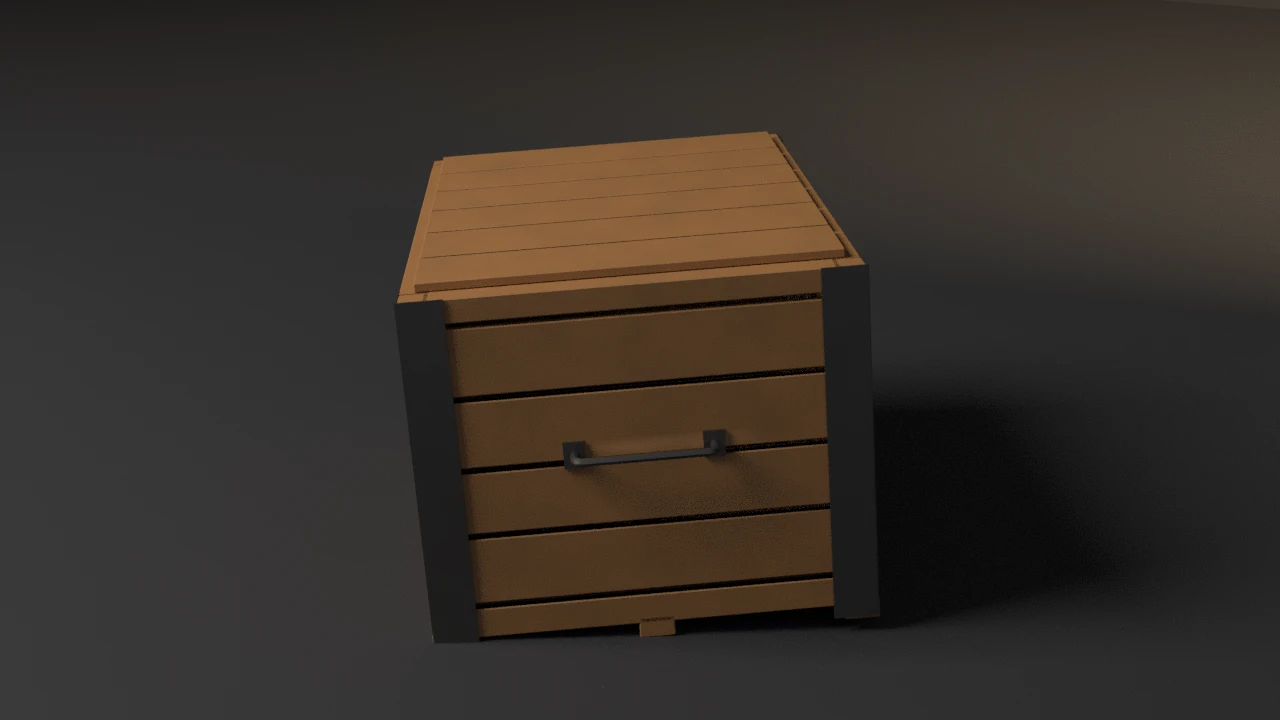
shipping-crate
A procedural shipping crate through UVs, bake, LOD, collider, and Unity glTF, asserting recomputed budgets rather than an API contract.
A procedural 1970s lugged-steel road bicycle standing on its side kickstand — a 56 cm diamond frame of round tubes joined in chromed, spear-pointed lugs at the head tube, seat cluster and bottom bracket, tapered stays in chromed tips, a fork with a chromed sloping crown and socks; two 700c wheels, each a box-section rim with 36 spokes laced three-cross from both flanges of a small-flange hub to nipples through the rim, quick-release skewers and tan-wall tyres with a black file-tread crown; a 52/42 crankset with quill pedals, toe clips and straps, a six-speed freewheel, a roller chain of 112 individual links solved round the ring, the cog and both jockey wheels, front and rear derailleurs, down-tube shifters, side-pull calipers with pads a millimetre off the rims, levers under gum hoods on cotton-taped drop bars, a quill stem, a leather saddle on rails and a bottle in a bolted wire cage — leaned 5° onto its stand, through UVs, bake, LOD, collider, and Unity glTF, asserting recomputed budgets rather than an API contract.
Rendered headless by the showcase piece itself — click to zoom.
category Vehicles
blender --background --python showcase/road-bicycle/road_bicycle.py --
A showcase piece, not an example, and the fifth in the vehicles category. It builds a procedural 1970s lugged-steel road bicycle (no brand names, badges with text or decals), standing on its side kickstand and leaning 5° onto it:
The layout is solved from named constants: a 415 mm chain stay with a 70 mm bottom-bracket drop, a 73.5° seat tube, a 73° head tube with 45 mm of fork offset, and a 560 mm top tube. The front axle is placed so the steering axis passes one fork offset behind it, which gives the design trail (55 mm). The chain's path is solved from the four circles it wraps (ring, cog, and the two jockeys, each wrapped on its own side), and the derailleur cage swings until the loop is a whole, even number of pitches. The bike is built upright and leaned about the line through both tyres' contacts; the kickstand is built after the lean, its sole on the plane the tyres touch.
It asserts budget conformance of the generated result. It does not witness an API contract. "It rendered without error" is not a check.
Composes skills mesh-editing-and-bmesh, bake-high-to-low, depsgraph-and-evaluated-data, engine-export-presets, and snippets bake_normal_high_to_low.py, setup_bake_target_image.py, lod_chain.py / decimate_to_budget.py, convex_hull_collider.py, export_preset_unity.py (helpers copied inline, not imported).
Intended size: 1.67 m from tyre to tyre, a 1.000 m wheelbase, 0.44 m across the bars and pedals, 1.00 m to the saddle's top. The seat tube is 0.580 m from the bottom-bracket centre to its top. The origin is under the bike, so it lands on its tyres and stand.
Every budget is declared as a named constant. Every gate recomputes its value from the mesh, materials, UVs, evaluated LOD, collider, or export file.
| Axis | Declared | Measured (5.2.1) |
|---|---|---|
| Base triangles | 45600–46600 | 46092 |
| LOD1 ratio | 0.32–0.62 of base | 0.4995 |
| LOD2 ratio | 0.10–0.35 of base | 0.2198 |
| Materials | exactly 10 distinct; ≥940 paint, ≥5650 chrome, ≥6250 alloy, ≥7410 steel, ≥480 tread rubber, ≥850 gum, ≥320 leather, ≥970 tape, ≥1620 black, ≥158 bottle faces | 10 slots; 1048 / 6438 / 6950 / 8239 / 540 / 952 / 356 / 1080 / 1810 / 176 |
| UVs | in 0..1, AABB overlap ≤ 1e-5 | in range, overlap 0 |
| Outer AABB | (1.670, 0.438, 0.997) m ± 0.01 | (1.6698, 0.4376, 0.9969), zmin 0 |
| Collider tris | ≤ 970 | 880 |
| Export | written, size > 0, removed after measuring | 3598060 bytes |
Every falsifier leaves the triangle count at 46092: they move parts, never add or remove them. --lift-chain keeps the default chain's link count and lets the derailleur cage take up the longer loop. DECIMATE COLLAPSE triangle counts are not identical across Blender series, so the LOD gate is a ratio band, not an exact count. Bake pixels are stochastic, so the bake gate is has_data plus operator FINISHED, not byte-identity. Construction uses no RNG; two default runs print identical measurements.
Recomputed from the generated mesh, not asserted about the script.
| Axis | Declared | Measured |
|---|---|---|
| Non-manifold edges | 0 | 0 |
| Loose verts / edges | 0 / 0 | 0 / 0 |
| Doubles merged at 1e-5 | 0 | 0 |
| Zero-area faces | 0 | 0 |
| N-gons | 0 | 0 |
| Coplanar cross-shell face pairs (KD range 0.05 m, plane ε 1e-4) | 0 | 0 |
Grounded: zmin | within 1e-4 of 0 | 0.0000 |
Supports: each tyre and the stand foot has its own zmin | within 1e-4 of 0 | 0, 0; 0 |
The chain is where this budget is hardest: 112 links, 224 plates and 112 rollers within a hand's width of each other, every plate cap on a plane parallel to every other. The first complete draft measured 7523 coplanar cross-shell pairs. What fixed them, family by family:
The remaining constants (the idle cogs' tooth phase, the roller phase step, the plate tapers, the right-hand plate scale and the tilt step) were chosen by a seeded search in a probe that counted pairs; the shipped script has no RNG.
| Axis | Declared | Measured |
|---|---|---|
| Hubs coaxial with their dropouts: each hub's axle (principal PCA axis of its body) against both dropout eyes' centres | ≤ 0.5 mm | 0.000 mm (front and rear, 2 eyes each) |
| Spoke seats: every spoke's hub end below its flange's rim (read off the hub's own radius at that station), and its rim end on its nipple's axis and inside it | flange depth 2.0–4.0 mm; ≤ 0.3 mm off axis; ≥ 2.0 mm inside the nipple | 3.00 mm; 0.000 mm; 4.50 mm (36 + 36 spokes, 36 + 36 nipples) |
| Wheels in the frame's centre plane: each rim's centre (PCA) against the plane of the main triangle's four tubes, and its axis against the plane's normal; frame size and wheelbase | ≤ 1.0 mm; ≤ 0.3°; seat tube 0.580 ± 0.004 m; wheelbase 1.000 ± 0.005 m | 0.000, 0.000 mm; 0.000°; 0.5800 m; 0.99982 m |
| Steering trail: the head tube's axis (principal PCA axis) meets the ground ahead of the front tyre's contact, on its line | 0.045–0.065 m; ≤ 3 mm across | 0.05536 m (axis 17.70° from vertical, 73° head angle plus the lean); 0.000 mm |
| Lacing: 36 spokes a wheel, 18 from each flange, rim ends equally pitched, each hub end three crosses round from its rim end | pitch within 0.3° of 10°; cross angle 58–62° | 36, 36; 18/18, 18/18; 0.000°; 60.000° |
| Chain seated: every roller that engages the big ring or the driven cog (its body straddles the sprocket's plane and cuts its teeth), counted and seated between root and tip | ≥ 20 on the ring, ≥ 6 on the cog; 0.5–6.5 mm above the root circle read off the sprocket | 30, 10; 1.20–3.40 mm |
| Chain line: every roller and the driven cog against the big ring's mid-plane | ≤ 1.0 mm | 0.000 mm; 0.000 mm |
| Stance: mass centre (shell volumes × density per material) inside the triangle of both tyres' contact rings and the stand foot's sole | ≥ 0.020 m inside every edge | 0.0393 m (11.80 kg, centre at x 0.076, y 0.039, z 0.498) |
| One connected assembly (union of shells whose BVH trees overlap) | 1 component | 1 (685 shells) |
A seated roller sits 1.2 mm above the root circle (its centre is on the pitch circle); the rollers entering and leaving each wrap sit higher, up to 3.4 mm, which is what the band's width allows for. The densities are named constants (frame tubes and rims as hollow sections, tyres round an air chamber, solid steel for chrome and chain parts), and the volumes come from the mesh. The lean puts the mass centre 39 mm onto the stand's side of the tyres' line; upright, it would sit just right of it (the drivetrain is on the right) and the bike would fall away from its stand, which is what --tuck-stand shows.
Each falsifier violates one named budget. Every one was run on 5.2.1 and exited its declared code, with every budget checked before it green and the triangle count unchanged.
| Flag | Budget violated | Exit |
|---|---|---|
--skip-decimate | LOD1 ratio band (measured 1.0000) | 9 |
--stray-vert | loose vertex count is 0 (measured 1, placed inside the envelope) | 15 |
--lift-z | bounding box zmin is 0 (measured 0.05000) | 16 |
--float-tyre | both tyres and the stand foot on the ground (rear tyre 3 mm up: its zmin 0.00300, the rest 0) | 16 |
--slip-wheel | hubs coaxial with their dropouts (front wheel 2 mm forward in its dropouts: 0.00200 m) | 17 |
--short-spoke | spoke seats (one front spoke 9 mm short at the rim: its end 1.5 mm outside its nipple, −0.00150 m) | 18 |
--dish-wheel | wheels in the frame's plane (rear rim, tyre and nipples 3 mm to the drive side, spokes re-aimed from their flanges: 0.00299 m) | 19 |
--steep-head | steering trail (head tube turned 6° steeper about its middle: trail −0.02926 m) | 20 |
--bunch-spokes | lacing (one front spoke and nipple turned 4° about the axle: pitch off by 4.000°) | 21 |
--lift-chain | chain seated (the chain wrapped 5 mm high on ring and cog: seated up to 8.11 mm above the root) | 22 |
--shift-rollers | chain line (every roller pushed 1.5 mm inboard along its pin: 0.00150 m) | 23 |
--tuck-stand | stance (the stand's foot drawn in to 40 mm off the tyres' line: margin −0.0062 m) | 24 |
--pop-bottle | one connected assembly (the bottle lifted 80 mm straight off the tube, clear of its cage: 2 components, bottle and cap) | 25 |
--float-tyre lifts only the rear tyre, so the rim, spokes and chain stay seated and only the support budget sees it. --slip-wheel moves the whole front wheel (tyre, rim, spokes, nipples, hub, skewer) along its dropouts, so every spoke still seats and the trail stays in band (53.4 mm); only the hub-to-eye distance sees it. Its first draft moved it 3 mm, which set a hub face on a dropout eye's plane and exited 15. --short-spoke pulls one spoke's rim end back along the spoke, which barely turns it about the axle, so the lacing still passes. --dish-wheel moves the rim horizontally in world space rather than along the leaned axle, which would have lifted the rear tyre off the ground and exited 16. --steep-head turns only the head tube, in the frame's plane, so the frame-plane budget before it is unchanged. --shift-rollers replaced a first draft that bent the chain's rear half inboard: a gradient of 2 mm over the chain stay moved each plate 0.12 mm per two links, exactly one stagger level, and 4528 plate faces landed on each other's planes (exit 15). Moving the rollers along their own pins leaves every plate face where it was. The chain audit counts a roller as engaged only when its body straddles the sprocket's plane; with contact alone the shifted rollers' pin tips touched the 19 and the audit chose it as the driven cog (exit 22). --pop-bottle lifts a part held by one joint only, and it caught a real defect: its first draft moved the bottle 30 mm sideways and split off seven shells, not two — the wire cage had been hanging on the bottle, its spines never reaching the bosses. The cage now has a crossbar and bolt at each boss, and the bottle, lifted 80 mm clear of the hoops, comes away alone with its cap. --float-tyre's first draft lifted the tyre 4 mm and set a face on a brake pad's plane (exit 15); it lifts 3 mm.
blender --background --python road_bicycle.py --
blender --background --python road_bicycle.py -- --skip-decimate
blender --background --python road_bicycle.py -- --stray-vert
blender --background --python road_bicycle.py -- --lift-z
blender --background --python road_bicycle.py -- --float-tyre
blender --background --python road_bicycle.py -- --slip-wheel
blender --background --python road_bicycle.py -- --short-spoke
blender --background --python road_bicycle.py -- --dish-wheel
blender --background --python road_bicycle.py -- --steep-head
blender --background --python road_bicycle.py -- --bunch-spokes
blender --background --python road_bicycle.py -- --lift-chain
blender --background --python road_bicycle.py -- --shift-rollers
blender --background --python road_bicycle.py -- --tuck-stand
blender --background --python road_bicycle.py -- --pop-bottle
blender --background --python road_bicycle.py -- --output bicycle.png
Smoke passes no flags.
The hero turns the piece HERO_YAW_DEG (−50°): a shallow three-quarter from the drive side, front wheel to the right, so the crankset, chain and derailleurs face the lens and the bike leans away onto its stand. The wall stands 2.6 m behind the bicycle, and the warm wedge pools on it. Chrome, alloy and steel carry the reflection-vector studio from espresso-machine so they read as metal on the dark stage.
File-local. 9 is a valid check code. 10 is reserved for gallery_framing.check_framing on the --output path. 15–19 are the hygiene and joint-fit family. 20–25 are file-local. 26 is the asset-quality floor on the render path: check_asset_quality returns 11, which this piece already spends on the collider ceiling, so the call site remaps it.
| Code | Meaning |
|---|---|
| 0 | Success |
| 1 | Uncaught exception (FATAL wrapper) |
| 2 | argparse / usage |
| 3 | Mesh did not build / no UV layer |
| 4 | Base triangle count outside range |
| 5 | Material count ≠ 10 distinct slots, or a face-count floor missed |
| 6 | UVs outside 0..1 |
| 7 | UV AABB overlap above tolerance |
| 8 | World AABB off declared outer size |
| 9 | LOD ratio band (--skip-decimate lands here) |
| 10 | Framing gate (render path only) |
| 11 | Collider triangle count above ceiling |
| 12 | Bake did not finish or image has no data |
| 13 | Export file missing or empty |
| 14 | --output produced no file |
| 15 | Mesh hygiene: loose, non-manifold, zero-area, doubles, n-gons, coplanar cross-shell pairs (--stray-vert) |
| 16 | Not grounded: bounding box zmin off 0, or a tyre or the stand foot off the ground (--lift-z, --float-tyre) |
| 17 | A hub's axle off a dropout eye's centre (--slip-wheel) |
| 18 | Spoke seats: a hub end outside its flange band, or a rim end off its nipple's axis or not inside it (--short-spoke) |
| 19 | A rim off the frame's centre plane or tilted to it, or the seat tube or wheelbase off size (--dish-wheel) |
| 20 | Steering trail outside its band, or the axis off the front contact's line (--steep-head) |
| 21 | Lacing: spoke or flange counts, rim-end pitch, or cross angle (--bunch-spokes) |
| 22 | Chain seat: too few rollers engaged on ring or cog, or one seated outside its band (--lift-chain) |
| 23 | Chain line: a roller or the driven cog off the big ring's plane (--shift-rollers) |
| 24 | Stance: mass centre within 0.020 m of the support triangle's edge (--tuck-stand) |
| 25 | Assembly splits into more than one connected component (--pop-bottle) |
| 26 | Asset-quality floor (render path only; remapped from 11) |
"""Game-ready 1970s lugged-steel road bicycle — a showcase piece, not an example. Asserts budget conformance of a procedural classic road bicycle standing on its side kickstand, after composing shipped pipeline pieces: bmesh construction, UVs, ten materials, high-to-low normal bake, LOD chain, convex collider, Unity glTF export. A diamond frame of round tubes joined in chromed lugs (spear-pointed sleeves at the head tube, the seat cluster and the bottom bracket shell), with tapered chain stays and seat stays in chromed tips, a chrome-capped seat-stay top, a brake bridge and a chain-stay bridge; a fork with a chromed sloping crown, blade sockets and socks, raked blades and dropouts. Two 700c wheels, each a box-section rim, 36 spokes laced three-cross from both flanges of a small-flange hub (every spoke from a flange hole to a nipple through the rim), a quick-release skewer and a tyre with a black file-tread crown over tan gum sidewalls. A double chainring crankset (spider, arms, bolts), quill pedals with toe clips and straps, a six-speed freewheel, a roller chain of individual links wrapped over the big ring and a cog and through the rear derailleur's two jockey wheels in an S, a front derailleur cage straddling the chain, down-tube friction shifters with their cables, side-pull calipers whose pads stand a millimetre off the rims, brake levers under gum hoods on taped drop bars, a quill stem, a leather saddle on rails and a seat post, a bottle in a wire cage, and a side kickstand whose foot and both tyres stand on the ground, the bike leaning onto it. Budgets are declared below and recomputed from the generated result. They are not API-contract witnesses. Each falsifier violates one named budget: ``--skip-decimate`` the LOD-ratio band, ``--stray-vert`` mesh hygiene, ``--lift-z`` grounded zmin, ``--float-tyre`` both tyres and the stand foot on the ground, ``--slip-wheel`` the hubs coaxial with their dropouts, ``--short-spoke`` every spoke end seated in its nipple and flange, ``--dish-wheel`` the wheels in the frame's centre plane, ``--steep-head`` the steering trail, ``--bunch-spokes`` the three-cross lacing, ``--lift-chain`` the chain seated on its sprockets, ``--shift-rollers`` a straight chain line, ``--tuck-stand`` the mass centre inside the support triangle, ``--pop-bottle`` one connected assembly. No RNG. Construction is closed-form. DECIMATE COLLAPSE triangle counts are not byte-identical across Blender versions — the LOD gate is a ratio band, not an exact count. blender --background --python road_bicycle.py -- blender --background --python road_bicycle.py -- --skip-decimate blender --background --python road_bicycle.py -- --output bicycle.png """ import argparse import math import os import sys import tempfile import traceback import bmesh import bpy import numpy as np from mathutils import Matrix, Vector from mathutils.bvhtree import BVHTree from mathutils.kdtree import KDTree # Showcase lives at repo-root/showcase/, not under examples/. The framing # helper is the repo's only shared import and lives next to the examples; # resolve the repo root so we do not move gallery_framing.py. _REPO = os.path.abspath( os.path.join(os.path.dirname(os.path.abspath(__file__)), os.pardir, os.pardir) ) sys.path.insert(0, os.path.join(_REPO, "examples")) sys.dont_write_bytecode = True import gallery_framing # noqa: E402 import gallery_asset_quality # noqa: E402 # --- Frame geometry (construction frame: front at +X, rider's left at +Y, the # drive side at -Y; built upright, then leaned onto the kickstand) ---------- R_TYRE = 0.335 # 700c x 25: 622 mm bead seat, 24 mm tyre TYRE_SEC = 0.0118 # tyre section radius CS_LEN = 0.415 # chain stay, BB centre to rear axle BB_DROP = 0.070 ST_DEG = 73.5 HT_DEG = 73.0 ST_CT = 0.560 # 56 cm frame: BB centre to top-tube centreline ST_EXT = 0.020 # seat tube above the top tube centreline TT_EFF = 0.560 HT_ABOVE_TT = 0.025 HT_LEN = 0.140 DT_ABOVE_HT_BOT = 0.022 FORK_OFFSET = 0.045 LEAN_DEG = 5.0 # onto the kickstand, toward +Y R_TT, R_DT, R_ST, R_HT = 0.0127, 0.0143, 0.0143, 0.0159 # --- Wheels ---------------------------------------------------------------------- TYRE_SEGS = 40 RIM_SEGS = 40 SPOKES = 36 CROSS = 3 FLANGE_R = 0.0225 # small-flange hub HOLE_R = 0.0195 # flange hole circle SPOKE_END_R = 0.2965 # spoke end, inside its nipple RIM_HOLE_W = 0.0020 # rim holes drilled alternately either side NIPPLE_LEN = 0.012 NIPPLE_IN = 0.0075 # spoke end this far into the nipple from its inner end SPOKE_R = 0.0010 SPOKE_SIDES = 5 FRONT_FLANGES = (-0.035, 0.035) FRONT_OLD = 0.050 # half over-locknut dimension (100 mm) REAR_FLANGES = (-0.021, 0.036) REAR_OLD = 0.063 # 126 mm, six-speed RIM_HALF = [(0.3100, 0.0060), (0.3106, 0.0085), (0.3152, 0.0085), (0.3152, 0.0101), (0.3055, 0.0101), (0.2995, 0.0090), (0.2972, 0.0060)] # --- Drivetrain ------------------------------------------------------------------ PITCH = 0.0127 CHAIN_Y = -0.046 RING_TEETH = (52, 42) RING_Y = (-0.046, -0.0395) RING_T = 0.0012 # half thickness COG_TEETH = (24, 21, 19, 17, 15, 14) COG_Y = (-0.031, -0.036, -0.041, -0.046, -0.051, -0.056) COG_T = 0.0009 DRIVEN_COG = 3 # the 17: in line with the big ring PULLEY_TEETH = 11 PULLEY_T = (0.00115, 0.00130) # upper, lower: off every cog face CRANK = 0.170 ROLLER_R = 0.0039 ROLLER_H = 0.0020 # roller half length (its rim), apex 0.3 mm beyond ROLLER_PHASE = math.radians(7.85) ROLLER_STEP_DEG = 11.13 # each roller turned a further step (mod 40 deg) COG_PHASE_STEP = 0.923 # tooth phase of the idle cogs (rad per cog) TAPER_IN, TAPER_OUT = 0.946, 0.927 # link plates taper, inner forward and outer back # Drafts: the rings, cogs and jockeys each turned and scaled a hair across # their thickness, the rollers coned, and each family of link plate (inner or # outer, left or right) inset across its thickness by its own amount. Every # wall face in the chain's plane then leans out of it by an angle no other # part's shares, so none can lie on another's plane. SPROCKET_DRAFT = (0.0030, 0.0042, 0.0060, 0.0072, 0.0084, 0.0096, 0.0108, 0.0120, 0.0160, 0.0180) ROLLER_CONE = 0.95 # the right-hand end of a roller this much narrower PLATE_INSET = {("in", 1.0): 0.00005, ("in", -1.0): 0.00010, ("out", 1.0): 0.00015, ("out", -1.0): 0.00020} RIGHT_PLATE_SCALE = 0.953 # the right-hand plate of a pair a little shallower LEVEL = 0.00012 # plate stagger step: every plate face on its own plane INNER_A, INNER_T = 0.00145, 0.00120 OUTER_B, OUTER_T = 0.00205, 0.00120 PLATE_LEVELS = 5 APEX_LEVELS = 10 TILT_STEP_DEG = 1.201 # and a tilt about its own axis, so crowded plates differ in normal GUIDE_OFF = (0.020, -0.068) # upper jockey from the rear axle (x, z) CAGE_LEN = 0.072 # --- Stand ------------------------------------------------------------------------- STAND_PIVOT = (-0.090, 0.030, 0.256) # construction frame FOOT_X = -0.235 # world, after the lean FOOT_Y = 0.165 FOOT_Y_TUCKED = 0.040 # --tuck-stand # --- Falsifier sizes ----------------------------------------------------------------- FLOAT_TYRE = 0.003 SLIP_WHEEL = 0.002 SHORT_SPOKE = 0.009 DISH_WHEEL = 0.003 STEEP_DEG = 6.0 BUNCH_DEG = 4.0 LIFT_CHAIN = 0.005 SHIFT_ROLLERS = 0.0015 # every roller along its pin, off the chain's plane POP_BOTTLE = 0.080 # straight off the tube, clear of the cage's hoops BBOX_TOL = 0.01 # Fitted after locking geometry. Recomputed from bound_box. OUTER_SIZE = (1.670, 0.438, 0.997) BASE_TRIS_MIN = 45600 BASE_TRIS_MAX = 46600 LOD1_RATIO_MIN = 0.32 LOD1_RATIO_MAX = 0.62 LOD2_RATIO_MIN = 0.10 LOD2_RATIO_MAX = 0.35 LOD1_TARGET = 0.50 LOD2_TARGET = 0.22 MATERIAL_COUNT = 10 UV_EPS = 1e-4 UV_OVERLAP_MAX = 1e-5 COLLIDER_TRIS_MAX = 970 BAKE_RES = 1024 CAGE_EXTRUSION = 0.003 # per slot: paint, chrome, alloy, steel, tread, gum, leather, tape, black, bottle FACE_FLOORS = (940, 5650, 6250, 7410, 480, 850, 320, 970, 1620, 158) ZMIN_EPS = 1e-4 DOUBLES_EPS = 1e-5 AREA_EPS = 1e-10 COPLANAR_NORMAL_EPS = 1e-4 COPLANAR_PLANE_EPS = 1e-4 COPLANAR_CENTRE_MAX = 0.05 LIFT_Z = 0.05 CONTACT_BAND = 2e-5 # Hubs coaxial with the dropout eyes. COAX_TOL = 0.0005 # Spoke seats: hub end buried in its flange, rim end inside its nipple. FLANGE_SEAT_MIN = 0.0020 FLANGE_SEAT_MAX = 0.0040 NIPPLE_AXIS_TOL = 0.0003 NIPPLE_DEPTH_MIN = 0.0020 # Wheels in the frame's centre plane; frame and wheelbase size. PLANE_TOL = 0.0010 PLANE_ANGLE_MAX_DEG = 0.3 SEAT_TUBE_LEN = 0.580 WHEELBASE = 1.000 SIZE_TOL = 0.004 # Steering trail. TRAIL_MIN = 0.045 TRAIL_MAX = 0.065 TRAIL_Y_TOL = 0.003 # Lacing: 36 spokes, 18 a flange, equal pitch at the rim, three-cross. PITCH_TOL_DEG = 0.3 CROSS_MIN_DEG = 58.0 CROSS_MAX_DEG = 62.0 # Chain seated on the ring and the cog; a straight chain line. RING_ENGAGED_MIN = 20 COG_ENGAGED_MIN = 6 SEAT_MIN = 0.0005 SEAT_MAX = 0.0065 CHAINLINE_TOL = 0.0010 # Stance: mass centre inside the triangle of both contacts and the stand foot. STANCE_MARGIN = 0.020 HERO_YAW_DEG = -50.0 WALL_Y = 2.6 PAINT_IDX, CHROME_IDX, ALLOY_IDX, STEEL_IDX, RUBBER_IDX = 0, 1, 2, 3, 4 GUM_IDX, LEATHER_IDX, TAPE_IDX, BLACK_IDX, BOTTLE_IDX = 5, 6, 7, 8, 9 # Densities (kg/m^3) per material slot for the stance audit: frame tubes and # rims are modelled solid but are hollow, so they carry an effective density; # tyres are modelled solid round an air chamber. DENSITY = (1100.0, 7800.0, 1500.0, 7800.0, 150.0, 150.0, 900.0, 600.0, 1200.0, 1000.0) # Part tags: a face attribute naming which part a face belongs to, so the # audits can find the shells they measure. Every measured value is read from # the vertices, never from these constants. (T_NONE, T_TYRE_F, T_TYRE_R, T_RIM_F, T_RIM_R, T_HUB_F, T_HUB_R, T_SPOKE_F, T_SPOKE_R, T_NIP_F, T_NIP_R, T_EYE_F, T_EYE_R, T_FRAME, T_HEADTUBE, T_SEATTUBE, T_RING, T_COG, T_ROLLER, T_PLATE, T_FOOT, T_BOTTLE, T_PULLEY) = range(23) ZAX = Vector((0.0, 0.0, 1.0)) YAX = Vector((0.0, 1.0, 0.0)) XAX = Vector((1.0, 0.0, 0.0)) # --- Derived layout ------------------------------------------------------------------ _ST = math.radians(ST_DEG) _HA = math.radians(HT_DEG) BB_Z = R_TYRE - BB_DROP BB = Vector((0.0, 0.0, BB_Z)) AXLE_RX = -math.sqrt(CS_LEN ** 2 - BB_DROP ** 2) ST_DIR = Vector((-math.cos(_ST), 0.0, math.sin(_ST))) HT_DIR = Vector((-math.cos(_HA), 0.0, math.sin(_HA))) HT_FWD = Vector((math.sin(_HA), 0.0, math.cos(_HA))) TT_Z = BB_Z + ST_CT * math.sin(_ST) ST_TT = BB + ST_DIR * ST_CT COT_HA = math.cos(_HA) / math.sin(_HA) def steer_x(z): return ST_TT.x + TT_EFF + (TT_Z - z) * COT_HA def steer_pt(z): return Vector((steer_x(z), 0.0, z)) HT_TOP_Z = TT_Z + HT_ABOVE_TT HT_BOT_Z = HT_TOP_Z - HT_LEN * math.sin(_HA) DT_HT_Z = HT_BOT_Z + DT_ABOVE_HT_BOT AXLE_FX = steer_x(R_TYRE) + FORK_OFFSET / math.sin(_HA) AXLE_F = Vector((AXLE_FX, 0.0, R_TYRE)) AXLE_R = Vector((AXLE_RX, 0.0, R_TYRE)) DT_TOP = steer_pt(DT_HT_Z) DT_DIR = (DT_TOP - BB).normalized() DT_UP = Vector((-DT_DIR.z, 0.0, DT_DIR.x)) # the down tube's upper side CROWN_Z = HT_BOT_Z - 0.022 STEM_Z = 0.898 def eevee_engine_id(): return "BLENDER_EEVEE" if bpy.app.version >= (5, 0, 0) else "BLENDER_EEVEE_NEXT" def fail(msg, code): print(f"ERROR: {msg}", file=sys.stderr) return code def triangle_count(mesh): mesh.calc_loop_triangles() return len(mesh.loop_triangles) def evaluated_triangle_count(obj): # Duplicated from snippets/lod_chain.py / decimate_to_budget.py (not a package). depsgraph = bpy.context.evaluated_depsgraph_get() eval_obj = obj.evaluated_get(depsgraph) eval_mesh = eval_obj.to_mesh() try: eval_mesh.calc_loop_triangles() return len(eval_mesh.loop_triangles) finally: eval_obj.to_mesh_clear() # -------------------------------------------------------------------------- # Construction helpers (copied from showcase/motor-scooter, not imported) # -------------------------------------------------------------------------- class Build: """The bmesh under construction, its part-tag layer and named vertex groups (for the falsifiers that move one assembly).""" def __init__(self, bm): self.bm = bm self.tag = bm.faces.layers.int.new("part") self.groups = {} self.bevel = [] def part(self, tag=T_NONE, *groups, bevel=False): return _Part(self, tag, groups, bevel) class _Part: def __init__(self, b, tag, groups, bevel): self.b, self.t, self.g, self.bevel = b, tag, groups, bevel def __enter__(self): self.nf = len(self.b.bm.faces) self.nv = len(self.b.bm.verts) return self def __exit__(self, *exc): bm = self.b.bm bm.faces.ensure_lookup_table() bm.verts.ensure_lookup_table() for i in range(self.nf, len(bm.faces)): bm.faces[i][self.b.tag] = self.t vs = [bm.verts[i] for i in range(self.nv, len(bm.verts))] for g in self.g: self.b.groups.setdefault(g, []).extend(vs) if self.bevel: self.b.bevel.extend(vs) return False def _mark(faces, mat_idx): for f in faces: f.material_index = mat_idx def frame(ez, ex_hint): """Rotation whose local Z is ``ez`` and local X is ``ex_hint`` made orthogonal to it (columns ex, ey, ez; right-handed).""" ez = Vector(ez).normalized() ex = Vector(ex_hint) ex = (ex - ez * ex.dot(ez)).normalized() ey = ez.cross(ex) return Matrix((ex, ey, ez)).transposed() def add_lathe(bm, profile, segs, mat_idx, center=(0.0, 0.0, 0.0), rot=None, phase=0.0, solid=False, seg_mats=None, rmod=None): """Revolve a profile [(r, z), ...] about local Z. ``solid``: the profile is an open polyline closed by n-gon caps at its two ends; otherwise it is a closed polygon revolved into a ring shell.""" c = Vector(center) m = rot if rot is not None else Matrix.Identity(3) rings = [] for i in range(segs): a = phase + 2.0 * math.pi * i / segs ca, sa = math.cos(a), math.sin(a) ring = [] for j, (r, z) in enumerate(profile): rr = r * (rmod(i, j) if rmod else 1.0) ring.append(bm.verts.new(c + m @ Vector((rr * ca, rr * sa, z)))) rings.append(ring) n = len(profile) last = n - 1 if solid else n for i in range(segs): r0, r1 = rings[i], rings[(i + 1) % segs] for j in range(last): k = (j + 1) % n f = bm.faces.new((r0[j], r1[j], r1[k], r0[k])) f.material_index = seg_mats[j] if seg_mats else mat_idx if solid: f0 = bm.faces.new([rings[i][0] for i in reversed(range(segs))]) f1 = bm.faces.new([rings[i][n - 1] for i in range(segs)]) f0.material_index = mat_idx f1.material_index = mat_idx return [v for ring in rings for v in ring] def add_sweep(bm, pts, radius, sides, mat_idx, phase=0.0, matfn=None, rfn=None, ref=None): """Capped tube swept along a polyline with parallel-transport frames. ``radius`` is a number or one per point; ``rfn(i, k)`` scales it per vertex; ``matfn(i)`` is the material of the band after point i.""" pts = [Vector(p) for p in pts] n = len(pts) radii = list(radius) if isinstance(radius, (list, tuple)) else [radius] * n tans = [] for i in range(n): a = pts[max(i - 1, 0)] b = pts[min(i + 1, n - 1)] tans.append((b - a).normalized()) if ref is None: ref = ZAX if abs(tans[0].z) < 0.9 else XAX nrm = (Vector(ref) - tans[0] * Vector(ref).dot(tans[0])).normalized() rings = [] for i, (p, t) in enumerate(zip(pts, tans)): nrm = (nrm - t * nrm.dot(t)).normalized() bi = t.cross(nrm) ring = [] for k in range(sides): a = phase + 2.0 * math.pi * k / sides r = radii[i] * (rfn(i, k) if rfn else 1.0) ring.append(bm.verts.new(p + r * (nrm * math.cos(a) + bi * math.sin(a)))) rings.append(ring) for i, (r0, r1) in enumerate(zip(rings, rings[1:])): for k in range(sides): m = (k + 1) % sides f = bm.faces.new((r0[k], r0[m], r1[m], r1[k])) f.material_index = matfn(i) if matfn else mat_idx f0 = bm.faces.new(tuple(reversed(rings[0]))) f1 = bm.faces.new(tuple(rings[-1])) f0.material_index = matfn(0) if matfn else mat_idx f1.material_index = matfn(n - 2) if matfn else mat_idx return [v for ring in rings for v in ring] def rrect(ha, hb, rc, n_corner=4): """Rounded rectangle loop (counter-clockwise).""" rc = max(min(rc, ha - 1e-4, hb - 1e-4), 0.0003) pts = [] for k, (sx, sy) in enumerate(((1, 1), (-1, 1), (-1, -1), (1, -1))): cx, cy = sx * (ha - rc), sy * (hb - rc) a0 = 0.5 * math.pi * k for s in range(n_corner + 1): a = a0 + 0.5 * math.pi * s / n_corner pts.append((cx + rc * math.cos(a), cy + rc * math.sin(a))) return pts def add_rbox(bm, ha, hb, rc, profile, origin, rot, mat_idx, n_corner=2): """Loft of rounded rectangles along local Z: profile [(inset, z)].""" o = Vector(origin) rings = [] for inset, z in profile: loop = rrect(ha - inset, hb - inset, rc - inset, n_corner) rings.append([bm.verts.new(o + rot @ Vector((x, y, z))) for x, y in loop]) n = len(rings[0]) faces = [] for r0, r1 in zip(rings, rings[1:]): for k in range(n): m = (k + 1) % n faces.append(bm.faces.new((r0[k], r0[m], r1[m], r1[k]))) faces.append(bm.faces.new(tuple(reversed(rings[0])))) faces.append(bm.faces.new(tuple(rings[-1]))) _mark(faces, mat_idx) return [v for ring in rings for v in ring] def add_prism(bm, outline, w0, w1, origin, rot, mat_idx): """Planar outline [(u, v)] extruded along local Z from w0 to w1.""" o = Vector(origin) a = [bm.verts.new(o + rot @ Vector((u, v, w0))) for u, v in outline] b = [bm.verts.new(o + rot @ Vector((u, v, w1))) for u, v in outline] n = len(outline) faces = [bm.faces.new((a[i], a[(i + 1) % n], b[(i + 1) % n], b[i])) for i in range(n)] faces.append(bm.faces.new(tuple(reversed(a)))) faces.append(bm.faces.new(tuple(b))) _mark(faces, mat_idx) return a + b def add_loft(bm, rings_pts, mat_idx): """Closed loops [[Vector]] lofted in order, n-gon caps at both ends.""" rings = [[bm.verts.new(p) for p in loop] for loop in rings_pts] n = len(rings[0]) faces = [] for r0, r1 in zip(rings, rings[1:]): for j in range(n): m = (j + 1) % n faces.append(bm.faces.new((r0[j], r0[m], r1[m], r1[j]))) faces.append(bm.faces.new(tuple(reversed(rings[0])))) faces.append(bm.faces.new(tuple(rings[-1]))) _mark(faces, mat_idx) return [v for ring in rings for v in ring] def add_bar(bm, pts, wax, half_w, half_t, rc, mat_idx, fillet=0.008, filleted=False, steps=3): """Flat bar bent in the plane normal to ``wax``: width along ``wax``, thickness in the bending plane; rounded-rectangle section.""" pts = [Vector(p) for p in pts] if filleted else fillet_path(pts, fillet, steps) wax = Vector(wax).normalized() sec = rrect(half_w, half_t, rc, 1) rings = [] for i, p in enumerate(pts): a = pts[max(i - 1, 0)] b = pts[min(i + 1, len(pts) - 1)] t = (b - a).normalized() w = (wax - t * wax.dot(t)).normalized() th = t.cross(w) rings.append([bm.verts.new(p + w * x + th * y) for x, y in sec]) n = len(sec) faces = [] for r0, r1 in zip(rings, rings[1:]): for k in range(n): m = (k + 1) % n faces.append(bm.faces.new((r0[k], r0[m], r1[m], r1[k]))) faces.append(bm.faces.new(tuple(reversed(rings[0])))) faces.append(bm.faces.new(tuple(rings[-1]))) _mark(faces, mat_idx) return [v for ring in rings for v in ring] def add_sheet(bm, surf, nu, nv, thick, mat_idx): """A closed plate: ``surf(u, v) -> (point, normal)`` over the unit square, offset ``thick`` back along the normal, rims stitched round the edge.""" front, back = [], [] for j in range(nv + 1): rf, rb = [], [] for i in range(nu + 1): p, n = surf(i / nu, j / nv) rf.append(bm.verts.new(p)) rb.append(bm.verts.new(p - n * thick)) front.append(rf) back.append(rb) faces = [] for j in range(nv): for i in range(nu): faces.append(bm.faces.new((front[j][i], front[j][i + 1], front[j + 1][i + 1], front[j + 1][i]))) faces.append(bm.faces.new((back[j][i], back[j + 1][i], back[j + 1][i + 1], back[j][i + 1]))) rim = ([(0, i) for i in range(nu + 1)] + [(j, nu) for j in range(1, nv + 1)] + [(nv, i) for i in reversed(range(nu))] + [(j, 0) for j in reversed(range(1, nv))]) for k in range(len(rim)): (ja, ia), (jb, ib) = rim[k], rim[(k + 1) % len(rim)] faces.append(bm.faces.new((front[jb][ib], front[ja][ia], back[ja][ia], back[jb][ib]))) _mark(faces, mat_idx) return [v for row in front + back for v in row] def fillet_path(pts, rf, steps=4): pts = [Vector(p) for p in pts] out = [pts[0]] for i in range(1, len(pts) - 1): a, p, b = pts[i - 1], pts[i], pts[i + 1] r = min(rf, (a - p).length * 0.45, (b - p).length * 0.45) p0 = p + (a - p).normalized() * r p1 = p + (b - p).normalized() * r for k in range(steps + 1): t = k / steps out.append((1 - t) ** 2 * p0 + 2 * (1 - t) * t * p + t * t * p1) out.append(pts[-1]) return out def fillet_corners(pts, rf, steps=5, min_deg=25.0): """Fillet only the vertices where the path turns by more than min_deg.""" pts = [Vector(p) for p in pts] out = [pts[0]] for i in range(1, len(pts) - 1): a, p, b = pts[i - 1], pts[i], pts[i + 1] if (p - a).angle(b - p, 0.0) < math.radians(min_deg): out.append(p) continue r = min(rf, (a - p).length * 0.45, (b - p).length * 0.45) p0 = p + (a - p).normalized() * r p1 = p + (b - p).normalized() * r for k in range(steps + 1): t = k / steps out.append((1 - t) ** 2 * p0 + 2 * (1 - t) * t * p + t * t * p1) out.append(pts[-1]) return out def resample(pts, step): """Points at uniform arc-length spacing along a polyline (ends kept).""" pts = [Vector(p) for p in pts] cum = [0.0] for a, b in zip(pts, pts[1:]): cum.append(cum[-1] + (b - a).length) total = cum[-1] n = max(2, int(round(total / step)) + 1) out = [] j = 0 for k in range(n): s = total * k / (n - 1) while j < len(pts) - 2 and cum[j + 1] < s: j += 1 seg = cum[j + 1] - cum[j] t = 0.0 if seg <= 0.0 else (s - cum[j]) / seg out.append(pts[j].lerp(pts[j + 1], min(max(t, 0.0), 1.0))) return out, total def bezier(p0, p1, p2, p3, n): p0, p1, p2, p3 = (Vector(p) for p in (p0, p1, p2, p3)) out = [] for k in range(n + 1): t = k / n u = 1.0 - t out.append(u ** 3 * p0 + 3 * u * u * t * p1 + 3 * u * t * t * p2 + t ** 3 * p3) return out def triangulate_ngons(bm): faces = [f for f in bm.faces if len(f.verts) > 4] if faces: bmesh.ops.triangulate(bm, faces=faces) def pack_uvs(bm, margin=0.08): uv = bm.loops.layers.uv.new("UVMap") faces = list(bm.faces) n = len(faces) cols = max(1, math.ceil(math.sqrt(n))) rows = max(1, math.ceil(n / cols)) cell_w = 1.0 / cols cell_h = 1.0 / rows pad_u = margin * cell_w * 0.5 pad_v = margin * cell_h * 0.5 usable_w = cell_w - 2.0 * pad_u usable_h = cell_h - 2.0 * pad_v for i, face in enumerate(faces): col = i % cols row = i // cols nrm = face.normal ax, ay, az = abs(nrm.x), abs(nrm.y), abs(nrm.z) coords = [] for loop in face.loops: co = loop.vert.co if az >= ax and az >= ay: coords.append((co.x, co.y)) elif ax >= ay: coords.append((co.y, co.z)) else: coords.append((co.x, co.z)) xs = [c[0] for c in coords] ys = [c[1] for c in coords] minx, maxx = min(xs), max(xs) miny, maxy = min(ys), max(ys) dx = max(maxx - minx, 1e-8) dy = max(maxy - miny, 1e-8) origin_u = col * cell_w + pad_u origin_v = row * cell_h + pad_v for loop, (x, y) in zip(face.loops, coords): loop[uv].uv = ( origin_u + (x - minx) / dx * usable_w, origin_v + (y - miny) / dy * usable_h, ) def pchip(keys): """Monotone cubic through (x, y) keys (Fritsch-Carlson): no overshoot.""" xs = [k[0] for k in keys] ys = [k[1] for k in keys] n = len(xs) h = [xs[i + 1] - xs[i] for i in range(n - 1)] d = [(ys[i + 1] - ys[i]) / h[i] for i in range(n - 1)] m = [d[0]] + [0.0] * (n - 2) + [d[-1]] for i in range(1, n - 1): if d[i - 1] * d[i] > 0.0: w1 = 2.0 * h[i] + h[i - 1] w2 = h[i] + 2.0 * h[i - 1] m[i] = (w1 + w2) / (w1 / d[i - 1] + w2 / d[i]) def f(x): x = min(max(x, xs[0]), xs[-1]) i = 0 while i < n - 2 and x > xs[i + 1]: i += 1 t = (x - xs[i]) / h[i] t2, t3 = t * t, t * t * t return ((2 * t3 - 3 * t2 + 1) * ys[i] + (t3 - 2 * t2 + t) * h[i] * m[i] + (-2 * t3 + 3 * t2) * ys[i + 1] + (t3 - t2) * h[i] * m[i + 1]) return f def _se(c, n): return math.copysign(abs(c) ** (2.0 / n), c) # -------------------------------------------------------------------------- # Frame # -------------------------------------------------------------------------- def add_sleeve(bm, base, axis, ref, r_tube, l0, l1, mat_idx, segs=16, nz=3, bite=0.0006, thick=0.0012, power=5.0): """A lug socket: a sleeve round a tube from ``base`` along ``axis``, its far edge cut to a spear point on either side of ``ref`` (the frame's normal, so the points show in side view) and thinned to a feathered edge. The inner face bites the tube (one band: it is hidden in it); the base annulus is buried in the host the tube joins.""" ez = Vector(axis).normalized() ex = (Vector(ref) - ez * Vector(ref).dot(ez)).normalized() ey = ez.cross(ex) b = Vector(base) r_in = r_tube - bite r_out = r_tube + thick r_edge = r_tube + 0.00025 outer = [] inner = [[], []] for j in range(nz + 1): t = j / nz ro = [] for i in range(segs): phi = 2.0 * math.pi * i / segs length = l0 + l1 * abs(math.cos(phi)) ** power z = length * t r_o = r_out - (r_out - r_edge) * t ** 2.2 d = ex * math.cos(phi) + ey * math.sin(phi) ro.append(bm.verts.new(b + ez * z + d * r_o)) if j in (0, nz): inner[0 if j == 0 else 1].append(bm.verts.new(b + ez * z + d * r_in)) outer.append(ro) faces = [] for j in range(nz): for i in range(segs): k = (i + 1) % segs faces.append(bm.faces.new((outer[j][i], outer[j][k], outer[j + 1][k], outer[j + 1][i]))) for i in range(segs): k = (i + 1) % segs faces.append(bm.faces.new((inner[0][i], inner[1][i], inner[1][k], inner[0][k]))) faces.append(bm.faces.new((outer[0][i], inner[0][i], inner[0][k], outer[0][k]))) faces.append(bm.faces.new((outer[nz][i], outer[nz][k], inner[1][k], inner[1][i]))) _mark(faces, mat_idx) def lathe_on(bm, profile, segs, mat_idx, center, axis, ref=XAX, solid=True, phase=0.0, rmod=None, seg_mats=None): if abs(Vector(axis).normalized().dot(Vector(ref))) > 0.9: ref = ZAX if abs(Vector(axis).normalized().z) < 0.9 else YAX return add_lathe(bm, profile, segs, mat_idx, center=center, rot=frame(axis, ref), solid=solid, phase=phase, rmod=rmod, seg_mats=seg_mats) def tube(bm, a, b, r, mat_idx, sides=16, phase=0.0): return add_sweep(bm, [a, b], r, sides, mat_idx, phase=phase) def chainstay_path(s): return fillet_path([ Vector((-0.004, s * 0.019, BB_Z + 0.002)), Vector((-0.060, s * 0.0215, BB_Z + 0.010)), Vector((-0.160, s * 0.030, BB_Z + 0.025)), Vector((-0.300, s * 0.050, BB_Z + 0.048)), Vector((AXLE_RX + 0.075, s * 0.062, R_TYRE - 0.004)), Vector((AXLE_RX + 0.028, s * 0.066, R_TYRE + 0.001)), ], 0.08, 3) def seatstay_ends(s): top = BB + ST_DIR * ((TT_Z - 0.030 - BB_Z) / ST_DIR.z) return (Vector((top.x, s * 0.019, top.z)), Vector((AXLE_RX + 0.016, s * 0.065, R_TYRE + 0.040))) def tapered(pts, r0, r1, chrome_tail=0.0): """Radii tapering along a path and a material function that chromes its last ``chrome_tail`` metres.""" cum = [0.0] for a, b in zip(pts, pts[1:]): cum.append(cum[-1] + (b - a).length) total = cum[-1] radii = [r0 + (r1 - r0) * (c / total) ** 1.4 for c in cum] def matfn(i): mid = 0.5 * (cum[i] + cum[i + 1]) return CHROME_IDX if total - mid < chrome_tail else PAINT_IDX return radii, matfn def add_dropout(b, centre, side, old, outline, eye_tag, group): """A dropout plate in the wheel's plane at the axle, and its eye: a boss round the axle hole the skewer clamps.""" bm = b.bm yc = side * (old + 0.0028) with b.part(T_NONE, group, bevel=True): add_prism(bm, outline, yc - 0.00225, yc + 0.00225, Vector((centre.x, 0.0, centre.z)), frame(YAX, XAX), CHROME_IDX) w0, w1 = side * (old - 0.0002), side * (old + 0.0058) lo, hi = min(w0, w1), max(w0, w1) with b.part(eye_tag, group): add_lathe(bm, [(0.0098, lo), (0.0104, lo + 0.0008), (0.0104, hi - 0.0008), (0.0098, hi)], 16, CHROME_IDX, center=Vector((centre.x, 0.0, centre.z)), rot=frame(YAX, XAX), solid=True) def rear_dropout_outline(drive): """(x, z) round the rear axle, in frame(YAX, XAX) coordinates (u = x, v = -z).""" pts = [(0.036, -0.007), (0.036, 0.009), (0.022, 0.044), (0.010, 0.048), (-0.012, 0.014), (-0.014, 0.000)] if drive: pts += [(-0.012, -0.020), (-0.004, -0.034), (0.008, -0.032), (0.012, -0.012)] else: pts += [(-0.008, -0.011), (0.010, -0.011)] return [(x, -z) for x, z in pts] def fork_dropout_outline(): pts = [(-0.008, 0.032), (0.010, 0.028), (0.012, 0.000), (0.004, -0.010), (-0.008, -0.008), (-0.012, 0.004)] return [(x, -z) for x, z in pts] def add_frame(b, steep_head): bm = b.bm # main triangle with b.part(T_FRAME, "frame"): tube(bm, ST_TT, steer_pt(TT_Z), R_TT, PAINT_IDX) tube(bm, BB, DT_TOP, R_DT, PAINT_IDX) with b.part(T_SEATTUBE, "frame"): # its own phase: rings sharing the down tube's start would weld the two tube(bm, BB, BB + ST_DIR * (ST_CT + ST_EXT), R_ST, PAINT_IDX, phase=math.pi / 16.0) with b.part(T_HEADTUBE, "frame"): vs = tube(bm, steer_pt(HT_BOT_Z), steer_pt(HT_TOP_Z), R_HT, PAINT_IDX, sides=20) if steep_head: mid = steer_pt(0.5 * (HT_BOT_Z + HT_TOP_Z)) m = Matrix.Rotation(math.radians(STEEP_DEG), 3, "Y") for v in vs: v.co = mid + m @ (v.co - mid) with b.part(T_NONE, "frame"): # head badge: a blank oval plate curved round the head tube's front zc = 0.5 * (HT_BOT_Z + HT_TOP_Z) + 0.006 def badge(u, v): x, y = 2.0 * u - 1.0, 2.0 * v - 1.0 ex_, ey_ = x * math.sqrt(1.0 - 0.5 * y * y), y * math.sqrt(1.0 - 0.5 * x * x) ang = ex_ * 0.62 c = steer_pt(zc) + HT_DIR * (ey_ * 0.017) n = HT_FWD * math.cos(ang) + YAX * math.sin(ang) return c + n * (R_HT + 0.0009), n add_sheet(bm, badge, 6, 6, 0.0016, CHROME_IDX) # lugs add_sleeve(bm, steer_pt(HT_TOP_Z) + HT_DIR * 0.0008, -HT_DIR, YAX, R_HT, 0.020, 0.016, CHROME_IDX, segs=24) add_sleeve(bm, steer_pt(TT_Z) - XAX * 0.010, -XAX, YAX, R_TT, 0.032, 0.022, CHROME_IDX) add_sleeve(bm, steer_pt(HT_BOT_Z) - HT_DIR * 0.0008, HT_DIR, YAX, R_HT, 0.020, 0.016, CHROME_IDX, segs=24) add_sleeve(bm, DT_TOP - DT_DIR * 0.010, -DT_DIR, YAX, R_DT, 0.034, 0.024, CHROME_IDX) add_sleeve(bm, BB + ST_DIR * (ST_CT + ST_EXT - 0.0015), -ST_DIR, YAX, R_ST, 0.030, 0.022, CHROME_IDX) add_sleeve(bm, ST_TT + XAX * 0.010, XAX, YAX, R_TT, 0.028, 0.020, CHROME_IDX) add_sleeve(bm, BB + ST_DIR * 0.008, ST_DIR, YAX, R_ST, 0.036, 0.018, CHROME_IDX) add_sleeve(bm, BB + DT_DIR * 0.008, DT_DIR, YAX, R_DT, 0.038, 0.018, CHROME_IDX) # seat-lug collar round the post and the binder bolt behind it top = BB + ST_DIR * (ST_CT + ST_EXT) lathe_on(bm, [(0.0128, -0.006), (0.0160, -0.0056), (0.0162, 0.0030), (0.0150, 0.0062), (0.0128, 0.0066)], 20, CHROME_IDX, top, ST_DIR, solid=False) back = top - ST_DIR * 0.016 - HT_FWD * 0.0 binder = Vector((back.x - 0.0175, 0.0, back.z - 0.004)) lathe_on(bm, [(0.0050, -0.012), (0.0056, -0.011), (0.0056, 0.011), (0.0050, 0.012)], 12, CHROME_IDX, binder, YAX) lathe_on(bm, [(0.0040, 0.011), (0.0055, 0.0115), (0.0055, 0.0165), (0.0045, 0.017)], 6, CHROME_IDX, binder, YAX) add_rbox(bm, 0.0070, 0.0105, 0.004, [(0.0015, -0.010), (0.0, -0.0085), (0.0, 0.0085), (0.0015, 0.010)], Vector((back.x - 0.0105, 0.0, back.z - 0.004)), frame(YAX, XAX), CHROME_IDX) # bottom-bracket shell and cups lathe_on(bm, [(0.0180, -0.0345), (0.0200, -0.0335), (0.0200, 0.0335), (0.0180, 0.0345)], 20, CHROME_IDX, BB, YAX) for s in (1.0, -1.0): lathe_on(bm, [(0.0150, s * 0.0320), (0.0212, s * 0.0328), (0.0212, s * 0.0372), (0.0150, s * 0.0380)], 20, BLACK_IDX, BB, YAX, solid=False) # stays with b.part(T_NONE, "frame"): for s in (1.0, -1.0): pts = chainstay_path(s) radii, matfn = tapered(pts, 0.0110, 0.0062, chrome_tail=0.050) add_sweep(bm, pts, radii, 14, PAINT_IDX, matfn=matfn) d0 = (pts[1] - pts[0]).normalized() add_sleeve(bm, pts[0] + d0 * 0.012, d0, ZAX, 0.0110, 0.020, 0.012, CHROME_IDX, segs=16) top, bot = seatstay_ends(s) spts = [top.lerp(bot, k / 8.0) for k in range(9)] radii, matfn = tapered(spts, 0.0082, 0.0060, chrome_tail=0.045) add_sweep(bm, spts, radii, 12, PAINT_IDX, matfn=matfn) d = (top - bot).normalized() lathe_on(bm, [(0.0080, -0.006), (0.0090, -0.002), (0.0088, 0.002), (0.0068, 0.0055), (0.0035, 0.0072)], 16, CHROME_IDX, top, d) # brake bridge between the seat stays top, bot = seatstay_ends(1.0) t = _bridge_t(top, bot) p = bot.lerp(top, t) tube(bm, Vector((p.x, -p.y + 0.002, p.z)), Vector((p.x, p.y - 0.002, p.z)), 0.0055, PAINT_IDX, sides=12) # chain-stay bridge behind the bottom bracket cs = chainstay_path(1.0) q = _path_at_x(cs, -0.125) tube(bm, Vector((q.x, -q.y + 0.003, q.z)), Vector((q.x, q.y - 0.003, q.z)), 0.0065, PAINT_IDX, sides=12) # rear dropouts and eyes for s, drive in ((1.0, False), (-1.0, True)): add_dropout(b, AXLE_R, s, REAR_OLD, rear_dropout_outline(drive), T_EYE_R, "frame") add_fork(b) def _bridge_t(top, bot): """Seat-stay station 0.370 m from the rear axle.""" lo, hi = 0.0, 1.0 for _ in range(50): mid = 0.5 * (lo + hi) p = bot.lerp(top, mid) if math.hypot(p.x - AXLE_R.x, p.z - AXLE_R.z) < 0.370: lo = mid else: hi = mid return 0.5 * (lo + hi) def _path_at_x(pts, x): for a, b in zip(pts, pts[1:]): if (a.x - x) * (b.x - x) <= 0.0: t = (x - a.x) / (b.x - a.x) return a.lerp(b, t) return pts[-1] def add_fork(b): bm = b.bm with b.part(T_NONE, "frame"): # sloping crown, chromed, square to the steering axis c = steer_pt(CROWN_Z) add_rbox(bm, 0.0165, 0.0105, 0.0055, [(0.0045, -0.041), (0.0015, -0.039), (0.0, -0.034), (0.0, 0.034), (0.0015, 0.039), (0.0045, 0.041)], c, frame(YAX, HT_FWD), CHROME_IDX) # steerer up through the head tube into the headset's locknut tube(bm, c, steer_pt(HT_TOP_Z + 0.014), 0.0112, CHROME_IDX, sides=16) # headset: lower cup on the crown, upper cup, washer and knurled locknut lathe_on(bm, [(0.0105, -0.0135), (0.0182, -0.0135), (0.0190, -0.010), (0.0190, 0.001), (0.0172, 0.004), (0.0105, 0.004)], 20, CHROME_IDX, steer_pt(HT_BOT_Z), HT_DIR, solid=False) lathe_on(bm, [(0.0105, -0.004), (0.0172, -0.004), (0.0190, -0.001), (0.0190, 0.008), (0.0105, 0.008)], 20, CHROME_IDX, steer_pt(HT_TOP_Z), HT_DIR, solid=False) lathe_on(bm, [(0.0100, 0.0078), (0.0176, 0.0078), (0.0176, 0.0105), (0.0100, 0.0105)], 20, CHROME_IDX, steer_pt(HT_TOP_Z), HT_DIR, solid=False) lathe_on(bm, [(0.0100, 0.0103), (0.0178, 0.0103), (0.0182, 0.0125), (0.0182, 0.0185), (0.0170, 0.0205), (0.0100, 0.0205)], 24, CHROME_IDX, steer_pt(HT_TOP_Z), HT_DIR, solid=False, rmod=lambda i, j: 1.035 if (i % 2 and 2 <= j <= 3) else 1.0) # blades: out of the crown's sockets, straight, raked forward to the dropouts for s in (1.0, -1.0): top = c + YAX * (s * 0.030) - HT_DIR * 0.004 y_do = s * (FRONT_OLD + 0.0028) tip = AXLE_F + Vector((-0.003, y_do, 0.024)) p1 = steer_pt(CROWN_Z - 0.230) + YAX * (s * 0.046) ctrl = steer_pt(CROWN_Z - 0.300) + YAX * (s * 0.050) pts = [top.lerp(p1, k / 6.0) for k in range(6)] for k in range(7): t = k / 6.0 pts.append((1 - t) ** 2 * p1 + 2 * (1 - t) * t * ctrl + t * t * tip) radii, matfn = tapered(pts, 0.0125, 0.0068, chrome_tail=0.130) add_sweep(bm, pts, radii, 14, PAINT_IDX, matfn=matfn, ref=XAX) d0 = (pts[1] - pts[0]).normalized() add_sleeve(bm, pts[0] + d0 * 0.002, d0, XAX, 0.0125, 0.020, 0.014, CHROME_IDX, segs=16) for s in (1.0, -1.0): add_dropout(b, AXLE_F, s, FRONT_OLD, fork_dropout_outline(), T_EYE_F, "frame") # -------------------------------------------------------------------------- # Wheels # -------------------------------------------------------------------------- def add_revolve(bm, c, profile, segs, matfn, a0=-0.5 * math.pi): """A closed (r, w) profile revolved round the axle (Y) through ``c``; ring 0 points straight down.""" rings = [] for k in range(segs): a = a0 + 2.0 * math.pi * k / segs ca, sa = math.cos(a), math.sin(a) rings.append([bm.verts.new((c.x + r * ca, c.y + w, c.z + r * sa)) for r, w in profile]) n = len(profile) for k in range(segs): r0, r1 = rings[k], rings[(k + 1) % segs] for j in range(n): m = (j + 1) % n f = bm.faces.new((r0[j], r1[j], r1[m], r0[m])) f.material_index = matfn(j) return [v for ring in rings for v in ring] def tyre_profile(): s = TYRE_SEC rc = R_TYRE - s pts = [(0.3110, -0.0074)] ts = [] for k in range(11): t = math.radians(-125.0 + 250.0 * k / 10.0) pts.append((rc + s * math.cos(t), s * math.sin(t))) ts.append(t) pts.append((0.3110, 0.0074)) tread = set() for j in range(1, 11): if abs(ts[j - 1]) < math.radians(55.0) and abs(ts[j]) < math.radians(55.0): tread.add(j) return pts, tread def hub_profile(old, f1, f2, rear): def flange(f): return [(0.0120, f - 0.0035), (0.0200, f - 0.0017), (FLANGE_R, f - 0.0008), (FLANGE_R, f + 0.0008), (0.0200, f + 0.0017), (0.0120, f + 0.0035)] p = [(0.0098, -old), (0.0110, -old + 0.0010), (0.0110, -old + 0.0055), (0.0090, -old + 0.0065), (0.0125, -old + 0.0080)] if rear: p += [(0.0125, f1 - 0.0060)] p += flange(f1) p += [(0.0112, 0.5 * (f1 + f2))] p += flange(f2) p += [(0.0125, old - 0.0080), (0.0090, old - 0.0065), (0.0110, old - 0.0055), (0.0110, old - 0.0010), (0.0098, old)] return p def add_wheel(b, c, front, short_spoke=False, bunch=False): bm = b.bm g = "wheel_f" if front else "wheel_r" tags = ((T_TYRE_F, T_RIM_F, T_HUB_F, T_SPOKE_F, T_NIP_F) if front else (T_TYRE_R, T_RIM_R, T_HUB_R, T_SPOKE_R, T_NIP_R)) old = FRONT_OLD if front else REAR_OLD f1, f2 = FRONT_FLANGES if front else REAR_FLANGES prof, tread = tyre_profile() with b.part(tags[0], g, g + "_tyre"): add_revolve(bm, c, prof, TYRE_SEGS, lambda j: RUBBER_IDX if j in tread else GUM_IDX) rim_prof = RIM_HALF + [(r, -w) for r, w in reversed(RIM_HALF)] with b.part(tags[1], g, g + "_rim"): add_revolve(bm, c, rim_prof, RIM_SEGS, lambda j: ALLOY_IDX, a0=-0.5 * math.pi + 0.017) with b.part(tags[2], g): add_lathe(bm, hub_profile(old, f1, f2, not front), 16, ALLOY_IDX, center=c, rot=frame(YAX, XAX), solid=True) step = 2.0 * math.pi / SPOKES hole_step = CROSS * 2.0 * step for k in range(SPOKES): theta = step * k side = 1.0 if k % 2 == 0 else -1.0 m = k // 2 f = f2 if side > 0 else f1 phi = theta + (hole_step if m % 2 == 0 else -hole_step) if bunch and front and k == 5: theta += math.radians(BUNCH_DEG) phi += math.radians(BUNCH_DEG) e = c + Vector((SPOKE_END_R * math.cos(theta), side * RIM_HOLE_W, SPOKE_END_R * math.sin(theta))) h = c + Vector((HOLE_R * math.cos(phi), f, HOLE_R * math.sin(phi))) u = (e - h).normalized() end = e - u * SHORT_SPOKE if (short_spoke and front and k == 4) else e with b.part(tags[3], g, g + "_spoke_rim"): add_sweep(bm, [h, end], SPOKE_R, SPOKE_SIDES, STEEL_IDX, phase=0.37 * k) with b.part(tags[4], g, g + "_rim"): lathe_on(bm, [(0.0019, 0.0), (0.0019, NIPPLE_LEN)], 5, CHROME_IDX, e - u * NIPPLE_IN, u, ref=YAX) # axle, skewer, cam lever on the left, cone nut on the right with b.part(T_NONE, g): lathe_on(bm, [(0.0045, -(old + 0.012)), (0.0045, old + 0.012)], 12, STEEL_IDX, c, YAX) lathe_on(bm, [(0.0070, old + 0.0055), (0.0088, old + 0.0065), (0.0088, old + 0.0130), (0.0072, old + 0.0160)], 20, ALLOY_IDX, c, YAX) lathe_on(bm, [(0.0082, -(old + 0.0055)), (0.0090, -(old + 0.0070)), (0.0072, -(old + 0.0130)), (0.0045, -(old + 0.0150))], 16, ALLOY_IDX, c, YAX) lv = Vector((-0.35, 0.0, 0.94)) if front else Vector((0.62, 0.0, 0.78)) pts = [c + YAX * (old + 0.0125) + lv * 0.004, c + YAX * (old + 0.0150) + lv * 0.030, c + YAX * (old + 0.0200) + lv * 0.056] add_bar(bm, pts, YAX, 0.0035, 0.0048, 0.0025, ALLOY_IDX, fillet=0.02) if not front: with b.part(T_NONE, g): add_lathe(bm, [(0.0165, -0.0262), (0.0180, -0.0270), (0.0180, -0.0585), (0.0165, -0.0593)], 24, STEEL_IDX, center=c, rot=frame(YAX, XAX), solid=True) # -------------------------------------------------------------------------- # Drivetrain: sprockets and the chain path # -------------------------------------------------------------------------- def pitch_radius(n): return PITCH / (2.0 * math.sin(math.pi / n)) def add_sprocket(bm, centre, y, n, phase, r_in, half_t, mat_idx, draft=0.0, simple=False): """A toothed annulus in the XZ plane at ``y``: four points per tooth on the outer loop (flank bases and tip corners), one inner point per tooth; each tooth's cap is one n-gon, triangulated later.""" r_p = pitch_radius(n) step = 2.0 * math.pi / n r_f = r_p - 0.0012 r_t = r_p + 0.0035 g = min(0.0031 / r_f, 0.35 * step) w1 = 0.5 * step - g w2 = min(0.0012 / r_p, 0.8 * w1) outer, inner = [], [] tooth = ((-w1, r_f), (0.0, r_t), (w1, r_f)) if simple else \ ((-w1, r_f), (-w2, r_t), (w2, r_t), (w1, r_f)) ppt = len(tooth) for j in range(n): a = phase + j * step for da, r in tooth: outer.append((a + da, r)) inner.append((a, r_in)) def v(ar, yy, top=False): a, r = ar if top: a, r = a + draft, r * (1.0 + draft) return bm.verts.new((centre.x + r * math.cos(a), yy, centre.z + r * math.sin(a))) ot = [v(p, y + half_t, True) for p in outer] ob = [v(p, y - half_t) for p in outer] it = [v(p, y + half_t, True) for p in inner] ib = [v(p, y - half_t) for p in inner] faces = [] m = len(outer) for j in range(n): o = [ppt * j + q for q in range(ppt)] + [(ppt * j + ppt) % m] jn = (j + 1) % n faces.append(bm.faces.new([it[j]] + [ot[q] for q in o] + [it[jn]])) faces.append(bm.faces.new([ib[jn]] + [ob[q] for q in reversed(o)] + [ib[j]])) faces.append(bm.faces.new((it[jn], ib[jn], ib[j], it[j]))) for q in range(m): k = (q + 1) % m faces.append(bm.faces.new((ot[q], ob[q], ob[k], ot[k]))) _mark(faces, mat_idx) def _tangent(ca, ra, sa, cb, rb, sb): d = cb - ca dist = d.length dh = d / dist dp = Vector((-dh.y, dh.x)) k = (sb * rb - sa * ra) / dist s = math.sqrt(max(0.0, 1.0 - k * k)) n = dh * k + dp * s return ca - n * (sa * ra), cb - n * (sb * rb) def chain_segments(circles): n = len(circles) deps, arrs = [None] * n, [None] * n for i in range(n): ca, ra, sa = circles[i] cb, rb, sb = circles[(i + 1) % n] pa, pb = _tangent(ca, ra, sa, cb, rb, sb) deps[i] = pa arrs[(i + 1) % n] = pb segs = [] for i in range(n): c, r, s = circles[i] a0 = math.atan2(arrs[i].y - c.y, arrs[i].x - c.x) a1 = math.atan2(deps[i].y - c.y, deps[i].x - c.x) if s > 0: sweep = (a1 - a0) % (2.0 * math.pi) else: sweep = -((a0 - a1) % (2.0 * math.pi)) segs.append(("arc", c, r, a0, sweep, i)) segs.append(("line", deps[i], arrs[(i + 1) % n], None, None, i)) return segs def seg_len(sg): if sg[0] == "arc": return abs(sg[4]) * sg[2] return (sg[2] - sg[1]).length def chain_circles(alpha, lift): c1 = Vector((BB.x, BB.z)) c2 = Vector((AXLE_R.x, AXLE_R.z)) g = c2 + Vector(GUIDE_OFF) t = g + Vector((math.sin(alpha), -math.cos(alpha))) * CAGE_LEN rp = pitch_radius(PULLEY_TEETH) return [(c1, pitch_radius(RING_TEETH[0]) + lift, 1.0), (c2, pitch_radius(COG_TEETH[DRIVEN_COG]) + lift, 1.0), (g, rp, -1.0), (t, rp, 1.0)] def solve_chain(lift, n_fixed=None): """The cage angle that makes the loop an even whole number of pitches, and the pins spaced one pitch apart along it. ``n_fixed`` keeps a given chain (the lifted chain is the same chain; the cage swings to take it up).""" def length(alpha): return sum(seg_len(sg) for sg in chain_segments(chain_circles(alpha, lift))) l0 = length(0.0) n_links = int(round(l0 / PITCH / 2.0)) * 2 alpha = None tries = (n_fixed,) if n_fixed else (n_links, n_links + 2, n_links - 2) for n_try in tries: target = n_try * PITCH lo, hi = -0.7, 0.7 flo, fhi = length(lo) - target, length(hi) - target if flo * fhi > 0.0: continue for _ in range(80): mid = 0.5 * (lo + hi) fm = length(mid) - target if fm * flo > 0.0: lo, flo = mid, fm else: hi = mid alpha, n_links = 0.5 * (lo + hi), n_try break if alpha is None: raise RuntimeError("chain length has no cage solution") circles = chain_circles(alpha, lift) segs = chain_segments(circles) lens = [seg_len(sg) for sg in segs] pins = [] for k in range(n_links): s = k * PITCH i = 0 while i < len(segs) - 1 and s > lens[i]: s -= lens[i] i += 1 sg = segs[i] if sg[0] == "arc": _, c, r, a0, sweep, ci = sg a = a0 + math.copysign(s / r, sweep) p = c + Vector((math.cos(a), math.sin(a))) * r sgn = 1.0 if sweep > 0 else -1.0 tang = Vector((-math.sin(a), math.cos(a))) * sgn pins.append((p, tang, ci, a)) else: _, p0, p1, _, _, ci = sg d = (p1 - p0).normalized() pins.append((p0 + d * s, d, None, None)) return circles, pins def sprocket_phase(pins, circle_idx, n): """Tooth phase that seats the middle pin of a wrap in a valley.""" angs = [a for (_p, _t, ci, a) in pins if ci == circle_idx] if not angs: return 0.0 a = angs[len(angs) // 2] return a - math.pi / n def inset_convex(poly, d): """A convex polygon with every edge moved ``d`` inwards.""" n = len(poly) pts = [Vector(p) for p in poly] area = sum(pts[i].x * pts[(i + 1) % n].y - pts[(i + 1) % n].x * pts[i].y for i in range(n)) sgn = 1.0 if area > 0.0 else -1.0 lines = [] for i in range(n): a, b = pts[i], pts[(i + 1) % n] e = (b - a).normalized() nrm = Vector((-e.y, e.x)) * sgn lines.append((a + nrm * d, e)) out = [] for i in range(n): (p1, e1), (p2, e2) = lines[i - 1], lines[i] den = e1.x * e2.y - e1.y * e2.x t = ((p2.x - p1.x) * e2.y - (p2.y - p1.y) * e2.x) / den q = p1 + e1 * t out.append((q.x, q.y)) return out def add_chain(b, pins, shift): """Rollers and alternating inner and outer plate pairs. Every plate face that could share a plane with a near neighbour's is staggered by LEVEL, chosen greedily, so no two plates within reach sit on one plane.""" bm = b.bm n = len(pins) # each roller's cone ends get a height chosen so that no roller within # reach has the same cone angle: equal angles are what let two cone faces # share a plane apex = [] for k, (p, _t, _ci, _a) in enumerate(pins): used = {apex[j] for j in range(k) if (pins[j][0] - p).length < 0.06} lvl = next((q for q in range(APEX_LEVELS) if q not in used), None) if lvl is None: raise RuntimeError("roller cone levels ran out") apex.append(lvl) for k, (p, t, _ci, _a) in enumerate(pins): yc = CHAIN_Y + (SHIFT_ROLLERS if shift else 0.0) ah = 0.0018 + 0.0001 * apex[k] # each roller turned a further step (kept 10 deg clear of a face square # to the run): no two near rollers share a face plane ang = math.atan2(t.y, t.x) + ROLLER_PHASE + math.radians((ROLLER_STEP_DEG * k) % 40.0) with b.part(T_ROLLER, "chain"): r0, r1 = [], [] for i in range(6): a = ang + 2.0 * math.pi * i / 6.0 x, z = p.x + ROLLER_R * math.cos(a), p.y + ROLLER_R * math.sin(a) r0.append(bm.verts.new((x, yc - ROLLER_H, z))) x1 = p.x + ROLLER_R * ROLLER_CONE * math.cos(a) z1 = p.y + ROLLER_R * ROLLER_CONE * math.sin(a) r1.append(bm.verts.new((x1, yc + ROLLER_H, z1))) # steep cone ends, buried in the outer plates a0 = bm.verts.new((p.x, yc - ROLLER_H - ah, p.y)) a1 = bm.verts.new((p.x, yc + ROLLER_H + ah, p.y)) faces = [] for i in range(6): j = (i + 1) % 6 faces.append(bm.faces.new((r0[i], r0[j], r1[j], r1[i]))) faces.append(bm.faces.new((r0[j], r0[i], a0))) faces.append(bm.faces.new((r1[i], r1[j], a1))) _mark(faces, STEEL_IDX) levels = {} placed = [] combos = [(lv, tv) for tv in (0, 1, -1, 2, -2, 3, -3, 4, -4) for lv in range(PLATE_LEVELS)] for k in range(n): pa, pb = pins[k][0], pins[(k + 1) % n][0] cls = "in" if k % 2 == 0 else "out" cen = 0.5 * (pa + pb) used = {cb for (c2, cl2, cb) in placed if cl2 == cls and (c2 - cen).length < 0.075} combo = next((q for q in combos if q not in used), None) if combo is None: raise RuntimeError("chain plate stagger ran out of levels") placed.append((cen, cls, combo)) levels[k] = (cls,) + combo for k in range(n): pa, pb = pins[k][0], pins[(k + 1) % n][0] cls, lv, tv = levels[k] u = (pb - pa).normalized() v = Vector((-u.y, u.x)) L = (pb - pa).length # inner links taper forward, outer links back: their edge faces # never run parallel along a straight run if cls == "in": ha, hb = 0.0041, 0.0041 * TAPER_IN else: ha, hb = 0.0043 * TAPER_OUT, 0.0043 loc = [(0.0, -ha), (-ha, 0.0), (0.0, ha), (L, hb), (L + hb, 0.0), (L, -hb)] yc = CHAIN_Y a0 = (INNER_A if cls == "in" else OUTER_B) + LEVEL * lv th = INNER_T if cls == "in" else OUTER_T tilt = math.radians(TILT_STEP_DEG * tv) ct, st = math.cos(tilt), math.sin(tilt) def place(x, z, yy): # tilt the plate about its own long axis (through the pin line) dv, dy = z, yy - yc z2, y2 = dv * ct - dy * st, dv * st + dy * ct q = pa + u * x + v * z2 return (q.x, yc + y2, q.y) # the right-hand plate a hair shallower: a plate pair's side faces # would otherwise share their planes for s, sc in ((1.0, 1.0), (-1.0, RIGHT_PLATE_SCALE)): with b.part(T_PLATE, "chain"): ys = sorted((yc + s * a0, yc + s * (a0 + th))) base = [(x, z * sc) for x, z in loc] outer_loop = inset_convex(base, PLATE_INSET[(cls, s)]) inner_face, outer_face = (base, outer_loop) if s > 0 else (outer_loop, base) lo = [bm.verts.new(place(x, z, ys[0])) for x, z in inner_face] hi = [bm.verts.new(place(x, z, ys[1])) for x, z in outer_face] m = len(loc) faces = [bm.faces.new((lo[i], lo[(i + 1) % m], hi[(i + 1) % m], hi[i])) for i in range(m)] faces.append(bm.faces.new(tuple(reversed(lo)))) faces.append(bm.faces.new(tuple(hi))) _mark(faces, STEEL_IDX) def add_drivetrain(b, lift_chain, shift_rollers): bm = b.bm n_links = len(solve_chain(0.0)[1]) circles, pins = solve_chain(LIFT_CHAIN if lift_chain else 0.0, n_links) ring_phase = sprocket_phase(pins, 0, RING_TEETH[0]) cog_phase = sprocket_phase(pins, 1, COG_TEETH[DRIVEN_COG]) # chainrings on the spider for i, (n, y) in enumerate(zip(RING_TEETH, RING_Y)): with b.part(T_RING, "drive"): add_sprocket(bm, BB, y, n, ring_phase if i == 0 else 0.0, 0.066 + 0.0005 * i, RING_T, ALLOY_IDX, draft=SPROCKET_DRAFT[i], simple=(i != 0)) with b.part(T_NONE, "drive"): # BB axle, drive crank boss, spider arms and the drive crank lathe_on(bm, [(0.0085, -0.058), (0.0085, 0.058)], 12, STEEL_IDX, BB, YAX) lathe_on(bm, [(0.0150, -0.0400), (0.0200, -0.0420), (0.0200, -0.0590), (0.0165, -0.0610)], 24, ALLOY_IDX, BB, YAX) for k in range(5): a = 2.0 * math.pi * k / 5.0 d = Vector((math.cos(a), 0.0, math.sin(a))) add_bar(bm, [BB + d * 0.012 + YAX * -0.0428, BB + d * 0.076 + YAX * -0.0428], Vector((-d.z, 0.0, d.x)), 0.0090, 0.0024, 0.002, ALLOY_IDX) bp = BB + d * 0.072 lathe_on(bm, [(0.0040, -0.0506), (0.0047, -0.0501), (0.0047, -0.0380), (0.0040, -0.0375)], 12, CHROME_IDX, Vector((bp.x, 0.0, bp.z)), YAX) add_crank(bm, 1.0) with b.part(T_NONE, "drive"): lathe_on(bm, [(0.0165, 0.0400), (0.0200, 0.0420), (0.0200, 0.0590), (0.0165, 0.0610)], 24, ALLOY_IDX, BB, YAX) add_crank(bm, -1.0) # freewheel cogs on the rear hub for i, (n, y) in enumerate(zip(COG_TEETH, COG_Y)): with b.part(T_COG, "wheel_r"): phase = cog_phase if i == DRIVEN_COG else COG_PHASE_STEP * i add_sprocket(bm, AXLE_R, y, n, phase, 0.0160 + 0.0003 * i, COG_T, STEEL_IDX, draft=SPROCKET_DRAFT[2 + i], simple=(i != DRIVEN_COG)) add_chain(b, pins, shift_rollers) add_rear_derailleur(b, circles, pins) add_front_derailleur(b) def add_crank(bm, drive): """Crank arm at 3 o'clock (drive) or 9 o'clock (left), quill pedal with a toe clip and strap.""" s = -1.0 if drive > 0 else 1.0 # side in Y d = XAX if drive > 0 else -XAX y0, y1 = s * 0.0510, s * 0.0605 ym = 0.5 * (y0 + y1) loops = [] for k in range(5): t = k / 4.0 p = BB + d * (0.004 + (CRANK - 0.004) * t) hw = 0.0125 - 0.0045 * t loop = rrect(0.5 * abs(y1 - y0), hw, 0.0035, 2) loops.append([Vector((p.x, ym + yy, p.z + zz)) for yy, zz in loop]) add_loft(bm, loops, ALLOY_IDX) eye = BB + d * CRANK lathe_on(bm, [(0.0105, min(y0, y1) - 0.0003), (0.0105, max(y0, y1) + 0.0003)], 16, ALLOY_IDX, eye, YAX) # pedal: spindle, barrel, two toothed cage plates, end plate lathe_on(bm, [(0.0055, s * 0.050), (0.0055, s * 0.160)] if s > 0 else [(0.0055, s * 0.160), (0.0055, s * 0.050)], 10, STEEL_IDX, eye, YAX) lathe_on(bm, [(0.0080, s * 0.066), (0.0095, s * 0.070), (0.0095, s * 0.150), (0.0080, s * 0.154)] if s > 0 else [(0.0080, s * 0.154), (0.0095, s * 0.150), (0.0095, s * 0.070), (0.0080, s * 0.066)], 14, ALLOY_IDX, eye, YAX) for fx, tooth in ((0.030, 0.0155), (-0.030, 0.0148)): outline = [(0.074, -0.010), (0.156, -0.010), (0.156, 0.012)] for q in range(4): yy = 0.156 - (q + 0.5) * (0.082 / 4.0) outline += [(yy + 0.0045, 0.012), (yy + 0.0020, tooth), (yy - 0.0020, tooth), (yy - 0.0045, 0.012)] outline += [(0.074, 0.012)] outline = [(s * yy, zz) for yy, zz in outline] if s < 0: outline.reverse() add_prism(bm, [(yy, zz) for yy, zz in outline], -0.00125, 0.00125, Vector((eye.x + fx, 0.0, eye.z)), frame(XAX, YAX), ALLOY_IDX) add_rbox(bm, 0.0335, 0.0120, 0.004, [(0.0, -0.00125), (0.0, 0.00125)], Vector((eye.x, s * 0.155, eye.z + 0.001)), frame(YAX, XAX), ALLOY_IDX) # toe clip forward over the pedal, and its strap yc = s * 0.113 clip = [Vector((eye.x + 0.029, yc, eye.z + 0.011)), Vector((eye.x + 0.060, yc, eye.z + 0.016)), Vector((eye.x + 0.082, yc, eye.z + 0.032)), Vector((eye.x + 0.086, yc, eye.z + 0.054)), Vector((eye.x + 0.072, yc, eye.z + 0.068)), Vector((eye.x + 0.046, yc, eye.z + 0.072))] add_bar(bm, clip, YAX, 0.0060, 0.0011, 0.0009, CHROME_IDX, fillet=0.02) strap = [Vector((eye.x + 0.050, yc, eye.z + 0.0725)), Vector((eye.x + 0.012, yc, eye.z + 0.070)), Vector((eye.x - 0.030, yc, eye.z + 0.042)), Vector((eye.x - 0.036, yc, eye.z + 0.000)), Vector((eye.x - 0.020, yc, eye.z - 0.013)), Vector((eye.x + 0.022, yc, eye.z - 0.013)), Vector((eye.x + 0.033, yc, eye.z + 0.004))] add_bar(bm, strap, YAX, 0.0062, 0.0008, 0.0006, BLACK_IDX, fillet=0.02) def add_rear_derailleur(b, circles, pins): bm = b.bm g_c, rp, _ = circles[2] t_c = circles[3][0] ph_g = sprocket_phase(pins, 2, PULLEY_TEETH) ph_t = sprocket_phase(pins, 3, PULLEY_TEETH) with b.part(T_PULLEY, "rd"): add_sprocket(bm, Vector((g_c.x, 0.0, g_c.y)), CHAIN_Y, PULLEY_TEETH, ph_g, 0.0045, PULLEY_T[0], BLACK_IDX, draft=SPROCKET_DRAFT[8]) with b.part(T_PULLEY, "rd"): add_sprocket(bm, Vector((t_c.x, 0.0, t_c.y)), CHAIN_Y, PULLEY_TEETH, ph_t, 0.0045, PULLEY_T[1], BLACK_IDX, draft=SPROCKET_DRAFT[9]) with b.part(T_NONE, "rd", bevel=True): gw = Vector((g_c.x, 0.0, g_c.y)) tw = Vector((t_c.x, 0.0, t_c.y)) ax = (tw - gw).normalized() cage_rot = frame(YAX, ax) outline = [] for k in range(7): a = math.pi * k / 6.0 + 0.5 * math.pi outline.append((0.0125 * math.cos(a), 0.0125 * math.sin(a))) L = (tw - gw).length for k in range(7): a = math.pi * k / 6.0 - 0.5 * math.pi outline.append((L + 0.0125 * math.cos(a), 0.0125 * math.sin(a))) # frame(YAX, ax): local x along the cage (G to T), local y across it for yp, sc in ((CHAIN_Y - 0.0056, 1.0), (CHAIN_Y + 0.0046, 0.965)): add_prism(bm, [(x * sc + L * 0.5 * (1.0 - sc), y * sc) for x, y in outline], yp, yp + 0.0010, gw, cage_rot, ALLOY_IDX) for p in (gw, tw): lathe_on(bm, [(0.0052, CHAIN_Y - 0.0063), (0.0052, CHAIN_Y + 0.0063)], 10, CHROME_IDX, Vector((p.x, 0.0, p.z)), YAX) # parallelogram body from the hanger bolt down to the cage pivot hanger = AXLE_R + Vector((-0.004, 0.0, -0.026)) lathe_on(bm, [(0.0050, -0.0742), (0.0062, -0.0737), (0.0062, -0.0650), (0.0055, -0.0640)], 16, CHROME_IDX, Vector((hanger.x, 0.0, hanger.z)), YAX) piv = gw d = (piv - hanger) body_ax = Vector((d.x, 0.0, d.z)).normalized() mid = hanger + d * 0.5 # knuckles at the hanger and at the cage pivot, two link plates between lathe_on(bm, [(0.0095, -0.0800), (0.0105, -0.0790), (0.0105, -0.0670), (0.0095, -0.0660)], 16, ALLOY_IDX, Vector((hanger.x, 0.0, hanger.z)), YAX) lathe_on(bm, [(0.0085, -0.0760), (0.0095, -0.0750), (0.0095, -0.0570), (0.0085, -0.0560)], 14, ALLOY_IDX, Vector((piv.x, 0.0, piv.z)), YAX) # the inner link a little narrower and shorter than the outer links = ((-0.0755, 0.0020, 0.0078, 0.0), (-0.0678, 0.0016, 0.0070, -0.0015)) for yc_, hw_, hb_, ext in links: add_rbox(bm, hw_, hb_, 0.0015, [(0.0006, -0.5 * d.length - 0.004 - ext), (0.0, -0.5 * d.length - 0.003 - ext), (0.0, 0.5 * d.length + 0.003 + ext), (0.0006, 0.5 * d.length + 0.004 + ext)], Vector((mid.x, yc_, mid.z)), frame(body_ax, YAX), ALLOY_IDX, n_corner=1) lathe_on(bm, [(0.0038, -0.0700), (0.0038, CHAIN_Y - 0.0065)], 12, CHROME_IDX, Vector((piv.x, 0.0, piv.z)), YAX) b.groups["rd_anchor"] = [hanger + (piv - hanger) * 0.30 + YAX * -0.0678] def add_front_derailleur(b): bm = b.bm with b.part(T_NONE, "fd", bevel=True): s_fd = 0.150 c = BB + ST_DIR * s_fd lathe_on(bm, [(0.0138, -0.009), (0.0168, -0.008), (0.0168, 0.008), (0.0138, 0.009)], 24, ALLOY_IDX, c, ST_DIR, solid=False) a0, a1 = math.radians(80.0), math.radians(124.0) r0, r1 = pitch_radius(RING_TEETH[0]) + 0.0072, pitch_radius(RING_TEETH[0]) + 0.0300 for yp, da, dr in ((-0.0525, 0.0, 0.0), (-0.0360, 0.03, 0.0015)): outline = [] for k in range(9): a = a0 + da + (a1 - a0 - 2.0 * da) * k / 8.0 outline.append(((r0 + dr) * math.cos(a), (r0 + dr) * math.sin(a))) for k in range(9): a = a1 - da - (a1 - a0 - 2.0 * da) * k / 8.0 outline.append(((r1 - dr) * math.cos(a), (r1 - dr) * math.sin(a))) outline = [(x, -z) for x, z in outline] add_prism(bm, outline, yp, yp + 0.0010, Vector((BB.x, 0.0, BB.z)), frame(YAX, XAX), ALLOY_IDX) for a in (a0 + 0.04, a1 - 0.05): r = 0.5 * (r0 + r1) + 0.004 p = Vector((BB.x + r * math.cos(a), 0.0, BB.z + r * math.sin(a))) lathe_on(bm, [(0.0022, -0.0533), (0.0022, -0.0346)], 8, ALLOY_IDX, p, YAX) # body: from the clamp's drive side out over the cage am = math.radians(112.0) rm = 0.5 * (r0 + r1) top = Vector((BB.x + rm * math.cos(am), 0.0, BB.z + rm * math.sin(am))) p0 = c + YAX * -0.012 p1 = top + YAX * -0.053 ax = (p1 - p0).normalized() b.groups["fd_anchor"] = [p0.lerp(p1, 0.35)] add_rbox(bm, 0.0070, 0.0060, 0.003, [(0.0015, -0.002), (0.0, 0.0), ((0.0), (p1 - p0).length), (0.0015, (p1 - p0).length + 0.002)], p0, frame(ax, ST_DIR), ALLOY_IDX) # -------------------------------------------------------------------------- # Cockpit: stem, bars, tape, levers, cables, brakes # -------------------------------------------------------------------------- HOOK_R = 0.068 BAR_R = 0.0119 def bar_centre(): return Vector((steer_x(STEM_Z) + 0.100, 0.0, STEM_Z)) def bar_half(s): """One side of the drop bar, from the clamp outwards, as a polyline.""" cb = bar_centre() xb, zb = cb.x, cb.z hc = Vector((xb + 0.045, s * 0.200, zb - HOOK_R)) pts = [Vector((xb, 0.0, zb)), Vector((xb, s * 0.130, zb)), Vector((xb + 0.045, s * 0.200, zb))] for k in range(1, 13): th = math.radians(90.0 - 15.0 * k) pts.append(hc + Vector((HOOK_R * math.cos(th), 0.0, HOOK_R * math.sin(th)))) pts.append(Vector((xb - 0.070, s * 0.200, zb - 2.0 * HOOK_R))) pts = fillet_corners(pts, 0.045, steps=6, min_deg=25.0) return pts, hc def add_cockpit(b): bm = b.bm cb = bar_centre() with b.part(T_NONE, "cockpit"): # quill and stem q0 = steer_pt(HT_TOP_Z - 0.050) q1 = steer_pt(STEM_Z + 0.006) tube(bm, q0, q1, 0.0106, ALLOY_IDX, sides=16) lathe_on(bm, [(0.0055, -0.001), (0.0060, 0.000), (0.0060, 0.008), (0.0050, 0.009)], 6, CHROME_IDX, q1, HT_DIR) ext0 = steer_pt(STEM_Z) - HT_DIR * 0.004 add_sweep(bm, [ext0, cb - XAX * 0.012], [0.0135, 0.0118], 14, ALLOY_IDX) lathe_on(bm, [(0.0126, -0.020), (0.0172, -0.019), (0.0172, 0.019), (0.0126, 0.020)], 20, ALLOY_IDX, cb, YAX, solid=False) lathe_on(bm, [(0.0114, -0.028), (0.0132, -0.027), (0.0132, 0.027), (0.0114, 0.028)], 20, ALLOY_IDX, cb, YAX, solid=False) lathe_on(bm, [(0.0035, -0.004), (0.0045, -0.003), (0.0045, 0.012), (0.0038, 0.013)], 6, CHROME_IDX, cb + Vector((0.004, 0.0, -0.021)), -ZAX) # the bare bar between the tape's ends (the taped bar lies inside the tape) add_sweep(bm, [cb - YAX * 0.066, cb + YAX * 0.066], BAR_R, 12, ALLOY_IDX, ref=ZAX) for s in (1.0, -1.0): half, hc = bar_half(s) cut = next(i for i, p in enumerate(half) if abs(p.y) > 0.058) seg = [half[cut - 1].lerp(half[cut], (0.058 - abs(half[cut - 1].y)) / max(1e-9, abs(half[cut].y) - abs(half[cut - 1].y)))] seg += half[cut:] end_dir = (seg[-1] - seg[-2]).normalized() seg[-1] = seg[-1] + end_dir * 0.002 pts, total = resample(seg, 0.0073) cum = [total * k / (len(pts) - 1) for k in range(len(pts))] wrap = 0.022 def rfn(i, k, cum=cum): u = (cum[i] / wrap + k / 8.0) % 1.0 return 1.0 + 0.045 * u with b.part(T_NONE, "cockpit"): add_sweep(bm, pts, BAR_R + 0.0016, 8, TAPE_IDX, rfn=rfn, ref=ZAX) d0 = (pts[1] - pts[0]).normalized() lathe_on(bm, [(0.0128, -0.005), (0.0142, -0.0045), (0.0142, 0.0045), (0.0128, 0.005)], 16, BLACK_IDX, pts[0] + d0 * 0.001, d0, ref=ZAX, solid=False) lathe_on(bm, [(0.0098, -0.006), (0.0106, 0.0030), (0.0100, 0.0038), (0.0060, 0.0042)], 12, BLACK_IDX, pts[-1], end_dir, ref=ZAX) add_lever(b, s, hc) add_brakes(b) def add_lever(b, s, hc): bm = b.bm th = math.radians(20.0) base = hc + Vector((HOOK_R * math.cos(th), 0.0, HOOK_R * math.sin(th))) h = Vector((math.cos(math.radians(15.0)), 0.0, math.sin(math.radians(15.0)))) v = Vector((-h.z, 0.0, h.x)) wkeys = pchip([(-0.014, 0.0120), (0.0, 0.0145), (0.040, 0.0133), (0.060, 0.0150), (0.070, 0.0110)]) hkeys = pchip([(-0.014, 0.0150), (0.0, 0.0185), (0.035, 0.0165), (0.060, 0.0190), (0.070, 0.0125)]) loops = [] for k in range(9): t = -0.014 + 0.084 * k / 8.0 c = base + h * t + v * 0.004 hw, hh = wkeys(t), hkeys(t) loop = [] for i in range(12): a = 2.0 * math.pi * i / 12.0 yy = hw * _se(math.cos(a), 2.6) zz = hh * _se(math.sin(a), 2.6) loop.append(c + YAX * yy + v * zz) loops.append(loop) with b.part(T_NONE, "cockpit"): add_loft(bm, loops, GUM_IDX) with b.part(T_NONE, "cockpit"): blade = [base + h * 0.052 - v * 0.004] for deg in (12.0, 0.0, -14.0, -28.0, -42.0, -56.0, -66.0): a = math.radians(deg) blade.append(hc + Vector(((HOOK_R + 0.024) * math.cos(a), 0.0, (HOOK_R + 0.024) * math.sin(a)))) add_bar(bm, blade, YAX, 0.0068, 0.0028, 0.0020, ALLOY_IDX, fillet=0.02) b.groups.setdefault("lever_tops", []).append(base + h * 0.030 + v * 0.024) def caliper(b, centre, pivot, bolt_dir, host): """Side-pull caliper hung from ``pivot``: two arms round the tyre to shoes and pads a millimetre off the rim's braking faces.""" bm = b.bm u = Vector((pivot.x - centre.x, 0.0, pivot.z - centre.z)) rho_p = u.length u.normalize() t = Vector((-u.z, 0.0, u.x)) def at(rho, y, tt=0.0): return Vector((centre.x, 0.0, centre.z)) + u * rho + YAX * y + t * tt with b.part(T_NONE, "brakes"): tube(bm, host, pivot + bolt_dir * 0.014, 0.0035, CHROME_IDX, sides=10) lathe_on(bm, [(0.0040, 0.0), (0.0058, 0.001), (0.0058, 0.0075), (0.0040, 0.0085)], 6, CHROME_IDX, pivot + bolt_dir * 0.008, bolt_dir) for s, st in ((1.0, 0.0034), (-1.0, -0.0034)): pts = [at(rho_p + 0.002, -s * 0.010, st), at(rho_p + 0.001, s * 0.020, st), at(rho_p - 0.012, s * 0.031, st), at(0.341, s * 0.029, st), at(0.322, s * 0.0235, st), at(0.3065, s * 0.0215, st)] add_bar(bm, pts, t, 0.0028, 0.0055, 0.0020, ALLOY_IDX, fillet=0.012) with b.part(T_NONE, "brakes"): for s, sc in ((1.0, 1.0), (-1.0, 0.96)): shoe = at(0.3060, s * 0.0170) add_rbox(bm, 0.0035, 0.0050 * sc, 0.0015, [(0.0006, -0.022 * sc), (0.0, -0.0205 * sc), (0.0, 0.0205 * sc), (0.0006, 0.022 * sc)], shoe, frame(t, YAX), ALLOY_IDX, n_corner=1) pad = at(0.3060, s * 0.0132) add_rbox(bm, 0.0022, 0.0040 * sc, 0.0012, [(0.0005, -0.019 * sc), (0.0, -0.018 * sc), (0.0, 0.018 * sc), (0.0005, 0.019 * sc)], pad, frame(t, YAX), RUBBER_IDX, n_corner=1) b.groups.setdefault("cable_stops", []).append(at(rho_p - 0.0055, 0.0255, 0.0034)) def add_brakes(b): c = steer_pt(CROWN_Z) front_pivot = c + HT_FWD * 0.024 caliper(b, AXLE_F, front_pivot, HT_FWD, c) top, bot = seatstay_ends(1.0) p = bot.lerp(top, _bridge_t(top, bot)) bridge = Vector((p.x, 0.0, p.z)) u = (bridge - AXLE_R).normalized() tdir = Vector((-u.z, 0.0, u.x)) caliper(b, AXLE_R, bridge + tdir * 0.014, tdir, bridge) def add_cables(b): bm = b.bm tops = b.groups.get("lever_tops", []) stops = b.groups.get("cable_stops", []) with b.part(T_NONE, "cables"): # front brake: the left lever over to the front caliper s0 = tops[0] e = stops[0] pts = bezier(s0, s0 + Vector((0.060, -0.030, 0.070)), e + Vector((0.030, 0.0, 0.100)), e, 18) add_sweep(bm, pts, 0.0025, 6, BLACK_IDX) # rear brake: the right lever back to a stop on the top tube, bare # cable along the top tube through three clips, a loop down to the caliper s1 = tops[1] tt_z = TT_Z + R_TT + 0.0022 e1 = Vector((steer_x(TT_Z) - 0.075, 0.0, tt_z)) e2 = Vector((ST_TT.x + 0.070, 0.0, tt_z)) pts = bezier(s1, s1 + Vector((-0.020, 0.020, 0.090)), e1 + Vector((0.120, 0.0, 0.050)), e1 + XAX * 0.006, 18) add_sweep(bm, pts, 0.0025, 6, BLACK_IDX) tube(bm, e1 + XAX * 0.004, e2 - XAX * 0.004, 0.0008, STEEL_IDX, sides=6) for p, dr in ((e1, 0.0), (e2, 0.0003)): lathe_on(bm, [(0.0030 + dr, -0.010), (0.0034 + dr, -0.009), (0.0034 + dr, 0.009), (0.0030 + dr, 0.010)], 8, CHROME_IDX, p, XAX) for k in range(3): x = e1.x + (e2.x - e1.x) * (k + 1) / 4.0 dr = 0.0002 * k lathe_on(bm, [(0.0124, -0.004), (0.0158 + dr, -0.0035), (0.0158 + dr, 0.0035), (0.0124, 0.004)], 16, CHROME_IDX, Vector((x, 0.0, TT_Z)), XAX, solid=False) e3 = stops[1] pts = bezier(e2 - XAX * 0.006, e2 + Vector((-0.110, 0.0, 0.020)), e3 + Vector((0.030, 0.0, 0.080)), e3, 16) add_sweep(bm, pts, 0.0025, 6, BLACK_IDX) def add_shifters(b): bm = b.bm st = 0.420 c = BB + DT_DIR * st dn = -DT_UP with b.part(T_NONE, "shifters"): lathe_on(bm, [(R_DT - 0.0005, -0.007), (R_DT + 0.0022, -0.0065), (R_DT + 0.0022, 0.0065), (R_DT - 0.0005, 0.007)], 20, CHROME_IDX, c, DT_DIR, solid=False) for s in (1.0, -1.0): dr = 0.0 if s > 0 else 0.0003 lathe_on(bm, [(0.0055 + dr, s * 0.004), (0.0060 + dr, s * 0.006), (0.0060 + dr, s * 0.024), (0.0050 + dr, s * 0.026)] if s > 0 else [(0.0050 + dr, s * 0.026), (0.0060 + dr, s * 0.024), (0.0060 + dr, s * 0.006), (0.0055 + dr, s * 0.004)], 12, CHROME_IDX, c, YAX) lv = (DT_DIR * 0.8 + DT_UP * 0.6).normalized() p0 = c + YAX * (s * 0.0205) add_bar(bm, [p0 - lv * (0.006 + dr), p0 + lv * (0.060 + dr)], YAX, 0.0022, 0.0050 - dr, 0.0015, ALLOY_IDX) dz = 0.0 if s > 0 else 0.0006 lathe_on(bm, [(0.0040 + dr, -0.002 - dz), (0.0052 + dr, 0.004), (0.0048 + dr, 0.010), (0.0025 + dr, 0.013 + dz)], 10, BLACK_IDX, p0 + lv * 0.056, lv) with b.part(T_NONE, "cables"): # gear cables down the down tube's underside, under the shell, and on rd_end = b.groups["rd_anchor"][0] for s, y in ((-1.0, -0.004), (1.0, 0.004)): start = c + YAX * (s * 0.016) p1 = BB + DT_DIR * (st - 0.030) + dn * (R_DT + 0.0012) + YAX * y p2 = BB + DT_DIR * 0.05 + dn * (R_DT + 0.0012) + YAX * y p3 = BB + Vector((0.0, y, -0.0212)) if s < 0: cs = chainstay_path(-1.0) q1 = _path_at_x(cs, -0.080) + Vector((0.0, 0.0, 0.0118)) q2 = _path_at_x(cs, -0.300) + Vector((0.0, 0.0, 0.0098)) pts = [start, p1, p2, p3, BB + Vector((-0.030, -0.020, -0.012)), q1, q2, AXLE_R + Vector((0.050, -0.064, 0.002))] pts = fillet_corners(pts, 0.03, steps=4, min_deg=10.0) add_sweep(bm, pts, 0.0008, 6, STEEL_IDX) h0 = AXLE_R + Vector((0.052, -0.064, 0.002)) loop = bezier(h0, h0 + Vector((-0.050, -0.004, 0.010)), rd_end + Vector((0.010, -0.002, 0.040)), rd_end, 12) add_sweep(bm, [h0 - Vector((0.004, 0, 0))] + loop[1:], 0.0022, 6, BLACK_IDX) else: fd = b.groups["fd_anchor"][0] pts = [start, p1, p2, p3, BB + Vector((0.010, -0.010, -0.018)), BB + Vector((0.024, -0.024, 0.030)), fd] pts = fillet_corners(pts, 0.03, steps=4, min_deg=10.0) add_sweep(bm, pts, 0.0008, 6, STEEL_IDX) # -------------------------------------------------------------------------- # Saddle, post, bottle, stand # -------------------------------------------------------------------------- SADDLE_XN = -0.065 SADDLE_XR = -0.340 def add_saddle(b): bm = b.bm post_top = BB + ST_DIR * 0.700 with b.part(T_NONE, "saddle"): tube(bm, BB + ST_DIR * 0.460, post_top, 0.0133, ALLOY_IDX, sides=18) cradle = post_top + ST_DIR * 0.012 lathe_on(bm, [(0.0100, -0.024), (0.0112, -0.022), (0.0112, 0.022), (0.0100, 0.024)], 18, ALLOY_IDX, cradle, YAX) lathe_on(bm, [(0.0030, -0.010), (0.0040, -0.009), (0.0040, 0.008), (0.0055, 0.009), (0.0055, 0.014), (0.0045, 0.015)], 6, CHROME_IDX, cradle, -ST_DIR) wk = pchip([(0.0, 0.020), (0.10, 0.023), (0.40, 0.030), (0.60, 0.052), (0.78, 0.078), (0.90, 0.084), (0.97, 0.076), (1.0, 0.060)]) zk = pchip([(0.0, 0.990), (0.25, 0.996), (0.55, 0.992), (0.80, 0.994), (1.0, 1.000)]) dk = pchip([(0.0, 0.020), (0.40, 0.026), (0.80, 0.040), (1.0, 0.040)]) loops = [] nst = 14 for k in range(nst): s = k / (nst - 1) x = SADDLE_XN + (SADDLE_XR - SADDLE_XN) * s w, zt, d = wk(s), zk(s), dk(s) loop = [] for i in range(19): t = math.pi * i / 18.0 loop.append(Vector((x, w * _se(math.cos(t), 2.4), (zt - d) + d * _se(math.sin(t), 2.4)))) for yy, dz in ((-w + 0.006, 0.0012), (-0.5 * w, 0.62), (0.0, 0.72), (0.5 * w, 0.62), (w - 0.006, 0.0012)): loop.append(Vector((x, yy, (zt - d) + (dz if dz < 0.01 else d * dz)))) loops.append(loop) with b.part(T_NONE, "saddle"): add_loft(bm, loops, LEATHER_IDX) zr = post_top.z + 0.012 with b.part(T_NONE, "saddle"): # nose piece, cantle plate, rails and rivets nose = Vector((SADDLE_XN - 0.018, 0.0, zk(0.07) - 0.018)) add_rbox(bm, 0.012, 0.009, 0.004, [(0.001, -0.014), (0.0, -0.012), (0.0, 0.012), (0.001, 0.014)], nose, frame(XAX, YAX), CHROME_IDX) rear_z = zk(0.97) - dk(0.97) + 0.0045 cant = [] for k in range(9): a = math.pi * (0.15 + 0.7 * k / 8.0) cant.append(Vector((SADDLE_XR + 0.030 - 0.028 * math.sin(a), 0.070 * math.cos(a), rear_z))) add_bar(bm, cant, ZAX, 0.0050, 0.0012, 0.0008, CHROME_IDX, filleted=True) for s in (1.0, -1.0): rail = [nose + Vector((0.008, s * 0.004, -0.004)), Vector((SADDLE_XN - 0.030, s * 0.016, zr + 0.010)), Vector((SADDLE_XN - 0.075, s * 0.022, zr)), Vector((SADDLE_XR + 0.090, s * 0.022, zr)), Vector((SADDLE_XR + 0.045, s * 0.040, zr + 0.008)), Vector((SADDLE_XR + 0.030 - 0.028 * math.sin(math.pi * 0.5 - 0.35), s * 0.070 * math.cos(math.pi * 0.5 - 0.35) * 1.0, rear_z))] add_sweep(bm, fillet_path(rail, 0.02, 4), 0.0035, 8, STEEL_IDX) for k in range(5): p = Vector((SADDLE_XR - 0.0006, -0.036 + 0.018 * k, zk(1.0) - 0.014)) dh = 0.00015 * k # each dome its own height and phase: no shared planes lathe_on(bm, [(0.0040, -0.0020 - dh), (0.0040, 0.0006), (0.0028, 0.0018 + dh), (0.0012, 0.0024 + dh)], 8, CHROME_IDX, p, -XAX, phase=0.29 * k) lathe_on(bm, [(0.0045, -0.003), (0.0045, 0.0008), (0.0030, 0.0022), (0.0012, 0.0028)], 8, CHROME_IDX, Vector((SADDLE_XN - 0.012, 0.0, zk(0.04) - 0.0005)), ZAX) def add_bottle(b): bm = b.bm def at(s, off, y=0.0): return BB + DT_DIR * s + DT_UP * off + YAX * y r_bot = 0.0365 axis_off = R_DT + 0.004 + r_bot base = at(0.190, axis_off) with b.part(T_BOTTLE, "bottle"): lathe_on(bm, [(0.0300, 0.000), (0.0350, 0.002), (0.0365, 0.008), (0.0365, 0.150), (0.0360, 0.162), (0.0300, 0.176), (0.0230, 0.184), (0.0225, 0.188)], 20, BOTTLE_IDX, base, DT_DIR) with b.part(T_NONE, "bottle"): lathe_on(bm, [(0.0205, 0.184), (0.0215, 0.186), (0.0215, 0.199), (0.0150, 0.202), (0.0085, 0.203), (0.0080, 0.214), (0.0060, 0.216)], 20, BLACK_IDX, base, DT_DIR) with b.part(T_NONE, "cage"): wr = 0.0022 for sb in (0.250, 0.370): lathe_on(bm, [(0.0045, R_DT - 0.002), (0.0045, R_DT + 0.004)], 10, CHROME_IDX, at(sb, 0.0), DT_UP) spine_off = R_DT + 0.0025 # a crossbar at each boss joins the two spines; the bolt through it # holds the cage to the tube for sb, ph in ((0.250, 0.0), (0.370, math.pi / 8.0)): add_sweep(bm, [at(sb, spine_off, -0.0135), at(sb, spine_off, 0.0135)], wr, 8, CHROME_IDX, phase=ph) lathe_on(bm, [(0.0030, 0.0010), (0.0042, 0.0012), (0.0042, 0.0030), (0.0026, 0.0040)], 12, CHROME_IDX, at(sb, spine_off), DT_UP) for y, ph, e in ((0.012, 0.0, 0.0), (-0.012, math.pi / 8.0, 0.0015)): pts = [at(0.199 + e, spine_off + 0.0015, y), at(0.250, spine_off, y), at(0.370, spine_off, y), at(0.392 - e, spine_off + 0.0015, y)] add_sweep(bm, pts, wr, 8, CHROME_IDX, phase=ph) hook = [at(0.199, spine_off + 0.0015, 0.012), at(0.186, R_DT + 0.012, 0.011), at(0.1845, axis_off, 0.0), at(0.186, R_DT + 0.012, -0.011), at(0.199, spine_off + 0.0015, -0.012)] add_sweep(bm, fillet_path(hook, 0.012, 4), wr, 8, CHROME_IDX) rh = r_bot + wr - 0.0006 for sh in (0.272, 0.362): ctr = at(sh, axis_off) pts = [at(sh, spine_off, 0.012)] for k in range(17): a = math.radians(32.0 + (360.0 - 64.0) * k / 16.0) pts.append(ctr - DT_UP * (rh * math.cos(a)) + YAX * (rh * math.sin(a))) pts.append(at(sh, spine_off, -0.012)) add_sweep(bm, fillet_corners(pts, 0.008, steps=3, min_deg=30.0), wr, 8, CHROME_IDX) def add_stand_mount(b): bm = b.bm with b.part(T_NONE, "stand"): x = STAND_PIVOT[0] cs = chainstay_path(1.0) q = _path_at_x(cs, x) add_rbox(bm, 0.020, 0.010, 0.004, [(0.0015, -0.036), (0.0, -0.034), (0.0, 0.034), (0.0015, 0.036)], Vector((x, 0.0, q.z - 0.0145)), frame(YAX, XAX), ALLOY_IDX) add_rbox(bm, 0.016, 0.0025, 0.0015, [(0.0006, -0.033), (0.0, -0.032), (0.0, 0.032), (0.0006, 0.033)], Vector((x, 0.0, q.z + 0.0105)), frame(YAX, XAX), BLACK_IDX) lathe_on(bm, [(0.0030, -0.030), (0.0030, 0.016), (0.0060, 0.017), (0.0060, 0.022), (0.0045, 0.023)], 6, CHROME_IDX, Vector((x, 0.0, q.z)), ZAX) lathe_on(bm, [(0.0080, -0.012), (0.0090, -0.010), (0.0090, 0.010), (0.0080, 0.012)], 14, ALLOY_IDX, Vector(STAND_PIVOT), XAX) def add_stand_leg(b, pivot, ground, tuck): """Built after the lean, in world space: the leg from the pivot to a rubber foot whose sole stands on the ground plane the tyres touch.""" bm = b.bm foot = Vector((FOOT_X, FOOT_Y_TUCKED if tuck else FOOT_Y, ground)) with b.part(T_NONE, "stand"): add_sweep(bm, [pivot, foot + ZAX * 0.010], 0.0068, 12, ALLOY_IDX) with b.part(T_FOOT, "stand"): add_lathe(bm, [(0.0125, 0.0), (0.0135, 0.003), (0.0130, 0.012), (0.0085, 0.019)], 16, RUBBER_IDX, center=foot, solid=True) # -------------------------------------------------------------------------- # The bicycle # -------------------------------------------------------------------------- def build_bicycle_mesh(name, bevel_offset, bevel_segments, float_tyre=False, slip_wheel=False, short_spoke=False, dish_wheel=False, steep_head=False, bunch_spokes=False, lift_chain=False, shift_rollers=False, tuck_stand=False, pop_bottle=False): bm = bmesh.new() try: b = Build(bm) add_frame(b, steep_head) add_wheel(b, AXLE_F, True, short_spoke=short_spoke, bunch=bunch_spokes) add_wheel(b, AXLE_R, False) add_drivetrain(b, lift_chain, shift_rollers) add_cockpit(b) add_cables(b) add_shifters(b) add_saddle(b) add_bottle(b) add_stand_mount(b) # lean the bike onto its stand: about the line through both contacts lean = Matrix.Rotation(-math.radians(LEAN_DEG), 3, "X") for v in bm.verts: v.co = lean @ v.co tyres = b.groups["wheel_f_tyre"] + b.groups["wheel_r_tyre"] ground = min(v.co.z for v in tyres) add_stand_leg(b, lean @ Vector(STAND_PIVOT), ground, tuck_stand) # falsifiers that move one finished assembly, in world space if float_tyre: for v in b.groups["wheel_r_tyre"]: v.co.z += FLOAT_TYRE if slip_wheel: for v in set(b.groups["wheel_f"]): v.co.x += SLIP_WHEEL if dish_wheel: moved = set(b.groups["wheel_r_tyre"]) | set(b.groups["wheel_r_rim"]) for v in moved: v.co.y -= DISH_WHEEL _dish_spokes(b) if pop_bottle: nrm = lean @ DT_UP for v in set(b.groups["bottle"]): v.co += nrm * POP_BOTTLE if bevel_offset > 0.0: for mat_idx in (CHROME_IDX, ALLOY_IDX): bm.edges.index_update() edges = sorted( {e for v in b.bevel if v.is_valid for e in v.link_edges if len(e.link_faces) == 2 and all(f.material_index == mat_idx for f in e.link_faces) and e.calc_face_angle() > math.radians(60.0)}, key=lambda e: e.index, ) if edges: bmesh.ops.bevel(bm, geom=edges, offset=bevel_offset, segments=bevel_segments, profile=0.5, affect="EDGES", clamp_overlap=True, material=mat_idx) bmesh.ops.remove_doubles(bm, verts=list(bm.verts), dist=1e-6) bmesh.ops.dissolve_degenerate(bm, dist=1e-7) triangulate_ngons(bm) zmin = min(v.co.z for v in bm.verts) for v in bm.verts: v.co.z -= zmin if v.co.z < 0.0: v.co.z = 0.0 pack_uvs(bm) bmesh.ops.recalc_face_normals(bm, faces=list(bm.faces)) for face in bm.faces: face.smooth = True for edge in bm.edges: mats = {f.material_index for f in edge.link_faces} if len(mats) > 1 or not edge.is_manifold or len(edge.link_faces) != 2: edge.smooth = False else: edge.smooth = edge.calc_face_angle() < math.radians(50.0) me = bpy.data.meshes.new(name) bm.to_mesh(me) me.update() finally: bm.free() obj = bpy.data.objects.new(name, me) bpy.context.collection.objects.link(obj) return obj def _dish_spokes(b): """--dish-wheel: the rear rim and tyre are shifted; each rear spoke's rim-end ring (the half of its vertices farther from the hub) follows.""" c = Vector(Matrix.Rotation(-math.radians(LEAN_DEG), 3, "X") @ AXLE_R) verts = b.groups["wheel_r_spoke_rim"] # each spoke is SPOKE_SIDES vertices at each end, built consecutively n = 2 * SPOKE_SIDES for k in range(0, len(verts), n): spoke = verts[k:k + n] far = sorted(spoke, key=lambda v: (v.co - c).length)[SPOKE_SIDES:] for v in far: v.co.y -= DISH_WHEEL # -------------------------------------------------------------------------- # Materials # -------------------------------------------------------------------------- def principled(name, color, metallic, roughness, roughness_var=0.0, mottle=0.0, noise_scale=14.0, coat=0.0, stretch=None): mat = bpy.data.materials.new(name) mat.use_nodes = True nt = mat.node_tree bsdf = nt.nodes["Principled BSDF"] bsdf.inputs["Base Color"].default_value = color bsdf.inputs["Metallic"].default_value = metallic bsdf.inputs["Roughness"].default_value = roughness if coat > 0.0 and "Coat Weight" in bsdf.inputs: bsdf.inputs["Coat Weight"].default_value = coat bsdf.inputs["Coat Roughness"].default_value = 0.06 if roughness_var > 0.0 or mottle > 0.0: coord = nt.nodes.new("ShaderNodeTexCoord") noise = nt.nodes.new("ShaderNodeTexNoise") noise.inputs["Scale"].default_value = noise_scale noise.inputs["Detail"].default_value = 6.0 if stretch: mp = nt.nodes.new("ShaderNodeMapping") mp.inputs["Scale"].default_value = stretch nt.links.new(coord.outputs["Object"], mp.inputs["Vector"]) nt.links.new(mp.outputs["Vector"], noise.inputs["Vector"]) else: nt.links.new(coord.outputs["Object"], noise.inputs["Vector"]) if roughness_var > 0.0: ramp = nt.nodes.new("ShaderNodeValToRGB") lo = max(0.03, roughness - roughness_var) hi = min(0.95, roughness + roughness_var) ramp.color_ramp.elements[0].position = 0.30 ramp.color_ramp.elements[0].color = (lo, lo, lo, 1.0) ramp.color_ramp.elements[1].position = 0.70 ramp.color_ramp.elements[1].color = (hi, hi, hi, 1.0) nt.links.new(noise.outputs["Fac"], ramp.inputs["Fac"]) nt.links.new(ramp.outputs["Color"], bsdf.inputs["Roughness"]) if mottle > 0.0: cramp = nt.nodes.new("ShaderNodeValToRGB") dark = tuple(c * (1.0 - mottle) for c in color[:3]) + (1.0,) cramp.color_ramp.elements[0].position = 0.35 cramp.color_ramp.elements[0].color = dark cramp.color_ramp.elements[1].position = 0.75 cramp.color_ramp.elements[1].color = color nt.links.new(noise.outputs["Fac"], cramp.inputs["Fac"]) nt.links.new(cramp.outputs["Color"], bsdf.inputs["Base Color"]) return mat def metal(name, color, roughness, env, stops, interp="EASE", roughness_var=0.04, noise_scale=40.0, stretch=None): """Metal with a studio carried in the material (copied from showcase/espresso-machine). On a dark stage a metal mirrors the dark stage and reads as grey plastic; here the world-space reflection vector looks up a soft studio — a bright horizon band, a dim ceiling, the floor dark only straight down, the key's side brighter — added as emission, so chrome reads as chrome in the hero and on the asset sheet alike.""" mat = principled(name, color, 1.0, roughness, roughness_var=roughness_var, noise_scale=noise_scale, stretch=stretch) nt = mat.node_tree bsdf = nt.nodes["Principled BSDF"] out = nt.nodes["Material Output"] coord = nt.nodes.new("ShaderNodeTexCoord") sep = nt.nodes.new("ShaderNodeSeparateXYZ") nt.links.new(coord.outputs["Reflection"], sep.inputs[0]) mz = nt.nodes.new("ShaderNodeMapRange") mz.inputs["From Min"].default_value = -1.0 mz.inputs["From Max"].default_value = 1.0 nt.links.new(sep.outputs["Z"], mz.inputs["Value"]) ramp = nt.nodes.new("ShaderNodeValToRGB") cr = ramp.color_ramp cr.interpolation = interp cr.elements[0].position, cr.elements[0].color = stops[0][0], (stops[0][1],) * 3 + (1.0,) cr.elements[1].position, cr.elements[1].color = stops[-1][0], (stops[-1][1],) * 3 + (1.0,) for pos, val in stops[1:-1]: e = cr.elements.new(pos) e.color = (val, val, val, 1.0) nt.links.new(mz.outputs["Result"], ramp.inputs["Fac"]) mx = nt.nodes.new("ShaderNodeMapRange") mx.inputs["From Min"].default_value = -1.0 mx.inputs["From Max"].default_value = 1.0 mx.inputs["To Min"].default_value = 1.0 mx.inputs["To Max"].default_value = 0.40 nt.links.new(sep.outputs["X"], mx.inputs["Value"]) side = nt.nodes.new("ShaderNodeMath") side.operation = "MULTIPLY" nt.links.new(mx.outputs["Result"], side.inputs[0]) side.inputs[1].default_value = env tint = nt.nodes.new("ShaderNodeMixRGB") tint.blend_type = "MULTIPLY" tint.inputs[0].default_value = 1.0 tint.inputs[2].default_value = color nt.links.new(ramp.outputs["Color"], tint.inputs[1]) em = nt.nodes.new("ShaderNodeEmission") nt.links.new(tint.outputs[0], em.inputs["Color"]) nt.links.new(side.outputs["Value"], em.inputs["Strength"]) add = nt.nodes.new("ShaderNodeAddShader") nt.links.new(bsdf.outputs["BSDF"], add.inputs[0]) nt.links.new(em.outputs["Emission"], add.inputs[1]) nt.links.new(add.outputs["Shader"], out.inputs["Surface"]) return mat def bicycle_materials(): """Shared by the check and the render, in slot order.""" paint = principled("FramePaint", (0.43, 0.035, 0.030, 1.0), 0.0, 0.24, roughness_var=0.04, noise_scale=40.0, coat=0.8) chrome = metal("Chrome", (0.92, 0.92, 0.94, 1.0), 0.10, 0.95, [(0.0, 0.01), (0.30, 0.02), (0.38, 0.90), (0.47, 1.0), (0.53, 0.06), (0.66, 0.08), (0.74, 0.75), (0.88, 0.60), (1.0, 0.20)], "LINEAR", roughness_var=0.03, noise_scale=70.0) alloy = metal("PolishedAlloy", (0.80, 0.80, 0.81, 1.0), 0.24, 0.40, [(0.0, 0.03), (0.18, 0.05), (0.30, 0.20), (0.40, 0.60), (0.48, 1.0), (0.60, 0.40), (0.80, 0.25), (1.0, 0.18)], roughness_var=0.06, noise_scale=60.0) steel = metal("SpokeSteel", (0.62, 0.62, 0.64, 1.0), 0.30, 0.30, [(0.0, 0.03), (0.30, 0.10), (0.42, 0.55), (0.50, 0.90), (0.62, 0.30), (1.0, 0.15)], roughness_var=0.06, noise_scale=90.0) rubber = principled("FileTread", (0.028, 0.028, 0.030, 1.0), 0.0, 0.62, roughness_var=0.12, noise_scale=420.0) gum = principled("GumWall", (0.50, 0.30, 0.13, 1.0), 0.0, 0.55, roughness_var=0.08, mottle=0.14, noise_scale=180.0) leather = principled("SaddleLeather", (0.36, 0.16, 0.055, 1.0), 0.0, 0.36, roughness_var=0.10, mottle=0.28, noise_scale=90.0, coat=0.35) tape = principled("CottonTape", (0.72, 0.68, 0.58, 1.0), 0.0, 0.85, roughness_var=0.06, mottle=0.12, noise_scale=300.0) black = principled("BlackParts", (0.022, 0.022, 0.024, 1.0), 0.0, 0.40, roughness_var=0.08, noise_scale=90.0, coat=0.2) bottle = principled("BottlePlastic", (0.72, 0.72, 0.68, 1.0), 0.0, 0.32, roughness_var=0.06, noise_scale=60.0, coat=0.3) return paint, chrome, alloy, steel, rubber, gum, leather, tape, black, bottle def assign_slots(obj, wanted): # Do not materials.clear() — that resets polygon material_index to 0. mats = obj.data.materials for i, mat in enumerate(wanted): if i < len(mats): mats[i] = mat else: mats.append(mat) # -------------------------------------------------------------------------- # Audits # -------------------------------------------------------------------------- def world_bbox(obj): corners = [obj.matrix_world @ Vector(c) for c in obj.bound_box] xs = [c.x for c in corners] ys = [c.y for c in corners] zs = [c.z for c in corners] return (min(xs), min(ys), min(zs), max(xs), max(ys), max(zs)) def uv_stats(mesh): uv = mesh.uv_layers.active if uv is None: return 0.0, 0.0, 1.0, 1.0, 0, 1.0 data = uv.data us = [loop.uv[0] for loop in data] vs = [loop.uv[1] for loop in data] aabbs = [] for poly in mesh.polygons: pu = [data[i].uv[0] for i in poly.loop_indices] pv = [data[i].uv[1] for i in poly.loop_indices] aabbs.append((min(pu), min(pv), max(pu), max(pv))) aabbs.sort() overlap = 0.0 for i, a in enumerate(aabbs): for j in range(i + 1, len(aabbs)): b = aabbs[j] if b[0] >= a[2]: break x0 = max(a[0], b[0]) y0 = max(a[1], b[1]) x1 = min(a[2], b[2]) y1 = min(a[3], b[3]) overlap += max(0.0, x1 - x0) * max(0.0, y1 - y0) return min(us), min(vs), max(us), max(vs), overlap, len(aabbs) def face_area(me, poly): vs = [me.vertices[i].co for i in poly.vertices] if len(vs) < 3: return 0.0 v0 = vs[0] area = 0.0 for i in range(1, len(vs) - 1): area += (vs[i] - v0).cross(vs[i + 1] - v0).length * 0.5 return area def hygiene_audit(me): # Combinatorics match examples/mesh-hygiene-audit.audit (copied, not imported). ngons = sum(1 for p in me.polygons if len(p.vertices) > 4) zero_area = sum(1 for p in me.polygons if face_area(me, p) <= AREA_EPS) bm = bmesh.new() try: bm.from_mesh(me) loose_v = sum(1 for v in bm.verts if len(v.link_edges) == 0) loose_e = sum(1 for e in bm.edges if len(e.link_faces) == 0) nonman = sum(1 for e in bm.edges if not e.is_manifold) ret = bmesh.ops.find_doubles(bm, verts=list(bm.verts), dist=DOUBLES_EPS) doubles = len(ret.get("targetmap") or {}) finally: bm.free() return {"ngons": ngons, "loose_v": loose_v, "loose_e": loose_e, "nonman": nonman, "zero_area": zero_area, "doubles": doubles} def shells(me): neighbors = [[] for _ in range(len(me.vertices))] for edge in me.edges: a, b = edge.vertices neighbors[a].append(b) neighbors[b].append(a) seen = [False] * len(me.vertices) groups = [] for start in range(len(me.vertices)): if seen[start]: continue seen[start] = True stack = [start] group = [] while stack: cur = stack.pop() group.append(cur) for nxt in neighbors[cur]: if not seen[nxt]: seen[nxt] = True stack.append(nxt) groups.append(group) return groups def zfight_pairs(me, groups, report=None): """Coplanar face pairs from *different shells* (copied from showcase/grindstone).""" owner = {} for si, g in enumerate(groups): for vi in g: owner[vi] = si faces = [(p.normal.copy(), p.center.copy(), owner.get(p.vertices[0], -1)) for p in me.polygons] kd = KDTree(len(faces)) for i, (_n, c, _s) in enumerate(faces): kd.insert(c, i) kd.balance() hits = 0 for i, (ni, ci, si) in enumerate(faces): for _co, j, _d in kd.find_range(ci, COPLANAR_CENTRE_MAX): if j <= i: continue nj, cj, sj = faces[j] if si == sj: continue if abs(abs(ni.dot(nj)) - 1.0) > COPLANAR_NORMAL_EPS: continue if abs(ni.dot(cj - ci)) > COPLANAR_PLANE_EPS: continue hits += 1 if report is not None: report.append((si, sj, tuple(round(x, 4) for x in ci), i, j)) return hits class Shell: def __init__(self, me, idx, verts, polys, tags): self.idx = idx self.verts = verts pts = [me.vertices[i].co.copy() for i in verts] self.pts = pts self.lo = Vector((min(p.x for p in pts), min(p.y for p in pts), min(p.z for p in pts))) self.hi = Vector((max(p.x for p in pts), max(p.y for p in pts), max(p.z for p in pts))) self.size = self.hi - self.lo self.mean = sum(pts, Vector()) / len(pts) mats, tg = {}, {} for p in polys: mats[p.material_index] = mats.get(p.material_index, 0) + 1 t = tags[p.index] tg[t] = tg.get(t, 0) + 1 self.mat = max(mats, key=mats.get) if mats else None self.tag = max(tg, key=tg.get) if tg else T_NONE remap = {vi: n for n, vi in enumerate(verts)} self.tri_idx = [[remap[v] for v in p.vertices] for p in polys] self.tree = BVHTree.FromPolygons([tuple(p) for p in pts], self.tri_idx) def pca(pts): """(mean, eigenvalues ascending, eigenvectors as columns).""" p = np.array([tuple(v) for v in pts], dtype=np.float64) c = p.mean(axis=0) q = p - c w, vecs = np.linalg.eigh(q.T @ q / len(p)) return Vector(c), w, vecs def classify(me): groups = shells(me) owner = [0] * len(me.vertices) for si, g in enumerate(groups): for vi in g: owner[vi] = si polys = [[] for _ in groups] for p in me.polygons: polys[owner[p.vertices[0]]].append(p) tags = [0] * len(me.polygons) attr = me.attributes.get("part") if attr is not None: attr.data.foreach_get("value", tags) parts = [Shell(me, i, g, polys[i], tags) for i, g in enumerate(groups)] by = {} for s in parts: by.setdefault(s.tag, []).append(s) return {"all": parts, "groups": groups, "by": by} def tagged(cls, tag): return cls["by"].get(tag, []) def line_dist(p, c, a): d = p - c return (d - a * d.dot(a)).length def axis_of(s, which): c, _w, vecs = pca(s.pts) return c, Vector(vecs[:, which]).normalized() def contact(s): pts = [p for p in s.pts if p.z < s.lo.z + CONTACT_BAND] return Vector((sum(p.x for p in pts) / len(pts), sum(p.y for p in pts) / len(pts), s.lo.z)) def coax_audit(cls): """Each hub's axle line (principal PCA axis) against both dropout eyes' centres.""" worst, counts = 0.0, [] for hub_t, eye_t in ((T_HUB_F, T_EYE_F), (T_HUB_R, T_EYE_R)): hubs, eyes = tagged(cls, hub_t), tagged(cls, eye_t) counts.append((len(hubs), len(eyes))) if len(hubs) != 1 or len(eyes) != 2: return 9.0, counts c, a = axis_of(hubs[0], 2) for e in eyes: worst = max(worst, line_dist(e.mean, c, a)) return worst, counts def spoke_ends(s, c): """(hub end, rim end): centroids of a spoke's near and far rings.""" d = sorted(s.pts, key=lambda p: (p - c).length) half = len(d) // 2 near = sum(d[:half], Vector()) / half far = sum(d[half:], Vector()) / (len(d) - half) return near, far def spoke_audit(cls): """Hub end buried in its flange (read off the hub's own radius at that station) and rim end inside a nipple, on its axis and past its ends.""" res = {"flange": [9.0, -9.0], "nip_off": 0.0, "nip_depth": 9.0, "count": []} for hub_t, sp_t, nip_t in ((T_HUB_F, T_SPOKE_F, T_NIP_F), (T_HUB_R, T_SPOKE_R, T_NIP_R)): hubs, spokes, nips = tagged(cls, hub_t), tagged(cls, sp_t), tagged(cls, nip_t) res["count"].append((len(spokes), len(nips))) if len(hubs) != 1 or not spokes or not nips: res["flange"] = [-9.0, 9.0] return res hc, ha = axis_of(hubs[0], 2) hub_ax = [(p - hc).dot(ha) for p in hubs[0].pts] hub_rad = [line_dist(p, hc, ha) for p in hubs[0].pts] nip_info = [] for n in nips: nc, na = axis_of(n, 2) if (nc - hc).dot(na) < 0.0: na = -na ext = [(p - nc).dot(na) for p in n.pts] nip_info.append((nc, na, min(ext), max(ext))) for s in spokes: near, far = spoke_ends(s, hc) ax = (near - hc).dot(ha) rho = line_dist(near, hc, ha) r_here = max((r for r, a in zip(hub_rad, hub_ax) if abs(a - ax) <= 0.0012), default=0.0) depth = r_here - rho res["flange"][0] = min(res["flange"][0], depth) res["flange"][1] = max(res["flange"][1], depth) nc, na, e0, e1 = min(nip_info, key=lambda q: (q[0] - far).length) off = line_dist(far, nc, na) t = (far - nc).dot(na) res["nip_off"] = max(res["nip_off"], off) res["nip_depth"] = min(res["nip_depth"], t - e0, e1 - t) return res def frame_plane(cls): pts = [p for t in (T_FRAME, T_HEADTUBE, T_SEATTUBE) for s in tagged(cls, t) for p in s.pts] c, _w, vecs = pca(pts) return c, Vector(vecs[:, 0]).normalized() def plane_audit(cls): """Each rim's centre against the frame's centre plane, and its axis against the frame's normal; the seat tube's length; the wheelbase.""" cf, nf = frame_plane(cls) res = {"offset": [], "angle": [], "st_len": 0.0, "wheelbase": 0.0} for rim_t in (T_RIM_F, T_RIM_R): rims = tagged(cls, rim_t) if len(rims) != 1: res["offset"].append(9.0) res["angle"].append(90.0) continue c, n = axis_of(rims[0], 0) res["offset"].append(abs((c - cf).dot(nf))) res["angle"].append(math.degrees(math.acos(min(1.0, abs(n.dot(nf)))))) sts = tagged(cls, T_SEATTUBE) if len(sts) == 1: c, a = axis_of(sts[0], 2) ext = [(p - c).dot(a) for p in sts[0].pts] # the tube's cap ends are square to its axis: its axial extent is its length res["st_len"] = max(ext) - min(ext) tf, tr = tagged(cls, T_TYRE_F), tagged(cls, T_TYRE_R) if len(tf) == 1 and len(tr) == 1: a, b = tf[0].mean, tr[0].mean res["wheelbase"] = math.hypot(a.x - b.x, a.y - b.y) return res def trail_audit(cls): res = {"trail": 9.0, "offset": 9.0, "rake": 0.0} hts, tf = tagged(cls, T_HEADTUBE), tagged(cls, T_TYRE_F) if len(hts) != 1 or len(tf) != 1: return res c, a = axis_of(hts[0], 2) if a.z < 0.0: a = -a hit = c - a * (c.z / a.z) cp = contact(tf[0]) res["trail"] = hit.x - cp.x res["offset"] = abs(hit.y - cp.y) res["rake"] = math.degrees(math.acos(min(1.0, a.z))) return res def _ang(v, e1, e2): return math.atan2(v.dot(e2), v.dot(e1)) def _wrap(a): return (a + math.pi) % (2.0 * math.pi) - math.pi def lacing_audit(cls): """Rim-end angles equally pitched; hub end three crosses round from its rim end; 18 spokes from each flange.""" res = {"count": [], "sides": [], "pitch": 0.0, "cross": [99.0, -99.0]} for rim_t, sp_t in ((T_RIM_F, T_SPOKE_F), (T_RIM_R, T_SPOKE_R)): rims, spokes = tagged(cls, rim_t), tagged(cls, sp_t) res["count"].append(len(spokes)) if len(rims) != 1 or not spokes: res["pitch"] = 99.0 return res c, n = axis_of(rims[0], 0) e1 = (XAX - n * XAX.dot(n)).normalized() e2 = n.cross(e1) thetas, plus = [], 0 for s in spokes: near, far = spoke_ends(s, c) th = _ang(far - c, e1, e2) ph = _ang(near - c, e1, e2) thetas.append(th) cr = abs(math.degrees(_wrap(ph - th))) res["cross"][0] = min(res["cross"][0], cr) res["cross"][1] = max(res["cross"][1], cr) if (near - c).dot(n) > 0.0: plus += 1 res["sides"].append((plus, len(spokes) - plus)) ts = sorted(thetas) want = 360.0 / len(ts) for a, b2 in zip(ts, ts[1:] + [ts[0] + 2.0 * math.pi]): res["pitch"] = max(res["pitch"], abs(math.degrees(b2 - a) - want)) return res def sprocket_frame(s): c, _w, vecs = pca(s.pts) n = Vector(vecs[:, 0]).normalized() rads = [line_dist(p, c, n) for p in s.pts] r_max, r_min = max(rads), min(rads) r_root = min(r for r in rads if r > 0.5 * (r_max + r_min)) return c, n, r_root def _overlap(a, b): if (a.lo.x > b.hi.x or b.lo.x > a.hi.x or a.lo.y > b.hi.y or b.lo.y > a.hi.y or a.lo.z > b.hi.z or b.lo.z > a.hi.z): return False return bool(a.tree.overlap(b.tree)) def chain_audit(cls): """Rollers that engage the big ring and the driven cog, seated between root and pitch; every roller and the driven cog in the ring's plane.""" rollers = tagged(cls, T_ROLLER) res = {"rollers": len(rollers), "ring": 0, "cog": 0, "seat": [9.0, -9.0], "line": 9.0, "cog_line": 9.0} rings, cogs = tagged(cls, T_RING), tagged(cls, T_COG) if not rollers or not rings or not cogs: return res def engaged(sp): # the roller's body straddles the sprocket's plane and cuts its teeth # (a pin tip grazing the next cog is not engagement) c, n, _r = sprocket_frame(sp) return [r for r in rollers if abs((r.mean - c).dot(n)) <= ROLLER_H and _overlap(r, sp)] ring = max(rings, key=lambda s: len(engaged(s))) cog = max(cogs, key=lambda s: len(engaged(s))) for sp, key in ((ring, "ring"), (cog, "cog")): c, n, r_root = sprocket_frame(sp) eng = engaged(sp) res[key] = len(eng) for r in eng: d = line_dist(r.mean, c, n) - r_root res["seat"][0] = min(res["seat"][0], d) res["seat"][1] = max(res["seat"][1], d) c, n, _r = sprocket_frame(ring) res["line"] = max(abs((r.mean - c).dot(n)) for r in rollers) cc, _n, _r = sprocket_frame(cog) res["cog_line"] = abs((cc - c).dot(n)) return res def shell_mass(s): vol = 0.0 mom = Vector() for tri in s.tri_idx: a = s.pts[tri[0]] for k in range(1, len(tri) - 1): b, c = s.pts[tri[k]], s.pts[tri[k + 1]] v = a.dot(b.cross(c)) / 6.0 vol += v mom += v * (a + b + c) / 4.0 return vol, (mom / vol if abs(vol) > 1e-15 else s.mean) def hull2d(pts): pts = sorted(set((round(x, 9), round(z, 9)) for x, z in pts)) def cross(o, a, b): return (a[0] - o[0]) * (b[1] - o[1]) - (a[1] - o[1]) * (b[0] - o[0]) lower, upper = [], [] for p in pts: while len(lower) >= 2 and cross(lower[-2], lower[-1], p) <= 1e-12: lower.pop() lower.append(p) for p in reversed(pts): while len(upper) >= 2 and cross(upper[-2], upper[-1], p) <= 1e-12: upper.pop() upper.append(p) return lower[:-1] + upper[:-1] def stance_audit(cls): total = 0.0 mom = Vector() for s in cls["all"]: if s.mat is None: continue vol, cen = shell_mass(s) m = abs(vol) * DENSITY[s.mat] total += m mom += m * cen com = mom / total sups = tagged(cls, T_TYRE_F) + tagged(cls, T_TYRE_R) + tagged(cls, T_FOOT) contact_pts = [(p.x, p.y) for sk in sups for p in sk.pts if p.z < sk.lo.z + CONTACT_BAND] margin = -1.0 if len(contact_pts) >= 3: hull = hull2d(contact_pts) margin = 9.0 for k in range(len(hull)): a, b = hull[k], hull[(k + 1) % len(hull)] ex, ey = b[0] - a[0], b[1] - a[1] ln = math.hypot(ex, ey) margin = min(margin, (ex * (com.y - a[1]) - ey * (com.x - a[0])) / ln) return {"mass": total, "com": com, "margin": margin} def connected_components(cls): parts = cls["all"] n = len(parts) parent = list(range(n)) def find(i): while parent[i] != i: parent[i] = parent[parent[i]] i = parent[i] return i order = sorted(range(n), key=lambda i: parts[i].lo.x) for ii, i in enumerate(order): a = parts[i] for j in order[ii + 1:]: b = parts[j] if b.lo.x > a.hi.x: break if find(i) == find(j): continue if _overlap(a, b): parent[find(i)] = find(j) roots = {find(i) for i in range(n)} sizes = {} for i in range(n): sizes[find(i)] = sizes.get(find(i), 0) + 1 return len(roots), sorted(sizes.values()) def add_stray_vert(me): bm = bmesh.new() try: bm.from_mesh(me) bm.verts.new((0.0, 0.0, 0.5)) bm.to_mesh(me) me.update() finally: bm.free() def make_lod(obj, name, ratio, skip_decimate): mesh = obj.data.copy() lod = bpy.data.objects.new(name, mesh) lod.matrix_world = obj.matrix_world.copy() bpy.context.scene.collection.objects.link(lod) if not skip_decimate and 0.0 < ratio < 1.0: mod = lod.modifiers.new("DecimateBudget", "DECIMATE") mod.decimate_type = "COLLAPSE" mod.ratio = ratio return lod def convex_hull_collider(obj, name): # Duplicated from snippets/convex_hull_collider.py (not a package). mesh = bpy.data.meshes.new(name) bm = bmesh.new() try: bm.from_mesh(obj.data) result = bmesh.ops.convex_hull(bm, input=list(bm.verts)) interior = result.get("geom_interior") or [] unused = result.get("geom_unused") or [] dead = [v for v in set(interior) | set(unused) if v.is_valid] if dead: bmesh.ops.delete(bm, geom=dead, context="VERTS") bm.to_mesh(mesh) mesh.update() finally: bm.free() collider = bpy.data.objects.new(name, mesh) bpy.context.collection.objects.link(collider) collider.matrix_world = obj.matrix_world.copy() return collider def setup_bake_image(obj, target_mat, size=BAKE_RES): # Adapted from snippets/setup_bake_target_image.py — do not replace slots. if not obj.data.uv_layers: return None, None img = bpy.data.images.new("BicycleNrm", size, size, alpha=True, float_buffer=False) img.colorspace_settings.name = "Non-Color" nodes = target_mat.node_tree.nodes tex = nodes.new("ShaderNodeTexImage") tex.image = img nodes.active = tex tex.select = True obj.active_material_index = ALLOY_IDX return img, tex def bake_normal(high, low): # Duplicated from snippets/bake_normal_high_to_low.py (not a package). scene = bpy.context.scene scene.render.engine = "CYCLES" scene.cycles.device = "CPU" scene.cycles.samples = 1 scene.cycles.use_denoising = False for ob in bpy.context.view_layer.objects: ob.select_set(False) high.select_set(True) low.select_set(True) bpy.context.view_layer.objects.active = low return bpy.ops.object.bake( type="NORMAL", use_selected_to_active=True, cage_extrusion=CAGE_EXTRUSION, use_cage=False, normal_space="TANGENT", margin=4, margin_type="ADJACENT_FACES", use_clear=True, target="IMAGE_TEXTURES", ) def export_unity(path, objects): # Duplicated from snippets/export_preset_unity.py (not a package). for ob in bpy.context.view_layer.objects: ob.select_set(False) for ob in objects: ob.select_set(True) bpy.context.view_layer.objects.active = objects[0] bpy.ops.export_scene.gltf( filepath=path, use_selection=True, export_yup=True, export_apply=True, export_draco_mesh_compression_enable=False, export_animations=False, ) FLAG_NAMES = ("float_tyre", "slip_wheel", "short_spoke", "dish_wheel", "steep_head", "bunch_spokes", "lift_chain", "shift_rollers", "tuck_stand", "pop_bottle") def check(skip_decimate, lift_z=False, stray_vert=False, **flags): bpy.ops.wm.read_factory_settings(use_empty=True) low = build_bicycle_mesh("BicycleLow", bevel_offset=0.0005, bevel_segments=1, **flags) high = build_bicycle_mesh("BicycleHigh", bevel_offset=0.0005, bevel_segments=3, **flags) mats = bicycle_materials() assign_slots(low, mats) assign_slots(high, mats) # The bake targets the alloy: cranks, arms, levers and cages are where the # high mesh's rounder chamfer differs from the low. target = mats[ALLOY_IDX] if stray_vert: add_stray_vert(low.data) if lift_z: for v in low.data.vertices: v.co.z += LIFT_Z low.data.update() none3 = (None, None, None) if low.data is None or len(low.data.polygons) < 6: return (fail("bicycle mesh did not build", 3),) + none3 base_tris = triangle_count(low.data) slots = [s for s in low.data.materials if s is not None] nmat = len(slots) distinct_mats = len({id(s) for s in slots}) idx_counts = {} for poly in low.data.polygons: idx_counts[poly.material_index] = idx_counts.get(poly.material_index, 0) + 1 print(f"measured mat_index_counts={dict(sorted(idx_counts.items()))}") u0, v0, u1, v1, overlap, nfaces = uv_stats(low.data) bb = world_bbox(low) size_x, size_y, size_z = bb[3] - bb[0], bb[4] - bb[1], bb[5] - bb[2] hyg = hygiene_audit(low.data) cls = classify(low.data) zrep = [] zf = zfight_pairs(low.data, cls["groups"], zrep) tyre_z = [s.lo.z for s in tagged(cls, T_TYRE_F) + tagged(cls, T_TYRE_R)] foot_z = [s.lo.z for s in tagged(cls, T_FOOT)] coax, coax_counts = coax_audit(cls) spk = spoke_audit(cls) pl = plane_audit(cls) tr = trail_audit(cls) lace = lacing_audit(cls) ch = chain_audit(cls) stance = stance_audit(cls) ncomp, comp_sizes = connected_components(cls) img, tex = setup_bake_image(low, target) if img is None: return (fail("bicycle has no UV layer", 3),) + none3 bake_result = bake_normal(high, low) lod1 = make_lod(low, "BicycleLOD1", LOD1_TARGET, skip_decimate) lod2 = make_lod(low, "BicycleLOD2", LOD2_TARGET, skip_decimate) bpy.context.view_layer.update() lod1_tris = evaluated_triangle_count(lod1) lod2_tris = evaluated_triangle_count(lod2) r1 = lod1_tris / base_tris if base_tris else 0.0 r2 = lod2_tris / base_tris if base_tris else 0.0 collider = convex_hull_collider(low, "BicycleCollider") col_tris = triangle_count(collider.data) export_path = os.path.join(tempfile.gettempdir(), f"bdt_road_bicycle_{os.getpid()}.glb") if os.path.exists(export_path): os.remove(export_path) export_unity(export_path, [low, collider]) export_size = os.path.getsize(export_path) if os.path.isfile(export_path) else 0 if os.path.isfile(export_path): try: os.remove(export_path) except OSError: pass print(f"blender={tuple(bpy.app.version)} skip_decimate={skip_decimate}") print(f"measured base_tris={base_tris} lod1_tris={lod1_tris} " f"lod2_tris={lod2_tris} r1={r1:.4f} r2={r2:.4f}") print(f"measured nmat={nmat} uv=({u0:.4f},{v0:.4f})-({u1:.4f},{v1:.4f}) " f"overlap={overlap:.6f} nfaces={nfaces}") print(f"measured bbox=({size_x:.4f},{size_y:.4f},{size_z:.4f}) " f"outer={OUTER_SIZE} zmin={bb[2]:.4f} min=({bb[0]:.4f},{bb[1]:.4f})") print(f"measured collider_tris={col_tris} bake={bake_result} " f"bake_has_data={img.has_data} export_bytes={export_size}") print(f"measured hygiene loose_v={hyg['loose_v']} loose_e={hyg['loose_e']} " f"nonman={hyg['nonman']} zero_area={hyg['zero_area']} " f"doubles={hyg['doubles']} ngons={hyg['ngons']} zfight={zf}") if zrep: print(f"measured zfight_first_pair at {zrep[0][2]}") print(f"measured shells={len(cls['all'])} tyre_zmin={[round(z, 5) for z in tyre_z]} " f"foot_zmin={[round(z, 5) for z in foot_z]}") print(f"measured coax={coax:.6f} counts={coax_counts}") print(f"measured spokes={spk['count']} flange_seat=[{spk['flange'][0]:.5f}," f"{spk['flange'][1]:.5f}] nipple_off={spk['nip_off']:.6f} " f"nipple_depth={spk['nip_depth']:.5f}") print(f"measured plane_offset={[round(x, 6) for x in pl['offset']]} " f"plane_angle={[round(x, 4) for x in pl['angle']]} st_len={pl['st_len']:.5f} " f"wheelbase={pl['wheelbase']:.5f}") print(f"measured rake={tr['rake']:.3f} trail={tr['trail']:.5f} offset={tr['offset']:.6f}") print(f"measured lacing count={lace['count']} sides={lace['sides']} " f"pitch_dev={lace['pitch']:.4f} cross=[{lace['cross'][0]:.3f},{lace['cross'][1]:.3f}]") print(f"measured chain rollers={ch['rollers']} ring_engaged={ch['ring']} " f"cog_engaged={ch['cog']} seat=[{ch['seat'][0]:.5f},{ch['seat'][1]:.5f}] " f"line={ch['line']:.6f} cog_line={ch['cog_line']:.6f}") print(f"measured mass={stance['mass']:.3f}kg com=({stance['com'].x:.4f}," f"{stance['com'].y:.4f},{stance['com'].z:.4f}) margin={stance['margin']:.4f}") print(f"measured components={ncomp} sizes={comp_sizes[:6]}") if not (BASE_TRIS_MIN <= base_tris <= BASE_TRIS_MAX): return (fail(f"base tris {base_tris} not in [{BASE_TRIS_MIN}, {BASE_TRIS_MAX}]", 4),) + none3 if nmat != MATERIAL_COUNT or distinct_mats != MATERIAL_COUNT: return (fail(f"material slots {nmat} distinct {distinct_mats} != {MATERIAL_COUNT}", 5),) + none3 labels = ("paint", "chrome", "alloy", "steel", "tread rubber", "gum", "leather", "tape", "black", "bottle") for idx, (floor, label) in enumerate(zip(FACE_FLOORS, labels)): if idx_counts.get(idx, 0) < floor: return (fail(f"{label} faces {idx_counts.get(idx, 0)} < {floor}", 5),) + none3 if u0 < -UV_EPS or v0 < -UV_EPS or u1 > 1.0 + UV_EPS or v1 > 1.0 + UV_EPS: return (fail(f"UVs outside 0..1: ({u0:.4f},{v0:.4f})-({u1:.4f},{v1:.4f})", 6),) + none3 if overlap > UV_OVERLAP_MAX: return (fail(f"UV AABB overlap {overlap:.6f} > {UV_OVERLAP_MAX}", 7),) + none3 if (abs(size_x - OUTER_SIZE[0]) > BBOX_TOL or abs(size_y - OUTER_SIZE[1]) > BBOX_TOL or abs(size_z - OUTER_SIZE[2]) > BBOX_TOL): return (fail(f"bbox ({size_x:.4f},{size_y:.4f},{size_z:.4f}) off outer {OUTER_SIZE}", 8),) + none3 if not (LOD1_RATIO_MIN <= r1 <= LOD1_RATIO_MAX): return (fail(f"LOD1 ratio {r1:.4f} not in [{LOD1_RATIO_MIN}, {LOD1_RATIO_MAX}] " "(--skip-decimate is the designed fail)", 9),) + none3 if not (LOD2_RATIO_MIN <= r2 <= LOD2_RATIO_MAX): return (fail(f"LOD2 ratio {r2:.4f} not in [{LOD2_RATIO_MIN}, {LOD2_RATIO_MAX}]", 9),) + none3 if col_tris > COLLIDER_TRIS_MAX: return (fail(f"collider tris {col_tris} > {COLLIDER_TRIS_MAX}", 11),) + none3 if bake_result != {"FINISHED"} or not img.has_data: return (fail(f"bake failed result={bake_result} has_data={img.has_data}", 12),) + none3 if export_size <= 0: return (fail("export file missing or empty", 13),) + none3 if (hyg["loose_v"] or hyg["loose_e"] or hyg["nonman"] or hyg["zero_area"] or hyg["doubles"] or hyg["ngons"] or zf): return (fail(f"hygiene {hyg} zfight={zf}", 15),) + none3 if bb[2] > ZMIN_EPS: return (fail(f"grounded zmin={bb[2]:.5f}", 16),) + none3 if len(tyre_z) != 2 or len(foot_z) != 1 or max(tyre_z + foot_z) > ZMIN_EPS: return (fail(f"supports: {len(tyre_z)} tyres (want 2), {len(foot_z)} stand foot (want 1), " f"zmin per tyre {[round(z, 5) for z in tyre_z]}, foot " f"{[round(z, 5) for z in foot_z]} (each within {ZMIN_EPS} of 0)", 16),) + none3 if coax > COAX_TOL: return (fail(f"hub axis {coax:.5f} m off a dropout eye's centre (tol {COAX_TOL}); " f"hubs/eyes {coax_counts}", 17),) + none3 if (spk["count"] != [(SPOKES, SPOKES), (SPOKES, SPOKES)] or not (FLANGE_SEAT_MIN <= spk["flange"][0] and spk["flange"][1] <= FLANGE_SEAT_MAX) or spk["nip_off"] > NIPPLE_AXIS_TOL or spk["nip_depth"] < NIPPLE_DEPTH_MIN): return (fail(f"spoke seats: counts {spk['count']}, flange depth " f"[{spk['flange'][0]:.5f}, {spk['flange'][1]:.5f}] not in " f"[{FLANGE_SEAT_MIN}, {FLANGE_SEAT_MAX}], nipple axis off " f"{spk['nip_off']:.5f} (tol {NIPPLE_AXIS_TOL}), end inside nipple by " f"{spk['nip_depth']:.5f} (min {NIPPLE_DEPTH_MIN})", 18),) + none3 if (max(pl["offset"]) > PLANE_TOL or max(pl["angle"]) > PLANE_ANGLE_MAX_DEG or abs(pl["st_len"] - SEAT_TUBE_LEN) > SIZE_TOL or abs(pl["wheelbase"] - WHEELBASE) > SIZE_TOL + 0.001): return (fail(f"wheels off the frame's plane {[round(x, 5) for x in pl['offset']]} m " f"(tol {PLANE_TOL}), tilted {[round(x, 3) for x in pl['angle']]} deg " f"(max {PLANE_ANGLE_MAX_DEG}), or size off: seat tube {pl['st_len']:.4f}, " f"wheelbase {pl['wheelbase']:.4f}", 19),) + none3 if not (TRAIL_MIN <= tr["trail"] <= TRAIL_MAX) or tr["offset"] > TRAIL_Y_TOL: return (fail(f"steering: trail {tr['trail']:.5f} m not in [{TRAIL_MIN}, {TRAIL_MAX}] or " f"axis {tr['offset']:.5f} m off the contact (tol {TRAIL_Y_TOL}); " f"rake {tr['rake']:.3f} deg", 20),) + none3 if (lace["count"] != [SPOKES, SPOKES] or lace["sides"] != [(SPOKES // 2, SPOKES // 2)] * 2 or lace["pitch"] > PITCH_TOL_DEG or not (CROSS_MIN_DEG <= lace["cross"][0] and lace["cross"][1] <= CROSS_MAX_DEG)): return (fail(f"lacing: counts {lace['count']}, flange split {lace['sides']}, pitch off by " f"{lace['pitch']:.3f} deg (tol {PITCH_TOL_DEG}), cross angle " f"[{lace['cross'][0]:.2f}, {lace['cross'][1]:.2f}] not in " f"[{CROSS_MIN_DEG}, {CROSS_MAX_DEG}]", 21),) + none3 if (ch["ring"] < RING_ENGAGED_MIN or ch["cog"] < COG_ENGAGED_MIN or not (SEAT_MIN <= ch["seat"][0] and ch["seat"][1] <= SEAT_MAX)): return (fail(f"chain seat: {ch['ring']} rollers on the ring (min {RING_ENGAGED_MIN}), " f"{ch['cog']} on the cog (min {COG_ENGAGED_MIN}), seated " f"[{ch['seat'][0]:.5f}, {ch['seat'][1]:.5f}] above the root, not in " f"[{SEAT_MIN}, {SEAT_MAX}]", 22),) + none3 if ch["line"] > CHAINLINE_TOL or ch["cog_line"] > CHAINLINE_TOL: return (fail(f"chain line: a roller {ch['line']:.5f} m off the ring's plane, the cog " f"{ch['cog_line']:.5f} m (tol {CHAINLINE_TOL})", 23),) + none3 if stance["margin"] < STANCE_MARGIN: return (fail(f"stance: mass centre {stance['margin']:.4f} m inside the support " f"triangle < {STANCE_MARGIN}", 24),) + none3 if ncomp != 1: return (fail(f"assembly splits into {ncomp} components {comp_sizes[:6]}", 25),) + none3 return 0, low, target, tex def wire_normal(mat, tex): nt = mat.node_tree bsdf = nt.nodes["Principled BSDF"] nrm = nt.nodes.new("ShaderNodeNormalMap") nrm.inputs["Strength"].default_value = 1.0 nt.links.new(tex.outputs["Color"], nrm.inputs["Color"]) nt.links.new(nrm.outputs["Normal"], bsdf.inputs["Normal"]) def render_still(low, target, tex, path, engine): scene = bpy.context.scene wire_normal(target, tex) for ob in list(scene.objects): if ob.type == "MESH" and ob != low: ob.hide_render = True ob.hide_viewport = True low.rotation_euler.z = math.radians(HERO_YAW_DEG) bpy.context.view_layer.update() bb = world_bbox(low) centre = Vector((0.5 * (bb[0] + bb[3]), 0.5 * (bb[1] + bb[4]), 0.5 * (bb[2] + bb[5]))) floor_me = bpy.data.meshes.new("Floor") bm = bmesh.new() try: bmesh.ops.create_grid(bm, x_segments=1, y_segments=1, size=60.0) bm.to_mesh(floor_me) finally: bm.free() fmat = bpy.data.materials.new("Floor") fmat.use_nodes = True fb = fmat.node_tree.nodes["Principled BSDF"] fb.inputs["Base Color"].default_value = (0.03, 0.032, 0.037, 1.0) fb.inputs["Roughness"].default_value = 0.7 floor_me.materials.append(fmat) floor = bpy.data.objects.new("Floor", floor_me) scene.collection.objects.link(floor) wall = bpy.data.objects.new("Wall", floor_me.copy()) wall.location = (0.0, centre.y + WALL_Y, 0.0) wall.rotation_euler = (math.radians(90), 0.0, 0.0) scene.collection.objects.link(wall) world = bpy.data.worlds.new("World") world.use_nodes = True world.node_tree.nodes["Background"].inputs["Color"].default_value = (0.02, 0.021, 0.025, 1.0) scene.world = world def light(name, offset, energy, size, col, target=None, spread=None): ld = bpy.data.lights.new(name, "AREA") ld.energy = energy ld.size = size ld.color = col if spread is not None: ld.spread = math.radians(spread) ob = bpy.data.objects.new(name, ld) ob.location = centre + Vector(offset) aim_at = centre if target is None else Vector(target) ob.rotation_euler = (aim_at - ob.location).normalized().to_track_quat("-Z", "Y").to_euler() scene.collection.objects.link(ob) # The house rig scaled to a 1.7 m bicycle: warm key upper left, cool # fill low right, cool rim behind, warm wedge pooled on the back wall. light("Key", (-2.1, -2.5, 2.4), 38.0, 1.4, (1.0, 0.92, 0.82), spread=30.0) light("Fill", (2.6, -1.8, 0.6), 7.0, 3.0, (0.72, 0.82, 1.0)) light("Rim", (-1.0, 1.7, 1.6), 60.0, 1.2, (0.62, 0.78, 1.0)) light("Wedge", (2.3, 2.3, 1.0), 150.0, 1.8, (1.0, 0.62, 0.30), target=(centre.x + 2.4, centre.y + WALL_Y, 0.55)) cam_data = bpy.data.cameras.new("Cam") cam_data.lens = 50.0 cam = bpy.data.objects.new("Cam", cam_data) view = Vector((-0.55, -0.83, 0.0)).normalized() cam.location = centre + view * 3.30 + Vector((0.0, 0.0, 0.62)) scene.collection.objects.link(cam) aim = bpy.data.objects.new("Aim", None) aim.location = centre + Vector((0.0, 0.0, -0.02)) scene.collection.objects.link(aim) con = cam.constraints.new("TRACK_TO") con.target = aim con.track_axis = "TRACK_NEGATIVE_Z" con.up_axis = "UP_Y" scene.camera = cam scene.render.engine = "CYCLES" if engine == "cycles" else eevee_engine_id() if engine == "cycles": scene.cycles.samples = 32 scene.cycles.device = "CPU" else: try: scene.eevee.taa_render_samples = 64 except AttributeError: pass scene.render.resolution_x = 1280 scene.render.resolution_y = 720 scene.render.image_settings.file_format = "WEBP" if path.lower().endswith(".webp") else "PNG" if path.lower().endswith(".webp"): scene.render.image_settings.quality = 90 scene.render.filepath = path # Standard, not AgX: AgX washes the red enamel and the tan walls grey scene.view_settings.view_transform = "Standard" fcode = gallery_framing.check_framing(scene, cam, hero=[low], elements=[low], stage=[floor, wall]) if fcode: return fcode # asset-quality floors return 11, which this piece spends on the # collider ceiling; remap at the call site if gallery_asset_quality.check_asset_quality(scene, cam, [low], stage=[floor, wall]): return 26 bpy.ops.render.render(write_still=True) if not (os.path.exists(path) and os.path.getsize(path) > 0): return fail("render produced no file", 14) return 0 def main(): argv = sys.argv[sys.argv.index("--") + 1:] if "--" in sys.argv else [] p = argparse.ArgumentParser() p.add_argument("--output", default=None) p.add_argument("--engine", default="eevee", choices=("eevee", "cycles")) p.add_argument("--skip-decimate", action="store_true") p.add_argument("--stray-vert", action="store_true") p.add_argument("--lift-z", action="store_true") p.add_argument("--float-tyre", action="store_true") p.add_argument("--slip-wheel", action="store_true") p.add_argument("--short-spoke", action="store_true") p.add_argument("--dish-wheel", action="store_true") p.add_argument("--steep-head", action="store_true") p.add_argument("--bunch-spokes", action="store_true") p.add_argument("--lift-chain", action="store_true") p.add_argument("--shift-rollers", action="store_true") p.add_argument("--tuck-stand", action="store_true") p.add_argument("--pop-bottle", action="store_true") args = p.parse_args(argv) flags = {name: getattr(args, name) for name in FLAG_NAMES} code, low, target, tex = check(args.skip_decimate, lift_z=args.lift_z, stray_vert=args.stray_vert, **flags) if code: return code if args.output: rcode = render_still(low, target, tex, os.path.abspath(args.output), args.engine) if rcode: return rcode print(f"rendered still {args.output}") print("road-bicycle OK") return 0 if __name__ == "__main__": try: sys.exit(main()) except Exception as e: traceback.print_exc() print(f"FATAL: {e}", file=sys.stderr) sys.exit(1)
A procedural shipping crate through UVs, bake, LOD, collider, and Unity glTF, asserting recomputed budgets rather than an API contract.
A procedural stone well through UVs, bake, LOD, collider, and Unity glTF, asserting recomputed budgets rather than an API contract.
A procedural wine-cask with boarded, croze-seated heads and chord-lofted hoops through UVs, bake, LOD, collider, and Unity glTF, asserting recomputed budgets rather than an API contract.