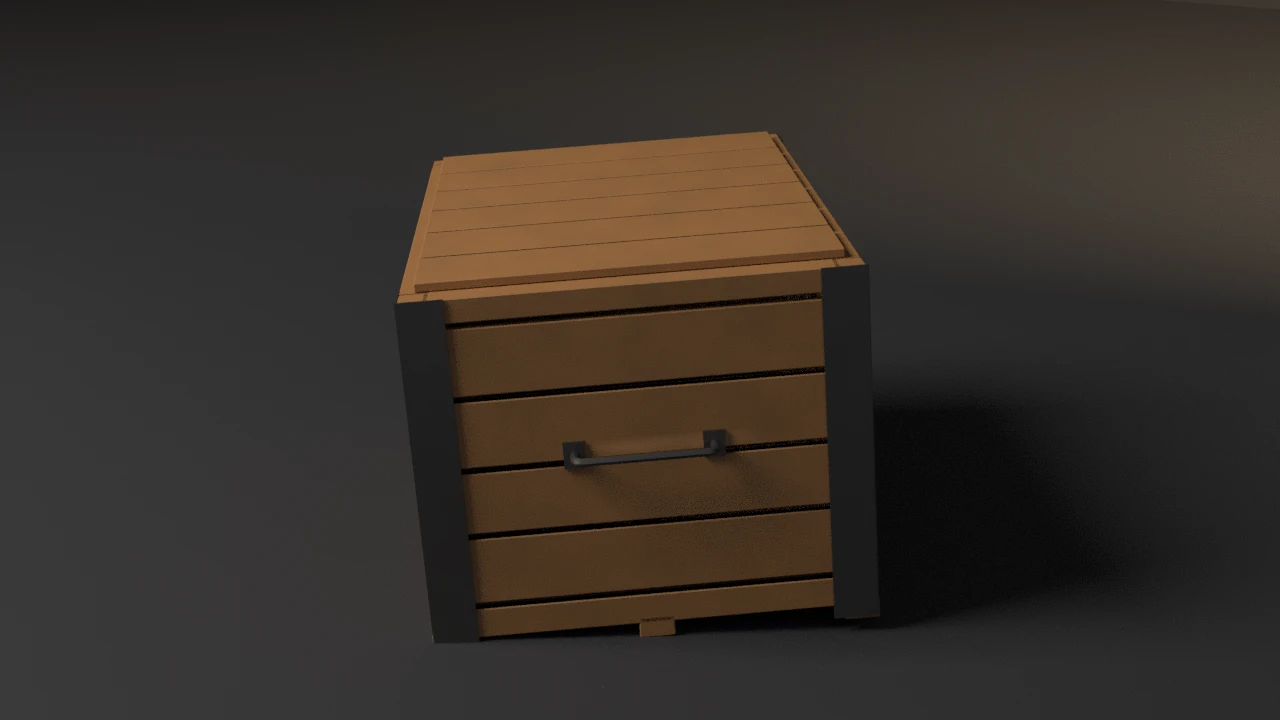
shipping-crate
A procedural shipping crate through UVs, bake, LOD, collider, and Unity glTF, asserting recomputed budgets rather than an API contract.
A procedural reading corner on a fringed wool rug — a Queen Anne / Chesterfield wingback armchair in oxblood leather whose tall reclined back is deep-button tufted, thirteen buttons on a diamond lattice each seated in a funnelled dimple with the leather puffed into pillows between them and folded into sharp pleats along every line that joins two buttons; two wings sweeping forward from the back into rolled arms, each arm one lofted scroll section with an English roll tucked under on the outside, a crowned front, a piped welt round the front seam and a row of brass nailheads following the scroll; a nailed front rail, a loose cushion with a crowned top and piped welts on both seams, cabriole front legs on pad feet and square rear legs splayed into brass ferrules; beside it a walnut tripod side table with a brass reading lamp (knopped stem, harp, finial, linen shade) and two cloth-bound books — through UVs, bake, LOD, collider, and Unity glTF, asserting recomputed budgets rather than an API contract.
Rendered headless by the showcase piece itself — click to zoom.
category Household
blender --background --python showcase/wingback-armchair/wingback_armchair.py --
A showcase piece, not an example, and the sixth in the household category. It builds a procedural reading corner: a Queen Anne / Chesterfield-style wingback armchair in oxblood leather beside a round side table with a brass reading lamp and two books, on a fringed wool rug.
Every face carries a part tag (a face attribute written as each part is built), and the audits classify shells by it. The measurements themselves are read off the mesh.
The tufted panel is a grid laid out in the lattice's own pitch: a tenth of a button spacing in each direction, so every pleat line and every button passes through grid vertices. Each grid cell is split along the diagonal of the nearest pleat, which is what keeps the folds sharp rather than stepped. Buttons and nailheads are placed by casting a ray onto the finished host (the back, an arm, the rail) and are aimed down the host's normal there; the buttons along the crown's normal, which is the dimple's axis of symmetry.
Things the coplanar budget forced:
r cos(roll) so its lowest vertex still lies on the floor.Shading follows what each part is: upholstery, turned wood, brass and cords are smooth-shaded; pleats sharper than 40°, board edges and every material boundary stay crisp. The leather is an oxblood with a two-octave mottle, rubbed lighter and browner where it faces up, darkened in the pleats and seams by ambient occlusion, with a pebbled grain and crinkles in the bump and a waxed coat. Brass carries a studio in its material (from showcase/espresso-machine), so it reads as metal on the dark stage.
It asserts budget conformance of the generated result. It does not witness an API contract. "It rendered without error" is not a check.
Composes skills mesh-editing-and-bmesh, bake-high-to-low, depsgraph-and-evaluated-data, engine-export-presets, procedural-materials-and-shaders, and snippets bake_normal_high_to_low.py, setup_bake_target_image.py, lod_chain.py / decimate_to_budget.py, convex_hull_collider.py, export_preset_unity.py (helpers copied inline, not imported).
Intended size: a chair 0.868 m wide, its seat 0.453 m and its back 1.111 m above the rug; a side table 0.575 m high and 0.47 m across. The outer AABB is 2.0304 × 1.400 × 1.160 m: the tassels set the width, the rug the depth and the lamp's finial the top. The origin is under the rug.
Every budget is declared as a named constant. Every gate recomputes its value from the mesh, materials, UVs, evaluated LOD, collider, or export file.
| Axis | Declared | Measured (5.2.1) |
|---|---|---|
| Base triangles | 43700–44900 | 44324 |
| LOD1 ratio | 0.32–0.62 of base | 0.5000 |
| LOD2 ratio | 0.10–0.35 of base | 0.2200 |
| Materials | exactly 9 distinct; face floors ≥14500 leather, ≥3350 wood, ≥4450 brass, ≥620 shade, ≥615 rug, ≥1390 fringe, ≥114 cloth, ≥11 paper, ≥195 bulb | 9 slots; 15712 / 3628 / 4825 / 672 / 668 / 1512 / 124 / 12 / 212 |
| UVs | in 0..1, AABB overlap ≤ 1e-5 | in range, overlap 0 |
| Outer AABB | (2.0304, 1.400, 1.160) m ± 0.01 | (2.0304, 1.4000, 1.1600), zmin 0 |
| Collider tris | ≤ 820 | 802 |
| Export | written, size > 0, removed after measuring | 3509556 bytes |
No falsifier changes the topology or the envelope: every run measures the default's 44324 triangles and AABB.
DECIMATE COLLAPSE triangle counts are not identical across Blender series, so the LOD gate is a ratio band, not an exact count. Bake pixels are stochastic, so the bake gate is has_data plus operator FINISHED, not byte-identity. Construction uses no RNG; two default runs print identical measurements.
Recomputed from the generated mesh, not asserted about the script.
| Axis | Declared | Measured |
|---|---|---|
| Non-manifold edges | 0 | 0 |
| Loose verts / edges | 0 / 0 | 0 / 0 |
| Doubles merged at 1e-5 | 0 | 0 |
| Zero-area faces | 0 | 0 |
| N-gons | 0 | 0 |
| Coplanar cross-shell face pairs (KD range 0.05 m, plane ε 1e-4) | 0 | 0 |
Grounded: zmin | within 1e-4 of 0 | 0.0000 |
| Feet: each of the 4 chair feet (2 pads, 2 ferrules) and 3 table pads sunk into the rug, against the rug's top read off the mesh | 0.0008–0.0040 m | 0.00200 (all 7) |
| Axis | Declared | Measured |
|---|---|---|
| Legs tenoned: each of the 4 chair legs' top above the body's underside, by a ray up from below the top onto the arms, back and base | 0.012–0.045 m | 0.0319, 0.0319 (front); 0.0288, 0.0288 (rear) |
| Buttons: 13, each one's deepest vertex below the back's surface on its axis (the smallest principal axis), its dome proud of that point, and the surface 40 mm round it risen above it (the dimple) | seat 0.0012–0.0045 m; proud ≥ 0.004 m; dimple ≥ 0.008 m | 0.00250; 0.00740; 0.01686–0.01847 |
| Mirror symmetry of the upholstered body (base, back, wings, arms, cushion, every welt): every vertex's distance to the nearest vertex at its mirror position; and size | ≤ 0.0005 m; seat 0.43–0.48 m, back 1.07–1.13 m, width 0.83–0.88 m above the rug | 0.000000 over 10620 verts; 0.4531, 1.1113, 0.8683 |
| Diamond lattice: every pair of buttons closer than 0.20 m (the diagonal neighbours) | 16 pairs; spread ≤ 0.004 m; in 0.150–0.175 m | 16; 0.00089; 0.16169–0.16258 |
| Table: mass centre of table, lamp and books (shell volumes × densities) inside the triangle of the three pads' contacts | ≥ 0.045 m | 0.0922 (7.50 kg) |
| Cushion resting: its underside pressed into the deck's top | 0.0008–0.0040 m | 0.00200 |
| Nailheads: two arm rows and a rail row; each nail's station where its axis meets its host; consecutive stations' spacing; each seated below that point and proud of it | equal arm rows ≥ 20, rail ≥ 12; spread ≤ 0.0015 m; seat 0.0004–0.0025 m; proud ≥ 0.002 m | 28, 28, 19; 0.0 (pitch 0.03000); 0.00100–0.00130; 0.00280–0.00310 |
The densities are named constants (leather 600, walnut 700, brass 4500 for a hollow cast lamp modelled solid, linen 300, cloth and paper 700, bulb 600).
Each falsifier violates one named budget. Every one was run on 5.2.1 and exited its declared code, and every other budget in its run stayed green (budget_fails lists only its own).
| Flag | Budget violated | Exit |
|---|---|---|
--skip-decimate | LOD1 ratio band (measured 1.0000) | 9 |
--stray-vert | loose vertex count is 0 (measured 1, placed inside the envelope) | 15 |
--lift-z | bounding box zmin is 0 (measured 0.05000) | 16 |
--float-foot | feet sunk into the rug (one table pad and its leg's end 3 mm up: −0.00100 m) | 16 |
--short-legs | legs tenoned into the body (the right rear leg's top 40 mm lower: −0.0038 m) | 17 |
--sink-buttons | buttons seated in their dimples (all 6 mm deeper: seat 0.00850, proud 0.00140 m) | 18 |
--odd-wing | mirror symmetry (the right wing 6 mm outward: 0.006000 m) | 19 |
--drift-buttons | diamond lattice (the row-2 side buttons and their dimples 18 mm outward, a mirrored pair: spread 0.01358 m) | 20 |
--narrow-tripod | table mass centre inside its feet (legs' reach cut to 30%: 0.0280 m) | 21 |
--lift-cushion | cushion resting on the deck (5 mm up: −0.00300 m) | 22 |
--bunch-nails | nailheads evenly spaced (nail 6 of each arm slid 45% of a pitch: spread 0.02699 m) | 23 |
--drift-buttons moves a mirrored pair, dimples and all, so the back stays symmetric and every button still sits in its own dimple; only the lattice breaks. --short-legs keeps the leg's foot in its ferrule on the rug. --float-foot lifts the pad with its leg's end, so the leg stays in its pad. --bunch-nails re-seats the slid nails on the arm's surface, so only the spacing breaks.
blender --background --python wingback_armchair.py --
blender --background --python wingback_armchair.py -- --skip-decimate
blender --background --python wingback_armchair.py -- --stray-vert
blender --background --python wingback_armchair.py -- --lift-z
blender --background --python wingback_armchair.py -- --float-foot
blender --background --python wingback_armchair.py -- --short-legs
blender --background --python wingback_armchair.py -- --sink-buttons
blender --background --python wingback_armchair.py -- --odd-wing
blender --background --python wingback_armchair.py -- --drift-buttons
blender --background --python wingback_armchair.py -- --narrow-tripod
blender --background --python wingback_armchair.py -- --lift-cushion
blender --background --python wingback_armchair.py -- --bunch-nails
blender --background --python wingback_armchair.py -- --output armchair.png
Smoke passes no flags.
The camera looks along (−0.50, −0.87) from low, so the hero shows the chair's front — the tufted back between the wings, both arm scrolls with their nail rows, the cushion and the rail — and its left side, with the table and lamp to the right on the rug. A warm point light sits in the lamp's bulb (render only).
File-local. 9 is a valid check code. 10 is reserved for gallery_framing.check_framing on the --output path. 15–19 are the hygiene and joint-fit family. 20–23 are file-local. 24 is the asset-quality floor on the render path: check_asset_quality returns 11, which this piece already spends on the collider ceiling, so the call site remaps it.
| Code | Meaning |
|---|---|
| 0 | Success |
| 1 | Uncaught exception (FATAL wrapper) |
| 2 | argparse / usage |
| 3 | Mesh did not build / no UV layer / rug, back or cushion not found |
| 4 | Base triangle count outside range |
| 5 | Material count ≠ 9 distinct slots, or a face-count floor missed |
| 6 | UVs outside 0..1 |
| 7 | UV AABB overlap above tolerance |
| 8 | World AABB off declared outer size |
| 9 | LOD ratio band (--skip-decimate lands here) |
| 10 | Framing gate (render path only) |
| 11 | Collider triangle count above ceiling |
| 12 | Bake did not finish or image has no data |
| 13 | Export file missing or empty |
| 14 | --output produced no file |
| 15 | Mesh hygiene: loose, non-manifold, zero-area, doubles, n-gons, coplanar cross-shell pairs |
| 16 | Not grounded: bounding box zmin off 0, or a foot's sink into the rug outside its band (--lift-z, --float-foot) |
| 17 | A chair leg's top not tenoned into the body by the band (--short-legs) |
| 18 | A button's seat, proud height or dimple outside its band, or not 13 buttons (--sink-buttons) |
| 19 | Mirror symmetry of the body, or seat height, back height or width off (--odd-wing) |
| 20 | Diamond lattice: diagonal-neighbour count, spread or band (--drift-buttons) |
| 21 | Table mass centre within 45 mm of its feet's triangle's edge (--narrow-tripod) |
| 22 | Cushion's underside not pressed into the deck by the band (--lift-cushion) |
| 23 | Nailheads: row counts, spacing spread, seat or proud height (--bunch-nails) |
| 24 | Asset-quality floor (render path only; remapped from 11) |
"""Game-ready wingback armchair in a reading corner — a showcase piece, not an example. Asserts budget conformance of a procedural reading-corner vignette after composing shipped pipeline pieces: bmesh construction, UVs, nine materials, high-to-low normal bake, LOD chain, convex collider, Unity glTF export. A Queen Anne / Chesterfield-style wingback armchair in oxblood leather stands on a fringed wool rug. Its tall back is deep-button tufted: thirteen buttons on a diamond lattice, each seated in a funnelled dimple, with the leather puffed into pillows between them and folded into sharp pleats along every line that joins two buttons; above the top row and beside the side columns the pleats run straight out to the edge. Two wings sweep forward from the back and down into rolled arms. Each arm is one lofted scroll profile — a flat inner face, an English roll over the top that tucks under on the outside, a flared outer panel — with a crowned front, a piped welt round the front seam and a row of brass nailheads following the scroll. A loose seat cushion with a crowned top and piped welts on both seams rests on the deck, whose crowned front rail carries a third row of nailheads. Cabriole front legs end in pad feet; square rear legs splay back into brass ferrules. Beside the chair a round walnut side table on a turned baluster pedestal and three snake-foot legs carries a brass reading lamp (domed base, knopped stem, socket, bulb, harp, finial, spider and a linen shade) and two cloth-bound books. Budgets are declared below and recomputed from the generated result. They are not API-contract witnesses. Each falsifier violates one named budget: ``--skip-decimate`` the LOD-ratio band, ``--stray-vert`` mesh hygiene, ``--lift-z`` grounded zmin, ``--float-foot`` every foot on the rug, ``--short-legs`` the legs tenoned into the body, ``--sink-buttons`` every button seated in its dimple, ``--odd-wing`` the chair's mirror symmetry, ``--drift-buttons`` the diamond lattice, ``--narrow-tripod`` the table's mass centre inside its feet, ``--lift-cushion`` the cushion resting on the deck, ``--bunch-nails`` the nailheads evenly spaced and seated. No RNG. Construction is closed-form. DECIMATE COLLAPSE triangle counts are not byte-identical across Blender versions — the LOD gate is a ratio band, not an exact count. blender --background --python wingback_armchair.py -- blender --background --python wingback_armchair.py -- --skip-decimate blender --background --python wingback_armchair.py -- --output armchair.png """ import argparse import math import os import sys import tempfile import traceback import bmesh import bpy from mathutils import Matrix, Vector from mathutils.bvhtree import BVHTree from mathutils.kdtree import KDTree # Showcase lives at repo-root/showcase/, not under examples/. The framing # helper is the repo's only shared import and lives next to the examples; # resolve the repo root so we do not move gallery_framing.py. _REPO = os.path.abspath( os.path.join(os.path.dirname(os.path.abspath(__file__)), os.pardir, os.pardir) ) sys.path.insert(0, os.path.join(_REPO, "examples")) sys.dont_write_bytecode = True import gallery_framing # noqa: E402 import gallery_asset_quality # noqa: E402 X_AX = Vector((1.0, 0.0, 0.0)) Y_AX = Vector((0.0, 1.0, 0.0)) Z_AX = Vector((0.0, 0.0, 1.0)) # Lathe segment multiplier: the high mesh for the bake turns finer. SEG_MUL = [1.0] # --- Rug (the whole vignette stands on it; the chair's front is -Y) -------- RUG_T = 0.010 Z0 = RUG_T # chair and table z below are above the rug top RUG_C = (0.24, -0.03) RUG_HX = 0.93 RUG_HY = 0.70 RUG_RC = 0.02 RUG_PROFILE = [(0.006, 0.0), (0.0015, 0.0012), (0.0, 0.0040), (0.0, 0.0065), (0.0015, 0.0088), (0.006, RUG_T)] FRINGE_PITCH = 0.032 FRINGE_R = 0.0032 FRINGE_LEN = 0.058 # --- Seat base: the upholstered box between the arms ------------------------ BASE_HX = 0.305 BASE_Y = (-0.405, 0.345) BASE_RC = 0.035 BASE_PROFILE = [(0.010, 0.245), (0.002, 0.249), (0.0, 0.258), (0.0, 0.332), (0.002, 0.340), (0.008, 0.345)] # --- Back (reclined slab; front face deep-button tufted) --------------------- BACK_REC_DEG = 8.0 BACK_O = (0.0, 0.262, 0.235) BACK_T = 0.120 BACK_HU = 0.395 BACK_VT = (0.878, 0.830) # top edge v at the centre line and at the sides BACK_CROWN = 0.030 BACK_CORNER = 0.040 LAT_DU = 0.011 # grid pitch; a tenth of the button pitch LAT_DV = 0.012 LAT_P = 27 # lattice-aligned u samples: -27..27 * LAT_DU GRID_V0 = 0.18 GRID_Q = 52 TOP_STEPS = 6 U_OUTER = (0.330, 0.360, 0.395) BTN_DX = 0.110 # diamond lattice: columns and rows BTN_DY = 0.120 BTN_V0 = 0.300 BTN_ROWS = 5 BTN_COLS = 2 # i = -2..2, buttons where i + j is even PUFF = 0.018 PLEAT_P = 0.6 DIMPLE_D = 0.016 DIMPLE_S = 0.028 TUFT_HALF = 0.300 BTN_PROFILE = [(0.0082, -0.0025), (0.0108, -0.0008), (0.0112, 0.0018), (0.0098, 0.0045), (0.0066, 0.0066), (0.0022, 0.0074)] # --- Arms (right arm at +X; the left is its mirror) -------------------------- ARM_Y = (-0.415, 0.345) ARM_ROLL_C = (0.362, 0.592) ARM_ROLL_R = 0.066 ARM_STAR = (0.350, 0.540) ARM_FRONT = [(0.990, -0.003), (0.965, -0.008), (0.920, -0.012), (0.820, -0.016), (0.620, -0.019), (0.350, -0.021)] PIPE_R = 0.0048 PIPE_OUT = 0.0020 NAIL_S = 0.93 NAIL_PITCH = 0.030 NAIL_MARGIN = 0.030 NAIL_SINK = 0.0010 RAIL_Z = 0.262 # nail row along the front rail RAIL_HALF = 0.270 NAIL_PROFILE = [(0.0044, 0.0), (0.0056, 0.0011), (0.0050, 0.0026), (0.0028, 0.0038), (0.0008, 0.0041)] # --- Wings -------------------------------------------------------------------- WING_XI = (0.318, 0.335) # inner face x at the back, at the front WING_PROFILE = [(0.30, -0.010), (0.60, -0.009), (0.80, -0.006), (0.92, -0.002), (0.970, 0.004), (0.992, 0.013), (1.0, 0.026), (1.0, 0.046), (0.992, 0.059), (0.970, 0.067), (0.92, 0.072), (0.80, 0.076), (0.60, 0.079), (0.30, 0.080)] WING_CTRL = [(-0.115, 0.632), (-0.150, 0.665), (-0.172, 0.715), (-0.183, 0.775), (-0.182, 0.840), (-0.170, 0.900), (-0.145, 0.950), (-0.105, 0.992), (-0.055, 1.022), (0.005, 1.042), (0.075, 1.054), (0.150, 1.060), (0.230, 1.060)] WING_PIPE_N = 0.036 # --- Cushion ------------------------------------------------------------------ CUSH_HX = 0.292 CUSH_FRONT = -0.448 CUSH_RC = 0.045 CUSH_BULGE = 0.010 CUSH_PROFILE = [(0.012, 0.343), (0.004, 0.345), (0.0, 0.3505), (0.0, 0.380), (0.0, 0.410), (0.0, 0.4335), (0.001, 0.438), (0.006, 0.4435), (0.014, 0.4474), (0.030, 0.4492), (0.060, 0.4510), (0.100, 0.4521), (0.150, 0.4528), (0.200, 0.4531)] WELT_Z = (0.3478, 0.4358) # --- Legs ----------------------------------------------------------------------- FRONT_LEG_XY = (0.345, -0.365) REAR_LEG_XY = (0.340, 0.355) FOOT_SINK = 0.0020 LEG_TOP = (0.265, 0.245) # front, rear: top of the leg inside the body SHORT_LEG = 2 # --short-legs: the right rear leg SHORT_DROP = 0.040 # --short-legs drops that leg's top out of the body # --- Side table, lamp and books ------------------------------------------------ TABLE_C = (0.900, -0.020) TABLE_TOP_Z = 0.575 TABLE_LEG_YAW = -30.0 TFOOT_R = 0.203 NARROW = 0.30 # --narrow-tripod scales the legs' reach FLOAT_TFOOT = 0.003 LAMP_OFF = (0.045, 0.075) BOOK_SIZES = ((0.215, 0.150, 0.030), (0.196, 0.134, 0.026)) BOOK_AT = ((-0.075, -0.065, 18.0), (-0.068, -0.070, 4.0)) # --- Budgets ------------------------------------------------------------------------ BBOX_TOL = 0.01 # Fitted after locking geometry. Recomputed from the mesh's vertices. OUTER_SIZE = (2.0304, 1.4000, 1.1600) BASE_TRIS_MIN = 43700 BASE_TRIS_MAX = 44900 LOD1_RATIO_MIN = 0.32 LOD1_RATIO_MAX = 0.62 LOD2_RATIO_MIN = 0.10 LOD2_RATIO_MAX = 0.35 LOD1_TARGET = 0.50 LOD2_TARGET = 0.22 MATERIAL_COUNT = 9 UV_EPS = 1e-4 UV_OVERLAP_MAX = 1e-5 COLLIDER_TRIS_MAX = 820 BAKE_RES = 1024 CAGE_EXTRUSION = 0.004 FACE_FLOORS = (("leather", 14500), ("wood", 3350), ("brass", 4450), ("shade", 620), ("rug", 615), ("fringe", 1390), ("cloth", 114), ("paper", 11), ("bulb", 195)) ZMIN_EPS = 1e-4 DOUBLES_EPS = 1e-5 AREA_EPS = 1e-10 COPLANAR_NORMAL_EPS = 1e-4 COPLANAR_PLANE_EPS = 1e-4 COPLANAR_CENTRE_MAX = 0.05 LIFT_Z = 0.05 # Feet: every chair foot (2 pads, 2 ferrules) and table foot (3 pads) sunk # into the rug's pile by a banded depth, read against the rug top. CHAIR_FEET = 4 TABLE_FEET = 3 SINK_BAND = (0.0008, 0.0040) # Legs tenoned into the body: each leg's top above the body's underside. LEG_BITE = (0.012, 0.045) # Buttons: 13, each seated a banded depth into the back below the surface # point under its centre, its dome proud of it, and that point a dimple. BTN_COUNT = 13 BTN_SEAT = (0.0012, 0.0045) BTN_PROUD_MIN = 0.004 DIMPLE_MIN = 0.008 DIMPLE_RING = 0.040 SINK_BUTTONS = 0.006 # Mirror symmetry of the upholstered body, and its real-world size. MIRROR_EPS = 0.0005 ODD_WING = 0.006 SEAT_HEIGHT = (0.43, 0.48) BACK_HEIGHT = (1.07, 1.13) CHAIR_WIDTH = (0.83, 0.88) # Diamond lattice: every pair of diagonal neighbours at one spacing. LATTICE_PAIRS = 16 LATTICE_NEAR = 0.20 LATTICE_SPREAD_MAX = 0.004 LATTICE_BAND = (0.150, 0.175) DRIFT_BUTTONS = 0.018 # Table: mass centre of table, lamp and books inside the feet's triangle. TRIPOD_MARGIN_MIN = 0.045 DENSITY = (600.0, 700.0, 4500.0, 300.0, 0.0, 0.0, 700.0, 700.0, 600.0) # Cushion resting on the deck: its underside pressed into the deck top. CUSHION_REST = (0.0008, 0.0040) LIFT_CUSHION = 0.005 # Nailheads: per arm, consecutive nails at one pitch, each sunk into the # arm's front by a banded depth with its dome proud of it. NAIL_SPREAD_MAX = 0.0015 NAIL_SEAT = (0.0004, 0.0025) NAIL_PROUD_MIN = 0.0020 BUNCH_NAIL = 6 BUNCH_SHIFT = 0.45 HERO_YAW_DEG = 0.0 WALL_Y = 3.2 LEATHER_IDX = 0 WOOD_IDX = 1 BRASS_IDX = 2 SHADE_IDX = 3 RUG_IDX = 4 FRINGE_IDX = 5 CLOTH_IDX = 6 PAPER_IDX = 7 BULB_IDX = 8 # Part tags (face attribute "part" = kind * 1000 + index). Measurements read # positions off the mesh; the tag only says which shell is which part. (RUG, TASSEL, BASE, ARM, ARMPIPE, NAIL, WING, WINGPIPE, BACK, BUTTON, CUSHION, WELT, LEG, PAD, FERRULE, TTOP, PED, TLEG, TPAD, LBASE, LSTEM, SOCKET, BULB, HARP, FINIAL, SHADE, SPIDER, COVER, PAGES) = range(1, 30) BODY_KINDS = (BASE, ARM, ARMPIPE, WING, WINGPIPE, BACK, CUSHION, WELT) TABLE_KINDS = (TTOP, PED, TLEG, TPAD, LBASE, LSTEM, SOCKET, BULB, HARP, FINIAL, SHADE, SPIDER, COVER, PAGES) FLAG_NAMES = ("float_foot", "short_legs", "sink_buttons", "odd_wing", "drift_buttons", "narrow_tripod", "lift_cushion", "bunch_nails") def eevee_engine_id(): return "BLENDER_EEVEE" if bpy.app.version >= (5, 0, 0) else "BLENDER_EEVEE_NEXT" def fail(msg, code): print(f"ERROR: {msg}", file=sys.stderr) return code def triangle_count(mesh): mesh.calc_loop_triangles() return len(mesh.loop_triangles) def evaluated_triangle_count(obj): # Duplicated from snippets/lod_chain.py / decimate_to_budget.py (not a package). depsgraph = bpy.context.evaluated_depsgraph_get() eval_obj = obj.evaluated_get(depsgraph) eval_mesh = eval_obj.to_mesh() try: eval_mesh.calc_loop_triangles() return len(eval_mesh.loop_triangles) finally: eval_obj.to_mesh_clear() # -------------------------------------------------------------------------- # Construction helpers # -------------------------------------------------------------------------- def W(x, y, z): """Chair- and table-local height (above the rug top) to world.""" return Vector((x, y, z + Z0)) def _mark(faces, mat_idx): for f in faces: f.material_index = mat_idx def tag(bm, verts, kind, idx=0): layer = bm.faces.layers.int.get("part") for f in {f for v in verts for f in v.link_faces}: f[layer] = kind * 1000 + idx return verts def set_tone(bm, verts, tone): layer = bm.faces.layers.float.get("tone") for f in {f for v in verts for f in v.link_faces}: f[layer] = tone def add_lathe(bm, profile, segs, mat_idx, center=(0.0, 0.0, 0.0), rot=None, phase=0.0, solid=False, seg_mats=None): """Revolve a profile [(r, z), ...] about local Z. ``solid``: the profile is an open polyline closed by n-gon caps at its two ends; otherwise it is a closed polygon revolved into a ring shell.""" segs = max(3, int(round(segs * SEG_MUL[0]))) c = Vector(center) m = rot if rot is not None else Matrix.Identity(3) rings = [] for i in range(segs): a = phase + 2.0 * math.pi * i / segs ca, sa = math.cos(a), math.sin(a) rings.append([bm.verts.new(c + m @ Vector((r * ca, r * sa, z))) for r, z in profile]) n = len(profile) last = n - 1 if solid else n for i in range(segs): r0, r1 = rings[i], rings[(i + 1) % segs] for j in range(last): k = (j + 1) % n f = bm.faces.new((r0[j], r1[j], r1[k], r0[k])) f.material_index = seg_mats[j] if seg_mats else mat_idx if solid: f0 = bm.faces.new([rings[i][0] for i in reversed(range(segs))]) f1 = bm.faces.new([rings[i][n - 1] for i in range(segs)]) f0.material_index = mat_idx f1.material_index = mat_idx return [v for ring in rings for v in ring] def add_loft(bm, rings_co, mat_idx, closed=False, caps=True): """Rings of points (each a closed loop, equal counts) joined in order.""" rings = [[bm.verts.new(p) for p in ring] for ring in rings_co] faces = [] n = len(rings) m = len(rings[0]) for i in range(n if closed else n - 1): r0, r1 = rings[i], rings[(i + 1) % n] for k in range(m): k1 = (k + 1) % m faces.append(bm.faces.new((r0[k], r0[k1], r1[k1], r1[k]))) if not closed and caps: faces.append(bm.faces.new(tuple(reversed(rings[0])))) faces.append(bm.faces.new(tuple(rings[-1]))) _mark(faces, mat_idx) return [v for ring in rings for v in ring] def sweep_rings(pts, section, normals=None, side=None, closed=False, scales=None): """Section [(a, b), ...] placed along a polyline: ``a`` along the frame normal, ``b`` along the binormal. The normal comes from ``normals`` (a surface), a fixed ``side`` axis (a planar path), or parallel transport. ``scales`` scales the section per point.""" pts = [Vector(p) for p in pts] n = len(pts) rings = [] prev = None for i, p in enumerate(pts): if closed: a, b = pts[i - 1], pts[(i + 1) % n] else: a, b = pts[max(i - 1, 0)], pts[min(i + 1, n - 1)] t = (b - a).normalized() if normals is not None: nv = Vector(normals[i]) nv = (nv - t * nv.dot(t)).normalized() bv = t.cross(nv) elif side is not None: bv = Vector(side) bv = (bv - t * bv.dot(t)).normalized() nv = bv.cross(t) else: if prev is None: ref = X_AX if abs(t.x) < 0.9 else Z_AX prev = (ref - t * ref.dot(t)).normalized() nv = (prev - t * prev.dot(t)).normalized() prev = nv bv = t.cross(nv) s = scales[i] if scales else 1.0 rings.append([p + nv * (sa * s) + bv * (sb * s) for sa, sb in section]) return rings def add_sweep(bm, pts, section, mat_idx, normals=None, side=None, closed=False, scales=None): return add_loft(bm, sweep_rings(pts, section, normals, side, closed, scales), mat_idx, closed=closed) def circle_section(r, n, phase=0.0): return [(r * math.cos(phase + 2.0 * math.pi * k / n), r * math.sin(phase + 2.0 * math.pi * k / n)) for k in range(n)] def superellipse_section(ha, hb, n, p): out = [] for k in range(n): t = 2.0 * math.pi * (k + 0.5) / n c, s = math.cos(t), math.sin(t) out.append((ha * math.copysign(abs(c) ** (2.0 / p), c), hb * math.copysign(abs(s) ** (2.0 / p), s))) return out def rrect_loop(hx, hy, r, nc=8, nsx=6, nsy=6): """Rounded rectangle, counter-clockwise, with ``nsx`` / ``nsy`` spans on the straight sides.""" corners = ((1, 1), (-1, 1), (-1, -1), (1, -1)) pts = [] for k, (sx, sy) in enumerate(corners): cx, cy = sx * (hx - r), sy * (hy - r) a0 = 0.5 * math.pi * k for s in range(nc + 1): a = a0 + 0.5 * math.pi * s / nc pts.append((cx + r * math.cos(a), cy + r * math.sin(a))) a1 = a0 + 0.5 * math.pi nx, ny = corners[(k + 1) % 4] p0 = (cx + r * math.cos(a1), cy + r * math.sin(a1)) p1 = (nx * (hx - r) + r * math.cos(a1), ny * (hy - r) + r * math.sin(a1)) nside = nsx if k in (0, 2) else nsy for s in range(1, nside): t = s / nside pts.append((p0[0] + (p1[0] - p0[0]) * t, p0[1] + (p1[1] - p0[1]) * t)) return pts def rrect_rings(hx, hy, rc, rmin, profile, xform, nc=8, nsx=6, nsy=6): rings = [] for d, z in profile: r = max(rc - d, rmin) rings.append([xform(x, y, z) for x, y in rrect_loop(hx - d, hy - d, r, nc, nsx, nsy)]) return rings def triangulate_ngons(bm): faces = [f for f in bm.faces if len(f.verts) > 4] if faces: bmesh.ops.triangulate(bm, faces=faces) def pack_uvs(bm, margin=0.08): uv = bm.loops.layers.uv.new("UVMap") faces = list(bm.faces) n = len(faces) cols = max(1, math.ceil(math.sqrt(n))) rows = max(1, math.ceil(n / cols)) cell_w = 1.0 / cols cell_h = 1.0 / rows pad_u = margin * cell_w * 0.5 pad_v = margin * cell_h * 0.5 usable_w = cell_w - 2.0 * pad_u usable_h = cell_h - 2.0 * pad_v for i, face in enumerate(faces): col = i % cols row = i // cols nrm = face.normal ax, ay, az = abs(nrm.x), abs(nrm.y), abs(nrm.z) coords = [] for loop in face.loops: co = loop.vert.co if az >= ax and az >= ay: coords.append((co.x, co.y)) elif ax >= ay: coords.append((co.y, co.z)) else: coords.append((co.x, co.z)) xs = [c[0] for c in coords] ys = [c[1] for c in coords] minx, maxx = min(xs), max(xs) miny, maxy = min(ys), max(ys) dx = max(maxx - minx, 1e-8) dy = max(maxy - miny, 1e-8) origin_u = col * cell_w + pad_u origin_v = row * cell_h + pad_v for loop, (x, y) in zip(face.loops, coords): loop[uv].uv = ( origin_u + (x - minx) / dx * usable_w, origin_v + (y - miny) / dy * usable_h, ) def frame_from(axis, ref): """Rotation whose local Z is ``axis`` and local X lies toward ``ref``.""" z = Vector(axis).normalized() x = Vector(ref) x = (x - z * x.dot(z)) if x.length < 1e-6: x = Vector((1.0, 0.0, 0.0)) if abs(z.x) < 0.9 else Vector((0.0, 1.0, 0.0)) x = x - z * x.dot(z) x.normalize() y = z.cross(x) return Matrix((x, y, z)).transposed() def catmull(pts, per=6): pts = [Vector(p) for p in pts] ext = [pts[0] * 2.0 - pts[1]] + pts + [pts[-1] * 2.0 - pts[-2]] out = [] for i in range(1, len(ext) - 2): p0, p1, p2, p3 = ext[i - 1], ext[i], ext[i + 1], ext[i + 2] for k in range(per): t = k / per out.append(0.5 * ((2.0 * p1) + (-p0 + p2) * t + (2.0 * p0 - 5.0 * p1 + 4.0 * p2 - p3) * t * t + (-p0 + 3.0 * p1 - 3.0 * p2 + p3) * t * t * t)) out.append(pts[-1]) return out def smooth01(t): t = min(1.0, max(0.0, t)) return t * t * (3.0 - 2.0 * t) def hull2d(pts): """Convex hull, counter-clockwise (monotone chain).""" pts = sorted(set((round(x, 9), round(z, 9)) for x, z in pts)) def cross(o, a, b): return (a[0] - o[0]) * (b[1] - o[1]) - (a[1] - o[1]) * (b[0] - o[0]) lower, upper = [], [] for p in pts: while len(lower) >= 2 and cross(lower[-2], lower[-1], p) <= 1e-12: lower.pop() lower.append(p) for p in reversed(pts): while len(upper) >= 2 and cross(upper[-2], upper[-1], p) <= 1e-12: upper.pop() upper.append(p) return lower[:-1] + upper[:-1] def bvh_of(verts): faces = list({f for v in verts for f in v.link_faces}) vs = list({v for f in faces for v in f.verts}) idx = {v: i for i, v in enumerate(vs)} return BVHTree.FromPolygons([v.co.copy() for v in vs], [[idx[v] for v in f.verts] for f in faces]) def cast(tree, origin, direction, dist=1.0): loc, nrm, _i, _d = tree.ray_cast(Vector(origin), Vector(direction).normalized(), dist) if loc is None: return None, None if nrm.dot(direction) > 0.0: nrm = -nrm return loc, nrm def outline_normals(pts, centre): """Outward 2D normals of a closed polyline, pointing away from ``centre``.""" n = len(pts) out = [] for i in range(n): ax, ay = pts[i - 1] bx, by = pts[(i + 1) % n] tx, ty = bx - ax, by - ay ln = math.hypot(tx, ty) or 1.0 nx, ny = ty / ln, -tx / ln if nx * (pts[i][0] - centre[0]) + ny * (pts[i][1] - centre[1]) < 0.0: nx, ny = -nx, -ny out.append((nx, ny)) return out def scaled(pts, centre, s): cx, cy = centre return [(cx + (x - cx) * s, cy + (y - cy) * s) for x, y in pts] def chord_walk(path, pitch, margin): """Stations along an open polyline, ``pitch`` apart as straight chords, starting ``margin`` along it and stopping ``margin`` short of its end.""" seg = [math.dist(path[i], path[i + 1]) for i in range(len(path) - 1)] total = sum(seg) def at(s): for i, ln in enumerate(seg): if s <= ln or i == len(seg) - 1: t = min(1.0, max(0.0, s / ln)) if ln > 0 else 0.0 return (path[i][0] + (path[i + 1][0] - path[i][0]) * t, path[i][1] + (path[i + 1][1] - path[i][1]) * t) s -= ln return path[-1] out = [at(margin)] s = margin step = pitch / 200.0 while True: prev = out[-1] s2 = s while s2 < total - margin and math.dist(at(s2), prev) < pitch: s2 += step if s2 >= total - margin: break # refine the chord to the pitch by bisection between s2 - step and s2 lo, hi = s2 - step, s2 for _ in range(30): mid = 0.5 * (lo + hi) if math.dist(at(mid), prev) < pitch: lo = mid else: hi = mid s = hi out.append(at(s)) return out, at # -------------------------------------------------------------------------- # Rug and fringe # -------------------------------------------------------------------------- def add_rug(bm): def xf(x, y, z): return Vector((RUG_C[0] + x, RUG_C[1] + y, z)) rings = rrect_rings(RUG_HX, RUG_HY, RUG_RC, 0.004, RUG_PROFILE, xf, nc=3, nsx=24, nsy=18) return tag(bm, add_loft(bm, rings, RUG_IDX), RUG) def add_fringe(bm): """Tassels along both short ends: each a four-sided strand from inside the rug's edge out onto the floor, a vertex of its section down so it lies on the floor along a line; lengths and lateral drift vary per tassel so no two neighbours share a plane.""" n = int((2.0 * RUG_HY - 0.06) / FRINGE_PITCH) + 1 y0 = RUG_C[1] - 0.5 * FRINGE_PITCH * (n - 1) idx = 0 for side in (-1.0, 1.0): xe = RUG_C[0] + side * RUG_HX for k in range(n): y = y0 + FRINGE_PITCH * k ph = k * 2.39996 + (0.7 if side > 0 else 0.0) # each strand rolled its own way about its path; its lowest # vertex, r cos(roll) below the path, lies on the floor roll = 0.40 * math.sin(1.7 * ph + 0.3) sec = [(FRINGE_R * math.cos(math.pi + roll + 2.0 * math.pi * j / 4), FRINGE_R * math.sin(math.pi + roll + 2.0 * math.pi * j / 4)) for j in range(4)] rc = FRINGE_R * math.cos(roll) drift = 0.0075 * math.sin(ph) ln = FRINGE_LEN + 0.011 * math.sin(k * 1.713 + 0.5 * side) zs = 0.0050 + 0.0007 * math.sin(ph + 1.0) z1 = 0.0046 + 0.0005 * math.sin(1.3 * ph + 2.0) z2 = rc + 0.0005 + 0.0004 * math.sin(0.7 * ph + 0.5) pts = [Vector((xe - side * 0.014, y, zs)), Vector((xe + side * 0.003, y + 0.05 * drift, z1)), Vector((xe + side * 0.016, y + 0.25 * drift, z2)), Vector((xe + side * (0.016 + 0.45 * ln), y + 0.62 * drift, rc * 0.95)), Vector((xe + side * (0.016 + ln), y + drift, rc * 1.30))] ups = [Z_AX] * len(pts) scales = [1.0, 1.0, 1.0, 0.95, 1.30] tag(bm, add_sweep(bm, pts, sec, FRINGE_IDX, normals=ups, scales=scales), TASSEL, idx) idx += 1 return idx # -------------------------------------------------------------------------- # Chair: base, back, buttons, arms, wings, cushion, legs # -------------------------------------------------------------------------- def add_base(bm): hy = 0.5 * (BASE_Y[1] - BASE_Y[0]) cy = 0.5 * (BASE_Y[1] + BASE_Y[0]) def xf(x, y, z): # the front rail is crowned forward a little yy = y + cy fr = smooth01((BASE_Y[0] + 0.10 - yy) / 0.10) bulge = 0.006 * (1.0 - (x / BASE_HX) ** 2) * fr zf = smooth01((z - 0.248) / 0.02) * smooth01((0.342 - z) / 0.02) return W(x, yy - bulge * zf, z) rings = rrect_rings(BASE_HX, hy, BASE_RC, 0.006, BASE_PROFILE, xf, nc=6, nsx=12, nsy=14) return tag(bm, add_loft(bm, rings, LEATHER_IDX), BASE) def back_axes(): r = math.radians(BACK_REC_DEG) vdir = Vector((0.0, math.sin(r), math.cos(r))) ndir = Vector((0.0, -math.cos(r), math.sin(r))) # toward the sitter return vdir, ndir def back_origin(): return W(*BACK_O) def v_top(u): # an arched crest whose corners roll down into the wings return (BACK_VT[1] + (BACK_VT[0] - BACK_VT[1]) * (1.0 - (u / BACK_HU) ** 2) - BACK_CORNER * smooth01((abs(u) - 0.330) / 0.065)) def back_crown(u, v): return (BACK_CROWN * (1.0 - (u / 0.42) ** 2) * smooth01(v / 0.25) * (1.0 - 0.5 * smooth01((v - (v_top(u) - 0.10)) / 0.10))) def tuft_pattern(u, v): """Pillows between buttons, folded into pleats along every line that joins two diagonal neighbours; straight pleats out to the edges beyond the lattice. Every term is even in u.""" a = u / BTN_DX + (v - BTN_V0) / BTN_DY b = u / BTN_DX - (v - BTN_V0) / BTN_DY dia = (abs(math.sin(0.5 * math.pi * a)) * abs(math.sin(0.5 * math.pi * b))) ** PLEAT_P vf = abs(math.sin(0.5 * math.pi * u / BTN_DX)) ** PLEAT_P hf = abs(math.sin(0.5 * math.pi * (v - BTN_V0) / BTN_DY)) ** PLEAT_P v_last = BTN_V0 + (BTN_ROWS - 1) * BTN_DY t_v = max(smooth01((v - v_last) / (0.5 * BTN_DY)), smooth01((BTN_V0 - v) / (0.5 * BTN_DY))) p = dia + (vf - dia) * t_v t_s = smooth01((abs(u) - BTN_COLS * BTN_DX) / (0.5 * BTN_DX)) return p + (hf - p) * t_s def back_h(u, v, dimples): dim = sum(math.exp(-((u - ub) ** 2 + (v - vb) ** 2) / DIMPLE_S ** 2) for ub, vb in dimples) tuft = PUFF * tuft_pattern(u, v) - DIMPLE_D * dim fade = (smooth01((TUFT_HALF - abs(u)) / 0.025) * smooth01((v_top(u) - v) / 0.035) * smooth01((v - 0.20) / 0.04)) return back_crown(u, v) + tuft * fade def back_point(u, v, depth=0.0, out_u=0.0, out_v=0.0): vdir, ndir = back_axes() return back_origin() + X_AX * (u + out_u) + vdir * (v + out_v) + ndir * depth def crown_normal(u, v): e = 1e-4 du = (back_point(u + e, v, back_crown(u + e, v)) - back_point(u - e, v, back_crown(u - e, v))) dv = (back_point(u, v + e, back_crown(u, v + e)) - back_point(u, v - e, back_crown(u, v - e))) n = du.cross(dv).normalized() return n if n.dot(back_axes()[1]) > 0.0 else -n def button_sites(drift=False): sites = [] for j in range(BTN_ROWS): for i in range(-BTN_COLS, BTN_COLS + 1): if (i + j) % 2: continue u = i * BTN_DX if drift and j == 2 and abs(i) == BTN_COLS: u += math.copysign(DRIFT_BUTTONS, i) sites.append((u, BTN_V0 + j * BTN_DY)) return sites def add_back(bm, dimples): us = ([-u for u in reversed(U_OUTER)] + [p * LAT_DU for p in range(-LAT_P, LAT_P + 1)] + list(U_OUTER)) vq = [0.0, 0.06, 0.12] + [GRID_V0 + q * LAT_DV for q in range(GRID_Q + 1)] nu = len(us) grid_uv = [] for iv in range(len(vq) + TOP_STEPS): row = [] for u in us: if iv < len(vq): v = vq[iv] else: k = iv - len(vq) + 1 v = vq[-1] + (v_top(u) - vq[-1]) * k / TOP_STEPS row.append((u, v)) grid_uv.append(row) nv = len(grid_uv) verts = [[bm.verts.new(back_point(u, v, back_h(u, v, dimples))) for u, v in row] for row in grid_uv] faces = [] lat_u0 = len(U_OUTER) lat_v0 = 3 for iv in range(nv - 1): for iu in range(nu - 1): v00, v10 = verts[iv][iu], verts[iv][iu + 1] v01, v11 = verts[iv + 1][iu], verts[iv + 1][iu + 1] p = iu - lat_u0 - LAT_P q = iv - lat_v0 lattice = (lat_u0 <= iu and iu + 1 <= lat_u0 + 2 * LAT_P and 0 <= q and iv + 1 <= lat_v0 + GRID_Q) if lattice: # split each cell along the diagonal of the nearest pleat ac = (p + q + 1.0) / 10.0 + (GRID_V0 - BTN_V0) / BTN_DY bc = (p - q) / 10.0 - (GRID_V0 - BTN_V0) / BTN_DY da = abs(ac - 2.0 * round(ac / 2.0)) db = abs(bc - 2.0 * round(bc / 2.0)) along_a = da <= db else: along_a = (v10.co - v01.co).length <= (v00.co - v11.co).length if along_a: faces.append(bm.faces.new((v00, v10, v01))) faces.append(bm.faces.new((v10, v11, v01))) else: faces.append(bm.faces.new((v00, v10, v11))) faces.append(bm.faces.new((v00, v11, v01))) # border loop: bottom, right, top (reversed), left loop = ([(0, iu) for iu in range(nu)] + [(iv, nu - 1) for iv in range(1, nv)] + [(nv - 1, iu) for iu in range(nu - 2, -1, -1)] + [(iv, 0) for iv in range(nv - 2, 0, -1)]) uv2 = [grid_uv[iv][iu] for iv, iu in loop] nrm2 = outline_normals(uv2, (0.0, 0.45)) front = [verts[iv][iu] for iv, iu in loop] rings = [front] for depth_f, out in ((-0.30, 0.012), (-0.72, 0.008), (-1.0, -0.004)): rings.append([bm.verts.new(back_point(u, v, depth_f * BACK_T, out * nu_, out * nv_)) for (u, v), (nu_, nv_) in zip(uv2, nrm2)]) m = len(front) for r0, r1 in zip(rings[:-1], rings[1:]): for k in range(m): k1 = (k + 1) % m faces.append(bm.faces.new((r0[k], r0[k1], r1[k1], r1[k]))) faces.append(bm.faces.new(tuple(rings[-1]))) _mark(faces, LEATHER_IDX) allv = [v for row in verts for v in row] + [v for r in rings[1:] for v in r] return tag(bm, allv, BACK) def add_buttons(bm, back_tree, sites, sink=0.0): for k, (u, v) in enumerate(sites): axis = crown_normal(u, v) guess = back_point(u, v, back_crown(u, v)) hit, _n = cast(back_tree, guess + axis * 0.10, -axis, 0.3) if hit is None: hit = guess c = hit - axis * sink tag(bm, add_lathe(bm, BTN_PROFILE, 12, LEATHER_IDX, center=c, rot=frame_from(axis, X_AX), phase=0.37 * k, solid=True), BUTTON, k) def arm_outline(): """Right arm's section in (x, z): flat inner face, an English roll over the top that tucks under on the outside, and a flared outer panel.""" pts = [(0.300, 0.235), (0.346, 0.235), (0.392, 0.235), (0.395, 0.300), (0.398, 0.380), (0.401, 0.460), (0.401, 0.492), (0.396, 0.510), (0.386, 0.522)] cx, cz = ARM_ROLL_C n = 28 for k in range(n): a = math.radians(-72.0 + 268.0 * k / (n - 1)) pts.append((cx + ARM_ROLL_R * math.cos(a), cz + ARM_ROLL_R * math.sin(a))) pts += [(0.300, 0.545), (0.300, 0.470), (0.300, 0.390), (0.300, 0.310)] return pts def add_arm(bm, side, bunch=False): """One arm: its section lofted along y with crowned ends, a piped welt round the front seam and a row of nailheads following the scroll.""" sg = 1.0 if side == 0 else -1.0 outline = arm_outline() y0, y1 = ARM_Y def to3(pts2, y): return [W(sg * x, y, z) for x, z in pts2] rings = [] for s, dy in reversed(ARM_FRONT): rings.append(to3(scaled(outline, ARM_STAR, s), y1 - dy)) # back end, crowned nst = 13 for k in range(nst + 1): rings.append(to3(outline, y1 + (y0 - y1) * k / nst)) for s, dy in ARM_FRONT: rings.append(to3(scaled(outline, ARM_STAR, s), y0 + dy)) arm_verts = tag(bm, add_loft(bm, rings, LEATHER_IDX), ARM, side) # piped welt on the front seam: a cord round the section, its centre # outside the seam so it bites the arm by R - OUT nrm = outline_normals(outline, ARM_STAR) k2 = PIPE_OUT / math.sqrt(2.0) pts = [W(sg * (x + nx * k2), y0 - k2, z + nz * k2) for (x, z), (nx, nz) in zip(outline, nrm)] ups = [Vector((sg * nx, 0.0, nz)) for nx, nz in nrm] tag(bm, add_sweep(bm, pts, circle_section(PIPE_R, 6), LEATHER_IDX, normals=ups, closed=True), ARMPIPE, side) # nailheads along the scroll, inside the welt: every station a chord of # one pitch from the last, seated on the arm's own front surface tree = bvh_of(arm_verts) ring = scaled(outline, ARM_STAR, NAIL_S) path = ring[2:] + ring[:1] # outer bottom corner round to inner bottom stations, at = chord_walk(path, NAIL_PITCH, NAIL_MARGIN) if bunch: # slide one nail part of a pitch toward the next a, b = stations[BUNCH_NAIL], stations[BUNCH_NAIL + 1] stations[BUNCH_NAIL] = (a[0] + (b[0] - a[0]) * BUNCH_SHIFT, a[1] + (b[1] - a[1]) * BUNCH_SHIFT) for k, (x, z) in enumerate(stations): hit, n = cast(tree, W(sg * x, y0 - 0.10, z), Y_AX, 0.3) if hit is None: continue sink = NAIL_SINK + 0.0003 * (k % 2) prof = [(r, zz - sink) for r, zz in NAIL_PROFILE] tag(bm, add_lathe(bm, prof, 8, BRASS_IDX, center=hit, rot=frame_from(n, Z_AX), phase=0.53 * k + 0.23 * side, solid=True), NAIL, side * 100 + k) return len(stations) def add_rail_nails(bm, base_verts): """A row of nailheads across the front rail under the cushion, at the arms' pitch, each seated on the rail's own crowned face.""" tree = bvh_of(base_verts) n = int(2.0 * RAIL_HALF / NAIL_PITCH + 1e-9) + 1 stations = [(NAIL_PITCH * (k - 0.5 * (n - 1)), RAIL_Z) for k in range(n)] for k, (x, z) in enumerate(stations): hit, n = cast(tree, W(x, BASE_Y[0] - 0.20, z), Y_AX, 0.4) if hit is None: continue sink = NAIL_SINK + 0.0003 * (k % 2) prof = [(r, zz - sink) for r, zz in NAIL_PROFILE] tag(bm, add_lathe(bm, prof, 8, BRASS_IDX, center=hit, rot=frame_from(n, Z_AX), phase=0.53 * k + 0.61, solid=True), NAIL, 200 + k) return len(stations) def back_front_y(z_local): return BACK_O[1] + (z_local - BACK_O[2]) * math.tan(math.radians(BACK_REC_DEG)) def wing_outline(): def yb(z): return back_front_y(z) + 0.045 bottom = [(yb(0.600), 0.600), (0.200, 0.612), (0.080, 0.618), (-0.040, 0.625)] front = [(p.x, p.y) for p in catmull([Vector((y, z, 0.0)) for y, z in WING_CTRL], per=2)] back = [(yb(1.050), 1.050), (yb(0.950), 0.950), (yb(0.850), 0.850), (yb(0.750), 0.750), (yb(0.660), 0.660)] return bottom + front + back, len(bottom), len(bottom) + len(front) def wing_xi(y): t = min(1.0, max(0.0, (0.36 - y) / 0.54)) return WING_XI[0] + (WING_XI[1] - WING_XI[0]) * t def add_wing(bm, side, shift=0.0): sg = 1.0 if side == 0 else -1.0 outline, i0, i1 = wing_outline() centre = (0.07, 0.84) def to3(y, z, n): return W(sg * (wing_xi(y) + n + shift), y, z) rings = [[to3(y, z, n) for y, z in scaled(outline, centre, s)] for s, n in WING_PROFILE] tag(bm, add_loft(bm, rings, LEATHER_IDX), WING, side) # piped front edge, from inside the arm's roll round to inside the back nrm = outline_normals(outline, centre) seg = range(i0, i1 + 1) pts = [to3(outline[i][0] + nrm[i][0] * PIPE_OUT, outline[i][1] + nrm[i][1] * PIPE_OUT, WING_PIPE_N) for i in seg] ups = [Vector((0.0, nrm[i][0], nrm[i][1])) for i in seg] tag(bm, add_sweep(bm, pts, circle_section(PIPE_R, 6), LEATHER_IDX, normals=ups), WINGPIPE, side) def cushion_back_y(): """The cushion's back edge, 5 mm clear of the back's front face at every height and width the cushion spans (read off the back's surface).""" ymin = 9.0 for iu in range(-6, 7): u = CUSH_HX * iu / 6.0 for iz in range(12): z = CUSH_PROFILE[0][1] + (CUSH_PROFILE[-1][1] - CUSH_PROFILE[0][1]) * iz / 11.0 # v such that the crown-only surface passes height z (one Newton pass) vdir, _ndir = back_axes() v = (z - BACK_O[2]) / vdir.z for _ in range(3): p = back_point(u, v, back_crown(u, v)) v -= (p.z - Z0 - z) / vdir.z ymin = min(ymin, back_point(u, v, back_crown(u, v)).y) return ymin - 0.005 def add_cushion(bm, lift=0.0): yb = cushion_back_y() hy = 0.5 * (yb - CUSH_FRONT) cy = 0.5 * (yb + CUSH_FRONT) z0, z1 = CUSH_PROFILE[2][1], CUSH_PROFILE[5][1] def bulge(z): return 1.0 + CUSH_BULGE * math.sin(math.pi * min(1.0, max(0.0, (z - z0) / (z1 - z0)))) def xf(x, y, z): b = bulge(z) return W(x * b if abs(x) > 1e-9 else x, cy + y * (1.0 + (b - 1.0) * 0.6), z + lift) rings = rrect_rings(CUSH_HX, hy, CUSH_RC, 0.010, CUSH_PROFILE, xf, nc=6, nsx=10, nsy=12) tag(bm, add_loft(bm, rings, LEATHER_IDX), CUSHION) for k, zw in enumerate(WELT_Z): loop = rrect_loop(CUSH_HX + PIPE_OUT, hy + PIPE_OUT, CUSH_RC + PIPE_OUT, 6, 10, 12) pts = [W(x, cy + y, zw + lift) for x, y in loop] tag(bm, add_sweep(bm, pts, circle_section(PIPE_R * 0.9, 6), LEATHER_IDX, side=Z_AX, closed=True), WELT, k) return yb def add_front_leg(bm, side, top_z): """Cabriole leg: knee bulging forward, a slim ankle and a pad foot.""" sg = 1.0 if side == 0 else -1.0 lx, ly = FRONT_LEG_XY ctrl = [(0.0, 0.0, top_z), (0.0, 0.0, 0.235), (0.004, -0.018, 0.195), (0.004, -0.013, 0.150), (0.0, 0.004, 0.095), (-0.002, 0.012, 0.046), (0.0, 0.004, 0.024), (0.0, -0.008, 0.013)] radii = [0.027, 0.027, 0.030, 0.025, 0.018, 0.0125, 0.0140, 0.0150] pts = catmull([W(sg * (lx + dx), ly + dy, z) for dx, dy, z in ctrl], per=3) rs = catmull([Vector((r, 0.0, 0.0)) for r in radii], per=3) sec = superellipse_section(1.0, 1.0, 16, 2.6) tag(bm, add_sweep(bm, pts, sec, WOOD_IDX, scales=[r.x for r in rs]), LEG, side) pad = [(0.0215, -FOOT_SINK), (0.0255, -FOOT_SINK + 0.003), (0.0268, 0.006), (0.0245, 0.0115), (0.0180, 0.0165), (0.0120, 0.0190)] tag(bm, add_lathe(bm, pad, 24, WOOD_IDX, center=W(sg * lx, ly - 0.008, 0.0), solid=True), PAD, side) def add_rear_leg(bm, side, top_z): """Square tapered leg splayed back, in a brass ferrule with a level sole.""" sg = 1.0 if side == 0 else -1.0 lx, ly = REAR_LEG_XY ctrl = [(0.0, 0.0, top_z), (0.002, 0.015, 0.180), (0.006, 0.040, 0.080), (0.009, 0.060, 0.010)] radii = [0.0165, 0.0155, 0.0130, 0.0112] pts = catmull([W(sg * (lx + dx), ly + dy, z) for dx, dy, z in ctrl], per=4) rs = catmull([Vector((r, 0.0, 0.0)) for r in radii], per=4) sec = superellipse_section(1.0, 1.0, 12, 4.0) tag(bm, add_sweep(bm, pts, sec, WOOD_IDX, side=X_AX, scales=[r.x for r in rs]), LEG, 2 + side) axis = (pts[-1] - pts[-5]).normalized() foot = pts[-1] cup = [(0.0120, -0.0040), (0.0150, -0.0030), (0.0158, 0.0010), (0.0152, 0.0300), (0.0138, 0.0340), (0.0118, 0.0345)] base = foot - axis * 0.0045 verts = add_lathe(bm, cup, 20, BRASS_IDX, center=base, rot=frame_from(-axis, Y_AX), solid=True) # the lathe's axis follows the raked leg; its sole is flattened level sole = Z0 - FOOT_SINK lo = min(v.co.z for v in verts) for v in verts: v.co.z += sole + 0.0015 - lo if v.co.z < sole + 0.0095: v.co.z = sole tag(bm, verts, FERRULE, side) # -------------------------------------------------------------------------- # Side table, lamp, books # -------------------------------------------------------------------------- def add_table(bm, narrow=False, float_foot=False): tx, ty = TABLE_C top = [(0.205, 0.551), (0.222, 0.552), (0.230, 0.556), (0.235, 0.562), (0.236, 0.567), (0.233, 0.572), (0.226, 0.575), (0.205, 0.575)] tag(bm, add_lathe(bm, top, 48, WOOD_IDX, center=W(tx, ty, 0.0), solid=True), TTOP) ped = [(0.012, 0.085), (0.020, 0.095), (0.030, 0.113), (0.044, 0.133), (0.046, 0.150), (0.042, 0.165), (0.030, 0.180), (0.024, 0.215), (0.030, 0.260), (0.040, 0.310), (0.038, 0.350), (0.027, 0.390), (0.019, 0.430), (0.021, 0.460), (0.028, 0.480), (0.032, 0.500), (0.028, 0.515), (0.040, 0.525), (0.052, 0.535), (0.052, 0.548), (0.048, 0.560)] tag(bm, add_lathe(bm, ped, 32, WOOD_IDX, center=W(tx, ty, 0.0), solid=True), PED) reach = NARROW if narrow else 1.0 path = [(0.020, 0.170), (0.055, 0.160), (0.095, 0.125), (0.135, 0.075), (0.170, 0.035), (0.190, 0.016), (0.203, 0.011)] sec = superellipse_section(0.0125, 0.0095, 12, 2.4) for k in range(3): ang = math.radians(TABLE_LEG_YAW + 120.0 * k) er = Vector((math.cos(ang), math.sin(ang), 0.0)) et = Vector((-math.sin(ang), math.cos(ang), 0.0)) lift = FLOAT_TFOOT if (float_foot and k == 0) else 0.0 ctrl = [] for i, (rho, z) in enumerate(path): rho2 = 0.020 + (rho - 0.020) * reach dz = lift * smooth01((i - 3) / 3.0) ctrl.append(W(tx, ty, 0.0) + er * rho2 + Z_AX * (z + dz)) pts = catmull(ctrl, per=3) nstat = len(pts) scales = [1.25 - 0.45 * i / (nstat - 1) for i in range(nstat)] tag(bm, add_sweep(bm, pts, sec, WOOD_IDX, side=et, scales=scales), TLEG, k) rho_f = 0.020 + (TFOOT_R - 0.020) * reach pad = [(0.0125, -FOOT_SINK + lift), (0.0158, -FOOT_SINK + 0.0028 + lift), (0.0170, 0.0060 + lift), (0.0150, 0.0140 + lift), (0.0105, 0.0200 + lift), (0.0060, 0.0225 + lift)] tag(bm, add_lathe(bm, pad, 20, WOOD_IDX, center=W(tx, ty, 0.0) + er * rho_f, solid=True), TPAD, k) def add_lamp(bm): lx, ly = TABLE_C[0] + LAMP_OFF[0], TABLE_C[1] + LAMP_OFF[1] c = W(lx, ly, TABLE_TOP_Z) base = [(0.066, -0.0008), (0.070, 0.002), (0.0705, 0.006), (0.064, 0.011), (0.050, 0.018), (0.032, 0.024), (0.020, 0.030), (0.016, 0.036), (0.012, 0.040)] tag(bm, add_lathe(bm, base, 40, BRASS_IDX, center=c, solid=True), LBASE) stem = [(0.0060, 0.030), (0.0075, 0.034), (0.0075, 0.165), (0.0105, 0.172), (0.0140, 0.182), (0.0150, 0.190), (0.0140, 0.198), (0.0105, 0.208), (0.0075, 0.215), (0.0075, 0.380), (0.0085, 0.386)] tag(bm, add_lathe(bm, stem, 24, BRASS_IDX, center=c, solid=True), LSTEM) sock = [(0.009, 0.378), (0.016, 0.384), (0.018, 0.392), (0.018, 0.420), (0.016, 0.428), (0.013, 0.432)] tag(bm, add_lathe(bm, sock, 24, BRASS_IDX, center=c, phase=0.13, solid=True), SOCKET) bulb = [(0.010, 0.426), (0.013, 0.434), (0.022, 0.450), (0.029, 0.470), (0.030, 0.485), (0.027, 0.498), (0.018, 0.508), (0.008, 0.512)] tag(bm, add_lathe(bm, bulb, 24, BULB_IDX, center=c, solid=True), BULB) harp = [(-0.012, 0.392), (-0.030, 0.405), (-0.052, 0.440), (-0.058, 0.490), (-0.045, 0.530), (-0.020, 0.552), (0.0, 0.557), (0.020, 0.552), (0.045, 0.530), (0.058, 0.490), (0.052, 0.440), (0.030, 0.405), (0.012, 0.392)] hp = catmull([c + Vector((x, 0.0, z)) for x, z in harp], per=3) tag(bm, add_sweep(bm, hp, circle_section(0.0022, 6), BRASS_IDX, side=Y_AX), HARP) fin = [(0.004, 0.553), (0.009, 0.556), (0.010, 0.562), (0.008, 0.570), (0.004, 0.575)] tag(bm, add_lathe(bm, fin, 16, BRASS_IDX, center=c, phase=0.21, solid=True), FINIAL) shade = [(0.1500, 0.3960), (0.1545, 0.3950), (0.1560, 0.3985), (0.1400, 0.4400), (0.1265, 0.4760), (0.1120, 0.5150), (0.0990, 0.5530), (0.1000, 0.5575), (0.0960, 0.5590), (0.0948, 0.5540), (0.1078, 0.5155), (0.1222, 0.4755), (0.1357, 0.4395), (0.1485, 0.4010)] tag(bm, add_lathe(bm, shade, 48, SHADE_IDX, center=c), SHADE) for k in range(3): a = math.radians(90.0 + 120.0 * k) d = Vector((math.cos(a), math.sin(a), 0.0)) pts = [c + Vector((0.0, 0.0, 0.5585)) + d * (0.004 + 0.093 * t / 5) - Z_AX * (0.003 * t / 5) for t in range(6)] tag(bm, add_sweep(bm, pts, circle_section(0.0016, 5), BRASS_IDX, side=Z_AX), SPIDER, k) return c def add_books(bm): """Two cloth-bound books: a U-shaped case (boards and a rounded spine) round a page block that bites both boards.""" tx, ty = TABLE_C z = TABLE_TOP_Z - 0.0012 for k, ((bw, bd, bh), (ox, oy, yaw)) in enumerate(zip(BOOK_SIZES, BOOK_AT)): rot = Matrix.Rotation(math.radians(yaw), 3, "Z") o = W(tx + ox, ty + oy, z) tb = 0.0022 rs = 0.5 * bh def P(w, d, h): return o + rot @ Vector((w - 0.5 * bw, d - 0.5 * bd, h)) prof = [(bd, 0.0)] for i in range(9): a = -0.5 * math.pi - math.pi * i / 8.0 prof.append((rs + rs * math.cos(a) * 0.55, rs + rs * math.sin(a))) prof.append((bd, bh)) prof.append((bd, bh - tb)) ri = rs - tb for i in range(9): a = 0.5 * math.pi + math.pi * i / 8.0 prof.append((rs + ri * math.cos(a) * 0.45, rs + ri * math.sin(a))) prof.append((bd, tb)) rings = [[P(w, d, h) for d, h in prof] for w in (0.0, bw)] cv = add_loft(bm, rings, CLOTH_IDX) tag(bm, cv, COVER, k) set_tone(bm, cv, float(k)) pb = [] for w in (0.003, bw - 0.003): pb.append([P(w, d, h) for d, h in ((bd - 0.0035, tb - 0.0004), (bd - 0.0035, bh - tb + 0.0004), (0.0120, bh - tb + 0.0004), (0.0120, tb - 0.0004))]) tag(bm, add_loft(bm, pb, PAPER_IDX), PAGES, k) z += bh - 0.0009 # -------------------------------------------------------------------------- # The vignette # -------------------------------------------------------------------------- def build_mesh(name, seg_mul=1.0, float_foot=False, short_legs=False, sink_buttons=False, odd_wing=False, drift_buttons=False, narrow_tripod=False, lift_cushion=False, bunch_nails=False): SEG_MUL[0] = seg_mul bm = bmesh.new() try: bm.faces.layers.int.new("part") bm.faces.layers.float.new("tone") add_rug(bm) add_fringe(bm) add_rail_nails(bm, add_base(bm)) sites = button_sites(drift_buttons) back_verts = add_back(bm, sites) add_buttons(bm, bvh_of(back_verts), sites, SINK_BUTTONS if sink_buttons else 0.0) for side in (0, 1): add_arm(bm, side, bunch=bunch_nails) add_wing(bm, side, ODD_WING if (odd_wing and side == 0) else 0.0) add_cushion(bm, LIFT_CUSHION if lift_cushion else 0.0) for side in (0, 1): add_front_leg(bm, side, LEG_TOP[0]) short = short_legs and 2 + side == SHORT_LEG add_rear_leg(bm, side, LEG_TOP[1] - (SHORT_DROP if short else 0.0)) add_table(bm, narrow=narrow_tripod, float_foot=float_foot) add_lamp(bm) add_books(bm) bmesh.ops.remove_doubles(bm, verts=list(bm.verts), dist=1e-5) bmesh.ops.dissolve_degenerate(bm, dist=1e-6) triangulate_ngons(bm) for v in bm.verts: # the fringe's floor-lying vertices land a rounding error under 0 if v.co.z < 0.0: v.co.z = 0.0 pack_uvs(bm) bmesh.ops.recalc_face_normals(bm, faces=list(bm.faces)) # Upholstery, turned wood and brass are smooth-shaded; pleats, seams, # board edges and material boundaries stay crisp through sharp edges. for face in bm.faces: face.smooth = True for edge in bm.edges: mats = {f.material_index for f in edge.link_faces} if len(mats) > 1 or not edge.is_manifold or len(edge.link_faces) != 2: edge.smooth = False else: edge.smooth = edge.calc_face_angle() < math.radians(40.0) me = bpy.data.meshes.new(name) bm.to_mesh(me) me.update() finally: bm.free() SEG_MUL[0] = 1.0 obj = bpy.data.objects.new(name, me) bpy.context.collection.objects.link(obj) return obj # -------------------------------------------------------------------------- # Materials # -------------------------------------------------------------------------- def _set(bsdf, key, value): if key in bsdf.inputs: bsdf.inputs[key].default_value = value def principled(name, color, metallic, roughness, roughness_var=0.0, mottle=0.0, noise_scale=14.0, coat=0.0, stretch=None): mat = bpy.data.materials.new(name) mat.use_nodes = True nt = mat.node_tree bsdf = nt.nodes["Principled BSDF"] bsdf.inputs["Base Color"].default_value = color bsdf.inputs["Metallic"].default_value = metallic bsdf.inputs["Roughness"].default_value = roughness if coat > 0.0 and "Coat Weight" in bsdf.inputs: bsdf.inputs["Coat Weight"].default_value = coat bsdf.inputs["Coat Roughness"].default_value = 0.12 if roughness_var > 0.0 or mottle > 0.0: coord = nt.nodes.new("ShaderNodeTexCoord") noise = nt.nodes.new("ShaderNodeTexNoise") noise.inputs["Scale"].default_value = noise_scale noise.inputs["Detail"].default_value = 6.0 if stretch: mp = nt.nodes.new("ShaderNodeMapping") mp.inputs["Scale"].default_value = stretch nt.links.new(coord.outputs["Object"], mp.inputs["Vector"]) nt.links.new(mp.outputs["Vector"], noise.inputs["Vector"]) else: nt.links.new(coord.outputs["Object"], noise.inputs["Vector"]) if roughness_var > 0.0: ramp = nt.nodes.new("ShaderNodeValToRGB") lo = max(0.03, roughness - roughness_var) hi = min(0.95, roughness + roughness_var) ramp.color_ramp.elements[0].position = 0.30 ramp.color_ramp.elements[0].color = (lo, lo, lo, 1.0) ramp.color_ramp.elements[1].position = 0.70 ramp.color_ramp.elements[1].color = (hi, hi, hi, 1.0) nt.links.new(noise.outputs["Fac"], ramp.inputs["Fac"]) nt.links.new(ramp.outputs["Color"], bsdf.inputs["Roughness"]) if mottle > 0.0: cramp = nt.nodes.new("ShaderNodeValToRGB") dark = tuple(c * (1.0 - mottle) for c in color[:3]) + (1.0,) cramp.color_ramp.elements[0].position = 0.35 cramp.color_ramp.elements[0].color = dark cramp.color_ramp.elements[1].position = 0.75 cramp.color_ramp.elements[1].color = color nt.links.new(noise.outputs["Fac"], cramp.inputs["Fac"]) nt.links.new(cramp.outputs["Color"], bsdf.inputs["Base Color"]) return mat def metal(name, color, roughness, env, stops, roughness_var=0.05, noise_scale=40.0): """Polished metal with a studio carried in the material (copied from showcase/espresso-machine): the world-space reflection vector looks up a bright band of walls and softboxes round the horizon, added as emission, so brass reads as metal on the dark stage and on the asset sheet alike.""" mat = principled(name, color, 1.0, roughness, roughness_var=roughness_var, noise_scale=noise_scale) nt = mat.node_tree bsdf = nt.nodes["Principled BSDF"] out = nt.nodes["Material Output"] coord = nt.nodes.new("ShaderNodeTexCoord") sep = nt.nodes.new("ShaderNodeSeparateXYZ") nt.links.new(coord.outputs["Reflection"], sep.inputs[0]) mz = nt.nodes.new("ShaderNodeMapRange") mz.inputs["From Min"].default_value = -1.0 mz.inputs["From Max"].default_value = 1.0 nt.links.new(sep.outputs["Z"], mz.inputs["Value"]) ramp = nt.nodes.new("ShaderNodeValToRGB") cr = ramp.color_ramp cr.interpolation = "EASE" cr.elements[0].position, cr.elements[0].color = stops[0][0], (stops[0][1],) * 3 + (1.0,) cr.elements[1].position, cr.elements[1].color = stops[-1][0], (stops[-1][1],) * 3 + (1.0,) for pos, val in stops[1:-1]: e = cr.elements.new(pos) e.color = (val, val, val, 1.0) nt.links.new(mz.outputs["Result"], ramp.inputs["Fac"]) mx = nt.nodes.new("ShaderNodeMapRange") mx.inputs["From Min"].default_value = -1.0 mx.inputs["From Max"].default_value = 1.0 mx.inputs["To Min"].default_value = 1.0 mx.inputs["To Max"].default_value = 0.40 nt.links.new(sep.outputs["X"], mx.inputs["Value"]) side = nt.nodes.new("ShaderNodeMath") side.operation = "MULTIPLY" nt.links.new(mx.outputs["Result"], side.inputs[0]) side.inputs[1].default_value = env tint = nt.nodes.new("ShaderNodeMixRGB") tint.blend_type = "MULTIPLY" tint.inputs[0].default_value = 1.0 tint.inputs[2].default_value = color nt.links.new(ramp.outputs["Color"], tint.inputs[1]) em = nt.nodes.new("ShaderNodeEmission") nt.links.new(tint.outputs[0], em.inputs["Color"]) nt.links.new(side.outputs["Value"], em.inputs["Strength"]) add = nt.nodes.new("ShaderNodeAddShader") nt.links.new(bsdf.outputs["BSDF"], add.inputs[0]) nt.links.new(em.outputs["Emission"], add.inputs[1]) nt.links.new(add.outputs["Shader"], out.inputs["Surface"]) return mat def leather_material(): """Oxblood leather: a two-octave mottle, rubbed lighter and browner where it faces up and wears, darkened in the pleats and seams by ambient occlusion, a fine pebbled grain and soft crinkles in the bump, and a waxed coat.""" mat = principled("OxbloodLeather", (0.150, 0.030, 0.024, 1.0), 0.0, 0.40) nt = mat.node_tree bsdf = nt.nodes["Principled BSDF"] coord = nt.nodes.new("ShaderNodeTexCoord") geo = nt.nodes.new("ShaderNodeNewGeometry") mott = nt.nodes.new("ShaderNodeTexNoise") mott.inputs["Scale"].default_value = 11.0 mott.inputs["Detail"].default_value = 7.0 mott.inputs["Roughness"].default_value = 0.6 nt.links.new(coord.outputs["Object"], mott.inputs["Vector"]) ramp = nt.nodes.new("ShaderNodeValToRGB") ramp.color_ramp.elements[0].position = 0.28 ramp.color_ramp.elements[0].color = (0.066, 0.021, 0.018, 1.0) ramp.color_ramp.elements[1].position = 0.74 ramp.color_ramp.elements[1].color = (0.150, 0.052, 0.042, 1.0) nt.links.new(mott.outputs["Fac"], ramp.inputs["Fac"]) # wear: upward-facing, rubbed patches go lighter and browner wear_n = nt.nodes.new("ShaderNodeTexNoise") wear_n.inputs["Scale"].default_value = 4.0 wear_n.inputs["Detail"].default_value = 4.0 nt.links.new(coord.outputs["Object"], wear_n.inputs["Vector"]) sep = nt.nodes.new("ShaderNodeSeparateXYZ") nt.links.new(geo.outputs["Normal"], sep.inputs[0]) up = _math(nt, "MULTIPLY_ADD", sep.outputs["Z"], 0.5, 0.5) wear = _math(nt, "MULTIPLY", _math(nt, "POWER", up, 3.0), _math(nt, "MULTIPLY", _math(nt, "SUBTRACT", wear_n.outputs["Fac"], 0.42), 2.6, clamp=True)) base = _mix(nt, wear, ramp.outputs["Color"], (0.190, 0.082, 0.056, 1.0)) # occlusion: pleats, seams and the joints between parts go deeper ao = nt.nodes.new("ShaderNodeAmbientOcclusion") ao.inputs["Distance"].default_value = 0.05 aor = nt.nodes.new("ShaderNodeValToRGB") aor.color_ramp.elements[0].position = 0.25 aor.color_ramp.elements[0].color = (0.30, 0.30, 0.30, 1.0) aor.color_ramp.elements[1].position = 0.95 aor.color_ramp.elements[1].color = (1.0, 1.0, 1.0, 1.0) nt.links.new(ao.outputs["AO"], aor.inputs["Fac"]) mul = nt.nodes.new("ShaderNodeMixRGB") mul.blend_type = "MULTIPLY" mul.inputs[0].default_value = 1.0 nt.links.new(base, mul.inputs[1]) nt.links.new(aor.outputs["Color"], mul.inputs[2]) nt.links.new(mul.outputs[0], bsdf.inputs["Base Color"]) rr = nt.nodes.new("ShaderNodeValToRGB") rr.color_ramp.elements[0].position = 0.25 rr.color_ramp.elements[0].color = (0.30, 0.30, 0.30, 1.0) rr.color_ramp.elements[1].position = 0.80 rr.color_ramp.elements[1].color = (0.55, 0.55, 0.55, 1.0) nt.links.new(mott.outputs["Fac"], rr.inputs["Fac"]) rough = _math(nt, "ADD", rr.outputs["Color"], _math(nt, "MULTIPLY", wear, -0.12)) nt.links.new(rough, bsdf.inputs["Roughness"]) grain = nt.nodes.new("ShaderNodeTexVoronoi") grain.inputs["Scale"].default_value = 420.0 nt.links.new(coord.outputs["Object"], grain.inputs["Vector"]) crink = nt.nodes.new("ShaderNodeTexNoise") crink.inputs["Scale"].default_value = 38.0 crink.inputs["Detail"].default_value = 3.0 crink.inputs["Distortion"].default_value = 1.2 nt.links.new(coord.outputs["Object"], crink.inputs["Vector"]) height = _math(nt, "ADD", grain.outputs["Distance"], _math(nt, "MULTIPLY", crink.outputs["Fac"], 1.4)) bump = nt.nodes.new("ShaderNodeBump") bump.inputs["Strength"].default_value = 0.16 bump.inputs["Distance"].default_value = 0.0004 nt.links.new(height, bump.inputs["Height"]) nt.links.new(bump.outputs["Normal"], bsdf.inputs["Normal"]) if "Coat Weight" in bsdf.inputs: bsdf.inputs["Coat Weight"].default_value = 0.25 bsdf.inputs["Coat Roughness"].default_value = 0.30 return mat def _math(nt, op, a, b=None, c=None, clamp=False): node = nt.nodes.new("ShaderNodeMath") node.operation = op node.use_clamp = clamp for i, x in enumerate((a, b, c)): if x is None: continue if isinstance(x, (int, float)): node.inputs[i].default_value = float(x) else: nt.links.new(x, node.inputs[i]) return node.outputs["Value"] def _mix(nt, fac, a, b): """a where fac is 0, b where fac is 1 (a, b colour tuples or sockets).""" node = nt.nodes.new("ShaderNodeMixRGB") node.blend_type = "MIX" nt.links.new(fac, node.inputs[0]) for i, x in ((1, a), (2, b)): if isinstance(x, tuple): node.inputs[i].default_value = x else: nt.links.new(x, node.inputs[i]) return node.outputs[0] def _band(nt, d, lo, hi, soft=0.004): """1 where lo < d < hi, soft-edged.""" a = _math(nt, "DIVIDE", _math(nt, "SUBTRACT", d, lo), soft, clamp=True) b = _math(nt, "DIVIDE", _math(nt, "SUBTRACT", hi, d), soft, clamp=True) return _math(nt, "MULTIPLY", a, b) def rug_material(): """Wool rug, faded: an ivory outer guard, a madder border with an ivory running motif, an ivory inner guard, an indigo field with a stepped ivory-and-madder medallion and corner spandrels; abrash (the dye lots' banding) and a pile bump over all of it. Laid out in object space.""" mat = bpy.data.materials.new("WoolRug") mat.use_nodes = True nt = mat.node_tree bsdf = nt.nodes["Principled BSDF"] bsdf.inputs["Roughness"].default_value = 0.92 coord = nt.nodes.new("ShaderNodeTexCoord") sep = nt.nodes.new("ShaderNodeSeparateXYZ") nt.links.new(coord.outputs["Object"], sep.inputs[0]) x = _math(nt, "SUBTRACT", sep.outputs["X"], RUG_C[0]) y = _math(nt, "SUBTRACT", sep.outputs["Y"], RUG_C[1]) ax = _math(nt, "ABSOLUTE", x) ay = _math(nt, "ABSOLUTE", y) d = _math(nt, "MINIMUM", _math(nt, "SUBTRACT", RUG_HX, ax), _math(nt, "SUBTRACT", RUG_HY, ay)) ivory = (0.25, 0.205, 0.145, 1.0) madder = (0.118, 0.048, 0.037, 1.0) indigo = (0.027, 0.032, 0.046, 1.0) rust = (0.15, 0.080, 0.046, 1.0) col = indigo # medallion: nested diamonds in the field's centre diam = _math(nt, "ADD", _math(nt, "DIVIDE", ax, 0.46), _math(nt, "DIVIDE", ay, 0.34)) col = _mix(nt, _band(nt, diam, -1.0, 1.0, 0.01), col, ivory) col = _mix(nt, _band(nt, diam, -1.0, 0.86, 0.01), col, madder) col = _mix(nt, _band(nt, diam, 0.34, 0.46, 0.01), col, indigo) col = _mix(nt, _band(nt, diam, -1.0, 0.20, 0.01), col, rust) # corner spandrels: quarter diamonds in the field's corners cx = _math(nt, "SUBTRACT", RUG_HX - 0.20, ax) cy = _math(nt, "SUBTRACT", RUG_HY - 0.20, ay) spd = _math(nt, "ADD", _math(nt, "DIVIDE", cx, 0.30), _math(nt, "DIVIDE", cy, 0.22)) col = _mix(nt, _band(nt, spd, -1.0, 1.0, 0.01), col, madder) col = _mix(nt, _band(nt, spd, 0.55, 0.70, 0.01), col, ivory) # borders by distance to the edge col = _mix(nt, _band(nt, d, 0.0, 0.200, 0.002), col, ivory) col = _mix(nt, _band(nt, d, 0.030, 0.170, 0.002), col, madder) # running motif in the border: rosettes along the edge along = _math(nt, "ADD", _math(nt, "MULTIPLY", x, 1.0), _math(nt, "MULTIPLY", y, 1.0)) ros = _math(nt, "MULTIPLY", _math(nt, "SINE", _math(nt, "MULTIPLY", along, 34.0)), _math(nt, "SINE", _math(nt, "MULTIPLY", _math(nt, "SUBTRACT", x, y), 34.0))) motif = _math(nt, "MULTIPLY", _band(nt, d, 0.060, 0.140, 0.004), _math(nt, "GREATER_THAN", ros, 0.55)) col = _mix(nt, motif, col, ivory) col = _mix(nt, _band(nt, d, 0.0, 0.010, 0.002), col, madder) # abrash and pile ab = nt.nodes.new("ShaderNodeTexNoise") ab.inputs["Scale"].default_value = 3.0 ab.inputs["Detail"].default_value = 3.0 nt.links.new(coord.outputs["Object"], ab.inputs["Vector"]) abr = nt.nodes.new("ShaderNodeValToRGB") abr.color_ramp.elements[0].color = (0.78, 0.78, 0.78, 1.0) abr.color_ramp.elements[1].color = (1.08, 1.08, 1.08, 1.0) nt.links.new(ab.outputs["Fac"], abr.inputs["Fac"]) mul = nt.nodes.new("ShaderNodeMixRGB") mul.blend_type = "MULTIPLY" mul.inputs[0].default_value = 1.0 nt.links.new(col, mul.inputs[1]) nt.links.new(abr.outputs["Color"], mul.inputs[2]) nt.links.new(mul.outputs[0], bsdf.inputs["Base Color"]) pile = nt.nodes.new("ShaderNodeTexNoise") pile.inputs["Scale"].default_value = 420.0 pile.inputs["Detail"].default_value = 2.0 nt.links.new(coord.outputs["Object"], pile.inputs["Vector"]) bump = nt.nodes.new("ShaderNodeBump") bump.inputs["Strength"].default_value = 0.35 bump.inputs["Distance"].default_value = 0.0008 nt.links.new(pile.outputs["Fac"], bump.inputs["Height"]) nt.links.new(bump.outputs["Normal"], bsdf.inputs["Normal"]) return mat def shade_material(): mat = principled("LinenShade", (0.62, 0.53, 0.38, 1.0), 0.0, 0.85, mottle=0.12, noise_scale=60.0) nt = mat.node_tree bsdf = nt.nodes["Principled BSDF"] if "Emission Color" in bsdf.inputs: bsdf.inputs["Emission Color"].default_value = (1.0, 0.70, 0.40, 1.0) bsdf.inputs["Emission Strength"].default_value = 0.45 coord = nt.nodes.new("ShaderNodeTexCoord") wv = nt.nodes.new("ShaderNodeTexWave") wv.wave_type = "BANDS" wv.bands_direction = "Z" wv.inputs["Scale"].default_value = 240.0 wv.inputs["Distortion"].default_value = 0.0 nt.links.new(coord.outputs["Object"], wv.inputs["Vector"]) bump = nt.nodes.new("ShaderNodeBump") bump.inputs["Strength"].default_value = 0.12 bump.inputs["Distance"].default_value = 0.0003 nt.links.new(wv.outputs["Fac"], bump.inputs["Height"]) nt.links.new(bump.outputs["Normal"], bsdf.inputs["Normal"]) return mat def cloth_material(): """Book cloth: each book's face attribute ``tone`` picks its colour.""" mat = principled("BookCloth", (0.05, 0.10, 0.07, 1.0), 0.0, 0.62, roughness_var=0.08, noise_scale=180.0) nt = mat.node_tree bsdf = nt.nodes["Principled BSDF"] attr = nt.nodes.new("ShaderNodeAttribute") attr.attribute_type = "GEOMETRY" attr.attribute_name = "tone" ramp = nt.nodes.new("ShaderNodeValToRGB") ramp.color_ramp.elements[0].position = 0.0 ramp.color_ramp.elements[0].color = (0.035, 0.080, 0.055, 1.0) ramp.color_ramp.elements[1].position = 1.0 ramp.color_ramp.elements[1].color = (0.150, 0.110, 0.060, 1.0) nt.links.new(attr.outputs["Fac"], ramp.inputs["Fac"]) nt.links.new(ramp.outputs["Color"], bsdf.inputs["Base Color"]) return mat def bulb_material(): mat = principled("WarmBulb", (0.95, 0.80, 0.55, 1.0), 0.0, 0.2) bsdf = mat.node_tree.nodes["Principled BSDF"] if "Emission Color" in bsdf.inputs: bsdf.inputs["Emission Color"].default_value = (1.0, 0.72, 0.40, 1.0) bsdf.inputs["Emission Strength"].default_value = 6.0 return mat def vignette_materials(): """Shared by the check and the render, in slot order.""" leather = leather_material() wood = principled("Walnut", (0.110, 0.048, 0.022, 1.0), 0.0, 0.40, roughness_var=0.08, mottle=0.40, noise_scale=45.0, coat=0.35, stretch=(1.0, 1.0, 10.0)) brass = metal("AgedBrass", (0.80, 0.58, 0.28, 1.0), 0.26, 0.55, [(0.0, 0.03), (0.20, 0.05), (0.30, 0.18), (0.40, 0.55), (0.48, 1.0), (0.60, 0.35), (0.80, 0.20), (1.0, 0.16)], roughness_var=0.08, noise_scale=60.0) shade = shade_material() rug = rug_material() fringe = principled("CottonFringe", (0.46, 0.41, 0.31, 1.0), 0.0, 0.90, mottle=0.18, noise_scale=90.0) cloth = cloth_material() paper = principled("PageEdges", (0.52, 0.48, 0.38, 1.0), 0.0, 0.85, mottle=0.10, noise_scale=300.0) bulb = bulb_material() return leather, wood, brass, shade, rug, fringe, cloth, paper, bulb def assign_slots(obj, wanted): # Do not materials.clear() — that resets polygon material_index to 0. mats = obj.data.materials for i, mat in enumerate(wanted): if i < len(mats): mats[i] = mat else: mats.append(mat) # -------------------------------------------------------------------------- # Audits # -------------------------------------------------------------------------- def vertex_bbox(me): xs = [v.co.x for v in me.vertices] ys = [v.co.y for v in me.vertices] zs = [v.co.z for v in me.vertices] return (min(xs), min(ys), min(zs), max(xs), max(ys), max(zs)) def uv_stats(mesh): uv = mesh.uv_layers.active if uv is None: return 0.0, 0.0, 1.0, 1.0, 0, 1.0 data = uv.data us = [loop.uv[0] for loop in data] vs = [loop.uv[1] for loop in data] aabbs = [] for poly in mesh.polygons: pu = [data[i].uv[0] for i in poly.loop_indices] pv = [data[i].uv[1] for i in poly.loop_indices] aabbs.append((min(pu), min(pv), max(pu), max(pv))) aabbs.sort() overlap = 0.0 for i, a in enumerate(aabbs): for j in range(i + 1, len(aabbs)): b = aabbs[j] if b[0] >= a[2]: break x0 = max(a[0], b[0]) y0 = max(a[1], b[1]) x1 = min(a[2], b[2]) y1 = min(a[3], b[3]) overlap += max(0.0, x1 - x0) * max(0.0, y1 - y0) return min(us), min(vs), max(us), max(vs), overlap, len(aabbs) def face_area(me, poly): vs = [me.vertices[i].co for i in poly.vertices] if len(vs) < 3: return 0.0 v0 = vs[0] area = 0.0 for i in range(1, len(vs) - 1): area += (vs[i] - v0).cross(vs[i + 1] - v0).length * 0.5 return area def hygiene_audit(me): # Combinatorics match examples/mesh-hygiene-audit.audit (copied, not imported). ngons = sum(1 for p in me.polygons if len(p.vertices) > 4) zero_area = sum(1 for p in me.polygons if face_area(me, p) <= AREA_EPS) bm = bmesh.new() try: bm.from_mesh(me) loose_v = sum(1 for v in bm.verts if len(v.link_edges) == 0) loose_e = sum(1 for e in bm.edges if len(e.link_faces) == 0) nonman = sum(1 for e in bm.edges if not e.is_manifold) ret = bmesh.ops.find_doubles(bm, verts=list(bm.verts), dist=DOUBLES_EPS) doubles = len(ret.get("targetmap") or {}) finally: bm.free() return {"ngons": ngons, "loose_v": loose_v, "loose_e": loose_e, "nonman": nonman, "zero_area": zero_area, "doubles": doubles} def shells(me): neighbors = [[] for _ in range(len(me.vertices))] for edge in me.edges: a, b = edge.vertices neighbors[a].append(b) neighbors[b].append(a) seen = [False] * len(me.vertices) groups = [] for start in range(len(me.vertices)): if seen[start]: continue seen[start] = True stack = [start] group = [] while stack: cur = stack.pop() group.append(cur) for nxt in neighbors[cur]: if not seen[nxt]: seen[nxt] = True stack.append(nxt) groups.append(group) return groups def zfight_pairs(me, groups, report=None): """Coplanar face pairs from *different shells* (copied from showcase/grindstone).""" owner = {} for si, g in enumerate(groups): for vi in g: owner[vi] = si faces = [(p.normal.copy(), p.center.copy(), owner.get(p.vertices[0], -1)) for p in me.polygons] kd = KDTree(len(faces)) for i, (_n, c, _s) in enumerate(faces): kd.insert(c, i) kd.balance() hits = 0 for i, (ni, ci, si) in enumerate(faces): for _co, j, _d in kd.find_range(ci, COPLANAR_CENTRE_MAX): if j <= i: continue nj, cj, sj = faces[j] if si == sj: continue if abs(abs(ni.dot(nj)) - 1.0) > COPLANAR_NORMAL_EPS: continue if abs(ni.dot(cj - ci)) > COPLANAR_PLANE_EPS: continue hits += 1 if report is not None: report.append((si, sj, tuple(round(c, 3) for c in ci))) return hits class Shell: def __init__(self, me, idx, verts, polys, part_attr): self.idx = idx self.verts = verts pts = [me.vertices[i].co.copy() for i in verts] self.pts = pts self.lo = Vector((min(p.x for p in pts), min(p.y for p in pts), min(p.z for p in pts))) self.hi = Vector((max(p.x for p in pts), max(p.y for p in pts), max(p.z for p in pts))) self.size = self.hi - self.lo self.mean = sum(pts, Vector()) / len(pts) mats, tags = {}, {} for p in polys: mats[p.material_index] = mats.get(p.material_index, 0) + 1 t = part_attr[p.index].value tags[t] = tags.get(t, 0) + 1 self.mat = max(mats, key=mats.get) if mats else None tg = max(tags, key=tags.get) if tags else 0 self.kind, self.part = tg // 1000, tg % 1000 remap = {vi: n for n, vi in enumerate(verts)} self.tri_idx = [[remap[v] for v in p.vertices] for p in polys] self.tree = BVHTree.FromPolygons([tuple(p) for p in pts], self.tri_idx) if polys else None def classify(me): groups = shells(me) owner = [0] * len(me.vertices) for si, g in enumerate(groups): for vi in g: owner[vi] = si polys = [[] for _ in groups] for p in me.polygons: polys[owner[p.vertices[0]]].append(p) attr = me.attributes["part"].data parts = [Shell(me, i, g, polys[i], attr) for i, g in enumerate(groups)] by = {} for s in parts: by.setdefault(s.kind, []).append(s) for v in by.values(): v.sort(key=lambda s: s.part) return {"all": parts, "groups": groups, "by": by} def union_tree(shell_list): pts, tris = [], [] for s in shell_list: base = len(pts) pts += [tuple(p) for p in s.pts] tris += [[base + i for i in t] for t in s.tri_idx] return BVHTree.FromPolygons(pts, tris) def pca_axis(pts, largest=False): c = sum(pts, Vector()) / len(pts) m = [[0.0] * 3 for _ in range(3)] for p in pts: d = p - c for i in range(3): for j in range(3): m[i][j] += d[i] * d[j] mat = Matrix(m) # power iteration on the covariance (largest), or on its adjugate-shifted # form (smallest) if not largest: tr = m[0][0] + m[1][1] + m[2][2] mat = Matrix(((tr - m[0][0], -m[0][1], -m[0][2]), (-m[1][0], tr - m[1][1], -m[1][2]), (-m[2][0], -m[2][1], tr - m[2][2]))) v = Vector((0.31, 0.57, 0.76)) for _ in range(200): v = (mat @ v).normalized() return c, v def feet_audit(cls, rug): top = rug.hi.z by = cls["by"] chair = by.get(PAD, []) + by.get(FERRULE, []) table = by.get(TPAD, []) return top, [top - s.lo.z for s in chair], [top - s.lo.z for s in table] def leg_audit(cls): """Each chair leg's top against the body's underside straight above it: a ray up from below the leg top meets the underside first.""" by = cls["by"] body = [s for k in (BASE, ARM, BACK) for s in by.get(k, [])] tree = union_tree(body) bites = [] for leg in by.get(LEG, []): top_z = leg.hi.z ring = [p for p in leg.pts if p.z >= top_z - 1e-4] c = sum(ring, Vector()) / len(ring) hit, _n = cast(tree, c - Z_AX * 0.15, Z_AX, 0.6) bites.append(c.z - hit.z if hit is not None else -9.0) return bites def seat_audit(parts, host_tree, dimple=False): """Per part (a lathe dome): its axis (smallest principal axis, pointed away from the host), the host surface under its centre, how deep its deepest vertex sits below that point, how far its top stands proud, and (``dimple``) how far the host's surface rises round it.""" out = [] for s in parts: c, a = pca_axis(s.pts) _loc, hn, _i, _d = host_tree.find_nearest(c) if hn is not None and a.dot(hn) < 0.0: a = -a hit, _n = cast(host_tree, c + a * 0.05, -a, 0.2) if hit is None: out.append((9.0, -9.0, 0.0, c)) continue # the host lies behind the head: the ray from outside along -a met it depth = max((hit - p).dot(a) for p in s.pts) proud = max((p - hit).dot(a) for p in s.pts) rise = 0.0 if dimple: e1 = a.orthogonal().normalized() e2 = a.cross(e1) hs = [] for k in range(8): t = 2.0 * math.pi * k / 8 q = hit + (e1 * math.cos(t) + e2 * math.sin(t)) * DIMPLE_RING h2, _n2 = cast(host_tree, q + a * 0.08, -a, 0.2) if h2 is not None: hs.append((h2 - hit).dot(a)) rise = sum(hs) / len(hs) if hs else 0.0 out.append((depth, proud, rise, hit)) return out def mirror_audit(cls): pts = [p for k in BODY_KINDS for s in cls["by"].get(k, []) for p in s.pts] kd = KDTree(len(pts)) for i, p in enumerate(pts): kd.insert(p, i) kd.balance() worst = 0.0 for p in pts: _co, _i, d = kd.find(Vector((-p.x, p.y, p.z))) worst = max(worst, d) xs = [p.x for p in pts] return worst, max(xs) - min(xs), len(pts) def lattice_audit(buttons): cs = [s.mean for s in buttons] ds = [] for i in range(len(cs)): for j in range(i + 1, len(cs)): d = (cs[i] - cs[j]).length if d < LATTICE_NEAR: ds.append(d) return ds def shell_mass(s): """Volume and centroid of one closed shell (divergence theorem over a fan triangulation of its faces).""" vol = 0.0 mom = Vector() for tri in s.tri_idx: a = s.pts[tri[0]] for k in range(1, len(tri) - 1): b, c = s.pts[tri[k]], s.pts[tri[k + 1]] v = a.dot(b.cross(c)) / 6.0 vol += v mom += v * (a + b + c) / 4.0 return vol, (mom / vol if abs(vol) > 1e-15 else s.mean) def tripod_audit(cls): by = cls["by"] total = 0.0 mom = Vector() for k in TABLE_KINDS: for s in by.get(k, []): vol, cen = shell_mass(s) m = abs(vol) * DENSITY[s.mat] total += m mom += m * cen if total <= 0.0: return 0.0, Vector(), -9.0 com = mom / total feet = [] for s in by.get(TPAD, []): low = [p for p in s.pts if p.z <= s.lo.z + 0.002] feet.append(((sum(p.x for p in low) / len(low)), (sum(p.y for p in low) / len(low)))) if len(feet) < 3: return total, com, -9.0 hull = hull2d(feet) margin = 9.0 for i in range(len(hull)): ax, ay = hull[i] bx, by_ = hull[(i + 1) % len(hull)] ex, ey = bx - ax, by_ - ay ln = math.hypot(ex, ey) margin = min(margin, (ex * (com.y - ay) - ey * (com.x - ax)) / ln) return total, com, margin def nail_audit(cls): by = cls["by"] arms = by.get(ARM, []) rows = {0: [], 1: [], 2: []} for s in by.get(NAIL, []): rows.setdefault(s.part // 100, []).append(s) pitches, seats = [], [] counts = [] for side in (0, 1, 2): # a nail's station is where its axis meets its host's surface: the # two arms' fronts and the front rail row = sorted(rows.get(side, []), key=lambda s: s.part) counts.append(len(row)) host = [a for a in arms if a.part == side] if side < 2 else by.get(BASE, []) st = seat_audit(row, host[0].tree) if (host and row) else [] seats += st pitches.append([(st[i + 1][3] - st[i][3]).length for i in range(len(st) - 1)]) return counts, pitches, seats def rng_(xs, nd=4): if not xs: return "()" return f"({min(xs):.{nd}f}..{max(xs):.{nd}f})" def add_stray_vert(me): bm = bmesh.new() try: bm.from_mesh(me) # inside the envelope, so only the hygiene budget can see it bm.verts.new((0.0, 0.0, 0.6)) bm.to_mesh(me) me.update() finally: bm.free() def make_lod(obj, name, ratio, skip_decimate): mesh = obj.data.copy() lod = bpy.data.objects.new(name, mesh) lod.matrix_world = obj.matrix_world.copy() bpy.context.scene.collection.objects.link(lod) if not skip_decimate and 0.0 < ratio < 1.0: mod = lod.modifiers.new("DecimateBudget", "DECIMATE") mod.decimate_type = "COLLAPSE" mod.ratio = ratio return lod def convex_hull_collider(obj, name): # Duplicated from snippets/convex_hull_collider.py (not a package). mesh = bpy.data.meshes.new(name) bm = bmesh.new() try: bm.from_mesh(obj.data) result = bmesh.ops.convex_hull(bm, input=list(bm.verts)) # a stray vertex is both interior and unused: delete the union once dead = {g for g in (result.get("geom_interior") or []) + (result.get("geom_unused") or []) if isinstance(g, bmesh.types.BMVert)} if dead: bmesh.ops.delete(bm, geom=list(dead), context="VERTS") bm.to_mesh(mesh) mesh.update() finally: bm.free() collider = bpy.data.objects.new(name, mesh) bpy.context.collection.objects.link(collider) collider.matrix_world = obj.matrix_world.copy() return collider def setup_bake_image(obj, target_mat, size=BAKE_RES): # Adapted from snippets/setup_bake_target_image.py — do not replace slots. if not obj.data.uv_layers: return None, None img = bpy.data.images.new("ArmchairNrm", size, size, alpha=True, float_buffer=False) img.colorspace_settings.name = "Non-Color" nodes = target_mat.node_tree.nodes tex = nodes.new("ShaderNodeTexImage") tex.image = img nodes.active = tex tex.select = True obj.active_material_index = WOOD_IDX return img, tex def bake_normal(high, low): # Duplicated from snippets/bake_normal_high_to_low.py (not a package). scene = bpy.context.scene scene.render.engine = "CYCLES" scene.cycles.device = "CPU" scene.cycles.samples = 1 scene.cycles.use_denoising = False for ob in bpy.context.view_layer.objects: ob.select_set(False) high.select_set(True) low.select_set(True) bpy.context.view_layer.objects.active = low return bpy.ops.object.bake( type="NORMAL", use_selected_to_active=True, cage_extrusion=CAGE_EXTRUSION, use_cage=False, normal_space="TANGENT", margin=4, margin_type="ADJACENT_FACES", use_clear=True, target="IMAGE_TEXTURES", ) def export_unity(path, objects): # Duplicated from snippets/export_preset_unity.py (not a package). for ob in bpy.context.view_layer.objects: ob.select_set(False) for ob in objects: ob.select_set(True) bpy.context.view_layer.objects.active = objects[0] bpy.ops.export_scene.gltf( filepath=path, use_selection=True, export_yup=True, export_apply=True, export_draco_mesh_compression_enable=False, export_animations=False, ) def measure(low): """Every piece-specific measurement, read off the mesh.""" me = low.data cls = classify(me) by = cls["by"] r = {"cls": cls} rug = by.get(RUG, [None])[0] r["rug_top"], r["chair_sinks"], r["table_sinks"] = feet_audit(cls, rug) r["leg_bites"] = leg_audit(cls) backs = by.get(BACK, []) r["buttons"] = seat_audit(by.get(BUTTON, []), backs[0].tree, dimple=True) if backs else [] r["mirror"], r["width"], r["body_verts"] = mirror_audit(cls) cush = by.get(CUSHION, []) r["seat_h"] = cush[0].hi.z - r["rug_top"] if cush else 0.0 r["back_h"] = backs[0].hi.z - r["rug_top"] if backs else 0.0 r["lattice"] = lattice_audit(by.get(BUTTON, [])) r["mass"], r["com"], r["tripod"] = tripod_audit(cls) bases = by.get(BASE, []) r["rest"] = (bases[0].hi.z - cush[0].lo.z) if (bases and cush) else -9.0 r["nail_counts"], r["nail_pitches"], r["nail_seats"] = nail_audit(cls) return r def budgets_of(bb, r): btn = r["buttons"] lat = r["lattice"] pitches = [p for row in r["nail_pitches"] for p in row] spreads = [(max(row) - min(row)) if row else 9.0 for row in r["nail_pitches"]] ns = r["nail_seats"] return { "grounded": bb[2] <= ZMIN_EPS, "feet": (len(r["chair_sinks"]) == CHAIR_FEET and len(r["table_sinks"]) == TABLE_FEET and all(SINK_BAND[0] <= s <= SINK_BAND[1] for s in r["chair_sinks"] + r["table_sinks"])), "legs": len(r["leg_bites"]) == 4 and all(LEG_BITE[0] <= b <= LEG_BITE[1] for b in r["leg_bites"]), "buttons": (len(btn) == BTN_COUNT and all(BTN_SEAT[0] <= d <= BTN_SEAT[1] for d, _p, _r, _h in btn) and all(p >= BTN_PROUD_MIN for _d, p, _r, _h in btn) and all(rr >= DIMPLE_MIN for _d, _p, rr, _h in btn)), "mirror": (r["mirror"] <= MIRROR_EPS and SEAT_HEIGHT[0] <= r["seat_h"] <= SEAT_HEIGHT[1] and BACK_HEIGHT[0] <= r["back_h"] <= BACK_HEIGHT[1] and CHAIR_WIDTH[0] <= r["width"] <= CHAIR_WIDTH[1]), "lattice": (len(lat) == LATTICE_PAIRS and (max(lat) - min(lat)) <= LATTICE_SPREAD_MAX and LATTICE_BAND[0] <= min(lat) and max(lat) <= LATTICE_BAND[1]) if lat else False, "tripod": r["tripod"] >= TRIPOD_MARGIN_MIN, "cushion": CUSHION_REST[0] <= r["rest"] <= CUSHION_REST[1], "nails": (r["nail_counts"][0] == r["nail_counts"][1] and r["nail_counts"][0] >= 20 and r["nail_counts"][2] >= 12 and bool(pitches) and max(spreads) <= NAIL_SPREAD_MAX and len(ns) == sum(r["nail_counts"]) and all(NAIL_SEAT[0] <= d <= NAIL_SEAT[1] and p >= NAIL_PROUD_MIN for d, p, _r, _h in ns)), } def check(skip_decimate, lift_z=False, stray_vert=False, **flags): bpy.ops.wm.read_factory_settings(use_empty=True) low = build_mesh("ArmchairLow", 1.0, **flags) high = build_mesh("ArmchairHigh", 1.5, **flags) mats = vignette_materials() assign_slots(low, mats) assign_slots(high, mats) wood = mats[WOOD_IDX] if stray_vert: add_stray_vert(low.data) if lift_z: for v in low.data.vertices: v.co.z += LIFT_Z low.data.update() none1 = (None,) if low.data is None or len(low.data.polygons) < 6: return (fail("armchair mesh did not build", 3),) + none1 base_tris = triangle_count(low.data) slots = [s for s in low.data.materials if s is not None] nmat = len(slots) distinct_mats = len({id(s) for s in slots}) idx_counts = {} for poly in low.data.polygons: idx_counts[poly.material_index] = idx_counts.get(poly.material_index, 0) + 1 print(f"measured mat_index_counts={dict(sorted(idx_counts.items()))}") u0, v0, u1, v1, overlap, nfaces = uv_stats(low.data) bb = vertex_bbox(low.data) size_x, size_y, size_z = bb[3] - bb[0], bb[4] - bb[1], bb[5] - bb[2] hyg = hygiene_audit(low.data) r = measure(low) cls = r["cls"] zrep = [] zf = zfight_pairs(low.data, cls["groups"], zrep) if not cls["by"].get(RUG) or not cls["by"].get(BACK) or not cls["by"].get(CUSHION): return (fail("rug, back or cushion shell not found", 3),) + none1 img, tex = setup_bake_image(low, wood) if img is None: return (fail("armchair has no UV layer", 3),) + none1 bake_result = bake_normal(high, low) lod1 = make_lod(low, "ArmchairLOD1", LOD1_TARGET, skip_decimate) lod2 = make_lod(low, "ArmchairLOD2", LOD2_TARGET, skip_decimate) bpy.context.view_layer.update() lod1_tris = evaluated_triangle_count(lod1) lod2_tris = evaluated_triangle_count(lod2) r1 = lod1_tris / base_tris if base_tris else 0.0 r2 = lod2_tris / base_tris if base_tris else 0.0 collider = convex_hull_collider(low, "ArmchairCollider") col_tris = triangle_count(collider.data) export_path = os.path.join(tempfile.gettempdir(), f"bdt_wingback_armchair_{os.getpid()}.glb") if os.path.exists(export_path): os.remove(export_path) export_unity(export_path, [low, collider]) export_size = os.path.getsize(export_path) if os.path.isfile(export_path) else 0 if os.path.isfile(export_path): try: os.remove(export_path) except OSError: pass budgets = budgets_of(bb, r) by = cls["by"] btn = r["buttons"] lat = r["lattice"] ns = r["nail_seats"] spreads = [(max(row) - min(row)) if row else 9.0 for row in r["nail_pitches"]] print(f"blender={tuple(bpy.app.version)} skip_decimate={skip_decimate}") print(f"measured base_tris={base_tris} lod1_tris={lod1_tris} " f"lod2_tris={lod2_tris} r1={r1:.4f} r2={r2:.4f}") print(f"measured nmat={nmat} uv=({u0:.4f},{v0:.4f})-({u1:.4f},{v1:.4f}) " f"overlap={overlap:.6f} nfaces={nfaces}") print(f"measured bbox=({size_x:.4f},{size_y:.4f},{size_z:.4f}) " f"outer={OUTER_SIZE} zmin={bb[2]:.5f} min=({bb[0]:.4f},{bb[1]:.4f}) max=({bb[3]:.4f},{bb[4]:.4f})") print(f"measured collider_tris={col_tris} bake={bake_result} " f"bake_has_data={img.has_data} export_bytes={export_size}") print(f"measured hygiene loose_v={hyg['loose_v']} loose_e={hyg['loose_e']} " f"nonman={hyg['nonman']} zero_area={hyg['zero_area']} " f"doubles={hyg['doubles']} ngons={hyg['ngons']} zfight={zf}") zkinds = {} for si, sj, at in zrep: key = tuple(sorted((cls['all'][si].kind, cls['all'][sj].kind))) zkinds.setdefault(key, [0, at])[0] += 1 for key, (n, at) in sorted(zkinds.items()): print(f"measured zfight_pairs kinds={key} n={n} e.g. at {at}") print(f"measured shells={len(cls['all'])} tassels={len(by.get(TASSEL, []))} " f"buttons={len(by.get(BUTTON, []))} nails={r['nail_counts']} legs={len(by.get(LEG, []))}") print(f"measured feet rug_top={r['rug_top']:.4f} chair_sinks={rng_(r['chair_sinks'], 5)} " f"table_sinks={rng_(r['table_sinks'], 5)}") print(f"measured leg_bites={[round(b, 4) for b in r['leg_bites']]}") print(f"measured buttons n={len(btn)} seat={rng_([d for d, _p, _r, _h in btn], 5)} " f"proud={rng_([p for _d, p, _r, _h in btn], 5)} dimple={rng_([rr for _d, _p, rr, _h in btn], 5)}") print(f"measured mirror={r['mirror']:.6f} over {r['body_verts']} verts seat_h={r['seat_h']:.4f} " f"back_h={r['back_h']:.4f} width={r['width']:.4f}") print(f"measured lattice pairs={len(lat)} {rng_(lat, 5)} spread=" f"{(max(lat) - min(lat)) if lat else 9.0:.5f}") print(f"measured tripod mass={r['mass']:.2f}kg com=({r['com'].x:.4f},{r['com'].y:.4f}," f"{r['com'].z:.4f}) margin={r['tripod']:.4f}") print(f"measured cushion rest={r['rest']:.5f}") print(f"measured nails counts={r['nail_counts']} pitch={rng_([p for row in r['nail_pitches'] for p in row], 5)} " f"spread={[round(s, 5) for s in spreads]} seat={rng_([d for d, _p, _r, _h in ns], 5)} " f"proud={rng_([p for _d, p, _r, _h in ns], 5)}") print(f"measured budget_fails={[k for k, ok in budgets.items() if not ok]}") if not (BASE_TRIS_MIN <= base_tris <= BASE_TRIS_MAX): return (fail(f"base tris {base_tris} not in [{BASE_TRIS_MIN}, {BASE_TRIS_MAX}]", 4),) + none1 if nmat != MATERIAL_COUNT or distinct_mats != MATERIAL_COUNT: return (fail(f"material slots {nmat} distinct {distinct_mats} != {MATERIAL_COUNT}", 5),) + none1 for idx, (label, floor) in enumerate(FACE_FLOORS): if idx_counts.get(idx, 0) < floor: return (fail(f"{label} faces {idx_counts.get(idx, 0)} < {floor}", 5),) + none1 if u0 < -UV_EPS or v0 < -UV_EPS or u1 > 1.0 + UV_EPS or v1 > 1.0 + UV_EPS: return (fail(f"UVs outside 0..1: ({u0:.4f},{v0:.4f})-({u1:.4f},{v1:.4f})", 6),) + none1 if overlap > UV_OVERLAP_MAX: return (fail(f"UV AABB overlap {overlap:.6f} > {UV_OVERLAP_MAX}", 7),) + none1 if (abs(size_x - OUTER_SIZE[0]) > BBOX_TOL or abs(size_y - OUTER_SIZE[1]) > BBOX_TOL or abs(size_z - OUTER_SIZE[2]) > BBOX_TOL): return (fail(f"bbox ({size_x:.4f},{size_y:.4f},{size_z:.4f}) off outer {OUTER_SIZE}", 8),) + none1 if not (LOD1_RATIO_MIN <= r1 <= LOD1_RATIO_MAX): return (fail(f"LOD1 ratio {r1:.4f} not in [{LOD1_RATIO_MIN}, {LOD1_RATIO_MAX}] " "(--skip-decimate is the designed fail)", 9),) + none1 if not (LOD2_RATIO_MIN <= r2 <= LOD2_RATIO_MAX): return (fail(f"LOD2 ratio {r2:.4f} not in [{LOD2_RATIO_MIN}, {LOD2_RATIO_MAX}]", 9),) + none1 if col_tris > COLLIDER_TRIS_MAX: return (fail(f"collider tris {col_tris} > {COLLIDER_TRIS_MAX}", 11),) + none1 if bake_result != {"FINISHED"} or not img.has_data: return (fail(f"bake failed result={bake_result} has_data={img.has_data}", 12),) + none1 if export_size <= 0: return (fail("export file missing or empty", 13),) + none1 if (hyg["loose_v"] or hyg["loose_e"] or hyg["nonman"] or hyg["zero_area"] or hyg["doubles"] or hyg["ngons"] or zf): return (fail(f"hygiene {hyg} zfight={zf}", 15),) + none1 if not budgets["grounded"]: return (fail(f"grounded zmin={bb[2]:.5f}", 16),) + none1 if not budgets["feet"]: return (fail(f"feet: {len(r['chair_sinks'])}/{CHAIR_FEET} chair and {len(r['table_sinks'])}/" f"{TABLE_FEET} table feet sunk {rng_(r['chair_sinks'], 5)} / " f"{rng_(r['table_sinks'], 5)} m into the rug, not all in {SINK_BAND}", 16),) + none1 if not budgets["legs"]: return (fail(f"legs: {len(r['leg_bites'])}/4 legs tenoned " f"{[round(b, 4) for b in r['leg_bites']]} m into the body, not all in {LEG_BITE}", 17),) + none1 if not budgets["buttons"]: return (fail(f"buttons: {len(btn)}/{BTN_COUNT}, seated {rng_([d for d, _p, _r, _h in btn], 5)} m " f"(band {BTN_SEAT}), proud {rng_([p for _d, p, _r, _h in btn], 5)} m " f"(min {BTN_PROUD_MIN}), dimple {rng_([rr for _d, _p, rr, _h in btn], 5)} m " f"(min {DIMPLE_MIN})", 18),) + none1 if not budgets["mirror"]: return (fail(f"mirror and size: worst vertex {r['mirror']:.6f} m off its mirror partner " f"(max {MIRROR_EPS}), seat {r['seat_h']:.4f} m {SEAT_HEIGHT}, back " f"{r['back_h']:.4f} m {BACK_HEIGHT}, width {r['width']:.4f} m {CHAIR_WIDTH}", 19),) + none1 if not budgets["lattice"]: return (fail(f"lattice: {len(lat)}/{LATTICE_PAIRS} diagonal pairs at {rng_(lat, 5)} m, spread " f"{(max(lat) - min(lat)) if lat else 9.0:.5f} (max {LATTICE_SPREAD_MAX}), " f"band {LATTICE_BAND}", 20),) + none1 if not budgets["tripod"]: return (fail(f"tripod: mass centre of table, lamp and books {r['tripod']:.4f} m inside the " f"feet's triangle (min {TRIPOD_MARGIN_MIN})", 21),) + none1 if not budgets["cushion"]: return (fail(f"cushion: underside {r['rest']:.5f} m into the deck, not in {CUSHION_REST}", 22),) + none1 if not budgets["nails"]: return (fail(f"nails: {r['nail_counts']} per arm, pitch spread {[round(s, 5) for s in spreads]} " f"(max {NAIL_SPREAD_MAX}), seated {rng_([d for d, _p, _r, _h in ns], 5)} m " f"(band {NAIL_SEAT}), proud {rng_([p for _d, p, _r, _h in ns], 5)} m " f"(min {NAIL_PROUD_MIN})", 23),) + none1 return 0, low def render_still(low, path, engine): scene = bpy.context.scene for ob in list(scene.objects): if ob.type == "MESH" and ob != low: ob.hide_render = True ob.hide_viewport = True low.rotation_euler.z = math.radians(HERO_YAW_DEG) bpy.context.view_layer.update() corners = [low.matrix_world @ Vector(c) for c in low.bound_box] lo = Vector((min(c.x for c in corners), min(c.y for c in corners), min(c.z for c in corners))) hi = Vector((max(c.x for c in corners), max(c.y for c in corners), max(c.z for c in corners))) centre = 0.5 * (lo + hi) floor_me = bpy.data.meshes.new("Floor") bm = bmesh.new() try: bmesh.ops.create_grid(bm, x_segments=1, y_segments=1, size=60.0) bm.to_mesh(floor_me) finally: bm.free() fmat = bpy.data.materials.new("Floor") fmat.use_nodes = True fb = fmat.node_tree.nodes["Principled BSDF"] fb.inputs["Base Color"].default_value = (0.03, 0.032, 0.037, 1.0) fb.inputs["Roughness"].default_value = 0.7 floor_me.materials.append(fmat) floor = bpy.data.objects.new("Floor", floor_me) floor.location.z = -0.0005 scene.collection.objects.link(floor) wall = bpy.data.objects.new("Wall", floor_me.copy()) wall.location = (0.0, centre.y + WALL_Y, 0.0) wall.rotation_euler = (math.radians(90), 0.0, 0.0) scene.collection.objects.link(wall) world = bpy.data.worlds.new("World") world.use_nodes = True world.node_tree.nodes["Background"].inputs["Color"].default_value = (0.02, 0.021, 0.025, 1.0) scene.world = world def light(name, offset, energy, size, col, target=None, spread=None): ld = bpy.data.lights.new(name, "AREA") ld.energy = energy ld.size = size ld.color = col if spread is not None: ld.spread = math.radians(spread) ob = bpy.data.objects.new(name, ld) ob.location = centre + Vector(offset) aim_at = centre if target is None else Vector(target) ob.rotation_euler = (aim_at - ob.location).normalized().to_track_quat("-Z", "Y").to_euler() scene.collection.objects.link(ob) # The house rig scaled to a 2 m vignette: warm key upper left, cool fill # low right, cool rim behind, warm wedge pooled on the back wall. light("Key", (-2.2, -2.6, 2.3), 136.0, 1.4, (1.0, 0.95, 0.90), spread=30.0) light("Fill", (2.8, -1.9, 0.5), 13.0, 3.0, (0.72, 0.82, 1.0)) light("Rim", (-0.9, 1.6, 1.4), 70.0, 1.2, (0.62, 0.78, 1.0)) light("Wedge", (2.4, 2.4, 1.0), 150.0, 2.0, (1.0, 0.68, 0.38), target=(centre.x + 2.6, centre.y + WALL_Y, 0.5)) # the reading lamp: a warm point inside its shade ld = bpy.data.lights.new("Bulb", "POINT") ld.energy = 6.0 ld.color = (1.0, 0.72, 0.42) ld.shadow_soft_size = 0.02 bulb = bpy.data.objects.new("Bulb", ld) bulb.location = low.matrix_world @ W(TABLE_C[0] + LAMP_OFF[0], TABLE_C[1] + LAMP_OFF[1], TABLE_TOP_Z + 0.470) scene.collection.objects.link(bulb) cam_data = bpy.data.cameras.new("Cam") cam_data.lens = 50.0 cam = bpy.data.objects.new("Cam", cam_data) view = Vector((-0.50, -0.87, 0.0)).normalized() cam.location = centre + view * 4.30 + Vector((0.0, 0.0, 0.64)) scene.collection.objects.link(cam) aim = bpy.data.objects.new("Aim", None) aim.location = centre + Vector((0.0, 0.0, -0.15)) scene.collection.objects.link(aim) con = cam.constraints.new("TRACK_TO") con.target = aim con.track_axis = "TRACK_NEGATIVE_Z" con.up_axis = "UP_Y" scene.camera = cam scene.render.engine = "CYCLES" if engine == "cycles" else eevee_engine_id() if engine == "cycles": scene.cycles.samples = 32 scene.cycles.device = "CPU" else: try: scene.eevee.taa_render_samples = 64 except AttributeError: pass scene.render.resolution_x = 1280 scene.render.resolution_y = 720 scene.render.image_settings.file_format = "WEBP" if path.lower().endswith(".webp") else "PNG" if path.lower().endswith(".webp"): scene.render.image_settings.quality = 90 scene.render.filepath = path # Standard, not AgX: AgX lifts the oxblood toward brick and greys the stage. scene.view_settings.view_transform = "Standard" fcode = gallery_framing.check_framing(scene, cam, hero=[low], elements=[low], stage=[floor, wall]) if fcode: return fcode # asset-quality floors return 11, which this piece spends on the # collider ceiling; remap at the call site if gallery_asset_quality.check_asset_quality(scene, cam, [low], stage=[floor, wall]): return 24 bpy.ops.render.render(write_still=True) if not (os.path.exists(path) and os.path.getsize(path) > 0): return fail("render produced no file", 14) return 0 def main(): argv = sys.argv[sys.argv.index("--") + 1:] if "--" in sys.argv else [] p = argparse.ArgumentParser() p.add_argument("--output", default=None) p.add_argument("--engine", default="eevee", choices=("eevee", "cycles")) p.add_argument("--skip-decimate", action="store_true") p.add_argument("--stray-vert", action="store_true") p.add_argument("--lift-z", action="store_true") p.add_argument("--float-foot", action="store_true") p.add_argument("--short-legs", action="store_true") p.add_argument("--sink-buttons", action="store_true") p.add_argument("--odd-wing", action="store_true") p.add_argument("--drift-buttons", action="store_true") p.add_argument("--narrow-tripod", action="store_true") p.add_argument("--lift-cushion", action="store_true") p.add_argument("--bunch-nails", action="store_true") args = p.parse_args(argv) flags = {name: getattr(args, name) for name in FLAG_NAMES} code, low = check(args.skip_decimate, lift_z=args.lift_z, stray_vert=args.stray_vert, **flags) if code: return code if args.output: rcode = render_still(low, os.path.abspath(args.output), args.engine) if rcode: return rcode print(f"rendered still {args.output}") print("wingback-armchair OK") return 0 if __name__ == "__main__": try: sys.exit(main()) except Exception as e: traceback.print_exc() print(f"FATAL: {e}", file=sys.stderr) sys.exit(1)
A procedural shipping crate through UVs, bake, LOD, collider, and Unity glTF, asserting recomputed budgets rather than an API contract.
A procedural stone well through UVs, bake, LOD, collider, and Unity glTF, asserting recomputed budgets rather than an API contract.
A procedural wine-cask with boarded, croze-seated heads and chord-lofted hoops through UVs, bake, LOD, collider, and Unity glTF, asserting recomputed budgets rather than an API contract.