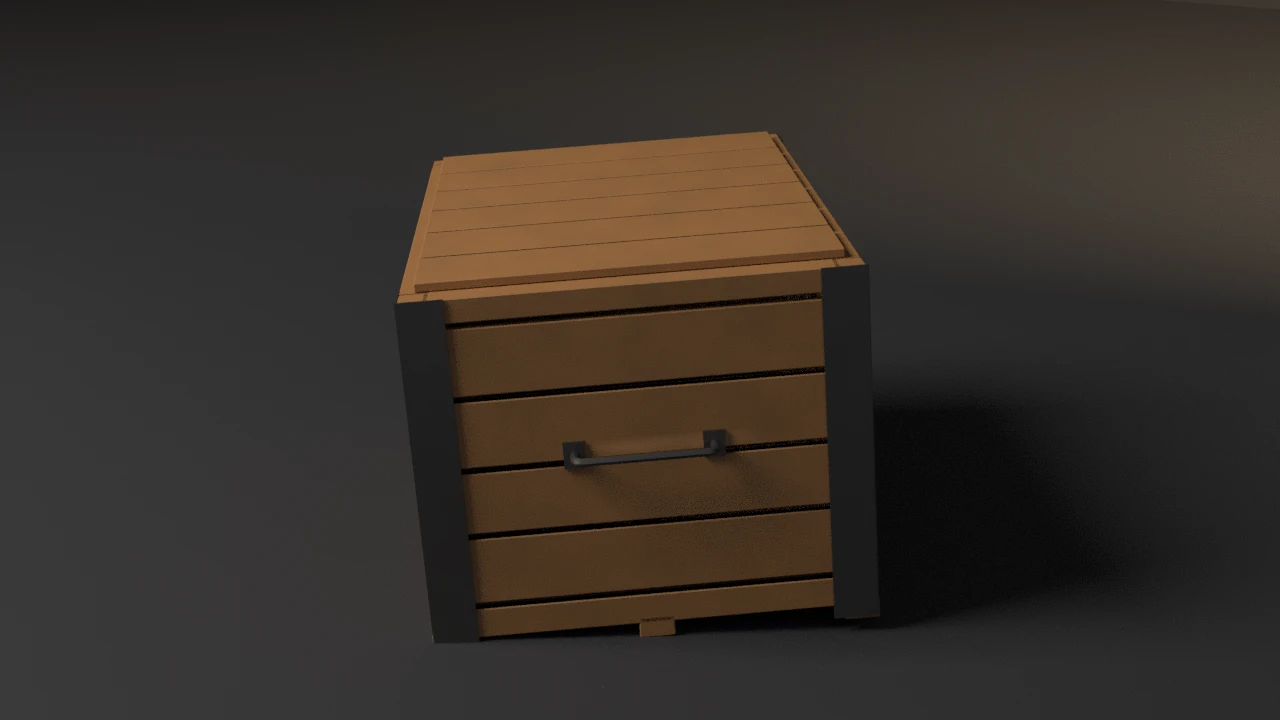
shipping-crate
A procedural shipping crate through UVs, bake, LOD, collider, and Unity glTF, asserting recomputed budgets rather than an API contract.
A procedural six-wheeled planetary science rover in the rocker-bogie tradition on a patch of rocky red-grey regolith — a cream warm-electronics body with gold-foil insulation blankets quilted into puffed cells, anodised corner posts and a trimmed deck carrying instrument boxes, sample inlets, a calibration target, a UHF can and a whip; a finned radioisotope power unit on struts between two radiator fin banks; on each side a rocker pivoting on a boss in the body side through its eye and pin, and a bogie pinned in a clevis on its front end, the two rockers linked through cranks and links to a differential bar on the deck so they turn equal and opposite; six 0.50 m aluminium drum wheels with 24 chevron grousers, six curved titanium flexure spokes and a drive actuator each, the four corners hanging from steering actuators through C-brackets; a camera mast with a laser telescope window, two camera barrels and navigation cameras; a high-gain dish on a two-axis gimbal; a 5-DOF arm whose turret drills a boulder; cable harnesses along every leg, the mast and the arm; ruts trailing behind both wheel lines and 19 broken rocks, the regolith fitted so every wheel sinks into it — through UVs, bake, LOD, collider, and Unity glTF, asserting recomputed budgets rather than an API contract.
Rendered headless by the showcase piece itself — click to zoom.
category Vehicles
blender --background --python showcase/planet-rover/planet_rover.py --
A showcase piece, not an example, and the sixth in the vehicles category. It builds a procedural six-wheeled planetary science rover in the rocker-bogie tradition (generic: no agency marks, flags or text), standing on a patch of rocky red-grey regolith with its arm reaching down to drill a boulder:
The stance is set by named constants: each rocker deflects 4° (left up, right down) and the bogies sit at −6° and +5° on their rockers. The differential bar turns so each link stays square to the rover's axis. The regolith is built to carry that stance: a closed-form field, the two ruts, and six Gaussians fitted by a 6×6 solve so the surface passes through each wheel's contact height with the grouser tips 12 mm into it. The fitted Gaussians are long across the track and short along it, so each wheel sits level across its width.
It asserts budget conformance of the generated result. It does not witness an API contract. "It rendered without error" is not a check.
Composes skills mesh-editing-and-bmesh, bake-high-to-low, depsgraph-and-evaluated-data, engine-export-presets, and snippets bake_normal_high_to_low.py, setup_bake_target_image.py, lod_chain.py / decimate_to_budget.py, convex_hull_collider.py, export_preset_unity.py (helpers copied inline, not imported).
Intended size: 2.70 m across the wheels' outer faces, 3.35 m from the power unit's fins to the turret, 2.10 m from the wheels' contact plane to the top of the mast head; a 2.05 m wheelbase on 0.51 m wheels. The regolith patch is 4.86 × 3.71 m. The origin is under the patch, so it lands on its base.
Every budget is declared as a named constant. Every gate recomputes its value from the mesh, materials, UVs, evaluated LOD, collider, or export file.
| Axis | Declared | Measured (5.2.1) |
|---|---|---|
| Base triangles | 45600–46600 | 46096 |
| LOD1 ratio | 0.32–0.62 of base | 0.5000 |
| LOD2 ratio | 0.10–0.35 of base | 0.2189 |
| Materials | exactly 9 distinct; ≥2260 paint, ≥1140 foil, ≥5820 aluminium, ≥8390 anodised, ≥2150 titanium, ≥600 glass, ≥870 harness, ≥2260 regolith, ≥550 rock faces | 9 slots; 2512 / 1276 / 6476 / 9330 / 2392 / 672 / 970 / 2516 / 620 |
| UVs | in 0..1, AABB overlap ≤ 1e-5 | in range, overlap 0 |
| Outer AABB | (4.857, 3.709, 2.200) m ± 0.01 | (4.8568, 3.7091, 2.1999), zmin 0 |
| Collider tris | ≤ 1160 | 1120 |
| Export | written, size > 0, removed after measuring | 3563808 bytes |
Every falsifier leaves the triangle count at 46096: they move parts, never add or remove them. DECIMATE COLLAPSE triangle counts are not identical across Blender series, so the LOD gate is a ratio band, not an exact count. Bake pixels are stochastic, so the bake gate is has_data plus operator FINISHED, not byte-identity. The low mesh is baked against a high copy whose edges over 35° are bevelled in three segments. The rocks' shapes come from a seeded random.Random; everything else is closed-form, and two default runs print identical measurements (and an identical export size).
Recomputed from the generated mesh, not asserted about the script.
| Axis | Declared | Measured |
|---|---|---|
| Non-manifold edges | 0 | 0 |
| Loose verts / edges | 0 / 0 | 0 / 0 |
| Doubles merged at 1e-5 | 0 | 0 |
| Zero-area faces | 0 | 0 |
| N-gons | 0 | 0 |
| Coplanar cross-shell face pairs (KD range 0.05 m, plane ε 1e-4) | 0 | 0 |
Grounded: zmin | within 1e-4 of 0 | 0.0000 |
What the coplanar budget caught while the piece was built, and what fixed each (none by widening a band):
| Axis | Declared | Measured |
|---|---|---|
| Every wheel sunk into the regolith: the deepest drum or grouser vertex below the surface read off the terrain shell (a ray down onto it at the vertex) | 0.006–0.025 m, all six | 0.0124, 0.0189, 0.0115, 0.0142, 0.0116, 0.0159 m |
| Pivot pins coaxial: each rocker and bogie pivot has one pin and its bushings (body boss and rocker eye; two lug bushings and the bogie eye), each bushing's centre on the pin's lathe axis, parallel to it and within its span | ≤ 0.5 mm off; ≤ 0.3° | 0.000000 m; 0.0000° (4 joints, 10 bushings) |
| Grousers seated: 24 a wheel; every grouser's root inside the drum's skin (radius read off the drum's own vertices) and its crown proud of it | root 0.5–2.5 mm in; crown ≥ 5 mm proud | 144; 1.00 mm; 7.50 mm |
| Mast plumb (its tube's lathe axis) and size: track over the drums, length over every rover part, height from the wheels' contact plane (mean of their lowest points) to the head's top | ≤ 0.2°; 2.700 ± 0.006 m; 3.351 ± 0.01 m; 2.100 ± 0.01 m | 0.0000°; 2.7000; 3.3509; 2.1004 m |
| Differential: each rocker's deflection read off its crank pin's centre against its pivot pin's (the crank stands plumb at neutral); equal and opposite; each link's eye on its crank pin's axis | residual ≤ 0.10°; eye ≤ 0.5 mm off | +4.0000°, −4.0000°: 0.0000°; 0.000000 m |
| Steering axes: each corner wheel's steering actuator axis (lathe axis) through its drum's centre | ≤ 1.0 mm | 0.000000 m (4 corners) |
| Axles level and lateral: each drum's axis against the lateral axis | ≤ 0.20° | 0.0000° |
| Grouser pitch: angular gaps between neighbouring grousers round each wheel | within 0.30° of 15° | 0.0148° |
| Stance: mass centre (shell volumes × density per material, the regolith and rocks excluded) inside the convex hull of the six wheels' contact patches, by at least the margin that keeps it standing tilted 45° any way (height of the mass centre above the contacts × tan 45°) | margin ≥ need | 1.0480 m ≥ 0.8170 m (750.0 kg, centre at x −0.026, y 0.004, z 0.915) |
| One connected assembly (union of shells whose BVH trees overlap; faceless shells are hygiene, not parts) | 1 component | 1 (441 shells) |
The rockers' mirror link is what the differential is for: when one rocker turns up, the bar turns and pulls the other down by the same angle, so the body stays level. The deflection is read at the crank because the crank is rigid with the rocker and plumb at neutral; the design angle is never consulted. Grouser pitch deviates 0.015° because alternate grousers' end stations are staggered 0.3 mm across the drum to keep their end caps off each other's planes, which moves each grouser's centroid a hair.
The wheels sink 11–19 mm: the fitted surface puts the grouser tips 12 mm in at each wheel's contact, and the deepest point of a wheel is a grouser tip at a drum edge where the rut's floor meets the low-frequency slope of the field. A first draft let the rut's full depth span only ±0.16 m of a 0.40 m wheel, and the drum edges dug 29–32 mm in; the rut floor is now level and full width (±0.215 m).
Each falsifier violates one named budget. Every one was run on 5.2.1 and exited its declared code, with every other budget green (budget_fails lists only its own) and the triangle count unchanged.
| Flag | Budget violated | Exit |
|---|---|---|
--skip-decimate | LOD1 ratio band (measured 1.0000) | 9 |
--stray-vert | loose vertex count is 0 (measured 1) | 15 |
--lift-z | bounding box zmin is 0 (measured 0.05000) | 16 |
--float-wheel | every wheel sunk into the regolith (the right middle wheel lifted 30 mm off its actuator: sink −0.0184 m) | 16 |
--offset-pin | pivot pins coaxial (the right bogie pin 4 mm forward: 0.00400 m off its bushings' axis) | 17 |
--sink-grousers | grousers seated (the right front wheel's grousers pressed 3 mm into the drum: root 0.00400 m in, crown 0.00450 m proud) | 18 |
--lean-mast | mast plumb and size (the mast turned 1.5° about its foot: tilt 1.5000°, height 2.1034 m still in band) | 19 |
--jam-rocker | differential (the right rocker turned 1.5° past the bar: deflections +4.0°, −2.5°, residual 1.5000°, link eye 0.00785 m off its crank pin) | 20 |
--offset-steer | steering axes (the right front steering actuator 10 mm forward: 0.01000 m off the wheel's centre) | 21 |
--camber-wheel | axles level and lateral (the right front wheel tilted 1° about its centre: 1.0000°) | 22 |
--bunch-grousers | grouser pitch (one right front grouser turned 3° about the axle: pitch off by 3.0148°) | 23 |
--overload-turret | stance (the turret 40 times its mass, 296.7 kg: centre at x 0.467, margin 0.6645 m < 0.7470 m) | 24 |
--loose-dish | one connected assembly (the dish, hub, feed and struts lifted 0.12 m along the boresight off the elevation axle: 2 components, 6 shells and 435) | 25 |
--float-wheel lifts the middle wheel because its contact patch lies on the support polygon's edge between the front and rear wheels' patches: its first draft lifted the right front wheel, which also removed a corner of the polygon and failed the stance budget with it. --sink-grousers replaced a first draft that floated the grousers 3 mm off the skin; that also split them from the drum and failed the assembly budget. Pressed in, they stay attached and only the seat band sees them; the wheel still sinks in band (the tips are 3 mm higher). --jam-rocker keeps the regolith fitted to the jammed stance (the wheels still sink in band) and builds the differential for the nominal one, so only the differential sees it; the height moves 3 mm, inside its band. --loose-dish's first draft moved the dish 60 mm and left the hub still round the axle (exit 0); the dish hangs on the gimbal by that one joint, and at 0.12 m it comes away alone. --camber-wheel widens the track 4.3 mm, inside its 6 mm tolerance, and --lean-mast raises the envelope 2.9 mm, inside BBOX_TOL.
blender --background --python planet_rover.py --
blender --background --python planet_rover.py -- --skip-decimate
blender --background --python planet_rover.py -- --stray-vert
blender --background --python planet_rover.py -- --lift-z
blender --background --python planet_rover.py -- --float-wheel
blender --background --python planet_rover.py -- --offset-pin
blender --background --python planet_rover.py -- --sink-grousers
blender --background --python planet_rover.py -- --lean-mast
blender --background --python planet_rover.py -- --jam-rocker
blender --background --python planet_rover.py -- --offset-steer
blender --background --python planet_rover.py -- --camber-wheel
blender --background --python planet_rover.py -- --bunch-grousers
blender --background --python planet_rover.py -- --overload-turret
blender --background --python planet_rover.py -- --loose-dish
blender --background --python planet_rover.py -- --output rover.png
Smoke passes no flags.
The hero turns the piece HERO_YAW_DEG (−2°) and views it from the right front, high: the right-hand rocker and bogie in profile, the arm drilling the boulder at the right, the mast and dish above, and the ruts trailing away to the left behind the rear wheel. The wall stands 4.2 m behind the patch and the warm wedge pools on it. Aluminium, titanium, foil and lens glass carry the reflection-vector studio from espresso-machine so they read as metal and glass on the dark stage.
File-local. 9 is a valid check code. 10 is reserved for gallery_framing.check_framing on the --output path. 15–19 are the hygiene and joint-fit family. 20–25 are file-local. 26 is the asset-quality floor on the render path: check_asset_quality returns 11, which this piece already spends on the collider ceiling, so the call site remaps it.
| Code | Meaning |
|---|---|
| 0 | Success |
| 1 | Uncaught exception (FATAL wrapper) |
| 2 | argparse / usage |
| 3 | Mesh did not build / no UV layer |
| 4 | Base triangle count outside range |
| 5 | Material count ≠ 9 distinct slots, or a face-count floor missed |
| 6 | UVs outside 0..1 |
| 7 | UV AABB overlap above tolerance |
| 8 | World AABB off declared outer size |
| 9 | LOD ratio band (--skip-decimate lands here) |
| 10 | Framing gate (render path only) |
| 11 | Collider triangle count above ceiling |
| 12 | Bake did not finish or image has no data |
| 13 | Export file missing or empty |
| 14 | --output produced no file |
| 15 | Mesh hygiene: loose, non-manifold, zero-area, doubles, n-gons, coplanar cross-shell pairs (--stray-vert) |
| 16 | Not grounded: bounding box zmin off 0, or a wheel not sunk into the regolith within its band (--lift-z, --float-wheel) |
| 17 | A rocker or bogie pivot bushing off its pin's axis, tilted to it or outside its span (--offset-pin) |
| 18 | Grousers: count, root inside the drum's skin outside its band, or crown not proud enough (--sink-grousers) |
| 19 | Mast off plumb, or track, length or height off size (--lean-mast) |
| 20 | Differential: rocker deflections not equal and opposite, or a link eye off its crank pin (--jam-rocker) |
| 21 | A corner wheel's steering axis off its centre (--offset-steer) |
| 22 | A wheel's axle off level or off the lateral (--camber-wheel) |
| 23 | Grouser pitch uneven round a wheel (--bunch-grousers) |
| 24 | Stance: mass centre inside the contact polygon by less than the 45° tip margin (--overload-turret) |
| 25 | Assembly splits into more than one connected component (--loose-dish) |
| 26 | Asset-quality floor (render path only; remapped from 11) |
"""Game-ready planetary science rover — a showcase piece, not an example. Asserts budget conformance of a procedural six-wheeled rocker-bogie rover standing on a patch of rocky regolith, after composing shipped pipeline pieces: bmesh construction, UVs, nine materials, high-to-low normal bake, LOD chain, convex collider, Unity glTF export. A warm-electronics body box in cream paint with gold-foil quilted insulation blankets on its sides and front, a deck plate carrying instrument boxes with sample inlets, a remote-sensing mast, a high-gain dish on a two-axis gimbal, a low-gain whip and a UHF can; a finned radioisotope power unit on struts at the rear between two radiator fin banks. On each side a rocker pivots on a boss in the body side and carries the rear wheel; a bogie pinned in a clevis on the rocker's front end carries the middle and front wheels. The two rockers are linked through a differential: a crank above each rocker pivot, a link to each end of a bar pivoting on the deck, so the rockers turn equal and opposite. Six cleated aluminium wheels, each a drum with 24 chevron grousers, six curved titanium flexure spokes and a hub on a drive actuator; the four corner wheels hang from steering actuators through C-brackets. The mast carries an azimuth actuator, an elevation yoke and a camera head with a laser telescope window, two camera barrels of different focal lengths and a navigation camera pair; two weather booms on its shaft. A 5-DOF arm reaches down from the body's front: shoulder azimuth and elevation, elbow, wrist and a turret roll, the turret carrying a drill with stabiliser prongs over a boulder, a contact spectrometer, a scoop and a hand-lens camera. Cable harnesses run along every leg, the mast and the arm. The regolith is a closed-form surface with wheel ruts trailing behind both wheel lines; its surface is fitted so every wheel sinks into it; broken rocks lie scattered and sealed into it. Budgets are declared below and recomputed from the generated result. They are not API-contract witnesses. Each falsifier violates one named budget: ``--skip-decimate`` the LOD-ratio band, ``--stray-vert`` mesh hygiene, ``--lift-z`` grounded zmin, ``--float-wheel`` every wheel sunk into the regolith, ``--offset-pin`` the rocker and bogie pivot pins coaxial with their bushings, ``--sink-grousers`` every grouser seated on its drum, ``--lean-mast`` the mast plumb and the rover's size, ``--jam-rocker`` the two rockers equal and opposite through the differential, ``--offset-steer`` every steering axis through its wheel's centre, ``--camber-wheel`` every axle level and lateral, ``--bunch-grousers`` equal grouser pitch, ``--overload-turret`` the mass centre inside the support polygon with a tip-over margin, ``--loose-dish`` one connected assembly. The only RNG is a seeded ``random.Random`` for the rocks' shapes; the rest is closed-form. DECIMATE COLLAPSE triangle counts are not byte-identical across Blender versions — the LOD gate is a ratio band, not an exact count. blender --background --python planet_rover.py -- blender --background --python planet_rover.py -- --skip-decimate blender --background --python planet_rover.py -- --output rover.png """ import argparse import math import os import random import sys import tempfile import traceback import bmesh import bpy import numpy as np from mathutils import Matrix, Vector from mathutils.bvhtree import BVHTree from mathutils.kdtree import KDTree # Showcase lives at repo-root/showcase/, not under examples/. The framing # helper is the repo's only shared import and lives next to the examples; # resolve the repo root so we do not move gallery_framing.py. _REPO = os.path.abspath( os.path.join(os.path.dirname(os.path.abspath(__file__)), os.pardir, os.pardir) ) sys.path.insert(0, os.path.join(_REPO, "examples")) sys.dont_write_bytecode = True import gallery_framing # noqa: E402 import gallery_asset_quality # noqa: E402 # --- Layout (front at +X, the rover's left at +Y; G is the regolith datum) --------- G = 0.11 R_SKIN = 0.2475 # wheel drum outer skin: a 0.50 m wheel GR_H = 0.0075 # grouser height proud of the skin GR_BITE = 0.0010 # grouser root inside the skin GR_W = 0.0040 # grouser half width R_TIP = R_SKIN + GR_H SINK = 0.012 # design sink of the grouser tips into the regolith WHEEL_Y = 1.15 W_HALF = 0.20 # drum half width: 0.40 m wheels ZC0 = G + R_TIP - SINK # wheel centre height in the rest pose WHEEL_X = (1.05, 0.05, -1.00) # front, middle, rear N_GR = 24 CHEV = 0.12 # grouser chevron sweep at the drum edge (rad) DRUM_SEGS = 36 N_SPOKE = 6 PIV_X, PIV_Y, PIV_Z = -0.15, 0.715, G + 0.88 # rocker pivot (differential axis) BOG_X, BOG_Z = 0.52, G + 0.56 # bogie pivot on the rocker's front end ROCKER_DEG = 4.0 # each rocker's deflection, equal and opposite BOGIE_DEG = (-6.0, 5.0) # left, right bogie angle on its rocker CRANK_L = 0.30 # differential crank above the rocker pivot LINK_Y = 0.6645 # link eye's mid-plane on the crank pin BAR_Y = 0.46 # differential bar end radius BAR_Z = G + 1.25 BODY_CX, BODY_HX, BODY_HY = 0.02, 0.80, 0.58 BODY_Z0, BODY_Z1 = G + 0.60, G + 1.10 DECK_Z = G + 1.115 # deck plate top FOOT_Z = G + 1.102 # bottom of anything standing on the deck MAST_X, MAST_Y = 0.58, -0.40 HEAD_AZ = math.radians(-32.0) HEAD_PITCH = math.radians(-8.0) MAST_AX_Z = G + 1.989 # mast head elevation axis ARM_S = Vector((0.92, 0.18, G + 1.06)) # shoulder elevation axis ARM_UP = (0.70, math.radians(15.0)) # upper arm length, elevation ARM_FORE = (0.70, math.radians(-95.0)) # forearm length, elevation TURRET_OFF = 0.21 HGA_X, HGA_Y = -0.50, 0.36 HGA_AZ = math.radians(-40.0) HGA_EL = math.radians(45.0) HGA_AX_Z = G + 1.42 DISH_R, DISH_F, DISH_W0 = 0.30, 0.19, 0.09 RTG_Q = Vector((-1.03, 0.0, G + 0.62)) RTG_D = Vector((-0.40, 0.0, 0.917)).normalized() # Regolith patch: a superellipse (n = 4) with a wobbled outline. PATCH_C = (-0.05, 0.0) PATCH_A, PATCH_B = 2.30, 1.75 TERRAIN_NU, TERRAIN_NV = 52, 38 EDGE_DROP = 0.045 RUT_D = 0.018 BERM_H = 0.012 RBF_SIGMA = (0.42, 0.75) # along, across the track # --- Falsifier sizes ----------------------------------------------------------------- FLOAT_WHEEL = 0.030 OFFSET_PIN = 0.004 SINK_GROUSERS = 0.003 LEAN_MAST_DEG = 1.5 JAM_DEG = 1.5 OFFSET_STEER = 0.010 CAMBER_DEG = 1.0 BUNCH_DEG = 3.0 OVERLOAD = 40.0 LOOSE_DISH = 0.120 FALSIFY_WHEEL = 3 # right front FLOAT_UNIT = 4 # right middle: its contact lies on the support polygon's edge BBOX_TOL = 0.01 # Fitted after locking geometry. Recomputed from bound_box. OUTER_SIZE = (4.857, 3.709, 2.200) BASE_TRIS_MIN = 45600 BASE_TRIS_MAX = 46600 LOD1_RATIO_MIN = 0.32 LOD1_RATIO_MAX = 0.62 LOD2_RATIO_MIN = 0.10 LOD2_RATIO_MAX = 0.35 LOD1_TARGET = 0.50 LOD2_TARGET = 0.22 MATERIAL_COUNT = 9 UV_EPS = 1e-4 UV_OVERLAP_MAX = 1e-5 COLLIDER_TRIS_MAX = 1160 BAKE_RES = 1024 CAGE_EXTRUSION = 0.003 # per slot: paint, foil, alu, anodised, titanium, glass, harness, regolith, rock FACE_FLOORS = (2260, 1140, 5820, 8390, 2150, 600, 870, 2260, 550) ZMIN_EPS = 1e-4 DOUBLES_EPS = 1e-5 AREA_EPS = 1e-10 COPLANAR_NORMAL_EPS = 1e-4 COPLANAR_PLANE_EPS = 1e-4 COPLANAR_CENTRE_MAX = 0.05 LIFT_Z = 0.05 # Every wheel sunk into the regolith: the deepest wheel vertex below the surface. SINK_MIN, SINK_MAX = 0.006, 0.025 # Pivot pins coaxial with their bushings. PIN_OFF_TOL = 0.0005 PIN_TILT_MAX_DEG = 0.3 # Grousers seated on the drum skin and proud of it. GR_BITE_MIN, GR_BITE_MAX = 0.0005, 0.0025 GR_PROUD_MIN = 0.0050 # Mast plumb; rover size. MAST_TILT_MAX_DEG = 0.2 TRACK_WIDTH = 2.700 TRACK_TOL = 0.006 ROVER_HEIGHT = 2.100 ROVER_LENGTH = 3.351 SIZE_TOL = 0.010 # Differential: rockers equal and opposite, link eyes on their crank pins. DIFF_TOL_DEG = 0.10 LINK_OFF_TOL = 0.0005 # Steering axes through the corner wheels' centres. STEER_OFF_TOL = 0.0010 # Axles level and lateral. AXLE_TOL_DEG = 0.20 # Grouser pitch. PITCH_TOL_DEG = 0.30 # Stance: mass centre inside the contact polygon by the 30-degree tip margin. TIP_DEG = 45.0 HERO_YAW_DEG = -2.0 WALL_Y = 4.2 (PAINT_IDX, FOIL_IDX, ALU_IDX, ANOD_IDX, TITAN_IDX, GLASS_IDX, HARNESS_IDX, REGOLITH_IDX, ROCK_IDX) = range(9) # Densities (kg/m^3) per material slot for the stance audit: the body box and # instrument boxes are modelled solid but are hollow shells full of # electronics, so they carry an effective density; regolith and rock are # ground, not rover (0). DENSITY = (330.0, 330.0, 2700.0, 1600.0, 2400.0, 2500.0, 1400.0, 0.0, 0.0) # Part tags: face attributes naming which part a face belongs to, so the # audits can find the shells they measure. Every measured value is read from # the vertices, never from these constants. (T_NONE, T_TERRAIN, T_ROCK, T_DRUM, T_GROUSER, T_STEER, T_PIN, T_BUSH, T_CRANKPIN, T_LINKEYE, T_MAST, T_TURRET, T_DISH, T_HUB, T_SPOKE) = range(15) ZAX = Vector((0.0, 0.0, 1.0)) YAX = Vector((0.0, 1.0, 0.0)) XAX = Vector((1.0, 0.0, 0.0)) def eevee_engine_id(): return "BLENDER_EEVEE" if bpy.app.version >= (5, 0, 0) else "BLENDER_EEVEE_NEXT" def fail(msg, code): print(f"ERROR: {msg}", file=sys.stderr) return code def triangle_count(mesh): mesh.calc_loop_triangles() return len(mesh.loop_triangles) def evaluated_triangle_count(obj): # Duplicated from snippets/lod_chain.py / decimate_to_budget.py (not a package). depsgraph = bpy.context.evaluated_depsgraph_get() eval_obj = obj.evaluated_get(depsgraph) eval_mesh = eval_obj.to_mesh() try: eval_mesh.calc_loop_triangles() return len(eval_mesh.loop_triangles) finally: eval_obj.to_mesh_clear() # -------------------------------------------------------------------------- # Construction helpers (copied from showcase/road-bicycle, not imported) # -------------------------------------------------------------------------- class Build: """The bmesh under construction, its part-tag and unit layers and named vertex groups (for the pose and for the falsifiers that move one assembly).""" def __init__(self, bm): self.bm = bm self.tag = bm.faces.layers.int.new("part") self.unit = bm.faces.layers.int.new("unit") self.tone = bm.faces.layers.float.new("Tone") self.rut = bm.verts.layers.float.new("RutMask") self.groups = {} self.bevel = [] def part(self, tag=T_NONE, unit=0, *groups, bevel=False, tone=0.5): return _Part(self, tag, unit, groups, bevel, tone) def verts(self, *names): out = set() for n in names: out.update(self.groups.get(n, [])) return out class _Part: def __init__(self, b, tag, unit, groups, bevel, tone): self.b, self.t, self.u, self.g, self.bevel, self.tone = b, tag, unit, groups, bevel, tone def __enter__(self): self.nf = len(self.b.bm.faces) self.nv = len(self.b.bm.verts) return self def __exit__(self, *exc): bm = self.b.bm bm.faces.ensure_lookup_table() bm.verts.ensure_lookup_table() for i in range(self.nf, len(bm.faces)): f = bm.faces[i] f[self.b.tag] = self.t f[self.b.unit] = self.u f[self.b.tone] = self.tone vs = [bm.verts[i] for i in range(self.nv, len(bm.verts))] for g in self.g: self.b.groups.setdefault(g, []).extend(vs) if self.bevel: self.b.bevel.extend(vs) return False def _mark(faces, mat_idx): for f in faces: f.material_index = mat_idx def frame(ez, ex_hint): """Rotation whose local Z is ``ez`` and local X is ``ex_hint`` made orthogonal to it (columns ex, ey, ez; right-handed).""" ez = Vector(ez).normalized() ex = Vector(ex_hint) ex = (ex - ez * ex.dot(ez)).normalized() ey = ez.cross(ex) return Matrix((ex, ey, ez)).transposed() def add_lathe(bm, profile, segs, mat_idx, center=(0.0, 0.0, 0.0), rot=None, phase=0.0, solid=False, seg_mats=None): """Revolve a profile [(r, z), ...] about local Z. ``solid``: the profile is an open polyline closed by n-gon caps at its two ends; otherwise it is a closed polygon revolved into a ring shell.""" c = Vector(center) m = rot if rot is not None else Matrix.Identity(3) rings = [] for i in range(segs): a = phase + 2.0 * math.pi * i / segs ca, sa = math.cos(a), math.sin(a) rings.append([bm.verts.new(c + m @ Vector((r * ca, r * sa, z))) for r, z in profile]) n = len(profile) last = n - 1 if solid else n for i in range(segs): r0, r1 = rings[i], rings[(i + 1) % segs] for j in range(last): k = (j + 1) % n f = bm.faces.new((r0[j], r1[j], r1[k], r0[k])) f.material_index = seg_mats[j] if seg_mats else mat_idx if solid: f0 = bm.faces.new([rings[i][0] for i in reversed(range(segs))]) f1 = bm.faces.new([rings[i][n - 1] for i in range(segs)]) f0.material_index = mat_idx f1.material_index = mat_idx return [v for ring in rings for v in ring] def lathe_on(bm, profile, segs, mat_idx, center, axis, ref=XAX, solid=True, phase=0.0, seg_mats=None): axis = Vector(axis).normalized() if abs(axis.dot(Vector(ref))) > 0.9: ref = ZAX if abs(axis.z) < 0.9 else YAX return add_lathe(bm, profile, segs, mat_idx, center=center, rot=frame(axis, ref), solid=solid, phase=phase, seg_mats=seg_mats) def add_sweep(bm, pts, radius, sides, mat_idx, phase=0.0, ref=None): """Capped tube swept along a polyline with parallel-transport frames.""" pts = [Vector(p) for p in pts] n = len(pts) radii = list(radius) if isinstance(radius, (list, tuple)) else [radius] * n tans = [] for i in range(n): a = pts[max(i - 1, 0)] b = pts[min(i + 1, n - 1)] tans.append((b - a).normalized()) if ref is None: ref = ZAX if abs(tans[0].z) < 0.9 else XAX nrm = (Vector(ref) - tans[0] * Vector(ref).dot(tans[0])).normalized() rings = [] for i, (p, t) in enumerate(zip(pts, tans)): nrm = (nrm - t * nrm.dot(t)).normalized() bi = t.cross(nrm) ring = [] for k in range(sides): a = phase + 2.0 * math.pi * k / sides ring.append(bm.verts.new(p + radii[i] * (nrm * math.cos(a) + bi * math.sin(a)))) rings.append(ring) faces = [] for r0, r1 in zip(rings, rings[1:]): for k in range(sides): m = (k + 1) % sides faces.append(bm.faces.new((r0[k], r0[m], r1[m], r1[k]))) faces.append(bm.faces.new(tuple(reversed(rings[0])))) faces.append(bm.faces.new(tuple(rings[-1]))) _mark(faces, mat_idx) return [v for ring in rings for v in ring] def tube(bm, a, b, r, mat_idx, sides=12, phase=0.0): return add_sweep(bm, [a, b], r, sides, mat_idx, phase=phase) def rrect(ha, hb, rc, n_corner=4): """Rounded rectangle loop (counter-clockwise).""" rc = max(min(rc, ha - 1e-4, hb - 1e-4), 0.0003) pts = [] for k, (sx, sy) in enumerate(((1, 1), (-1, 1), (-1, -1), (1, -1))): cx, cy = sx * (ha - rc), sy * (hb - rc) a0 = 0.5 * math.pi * k for s in range(n_corner + 1): a = a0 + 0.5 * math.pi * s / n_corner pts.append((cx + rc * math.cos(a), cy + rc * math.sin(a))) return pts def add_rbox(bm, ha, hb, rc, profile, origin, rot, mat_idx, n_corner=2): """Loft of rounded rectangles along local Z: profile [(inset, z)].""" o = Vector(origin) rings = [] for inset, z in profile: loop = rrect(ha - inset, hb - inset, rc - inset, n_corner) rings.append([bm.verts.new(o + rot @ Vector((x, y, z))) for x, y in loop]) n = len(rings[0]) faces = [] for r0, r1 in zip(rings, rings[1:]): for k in range(n): m = (k + 1) % n faces.append(bm.faces.new((r0[k], r0[m], r1[m], r1[k]))) faces.append(bm.faces.new(tuple(reversed(rings[0])))) faces.append(bm.faces.new(tuple(rings[-1]))) _mark(faces, mat_idx) return [v for ring in rings for v in ring] def box_profile(z0, z1, c): return [(c, z0), (0.0, z0 + c), (0.0, z1 - c), (c, z1)] def add_box(bm, centre, half, rot, mat_idx, rc=0.006, c=0.003, n_corner=2): """Chamfered rounded box: ``half`` = (along local x, local y, local z).""" hx, hy, hz = half return add_rbox(bm, hx, hy, rc, box_profile(-hz, hz, c), centre, rot, mat_idx, n_corner) def add_plate_xz(bm, outline, y0, y1, mat_idx): """A world-XZ outline [(x, z)] extruded along Y from y0 to y1.""" a = [bm.verts.new((x, y0, z)) for x, z in outline] b = [bm.verts.new((x, y1, z)) for x, z in outline] n = len(outline) faces = [bm.faces.new((a[i], a[(i + 1) % n], b[(i + 1) % n], b[i])) for i in range(n)] faces.append(bm.faces.new(tuple(reversed(a)))) faces.append(bm.faces.new(tuple(b))) _mark(faces, mat_idx) return a + b def add_loft(bm, rings_pts, mat_idx): """Closed loops [[Vector]] lofted in order, n-gon caps at both ends.""" rings = [[bm.verts.new(p) for p in loop] for loop in rings_pts] n = len(rings[0]) faces = [] for r0, r1 in zip(rings, rings[1:]): for j in range(n): m = (j + 1) % n faces.append(bm.faces.new((r0[j], r0[m], r1[m], r1[j]))) faces.append(bm.faces.new(tuple(reversed(rings[0])))) faces.append(bm.faces.new(tuple(rings[-1]))) _mark(faces, mat_idx) return [v for ring in rings for v in ring] def add_bar(bm, pts, wax, half_w, half_t, rc, mat_idx, fillet=0.008, filleted=False, steps=3): """Flat bar bent in the plane normal to ``wax``: width along ``wax``, thickness in the bending plane; rounded-rectangle section.""" pts = [Vector(p) for p in pts] if filleted else fillet_path(pts, fillet, steps) wax = Vector(wax).normalized() sec = rrect(half_w, half_t, rc, 1) rings = [] for i, p in enumerate(pts): a = pts[max(i - 1, 0)] b = pts[min(i + 1, len(pts) - 1)] t = (b - a).normalized() w = (wax - t * wax.dot(t)).normalized() th = t.cross(w) rings.append([bm.verts.new(p + w * x + th * y) for x, y in sec]) n = len(sec) faces = [] for r0, r1 in zip(rings, rings[1:]): for k in range(n): m = (k + 1) % n faces.append(bm.faces.new((r0[k], r0[m], r1[m], r1[k]))) faces.append(bm.faces.new(tuple(reversed(rings[0])))) faces.append(bm.faces.new(tuple(rings[-1]))) _mark(faces, mat_idx) return [v for ring in rings for v in ring] def fillet_path(pts, rf, steps=4): pts = [Vector(p) for p in pts] out = [pts[0]] for i in range(1, len(pts) - 1): a, p, b = pts[i - 1], pts[i], pts[i + 1] r = min(rf, (a - p).length * 0.45, (b - p).length * 0.45) p0 = p + (a - p).normalized() * r p1 = p + (b - p).normalized() * r for k in range(steps + 1): t = k / steps out.append((1 - t) ** 2 * p0 + 2 * (1 - t) * t * p + t * t * p1) out.append(pts[-1]) return out def triangulate_ngons(bm): faces = [f for f in bm.faces if len(f.verts) > 4] if faces: bmesh.ops.triangulate(bm, faces=faces) def pack_uvs(bm, margin=0.08): uv = bm.loops.layers.uv.new("UVMap") faces = list(bm.faces) n = len(faces) cols = max(1, math.ceil(math.sqrt(n))) rows = max(1, math.ceil(n / cols)) cell_w = 1.0 / cols cell_h = 1.0 / rows pad_u = margin * cell_w * 0.5 pad_v = margin * cell_h * 0.5 usable_w = cell_w - 2.0 * pad_u usable_h = cell_h - 2.0 * pad_v for i, face in enumerate(faces): col = i % cols row = i // cols nrm = face.normal ax, ay, az = abs(nrm.x), abs(nrm.y), abs(nrm.z) coords = [] for loop in face.loops: co = loop.vert.co if az >= ax and az >= ay: coords.append((co.x, co.y)) elif ax >= ay: coords.append((co.y, co.z)) else: coords.append((co.x, co.z)) xs = [c[0] for c in coords] ys = [c[1] for c in coords] minx, maxx = min(xs), max(xs) miny, maxy = min(ys), max(ys) dx = max(maxx - minx, 1e-8) dy = max(maxy - miny, 1e-8) origin_u = col * cell_w + pad_u origin_v = row * cell_h + pad_v for loop, (x, y) in zip(face.loops, coords): loop[uv].uv = ( origin_u + (x - minx) / dx * usable_w, origin_v + (y - miny) / dy * usable_h, ) def hull2d(pts): """Convex hull, counter-clockwise (monotone chain).""" pts = sorted(set((round(x, 9), round(y, 9)) for x, y in pts)) def cross(o, a, b): return (a[0] - o[0]) * (b[1] - o[1]) - (a[1] - o[1]) * (b[0] - o[0]) lower, upper = [], [] for p in pts: while len(lower) >= 2 and cross(lower[-2], lower[-1], p) <= 1e-12: lower.pop() lower.append(p) for p in reversed(pts): while len(upper) >= 2 and cross(upper[-2], upper[-1], p) <= 1e-12: upper.pop() upper.append(p) return lower[:-1] + upper[:-1] def circle_pts(cx, cz, r, n=16, phase=0.0): return [(cx + r * math.cos(phase + 2.0 * math.pi * k / n), cz + r * math.sin(phase + 2.0 * math.pi * k / n)) for k in range(n)] def smoothstep(e0, e1, x): t = min(max((x - e0) / (e1 - e0), 0.0), 1.0) return t * t * (3.0 - 2.0 * t) def rot_y(p, c, ang): return Vector(c) + Matrix.Rotation(ang, 3, "Y") @ (Vector(p) - Vector(c)) def ymir(p, s): return Vector((p[0], s * p[1], p[2])) # -------------------------------------------------------------------------- # Pose: the rocker and bogie angles and where they put each wheel # -------------------------------------------------------------------------- def side_angles(s, jam=False): """(rocker angle, bogie angle) for side s; the rockers are equal and opposite through the differential; ``jam`` turns the right rocker past what the differential allows.""" ar = math.radians(ROCKER_DEG) * s if jam and s < 0: ar += math.radians(JAM_DEG) ab = math.radians(BOGIE_DEG[0 if s > 0 else 1]) return ar, ab def pivots(s): return Vector((PIV_X, s * PIV_Y, PIV_Z)), Vector((BOG_X, s * PIV_Y, BOG_Z)) def pose_point(p, s, on_bogie, jam=False): ar, ab = side_angles(s, jam) piv, bog = pivots(s) q = Vector(p) if on_bogie: q = rot_y(q, bog, ab) return rot_y(q, piv, ar) def wheel_centres(jam=False): """unit -> posed wheel centre; units 0..2 left front/middle/rear, 3..5 right.""" out = {} for s in (1.0, -1.0): for k in range(3): u = k + (0 if s > 0 else 3) rest = Vector((WHEEL_X[k], s * WHEEL_Y, ZC0)) out[u] = pose_point(rest, s, k < 2, jam) return out # -------------------------------------------------------------------------- # Regolith # -------------------------------------------------------------------------- def wob(th): return 1.0 + 0.035 * math.cos(3 * th + 0.7) + 0.025 * math.cos(5 * th + 2.1) \ + 0.012 * math.cos(7 * th + 0.3) def patch_m(x, y): lx = (x - PATCH_C[0]) / PATCH_A ly = (y - PATCH_C[1]) / PATCH_B th = math.atan2(ly, lx) return (lx ** 4 + ly ** 4) ** 0.25 / wob(th) def patch_point(u, v): """Grid (u, v) in [-1, 1]^2 onto the wobbled superellipse: each square ring of the grid lands on one superellipse ring.""" m = max(abs(u), abs(v)) if m < 1e-12: return PATCH_C[0], PATCH_C[1] n4 = (u ** 4 + v ** 4) ** 0.25 px, py = u * m / n4, v * m / n4 w = wob(math.atan2(py, px)) return PATCH_C[0] + PATCH_A * px * w, PATCH_C[1] + PATCH_B * py * w class Regolith: """The regolith's surface: a closed-form field, two ruts trailing behind the wheel lines, and a sum of Gaussians fitted so the surface passes through each wheel's contact height (the grouser tips SINK into it).""" def __init__(self, centres): self.front_x = {1.0: centres[0].x, -1.0: centres[3].x} self.c = [] rhs = [] for u in sorted(centres): w = centres[u] self.c.append((w.x, w.y)) rhs.append(w.z - R_TIP + SINK - self.raw(w.x, w.y)) n = len(self.c) a = np.zeros((n, n)) for i in range(n): for j in range(n): a[i, j] = self.g(self.c[i], self.c[j][0], self.c[j][1]) self.w = [float(x) for x in np.linalg.solve(a, np.array(rhs))] @staticmethod def g(c, x, y): return math.exp(-((x - c[0]) ** 2 / (2.0 * RBF_SIGMA[0] ** 2) + (y - c[1]) ** 2 / (2.0 * RBF_SIGMA[1] ** 2))) def rut_terms(self, x, y): mask, berm = 0.0, 0.0 for s, xf in self.front_x.items(): d = abs(y - s * WHEEL_Y) along = 1.0 - smoothstep(xf + 0.02, xf + 0.20, x) mask = max(mask, (1.0 - smoothstep(0.215, 0.265, d)) * along) berm = max(berm, math.exp(-((d - 0.300) / 0.035) ** 2) * along) return mask, berm @staticmethod def low(x, y): return (0.022 * math.cos(1.25 * x + 0.4) * math.cos(1.05 * y - 0.7) + 0.012 * math.sin(2.7 * x - 1.3 * y + 0.5)) @staticmethod def fine(x, y): return (0.006 * math.cos(6.3 * x + 4.1 * y + 1.3) + 0.004 * math.sin(8.9 * y - 5.7 * x + 1.1) + 0.0025 * math.cos(13.1 * x - 11.3 * y)) def raw(self, x, y): """The field, with a rut pressed in along each wheel line: the rut's floor is level across the track (compacted), at the height of the track's centre line.""" mask, berm = self.rut_terms(x, y) z = G + self.low(x, y) + self.fine(x, y) * (1.0 - 0.8 * mask) if mask > 0.0: z += (G + self.low(x, math.copysign(WHEEL_Y, y)) - z) * mask return z - RUT_D * mask + BERM_H * berm def top(self, x, y): z = self.raw(x, y) for c, w in zip(self.c, self.w): z += w * self.g(c, x, y) return z - EDGE_DROP * smoothstep(0.80, 1.0, patch_m(x, y)) ** 1.5 def track_warp(n): """n + 1 grid values over [-1, 1], closer together across the two ruts (equal steps of a density that peaks on the wheel lines).""" vt = WHEEL_Y / PATCH_B k = 4000 xs = [-1.0 + 2.0 * i / k for i in range(k + 1)] dens = [1.0 + 1.6 * math.exp(-((abs(x) - vt) / 0.10) ** 2) for x in xs] cum = [0.0] for i in range(1, k + 1): cum.append(cum[-1] + 0.5 * (dens[i] + dens[i - 1]) * (xs[i] - xs[i - 1])) out, i = [], 0 for j in range(n + 1): target = cum[-1] * j / n while i < k - 1 and cum[i + 1] < target: i += 1 t = (target - cum[i]) / max(cum[i + 1] - cum[i], 1e-12) out.append(xs[i] + (xs[i + 1] - xs[i]) * min(max(t, 0.0), 1.0)) out[0], out[-1] = -1.0, 1.0 return out def add_regolith(b, field): bm = b.bm nu, nv = TERRAIN_NU, TERRAIN_NV vs = track_warp(nv) with b.part(T_TERRAIN, 0): grid = [] for j in range(nv + 1): row = [] for i in range(nu + 1): x, y = patch_point(-1.0 + 2.0 * i / nu, vs[j]) vert = bm.verts.new((x, y, field.top(x, y))) vert[b.rut] = field.rut_terms(x, y)[0] row.append(vert) grid.append(row) faces = [] for j in range(nv): for i in range(nu): faces.append(bm.faces.new((grid[j][i], grid[j][i + 1], grid[j + 1][i + 1], grid[j + 1][i]))) ring = ([grid[0][i] for i in range(nu + 1)] + [grid[j][nu] for j in range(1, nv + 1)] + [grid[nv][i] for i in reversed(range(nu))] + [grid[j][0] for j in reversed(range(1, nv))]) # a rolled skirt down to the floor rings = [ring] for push, frac in ((0.028, 0.45), (0.034, 0.0)): nr = [] for v in ring: d = Vector((v.co.x - PATCH_C[0], v.co.y - PATCH_C[1], 0.0)).normalized() nr.append(bm.verts.new((v.co.x + d.x * push, v.co.y + d.y * push, v.co.z * frac))) rings.append(nr) n = len(ring) for r0, r1 in zip(rings, rings[1:]): for k in range(n): m = (k + 1) % n faces.append(bm.faces.new((r0[k], r0[m], r1[m], r1[k]))) cen = bm.verts.new((PATCH_C[0], PATCH_C[1], 0.0)) last = rings[-1] for k in range(n): faces.append(bm.faces.new((cen, last[(k + 1) % n], last[k]))) _mark(faces, REGOLITH_IDX) # (x, y, half sizes, yaw, subdivisions): broken rocks; the first sits under the drill ROCKS = [ (None, None, (0.22, 0.18, 0.19), 0.4, 2), (-1.70, 0.45, (0.20, 0.15, 0.13), 1.1, 2), (-0.55, -0.33, (0.11, 0.09, 0.07), 2.0, 1), (0.35, 1.52, (0.13, 0.10, 0.09), 0.3, 2), (1.30, -0.62, (0.14, 0.11, 0.10), 2.6, 2), (-0.95, -1.52, (0.12, 0.09, 0.08), 0.9, 1), (1.95, 0.95, (0.08, 0.07, 0.06), 1.7, 1), (0.28, -1.53, (0.09, 0.07, 0.06), 0.2, 1), (-1.95, -0.55, (0.11, 0.09, 0.07), 2.2, 1), (1.20, 0.52, (0.06, 0.05, 0.04), 1.2, 1), (-0.20, 0.50, (0.06, 0.05, 0.04), 0.5, 1), (0.90, -1.52, (0.07, 0.06, 0.05), 2.9, 1), (1.90, -0.25, (0.05, 0.04, 0.035), 0.8, 1), (-1.00, 0.05, (0.05, 0.045, 0.035), 1.9, 1), (0.55, -0.80, (0.045, 0.04, 0.03), 0.1, 1), (-0.40, 1.48, (0.05, 0.045, 0.035), 2.4, 1), (-1.75, 0.02, (0.07, 0.06, 0.05), 0.6, 1), (1.62, -0.95, (0.05, 0.04, 0.035), 1.4, 1), (-2.15, 0.90, (0.06, 0.05, 0.04), 2.7, 1), ] ROCK_BITE = 0.012 def add_rocks(b, field, drill_xy): bm = b.bm rng = random.Random(1976) for idx, (x, y, half, yaw, sub) in enumerate(ROCKS): if x is None: x, y = drill_xy tmp = bmesh.new() try: bmesh.ops.create_icosphere(tmp, subdivisions=sub, radius=1.0) pts = [v.co.copy() for v in tmp.verts] tris = [[v.index for v in f.verts] for f in tmp.faces] finally: tmp.free() jit = [1.0 + rng.uniform(-0.10, 0.10) for _ in pts] planes = [] for k in range(5): th = rng.uniform(0.0, 2.0 * math.pi) el = rng.uniform(-0.35, 0.9) planes.append((Vector((math.cos(th) * math.cos(el), math.sin(th) * math.cos(el), math.sin(el))), rng.uniform(0.62, 0.84))) if idx == 0: planes.append((Vector((0.05, -0.03, 1.0)).normalized(), 0.71)) # a broad bed underneath: the rock is embedded, not a ball in a pit planes.append((Vector((0.0, 0.0, -1.0)), 0.50)) rz = Matrix.Rotation(yaw, 3, "Z") world = [] for p, j in zip(pts, jit): q = p * j for n, d in planes: e = q.dot(n) if e > d: q = q - n * (e - d) world.append(rz @ Vector((q.x * half[0], q.y * half[1], q.z * half[2]))) # seat: sink until every sector's lowest vertex is ROCK_BITE under the ground cx = sum(p.x for p in world) / len(world) cy = sum(p.y for p in world) / len(world) zmid = 0.5 * (min(p.z for p in world) + max(p.z for p in world)) sectors = {} for p in world: if p.z > zmid: continue sec = int(((math.atan2(p.y - cy, p.x - cx) + math.pi) / (2 * math.pi)) * 6) % 6 h = p.z - field.top(x + p.x, y + p.y) sectors[sec] = min(sectors.get(sec, 9.0), h) dz = -max(sectors.values()) - ROCK_BITE tone = rng.uniform(0.0, 1.0) with b.part(T_ROCK, idx, tone=tone): vs = [bm.verts.new((x + p.x, y + p.y, p.z + dz)) for p in world] faces = [bm.faces.new([vs[i] for i in t]) for t in tris] _mark(faces, ROCK_IDX) # -------------------------------------------------------------------------- # Body, deck and power unit # -------------------------------------------------------------------------- def add_quilt(bm, origin, eu, ev, en, size, grid, cells, t0, puff, thick, mat_idx): """A foil blanket: a grid puffed between stitch lines (``cells`` per side), a rim down to a back plane ``thick`` behind it, the back closed by a fan so it holds no n-gon.""" o, eu, ev, en = Vector(origin), Vector(eu), Vector(ev), Vector(en) (uu, vv), (nu, nv), (cu, cv) = size, grid, cells front, back = [], [] for j in range(nv + 1): rf, rb = [], [] for i in range(nu + 1): fu = (i * cu / nu) % 1.0 fv = (j * cv / nv) % 1.0 off = t0 + puff * math.sin(math.pi * fu) * math.sin(math.pi * fv) base = o + eu * (uu * i / nu) + ev * (vv * j / nv) rf.append(bm.verts.new(base + en * off)) rb.append(bm.verts.new(base + en * (t0 - thick))) front.append(rf) back.append(rb) faces = [] for j in range(nv): for i in range(nu): faces.append(bm.faces.new((front[j][i], front[j][i + 1], front[j + 1][i + 1], front[j + 1][i]))) rim = ([(0, i) for i in range(nu + 1)] + [(j, nu) for j in range(1, nv + 1)] + [(nv, i) for i in reversed(range(nu))] + [(j, 0) for j in reversed(range(1, nv))]) for k in range(len(rim)): (ja, ia), (jb, ib) = rim[k], rim[(k + 1) % len(rim)] faces.append(bm.faces.new((front[jb][ib], front[ja][ia], back[ja][ia], back[jb][ib]))) cen = bm.verts.new(o + eu * (uu * 0.5) + ev * (vv * 0.5) + en * (t0 - thick)) for k in range(len(rim)): (ja, ia), (jb, ib) = rim[k], rim[(k + 1) % len(rim)] faces.append(bm.faces.new((cen, back[ja][ia], back[jb][ib]))) # the back grid's interior vertices are unused: drop them used = {v for row in (back[0], back[nv]) for v in row} used |= {back[j][0] for j in range(nv + 1)} | {back[j][nu] for j in range(nv + 1)} for row in back: for v in row: if v not in used: bm.verts.remove(v) _mark(faces, mat_idx) def add_body(b): bm = b.bm ident = Matrix.Identity(3) with b.part(T_NONE, 0, "body"): add_rbox(bm, BODY_HX, BODY_HY, 0.045, [(0.012, BODY_Z0), (0.0, BODY_Z0 + 0.012), (0.0, BODY_Z1 - 0.012), (0.012, BODY_Z1)], (BODY_CX, 0.0, 0.0), ident, PAINT_IDX, n_corner=3) add_rbox(bm, BODY_HX + 0.03, BODY_HY + 0.03, 0.06, [(0.008, G + 1.085), (0.0, G + 1.093), (0.0, DECK_Z - 0.010), (0.008, DECK_Z - 0.002)], (BODY_CX, 0.0, 0.0), ident, ANOD_IDX, n_corner=3) with b.part(T_NONE, 0, "body"): add_rbox(bm, BODY_HX + 0.005, BODY_HY + 0.005, 0.045, [(0.0, DECK_Z - 0.006), (0.0, DECK_Z - 0.001), (0.004, DECK_Z + 0.001)], (BODY_CX, 0.0, 0.0), ident, PAINT_IDX, n_corner=3) with b.part(T_NONE, 0, "body"): for sx in (1.0, -1.0): for sy in (1.0, -1.0): cx = BODY_CX + sx * (BODY_HX - 0.030) cy = sy * (BODY_HY - 0.030) add_rbox(bm, 0.034, 0.034, 0.016, box_profile(BODY_Z0 - 0.004, G + 1.090, 0.004), (cx, cy, 0.0), ident, ANOD_IDX, n_corner=2) with b.part(T_NONE, 0, "body"): # foil blankets: both sides and the front for s in (1.0, -1.0): for x0, ln, nu, cu in ((-0.72, 0.66, 12, 3), (-0.02, 0.74, 12, 3)): add_quilt(bm, (BODY_CX + x0, s * (BODY_HY), G + 0.64), (1.0, 0.0, 0.0), (0.0, 0.0, 1.0), (0.0, s, 0.0), (ln, 0.40), (nu, 8), (cu, 2), 0.004, 0.017, 0.014, FOIL_IDX) add_quilt(bm, (BODY_CX + BODY_HX, -0.50, G + 0.655), (0.0, 1.0, 0.0), (0.0, 0.0, 1.0), (1.0, 0.0, 0.0), (1.00, 0.38), (16, 8), (4, 2), 0.004, 0.015, 0.014, FOIL_IDX) # front hazard cameras fx = BODY_CX + BODY_HX for k, yc in enumerate((0.24, -0.24)): with b.part(T_NONE, 0, "body", bevel=True): add_box(bm, (fx + 0.038, yc, G + 0.705), (0.045, 0.078, 0.032), frame(ZAX, XAX), PAINT_IDX, rc=0.012, c=0.004) for dy in (-0.042, 0.042): with b.part(T_NONE, 0, "body"): c = Vector((0.0, yc + dy, G + 0.705 + 0.002 * k)) lathe_on(bm, [(0.015, fx + 0.072), (0.021, fx + 0.076), (0.021, fx + 0.089), (0.017, fx + 0.092)], 16, ANOD_IDX, c, XAX) lathe_on(bm, [(0.012, fx + 0.086), (0.0145, fx + 0.093), (0.011, fx + 0.098), (0.005, fx + 0.1005)], 12, GLASS_IDX, c, XAX) # radiator banks either side of the power unit rx = BODY_CX - BODY_HX for s in (1.0, -1.0): with b.part(T_NONE, 0, "body", bevel=True): add_box(bm, (rx - 0.004, s * 0.42, G + 0.85), (0.012, 0.145, 0.195), frame(ZAX, XAX), ANOD_IDX, rc=0.008, c=0.003) for k in range(8): with b.part(T_NONE, 0, "body"): depth = 0.030 + 0.0015 * k z0, z1 = G + 0.675 + 0.0017 * k, G + 1.025 - 0.0023 * k add_rbox(bm, depth, 0.0026, 0.0018, box_profile(z0, z1, 0.0012), (rx - 0.002 - 0.0011 * k - depth, s * (0.302 + 0.0335 * k), 0.0), Matrix.Identity(3), PAINT_IDX, n_corner=1) add_rtg(b) add_deck(b) def add_rtg(b): bm = b.bm q, d = RTG_Q, RTG_D e1 = (XAX - d * XAX.dot(d)).normalized() e2 = d.cross(e1) with b.part(T_NONE, 0, "body", bevel=True): lathe_on(bm, [(0.060, -0.020), (0.100, -0.012), (0.118, 0.0), (0.118, 0.030), (0.130, 0.036), (0.130, 0.060), (0.124, 0.066), (0.124, 0.554), (0.130, 0.560), (0.130, 0.584), (0.118, 0.590), (0.118, 0.620), (0.100, 0.632), (0.060, 0.640)], 20, ANOD_IDX, q, d, ref=e1) for k in range(8): ang = math.radians(22.5 + 45.0 * k) ek = e1 * math.cos(ang) + e2 * math.sin(ang) with b.part(T_NONE, 0, "body"): add_rbox(bm, 0.082, 0.005, 0.004, [(0.004, 0.075), (0.0, 0.082), (0.0, 0.538), (0.004, 0.545)], q + ek * 0.190, frame(d, ek), ANOD_IDX, n_corner=1) # two struts through the fins' gap to the body's rear face, a bearer below rx = BODY_CX - BODY_HX for w in (0.10, 0.30): a = q + d * w t = (rx + 0.012 - a.x) / e1.x with b.part(T_NONE, 0, "body"): tube(bm, a, a + e1 * t, 0.021, TITAN_IDX, sides=12) with b.part(T_NONE, 0, "body", bevel=True): end = a + e1 * t lathe_on(bm, [(0.030, -0.006), (0.036, -0.002), (0.036, 0.010), (0.030, 0.014)], 16, ANOD_IDX, end - e1 * 0.0, -e1) # power cable from the unit's foot into the body with b.part(T_NONE, 0, "body"): p0 = q + d * 0.02 + e2 * 0.07 add_sweep(bm, fillet_path([p0, p0 + Vector((0.10, 0.02, -0.08)), Vector((rx + 0.05, 0.12, G + 0.64))], 0.06, 4), 0.012, 8, HARNESS_IDX) def add_deck(b): bm = b.bm ident = Matrix.Identity(3) # instrument boxes with b.part(T_NONE, 0, "body", bevel=True): add_rbox(bm, 0.19, 0.15, 0.025, box_profile(FOOT_Z + 0.001, G + 1.225, 0.006), (0.16, 0.30, 0.0), ident, FOIL_IDX, n_corner=2) add_rbox(bm, 0.13, 0.11, 0.018, box_profile(FOOT_Z + 0.002, G + 1.192, 0.005), (0.20, -0.20, 0.0), ident, PAINT_IDX, n_corner=2) add_rbox(bm, 0.10, 0.09, 0.018, box_profile(FOOT_Z + 0.003, G + 1.172, 0.005), (-0.47, -0.20, 0.0), ident, FOIL_IDX, n_corner=2) with b.part(T_NONE, 0, "body", bevel=True): add_rbox(bm, 0.12, 0.13, 0.018, box_profile(FOOT_Z + 0.004, G + 1.198, 0.005), (0.66, 0.33, 0.0), ident, PAINT_IDX, n_corner=2) for k, (dx, dy) in enumerate(((-0.05, -0.05), (0.05, 0.06))): with b.part(T_NONE, 0, "body"): add_rbox(bm, 0.040, 0.034, 0.008, box_profile(G + 1.194 + 0.001 * k, G + 1.207 + 0.001 * k, 0.003), (0.66 + dx, 0.33 + dy, 0.0), ident, ANOD_IDX, n_corner=1) # panel seams across the deck for k, xs in enumerate((0.44, -0.32)): with b.part(T_NONE, 0, "body"): add_rbox(bm, 0.006 + 0.0005 * k, BODY_HY + 0.004, 0.003, box_profile(DECK_Z - 0.004, DECK_Z + 0.004 + 0.0004 * k, 0.002), (xs, 0.0, 0.0), ident, ANOD_IDX, n_corner=1) # calibration target: a plate with a gnomon on a post ct = Vector((0.43, -0.54, 0.0)) with b.part(T_NONE, 0, "body", bevel=True): lathe_on(bm, [(0.014, FOOT_Z + 0.0105), (0.016, G + 1.125), (0.012, G + 1.132), (0.012, G + 1.203)], 12, ANOD_IDX, ct, ZAX) tilt = frame(Vector((0.25, -0.20, 1.0)), XAX) with b.part(T_NONE, 0, "body"): add_rbox(bm, 0.048, 0.048, 0.008, box_profile(-0.004, 0.004, 0.0015), ct + ZAX * (G + 1.200), tilt, PAINT_IDX, n_corner=2) with b.part(T_NONE, 0, "body"): lathe_on(bm, [(0.032, 0.002), (0.036, 0.0035), (0.036, 0.006), (0.032, 0.0075)], 20, ANOD_IDX, ct + ZAX * (G + 1.200), tilt @ ZAX, solid=False) lathe_on(bm, [(0.0035, 0.0), (0.0035, 0.034), (0.0015, 0.037)], 8, ALU_IDX, ct + ZAX * (G + 1.200), tilt @ ZAX) # cables along the deck zc = DECK_Z + 0.006 for pts in ([(0.53, -0.36, zc), (0.42, -0.30, zc), (0.33, -0.22, zc)], [(-0.44, 0.34, zc), (-0.30, 0.25, zc), (-0.08, 0.26, zc), (-0.02, 0.28, zc)], [(-0.58, -0.37, zc), (-0.56, -0.27, zc), (-0.52, -0.25, zc)]): with b.part(T_NONE, 0, "body"): add_sweep(bm, fillet_path([Vector(p) for p in pts], 0.06, 3), 0.008, 6, HARNESS_IDX) # sample inlets with lids, a funnel for k, (x, y) in enumerate(((0.07, 0.36), (0.22, 0.36))): with b.part(T_NONE, 0, "body", bevel=True): lathe_on(bm, [(0.028, G + 1.215), (0.034, G + 1.219), (0.034, G + 1.244 + 0.002 * k), (0.030, G + 1.248 + 0.002 * k)], 20, ANOD_IDX, (x, y, 0.0), ZAX) with b.part(T_NONE, 0, "body"): add_box(bm, (x - 0.012, y, G + 1.262 + 0.002 * k), (0.030, 0.038, 0.006), frame(Vector((0.36, 0.0, 0.93)), XAX), PAINT_IDX, rc=0.006, c=0.002) with b.part(T_NONE, 0, "body"): lathe_on(bm, [(0.020, G + 1.180), (0.026, G + 1.186), (0.052, G + 1.232), (0.056, G + 1.240), (0.050, G + 1.244), (0.024, G + 1.206)], 20, ALU_IDX, (0.24, -0.22, 0.0), ZAX, solid=False) # differential pedestal with b.part(T_NONE, 0, "body", bevel=True): lathe_on(bm, [(0.075, FOOT_Z + 0.004), (0.075, G + 1.127), (0.052, G + 1.137), (0.042, G + 1.200), (0.032, BAR_Z - 0.024)], 20, ANOD_IDX, (PIV_X, 0.0, 0.0), ZAX) # UHF can, low-gain whip with b.part(T_NONE, 0, "body", bevel=True): lathe_on(bm, [(0.050, FOOT_Z + 0.005), (0.054, G + 1.126), (0.054, G + 1.198), (0.046, G + 1.214), (0.022, G + 1.224)], 20, PAINT_IDX, (-0.66, 0.05, 0.0), ZAX) with b.part(T_NONE, 0, "body", bevel=True): lathe_on(bm, [(0.036, FOOT_Z + 0.006), (0.036, G + 1.127), (0.023, G + 1.137), (0.018, G + 1.190), (0.012, G + 1.196)], 16, ANOD_IDX, (-0.62, -0.40, 0.0), ZAX) with b.part(T_NONE, 0, "body"): lathe_on(bm, [(0.0055, G + 1.186), (0.0065, G + 1.191), (0.0045, G + 1.690), (0.0040, G + 1.695)], 8, ALU_IDX, (-0.62, -0.40, 0.0), ZAX) lathe_on(bm, [(0.004, G + 1.683), (0.010, G + 1.689), (0.011, G + 1.697), (0.008, G + 1.705), (0.003, G + 1.709)], 10, ANOD_IDX, (-0.62, -0.40, 0.0), ZAX) # -------------------------------------------------------------------------- # Suspension and wheels # -------------------------------------------------------------------------- STEER_PROF = [(0.060, 0.290), (0.074, 0.292), (0.076, 0.300), (0.076, 0.312), (0.066, 0.316), (0.064, 0.462), (0.057, 0.476), (0.040, 0.484)] ACT_PROF = [(0.050, 0.885), (0.058, 0.890), (0.058, 0.934), (0.064, 0.939), (0.064, 0.953), (0.052, 0.966), (0.052, 1.315)] HUB_PROF = [(0.040, 1.300), (0.070, 1.302), (0.085, 1.310), (0.085, 1.338), (0.078, 1.3485), (0.060, 1.356), (0.030, 1.362)] DRUM_PROF = [(0.2445, -0.186), (0.2445, 0.186), (0.2275, 0.190), (0.2275, 0.1985), (0.2475, 0.2000), (0.2475, -0.2000), (0.2275, -0.1985), (0.2275, -0.190)] def add_wheel_station(b, s, k, grp): """A wheel on its drive actuator, and for a corner wheel the steering actuator and C-bracket above it, all in the rest pose.""" bm = b.bm xw = WHEEL_X[k] u = k + (0 if s > 0 else 3) wg = f"wheel{u}" axis = Vector((0.0, s, 0.0)) c_ax = Vector((xw, 0.0, ZC0)) if k != 1: with b.part(T_STEER, u, grp, f"steer{u}", bevel=True): lathe_on(bm, [(r, ZC0 + z) for r, z in STEER_PROF], 16, ANOD_IDX, (xw, s * WHEEL_Y, 0.0), ZAX) with b.part(T_NONE, 0, grp, bevel=True): zt = ZC0 + 0.283 add_bar(bm, [(xw, s * WHEEL_Y, zt), (xw, s * 0.905, zt), (xw, s * 0.905, ZC0 - 0.04)], XAX, 0.042, 0.011, 0.005, ANOD_IDX, fillet=0.05, steps=4) with b.part(T_NONE, 0, grp): # the steering actuator's connector add_box(bm, (xw - 0.070, s * (WHEEL_Y - 0.035), ZC0 + 0.41), (0.018, 0.026, 0.030), frame(ZAX, XAX), PAINT_IDX, rc=0.006, c=0.002) else: with b.part(T_NONE, 0, grp, bevel=True): add_box(bm, (xw, s * 0.873, ZC0 + 0.035), (0.058, 0.029, 0.078), frame(ZAX, XAX), ANOD_IDX, rc=0.012, c=0.004) with b.part(T_NONE, 0, grp, bevel=True): lathe_on(bm, ACT_PROF, 16, ANOD_IDX, c_ax, axis) with b.part(T_HUB, u, grp, wg, bevel=True): lathe_on(bm, HUB_PROF, 16, ALU_IDX, c_ax, axis) with b.part(T_DRUM, u, grp, wg): lathe_on(bm, [(r, WHEEL_Y + w) for r, w in DRUM_PROF], DRUM_SEGS, ALU_IDX, c_ax, axis, solid=False) # curved flexure spokes, hub to the outer lip for n in range(N_SPOKE): th0 = 2.0 * math.pi * n / N_SPOKE + 0.30 yc = s * (WHEEL_Y + 0.187 + 0.0002 * n) pts = [] for i in range(4): t = i / 3.0 rho = 0.070 + (0.238 - 0.070) * t th = th0 + 0.34 * math.sin(math.pi * t) + 0.10 * t pts.append(Vector((xw + rho * math.cos(th), yc, ZC0 + rho * math.sin(th)))) with b.part(T_SPOKE, u, grp, wg): add_bar(bm, pts, YAX, 0.011, 0.0055, 0.003, TITAN_IDX, filleted=True) # chevron grousers on the skin ys = [-0.186, 0.0, 0.186] r0, r1, ch = R_SKIN - GR_BITE, R_TIP, 0.0015 sec = [(-GR_W, r0), (GR_W, r0), (GR_W, r1 - ch), (GR_W - ch, r1), (-GR_W + ch, r1), (-GR_W, r1 - ch)] for n in range(N_GR): th_n = 2.0 * math.pi * n / N_GR stag = 0.0003 * (n % 3) rings = [] for yy in ys: yv = yy + (math.copysign(stag, yy) if abs(yy) > 0.1 else 0.0) th = th_n + CHEV * abs(yv) / 0.186 ring = [] for tt, rr in sec: a = th + tt / R_SKIN ring.append(Vector((xw + rr * math.cos(a), s * (WHEEL_Y + yv), ZC0 + rr * math.sin(a)))) rings.append(ring) with b.part(T_GROUSER, u, grp, wg, f"gr{u}", f"gr{u}_{n}"): add_loft(bm, rings, ALU_IDX) def harness_along(bm, pts, r_host, r_h=0.009, bite=0.003): """A cable laid along the top of a tube path.""" out = [] n = len(pts) for i, p in enumerate(pts): a = pts[max(i - 1, 0)] c = pts[min(i + 1, n - 1)] t = (c - a).normalized() up = (ZAX - t * ZAX.dot(t)).normalized() out.append(p + up * (r_host + r_h - bite)) out[0] = out[0] + (out[1] - out[0]).normalized() * 0.005 out[-1] = out[-1] + (out[-2] - out[-1]).normalized() * 0.005 add_sweep(bm, out, r_h, 6, HARNESS_IDX) return out def add_clip(bm, p, t, up, r_host, r_h=0.009): """A P-clip strapping a cable to its tube.""" c = p + up * (r_host + 0.5 * r_h) add_box(bm, c, (0.010, 0.016, r_h + 0.004), frame(up, t), ANOD_IDX, rc=0.005, c=0.002, n_corner=1) def add_side(b, s): bm = b.bm piv, bog = pivots(s) rk, bg = f"rk{s:+.0f}", f"bg{s:+.0f}" ju_r = 1 if s > 0 else 2 ju_b = 3 if s > 0 else 4 ax = Vector((0.0, s, 0.0)) pc = Vector((PIV_X, 0.0, PIV_Z)) bc = Vector((BOG_X, 0.0, BOG_Z)) # rocker pivot: a boss in the body side, the rocker's eye, a pin through both with b.part(T_BUSH, ju_r, "body", bevel=True): lathe_on(bm, [(0.050, 0.545), (0.070, 0.550), (0.075, 0.556), (0.075, 0.598), (0.062, 0.604), (0.060, 0.652), (0.056, 0.658)], 16, ANOD_IDX, pc, ax) with b.part(T_BUSH, ju_r, rk, bevel=True): lathe_on(bm, [(0.056, 0.664), (0.064, 0.670), (0.064, 0.760), (0.056, 0.766)], 16, ANOD_IDX, pc, ax) with b.part(T_PIN, ju_r, rk, f"pin{ju_r}"): lathe_on(bm, [(0.020, 0.560), (0.022, 0.564), (0.022, 0.762), (0.034, 0.762), (0.036, 0.767), (0.036, 0.777), (0.030, 0.783)], 12, ALU_IDX, pc, ax) # differential crank above the pivot, its boss and pin with b.part(T_NONE, 0, rk, bevel=True): add_rbox(bm, 0.028, 0.020, 0.010, [(0.006, PIV_Z + 0.030), (0.0, PIV_Z + 0.040), (0.0, PIV_Z + 0.280), (0.006, PIV_Z + 0.290)], (PIV_X, s * PIV_Y, 0.0), Matrix.Identity(3), TITAN_IDX, n_corner=2) lathe_on(bm, [(0.024, 0.690), (0.030, 0.694), (0.030, 0.736), (0.024, 0.740)], 16, ANOD_IDX, pc + ZAX * CRANK_L, ax) with b.part(T_CRANKPIN, ju_r, rk): lathe_on(bm, [(0.020, 0.630), (0.024, 0.634), (0.024, 0.650), (0.013, 0.650), (0.013, 0.733), (0.021, 0.733), (0.021, 0.748), (0.017, 0.752)], 12, ALU_IDX, pc + ZAX * CRANK_L, ax) # rocker: rear leg to the rear steering actuator, front arm to the clevis rear = fillet_path([Vector((-0.17, s * 0.715, G + 0.862)), Vector((-0.50, s * 0.760, G + 0.740)), Vector((-0.84, s * 0.980, G + 0.660)), Vector((-0.975, s * 1.125, ZC0 + 0.370))], 0.12, 4) dirb = (bog - piv).normalized() front = [piv + dirb * 0.01, bog - dirb * 0.115] with b.part(T_NONE, 0, rk): add_sweep(bm, rear, 0.030, 10, TITAN_IDX) add_sweep(bm, front, 0.030, 10, TITAN_IDX, phase=0.13) perp = Vector((-dirb.z, 0.0, dirb.x)) with b.part(T_NONE, 0, rk, bevel=True): add_box(bm, bog - dirb * 0.125, (0.075, 0.042, 0.045), frame(dirb, YAX), ANOD_IDX, rc=0.012, c=0.004) base = [] for dd in (0.150, 0.095): for w in (-0.034, 0.034): q = bog - dirb * dd + perp * w base.append((q.x, q.z)) outline = hull2d(circle_pts(bog.x, bog.z, 0.045, 12) + base) for y0, y1 in ((0.641, 0.672), (0.758, 0.789)): a, c = sorted((s * y0, s * y1)) add_plate_xz(bm, outline, a, c, ANOD_IDX) for prof in ([(0.050, 0.638), (0.058, 0.642), (0.058, 0.675), (0.050, 0.679)], [(0.050, 0.751), (0.058, 0.755), (0.058, 0.788), (0.050, 0.792)]): with b.part(T_BUSH, ju_b, rk, bevel=True): lathe_on(bm, prof, 16, ANOD_IDX, bc, ax) with b.part(T_PIN, ju_b, rk, f"pin{ju_b}"): lathe_on(bm, [(0.027, 0.620), (0.032, 0.625), (0.032, 0.644), (0.018, 0.644), (0.018, 0.786), (0.032, 0.786), (0.032, 0.805), (0.027, 0.810)], 12, ALU_IDX, bc, ax) # bogie: its eye, a rear leg to the middle wheel's mount, a front leg to # the front steering actuator with b.part(T_BUSH, ju_b, bg, bevel=True): lathe_on(bm, [(0.048, 0.685), (0.055, 0.689), (0.055, 0.741), (0.048, 0.745)], 16, ANOD_IDX, bc, ax) brear = fillet_path([bog + Vector((-0.02, 0.0, -0.01)), Vector((0.34, s * 0.740, G + 0.500)), Vector((0.14, s * 0.820, ZC0 + 0.200)), Vector((0.06, s * 0.868, ZC0 + 0.090))], 0.10, 4) bfront = fillet_path([bog + Vector((0.02, 0.0, 0.0)), Vector((0.78, s * 0.800, G + 0.600)), Vector((0.97, s * 1.060, ZC0 + 0.370)), Vector((1.025, s * 1.125, ZC0 + 0.370))], 0.10, 4) with b.part(T_NONE, 0, bg): add_sweep(bm, brear, 0.027, 10, TITAN_IDX, phase=0.21) add_sweep(bm, bfront, 0.027, 10, TITAN_IDX, phase=0.07) # wheels add_wheel_station(b, s, 2, rk) add_wheel_station(b, s, 0, bg) add_wheel_station(b, s, 1, bg) # harnesses along every leg, strapped with clips for path, r_host, grp in ((rear, 0.030, rk), (brear, 0.027, bg), (bfront, 0.027, bg)): with b.part(T_NONE, 0, grp): harness_along(bm, path, r_host) for f in (0.35, 0.70): i = int(len(path) * f) t = (path[i + 1] - path[i - 1]).normalized() up = (ZAX - t * ZAX.dot(t)).normalized() with b.part(T_NONE, 0, grp): add_clip(bm, path[i], t, up, r_host) front_h = [piv + dirb * 0.02 + Vector((0.0, s * 0.0, 0.0)), bog - dirb * 0.12] with b.part(T_NONE, 0, rk): harness_along(bm, [front_h[0].lerp(front_h[1], t / 6.0) for t in range(7)], 0.030) def pose_side(b, s, jam=False): ar, ab = side_angles(s, jam) piv, bog = pivots(s) rk, bg = f"rk{s:+.0f}", f"bg{s:+.0f}" mb = Matrix.Rotation(ab, 3, "Y") for v in b.verts(bg): v.co = bog + mb @ (v.co - bog) mr = Matrix.Rotation(ar, 3, "Y") for v in b.verts(rk, bg): v.co = piv + mr @ (v.co - piv) def add_differential(b): """The bar on the deck and a link from each end to its rocker's crank, built for the nominal equal-and-opposite deflection.""" bm = b.bm a = math.radians(ROCKER_DEG) phi = -math.asin(CRANK_L * math.sin(a) / BAR_Y) bdir = Vector((-math.sin(phi), math.cos(phi), 0.0)) with b.part(T_NONE, 0, "diff", bevel=True): lathe_on(bm, [(0.036, BAR_Z - 0.030), (0.045, BAR_Z - 0.026), (0.045, BAR_Z + 0.026), (0.036, BAR_Z + 0.030)], 20, ANOD_IDX, (PIV_X, 0.0, 0.0), ZAX) with b.part(T_NONE, 0, "diff"): add_rbox(bm, 0.018, 0.022, 0.008, [(0.006, -0.470), (0.0, -0.462), (0.0, 0.462), (0.006, 0.470)], (PIV_X, 0.0, BAR_Z), frame(bdir, ZAX), PAINT_IDX, n_corner=2) lathe_on(bm, [(0.018, BAR_Z + 0.026), (0.024, BAR_Z + 0.036), (0.012, BAR_Z + 0.044)], 16, ANOD_IDX, (PIV_X, 0.0, 0.0), ZAX) for s in (1.0, -1.0): ju = 1 if s > 0 else 2 tip = rot_y(Vector((PIV_X, 0.0, PIV_Z + CRANK_L)), Vector((PIV_X, 0.0, PIV_Z)), s * a) end = Vector((PIV_X, 0.0, BAR_Z)) + bdir * (s * BAR_Y) with b.part(T_NONE, 0, "diff", bevel=True): lathe_on(bm, [(0.024, BAR_Z - 0.030), (0.031, BAR_Z - 0.026), (0.031, BAR_Z + 0.026), (0.024, BAR_Z + 0.030)], 16, ANOD_IDX, (end.x, end.y, 0.0), ZAX) with b.part(T_LINKEYE, ju, "diff", bevel=True): lathe_on(bm, [(0.022, 0.645), (0.028, 0.649), (0.028, 0.680), (0.022, 0.684)], 16, ANOD_IDX, tip, Vector((0.0, s, 0.0))) start = Vector((tip.x, s * LINK_Y, tip.z)) ld = (end - start).normalized() with b.part(T_NONE, 0, "diff"): add_sweep(bm, [start, end], 0.012, 10, TITAN_IDX) lathe_on(bm, [(0.014, -0.075), (0.020, -0.068), (0.020, -0.012), (0.016, -0.004)], 12, ANOD_IDX, end, ld) # -------------------------------------------------------------------------- # Mast, arm, antennas # -------------------------------------------------------------------------- def mast_frame(): look = Vector((math.cos(HEAD_AZ), math.sin(HEAD_AZ), 0.0)) lat = ZAX.cross(look) lk = look * math.cos(HEAD_PITCH) + ZAX * math.sin(HEAD_PITCH) up = ZAX * math.cos(HEAD_PITCH) - look * math.sin(HEAD_PITCH) return look, lat, lk, up def add_mast(b): bm = b.bm m = Vector((MAST_X, MAST_Y, 0.0)) look, lat, lk, up = mast_frame() with b.part(T_NONE, 0, "body", bevel=True): lathe_on(bm, [(0.090, FOOT_Z + 0.007), (0.090, G + 1.126), (0.070, G + 1.136), (0.066, G + 1.182), (0.058, G + 1.188)], 24, ANOD_IDX, m, ZAX) with b.part(T_MAST, 0, "mast"): lathe_on(bm, [(0.044, G + 1.150), (0.048, G + 1.156), (0.048, G + 1.835), (0.044, G + 1.841)], 20, PAINT_IDX, m, ZAX) with b.part(T_NONE, 0, "mast", bevel=True): for z in (G + 1.40, G + 1.52, G + 1.66): lathe_on(bm, [(0.052, z - 0.013), (0.057, z - 0.009), (0.057, z + 0.009), (0.052, z + 0.013)], 20, ANOD_IDX, m, ZAX) lathe_on(bm, [(0.060, G + 1.819), (0.074, G + 1.825), (0.078, G + 1.835), (0.078, G + 1.892), (0.070, G + 1.901)], 24, ANOD_IDX, m, ZAX) # weather booms on the middle collar for k, (az, ln) in enumerate(((HEAD_AZ + math.radians(105.0), 0.20), (HEAD_AZ - math.radians(150.0), 0.17))): d = Vector((math.cos(az), math.sin(az), 0.0)) zb = G + 1.52 + 0.002 * k with b.part(T_NONE, 0, "mast"): add_rbox(bm, 0.008 + 0.001 * k, 0.011, 0.004, [(0.002, 0.030), (0.0, 0.034), (0.0, ln), (0.002, ln + 0.004)], m + ZAX * zb, frame(d, ZAX), PAINT_IDX, n_corner=1) add_box(bm, m + ZAX * zb + d * (ln + 0.012), (0.018, 0.022, 0.016), frame(d, ZAX), ANOD_IDX, rc=0.006, c=0.002) ax = m + ZAX * MAST_AX_Z with b.part(T_NONE, 0, "mast", bevel=True): add_bar(bm, [ax - lat * 0.20, ax - lat * 0.20 - ZAX * 0.087, ax + lat * 0.20 - ZAX * 0.087, ax + lat * 0.20], look, 0.030, 0.010, 0.004, PAINT_IDX, fillet=0.03, steps=3) for sg in (1.0, -1.0): with b.part(T_NONE, 0, "mast", bevel=True): lathe_on(bm, [(0.026, 0.160), (0.031, 0.165), (0.031, 0.212 + 0.001 * sg), (0.026, 0.217 + 0.001 * sg)], 16, ANOD_IDX, ax, lat * sg) hc = ax + lk * 0.02 hrot = frame(up, lk) with b.part(T_NONE, 0, "mast", bevel=True): add_rbox(bm, 0.100, 0.170, 0.030, [(0.010, -0.085), (0.0, -0.075), (0.0, 0.075), (0.010, 0.085)], hc, hrot, PAINT_IDX, n_corner=3) with b.part(T_NONE, 0, "mast"): add_rbox(bm, 0.080, 0.145, 0.025, [(0.004, 0.078), (0.0, 0.082), (0.0, 0.090), (0.004, 0.094)], hc, hrot, FOIL_IDX, n_corner=3) def hp(w, l, h): return hc + lk * w + lat * l + up * h # laser telescope window with b.part(T_NONE, 0, "mast", bevel=True): lathe_on(bm, [(0.038, 0.094), (0.052, 0.096), (0.054, 0.108), (0.048, 0.114), (0.038, 0.112)], 20, ANOD_IDX, hp(0.0, -0.055, 0.030), lk, ref=up, solid=False) with b.part(T_NONE, 0, "mast"): lathe_on(bm, [(0.0395, 0.090), (0.0395, 0.105), (0.030, 0.1085), (0.012, 0.110)], 20, GLASS_IDX, hp(0.0, -0.055, 0.030), lk, ref=up) # two camera barrels of different focal lengths for l, ln, rr, w0 in ((0.040, 0.062, 0.024, 0.088), (0.112, 0.094, 0.027, 0.091)): c = hp(0.0, l, -0.038) with b.part(T_NONE, 0, "mast", bevel=True): lathe_on(bm, [(rr - 0.004, w0), (rr, 0.094), (rr, 0.094 + ln), (rr + 0.004, 0.098 + ln), (rr + 0.004, 0.108 + ln), (rr, 0.111 + ln)], 20, ANOD_IDX, c, lk, ref=up) with b.part(T_NONE, 0, "mast"): lathe_on(bm, [(rr - 0.003, 0.104 + ln), (rr - 0.001, 0.112 + ln), (rr - 0.008, 0.117 + ln)], 20, GLASS_IDX, c, lk, ref=up) # navigation camera pair on the head's lower corners for l in (-0.148, 0.148): c = hp(0.075, l, -0.060) with b.part(T_NONE, 0, "mast", bevel=True): add_box(bm, c, (0.032 + 0.001 * (l > 0), 0.024, 0.020), frame(up, lk), ANOD_IDX, rc=0.006, c=0.002) with b.part(T_NONE, 0, "mast"): lathe_on(bm, [(0.010, 0.026), (0.013, 0.030), (0.013, 0.040), (0.008, 0.044)], 14, GLASS_IDX, c, lk, ref=up) # cable up the back of the mast, clipped back = -look pts = [m + back * 0.062 + ZAX * (G + 1.098), m + back * 0.062 + ZAX * (G + 1.76), m + back * 0.040 + ZAX * (G + 1.859)] with b.part(T_NONE, 0, "mast"): add_sweep(bm, fillet_path(pts, 0.06, 4), 0.010, 8, HARNESS_IDX) for z in (G + 1.30, G + 1.75): with b.part(T_NONE, 0, "mast"): add_box(bm, m + back * 0.055 + ZAX * z, (0.014, 0.012, 0.010), frame(ZAX, back), ANOD_IDX, rc=0.004, c=0.002) def arm_points(): s = ARM_S e = s + Vector((ARM_UP[0] * math.cos(ARM_UP[1]), 0.0, ARM_UP[0] * math.sin(ARM_UP[1]))) w = e + Vector((ARM_FORE[0] * math.cos(ARM_FORE[1]), 0.0, ARM_FORE[0] * math.sin(ARM_FORE[1]))) t = w + Vector((TURRET_OFF, 0.0, 0.0)) return s, e, w, t def add_arm(b): bm = b.bm s, e, w, t = arm_points() fx = BODY_CX + BODY_HX with b.part(T_NONE, 0, "arm", bevel=True): add_box(bm, (fx + 0.020, s.y, G + 0.945), (0.070, 0.068, 0.048), frame(ZAX, XAX), PAINT_IDX, rc=0.014, c=0.004) lathe_on(bm, [(0.060, G + 0.902), (0.068, G + 0.907), (0.068, G + 0.990), (0.060, G + 0.996)], 24, ANOD_IDX, (s.x, s.y, 0.0), ZAX) add_box(bm, (s.x, s.y, G + 1.018), (0.050, 0.052, 0.036), frame(ZAX, XAX), ANOD_IDX, rc=0.012, c=0.004) for p, prof in ((s, [(0.052, -0.085), (0.062, -0.078), (0.062, 0.078), (0.052, 0.085)]), (e, [(0.048, -0.075), (0.056, -0.068), (0.056, 0.068), (0.048, 0.075)]), (w, [(0.042, -0.065), (0.050, -0.058), (0.050, 0.058), (0.042, 0.065)])): with b.part(T_NONE, 0, "arm", bevel=True): lathe_on(bm, prof, 24, ANOD_IDX, p, YAX) with b.part(T_NONE, 0, "arm"): add_sweep(bm, [s, e], 0.040, 16, PAINT_IDX) add_sweep(bm, [e, w], 0.034, 16, PAINT_IDX, phase=0.1) with b.part(T_NONE, 0, "arm", bevel=True): add_box(bm, w + XAX * 0.060, (0.060, 0.036, 0.034), frame(ZAX, XAX), ANOD_IDX, rc=0.012, c=0.004) lathe_on(bm, [(0.045, 0.100), (0.052, 0.106), (0.052, 0.165), (0.045, 0.170)], 20, ANOD_IDX, w, XAX, ref=ZAX) # the turret and its instruments with b.part(T_TURRET, 0, "arm", bevel=True): lathe_on(bm, [(0.060, -0.045), (0.078, -0.035), (0.078, 0.035), (0.060, 0.045)], 24, ANOD_IDX, t, XAX, ref=ZAX) down = -ZAX with b.part(T_TURRET, 0, "arm", bevel=True): add_box(bm, t + down * 0.125, (0.055, 0.055, 0.072), frame(ZAX, XAX), PAINT_IDX, rc=0.014, c=0.004) with b.part(T_TURRET, 0, "arm"): lathe_on(bm, [(0.030, 0.170), (0.036, 0.175), (0.036, 0.250), (0.024, 0.262), (0.020, 0.300)], 20, ANOD_IDX, t, down) lathe_on(bm, [(0.009, 0.290), (0.011, 0.295), (0.011, 0.345), (0.004, 0.360)], 12, ALU_IDX, t, down) for dy in (-0.052, 0.052): add_sweep(bm, [t + down * 0.180 + YAX * dy, t + down * 0.352 + YAX * dy], 0.0065, 8, ALU_IDX) lathe_on(bm, [(0.006, 0.344), (0.011, 0.348), (0.011, 0.356), (0.007, 0.359)], 12, ANOD_IDX, t + YAX * dy, down) with b.part(T_TURRET, 0, "arm", bevel=True): lathe_on(bm, [(0.028, 0.070), (0.034, 0.075), (0.034, 0.160), (0.040, 0.165), (0.040, 0.190), (0.030, 0.196)], 20, ANOD_IDX, t, YAX) with b.part(T_TURRET, 0, "arm"): lathe_on(bm, [(0.030, 0.188), (0.036, 0.194), (0.036, 0.202), (0.020, 0.204)], 20, ALU_IDX, t, YAX) with b.part(T_TURRET, 0, "arm", bevel=True): add_box(bm, t + ZAX * 0.128, (0.060, 0.050, 0.062), frame(ZAX, XAX), PAINT_IDX, rc=0.014, c=0.004) lathe_on(bm, [(0.030, -0.070), (0.036, -0.066), (0.036, 0.066), (0.030, 0.070)], 20, ALU_IDX, t + ZAX * 0.150 + XAX * 0.0, YAX, ref=XAX) with b.part(T_TURRET, 0, "arm"): add_bar(bm, [t + ZAX * 0.19 + XAX * 0.03, t + ZAX * 0.24 + XAX * 0.06, t + ZAX * 0.24 + XAX * 0.13], YAX, 0.045, 0.004, 0.003, ALU_IDX, fillet=0.03, steps=3) with b.part(T_TURRET, 0, "arm", bevel=True): add_box(bm, t - YAX * 0.118, (0.036, 0.050, 0.042), frame(ZAX, XAX), PAINT_IDX, rc=0.010, c=0.003) with b.part(T_TURRET, 0, "arm"): lathe_on(bm, [(0.018, 0.160), (0.023, 0.165), (0.023, 0.182), (0.018, 0.186)], 18, ANOD_IDX, t, -YAX) lathe_on(bm, [(0.0155, 0.178), (0.0165, 0.186), (0.010, 0.190)], 18, GLASS_IDX, t, -YAX) # cable along the arm's side, with a service loop at the elbow side = YAX * 0.050 pts = [s + side + XAX * 0.02, s.lerp(e, 0.5) + side + ZAX * 0.030, e + side + Vector((-0.07, 0, 0.06)), e + side + Vector((0.06, 0.0, 0.08)), e + side + Vector((0.07, 0.0, -0.06)), e.lerp(w, 0.5) + side + XAX * 0.030, w + side + Vector((-0.02, 0.0, 0.04))] with b.part(T_NONE, 0, "arm"): add_sweep(bm, fillet_path(pts, 0.05, 3), 0.009, 8, HARNESS_IDX) def add_hga(b): bm = b.bm hx = Vector((HGA_X, HGA_Y, 0.0)) az = Vector((math.cos(HGA_AZ), math.sin(HGA_AZ), 0.0)) lat = ZAX.cross(az) n = az * math.cos(HGA_EL) + ZAX * math.sin(HGA_EL) ax = hx + ZAX * HGA_AX_Z with b.part(T_NONE, 0, "body", bevel=True): lathe_on(bm, [(0.070, FOOT_Z + 0.008), (0.070, G + 1.126), (0.050, G + 1.136), (0.045, G + 1.200), (0.040, G + 1.206)], 20, ANOD_IDX, hx, ZAX) lathe_on(bm, [(0.052, G + 1.196), (0.064, G + 1.201), (0.066, G + 1.211), (0.066, G + 1.271), (0.058, G + 1.279)], 24, ANOD_IDX, hx, ZAX) add_bar(bm, [ax - lat * 0.14, ax - lat * 0.14 - ZAX * 0.135, ax + lat * 0.14 - ZAX * 0.135, ax + lat * 0.14], az, 0.028, 0.010, 0.004, PAINT_IDX, fillet=0.03, steps=3) lathe_on(bm, [(0.026, -0.158), (0.030, -0.154), (0.030, 0.154), (0.026, 0.158)], 16, ANOD_IDX, ax, lat) # the dish: hub on the elevation axle, a paraboloid shell, three struts to the feed with b.part(T_DISH, 0, "dish", bevel=True): lathe_on(bm, [(0.035, -0.036), (0.048, -0.030), (0.050, 0.020), (0.074, 0.074), (0.074, 0.096), (0.062, 0.101)], 24, ANOD_IDX, ax, n, ref=lat) prof, mats = [], [] rs = [0.055, 0.11, 0.17, 0.225, 0.27, DISH_R] for r in rs: prof.append((r, DISH_W0 + r * r / (4.0 * DISH_F))) mats.append(PAINT_IDX) wr = DISH_W0 + DISH_R ** 2 / (4.0 * DISH_F) prof += [(DISH_R + 0.006, wr + 0.002), (DISH_R + 0.008, wr - 0.008)] mats += [PAINT_IDX, PAINT_IDX] for r in reversed(rs): prof.append((r, DISH_W0 + r * r / (4.0 * DISH_F) - 0.012 + 0.002 * (r / DISH_R))) mats.append(FOIL_IDX) mats[-1] = PAINT_IDX with b.part(T_DISH, 0, "dish"): lathe_on(bm, prof, 32, PAINT_IDX, ax, n, ref=lat, solid=False, seg_mats=mats) with b.part(T_DISH, 0, "dish"): lathe_on(bm, [(0.016, 0.228), (0.022, 0.233), (0.030, 0.262), (0.034, 0.276), (0.034, 0.290), (0.026, 0.296)], 16, ANOD_IDX, ax, n, ref=lat) e1 = lat e2 = n.cross(e1) for k in range(3): ang = math.radians(90.0 + 120.0 * k) rad = e1 * math.cos(ang) + e2 * math.sin(ang) p0 = ax + n * (DISH_W0 + 0.287 ** 2 / (4.0 * DISH_F) + 0.002) + rad * 0.287 p1 = ax + n * 0.250 + rad * 0.018 with b.part(T_DISH, 0, "dish"): add_sweep(bm, [p0, p1], 0.0055, 8, TITAN_IDX) # -------------------------------------------------------------------------- # Assembly # -------------------------------------------------------------------------- FLAG_NAMES = ("float_wheel", "offset_pin", "sink_grousers", "lean_mast", "jam_rocker", "offset_steer", "camber_wheel", "bunch_grousers", "loose_dish") def build_rover_mesh(name, bevel_offset, bevel_segments, float_wheel=False, offset_pin=False, sink_grousers=False, lean_mast=False, jam_rocker=False, offset_steer=False, camber_wheel=False, bunch_grousers=False, loose_dish=False): bm = bmesh.new() try: b = Build(bm) add_body(b) for s in (1.0, -1.0): add_side(b, s) pose_side(b, s, jam_rocker) add_differential(b) add_mast(b) add_arm(b) add_hga(b) centres = wheel_centres(jam_rocker) field = Regolith(centres) add_regolith(b, field) t = arm_points()[3] add_rocks(b, field, (t.x, t.y)) # falsifiers that move one finished assembly fw = FALSIFY_WHEEL wc = centres[fw] if float_wheel: for v in b.verts(f"wheel{FLOAT_UNIT}"): v.co.z += FLOAT_WHEEL if offset_pin: for v in b.verts("pin4"): v.co.x += OFFSET_PIN if sink_grousers: for v in b.verts(f"gr{fw}"): r = Vector((v.co.x - wc.x, 0.0, v.co.z - wc.z)) v.co -= r.normalized() * SINK_GROUSERS if lean_mast: m = Matrix.Rotation(math.radians(LEAN_MAST_DEG), 3, "X") foot = Vector((MAST_X, MAST_Y, G + 1.15)) for v in b.verts("mast"): v.co = foot + m @ (v.co - foot) if offset_steer: for v in b.verts(f"steer{fw}"): v.co.x += OFFSET_STEER if camber_wheel: m = Matrix.Rotation(math.radians(CAMBER_DEG), 3, "X") for v in b.verts(f"wheel{fw}"): v.co = wc + m @ (v.co - wc) if bunch_grousers: m = Matrix.Rotation(math.radians(BUNCH_DEG), 3, "Y") for v in b.verts(f"gr{fw}_0"): v.co = wc + m @ (v.co - wc) if loose_dish: az = Vector((math.cos(HGA_AZ), math.sin(HGA_AZ), 0.0)) n = az * math.cos(HGA_EL) + ZAX * math.sin(HGA_EL) for v in b.verts("dish"): v.co += n * LOOSE_DISH if bevel_offset > 0.0: for mat_idx in (ANOD_IDX, PAINT_IDX): bm.edges.index_update() edges = sorted( {e for v in b.bevel if v.is_valid for e in v.link_edges if len(e.link_faces) == 2 and all(f.material_index == mat_idx for f in e.link_faces) and e.calc_face_angle() > math.radians(35.0)}, key=lambda e: e.index, ) if edges: bmesh.ops.bevel(bm, geom=edges, offset=bevel_offset, segments=bevel_segments, profile=0.5, affect="EDGES", clamp_overlap=True, material=mat_idx) bmesh.ops.remove_doubles(bm, verts=list(bm.verts), dist=1e-6) bmesh.ops.dissolve_degenerate(bm, dist=1e-7) triangulate_ngons(bm) zmin = min(v.co.z for v in bm.verts) for v in bm.verts: v.co.z -= zmin if v.co.z < 0.0: v.co.z = 0.0 pack_uvs(bm) bmesh.ops.recalc_face_normals(bm, faces=list(bm.faces)) for face in bm.faces: face.smooth = face.material_index != ROCK_IDX for edge in bm.edges: mats = {f.material_index for f in edge.link_faces} if len(mats) > 1 or not edge.is_manifold or len(edge.link_faces) != 2: edge.smooth = False else: edge.smooth = edge.calc_face_angle() < math.radians(50.0) me = bpy.data.meshes.new(name) bm.to_mesh(me) me.update() finally: bm.free() obj = bpy.data.objects.new(name, me) bpy.context.collection.objects.link(obj) return obj # -------------------------------------------------------------------------- # Materials # -------------------------------------------------------------------------- def principled(name, color, metallic, roughness, roughness_var=0.0, mottle=0.0, noise_scale=14.0, coat=0.0, stretch=None): mat = bpy.data.materials.new(name) mat.use_nodes = True nt = mat.node_tree bsdf = nt.nodes["Principled BSDF"] bsdf.inputs["Base Color"].default_value = color bsdf.inputs["Metallic"].default_value = metallic bsdf.inputs["Roughness"].default_value = roughness if coat > 0.0 and "Coat Weight" in bsdf.inputs: bsdf.inputs["Coat Weight"].default_value = coat bsdf.inputs["Coat Roughness"].default_value = 0.08 if roughness_var > 0.0 or mottle > 0.0: coord = nt.nodes.new("ShaderNodeTexCoord") noise = nt.nodes.new("ShaderNodeTexNoise") noise.inputs["Scale"].default_value = noise_scale noise.inputs["Detail"].default_value = 6.0 if stretch: mp = nt.nodes.new("ShaderNodeMapping") mp.inputs["Scale"].default_value = stretch nt.links.new(coord.outputs["Object"], mp.inputs["Vector"]) nt.links.new(mp.outputs["Vector"], noise.inputs["Vector"]) else: nt.links.new(coord.outputs["Object"], noise.inputs["Vector"]) if roughness_var > 0.0: ramp = nt.nodes.new("ShaderNodeValToRGB") lo = max(0.03, roughness - roughness_var) hi = min(0.95, roughness + roughness_var) ramp.color_ramp.elements[0].position = 0.30 ramp.color_ramp.elements[0].color = (lo, lo, lo, 1.0) ramp.color_ramp.elements[1].position = 0.70 ramp.color_ramp.elements[1].color = (hi, hi, hi, 1.0) nt.links.new(noise.outputs["Fac"], ramp.inputs["Fac"]) nt.links.new(ramp.outputs["Color"], bsdf.inputs["Roughness"]) if mottle > 0.0: cramp = nt.nodes.new("ShaderNodeValToRGB") dark = tuple(c * (1.0 - mottle) for c in color[:3]) + (1.0,) cramp.color_ramp.elements[0].position = 0.35 cramp.color_ramp.elements[0].color = dark cramp.color_ramp.elements[1].position = 0.75 cramp.color_ramp.elements[1].color = color nt.links.new(noise.outputs["Fac"], cramp.inputs["Fac"]) nt.links.new(cramp.outputs["Color"], bsdf.inputs["Base Color"]) return mat def metal(name, color, roughness, env, stops, interp="EASE", roughness_var=0.04, noise_scale=40.0, stretch=None): """Metal with a studio carried in the material (copied from showcase/road-bicycle). On a dark stage a metal mirrors the dark stage and reads as grey plastic; here the world-space reflection vector looks up a soft studio — a bright horizon band, a dim ceiling, the floor dark only straight down, the key's side brighter — added as emission, so aluminium and foil read as metal in the hero and on the asset sheet.""" mat = principled(name, color, 1.0, roughness, roughness_var=roughness_var, noise_scale=noise_scale, stretch=stretch) nt = mat.node_tree bsdf = nt.nodes["Principled BSDF"] out = nt.nodes["Material Output"] coord = nt.nodes.new("ShaderNodeTexCoord") sep = nt.nodes.new("ShaderNodeSeparateXYZ") nt.links.new(coord.outputs["Reflection"], sep.inputs[0]) mz = nt.nodes.new("ShaderNodeMapRange") mz.inputs["From Min"].default_value = -1.0 mz.inputs["From Max"].default_value = 1.0 nt.links.new(sep.outputs["Z"], mz.inputs["Value"]) ramp = nt.nodes.new("ShaderNodeValToRGB") cr = ramp.color_ramp cr.interpolation = interp cr.elements[0].position, cr.elements[0].color = stops[0][0], (stops[0][1],) * 3 + (1.0,) cr.elements[1].position, cr.elements[1].color = stops[-1][0], (stops[-1][1],) * 3 + (1.0,) for pos, val in stops[1:-1]: e = cr.elements.new(pos) e.color = (val, val, val, 1.0) nt.links.new(mz.outputs["Result"], ramp.inputs["Fac"]) mx = nt.nodes.new("ShaderNodeMapRange") mx.inputs["From Min"].default_value = -1.0 mx.inputs["From Max"].default_value = 1.0 mx.inputs["To Min"].default_value = 1.0 mx.inputs["To Max"].default_value = 0.40 nt.links.new(sep.outputs["X"], mx.inputs["Value"]) side = nt.nodes.new("ShaderNodeMath") side.operation = "MULTIPLY" nt.links.new(mx.outputs["Result"], side.inputs[0]) side.inputs[1].default_value = env tint = nt.nodes.new("ShaderNodeMixRGB") tint.blend_type = "MULTIPLY" tint.inputs[0].default_value = 1.0 tint.inputs[2].default_value = color nt.links.new(ramp.outputs["Color"], tint.inputs[1]) em = nt.nodes.new("ShaderNodeEmission") nt.links.new(tint.outputs[0], em.inputs["Color"]) nt.links.new(side.outputs["Value"], em.inputs["Strength"]) add = nt.nodes.new("ShaderNodeAddShader") nt.links.new(bsdf.outputs["BSDF"], add.inputs[0]) nt.links.new(em.outputs["Emission"], add.inputs[1]) nt.links.new(add.outputs["Shader"], out.inputs["Surface"]) return mat def _math(nt, op, a, b): node = nt.nodes.new("ShaderNodeMath") node.operation = op for i, v in enumerate((a, b)): if isinstance(v, (int, float)): node.inputs[i].default_value = v else: nt.links.new(v, node.inputs[i]) return node.outputs[0] def add_bump(nt, height, strength, distance): bsdf = nt.nodes["Principled BSDF"] bump = nt.nodes.new("ShaderNodeBump") bump.inputs["Strength"].default_value = strength bump.inputs["Distance"].default_value = distance nt.links.new(height, bump.inputs["Height"]) nt.links.new(bump.outputs["Normal"], bsdf.inputs["Normal"]) def foil_material(): mat = metal("GoldFoil", (0.95, 0.70, 0.33, 1.0), 0.22, 1.15, [(0.0, 0.02), (0.30, 0.06), (0.42, 0.55), (0.50, 0.85), (0.60, 0.35), (0.80, 0.22), (1.0, 0.12)], roughness_var=0.10, noise_scale=30.0) nt = mat.node_tree coord = nt.nodes.new("ShaderNodeTexCoord") vor = nt.nodes.new("ShaderNodeTexVoronoi") vor.inputs["Scale"].default_value = 70.0 nt.links.new(coord.outputs["Object"], vor.inputs["Vector"]) add_bump(nt, vor.outputs["Distance"], 0.45, 0.003) return mat def regolith_material(): mat = principled("Regolith", (0.33, 0.235, 0.18, 1.0), 0.0, 0.92, roughness_var=0.04, mottle=0.24, noise_scale=3.5) nt = mat.node_tree bsdf = nt.nodes["Principled BSDF"] coord = nt.nodes.new("ShaderNodeTexCoord") sep = nt.nodes.new("ShaderNodeSeparateXYZ") nt.links.new(coord.outputs["Object"], sep.inputs[0]) attr = nt.nodes.new("ShaderNodeAttribute") attr.attribute_name = "RutMask" # tracks: the disturbed soil darker, and a chevron imprint every grouser pitch cur = bsdf.inputs["Base Color"].links[0].from_socket mix = nt.nodes.new("ShaderNodeMixRGB") mix.blend_type = "MULTIPLY" nt.links.new(attr.outputs["Fac"], mix.inputs[0]) nt.links.new(cur, mix.inputs[1]) mix.inputs[2].default_value = (0.36, 0.35, 0.36, 1.0) # a finer mottle and a scatter of dark pebbles n2 = nt.nodes.new("ShaderNodeTexNoise") n2.inputs["Scale"].default_value = 13.0 n2.inputs["Detail"].default_value = 3.0 nt.links.new(coord.outputs["Object"], n2.inputs["Vector"]) m2 = nt.nodes.new("ShaderNodeMapRange") m2.inputs["From Min"].default_value = 0.30 m2.inputs["From Max"].default_value = 0.70 m2.inputs["To Min"].default_value = 0.80 m2.inputs["To Max"].default_value = 1.12 nt.links.new(n2.outputs["Fac"], m2.inputs["Value"]) vor = nt.nodes.new("ShaderNodeTexVoronoi") vor.inputs["Scale"].default_value = 46.0 nt.links.new(coord.outputs["Object"], vor.inputs["Vector"]) peb = nt.nodes.new("ShaderNodeMapRange") peb.inputs["From Min"].default_value = 0.0 peb.inputs["From Max"].default_value = 0.20 peb.inputs["To Min"].default_value = 1.0 peb.inputs["To Max"].default_value = 0.0 nt.links.new(vor.outputs["Distance"], peb.inputs["Value"]) shade = _math(nt, "MULTIPLY", m2.outputs["Result"], _math(nt, "SUBTRACT", 1.0, _math(nt, "MULTIPLY", peb.outputs["Result"], 0.40))) comb = nt.nodes.new("ShaderNodeCombineXYZ") for i in range(3): nt.links.new(shade, comb.inputs[i]) mix2 = nt.nodes.new("ShaderNodeMixRGB") mix2.blend_type = "MULTIPLY" mix2.inputs[0].default_value = 1.0 nt.links.new(mix.outputs[0], mix2.inputs[1]) nt.links.new(comb.outputs[0], mix2.inputs[2]) nt.links.new(mix2.outputs[0], bsdf.inputs["Base Color"]) d = _math(nt, "ABSOLUTE", _math(nt, "SUBTRACT", _math(nt, "ABSOLUTE", sep.outputs["Y"], 0.0), WHEEL_Y), 0.0) q = _math(nt, "DIVIDE", _math(nt, "ADD", sep.outputs["X"], _math(nt, "MULTIPLY", d, 0.16)), 2.0 * math.pi * R_TIP / N_GR) fr = _math(nt, "FRACT", q, 0.0) ridge = _math(nt, "MINIMUM", _math(nt, "MULTIPLY", fr, 6.0), _math(nt, "MULTIPLY", _math(nt, "SUBTRACT", 1.0, fr), 1.5)) ridge = _math(nt, "MINIMUM", ridge, 1.0) grain = nt.nodes.new("ShaderNodeTexNoise") grain.inputs["Scale"].default_value = 90.0 grain.inputs["Detail"].default_value = 4.0 nt.links.new(coord.outputs["Object"], grain.inputs["Vector"]) h = _math(nt, "ADD", _math(nt, "MULTIPLY", _math(nt, "MULTIPLY", ridge, attr.outputs["Fac"]), 1.0), _math(nt, "MULTIPLY", grain.outputs["Fac"], 0.35)) h = _math(nt, "ADD", h, _math(nt, "MULTIPLY", peb.outputs["Result"], 0.5)) add_bump(nt, h, 0.45, 0.008) return mat def rock_material(): mat = principled("Basalt", (0.19, 0.16, 0.145, 1.0), 0.0, 0.78, roughness_var=0.10, mottle=0.35, noise_scale=26.0) nt = mat.node_tree bsdf = nt.nodes["Principled BSDF"] attr = nt.nodes.new("ShaderNodeAttribute") attr.attribute_name = "Tone" cur = bsdf.inputs["Base Color"].links[0].from_socket mix = nt.nodes.new("ShaderNodeMixRGB") mix.blend_type = "MULTIPLY" mix.inputs[0].default_value = 1.0 tone = _math(nt, "ADD", _math(nt, "MULTIPLY", attr.outputs["Fac"], 0.45), 0.75) comb = nt.nodes.new("ShaderNodeCombineXYZ") for i in range(3): nt.links.new(tone, comb.inputs[i]) nt.links.new(cur, mix.inputs[1]) nt.links.new(comb.outputs[0], mix.inputs[2]) nt.links.new(mix.outputs[0], bsdf.inputs["Base Color"]) coord = nt.nodes.new("ShaderNodeTexCoord") speck = nt.nodes.new("ShaderNodeTexNoise") speck.inputs["Scale"].default_value = 140.0 nt.links.new(coord.outputs["Object"], speck.inputs["Vector"]) add_bump(nt, speck.outputs["Fac"], 0.30, 0.004) return mat def rover_materials(): """Shared by the check and the render, in slot order.""" paint = principled("CreamPaint", (0.70, 0.67, 0.60, 1.0), 0.0, 0.46, roughness_var=0.06, mottle=0.05, noise_scale=30.0, coat=0.15) foil = foil_material() alu = metal("WheelAluminium", (0.74, 0.74, 0.76, 1.0), 0.42, 0.26, [(0.0, 0.03), (0.18, 0.05), (0.30, 0.20), (0.40, 0.60), (0.48, 1.0), (0.60, 0.40), (0.80, 0.25), (1.0, 0.18)], roughness_var=0.06, noise_scale=60.0) anod = principled("DarkAnodised", (0.032, 0.033, 0.036, 1.0), 0.35, 0.36, roughness_var=0.08, noise_scale=80.0, coat=0.25) titan = metal("Titanium", (0.52, 0.51, 0.49, 1.0), 0.44, 0.24, [(0.0, 0.03), (0.30, 0.10), (0.42, 0.55), (0.50, 0.90), (0.62, 0.30), (1.0, 0.15)], roughness_var=0.06, noise_scale=90.0) glass = metal("LensGlass", (0.16, 0.20, 0.34, 1.0), 0.05, 0.60, [(0.0, 0.01), (0.40, 0.05), (0.50, 0.70), (0.58, 0.20), (1.0, 0.08)], "LINEAR", roughness_var=0.01, noise_scale=90.0) harness = principled("HarnessWrap", (0.50, 0.42, 0.31, 1.0), 0.0, 0.66, roughness_var=0.08, mottle=0.18, noise_scale=160.0, stretch=(1.0, 1.0, 8.0)) regolith = regolith_material() rock = rock_material() return paint, foil, alu, anod, titan, glass, harness, regolith, rock def assign_slots(obj, wanted): # Do not materials.clear() — that resets polygon material_index to 0. mats = obj.data.materials for i, mat in enumerate(wanted): if i < len(mats): mats[i] = mat else: mats.append(mat) # -------------------------------------------------------------------------- # Audits # -------------------------------------------------------------------------- def world_bbox(obj): corners = [obj.matrix_world @ Vector(c) for c in obj.bound_box] xs = [c.x for c in corners] ys = [c.y for c in corners] zs = [c.z for c in corners] return (min(xs), min(ys), min(zs), max(xs), max(ys), max(zs)) def uv_stats(mesh): uv = mesh.uv_layers.active if uv is None: return 0.0, 0.0, 1.0, 1.0, 0, 1.0 data = uv.data us = [loop.uv[0] for loop in data] vs = [loop.uv[1] for loop in data] aabbs = [] for poly in mesh.polygons: pu = [data[i].uv[0] for i in poly.loop_indices] pv = [data[i].uv[1] for i in poly.loop_indices] aabbs.append((min(pu), min(pv), max(pu), max(pv))) aabbs.sort() overlap = 0.0 for i, a in enumerate(aabbs): for j in range(i + 1, len(aabbs)): b = aabbs[j] if b[0] >= a[2]: break x0 = max(a[0], b[0]) y0 = max(a[1], b[1]) x1 = min(a[2], b[2]) y1 = min(a[3], b[3]) overlap += max(0.0, x1 - x0) * max(0.0, y1 - y0) return min(us), min(vs), max(us), max(vs), overlap, len(aabbs) def face_area(me, poly): vs = [me.vertices[i].co for i in poly.vertices] if len(vs) < 3: return 0.0 v0 = vs[0] area = 0.0 for i in range(1, len(vs) - 1): area += (vs[i] - v0).cross(vs[i + 1] - v0).length * 0.5 return area def hygiene_audit(me): # Combinatorics match examples/mesh-hygiene-audit.audit (copied, not imported). ngons = sum(1 for p in me.polygons if len(p.vertices) > 4) zero_area = sum(1 for p in me.polygons if face_area(me, p) <= AREA_EPS) bm = bmesh.new() try: bm.from_mesh(me) loose_v = sum(1 for v in bm.verts if len(v.link_edges) == 0) loose_e = sum(1 for e in bm.edges if len(e.link_faces) == 0) nonman = sum(1 for e in bm.edges if not e.is_manifold) ret = bmesh.ops.find_doubles(bm, verts=list(bm.verts), dist=DOUBLES_EPS) doubles = len(ret.get("targetmap") or {}) finally: bm.free() return {"ngons": ngons, "loose_v": loose_v, "loose_e": loose_e, "nonman": nonman, "zero_area": zero_area, "doubles": doubles} def shells(me): neighbors = [[] for _ in range(len(me.vertices))] for edge in me.edges: a, b = edge.vertices neighbors[a].append(b) neighbors[b].append(a) seen = [False] * len(me.vertices) groups = [] for start in range(len(me.vertices)): if seen[start]: continue seen[start] = True stack = [start] group = [] while stack: cur = stack.pop() group.append(cur) for nxt in neighbors[cur]: if not seen[nxt]: seen[nxt] = True stack.append(nxt) groups.append(group) return groups def zfight_pairs(me, groups, report=None): """Coplanar face pairs from *different shells* (copied from showcase/grindstone).""" owner = {} for si, g in enumerate(groups): for vi in g: owner[vi] = si faces = [(p.normal.copy(), p.center.copy(), owner.get(p.vertices[0], -1)) for p in me.polygons] kd = KDTree(len(faces)) for i, (_n, c, _s) in enumerate(faces): kd.insert(c, i) kd.balance() hits = 0 for i, (ni, ci, si) in enumerate(faces): for _co, j, _d in kd.find_range(ci, COPLANAR_CENTRE_MAX): if j <= i: continue nj, cj, sj = faces[j] if si == sj: continue if abs(abs(ni.dot(nj)) - 1.0) > COPLANAR_NORMAL_EPS: continue if abs(ni.dot(cj - ci)) > COPLANAR_PLANE_EPS: continue hits += 1 if report is not None: report.append((si, sj, tuple(round(x, 4) for x in ci), i, j)) return hits class Shell: def __init__(self, me, idx, verts, polys, tags, units): self.idx = idx self.verts = verts pts = [me.vertices[i].co.copy() for i in verts] self.pts = pts self.lo = Vector((min(p.x for p in pts), min(p.y for p in pts), min(p.z for p in pts))) self.hi = Vector((max(p.x for p in pts), max(p.y for p in pts), max(p.z for p in pts))) self.mean = sum(pts, Vector()) / len(pts) mats, tg = {}, {} for p in polys: mats[p.material_index] = mats.get(p.material_index, 0) + 1 key = (tags[p.index], units[p.index]) tg[key] = tg.get(key, 0) + 1 self.mat = max(mats, key=mats.get) if mats else None self.tag, self.unit = max(tg, key=tg.get) if tg else (T_NONE, 0) remap = {vi: n for n, vi in enumerate(verts)} self.tri_idx = [[remap[v] for v in p.vertices] for p in polys] self.tree = BVHTree.FromPolygons([tuple(p) for p in pts], self.tri_idx) def pca(pts): """(mean, eigenvalues ascending, eigenvectors as columns).""" p = np.array([tuple(v) for v in pts], dtype=np.float64) c = p.mean(axis=0) q = p - c w, vecs = np.linalg.eigh(q.T @ q / len(p)) return Vector(c), w, vecs def lathe_axis(pts): """A turned part's axis: the eigenvector whose eigenvalue stands apart from the other two (its radial pair is equal by symmetry).""" c, w, vecs = pca(pts) if (w[2] - w[1]) > (w[1] - w[0]): return c, Vector(vecs[:, 2]).normalized() return c, Vector(vecs[:, 0]).normalized() def classify(me): groups = shells(me) owner = [0] * len(me.vertices) for si, g in enumerate(groups): for vi in g: owner[vi] = si polys = [[] for _ in groups] for p in me.polygons: polys[owner[p.vertices[0]]].append(p) tags = [0] * len(me.polygons) units = [0] * len(me.polygons) if "part" in me.attributes: me.attributes["part"].data.foreach_get("value", tags) me.attributes["unit"].data.foreach_get("value", units) parts = [Shell(me, i, g, polys[i], tags, units) for i, g in enumerate(groups)] by = {} for s in parts: by.setdefault(s.tag, {}).setdefault(s.unit, []).append(s) return {"all": parts, "groups": groups, "by": by} def tagged(cls, tag, unit=None): d = cls["by"].get(tag, {}) if unit is None: return [s for u in sorted(d) for s in d[u]] return d.get(unit, []) def line_dist(p, c, a): d = p - c return (d - a * d.dot(a)).length def terrain_shell(cls): ts = tagged(cls, T_TERRAIN) return ts[0] if len(ts) == 1 else None def ground_z(terrain, x, y): hit = terrain.tree.ray_cast(Vector((x, y, 50.0)), Vector((0.0, 0.0, -1.0))) return hit[0].z if hit[0] is not None else None def sink_audit(cls): """Per wheel (drum and grousers): the deepest vertex below the regolith surface read off the terrain shell; and the vertices below it (the contact patch) for the stance audit.""" ter = terrain_shell(cls) res = {"sink": [], "contacts": {}} if ter is None: return res for u in range(6): pts = [p for t in (T_DRUM, T_GROUSER) for s in tagged(cls, t, u) for p in s.pts] best, cont = -9.0, [] for p in pts: if p.z > ter.hi.z: continue gz = ground_z(ter, p.x, p.y) if gz is None: continue d = gz - p.z best = max(best, d) if d > 0.0: cont.append(p) res["sink"].append(best if pts else -9.0) res["contacts"][u] = cont return res def pin_audit(cls): """Every rocker and bogie pivot: one pin and its bushings (two at the rocker, three at the bogie), each bushing's centre on the pin's axis, its axis parallel to the pin's, and within the pin's span.""" worst_off, worst_tilt, bad = 0.0, 0.0, [] want = {1: 2, 2: 2, 3: 3, 4: 3} for u, nb in want.items(): pins, bush = tagged(cls, T_PIN, u), tagged(cls, T_BUSH, u) if len(pins) != 1 or len(bush) != nb: bad.append((u, len(pins), len(bush))) continue pc, pa = lathe_axis(pins[0].pts) proj = [(p - pc).dot(pa) for p in pins[0].pts] lo, hi = min(proj), max(proj) for bsh in bush: bc, ba = lathe_axis(bsh.pts) r = bc - pc along = r.dot(pa) worst_off = max(worst_off, (r - pa * along).length) worst_tilt = max(worst_tilt, math.degrees(math.acos(min(1.0, abs(ba.dot(pa)))))) if not (lo < along < hi): bad.append((u, "span", round(along, 4))) return {"offset": worst_off, "tilt": worst_tilt, "bad": bad} def wheel_frame(cls, u): drums = tagged(cls, T_DRUM, u) if len(drums) != 1: return None c, a = lathe_axis(drums[0].pts) if a.y < 0.0: a = -a r_skin = max(line_dist(p, c, a) for p in drums[0].pts) e1 = (XAX - a * XAX.dot(a)).normalized() e2 = a.cross(e1) return c, a, r_skin, e1, e2, drums[0] def grouser_audit(cls): """Every grouser's root inside the drum's skin (radius read off the drum) by a band, its crown proud of it; and the grousers' angular pitch round each wheel.""" res = {"count": [], "bite": [9.0, -9.0], "proud": 9.0, "pitch": 0.0} for u in range(6): wf = wheel_frame(cls, u) grs = tagged(cls, T_GROUSER, u) res["count"].append(len(grs)) if wf is None or not grs: res["bite"] = [-9.0, 9.0] res["pitch"] = 99.0 continue c, a, r_skin, e1, e2, _d = wf angs = [] for g in grs: rads = [line_dist(p, c, a) for p in g.pts] res["bite"][0] = min(res["bite"][0], r_skin - min(rads)) res["bite"][1] = max(res["bite"][1], r_skin - min(rads)) res["proud"] = min(res["proud"], max(rads) - r_skin) v = g.mean - c angs.append(math.atan2(v.dot(e2), v.dot(e1))) ts = sorted(angs) want = 360.0 / len(ts) for x, y in zip(ts, ts[1:] + [ts[0] + 2.0 * math.pi]): res["pitch"] = max(res["pitch"], abs(math.degrees(y - x) - want)) return res def mast_audit(cls): """Mast plumb (its tube's axis against vertical), and the rover's size: track width over the drums, length over every rover part, height from the wheels' contact plane (the mean of the six wheels' lowest points) to the top of the mast head.""" res = {"tilt": 90.0, "track": 0.0, "length": 0.0, "height": 0.0} masts = tagged(cls, T_MAST) if len(masts) != 1: return res _c, a = lathe_axis(masts[0].pts) res["tilt"] = math.degrees(math.acos(min(1.0, abs(a.z)))) drums = tagged(cls, T_DRUM) res["track"] = max(s.hi.y for s in drums) - min(s.lo.y for s in drums) rover = [s for s in cls["all"] if s.tag not in (T_TERRAIN, T_ROCK)] res["length"] = max(s.hi.x for s in rover) - min(s.lo.x for s in rover) bottoms = [] for u in range(6): pts = [p.z for t in (T_DRUM, T_GROUSER) for s in tagged(cls, t, u) for p in s.pts] if pts: bottoms.append(min(pts)) if len(bottoms) == 6: res["height"] = max(s.hi.z for s in rover) - sum(bottoms) / 6.0 return res def diff_audit(cls): """Each rocker's deflection, read off its crank pin's centre against its pivot pin's centre (the crank stands plumb when the rocker is neutral); equal and opposite; each link's eye on its crank pin's axis.""" res = {"defl": [], "resid": 9.0, "link_off": 9.0} link_off = 0.0 for u in (1, 2): pins, cps, eyes = tagged(cls, T_PIN, u), tagged(cls, T_CRANKPIN, u), tagged(cls, T_LINKEYE, u) if len(pins) != 1 or len(cps) != 1 or len(eyes) != 1: return res pc, _pa = lathe_axis(pins[0].pts) cc, ca = lathe_axis(cps[0].pts) d = cc - pc res["defl"].append(math.degrees(math.atan2(d.x, d.z))) ec, _ea = lathe_axis(eyes[0].pts) link_off = max(link_off, line_dist(ec, cc, ca)) res["resid"] = abs(res["defl"][0] + res["defl"][1]) res["link_off"] = link_off return res def steer_audit(cls): """Each corner wheel's steering actuator axis against its drum's centre.""" worst, n = 0.0, 0 for u in (0, 2, 3, 5): st = tagged(cls, T_STEER, u) wf = wheel_frame(cls, u) if len(st) != 1 or wf is None: return 9.0, n sc, sa = lathe_axis(st[0].pts) worst = max(worst, line_dist(wf[0], sc, sa)) n += 1 return worst, n def axle_audit(cls): """Each drum's axis against the lateral axis (level and square).""" worst = 0.0 for u in range(6): wf = wheel_frame(cls, u) if wf is None: return 90.0 worst = max(worst, math.degrees(math.acos(min(1.0, abs(wf[1].dot(YAX)))))) return worst def shell_mass(s): vol = 0.0 mom = Vector() for tri in s.tri_idx: a = s.pts[tri[0]] for k in range(1, len(tri) - 1): b, c = s.pts[tri[k]], s.pts[tri[k + 1]] v = a.dot(b.cross(c)) / 6.0 vol += v mom += v * (a + b + c) / 4.0 return vol, (mom / vol if abs(vol) > 1e-15 else s.mean) def stance_audit(cls, contacts, overload=False): """Mass centre of the rover (shell volumes x density per material) against the convex hull of the six wheels' contact patches; the floor is the margin that keeps it standing tilted TIP_DEG any way.""" total = 0.0 mom = Vector() turret = 0.0 for s in cls["all"]: if s.mat is None or s.tag in (T_TERRAIN, T_ROCK): continue vol, cen = shell_mass(s) m = abs(vol) * DENSITY[s.mat] if s.tag == T_TURRET: if overload: m *= OVERLOAD turret += m total += m mom += m * cen com = mom / total pts = [p for u in contacts for p in contacts[u]] margin, need = -1.0, 9.0 if len(pts) >= 3: cz = sum(p.z for p in pts) / len(pts) need = (com.z - cz) * math.tan(math.radians(TIP_DEG)) hull = hull2d([(p.x, p.y) for p in pts]) margin = 9.0 for k in range(len(hull)): a, b = hull[k], hull[(k + 1) % len(hull)] ex, ey = b[0] - a[0], b[1] - a[1] ln = math.hypot(ex, ey) margin = min(margin, (ex * (com.y - a[1]) - ey * (com.x - a[0])) / ln) return {"mass": total, "turret": turret, "com": com, "margin": margin, "need": need} def _overlap(a, b): if (a.lo.x > b.hi.x or b.lo.x > a.hi.x or a.lo.y > b.hi.y or b.lo.y > a.hi.y or a.lo.z > b.hi.z or b.lo.z > a.hi.z): return False return bool(a.tree.overlap(b.tree)) def connected_components(cls): # a vertex with no face is a hygiene defect, not a part parts = [s for s in cls["all"] if s.tri_idx] n = len(parts) parent = list(range(n)) def find(i): while parent[i] != i: parent[i] = parent[parent[i]] i = parent[i] return i order = sorted(range(n), key=lambda i: parts[i].lo.x) for ii, i in enumerate(order): a = parts[i] for j in order[ii + 1:]: b = parts[j] if b.lo.x > a.hi.x: break if find(i) == find(j): continue if _overlap(a, b): parent[find(i)] = find(j) roots = {find(i) for i in range(n)} sizes = {} for i in range(n): sizes[find(i)] = sizes.get(find(i), 0) + 1 small = [parts[i].mean for i in range(n) if sizes[find(i)] < max(sizes.values())] return len(roots), sorted(sizes.values()), small[:3] def add_stray_vert(me): bm = bmesh.new() try: bm.from_mesh(me) bm.verts.new((0.0, 0.0, 1.0)) bm.to_mesh(me) me.update() finally: bm.free() def make_lod(obj, name, ratio, skip_decimate): mesh = obj.data.copy() lod = bpy.data.objects.new(name, mesh) lod.matrix_world = obj.matrix_world.copy() bpy.context.scene.collection.objects.link(lod) if not skip_decimate and 0.0 < ratio < 1.0: mod = lod.modifiers.new("DecimateBudget", "DECIMATE") mod.decimate_type = "COLLAPSE" mod.ratio = ratio return lod def convex_hull_collider(obj, name): # Duplicated from snippets/convex_hull_collider.py (not a package). mesh = bpy.data.meshes.new(name) bm = bmesh.new() try: bm.from_mesh(obj.data) result = bmesh.ops.convex_hull(bm, input=list(bm.verts)) interior = result.get("geom_interior") or [] unused = result.get("geom_unused") or [] dead = [v for v in set(interior) | set(unused) if v.is_valid] if dead: bmesh.ops.delete(bm, geom=dead, context="VERTS") bm.to_mesh(mesh) mesh.update() finally: bm.free() collider = bpy.data.objects.new(name, mesh) bpy.context.collection.objects.link(collider) collider.matrix_world = obj.matrix_world.copy() return collider def setup_bake_image(obj, target_mat, size=BAKE_RES): # Adapted from snippets/setup_bake_target_image.py — do not replace slots. if not obj.data.uv_layers: return None, None img = bpy.data.images.new("RoverNrm", size, size, alpha=True, float_buffer=False) img.colorspace_settings.name = "Non-Color" nodes = target_mat.node_tree.nodes tex = nodes.new("ShaderNodeTexImage") tex.image = img nodes.active = tex tex.select = True obj.active_material_index = ANOD_IDX return img, tex def bake_normal(high, low): # Duplicated from snippets/bake_normal_high_to_low.py (not a package). scene = bpy.context.scene scene.render.engine = "CYCLES" scene.cycles.device = "CPU" scene.cycles.samples = 1 scene.cycles.use_denoising = False for ob in bpy.context.view_layer.objects: ob.select_set(False) high.select_set(True) low.select_set(True) bpy.context.view_layer.objects.active = low return bpy.ops.object.bake( type="NORMAL", use_selected_to_active=True, cage_extrusion=CAGE_EXTRUSION, use_cage=False, normal_space="TANGENT", margin=4, margin_type="ADJACENT_FACES", use_clear=True, target="IMAGE_TEXTURES", ) def export_unity(path, objects): # Duplicated from snippets/export_preset_unity.py (not a package). for ob in bpy.context.view_layer.objects: ob.select_set(False) for ob in objects: ob.select_set(True) bpy.context.view_layer.objects.active = objects[0] bpy.ops.export_scene.gltf( filepath=path, use_selection=True, export_yup=True, export_apply=True, export_draco_mesh_compression_enable=False, export_animations=False, ) def _rng(vals, nd=4): return f"[{min(vals):.{nd}f},{max(vals):.{nd}f}]" if vals else "[]" def check(skip_decimate, lift_z=False, stray_vert=False, overload_turret=False, **flags): bpy.ops.wm.read_factory_settings(use_empty=True) low = build_rover_mesh("RoverLow", bevel_offset=0.0, bevel_segments=1, **flags) high = build_rover_mesh("RoverHigh", bevel_offset=0.0020, bevel_segments=3, **flags) mats = rover_materials() assign_slots(low, mats) assign_slots(high, mats) # The bake targets the anodised parts: actuators, bushings and brackets # are where the high mesh's rounder chamfer differs from the low. target = mats[ANOD_IDX] if stray_vert: add_stray_vert(low.data) if lift_z: for v in low.data.vertices: v.co.z += LIFT_Z low.data.update() none3 = (None, None, None) if low.data is None or len(low.data.polygons) < 6: return (fail("rover mesh did not build", 3),) + none3 base_tris = triangle_count(low.data) slots = [s for s in low.data.materials if s is not None] nmat = len(slots) distinct_mats = len({id(s) for s in slots}) idx_counts = {} for poly in low.data.polygons: idx_counts[poly.material_index] = idx_counts.get(poly.material_index, 0) + 1 print(f"measured mat_index_counts={dict(sorted(idx_counts.items()))}") u0, v0, u1, v1, overlap, nfaces = uv_stats(low.data) bb = world_bbox(low) size_x, size_y, size_z = bb[3] - bb[0], bb[4] - bb[1], bb[5] - bb[2] hyg = hygiene_audit(low.data) cls = classify(low.data) zrep = [] zf = zfight_pairs(low.data, cls["groups"], zrep) snk = sink_audit(cls) pins = pin_audit(cls) grs = grouser_audit(cls) mst = mast_audit(cls) dif = diff_audit(cls) steer, nsteer = steer_audit(cls) axle = axle_audit(cls) stance = stance_audit(cls, snk["contacts"], overload_turret) ncomp, comp_sizes, loose = connected_components(cls) img, tex = setup_bake_image(low, target) if img is None: return (fail("rover has no UV layer", 3),) + none3 bake_result = bake_normal(high, low) lod1 = make_lod(low, "RoverLOD1", LOD1_TARGET, skip_decimate) lod2 = make_lod(low, "RoverLOD2", LOD2_TARGET, skip_decimate) bpy.context.view_layer.update() lod1_tris = evaluated_triangle_count(lod1) lod2_tris = evaluated_triangle_count(lod2) r1 = lod1_tris / base_tris if base_tris else 0.0 r2 = lod2_tris / base_tris if base_tris else 0.0 collider = convex_hull_collider(low, "RoverCollider") col_tris = triangle_count(collider.data) export_path = os.path.join(tempfile.gettempdir(), f"bdt_planet_rover_{os.getpid()}.glb") if os.path.exists(export_path): os.remove(export_path) export_unity(export_path, [low, collider]) export_size = os.path.getsize(export_path) if os.path.isfile(export_path) else 0 if os.path.isfile(export_path): try: os.remove(export_path) except OSError: pass print(f"blender={tuple(bpy.app.version)} skip_decimate={skip_decimate}") print(f"measured base_tris={base_tris} lod1_tris={lod1_tris} " f"lod2_tris={lod2_tris} r1={r1:.4f} r2={r2:.4f}") print(f"measured nmat={nmat} uv=({u0:.4f},{v0:.4f})-({u1:.4f},{v1:.4f}) " f"overlap={overlap:.6f} nfaces={nfaces}") print(f"measured bbox=({size_x:.4f},{size_y:.4f},{size_z:.4f}) " f"outer={OUTER_SIZE} zmin={bb[2]:.4f} min=({bb[0]:.4f},{bb[1]:.4f})") print(f"measured collider_tris={col_tris} bake={bake_result} " f"bake_has_data={img.has_data} export_bytes={export_size}") print(f"measured hygiene loose_v={hyg['loose_v']} loose_e={hyg['loose_e']} " f"nonman={hyg['nonman']} zero_area={hyg['zero_area']} " f"doubles={hyg['doubles']} ngons={hyg['ngons']} zfight={zf}") if zrep: print(f"measured zfight_first_pairs at {[r[2] for r in zrep[:6]]}") print(f"measured shells={len(cls['all'])} wheel_sink={[round(x, 5) for x in snk['sink']]}") print(f"measured pins offset={pins['offset']:.6f} tilt={pins['tilt']:.4f} bad={pins['bad']}") print(f"measured grousers count={grs['count']} bite=[{grs['bite'][0]:.5f}," f"{grs['bite'][1]:.5f}] proud={grs['proud']:.5f} pitch_dev={grs['pitch']:.4f}") print(f"measured mast tilt={mst['tilt']:.4f} track={mst['track']:.4f} " f"length={mst['length']:.4f} height={mst['height']:.4f}") print(f"measured differential defl={[round(x, 4) for x in dif['defl']]} " f"resid={dif['resid']:.4f} link_off={dif['link_off']:.6f}") print(f"measured steering offset={steer:.6f} ({nsteer} corners) axle_dev={axle:.4f}") print(f"measured mass={stance['mass']:.1f}kg turret={stance['turret']:.1f}kg " f"com=({stance['com'].x:.4f},{stance['com'].y:.4f},{stance['com'].z:.4f}) " f"margin={stance['margin']:.4f} need={stance['need']:.4f}") print(f"measured components={ncomp} sizes={comp_sizes[:6]} loose={loose}") labels = ("paint", "foil", "aluminium", "anodised", "titanium", "glass", "harness", "regolith", "rock") budgets = { "tris": BASE_TRIS_MIN <= base_tris <= BASE_TRIS_MAX, "materials": nmat == MATERIAL_COUNT and distinct_mats == MATERIAL_COUNT and all(idx_counts.get(i, 0) >= f for i, f in enumerate(FACE_FLOORS)), "uv": not (u0 < -UV_EPS or v0 < -UV_EPS or u1 > 1.0 + UV_EPS or v1 > 1.0 + UV_EPS) and overlap <= UV_OVERLAP_MAX, "bbox": all(abs(sz - o) <= BBOX_TOL for sz, o in zip((size_x, size_y, size_z), OUTER_SIZE)), "lod": LOD1_RATIO_MIN <= r1 <= LOD1_RATIO_MAX and LOD2_RATIO_MIN <= r2 <= LOD2_RATIO_MAX, "collider": col_tris <= COLLIDER_TRIS_MAX, "hygiene": not (hyg["loose_v"] or hyg["loose_e"] or hyg["nonman"] or hyg["zero_area"] or hyg["doubles"] or hyg["ngons"] or zf), "grounded": bb[2] <= ZMIN_EPS and len(snk["sink"]) == 6 and all(SINK_MIN <= x <= SINK_MAX for x in snk["sink"]), "pins": not pins["bad"] and pins["offset"] <= PIN_OFF_TOL and pins["tilt"] <= PIN_TILT_MAX_DEG, "grouser_seat": grs["count"] == [N_GR] * 6 and GR_BITE_MIN <= grs["bite"][0] and grs["bite"][1] <= GR_BITE_MAX and grs["proud"] >= GR_PROUD_MIN, "mast_size": mst["tilt"] <= MAST_TILT_MAX_DEG and abs(mst["track"] - TRACK_WIDTH) <= TRACK_TOL and abs(mst["length"] - ROVER_LENGTH) <= SIZE_TOL and abs(mst["height"] - ROVER_HEIGHT) <= SIZE_TOL, "differential": len(dif["defl"]) == 2 and dif["resid"] <= DIFF_TOL_DEG and dif["link_off"] <= LINK_OFF_TOL, "steering": nsteer == 4 and steer <= STEER_OFF_TOL, "axles": axle <= AXLE_TOL_DEG, "grouser_pitch": grs["pitch"] <= PITCH_TOL_DEG, "stance": stance["margin"] >= stance["need"], "assembly": ncomp == 1, } print(f"measured budget_fails={[k for k, ok in budgets.items() if not ok]}") if not budgets["tris"]: return (fail(f"base tris {base_tris} not in [{BASE_TRIS_MIN}, {BASE_TRIS_MAX}]", 4),) + none3 if nmat != MATERIAL_COUNT or distinct_mats != MATERIAL_COUNT: return (fail(f"material slots {nmat} distinct {distinct_mats} != {MATERIAL_COUNT}", 5),) + none3 for idx, (floor, label) in enumerate(zip(FACE_FLOORS, labels)): if idx_counts.get(idx, 0) < floor: return (fail(f"{label} faces {idx_counts.get(idx, 0)} < {floor}", 5),) + none3 if u0 < -UV_EPS or v0 < -UV_EPS or u1 > 1.0 + UV_EPS or v1 > 1.0 + UV_EPS: return (fail(f"UVs outside 0..1: ({u0:.4f},{v0:.4f})-({u1:.4f},{v1:.4f})", 6),) + none3 if overlap > UV_OVERLAP_MAX: return (fail(f"UV AABB overlap {overlap:.6f} > {UV_OVERLAP_MAX}", 7),) + none3 if not budgets["bbox"]: return (fail(f"bbox ({size_x:.4f},{size_y:.4f},{size_z:.4f}) off outer {OUTER_SIZE}", 8),) + none3 if not (LOD1_RATIO_MIN <= r1 <= LOD1_RATIO_MAX): return (fail(f"LOD1 ratio {r1:.4f} not in [{LOD1_RATIO_MIN}, {LOD1_RATIO_MAX}] " "(--skip-decimate is the designed fail)", 9),) + none3 if not (LOD2_RATIO_MIN <= r2 <= LOD2_RATIO_MAX): return (fail(f"LOD2 ratio {r2:.4f} not in [{LOD2_RATIO_MIN}, {LOD2_RATIO_MAX}]", 9),) + none3 if col_tris > COLLIDER_TRIS_MAX: return (fail(f"collider tris {col_tris} > {COLLIDER_TRIS_MAX}", 11),) + none3 if bake_result != {"FINISHED"} or not img.has_data: return (fail(f"bake failed result={bake_result} has_data={img.has_data}", 12),) + none3 if export_size <= 0: return (fail("export file missing or empty", 13),) + none3 if not budgets["hygiene"]: return (fail(f"hygiene {hyg} zfight={zf}", 15),) + none3 if bb[2] > ZMIN_EPS: return (fail(f"grounded zmin={bb[2]:.5f}", 16),) + none3 if not budgets["grounded"]: return (fail(f"wheels: sink into the regolith {[round(x, 5) for x in snk['sink']]} m, " f"each must be in [{SINK_MIN}, {SINK_MAX}]", 16),) + none3 if not budgets["pins"]: return (fail(f"pivot pins: a bushing {pins['offset']:.5f} m off its pin's axis (tol " f"{PIN_OFF_TOL}), tilted {pins['tilt']:.4f} deg (cap {PIN_TILT_MAX_DEG}), " f"or joint counts/spans {pins['bad']}", 17),) + none3 if not budgets["grouser_seat"]: return (fail(f"grousers: counts {grs['count']}, root inside the skin " f"[{grs['bite'][0]:.5f}, {grs['bite'][1]:.5f}] not in " f"[{GR_BITE_MIN}, {GR_BITE_MAX}], or crown {grs['proud']:.5f} m proud " f"(min {GR_PROUD_MIN})", 18),) + none3 if not budgets["mast_size"]: return (fail(f"mast {mst['tilt']:.4f} deg off plumb (cap {MAST_TILT_MAX_DEG}), or size " f"off: track {mst['track']:.4f} ({TRACK_WIDTH} +-{TRACK_TOL}), length " f"{mst['length']:.4f} ({ROVER_LENGTH}), height {mst['height']:.4f} " f"({ROVER_HEIGHT}) +-{SIZE_TOL}", 19),) + none3 if not budgets["differential"]: return (fail(f"differential: rocker deflections {[round(x, 4) for x in dif['defl']]} " f"deg not equal and opposite (residual {dif['resid']:.4f}, tol " f"{DIFF_TOL_DEG}), or a link eye {dif['link_off']:.5f} m off its crank " f"pin (tol {LINK_OFF_TOL})", 20),) + none3 if not budgets["steering"]: return (fail(f"steering: an actuator axis {steer:.5f} m off its wheel's centre (tol " f"{STEER_OFF_TOL}), {nsteer} corners", 21),) + none3 if not budgets["axles"]: return (fail(f"axles: a drum axis {axle:.4f} deg off the lateral (tol {AXLE_TOL_DEG})", 22),) + none3 if not budgets["grouser_pitch"]: return (fail(f"grouser pitch off by {grs['pitch']:.4f} deg (tol {PITCH_TOL_DEG})", 23),) + none3 if not budgets["stance"]: return (fail(f"stance: mass centre {stance['margin']:.4f} m inside the contact polygon " f"< {stance['need']:.4f} (the {TIP_DEG:.0f} deg tip margin)", 24),) + none3 if ncomp != 1: return (fail(f"assembly splits into {ncomp} components {comp_sizes[:6]}", 25),) + none3 return 0, low, target, tex def wire_normal(mat, tex): nt = mat.node_tree bsdf = nt.nodes["Principled BSDF"] nrm = nt.nodes.new("ShaderNodeNormalMap") nrm.inputs["Strength"].default_value = 1.0 nt.links.new(tex.outputs["Color"], nrm.inputs["Color"]) nt.links.new(nrm.outputs["Normal"], bsdf.inputs["Normal"]) def render_still(low, target, tex, path, engine): scene = bpy.context.scene wire_normal(target, tex) for ob in list(scene.objects): if ob.type == "MESH" and ob != low: ob.hide_render = True ob.hide_viewport = True low.rotation_euler.z = math.radians(HERO_YAW_DEG) bpy.context.view_layer.update() bb = world_bbox(low) centre = Vector((0.5 * (bb[0] + bb[3]), 0.5 * (bb[1] + bb[4]), 0.5 * (bb[2] + bb[5]))) floor_me = bpy.data.meshes.new("Floor") bm = bmesh.new() try: bmesh.ops.create_grid(bm, x_segments=1, y_segments=1, size=60.0) bm.to_mesh(floor_me) finally: bm.free() fmat = bpy.data.materials.new("Floor") fmat.use_nodes = True fb = fmat.node_tree.nodes["Principled BSDF"] fb.inputs["Base Color"].default_value = (0.03, 0.032, 0.037, 1.0) fb.inputs["Roughness"].default_value = 0.7 floor_me.materials.append(fmat) floor = bpy.data.objects.new("Floor", floor_me) scene.collection.objects.link(floor) wall = bpy.data.objects.new("Wall", floor_me.copy()) wall.location = (0.0, centre.y + WALL_Y, 0.0) wall.rotation_euler = (math.radians(90), 0.0, 0.0) scene.collection.objects.link(wall) world = bpy.data.worlds.new("World") world.use_nodes = True world.node_tree.nodes["Background"].inputs["Color"].default_value = (0.02, 0.021, 0.025, 1.0) scene.world = world def light(name, offset, energy, size, col, target=None, spread=None): ld = bpy.data.lights.new(name, "AREA") ld.energy = energy ld.size = size ld.color = col if spread is not None: ld.spread = math.radians(spread) ob = bpy.data.objects.new(name, ld) ob.location = centre + Vector(offset) aim_at = centre if target is None else Vector(target) ob.rotation_euler = (aim_at - ob.location).normalized().to_track_quat("-Z", "Y").to_euler() scene.collection.objects.link(ob) # The house rig scaled to a 4.5 m set piece: warm key upper left, cool # fill low right, cool rim behind, warm wedge pooled on the back wall. light("Key", (-4.6, -5.2, 5.4), 322.0, 3.0, (1.0, 0.95, 0.90), spread=40.0) light("Fill", (5.6, -3.8, 1.4), 50.0, 6.0, (0.72, 0.82, 1.0)) light("Rim", (-2.2, 3.4, 3.4), 210.0, 2.4, (0.62, 0.78, 1.0)) light("Wedge", (4.4, 3.6, 1.8), 655.0, 3.2, (1.0, 0.64, 0.34), target=(centre.x + 4.6, centre.y + WALL_Y, 1.1)) cam_data = bpy.data.cameras.new("Cam") cam_data.lens = 50.0 cam = bpy.data.objects.new("Cam", cam_data) view = Vector((0.30, -0.95, 0.0)).normalized() cam.location = centre + view * 8.7 + Vector((0.0, 0.0, 3.1)) scene.collection.objects.link(cam) aim = bpy.data.objects.new("Aim", None) aim.location = centre + Vector((0.0, 0.0, -0.70)) scene.collection.objects.link(aim) con = cam.constraints.new("TRACK_TO") con.target = aim con.track_axis = "TRACK_NEGATIVE_Z" con.up_axis = "UP_Y" scene.camera = cam scene.render.engine = "CYCLES" if engine == "cycles" else eevee_engine_id() if engine == "cycles": scene.cycles.samples = 32 scene.cycles.device = "CPU" else: try: scene.eevee.taa_render_samples = 64 except AttributeError: pass scene.render.resolution_x = 1280 scene.render.resolution_y = 720 scene.render.image_settings.file_format = "WEBP" if path.lower().endswith(".webp") else "PNG" if path.lower().endswith(".webp"): scene.render.image_settings.quality = 90 scene.render.filepath = path # Standard, not AgX: AgX washes the foil and the regolith grey scene.view_settings.view_transform = "Standard" fcode = gallery_framing.check_framing(scene, cam, hero=[low], elements=[low], stage=[floor, wall]) if fcode: return fcode # asset-quality floors return 11, which this piece spends on the # collider ceiling; remap at the call site if gallery_asset_quality.check_asset_quality(scene, cam, [low], stage=[floor, wall]): return 26 bpy.ops.render.render(write_still=True) if not (os.path.exists(path) and os.path.getsize(path) > 0): return fail("render produced no file", 14) return 0 def main(): argv = sys.argv[sys.argv.index("--") + 1:] if "--" in sys.argv else [] p = argparse.ArgumentParser() p.add_argument("--output", default=None) p.add_argument("--engine", default="eevee", choices=("eevee", "cycles")) p.add_argument("--skip-decimate", action="store_true") p.add_argument("--stray-vert", action="store_true") p.add_argument("--lift-z", action="store_true") p.add_argument("--float-wheel", action="store_true") p.add_argument("--offset-pin", action="store_true") p.add_argument("--sink-grousers", action="store_true") p.add_argument("--lean-mast", action="store_true") p.add_argument("--jam-rocker", action="store_true") p.add_argument("--offset-steer", action="store_true") p.add_argument("--camber-wheel", action="store_true") p.add_argument("--bunch-grousers", action="store_true") p.add_argument("--overload-turret", action="store_true") p.add_argument("--loose-dish", action="store_true") args = p.parse_args(argv) flags = {name: getattr(args, name) for name in FLAG_NAMES} code, low, target, tex = check(args.skip_decimate, lift_z=args.lift_z, stray_vert=args.stray_vert, overload_turret=args.overload_turret, **flags) if code: return code if args.output: rcode = render_still(low, target, tex, os.path.abspath(args.output), args.engine) if rcode: return rcode print(f"rendered still {args.output}") print("planet-rover OK") return 0 if __name__ == "__main__": try: sys.exit(main()) except Exception as e: traceback.print_exc() print(f"FATAL: {e}", file=sys.stderr) sys.exit(1)
A procedural shipping crate through UVs, bake, LOD, collider, and Unity glTF, asserting recomputed budgets rather than an API contract.
A procedural stone well through UVs, bake, LOD, collider, and Unity glTF, asserting recomputed budgets rather than an API contract.
A procedural wine-cask with boarded, croze-seated heads and chord-lofted hoops through UVs, bake, LOD, collider, and Unity glTF, asserting recomputed budgets rather than an API contract.