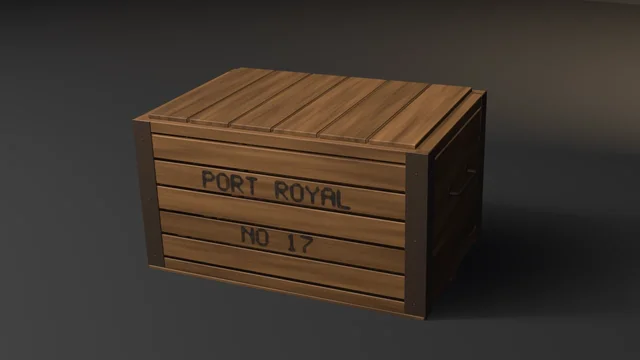
Shipping Crate
A procedural shipping crate through UVs, bake, LOD, collider, and Unity glTF, asserting recomputed budgets rather than an API contract.
showcase/bamboo-clump/
A procedural clump of seven clumping-bamboo culms rising from a 0.6 m rhizome mass on a lobed hummock of leaf-litter soil, five jointed rhizome knuckles breaking the soil at the outer culms' feet; each culm splayed out from the soil, then leaning and arching to a fine whip, ringed with 99 raised nodes at a pitch short at the foot, long through the middle and short again at the tip, its lowest three nodes still in papery sheaths and a fresh culm white-waxed below every node; 107 arching branches, one or two to a node, carrying 815 slim leaves with a droop of their own; three young shoots and litter off the hummock, through UVs, bake, LOD, collider and Unity glTF, asserting recomputed budgets rather than an API contract.
Rendered headless by the showcase piece itself. Select it to enlarge.
category Nature
blender --background --python showcase/bamboo-clump/bamboo_clump.py --
A showcase piece, not an example, and a nature piece. It builds a procedural, game-ready clump of clumping bamboo on a low mound of leaf-litter soil:
Proportion, stated. Real clumping bamboo is slenderer than this: a Bambusa textilis or B. tuldoides culm stands 100–200 diameters tall. These stand about 60–75. The culms are thickened on purpose so each still reads as a cane rather than a wire at gallery size; the node pitch, the taper and the clump's 0.6 m footprint are kept to life.
Every seeded draw comes from random.Random(SEED) in plan_clump(), before anything is built, and only places the litter. Everything on the culms comes from a closed-form hash of the node's indices, so no flag can shift it.
Five materials, one per substance: soil, bamboo culm (culm, node rings, branches and rhizome knuckles, told apart by a face zone), leaf, culm sheath (the shoots, the sheaths still on the culms and the fallen ones) and dry leaf. Point attributes Along (the run along a culm, branch, leaf or shoot), Nd (the signed distance to the nearest node: the wax band lies only below a node, the scar line either side) and Side (across a leaf for its midrib, and up a node ring to mark its crest), a Skirt attribute for the soil's cut edge, and a seeded Tone face attribute carry the variation. Everything is smooth-shaded; every material boundary and every fold sharper than 62° is a hard edge, so a leaf's edge and a node ring's shoulders stay crisp while a ten-sided culm stays round.
It asserts budget conformance of the generated result. It does not witness an API contract. "It rendered without error" is not a check.
Composes skills mesh-editing-and-bmesh, bake-high-to-low, depsgraph-and-evaluated-data, engine-export-presets, and snippets bake_normal_high_to_low.py, setup_bake_target_image.py, lod_chain.py / decimate_to_budget.py, convex_hull_collider.py, export_preset_unity.py (helpers copied inline, not imported).
Intended size: a clump 3.82 × 3.55 m across its leaves and 4.83 m to the highest leaf. The outer AABB is 3.8168 × 3.5512 × 4.8254 m, read off the vertices: the leaning culms and their branches set X and Y, a leaf on the tallest culm's top plume sets the top; the soil's underside is the ground. The collider is the convex hull of the lower 1.25 m of the clump, coarse: a player walks the litter and brushes through the leaves, but not through the culms.
Every budget is declared as a named constant. Every gate recomputes its value from the mesh, materials, UVs, evaluated LOD, collider, or export file.
| Axis | Declared | Measured (5.2.1) |
|---|---|---|
| Base triangles | 72800–74800 | 73804 |
| LOD1 ratio | 0.32–0.62 of base | 0.5000 |
| LOD2 ratio | 0.10–0.35 of base | 0.2200 |
| Materials | exactly 5 distinct; ≥2680 soil, ≥16600 culm, ≥16770 leaf, ≥2920 sheath, ≥740 dry-leaf faces | 5 slots; 2734 / 16944 / 17115 / 2979 / 756 |
| UVs | in 0..1, AABB overlap ≤ 1e-5 | in range, overlap 0 |
| Outer AABB | (3.8168, 3.5512, 4.8254) m ± 0.01 | (3.8168, 3.5512, 4.8254), zmin 0 |
| Collider tris (lower 1.25 m hull) | ≤ 96 | 88 |
| Export | written, size > 0, removed after measuring | 5606968 bytes |
The quality pass re-fitted four of these around the new measurements, each for a stated reason. The triangle band moved from 51500–53500 to 72800–74800, paying for a fuller crown (815 leaves on 107 branches against 567 on 63), 21 culm sheaths, five knuckles and a wax-band row under every node. The face floors follow the same counts. The collider ceiling went from 80 to 96: the culms now rise from a 0.6 m footprint and splay from the soil, so the hull of the lower 1.25 m has more facets (88). The AABB is a new shape.
DECIMATE COLLAPSE triangle counts are not identical across Blender series, so the LOD gate is a ratio band, not an exact count. Bake pixels are stochastic, so the bake gate is has_data plus operator FINISHED, not byte-identity. The plan is seeded and nothing else is random; the geometry is pure Python math. Two default runs print identical measurements.
Recomputed from the generated mesh, not asserted about the script.
| Axis | Declared | Measured |
|---|---|---|
| Non-manifold edges | 0 | 0 |
| Loose verts / edges | 0 / 0 | 0 / 0 |
| Doubles merged at 1e-5 | 0 | 0 |
| Zero-area faces | 0 | 0 |
| N-gons | 0 | 0 |
| Coplanar cross-shell face pairs (KD range 0.05 m, plane ε 1e-4) | 0 | 0 |
Grounded: zmin | within 1e-4 of 0 | 0.0000 |
The first builds had cross-shell pairs: litter flanks lying in the soil's plane (five, then two), and later one pair of tip leaves sharing a base point. The litter's flanks now lean steeper than the mound can tilt and the two tip leaves start 4% of the branch apart, rather than widening any band.
These are the organic invariants. The 1099 shells are told apart by a Part face attribute that names a shell and never measures it; every number below is read off the generated vertices.
| Axis | Declared | Measured |
|---|---|---|
| Shells | 1 soil, 7 culms, 3 shoots, 36 litter leaves, 5 fallen sheaths, 5 knuckles, and as many node rings, branches, leaves and culm sheaths as were built | 1 / 7 / 3 / 36 / 5 / 5 / 99 / 107 / 815 / 21 |
| Grounded, per support: each culm's, shoot's and knuckle's lowest vertex under the soil straight above it | 0.020–0.075 m (each of 15 supports) | 0.0256–0.0479 m |
| Nodes seated: for each ring, a ray from its centre (on the culm's axis) to each ring vertex meets the host culm's own surface at that angle. The crest is outside it, the inner wall inside it | crest 0.0025–0.0048 m, inner wall 0.0020–0.0060 m, all 99 rings | 0.0035–0.0036 m; 0.0031–0.0034 m |
| Branches sprung from nodes: the first ring's centre inside its host culm (ray parity, three directions, distance to the nearest face), and its distance from the nearest node ring centre less the culm radius there | depth 0.004–0.010 m; ≤ 0.010 m off its node; all 107 | 0.0055–0.0067 m; −0.0063 to −0.0053 m |
| Leaves seated: each leaf's first ring centre inside its branch | 0.0010–0.0052 m; all 815 | 0.0020–0.0040 m |
| Size: each culm's height from the soil under its lowest vertex to its highest; its diameter at the lowest node (twice the distance from the ring's centre to the culm's surface) | height 2.6–4.7 m with a spread of at least 1.0 m; diameter 0.042–0.080 m | 2.7117–4.5463 m; 0.0458–0.0738 m |
| Taper: the radius at each node going up each culm never rises; the last node over the first | rise ≤ 0.0004 m; ratio 0.54–0.66 | −0.00044 m (it falls at every node); 0.5728–0.6036 |
| Pitch: the distance between consecutive ring centres up each culm, its mean per culm, and the middle third's mean minus the first third's | at least 10 nodes a culm; gap 0.12–0.38 m; mean 0.23–0.28 m; middle longer by ≥ 0.06 m | 11–18; 0.1516–0.3305 m; 0.2487–0.2566 m; 0.0794–0.1064 m |
| Clump: BVH overlap between every pair of culms, and the closest vertex-to-surface approach | 0 intersecting pairs; ≥ 0.020 m | 0; 0.0831 m |
| Litter resting: each blade's deepest vertex under the soil straight above it | 41 blades, each 0.0005–0.006 m | 0.0011–0.0027 m |
| Culm sheaths seated: per sheath, against the culm its centroid lies in, the deepest vertex inside the culm, the proudest outside it, and the share of its vertices inside (the inner wall is half of them) | inside 0.0008–0.0030 m, proud 0.0020–0.0065 m, share ≥ 0.45; all 21 | 0.0014–0.0016 m; 0.0036–0.0037 m; 0.50 |
Three measurements needed care. A ring's host is the culm its centre lies inside, by ray parity, not the nearest surface: with two culms overlapping, a centre can be nearer its neighbour's skin than its own. A litter blade's lowest vertex is often a flank on a slope, so the litter is measured by its deepest vertex. And a node ring is revolved about the axis, so its centroid is the axis point, which makes the radius, the pitch and the host all one measurement.
The taper budget is what keeps the culm honest: it is a cone that only narrows, nothing swells at a node, and the rings follow the wall rather than carry the shape. The whip above the last node is outside its reach by design: no ring stands there, so the fast final thinning cannot flatter the ratio measured between the first and last rings.
A culm sheath's columns stand on the culm's own ten vertex bearings. Set half a step round, its inner wall would cut the culm's flat facets at their middles, where the facet lies 4.9% of the radius inside the vertex circle, and a 1.5 mm bite would read as a gap on every culm thicker than 3 cm.
Each falsifier violates one named budget. Every one was run on 5.2.1 and exited its declared code, and the budget_fails line it prints names only its own budget. Blender 4.5 and 5.1 were not available locally.
| Flag | Budget violated | Exit |
|---|---|---|
--skip-decimate | LOD1 ratio band (measured 1.0000) | 9 |
--stray-vert | loose vertex count is 0 (measured 1, placed inside the envelope) | 15 |
--lift-z | bounding box zmin is 0 (measured 0.05000) | 16 |
--float-culm | each support bedded in the soil (culm 5 raised 70 mm: its foot 0.0410 m above the soil), while the soil still grounds the AABB | 16 |
--sunk-nodes | nodes seated (every ring's crest 0.6 mm outside the wall: 0.0016–0.0018 m) | 17 |
--stray-branches | branches sprung from nodes (culm 0's lowest branch 90 mm up its culm, still inside it: 0.0613 m off the nearest node) | 18 |
--swell-culm | taper (culm 2 swells 35% about 45% up, its rings following: radius rises 0.00623 m between nodes) | 19 |
--bunch-nodes | pitch (culm 0's seventh node slid to 70 mm under the next: gaps 0.0700–0.4805 m) | 20 |
--crowd-culms | clump (culm 3's foot stood against culm 6's and re-bedded there: 18 intersecting triangle pairs, closest approach 0.0004 m) | 21 |
--float-litter | litter resting (every blade lifted 25 mm: deepest vertex 0.0223–0.0239 m above the soil) | 22 |
--lift-leaves | leaves seated (every leaf's base lifted 8 mm out of its branch: −0.0059 to 0.0016 m) | 23 |
--loose-sheaths | culm sheaths seated (every sheath's inner wall 3 mm outside its culm: −0.0030 to −0.0028 m, no vertex inside) | 25 |
Each falsifier moves only what its budget measures. --stray-branches moves one branch, --crowd-culms one culm and --float-culm one culm straight up, so the envelope does not move: each stays inside BBOX_TOL. --swell-culm scales the radius and the rings that follow it, --bunch-nodes moves one ring and the branch on it, --sunk-nodes moves only the crest of every ring, and --loose-sheaths moves only the sheaths. The first --stray-branches shifted every branch and grew the box 0.09 m, exit 8; the first --crowd-culms moved culm 4, which set the box's Y, exit 8 again.
In the quality pass --crowd-culms was re-aimed twice. Moving culm 0 (the tallest, which sets the top) toward culm 4 and holding its foot's height so the top stayed put left the foot 14 mm above the soil, because the rhizome hummock falls away from the centre: exit 16, not 21. Re-bedding it instead would have dropped the top. Every culm-and-neighbour pair was then tried against the envelope, and culm 3 stood against culm 6 is one of the few that moves no extreme: the envelope changes by 0.0000 m and only the clump budget fails.
blender --background --python bamboo_clump.py --
blender --background --python bamboo_clump.py -- --skip-decimate
blender --background --python bamboo_clump.py -- --stray-vert
blender --background --python bamboo_clump.py -- --lift-z
blender --background --python bamboo_clump.py -- --float-culm
blender --background --python bamboo_clump.py -- --sunk-nodes
blender --background --python bamboo_clump.py -- --stray-branches
blender --background --python bamboo_clump.py -- --swell-culm
blender --background --python bamboo_clump.py -- --bunch-nodes
blender --background --python bamboo_clump.py -- --crowd-culms
blender --background --python bamboo_clump.py -- --float-litter
blender --background --python bamboo_clump.py -- --lift-leaves
blender --background --python bamboo_clump.py -- --loose-sheaths
blender --background --python bamboo_clump.py -- --output bamboo.png
Smoke passes no flags.
The hero keeps the piece unturned (HERO_YAW_DEG 0°) and looks in from the south-south-west, 1.8 m above the clump's mid-height, so the clump fans across the frame, the lit leaves stand out of the dark wall and the eye falls a little onto the hummock. The fill is 0.303 × 0.833.
File-local. 9 is a valid check code. 10 is reserved for gallery_framing.check_framing on the --output path. 15–19 are the hygiene, grounding, joint, seat and plumb family. 20–23 and 25 are file-local. 24 is the asset-quality floor on the render path: check_asset_quality returns 11, which this piece already spends on the collider ceiling, so the call site remaps it.
| Code | Meaning |
|---|---|
| 0 | Success |
| 1 | Uncaught exception (FATAL wrapper) |
| 2 | argparse / usage |
| 3 | Mesh did not build, no UV layer, or a shell count off the plan |
| 4 | Base triangle count outside range |
| 5 | Material count ≠ 5 distinct slots, or a face-count floor missed |
| 6 | UVs outside 0..1 |
| 7 | UV AABB overlap above tolerance |
| 8 | World AABB off declared outer size |
| 9 | LOD ratio band (--skip-decimate lands here) |
| 10 | Framing gate (render path only) |
| 11 | Collider triangle count above ceiling |
| 12 | Bake did not finish or image has no data |
| 13 | Export file missing or empty |
| 14 | --output produced no file |
| 15 | Mesh hygiene: loose, non-manifold, zero-area, doubles, n-gons, coplanar cross-shell pairs |
| 16 | Not grounded: bounding box zmin off 0 (--lift-z), or a culm, shoot or rhizome knuckle not bedded 0.020–0.075 m in the soil (--float-culm) |
| 17 | Nodes: a ring's crest outside 0.0025–0.0048 m or its inner wall outside 0.0020–0.0060 m (--sunk-nodes) |
| 18 | Branches: a first ring outside 0.004–0.010 m inside its culm, or more than 0.010 m off a node (--stray-branches) |
| 19 | Size and taper: a culm's height or diameter (0.042–0.080 m) off its band, heights less than 1.0 m apart, a radius that rises up a culm, or a taper ratio off 0.54–0.66 (--swell-culm) |
| 20 | Pitch: fewer than 10 nodes on a culm, a gap outside 0.12–0.38 m, a mean outside 0.23–0.28 m, or a middle third less than 0.06 m longer than the first (--bunch-nodes) |
| 21 | Clump: two culms intersect, or come closer than 0.020 m (--crowd-culms) |
| 22 | Litter: a blade's deepest vertex outside 0.0005–0.006 m under the soil (--float-litter) |
| 23 | Leaves: a leaf's base not 0.0010–0.0052 m inside its branch (--lift-leaves) |
| 24 | Asset-quality floor (render path only; remapped from 11) |
| 25 | Culm sheaths: a sheath's inner wall not 0.0008–0.0030 m inside its culm, its outer wall not 0.0020–0.0065 m proud, or fewer than 45% of its vertices inside (--loose-sheaths) |
"""Game-ready bamboo clump on a leaf-litter mound — a showcase piece, not an example. Asserts budget conformance of a procedural bamboo clump after composing shipped pipeline pieces: bmesh construction, UVs, five materials, high-to-low normal bake, LOD chain, convex collider, Unity glTF export. A mound of dark earth, heaved into a lobed hummock by the rhizome mass, holds one clump of seven bamboo culms, 2.7 to 4.5 m tall and 4.6 to 7.4 cm across at the first node, rising from a footprint about 0.6 m across, each rooted in a collar of heaped soil. Five jointed rhizome knuckles break the soil and run in to the outer culms' feet. A culm leaves the soil already leaning out from the clump's centre, then leans further and arches, tapering to a fine whip. It is ringed with nodes at an uneven pitch: close together near the foot, long through the middle, close again toward the tip, each a raised ridge darker than its culm with a pale scar on its crest, and on a fresh culm a band of white wax just below it. Tone runs from fresh green to an old culm gone yellow. The lowest three nodes keep their papery culm sheaths, ragged sleeves bitten into the culm. From the upper nodes leafy branches spring up and out, one at every node and often a second, more toward the crown, each carrying 4 to 12 slim, pointed, drooping leaves with its own droop; the top node's branch plumes the whip. Three young shoots in overlapping sheaths push out of the earth beside the clump, and thirty-six dry leaves and five fallen culm sheaths lie in the litter off the hummock. Budgets are declared below and recomputed from the generated result. They are not API-contract witnesses. Each falsifier violates one named budget: ``--skip-decimate`` the LOD-ratio band, ``--stray-vert`` mesh hygiene, ``--lift-z`` and ``--float-culm`` grounding, ``--sunk-nodes`` every node ring proud of its culm, ``--stray-branches`` every branch springing from a node, ``--swell-culm`` a culm that only ever tapers, ``--bunch-nodes`` the pitch of the nodes, ``--crowd-culms`` culms that stand clear of each other, ``--float-litter`` the litter resting in the soil, ``--lift-leaves`` every leaf seated in its branch, ``--loose-sheaths`` every culm sheath bitten into its culm. Seeded, not random: ``random.Random(SEED)`` draws the litter before anything is built, and everything on the culms comes from a closed-form hash of the node's indices, so flags never shift the stream. DECIMATE COLLAPSE triangle counts are not byte-identical across Blender versions — the LOD gate is a ratio band, not an exact count. blender --background --python bamboo_clump.py -- blender --background --python bamboo_clump.py -- --skip-decimate blender --background --python bamboo_clump.py -- --output bamboo.png """ import argparse import math import os import random import sys import tempfile import traceback import bmesh import bpy from mathutils import Matrix, Vector from mathutils.bvhtree import BVHTree from mathutils.kdtree import KDTree # Showcase lives at repo-root/showcase/, not under examples/. The framing # helper is the repo's only shared import and lives next to the examples; # resolve the repo root so we do not move gallery_framing.py. _REPO = os.path.abspath( os.path.join(os.path.dirname(os.path.abspath(__file__)), os.pardir, os.pardir) ) sys.path.insert(0, os.path.join(_REPO, "examples")) sys.dont_write_bytecode = True import gallery_framing # noqa: E402 import gallery_asset_quality # noqa: E402 SEED = 6203 TAU = 2.0 * math.pi UP = Vector((0.0, 0.0, 1.0)) # --- Ground ------------------------------------------------------------------ DISC_A = (1.10, 0.98) # soil disc semi-axes before its wobble, m DISC_N = {"low": 36, "high": 64} MOUND_Z = 0.060 # the litter heap, falling to the disc's rim RHIZ_Z = 0.120 # the rhizome mass heaving the soil under the clump RHIZ_R = 0.36 # its gaussian radius, m COLLAR_Z = 0.022 # soil heaped round every culm's foot COLLAR_R = 0.060 # --- Culms ------------------------------------------------------------------- # A sympodial (clumping) bamboo after Bambusa textilis / B. tuldoides: culms # 3-4.6 m here, 4.8-7.7 cm across. Real culms run 100-200 diameters tall; # these run about 60-75, a deliberate thickening so a culm still reads as a # cane, not a wire, at gallery size. The culms rise from a rhizome mass about # 0.6 m across, each foot splayed outward from the clump's centre. # (distance of the foot from the clump's centre, length along the axis from # the buried foot to the tip, radius at the foot before the flare, lean at # the tip deg, bearing of the lean deg, sway deg, sway phase, tone: 0 a # fresh, powdered culm, 1 an old one gone yellow) CULM_SPECS = ( (0.030, 4.60, 0.0385, 12.0, 100.0, 18.0, 0.3, 0.50), (0.200, 4.20, 0.0365, 34.0, -25.0, 22.0, 1.2, 0.30), (0.220, 4.00, 0.0340, 38.0, 212.0, 20.0, 2.0, 0.96), (0.190, 3.60, 0.0310, 36.0, 128.0, 24.0, 0.9, 0.45), (0.240, 3.80, 0.0285, 36.0, 58.0, 18.0, 2.6, 0.62), (0.280, 3.20, 0.0260, 42.0, 268.0, 22.0, 1.7, 0.04), (0.300, 3.00, 0.0240, 44.0, 178.0, 20.0, 0.4, 0.78), ) def _foot_bearing(az0, sway, phase): return math.radians(az0 + sway * math.sin(phase)) # (x, y, length, r0, lean, bearing, sway, phase, tone): each foot set out # from the centre along the bearing its culm starts to lean on CULMS = tuple( (rho * math.cos(_foot_bearing(az0, sw, ph)), rho * math.sin(_foot_bearing(az0, sw, ph)), L_, r0, lean, az0, sw, ph, tone) for rho, L_, r0, lean, az0, sw, ph, tone in CULM_SPECS ) SPLAY = 7.0 # every outer culm leaves the soil this far off plumb, outward DS = 0.01 # step of the dense axis polyline CULM_BED = 0.045 # the foot this far under the soil at its centre CULM_SIDES = {"low": 10, "high": 16} TAPER = 0.45 # r(tip) = r0 * (1 - TAPER) FLARE = 0.30 # the foot's flare, and how far up it runs FLARE_LEN = 0.18 TIP_LEN = 0.07 # the closed cone at the top WHIP = 0.60 # the radius lost over the last NODE_END of the culm NODE_FIRST = 0.14 # first node, along the axis from the buried foot NODE_END = 0.22 # no node nearer the tip than this NODE_BASE_L = 0.14 # internode length: base + mid * sin(pi u) ** 0.9 NODE_MID_L = 0.17 RING_H = 0.006 # half height of a node ring RING_PROUD = 0.0035 # its crest this far outside the culm RING_BITE = 0.003 # its inner wall this far inside it RING_SIDES = 10 # --- Branches and leaves ------------------------------------------------------- BR_FROM_U = 0.30 # branches from the nodes above this fraction of the length BR_TIP_CLEAR = 0.12 # and none this near the tip BR_R_MIN = 0.0105 # on a culm at least this thick BR_R0 = 0.0055 BR_BITE = 0.007 # a branch's first ring centre this far inside the culm BR_SIDES = 6 BR_L0 = 0.40 BR_L1 = 0.42 BR2_FROM_U = 0.42 # a second, shorter branch at the nodes above this BR2_P = 0.62 # at this share of them BR2_ALWAYS_U = 0.62 # and above this, at nearly all of them TOP_BR_SCALE = 0.55 # the top node's upright plume, against an ordinary first branch BR2_SCALE = 0.62 # its length against the first's BR2_R = 0.78 # its radius against the first's LEAVES_N = (6, 12) # leaves on a first branch, low and high LEAVES2_N = (4, 7) # on a second one LEAF_FROM_V = 0.34 # leaves along the branch's outer two thirds LEAF_U = (0.0, 0.25, 0.50, 0.75, 0.92) LEAF_TIP_INSET = 0.002 # --- Culm sheaths, rhizome knuckles ------------------------------------------- SHEATH_NODES = 3 # the lowest three nodes above the soil keep their sheath SHEATH_SIDES = 10 SHEATH_T = 6 # stations up a sheath SHEATH_BITE = 0.0015 # its inner wall this far inside the culm SHEATH_PROUD0 = 0.0026 # its outer wall this far outside at its foot, under the ridge's crest... SHEATH_PROUD1 = 0.0016 # ...and this far at its ragged top SHEATH_CURL = 0.0020 # the top lip curls off the culm by this much more SHEATH_UP = (0.55, 0.85) # how far up the internode the sheath's tall side reaches KNUCKLES = (1, 2, 4, 5, 6) # culms whose rhizome knuckle breaks the soil KNUCKLE_LEN = 0.28 # from the inner end to the culm's axis, m KNUCKLE_R = 1.15 # its girth against the culm's foot radius KNUCKLE_SINK = 0.32 # its axis this many of its radii under the soil KNUCKLE_ST = 14 KNUCKLE_SIDES = {"low": 8, "high": 12} # --- Shoots and litter ---------------------------------------------------------- # (x, y, height, radius at the foot) SHOOTS = ((0.420, 0.120, 0.62, 0.026), (-0.090, 0.440, 0.40, 0.022), (0.250, -0.400, 0.27, 0.019)) SHOOT_BED = 0.036 SHOOT_SHEATHS = 7 N_LITTER = 36 N_SHEATH = 5 LITTER_BELLY = 0.0025 # a litter blade's belly this far under the soil, before its stagger LITTER_HT = 0.0030 # half thickness: the flanks lean 11-15 degrees, steeper than any slope of the mound SHEATH_HT = 0.0110 # a sheath is wider, so thicker, or its flank lies in the soil's own plane LITTER_L0, LITTER_L1 = 0.12, 0.10 LITTER_RAD0 = 0.44 # litter from this fraction of the disc out SHEATH_L0, SHEATH_L1 = 0.34, 0.14 # --- Falsifier magnitudes ------------------------------------------------------------ SUNK_PROUD = 0.0006 # --sunk-nodes: every ring's crest this far outside the culm STRAY_SHIFT = 0.09 # --stray-branches: culm 0's lowest branch this far up from its node STRAY_IDX = 0 SWELL = 0.35 # --swell-culm: one culm swells this much about 45% up SWELL_IDX = 2 BUNCH_IDX = 0 # --bunch-nodes: culm 0's seventh node... BUNCH_NODE = 6 BUNCH_GAP = 0.07 # ...slid up until it is this far under the next CROWD_IDX = 3 # --crowd-culms: this culm's foot stood against culm 6's, re-bedded CROWD_SHIFT = (-0.106, -0.102) # in the soil there; culm 3 sets no extreme of the envelope LOOSE_SHEATH = 0.0030 # --loose-sheaths: every sheath's inner wall this far outside the culm FLOAT_CULM_IDX = 5 # --float-culm: this culm raised off the soil FLOAT_CULM = 0.070 FLOAT_LITTER = 0.025 LIFT_LEAVES = 0.008 LIFT_Z = 0.05 BBOX_TOL = 0.01 # Fitted after locking geometry. Recomputed from the vertices. OUTER_SIZE = (3.8168, 3.5512, 4.8254) BASE_TRIS_MIN = 72800 BASE_TRIS_MAX = 74800 LOD1_RATIO_MIN = 0.32 LOD1_RATIO_MAX = 0.62 LOD2_RATIO_MIN = 0.10 LOD2_RATIO_MAX = 0.35 LOD1_TARGET = 0.50 LOD2_TARGET = 0.22 MATERIAL_COUNT = 5 UV_EPS = 1e-4 UV_OVERLAP_MAX = 1e-5 COLLIDER_TRIS_MAX = 96 BAKE_RES = 512 CAGE_EXTRUSION = 0.01 # soil, culm, leaf, shoot sheath, dry leaf FACE_FLOORS = (2680, 16600, 16770, 2920, 740) SOIL_IDX = 0 CULM_IDX = 1 LEAF_IDX = 2 SHOOT_IDX = 3 DRY_IDX = 4 MAT_LABELS = ("soil", "culm", "leaf", "shoot sheath", "dry leaf") ZMIN_EPS = 1e-4 DOUBLES_EPS = 1e-5 AREA_EPS = 1e-10 COPLANAR_NORMAL_EPS = 1e-4 COPLANAR_PLANE_EPS = 1e-4 COPLANAR_CENTRE_MAX = 0.05 BED_MIN = 0.020 # every culm's and shoot's lowest vertex under the soil BED_MAX = 0.075 PROUD_BAND = (0.0025, 0.0048) BITE_BAND = (0.0020, 0.0060) BRANCH_BITE_BAND = (0.004, 0.010) NODE_SLACK = 0.010 LEAF_SEAT_BAND = (0.0010, 0.0052) CULM_H_BAND = (2.6, 4.7) CULM_H_SPREAD_MIN = 1.0 CULM_D_BAND = (0.042, 0.080) TAPER_EPS = 0.0004 TAPER_RATIO_BAND = (0.54, 0.66) GAP_BAND = (0.12, 0.38) PITCH_BAND = (0.23, 0.28) LENGTHEN_MIN = 0.06 NODES_MIN = 10 CLUMP_GAP_MIN = 0.020 REST_BAND = (0.0005, 0.006) SHEATH_BITE_BAND = (0.0008, 0.0030) # a culm sheath's inner wall inside its culm SHEATH_PROUD_BAND = (0.0020, 0.0065) # and its outer wall outside it HERO_YAW_DEG = 0.0 WALL_Y = 4.0 CAM_DIST = 14.7 CAM_UP = 1.8 AIM_DZ = 0.0 # part labels (a face attribute): they name a shell, they never measure it P_SOIL, P_CULM, P_NODE, P_BRANCH, P_LEAF, P_SHOOT, P_LITTER, P_SHEATH = 1, 2, 3, 4, 5, 6, 7, 8 P_CSHEATH, P_KNUCKLE = 9, 10 N_PARTS = 10 FLAG_NAMES = ("sunk_nodes", "stray_branches", "swell_culm", "bunch_nodes", "crowd_culms", "float_culm", "float_litter", "lift_leaves", "loose_sheaths") BUILT = {} def eevee_engine_id(): return "BLENDER_EEVEE" if bpy.app.version >= (5, 0, 0) else "BLENDER_EEVEE_NEXT" def fail(msg, code): print(f"ERROR: {msg}", file=sys.stderr) return code def triangle_count(mesh): mesh.calc_loop_triangles() return len(mesh.loop_triangles) def evaluated_triangle_count(obj): # Duplicated from snippets/lod_chain.py / decimate_to_budget.py (not a package). depsgraph = bpy.context.evaluated_depsgraph_get() eval_obj = obj.evaluated_get(depsgraph) eval_mesh = eval_obj.to_mesh() try: eval_mesh.calc_loop_triangles() return len(eval_mesh.loop_triangles) finally: eval_obj.to_mesh_clear() def smoothstep(x, lo, hi): t = min(max((x - lo) / (hi - lo), 0.0), 1.0) return t * t * (3.0 - 2.0 * t) def perp_basis(d): ref = UP if abs(d.z) < 0.9 else Vector((1.0, 0.0, 0.0)) e1 = d.cross(ref).normalized() return e1, d.cross(e1).normalized() def hash01(a, b, c): """A closed-form draw in [0, 1) from three indices: per-leaflet variety that no flag can shift.""" x = math.sin(a * 12.9898 + b * 78.233 + c * 37.719 + SEED * 0.0137) * 43758.5453 return x - math.floor(x) def squircle(i, k, n): """A square grid mapped onto the unit disc (its border on the circle).""" uu = -1.0 + 2.0 * i / n vv = -1.0 + 2.0 * k / n return uu * math.sqrt(1.0 - vv * vv / 2.0), vv * math.sqrt(1.0 - uu * uu / 2.0) def hor(v): return Vector((v.x, v.y, 0.0)) def heading(deg): a = math.radians(deg) return Vector((math.cos(a), math.sin(a), 0.0)) def rotate_about(v, axis, ang): return Matrix.Rotation(ang, 3, axis) @ v def disc_wobble(th): return 1.0 + 0.040 * math.sin(3.0 * th + 0.7) + 0.028 * math.sin(5.0 * th + 2.1) \ + 0.015 * math.sin(8.0 * th + 1.3) def disc_radius(x, y): """Normalised disc radius: 1 on the soil's rim.""" X, Y = x / DISC_A[0], y / DISC_A[1] return math.hypot(X, Y) / disc_wobble(math.atan2(Y, X)) # -------------------------------------------------------------------------- # Construction helpers (shared) # -------------------------------------------------------------------------- def new_face(bm, verts, mat, L, tone, zone, part): out = [] for v in verts: if not out or out[-1] is not v: out.append(v) if len(out) > 1 and out[0] is out[-1]: out.pop() f = bm.faces.new(out) f.material_index = mat f[L["tone"]] = tone f[L["zone"]] = zone f[L["part"]] = part return f def grid_faces(bm, grid, n, mat, L, tone, part): for i in range(n): for k in range(n): a, b, c, d = grid[i][k], grid[i + 1][k], grid[i + 1][k + 1], grid[i][k + 1] if (a.co - c.co).length <= (b.co - d.co).length: tris = ((a, b, c), (a, c, d)) else: tris = ((a, b, d), (b, c, d)) for tri in tris: new_face(bm, tri, mat, L, tone, 0.0, part) def grid_rim(grid, n): return ([grid[i][0] for i in range(n)] + [grid[n][k] for k in range(n)] + [grid[i][n] for i in range(n, 0, -1)] + [grid[0][k] for k in range(n, 0, -1)]) def add_soil(bm, L, V, n): grid = [] for i in range(n + 1): col = [] for k in range(n + 1): X, Y = squircle(i, k, n) wob = disc_wobble(math.atan2(Y, X)) x = DISC_A[0] * X * wob y = DISC_A[1] * Y * wob on_rim = i in (0, n) or k in (0, n) z = 0.0 if on_rim else soil_height(x, y) v = bm.verts.new((x, y, z)) v[V["skirt"]] = smoothstep(disc_radius(x, y), 0.86, 0.93) col.append(v) grid.append(col) grid_faces(bm, grid, n, SOIL_IDX, L, 0.5, P_SOIL) new_face(bm, list(reversed(grid_rim(grid, n))), SOIL_IDX, L, 0.5, 0.0, P_SOIL) def soil_hit(tree, x, y): loc, nrm, _i, _d = tree.ray_cast(Vector((x, y, 5.0)), Vector((0.0, 0.0, -1.0)), 20.0) if loc is None: return Vector((x, y, 0.0)), Vector((0.0, 0.0, 1.0)) if nrm.z < 0.0: nrm = -nrm return loc, nrm def triangulate_ngons(bm): faces = [f for f in bm.faces if len(f.verts) > 4] if faces: bmesh.ops.triangulate(bm, faces=faces) def pack_uvs(bm, margin=0.08): uv = bm.loops.layers.uv.new("UVMap") faces = list(bm.faces) n = len(faces) cols = max(1, math.ceil(math.sqrt(n))) rows = max(1, math.ceil(n / cols)) cell_w = 1.0 / cols cell_h = 1.0 / rows pad_u = margin * cell_w * 0.5 pad_v = margin * cell_h * 0.5 usable_w = cell_w - 2.0 * pad_u usable_h = cell_h - 2.0 * pad_v for i, face in enumerate(faces): col = i % cols row = i // cols nrm = face.normal ax, ay, az = abs(nrm.x), abs(nrm.y), abs(nrm.z) coords = [] for loop in face.loops: co = loop.vert.co if az >= ax and az >= ay: coords.append((co.x, co.y)) elif ax >= ay: coords.append((co.y, co.z)) else: coords.append((co.x, co.z)) xs = [c[0] for c in coords] ys = [c[1] for c in coords] minx, maxx = min(xs), max(xs) miny, maxy = min(ys), max(ys) dx = max(maxx - minx, 1e-8) dy = max(maxy - miny, 1e-8) origin_u = col * cell_w + pad_u origin_v = row * cell_h + pad_v for loop, (x, y) in zip(face.loops, coords): loop[uv].uv = ( origin_u + (x - minx) / dx * usable_w, origin_v + (y - miny) / dy * usable_h, ) # -------------------------------------------------------------------------- # Materials # -------------------------------------------------------------------------- def enabled_socket(sockets, name): """The one enabled socket called ``name`` (Mix / Map Range carry one per data type under one name; identifiers changed in 5.2).""" for sock in sockets: if sock.name == name and sock.enabled: return sock return sockets[name] def surface(name): mat = bpy.data.materials.new(name) mat.use_nodes = True nt = mat.node_tree bsdf = nt.nodes["Principled BSDF"] bsdf.inputs["Metallic"].default_value = 0.0 coord = nt.nodes.new("ShaderNodeTexCoord").outputs["Object"] return mat, nt, bsdf, coord def mapping(nt, vec, scale=(1.0, 1.0, 1.0), rot=(0.0, 0.0, 0.0)): node = nt.nodes.new("ShaderNodeMapping") node.inputs["Scale"].default_value = scale node.inputs["Rotation"].default_value = rot nt.links.new(vec, node.inputs["Vector"]) return node.outputs["Vector"] def noise(nt, vec, scale, detail, roughness): node = nt.nodes.new("ShaderNodeTexNoise") node.inputs["Scale"].default_value = scale node.inputs["Detail"].default_value = detail node.inputs["Roughness"].default_value = roughness nt.links.new(vec, node.inputs["Vector"]) return node.outputs["Fac"] def wave(nt, vec, scale, distortion, detail): node = nt.nodes.new("ShaderNodeTexWave") node.wave_type = "BANDS" node.bands_direction = "X" node.inputs["Scale"].default_value = scale node.inputs["Distortion"].default_value = distortion node.inputs["Detail"].default_value = detail nt.links.new(vec, node.inputs["Vector"]) return node.outputs["Fac"] def voronoi_color(nt, vec, scale): node = nt.nodes.new("ShaderNodeTexVoronoi") node.inputs["Scale"].default_value = scale nt.links.new(vec, node.inputs["Vector"]) sep = nt.nodes.new("ShaderNodeSeparateColor") nt.links.new(node.outputs["Color"], sep.inputs["Color"]) return sep.outputs[0], sep.outputs[1], node.outputs["Distance"] def ramp(nt, fac, stops): node = nt.nodes.new("ShaderNodeValToRGB") els = node.color_ramp.elements els[0].position = stops[0][0] els[0].color = (*stops[0][1], 1.0) els[1].position = stops[-1][0] els[1].color = (*stops[-1][1], 1.0) for pos, rgb in stops[1:-1]: els.new(pos).color = (*rgb, 1.0) nt.links.new(fac, node.inputs["Fac"]) return node.outputs["Color"] def remap(nt, value, from_lo, from_hi, to_lo, to_hi): node = nt.nodes.new("ShaderNodeMapRange") nt.links.new(value, enabled_socket(node.inputs, "Value")) enabled_socket(node.inputs, "From Min").default_value = from_lo enabled_socket(node.inputs, "From Max").default_value = from_hi enabled_socket(node.inputs, "To Min").default_value = to_lo enabled_socket(node.inputs, "To Max").default_value = to_hi return enabled_socket(node.outputs, "Result") def math_node(nt, op, a, b): node = nt.nodes.new("ShaderNodeMath") node.operation = op for i, value in enumerate((a, b)): if isinstance(value, (int, float)): node.inputs[i].default_value = value else: nt.links.new(value, node.inputs[i]) return node.outputs[0] def mix_color(nt, a, b, fac): node = nt.nodes.new("ShaderNodeMix") node.data_type = "RGBA" if isinstance(fac, (int, float)): enabled_socket(node.inputs, "Factor").default_value = fac else: nt.links.new(fac, enabled_socket(node.inputs, "Factor")) for nm, value in (("A", a), ("B", b)): sock = enabled_socket(node.inputs, nm) if isinstance(value, tuple): sock.default_value = (*value, 1.0) else: nt.links.new(value, sock) return enabled_socket(node.outputs, "Result") def attr(nt, name): node = nt.nodes.new("ShaderNodeAttribute") node.attribute_type = "GEOMETRY" node.attribute_name = name return node.outputs["Fac"] def height(nt, coord): sep = nt.nodes.new("ShaderNodeSeparateXYZ") nt.links.new(coord, sep.inputs["Vector"]) return sep.outputs["Z"] def bump(nt, bsdf, h, strength, distance): node = nt.nodes.new("ShaderNodeBump") node.inputs["Strength"].default_value = strength node.inputs["Distance"].default_value = distance nt.links.new(h, node.inputs["Height"]) nt.links.new(node.outputs["Normal"], bsdf.inputs["Normal"]) def band(nt, value, lo, hi): """1 across [lo, hi] of ``value`` with soft shoulders, 0 elsewhere.""" return math_node(nt, "MULTIPLY", remap(nt, value, lo - 0.45, lo - 0.05, 0.0, 1.0), remap(nt, value, hi + 0.05, hi + 0.45, 1.0, 0.0)) # -------------------------------------------------------------------------- # The ground as a function of plan position # -------------------------------------------------------------------------- def soil_height(x, y): rr = disc_radius(x, y) z = MOUND_Z * (1.0 - smoothstep(rr, 0.20, 1.0)) # the rhizome mass: a lobed heave under the clump, highest toward the culms th = math.atan2(y, x) lobe = 1.0 + 0.22 * math.cos(3.0 * th - 0.6) + 0.12 * math.cos(5.0 * th + 1.4) z += RHIZ_Z * math.exp(-(x * x + y * y) / (RHIZ_R * lobe) ** 2) z += 0.0045 * math.sin(x * 7.3 + 1.1) * math.sin(y * 6.1 + 0.4) * (1.0 - smoothstep(rr, 0.70, 1.0)) for cx, cy, *_rest in CULMS: d2 = (x - cx) ** 2 + (y - cy) ** 2 z += COLLAR_Z * math.exp(-d2 / (2.0 * COLLAR_R ** 2)) return max(z, 0.0) # -------------------------------------------------------------------------- # Construction helpers # -------------------------------------------------------------------------- def path_rows(pts, radii, alongs): """Rows (centre, e1, e2, radius, along, nd) along ``pts`` with parallel- transported frames.""" pts = [Vector(p) for p in pts] n = len(pts) tans = [(pts[min(i + 1, n - 1)] - pts[max(i - 1, 0)]).normalized() for i in range(n)] e1, _e2 = perp_basis(tans[0]) rows = [] for p, t, r, al in zip(pts, tans, radii, alongs): e1 = (e1 - t * e1.dot(t)).normalized() rows.append((p, e1.copy(), t.cross(e1), r, al, 1.0)) return rows def add_rows(bm, rows, sides, mat, L, V, tone, zone, part, tip=None): """A closed tube through ``rows``: flat base cap, and either a flat top cap or a point at ``tip``.""" rings = [] for c, e1, e2, r, al, nd in rows: ring = [] for k in range(sides): a = TAU * k / sides v = bm.verts.new(c + r * (e1 * math.cos(a) + e2 * math.sin(a))) v[V["along"]] = al v[V["nd"]] = nd ring.append(v) rings.append(ring) for r0, r1 in zip(rings, rings[1:]): for k in range(sides): m = (k + 1) % sides new_face(bm, (r0[k], r0[m], r1[m], r1[k]), mat, L, tone, zone, part) new_face(bm, tuple(reversed(rings[0])), mat, L, tone, zone, part) if tip is None: new_face(bm, tuple(rings[-1]), mat, L, tone, zone, part) else: tv = bm.verts.new(tip) tv[V["along"]] = 1.0 for k in range(sides): new_face(bm, (rings[-1][k], rings[-1][(k + 1) % sides], tv), mat, L, tone, zone, part) return rings def add_blade(bm, pts, hws, ht, wd, mat, L, V, tone, part, along_of): """A slim closed blade: a diamond section (left, top, right, bottom) swept along ``pts`` (the last point is the tip), ``hws`` half widths.""" rings = [] n = len(pts) - 1 for i in range(n): p = Vector(pts[i]) t = (Vector(pts[i + 1]) - Vector(pts[max(i - 1, 0)])).normalized() w = wd - t * wd.dot(t) if w.length < 1e-6: w = perp_basis(t)[0] w = w.normalized() nrm = t.cross(w).normalized() if nrm.z < 0.0: nrm = -nrm hw = hws[i] quad = ((p - w * hw, -1.0), (p + nrm * ht, 0.0), (p + w * hw, 1.0), (p - nrm * ht, 0.0)) ring = [] for co, sd in quad: v = bm.verts.new(co) v[V["along"]] = along_of(i) v[V["side"]] = sd ring.append(v) rings.append(ring) for r0, r1 in zip(rings, rings[1:]): for k in range(4): m = (k + 1) % 4 new_face(bm, (r0[k], r0[m], r1[m], r1[k]), mat, L, tone, 0.0, part) new_face(bm, tuple(reversed(rings[0])), mat, L, tone, 0.0, part) tv = bm.verts.new(pts[-1]) tv[V["along"]] = 1.0 for k in range(4): new_face(bm, (rings[-1][k], rings[-1][(k + 1) % 4], tv), mat, L, tone, 0.0, part) def leaf_widths(hw): out = [] for u in LEAF_U: out.append(max(hw * math.sin(math.pi * min(u + 0.04, 1.0) ** 0.75), 0.0012)) return out # -------------------------------------------------------------------------- # Culms # -------------------------------------------------------------------------- class Culm: """The axis of one culm as a dense polyline with parallel-transported frames, and the radius as a function of the arc length ``s`` from the buried foot.""" def __init__(self, idx, spec, dx=0.0, dy=0.0, dz=0.0, swell=False): self.idx = idx x, y, self.L, self.r0, lean, az0, sway, phase, self.tone = spec self.swell = swell x += dx y += dy z0 = soil_height(x, y) - CULM_BED + dz lean = math.radians(lean) az0 = math.radians(az0) sway = math.radians(sway) # the outer culms leave the rhizome already leaning out; the centre one stands splay = math.radians(SPLAY) * smoothstep(math.hypot(spec[0], spec[1]), 0.05, 0.15) n = int(self.L / DS) + 3 p = Vector((x, y, z0)) self.p = [p.copy()] for i in range(n - 1): u = min((i + 0.5) * DS / self.L, 1.0) th = splay + (lean - splay) * (0.35 * u + 0.65 * u * u) az = az0 + sway * math.sin(2.2 * u + phase) d = Vector((math.sin(th) * math.cos(az), math.sin(th) * math.sin(az), math.cos(th))) p = p + d * DS self.p.append(p.copy()) m = len(self.p) self.t = [(self.p[min(i + 1, m - 1)] - self.p[max(i - 1, 0)]).normalized() for i in range(m)] e1, _e2 = perp_basis(self.t[0]) self.e1, self.e2 = [], [] for t in self.t: e1 = (e1 - t * e1.dot(t)).normalized() self.e1.append(e1.copy()) self.e2.append(t.cross(e1)) def radius(self, s): u = min(max(s / self.L, 0.0), 1.0) r = self.r0 * (1.0 - TAPER * u ** 1.2) r *= 1.0 + FLARE * max(0.0, 1.0 - s / FLARE_LEN) ** 2 # the whip: above the last node the culm thins fast to its tip, so it # ends in a fine, leafy whip rather than a sharpened pencil. No node # stands up here, so the taper measured at the rings does not see it. r *= 1.0 - WHIP * smoothstep(s, self.L - NODE_END, self.L) if self.swell: r *= 1.0 + SWELL * math.exp(-(((u - 0.45) / 0.07) ** 2)) return r def at(self, s): i = min(max(int(s / DS), 0), len(self.p) - 2) f = (s - i * DS) / DS p = self.p[i].lerp(self.p[i + 1], f) t = self.t[i].lerp(self.t[i + 1], f).normalized() e1 = self.e1[i].lerp(self.e1[i + 1], f) e1 = (e1 - t * e1.dot(t)).normalized() return p, t, e1, t.cross(e1) def node_stations(idx, L, bunch): out = [] s = NODE_FIRST while s <= L - NODE_END: out.append(s) u = s / L step = NODE_BASE_L + NODE_MID_L * math.sin(math.pi * u) ** 0.9 step *= 1.0 + 0.16 * (hash01(idx, len(out), 7) - 0.5) s += step if bunch and idx == BUNCH_IDX and len(out) > BUNCH_NODE + 1: out[BUNCH_NODE] = out[BUNCH_NODE + 1] - BUNCH_GAP return out def culm_stations(L, nodes): anchors = [0.0] + list(nodes) + [L - TIP_LEN] out = {0.0, L - TIP_LEN} for a, b in zip(anchors, anchors[1:]): out.add(round(a, 5)) out.add(round(b, 5)) gap = b - a if a in nodes: out.add(round(a + 0.012, 5)) if b in nodes: out.add(round(b - 0.012, 5)) if gap > 0.12: out.add(round(b - 0.045, 5)) # the foot of the wax band under the node k = max(int(gap / 0.085), 1) for j in range(1, k): out.add(round(a + gap * j / k, 5)) return sorted(out) def add_culm(bm, L, V, culm, nodes, detail): sides = CULM_SIDES[detail] rows = [] for s in culm_stations(culm.L, nodes): p, _t, e1, e2 = culm.at(s) # signed: negative below the nearest node, where the wax band lies nd = s - min(nodes, key=lambda n: abs(s - n)) rows.append((p, e1, e2, culm.radius(s), s / culm.L, nd)) tip = culm.at(culm.L)[0] add_rows(bm, rows, sides, CULM_IDX, L, V, culm.tone, 0.0, P_CULM, tip=tip) def add_node_ring(bm, L, V, culm, s, proud, sides): p, _t, e1, e2 = culm.at(s) r = culm.radius(s) profile = ((-RING_BITE, -RING_H), (0.0016, -RING_H), (proud, -0.55 * RING_H), (proud, 0.55 * RING_H), (0.0016, RING_H), (-RING_BITE, RING_H)) t = culm.at(s)[1] # Side marks the ridge: 1 on its crest, where the material lays a pale # sheath-scar line along a darker collar crest = (0.0, 0.3, 1.0, 1.0, 0.3, 0.0) rings = [] for (dr, da), cr in zip(profile, crest): ring = [] for k in range(sides): a = TAU * k / sides v = bm.verts.new(p + t * da + (r + dr) * (e1 * math.cos(a) + e2 * math.sin(a))) v[V["along"]] = s / culm.L v[V["nd"]] = 0.0 v[V["side"]] = cr ring.append(v) rings.append(ring) for i in range(len(profile)): r0, r1 = rings[i], rings[(i + 1) % len(profile)] for k in range(sides): m = (k + 1) % sides new_face(bm, (r0[k], r0[m], r1[m], r1[k]), CULM_IDX, L, culm.tone, 1.0, P_NODE) def add_branches(bm, L, V, culm, nodes, stray, lift_leaves): n_branch = n_leaf = 0 for k, s_node in enumerate(nodes): if s_node / culm.L < BR_FROM_U or s_node > culm.L - BR_TIP_CLEAR: continue if culm.radius(s_node) < BR_R_MIN: continue u_node = s_node / culm.L top = k == len(nodes) - 1 # 0 at the lowest branching node, 1 at the top: the crown fills upward u_rel = (u_node - BR_FROM_U) / max(1.0 - BR_FROM_U, 1e-6) # a first branch at every node; above BR2_FROM_U often a second, # shorter and flatter, turned away from it, and in the upper crown # nearly always specs = [(0, 1.0, 1.0, 0.0)] p2 = BR2_P if u_node < BR2_ALWAYS_U else 0.95 if u_node >= BR2_FROM_U and hash01(culm.idx, k, 11) < p2: specs.append((1, BR2_SCALE, BR2_R, 1.0 + 0.9 * hash01(culm.idx, k, 12))) for bi, scale, rscale, turn in specs: s_b = s_node + (STRAY_SHIFT if stray and n_branch == 0 else 0.0) pc, t, e1, e2 = culm.at(s_b) r_c = culm.radius(s_b) key = culm.idx * 31 + k + 17 * bi az = k * 2.39996 + 1.2 * hash01(culm.idx, k, 1) + turn * (1.0 if k % 2 else -1.0) radial = e1 * math.cos(az) + e2 * math.sin(az) phi = math.radians(44.0 + 22.0 * hash01(key, k, 2) + 12.0 * bi) if top and bi == 0: # the top node's branch rises with the whip and plumes it phi = math.radians(16.0 + 10.0 * hash01(key, k, 2)) d0 = t * math.cos(phi) + radial * math.sin(phi) lb = (BR_L0 + BR_L1 * hash01(key, k, 3)) * scale if top and bi == 0: lb *= TOP_BR_SCALE # how far the branch arches over under its leaves: some ride high, some hang sag = 0.18 + 0.36 * hash01(key, k, 13) p0 = pc + radial * (r_c - BR_BITE) pts, radii, alongs = [], [], [] for j in range(7): v = j / 6.0 pts.append(p0 + d0 * (lb * v) + radial * (0.10 * lb * v * v) + Vector((0.0, 0.0, -sag * lb * v * v))) radii.append(BR_R0 * rscale * (1.0 - 0.45 * v)) alongs.append(v) rows = path_rows(pts, radii, alongs) add_rows(bm, rows, BR_SIDES, CULM_IDX, L, V, culm.tone, 2.0, P_BRANCH) n_branch += 1 tans = [(pts[min(j + 1, 6)] - pts[max(j - 1, 0)]).normalized() for j in range(7)] lo, hi = LEAVES2_N if bi else LEAVES_N n = lo + int((hi - lo + 1) * (0.45 * hash01(key, k, 14) + 0.55 * u_rel) * 0.999) if top and bi == 0: n = hi # this branch's leaves share a hang, so tufts differ from each other # more than the leaves within one tuft do droop_b = 0.35 + 0.80 * hash01(key, k, 15) ll_b = 0.19 + 0.10 * hash01(key, k, 16) for li in range(n): if li == n - 1: v, side = 1.0, 0.0 else: v = LEAF_FROM_V + (0.97 - LEAF_FROM_V) * (li / max(n - 2, 1)) ** 0.8 side = 1.0 if li % 2 == 0 else -1.0 j = v * 6.0 j0 = min(int(j), 5) f = j - j0 base = pts[j0].lerp(pts[j0 + 1], f) tb = tans[j0].lerp(tans[j0 + 1], f).normalized() if v >= 1.0: base = base - tb * LEAF_TIP_INSET sp = tb.cross(UP) sp = sp.normalized() if sp.length > 1e-6 else Vector((1.0, 0.0, 0.0)) if side == 0.0: dl = (tb * 0.9 + UP * 0.1).normalized() else: fan = 0.55 + 0.35 * hash01(key, li, 9) dl = (tb * 0.5 + sp * (fan * side) + UP * 0.10).normalized() ll = ll_b + 0.10 * hash01(key, li, 4) hw = 0.0155 + 0.006 * hash01(key, li, 5) droop = droop_b * (0.7 + 0.6 * hash01(key, li, 6)) if lift_leaves: base = base + Vector((0.0, 0.0, LIFT_LEAVES)) lp = [base + dl * ll * u + Vector((0.0, 0.0, -droop * ll * u * u)) for u in LEAF_U + (1.0,)] wd = dl.cross(UP) wd = wd.normalized() if wd.length > 1e-6 else Vector((1.0, 0.0, 0.0)) add_blade(bm, lp, leaf_widths(hw), 0.0012, wd, LEAF_IDX, L, V, 0.15 + 0.7 * hash01(key, li, 8), P_LEAF, lambda i: LEAF_U[i]) n_leaf += 1 return n_branch, n_leaf def add_culm_sheaths(bm, L, V, culm, nodes, sides, loose): """The papery sheaths the lowest nodes keep: a sleeve wrapped round the culm from just above the node's ridge, its inner wall bitten into the culm, its outer wall thinning to a ragged, diagonal top whose lip curls off. Columns stand on the culm's own vertex bearings, so the inner wall runs parallel to the culm's facets rather than cutting their chords.""" n = 0 soil_s = CULM_BED + 0.02 lows = [s for s in nodes if s > soil_s][:SHEATH_NODES] for q, s_n in enumerate(lows): if s_n / culm.L >= BR_FROM_U: continue nxt = nodes[nodes.index(s_n) + 1] gap = nxt - s_n s0 = s_n + RING_H + 0.0015 h = hash01(culm.idx, q, 21) up = gap * (SHEATH_UP[0] + (SHEATH_UP[1] - SHEATH_UP[0]) * h) a0 = TAU * hash01(culm.idx, q, 22) rag = TAU * hash01(culm.idx, q, 23) inner_off = LOOSE_SHEATH if loose else -SHEATH_BITE tone = 0.25 + 0.6 * hash01(culm.idx, q, 24) grids = ([], []) for j in range(SHEATH_T): t = j / (SHEATH_T - 1) outer, inner = [], [] for k in range(sides): a = TAU * k / sides tall = 0.5 + 0.5 * math.cos(a - a0) top = s0 + up * (0.58 + 0.42 * tall) + 0.010 * math.sin(5.0 * a + rag) * (1.0 - tall) s = s0 + t * (top - s0) p, _t, e1, e2 = culm.at(s) rad = e1 * math.cos(a) + e2 * math.sin(a) r = culm.radius(s) proud = SHEATH_PROUD0 + (SHEATH_PROUD1 - SHEATH_PROUD0) * t + SHEATH_CURL * t ** 3 ro = r + inner_off + SHEATH_BITE + proud ri = r + inner_off for grid, rr in ((outer, ro), (inner, ri)): v = bm.verts.new(p + rad * rr) v[V["along"]] = 0.3 v[V["nd"]] = 1.0 grid.append(v) grids[0].append(outer) grids[1].append(inner) outer, inner = grids for j in range(SHEATH_T - 1): for k in range(sides): m = (k + 1) % sides new_face(bm, (outer[j][k], outer[j][m], outer[j + 1][m], outer[j + 1][k]), SHOOT_IDX, L, tone, 0.0, P_CSHEATH) new_face(bm, (inner[j][k], inner[j + 1][k], inner[j + 1][m], inner[j][m]), SHOOT_IDX, L, tone, 0.0, P_CSHEATH) for k in range(sides): m = (k + 1) % sides new_face(bm, (inner[0][k], inner[0][m], outer[0][m], outer[0][k]), SHOOT_IDX, L, tone, 0.0, P_CSHEATH) new_face(bm, (outer[-1][k], outer[-1][m], inner[-1][m], inner[-1][k]), SHOOT_IDX, L, tone, 0.0, P_CSHEATH) n += 1 return n def knuckle_plan(i): """Plan of culm ``i``'s exposed rhizome knuckle: its inner end and its culm's foot, both in the build frame.""" x, y = CULMS[i][0], CULMS[i][1] rho = math.hypot(x, y) length = min(KNUCKLE_LEN, rho - 0.07) turn = math.radians(28.0 if i % 2 else -28.0) d_in = Vector((-x, -y, 0.0)).normalized() d_in = rotate_about(d_in, UP, turn) return Vector((x, y, 0.0)) + d_in * length, Vector((x, y, 0.0)) def add_knuckle(bm, L, V, i, sides): """A pachymorph rhizome segment breaking the soil: a short, fat, jointed sausage running in to the culm's foot, its axis sunk KNUCKLE_SINK radii under the soil the whole way, so it is bedded along its length.""" a, b = knuckle_plan(i) rk0 = KNUCKLE_R * CULMS[i][3] n = 16 joints = (4, 8, 12) pts, radii, alongs = [], [], [] for j in range(n + 1): t = j / n xy = b.lerp(a, t) # from the culm's foot outward to the free end rk = rk0 * (0.80 + 0.20 * math.sin(math.pi * min(1.0, 0.25 + 0.9 * t))) if j in joints: rk *= 0.86 z = soil_height(xy.x, xy.y) - KNUCKLE_SINK * rk pts.append((xy.x, xy.y, z)) radii.append(rk) alongs.append(0.5) rows = path_rows(pts, radii, alongs) # Nd: signed distance (in stations) to the nearest joint, for the dark joint scars rows = [(c, e1, e2, r, al, (j - min(joints, key=lambda q: abs(j - q))) * 0.004) for j, (c, e1, e2, r, al, _nd) in enumerate(rows)] d = (Vector(pts[-1]) - Vector(pts[-2])).normalized() tip = Vector(pts[-1]) + d * radii[-1] * 0.85 add_rows(bm, rows, sides, CULM_IDX, L, V, CULMS[i][8], 3.0, P_KNUCKLE, tip=tip) # -------------------------------------------------------------------------- # Ground, shoots, litter # -------------------------------------------------------------------------- def add_shoot(bm, L, V, tree, spec, detail): x, y, h, r = spec z0 = soil_hit(tree, x, y)[0].z - SHOOT_BED pts, radii, alongs = [], [], [] bed = SHOOT_BED total = h + bed for k in range(SHOOT_SHEATHS): a = total * k / SHOOT_SHEATHS b = total * (k + 1) / SHOOT_SHEATHS for s, f in ((a + 0.004, 1.00), (b, 0.82)): u = min(s / total, 1.0) pts.append((x + 0.012 * math.sin(3.0 * u), y + 0.010 * math.sin(2.0 * u + 1.0), z0 + s)) radii.append(r * (1.0 - 0.70 * u) * f * (1.12 if k else 1.0)) alongs.append(u) rows = path_rows(pts, radii, alongs) tip = Vector((x + 0.012 * math.sin(3.0), y + 0.010 * math.sin(3.0), z0 + total + 0.05)) add_rows(bm, rows, 8 if detail == "low" else 12, SHOOT_IDX, L, V, 0.5, 0.0, P_SHOOT, tip=tip) def add_litter_blade(bm, L, V, tree, x, y, yaw, length, hw, ht, mat, part, tone, lift, stagger): d = Vector((math.cos(yaw), math.sin(yaw), 0.0)) pts = [] for u in LEAF_U + (1.0,): px, py = x + d.x * length * u, y + d.y * length * u z = soil_hit(tree, px, py)[0].z + ht - LITTER_BELLY + stagger + lift pts.append(Vector((px, py, z))) wd = d.cross(UP).normalized() add_blade(bm, pts, leaf_widths(hw), ht, wd, mat, L, V, tone, part, lambda i: LEAF_U[i]) def plan_clump(): rng = random.Random(SEED) keep = [(c[0], c[1], 0.06 + c[3]) for c in CULMS] + [(s[0], s[1], 0.06 + s[3]) for s in SHOOTS] for i in KNUCKLES: a, b = knuckle_plan(i) for t in (0.0, 0.33, 0.66, 1.0): p = b.lerp(a, t) keep.append((p.x, p.y, 0.03 + KNUCKLE_R * CULMS[i][3])) litter, sheaths = [], [] while len(litter) < N_LITTER or len(sheaths) < N_SHEATH: # off the rhizome hummock, whose flanks tilt steeper than a lying # blade's own flanks lean (LITTER_HT): only where the soil is gentle rad = LITTER_RAD0 + (0.92 - LITTER_RAD0) * math.sqrt(rng.random()) th = rng.random() * TAU x, y = DISC_A[0] * 0.92 * rad * math.cos(th), DISC_A[1] * 0.92 * rad * math.sin(th) draw = (x, y, rng.random() * TAU, rng.random(), rng.random()) length = LITTER_L0 + LITTER_L1 * draw[3] if len(litter) < N_LITTER else SHEATH_L0 + SHEATH_L1 * draw[3] ex, ey = x + math.cos(draw[2]) * length, y + math.sin(draw[2]) * length if (disc_radius(x, y) > 0.80 or disc_radius(ex, ey) > 0.80 or any(math.hypot(x - kx, y - ky) < kr + 0.05 for kx, ky, kr in keep)): continue if len(litter) < N_LITTER: litter.append(draw) else: sheaths.append(draw) return {"litter": litter, "sheaths": sheaths} def build_clump_mesh(name, plan, detail="low", sunk_nodes=False, stray_branches=False, swell_culm=False, bunch_nodes=False, crowd_culms=False, float_culm=False, float_litter=False, lift_leaves=False, loose_sheaths=False): bm = bmesh.new() try: L = {"tone": bm.faces.layers.float.new("Tone"), "zone": bm.faces.layers.float.new("Zone"), "part": bm.faces.layers.int.new("Part")} V = {"skirt": bm.verts.layers.float.new("Skirt"), "along": bm.verts.layers.float.new("Along"), "nd": bm.verts.layers.float.new("Nd"), "side": bm.verts.layers.float.new("Side")} add_soil(bm, L, V, DISC_N[detail]) bm.faces.ensure_lookup_table() bm.normal_update() tree = BVHTree.FromBMesh(bm) n_ring = n_branch = n_leaf = n_csheath = 0 for i, spec in enumerate(CULMS): dx, dy = CROWD_SHIFT if (crowd_culms and i == CROWD_IDX) else (0.0, 0.0) dz = FLOAT_CULM if (float_culm and i == FLOAT_CULM_IDX) else 0.0 culm = Culm(i, spec, dx, dy, dz, swell=(swell_culm and i == SWELL_IDX)) nodes = node_stations(i, culm.L, bunch_nodes) add_culm(bm, L, V, culm, nodes, detail) for s in nodes: add_node_ring(bm, L, V, culm, s, SUNK_PROUD if sunk_nodes else RING_PROUD, RING_SIDES) n_ring += len(nodes) nb, nl = add_branches(bm, L, V, culm, nodes, stray_branches and i == STRAY_IDX, lift_leaves) n_branch += nb n_leaf += nl n_csheath += add_culm_sheaths(bm, L, V, culm, nodes, CULM_SIDES[detail], loose_sheaths) for i in KNUCKLES: add_knuckle(bm, L, V, i, KNUCKLE_SIDES[detail]) for spec in SHOOTS: add_shoot(bm, L, V, tree, spec, detail) lift = FLOAT_LITTER if float_litter else 0.0 for k, (x, y, yaw, a, b) in enumerate(plan["litter"]): add_litter_blade(bm, L, V, tree, x, y, yaw, LITTER_L0 + LITTER_L1 * a, 0.011 + 0.004 * b, LITTER_HT, DRY_IDX, P_LITTER, a, lift, 0.0007 * (k % 3)) for k, (x, y, yaw, a, b) in enumerate(plan["sheaths"]): add_litter_blade(bm, L, V, tree, x, y, yaw, SHEATH_L0 + SHEATH_L1 * a, 0.045 + 0.015 * b, SHEATH_HT, SHOOT_IDX, P_SHEATH, 0.2 + 0.5 * b, lift, 0.0007 * (k % 3)) BUILT.update(rings=n_ring, branches=n_branch, leaves=n_leaf, csheaths=n_csheath) bmesh.ops.remove_doubles(bm, verts=list(bm.verts), dist=1e-5) bmesh.ops.dissolve_degenerate(bm, dist=1e-6) triangulate_ngons(bm) xs = [v.co.x for v in bm.verts] ys = [v.co.y for v in bm.verts] cx = 0.5 * (min(xs) + max(xs)) cy = 0.5 * (min(ys) + max(ys)) zmin = min(v.co.z for v in bm.verts) BUILT["shift"] = (cx, cy, zmin) for v in bm.verts: v.co.x -= cx v.co.y -= cy v.co.z -= zmin pack_uvs(bm) bmesh.ops.recalc_face_normals(bm, faces=list(bm.faces)) bm.normal_update() # Everything smooth-shaded; every material boundary and every fold # sharper than 62 degrees a hard edge, so a leaf's edges and a node # ring's shoulders stay crisp while a ten-sided culm stays round. for face in bm.faces: face.smooth = True for edge in bm.edges: mats_ = {f.material_index for f in edge.link_faces} if len(mats_) > 1 or not edge.is_manifold or len(edge.link_faces) != 2: edge.smooth = False else: edge.smooth = edge.calc_face_angle() < math.radians(62.0) me = bpy.data.meshes.new(name) bm.to_mesh(me) me.update() finally: bm.free() obj = bpy.data.objects.new(name, me) bpy.context.collection.objects.link(obj) return obj def build_collider_source(name, low): """The lower 1.2 m of the clump, coarse: a player walks the litter and brushes through the leaves, but not through the culms.""" cx, cy, zmin = BUILT["shift"] bm = bmesh.new() try: for i, spec in enumerate(CULMS): culm = Culm(i, spec) for s in (0.1, 1.25): p, _t, e1, e2 = culm.at(s) r = culm.radius(s) * 1.05 for j in range(5): a = TAU * j / 5 co = p + r * (e1 * math.cos(a) + e2 * math.sin(a)) bm.verts.new((co.x - cx, co.y - cy, co.z - zmin)) me = bpy.data.meshes.new(name) bm.to_mesh(me) me.update() finally: bm.free() obj = bpy.data.objects.new(name, me) bpy.context.collection.objects.link(obj) return obj def soil_material(): mat, nt, bsdf, coord = surface("LitterSoil") drift = noise(nt, coord, 7.0, 5.0, 0.55) col = ramp(nt, drift, ((0.30, (0.040, 0.029, 0.020)), (0.60, (0.070, 0.050, 0.033)), (0.85, (0.105, 0.077, 0.050)))) # crumb and leaf-litter flecks g0, g1, _gd = voronoi_color(nt, coord, 60.0) col = mix_color(nt, col, (0.190, 0.130, 0.065), remap(nt, g0, 0.90, 0.95, 0.0, 0.50)) col = mix_color(nt, col, (0.022, 0.018, 0.013), remap(nt, g1, 0.90, 0.95, 0.0, 0.45)) # the disc's cut edge: damp, darker earth wob = noise(nt, coord, 5.0, 3.0, 0.5) hz = math_node(nt, "ADD", remap(nt, height(nt, coord), 0.0, MOUND_Z * 0.7, 0.0, 1.0), remap(nt, wob, 0.0, 1.0, -0.08, 0.08)) prof = ramp(nt, hz, ((0.00, (0.022, 0.018, 0.013)), (0.35, (0.036, 0.028, 0.020)), (0.70, (0.062, 0.046, 0.031)), (1.00, (0.080, 0.059, 0.039)))) col = mix_color(nt, col, prof, attr(nt, "Skirt")) nt.links.new(col, bsdf.inputs["Base Color"]) bsdf.inputs["Roughness"].default_value = 0.96 bump(nt, bsdf, math_node(nt, "ADD", math_node(nt, "MULTIPLY", drift, 0.7), remap(nt, g0, 0.90, 0.95, 0.0, 0.5)), 0.45, 0.005) return mat def culm_material(): """Bamboo, one substance: zone 0 the culm, 1 a node ring, 2 a branch, 3 a rhizome knuckle. Tone runs from a fresh culm (0), deep green and heavily powdered under every node, to an old one (1) gone yellow.""" mat, nt, bsdf, coord = surface("BambooCulm") tone = attr(nt, "Tone") zone = attr(nt, "Zone") along = attr(nt, "Along") nd = attr(nt, "Nd") side = attr(nt, "Side") and_ = math_node(nt, "ABSOLUTE", nd, 0.0) # fine vertical streaks: noise stretched along the culm streak = noise(nt, mapping(nt, coord, scale=(34.0, 34.0, 1.4)), 3.0, 4.0, 0.6) base = ramp(nt, tone, ((0.0, (0.060, 0.150, 0.026)), (0.35, (0.115, 0.200, 0.036)), (0.70, (0.200, 0.235, 0.050)), (0.92, (0.330, 0.280, 0.070)), (1.0, (0.390, 0.315, 0.090)))) col = mix_color(nt, base, ramp(nt, streak, ((0.30, (0.050, 0.090, 0.016)), (0.85, (0.230, 0.270, 0.075)))), 0.30) # older wood is yellower toward the foot, and dusted with earth col = mix_color(nt, col, (0.300, 0.265, 0.060), remap(nt, along, 0.0, 0.18, 0.22, 0.0)) col = mix_color(nt, col, (0.060, 0.045, 0.030), remap(nt, along, 0.04, 0.0, 0.0, 0.55)) # the white wax band just below every node, heaviest on a fresh culm powder = math_node(nt, "MULTIPLY", remap(nt, nd, -0.048, -0.012, 0.0, 1.0), remap(nt, nd, -0.004, 0.0, 1.0, 0.0)) powder = math_node(nt, "MULTIPLY", powder, remap(nt, tone, 0.05, 0.50, 0.80, 0.0)) col = mix_color(nt, col, (0.470, 0.510, 0.440), powder) # and a dark scar line hard against the node col = mix_color(nt, col, (0.045, 0.036, 0.012), remap(nt, and_, 0.0, 0.008, 0.70, 0.0)) # node ring: a collar darker than its culm, a pale sheath scar on its crest collar = mix_color(nt, base, (0.070, 0.060, 0.020), 0.45) ring = mix_color(nt, collar, (0.420, 0.400, 0.250), remap(nt, side, 0.6, 1.0, 0.0, 0.75)) col = mix_color(nt, col, ring, band(nt, zone, 1.0, 1.0)) # branches: thinner, darker olive col = mix_color(nt, col, (0.085, 0.115, 0.028), math_node(nt, "MULTIPLY", band(nt, zone, 2.0, 2.0), 0.85)) # rhizome knuckle: earthy tan, a dark root-scar ring at every joint knuckle = mix_color(nt, (0.330, 0.265, 0.140), (0.070, 0.048, 0.024), remap(nt, and_, 0.0, 0.003, 0.80, 0.0)) knuckle = mix_color(nt, knuckle, (0.090, 0.068, 0.040), remap(nt, streak, 0.40, 0.75, 0.0, 0.5)) col = mix_color(nt, col, knuckle, band(nt, zone, 3.0, 3.0)) nt.links.new(col, bsdf.inputs["Base Color"]) # the waxy powder is matte; the rind between nodes polished bsdf.inputs["Roughness"].default_value = 0.42 nt.links.new(math_node(nt, "ADD", 0.38, math_node(nt, "MULTIPLY", powder, 0.40)), bsdf.inputs["Roughness"]) bump(nt, bsdf, math_node(nt, "ADD", streak, math_node(nt, "MULTIPLY", band(nt, zone, 1.0, 1.0), 1.5)), 0.35, 0.003) return mat def leaf_material(): mat, nt, bsdf, coord = surface("BambooLeaf") tone = attr(nt, "Tone") along = attr(nt, "Along") side = attr(nt, "Side") leaf = ramp(nt, tone, ((0.0, (0.050, 0.115, 0.016)), (0.5, (0.075, 0.160, 0.024)), (1.0, (0.115, 0.210, 0.034)))) # a pale midrib, and the tips going straw mid = remap(nt, math_node(nt, "ABSOLUTE", side, 0.0), 0.0, 0.5, 0.55, 0.0) leaf = mix_color(nt, leaf, (0.190, 0.290, 0.085), mid) leaf = mix_color(nt, leaf, (0.240, 0.250, 0.050), remap(nt, along, 0.80, 1.0, 0.0, 0.55)) fine = noise(nt, mapping(nt, coord, scale=(60.0, 60.0, 60.0)), 2.0, 3.0, 0.5) leaf = mix_color(nt, leaf, (0.040, 0.085, 0.012), remap(nt, fine, 0.4, 0.7, 0.0, 0.25)) nt.links.new(leaf, bsdf.inputs["Base Color"]) bsdf.inputs["Roughness"].default_value = 0.46 bump(nt, bsdf, mid, 0.25, 0.002) return mat def shoot_material(): """Culm sheath: a young shoot's overlapping husks and the fallen ones.""" mat, nt, bsdf, coord = surface("BambooSheath") tone = attr(nt, "Tone") along = attr(nt, "Along") sheath = ramp(nt, tone, ((0.0, (0.290, 0.215, 0.100)), (0.5, (0.400, 0.315, 0.165)), (1.0, (0.500, 0.410, 0.240)))) fib = noise(nt, mapping(nt, coord, scale=(55.0, 55.0, 7.0)), 2.0, 4.0, 0.6) sheath = mix_color(nt, sheath, (0.060, 0.038, 0.018), remap(nt, fib, 0.35, 0.80, 0.0, 0.65)) # a young shoot's tip greens sheath = mix_color(nt, sheath, (0.090, 0.150, 0.030), remap(nt, along, 0.80, 1.0, 0.0, 0.8)) nt.links.new(sheath, bsdf.inputs["Base Color"]) bsdf.inputs["Roughness"].default_value = 0.78 bump(nt, bsdf, fib, 0.5, 0.003) return mat def dry_material(): mat, nt, bsdf, coord = surface("DryLeaf") tone = attr(nt, "Tone") side = attr(nt, "Side") col = ramp(nt, tone, ((0.0, (0.130, 0.075, 0.025)), (0.5, (0.230, 0.150, 0.055)), (1.0, (0.330, 0.250, 0.110)))) vein = remap(nt, math_node(nt, "ABSOLUTE", side, 0.0), 0.0, 0.4, 0.5, 0.0) col = mix_color(nt, col, (0.080, 0.045, 0.015), vein) nt.links.new(col, bsdf.inputs["Base Color"]) bsdf.inputs["Roughness"].default_value = 0.85 bump(nt, bsdf, vein, 0.3, 0.002) return mat def clump_materials(): """Five slots, in index order: shared by the check and the render.""" return (soil_material(), culm_material(), leaf_material(), shoot_material(), dry_material()) def assign_slots(obj, wanted): # Do not materials.clear() — that resets polygon material_index to 0. mats = obj.data.materials for i, mat in enumerate(wanted): if i < len(mats): mats[i] = mat else: mats.append(mat) # -------------------------------------------------------------------------- # Audits # -------------------------------------------------------------------------- def vertex_bbox(me): xs = [v.co.x for v in me.vertices] ys = [v.co.y for v in me.vertices] zs = [v.co.z for v in me.vertices] return (min(xs), min(ys), min(zs), max(xs), max(ys), max(zs)) def uv_stats(mesh): uv = mesh.uv_layers.active if uv is None: return 0.0, 0.0, 1.0, 1.0, 0, 1.0 data = uv.data us = [loop.uv[0] for loop in data] vs = [loop.uv[1] for loop in data] aabbs = [] for poly in mesh.polygons: pu = [data[i].uv[0] for i in poly.loop_indices] pv = [data[i].uv[1] for i in poly.loop_indices] aabbs.append((min(pu), min(pv), max(pu), max(pv))) aabbs.sort() overlap = 0.0 for i, a in enumerate(aabbs): for j in range(i + 1, len(aabbs)): b = aabbs[j] if b[0] >= a[2]: break if b[1] >= a[3] or a[1] >= b[3]: continue x0 = max(a[0], b[0]) y0 = max(a[1], b[1]) x1 = min(a[2], b[2]) y1 = min(a[3], b[3]) overlap += max(0.0, x1 - x0) * max(0.0, y1 - y0) return min(us), min(vs), max(us), max(vs), overlap, len(aabbs) def face_area(me, poly): vs = [me.vertices[i].co for i in poly.vertices] if len(vs) < 3: return 0.0 v0 = vs[0] area = 0.0 for i in range(1, len(vs) - 1): area += (vs[i] - v0).cross(vs[i + 1] - v0).length * 0.5 return area def hygiene_audit(me): # Combinatorics match examples/mesh-hygiene-audit.audit (copied, not imported). ngons = sum(1 for p in me.polygons if len(p.vertices) > 4) zero_area = sum(1 for p in me.polygons if face_area(me, p) <= AREA_EPS) bm = bmesh.new() try: bm.from_mesh(me) loose_v = sum(1 for v in bm.verts if len(v.link_edges) == 0) loose_e = sum(1 for e in bm.edges if len(e.link_faces) == 0) nonman = sum(1 for e in bm.edges if not e.is_manifold) ret = bmesh.ops.find_doubles(bm, verts=list(bm.verts), dist=DOUBLES_EPS) doubles = len(ret.get("targetmap") or {}) finally: bm.free() return {"ngons": ngons, "loose_v": loose_v, "loose_e": loose_e, "nonman": nonman, "zero_area": zero_area, "doubles": doubles} def shells(me): neighbors = [[] for _ in range(len(me.vertices))] for edge in me.edges: a, b = edge.vertices neighbors[a].append(b) neighbors[b].append(a) seen = [False] * len(me.vertices) groups = [] for start in range(len(me.vertices)): if seen[start]: continue seen[start] = True stack = [start] group = [] while stack: cur = stack.pop() group.append(cur) for nxt in neighbors[cur]: if not seen[nxt]: seen[nxt] = True stack.append(nxt) groups.append(group) return groups def zfight_pairs(me, groups, report=None): """Coplanar face pairs from *different shells* (copied from showcase/grindstone).""" owner = {} for si, g in enumerate(groups): for vi in g: owner[vi] = si faces = [(p.normal.copy(), p.center.copy(), owner.get(p.vertices[0], -1)) for p in me.polygons] kd = KDTree(len(faces)) for i, (_n, c, _s) in enumerate(faces): kd.insert(c, i) kd.balance() hits = 0 for i, (ni, ci, si) in enumerate(faces): for _co, j, _d in kd.find_range(ci, COPLANAR_CENTRE_MAX): if j <= i: continue nj, cj, sj = faces[j] if si == sj: continue if abs(abs(ni.dot(nj)) - 1.0) > COPLANAR_NORMAL_EPS: continue if abs(ni.dot(cj - ci)) > COPLANAR_PLANE_EPS: continue hits += 1 if report is not None and len(report) < 20: report.append((si, sj, tuple(round(c, 3) for c in ci))) return hits class Shell: def __init__(self, me, idx, verts, polys, part): self.idx = idx self.verts = verts pts = [me.vertices[i].co.copy() for i in verts] self.pts = pts self.lo = Vector((min(p.x for p in pts), min(p.y for p in pts), min(p.z for p in pts))) self.hi = Vector((max(p.x for p in pts), max(p.y for p in pts), max(p.z for p in pts))) self.size = self.hi - self.lo self.part = part remap_ = {vi: n for n, vi in enumerate(verts)} self.faces = [[remap_[v] for v in p.vertices] for p in polys] self.tree = BVHTree.FromPolygons([tuple(p) for p in pts], self.faces) self.centre = sum(pts, Vector()) / len(pts) def volume(self): """Signed volume and volume centroid of the closed shell.""" vol = 0.0 acc = Vector() for f in self.faces: a = self.pts[f[0]] for i in range(1, len(f) - 1): b, c = self.pts[f[i]], self.pts[f[i + 1]] v6 = a.dot(b.cross(c)) vol += v6 acc += (a + b + c) * v6 if abs(vol) < 1e-15: return 0.0, self.centre return vol / 6.0, acc / (4.0 * vol) def classify(me): groups = shells(me) owner = [0] * len(me.vertices) for si, g in enumerate(groups): for vi in g: owner[vi] = si part_attr = me.attributes.get("Part") pvals = [0] * len(me.polygons) if part_attr is not None: part_attr.data.foreach_get("value", pvals) polys = [[] for _ in groups] votes = [{} for _ in groups] for p, pv in zip(me.polygons, pvals): s = owner[p.vertices[0]] polys[s].append(p) votes[s][pv] = votes[s].get(pv, 0) + 1 parts = [] for i, g in enumerate(groups): part = max(votes[i], key=votes[i].get) if votes[i] else 0 parts.append(Shell(me, i, g, polys[i], part)) out = {"all": parts, "groups": groups} for pid in range(1, N_PARTS + 1): out[pid] = [s for s in parts if s.part == pid] return out def ray_down(tree, x, y): loc, _n, _i, _d = tree.ray_cast(Vector((x, y, 8.0)), Vector((0.0, 0.0, -1.0)), 20.0) return None if loc is None else loc.z PARITY_DIRS = (Vector((0.31, 0.47, 0.83)).normalized(), Vector((-0.62, 0.21, -0.75)).normalized(), Vector((0.55, -0.79, 0.27)).normalized()) def inside(tree, p): """Ray parity, by majority over three directions: an odd number of crossings out of a closed shell. One ray that grazes an edge counts it twice; three rays do not all graze.""" votes = 0 for d in PARITY_DIRS: count, o = 0, p.copy() for _ in range(64): loc, _n, _i, _d = tree.ray_cast(o, d, 20.0) if loc is None: break count += 1 o = loc + d * 1e-6 votes += count % 2 return votes >= 2 def signed_depth(tree, p): """How far ``p`` lies inside the closed shell of ``tree`` (negative outside).""" loc, _nrm, _i, dist = tree.find_nearest(p) if loc is None: return -9.0 return dist if inside(tree, p) else -dist def near_box(s, lo, hi, pad): return not (s.hi.x < lo.x - pad or s.lo.x > hi.x + pad or s.hi.y < lo.y - pad or s.lo.y > hi.y + pad or s.hi.z < lo.z - pad or s.lo.z > hi.z + pad) def add_stray_vert(me): bm = bmesh.new() try: bm.from_mesh(me) bm.verts.new((0.0, 0.0, 0.5)) bm.to_mesh(me) me.update() finally: bm.free() def make_lod(obj, name, ratio, skip_decimate): mesh = obj.data.copy() lod = bpy.data.objects.new(name, mesh) lod.matrix_world = obj.matrix_world.copy() bpy.context.scene.collection.objects.link(lod) if not skip_decimate and 0.0 < ratio < 1.0: mod = lod.modifiers.new("DecimateBudget", "DECIMATE") mod.decimate_type = "COLLAPSE" mod.ratio = ratio return lod def convex_hull_collider(obj, name): # Duplicated from snippets/convex_hull_collider.py (not a package). mesh = bpy.data.meshes.new(name) bm = bmesh.new() try: bm.from_mesh(obj.data) result = bmesh.ops.convex_hull(bm, input=list(bm.verts)) interior = result.get("geom_interior") or [] unused = result.get("geom_unused") or [] if interior: bmesh.ops.delete(bm, geom=interior, context="VERTS") unused = [v for v in unused if v.is_valid] if unused: bmesh.ops.delete(bm, geom=unused, context="VERTS") bm.to_mesh(mesh) mesh.update() finally: bm.free() collider = bpy.data.objects.new(name, mesh) bpy.context.collection.objects.link(collider) collider.matrix_world = obj.matrix_world.copy() return collider def setup_bake_image(obj, target_mat, size=BAKE_RES): # Adapted from snippets/setup_bake_target_image.py — do not replace slots. if not obj.data.uv_layers: return None, None img = bpy.data.images.new("BambooNrm", size, size, alpha=True, float_buffer=False) img.colorspace_settings.name = "Non-Color" nodes = target_mat.node_tree.nodes tex = nodes.new("ShaderNodeTexImage") tex.image = img nodes.active = tex tex.select = True obj.active_material_index = SOIL_IDX return img, tex def bake_normal(high, low): # Duplicated from snippets/bake_normal_high_to_low.py (not a package). scene = bpy.context.scene scene.render.engine = "CYCLES" scene.cycles.device = "CPU" scene.cycles.samples = 1 scene.cycles.use_denoising = False for ob in bpy.context.view_layer.objects: ob.select_set(False) high.select_set(True) low.select_set(True) bpy.context.view_layer.objects.active = low return bpy.ops.object.bake( type="NORMAL", use_selected_to_active=True, cage_extrusion=CAGE_EXTRUSION, use_cage=False, normal_space="TANGENT", margin=4, margin_type="ADJACENT_FACES", use_clear=True, target="IMAGE_TEXTURES", ) def export_unity(path, objects): # Duplicated from snippets/export_preset_unity.py (not a package). for ob in bpy.context.view_layer.objects: ob.select_set(False) for ob in objects: ob.select_set(True) bpy.context.view_layer.objects.active = objects[0] bpy.ops.export_scene.gltf( filepath=path, use_selection=True, export_yup=True, export_apply=True, export_draco_mesh_compression_enable=False, export_animations=False, ) # -------------------------------------------------------------------------- # Organic audits (all recomputed from the generated mesh) # -------------------------------------------------------------------------- def point_attr(me, name): vals = [0.0] * len(me.vertices) me.attributes[name].data.foreach_get("value", vals) return vals def base_centre(me, shell, along): pts = [me.vertices[i].co for i in shell.verts if along[i] < 1e-6] return sum(pts, Vector()) / len(pts) if pts else None def host_of(candidates, p, pad=0.05): """The shell ``p`` lies deepest inside, and how deep (negative outside).""" best, best_d = None, -9.0 for s in candidates: if not near_box(s, p, p, pad): continue d = signed_depth(s.tree, p) if d > best_d: best, best_d = s, d return best, best_d def soil_z_under(soil, v): z = ray_down(soil.tree, v.x, v.y) return 0.0 if z is None else z def lowest(shell): return min(shell.pts, key=lambda p: p.z) def buried(soil, shell): """How far the shell's deepest vertex lies under the soil straight above it.""" return max(soil_z_under(soil, p) - p.z for p in shell.pts) def bed_audit(shells_, soil): """Each shell's lowest vertex under the soil straight above it.""" return [soil_z_under(soil, lowest(s)) - lowest(s).z for s in shells_] def ring_audit(rings, culms): """(host culm, ring centre, proud, bite) per node ring. The centre of a ring lies on its culm's axis, so a ray from it towards each ring vertex meets the culm surface at the culm's own radius in that direction.""" out = [] for r in rings: c = r.centre # the culm the ring's centre lies inside: not the nearest surface, which # an overlapping neighbour can be host, _depth = host_of(culms, c) if host is None: continue proud = bite = -9.0 for p in r.pts: d = p - c rho = d.length if rho < 1e-9: continue loc, _n, _i, dist = host.tree.ray_cast(c, d / rho, 1.0) if loc is None: continue proud = max(proud, rho - dist) bite = max(bite, dist - rho) out.append((host, c, proud, bite)) return out def culm_report(culms, info, soil): """Per culm, in plan order of height: radius at each node ring up the culm, the gaps between rings, the height above the soil.""" per = {id(s): [] for s in culms} for host, c, _p, _b in info: per[id(host)].append(c) out = [] for s in culms: cs = sorted(per[id(s)], key=lambda v: v.z) radii = [s.tree.find_nearest(c)[3] for c in cs] gaps = [(b - a).length for a, b in zip(cs, cs[1:])] low_v = lowest(s) height = s.hi.z - soil_z_under(soil, low_v) out.append({"shell": s, "n": len(cs), "radii": radii, "gaps": gaps, "height": height}) return out def mean(vals): return sum(vals) / len(vals) if vals else 0.0 def thirds(gaps): k = len(gaps) // 3 return gaps[:k], gaps[k:len(gaps) - k] def clump_audit(culms): gap, overlaps = 9.0, 0 for i, a in enumerate(culms): for b in culms[i + 1:]: overlaps += len(a.tree.overlap(b.tree)) for p in a.pts: gap = min(gap, b.tree.find_nearest(p)[3]) for p in b.pts: gap = min(gap, a.tree.find_nearest(p)[3]) return overlaps, gap def branch_audit(me, branches, culms, info, along): """Each branch's first ring centre inside its host culm, and how far it stands from the nearest node ring.""" bites, reach = [], [] rings_of = {id(s): [] for s in culms} for host, c, _p, _b in info: rings_of[id(host)].append((c, host.tree.find_nearest(c)[3])) for b in branches: base = base_centre(me, b, along) host, depth = host_of(culms, base) bites.append(depth) if host is None: reach.append(9.0) continue c, r_c = min(rings_of[id(host)], key=lambda cr: (cr[0] - base).length) reach.append((base - c).length - r_c) return bites, reach def leaf_audit(me, leaves, branches, along): seats = [] for lf in leaves: base = base_centre(me, lf, along) _host, depth = host_of(branches, base, pad=0.01) seats.append(depth) return seats def sheath_audit(csheaths, culms): """(bite, proud, inside share) per culm sheath, against the culm whose body its centroid lies in: the deepest vertex inside the culm, the proudest outside it, and the share of vertices inside (the inner wall is half of them).""" out = [] for sh in csheaths: host, _d = host_of(culms, sh.centre) if host is None: out.append((-9.0, 9.0, 0.0)) continue depths = [signed_depth(host.tree, p) for p in sh.pts] inside_share = sum(1 for d in depths if d > 0.0) / len(depths) out.append((max(depths), -min(depths), inside_share)) return out def rng_(vals): return f"[{min(vals):.4f},{max(vals):.4f}]" if vals else "[]" def check(skip_decimate, lift_z=False, stray_vert=False, **flags): bpy.ops.wm.read_factory_settings(use_empty=True) plan = plan_clump() low = build_clump_mesh("BambooLow", plan, "low", **flags) counts = dict(BUILT) high = build_clump_mesh("BambooHigh", plan, "high", **flags) mats = clump_materials() assign_slots(low, mats) assign_slots(high, mats) soil_mat = mats[SOIL_IDX] if stray_vert: add_stray_vert(low.data) if lift_z: for v in low.data.vertices: v.co.z += LIFT_Z low.data.update() none2 = (None, None) if low.data is None or len(low.data.polygons) < 6: return (fail("bamboo mesh did not build", 3),) + none2 base_tris = triangle_count(low.data) slots = [s for s in low.data.materials if s is not None] nmat = len(slots) distinct_mats = len({id(s) for s in slots}) idx_counts = {} for poly in low.data.polygons: idx_counts[poly.material_index] = idx_counts.get(poly.material_index, 0) + 1 print(f"measured mat_index_counts={dict(sorted(idx_counts.items()))}") u0, v0, u1, v1, overlap, nfaces = uv_stats(low.data) bb = vertex_bbox(low.data) size_x, size_y, size_z = bb[3] - bb[0], bb[4] - bb[1], bb[5] - bb[2] hyg = hygiene_audit(low.data) cls = classify(low.data) zrep = [] zf = zfight_pairs(low.data, cls["groups"], zrep) want = {P_SOIL: 1, P_CULM: len(CULMS), P_NODE: counts["rings"], P_BRANCH: counts["branches"], P_LEAF: counts["leaves"], P_SHOOT: len(SHOOTS), P_LITTER: N_LITTER, P_SHEATH: N_SHEATH, P_CSHEATH: counts["csheaths"], P_KNUCKLE: len(KNUCKLES)} got = {pid: len(cls[pid]) for pid in want} if got != want: return (fail(f"shell counts {got} != planned {want}", 3),) + none2 soil = cls[P_SOIL][0] culms = cls[P_CULM] along = point_attr(low.data, "Along") beds = bed_audit(culms + cls[P_SHOOT] + cls[P_KNUCKLE], soil) sheaths = sheath_audit(cls[P_CSHEATH], culms) sh_bite = [b for b, _p, _s in sheaths] sh_proud = [p for _b, p, _s in sheaths] sh_share = [s for _b, _p, s in sheaths] info = ring_audit(cls[P_NODE], culms) proud = [p for _h, _c, p, _b in info] bite = [b for _h, _c, _p, b in info] rep = culm_report(culms, info, soil) heights = [r["height"] for r in rep] diams = [2.0 * r["radii"][0] for r in rep if r["radii"]] ratios = [r["radii"][-1] / r["radii"][0] for r in rep if r["radii"]] worst_rise = max((b - a for r in rep for a, b in zip(r["radii"], r["radii"][1:])), default=9.0) pitches = [mean(r["gaps"]) for r in rep] all_gaps = [g for r in rep for g in r["gaps"]] lengthen = [] for r in rep: first, mid = thirds(r["gaps"]) lengthen.append(mean(mid) - mean(first)) clump_overlaps, clump_gap = clump_audit(culms) br_bites, br_reach = branch_audit(low.data, cls[P_BRANCH], culms, info, along) leaf_seats = leaf_audit(low.data, cls[P_LEAF], cls[P_BRANCH], along) rests = [buried(soil, sh) for sh in cls[P_LITTER] + cls[P_SHEATH]] img, tex = setup_bake_image(low, soil_mat) if img is None: return (fail("bamboo has no UV layer", 3),) + none2 bake_result = bake_normal(high, low) lod1 = make_lod(low, "BambooLOD1", LOD1_TARGET, skip_decimate) lod2 = make_lod(low, "BambooLOD2", LOD2_TARGET, skip_decimate) bpy.context.view_layer.update() lod1_tris = evaluated_triangle_count(lod1) lod2_tris = evaluated_triangle_count(lod2) r1 = lod1_tris / base_tris if base_tris else 0.0 r2 = lod2_tris / base_tris if base_tris else 0.0 collider_src = build_collider_source("BambooColSrc", low) collider = convex_hull_collider(collider_src, "BambooCollider") bpy.data.objects.remove(collider_src, do_unlink=True) col_tris = triangle_count(collider.data) export_path = os.path.join(tempfile.gettempdir(), f"bdt_bamboo_clump_{os.getpid()}.glb") if os.path.exists(export_path): os.remove(export_path) export_unity(export_path, [low, collider]) export_size = os.path.getsize(export_path) if os.path.isfile(export_path) else 0 if os.path.isfile(export_path): try: os.remove(export_path) except OSError: pass # every piece-specific budget, pass or fail, so a falsifier run shows # that it breaks exactly one budgets = { "grounded": bb[2] <= ZMIN_EPS and bool(beds) and BED_MIN <= min(beds) and max(beds) <= BED_MAX, "nodes": len(info) == counts["rings"] and PROUD_BAND[0] <= min(proud) and max(proud) <= PROUD_BAND[1] and BITE_BAND[0] <= min(bite) and max(bite) <= BITE_BAND[1], "branches": len(br_bites) == counts["branches"] and BRANCH_BITE_BAND[0] <= min(br_bites) and max(br_bites) <= BRANCH_BITE_BAND[1] and max(br_reach) <= NODE_SLACK, "size": len(rep) == len(CULMS) and CULM_H_BAND[0] <= min(heights) and max(heights) <= CULM_H_BAND[1] and max(heights) - min(heights) >= CULM_H_SPREAD_MIN and CULM_D_BAND[0] <= min(diams) and max(diams) <= CULM_D_BAND[1] and worst_rise <= TAPER_EPS and TAPER_RATIO_BAND[0] <= min(ratios) and max(ratios) <= TAPER_RATIO_BAND[1], "pitch": all(r["n"] >= NODES_MIN for r in rep) and GAP_BAND[0] <= min(all_gaps) and max(all_gaps) <= GAP_BAND[1] and PITCH_BAND[0] <= min(pitches) and max(pitches) <= PITCH_BAND[1] and min(lengthen) >= LENGTHEN_MIN, "clump": clump_overlaps == 0 and clump_gap >= CLUMP_GAP_MIN, "litter": len(rests) == N_LITTER + N_SHEATH and REST_BAND[0] <= min(rests) and max(rests) <= REST_BAND[1], "leaves": len(leaf_seats) == counts["leaves"] and LEAF_SEAT_BAND[0] <= min(leaf_seats) and max(leaf_seats) <= LEAF_SEAT_BAND[1], "sheaths": len(sheaths) == counts["csheaths"] > 0 and SHEATH_BITE_BAND[0] <= min(sh_bite) and max(sh_bite) <= SHEATH_BITE_BAND[1] and SHEATH_PROUD_BAND[0] <= min(sh_proud) and max(sh_proud) <= SHEATH_PROUD_BAND[1] and min(sh_share) >= 0.45, } print(f"blender={tuple(bpy.app.version)} skip_decimate={skip_decimate}") print(f"measured base_tris={base_tris} lod1_tris={lod1_tris} " f"lod2_tris={lod2_tris} r1={r1:.4f} r2={r2:.4f}") print(f"measured nmat={nmat} uv=({u0:.4f},{v0:.4f})-({u1:.4f},{v1:.4f}) " f"overlap={overlap:.6f} nfaces={nfaces}") print(f"measured bbox=({size_x:.4f},{size_y:.4f},{size_z:.4f}) " f"outer={OUTER_SIZE} zmin={bb[2]:.5f}") print(f"measured collider_tris={col_tris} bake={bake_result} " f"bake_has_data={img.has_data} export_bytes={export_size}") print(f"measured hygiene loose_v={hyg['loose_v']} loose_e={hyg['loose_e']} " f"nonman={hyg['nonman']} zero_area={hyg['zero_area']} " f"doubles={hyg['doubles']} ngons={hyg['ngons']} zfight={zf}") zkinds = {} for si, sj, at in zrep: key = tuple(sorted((cls['all'][si].part, cls['all'][sj].part))) zkinds.setdefault(key, [0, at])[0] += 1 for key, (n, at) in sorted(zkinds.items()): print(f"measured zfight_pairs parts={key} n={n} e.g. at {at}") print(f"measured shells={len(cls['all'])} {got}") print(f"measured bed culms+shoots+knuckles={rng_(beds)} litter={rng_(rests)}") print(f"measured nodes proud={rng_(proud)} bite={rng_(bite)}") print(f"measured culms heights={rng_(heights)} diameters={rng_(diams)} taper_ratio={rng_(ratios)} " f"worst_rise={worst_rise:.5f}") print(f"measured nodes per culm={[r['n'] for r in rep]} gaps={rng_(all_gaps)} " f"pitches={rng_(pitches)} lengthen={rng_(lengthen)}") print(f"measured clump overlaps={clump_overlaps} gap={clump_gap:.4f}") print(f"measured branches bite={rng_(br_bites)} node_reach={rng_(br_reach)} " f"leaf_seat={rng_(leaf_seats)}") print(f"measured culm_sheaths n={len(sheaths)} bite={rng_(sh_bite)} proud={rng_(sh_proud)} " f"inside_share={rng_(sh_share)} leaves={counts['leaves']} branches={counts['branches']}") print(f"measured budget_fails={[k for k, ok in budgets.items() if not ok]}") if not (BASE_TRIS_MIN <= base_tris <= BASE_TRIS_MAX): return (fail(f"base tris {base_tris} not in [{BASE_TRIS_MIN}, {BASE_TRIS_MAX}]", 4),) + none2 if nmat != MATERIAL_COUNT or distinct_mats != MATERIAL_COUNT: return (fail(f"material slots {nmat} distinct {distinct_mats} != {MATERIAL_COUNT}", 5),) + none2 for idx, (floor, label) in enumerate(zip(FACE_FLOORS, MAT_LABELS)): if idx_counts.get(idx, 0) < floor: return (fail(f"{label} faces {idx_counts.get(idx, 0)} < {floor}", 5),) + none2 if u0 < -UV_EPS or v0 < -UV_EPS or u1 > 1.0 + UV_EPS or v1 > 1.0 + UV_EPS: return (fail(f"UVs outside 0..1: ({u0:.4f},{v0:.4f})-({u1:.4f},{v1:.4f})", 6),) + none2 if overlap > UV_OVERLAP_MAX: return (fail(f"UV AABB overlap {overlap:.6f} > {UV_OVERLAP_MAX}", 7),) + none2 if (abs(size_x - OUTER_SIZE[0]) > BBOX_TOL or abs(size_y - OUTER_SIZE[1]) > BBOX_TOL or abs(size_z - OUTER_SIZE[2]) > BBOX_TOL): return (fail(f"bbox ({size_x:.4f},{size_y:.4f},{size_z:.4f}) off outer {OUTER_SIZE}", 8),) + none2 if not (LOD1_RATIO_MIN <= r1 <= LOD1_RATIO_MAX): return (fail(f"LOD1 ratio {r1:.4f} not in [{LOD1_RATIO_MIN}, {LOD1_RATIO_MAX}] " "(--skip-decimate is the designed fail)", 9),) + none2 if not (LOD2_RATIO_MIN <= r2 <= LOD2_RATIO_MAX): return (fail(f"LOD2 ratio {r2:.4f} not in [{LOD2_RATIO_MIN}, {LOD2_RATIO_MAX}]", 9),) + none2 if col_tris > COLLIDER_TRIS_MAX: return (fail(f"collider tris {col_tris} > {COLLIDER_TRIS_MAX}", 11),) + none2 if bake_result != {"FINISHED"} or not img.has_data: return (fail(f"bake failed result={bake_result} has_data={img.has_data}", 12),) + none2 if export_size <= 0: return (fail("export file missing or empty", 13),) + none2 if (hyg["loose_v"] or hyg["loose_e"] or hyg["nonman"] or hyg["zero_area"] or hyg["doubles"] or hyg["ngons"] or zf): return (fail(f"hygiene {hyg} zfight={zf}", 15),) + none2 if not budgets["grounded"]: return (fail(f"grounded: zmin={bb[2]:.5f}, culms, shoots and knuckles bedded {rng_(beds)} m under the soil " f"(band [{BED_MIN}, {BED_MAX}])", 16),) + none2 if not budgets["nodes"]: return (fail(f"nodes: {len(info)}/{counts['rings']} rings, crest outside the culm {rng_(proud)} m " f"(band {PROUD_BAND}), inner wall inside it {rng_(bite)} m (band {BITE_BAND})", 17),) + none2 if not budgets["branches"]: return (fail(f"branches: {len(br_bites)}/{counts['branches']}, first ring inside the culm " f"{rng_(br_bites)} m (band {BRANCH_BITE_BAND}), off its node by {rng_(br_reach)} m " f"(max {NODE_SLACK})", 18),) + none2 if not budgets["size"]: return (fail(f"size: heights {rng_(heights)} m (band {CULM_H_BAND}, spread >= {CULM_H_SPREAD_MIN}), " f"diameters {rng_(diams)} m (band {CULM_D_BAND}), worst radius rise up a culm " f"{worst_rise:.5f} m (max {TAPER_EPS}), taper ratio {rng_(ratios)} " f"(band {TAPER_RATIO_BAND})", 19),) + none2 if not budgets["pitch"]: return (fail(f"pitch: nodes per culm {[r['n'] for r in rep]} (min {NODES_MIN}), gaps {rng_(all_gaps)} " f"(band {GAP_BAND}), mean pitch {rng_(pitches)} (band {PITCH_BAND}), mid minus base " f"{rng_(lengthen)} (min {LENGTHEN_MIN})", 20),) + none2 if not budgets["clump"]: return (fail(f"clump: {clump_overlaps} intersecting triangle pairs between culms, closest approach " f"{clump_gap:.4f} m (min {CLUMP_GAP_MIN})", 21),) + none2 if not budgets["litter"]: return (fail(f"litter: lowest point under the soil {rng_(rests)} m, not all in {REST_BAND}", 22),) + none2 if not budgets["leaves"]: return (fail(f"leaves: {len(leaf_seats)}/{counts['leaves']}, base inside its branch " f"{rng_(leaf_seats)} m (band {LEAF_SEAT_BAND})", 23),) + none2 if not budgets["sheaths"]: return (fail(f"culm sheaths: {len(sheaths)}/{counts['csheaths']}, inner wall inside the culm " f"{rng_(sh_bite)} m (band {SHEATH_BITE_BAND}), outer wall proud {rng_(sh_proud)} m " f"(band {SHEATH_PROUD_BAND}), share of vertices inside {rng_(sh_share)} (min 0.45)", 25),) + none2 return 0, low, soil_mat def render_still(low, path, engine): scene = bpy.context.scene for ob in list(scene.objects): if ob.type == "MESH" and ob != low: ob.hide_render = True ob.hide_viewport = True low.rotation_euler.z = math.radians(HERO_YAW_DEG) bpy.context.view_layer.update() bb = vertex_bbox(low.data) centre = Vector((0.5 * (bb[0] + bb[3]), 0.5 * (bb[1] + bb[4]), 0.5 * (bb[2] + bb[5]))) floor_me = bpy.data.meshes.new("Floor") bm = bmesh.new() try: bmesh.ops.create_grid(bm, x_segments=1, y_segments=1, size=60.0) bm.to_mesh(floor_me) finally: bm.free() fmat = bpy.data.materials.new("Floor") fmat.use_nodes = True fb = fmat.node_tree.nodes["Principled BSDF"] fb.inputs["Base Color"].default_value = (0.03, 0.032, 0.037, 1.0) fb.inputs["Roughness"].default_value = 0.7 floor_me.materials.append(fmat) floor = bpy.data.objects.new("Floor", floor_me) floor.location.z = -0.0005 scene.collection.objects.link(floor) wall = bpy.data.objects.new("Wall", floor_me.copy()) wall.location = (0.0, centre.y + WALL_Y, 0.0) wall.rotation_euler = (math.radians(90), 0.0, 0.0) scene.collection.objects.link(wall) world = bpy.data.worlds.new("World") world.use_nodes = True world.node_tree.nodes["Background"].inputs["Color"].default_value = (0.100, 0.102, 0.116, 1.0) scene.world = world def light(name, offset, energy, size, col, target=None, spread=None): ld = bpy.data.lights.new(name, "AREA") ld.energy = energy ld.size = size ld.color = col if spread is not None: ld.spread = math.radians(spread) ob = bpy.data.objects.new(name, ld) ob.location = centre + Vector(offset) aim_at = centre if target is None else Vector(target) ob.rotation_euler = (aim_at - ob.location).normalized().to_track_quat("-Z", "Y").to_euler() scene.collection.objects.link(ob) # The house rig scaled to a 4.5 m clump: warm key upper left, cool fill low # right, cool rim behind, warm wedge pooled on the back wall. light("Key", (-5.5, -7.0, 5.0), 720.0, 3.5, (1.0, 0.93, 0.83), spread=75.0) light("Fill", (8.0, -5.0, -0.5), 70.0, 8.0, (0.72, 0.82, 1.0)) light("Rim", (-2.5, 3.2, 3.5), 400.0, 3.0, (0.62, 0.78, 1.0)) light("Wedge", (6.0, 2.2, -0.2), 560.0, 3.5, (1.0, 0.70, 0.45), target=(centre.x + 5.0, centre.y + WALL_Y, 1.0)) cam_data = bpy.data.cameras.new("Cam") cam_data.lens = 50.0 cam = bpy.data.objects.new("Cam", cam_data) view = Vector((-0.36, -0.93, 0.0)).normalized() cam.location = centre + view * CAM_DIST + Vector((0.0, 0.0, CAM_UP)) scene.collection.objects.link(cam) aim = bpy.data.objects.new("Aim", None) aim.location = centre + Vector((0.0, 0.0, AIM_DZ)) scene.collection.objects.link(aim) con = cam.constraints.new("TRACK_TO") con.target = aim con.track_axis = "TRACK_NEGATIVE_Z" con.up_axis = "UP_Y" scene.camera = cam scene.render.engine = "CYCLES" if engine == "cycles" else eevee_engine_id() if engine == "cycles": scene.cycles.samples = 32 scene.cycles.device = "CPU" else: try: scene.eevee.taa_render_samples = 64 except AttributeError: pass scene.render.resolution_x = 1280 scene.render.resolution_y = 720 scene.render.image_settings.file_format = "WEBP" if path.lower().endswith(".webp") else "PNG" if path.lower().endswith(".webp"): scene.render.image_settings.quality = 90 scene.render.filepath = path # Standard, not AgX: AgX lifts the stage toward grey and pastels the fronds. scene.view_settings.view_transform = "Standard" fcode = gallery_framing.check_framing(scene, cam, hero=[low], elements=[low], stage=[floor, wall]) if fcode: return fcode # asset-quality floors return 11, which this piece spends on the # collider ceiling; remap at the call site if gallery_asset_quality.check_asset_quality(scene, cam, [low], stage=[floor, wall]): return 24 bpy.ops.render.render(write_still=True) if not (os.path.exists(path) and os.path.getsize(path) > 0): return fail("render produced no file", 14) return 0 def main(): argv = sys.argv[sys.argv.index("--") + 1:] if "--" in sys.argv else [] p = argparse.ArgumentParser() p.add_argument("--output", default=None) p.add_argument("--engine", default="eevee", choices=("eevee", "cycles")) p.add_argument("--skip-decimate", action="store_true") p.add_argument("--stray-vert", action="store_true") p.add_argument("--lift-z", action="store_true") p.add_argument("--sunk-nodes", action="store_true") p.add_argument("--stray-branches", action="store_true") p.add_argument("--swell-culm", action="store_true") p.add_argument("--bunch-nodes", action="store_true") p.add_argument("--crowd-culms", action="store_true") p.add_argument("--float-culm", action="store_true") p.add_argument("--float-litter", action="store_true") p.add_argument("--lift-leaves", action="store_true") p.add_argument("--loose-sheaths", action="store_true") args = p.parse_args(argv) flags = {name: getattr(args, name) for name in FLAG_NAMES} code, low, _soil = check(args.skip_decimate, lift_z=args.lift_z, stray_vert=args.stray_vert, **flags) if code: return code if args.output: rcode = render_still(low, os.path.abspath(args.output), args.engine) if rcode: return rcode print(f"rendered still {args.output}") print("bamboo-clump OK") return 0 if __name__ == "__main__": try: sys.exit(main()) except Exception as e: traceback.print_exc() print(f"FATAL: {e}", file=sys.stderr) sys.exit(1)
A procedural shipping crate through UVs, bake, LOD, collider, and Unity glTF, asserting recomputed budgets rather than an API contract.
A procedural stone well through UVs, bake, LOD, collider, and Unity glTF, asserting recomputed budgets rather than an API contract.
A procedural wine-cask with boarded, croze-seated heads and chord-lofted hoops through UVs, bake, LOD, collider, and Unity glTF, asserting recomputed budgets rather than an API contract.