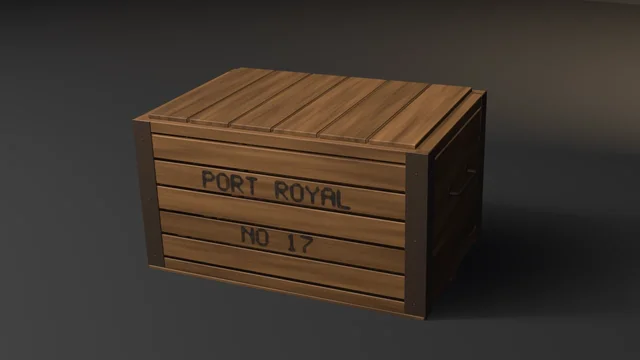
Shipping Crate
A procedural shipping crate through UVs, bake, LOD, collider, and Unity glTF, asserting recomputed budgets rather than an API contract.
showcase/toboggan/
A procedural runner sled — two steel-shod timber runners with high front horns and a near-flat tail, tenoned posts and bearers under a screwed seven-slat deck, one painted steering bar drilled at its centre, and a three-strand hemp rope through the hole to a wooden toggle — carried through UVs, bake, LOD, compound collider, and Unity glTF, asserting recomputed budgets rather than an API contract.
Rendered headless by the showcase piece itself. Select it to enlarge.
category Vehicles
blender --background --python showcase/toboggan/toboggan.py --
A traditional runner sled in the Flexible Flyer pattern (the name is the repo's; the model is the steered runner sled, not a flat-bottom toboggan): two steel-shod wooden runners with upturned front horns, six posts carrying three cross bearers, a deck of seven lengthwise slats screwed to them, one painted steering bar through both horns and proud of each as a hand grip, and a three-strand hemp rope threaded through a hole drilled in the bar's centre and stopped with a knot behind it, ending in a wooden toggle on the floor. A showcase piece, not an example — it witnesses no API contract. It asserts that generated geometry meets declared asset budgets, recomputed from the finished mesh.
| Shipped content | Used for |
|---|---|
skills/mesh-editing-and-bmesh | chamfered and round-cornered members swept along a curve, a drilled bar, lathed bolts and screws, a three-strand rope on a parallel-transport frame, all in one bmesh |
skills/custom-properties | face attributes (PlankTone, GrainDir) and a point attribute (Lay) read by the shaders |
skills/procedural-materials-and-shaders | slat pine, stained frame, worn steel, hemp darkened in the lay grooves, worn red enamel |
skills/bake-high-to-low | Cycles tangent-space normal bake, high onto low |
skills/engine-export-presets | Unity glTF (export_yup=True) |
skills/depsgraph-and-evaluated-data | evaluated triangle counts for the LOD ratios |
snippets/decimate_to_budget.py | LOD1 / LOD2 COLLAPSE chain |
snippets/convex_hull_collider.py | four hulls per runner, one for the deck, one for the bar, merged into a compound |
snippets/lod_chain.py | LOD naming and ratio pattern |
examples/mesh-hygiene-audit | hygiene combinatorics (copied, not imported) |
A sled stands on two steel shoes and is held together by tenons, rebates and a rope through a hole. Each of those fails invisibly to an AABB:
zmin sees it (--float-shoe, exit 16).--miss-hole, exit 18).Declared in the script as named constants, recomputed from the generated mesh. Measured values are from Blender 5.2.1, the only binary run locally; 4.5 and 5.1 were not run for this piece.
| Budget | Band | Measured | ||
|---|---|---|---|---|
| Base triangles | 7050–7650 | 7356 | ||
| LOD1 ratio | 0.32–0.62 | 0.5000 | ||
| LOD2 ratio | 0.10–0.35 | 0.2200 | ||
| Material slots | exactly 5, distinct | 5 | ||
| Slat / frame / steel / rope / paint faces | ≥ 230 / 770 / 1450 / 1300 / 44 | 252 / 864 / 1560 / 1412 / 48 | ||
| UV bounds | inside 0..1 | (0.0037, 0.0043)–(0.9962, 0.9957) | ||
| UV AABB overlap | ≤ 1e-5 | 0.000000 | ||
| Outer AABB | 1.623 × 0.468 × 0.243 m ± 0.020 | 1.6234 × 0.4680 × 0.2428 | ||
| Collider triangles | ≤ 720 | 632 (10 hulls) | ||
| Normal bake | {'FINISHED'} with image data | {'FINISHED'}, has_data=True | ||
| glTF export | file written, non-empty | ~326 kB | ||
| Hygiene | all zero | loose 0/0, non-manifold 0, zero-area 0, doubles 0, n-gons 0, coplanar cross-shell pairs 0 | ||
| Grounded AABB | \ | zmin\ | ≤ 1e-4 | 0.00000 |
| Named shoes | 2 shoes, each zmin ≤ 1e-4 | 2 at 0.00000 | ||
| Post bite into runner | 6 posts, 5–16 mm | 11.5 mm | ||
| Post tenon into bearer | 6–18 mm; clear of the slats ≥ 12 mm | 13.5 mm; 21.5 mm | ||
| Bar protrusion | 1 bar, 55–85 mm past each runner's outer face | 70.0 mm both ends | ||
| Slat seat | 7 slats, 21 joints, 1.5–4.5 mm | 3.0 mm | ||
| Screw seat | 21 screws, one per slat-bearer joint, 0.3–1.2 mm bite, 0.8–2.0 mm proud | 0.6 mm; 1.2 mm | ||
| Shoe seat | 2 shoes, 0.5–2.5 mm up into the runner | 1.5 mm | ||
| Bolt seat | 6 bolts, 3–6 mm proud, 0.5–2 mm bite | 4.4 mm; 1.0 mm | ||
| Rope in the hole | bar 1, rope 1, clearance 0.5–6 mm | hole r 11.0 mm, clearance 4.2 mm to the strand crowns, 72 rope vertices (six rings) inside the bar | ||
| Runner length | 1.15–1.25 m | 1.191 m | ||
| Deck | 0.90–0.98 m × 0.40–0.44 m, top 0.130–0.155 m | 0.943 × 0.417, 0.145 | ||
| Track (runner centre to centre) | 0.29–0.31 m | 0.300 m | ||
| Mirrored runners and shoes | extents mirrored through y = 0 within 0.1 mm | 0.000 mm |
Real-world size: the bands are this piece's own, chosen to match the common retail runner sled (about 1.2 m of runner, a deck about 0.4 m wide, standing 0.12–0.15 m off the snow). They are not taken from a standard.
SHOE_BITE), and its bottom vertices sit at exactly z = 0 on the flat run.PlankTone lands 0.73–1.33 of the ramp, so neighbouring boards read as different boards rather than one sheet.6 mm × (1 + 0.14 cos(3θ − 2πs/36 mm)), so the strands spiral along the rope in its silhouette, and a Lay point attribute with the same phase darkens the grooves between them. The path is re-cut at an even 6 mm. It starts at a knot centre behind the bar, runs straight through the hole, sags to the floor over 250 mm on a smoothstep, then curls 85° on the floor and ends in a toggle. The floor run sits at the strand crowns' radius (6.84 mm), not the mean, so the rope does not dip through the floor. The knot sphere (16.5 mm) is larger than the hole (11 mm), so the rope cannot pull through.doubles=2: the rope path's straight run landed exactly on the point where the sag begins, and the start-of-sag point was appended again. The path now appends it only when it is more than 0.1 mm from the last point.--float-bolts first lifted the bolts 4 mm, which put each bolt's base disc on y = 167 mm, exactly the plane of the steel shoe's side. The disc and the shoe's side face share no area, but the coplanar cross-shell count sees centres within 50 mm and reported 184 pairs, so the run exited 15, not 18. The displacement is now 3.5 mm.--short-bar (both ends pulled inside the runners) shrank the AABB by 80 mm in Y and exited 8, not 17. It now pulls only the left end in 19 mm, which stays inside BBOX_TOL (the box narrows 17.8 mm) and leaves that end 51 mm proud, under the 55 mm minimum.Every convention in showcase/README.md, and whether it applies here.
| Convention | Applies | How |
|---|---|---|
| Deterministic, budgets declared, assertions recompute | yes | no RNG; every value above is read off the mesh |
| Falsifier fails the budget it targets | yes | table below, run on 5.2.1 |
| Hygiene incl. cross-shell coplanar | yes | exit 15 |
| Named supports | yes | the two shoes (--float-shoe) |
| Even shaping terms and mirror symmetry | yes | one curve for both runners; mirrored runners and shoes asserted (--skew-runner) |
| Plumb and real-world size | yes | runner, deck and track bands (--tall-posts) |
| A member is tenoned into its seat | yes | posts into runner and bearer (--short-post), slats rebated (--float-slats) |
| Joint-fit budgets | yes | post and bar bands recomputed from the host shell |
| Fasteners seated | yes | bolt heads proud and bitten (--float-bolts); slat screws bitten and proud (--float-screws) |
| Seat conformance | yes | shoe up into runner (--lift-runners) |
| Hung / threaded rope | yes | rope in the bar's centre hole (--miss-hole) |
| Wrappers follow the host's profile | n/a | the shoe is a parallel offset of the same centreline, not a wrapper |
| Edge treatment: no right angles | yes, by construction | every member is a chamfered section; a 90° edge fraction of 0.015 is printed by the asset-quality gate on the render path |
| Shading is part of the model | yes | smooth along members, every edge over 40° hard (chamfers, caps) |
| One substance, one slot | yes | slat pine, frame, steel, rope, paint |
| Iron is not chrome | yes | steel metallic 0.85, roughness 0.30–0.62, rust speckle |
| Identical boards read as CG | yes | per-shell PlankTone; grain along each member |
| The bake cage is narrower than the nearest neighbour | yes | CAGE_EXTRUSION 0.01 m |
| Level on the stage; stage 60 m | yes | turned about Z only; 60 m floor and wall |
| Keep a falsifier's envelope still | yes | every displacement stays inside BBOX_TOL; --tall-posts raises the deck 40 mm but stays under the horn tips, so the AABB is unchanged |
| Masonry, vessels, scatter, roofs | no | the piece has none of these |
Each breaks one pipeline stage so a named budget fails. All thirteen exited their declared code on Blender 5.2.1; 4.5 and 5.1 were not run.
| Flag | Target budget | Breaks | Exit |
|---|---|---|---|
--skip-decimate | LOD1 ratio | drops the DECIMATE modifiers, LOD1 ratio goes to 1.0000 | 9 |
--stray-vert | mesh hygiene | adds one loose vertex under the deck | 15 |
--lift-z | grounded zmin | lifts the whole mesh 50 mm | 16 |
--float-shoe | named shoes | lifts the left shoe 6 mm; the right still grounds the AABB | 16 |
--short-post | post bite into the runner | starts every post 4 mm above the runner's top; −2.5 mm | 17 |
--short-bar | bar protrusion | pulls the bar's left end in 19 mm; 51 mm proud, under the 55 mm minimum | 17 |
--float-slats | slat seat | lifts every slat 5 mm off its bearers; −2.0 mm | 18 |
--lift-runners | shoe seat | lifts both timbers 4 mm off their shoes; −2.5 mm | 18 |
--float-bolts | bolt seat | moves every bolt 3.5 mm outward; bite −2.5 mm | 18 |
--float-screws | screw seat | lifts every screw head 3 mm off its slat; bite −2.4 mm | 18 |
--miss-hole | rope in the hole | lifts the rope and knot 12 mm; clearance −7.8 mm | 18 |
--tall-posts | real-world deck height | raises bearers, posts and slats 40 mm; deck top 185 mm | 19 |
--skew-runner | mirrored runners | moves the left runner and shoe 6 mm along X; 6.0 mm | 19 |
File-local and sequential. 9 is a valid check code. 1 is the FATAL wrapper — a crash, never a named check.
| Code | Meaning |
|---|---|
| 0 | Success |
| 1 | Uncaught exception (FATAL wrapper) |
| 2 | argparse / usage |
| 3 | Mesh did not build, or has no UV layer |
| 4 | Base triangle count outside band |
| 5 | Material slots, or a material's face floor |
| 6 | UVs outside 0..1 |
| 7 | UV AABB overlap above tolerance |
| 8 | Outer AABB off declared size |
| 9 | LOD1 or LOD2 ratio outside band (--skip-decimate) |
| 10 | Framing gate (examples/gallery_framing.py, render path only) |
| 11 | Collider triangles above ceiling |
| 12 | Normal bake failed or produced no image data |
| 13 | glTF export missing or empty |
| 14 | --output produced no file |
| 15 | Mesh hygiene (--stray-vert) |
| 16 | Grounded zmin, or a shoe floating (--lift-z, --float-shoe) |
| 17 | Post bite or tenon, or bar protrusion (--short-post, --short-bar) |
| 18 | Slat, screw, shoe or bolt seat, or the rope in its hole (--float-slats, --float-screws, --lift-runners, --float-bolts, --miss-hole) |
| 19 | Real-world size or mirrored runners (--tall-posts, --skew-runner) |
| 24 | Asset-quality floors (examples/gallery_asset_quality.py, render path only; remapped from 11) |
# Budget check, no render. About 2 s on 5.2.1.
blender --background --python toboggan.py --

# Falsifier: the rope sits in solid wood, not in the hole. Must exit 18.
blender --background --python toboggan.py -- --miss-hole

# Falsifier: one shoe leaves the floor. Must exit 16.
blender --background --python toboggan.py -- --float-shoe

# Render the gallery still (EEVEE; --engine cycles on a GPU-less host).
blender --background --python toboggan.py -- --output toboggan.webp
Smoke runs the check-only path. It does not pass --output or any falsifier.
Only Blender 5.2.1 was run locally. The values below are from it; a column for 4.5 and 5.1 would be a guess, so there is none.
| Value | 5.2.1 |
|---|---|
| Base triangles | 7356 |
| LOD1 / LOD2 tris | 3678 / 1618 |
| Face counts (slat / frame / steel / rope / paint) | 252 / 864 / 1560 / 1412 / 48 |
| Outer AABB | 1.6234 × 0.4680 × 0.2428 |
| Collider tris | 632 |
| glTF bytes | 325848 |
"""Game-ready runner sled — a showcase piece, not an example. Asserts budget conformance of a procedural Flexible-Flyer-style runner sled: two steel-shod wooden runners with upturned front horns, six posts carrying three cross bearers, a deck of seven lengthwise slats seated on the bearers and screwed to them, one painted steering bar through both runner horns drilled at its centre for a pull rope, and a three-strand rope threaded through that hole and stopped with a knot behind it. Carried through UVs, five materials (slat pine, stained frame, steel, hemp rope, red paint), a high-to-low normal bake, an LOD chain, a compound convex collider, and a Unity glTF export. The budgets that matter here are the ones a sled fails invisibly. A sled stands on its two shoes, not on its deck: an AABB that touches the floor says nothing about whether *each* shoe does. The deck rides on tenoned posts and seated slats, and the rope has to pass through the bar's hole rather than through the bar. The piece measures each off the finished mesh. Budgets are declared below and recomputed from the generated result. They are not API-contract witnesses. Each falsifier violates one named budget: ``--skip-decimate`` the LOD-ratio band, ``--stray-vert`` mesh hygiene, ``--lift-z`` grounded zmin, ``--float-shoe`` the named shoes, ``--short-post`` the post tenons, ``--short-bar`` the bar's protrusion, ``--float-slats`` the slat seat, ``--lift-runners`` the shoe seat, ``--float-bolts`` the bolt seat, ``--float-screws`` the screw seat, ``--miss-hole`` the rope in its hole, ``--tall-posts`` the real-world deck height, ``--skew-runner`` the mirrored runners. No randomness. DECIMATE COLLAPSE triangle counts are not byte-identical across Blender versions — the LOD gate is a ratio band. blender --background --python toboggan.py -- blender --background --python toboggan.py -- --miss-hole blender --background --python toboggan.py -- --output toboggan.webp """ import argparse import math import os import sys import tempfile import traceback import bmesh import bpy from mathutils import Matrix, Vector from mathutils.kdtree import KDTree _REPO = os.path.abspath( os.path.join(os.path.dirname(os.path.abspath(__file__)), os.pardir, os.pardir) ) sys.path.insert(0, os.path.join(_REPO, "examples")) sys.dont_write_bytecode = True import gallery_asset_quality # noqa: E402 import gallery_framing # noqa: E402 # Frame: +X is the front of the sled, Y runs across it, Z is up, Z = 0 is # the floor the shoes stand on. # Runners: a chamfered timber on edge, swept along a curve that is flat # under the deck and rises into a front horn and a short rear tail. The # curve and its slope are closed-form, so the shoe and the body are # parallel offsets of one centreline. The tail is a small kick-up only: a # runner sled's back is cut off nearly flat. RUN_Y = 0.150 RUN_HALF = 0.600 HORN_X0 = 0.280 HORN_RISE = 0.210 HORN_POW = 2.5 TAIL_X0 = -0.500 TAIL_RISE = 0.008 TAIL_POW = 2.0 RUN_STATIONS = 36 RUN_HW = 0.014 RUN_HH = 0.027 RUN_CH = 0.004 # Steel shoe: a flat strap under each runner, wider than the timber. SHOE_HW = 0.017 SHOE_HH = 0.0045 SHOE_CH = 0.0015 SHOE_BITE = 0.0015 BODY_D = 2.0 * SHOE_HH - SHOE_BITE + RUN_HH BODY_TOP = BODY_D + RUN_HH # Posts, bearers, slats. The post tenons into the runner and into the # bearer; the slat is rebated into the bearer. POST_X = (-0.400, -0.040, 0.260) POST_HX = 0.014 POST_HY = 0.012 POST_CH = 0.003 POST_BITE = 0.010 POST_TENON = 0.012 BEAR_HALF = 0.190 BEAR_HX = 0.020 BEAR_HZ = 0.0175 BEAR_CH = 0.004 SLAT_N = 7 SLAT_PITCH = 0.0605 SLAT_HW = 0.027 SLAT_HH = 0.008 SLAT_CH = 0.0025 SLAT_X0 = -0.520 SLAT_X1 = 0.420 SLAT_SEAT = 0.003 DECK_TOP = 0.145 BEAR_TOP = DECK_TOP - 2.0 * SLAT_HH + SLAT_SEAT BEAR_ZC = BEAR_TOP - BEAR_HZ BEAR_BOT = BEAR_ZC - BEAR_HZ # Steering bar: one painted crossbar through both runner horns, proud of # each, drilled through at its centre for the pull rope; a knot behind it. BAR_X = 0.500 BAR_HX = 0.016 BAR_HZ = 0.018 BAR_CH = 0.010 BAR_PROT = 0.070 HOLE_R = 0.011 # Three-strand hemp: the section's radius swells along three helical # strands, so the lay reads in the silhouette, not only in the shading. ROPE_R = 0.006 ROPE_SEG = 12 ROPE_STEP = 0.006 LAY_AMP = 0.14 LAY_PITCH = 0.036 ROPE_RMAX = ROPE_R * (1.0 + LAY_AMP) KNOT_R = 0.0165 KNOT_C = 0.010 TOGGLE_HALF = 0.050 TOGGLE_H = 0.009 DROP_X = 0.25 CURL_R = 0.22 CURL_A = math.radians(85.0) # A domed screw head through each slat into every bearer it crosses, # phase-turned per screw so no two heads share a facet plane. SCREW_PROFILE = ((0.0042, 0.0004), (0.0035, 0.0013)) SCREW_TIP = 0.0018 SCREW_BITE = 0.0006 SCREW_SEG = 8 # Carriage bolts through each runner at every post. BOLT_BITE = 0.0010 BOLT_PROFILE = ((0.0095, 0.0), (0.0095, 0.0015), (0.0085, 0.0028), (0.0060, 0.0042), (0.0030, 0.0050)) BOLT_TIP = 0.0054 # Falsifier displacements. Each stays inside BBOX_TOL. FLOAT_SHOE = 0.006 SHORT_POST = -0.004 SHORT_BAR = 0.019 FLOAT_SLATS = 0.005 LIFT_RUNNERS = 0.004 FLOAT_BOLTS = 0.0035 FLOAT_SCREWS = 0.003 MISS_HOLE = 0.012 TALL_POSTS = 0.040 SKEW_RUNNER = 0.006 BBOX_TOL = 0.020 OUTER_SIZE = (1.623, 0.468, 0.243) BASE_TRIS_MIN = 7050 BASE_TRIS_MAX = 7650 LOD1_RATIO_MIN = 0.32 LOD1_RATIO_MAX = 0.62 LOD2_RATIO_MIN = 0.10 LOD2_RATIO_MAX = 0.35 LOD1_TARGET = 0.50 LOD2_TARGET = 0.22 MATERIAL_COUNT = 5 FACE_FLOORS = {0: 230, 1: 770, 2: 1450, 3: 1300, 4: 44} UV_EPS = 1e-4 UV_OVERLAP_MAX = 1e-5 COLLIDER_TRIS_MAX = 720 BAKE_RES = 512 CAGE_EXTRUSION = 0.01 ZMIN_EPS = 1e-4 DOUBLES_EPS = 1e-5 AREA_EPS = 1e-10 COPLANAR_NORMAL_EPS = 1e-4 COPLANAR_PLANE_EPS = 1e-4 COPLANAR_CENTRE_MAX = 0.05 LIFT_Z = 0.05 SHOE_Z_MAX = 1e-4 POST_BITE_MIN = 0.005 POST_BITE_MAX = 0.016 POST_TENON_MIN = 0.006 POST_TENON_MAX = 0.018 POST_CLEAR_MIN = 0.012 BAR_PROT_MIN = 0.055 BAR_PROT_MAX = 0.085 SLAT_SEAT_MIN = 0.0015 SLAT_SEAT_MAX = 0.0045 SHOE_SEAT_MIN = 0.0005 SHOE_SEAT_MAX = 0.0025 BOLT_PROUD_MIN = 0.0030 BOLT_PROUD_MAX = 0.0060 BOLT_BITE_MIN = 0.0005 BOLT_BITE_MAX = 0.0020 SCREW_BITE_MIN = 0.0003 SCREW_BITE_MAX = 0.0012 SCREW_PROUD_MIN = 0.0008 SCREW_PROUD_MAX = 0.0020 ROPE_CLEAR_MIN = 0.0005 ROPE_CLEAR_MAX = 0.0060 RUNNER_LEN = (1.15, 1.25) DECK_LEN = (0.90, 0.98) DECK_W = (0.40, 0.44) DECK_H = (0.130, 0.155) TRACK = (0.29, 0.31) MIRROR_EPS = 1e-4 SLAT_IDX = 0 FRAME_IDX = 1 STEEL_IDX = 2 ROPE_IDX = 3 PAINT_IDX = 4 # Hero camera: front three-quarter, low, the rope curling toward the viewer. CAM_YAW = 0.0 CAM_LENS = 50.0 CAM_LOC = (1.62, -1.50, 0.68) CAM_AIM = (0.30, -0.10, 0.04) def eevee_engine_id(): """EEVEE id: 'BLENDER_EEVEE' on 5.0+, 'BLENDER_EEVEE_NEXT' on 4.2-4.5.""" return "BLENDER_EEVEE" if bpy.app.version >= (5, 0, 0) else "BLENDER_EEVEE_NEXT" def fail(msg, code): print(f"FAIL[{code}]: {msg}", file=sys.stderr) return code def triangle_count(mesh): mesh.calc_loop_triangles() return len(mesh.loop_triangles) def evaluated_triangle_count(obj): deps = bpy.context.evaluated_depsgraph_get() ev = obj.evaluated_get(deps) mesh = ev.to_mesh() try: mesh.calc_loop_triangles() return len(mesh.loop_triangles) finally: ev.to_mesh_clear() def new_island(ctx): ctx["next"] += 1 return ctx["next"] def stamp(ctx, face, island, uvmap, grain): face[ctx["isl"]] = island for loop in face.loops: loop[ctx["uv"]].uv = uvmap[loop.vert] face[ctx["gx"]], face[ctx["gy"]], face[ctx["gz"]] = grain def tube(bm, rings, closed_ends, mat_idx, ctx, grains): """Quads between consecutive rings, fans to the two end poles.""" island = new_island(ctx) n = len(rings[0]) arc = [0.0] for a, b in zip(rings, rings[1:]): ca = sum((v.co for v in a), Vector()) / n cb = sum((v.co for v in b), Vector()) / n arc.append(arc[-1] + (cb - ca).length) for k in range(len(rings) - 1): a, b = rings[k], rings[k + 1] for i in range(n): j = (i + 1) % n f = bm.faces.new((a[i], a[j], b[j], b[i])) f.material_index = mat_idx stamp(ctx, f, island, {a[i]: (arc[k], i / n), a[j]: (arc[k], (i + 1) / n), b[j]: (arc[k + 1], (i + 1) / n), b[i]: (arc[k + 1], i / n)}, grains[k]) for pole, ring, s, g, sign in ((closed_ends[0], rings[0], arc[0], grains[0], -1.0), (closed_ends[1], rings[-1], arc[-1], grains[-1], 1.0)): for i in range(n): j = (i + 1) % n vs = (pole, ring[i], ring[j]) if sign < 0 else (pole, ring[j], ring[i]) f = bm.faces.new(vs) f.material_index = mat_idx stamp(ctx, f, island, {pole: (s + sign * 0.01, (i + 0.5) / n), ring[i]: (s, i / n), ring[j]: (s, (i + 1) / n)}, g) def pack_uvs(bm, ctx, margin=0.06): """One grid cell per UV island (every face here belongs to a strip island).""" uv, isl = ctx["uv"], ctx["isl"] islands, order = {}, [] for face in bm.faces: key = face[isl] if key not in islands: islands[key] = [] order.append(key) islands[key].append(face) cols = max(1, math.ceil(math.sqrt(len(order)))) rows = max(1, math.ceil(len(order) / cols)) cw, ch = 1.0 / cols, 1.0 / rows pu, pv = margin * cw * 0.5, margin * ch * 0.5 for idx, key in enumerate(order): faces = islands[key] allc = [tuple(loop[uv].uv) for f in faces for loop in f.loops] minx, maxx = min(c[0] for c in allc), max(c[0] for c in allc) miny, maxy = min(c[1] for c in allc), max(c[1] for c in allc) dx, dy = max(maxx - minx, 1e-8), max(maxy - miny, 1e-8) ou, ov = (idx % cols) * cw + pu, (idx // cols) * ch + pv for face in faces: for loop in face.loops: x, y = loop[uv].uv loop[uv].uv = (ou + (x - minx) / dx * (cw - 2 * pu), ov + (y - miny) / dy * (ch - 2 * pv)) def paint_pieces(me): """``GrainDir`` from the per-face path tangent, ``PlankTone`` per shell.""" npoly = len(me.polygons) comps = [] for nm in ("gx", "gy", "gz"): vals = [0.0] * npoly me.attributes[nm].data.foreach_get("value", vals) comps.append(vals) me.attributes.remove(me.attributes[nm]) grain = [c for i in range(npoly) for c in (comps[0][i], comps[1][i], comps[2][i])] tone = [0.5] * npoly vf = [[] for _ in range(len(me.vertices))] for p in me.polygons: for i in p.vertices: vf[i].append(p.index) for k, g in enumerate(shells(me)): t = 0.5 + 0.3 * (((k * 0.6180339887 + 0.3) % 1.0) - 0.5) for fi in {fi for i in g for fi in vf[i]}: tone[fi] = t a = me.attributes.new("PlankTone", "FLOAT", "FACE") a.data.foreach_set("value", tone) b = me.attributes.new("GrainDir", "FLOAT_VECTOR", "FACE") b.data.foreach_set("vector", grain) def _sock(sockets, identifier): return next(sk for sk in sockets if sk.identifier == identifier) def wood_material(name, dark, light, rough=(0.72, 0.52)): """Timber whose grain runs along ``GrainDir`` and whose tone varies by piece.""" mat = bpy.data.materials.new(name) mat.use_nodes = True nt = mat.node_tree bsdf = nt.nodes["Principled BSDF"] coord = nt.nodes.new("ShaderNodeTexCoord") gdir = nt.nodes.new("ShaderNodeAttribute") gdir.attribute_name = "GrainDir" tone = nt.nodes.new("ShaderNodeAttribute") tone.attribute_name = "PlankTone" dot = nt.nodes.new("ShaderNodeVectorMath") dot.operation = "DOT_PRODUCT" nt.links.new(coord.outputs["Object"], dot.inputs[0]) nt.links.new(gdir.outputs["Vector"], dot.inputs[1]) squash = nt.nodes.new("ShaderNodeMath") squash.operation = "MULTIPLY" squash.inputs[1].default_value = 0.94 nt.links.new(dot.outputs["Value"], squash.inputs[0]) along = nt.nodes.new("ShaderNodeVectorMath") along.operation = "SCALE" nt.links.new(gdir.outputs["Vector"], along.inputs[0]) nt.links.new(squash.outputs["Value"], along.inputs["Scale"]) grain_co = nt.nodes.new("ShaderNodeVectorMath") grain_co.operation = "SUBTRACT" nt.links.new(coord.outputs["Object"], grain_co.inputs[0]) nt.links.new(along.outputs["Vector"], grain_co.inputs[1]) shift = nt.nodes.new("ShaderNodeVectorMath") shift.operation = "ADD" nt.links.new(grain_co.outputs["Vector"], shift.inputs[0]) nt.links.new(tone.outputs["Fac"], shift.inputs[1]) noise = nt.nodes.new("ShaderNodeTexNoise") noise.inputs["Scale"].default_value = 30.0 noise.inputs["Detail"].default_value = 6.0 noise.inputs["Roughness"].default_value = 0.62 nt.links.new(shift.outputs["Vector"], noise.inputs["Vector"]) ramp = nt.nodes.new("ShaderNodeValToRGB") ramp.color_ramp.elements[0].position = 0.30 ramp.color_ramp.elements[0].color = (*dark, 1.0) ramp.color_ramp.elements[1].position = 0.72 ramp.color_ramp.elements[1].color = (*light, 1.0) nt.links.new(noise.outputs["Fac"], ramp.inputs["Fac"]) gain = nt.nodes.new("ShaderNodeMath") gain.operation = "MULTIPLY_ADD" # PlankTone spans 0.35..0.65, so each piece lands 0.73..1.33 of the ramp: # neighbouring slats read as different boards, not one sheet. gain.inputs[1].default_value = 2.0 gain.inputs[2].default_value = 0.03 nt.links.new(tone.outputs["Fac"], gain.inputs[0]) mix = nt.nodes.new("ShaderNodeMix") mix.data_type = "RGBA" mix.blend_type = "MULTIPLY" _sock(mix.inputs, "Factor_Float").default_value = 1.0 nt.links.new(ramp.outputs["Color"], _sock(mix.inputs, "A_Color")) nt.links.new(gain.outputs["Value"], _sock(mix.inputs, "B_Color")) nt.links.new(_sock(mix.outputs, "Result_Color"), bsdf.inputs["Base Color"]) rmap = nt.nodes.new("ShaderNodeMapRange") rmap.inputs["To Min"].default_value = rough[0] rmap.inputs["To Max"].default_value = rough[1] nt.links.new(noise.outputs["Fac"], rmap.inputs["Value"]) nt.links.new(rmap.outputs["Result"], bsdf.inputs["Roughness"]) return mat def iron_material(name): """Forged iron: near-black, rough, rusted in patches. Not chrome.""" mat = bpy.data.materials.new(name) mat.use_nodes = True nt = mat.node_tree bsdf = nt.nodes["Principled BSDF"] tc = nt.nodes.new("ShaderNodeTexCoord") noise = nt.nodes.new("ShaderNodeTexNoise") noise.inputs["Scale"].default_value = 40.0 noise.inputs["Detail"].default_value = 8.0 nt.links.new(tc.outputs["Object"], noise.inputs["Vector"]) ramp = nt.nodes.new("ShaderNodeValToRGB") ramp.color_ramp.elements[0].position = 0.45 ramp.color_ramp.elements[0].color = (0.035, 0.033, 0.031, 1.0) ramp.color_ramp.elements[1].position = 0.78 ramp.color_ramp.elements[1].color = (0.20, 0.085, 0.035, 1.0) nt.links.new(noise.outputs["Fac"], ramp.inputs["Fac"]) nt.links.new(ramp.outputs["Color"], bsdf.inputs["Base Color"]) bsdf.inputs["Metallic"].default_value = 0.65 rough = nt.nodes.new("ShaderNodeMapRange") rough.inputs["To Min"].default_value = 0.55 rough.inputs["To Max"].default_value = 0.85 nt.links.new(noise.outputs["Fac"], rough.inputs["Value"]) nt.links.new(rough.outputs["Result"], bsdf.inputs["Roughness"]) return mat def assign_slots(obj, mats): slots = obj.data.materials for i, mat in enumerate(mats): if i < len(slots): slots[i] = mat else: slots.append(mat) def world_bbox(obj): corners = [obj.matrix_world @ Vector(c) for c in obj.bound_box] xs, ys, zs = [c.x for c in corners], [c.y for c in corners], [c.z for c in corners] return (min(xs), min(ys), min(zs), max(xs), max(ys), max(zs)) def uv_stats(mesh): uv = mesh.uv_layers.active if uv is None: return 0.0, 0.0, 1.0, 1.0, 0.0, 0 data = uv.data us = [loop.uv[0] for loop in data] vs = [loop.uv[1] for loop in data] aabbs = [] for poly in mesh.polygons: pu = [data[i].uv[0] for i in poly.loop_indices] pv = [data[i].uv[1] for i in poly.loop_indices] aabbs.append((min(pu), min(pv), max(pu), max(pv))) span = max(1e-6, max(a[2] - a[0] for a in aabbs), max(a[3] - a[1] for a in aabbs)) buckets = {} for i, a in enumerate(aabbs): for c in range(int(a[0] // span), int(a[2] // span) + 1): for r in range(int(a[1] // span), int(a[3] // span) + 1): buckets.setdefault((c, r), []).append(i) overlap = 0.0 seen = set() for members in buckets.values(): for ii in range(len(members)): for jj in range(ii + 1, len(members)): i, j = members[ii], members[jj] key = (i, j) if i < j else (j, i) if key in seen: continue seen.add(key) a, b = aabbs[i], aabbs[j] overlap += max(0.0, min(a[2], b[2]) - max(a[0], b[0])) * max( 0.0, min(a[3], b[3]) - max(a[1], b[1])) return min(us), min(vs), max(us), max(vs), overlap, len(aabbs) def face_area(me, poly): idxs = poly.vertices v0 = me.vertices[idxs[0]].co area = 0.0 for i in range(1, len(idxs) - 1): area += (me.vertices[idxs[i]].co - v0).cross(me.vertices[idxs[i + 1]].co - v0).length * 0.5 return area def hygiene_audit(me): ngons = sum(1 for p in me.polygons if len(p.vertices) > 4) zero_area = sum(1 for p in me.polygons if face_area(me, p) <= AREA_EPS) bm = bmesh.new() try: bm.from_mesh(me) loose_v = sum(1 for v in bm.verts if len(v.link_edges) == 0) loose_e = sum(1 for e in bm.edges if len(e.link_faces) == 0) nonman = sum(1 for e in bm.edges if not e.is_manifold) ret = bmesh.ops.find_doubles(bm, verts=list(bm.verts), dist=DOUBLES_EPS) doubles = len(ret.get("targetmap") or {}) finally: bm.free() return {"ngons": ngons, "loose_v": loose_v, "loose_e": loose_e, "nonman": nonman, "zero_area": zero_area, "doubles": doubles} def shells(me): neighbors = [[] for _ in range(len(me.vertices))] for edge in me.edges: a, b = edge.vertices neighbors[a].append(b) neighbors[b].append(a) seen = [False] * len(me.vertices) groups = [] for start in range(len(me.vertices)): if seen[start]: continue seen[start] = True stack = [start] group = [] while stack: cur = stack.pop() group.append(cur) for nxt in neighbors[cur]: if not seen[nxt]: seen[nxt] = True stack.append(nxt) groups.append(group) return groups def zfight_pairs(me): """Coplanar face pairs from *different shells* (copied from showcase/grindstone).""" owner = {} for si, g in enumerate(shells(me)): for vi in g: owner[vi] = si faces = [(p.normal.copy(), p.center.copy(), owner.get(p.vertices[0], -1)) for p in me.polygons] kd = KDTree(len(faces)) for i, (_n, c, _s) in enumerate(faces): kd.insert(c, i) kd.balance() hits = 0 for i, (ni, ci, si) in enumerate(faces): for _co, j, _d in kd.find_range(ci, COPLANAR_CENTRE_MAX): if j <= i: continue nj, cj, sj = faces[j] if si == sj: continue if abs(abs(ni.dot(nj)) - 1.0) > COPLANAR_NORMAL_EPS: continue if abs(ni.dot(cj - ci)) > COPLANAR_PLANE_EPS: continue hits += 1 return hits # --- runner curve ----------------------------------------------------------- def hump(x): """Centreline height and slope at ``x``: flat under the deck, a horn in front, a tail behind.""" if x > HORN_X0: span = RUN_HALF - HORN_X0 u = (x - HORN_X0) / span return HORN_RISE * u ** HORN_POW, HORN_RISE * HORN_POW * u ** (HORN_POW - 1.0) / span if x < TAIL_X0: span = TAIL_X0 + RUN_HALF u = (TAIL_X0 - x) / span return TAIL_RISE * u ** TAIL_POW, -TAIL_RISE * TAIL_POW * u ** (TAIL_POW - 1.0) / span return 0.0, 0.0 def offset_pt(x, d): """Point ``d`` off the centreline along its normal, in the XZ plane (y = 0).""" f, df = hump(x) k = 1.0 / math.hypot(1.0, df) return Vector((x - d * df * k, 0.0, f + d * k)) def runner_stations(): xs = {round(-RUN_HALF + 2.0 * RUN_HALF * k / RUN_STATIONS, 6) for k in range(RUN_STATIONS + 1)} xs |= {HORN_X0, TAIL_X0, BAR_X} return sorted(xs) # --- construction ----------------------------------------------------------- def section8(hw, hh, ch): """A rectangle with its four corners chamfered: eight (side, up) offsets.""" return [(hw - ch, hh), (hw, hh - ch), (hw, -(hh - ch)), (hw - ch, -hh), (-(hw - ch), -hh), (-hw, -(hh - ch)), (-hw, hh - ch), (-(hw - ch), hh)] def section_round(hw, hh, r, steps=2): """A rectangle with its four corners rounded: ``steps`` + 1 points per quarter arc.""" out = [] for cx, cy, a0 in ((hw - r, hh - r, 90.0), (hw - r, -(hh - r), 0.0), (-(hw - r), -(hh - r), -90.0), (-(hw - r), hh - r, -180.0)): for k in range(steps + 1): a = math.radians(a0 - 90.0 * k / steps) out.append((cx + r * math.cos(a), cy + r * math.sin(a))) return out def member(bm, ctx, pts, side, hw, hh, ch, mat, grain, reach=0.0015, sec=None): """Chamfered-rectangle section swept along ``pts``. ``side`` is the direction the section's width ``hw`` runs in; ``up`` is ``t x side``, so a path along +X with side +Y has its height along +Z. Ends close on a pole a hair past the last ring, so every cap is a fan of triangles rather than an n-gon. """ m = len(pts) tans = [(pts[min(i + 1, m - 1)] - pts[max(i - 1, 0)]).normalized() for i in range(m)] sec = sec or section8(hw, hh, ch) rings = [] for p, t in zip(pts, tans): s = (side - t * side.dot(t)).normalized() u = t.cross(s) rings.append([bm.verts.new(p + s * a + u * b) for a, b in sec]) poles = (bm.verts.new(pts[0] - tans[0] * reach), bm.verts.new(pts[-1] + tans[-1] * reach)) tube(bm, rings, poles, mat, ctx, [grain] * m) def resample(pts, step): """The polyline ``pts`` re-cut at an even arc-length ``step``, ends kept.""" acc = [0.0] for a, b in zip(pts, pts[1:]): acc.append(acc[-1] + (b - a).length) n = max(2, round(acc[-1] / step)) out, j = [], 0 for k in range(n + 1): s = acc[-1] * k / n while j < len(pts) - 2 and acc[j + 1] < s: j += 1 f = (s - acc[j]) / max(acc[j + 1] - acc[j], 1e-12) out.append(pts[j].lerp(pts[j + 1], min(max(f, 0.0), 1.0))) return out def rope_sweep(bm, ctx, pts, radius, seg, mat): """Three-strand rope swept along a 3D path with a parallel-transport frame. The section radius swells along three helical strands; the ``Lay`` point attribute carries the same phase so the shader darkens the grooves between strands. """ lay = ctx["lay"] m = len(pts) tans = [(pts[min(i + 1, m - 1)] - pts[max(i - 1, 0)]).normalized() for i in range(m)] n = Vector((0.0, 0.0, 1.0)) rings, grains = [], [] s = 0.0 for i, (p, t) in enumerate(zip(pts, tans)): if i: s += (p - pts[i - 1]).length n = (n - t * n.dot(t)).normalized() b = t.cross(n) ring = [] for k in range(seg): th = 2 * math.pi * k / seg c = math.cos(3.0 * th - 2.0 * math.pi * s / LAY_PITCH) r = radius * (1.0 + LAY_AMP * c) v = bm.verts.new(p + n * (r * math.cos(th)) + b * (r * math.sin(th))) v[lay] = 0.5 + 0.5 * c ring.append(v) rings.append(ring) grains.append(tuple(t)) poles = (bm.verts.new(pts[0] - tans[0] * (0.5 * radius)), bm.verts.new(pts[-1] + tans[-1] * (0.5 * radius))) tube(bm, rings, poles, mat, ctx, grains) def add_knot(bm, ctx, centre, radius, mat, rows=7, seg=10): """A stopper knot: a sphere on latitudinal rings about the X axis.""" rings = [] for k in range(1, rows + 1): phi = math.pi * k / (rows + 1) x = -radius * math.cos(phi) r = radius * math.sin(phi) rings.append([bm.verts.new(centre + Vector((x, r * math.cos(2 * math.pi * i / seg), r * math.sin(2 * math.pi * i / seg)))) for i in range(seg)]) poles = (bm.verts.new(centre + Vector((-radius, 0.0, 0.0))), bm.verts.new(centre + Vector((radius, 0.0, 0.0)))) tube(bm, rings, poles, mat, ctx, [(0.0, 1.0, 0.0)] * len(rings)) def add_bar(bm, ctx, centre, hy, mat, short=0.0): """One crossbar drilled through along X at its centre: a chamfered rectangle ring of half-span ``hy`` around a 12-gon hole. ``short`` pulls the -Y end in by that much and leaves the +Y end where it is. Four strips (front ring, back ring, outer wall, hole wall), each quad a cell of a UV row, so no two faces share UV area. """ hz, c = BAR_HZ, BAR_CH outer = [(hy, 0.0), (hy, hz - c), (hy - c, hz), (0.0, hz), (-(hy - c), hz), (-hy, hz - c), (-hy, 0.0), (-hy, -(hz - c)), (-(hy - c), -hz), (0.0, -hz), (hy - c, -hz), (hy, -(hz - c))] n = len(outer) inner = [(HOLE_R * math.cos(2 * math.pi * k / n), HOLE_R * math.sin(2 * math.pi * k / n)) for k in range(n)] def ring(pts, dx): return [bm.verts.new(centre + Vector((dx, a + (short if a < -HOLE_R else 0.0), b))) for a, b in pts] of, ob = ring(outer, BAR_HX), ring(outer, -BAR_HX) inf, inb = ring(inner, BAR_HX), ring(inner, -BAR_HX) island = new_island(ctx) def strip(row, quads): for i, vs in enumerate(quads): f = bm.faces.new(vs) f.material_index = mat u0, u1, v0, v1 = i / n, (i + 1) / n, row / 4.0, (row + 1) / 4.0 stamp(ctx, f, island, {vs[0]: (u0, v0), vs[1]: (u1, v0), vs[2]: (u1, v1), vs[3]: (u0, v1)}, (0.0, 1.0, 0.0)) j = lambda i: (i + 1) % n # noqa: E731 strip(0, [(of[i], of[j(i)], inf[j(i)], inf[i]) for i in range(n)]) strip(1, [(ob[i], ob[j(i)], inb[j(i)], inb[i]) for i in range(n)]) strip(2, [(of[i], of[j(i)], ob[j(i)], ob[i]) for i in range(n)]) strip(3, [(inf[i], inf[j(i)], inb[j(i)], inb[i]) for i in range(n)]) def lathe_axis(bm, profile, n, mat, ctx, origin, sign): """Revolve an (r, t) profile about an axis along ``sign`` * Y from ``origin``.""" xf = Matrix.Translation(origin) @ Matrix.Rotation(-sign * math.pi / 2.0, 4, "X") rings, poles = [], [] for p in profile: if p.x <= 0.0: poles.append(bm.verts.new(xf @ Vector((0.0, 0.0, p.y)))) else: rings.append([bm.verts.new(xf @ Vector((p.x * math.cos(2 * math.pi * k / n), p.x * math.sin(2 * math.pi * k / n), p.y))) for k in range(n)]) tube(bm, rings, poles, mat, ctx, [(0.0, 1.0, 0.0)] * len(rings)) def lathe_z(bm, profile, n, mat, ctx, origin, phase): """Revolve an (r, z) profile about +Z from ``origin``, turned by ``phase``.""" rings, poles = [], [] for p in profile: if p.x <= 0.0: poles.append(bm.verts.new(origin + Vector((0.0, 0.0, p.y)))) else: rings.append([bm.verts.new(origin + Vector(( p.x * math.cos(phase + 2 * math.pi * k / n), p.x * math.sin(phase + 2 * math.pi * k / n), p.y))) for k in range(n)]) tube(bm, rings, poles, mat, ctx, [(0.0, 0.0, 1.0)] * len(rings)) def screw_profile(): return ([Vector((0.0, 0.0))] + [Vector(p) for p in SCREW_PROFILE] + [Vector((0.0, SCREW_TIP))]) def bolt_profile(): return ([Vector((0.0, 0.0))] + [Vector(p) for p in BOLT_PROFILE] + [Vector((0.0, BOLT_TIP))]) def rope_path(hx, hz, lift): """Knot, through the hole, a sag to the floor, then a curl lying on it.""" kx = hx - BAR_HX - KNOT_C pts = [Vector((kx + 0.015 * k, 0.0, hz)) for k in range(4)] x_s = hx + BAR_HX + 0.01 while pts[-1].x < x_s - 0.0075: pts.append(Vector((pts[-1].x + 0.015, 0.0, hz))) if x_s - pts[-1].x > 1e-4: pts.append(Vector((x_s, 0.0, hz))) steps = 12 for k in range(1, steps + 1): s = k / steps sm = s * s * (3.0 - 2.0 * s) pts.append(Vector((x_s + DROP_X * s, 0.0, hz + (ROPE_RMAX - hz) * sm))) x_e = x_s + DROP_X arcs = 18 for k in range(1, arcs + 1): th = CURL_A * k / arcs pts.append(Vector((x_e + CURL_R * math.sin(th), -CURL_R * (1.0 - math.cos(th)), ROPE_RMAX))) return [p + Vector((0.0, 0.0, lift)) for p in resample(pts, ROPE_STEP)], kx def build_sled_mesh( name, stray_vert=False, float_shoe=False, short_post=False, short_bar=False, float_slats=False, lift_runners=False, miss_hole=False, float_bolts=False, float_screws=False, tall_posts=False, skew_runner=False, ): bm = bmesh.new() try: ctx = {"uv": bm.loops.layers.uv.new("UVMap"), "isl": bm.faces.layers.int.new("UVIsland"), "gx": bm.faces.layers.float.new("gx"), "gy": bm.faces.layers.float.new("gy"), "gz": bm.faces.layers.float.new("gz"), "lay": bm.verts.layers.float.new("Lay"), "next": 0} xs = runner_stations() raise_by = TALL_POSTS if tall_posts else 0.0 for side in (-1.0, 1.0): y = side * RUN_Y dx = SKEW_RUNNER if (skew_runner and side < 0) else 0.0 shoe_lift = FLOAT_SHOE if (float_shoe and side < 0) else 0.0 body_lift = LIFT_RUNNERS if lift_runners else 0.0 shoe = [offset_pt(x, SHOE_HH) + Vector((dx, y, shoe_lift)) for x in xs] body = [offset_pt(x, BODY_D + body_lift) + Vector((dx, y, 0.0)) for x in xs] member(bm, ctx, shoe, Vector((0.0, 1.0, 0.0)), SHOE_HW, SHOE_HH, SHOE_CH, STEEL_IDX, (1.0, 0.0, 0.0)) member(bm, ctx, body, Vector((0.0, 1.0, 0.0)), RUN_HW, RUN_HH, RUN_CH, FRAME_IDX, (1.0, 0.0, 0.0)) # Posts: tenoned into the runner below and the bearer above. z_bot = BODY_TOP - (SHORT_POST if short_post else POST_BITE) z_top = BEAR_BOT + raise_by + POST_TENON for px in POST_X: member(bm, ctx, [Vector((px, y, z_bot)), Vector((px, y, z_top))], Vector((1.0, 0.0, 0.0)), POST_HX, POST_HY, POST_CH, FRAME_IDX, (0.0, 0.0, 1.0)) # Bolts through the runner and into the post, heads on the outer face. face = RUN_Y + RUN_HW shift = FLOAT_BOLTS if float_bolts else 0.0 for px in POST_X: lathe_axis(bm, bolt_profile(), 12, STEEL_IDX, ctx, Vector((px + dx, side * (face - BOLT_BITE + shift), BODY_D)), side) for px in POST_X: member(bm, ctx, [Vector((px, -BEAR_HALF, BEAR_ZC + raise_by)), Vector((px, BEAR_HALF, BEAR_ZC + raise_by))], Vector((1.0, 0.0, 0.0)), BEAR_HX, BEAR_HZ, BEAR_CH, FRAME_IDX, (0.0, 1.0, 0.0)) slat_z = DECK_TOP - SLAT_HH + raise_by + (FLOAT_SLATS if float_slats else 0.0) slat_sec = section_round(SLAT_HW, SLAT_HH, SLAT_CH) screw_z = slat_z + SLAT_HH - SCREW_BITE + (FLOAT_SCREWS if float_screws else 0.0) for k in range(SLAT_N): y = (k - (SLAT_N - 1) / 2.0) * SLAT_PITCH member(bm, ctx, [Vector((SLAT_X0, y, slat_z)), Vector((SLAT_X1, y, slat_z))], Vector((0.0, 1.0, 0.0)), SLAT_HW, SLAT_HH, SLAT_CH, SLAT_IDX, (1.0, 0.0, 0.0), sec=slat_sec) for j, px in enumerate(POST_X): lathe_z(bm, screw_profile(), SCREW_SEG, STEEL_IDX, ctx, Vector((px, y, screw_z)), 2.39996 * (k * len(POST_X) + j)) # One steering bar through both horns, drilled at its centre for the rope. bp = offset_pt(BAR_X, BODY_D) hx, hz = bp.x, bp.z add_bar(bm, ctx, Vector((hx, 0.0, hz)), RUN_Y + RUN_HW + BAR_PROT, PAINT_IDX, short=SHORT_BAR if short_bar else 0.0) pts, kx = rope_path(hx, hz, MISS_HOLE if miss_hole else 0.0) rope_sweep(bm, ctx, pts, ROPE_R, ROPE_SEG, ROPE_IDX) # A wooden toggle across the rope's end, lying on the floor. tip = pts[-1] - Vector((0.0, 0.0, pts[-1].z - TOGGLE_H)) tang = (pts[-1] - pts[-2]).normalized() across = Vector((-tang.y, tang.x, 0.0)).normalized() member(bm, ctx, [tip - across * TOGGLE_HALF, tip + across * TOGGLE_HALF], tang, TOGGLE_H, TOGGLE_H, 0.003, FRAME_IDX, tuple(across)) add_knot(bm, ctx, Vector((kx, 0.0, hz + (MISS_HOLE if miss_hole else 0.0))), KNOT_R, ROPE_IDX) if stray_vert: bm.verts.new((0.0, 0.0, 0.1)) bmesh.ops.recalc_face_normals(bm, faces=list(bm.faces)) for f in bm.faces: f.smooth = True for e in bm.edges: if len(e.link_faces) == 2 and e.calc_face_angle(0.0) > math.radians(40.0): e.smooth = False pack_uvs(bm, ctx) bm.faces.layers.int.remove(ctx["isl"]) me = bpy.data.meshes.new(name) bm.to_mesh(me) me.update() finally: bm.free() paint_pieces(me) obj = bpy.data.objects.new(name, me) bpy.context.collection.objects.link(obj) return obj def steel_material(name): """Bright worn strap steel, dulled and speckled with rust. Not chrome.""" mat = bpy.data.materials.new(name) mat.use_nodes = True nt = mat.node_tree bsdf = nt.nodes["Principled BSDF"] tc = nt.nodes.new("ShaderNodeTexCoord") noise = nt.nodes.new("ShaderNodeTexNoise") noise.inputs["Scale"].default_value = 55.0 noise.inputs["Detail"].default_value = 8.0 nt.links.new(tc.outputs["Object"], noise.inputs["Vector"]) ramp = nt.nodes.new("ShaderNodeValToRGB") ramp.color_ramp.elements[0].position = 0.42 ramp.color_ramp.elements[0].color = (0.30, 0.30, 0.32, 1.0) ramp.color_ramp.elements[1].position = 0.80 ramp.color_ramp.elements[1].color = (0.17, 0.085, 0.045, 1.0) nt.links.new(noise.outputs["Fac"], ramp.inputs["Fac"]) nt.links.new(ramp.outputs["Color"], bsdf.inputs["Base Color"]) bsdf.inputs["Metallic"].default_value = 0.85 rough = nt.nodes.new("ShaderNodeMapRange") rough.inputs["To Min"].default_value = 0.30 rough.inputs["To Max"].default_value = 0.62 nt.links.new(noise.outputs["Fac"], rough.inputs["Value"]) nt.links.new(rough.outputs["Result"], bsdf.inputs["Roughness"]) return mat def paint_material(name): """Enamel red, worn to a darker undercoat in patches.""" mat = bpy.data.materials.new(name) mat.use_nodes = True nt = mat.node_tree bsdf = nt.nodes["Principled BSDF"] tc = nt.nodes.new("ShaderNodeTexCoord") noise = nt.nodes.new("ShaderNodeTexNoise") noise.inputs["Scale"].default_value = 22.0 noise.inputs["Detail"].default_value = 9.0 nt.links.new(tc.outputs["Object"], noise.inputs["Vector"]) ramp = nt.nodes.new("ShaderNodeValToRGB") ramp.color_ramp.elements[0].position = 0.40 ramp.color_ramp.elements[0].color = (0.40, 0.030, 0.022, 1.0) ramp.color_ramp.elements[1].position = 0.72 ramp.color_ramp.elements[1].color = (0.60, 0.060, 0.040, 1.0) nt.links.new(noise.outputs["Fac"], ramp.inputs["Fac"]) nt.links.new(ramp.outputs["Color"], bsdf.inputs["Base Color"]) rough = nt.nodes.new("ShaderNodeMapRange") rough.inputs["To Min"].default_value = 0.38 rough.inputs["To Max"].default_value = 0.62 nt.links.new(noise.outputs["Fac"], rough.inputs["Value"]) nt.links.new(rough.outputs["Result"], bsdf.inputs["Roughness"]) return mat def rope_material(name): """Hemp: diagonal lay lines from the rope's own UVs, so the twist follows the strand.""" mat = bpy.data.materials.new(name) mat.use_nodes = True nt = mat.node_tree bsdf = nt.nodes["Principled BSDF"] tc = nt.nodes.new("ShaderNodeTexCoord") wave = nt.nodes.new("ShaderNodeTexWave") wave.wave_type = "BANDS" wave.bands_direction = "DIAGONAL" wave.wave_profile = "SIN" wave.inputs["Scale"].default_value = 70.0 wave.inputs["Distortion"].default_value = 2.5 wave.inputs["Detail"].default_value = 2.0 nt.links.new(tc.outputs["UV"], wave.inputs["Vector"]) noise = nt.nodes.new("ShaderNodeTexNoise") noise.inputs["Scale"].default_value = 160.0 noise.inputs["Detail"].default_value = 4.0 nt.links.new(tc.outputs["Object"], noise.inputs["Vector"]) mixf = nt.nodes.new("ShaderNodeMath") mixf.operation = "MULTIPLY_ADD" mixf.inputs[1].default_value = 0.35 nt.links.new(wave.outputs["Fac"], mixf.inputs[0]) nt.links.new(noise.outputs["Fac"], mixf.inputs[2]) ramp = nt.nodes.new("ShaderNodeValToRGB") ramp.color_ramp.elements[0].position = 0.30 ramp.color_ramp.elements[0].color = (0.20, 0.14, 0.065, 1.0) ramp.color_ramp.elements[1].position = 0.78 ramp.color_ramp.elements[1].color = (0.58, 0.45, 0.25, 1.0) nt.links.new(mixf.outputs["Value"], ramp.inputs["Fac"]) # ``Lay`` is 1 on a strand's crown and 0 in the groove between strands. lay = nt.nodes.new("ShaderNodeAttribute") lay.attribute_name = "Lay" shade = nt.nodes.new("ShaderNodeMath") shade.operation = "MULTIPLY_ADD" shade.inputs[1].default_value = 0.65 shade.inputs[2].default_value = 0.35 nt.links.new(lay.outputs["Fac"], shade.inputs[0]) mix = nt.nodes.new("ShaderNodeMix") mix.data_type = "RGBA" mix.blend_type = "MULTIPLY" _sock(mix.inputs, "Factor_Float").default_value = 1.0 nt.links.new(ramp.outputs["Color"], _sock(mix.inputs, "A_Color")) nt.links.new(shade.outputs["Value"], _sock(mix.inputs, "B_Color")) nt.links.new(_sock(mix.outputs, "Result_Color"), bsdf.inputs["Base Color"]) bsdf.inputs["Roughness"].default_value = 0.92 return mat def sled_materials(): return ( wood_material("SledSlat", (0.20, 0.105, 0.040), (0.56, 0.34, 0.15), rough=(0.50, 0.68)), wood_material("SledFrame", (0.075, 0.036, 0.016), (0.24, 0.125, 0.055), rough=(0.62, 0.80)), steel_material("SledSteel"), rope_material("SledRope"), paint_material("SledPaint"), ) def classify(me): mats = {} for p in me.polygons: for i in p.vertices: mats.setdefault(i, p.material_index) out = {k: [] for k in ("slat", "runner", "post", "bearer", "shoe", "bolt", "screw", "bar", "rope", "knot", "toggle", "other")} for g in shells(me): pts = [me.vertices[i].co.copy() for i in g] lo = Vector((min(p.x for p in pts), min(p.y for p in pts), min(p.z for p in pts))) hi = Vector((max(p.x for p in pts), max(p.y for p in pts), max(p.z for p in pts))) rec = {"g": g, "pts": pts, "lo": lo, "hi": hi, "ext": hi - lo, "c": sum(pts, Vector()) / len(pts)} m = mats.get(g[0], -1) e = rec["ext"] if m == SLAT_IDX: out["slat"].append(rec) elif m == FRAME_IDX: out["toggle" if e.z < 0.03 else "runner" if e.x > 0.8 else "bearer" if e.y > 0.3 else "post"].append(rec) elif m == STEEL_IDX: out["shoe" if e.x > 0.8 else "screw" if e.z < 0.006 else "bolt"].append(rec) elif m == PAINT_IDX: out["bar"].append(rec) elif m == ROPE_IDX: out["rope" if e.x > 0.1 else "knot"].append(rec) else: out["other"].append(rec) return out def sled_audit(me): parts = classify(me) out = {k: len(v) for k, v in parts.items()} runners = sorted(parts["runner"], key=lambda r: r["c"].y) shoes = sorted(parts["shoe"], key=lambda r: r["c"].y) def runner_for(y): return min(runners, key=lambda r: abs(r["c"].y - y)) if runners else None def top_near(rec, x, half=0.02): zs = [p.z for p in rec["pts"] if abs(p.x - x) < half] return max(zs) if zs else None # Each shoe is a named support: it stands on the floor by itself. out["shoe_z"] = max((r["lo"].z for r in shoes), default=99.0) # Posts: tenoned into the runner below and the bearer above, clear of the slats. bites, tenons, clears = [], [], [] for post in parts["post"]: run = runner_for(post["c"].y) bear = min(parts["bearer"], key=lambda b: abs(b["c"].x - post["c"].x), default=None) top = top_near(run, post["c"].x) if run else None if top is None or bear is None: continue bites.append(top - post["lo"].z) tenons.append(post["hi"].z - bear["lo"].z) clears.append(bear["hi"].z - post["hi"].z) out["post_bite"] = (min(bites, default=-99.0), max(bites, default=99.0)) out["post_tenon"] = (min(tenons, default=-99.0), max(tenons, default=99.0)) out["post_clear"] = min(clears, default=-99.0) # The steering bar passes through both runners and stands proud of each outer face. prot = [] if parts["bar"] and len(runners) == 2: bar = parts["bar"][0] prot = [runners[0]["lo"].y - bar["lo"].y, bar["hi"].y - runners[1]["hi"].y] out["bar_prot"] = (min(prot, default=-99.0), max(prot, default=99.0)) # Slats are rebated into every bearer they cross. seats = [] for s in parts["slat"]: for b in parts["bearer"]: if s["lo"].x < b["c"].x < s["hi"].x and b["lo"].y < s["c"].y < b["hi"].y: seats.append(b["hi"].z - s["lo"].z) out["slat_joints"] = len(seats) out["slat_seat"] = (min(seats, default=-99.0), max(seats, default=99.0)) # A screw head at every slat-bearer joint: biting the slat, domed proud of it. sbite, sproud = [], [] for sc in parts["screw"]: slat = next((s for s in parts["slat"] if s["lo"].x < sc["c"].x < s["hi"].x and s["lo"].y < sc["c"].y < s["hi"].y), None) bear = next((b for b in parts["bearer"] if b["lo"].x < sc["c"].x < b["hi"].x), None) if slat is None or bear is None: continue sbite.append(slat["hi"].z - sc["lo"].z) sproud.append(sc["hi"].z - slat["hi"].z) out["screw_joints"] = len(sbite) out["screw_bite"] = (min(sbite, default=-99.0), max(sbite, default=99.0)) out["screw_proud"] = (min(sproud, default=-99.0), max(sproud, default=99.0)) # The steel shoe is seated up into its runner, measured on the flat run. sseat = [] for sh in shoes: run = runner_for(sh["c"].y) flat_s = [p.z for p in sh["pts"] if abs(p.x) < 0.1] flat_r = [p.z for p in run["pts"] if abs(p.x) < 0.1] if run else [] if flat_s and flat_r: sseat.append(max(flat_s) - min(flat_r)) out["shoe_seat"] = (min(sseat, default=-99.0), max(sseat, default=99.0)) # Bolt heads stand proud of the runner's outer face and bite into it. proud, bite = [], [] for b in parts["bolt"]: run = runner_for(b["c"].y) if run is None: continue if b["c"].y > 0: proud.append(b["hi"].y - run["hi"].y) bite.append(run["hi"].y - b["lo"].y) else: proud.append(run["lo"].y - b["lo"].y) bite.append(b["hi"].y - run["lo"].y) out["bolt_proud"] = (min(proud, default=-99.0), max(proud, default=99.0)) out["bolt_bite"] = (min(bite, default=-99.0), max(bite, default=99.0)) # The rope passes through the bar's centre hole, with room to spare. out["rope_clear"] = -99.0 out["hole_r"] = 0.0 out["rope_inside"] = 0 if parts["bar"] and parts["rope"]: bar, rope = parts["bar"][0], parts["rope"][0] cy, cz = (bar["lo"].y + bar["hi"].y) * 0.5, (bar["lo"].z + bar["hi"].z) * 0.5 lim = 0.75 * bar["ext"].z * 0.5 ring = [math.hypot(p.y - cy, p.z - cz) for p in bar["pts"] if math.hypot(p.y - cy, p.z - cz) < lim] inside = [math.hypot(p.y - cy, p.z - cz) for p in rope["pts"] if bar["lo"].x <= p.x <= bar["hi"].x] out["rope_inside"] = len(inside) if ring and inside: out["hole_r"] = sum(ring) / len(ring) out["rope_clear"] = out["hole_r"] - max(inside) # Real-world size, read off the parts rather than the outer AABB. out["runner_len"] = (min((r["ext"].x for r in runners), default=-99.0), max((r["ext"].x for r in runners), default=99.0)) slats = parts["slat"] out["deck_len"] = (max(s["hi"].x for s in slats) - min(s["lo"].x for s in slats)) if slats else 0.0 out["deck_w"] = (max(s["hi"].y for s in slats) - min(s["lo"].y for s in slats)) if slats else 0.0 out["deck_h"] = max((s["hi"].z for s in slats), default=0.0) out["track"] = (runners[1]["c"].y - runners[0]["c"].y) if len(runners) == 2 else 0.0 # Mirrored runners and shoes: one the image of the other through y = 0. mirror = 0.0 for pair in (runners, shoes): if len(pair) != 2: mirror = 99.0 continue a, b = pair mirror = max(mirror, abs(a["lo"].x - b["lo"].x), abs(a["hi"].x - b["hi"].x), abs(a["lo"].z - b["lo"].z), abs(a["hi"].z - b["hi"].z), abs(a["lo"].y + b["hi"].y), abs(a["hi"].y + b["lo"].y)) out["mirror"] = mirror return out def make_lod(obj, name, ratio, skip_decimate): mesh = obj.data.copy() lod = bpy.data.objects.new(name, mesh) lod.matrix_world = obj.matrix_world.copy() bpy.context.scene.collection.objects.link(lod) if not skip_decimate and 0.0 < ratio < 1.0: mod = lod.modifiers.new("DecimateBudget", "DECIMATE") mod.decimate_type = "COLLAPSE" mod.ratio = ratio return lod def ring_near(me, group, seg, x): """Index of the swept ring of ``group`` whose centroid is nearest ``x``.""" body = sorted(group)[:-2] return min(range(len(body) // seg), key=lambda r: abs(sum(me.vertices[body[r * seg + k]].co.x for k in range(seg)) / seg - x)) def ring_slice(me, group, seg, r0, r1, first, last): order = sorted(group) body, poles = order[:-2], order[-2:] pts = [me.vertices[body[r * seg + k]].co.copy() for r in range(r0, r1 + 1) for k in range(seg)] if first: pts.append(me.vertices[poles[0]].co.copy()) if last: pts.append(me.vertices[poles[1]].co.copy()) return pts def hull_collider(obj, name): """Compound collider: four hulls per runner, one for the deck, one for the bar. A runner is a curve, so one hull would fill the wedge under its horn. Each hull is taken over a run of whole rings of the timber and its shoe, boundary rings shared, so the slices tile the curve without a gap. """ me = obj.data parts = classify(me) groups = [] shoes = sorted(parts["shoe"], key=lambda r: r["c"].y) for run in sorted(parts["runner"], key=lambda r: r["c"].y): shoe = min(shoes, key=lambda s: abs(s["c"].y - run["c"].y)) n = len(sorted(run["g"])[:-2]) // 8 cuts = [0, ring_near(me, run["g"], 8, -0.40), ring_near(me, run["g"], 8, HORN_X0), ring_near(me, run["g"], 8, 0.44), n - 1] for a, b in zip(cuts, cuts[1:]): groups.append(ring_slice(me, run["g"], 8, a, b, a == 0, b == n - 1) + ring_slice(me, shoe["g"], 8, a, b, a == 0, b == n - 1)) deck = [p for rec in parts["slat"] + parts["bearer"] for p in rec["pts"]] groups.append(deck) groups.append([p for rec in parts["bar"] for p in rec["pts"]]) mesh = bpy.data.meshes.new(name) bm = bmesh.new() try: for pts in groups: if len(pts) < 4: continue tmp = bmesh.new() try: vs = [tmp.verts.new(p) for p in pts] bmesh.ops.convex_hull(tmp, input=vs) remap = {} for f in tmp.faces: for v in f.verts: if v not in remap: remap[v] = bm.verts.new(v.co) bm.faces.new([remap[v] for v in f.verts]) finally: tmp.free() bm.to_mesh(mesh) mesh.update() finally: bm.free() col = bpy.data.objects.new(name, mesh) bpy.context.collection.objects.link(col) return col def setup_bake_image(obj, target_mat, size): img = bpy.data.images.new("SledNrm", size, size, alpha=True, float_buffer=False) img.colorspace_settings.name = "Non-Color" nodes = target_mat.node_tree.nodes tex = nodes.new("ShaderNodeTexImage") tex.image = img nodes.active = tex tex.select = True obj.active_material_index = FRAME_IDX return img, tex def bake_normal(high, low): scene = bpy.context.scene scene.render.engine = "CYCLES" scene.cycles.device = "CPU" scene.cycles.samples = 1 scene.cycles.use_denoising = False for ob in bpy.context.view_layer.objects: ob.select_set(False) high.select_set(True) low.select_set(True) bpy.context.view_layer.objects.active = low return bpy.ops.object.bake( type="NORMAL", use_selected_to_active=True, cage_extrusion=CAGE_EXTRUSION, use_cage=False, normal_space="TANGENT", margin=4, margin_type="ADJACENT_FACES", use_clear=True, target="IMAGE_TEXTURES", ) def export_unity(path, objects): for ob in bpy.context.view_layer.objects: ob.select_set(False) for ob in objects: ob.select_set(True) bpy.context.view_layer.objects.active = objects[0] bpy.ops.export_scene.gltf( filepath=path, use_selection=True, export_yup=True, export_apply=True, export_draco_mesh_compression_enable=False, export_animations=False, ) def wire_normal(mat, tex): nt = mat.node_tree nrm = nt.nodes.new("ShaderNodeNormalMap") nt.links.new(tex.outputs["Color"], nrm.inputs["Color"]) nt.links.new(nrm.outputs["Normal"], nt.nodes["Principled BSDF"].inputs["Normal"]) def check(skip_decimate, lift_z=False, **flags): bpy.ops.wm.read_factory_settings(use_empty=True) nothing = (None,) * 5 low = build_sled_mesh("SledLow", **flags) hi_flags = {k: v for k, v in flags.items() if k != "stray_vert"} high = build_sled_mesh("SledHigh", **hi_flags) mats = sled_materials() assign_slots(low, mats) assign_slots(high, mats) if lift_z: for v in low.data.vertices: v.co.z += LIFT_Z low.data.update() bpy.context.view_layer.update() if len(low.data.polygons) < 6 or not low.data.uv_layers: return (fail("sled mesh did not build, or has no UV layer", 3),) + nothing base_tris = triangle_count(low.data) slots = [s for s in low.data.materials if s is not None] nmat, distinct = len(slots), len({id(s) for s in slots}) idx_counts = {} for poly in low.data.polygons: idx_counts[poly.material_index] = idx_counts.get(poly.material_index, 0) + 1 u0, v0, u1, v1, overlap, nfaces = uv_stats(low.data) bb = world_bbox(low) size_x, size_y, size_z = bb[3] - bb[0], bb[4] - bb[1], bb[5] - bb[2] img, tex = setup_bake_image(low, mats[FRAME_IDX], BAKE_RES) bake_result = bake_normal(high, low) lod1 = make_lod(low, "SledLOD1", LOD1_TARGET, skip_decimate) lod2 = make_lod(low, "SledLOD2", LOD2_TARGET, skip_decimate) bpy.context.view_layer.update() lod1_tris = evaluated_triangle_count(lod1) lod2_tris = evaluated_triangle_count(lod2) r1 = lod1_tris / base_tris if base_tris else 0.0 r2 = lod2_tris / base_tris if base_tris else 0.0 collider = hull_collider(high, "SledCollider") col_tris = triangle_count(collider.data) export_path = os.path.join(tempfile.gettempdir(), f"bdt_sled_{os.getpid()}.glb") if os.path.exists(export_path): os.remove(export_path) export_unity(export_path, [low, collider]) export_size = os.path.getsize(export_path) if os.path.isfile(export_path) else 0 # Blender points TMPDIR at its own temp preference, which on a portable # build is the working directory, so the export must not outlive this. if os.path.isfile(export_path): os.remove(export_path) hyg = hygiene_audit(low.data) zf = zfight_pairs(low.data) sa = sled_audit(low.data) def rng(t): return f"({t[0]:.5f},{t[1]:.5f})" print(f"blender={tuple(bpy.app.version)} skip_decimate={skip_decimate}") print(f"measured mat_index_counts={dict(sorted(idx_counts.items()))}") print(f"measured base_tris={base_tris} lod1_tris={lod1_tris} " f"lod2_tris={lod2_tris} r1={r1:.4f} r2={r2:.4f}") print(f"measured nmat={nmat} uv=({u0:.4f},{v0:.4f})-({u1:.4f},{v1:.4f}) " f"overlap={overlap:.6f} nfaces={nfaces}") print(f"measured bbox=({size_x:.4f},{size_y:.4f},{size_z:.4f}) " f"outer={OUTER_SIZE} zmin={bb[2]:.5f}") print(f"measured collider_tris={col_tris} bake={bake_result} " f"bake_has_data={img.has_data} export_bytes={export_size}") print(f"measured hygiene loose_v={hyg['loose_v']} loose_e={hyg['loose_e']} " f"nonman={hyg['nonman']} zero_area={hyg['zero_area']} " f"doubles={hyg['doubles']} ngons={hyg['ngons']} zfight={zf}") print(f"measured parts slats={sa['slat']} runners={sa['runner']} posts={sa['post']} " f"bearers={sa['bearer']} shoes={sa['shoe']} bolts={sa['bolt']} screws={sa['screw']} " f"bar={sa['bar']} rope={sa['rope']} knot={sa['knot']} other={sa['other']} " f"shoe_z={sa['shoe_z']:.5f}") print(f"measured joints post_bite={rng(sa['post_bite'])} post_tenon={rng(sa['post_tenon'])} " f"post_clear={sa['post_clear']:.5f} bar_prot={rng(sa['bar_prot'])}") print(f"measured seats slat_joints={sa['slat_joints']} slat_seat={rng(sa['slat_seat'])} " f"shoe_seat={rng(sa['shoe_seat'])} bolt_proud={rng(sa['bolt_proud'])} " f"bolt_bite={rng(sa['bolt_bite'])} screw_joints={sa['screw_joints']} " f"screw_bite={rng(sa['screw_bite'])} screw_proud={rng(sa['screw_proud'])}") print(f"measured rope hole_r={sa['hole_r']:.5f} clear={sa['rope_clear']:.5f} " f"rings_in_bar={sa['rope_inside']}") print(f"measured size runner_len={rng(sa['runner_len'])} deck_len={sa['deck_len']:.4f} " f"deck_w={sa['deck_w']:.4f} deck_h={sa['deck_h']:.4f} track={sa['track']:.4f} " f"mirror={sa['mirror']:.6f}") if not (BASE_TRIS_MIN <= base_tris <= BASE_TRIS_MAX): return (fail(f"base tris {base_tris} not in [{BASE_TRIS_MIN}, {BASE_TRIS_MAX}]", 4),) + nothing if nmat != MATERIAL_COUNT or distinct != MATERIAL_COUNT: return (fail(f"material slots {nmat} distinct {distinct} != {MATERIAL_COUNT}", 5),) + nothing for idx, floor in FACE_FLOORS.items(): if idx_counts.get(idx, 0) < floor: return (fail(f"material {idx} faces {idx_counts.get(idx, 0)} < {floor}", 5),) + nothing if u0 < -UV_EPS or v0 < -UV_EPS or u1 > 1.0 + UV_EPS or v1 > 1.0 + UV_EPS: return (fail(f"UVs outside 0..1: ({u0:.4f},{v0:.4f})-({u1:.4f},{v1:.4f})", 6),) + nothing if overlap > UV_OVERLAP_MAX: return (fail(f"UV AABB overlap {overlap:.6f} > {UV_OVERLAP_MAX}", 7),) + nothing if (abs(size_x - OUTER_SIZE[0]) > BBOX_TOL or abs(size_y - OUTER_SIZE[1]) > BBOX_TOL or abs(size_z - OUTER_SIZE[2]) > BBOX_TOL): return (fail(f"bbox ({size_x:.4f},{size_y:.4f},{size_z:.4f}) off outer {OUTER_SIZE}", 8),) + nothing if not (LOD1_RATIO_MIN <= r1 <= LOD1_RATIO_MAX): return (fail(f"LOD1 ratio {r1:.4f} not in [{LOD1_RATIO_MIN}, {LOD1_RATIO_MAX}] " "(--skip-decimate is the designed fail)", 9),) + nothing if not (LOD2_RATIO_MIN <= r2 <= LOD2_RATIO_MAX): return (fail(f"LOD2 ratio {r2:.4f} not in [{LOD2_RATIO_MIN}, {LOD2_RATIO_MAX}]", 9),) + nothing if col_tris > COLLIDER_TRIS_MAX: return (fail(f"collider tris {col_tris} > {COLLIDER_TRIS_MAX}", 11),) + nothing if bake_result != {"FINISHED"} or not img.has_data: return (fail(f"bake failed result={bake_result} has_data={img.has_data}", 12),) + nothing if export_size <= 0: return (fail("export file missing or empty", 13),) + nothing if (hyg["loose_v"] or hyg["loose_e"] or hyg["nonman"] or hyg["zero_area"] or hyg["doubles"] or hyg["ngons"] or zf): return (fail(f"hygiene {hyg} zfight={zf} (--stray-vert is the designed fail)", 15),) + nothing if abs(bb[2]) > ZMIN_EPS: return (fail(f"zmin {bb[2]:.6f} not within {ZMIN_EPS} of 0 " "(--lift-z is the designed fail)", 16),) + nothing if sa["shoe"] != 2 or sa["shoe_z"] > SHOE_Z_MAX: return (fail(f"shoes: {sa['shoe']} of 2, worst shoe zmin={sa['shoe_z']:.5f} > {SHOE_Z_MAX} " "(--float-shoe is the designed fail)", 16),) + nothing if (sa["post"] != 6 or sa["bearer"] != 3 or sa["post_bite"][0] < POST_BITE_MIN or sa["post_bite"][1] > POST_BITE_MAX): return (fail(f"{sa['post']} of 6 posts, bite into the runner {sa['post_bite']} outside " f"[{POST_BITE_MIN}, {POST_BITE_MAX}] (--short-post is the designed fail)", 17),) + nothing if (sa["post_tenon"][0] < POST_TENON_MIN or sa["post_tenon"][1] > POST_TENON_MAX or sa["post_clear"] < POST_CLEAR_MIN): return (fail(f"post tenon into the bearer {sa['post_tenon']} outside " f"[{POST_TENON_MIN}, {POST_TENON_MAX}], clear of the slats " f"{sa['post_clear']:.5f} < {POST_CLEAR_MIN}", 17),) + nothing if sa["bar"] != 1 or sa["bar_prot"][0] < BAR_PROT_MIN or sa["bar_prot"][1] > BAR_PROT_MAX: return (fail(f"{sa['bar']} of 1 steering bar, protrusion past the runner {sa['bar_prot']} " f"outside [{BAR_PROT_MIN}, {BAR_PROT_MAX}] (--short-bar is the designed fail)", 17),) + nothing if (sa["slat"] != SLAT_N or sa["slat_joints"] != SLAT_N * len(POST_X) or sa["slat_seat"][0] < SLAT_SEAT_MIN or sa["slat_seat"][1] > SLAT_SEAT_MAX): return (fail(f"{sa['slat']} of {SLAT_N} slats, {sa['slat_joints']} joints, seat " f"{sa['slat_seat']} outside [{SLAT_SEAT_MIN}, {SLAT_SEAT_MAX}] " "(--float-slats is the designed fail)", 18),) + nothing njoint = SLAT_N * len(POST_X) if (sa["screw"] != njoint or sa["screw_joints"] != njoint or sa["screw_bite"][0] < SCREW_BITE_MIN or sa["screw_bite"][1] > SCREW_BITE_MAX or sa["screw_proud"][0] < SCREW_PROUD_MIN or sa["screw_proud"][1] > SCREW_PROUD_MAX): return (fail(f"{sa['screw']} screws at {sa['screw_joints']} of {njoint} joints, bite " f"{sa['screw_bite']} [{SCREW_BITE_MIN}, {SCREW_BITE_MAX}], proud " f"{sa['screw_proud']} [{SCREW_PROUD_MIN}, {SCREW_PROUD_MAX}] " "(--float-screws is the designed fail)", 18),) + nothing if sa["shoe_seat"][0] < SHOE_SEAT_MIN or sa["shoe_seat"][1] > SHOE_SEAT_MAX: return (fail(f"shoe seat {sa['shoe_seat']} outside [{SHOE_SEAT_MIN}, {SHOE_SEAT_MAX}] " "(--lift-runners is the designed fail)", 18),) + nothing if (sa["bolt"] != 2 * len(POST_X) or sa["bolt_proud"][0] < BOLT_PROUD_MIN or sa["bolt_proud"][1] > BOLT_PROUD_MAX or sa["bolt_bite"][0] < BOLT_BITE_MIN or sa["bolt_bite"][1] > BOLT_BITE_MAX): return (fail(f"{sa['bolt']} of {2 * len(POST_X)} bolts, proud {sa['bolt_proud']} " f"[{BOLT_PROUD_MIN}, {BOLT_PROUD_MAX}], bite {sa['bolt_bite']} " f"[{BOLT_BITE_MIN}, {BOLT_BITE_MAX}] (--float-bolts is the designed fail)", 18),) + nothing if (sa["bar"] != 1 or sa["rope"] != 1 or sa["rope_inside"] < 2 or not (ROPE_CLEAR_MIN <= sa["rope_clear"] <= ROPE_CLEAR_MAX)): return (fail(f"rope through the hole: {sa['rope_inside']} rings in the bar, clearance " f"{sa['rope_clear']:.5f} outside [{ROPE_CLEAR_MIN}, {ROPE_CLEAR_MAX}] " "(--miss-hole is the designed fail)", 18),) + nothing if (not (RUNNER_LEN[0] <= sa["runner_len"][0] and sa["runner_len"][1] <= RUNNER_LEN[1]) or not (DECK_LEN[0] <= sa["deck_len"] <= DECK_LEN[1]) or not (DECK_W[0] <= sa["deck_w"] <= DECK_W[1]) or not (DECK_H[0] <= sa["deck_h"] <= DECK_H[1]) or not (TRACK[0] <= sa["track"] <= TRACK[1])): return (fail(f"real-world size: runner {sa['runner_len']} (band {RUNNER_LEN}), deck " f"{sa['deck_len']:.4f} x {sa['deck_w']:.4f} (bands {DECK_LEN}, {DECK_W}), " f"deck height {sa['deck_h']:.4f} (band {DECK_H}), track {sa['track']:.4f} " f"(band {TRACK}) (--tall-posts is the designed fail)", 19),) + nothing if sa["mirror"] > MIRROR_EPS: return (fail(f"runners not mirrored: {sa['mirror']:.6f} > {MIRROR_EPS} " "(--skew-runner is the designed fail)", 19),) + nothing return 0, low, high, mats, tex, collider def render_still(low, mats, tex, path, engine): scene = bpy.context.scene wire_normal(mats[FRAME_IDX], tex) for ob in list(scene.objects): if ob.type == "MESH" and ob != low: ob.hide_render = True ob.hide_viewport = True # Level on the floor: turned about Z only. low.rotation_euler.z = math.radians(CAM_YAW) floor_me = bpy.data.meshes.new("Floor") bm = bmesh.new() try: bmesh.ops.create_grid(bm, x_segments=1, y_segments=1, size=60.0) bm.to_mesh(floor_me) finally: bm.free() fmat = bpy.data.materials.new("Floor") fmat.use_nodes = True fb = fmat.node_tree.nodes["Principled BSDF"] fb.inputs["Base Color"].default_value = (0.03, 0.032, 0.037, 1.0) fb.inputs["Roughness"].default_value = 0.7 floor_me.materials.append(fmat) floor = bpy.data.objects.new("Floor", floor_me) scene.collection.objects.link(floor) wall = bpy.data.objects.new("Wall", floor_me.copy()) wall.location = (0.0, 8.5, 0.0) wall.rotation_euler = (math.radians(90), 0.0, 0.0) scene.collection.objects.link(wall) world = bpy.data.worlds.new("World") world.use_nodes = True world.node_tree.nodes["Background"].inputs["Color"].default_value = (0.02, 0.021, 0.025, 1.0) scene.world = world def light(name, kind, loc, energy, size, col, rot=(0, 0, 0)): ld = bpy.data.lights.new(name, kind) ld.energy = energy if kind == "AREA": ld.size = size else: ld.shadow_soft_size = size ld.color = col ob = bpy.data.objects.new(name, ld) ob.location = loc ob.rotation_euler = tuple(math.radians(a) for a in rot) scene.collection.objects.link(ob) light("Key", "AREA", (-2.4, -3.2, 3.0), 360.0, 3.0, (1.0, 0.95, 0.88), (50, 0, -35)) light("Fill", "AREA", (3.2, -2.6, 1.4), 60.0, 5.0, (0.74, 0.84, 1.0), (70, 0, 50)) light("Rim", "AREA", (-1.6, 2.6, 2.2), 220.0, 3.0, (0.62, 0.78, 1.0), (-55, 0, 200)) ld = bpy.data.lights.new("Wedge", "SPOT") ld.energy, ld.color = 220.0, (1.0, 0.66, 0.34) ld.spot_size, ld.spot_blend, ld.shadow_soft_size = math.radians(50.0), 1.0, 0.3 wedge = bpy.data.objects.new("Wedge", ld) wedge.location = (0.5, 1.6, 1.9) wedge.rotation_euler = (Vector((0.2, 0.5, 0.0)) - wedge.location).to_track_quat( "-Z", "Y").to_euler() scene.collection.objects.link(wedge) cam_data = bpy.data.cameras.new("Cam") cam_data.lens = CAM_LENS cam = bpy.data.objects.new("Cam", cam_data) cam.location = CAM_LOC scene.collection.objects.link(cam) aim = bpy.data.objects.new("Aim", None) aim.location = CAM_AIM scene.collection.objects.link(aim) con = cam.constraints.new("TRACK_TO") con.target = aim con.track_axis = "TRACK_NEGATIVE_Z" con.up_axis = "UP_Y" scene.camera = cam scene.render.engine = "CYCLES" if engine == "cycles" else eevee_engine_id() if engine == "cycles": scene.cycles.samples = 32 scene.cycles.device = "CPU" else: try: scene.eevee.taa_render_samples = 64 except AttributeError: pass scene.render.resolution_x = 1280 scene.render.resolution_y = 720 scene.render.image_settings.file_format = "WEBP" if path.lower().endswith(".webp") else "PNG" if path.lower().endswith(".webp"): scene.render.image_settings.quality = 90 scene.render.filepath = path scene.view_settings.view_transform = "Standard" fcode = gallery_framing.check_framing(scene, cam, hero=[low], elements=[low], stage=[floor, wall]) if fcode: return fcode # asset-quality floors return 11, which this piece spends on the # collider ceiling; remap at the call site if gallery_asset_quality.check_asset_quality(scene, cam, [low], stage=[floor, wall]): return 24 bpy.ops.render.render(write_still=True) if not (os.path.exists(path) and os.path.getsize(path) > 0): return fail("render produced no file", 14) return 0 def main(): argv = sys.argv[sys.argv.index("--") + 1:] if "--" in sys.argv else [] p = argparse.ArgumentParser() p.add_argument("--output", default=None) p.add_argument("--engine", default="eevee", choices=("eevee", "cycles")) p.add_argument("--skip-decimate", action="store_true") p.add_argument("--stray-vert", action="store_true") p.add_argument("--lift-z", action="store_true") p.add_argument("--float-shoe", action="store_true") p.add_argument("--short-post", action="store_true") p.add_argument("--short-bar", action="store_true") p.add_argument("--float-slats", action="store_true") p.add_argument("--lift-runners", action="store_true") p.add_argument("--float-bolts", action="store_true") p.add_argument("--float-screws", action="store_true") p.add_argument("--miss-hole", action="store_true") p.add_argument("--tall-posts", action="store_true") p.add_argument("--skew-runner", action="store_true") args = p.parse_args(argv) code, low, _high, mats, tex, _col = check( args.skip_decimate, lift_z=args.lift_z, stray_vert=args.stray_vert, float_shoe=args.float_shoe, short_post=args.short_post, short_bar=args.short_bar, float_slats=args.float_slats, lift_runners=args.lift_runners, float_bolts=args.float_bolts, float_screws=args.float_screws, miss_hole=args.miss_hole, tall_posts=args.tall_posts, skew_runner=args.skew_runner, ) if code: return code if args.output: rcode = render_still(low, mats, tex, os.path.abspath(args.output), args.engine) if rcode: return rcode print(f"rendered still {args.output}") print("toboggan OK") return 0 if __name__ == "__main__": try: sys.exit(main()) except Exception as e: traceback.print_exc() print(f"FATAL: {e}", file=sys.stderr) sys.exit(1)
A procedural shipping crate through UVs, bake, LOD, collider, and Unity glTF, asserting recomputed budgets rather than an API contract.
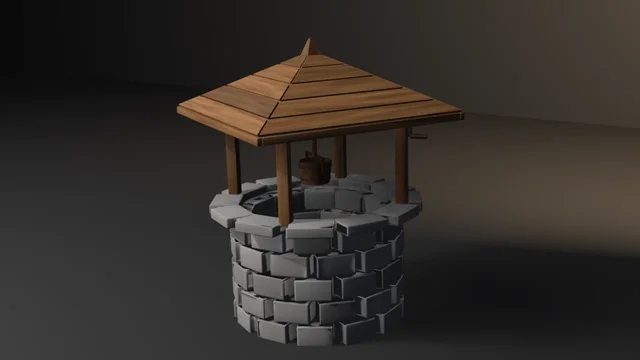
A procedural stone well through UVs, bake, LOD, collider, and Unity glTF, asserting recomputed budgets rather than an API contract.
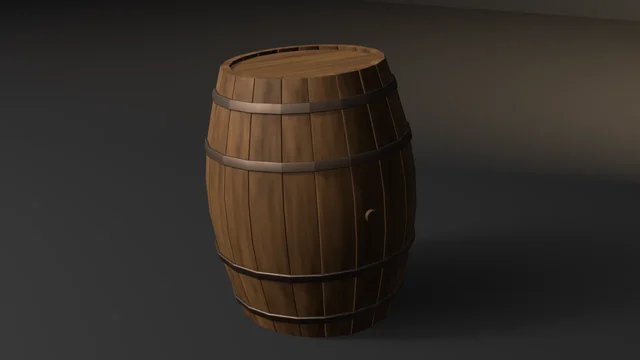
A procedural wine-cask with boarded, croze-seated heads and chord-lofted hoops through UVs, bake, LOD, collider, and Unity glTF, asserting recomputed budgets rather than an API contract.