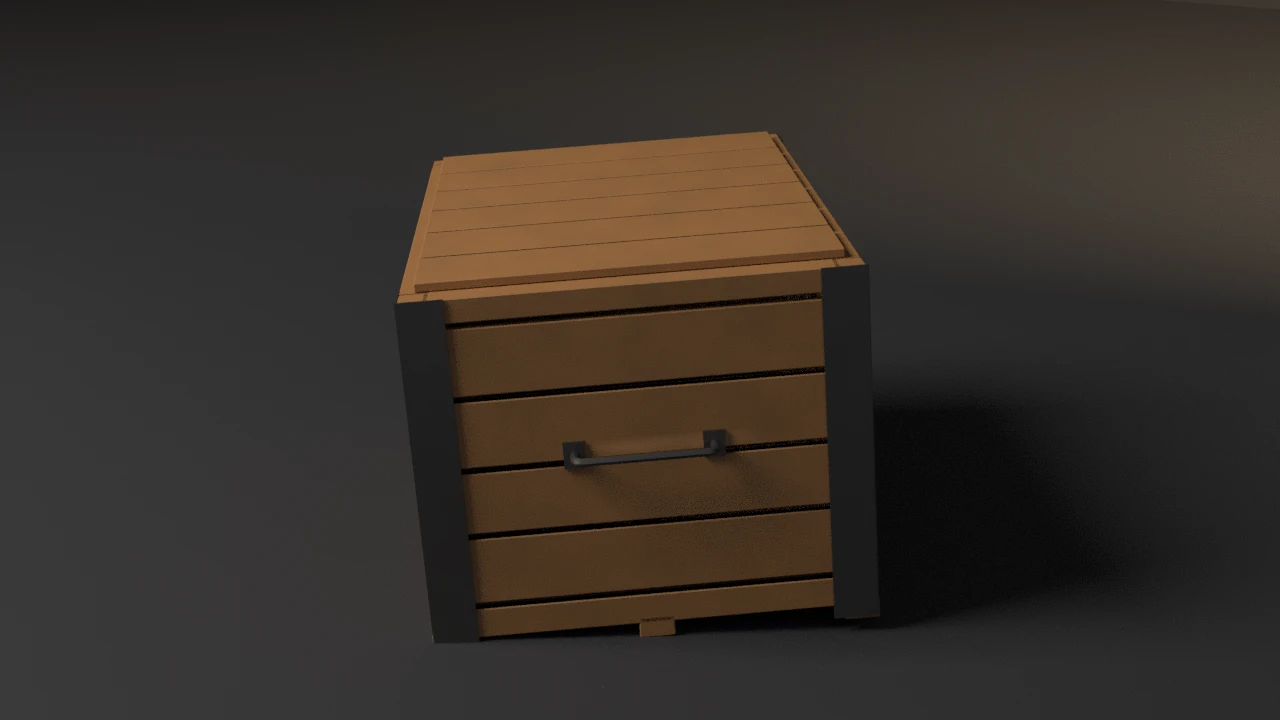
shipping-crate
A procedural shipping crate through UVs, bake, LOD, collider, and Unity glTF, asserting recomputed budgets rather than an API contract.
A procedural fallen forest log — one furrowed lathe along a bowed axis with bark peeled to galleried sapwood, a rotted hollow saw-cut butt, a splintered snapped top, broken branch stubs, moss cushions on its top and shaded side and three tiers of bracket fungi rooted in the bark — settled into a soil mound with toadstools, ferns and fallen leaves, through UVs, bake, LOD, collider, and Unity glTF, asserting recomputed budgets rather than an API contract.
Rendered headless by the showcase piece itself — click to zoom.
category Nature
blender --background --python showcase/fallen-log/fallen_log.py --
A showcase piece, not an example, and the second in the nature category. It builds a procedural, game-ready fallen log on its patch of forest floor:
Every draw comes from random.Random(SEED) in plan_log(), before anything is built: peel and moss outlines, shelf sizes and swing, the splinter lengths, the toadstools, the fronds and the leaves. No flag draws from the stream, so a falsifier changes only what it names.
Nine materials, one per substance: bark, wood (sapwood, end grain and broken wood), rot, moss, bracket fungus, toadstool, soil, leaf litter and fern. The bark shader cuts the furrows with ridged noise stretched along the log. A Peel point attribute is 0.5 exactly on each patch's outline, so the bark shader cuts the torn edge between vertices, with a dark rim of broken bark, not along the triangle grid. The end grain draws its growth rings from a Radial point attribute; the brackets and toadstools take their zones from a Zone face attribute, and every cushion, shelf, leaf and frond has a seeded Tone. Wood is smooth-shaded except broken wood: the splinters and stub ends are flat-shaded facets. Every material boundary is a hard edge.
It asserts budget conformance of the generated result. It does not witness an API contract. "It rendered without error" is not a check.
Composes skills mesh-editing-and-bmesh, bake-high-to-low, depsgraph-and-evaluated-data, engine-export-presets, and snippets bake_normal_high_to_low.py, setup_bake_target_image.py, lod_chain.py / decimate_to_budget.py, convex_hull_collider.py, export_preset_unity.py (helpers copied inline, not imported).
Intended size: a log 3.60 m long to the tip of its longest splinter, its top 0.67 m off the ground, on a soil mound 4.12 × 2.17 m. The outer AABB is 4.119 × 2.189 × 1.027 m. The soil sets X and the south edge, the tip of one fern frond the north edge, and the upright stub's broken tip the top. The soil's underside is the ground. The collider is the convex hull of the log alone, round and unfurrowed: players walk through ferns.
Every budget is declared as a named constant. Every gate recomputes its value from the mesh, materials, UVs, evaluated LOD, collider, or export file.
| Axis | Declared | Measured (5.2.1) |
|---|---|---|
| Base triangles | 35600–37200 | 36374 |
| LOD1 ratio | 0.32–0.62 of base | 0.5000 |
| LOD2 ratio | 0.10–0.35 of base | 0.2200 |
| Materials | exactly 9 distinct; ≥4600 bark, ≥800 wood, ≥340 rot, ≥2150 moss, ≥2200 bracket, ≥1160 toadstool, ≥2240 soil, ≥1870 litter, ≥4580 fern faces | 9 slots; 5144 / 892 / 384 / 2400 / 2448 / 1296 / 2494 / 2080 / 5090 |
| UVs | in 0..1, AABB overlap ≤ 1e-5 | in range, overlap 0 |
| Outer AABB | (4.1189, 2.1885, 1.0267) m ± 0.01 | (4.1189, 2.1885, 1.0267), zmin 0 |
| Collider tris (log hull) | ≤ 240 | 215 |
| Export | written, size > 0, removed after measuring | 2826044 bytes |
No falsifier changes the triangle count: they move parts or the soil, never add or remove them.
DECIMATE COLLAPSE triangle counts are not identical across Blender series, so the LOD gate is a ratio band, not an exact count. Bake pixels are stochastic, so the bake gate is has_data plus operator FINISHED, not byte-identity. The plan is seeded and nothing else is random; two default runs print identical measurements.
Recomputed from the generated mesh, not asserted about the script.
| Axis | Declared | Measured |
|---|---|---|
| Non-manifold edges | 0 | 0 |
| Loose verts / edges | 0 / 0 | 0 / 0 |
| Doubles merged at 1e-5 | 0 | 0 |
| Zero-area faces | 0 | 0 |
| N-gons | 0 | 0 |
| Coplanar cross-shell face pairs (KD range 0.05 m, plane ε 1e-4) | 0 | 0 |
Grounded: zmin | within 1e-4 of 0 | 0.0000 |
The first run measured 360 non-manifold edges and 32 zero-area faces, all leaves flattened to lines: BVHTree.FromBMesh reads the stored face normals, which a fresh bmesh has not computed, so every leaf was laid on a zero normal. The soil now calls normal_update() before its tree is built. The coplanar budget then caught two more faults. Two bracket shelves in one tier met in one plane on their undersides, inside the bark; neighbouring shelves now bite 1.5 mm apart. The fern pinnae along one side of a rachis are translated copies inside one blade plane: 53 pairs on the first run. A seeded sine twist left 7, because two neighbours sometimes drew the same angle. The twist is now period 3, so any two neighbours differ by at least 0.1 rad, and the droop and midrib depth step per pinna too.
These are the organic invariants. A log has no joinery. What makes it read as a fallen log is that it lies along the ground rather than on it, that its fungi grow out of it, that it would not roll, and that moss grows where the sun does not reach.
| Axis | Declared | Measured |
|---|---|---|
| Contact patch: the log shell binned along X at 0.10 m; a station is bedded when its most-buried vertex lies below the soil straight under it (a ray down onto the soil shell alone) by a depth in the band | ≥ 0.75 of the stations bedded, depth band 0.020–0.090 m | 0.8889 (32 of 36; the four off-band stations are the splinters past the break), deepest 0.0461 |
| Rooted brackets: for each shelf, its deepest vertex inside the log shell (signed distance to the nearest bark face along that face's normal) | 12 shelves, each 0.008–0.050 m | 12; 0.0214–0.0293 |
| Balance: the log's volume centroid (signed tetrahedra over the closed shell) inside the plan hull of every vertex buried in the soil | ≥ 0.06 m inside | 0.1491 (centroid at (−0.194, 0.094), volume 0.706 m³) |
| Moss: of the moss top faces (facing away from the bark under them), the area fraction whose normal faces up (z > 0.25) or north into the shade (y > 0.5) | 10 cushions, ≥ 0.85 | 10; 0.9921 |
| Ground cover rooted: soil, leaves, toadstool stems and caps, and fern rachises and pinnae, unioned by BVH overlap | 436 shells, all joined to the soil | 436; 0 loose |
The soil under the log is one line along X, ground_line(x), and the log settles into it: every ring's lowest vertex is set 45 mm below that line. The contact budget reads the bed back off the mesh by raycast, so it sees the soil that was built, not the function that built it. The balance budget is the tip-over check turned on its side: a log that rests only on its flank has a contact hull that misses its own centre of mass.
Each falsifier violates one named budget. Every one was run on 5.2.1 and exited its declared code. None moves the envelope: every run measured the same outer AABB as the default, and every other budget stayed green.
| Flag | Budget violated | Exit |
|---|---|---|
--skip-decimate | LOD1 ratio band (measured 1.0000) | 9 |
--stray-vert | loose vertex count is 0 (measured 1, placed inside the envelope) | 15 |
--lift-z | bounding box zmin is 0 (measured 0.05000) | 16 |
--hump-ground | contact patch (the bed sinks 90 mm under the log but for a hump under its mass centre: 0.0833 of the stations bedded) | 17 |
--float-fungi | rooted brackets (every shelf moved 35 mm off the bark: deepest vertex −0.0133 to −0.0027 m, outside) | 18 |
--tilt-ground | balance (the bed falls away under the south half and banks up on the north: centroid 0.0316 m outside the contact hull) | 19 |
--sunny-moss | moss on up- and shade-facing surfaces (every cushion turned half round the log: 0.1146) | 20 |
--float-litter | ground cover rooted (every leaf lifted 25 mm off the soil: 130 of 436 shells loose) | 21 |
--hump-ground keeps the log where it is and changes only the soil, so the log balances on one point: the balance budget still passes with the hump under the mass centre (0.1015 m inside), and only the contact budget fails. --tilt-ground is the converse: the log still lies bedded along its length (0.8611 of the stations) but only by its north flank, so it would roll. Both edit the soil within 0.50 m of the log's axis, which keeps the fern clumps where they are. --float-fungi leaves each shelf's shape and swing alone. --sunny-moss moves the cushions onto the underside and south flank with the same outlines, so the moss face count is unchanged.
blender --background --python fallen_log.py --
blender --background --python fallen_log.py -- --skip-decimate
blender --background --python fallen_log.py -- --stray-vert
blender --background --python fallen_log.py -- --lift-z
blender --background --python fallen_log.py -- --hump-ground
blender --background --python fallen_log.py -- --float-fungi
blender --background --python fallen_log.py -- --tilt-ground
blender --background --python fallen_log.py -- --sunny-moss
blender --background --python fallen_log.py -- --float-litter
blender --background --python fallen_log.py -- --output log.png
Smoke passes no flags.
The hero keeps the piece unturned (HERO_YAW_DEG 0°) and raises the camera above the south-west corner. The log then runs across the frame toward the snapped top. The butt's rings and hollow face the camera, the brackets and peels on the south flank are lit, and the ferns stand behind the log against the wall. A long, low subject still fills the frame in both axes this way: 0.806 × 0.750.
File-local. 9 is a valid check code. 10 is reserved for gallery_framing.check_framing on the --output path. 15–19 are the hygiene, grounding, contact and balance family. 20 and 21 are file-local. 22 is the asset-quality floor on the render path: check_asset_quality returns 11, which this piece already spends on the collider ceiling, so the call site remaps it.
| Code | Meaning |
|---|---|
| 0 | Success |
| 1 | Uncaught exception (FATAL wrapper) |
| 2 | argparse / usage |
| 3 | Mesh did not build, no UV layer, or no log or soil shell |
| 4 | Base triangle count outside range |
| 5 | Material count ≠ 9 distinct slots, or a face-count floor missed |
| 6 | UVs outside 0..1 |
| 7 | UV AABB overlap above tolerance |
| 8 | World AABB off declared outer size |
| 9 | LOD ratio band (--skip-decimate lands here) |
| 10 | Framing gate (render path only) |
| 11 | Collider triangle count above ceiling |
| 12 | Bake did not finish or image has no data |
| 13 | Export file missing or empty |
| 14 | --output produced no file |
| 15 | Mesh hygiene: loose, non-manifold, zero-area, doubles, n-gons, coplanar cross-shell pairs |
| 16 | Not grounded: bounding box zmin off 0 (--lift-z) |
| 17 | Contact patch: under 0.75 of the log's stations bedded in the soil within the depth band (--hump-ground) |
| 18 | Rooted brackets: not 12 shelves, or a shelf's deepest vertex in the bark outside its band (--float-fungi) |
| 19 | Balance: the log's mass centre less than 0.06 m inside the plan hull of its buried vertices (--tilt-ground) |
| 20 | Moss: not 10 cushions, or under 0.85 of the moss top area facing up or north (--sunny-moss) |
| 21 | Ground cover: not 436 shells, or a leaf, toadstool or frond part not joined to the soil (--float-litter) |
| 22 | Asset-quality floor (render path only; remapped from 11) |
"""Game-ready fallen log — a showcase piece, not an example. Asserts budget conformance of a procedural forest-floor log after composing shipped pipeline pieces: bmesh construction, UVs, nine materials, high-to-low normal bake, LOD chain, convex log collider, Unity glTF export. The log is one lathe along a bowed axis, about 3.1 m long, tapering from a flared butt to a snapped top. Its bark is plated and cut by narrow furrows, and it is peeled away in four patches that show the sapwood underneath, cut by beetle galleries. The butt is an old saw cut, its growth rings weathered round a rotted-out hollow heart; the top is a snapped break of splintered fibres with a long tongue. Two broken branch stubs stand out of it. The log has settled into a soil mound along its whole length. Moss cushions grow on its top and shaded north side; three tiers of bracket fungi grow out of its south flank; a cluster of toadstools, two clumps of ferns and a scatter of fallen leaves lie on the soil round it. Budgets are declared below and recomputed from the generated result. They are not API-contract witnesses. Each falsifier violates one named budget: ``--skip-decimate`` the LOD-ratio band, ``--stray-vert`` mesh hygiene, ``--lift-z`` grounded zmin, ``--hump-ground`` the log bedded along its length, ``--float-fungi`` the brackets rooted in the bark, ``--tilt-ground`` the mass centre over the contact patch, ``--sunny-moss`` the moss on up- and shade-facing surfaces, ``--float-litter`` the ground cover rooted in the soil. Seeded, not random: ``random.Random(SEED)`` draws the whole plan before anything is built, so flags never shift the stream. DECIMATE COLLAPSE triangle counts are not byte-identical across Blender versions — the LOD gate is a ratio band, not an exact count. blender --background --python fallen_log.py -- blender --background --python fallen_log.py -- --skip-decimate blender --background --python fallen_log.py -- --output log.png """ import argparse import math import os import random import sys import tempfile import traceback import bmesh import bpy from mathutils import Vector from mathutils.bvhtree import BVHTree from mathutils.kdtree import KDTree # Showcase lives at repo-root/showcase/, not under examples/. The framing # helper is the repo's only shared import and lives next to the examples; # resolve the repo root so we do not move gallery_framing.py. _REPO = os.path.abspath( os.path.join(os.path.dirname(os.path.abspath(__file__)), os.pardir, os.pardir) ) sys.path.insert(0, os.path.join(_REPO, "examples")) sys.dont_write_bytecode = True import gallery_framing # noqa: E402 import gallery_asset_quality # noqa: E402 SEED = 2231 TAU = 2.0 * math.pi # --- Log ------------------------------------------------------------------- LOG_L = 3.10 # butt ring to top ring along the axis R_BUTT = 0.300 R_TOP = 0.245 BUTT_FLARE = 0.035 # extra radius at the butt, fading over the first metres ELLIPSE = 0.05 # out-of-round, turning slowly along the log LOG_SIDES = 64 LOG_SIDES_HIGH = 128 RING_STEP = 0.04 FURROWS = 16 # bark furrows round the girth FURROW_D = 0.022 # furrow depth below the plates BARK_T = 0.026 # sapwood lies this far under the plate surface BOW = (0.08, -0.025) # plan bow: sin(pi s) and sin(2 pi s) terms, m BURY = 0.045 # the log's underside is this far into its bed R_MID = 0.28 # metres per radian, for patch sizes on the girth # peeled bark: (s, a deg, half-length m, half-arc m) PEELS = ((0.30, 140.0, 0.24, 0.12), (0.60, 168.0, 0.30, 0.10), (0.88, 125.0, 0.18, 0.13), (0.08, 118.0, 0.12, 0.09)) # moss cushions on the top and the shaded (north, +Y) side MOSS = ((0.17, 72.0, 0.30, 0.15), (0.43, 80.0, 0.33, 0.13), (0.55, 36.0, 0.24, 0.12), (0.77, 98.0, 0.20, 0.11), (0.94, 62.0, 0.11, 0.10), (0.30, 26.0, 0.20, 0.11), (0.66, 112.0, 0.10, 0.07), (0.04, 80.0, 0.09, 0.09), (0.36, 55.0, 0.12, 0.08), (0.86, 40.0, 0.14, 0.10)) MOSS_T = 0.028 MOSS_EDGE = 0.003 # the cushion's rim tucks this far under the bark MOSS_BITE = 0.006 # the cushion's base, inside the bark (staggered per patch) MOSS_STAGGER = 0.0015 # broken branch stubs: (s, a deg, length past the bark, radius, lean along the log) STUBS = ((0.60, 78.0, 0.44, 0.055, 0.35), (0.30, 200.0, 0.16, 0.045, -0.20)) # bracket fungus tiers: (s, top a deg, a step deg, [(width, reach)...]) TIERS = ((0.45, 176.0, 8.5, ((0.30, 0.16), (0.27, 0.15), (0.23, 0.13), (0.19, 0.11), (0.15, 0.085))), (0.80, 172.0, 9.0, ((0.26, 0.14), (0.22, 0.125), (0.18, 0.10), (0.14, 0.08))), (0.15, 166.0, 9.0, ((0.21, 0.115), (0.17, 0.095), (0.13, 0.07)))) SHELF_NS = 12 SHELF_ROWS = (0.0, 0.18, 0.35, 0.50, 0.63, 0.75, 0.85, 0.935, 1.0) # thin white margin row SHELF_NT = len(SHELF_ROWS) - 1 SHELF_BITE = 0.020 # a shelf's back edge, inside the bark SHELF_STAGGER = 0.0015 # neighbouring shelves bite to different depths FLOAT_FUNGI = 0.035 # --float-fungi: every shelf moved this far off the bark # --- Ground ---------------------------------------------------------------- SOIL_A = (2.00, 1.06) # mound semi-axes SOIL_Y0 = 0.03 SOIL_H0 = 0.075 SOIL_N = 48 SOIL_EDGE = 0.20 # rolled rim, fraction of the radius BERM_H = 0.035 # soil drifted against the log's sides BERM_W = 0.12 SOIL_FLOOR = 0.012 N_LEAVES = 130 LEAF_BITE = 0.006 FLOAT_LITTER = 0.025 TOAD_CENTRE = (0.45, -0.62) N_TOADS = 8 FERN_CLUMPS = (((0.95, 0.62), (18.0, 46.0, 74.0, 100.0, 126.0, 154.0), (0.64, 0.80)), ((-1.30, 0.55), (95.0, 135.0, 170.0, 205.0), (0.48, 0.60))) FERN_PINNAE = 14 # falsifier grounds HUMP_X = 0.03 # the hump sits under the log's mass centre HUMP_W = 0.24 HUMP_DROP = 0.09 TILT_DROP = 0.08 TILT_BANK = 0.05 BBOX_TOL = 0.01 # Fitted after locking geometry. Recomputed from bound_box. OUTER_SIZE = (4.1189, 2.1885, 1.0267) BASE_TRIS_MIN = 35600 BASE_TRIS_MAX = 37200 LOD1_RATIO_MIN = 0.32 LOD1_RATIO_MAX = 0.62 LOD2_RATIO_MIN = 0.10 LOD2_RATIO_MAX = 0.35 LOD1_TARGET = 0.50 LOD2_TARGET = 0.22 MATERIAL_COUNT = 9 UV_EPS = 1e-4 UV_OVERLAP_MAX = 1e-5 COLLIDER_TRIS_MAX = 240 BAKE_RES = 512 CAGE_EXTRUSION = 0.01 # bark, wood, rot, moss, bracket, toadstool, soil, litter, fern FACE_FLOORS = (4600, 800, 340, 2150, 2200, 1160, 2240, 1870, 4580) ZMIN_EPS = 1e-4 DOUBLES_EPS = 1e-5 AREA_EPS = 1e-10 COPLANAR_NORMAL_EPS = 1e-4 COPLANAR_PLANE_EPS = 1e-4 COPLANAR_CENTRE_MAX = 0.05 LIFT_Z = 0.05 # Contact patch: the log shell binned along X; a bin is bedded when its # most-buried vertex is below the soil surface by a depth inside the band. STATION = 0.10 BED_MIN = 0.020 BED_MAX = 0.090 BEDDED_MIN = 0.75 CONTACT_EPS = 0.003 # Mass centre: inside the plan hull of the buried vertices by this much. HULL_MARGIN_MIN = 0.06 # Brackets: each shelf's deepest vertex inside the bark, as a band. FUNGUS_BITE_MIN = 0.008 FUNGUS_BITE_MAX = 0.050 # Moss: top faces (facing away from the bark) that face up or north. MOSS_TOP_DOT = 0.3 MOSS_UP_Z = 0.25 MOSS_SHADE_Y = 0.5 MOSS_FRAC_MIN = 0.85 # Hero yaw about Z only (level on the stage). HERO_YAW_DEG = 0.0 WALL_Y = 4.5 BARK_IDX = 0 WOOD_IDX = 1 ROT_IDX = 2 MOSS_IDX = 3 BRACKET_IDX = 4 TOAD_IDX = 5 SOIL_IDX = 6 LITTER_IDX = 7 FERN_IDX = 8 MAT_LABELS = ("bark", "wood", "rot", "moss", "bracket", "toadstool", "soil", "litter", "fern") def eevee_engine_id(): return "BLENDER_EEVEE" if bpy.app.version >= (5, 0, 0) else "BLENDER_EEVEE_NEXT" def fail(msg, code): print(f"ERROR: {msg}", file=sys.stderr) return code def triangle_count(mesh): mesh.calc_loop_triangles() return len(mesh.loop_triangles) def evaluated_triangle_count(obj): # Duplicated from snippets/lod_chain.py / decimate_to_budget.py (not a package). depsgraph = bpy.context.evaluated_depsgraph_get() eval_obj = obj.evaluated_get(depsgraph) eval_mesh = eval_obj.to_mesh() try: eval_mesh.calc_loop_triangles() return len(eval_mesh.loop_triangles) finally: eval_obj.to_mesh_clear() def smoothstep(x, lo, hi): t = min(max((x - lo) / (hi - lo), 0.0), 1.0) return t * t * (3.0 - 2.0 * t) def wrap(a): return (a + math.pi) % TAU - math.pi # -------------------------------------------------------------------------- # The log's closed-form shape # -------------------------------------------------------------------------- def ground_line(x): """Soil level along the log's bed. One function of X, so the log settles evenly along its length and the bed under it is the same line.""" return SOIL_H0 + 0.010 * math.sin(1.7 * x + 0.4) + 0.005 * math.sin(3.3 * x + 1.1) def base_radius(s, a): r = R_BUTT + (R_TOP - R_BUTT) * s + BUTT_FLARE * math.exp(-s / 0.05) r *= 1.0 + ELLIPSE * math.cos(2.0 * (a - 0.6 - 0.9 * s)) r *= (1.0 + 0.022 * math.sin(TAU * 1.6 * s + 1.3 + a) + 0.016 * math.sin(TAU * 3.7 * s + 2.0 * a + 0.5)) return r def furrow(s, a): """Plates with narrow V furrows between them; the plates break across the log, so the furrow depth changes along it.""" ph = FURROWS * a + 0.35 * math.sin(TAU * 2.3 * s + 0.7) + 0.2 * math.sin(TAU * 5.1 * s) v = (1.0 - math.cos(ph)) * 0.5 depth = FURROW_D * (0.75 + 0.25 * math.sin(TAU * 4.3 * s + 3.0 * a)) return -depth * v ** 3 def axis_xy(s): s = min(max(s, 0.0), 1.0) x = -0.5 * LOG_L + LOG_L * s y = BOW[0] * math.sin(math.pi * s) + BOW[1] * math.sin(TAU * s) return x, y def axis_point(s): x, y = axis_xy(s) bottom = base_radius(s, 1.5 * math.pi) + furrow(s, 1.5 * math.pi) return Vector((x, y, ground_line(x) - BURY + bottom)) def axis_frame(s): e = 1e-3 t = (axis_point(min(1.0, s + e)) - axis_point(max(0.0, s - e))).normalized() lat = Vector((0.0, 0.0, 1.0)).cross(t).normalized() return t, lat, t.cross(lat) def ring_dir(frame, a): _t, lat, vert = frame return lat * math.cos(a) + vert * math.sin(a) def peel_field(s, a, patches): """Largest (edge - r) over the peel patches: positive inside a patch, zero on its torn edge.""" best = -9.0 for p in patches: ds = (s - p["s"]) * LOG_L / p["hs"] da = wrap(a - p["a"]) * R_MID / p["ha"] r = math.hypot(ds, da) th = math.atan2(da, ds) edge = 1.0 + 0.22 * math.sin(3.0 * th + p["ph"]) + 0.12 * math.sin(7.0 * th + 2.0 * p["ph"]) best = max(best, edge - r) return best def peeled(s, a, patches): return peel_field(s, a, patches) > 0.0 # -------------------------------------------------------------------------- # The plan: every seeded draw happens here, before anything is built # -------------------------------------------------------------------------- def plan_log(): rng = random.Random(SEED) def u(a, b): return a + (b - a) * rng.random() peels = [{"s": s, "a": math.radians(a), "hs": hs, "ha": ha, "ph": u(0.0, TAU)} for s, a, hs, ha in PEELS] moss = [{"s": s, "a": math.radians(a), "hs": hs * u(0.92, 1.08), "ha": ha * u(0.92, 1.08), "ph": u(0.0, TAU), "tone": rng.random()} for s, a, hs, ha in MOSS] shelves = [] for ti, (s0, a0, da, sizes) in enumerate(TIERS): for k, (w, d) in enumerate(sizes): shelves.append({ "tier": ti, "s": s0 + (0.030 if k % 2 else -0.022) * (1.0 + 0.4 * rng.random()), "yaw": math.radians(u(-16.0, 16.0)), "a": math.radians(a0 + da * k + u(-1.5, 1.5)), "w": w * u(0.92, 1.08), "d": d * u(0.92, 1.08), "ph": u(0.0, TAU), "tone": rng.random(), "lift": u(-0.03, 0.08), }) # the snapped top: one splinter length per 1/64 of the girth spikes = [] for j in range(64): v = rng.random() spikes.append((0.015 + 0.19 * v ** 2.5) * (1.0 if j % 2 else 0.30)) lip = [u(0.004, 0.020) for _ in range(64)] toads = [] for k in range(N_TOADS): ang = TAU * k / N_TOADS + u(-0.4, 0.4) rad = 0.02 + 0.13 * rng.random() ** 0.7 toads.append({"x": TOAD_CENTRE[0] + rad * math.cos(ang), "y": TOAD_CENTRE[1] + rad * math.sin(ang), "h": u(0.07, 0.14), "rc": u(0.028, 0.052), "lean": (u(-0.25, 0.25), u(-0.25, 0.25)), "spin": u(0.0, TAU), "tone": rng.random()}) ferns = [] for (cx, cy), yaws, (h0, h1) in FERN_CLUMPS: for yaw in yaws: ferns.append({"x": cx + u(-0.03, 0.03), "y": cy + u(-0.03, 0.03), "yaw": math.radians(yaw + u(-8.0, 8.0)), "h": u(h0, h1), "reach": u(0.34, 0.44), "lp": u(0.10, 0.13), "tone": rng.random(), "curl": u(0.25, 0.40)}) avoid = [(TOAD_CENTRE, 0.22)] + [((c[0][0], c[0][1]), 0.26) for c in FERN_CLUMPS] leaves = [] tries = 0 while len(leaves) < N_LEAVES and tries < 20000: tries += 1 x = u(-1.0, 1.0) * SOIL_A[0] y = u(-1.0, 1.0) * SOIL_A[1] + SOIL_Y0 if (x / SOIL_A[0]) ** 2 + ((y - SOIL_Y0) / SOIL_A[1]) ** 2 > 0.74 ** 2: continue s = (x + 0.5 * LOG_L) / LOG_L if -0.10 < s < 1.14 and abs(y - axis_xy(s)[1]) < 0.40: continue if any(math.hypot(x - c[0], y - c[1]) < r for c, r in avoid): continue if any(math.hypot(x - lf["x"], y - lf["y"]) < 0.055 for lf in leaves): continue leaves.append({"x": x, "y": y, "yaw": u(0.0, TAU), "len": u(0.055, 0.110), "wid": u(0.38, 0.58), "curl": u(0.002, 0.008), "tone": rng.random() ** 1.5}) return {"peels": peels, "moss": moss, "shelves": shelves, "spikes": spikes, "lip": lip, "toads": toads, "ferns": ferns, "leaves": leaves} # -------------------------------------------------------------------------- # Ground # -------------------------------------------------------------------------- def soil_height(x, y, mode): s = (x + 0.5 * LOG_L) / LOG_L past = max(0.0, -s, s - 1.0) * LOG_L w_end = math.exp(-(past / 0.25) ** 2) dy = y - axis_xy(s)[1] ady = abs(dy) ambient = (SOIL_H0 + 0.020 * math.sin(1.3 * x + 0.2) * math.cos(1.9 * y + 0.5) + 0.012 * math.sin(2.9 * x - 2.1 * y + 1.0) + 0.006 * math.sin(5.3 * x + 3.7 * y)) w = w_end * (1.0 - smoothstep(ady, 0.38, 0.75)) h = ambient * (1.0 - w) + ground_line(x) * w h += BERM_H * math.exp(-((ady - 0.30) / BERM_W) ** 2) * w_end if mode == "hump": band = w_end * (1.0 - smoothstep(ady, 0.36, 0.50)) h -= HUMP_DROP * band * (1.0 - math.exp(-((x - HUMP_X) / HUMP_W) ** 2)) elif mode == "tilt": band = w_end * (1.0 - smoothstep(ady, 0.36, 0.50)) h += band * (TILT_BANK * smoothstep(dy, 0.06, 0.20) - TILT_DROP * (1.0 - smoothstep(dy, 0.02, 0.10))) return max(SOIL_FLOOR, h) def add_soil(bm, L, mode): """A soil mound: a squircle-mapped grid whose rim rolls down to a flat base at Z = 0. The base is one n-gon, triangulated later.""" n = SOIL_N grid = [] for i in range(n + 1): col = [] for k in range(n + 1): uu = -1.0 + 2.0 * i / n vv = -1.0 + 2.0 * k / n X = uu * math.sqrt(1.0 - vv * vv / 2.0) Y = vv * math.sqrt(1.0 - uu * uu / 2.0) r = min(1.0, math.hypot(X, Y)) th = math.atan2(Y, X) wob = (1.0 + 0.07 * math.sin(3.0 * th + 0.7) + 0.05 * math.sin(5.0 * th + 2.1) + 0.03 * math.sin(8.0 * th + 0.3)) x = SOIL_A[0] * X * wob y = SOIL_A[1] * Y * wob + SOIL_Y0 on_rim = i in (0, n) or k in (0, n) z = 0.0 if on_rim else soil_height(x, y, mode) * smoothstep(1.0 - r, 0.0, SOIL_EDGE) col.append(bm.verts.new((x, y, z))) grid.append(col) faces = [] for i in range(n): for k in range(n): faces.append(new_face(bm, (grid[i][k], grid[i + 1][k], grid[i + 1][k + 1], grid[i][k + 1]), SOIL_IDX, L, 0.5)) rim = ([grid[i][0] for i in range(n)] + [grid[n][k] for k in range(n)] + [grid[i][n] for i in range(n, 0, -1)] + [grid[0][k] for k in range(n, 0, -1)]) faces.append(new_face(bm, list(reversed(rim)), SOIL_IDX, L, 0.5)) return faces # -------------------------------------------------------------------------- # Construction helpers # -------------------------------------------------------------------------- def new_face(bm, verts, mat, L, tone, zone=0.0, grain=0.0): out = [] for v in verts: if not out or out[-1] is not v: out.append(v) if len(out) > 1 and out[0] is out[-1]: out.pop() f = bm.faces.new(out) f.material_index = mat f[L["tone"]] = tone f[L["zone"]] = zone f[L["grain"]] = grain return f def frames(pts): """Parallel-transported (tangent, normal, binormal) along a polyline.""" tans = [] for i in range(len(pts)): a = pts[max(i - 1, 0)] b = pts[min(i + 1, len(pts) - 1)] tans.append((b - a).normalized()) ref = Vector((0.0, 0.0, 1.0)) if abs(tans[0].z) < 0.9 else Vector((1.0, 0.0, 0.0)) nrm = (ref - tans[0] * ref.dot(tans[0])).normalized() out = [] for t in tans: nrm = (nrm - t * nrm.dot(t)).normalized() out.append((t, nrm, t.cross(nrm))) return out def add_tube(bm, pts, radii, sides, mat, L, tone, phase=0.0, jag=None, end_mat=None, zone=0.0): """Capped round bar swept along a polyline with a radius per point. ``jag``: per-vertex (radial factor, axial offset) for the last ring.""" pts = [Vector(p) for p in pts] rings = [] for idx, (p, (t, n, b)) in enumerate(zip(pts, frames(pts))): ring = [] for k in range(sides): a = phase + TAU * k / sides r = radii[idx] off = Vector((0.0, 0.0, 0.0)) if jag is not None and idx == len(pts) - 1: r *= jag[k % len(jag)][0] off = t * jag[k % len(jag)][1] ring.append(bm.verts.new(p + off + r * (n * math.cos(a) + b * math.sin(a)))) rings.append(ring) faces = [] for r0, r1 in zip(rings, rings[1:]): for k in range(sides): m = (k + 1) % sides faces.append(new_face(bm, (r0[k], r0[m], r1[m], r1[k]), mat, L, tone, zone)) faces.append(new_face(bm, tuple(reversed(rings[0])), mat, L, tone, zone)) faces.append(new_face(bm, tuple(rings[-1]), end_mat if end_mat is not None else mat, L, tone, zone, 0.4 if end_mat is not None else 0.0)) return faces def add_lens(bm, outline, top, bottom, mat, L, tone, zone=0.0): """A thin closed leaf: an outline ring fanned to a raised top centre and a lowered bottom centre. Every outline edge has one top and one bottom face.""" ring = [bm.verts.new(p) for p in outline] vt = bm.verts.new(top) vb = bm.verts.new(bottom) n = len(ring) for k in range(n): m = (k + 1) % n new_face(bm, (ring[k], ring[m], vt), mat, L, tone, zone) new_face(bm, (ring[m], ring[k], vb), mat, L, tone, zone) def add_lathe(bm, origin, axis, profile, sides, spin, mat, L, tone, part_fn): """Closed body of revolution; profile (r, z) runs pole to pole.""" axis = axis.normalized() ref = Vector((0.0, 0.0, 1.0)) if abs(axis.z) < 0.9 else Vector((1.0, 0.0, 0.0)) e1 = axis.cross(ref).normalized() e2 = axis.cross(e1) p0 = bm.verts.new(origin + axis * profile[0][1]) p1 = bm.verts.new(origin + axis * profile[-1][1]) rings = [] for r, z in profile[1:-1]: ring = [] for j in range(sides): a = spin + TAU * j / sides ring.append(bm.verts.new(origin + axis * z + r * (e1 * math.cos(a) + e2 * math.sin(a)))) rings.append(ring) for j in range(sides): m = (j + 1) % sides new_face(bm, (rings[0][m], rings[0][j], p0), mat, L, tone, part_fn(0)) new_face(bm, (rings[-1][j], rings[-1][m], p1), mat, L, tone, part_fn(len(profile) - 2)) for k, (r0, r1) in enumerate(zip(rings, rings[1:])): for j in range(sides): m = (j + 1) % sides new_face(bm, (r0[j], r0[m], r1[m], r1[j]), mat, L, tone, part_fn(k + 1)) class LogSurface: """The built log's vertex grid, sampled bilinearly, so anything laid on the bark (moss, brackets) sits on the faces actually shipped.""" def __init__(self, grid, n, sides): self.grid = grid self.n = n self.sides = sides def point(self, s, a): fi = min(max(s, 0.0), 1.0) * self.n i = min(int(fi), self.n - 1) u = fi - i fj = (a % TAU) / TAU * self.sides j = int(fj) % self.sides v = fj - math.floor(fj) j1 = (j + 1) % self.sides g = self.grid return (g[i][j] * ((1 - u) * (1 - v)) + g[i + 1][j] * (u * (1 - v)) + g[i][j1] * ((1 - u) * v) + g[i + 1][j1] * (u * v)) def normal(self, s, a): es = 0.004 ea = 0.012 ps = self.point(s + es, a) - self.point(s - es, a) pa = self.point(s, a + ea) - self.point(s, a - ea) n = ps.cross(pa).normalized() if n.dot(self.point(s, a) - axis_point(s)) < 0.0: n = -n return n def build_log(bm, plan, sides, L, radial, peel_layer): n = int(round(LOG_L / RING_STEP)) grid = [] flags = [] for i in range(n + 1): s = i / n c = axis_point(s) fr = axis_frame(s) ring = [] pf = [] for j in range(sides): a = TAU * j / sides field = peel_field(s, a, plan["peels"]) peel = field > 0.0 r = base_radius(s, a) - BARK_T if peel else base_radius(s, a) + furrow(s, a) ring.append(c + ring_dir(fr, a) * r) pf.append((peel, field)) grid.append(ring) flags.append(pf) verts = [[bm.verts.new(p) for p in ring] for ring in grid] for ring, pf in zip(verts, flags): for v, (_peel, field) in zip(ring, pf): v[radial] = 1.0 # the torn edge, for the bark shader: 0.5 exactly on the patch # outline, so the edge is cut between vertices, not along faces v[peel_layer] = min(1.0, max(0.0, 0.5 + 2.0 * field)) flags = [[f for f, _field in pf] for pf in flags] for i in range(n): for j in range(sides): m = (j + 1) % sides q = (verts[i][j], verts[i][m], verts[i + 1][m], verts[i + 1][j]) f = (flags[i][j], flags[i][m], flags[i + 1][m], flags[i + 1][j]) npeel = sum(f) if npeel == 0 or npeel == 4: new_face(bm, q, WOOD_IDX if npeel else BARK_IDX, L, 0.1 if npeel else 0.25) continue # a quad on a peel's edge splits along the diagonal that keeps # its bark corner apart, so the torn edge runs at 45 degrees # instead of stepping round the quad grid if npeel == 3: k = 1 if not (f[0] and f[2]) else 0 else: k = (i + j) % 2 tris = (((q[0], q[1], q[2]), (0, 1, 2)), ((q[0], q[2], q[3]), (0, 2, 3))) if k == 0 \ else (((q[0], q[1], q[3]), (0, 1, 3)), ((q[1], q[2], q[3]), (1, 2, 3))) for tri, idx in tris: wood = all(f[x] for x in idx) new_face(bm, tri, WOOD_IDX if wood else BARK_IDX, L, 0.1 if wood else 0.25) def cap(ring0, s, spec, centre_off, inward, sector_mat, tone): """End cap rings from the lathe's end ring inward: ``spec`` rows are (radius fn, axial offset fn, material, grain, radial value).""" c = axis_point(s) fr = axis_frame(s) t = fr[0] * inward prev = ring0 for rad_fn, off_fn, mat, grain, rv in spec: ring = [] for j in range(sides): a = TAU * j / sides v = bm.verts.new(c + t * off_fn(j, a) + ring_dir(fr, a) * rad_fn(a)) v[radial] = rv ring.append(v) for j in range(sides): m = (j + 1) % sides new_face(bm, (prev[j], prev[m], ring[m], ring[j]), mat, L, tone, 0.0, grain) prev = ring centre = bm.verts.new(c + t * centre_off) centre[radial] = 0.0 for j in range(sides): m = (j + 1) % sides new_face(bm, (prev[j], prev[m], centre), sector_mat, L, tone, 0.0, 1.0 if sector_mat == WOOD_IDX else 0.0) # the butt: an old saw cut, weathered concave, round a rotted hollow heart def rf(k): return lambda a: base_radius(0.0, a) * k def off(d): return lambda j, a: d butt = [(lambda a: base_radius(0.0, a) - BARK_T, off(0.0), BARK_IDX, 0.0, 0.97), (rf(0.86), off(0.003), WOOD_IDX, 1.0, 0.86), (rf(0.72), off(0.005), WOOD_IDX, 1.0, 0.72), (rf(0.60), off(0.007), WOOD_IDX, 1.0, 0.60), (rf(0.50), off(0.009), WOOD_IDX, 1.0, 0.50), (rf(0.46), off(0.030), ROT_IDX, 0.0, 0.46), (rf(0.42), off(0.100), ROT_IDX, 0.0, 0.42), (rf(0.37), off(0.200), ROT_IDX, 0.0, 0.37), (rf(0.30), off(0.310), ROT_IDX, 0.0, 0.30), (rf(0.20), off(0.390), ROT_IDX, 0.0, 0.20)] cap(verts[0], 0.0, butt, 0.42, 1.0, ROT_IDX, 0.35) # the top: a snapped break, the upper fibres pulled out longest, with a # tongue torn out along the north-upper side spikes = plan["spikes"] lip = plan["lip"] def sector(a): return int((a % TAU) / TAU * 64) % 64 def brk(k): w = 0.25 + 0.75 * math.sin(math.pi * k) def f(j, a): tilt = 0.06 + 0.05 * math.sin(a) tongue = 0.20 * max(0.0, math.cos(a - 1.2)) ** 4 sec = sector(a) # every ring breaks at its own length: splinters, not a dome crag = 0.035 * math.sin(sec * 2.7 + k * 11.0) * math.sin(sec * 1.3 + k * 5.0) return tilt + tongue + spikes[sec] * w + crag + 0.01 * (1.0 - k) return f top = [(lambda a: base_radius(1.0, a) - BARK_T, lambda j, a: lip[sector(a)], BARK_IDX, 0.0, 0.97)] for k in (0.84, 0.66, 0.48, 0.30, 0.14): top.append((lambda a, k=k: base_radius(1.0, a) * k, brk(k), WOOD_IDX, 0.4, k)) cap(verts[n], 1.0, top, 0.075, 1.0, WOOD_IDX, 0.9) return LogSurface(grid, n, sides) def add_moss(bm, surf, patch, L, rot, bite): """A moss cushion: a lens over a patch of the bark, its rim tucked under the bark surface and its base inside the log.""" K = 6 M = 20 sc = patch["s"] ac = patch["a"] + rot def lump(s, a): return (0.72 + 0.28 * math.sin(41.0 * s + 6.0 * a + patch["ph"]) * math.sin(23.0 * s - 5.0 * a + 1.3 * patch["ph"])) top_rings = [] bot_rings = [] for k in range(1, K + 1): rho = k / K tr = [] br = [] for m in range(M): th = TAU * m / M edge = 1.0 + 0.20 * math.sin(3.0 * th + patch["ph"]) + 0.10 * math.sin(5.0 * th + 2.0 * patch["ph"]) s = sc + rho * edge * patch["hs"] * math.cos(th) / LOG_L a = ac + rho * edge * patch["ha"] * math.sin(th) / R_MID p = surf.point(s, a) nrm = surf.normal(s, a) thick = MOSS_T * max(0.0, 1.0 - rho * rho) ** 0.5 * lump(s, a) tv = bm.verts.new(p + nrm * (thick - MOSS_EDGE)) tr.append(tv) br.append(tv if k == K else bm.verts.new(p - nrm * bite)) top_rings.append(tr) bot_rings.append(br) p0 = surf.point(sc, ac) n0 = surf.normal(sc, ac) ct = bm.verts.new(p0 + n0 * (MOSS_T * lump(sc, ac) - MOSS_EDGE)) cb = bm.verts.new(p0 - n0 * bite) tone = patch["tone"] for rings, centre, flip in ((top_rings, ct, False), (bot_rings, cb, True)): for m in range(M): q = (m + 1) % M tri = (rings[0][m], rings[0][q], centre) new_face(bm, tri[::-1] if flip else tri, MOSS_IDX, L, tone) for r0, r1 in zip(rings, rings[1:]): for m in range(M): q = (m + 1) % M quad = (r0[m], r1[m], r1[q], r0[q]) new_face(bm, quad[::-1] if flip else quad, MOSS_IDX, L, tone) def add_shelf(bm, surf, shelf, L, float_off, bite): """One bracket: a horizontal half-lens with a flat pore surface under a domed, zoned cap, its back edge set into the bark.""" s, a = shelf["s"], shelf["a"] p = surf.point(s, a) n = surf.normal(s, a) nh = Vector((n.x, n.y, 0.0)).normalized() up = Vector((0.0, 0.0, 1.0)) wv = up.cross(nh) # the shelf body swings about its attachment; the back row stays on the bark cy, sy = math.cos(shelf["yaw"]), math.sin(shelf["yaw"]) nr = Vector((nh.x * cy - nh.y * sy, nh.x * sy + nh.y * cy, 0.0)) wr = up.cross(nr) W, D, ph = shelf["w"], shelf["d"], shelf["ph"] t0 = 0.16 * D tb = 0.055 * D ns, nt = SHELF_NS, SHELF_NT top = [[None] * (nt + 1) for _ in range(ns + 1)] bot = [[None] * (nt + 1) for _ in range(ns + 1)] for i in range(ns + 1): si = -1.0 + 2.0 * i / ns env = max(0.0, 1.0 - si * si) reach = D * env ** 0.5 * (1.0 + 0.08 * math.sin(5.0 * si + ph)) for j in range(nt + 1): t = SHELF_ROWS[j] grow = (reach + bite) * t ** 0.9 wc = 0.5 * W * si slope = -0.12 * D * t * t + shelf["lift"] * D * t wave = 0.005 * math.sin(6.0 * si + ph) * t ** 3 # a year's growth per step: shallow concentric ridges on the cap ridge = 0.022 * D * math.sin(t * 3.5 * TAU) * (1.0 - t) * env ** 0.35 zt = t0 * (1.0 - t ** 1.6) * env ** 0.35 + slope + wave + ridge zb = -tb * (1.0 - t ** 2.2) * env ** 0.35 + slope + wave base = (p + nh * (float_off - bite) + wv * wc + nr * grow + wr * (0.18 * wc * t)) vt = bm.verts.new(base + up * zt) top[i][j] = vt shared = i in (0, ns) or j == nt bot[i][j] = vt if shared else bm.verts.new(base + up * zb) tone = shelf["tone"] for i in range(ns): for j in range(nt): zone = (j + 0.5) / nt new_face(bm, (top[i][j], top[i + 1][j], top[i + 1][j + 1], top[i][j + 1]), BRACKET_IDX, L, tone, zone) new_face(bm, (bot[i][j + 1], bot[i + 1][j + 1], bot[i + 1][j], bot[i][j]), BRACKET_IDX, L, tone, 2.0) new_face(bm, (top[i][0], bot[i][0], bot[i + 1][0], top[i + 1][0]), BRACKET_IDX, L, tone, 0.0) def soil_hit(tree, x, y): loc, nrm, _i, _d = tree.ray_cast(Vector((x, y, 5.0)), Vector((0.0, 0.0, -1.0)), 20.0) if loc is None: return Vector((x, y, 0.0)), Vector((0.0, 0.0, 1.0)) if nrm.z < 0.0: nrm = -nrm return loc, nrm def add_leaf(bm, tree, lf, L, lift): c, nrm = soil_hit(tree, lf["x"], lf["y"]) e1 = Vector((math.cos(lf["yaw"]), math.sin(lf["yaw"]), 0.0)) e1 = (e1 - nrm * e1.dot(nrm)).normalized() e2 = nrm.cross(e1) ln = lf["len"] wd = ln * lf["wid"] * 0.5 shape = ((-0.50, 0.0), (-0.30, 0.62), (0.0, 1.0), (0.28, 0.78), (0.50, 0.0), (0.28, -0.78), (0.0, -1.0), (-0.30, -0.62)) up = Vector((0.0, 0.0, lift)) outline = [] for fx, fy in shape: curl = lf["curl"] * (fy * fy + 0.6 * (2.0 * fx) ** 2) outline.append(c + e1 * (fx * ln) + e2 * (fy * wd) + nrm * (0.0015 + curl) + up) add_lens(bm, outline, c + nrm * 0.004 + up, c - nrm * LEAF_BITE + up, LITTER_IDX, L, lf["tone"]) def add_toadstool(bm, tree, td, L): base, _n = soil_hit(tree, td["x"], td["y"]) base = base - Vector((0.0, 0.0, 0.02)) axis = Vector((td["lean"][0], td["lean"][1], 1.0)).normalized() h = td["h"] + 0.02 rc = td["rc"] sr = 0.17 * rc + 0.002 tip = base + axis * h add_tube(bm, [base, base + axis * (0.3 * h), base + axis * (0.7 * h), tip], [sr * 1.3, sr, sr * 0.9, sr * 0.85], 8, TOAD_IDX, L, td["tone"], zone=0.0) prof = ((0.0, 0.0), (0.25, 0.002), (0.55, 0.006), (0.85, 0.012), (1.0, 0.022), (0.97, 0.034), (0.85, 0.050), (0.62, 0.064), (0.32, 0.073), (0.0, 0.076)) prof = [(r * rc, z * rc / 0.076 * 0.9) for r, z in prof] def part(k): if k <= 3: return 0.5 return 1.0 + min(1.0, max(0.0, (prof[min(k, len(prof) - 1)][0]) / rc)) add_lathe(bm, tip - axis * 0.010, axis, prof, 14, td["spin"], TOAD_IDX, L, td["tone"], part) def add_fern(bm, tree, fd, L): base, _n = soil_hit(tree, fd["x"], fd["y"]) base = base - Vector((0.0, 0.0, 0.03)) hdir = Vector((math.cos(fd["yaw"]), math.sin(fd["yaw"]), 0.0)) up = Vector((0.0, 0.0, 1.0)) H, R = fd["h"], fd["reach"] pts = [] steps = 12 for k in range(steps): t = k / (steps - 1) z = H * (2.0 * t - t * t) * (1.0 - fd["curl"] * t ** 3) + 0.03 * min(1.0, t * 8.0) pts.append(base + hdir * (R * t ** 1.25) + up * z) radii = [0.0070 - 0.0048 * (k / (steps - 1)) for k in range(steps)] add_tube(bm, pts, radii, 5, FERN_IDX, L, fd["tone"]) def at(t): x = t * (steps - 1) i = min(int(x), steps - 2) f = x - i return pts[i].lerp(pts[i + 1], f), (pts[i + 1] - pts[i]).normalized() for k in range(FERN_PINNAE): t = 0.22 + 0.73 * k / (FERN_PINNAE - 1) lp = fd["lp"] * max(0.18, math.sin(math.pi * (t - 0.12) / 0.92)) ** 0.7 for side, dt in ((1.0, 0.0), (-1.0, 0.012)): p, tan = at(min(0.995, t + dt)) bn = (up - tan * up.dot(tan)).normalized() # each pinna twists a little about the rachis: neighbours along # one side are otherwise translated copies in one blade plane. # Period 3, so any two neighbours differ by at least 0.1 rad. tw = 0.10 * ((k % 3) - 1) + (0.04 if side < 0 else 0.0) bn = (bn * math.cos(tw) + tan.cross(bn) * math.sin(tw)).normalized() sd = tan.cross(bn) * side e1 = (sd * math.cos(0.35) + tan * math.sin(0.35) - bn * 0.12).normalized() e2 = (tan - e1 * tan.dot(e1)).normalized() e3 = e1.cross(e2).normalized() wp = 0.24 * lp # droop and midrib depth step per pinna too, so no two nearby # pinna faces share a plane by chance dr = 0.22 + 0.05 * ((k + (1 if side < 0 else 0)) % 4) rib = 0.0022 + 0.0006 * (k % 2) outline = [] for f, sg in ((0.0, 0.0), (0.22, 1.0), (0.5, 1.0), (0.78, 1.0), (1.0, 0.0), (0.78, -1.0), (0.5, -1.0), (0.22, -1.0)): hw = wp * math.sin(math.pi * f) ** 0.6 if 0.0 < f < 1.0 else 0.0 droop = dr * lp * f * f outline.append(p + e1 * (f * lp) + e2 * (sg * hw) - bn * droop) mid = p + e1 * (0.45 * lp) - bn * (dr * lp * 0.2) add_lens(bm, outline, mid + e3 * rib, mid - e3 * rib, FERN_IDX, L, fd["tone"], 0.5 + 0.5 * t) def build_log_mesh(name, plan, detail="low", hump_ground=False, tilt_ground=False, float_fungi=False, sunny_moss=False, float_litter=False): mode = "hump" if hump_ground else ("tilt" if tilt_ground else None) bm = bmesh.new() try: L = {"tone": bm.faces.layers.float.new("Tone"), "zone": bm.faces.layers.float.new("Zone"), "grain": bm.faces.layers.float.new("EndGrain")} radial = bm.verts.layers.float.new("Radial") sides = LOG_SIDES_HIGH if detail == "high" else LOG_SIDES add_soil(bm, L, mode) bm.faces.ensure_lookup_table() bm.normal_update() # FromBMesh reads the stored face normals soil_tree = BVHTree.FromBMesh(bm) surf = build_log(bm, plan, sides, L, radial, bm.verts.layers.float.new("Peel")) rot = math.pi if sunny_moss else 0.0 for k, patch in enumerate(plan["moss"]): add_moss(bm, surf, patch, L, rot, MOSS_BITE + MOSS_STAGGER * k) for s, a_deg, ln, r, lean in STUBS: a = math.radians(a_deg) c = axis_point(s) fr = axis_frame(s) perp = ring_dir(fr, a) d = (perp + fr[0] * lean).normalized() R = base_radius(s, a) b0 = c + perp * (0.35 * R) pts = [b0, b0 + d * (0.70 * R), b0 + d * (0.70 * R + 0.55 * ln), b0 + d * (0.70 * R + ln)] jag = [(0.85, 0.012), (1.0, -0.006), (0.75, 0.024), (0.95, -0.010), (0.80, 0.018), (1.0, 0.0), (0.9, 0.030), (0.7, 0.008)] add_tube(bm, pts, [r * 1.3, r * 1.15, r * 0.95, r * 0.85], 10, BARK_IDX, L, 0.3, phase=a, jag=jag, end_mat=WOOD_IDX) off = FLOAT_FUNGI if float_fungi else 0.0 for k, shelf in enumerate(plan["shelves"]): add_shelf(bm, surf, shelf, L, off, SHELF_BITE + SHELF_STAGGER * (k % 4)) lift = FLOAT_LITTER if float_litter else 0.0 for lf in plan["leaves"]: add_leaf(bm, soil_tree, lf, L, lift) for td in plan["toads"]: add_toadstool(bm, soil_tree, td, L) for fd in plan["ferns"]: add_fern(bm, soil_tree, fd, L) bmesh.ops.remove_doubles(bm, verts=list(bm.verts), dist=1e-5) bmesh.ops.dissolve_degenerate(bm, dist=1e-6) triangulate_ngons(bm) xs = [v.co.x for v in bm.verts] ys = [v.co.y for v in bm.verts] cx = 0.5 * (min(xs) + max(xs)) cy = 0.5 * (min(ys) + max(ys)) zmin = min(v.co.z for v in bm.verts) for v in bm.verts: v.co.x -= cx v.co.y -= cy v.co.z -= zmin pack_uvs(bm) bmesh.ops.recalc_face_normals(bm, faces=list(bm.faces)) # Everything organic is smooth-shaded except broken wood; the # furrows and the fern and leaf lenses carry in the silhouette. Every # material boundary and every fold sharper than 70 degrees is a hard # edge. for face in bm.faces: # broken wood (the snapped top, the stub ends) stays faceted: # splinters are facets, not a smooth dome face.smooth = not (face.material_index == WOOD_IDX and abs(face[L["grain"]] - 0.4) < 1e-6) for edge in bm.edges: mats = {f.material_index for f in edge.link_faces} if len(mats) > 1 or not edge.is_manifold or len(edge.link_faces) != 2: edge.smooth = False else: edge.smooth = edge.calc_face_angle() < math.radians(70.0) me = bpy.data.meshes.new(name) bm.to_mesh(me) me.update() finally: bm.free() obj = bpy.data.objects.new(name, me) bpy.context.collection.objects.link(obj) return obj def build_collider_source(name): """The log alone, round and unfurrowed: players walk through ferns.""" bm = bmesh.new() try: L = {"tone": bm.faces.layers.float.new("Tone"), "zone": bm.faces.layers.float.new("Zone"), "grain": bm.faces.layers.float.new("EndGrain")} rings = [] n = 12 for i in range(n + 1): s = i / n c = axis_point(s) fr = axis_frame(s) rings.append([bm.verts.new(c + ring_dir(fr, TAU * j / 16) * base_radius(s, TAU * j / 16)) for j in range(16)]) for r0, r1 in zip(rings, rings[1:]): for j in range(16): m = (j + 1) % 16 new_face(bm, (r0[j], r0[m], r1[m], r1[j]), BARK_IDX, L, 0.0) new_face(bm, tuple(reversed(rings[0])), BARK_IDX, L, 0.0) new_face(bm, tuple(rings[-1]), BARK_IDX, L, 0.0) triangulate_ngons(bm) me = bpy.data.meshes.new(name) bm.to_mesh(me) me.update() finally: bm.free() obj = bpy.data.objects.new(name, me) bpy.context.collection.objects.link(obj) return obj def triangulate_ngons(bm): faces = [f for f in bm.faces if len(f.verts) > 4] if faces: bmesh.ops.triangulate(bm, faces=faces) def pack_uvs(bm, margin=0.08): uv = bm.loops.layers.uv.new("UVMap") faces = list(bm.faces) n = len(faces) cols = max(1, math.ceil(math.sqrt(n))) rows = max(1, math.ceil(n / cols)) cell_w = 1.0 / cols cell_h = 1.0 / rows pad_u = margin * cell_w * 0.5 pad_v = margin * cell_h * 0.5 usable_w = cell_w - 2.0 * pad_u usable_h = cell_h - 2.0 * pad_v for i, face in enumerate(faces): col = i % cols row = i // cols nrm = face.normal ax, ay, az = abs(nrm.x), abs(nrm.y), abs(nrm.z) coords = [] for loop in face.loops: co = loop.vert.co if az >= ax and az >= ay: coords.append((co.x, co.y)) elif ax >= ay: coords.append((co.y, co.z)) else: coords.append((co.x, co.z)) xs = [c[0] for c in coords] ys = [c[1] for c in coords] minx, maxx = min(xs), max(xs) miny, maxy = min(ys), max(ys) dx = max(maxx - minx, 1e-8) dy = max(maxy - miny, 1e-8) origin_u = col * cell_w + pad_u origin_v = row * cell_h + pad_v for loop, (x, y) in zip(face.loops, coords): loop[uv].uv = ( origin_u + (x - minx) / dx * usable_w, origin_v + (y - miny) / dy * usable_h, ) # -------------------------------------------------------------------------- # Materials # -------------------------------------------------------------------------- def enabled_socket(sockets, name): """The one enabled socket called ``name`` (Mix / Map Range carry one per data type under one name; identifiers changed in 5.2).""" for sock in sockets: if sock.name == name and sock.enabled: return sock return sockets[name] def surface(name): mat = bpy.data.materials.new(name) mat.use_nodes = True nt = mat.node_tree bsdf = nt.nodes["Principled BSDF"] bsdf.inputs["Metallic"].default_value = 0.0 coord = nt.nodes.new("ShaderNodeTexCoord").outputs["Object"] return mat, nt, bsdf, coord def mapping(nt, vec, scale=(1.0, 1.0, 1.0)): node = nt.nodes.new("ShaderNodeMapping") node.inputs["Scale"].default_value = scale nt.links.new(vec, node.inputs["Vector"]) return node.outputs["Vector"] def noise(nt, vec, scale, detail, roughness): node = nt.nodes.new("ShaderNodeTexNoise") node.inputs["Scale"].default_value = scale node.inputs["Detail"].default_value = detail node.inputs["Roughness"].default_value = roughness nt.links.new(vec, node.inputs["Vector"]) return node.outputs["Fac"] def wave(nt, vec, direction, scale, distortion): node = nt.nodes.new("ShaderNodeTexWave") node.wave_type = "BANDS" node.bands_direction = direction node.inputs["Scale"].default_value = scale node.inputs["Distortion"].default_value = distortion node.inputs["Detail"].default_value = 3.0 nt.links.new(vec, node.inputs["Vector"]) return node.outputs["Fac"] def ramp(nt, fac, stops): node = nt.nodes.new("ShaderNodeValToRGB") els = node.color_ramp.elements els[0].position = stops[0][0] els[0].color = (*stops[0][1], 1.0) els[1].position = stops[-1][0] els[1].color = (*stops[-1][1], 1.0) for pos, rgb in stops[1:-1]: els.new(pos).color = (*rgb, 1.0) nt.links.new(fac, node.inputs["Fac"]) return node.outputs["Color"] def remap(nt, value, from_lo, from_hi, to_lo, to_hi): node = nt.nodes.new("ShaderNodeMapRange") nt.links.new(value, enabled_socket(node.inputs, "Value")) enabled_socket(node.inputs, "From Min").default_value = from_lo enabled_socket(node.inputs, "From Max").default_value = from_hi enabled_socket(node.inputs, "To Min").default_value = to_lo enabled_socket(node.inputs, "To Max").default_value = to_hi return enabled_socket(node.outputs, "Result") def math_node(nt, op, a, b): node = nt.nodes.new("ShaderNodeMath") node.operation = op for i, value in enumerate((a, b)): if isinstance(value, (int, float)): node.inputs[i].default_value = value else: nt.links.new(value, node.inputs[i]) return node.outputs[0] def mix_color(nt, a, b, fac): node = nt.nodes.new("ShaderNodeMix") node.data_type = "RGBA" if isinstance(fac, (int, float)): enabled_socket(node.inputs, "Factor").default_value = fac else: nt.links.new(fac, enabled_socket(node.inputs, "Factor")) for nm, value in (("A", a), ("B", b)): sock = enabled_socket(node.inputs, nm) if isinstance(value, tuple): sock.default_value = (*value, 1.0) else: nt.links.new(value, sock) return enabled_socket(node.outputs, "Result") def attr(nt, name): node = nt.nodes.new("ShaderNodeAttribute") node.attribute_type = "GEOMETRY" node.attribute_name = name return node.outputs["Fac"] def height(nt, coord): sep = nt.nodes.new("ShaderNodeSeparateXYZ") nt.links.new(coord, sep.inputs["Vector"]) return sep.outputs["Z"] def bump(nt, bsdf, h, strength, distance): node = nt.nodes.new("ShaderNodeBump") node.inputs["Strength"].default_value = strength node.inputs["Distance"].default_value = distance nt.links.new(h, node.inputs["Height"]) nt.links.new(node.outputs["Normal"], bsdf.inputs["Normal"]) def damp(nt, col, coord, rgb, amount): """Wood darkens where it has lain in the wet soil.""" fac = remap(nt, height(nt, coord), 0.06, 0.24, amount, 0.0) return mix_color(nt, col, rgb, fac) def bark_material(): mat, nt, bsdf, coord = surface("LogBark") # Furrows: ridged noise stretched along the log (X), so the fissures run # with the grain and branch; the plates between them catch the light. plates = noise(nt, mapping(nt, coord, scale=(1.6, 7.0, 7.0)), 3.0, 8.0, 0.62) fn = noise(nt, mapping(nt, coord, scale=(0.9, 13.0, 13.0)), 1.0, 6.0, 0.58) ridge = math_node(nt, "ABSOLUTE", math_node(nt, "SUBTRACT", fn, 0.5), 0.0) furrow_f = remap(nt, ridge, 0.0, 0.10, 1.0, 0.0) fine = noise(nt, mapping(nt, coord, scale=(5.0, 34.0, 34.0)), 2.0, 6.0, 0.55) col = ramp(nt, plates, ((0.30, (0.050, 0.041, 0.033)), (0.50, (0.085, 0.070, 0.056)), (0.70, (0.125, 0.108, 0.088)), (0.85, (0.160, 0.142, 0.120)))) col = mix_color(nt, col, (0.012, 0.009, 0.007), furrow_f) col = mix_color(nt, col, (0.030, 0.024, 0.019), remap(nt, fine, 0.35, 0.65, 0.4, 0.0)) # crustose lichen: a few soft grey-green blots on the plates lich = noise(nt, mapping(nt, coord, scale=(1.2, 1.2, 1.2)), 3.0, 5.0, 0.55) col = mix_color(nt, col, (0.16, 0.17, 0.13), remap(nt, lich, 0.64, 0.74, 0.0, 0.55)) col = damp(nt, col, coord, (0.028, 0.022, 0.016), 0.6) # where a boundary face crosses into a peel, the torn edge shows the # sapwood under a dark rim of broken bark peel = attr(nt, "Peel") col = mix_color(nt, col, (0.010, 0.008, 0.006), remap(nt, peel, 0.36, 0.47, 0.0, 1.0)) col = mix_color(nt, col, (0.34, 0.23, 0.13), remap(nt, peel, 0.49, 0.51, 0.0, 1.0)) nt.links.new(col, bsdf.inputs["Base Color"]) nt.links.new(remap(nt, plates, 0.35, 0.8, 0.95, 0.78), bsdf.inputs["Roughness"]) bump(nt, bsdf, math_node(nt, "ADD", math_node(nt, "MULTIPLY", furrow_f, -1.0), math_node(nt, "ADD", math_node(nt, "MULTIPLY", plates, 0.5), math_node(nt, "MULTIPLY", fine, 0.25))), 1.0, 0.03) return mat def wood_material(): mat, nt, bsdf, coord = surface("LogWood") grain_fac = attr(nt, "EndGrain") streak = noise(nt, mapping(nt, coord, scale=(1.2, 22.0, 22.0)), 2.0, 6.0, 0.6) base = ramp(nt, streak, ((0.30, (0.25, 0.16, 0.085)), (0.55, (0.38, 0.26, 0.15)), (0.80, (0.46, 0.34, 0.21)))) # beetle galleries: a wandering egg gallery along the grain (X) and the # larval tunnels radiating across it, thinning out away from it egg = wave(nt, coord, "Y", 2.2, 7.0) larva = wave(nt, coord, "X", 16.0, 4.0) near = remap(nt, egg, 0.55, 0.95, 0.0, 1.0) line = math_node(nt, "MAXIMUM", remap(nt, egg, 0.955, 0.985, 0.0, 1.0), math_node(nt, "MULTIPLY", remap(nt, larva, 0.88, 0.97, 0.0, 0.9), near)) line = math_node(nt, "MULTIPLY", line, remap(nt, grain_fac, 0.0, 0.3, 1.0, 0.0)) col = mix_color(nt, base, (0.09, 0.055, 0.030), line) # end grain: growth rings on the radial attribute, heartwood darker radial = attr(nt, "Radial") wob = noise(nt, coord, 9.0, 3.0, 0.5) ringv = math_node(nt, "SINE", math_node(nt, "ADD", math_node(nt, "MULTIPLY", radial, TAU * 21.0), math_node(nt, "MULTIPLY", wob, 2.2)), 0.0) endcol = ramp(nt, radial, ((0.45, (0.20, 0.11, 0.055)), (0.62, (0.36, 0.22, 0.11)), (0.90, (0.55, 0.42, 0.27)))) endcol = mix_color(nt, endcol, (0.13, 0.075, 0.040), remap(nt, ringv, 0.55, 1.0, 0.0, 0.7)) col = mix_color(nt, col, endcol, remap(nt, grain_fac, 0.6, 1.0, 0.0, 1.0)) # weathering: the snapped top has greyed in the open col = mix_color(nt, col, (0.27, 0.25, 0.22), remap(nt, attr(nt, "Tone"), 0.5, 0.8, 0.0, 0.55)) col = damp(nt, col, coord, (0.10, 0.065, 0.040), 0.5) nt.links.new(col, bsdf.inputs["Base Color"]) bsdf.inputs["Roughness"].default_value = 0.82 bump(nt, bsdf, math_node(nt, "ADD", streak, math_node(nt, "MULTIPLY", line, -0.6)), 0.5, 0.01) return mat def rot_material(): mat, nt, bsdf, coord = surface("LogRot") punk = noise(nt, coord, 14.0, 6.0, 0.65) col = ramp(nt, punk, ((0.35, (0.030, 0.017, 0.010)), (0.60, (0.090, 0.050, 0.028)), (0.80, (0.160, 0.090, 0.050)))) nt.links.new(col, bsdf.inputs["Base Color"]) bsdf.inputs["Roughness"].default_value = 0.95 bump(nt, bsdf, punk, 0.8, 0.02) return mat def moss_material(): mat, nt, bsdf, coord = surface("Moss") tone = attr(nt, "Tone") # each cushion its own green; within it, olive hollows, bright # yellow-green crowns and a fine fuzz base = ramp(nt, tone, ((0.0, (0.045, 0.095, 0.015)), (0.5, (0.080, 0.150, 0.022)), (1.0, (0.120, 0.200, 0.030)))) fuzz = noise(nt, coord, 140.0, 4.0, 0.7) tufts = noise(nt, coord, 26.0, 4.0, 0.6) patchy = noise(nt, coord, 6.0, 3.0, 0.5) col = mix_color(nt, base, (0.060, 0.070, 0.020), remap(nt, patchy, 0.40, 0.65, 0.55, 0.0)) col = mix_color(nt, col, (0.018, 0.040, 0.010), remap(nt, fuzz, 0.35, 0.65, 0.65, 0.0)) col = mix_color(nt, col, (0.20, 0.27, 0.045), remap(nt, tufts, 0.58, 0.74, 0.0, 0.65)) nt.links.new(col, bsdf.inputs["Base Color"]) bsdf.inputs["Roughness"].default_value = 0.92 bump(nt, bsdf, math_node(nt, "ADD", fuzz, math_node(nt, "MULTIPLY", tufts, 1.6)), 0.9, 0.008) return mat def bracket_material(): mat, nt, bsdf, coord = surface("BracketFungus") # Zone: 0..1 across the cap from the bark to the margin; 2.0 on the # pore surface. The shelves' concentric bands are the face rows. zone = attr(nt, "Zone") tone = attr(nt, "Tone") # Artist's conk: a crusted brown cap zoned darker toward the bark, a # white growing margin and a white pore surface underneath. zone = math_node(nt, "ADD", zone, math_node(nt, "MULTIPLY", tone, 0.05)) col = ramp(nt, zone, ((0.00, (0.030, 0.017, 0.010)), (0.25, (0.060, 0.032, 0.016)), (0.45, (0.110, 0.058, 0.026)), (0.62, (0.170, 0.092, 0.040)), (0.76, (0.220, 0.130, 0.058)), (0.86, (0.280, 0.185, 0.095)), (0.94, (0.780, 0.740, 0.640)), (1.20, (0.820, 0.780, 0.680)), (1.90, (0.760, 0.720, 0.620)), (2.10, (0.740, 0.700, 0.600)))) velvet = noise(nt, coord, 60.0, 3.0, 0.6) col = mix_color(nt, col, (0.06, 0.035, 0.02), remap(nt, velvet, 0.3, 0.7, 0.30, 0.0)) # spore dust: the rust-brown bloom a conk drops on the shelf below dust = noise(nt, coord, 8.0, 2.0, 0.5) col = mix_color(nt, col, (0.30, 0.13, 0.05), remap(nt, dust, 0.55, 0.75, 0.0, 0.35)) nt.links.new(col, bsdf.inputs["Base Color"]) bsdf.inputs["Roughness"].default_value = 0.86 bump(nt, bsdf, velvet, 0.3, 0.004) return mat def toadstool_material(): mat, nt, bsdf, coord = surface("Toadstool") # Zone: 0 stem, 0.5 gills, 1..2 cap from the crown to the margin. zone = attr(nt, "Zone") col = ramp(nt, zone, ((0.00, (0.70, 0.62, 0.48)), (0.40, (0.66, 0.58, 0.44)), (0.50, (0.46, 0.36, 0.24)), (0.95, (0.46, 0.36, 0.24)), (1.05, (0.33, 0.12, 0.030)), (1.55, (0.62, 0.30, 0.070)), (2.00, (0.78, 0.52, 0.20)))) speck = noise(nt, coord, 90.0, 2.0, 0.5) col = mix_color(nt, col, (0.25, 0.10, 0.03), remap(nt, speck, 0.55, 0.7, 0.0, 0.3)) nt.links.new(col, bsdf.inputs["Base Color"]) bsdf.inputs["Roughness"].default_value = 0.45 return mat def soil_material(): mat, nt, bsdf, coord = surface("ForestSoil") clods = noise(nt, coord, 6.0, 6.0, 0.62) crumbs = noise(nt, coord, 70.0, 3.0, 0.6) col = ramp(nt, clods, ((0.30, (0.030, 0.022, 0.016)), (0.55, (0.060, 0.043, 0.030)), (0.80, (0.095, 0.072, 0.052)))) col = mix_color(nt, col, (0.018, 0.013, 0.010), remap(nt, crumbs, 0.35, 0.55, 0.6, 0.0)) # needle and twig duff: fine pale flecks duff = noise(nt, mapping(nt, coord, scale=(40.0, 8.0, 40.0)), 3.0, 3.0, 0.5) col = mix_color(nt, col, (0.16, 0.11, 0.06), remap(nt, duff, 0.66, 0.74, 0.0, 0.6)) # a green film of moss and algae in the damp hollows film = noise(nt, coord, 2.2, 4.0, 0.55) col = mix_color(nt, col, (0.040, 0.060, 0.018), remap(nt, film, 0.50, 0.62, 0.0, 0.75)) nt.links.new(col, bsdf.inputs["Base Color"]) bsdf.inputs["Roughness"].default_value = 0.96 bump(nt, bsdf, math_node(nt, "ADD", clods, math_node(nt, "MULTIPLY", crumbs, 0.6)), 0.6, 0.01) return mat def litter_material(): mat, nt, bsdf, coord = surface("LeafLitter") tone = attr(nt, "Tone") # mostly dead brown, a few still rust and ochre col = ramp(nt, tone, ((0.0, (0.060, 0.030, 0.012)), (0.40, (0.150, 0.070, 0.022)), (0.70, (0.300, 0.120, 0.030)), (1.0, (0.450, 0.300, 0.070)))) blot = noise(nt, coord, 35.0, 3.0, 0.6) col = mix_color(nt, col, (0.08, 0.04, 0.015), remap(nt, blot, 0.45, 0.75, 0.0, 0.5)) nt.links.new(col, bsdf.inputs["Base Color"]) bsdf.inputs["Roughness"].default_value = 0.75 return mat def fern_material(): mat, nt, bsdf, coord = surface("Fern") tone = attr(nt, "Tone") zone = attr(nt, "Zone") col = ramp(nt, tone, ((0.0, (0.040, 0.120, 0.020)), (0.5, (0.070, 0.180, 0.030)), (1.0, (0.110, 0.230, 0.040)))) # the frond's tip is this season's growth, lighter col = mix_color(nt, col, (0.16, 0.30, 0.06), remap(nt, zone, 0.8, 1.0, 0.0, 0.6)) nt.links.new(col, bsdf.inputs["Base Color"]) bsdf.inputs["Roughness"].default_value = 0.55 return mat def log_materials(): """Nine slots, in index order: shared by the check and the render.""" return (bark_material(), wood_material(), rot_material(), moss_material(), bracket_material(), toadstool_material(), soil_material(), litter_material(), fern_material()) def assign_slots(obj, wanted): # Do not materials.clear() — that resets polygon material_index to 0. mats = obj.data.materials for i, mat in enumerate(wanted): if i < len(mats): mats[i] = mat else: mats.append(mat) # -------------------------------------------------------------------------- # Audits # -------------------------------------------------------------------------- def world_bbox(obj): corners = [obj.matrix_world @ Vector(c) for c in obj.bound_box] xs = [c.x for c in corners] ys = [c.y for c in corners] zs = [c.z for c in corners] return (min(xs), min(ys), min(zs), max(xs), max(ys), max(zs)) def uv_stats(mesh): uv = mesh.uv_layers.active if uv is None: return 0.0, 0.0, 1.0, 1.0, 0, 1.0 data = uv.data us = [loop.uv[0] for loop in data] vs = [loop.uv[1] for loop in data] aabbs = [] for poly in mesh.polygons: pu = [data[i].uv[0] for i in poly.loop_indices] pv = [data[i].uv[1] for i in poly.loop_indices] aabbs.append((min(pu), min(pv), max(pu), max(pv))) aabbs.sort() overlap = 0.0 for i, a in enumerate(aabbs): for j in range(i + 1, len(aabbs)): b = aabbs[j] if b[0] >= a[2]: break if b[1] >= a[3] or a[1] >= b[3]: continue x0 = max(a[0], b[0]) y0 = max(a[1], b[1]) x1 = min(a[2], b[2]) y1 = min(a[3], b[3]) overlap += max(0.0, x1 - x0) * max(0.0, y1 - y0) return min(us), min(vs), max(us), max(vs), overlap, len(aabbs) def face_area(me, poly): vs = [me.vertices[i].co for i in poly.vertices] if len(vs) < 3: return 0.0 v0 = vs[0] area = 0.0 for i in range(1, len(vs) - 1): area += (vs[i] - v0).cross(vs[i + 1] - v0).length * 0.5 return area def hygiene_audit(me): # Combinatorics match examples/mesh-hygiene-audit.audit (copied, not imported). ngons = sum(1 for p in me.polygons if len(p.vertices) > 4) zero_area = sum(1 for p in me.polygons if face_area(me, p) <= AREA_EPS) bm = bmesh.new() try: bm.from_mesh(me) loose_v = sum(1 for v in bm.verts if len(v.link_edges) == 0) loose_e = sum(1 for e in bm.edges if len(e.link_faces) == 0) nonman = sum(1 for e in bm.edges if not e.is_manifold) ret = bmesh.ops.find_doubles(bm, verts=list(bm.verts), dist=DOUBLES_EPS) doubles = len(ret.get("targetmap") or {}) finally: bm.free() return {"ngons": ngons, "loose_v": loose_v, "loose_e": loose_e, "nonman": nonman, "zero_area": zero_area, "doubles": doubles} def shells(me): neighbors = [[] for _ in range(len(me.vertices))] for edge in me.edges: a, b = edge.vertices neighbors[a].append(b) neighbors[b].append(a) seen = [False] * len(me.vertices) groups = [] for start in range(len(me.vertices)): if seen[start]: continue seen[start] = True stack = [start] group = [] while stack: cur = stack.pop() group.append(cur) for nxt in neighbors[cur]: if not seen[nxt]: seen[nxt] = True stack.append(nxt) groups.append(group) return groups def zfight_pairs(me, groups): """Coplanar face pairs from *different shells* (copied from showcase/grindstone).""" owner = {} for si, g in enumerate(groups): for vi in g: owner[vi] = si faces = [(p.normal.copy(), p.center.copy(), owner.get(p.vertices[0], -1)) for p in me.polygons] kd = KDTree(len(faces)) for i, (_n, c, _s) in enumerate(faces): kd.insert(c, i) kd.balance() hits = 0 for i, (ni, ci, si) in enumerate(faces): for _co, j, _d in kd.find_range(ci, COPLANAR_CENTRE_MAX): if j <= i: continue nj, cj, sj = faces[j] if si == sj: continue if abs(abs(ni.dot(nj)) - 1.0) > COPLANAR_NORMAL_EPS: continue if abs(ni.dot(cj - ci)) > COPLANAR_PLANE_EPS: continue hits += 1 return hits def shell_polys(me, groups): owner = [0] * len(me.vertices) for si, g in enumerate(groups): for vi in g: owner[vi] = si polys = [[] for _ in groups] for p in me.polygons: polys[owner[p.vertices[0]]].append(p) return polys class Shell: def __init__(self, me, idx, verts, polys): self.idx = idx self.verts = verts pts = [me.vertices[i].co.copy() for i in verts] self.pts = pts self.lo = Vector((min(p.x for p in pts), min(p.y for p in pts), min(p.z for p in pts))) self.hi = Vector((max(p.x for p in pts), max(p.y for p in pts), max(p.z for p in pts))) self.size = self.hi - self.lo mats = {} for p in polys: mats[p.material_index] = mats.get(p.material_index, 0) + 1 self.mat = max(mats, key=mats.get) if mats else None remap_ = {vi: n for n, vi in enumerate(verts)} self.tree = BVHTree.FromPolygons( [tuple(p) for p in pts], [[remap_[v] for v in p.vertices] for p in polys]) self.polys = polys def classify(me): groups = shells(me) polys = shell_polys(me, groups) parts = [Shell(me, i, g, polys[i]) for i, g in enumerate(groups)] out = {"all": parts, "groups": groups} bark = [s for s in parts if s.mat == BARK_IDX] out["log"] = max(bark, key=lambda s: s.size.x) if bark else None out["stubs"] = [s for s in bark if s is not out["log"]] out["soil"] = [s for s in parts if s.mat == SOIL_IDX] out["fungi"] = [s for s in parts if s.mat == BRACKET_IDX] out["moss"] = [s for s in parts if s.mat == MOSS_IDX] out["leaves"] = [s for s in parts if s.mat == LITTER_IDX] out["toads"] = [s for s in parts if s.mat == TOAD_IDX] out["ferns"] = [s for s in parts if s.mat == FERN_IDX] return out def contact_audit(log, soil): """Bury depth of every log vertex below the soil surface straight under it (a ray down onto the soil shell alone), binned along X.""" down = Vector((0.0, 0.0, -1.0)) bury = [] for p in log.pts: loc, _n, _i, _d = soil.tree.ray_cast(Vector((p.x, p.y, 5.0)), down, 20.0) bury.append(loc.z - p.z if loc is not None else -1.0) x0 = log.lo.x nb = max(1, int(math.ceil((log.hi.x - x0) / STATION))) best = [-1.0] * nb for p, b in zip(log.pts, bury): k = min(nb - 1, int((p.x - x0) / STATION)) best[k] = max(best[k], b) bedded = [BED_MIN <= b <= BED_MAX for b in best] contact = [p for p, b in zip(log.pts, bury) if b >= CONTACT_EPS] return sum(bedded) / nb, best, contact def volume_centroid(me, shell): vol = 0.0 acc = Vector((0.0, 0.0, 0.0)) for poly in shell.polys: vs = [me.vertices[i].co for i in poly.vertices] for k in range(1, len(vs) - 1): a, b, c = vs[0], vs[k], vs[k + 1] v6 = a.dot(b.cross(c)) vol += v6 acc += v6 * (a + b + c) return acc / (4.0 * vol), vol / 6.0 def hull2d(pts): pts = sorted(set((round(p.x, 6), round(p.y, 6)) for p in pts)) if len(pts) < 3: return pts def cross(o, a, b): return (a[0] - o[0]) * (b[1] - o[1]) - (a[1] - o[1]) * (b[0] - o[0]) lower = [] for p in pts: while len(lower) >= 2 and cross(lower[-2], lower[-1], p) <= 0: lower.pop() lower.append(p) upper = [] for p in reversed(pts): while len(upper) >= 2 and cross(upper[-2], upper[-1], p) <= 0: upper.pop() upper.append(p) return lower[:-1] + upper[:-1] def hull_margin(hull, q): """Signed distance of q inside a CCW hull (negative outside).""" if len(hull) < 3: return -9.0 best = 9.0 for a, b in zip(hull, hull[1:] + hull[:1]): ex, ey = b[0] - a[0], b[1] - a[1] ln = math.hypot(ex, ey) d = (ex * (q.y - a[1]) - ey * (q.x - a[0])) / ln best = min(best, d) return best def fungus_audit(fungi, log): """Per shelf: its deepest vertex inside the log shell (signed distance to the nearest bark face along that face's outward normal).""" out = [] for f in fungi: deepest = -9.0 for p in f.pts: loc, nrm, _i, _d = log.tree.find_nearest(p) if loc is None: continue deepest = max(deepest, -(p - loc).dot(nrm)) out.append(deepest) return out def moss_audit(moss, log): """Area fraction of moss top faces (facing away from the bark under them) whose normal faces up or north, into the shade.""" top = 0.0 good = 0.0 for m in moss: for poly in m.polys: loc, ln, _i, _d = log.tree.find_nearest(poly.center) if loc is None or poly.normal.dot(ln) < MOSS_TOP_DOT: continue a = poly.area top += a if poly.normal.z > MOSS_UP_Z or poly.normal.y > MOSS_SHADE_Y: good += a return (good / top if top else 0.0), top def union_components(parts): n = len(parts) parent = list(range(n)) def find(i): while parent[i] != i: parent[i] = parent[parent[i]] i = parent[i] return i order = sorted(range(n), key=lambda i: parts[i].lo.x) for oi, i in enumerate(order): a = parts[i] for j in order[oi + 1:]: b = parts[j] if b.lo.x > a.hi.x: break if (a.lo.y > b.hi.y or b.lo.y > a.hi.y or a.lo.z > b.hi.z or b.lo.z > a.hi.z): continue if find(i) == find(j): continue if a.tree.overlap(b.tree): parent[find(i)] = find(j) return [find(i) for i in range(n)] def cover_audit(cls): """Ground cover (leaves, toadstools, fern rachises and pinnae) joined to the soil through BVH overlaps: how many shells are not.""" soil = cls["soil"][0] cover = cls["leaves"] + cls["toads"] + cls["ferns"] parts = [soil] + cover roots = union_components(parts) loose = [p for p, r in zip(parts[1:], roots[1:]) if r != roots[0]] loose_leaves = sum(1 for p in loose if p.mat == LITTER_IDX) return len(cover), len(loose), loose_leaves def add_stray_vert(me): bm = bmesh.new() try: bm.from_mesh(me) bm.verts.new((0.0, 0.0, 1.0)) bm.to_mesh(me) me.update() finally: bm.free() def make_lod(obj, name, ratio, skip_decimate): mesh = obj.data.copy() lod = bpy.data.objects.new(name, mesh) lod.matrix_world = obj.matrix_world.copy() bpy.context.scene.collection.objects.link(lod) if not skip_decimate and 0.0 < ratio < 1.0: mod = lod.modifiers.new("DecimateBudget", "DECIMATE") mod.decimate_type = "COLLAPSE" mod.ratio = ratio return lod def convex_hull_collider(obj, name): # Duplicated from snippets/convex_hull_collider.py (not a package). mesh = bpy.data.meshes.new(name) bm = bmesh.new() try: bm.from_mesh(obj.data) result = bmesh.ops.convex_hull(bm, input=list(bm.verts)) interior = result.get("geom_interior") or [] unused = result.get("geom_unused") or [] if interior: bmesh.ops.delete(bm, geom=interior, context="VERTS") if unused: bmesh.ops.delete(bm, geom=unused, context="VERTS") bm.to_mesh(mesh) mesh.update() finally: bm.free() collider = bpy.data.objects.new(name, mesh) bpy.context.collection.objects.link(collider) collider.matrix_world = obj.matrix_world.copy() return collider def setup_bake_image(obj, target_mat, size=BAKE_RES): # Adapted from snippets/setup_bake_target_image.py — do not replace slots. if not obj.data.uv_layers: return None, None img = bpy.data.images.new("LogNrm", size, size, alpha=True, float_buffer=False) img.colorspace_settings.name = "Non-Color" nodes = target_mat.node_tree.nodes tex = nodes.new("ShaderNodeTexImage") tex.image = img nodes.active = tex tex.select = True obj.active_material_index = BARK_IDX return img, tex def bake_normal(high, low): # Duplicated from snippets/bake_normal_high_to_low.py (not a package). scene = bpy.context.scene scene.render.engine = "CYCLES" scene.cycles.device = "CPU" scene.cycles.samples = 1 scene.cycles.use_denoising = False for ob in bpy.context.view_layer.objects: ob.select_set(False) high.select_set(True) low.select_set(True) bpy.context.view_layer.objects.active = low return bpy.ops.object.bake( type="NORMAL", use_selected_to_active=True, cage_extrusion=CAGE_EXTRUSION, use_cage=False, normal_space="TANGENT", margin=4, margin_type="ADJACENT_FACES", use_clear=True, target="IMAGE_TEXTURES", ) def export_unity(path, objects): # Duplicated from snippets/export_preset_unity.py (not a package). for ob in bpy.context.view_layer.objects: ob.select_set(False) for ob in objects: ob.select_set(True) bpy.context.view_layer.objects.active = objects[0] bpy.ops.export_scene.gltf( filepath=path, use_selection=True, export_yup=True, export_apply=True, export_draco_mesh_compression_enable=False, export_animations=False, ) def check(skip_decimate, lift_z=False, stray_vert=False, hump_ground=False, float_fungi=False, tilt_ground=False, sunny_moss=False, float_litter=False): bpy.ops.wm.read_factory_settings(use_empty=True) plan = plan_log() flags = dict(hump_ground=hump_ground, tilt_ground=tilt_ground, float_fungi=float_fungi, sunny_moss=sunny_moss, float_litter=float_litter) low = build_log_mesh("LogLow", plan, "low", **flags) high = build_log_mesh("LogHigh", plan, "high", **flags) mats = log_materials() assign_slots(low, mats) assign_slots(high, mats) bark = mats[BARK_IDX] if stray_vert: add_stray_vert(low.data) if lift_z: for v in low.data.vertices: v.co.z += LIFT_Z low.data.update() none2 = (None, None) if low.data is None or len(low.data.polygons) < 6: return (fail("log mesh did not build", 3),) + none2 base_tris = triangle_count(low.data) slots = [s for s in low.data.materials if s is not None] nmat = len(slots) distinct_mats = len({id(s) for s in slots}) idx_counts = {} for poly in low.data.polygons: idx_counts[poly.material_index] = idx_counts.get(poly.material_index, 0) + 1 print(f"measured mat_index_counts={dict(sorted(idx_counts.items()))}") u0, v0, u1, v1, overlap, nfaces = uv_stats(low.data) bb = world_bbox(low) size_x, size_y, size_z = bb[3] - bb[0], bb[4] - bb[1], bb[5] - bb[2] hyg = hygiene_audit(low.data) cls = classify(low.data) zf = zfight_pairs(low.data, cls["groups"]) if cls["log"] is None or len(cls["soil"]) != 1: return (fail(f"log or soil shell not found: soil shells {len(cls['soil'])}", 3),) + none2 log = cls["log"] soil = cls["soil"][0] frac, best, contact = contact_audit(log, soil) centroid, volume = volume_centroid(low.data, log) hull = hull2d(contact) margin = hull_margin(hull, centroid) depths = fungus_audit(cls["fungi"], log) moss_frac, moss_top = moss_audit(cls["moss"], log) ncover, nloose, loose_leaves = cover_audit(cls) img, tex = setup_bake_image(low, bark) if img is None: return (fail("log has no UV layer", 3),) + none2 bake_result = bake_normal(high, low) lod1 = make_lod(low, "LogLOD1", LOD1_TARGET, skip_decimate) lod2 = make_lod(low, "LogLOD2", LOD2_TARGET, skip_decimate) bpy.context.view_layer.update() lod1_tris = evaluated_triangle_count(lod1) lod2_tris = evaluated_triangle_count(lod2) r1 = lod1_tris / base_tris if base_tris else 0.0 r2 = lod2_tris / base_tris if base_tris else 0.0 collider_src = build_collider_source("LogColSrc") collider = convex_hull_collider(collider_src, "LogCollider") bpy.data.objects.remove(collider_src, do_unlink=True) col_tris = triangle_count(collider.data) export_path = os.path.join(tempfile.gettempdir(), f"bdt_fallen_log_{os.getpid()}.glb") if os.path.exists(export_path): os.remove(export_path) export_unity(export_path, [low, collider]) export_size = os.path.getsize(export_path) if os.path.isfile(export_path) else 0 if os.path.isfile(export_path): try: os.remove(export_path) except OSError: pass expected_fungi = len(plan["shelves"]) expected_cover = (N_LEAVES + 2 * N_TOADS + len(plan["ferns"]) * (1 + 2 * FERN_PINNAE)) unbedded = [round(b, 3) for b in best if not (BED_MIN <= b <= BED_MAX)] print(f"blender={tuple(bpy.app.version)} skip_decimate={skip_decimate}") print(f"measured base_tris={base_tris} lod1_tris={lod1_tris} " f"lod2_tris={lod2_tris} r1={r1:.4f} r2={r2:.4f}") print(f"measured nmat={nmat} uv=({u0:.4f},{v0:.4f})-({u1:.4f},{v1:.4f}) " f"overlap={overlap:.6f} nfaces={nfaces}") print(f"measured bbox=({size_x:.4f},{size_y:.4f},{size_z:.4f}) " f"outer={OUTER_SIZE} zmin={bb[2]:.4f}") print(f"measured collider_tris={col_tris} bake={bake_result} " f"bake_has_data={img.has_data} export_bytes={export_size}") print(f"measured hygiene loose_v={hyg['loose_v']} loose_e={hyg['loose_e']} " f"nonman={hyg['nonman']} zero_area={hyg['zero_area']} " f"doubles={hyg['doubles']} ngons={hyg['ngons']} zfight={zf}") print(f"measured shells={len(cls['all'])} stubs={len(cls['stubs'])} " f"fungi={len(cls['fungi'])} moss={len(cls['moss'])} leaves={len(cls['leaves'])} " f"toads={len(cls['toads'])} ferns={len(cls['ferns'])} " f"log_len={log.size.x:.4f} log_verts={len(log.pts)}") print(f"measured bedded={frac:.4f} stations={len(best)} " f"bury min={min(best):.4f} max={max(best):.4f} unbedded={unbedded[:12]}") print(f"measured centroid=({centroid.x:.4f},{centroid.y:.4f},{centroid.z:.4f}) " f"volume={volume:.4f} contact_verts={len(contact)} hull_margin={margin:.4f}") print(f"measured fungus_bite min={min(depths, default=-9):.4f} " f"max={max(depths, default=-9):.4f} n={len(depths)}") print(f"measured moss_up_shade={moss_frac:.4f} moss_top_area={moss_top:.4f}") print(f"measured cover={ncover} loose={nloose} loose_leaves={loose_leaves}") if not (BASE_TRIS_MIN <= base_tris <= BASE_TRIS_MAX): return (fail(f"base tris {base_tris} not in [{BASE_TRIS_MIN}, {BASE_TRIS_MAX}]", 4),) + none2 if nmat != MATERIAL_COUNT or distinct_mats != MATERIAL_COUNT: return (fail(f"material slots {nmat} distinct {distinct_mats} != {MATERIAL_COUNT}", 5),) + none2 for idx, (floor, label) in enumerate(zip(FACE_FLOORS, MAT_LABELS)): if idx_counts.get(idx, 0) < floor: return (fail(f"{label} faces {idx_counts.get(idx, 0)} < {floor}", 5),) + none2 if u0 < -UV_EPS or v0 < -UV_EPS or u1 > 1.0 + UV_EPS or v1 > 1.0 + UV_EPS: return (fail(f"UVs outside 0..1: ({u0:.4f},{v0:.4f})-({u1:.4f},{v1:.4f})", 6),) + none2 if overlap > UV_OVERLAP_MAX: return (fail(f"UV AABB overlap {overlap:.6f} > {UV_OVERLAP_MAX}", 7),) + none2 if (abs(size_x - OUTER_SIZE[0]) > BBOX_TOL or abs(size_y - OUTER_SIZE[1]) > BBOX_TOL or abs(size_z - OUTER_SIZE[2]) > BBOX_TOL): return (fail(f"bbox ({size_x:.4f},{size_y:.4f},{size_z:.4f}) off outer {OUTER_SIZE}", 8),) + none2 if not (LOD1_RATIO_MIN <= r1 <= LOD1_RATIO_MAX): return (fail(f"LOD1 ratio {r1:.4f} not in [{LOD1_RATIO_MIN}, {LOD1_RATIO_MAX}] " "(--skip-decimate is the designed fail)", 9),) + none2 if not (LOD2_RATIO_MIN <= r2 <= LOD2_RATIO_MAX): return (fail(f"LOD2 ratio {r2:.4f} not in [{LOD2_RATIO_MIN}, {LOD2_RATIO_MAX}]", 9),) + none2 if col_tris > COLLIDER_TRIS_MAX: return (fail(f"collider tris {col_tris} > {COLLIDER_TRIS_MAX}", 11),) + none2 if bake_result != {"FINISHED"} or not img.has_data: return (fail(f"bake failed result={bake_result} has_data={img.has_data}", 12),) + none2 if export_size <= 0: return (fail("export file missing or empty", 13),) + none2 if (hyg["loose_v"] or hyg["loose_e"] or hyg["nonman"] or hyg["zero_area"] or hyg["doubles"] or hyg["ngons"] or zf): return (fail(f"hygiene {hyg} zfight={zf}", 15),) + none2 if bb[2] > ZMIN_EPS: return (fail(f"grounded zmin={bb[2]:.5f}", 16),) + none2 if frac < BEDDED_MIN: return (fail(f"log bedded along {frac:.4f} of its length (min {BEDDED_MIN}); " f"station bury band [{BED_MIN}, {BED_MAX}], off-band {unbedded[:8]}", 17),) + none2 if (len(depths) != expected_fungi or min(depths) < FUNGUS_BITE_MIN or max(depths) > FUNGUS_BITE_MAX): return (fail(f"brackets rooted: {len(depths)}/{expected_fungi} shelves, deepest vertex " f"in the bark {min(depths, default=-9):.4f}..{max(depths, default=-9):.4f} " f"not in [{FUNGUS_BITE_MIN}, {FUNGUS_BITE_MAX}]", 18),) + none2 if margin < HULL_MARGIN_MIN: return (fail(f"mass centre ({centroid.x:.4f},{centroid.y:.4f}) {margin:.4f} m inside " f"the contact hull (min {HULL_MARGIN_MIN}): the log would roll", 19),) + none2 if len(cls["moss"]) != len(MOSS) or moss_frac < MOSS_FRAC_MIN: return (fail(f"moss: {len(cls['moss'])}/{len(MOSS)} cushions, {moss_frac:.4f} of top " f"area faces up or north (min {MOSS_FRAC_MIN})", 20),) + none2 if ncover != expected_cover or nloose: return (fail(f"ground cover: {ncover}/{expected_cover} shells, {nloose} not rooted in " f"the soil ({loose_leaves} leaves)", 21),) + none2 return 0, low, bark def render_still(low, path, engine): scene = bpy.context.scene for ob in list(scene.objects): if ob.type == "MESH" and ob != low: ob.hide_render = True ob.hide_viewport = True low.rotation_euler.z = math.radians(HERO_YAW_DEG) bpy.context.view_layer.update() bb = world_bbox(low) centre = Vector((0.5 * (bb[0] + bb[3]), 0.5 * (bb[1] + bb[4]), 0.5 * (bb[2] + bb[5]))) floor_me = bpy.data.meshes.new("Floor") bm = bmesh.new() try: bmesh.ops.create_grid(bm, x_segments=1, y_segments=1, size=60.0) bm.to_mesh(floor_me) finally: bm.free() fmat = bpy.data.materials.new("Floor") fmat.use_nodes = True fb = fmat.node_tree.nodes["Principled BSDF"] fb.inputs["Base Color"].default_value = (0.03, 0.032, 0.037, 1.0) fb.inputs["Roughness"].default_value = 0.7 floor_me.materials.append(fmat) floor = bpy.data.objects.new("Floor", floor_me) scene.collection.objects.link(floor) wall = bpy.data.objects.new("Wall", floor_me.copy()) wall.location = (0.0, WALL_Y, 0.0) wall.rotation_euler = (math.radians(90), 0.0, 0.0) scene.collection.objects.link(wall) world = bpy.data.worlds.new("World") world.use_nodes = True world.node_tree.nodes["Background"].inputs["Color"].default_value = (0.02, 0.021, 0.025, 1.0) scene.world = world def light(name, offset, energy, size, col, target=None, spread=None): ld = bpy.data.lights.new(name, "AREA") ld.energy = energy ld.size = size ld.color = col if spread is not None: ld.spread = math.radians(spread) ob = bpy.data.objects.new(name, ld) ob.location = centre + Vector(offset) aim_at = centre if target is None else Vector(target) ob.rotation_euler = (aim_at - ob.location).normalized().to_track_quat("-Z", "Y").to_euler() scene.collection.objects.link(ob) # Key, fill, rim and the warm wedge, scaled for a 4 m mound. light("Key", (-4.5, -5.5, 7.0), 260.0, 3.0, (1.0, 0.95, 0.88), spread=11.0) light("Fill", (7.0, -4.0, 1.5), 8.0, 8.0, (0.72, 0.82, 1.0)) light("Rim", (-2.0, 4.0, 3.5), 170.0, 3.0, (0.62, 0.78, 1.0)) light("Wedge", (4.5, 1.5, 3.0), 420.0, 4.0, (1.0, 0.68, 0.38), target=(2.5, WALL_Y - 1.5, 0.0)) cam_data = bpy.data.cameras.new("Cam") cam_data.lens = 50.0 cam = bpy.data.objects.new("Cam", cam_data) view = Vector((-0.50, -0.87, 0.0)).normalized() cam.location = centre + view * 5.6 + Vector((0.0, 0.0, 2.8)) scene.collection.objects.link(cam) aim = bpy.data.objects.new("Aim", None) aim.location = centre + Vector((-0.22, 0.0, -0.16)) scene.collection.objects.link(aim) con = cam.constraints.new("TRACK_TO") con.target = aim con.track_axis = "TRACK_NEGATIVE_Z" con.up_axis = "UP_Y" scene.camera = cam scene.render.engine = "CYCLES" if engine == "cycles" else eevee_engine_id() if engine == "cycles": scene.cycles.samples = 32 scene.cycles.device = "CPU" else: try: scene.eevee.taa_render_samples = 64 except AttributeError: pass scene.render.resolution_x = 1280 scene.render.resolution_y = 720 scene.render.image_settings.file_format = "WEBP" if path.lower().endswith(".webp") else "PNG" if path.lower().endswith(".webp"): scene.render.image_settings.quality = 90 scene.render.filepath = path # Standard, not AgX: AgX lifts the stage toward grey and pastels the moss. scene.view_settings.view_transform = "Standard" fcode = gallery_framing.check_framing(scene, cam, hero=[low], elements=[low], stage=[floor, wall]) if fcode: return fcode # asset-quality floors return 11, which this piece spends on the # collider ceiling; remap at the call site if gallery_asset_quality.check_asset_quality(scene, cam, [low], stage=[floor, wall]): return 22 bpy.ops.render.render(write_still=True) if not (os.path.exists(path) and os.path.getsize(path) > 0): return fail("render produced no file", 14) return 0 def main(): argv = sys.argv[sys.argv.index("--") + 1:] if "--" in sys.argv else [] p = argparse.ArgumentParser() p.add_argument("--output", default=None) p.add_argument("--engine", default="eevee", choices=("eevee", "cycles")) p.add_argument("--skip-decimate", action="store_true") p.add_argument("--stray-vert", action="store_true") p.add_argument("--lift-z", action="store_true") p.add_argument("--hump-ground", action="store_true") p.add_argument("--float-fungi", action="store_true") p.add_argument("--tilt-ground", action="store_true") p.add_argument("--sunny-moss", action="store_true") p.add_argument("--float-litter", action="store_true") args = p.parse_args(argv) code, low, _bark = check( args.skip_decimate, lift_z=args.lift_z, stray_vert=args.stray_vert, hump_ground=args.hump_ground, float_fungi=args.float_fungi, tilt_ground=args.tilt_ground, sunny_moss=args.sunny_moss, float_litter=args.float_litter, ) if code: return code if args.output: rcode = render_still(low, os.path.abspath(args.output), args.engine) if rcode: return rcode print(f"rendered still {args.output}") print("fallen-log OK") return 0 if __name__ == "__main__": try: sys.exit(main()) except Exception as e: traceback.print_exc() print(f"FATAL: {e}", file=sys.stderr) sys.exit(1)
A procedural shipping crate through UVs, bake, LOD, collider, and Unity glTF, asserting recomputed budgets rather than an API contract.
A procedural stone well through UVs, bake, LOD, collider, and Unity glTF, asserting recomputed budgets rather than an API contract.
A procedural wine-cask with boarded, croze-seated heads and chord-lofted hoops through UVs, bake, LOD, collider, and Unity glTF, asserting recomputed budgets rather than an API contract.