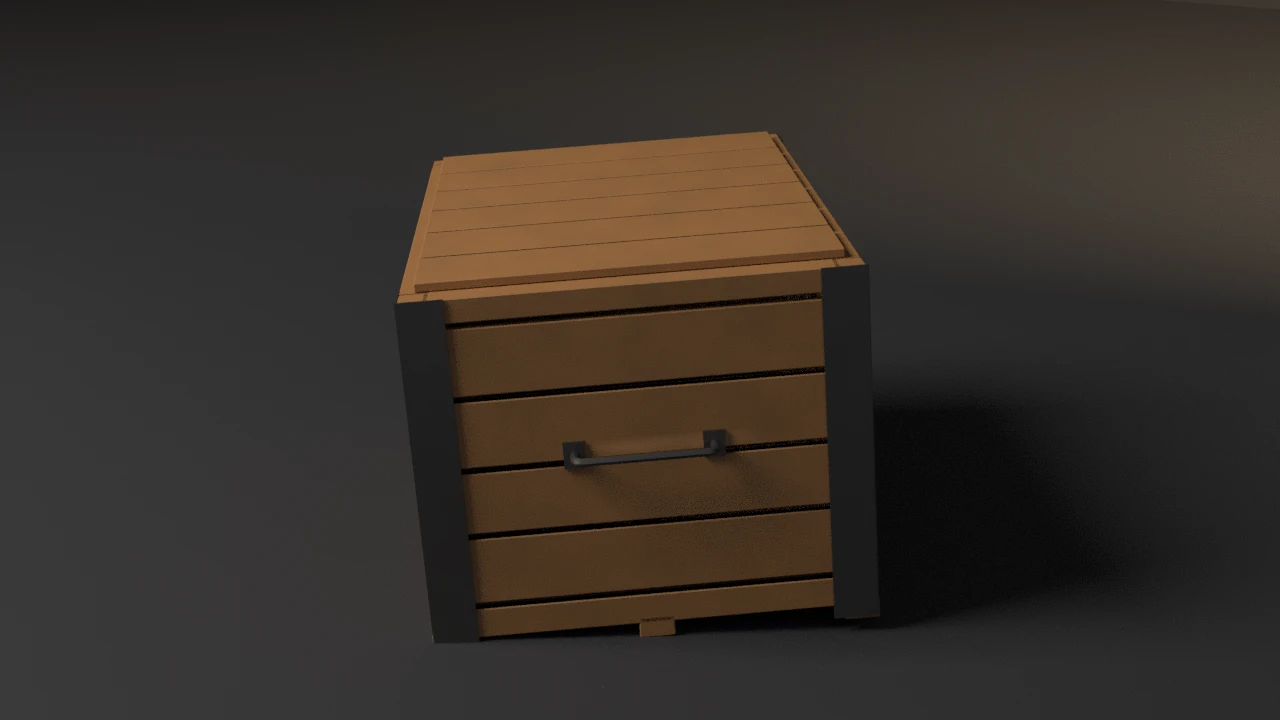
shipping-crate
A procedural shipping crate through UVs, bake, LOD, collider, and Unity glTF, asserting recomputed budgets rather than an API contract.
A procedural felled-tree stump on a sloping forest-floor soil disc — one furrowed lathe about a plumb axis flaring through five buttresses into the ground, its bark peeled in two patches to grey sapwood a bark's thickness under a ragged torn lip with curling flakes, a felling top with weathered growth rings, radial drying checks, the undercut floor a step under the back cut and a low band of torn hinge fibres along the step, five surface roots bedded along their run, thin moss cushions laid on the furrowed bark with tufted rims, two tiers of turkey-tail brackets rooted in the bark, three fly agarics with warted caps, pleated gills, volva and skirt, and two clusters of ringed honey fungus out of a root and the stump's foot — with fallen leaves, bipinnate ferns, twigs and pebbles, through UVs, bake, LOD, collider, and Unity glTF, asserting recomputed budgets rather than an API contract.
Rendered headless by the showcase piece itself — click to zoom.
category Nature
blender --background --python showcase/mushroom-stump/mushroom_stump.py --
A showcase piece, not an example, and the seventh in the nature category. It builds a procedural, game-ready tree stump on its patch of forest floor:
fern-mossy-rock (copied inline, not imported) at about half its size: young fronds stand up, old ones arch out and down; each carries 9–11 alternate pinnae a side, each pinna cut into up to three pairs of pinnules, with rusty sori on the underside.Every draw comes from random.Random(SEED) in plan_stump(), before anything is built: peel and moss outlines, flakes and tufts, shelf sizes and swing, the roots' reach and meander, the hinge fibres, the mushrooms, the fronds, twigs, pebbles and leaves; per-pinna and per-cap variety comes from a closed-form hash of indices. No flag draws from the stream, so a falsifier changes only what it names.
Twelve materials, one per substance: bark, wood (sapwood, the sawn end grain and the torn holding wood), moss, turkey tail, fly-agaric cap, honey-fungus cap, mushroom flesh (stipes and gills), soil, leaf litter, fern, pebble and twig. A Peel point attribute is 0.5 exactly on each patch's outline, so the bark shader cuts the torn edge between vertices; a flake's underside (Zone 1) is inner bark. A Notch point attribute is 0 on the back cut and 1 on the undercut floor. Moss faces carry their distance from the cushion's heart in Zone, which thins the colour toward the rim. Fern pinnae carry a LeafUV map across and along each pinna for the midrib and sori (the packed UVMap stays first and active). The end grain draws its rings from a Radial point attribute and its cracks from a Check point attribute that is 1 only on the floor of each groove; the caps, gills, stipes and brackets take their zones from a Zone face attribute; the fly agaric's warts are a Voronoi field thinning toward the margin. Everything organic is smooth-shaded; the torn holding wood and the pebbles are flat-shaded facets. Every material boundary is a hard edge, so the sawn rim stays crisp against the bark.
It asserts budget conformance of the generated result. It does not witness an API contract. "It rendered without error" is not a check.
Composes skills mesh-editing-and-bmesh, bake-high-to-low, depsgraph-and-evaluated-data, engine-export-presets, and snippets bake_normal_high_to_low.py, setup_bake_target_image.py, lod_chain.py / decimate_to_budget.py, convex_hull_collider.py, export_preset_unity.py (helpers copied inline, not imported).
Intended size: a stump 0.62 m across the bark at the cut, sawn 0.50 m above the soil at its axis, on a soil disc 1.7 × 1.6 m. The outer AABB is 1.935 × 1.628 × 0.689 m. Two fern fronds set X, the soil sets Y, and the tallest hinge fibre the top. The soil's underside is the ground. The collider is the convex hull of the stump alone, round and unfurrowed, down to the soil: players walk through ferns and step over roots.
Every budget is declared as a named constant. Every gate recomputes its value from the mesh, materials, UVs, evaluated LOD, collider, or export file.
| Axis | Declared | Measured (5.2.1) |
|---|---|---|
| Base triangles | 56150–57250 | 56710 |
| LOD1 ratio | 0.32–0.62 of base | 0.5000 |
| LOD2 ratio | 0.10–0.35 of base | 0.2200 |
| Materials | exactly 12 distinct; ≥4000 bark, ≥1530 wood, ≥2770 moss, ≥1440 bracket, ≥600 agaric, ≥1640 honey, ≥3640 flesh, ≥1580 soil, ≥1100 litter, ≥16100 fern, ≥345 stone, ≥190 twig faces | 12 slots; 4441 / 1702 / 3080 / 1596 / 672 / 1820 / 4050 / 1758 / 1232 / 17884 / 384 / 210 |
| UVs | in 0..1, AABB overlap ≤ 1e-5 | in range, overlap 0 |
| Outer AABB | (1.9351, 1.6283, 0.6888) m ± 0.01 | (1.9351, 1.6283, 0.6888), zmin 0 |
| Collider tris (stump hull) | ≤ 75 | 66 |
| Export | written, size > 0, removed after measuring | 5733424 bytes |
No falsifier changes the triangle count, and only --tall-hinge moves the envelope, 7.2 mm up against the 10 mm tolerance: they move parts or reshape the foot, never add or remove faces. The upper lathe carries a fixed ring count, so moving the foot keeps the topology; the step's chord scales with --fat-stump, so the cuts along it cross the same edges.
DECIMATE COLLAPSE triangle counts are not identical across Blender series, so the LOD gate is a ratio band, not an exact count. Bake pixels are stochastic, so the bake gate is has_data plus operator FINISHED, not byte-identity. The plan is seeded and nothing else is random; two default runs print identical measurements, and 4.5.11 and 5.1.2 print the same measurements as 5.2.1 (the glTF differs by 16 bytes).
Recomputed from the generated mesh, not asserted about the script.
| Axis | Declared | Measured |
|---|---|---|
| Non-manifold edges | 0 | 0 |
| Loose verts / edges | 0 / 0 | 0 / 0 |
| Doubles merged at 1e-5 | 0 | 0 |
| Zero-area faces | 0 | 0 |
| N-gons | 0 | 0 |
| Coplanar cross-shell face pairs (KD range 0.05 m, plane ε 1e-4) | 0 | 0 |
Grounded: zmin | within 1e-4 of 0 | 0.0000 |
The coplanar budget caught three faults on the way. Two honey-fungus clusters first grew their members at one height and one reach, so their caps ran into each other and two gill fans met a crown in one plane; the members now alternate tall and close in with short and leaning out. Leaves closer than their own length overlapped, and two lay on one soil face in one plane; they are now spaced by their half-lengths and each rolls a few degrees about its midrib. Two fern fronds in one clump carried pinnae in one plane; each frond now has its own twist phase. Later, --perch-stump moved the second bracket tier's neighbour, a honey cap, onto a shelf's underside plane; the tier went up the bole and the cluster round it. The remodel met it three more times. Moss bases laid a fixed depth under the curved bark met a tuft's base in one plane; each cushion's base now bellies into the stump by its own depth and each tuft's base is one cone from its rim. Two shingled honey caps shared a plane once the stump grew finer; each cap now tips its own small hashed way. And pinnae are turned about their own axes, as in fern-mossy-rock, until no two within range share a plane.
A stump has no joinery. What makes it read as a stump is that it grows out of the ground rather than standing on it, that its roots lie in the soil, that the saw left it level and it is the size it says, that its fungi grow out of it and out of the soil rather than resting on them, and that moss grows where the sun does not reach.
| Axis | Declared | Measured |
|---|---|---|
| Stump sealed: azimuth sectors round the stump's centroid holding a stump vertex at least 5 mm under the soil straight above it (a ray down onto the soil shell alone) | 8 of 8 | 8 of 8 |
| Caps seated: for each cap, the deepest vertex of its own stipe inside it (signed distance by ray parity) | 16 caps on 16 stipes, each 0.003–0.030 m | 16; 0.0052–0.0137 |
Cut level: plane fit on the back cut's end grain (the check grooves and the undercut floor, Notch > 0, left out) | tilt ≤ 1.0° | 0.0894° |
| Real-world size: diameter across the bark 5–50 mm under the fit plane (mean of the X and Y extents); the fit plane's height at its centre above the soil | 0.62 ± 0.015 m and 0.50 ± 0.015 m | 0.6210 and 0.4966 |
| Roots bedded: each root's vertices outside the stump, binned at 0.05 m from the stump's axis; every bin's most-buried vertex under the soil (bins where the root leaves the buttress are sealed by the stump and skipped) | 5 roots, every station ≥ 0.006 m under | 5; shallowest 0.0547 over 14 stations |
| Mushrooms rooted: each stipe's deepest vertex in its host — under the soil straight above it for a fly agaric, inside the root or the stump for honey fungus | 16 stipes, each 0.008–0.070 m | 16; 0.0248–0.0382 |
| Brackets rooted: each shelf's deepest vertex inside the stump shell (signed distance to the nearest bark face along its normal) | 6 shelves, each 0.006–0.050 m | 6; 0.0183–0.0211 |
| Moss facing: of the moss top faces (facing away from the bark under them), the area fraction whose normal faces up (z > 0.25) or north into the shade (y > 0.5) | 23 cushions and tufts, ≥ 0.85 | 23; 0.9460 |
| Ground cover joined: soil, leaves, fern rachises and pinnae, twigs and pebbles, unioned by BVH overlap | 339 shells, all joined to the soil | 339; 0 loose |
Felling: the undercut floor's mean depth under the back-cut plane (its end-grain vertices, Notch 1, checks left out); the torn hinge band's tallest vertex over that plane | step 0.028–0.041 m; hinge 0.018–0.034 m | 0.0346 over 189 vertices; 0.0286 |
Peel: round each peel, from the stump's own vertices about its axis (the pith), the median radius of the torn lip (Peel 0.2–0.5) less that of the exposed sapwood (Peel > 0.5); each bark flake's deepest vertex inside the stump | 2 peels, each 0.020–0.034 m; 12 flakes, each 0.002–0.020 m | 0.0268 and 0.0249; 12, 0.0042–0.0150 |
Moss conforms: the greatest height of any moss top vertex (Zone < 1.5) over the bark, along the normal of the nearest stump face | 0.006–0.016 m | 0.0104 |
The stump's foot follows the soil: its four lowest rings sit a fixed offset above (and the lowest 45 mm under) the soil straight under each vertex, read back by raycast off the built soil, and the ground rises toward the back. A stump sunk by the soil at its axis alone, the rule terrain-scatter's stones first shipped with, leaves daylight under its downhill side.
The felling budget is why the step is measured, not assumed: a real felled stump has a flat back cut and, on the fall side, the undercut a few centimetres lower, with the hinge's holding wood torn along the edge between them. The first draft stood a comb of splinters, 13 cm tall, in the middle of a level cut. The peel budget holds the exposed wood as the trunk's own surface a bark's thickness under the torn bark; the first draft's patch read as a plank pasted on. The moss budget caps the moss's height over the bark: the first draft's 26 mm dome over the plate crests filled the furrows and read as a slab.
Each falsifier violates one named budget. Every one was run on 5.2.1 and 4.5.11 and exited its declared code. Every run measured the default's triangle count, and every one but --tall-hinge its outer AABB.
| Flag | Budget violated | Exit |
|---|---|---|
--skip-decimate | LOD1 ratio band (measured 1.0000) | 9 |
--stray-vert | loose vertex count is 0 (measured 1, placed inside the envelope) | 15 |
--lift-z | bounding box zmin is 0 (measured 0.05000) | 16 |
--perch-stump | stump sealed all round (the foot set from the soil at the axis alone: sealed in 6/8 sectors) | 17 |
--float-caps | caps seated on their stipes (every cap moved 24 mm up its axis: stipe bite −0.0156 to −0.0100 m) | 18 |
--tilt-cut | saw cut level (the cut plane turned 5° about the hinge chord: measured 4.9584°) | 19 |
--fat-stump | stated size (every stump radius × 1.08: 0.6706 m across) | 19 |
--arch-roots | roots bedded along their run (each root's middle raised 120 mm: shallowest station −0.0524 m) | 20 |
--float-mushrooms | stipes rooted in their host (every mushroom moved 50 mm off its host: −0.0249 to −0.0032 m) | 21 |
--float-brackets | brackets rooted in the bark (every shelf moved 35 mm off the bark: −0.0164 to −0.0131 m) | 22 |
--sunny-moss | moss on up- and shade-facing surfaces (every cushion and tuft turned half round the stump: 0.4270) | 23 |
--float-cover | ground cover joined (every leaf lifted 25 mm off the soil: 77 of 339 shells loose) | 24 |
--flat-felling | felling step (the undercut floor sawn level with the back cut: step 0.0006 m) | 25 |
--tall-hinge | felling hinge band low (every torn fibre × 1.25: tallest 0.0358 m; the AABB's top rises 7.2 mm, inside its 10 mm tolerance) | 25 |
--flush-peel | torn bark over the sapwood (no bark thickness and no lip: −0.0015 and −0.0011 m) | 26 |
--float-flakes | flakes rooted in the bark (every flake moved 20 mm off the bark along its normal: −0.0108 to 0.0011 m) | 26 |
--slab-moss | moss conforms (every cushion the old 26 mm dome over the plate crests: 0.0360 m) | 27 |
--tilt-cut turns the cut about the hinge chord, so the holding wood and the stump's height at its axis stay put and only the tilt fails. --fat-stump scales the stump and leaves the soil, the roots and the holding wood's height alone, so only the diameter fails. --float-caps at 30 mm put one honey cap's crown on a neighbour's gill plane and exited 15; 24 mm keeps it on 18. --float-mushrooms moves soil- and root-grown mushrooms straight up and stump-grown ones out along the bark's normal: lifted, those would have stayed inside the flaring foot. --tall-hinge is sized to the tolerance: the tallest fibre sets the top of the envelope, and × 1.25 clears the 0.034 m band by 1.8 mm while the top moves 7.2 mm of its 10 mm. --arch-roots went from 90 to 120 mm when the roots were shortened for the smaller disc and bedded deeper: at 90 mm the shallowest station still lay 3.4 mm under the soil, a fail by only 2.6 mm.
blender --background --python mushroom_stump.py --
blender --background --python mushroom_stump.py -- --skip-decimate
blender --background --python mushroom_stump.py -- --stray-vert
blender --background --python mushroom_stump.py -- --lift-z
blender --background --python mushroom_stump.py -- --perch-stump
blender --background --python mushroom_stump.py -- --float-caps
blender --background --python mushroom_stump.py -- --tilt-cut
blender --background --python mushroom_stump.py -- --fat-stump
blender --background --python mushroom_stump.py -- --arch-roots
blender --background --python mushroom_stump.py -- --float-mushrooms
blender --background --python mushroom_stump.py -- --float-brackets
blender --background --python mushroom_stump.py -- --sunny-moss
blender --background --python mushroom_stump.py -- --float-cover
blender --background --python mushroom_stump.py -- --flat-felling
blender --background --python mushroom_stump.py -- --tall-hinge
blender --background --python mushroom_stump.py -- --flush-peel
blender --background --python mushroom_stump.py -- --float-flakes
blender --background --python mushroom_stump.py -- --slab-moss
blender --background --python mushroom_stump.py -- --output stump.png
Smoke passes no flags.
The hero turns the piece half round (HERO_YAW_DEG 180°, about Z only), so the shaded north flank with its moss faces the camera, and raises the camera over the south-west corner so the cut face, its rings, checks and the felling step read from above; the tree fell to the camera's right, so the step and its torn band are seen three-quarter on. The fly agarics stand in the foreground, the brackets stand out in profile on both flanks and a fern clump stands either side of the stump: fill 0.709 × 0.833.
File-local. 9 is a valid check code. 10 is reserved for gallery_framing.check_framing on the --output path. 15–19 are the hygiene, grounding, sealing, seating and size family. 20–27 are file-local. 28 is the asset-quality floor on the render path: check_asset_quality returns 11, which this piece already spends on the collider ceiling, so the call site remaps it.
| Code | Meaning |
|---|---|
| 0 | Success |
| 1 | Uncaught exception (FATAL wrapper) |
| 2 | argparse / usage |
| 3 | Mesh did not build, no UV layer, or no stump or soil shell |
| 4 | Base triangle count outside range |
| 5 | Material count ≠ 12 distinct slots, or a face-count floor missed |
| 6 | UVs outside 0..1 |
| 7 | UV AABB overlap above tolerance |
| 8 | World AABB off declared outer size |
| 9 | LOD ratio band (--skip-decimate lands here) |
| 10 | Framing gate (render path only) |
| 11 | Collider triangle count above ceiling |
| 12 | Bake did not finish or image has no data |
| 13 | Export file missing or empty |
| 14 | --output produced no file |
| 15 | Mesh hygiene: loose, non-manifold, zero-area, doubles, n-gons, coplanar cross-shell pairs |
| 16 | Not grounded: bounding box zmin off 0 (--lift-z) |
| 17 | Stump not sealed in the soil in all 8 sectors (--perch-stump) |
| 18 | Caps seated: not 16 caps on 16 stipes, or a stipe's bite in its cap outside its band (--float-caps) |
| 19 | Saw cut tilted over 1°, or the stump off its stated 0.62 m diameter or 0.50 m height (--tilt-cut, --fat-stump) |
| 20 | Roots bedded: not 5 roots, or a station along a root not under the soil (--arch-roots) |
| 21 | Mushrooms rooted: not 16 stipes, or a stipe's depth in its host outside its band (--float-mushrooms) |
| 22 | Brackets rooted: not 6 shelves, or a shelf's deepest vertex in the bark outside its band (--float-brackets) |
| 23 | Moss: not 23 cushions and tufts, or under 0.85 of the moss top area facing up or north (--sunny-moss) |
| 24 | Ground cover: not 339 shells, or a leaf, frond part, twig or pebble not joined to the soil (--float-cover) |
| 25 | Felling: not one hinge band, the undercut floor off its step under the back cut, or the tallest hinge fibre outside its band (--flat-felling, --tall-hinge) |
| 26 | Peel: the torn bark's stand over the sapwood outside its band at either peel, not 12 flakes, or a flake's root in the bark outside its band (--flush-peel, --float-flakes) |
| 27 | Moss conforms: the moss's greatest height over the bark outside its band (--slab-moss) |
| 28 | Asset-quality floor (render path only; remapped from 11) |
"""Game-ready mushroom stump — a showcase piece, not an example. Asserts budget conformance of a procedural felled-tree stump on its patch of forest floor after composing shipped pipeline pieces: bmesh construction, UVs, twelve materials, high-to-low normal bake, LOD chain, convex stump collider, Unity glTF export. The stump is one lathe about a plumb axis: a chainsaw cut 0.50 m above the soil, 0.62 m across the bark, flaring through five buttresses into the ground. Its plated bark is cut by sixteen narrow furrows and peeled away in two patches: the sapwood lies a bark's thickness under a ragged torn lip, weathered grey with beetle galleries, and bark flakes curl off the edge. The top is the felling: a back cut with growth rings round a dark heartwood and five radial drying checks, and beyond the hinge chord the undercut floor a step lower, a low band of torn hinge fibres along the step's edge. Five surface roots run out of the buttresses and dive into the soil. Thin moss cushions lie on the bark as built, furrows and all, on the shaded north flank and in two root crotches, their lumpy rims tongued along the furrows and ringed by satellite tufts; two tiers of turkey-tail brackets grow out of the bark; three fly agarics (a mature cap, a domed one and a button) stand on the soil in front of it, each on a bulbous, volva-ringed stipe with a hanging skirt; two clusters of honey fungus grow on thin ringed stipes out of a root and out of the stump's foot. Ground cover is fallen leaves, two clumps of bipinnate ferns (the frond builder of showcase/fern-mossy-rock, copied inline), twigs and a few broken pebbles. Budgets are declared below and recomputed from the generated result. They are not API-contract witnesses. Each falsifier violates one named budget: ``--skip-decimate`` the LOD-ratio band, ``--stray-vert`` mesh hygiene, ``--lift-z`` grounded zmin, ``--perch-stump`` the stump sealed in the soil all round, ``--float-caps`` every cap seated on its stipe, ``--tilt-cut`` the saw cut level, ``--fat-stump`` the stump's stated size, ``--arch-roots`` the roots bedded along their run, ``--float-mushrooms`` every stipe rooted in its host, ``--float-brackets`` the brackets rooted in the bark, ``--sunny-moss`` the moss on up- and shade-facing surfaces, ``--float-cover`` the ground cover joined to the soil, ``--flat-felling`` and ``--tall-hinge`` the felling step and the low hinge band, ``--flush-peel`` and ``--float-flakes`` the torn bark round each peel and its flakes rooted in it, ``--slab-moss`` the moss a thin shell on the bark. Seeded, not random: ``random.Random(SEED)`` draws the whole plan before anything is built, so flags never shift the stream. DECIMATE COLLAPSE triangle counts are not byte-identical across Blender versions — the LOD gate is a ratio band, not an exact count. blender --background --python mushroom_stump.py -- blender --background --python mushroom_stump.py -- --skip-decimate blender --background --python mushroom_stump.py -- --output stump.png """ import argparse import math import os import random import sys import tempfile import traceback import bmesh import bpy from mathutils import Matrix, Vector from mathutils.bvhtree import BVHTree from mathutils.kdtree import KDTree # Showcase lives at repo-root/showcase/, not under examples/. The framing # helper is the repo's only shared import and lives next to the examples; # resolve the repo root so we do not move gallery_framing.py. _REPO = os.path.abspath( os.path.join(os.path.dirname(os.path.abspath(__file__)), os.pardir, os.pardir) ) sys.path.insert(0, os.path.join(_REPO, "examples")) sys.dont_write_bytecode = True import gallery_framing # noqa: E402 import gallery_asset_quality # noqa: E402 SEED = 5173 TAU = 2.0 * math.pi UP = Vector((0.0, 0.0, 1.0)) # --- Stump ----------------------------------------------------------------- R_CUT = 0.307 # bark radius at the cut, before out-of-round and furrows TAPER = 0.07 # the bole widens this fraction from the cut to the soil ELLIPSE = 0.035 CUT_H = 0.50 # saw cut above the soil at the axis STUMP_SIDES = 128 STUMP_SIDES_HIGH = 256 FURROWS = 16 FURROW_D = 0.016 BARK_T = 0.026 # the sapwood lies this far under the plate crests # buttresses: (azimuth deg, half-width rad, strength); a root runs out of each LOBES = ((-10.0, 0.34, 1.00), (96.0, 0.30, 0.85), (165.0, 0.33, 0.95), (235.0, 0.30, 0.80), (300.0, 0.33, 1.00)) FLARE = 0.17 FLARE_H = 0.11 FOOT_OFFS = (-0.045, 0.010, 0.032, 0.066) # foot rings: above the soil under each vertex UPPER_Z0 = 0.13 # first level ring above the soil at the axis (lifted clear of the foot) UPPER_STEP = 0.024 PEEL_LOW = 0.05 PEEL_TOP_CLEAR = 0.035 # peeled bark: (height above the soil m, azimuth deg, half-height m, half-arc m) PEELS = ((0.32, 34.0, 0.092, 0.080), (0.16, 128.0, 0.052, 0.060)) # the torn bark round a peel lifts off the wood: a lip this far proud of the # plates at the edge, fading out over PEEL_LIP_W of the patch's radius PEEL_LIP = 0.006 PEEL_LIP_W = 0.30 # bark flakes curling off each peel's edge: (count per patch) FLAKES = (7, 5) FLAKE_NL = 6 FLAKE_NW = 4 FLAKE_BITE = 0.007 FLAKE_T = 0.0035 # the cut face: rings as fractions of the wood's radius, bark ring first CAP_FR = (0.965, 0.90, 0.80, 0.68, 0.55, 0.42, 0.29, 0.16) # radial drying checks: (azimuth deg, reach inward as a fraction of the radius) CHECKS = ((14.0, 0.46), (104.0, 0.62), (198.0, 0.38), (262.0, 0.30), (318.0, 0.54)) CHECK_D = 0.016 # the felling: the tree fell toward FALL_DEG. The undercut (the notch's # floor) is the segment beyond the hinge chord, HINGE_OFF toward the fall; # the back cut, sawn from the other side, stands STEP above it, and the # holding wood tore along the step's edge as a low band of fibres. FALL_DEG = 120.0 HINGE_OFF = 0.172 STEP = 0.034 STEP_W = 0.006 # the step face's run across the chord HINGE_N = 64 HINGE_SPAN = 0.66 # the torn band covers this fraction of the chord HINGE_H = 0.022 # a typical torn fibre above the back cut HINGE_HW = 0.018 # the band's reach back from the step edge HINGE_BITE = 0.007 TILT_CUT_DEG = 5.0 # --tilt-cut: the cut plane turned about the hinge chord FAT_STUMP = 1.08 # --fat-stump: every stump radius scaled TALL_HINGE = 1.25 # --tall-hinge: every torn fibre this much taller # --- Roots ----------------------------------------------------------------- ROOT_SIDES = 8 # (fraction of reach, centre above the soil m, radius m) ROOT_PROF = ((0.28, 0.110, 0.100), (0.38, 0.075, 0.085), (0.48, 0.045, 0.072), (0.57, 0.025, 0.062), (0.66, 0.010, 0.052), (0.75, -0.004, 0.044), (0.83, -0.018, 0.036), (0.90, -0.032, 0.029), (0.96, -0.046, 0.023), (1.00, -0.058, 0.018)) ROOT_RINGS = 24 ROOT_REACH = (0.56, 0.64) ARCH_ROOTS = 0.120 # --arch-roots: each root's middle raised off its bed # --- Moss and brackets ------------------------------------------------------- # moss on the shaded north flank and in the root crotches either side of # it: (height m, azimuth deg, half-height m, half-arc m, satellite tufts) MOSS = ((0.25, 86.0, 0.110, 0.100, 8), (0.42, 66.0, 0.036, 0.058, 3), (0.085, 58.0, 0.038, 0.072, 4), (0.080, 148.0, 0.034, 0.060, 4)) MOSS_K = 7 # rings from the centre to the rim MOSS_M = 36 # spokes round the rim MOSS_T = 0.0105 # a cushion's thickness over the bark at its heart MOSS_EDGE = 0.002 # its rim this far inside the bark MOSS_BITE = 0.006 MOSS_STAGGER = 0.004 TUFT_R = (0.007, 0.016) # a satellite tuft's radius TUFT_BITE = 0.0022 # a tuft's base this far in: well clear of the cushions' bases SLAB_T = 0.026 # --slab-moss: the old cushion, a dome over the plate crests # turkey-tail tiers: (top height m, azimuth deg, height step m, [(width, reach)...]) TIERS = ((0.34, 134.0, -0.050, ((0.15, 0.085), (0.13, 0.075), (0.10, 0.060))), (0.37, -6.0, -0.046, ((0.15, 0.085), (0.13, 0.075), (0.10, 0.058)))) SHELF_NS = 14 SHELF_ROWS = (0.0, 0.16, 0.32, 0.47, 0.60, 0.72, 0.82, 0.91, 0.965, 1.0) SHELF_NT = len(SHELF_ROWS) - 1 SHELF_BITE = 0.018 SHELF_STAGGER = 0.0015 FLOAT_BRACKETS = 0.035 # --- Mushrooms ------------------------------------------------------------- # fly agarics on the soil: (x, y, cap radius, stipe height, stipe radius, dome, lean x, lean y) AGARICS = ((0.38, 0.41, 0.076, 0.168, 0.0138, 1.00, -0.06, 0.05), (0.57, 0.27, 0.052, 0.120, 0.0105, 1.45, 0.10, -0.04), (0.25, 0.58, 0.031, 0.052, 0.0090, 2.00, 0.02, 0.08)) AG_SIDES = 32 AG_SINK = 0.030 # the bulb's foot under the soil AG_BITE = 0.014 # the stipe's tip inside its cap GILL_D = 0.05 # honey-fungus clusters: (host, root index or azimuth deg, station, members) HONEY = (("root", 1, 0.64, 7), ("stump", 36.0, 0.085, 6)) HONEY_SIDES = 10 HONEY_CAP_SIDES = 20 HONEY_BITE = 0.008 HOST_DEPTH = 0.030 # a honey stipe's foot inside its host FLOAT_CAPS = 0.024 # --float-caps: every cap moved up its axis FLOAT_MUSH = 0.050 # --float-mushrooms: every mushroom moved off its host # --- Ground ---------------------------------------------------------------- SOIL_A = (0.84, 0.80) SOIL_N = 40 SOIL_H0 = 0.15 SLOPE = 0.15 # the ground rises toward the back (-Y) SOIL_EDGE = 0.16 SOIL_FLOOR = 0.012 N_LEAVES = 96 LEAF_BITE = 0.006 FLOAT_COVER = 0.025 # fern clumps behind the stump: (centre, fronds, heading deg, fan deg) FERN_CLUMPS = (((-0.56, -0.12), 6, 192.0, 150.0), ((0.50, -0.36), 6, 335.0, 165.0)) FROND_L = (0.44, 0.62) FROND_RINGS = 16 FROND_SIDES = 5 FROND_SIDES_HIGH = 7 R_STIPE = 0.0032 R_RACHIS_TIP = 0.0010 STIPE_F = 0.19 # the stipe's share of the frond PINNAE = (9, 11) # per side, by frond length PINNULES_MAX = 3 PINNA_TWIST = 0.20 PINNA_SEP = math.radians(8.0) PINNA_STEP = 0.04 FROND_SINK = 0.025 # a frond's foot this far under the soil # twigs: (x, y, yaw deg, length, radius) TWIGS = ((-0.43, 0.40, 20.0, 0.30, 0.010), (0.02, 0.655, 5.0, 0.20, 0.008), (-0.05, -0.55, 0.0, 0.24, 0.009)) PEBBLES = ((0.13, 0.57, 0.045), (0.60, 0.09, 0.035), (-0.26, 0.52, 0.030), (0.56, -0.20, 0.040)) STONE_BED = 0.010 BBOX_TOL = 0.01 # Fitted after locking geometry. Recomputed from bound_box. OUTER_SIZE = (1.9351, 1.6283, 0.6888) BASE_TRIS_MIN = 56150 BASE_TRIS_MAX = 57250 LOD1_RATIO_MIN = 0.32 LOD1_RATIO_MAX = 0.62 LOD2_RATIO_MIN = 0.10 LOD2_RATIO_MAX = 0.35 LOD1_TARGET = 0.50 LOD2_TARGET = 0.22 MATERIAL_COUNT = 12 UV_EPS = 1e-4 UV_OVERLAP_MAX = 1e-5 COLLIDER_TRIS_MAX = 75 BAKE_RES = 512 CAGE_EXTRUSION = 0.01 # bark, wood, moss, bracket, agaric, honey, flesh, soil, litter, fern, stone, twig FACE_FLOORS = (4000, 1530, 2770, 1440, 600, 1640, 3640, 1580, 1100, 16100, 345, 190) ZMIN_EPS = 1e-4 DOUBLES_EPS = 1e-5 AREA_EPS = 1e-10 COPLANAR_NORMAL_EPS = 1e-4 COPLANAR_PLANE_EPS = 1e-4 COPLANAR_CENTRE_MAX = 0.05 LIFT_Z = 0.05 # Stump sealed: in each azimuth sector round its centroid, some stump # vertex lies at least SEAL_EPS under the soil straight above it. SEAL_SECTORS = 8 SEAL_EPS = 0.005 # Caps: the stipe's deepest vertex inside its own cap. CAP_BITE_MIN = 0.003 CAP_BITE_MAX = 0.030 # Cut and size: plane fit on the sawn face; diameter across the bark just # under the cut; height of the cut above the soil at the fit's centre. CUT_TILT_MAX = 1.0 STUMP_D = 0.62 STUMP_HT = 0.50 SIZE_TOL = 0.015 # Roots: binned at ROOT_STATION along their run outside the stump, every # station's most-buried vertex at least ROOT_BED_MIN under the soil. ROOT_STATION = 0.05 ROOT_BED_MIN = 0.006 # Mushrooms: each stipe's deepest vertex in its host (soil or wood). HOST_MIN = 0.008 HOST_MAX = 0.070 # Brackets: each shelf's deepest vertex inside the bark. FUNGUS_BITE_MIN = 0.006 FUNGUS_BITE_MAX = 0.050 # Moss: top faces (facing away from the bark) that face up or north. MOSS_TOP_DOT = 0.3 MOSS_UP_Z = 0.25 MOSS_SHADE_Y = 0.5 MOSS_FRAC_MIN = 0.85 # Felling: the undercut floor's depth under the back-cut plane, and the # torn band's tallest fibre over that plane. STEP_BAND = (0.028, 0.041) HINGE_TIP_BAND = (0.018, 0.034) # Peel: the torn bark's stand over the exposed sapwood round each peel, # and each flake's root in the bark. RECESS_BAND = (0.020, 0.034) FLAKE_BITE_BAND = (0.002, 0.020) FLOAT_FLAKES = 0.020 # --float-flakes: every flake moved off the bark along its normal # Moss: a conforming shell, its top's greatest height over the bark along # the bark's normal. MOSS_THICK_BAND = (0.006, 0.016) # Hero yaw about Z only (level on the stage). HERO_YAW_DEG = 180.0 WALL_Y = 4.0 BARK_IDX = 0 WOOD_IDX = 1 MOSS_IDX = 2 BRACKET_IDX = 3 AGARIC_IDX = 4 HONEY_IDX = 5 FLESH_IDX = 6 SOIL_IDX = 7 LITTER_IDX = 8 FERN_IDX = 9 STONE_IDX = 10 TWIG_IDX = 11 MAT_LABELS = ("bark", "wood", "moss", "bracket", "agaric", "honey", "flesh", "soil", "litter", "fern", "stone", "twig") # face Part codes, so every audit classifies shells by what built them P_SOIL, P_STUMP, P_ROOT, P_HINGE, P_MOSS, P_BRACKET, P_STIPE, P_CAP, P_LEAF, P_FERN, \ P_TWIG, P_PEBBLE, P_FLAKE = range(1, 14) def eevee_engine_id(): return "BLENDER_EEVEE" if bpy.app.version >= (5, 0, 0) else "BLENDER_EEVEE_NEXT" def fail(msg, code): print(f"ERROR: {msg}", file=sys.stderr) return code def triangle_count(mesh): mesh.calc_loop_triangles() return len(mesh.loop_triangles) def evaluated_triangle_count(obj): # Duplicated from snippets/lod_chain.py / decimate_to_budget.py (not a package). depsgraph = bpy.context.evaluated_depsgraph_get() eval_obj = obj.evaluated_get(depsgraph) eval_mesh = eval_obj.to_mesh() try: eval_mesh.calc_loop_triangles() return len(eval_mesh.loop_triangles) finally: eval_obj.to_mesh_clear() def smoothstep(x, lo, hi): t = min(max((x - lo) / (hi - lo), 0.0), 1.0) return t * t * (3.0 - 2.0 * t) def wrap(a): return (a + math.pi) % TAU - math.pi def hor(v): return Vector((v.x, v.y, 0.0)) def hash01(a, b, c): """A closed-form draw in [0, 1) from three indices: per-part variety that no flag can shift (copied from showcase/fern-mossy-rock).""" x = math.sin(a * 12.9898 + b * 78.233 + c * 37.719 + SEED * 0.0137) * 43758.5453 return x - math.floor(x) def rotate_about(v, axis, ang): return Matrix.Rotation(ang, 3, axis) @ v # -------------------------------------------------------------------------- # The stump's closed-form shape # -------------------------------------------------------------------------- def fall_dir(): a = math.radians(FALL_DEG) return Vector((math.cos(a), math.sin(a), 0.0)) def hinge_point(): return fall_dir() * HINGE_OFF def cut_z(x, y, soil0, tilt): """The saw cut: level at CUT_H above the soil at the axis. ``--tilt-cut`` turns it about the hinge chord, so the hinge stays where it is.""" z = soil0 + CUT_H if tilt: h = hinge_point() f = fall_dir() z += math.tan(math.radians(TILT_CUT_DEG)) * ((x - h.x) * f.x + (y - h.y) * f.y) return z def notch(x, y, fat=1.0): """0 on the back cut, 1 on the undercut floor beyond the hinge chord, a straight ramp down the step face between them. ``fat`` scales the chord with the stump, so --fat-stump keeps the top's topology.""" f = fall_dir() d = (x * f.x + y * f.y) / fat return min(max((d - (HINGE_OFF - 0.5 * STEP_W)) / STEP_W, 0.0), 1.0) def top_z(x, y, soil0, tilt, step, fat=1.0): """The stump's top: the back cut, and the undercut floor ``step`` under it.""" return cut_z(x, y, soil0, tilt) - step * notch(x, y, fat) def lobe(a): best = 0.0 for deg, w, s in LOBES: best = max(best, s * math.exp(-(wrap(a - math.radians(deg)) / w) ** 2)) return best def stump_radius(zrel, a, fat=1.0): """Bark radius (plate crests) at height ``zrel`` above the soil.""" t = min(max(zrel / CUT_H, 0.0), 1.2) r = R_CUT * (1.0 + TAPER * (1.0 - t)) r *= 1.0 + ELLIPSE * math.cos(2.0 * (a - 0.7)) r *= 1.0 + 0.018 * math.sin(3.0 * a + 1.1 + 2.0 * zrel) + 0.012 * math.sin(5.0 * a + 0.4) fl = math.exp(-max(zrel, 0.0) / FLARE_H) r += FLARE * fl * (0.22 + 0.78 * lobe(a)) return r * fat def furrow(zrel, a): """Plates with narrow V furrows between them, wandering up the bole. cos(FURROWS a) is sampled on the lathe's own vertices, so the high and low builds carry the same furrows.""" ph = FURROWS * a + 0.5 * math.sin(5.1 * zrel + 0.7) + 0.3 * math.sin(11.0 * zrel) v = (1.0 - math.cos(ph)) * 0.5 depth = FURROW_D * (0.70 + 0.30 * math.sin(3.3 * zrel + 2.0 * a)) return -depth * v ** 3 def peel_field(zrel, a, patches): """Largest (edge - r) over the peel patches: positive inside a patch, zero on its torn edge. Never at the rim or in the soil.""" if zrel > CUT_H - PEEL_TOP_CLEAR or zrel < PEEL_LOW: return -1.0 best = -9.0 for p in patches: ds = (zrel - p["z"]) / p["hz"] da = wrap(a - p["a"]) * R_CUT / p["ha"] r = math.hypot(ds, da) th = math.atan2(da, ds) best = max(best, peel_edge(p, th) - r) return best def peel_edge(p, th): """A peel's torn outline, in patch radii, at angle ``th`` round it.""" ph = p["ph"] return (1.0 + 0.20 * math.sin(3.0 * th + ph) + 0.10 * math.sin(7.0 * th + 2.0 * ph) + 0.06 * math.sin(11.0 * th + 3.0 * ph) + 0.04 * math.sin(17.0 * th + 5.0 * ph)) def peel_lip(field, zrel, a): """The torn bark round a peel curls off the wood: proudest at the edge, ragged along it, gone PEEL_LIP_W of a patch radius out.""" if field > 0.0 or field < -PEEL_LIP_W: return 0.0 s = 1.0 + field / PEEL_LIP_W rag = 0.60 + 0.25 * math.sin(41.0 * a + 23.0 * zrel) + 0.15 * math.sin(67.0 * a - 37.0 * zrel) return PEEL_LIP * s ** 1.6 * rag # -------------------------------------------------------------------------- # The plan: every seeded draw happens here, before anything is built # -------------------------------------------------------------------------- def plan_stump(): rng = random.Random(SEED) def u(a, b): return a + (b - a) * rng.random() peels = [{"z": z, "a": math.radians(a), "hz": hz, "ha": ha, "ph": u(0.0, TAU)} for z, a, hz, ha in PEELS] flakes = [] for pi, n in enumerate(FLAKES): th0 = u(0.0, TAU) for k in range(n): flakes.append({"patch": pi, "th": th0 + TAU * (k + u(-0.3, 0.3)) / n, "L": u(0.024, 0.046), "W": u(0.018, 0.032), "curl": u(0.010, 0.026), "cup": u(0.002, 0.005), "tone": rng.random()}) moss = [] for z, a, hz, ha, ntuft in MOSS: patch = {"z": z, "a": math.radians(a), "hz": hz * u(0.92, 1.08), "ha": ha * u(0.92, 1.08), "ph": u(0.0, TAU), "ph2": u(0.0, TAU), "tone": rng.random(), "tufts": []} th0 = u(0.0, TAU) for k in range(ntuft): patch["tufts"].append({"th": th0 + TAU * (k + u(-0.25, 0.25)) / ntuft, "out": u(1.02, 1.28), "r": u(*TUFT_R), "ph": u(0.0, TAU), "tone": rng.random()}) moss.append(patch) shelves = [] for ti, (z0, a0, dz, sizes) in enumerate(TIERS): for k, (w, d) in enumerate(sizes): shelves.append({"tier": ti, "z": z0 + dz * k + u(-0.006, 0.006), "a": math.radians(a0 + (7.0 if k % 2 else -5.0) + u(-3.0, 3.0)), "yaw": math.radians(u(-14.0, 14.0)), "w": w * u(0.92, 1.08), "d": d * u(0.92, 1.08), "ph": u(0.0, TAU), "tone": rng.random(), "lift": u(-0.02, 0.10)}) roots = [] for k, (deg, _w, s) in enumerate(LOBES): roots.append({"yaw": math.radians(deg + u(-4.0, 4.0)), "reach": u(*ROOT_REACH), "wig": u(0.06, 0.12) * (1.0 if k % 2 else -1.0), "ph": u(0.0, TAU), "scale": 0.80 + 0.20 * s, "tone": rng.random()}) # the holding wood: each torn fibre bundle its own height, lean and # width; short stubs between them, now and then a longer splinter hinge = [] for i in range(HINGE_N + 1): v = rng.random() if i % 2: h = u(0.22, 0.50) # the torn floor between splinters else: h = 0.55 + 0.55 * v ** 1.3 if rng.random() < 0.14: h = u(1.30, 1.65) # a longer splinter hinge.append({"h": h, "lean": u(0.10, 0.45), "slide": u(-0.0025, 0.0025), "w": u(0.75, 1.20), "front": u(0.0, 0.004)}) agarics = [{"tone": u(0.0, 0.3), "spin": u(0.0, TAU), "cap_tone": rng.random()} for _ in AGARICS] honey = [] for host, which, station, count in HONEY: members = [] for m in range(count): span = (m + 0.5) / count - 0.5 L = u(0.100, 0.160) # neighbours alternate: a tall one close in, a short one leaning # out, so their caps shingle instead of running into each other tall = m % 2 == 0 members.append({"yaw": span * math.radians(210.0 if host == "root" else 120.0) + math.radians(u(-7.0, 7.0)), "L": L, "reach": L * (u(0.28, 0.40) if tall else u(0.70, 0.85)), "h": L * (u(0.88, 0.98) if tall else u(0.50, 0.62)), "rc": u(0.022, 0.034), "dome": u(0.9, 1.2), "spin": u(0.0, TAU), "tone": u(0.7, 1.0), "cap_tone": rng.random(), "dx": u(-0.012, 0.012), "dy": u(-0.012, 0.012)}) honey.append({"host": host, "which": which, "station": station, "members": members}) # bipinnate fronds, as showcase/fern-mossy-rock grows them, at a third # of its size: in each clump the young fronds stand up, the old ones # arch out and down ferns = [] for (cx, cy), n, head, fan in FERN_CLUMPS: order = list(range(n)) rng.shuffle(order) for k in range(n): az = math.radians(head + fan * ((k + 0.5) / n - 0.5) + u(-8.0, 8.0)) age = order[k] / (n - 1) L = u(*FROND_L) * (0.90 + 0.12 * age) off = u(0.010, 0.024) bx, by = cx + math.cos(az) * off, cy + math.sin(az) * off fr = {"id": len(ferns), "base": Vector((bx, by, soil_height(bx, by) - FROND_SINK)), "az": az, "L": L, "e0": math.radians(80.0 - 22.0 * age + u(-3.0, 3.0)), "etip": math.radians(-4.0 - 30.0 * age + u(-5.0, 5.0)), "curv": u(1.5, 1.9), "lat": u(-0.25, 0.25), "twist": u(-0.30, 0.30), "rings": FROND_RINGS, "sb": STIPE_F + u(-0.02, 0.02), "r0": R_STIPE * u(0.9, 1.1), "lmax": u(0.150, 0.170) * L, "peak": u(0.26, 0.38), "tone": rng.random()} fr["n_side"] = PINNAE[0] + int(round((PINNAE[1] - PINNAE[0]) * min(1.0, max( 0.0, (L - FROND_L[0]) / (FROND_L[1] - FROND_L[0]))))) # a frond that would run into the stump or the soil stands up # steeper and arches less until it clears for _t in range(16): if frond_clear(fr): break fr["e0"] = min(fr["e0"] + math.radians(3.0), math.radians(86.0)) fr["etip"] = fr["etip"] + math.radians(5.0) fr["pinnae"] = plan_pinnae(fr, fr["n_side"], fr["lmax"], PINNULES_MAX, fr["id"] + 1) ferns.append(fr) separate_pinnae(ferns) twigs = [{"bend": u(-0.25, 0.25), "fork": u(0.35, 0.6), "tone": rng.random()} for _ in TWIGS] pebbles = [{"yaw": u(0.0, TAU), "jit": [rng.random() for _ in range(8)]} for _ in PEBBLES] avoid = ([((x, y), 0.12) for x, y, *_rest in AGARICS] + [((c[0][0], c[0][1]), 0.20) for c in FERN_CLUMPS] + [((x, y), r + 0.05) for x, y, r in PEBBLES]) leaves = [] tries = 0 while len(leaves) < N_LEAVES and tries < 60000: tries += 1 x = u(-1.0, 1.0) * SOIL_A[0] y = u(-1.0, 1.0) * SOIL_A[1] rr = math.hypot(x / SOIL_A[0], y / SOIL_A[1]) if rr > 0.88 or math.hypot(x, y) < 0.40: continue # drifts, not a ring: the litter gathers in patches drift = 0.5 + 0.5 * math.sin(3.1 * x + 1.3) * math.sin(2.7 * y + 0.4) if rng.random() > 0.25 + 0.75 * drift: continue near_root = False for rt in roots: d = Vector((math.cos(rt["yaw"]), math.sin(rt["yaw"]), 0.0)) along = x * d.x + y * d.y if -0.05 < along < rt["reach"] + 0.05 and abs(x * d.y - y * d.x) < 0.14: near_root = True if near_root: continue if any(math.hypot(x - c[0], y - c[1]) < r for c, r in avoid): continue ln = u(0.050, 0.100) # leaves never overlap: the one on top would lie on the other, not on the soil if any(math.hypot(x - lf["x"], y - lf["y"]) < 0.5 * (ln + lf["len"]) + 0.004 for lf in leaves): continue leaves.append({"x": x, "y": y, "yaw": u(0.0, TAU), "len": ln, "wid": u(0.40, 0.60), "curl": u(0.002, 0.008), "tilt": u(-0.14, 0.14), "tone": rng.random() ** 1.3}) return {"peels": peels, "flakes": flakes, "moss": moss, "shelves": shelves, "roots": roots, "hinge": hinge, "agarics": agarics, "honey": honey, "ferns": ferns, "twigs": twigs, "pebbles": pebbles, "leaves": leaves} # -------------------------------------------------------------------------- # Fern fronds (adapted from showcase/fern-mossy-rock, inline, not imported) # -------------------------------------------------------------------------- def frond_dir(fr, s): th = fr["e0"] + (fr["etip"] - fr["e0"]) * s ** fr["curv"] ps = fr["az"] + fr["lat"] * s * s return Vector((math.cos(th) * math.cos(ps), math.cos(th) * math.sin(ps), math.sin(th))) def frond_path(fr): """Rachis points, tangents and blade side vectors (horizontal, left of the heading, turned by the frond's twist).""" n = fr["rings"] step = fr["L"] / (n - 1) p = fr["base"].copy() pts = [p.copy()] for i in range(1, n): s = (i - 0.5) / (n - 1) p = p + frond_dir(fr, s) * step pts.append(p.copy()) tans, sides = [], [] for i in range(n): a = pts[max(i - 1, 0)] b = pts[min(i + 1, n - 1)] t = (b - a).normalized() s = i / (n - 1) ps = fr["az"] + fr["lat"] * s * s sv = Vector((-math.sin(ps), math.cos(ps), 0.0)) sv = (sv - t * sv.dot(t)).normalized() sv = rotate_about(sv, t, fr["twist"] * s) tans.append(t) sides.append(sv) return pts, tans, sides def rachis_radius(fr, s): return R_RACHIS_TIP + (fr["r0"] - R_RACHIS_TIP) * (1.0 - s) ** 0.75 def path_at(path, s): pts, _tans, sides = path n = len(pts) x = min(max(s, 0.0), 1.0) * (n - 1) j = min(int(x), n - 2) f = x - j p = pts[j].lerp(pts[j + 1], f) t = (pts[j + 1] - pts[j]).normalized() sv = sides[j].lerp(sides[j + 1], f) sv = (sv - t * sv.dot(t)).normalized() return p, t, sv def pinna_profile(u, peak): """Pinna length along the blade (0 at its base, 1 at the tip): the lowest pinnae shorter, the longest a third of the way up, tapering to a point.""" if u < peak: return 0.50 + 0.50 * math.sin(0.5 * math.pi * u / peak) return 0.06 + 0.94 * math.cos(0.5 * math.pi * min(1.0, (u - peak) / (1.0 - peak))) ** 1.15 def plan_pinnae(fr, n_side, lmax, npin_max, key0): """Alternate pinnae: stations on the two sides interleave by half a spacing, crowding a little toward the tip.""" peak = fr["peak"] out = [] for side, off in ((1.0, 0.0), (-1.0, 0.5)): for i in range(n_side): u = 0.015 + 0.955 * ((i + off + 0.25) / n_side) ** 0.94 ell = lmax * pinna_profile(u, peak) * (0.94 + 0.12 * hash01(key0, i, side)) npin = max(1, min(npin_max, int(round(ell / 0.0200)))) k = key0 * 1000.0 + i * 2 + (0 if side > 0 else 1) out.append({"u": u, "i": i, "side": side, "ell": ell, "npin": npin, "key": k, "beta": math.radians(76.0 - 26.0 * u + 6.0 * (hash01(k, 1, 1) - 0.5)), "roll": PINNA_TWIST * ((i % 3) - 1) + 0.03 * (hash01(k, 1, 2) - 0.5), "droop": 0.004 + 0.006 * hash01(k, 1, 3), "sweep": 0.05 + 0.08 * hash01(k, 1, 4), "rise": 0.08 + 0.08 * hash01(k, 1, 7)}) return out def pinna_frame(fr, pn, path): """Where a pinna leaves the rachis and how it is set: its station, the rachis point, the rachis tangent, the blade normal, the pinna's axis and its unturned normal.""" s = fr["sb"] + pn["u"] * (0.985 - fr["sb"]) p, t, sv = path_at(path, s) nb = t.cross(sv).normalized() sg = pn["side"] be = pn["beta"] e1 = (t * math.cos(be) + sv * (sg * math.sin(be)) + nb * pn["rise"]).normalized() e30 = (nb - e1 * nb.dot(e1)).normalized() return s, p, t, nb, e1, e30 def separate_pinnae(fronds): """Turn each pinna about its own axis, in PINNA_STEP steps either side of its planned twist, until its normal is PINNA_SEP off the normal of every pinna already set whose faces can come within COPLANAR_CENTRE_MAX of its own. Returns how many could not be cleared.""" placed = [] cos_sep = math.cos(PINNA_SEP) failed = 0 for fr in fronds: path = frond_path(fr) for pn in sorted(fr["pinnae"], key=lambda q: (q["u"], q["side"])): _s, p, _t, _nb, e1, e30 = pinna_frame(fr, pn, path) half = 0.5 * pn["ell"] c = p + e1 * half near = [n for q, n, h in placed if (q - c).length < half + h + COPLANAR_CENTRE_MAX] r0 = pn["roll"] best = None for k in range(41): r = r0 + ((k + 1) // 2) * PINNA_STEP * (1.0 if k % 2 else -1.0) n = rotate_about(e30, e1, r) if all(abs(n.dot(m)) < cos_sep for m in near): best = r break if best is None: failed += 1 best = r0 pn["roll"] = best placed.append((c, rotate_about(e30, e1, best), half)) return failed def frond_clear(fr): """True if the frond keeps off the stump and above the soil.""" pts, _tans, sides = frond_path(fr) for i, p in enumerate(pts): s = i / (len(pts) - 1) zrel = p.z - SOIL_H0 rr = stump_radius(zrel, math.atan2(p.y, p.x)) + 0.05 if math.hypot(p.x, p.y) < rr and p.z < SOIL_H0 + CUT_H + 0.05: return False if i > 2 and p.z < soil_height(p.x, p.y) + 0.05: return False if s >= fr["sb"]: u = (s - fr["sb"]) / (1.0 - fr["sb"]) half = fr["lmax"] * pinna_profile(u, fr["peak"]) for sg in (1.0, -1.0): q = p + sides[i] * (sg * half) if q.z < soil_height(q.x, q.y) + 0.03: return False if math.hypot(q.x, q.y) < stump_radius(q.z - SOIL_H0, math.atan2(q.y, q.x)) + 0.02 \ and q.z < SOIL_H0 + CUT_H + 0.05: return False return True # -------------------------------------------------------------------------- # Construction helpers # -------------------------------------------------------------------------- class Builder: def __init__(self, bm): self.bm = bm f = bm.faces.layers.float self.L = {n: f.new(n) for n in ("Tone", "Zone", "EndGrain", "Part", "Ident")} v = bm.verts.layers.float self.radial = v.new("Radial") self.peel = v.new("Peel") self.check = v.new("Check") self.notch = v.new("Notch") # the packed UVMap first, so it stays the active (baked, exported) # map; LeafUV runs across (x) and along (y) each fern pinna for its veins self.uv = bm.loops.layers.uv.new("UVMap") self.luv = bm.loops.layers.uv.new("LeafUV") self.leaf_uv = {} def vert(self, co, luv=None): v = self.bm.verts.new(co) if luv is not None: self.leaf_uv[v] = luv return v def finish_luv(self, faces): for f in faces: for loop in f.loops: loop[self.luv].uv = self.leaf_uv.get(loop.vert, (0.5, 0.5)) def face(self, verts, mat, tone, part, ident=0.0, zone=0.0, grain=0.0): out = [] for v in verts: if not out or out[-1] is not v: out.append(v) if len(out) > 1 and out[0] is out[-1]: out.pop() f = self.bm.faces.new(out) f.material_index = mat L = self.L f[L["Tone"]] = tone f[L["Zone"]] = zone f[L["EndGrain"]] = grain f[L["Part"]] = float(part) f[L["Ident"]] = float(ident) return f class Ground: """The built soil, sampled by a ray straight down, so everything seated on it sits on the faces actually shipped (the rim roll-off included).""" def __init__(self, tree): self.tree = tree def hit(self, x, y): loc, nrm, _i, _d = self.tree.ray_cast(Vector((x, y, 5.0)), Vector((0.0, 0.0, -1.0)), 20.0) if loc is None: return Vector((x, y, 0.0)), Vector((0.0, 0.0, 1.0)) if nrm.z < 0.0: nrm = -nrm return loc, nrm def z(self, x, y): return self.hit(x, y)[0].z def frames(pts): """Parallel-transported (tangent, normal, binormal) along a polyline.""" tans = [] for i in range(len(pts)): a = pts[max(i - 1, 0)] b = pts[min(i + 1, len(pts) - 1)] tans.append((b - a).normalized()) ref = Vector((0.0, 0.0, 1.0)) if abs(tans[0].z) < 0.9 else Vector((1.0, 0.0, 0.0)) nrm = (ref - tans[0] * ref.dot(tans[0])).normalized() out = [] for t in tans: nrm = (nrm - t * nrm.dot(t)).normalized() out.append((t, nrm, t.cross(nrm))) return out def add_tube(B, pts, radii, sides, mat, tone, part, ident=0.0, phase=0.0, zones=None, jag=None, end_mat=None, end_grain=0.0): """Capped round bar swept along a polyline with a radius per point. ``jag``: per-vertex (radial factor, axial offset) for the last ring.""" pts = [Vector(p) for p in pts] rings = [] for idx, (p, (t, n, b)) in enumerate(zip(pts, frames(pts))): ring = [] for k in range(sides): a = phase + TAU * k / sides r = radii[idx] off = Vector((0.0, 0.0, 0.0)) if jag is not None and idx == len(pts) - 1: r *= jag[k % len(jag)][0] off = t * jag[k % len(jag)][1] ring.append(B.vert(p + off + r * (n * math.cos(a) + b * math.sin(a)))) rings.append(ring) nz = len(rings) - 1 for i, (r0, r1) in enumerate(zip(rings, rings[1:])): zone = zones[i] if zones else 0.0 for k in range(sides): m = (k + 1) % sides B.face((r0[k], r0[m], r1[m], r1[k]), mat, tone, part, ident, zone) B.face(tuple(reversed(rings[0])), mat, tone, part, ident, zones[0] if zones else 0.0) B.face(tuple(rings[-1]), end_mat if end_mat is not None else mat, tone, part, ident, zones[nz - 1] if zones else 0.0, end_grain) return rings def add_lens(B, outline, top, bottom, mat, tone, part, zone=0.0): """A thin closed leaf: an outline ring fanned to a raised top centre and a lowered bottom centre. Every outline edge has one top and one bottom face.""" ring = [B.vert(p) for p in outline] vt = B.vert(top) vb = B.vert(bottom) n = len(ring) for k in range(n): m = (k + 1) % n B.face((ring[k], ring[m], vt), mat, tone, part, 0.0, zone) B.face((ring[m], ring[k], vb), mat, tone, part, 0.0, zone) def lathe(B, origin, axis, profile, sides, spin, tone, part, ident, band_fn, offset_fn=None): """Closed body of revolution; profile (r, z) runs pole to pole. ``band_fn(k)`` gives (material, zone) for the band between profile rows k and k + 1; ``offset_fn(k, j)`` an extra axial offset per ring vertex.""" axis = axis.normalized() ref = Vector((0.0, 0.0, 1.0)) if abs(axis.z) < 0.9 else Vector((1.0, 0.0, 0.0)) e1 = axis.cross(ref).normalized() e2 = axis.cross(e1) p0 = B.vert(origin + axis * profile[0][1]) p1 = B.vert(origin + axis * profile[-1][1]) rings = [] for k, (r, z) in enumerate(profile[1:-1], start=1): ring = [] for j in range(sides): a = spin + TAU * j / sides dz = offset_fn(k, j) if offset_fn else 0.0 ring.append(B.vert(origin + axis * (z + dz) + r * (e1 * math.cos(a) + e2 * math.sin(a)))) rings.append(ring) last = len(profile) - 2 for j in range(sides): m = (j + 1) % sides mat, zone = band_fn(0) B.face((rings[0][m], rings[0][j], p0), mat, tone, part, ident, zone) mat, zone = band_fn(last) B.face((rings[-1][j], rings[-1][m], p1), mat, tone, part, ident, zone) for k, (r0, r1) in enumerate(zip(rings, rings[1:]), start=1): mat, zone = band_fn(k) for j in range(sides): m = (j + 1) % sides B.face((r0[j], r0[m], r1[m], r1[j]), mat, tone, part, ident, zone) # -------------------------------------------------------------------------- # Ground # -------------------------------------------------------------------------- def soil_height(x, y): h = (SOIL_H0 - SLOPE * y + 0.014 * math.sin(1.9 * x + 0.3) * math.cos(2.3 * y + 0.9) + 0.008 * math.sin(4.1 * x - 3.3 * y + 1.2) + 0.004 * math.sin(7.3 * x + 5.9 * y)) return max(SOIL_FLOOR, h) def add_soil(B): """A soil disc: a squircle-mapped grid whose rim rolls down to a flat base at Z = 0. The base is one n-gon, triangulated later.""" n = SOIL_N grid = [] for i in range(n + 1): col = [] for k in range(n + 1): uu = -1.0 + 2.0 * i / n vv = -1.0 + 2.0 * k / n X = uu * math.sqrt(1.0 - vv * vv / 2.0) Y = vv * math.sqrt(1.0 - uu * uu / 2.0) r = min(1.0, math.hypot(X, Y)) th = math.atan2(Y, X) wob = (1.0 + 0.06 * math.sin(3.0 * th + 0.7) + 0.04 * math.sin(5.0 * th + 2.1) + 0.025 * math.sin(8.0 * th + 0.3)) x = SOIL_A[0] * X * wob y = SOIL_A[1] * Y * wob on_rim = i in (0, n) or k in (0, n) z = 0.0 if on_rim else soil_height(x, y) * smoothstep(1.0 - r, 0.0, SOIL_EDGE) col.append(B.vert((x, y, z))) grid.append(col) for i in range(n): for k in range(n): B.face((grid[i][k], grid[i + 1][k], grid[i + 1][k + 1], grid[i][k + 1]), SOIL_IDX, 0.5, P_SOIL) rim = ([grid[i][0] for i in range(n)] + [grid[n][k] for k in range(n)] + [grid[i][n] for i in range(n, 0, -1)] + [grid[0][k] for k in range(n, 0, -1)]) B.face(list(reversed(rim)), SOIL_IDX, 0.5, P_SOIL) # -------------------------------------------------------------------------- # The stump # -------------------------------------------------------------------------- class StumpSurface: """The built stump's lathe grid, sampled per column by height, so anything laid on the bark (moss, brackets, honey fungus) sits on the faces actually shipped.""" def __init__(self, grid, sides): self.grid = grid self.sides = sides def _col(self, j, z): g = self.grid if z <= g[0][j].z: return g[0][j].copy() for i in range(len(g) - 1): a, b = g[i][j], g[i + 1][j] if z <= b.z: t = (z - a.z) / max(b.z - a.z, 1e-9) return a.lerp(b, t) return g[-1][j].copy() def point(self, z, a): fj = (a % TAU) / TAU * self.sides j = int(fj) % self.sides v = fj - math.floor(fj) j1 = (j + 1) % self.sides return self._col(j, z).lerp(self._col(j1, z), v) def normal(self, z, a): ez = 0.004 ea = 0.010 pz = self.point(z + ez, a) - self.point(z - ez, a) pa = self.point(z, a + ea) - self.point(z, a - ea) n = pa.cross(pz).normalized() if n.dot(hor(self.point(z, a))) < 0.0: n = -n return n def check_dip(j, sides, frac): """Depth of a drying check at column ``j`` and radial fraction ``frac``.""" for deg, reach in CHECKS: jc = int(round(math.radians(deg) / TAU * sides)) % sides if j == jc: return CHECK_D * smoothstep(frac, 1.0 - reach, 1.0) return 0.0 def build_stump(B, plan, sides, G, flags): bm = B.bm soil0 = G.z(0.0, 0.0) fat = FAT_STUMP if flags["fat_stump"] else 1.0 tilt = flags["tilt_cut"] perch = flags["perch_stump"] flush = flags["flush_peel"] step = 0.0 if flags["flat_felling"] else STEP peels = plan["peels"] angles = [TAU * j / sides for j in range(sides)] def bark_r(zrel, a): """The built bark: plates and furrows, a torn lip curling proud round each peel, and inside it the sapwood a bark's thickness down.""" field = peel_field(zrel, a, peels) rr = stump_radius(zrel, a, fat) if flush: return (rr if field > 0.0 else rr + furrow(zrel, a) * fat), field if field > 0.0: return rr - BARK_T * fat, field return rr + (furrow(zrel, a) + peel_lip(field, zrel, a)) * fat, field grid = [] fields = [] # foot rings follow the soil under each vertex; --perch-stump sets them # from the soil at the axis alone, which leaves the downhill side open for off in FOOT_OFFS: ring = [] pf = [] for a in angles: r, field = bark_r(off, a) x, y = r * math.cos(a), r * math.sin(a) z = (soil0 if perch else G.z(x, y)) + off ring.append(Vector((x, y, z))) pf.append(field) grid.append(ring) fields.append(pf) zb = max(soil0 + UPPER_Z0, max(p.z for p in grid[-1]) + 0.03) zc = soil0 + CUT_H # a fixed ring count, so a falsifier that moves the foot keeps the topology n_up = int(math.ceil((CUT_H - UPPER_Z0) / UPPER_STEP)) for i in range(n_up + 1): f = i / n_up znom = zb + f * (zc - zb) zrel = znom - soil0 ring = [] pf = [] for j, a in enumerate(angles): r, field = bark_r(zrel, a) x, y = r * math.cos(a), r * math.sin(a) z = zb + f * (top_z(x, y, soil0, tilt, step, fat) - zb) if i == n_up: z -= 0.7 * check_dip(j, sides, 1.0) ring.append(Vector((x, y, z))) pf.append(field) grid.append(ring) fields.append(pf) verts = [[B.vert(p) for p in ring] for ring in grid] for ring, pf in zip(verts, fields): for v, field in zip(ring, pf): v[B.radial] = 1.0 # the torn edge, for the bark shader and the peel audit: 0.5 # exactly on the patch outline, 1 well inside, 0 well outside v[B.peel] = min(1.0, max(0.0, 0.5 + field)) for v in verts[-1]: v[B.notch] = notch(v.co.x, v.co.y, fat) flags_ = [[fl > 0.0 for fl in pf] for pf in fields] for i in range(len(verts) - 1): for j in range(sides): m = (j + 1) % sides q = (verts[i][j], verts[i][m], verts[i + 1][m], verts[i + 1][j]) f = (flags_[i][j], flags_[i][m], flags_[i + 1][m], flags_[i + 1][j]) npeel = sum(f) if npeel == 0 or npeel == 4: B.face(q, WOOD_IDX if npeel else BARK_IDX, 0.1 if npeel else 0.25, P_STUMP) continue # a quad on a peel's edge splits along the diagonal that keeps # its bark corner apart, so the torn edge runs at 45 degrees if npeel == 3: k = 1 if not (f[0] and f[2]) else 0 else: k = (i + j) % 2 tris = (((q[0], q[1], q[2]), (0, 1, 2)), ((q[0], q[2], q[3]), (0, 2, 3))) if k == 0 \ else (((q[0], q[1], q[3]), (0, 1, 3)), ((q[1], q[2], q[3]), (1, 2, 3))) for tri, idx in tris: wood = all(f[x] for x in idx) B.face(tri, WOOD_IDX if wood else BARK_IDX, 0.1 if wood else 0.25, P_STUMP) # the foot under the soil: a fan to a buried centre bottom = B.vert(Vector((0.0, 0.0, sum(v.co.z for v in verts[0]) / sides - 0.02))) for j in range(sides): m = (j + 1) % sides B.face((verts[0][m], verts[0][j], bottom), BARK_IDX, 0.25, P_STUMP) # the sawn top: the bark's top edge, then the end grain ring by ring to # the pith, notched by the drying checks; the undercut floor ``step`` # under the back cut beyond the hinge chord rb = [stump_radius(CUT_H, a, fat) - BARK_T * fat for a in angles] prev = verts[-1] top = [] spec = [(1.0, BARK_IDX, 1.0, 0.0)] + [(k, WOOD_IDX, k, 1.0) for k in CAP_FR] for frac, mat, radial, grain in spec: ring = [] for j, a in enumerate(angles): x = rb[j] * frac * math.cos(a) y = rb[j] * frac * math.sin(a) dip = check_dip(j, sides, frac) weather = 0.0012 * math.sin(9.0 * x + 2.0) * math.cos(8.0 * y + 1.0) v = B.vert(Vector((x, y, top_z(x, y, soil0, tilt, step, fat) - dip + weather))) v[B.radial] = radial v[B.check] = dip / CHECK_D v[B.notch] = notch(x, y, fat) ring.append(v) for j in range(sides): m = (j + 1) % sides top.append(B.face((prev[j], prev[m], ring[m], ring[j]), mat, 0.25 if mat == BARK_IDX else 0.6, P_STUMP, 0.0, 0.0, grain)) prev = ring zp = top_z(0.0, 0.0, soil0, tilt, step, fat) - 0.001 pith = B.vert(Vector((0.0, 0.0, zp))) pith[B.radial] = 0.0 pith[B.notch] = notch(0.0, 0.0, fat) for j in range(sides): m = (j + 1) % sides top.append(B.face((prev[j], prev[m], pith), WOOD_IDX, 0.6, P_STUMP, 0.0, 0.0, 1.0)) # the step: cut the top along both edges of the step face, so the ramp # between the back cut and the undercut floor is its own strip of faces fd = fall_dir() for off, level in ((HINGE_OFF - 0.5 * STEP_W, 0.0), (HINGE_OFF + 0.5 * STEP_W, 1.0)): geom = set(top) for f in top: geom.update(f.verts) geom.update(f.edges) ret = bmesh.ops.bisect_plane(bm, geom=list(geom), dist=1e-7, plane_co=fd * (off * fat), plane_no=fd) for g in ret["geom_cut"]: if isinstance(g, bmesh.types.BMVert): # a vertex on the cut came from an edge across the ramp: its # height was interpolated along the edge, so set the step's # share of it to this edge of the ramp g.co.z += step * (g[B.notch] - level) g[B.notch] = level top = [g for g in ret["geom"] if isinstance(g, bmesh.types.BMFace)] grain_l = B.L["EndGrain"] for f in top: ns = [v[B.notch] for v in f.verts] if f.material_index == WOOD_IDX and min(ns) < 0.5 < max(ns): f[grain_l] = 0.4 # the step face: torn fibres # the holding wood: a low band of torn fibres along the step's edge, # its back foot set into the back cut, its front face running down the # step to below the undercut floor, the fibres leaning toward the fall hd = Vector((-fd.y, fd.x, 0.0)) hp = hinge_point() * fat rmin = min(rb) half = math.sqrt(max(rmin * rmin - (HINGE_OFF * fat) ** 2, 0.01)) * HINGE_SPAN tall = TALL_HINGE if flags["tall_hinge"] else 1.0 back = -0.5 * STEP_W stations = [] for i, fib in enumerate(plan["hinge"]): t = -1.0 + 2.0 * i / HINGE_N env = max(0.0, 1.0 - t * t) p = hp + hd * (t * half) z0 = cut_z(p.x, p.y, soil0, tilt) h = HINGE_H * (0.30 + 0.70 * env ** 0.5) * fib["h"] * tall w = HINGE_HW * (0.55 + 0.45 * env ** 0.5) * fib["w"] lean = fd * (fib["lean"] * h) + hd * fib["slide"] stations.append(( B.vert(p + fd * (back - w) + UP * (z0 - HINGE_BITE)), B.vert(p + fd * (back - 0.40 * w) + lean + UP * (z0 + h)), B.vert(p + fd * (back + 0.15 * w) + lean + UP * (z0 + 0.70 * h)), B.vert(p + fd * (0.5 * STEP_W + 0.004 + fib["front"]) + UP * (z0 - step - HINGE_BITE)), B.vert(p + fd * (back - 0.003) + UP * (z0 - step - HINGE_BITE)), )) n5 = 5 for s0, s1 in zip(stations, stations[1:]): for a in range(n5): b = (a + 1) % n5 B.face((s0[a], s1[a], s1[b], s0[b]), WOOD_IDX, 0.8, P_HINGE, 0.0, 0.0, 0.4) B.face(tuple(reversed(stations[0])), WOOD_IDX, 0.8, P_HINGE, 0.0, 0.0, 0.4) B.face(tuple(stations[-1]), WOOD_IDX, 0.8, P_HINGE, 0.0, 0.0, 0.4) # bark flakes lifting off each peel's torn edge surf = StumpSurface(grid, sides) lift = FLOAT_FLAKES if flags["float_flakes"] else 0.0 for k, fl in enumerate(plan["flakes"]): add_flake(B, fl, peels[fl["patch"]], soil0, bark_r, surf, fat, lift, k + 1) return surf, soil0 def add_flake(B, fl, patch, soil0, bark_r, surf, fat, lift, ident): """A bark flake curling off a peel's torn edge: a thin cupped plate, its root set into the bark just outside the edge, lying over the edge and lifting off the sapwood toward its ragged tip.""" th = fl["th"] e = peel_edge(patch, th) ct, st = math.cos(th), math.sin(th) # metres per patch radius along the ray and across it along = math.hypot(ct * patch["hz"], st * patch["ha"]) across = math.hypot(st * patch["hz"], ct * patch["ha"]) rho0 = e + 0.16 nl, nw = FLAKE_NL, FLAKE_NW top = [[None] * (nw + 1) for _ in range(nl + 1)] bot = [[None] * (nw + 1) for _ in range(nl + 1)] for j in range(nl + 1): s = j / nl rho = rho0 - fl["L"] * s / along wid = fl["W"] * (1.0 - 0.55 * s ** 1.5) * (1.0 + 0.25 * math.sin(7.0 * th + 3.0 * s)) for i in range(nw + 1): v = 2.0 * i / nw - 1.0 lat = 0.5 * wid * v / across ds = rho * ct - lat * st da = rho * st + lat * ct zrel = patch["z"] + ds * patch["hz"] a = patch["a"] + da * patch["ha"] / R_CUT nr = Vector((math.cos(a), math.sin(a), 0.0)) crest = stump_radius(zrel, a, fat) + 0.8 * PEEL_LIP * fat # the root under the bark as built: the closed form, or the # mesh between its vertices where that lies lower built = hor(surf.point(soil0 + zrel, a)).length root = min(bark_r(zrel, a)[0], built) - FLAKE_BITE r = root + (crest - root) * smoothstep(s, 0.0, 0.35) + fl["curl"] * s * s r += fl["cup"] * (1.0 - v * v) * s + lift # the tip is torn, not cut: its corners reach unevenly p = Vector((0.0, 0.0, soil0 + zrel)) + nr * r hth = 0.5 * FLAKE_T * (1.0 - 0.6 * s) * (1.0 - v * v) ** 0.5 vt = B.vert(p + nr * hth) top[j][i] = vt shared = i in (0, nw) or j == nl bot[j][i] = vt if shared else B.vert(p - nr * hth) tone = fl["tone"] for j in range(nl): for i in range(nw): B.face((top[j][i], top[j + 1][i], top[j + 1][i + 1], top[j][i + 1]), BARK_IDX, tone, P_FLAKE, ident, 0.0) B.face((bot[j][i + 1], bot[j + 1][i + 1], bot[j + 1][i], bot[j][i]), BARK_IDX, tone, P_FLAKE, ident, 1.0) for i in range(nw): B.face((top[0][i], top[0][i + 1], bot[0][i + 1], bot[0][i]), BARK_IDX, tone, P_FLAKE, ident, 1.0) def root_profile(): """ROOT_PROF resampled at ROOT_RINGS even steps of the reach, so a ring falls in every station the bed audit bins.""" out = [] for i in range(ROOT_RINGS): rf = ROOT_PROF[0][0] + (1.0 - ROOT_PROF[0][0]) * i / (ROOT_RINGS - 1) for (f0, z0, r0), (f1, z1, r1) in zip(ROOT_PROF, ROOT_PROF[1:]): if rf <= f1 + 1e-9: t = (rf - f0) / (f1 - f0) out.append((rf, z0 + (z1 - z0) * t, r0 + (r1 - r0) * t)) break return out def build_roots(B, plan, G, arch): """Surface roots out of the buttresses, bedded along their run and diving into the soil at the tip. Returns each root's centreline.""" lines = [] for k, rt in enumerate(plan["roots"]): pts = [] radii = [] for rf, dz, rad in root_profile(): a = rt["yaw"] + rt["wig"] * math.sin(7.0 * rf + rt["ph"]) * rf d = rt["reach"] * rf x, y = d * math.cos(a), d * math.sin(a) lift = ARCH_ROOTS * math.sin(math.pi * min(max((rf - 0.36) / 0.52, 0.0), 1.0)) \ if arch else 0.0 # near the disc's rolled rim the soil thins: keep the root inside it zc = max(G.z(x, y) + dz * rt["scale"], rad * rt["scale"] + 0.006) pts.append(Vector((x, y, zc + lift))) radii.append(rad * rt["scale"]) add_tube(B, pts, radii, ROOT_SIDES, BARK_IDX, 0.3 + 0.4 * rt["tone"], P_ROOT, k + 1, phase=rt["yaw"]) lines.append((pts, radii)) return lines def add_cushion(B, surf, zc, ac, hz, ha, outline, lump, T, bite, tone, K, M, soil0, slab, fat, lens, cone=False): """A moss cushion: a thin shell laid on the bark as built — plates, furrows and all — so its top follows the furrows. It thins from its heart to a feathered rim tucked MOSS_EDGE under the bark, and its base sits ``bite`` inside the stump. ``hz`` and ``ha`` are its half-height and half-arc in metres; ``outline(th)`` its rim in those radii. ``slab`` builds the old cushion instead: a dome over the plate crests.""" # never over the sawn rim: a cushion near it is squashed to stop short reach_up = max(outline(TAU * m / M) * math.cos(TAU * m / M) for m in range(M)) hz = min(hz, (soil0 + CUT_H - 0.030 - zc) / max(reach_up, 1e-6)) def at(rho, th): e = outline(th) return zc + rho * e * hz * math.cos(th), ac + rho * e * ha * math.sin(th) / R_CUT def top_pt(z, a, rho): if slab: nr = Vector((math.cos(a), math.sin(a), 0.0)) p = Vector((0.0, 0.0, z)) + nr * stump_radius(z - soil0, a, fat) return p + nr * (SLAB_T * max(0.0, 1.0 - rho * rho) ** 0.5 * lump(z, a) - MOSS_EDGE) p = surf.point(z, a) n = surf.normal(z, a) return p + n * (T * max(0.0, 1.0 - rho * rho) ** 0.45 * lump(z, a) - MOSS_EDGE * rho ** 4) top_rings = [] bot_rings = [] for k in range(1, K + 1): rho = k / K tr = [] br = [] for m in range(M): th = TAU * m / M z, a = at(rho, th) tv = B.vert(top_pt(z, a, rho)) tr.append(tv) br.append(tv if (k == K or cone) else B.vert(surf.point(z, a) - surf.normal(z, a) * (bite + lens * (1.0 - rho * rho)))) top_rings.append(tr) bot_rings.append(br) ct = B.vert(top_pt(zc, ac, 0.0)) # the base bellies into the stump, each cushion by its own depth, so no # two bases run parallel; a tuft's base is one cone from its rim cb = B.vert(surf.point(zc, ac) - surf.normal(zc, ac) * (bite + lens)) # Zone: the top's distance from the heart (0..1), 2 on the base for m in range(M): q = (m + 1) % M B.face((top_rings[0][m], top_rings[0][q], ct), MOSS_IDX, tone, P_MOSS, 0.0, 0.5 / K) if cone: B.face((top_rings[-1][q], top_rings[-1][m], cb), MOSS_IDX, tone, P_MOSS, 0.0, 2.0) else: B.face((bot_rings[0][q], bot_rings[0][m], cb), MOSS_IDX, tone, P_MOSS, 0.0, 2.0) for k, (t0, t1, b0, b1) in enumerate(zip(top_rings, top_rings[1:], bot_rings, bot_rings[1:])): zone = (k + 1.5) / K for m in range(M): q = (m + 1) % M B.face((t0[m], t1[m], t1[q], t0[q]), MOSS_IDX, tone, P_MOSS, 0.0, zone) if not cone: B.face((b0[q], b1[q], b1[m], b0[m]), MOSS_IDX, tone, P_MOSS, 0.0, 2.0) def add_moss(B, surf, patch, rot, bite, soil0, slab, fat): """A moss patch: a main cushion with a lumpy, lobed rim that runs out in tongues along the bark's furrows, and a few satellite tufts round it.""" zc = soil0 + patch["z"] ac = patch["a"] + rot ph, ph2 = patch["ph"], patch["ph2"] hz, ha = patch["hz"], patch["ha"] def outline(th): e = (1.0 + 0.16 * math.sin(3.0 * th + ph) + 0.09 * math.sin(5.0 * th + 2.0 * ph) + 0.06 * math.sin(9.0 * th + ph2) + 0.04 * math.sin(14.0 * th + 3.0 * ph2)) # tongues up and down the furrows: moss creeps along the fissures z = zc + e * hz * math.cos(th) a = ac + e * ha * math.sin(th) / R_CUT v = -furrow(z - soil0, a) / FURROW_D return e * (1.0 + 0.30 * v * math.cos(th) ** 2) def lump(z, a): return (0.80 + 0.12 * math.sin(61.0 * z + 23.0 * a + ph) * math.sin(37.0 * z - 29.0 * a + ph2) + 0.08 * math.sin(143.0 * z + 71.0 * a + 2.0 * ph)) add_cushion(B, surf, zc, ac, hz, ha, outline, lump, MOSS_T, bite, patch["tone"], MOSS_K, MOSS_M, soil0, slab, fat, 0.08 * hz * (0.7 + 0.6 * patch["tone"])) for k, tf in enumerate(patch["tufts"]): e = outline(tf["th"]) * tf["out"] tz = min(zc + e * hz * math.cos(tf["th"]), soil0 + CUT_H - 0.035 - tf["r"]) ta = ac + e * ha * math.sin(tf["th"]) / R_CUT tph = tf["ph"] def t_outline(th, tph=tph): return 1.0 + 0.15 * math.sin(3.0 * th + tph) + 0.08 * math.sin(5.0 * th + 2.0 * tph) add_cushion(B, surf, tz, ta, tf["r"], tf["r"], t_outline, lump, 0.75 * MOSS_T, TUFT_BITE + 0.0004 * k, tf["tone"], 3, 14, soil0, slab, fat, tf["r"] * (0.25 + 0.30 * tf["tone"]), cone=True) def add_shelf(B, surf, shelf, float_off, bite, soil0, ident): """One turkey-tail bracket: a thin, lobed, wavy half-lens with a pore surface under a zoned cap. Its back edge follows the bark round the girth and is set into it.""" z = soil0 + shelf["z"] W, D, ph = shelf["w"], shelf["d"], shelf["ph"] cy, sy = math.cos(shelf["yaw"]), math.sin(shelf["yaw"]) t0 = 0.10 * D tb = 0.040 * D ns, nt = SHELF_NS, SHELF_NT top = [[None] * (nt + 1) for _ in range(ns + 1)] bot = [[None] * (nt + 1) for _ in range(ns + 1)] for i in range(ns + 1): si = -1.0 + 2.0 * i / ns env = max(0.0, 1.0 - si * si) ai = shelf["a"] + 0.5 * W * si / R_CUT p = surf.point(z, ai) nh = hor(surf.normal(z, ai)).normalized() nr = Vector((nh.x * cy - nh.y * sy, nh.x * sy + nh.y * cy, 0.0)) # a lobed margin: the reach swells and dips round the fan reach = D * env ** 0.5 * (1.0 + 0.10 * math.sin(5.0 * si + ph) + 0.07 * math.sin(11.0 * si + 2.0 * ph)) for j in range(nt + 1): t = SHELF_ROWS[j] grow = (reach + bite) * t ** 0.9 slope = -0.10 * D * t * t + shelf["lift"] * D * t wave = 0.008 * math.sin(7.0 * si + ph) * t ** 2.5 ridge = 0.018 * D * math.sin(t * 4.5 * TAU) * (1.0 - t) * env ** 0.35 zt = t0 * (1.0 - t ** 1.4) * env ** 0.35 + slope + wave + ridge zb = -tb * (1.0 - t ** 2.0) * env ** 0.35 + slope + wave base = p + nh * (float_off - bite) + nr * grow vt = B.vert(base + UP * zt) top[i][j] = vt shared = i in (0, ns) or j == nt bot[i][j] = vt if shared else B.vert(base + UP * zb) tone = shelf["tone"] for i in range(ns): for j in range(nt): zone = (j + 0.5) / nt B.face((top[i][j], top[i + 1][j], top[i + 1][j + 1], top[i][j + 1]), BRACKET_IDX, tone, P_BRACKET, ident, zone) B.face((bot[i][j + 1], bot[i + 1][j + 1], bot[i + 1][j], bot[i][j]), BRACKET_IDX, tone, P_BRACKET, ident, 2.0) B.face((top[i][0], bot[i][0], bot[i + 1][0], top[i + 1][0]), BRACKET_IDX, tone, P_BRACKET, ident, 0.0) # -------------------------------------------------------------------------- # Mushrooms # -------------------------------------------------------------------------- AG_CAP = ((0.0, 0.0), (0.18, 0.035), (0.40, 0.070), (0.62, 0.100), (0.82, 0.125), (0.95, 0.150), (1.00, 0.190), (0.99, 0.235), (0.92, 0.310), (0.78, 0.390), (0.58, 0.450), (0.34, 0.490), (0.12, 0.505), (0.0, 0.510)) AG_MARGIN = 6 HONEY_CAP = ((0.0, 0.0), (0.20, 0.030), (0.45, 0.060), (0.70, 0.085), (0.90, 0.110), (1.00, 0.150), (0.97, 0.215), (0.86, 0.320), (0.68, 0.420), (0.45, 0.500), (0.22, 0.560), (0.08, 0.600), (0.0, 0.610)) HONEY_MARGIN = 5 def add_cap(B, origin, axis, prof, margin, rc, dome, sides, spin, mat, tone, ident): """A cap on the stipe: a lathe from the centre of its gills out to the margin and back over the crown. The gill surface is pleated into ridges. Zone runs 1 at the crown to 2 at the margin on the cap, 2 on the gills.""" pts = [(r * rc, z * rc * dome) for r, z in prof] def band(k): if k < margin: return FLESH_IDX, 2.0 return mat, 1.0 + min(1.0, prof[min(k + 1, len(prof) - 1)][0]) def gills(k, j): if 0 < k < margin - 1 and j % 2 == 0: return -GILL_D * rc * dome * math.sin(math.pi * prof[k][0] / 0.95) return 0.0 lathe(B, origin, axis, pts, sides, spin, tone, P_CAP, ident, band, gills) def agaric_profile(h, rs): rb = 1.75 * rs bz = min(rb, 0.55 * h / 2.8) prof = [(0.0, 0.0), (0.50 * rb, 0.12 * bz), (0.85 * rb, 0.45 * bz), (rb, 1.0 * bz), (0.97 * rb, 1.5 * bz), (0.86 * rb, 1.85 * bz), (0.92 * rb, 1.95 * bz), (0.70 * rb, 2.2 * bz), (1.08 * rs, 2.8 * bz)] if h >= 0.09: zr = 0.80 * h sk = 1.5 * rs prof += [(1.00 * rs, 0.40 * h), (0.95 * rs, zr - 0.10 * h), (0.93 * rs + 0.0012, zr - 0.006), (0.92 * rs + sk, zr - 0.9 * sk), (0.94 * rs + sk + 0.0015, zr - 0.85 * sk), (0.92 * rs + 0.25 * sk, zr + 0.002), (0.88 * rs, zr + 0.012)] prof += [(0.85 * rs, h - 0.004), (0.0, h)] return prof def add_agaric(B, G, spec, pl, ident, float_cap, lift): x, y, rc, h, rs, dome, lx, ly = spec gz = G.z(x, y) axis = Vector((lx, ly, 1.0)).normalized() origin = Vector((x, y, gz - AG_SINK)) + UP * lift prof = agaric_profile(h, rs) def stipe_band(k): return FLESH_IDX, min(1.0, prof[min(k + 1, len(prof) - 1)][1] / h) lathe(B, origin, axis, prof, 24, pl["spin"], pl["tone"], P_STIPE, ident, stipe_band) cap_o = origin + axis * (h - AG_BITE + (FLOAT_CAPS if float_cap else 0.0)) add_cap(B, cap_o, axis, AG_CAP, AG_MARGIN, rc, dome, AG_SIDES, pl["spin"], AGARIC_IDX, pl["tone"], ident) def add_honey(B, base, out, m, ident, float_cap, shift): """One honey-fungus mushroom: a thin, curved, ringed stipe out of its host and a convex, umbonate cap on its tip.""" o = Vector((out.x, out.y, 0.0)).normalized() ca, sa = math.cos(m["yaw"]), math.sin(m["yaw"]) o = Vector((o.x * ca - o.y * sa, o.x * sa + o.y * ca, 0.0)) b = base + Vector((m["dx"], m["dy"], 0.0)) + shift n = 8 pts = [] radii = [] zones = [] for k in range(n): t = k / (n - 1) pts.append(b + o * (m["reach"] * t ** 0.6) + UP * (m["h"] * t)) r = 0.0075 - 0.0020 * t if k == 5: r += 0.0028 # the ring on the stipe radii.append(r) zones.append(min(1.0, (t + 0.5 / (n - 1)))) add_tube(B, pts, radii, HONEY_SIDES, FLESH_IDX, m["tone"], P_STIPE, ident, zones=zones) tan = (pts[-1] - pts[-2]).normalized() # each cap tipped its own way, so shingled neighbours never share a plane wob = Vector(((hash01(ident, 7, 1) - 0.5) * 0.20, (hash01(ident, 7, 2) - 0.5) * 0.20, 0.0)) axis = (tan + UP * 0.8 + wob).normalized() cap_o = pts[-1] - axis * HONEY_BITE + axis * (FLOAT_CAPS if float_cap else 0.0) add_cap(B, cap_o, axis, HONEY_CAP, HONEY_MARGIN, m["rc"], m["dome"], HONEY_CAP_SIDES, m["spin"], HONEY_IDX, m["tone"], ident) def add_leaf(B, G, lf, lift): c, nrm = G.hit(lf["x"], lf["y"]) e1 = Vector((math.cos(lf["yaw"]), math.sin(lf["yaw"]), 0.0)) e1 = (e1 - nrm * e1.dot(nrm)).normalized() # a leaf never lies dead flat: it rolls a few degrees about its midrib nrm = (nrm * math.cos(lf["tilt"]) + nrm.cross(e1) * math.sin(lf["tilt"])).normalized() e2 = nrm.cross(e1) ln = lf["len"] wd = ln * lf["wid"] * 0.5 shape = ((-0.50, 0.0), (-0.30, 0.62), (0.0, 1.0), (0.28, 0.78), (0.50, 0.0), (0.28, -0.78), (0.0, -1.0), (-0.30, -0.62)) up = Vector((0.0, 0.0, lift)) outline = [] for fx, fy in shape: curl = lf["curl"] * (fy * fy + 0.6 * (2.0 * fx) ** 2) outline.append(c + e1 * (fx * ln) + e2 * (fy * wd) + nrm * (0.0015 + curl) + up) add_lens(B, outline, c + nrm * 0.004 + up, c - nrm * LEAF_BITE + up, LITTER_IDX, lf["tone"], P_LEAF) def fan_strip(B, P, run, faces, tone, zone): """Triangles from outline vertex ``P`` over the costa ``run``.""" for c0, c1 in zip(run, run[1:]): faces.append(B.face((c0, P, c1), FERN_IDX, tone, P_FERN, 0.0, zone)) def add_pinna(B, base, e1, e2, e3, ell, pn, tone): """A pinna cut into pinnules: one closed, thin shell (adapted from showcase/fern-mossy-rock). A costa runs from the base (inside the rachis) to the apex, curving toward the frond's tip; alternate oblong pinnules on its two sides are lobes cut almost to the costa. The rim is shared by a top and a bottom surface, each fanned from its own costa vertices, so every rim edge has one face above and one below.""" npin = pn["npin"] sweep, droop = pn["sweep"], pn["droop"] key = pn["key"] lam0 = 0.150 wing0 = 0.028 alpha = math.radians(70.0) # the costa stands this proud of the rim above and below, in pinna # lengths, never under 30 um: the smallest pinnae stay clear of the # doubles merge lift_t = max(0.0012, 0.000030 / ell) lift_b = max(0.0010, 0.000025 / ell) def frame(x): a = Vector((1.0, 2.0 * sweep * x)).normalized() return a, Vector((-a.y, a.x)) def cpt(x): return Vector((x, sweep * x * x)) def world(q2, x, lift=0.0): z = -droop * x * x + lift return base + e1 * (q2.x * ell) + e2 * (q2.y * ell) + e3 * (z * ell) x0, x1 = 0.07, 0.90 dx = (x1 - x0) / npin lobes = {1.0: [], -1.0: []} stations = [] for sg, off in ((1.0, 0.25), (-1.0, 0.75)): for j in range(npin): stations.append((x0 + (j + off) * dx, sg, j)) stations.sort() top, bot = {}, {} for xj, sg, j in stations: c = cpt(xj) lift = 1.0 - 0.7 * xj top[(sg, j)] = B.vert(world(c, xj, lift_t * lift), luv=(0.5, xj)) bot[(sg, j)] = B.vert(world(c, xj, -lift_b * lift), luv=(0.5, xj)) vb = B.vert(base, luv=(0.5, 0.0)) va = B.vert(world(cpt(1.0), 1.0), luv=(0.5, 1.0)) reach = lam0 + wing0 * 2.0 for sg in (1.0, -1.0): for j in range(npin): xj = x0 + (j + (0.25 if sg > 0 else 0.75)) * dx a, b = frame(xj) c = cpt(xj) k2 = key * 7.0 + j * 2 + (0 if sg > 0 else 1) lam = lam0 * (1.0 - 0.60 * xj) * (1.0 if sg > 0 else 0.90) * (0.90 + 0.20 * hash01(k2, 3, 1)) w = 0.80 * dx wing = wing0 * (1.0 + 0.8 * xj) ca, sa = math.cos(alpha), math.sin(alpha) B1 = Vector((-0.5 * w, wing)) B2 = Vector((0.5 * w, wing)) T = Vector((lam * ca + 0.15 * w, wing + lam * sa)) + Vector(((hash01(k2, 3, 2) - 0.5) * 0.2 * w, 0.0)) e_p = (T - B1).normalized() e_d = (T - B2).normalized() E1 = B1 * 0.35 + T * 0.65 + Vector((-e_p.y, e_p.x)) * (0.22 * w) E2 = B2 * 0.35 + T * 0.65 + Vector((e_d.y, -e_d.x)) * (0.22 * w) run = [] for q in (B1, E1, T, E2, B2): q2 = c + a * q.x + b * (sg * q.y) run.append(B.vert(world(q2, xj + q.x), luv=(0.5 + 0.5 * sg * q.y / reach, xj + q.x))) lobes[sg].append(run) faces = [] for sg in (1.0, -1.0): mine = [(xj, j) for xj, s2, j in stations if s2 == sg] for surf, zone in ((top, 0.0), (bot, 1.0)): costa = [(0.0, vb)] + [(xj, surf[(s2, j)]) for xj, s2, j in stations] + [(1.0, va)] idx = {id(v): i for i, (_x, v) in enumerate(costa)} cv = [v for _x, v in costa] prev = 0 for (xj, j), run in zip(mine, lobes[sg]): m = surf[(sg, j)] mi = idx[id(m)] # the gap before this lobe gap = cv[prev:mi + 1] if prev == 0: fan_strip(B, run[0], gap, faces, tone, zone) else: P = lobes[sg][mine.index((xj, j)) - 1][-1] h = (len(gap) - 1) // 2 fan_strip(B, P, gap[:h + 1], faces, tone, zone) faces.append(B.face((gap[h], P, run[0]), FERN_IDX, tone, P_FERN, 0.0, zone)) fan_strip(B, run[0], gap[h:], faces, tone, zone) for q0, q1 in zip(run, run[1:]): faces.append(B.face((m, q0, q1), FERN_IDX, tone, P_FERN, 0.0, zone)) prev = mi fan_strip(B, lobes[sg][-1][-1], cv[prev:], faces, tone, zone) B.finish_luv(faces) def add_frond(B, fr, detail): """A stipe and rachis as one tapering tube, its foot in the soil, and its pinnae, each its own thin shell set into the rachis.""" path = frond_path(fr) pts, _tans, _sides = path n = len(pts) radii = [rachis_radius(fr, i / (n - 1)) for i in range(n)] sides_n = FROND_SIDES_HIGH if detail == "high" else FROND_SIDES tone = fr["tone"] add_tube(B, pts, radii, sides_n, FERN_IDX, tone, P_FERN, phase=fr["az"], zones=[2.0] * (n - 1)) for pn in fr["pinnae"]: s, p, t, _nb, e1, e30 = pinna_frame(fr, pn, path) e3 = rotate_about(e30, e1, pn["roll"]) e2 = e3.cross(e1).normalized() if e2.dot(t) < 0.0: e2 = -e2 k = pn["key"] base = p + t * ((hash01(k, 2, 2) - 0.5) * 0.8 * rachis_radius(fr, s)) ptone = min(1.0, max(0.0, tone * 0.6 + 0.4 * hash01(k, 4, 1))) add_pinna(B, base, e1, e2, e3, pn["ell"], pn, ptone) def add_twig(B, G, spec, tw): x, y, yaw_deg, ln, r = spec yaw = math.radians(yaw_deg) d = Vector((math.cos(yaw), math.sin(yaw), 0.0)) side = Vector((-d.y, d.x, 0.0)) pts = [] n = 7 for k in range(n): t = k / (n - 1) q = Vector((x, y, 0.0)) + d * (ln * (t - 0.5)) + side * (tw["bend"] * ln * (t * t - t)) pts.append(Vector((q.x, q.y, G.z(q.x, q.y) + 0.30 * r))) radii = [r * (1.0 - 0.45 * k / (n - 1)) for k in range(n)] add_tube(B, pts, radii, 6, TWIG_IDX, tw["tone"], P_TWIG) # a side shoot, forked off the middle and lying on the soil m = pts[3] fdir = (d * math.cos(0.6) + side * math.sin(0.6)).normalized() fl = ln * tw["fork"] * 0.5 fpts = [] for k in range(4): t = k / 3.0 q = m + fdir * (fl * t) fpts.append(Vector((q.x, q.y, G.z(q.x, q.y) + 0.30 * r * 0.6 + (0.4 * r if k == 0 else 0.0)))) add_tube(B, fpts, [r * 0.62, r * 0.55, r * 0.48, r * 0.40], 6, TWIG_IDX, tw["tone"], P_TWIG) _CUBE = {} def cube_sphere(n): """Unit directions on a warped cube-sphere lattice and its quads.""" if n in _CUBE: return _CUBE[n] index = {} dirs = [] def vid(i, j, k): key = (i, j, k) if key not in index: q = [math.tan(math.pi / 4.0 * (2.0 * c / n - 1.0)) for c in key] index[key] = len(dirs) dirs.append(Vector(q).normalized()) return index[key] quads = [] for ax in range(3): b, c = (ax + 1) % 3, (ax + 2) % 3 for side in (0, n): for uu in range(n): for vv in range(n): corners = [] for du, dv in ((0, 0), (1, 0), (1, 1), (0, 1)): key = [0, 0, 0] key[ax] = side key[b] = uu + du key[c] = vv + dv corners.append(vid(*key)) quads.append(corners if side else corners[::-1]) _CUBE[n] = (dirs, quads) return _CUBE[n] def add_pebble(B, G, spec, pb): """A broken pebble: a cube-sphere cut by three cleavage planes and a flat bed, bedded in the soil.""" x, y, r = spec h = 0.62 * r jit = pb["jit"] yaw = pb["yaw"] dirs, quads = cube_sphere(4) cuts = [] for k in range(3): a = yaw + TAU * (k + 0.3 * jit[k]) / 3.0 nrm = Vector((math.cos(a), math.sin(a), 0.55 + 0.4 * jit[k + 3])).normalized() cuts.append((nrm, r * (0.62 + 0.12 * jit[min(k + 5, 7)]))) verts = [] for dvec in dirs: wob = 1.0 + 0.08 * math.sin(3.1 * dvec.x + 5.0 * jit[6]) * math.cos(2.7 * dvec.y + 3.0 * jit[7]) p = Vector((dvec.x * r * wob, dvec.y * r * 0.82 * wob, dvec.z * h)) for nrm, off in cuts: over = p.dot(nrm) - off if over > 0.0: p -= nrm * over p.z = max(p.z, -0.45 * h) p = Matrix.Rotation(yaw, 3, "Z") @ p verts.append(B.vert(Vector((x, y, 0.0)) + p)) for q in quads: B.face([verts[i] for i in q], STONE_IDX, jit[0], P_PEBBLE) bed = [v for v in verts if v.co.z < min(w.co.z for w in verts) + 1e-6] over = max(v.co.z - G.z(v.co.x, v.co.y) for v in bed) for v in verts: v.co.z -= over + STONE_BED # -------------------------------------------------------------------------- # The whole piece # -------------------------------------------------------------------------- def build_mesh(name, plan, detail="low", **flags): bm = bmesh.new() try: B = Builder(bm) sides = STUMP_SIDES_HIGH if detail == "high" else STUMP_SIDES add_soil(B) bm.faces.ensure_lookup_table() bm.normal_update() # FromBMesh reads the stored face normals G = Ground(BVHTree.FromBMesh(bm)) surf, soil0 = build_stump(B, plan, sides, G, flags) roots = build_roots(B, plan, G, flags["arch_roots"]) rot = math.pi if flags["sunny_moss"] else 0.0 fat = FAT_STUMP if flags["fat_stump"] else 1.0 for k, patch in enumerate(plan["moss"]): add_moss(B, surf, patch, rot, MOSS_BITE + MOSS_STAGGER * k, soil0, flags["slab_moss"], fat) off = FLOAT_BRACKETS if flags["float_brackets"] else 0.0 for k, shelf in enumerate(plan["shelves"]): add_shelf(B, surf, shelf, off, SHELF_BITE + SHELF_STAGGER * (k % 3), soil0, k + 1) lift = FLOAT_MUSH if flags["float_mushrooms"] else 0.0 ident = 0 for spec, pl in zip(AGARICS, plan["agarics"]): ident += 1 add_agaric(B, G, spec, pl, ident, flags["float_caps"], lift) for cl in plan["honey"]: if cl["host"] == "root": pts, radii = roots[cl["which"]] x = cl["station"] * (len(pts) - 1) i = min(int(x), len(pts) - 2) f = x - i c = pts[i].lerp(pts[i + 1], f) rad = radii[i] + (radii[i + 1] - radii[i]) * f out = hor(pts[i + 1] - pts[i]) base = c + UP * (rad - HOST_DEPTH) shift = UP * lift else: # on the foot, ``station`` above the soil at the bark a = math.radians(cl["which"]) p0 = surf.point(soil0, a) zg = G.z(p0.x, p0.y) + cl["station"] p = surf.point(zg, a) n = surf.normal(zg, a) base = p - n * HOST_DEPTH out = hor(n) shift = hor(n).normalized() * lift for m in cl["members"]: ident += 1 add_honey(B, base, out, m, ident, flags["float_caps"], shift) lift = FLOAT_COVER if flags["float_cover"] else 0.0 for lf in plan["leaves"]: add_leaf(B, G, lf, lift) for fr in plan["ferns"]: add_frond(B, fr, detail) for spec, tw in zip(TWIGS, plan["twigs"]): add_twig(B, G, spec, tw) for spec, pb in zip(PEBBLES, plan["pebbles"]): add_pebble(B, G, spec, pb) bmesh.ops.remove_doubles(bm, verts=list(bm.verts), dist=1e-5) bmesh.ops.dissolve_degenerate(bm, dist=1e-6) triangulate_ngons(bm) xs = [v.co.x for v in bm.verts] ys = [v.co.y for v in bm.verts] cx = 0.5 * (min(xs) + max(xs)) cy = 0.5 * (min(ys) + max(ys)) zmin = min(v.co.z for v in bm.verts) for v in bm.verts: v.co.x -= cx v.co.y -= cy v.co.z -= zmin pack_uvs(bm) bmesh.ops.recalc_face_normals(bm, faces=list(bm.faces)) # Everything organic is smooth-shaded except what is broken: the # torn holding wood and the cleaved pebbles are facets. Every # material boundary and every fold sharper than 70 degrees is a hard # edge, so the sawn rim stays crisp against the bark. part = B.L["Part"] for face in bm.faces: face.smooth = int(round(face[part])) not in (P_HINGE, P_PEBBLE) for edge in bm.edges: mats = {f.material_index for f in edge.link_faces} if len(mats) > 1 or not edge.is_manifold or len(edge.link_faces) != 2: edge.smooth = False else: edge.smooth = edge.calc_face_angle() < math.radians(70.0) me = bpy.data.meshes.new(name) bm.to_mesh(me) me.update() finally: bm.free() obj = bpy.data.objects.new(name, me) bpy.context.collection.objects.link(obj) return obj, (cx, cy, zmin) def build_collider_source(name, shift, plan): """The stump alone, unfurrowed, down to the soil: players walk through ferns and step over roots.""" bm = bmesh.new() try: B = Builder(bm) rings = [] sides = 16 soil0 = soil_height(0.0, 0.0) for zrel in (-0.02, 0.03, 0.08, 0.15, 0.25, 0.38, CUT_H): ring = [] for j in range(sides): a = TAU * j / sides r = stump_radius(zrel, a) ring.append(B.vert(Vector((r * math.cos(a), r * math.sin(a), soil0 + zrel)))) rings.append(ring) for r0, r1 in zip(rings, rings[1:]): for j in range(sides): m = (j + 1) % sides B.face((r0[j], r0[m], r1[m], r1[j]), BARK_IDX, 0.0, P_STUMP) B.face(tuple(reversed(rings[0])), BARK_IDX, 0.0, P_STUMP) B.face(tuple(rings[-1]), BARK_IDX, 0.0, P_STUMP) triangulate_ngons(bm) for v in bm.verts: v.co -= Vector(shift) me = bpy.data.meshes.new(name) bm.to_mesh(me) me.update() finally: bm.free() obj = bpy.data.objects.new(name, me) bpy.context.collection.objects.link(obj) return obj def triangulate_ngons(bm): faces = [f for f in bm.faces if len(f.verts) > 4] if faces: bmesh.ops.triangulate(bm, faces=faces) def pack_uvs(bm, margin=0.08): uv = bm.loops.layers.uv["UVMap"] faces = list(bm.faces) n = len(faces) cols = max(1, math.ceil(math.sqrt(n))) rows = max(1, math.ceil(n / cols)) cell_w = 1.0 / cols cell_h = 1.0 / rows pad_u = margin * cell_w * 0.5 pad_v = margin * cell_h * 0.5 usable_w = cell_w - 2.0 * pad_u usable_h = cell_h - 2.0 * pad_v for i, face in enumerate(faces): col = i % cols row = i // cols nrm = face.normal ax, ay, az = abs(nrm.x), abs(nrm.y), abs(nrm.z) coords = [] for loop in face.loops: co = loop.vert.co if az >= ax and az >= ay: coords.append((co.x, co.y)) elif ax >= ay: coords.append((co.y, co.z)) else: coords.append((co.x, co.z)) xs = [c[0] for c in coords] ys = [c[1] for c in coords] minx, maxx = min(xs), max(xs) miny, maxy = min(ys), max(ys) dx = max(maxx - minx, 1e-8) dy = max(maxy - miny, 1e-8) origin_u = col * cell_w + pad_u origin_v = row * cell_h + pad_v for loop, (x, y) in zip(face.loops, coords): loop[uv].uv = ( origin_u + (x - minx) / dx * usable_w, origin_v + (y - miny) / dy * usable_h, ) # -------------------------------------------------------------------------- # Materials # -------------------------------------------------------------------------- def enabled_socket(sockets, name): """The one enabled socket called ``name`` (Mix / Map Range carry one per data type under one name; identifiers changed in 5.2).""" for sock in sockets: if sock.name == name and sock.enabled: return sock return sockets[name] def surface(name): mat = bpy.data.materials.new(name) mat.use_nodes = True nt = mat.node_tree bsdf = nt.nodes["Principled BSDF"] bsdf.inputs["Metallic"].default_value = 0.0 coord = nt.nodes.new("ShaderNodeTexCoord").outputs["Object"] return mat, nt, bsdf, coord def mapping(nt, vec, scale=(1.0, 1.0, 1.0), rot=(0.0, 0.0, 0.0)): node = nt.nodes.new("ShaderNodeMapping") node.inputs["Scale"].default_value = scale node.inputs["Rotation"].default_value = rot nt.links.new(vec, node.inputs["Vector"]) return node.outputs["Vector"] def noise(nt, vec, scale, detail, roughness): node = nt.nodes.new("ShaderNodeTexNoise") node.inputs["Scale"].default_value = scale node.inputs["Detail"].default_value = detail node.inputs["Roughness"].default_value = roughness nt.links.new(vec, node.inputs["Vector"]) return node.outputs["Fac"] def voronoi(nt, vec, scale, randomness=1.0): node = nt.nodes.new("ShaderNodeTexVoronoi") node.inputs["Scale"].default_value = scale node.inputs["Randomness"].default_value = randomness nt.links.new(vec, node.inputs["Vector"]) return node.outputs["Distance"] def wave(nt, vec, direction, scale, distortion, detail=3.0): node = nt.nodes.new("ShaderNodeTexWave") node.wave_type = "BANDS" node.bands_direction = direction node.inputs["Scale"].default_value = scale node.inputs["Distortion"].default_value = distortion node.inputs["Detail"].default_value = detail nt.links.new(vec, node.inputs["Vector"]) return node.outputs["Fac"] def ramp(nt, fac, stops): node = nt.nodes.new("ShaderNodeValToRGB") els = node.color_ramp.elements els[0].position = stops[0][0] els[0].color = (*stops[0][1], 1.0) els[1].position = stops[-1][0] els[1].color = (*stops[-1][1], 1.0) for pos, rgb in stops[1:-1]: els.new(pos).color = (*rgb, 1.0) nt.links.new(fac, node.inputs["Fac"]) return node.outputs["Color"] def remap(nt, value, from_lo, from_hi, to_lo, to_hi): node = nt.nodes.new("ShaderNodeMapRange") nt.links.new(value, enabled_socket(node.inputs, "Value")) enabled_socket(node.inputs, "From Min").default_value = from_lo enabled_socket(node.inputs, "From Max").default_value = from_hi enabled_socket(node.inputs, "To Min").default_value = to_lo enabled_socket(node.inputs, "To Max").default_value = to_hi return enabled_socket(node.outputs, "Result") def math_node(nt, op, a, b): node = nt.nodes.new("ShaderNodeMath") node.operation = op for i, value in enumerate((a, b)): if isinstance(value, (int, float)): node.inputs[i].default_value = value else: nt.links.new(value, node.inputs[i]) return node.outputs[0] def mix_color(nt, a, b, fac): node = nt.nodes.new("ShaderNodeMix") node.data_type = "RGBA" if isinstance(fac, (int, float)): enabled_socket(node.inputs, "Factor").default_value = fac else: nt.links.new(fac, enabled_socket(node.inputs, "Factor")) for nm, value in (("A", a), ("B", b)): sock = enabled_socket(node.inputs, nm) if isinstance(value, tuple): sock.default_value = (*value, 1.0) else: nt.links.new(value, sock) return enabled_socket(node.outputs, "Result") def attr(nt, name): node = nt.nodes.new("ShaderNodeAttribute") node.attribute_type = "GEOMETRY" node.attribute_name = name return node.outputs["Fac"] def height(nt, coord): sep = nt.nodes.new("ShaderNodeSeparateXYZ") nt.links.new(coord, sep.inputs["Vector"]) return sep.outputs["Z"] def bump(nt, bsdf, h, strength, distance): node = nt.nodes.new("ShaderNodeBump") node.inputs["Strength"].default_value = strength node.inputs["Distance"].default_value = distance nt.links.new(h, node.inputs["Height"]) nt.links.new(node.outputs["Normal"], bsdf.inputs["Normal"]) def damp(nt, col, coord, rgb, amount, lo=0.10, hi=0.32): """Wood and bark darken where they meet the wet soil.""" fac = remap(nt, height(nt, coord), lo, hi, amount, 0.0) return mix_color(nt, col, rgb, fac) def bark_material(): mat, nt, bsdf, coord = surface("StumpBark") # Plates: ridged noise stretched up the bole (Z), so the fissures run # with the grain and branch, broken across by short horizontal cracks. plates = noise(nt, mapping(nt, coord, scale=(7.0, 7.0, 1.5)), 3.0, 8.0, 0.62) fn = noise(nt, mapping(nt, coord, scale=(13.0, 13.0, 0.9)), 1.0, 6.0, 0.58) ridge = math_node(nt, "ABSOLUTE", math_node(nt, "SUBTRACT", fn, 0.5), 0.0) furrow_f = remap(nt, ridge, 0.0, 0.10, 1.0, 0.0) brk = noise(nt, mapping(nt, coord, scale=(3.0, 3.0, 24.0)), 2.0, 4.0, 0.5) cross = remap(nt, math_node(nt, "ABSOLUTE", math_node(nt, "SUBTRACT", brk, 0.5), 0.0), 0.0, 0.028, 0.55, 0.0) fine = noise(nt, mapping(nt, coord, scale=(34.0, 34.0, 5.0)), 2.0, 6.0, 0.55) col = ramp(nt, plates, ((0.30, (0.052, 0.042, 0.034)), (0.50, (0.090, 0.074, 0.059)), (0.70, (0.135, 0.116, 0.095)), (0.85, (0.175, 0.155, 0.130)))) col = mix_color(nt, col, (0.012, 0.009, 0.007), furrow_f) col = mix_color(nt, col, (0.016, 0.012, 0.010), cross) col = mix_color(nt, col, (0.030, 0.024, 0.019), remap(nt, fine, 0.35, 0.65, 0.4, 0.0)) # crustose lichen: a few soft grey-green blots on the plates lich = noise(nt, mapping(nt, coord, scale=(1.4, 1.4, 1.4)), 3.0, 5.0, 0.55) col = mix_color(nt, col, (0.17, 0.18, 0.13), remap(nt, lich, 0.63, 0.73, 0.0, 0.55)) col = damp(nt, col, coord, (0.026, 0.028, 0.014), 0.65) # the torn lip round a peel: the bark's broken edge shows the rust-brown # inner bark, ragged, then the sapwood beyond the outline peel = attr(nt, "Peel") rag = noise(nt, coord, 60.0, 3.0, 0.6) edge = math_node(nt, "ADD", peel, math_node(nt, "MULTIPLY", rag, 0.05)) col = mix_color(nt, col, (0.030, 0.016, 0.010), remap(nt, edge, 0.40, 0.46, 0.0, 0.8)) col = mix_color(nt, col, (0.17, 0.085, 0.040), remap(nt, edge, 0.47, 0.51, 0.0, 1.0)) col = mix_color(nt, col, (0.22, 0.19, 0.15), remap(nt, peel, 0.515, 0.53, 0.0, 1.0)) # a flake's underside (Zone 1): the inner bark it tore off the wood col = mix_color(nt, col, (0.20, 0.10, 0.050), attr(nt, "Zone")) nt.links.new(col, bsdf.inputs["Base Color"]) nt.links.new(remap(nt, plates, 0.35, 0.8, 0.95, 0.78), bsdf.inputs["Roughness"]) bump(nt, bsdf, math_node(nt, "ADD", math_node(nt, "MULTIPLY", furrow_f, -1.0), math_node(nt, "ADD", math_node(nt, "MULTIPLY", plates, 0.5), math_node(nt, "MULTIPLY", cross, -0.4))), 0.9, 0.03) return mat def wood_material(): mat, nt, bsdf, coord = surface("StumpWood") grain = attr(nt, "EndGrain") # sapwood under the peeled bark: weathered grey-brown, fibres streaked # up the grain (Z), fine dark checks along it, and the winding galleries # bark beetles cut under the bark before it fell away streak = noise(nt, mapping(nt, coord, scale=(30.0, 30.0, 1.0)), 2.0, 6.0, 0.6) sap = ramp(nt, streak, ((0.30, (0.105, 0.080, 0.056)), (0.55, (0.165, 0.130, 0.092)), (0.80, (0.215, 0.180, 0.135)))) sap = mix_color(nt, sap, (0.19, 0.18, 0.165), remap(nt, noise(nt, coord, 4.0, 4.0, 0.55), 0.35, 0.7, 0.2, 0.65)) fcheck = noise(nt, mapping(nt, coord, scale=(55.0, 55.0, 2.0)), 2.0, 3.0, 0.5) fck = remap(nt, math_node(nt, "ABSOLUTE", math_node(nt, "SUBTRACT", fcheck, 0.5), 0.0), 0.0, 0.025, 0.7, 0.0) sap = mix_color(nt, sap, (0.045, 0.032, 0.022), fck) gal = noise(nt, mapping(nt, coord, scale=(9.0, 9.0, 4.0)), 3.0, 2.0, 0.5) galf = remap(nt, math_node(nt, "ABSOLUTE", math_node(nt, "SUBTRACT", gal, 0.5), 0.0), 0.0, 0.018, 0.85, 0.0) sap = mix_color(nt, sap, (0.060, 0.038, 0.022), galf) # torn holding wood: long pale fibres fib = noise(nt, mapping(nt, coord, scale=(60.0, 60.0, 3.0)), 2.0, 4.0, 0.6) broken = ramp(nt, fib, ((0.35, (0.11, 0.085, 0.060)), (0.60, (0.22, 0.18, 0.13)), (0.80, (0.31, 0.27, 0.21)))) # the saw cut: growth rings on the Radial attribute round a dark # heartwood, a pale sapwood band, weathered grey toward the rim radial = attr(nt, "Radial") # growth rings: uneven years (the ring phase wanders with two noises) # drawn as thin dark latewood lines, not sine bands wob = noise(nt, coord, 3.0, 3.0, 0.5) wob2 = noise(nt, coord, 11.0, 2.0, 0.5) phase = math_node(nt, "ADD", math_node(nt, "MULTIPLY", radial, TAU * 24.0), math_node(nt, "ADD", math_node(nt, "MULTIPLY", wob, 9.0), math_node(nt, "MULTIPLY", wob2, 2.5))) ringv = math_node(nt, "SINE", phase, 0.0) late = remap(nt, ringv, 0.62, 0.95, 0.0, 1.0) endcol = ramp(nt, radial, ((0.02, (0.05, 0.025, 0.013)), (0.06, (0.14, 0.075, 0.036)), (0.50, (0.17, 0.095, 0.048)), (0.62, (0.22, 0.15, 0.085)), (0.76, (0.27, 0.21, 0.14)), (0.96, (0.29, 0.23, 0.155)))) endcol = mix_color(nt, endcol, (0.070, 0.040, 0.022), math_node(nt, "MULTIPLY", late, 0.75)) # chainsaw marks: faint streaks across the face, one direction saw = noise(nt, mapping(nt, coord, scale=(3.0, 55.0, 3.0), rot=(0.0, 0.0, 0.5)), 2.0, 3.0, 0.5) endcol = mix_color(nt, endcol, (0.10, 0.07, 0.045), remap(nt, saw, 0.55, 0.75, 0.0, 0.18)) # years in the open: silver-grey weathering from the rim in, in blotches weather = noise(nt, coord, 3.0, 4.0, 0.55) wfac = math_node(nt, "ADD", remap(nt, radial, 0.35, 1.0, 0.0, 0.50), remap(nt, weather, 0.38, 0.66, 0.0, 0.50)) endcol = mix_color(nt, endcol, (0.168, 0.160, 0.146), wfac) ringv = late stain = noise(nt, coord, 5.0, 5.0, 0.6) endcol = mix_color(nt, endcol, (0.07, 0.055, 0.04), remap(nt, stain, 0.60, 0.72, 0.0, 0.6)) algae = noise(nt, coord, 2.5, 3.0, 0.5) endcol = mix_color(nt, endcol, (0.07, 0.10, 0.035), math_node(nt, "MULTIPLY", remap(nt, radial, 0.80, 1.0, 0.0, 0.7), remap(nt, algae, 0.50, 0.65, 0.0, 1.0))) # the drying checks: a thin dark crack along the floor of each groove chk = attr(nt, "Check") endcol = mix_color(nt, endcol, (0.018, 0.012, 0.008), remap(nt, chk, 0.02, 0.35, 0.0, 0.45)) endcol = mix_color(nt, endcol, (0.008, 0.005, 0.004), remap(nt, chk, 0.80, 0.95, 0.0, 1.0)) col = mix_color(nt, sap, broken, remap(nt, grain, 0.2, 0.35, 0.0, 1.0)) col = mix_color(nt, col, endcol, remap(nt, grain, 0.6, 0.9, 0.0, 1.0)) col = damp(nt, col, coord, (0.10, 0.065, 0.040), 0.45) nt.links.new(col, bsdf.inputs["Base Color"]) bsdf.inputs["Roughness"].default_value = 0.84 sapgrain = math_node(nt, "ADD", math_node(nt, "MULTIPLY", streak, 0.4), math_node(nt, "ADD", math_node(nt, "MULTIPLY", fck, -0.5), math_node(nt, "MULTIPLY", galf, -0.6))) sapgrain = math_node(nt, "MULTIPLY", sapgrain, remap(nt, grain, 0.2, 0.35, 1.0, 0.25)) bump(nt, bsdf, math_node(nt, "ADD", math_node(nt, "MULTIPLY", ringv, -0.25), math_node(nt, "ADD", math_node(nt, "MULTIPLY", saw, 0.15), sapgrain)), 0.45, 0.01) return mat def moss_material(): mat, nt, bsdf, coord = surface("Moss") tone = attr(nt, "Tone") base = ramp(nt, tone, ((0.0, (0.045, 0.095, 0.015)), (0.5, (0.080, 0.150, 0.022)), (1.0, (0.120, 0.200, 0.030)))) fuzz = noise(nt, coord, 140.0, 4.0, 0.7) tufts = noise(nt, coord, 26.0, 4.0, 0.6) patchy = noise(nt, coord, 6.0, 3.0, 0.5) col = mix_color(nt, base, (0.060, 0.070, 0.020), remap(nt, patchy, 0.40, 0.65, 0.55, 0.0)) col = mix_color(nt, col, (0.018, 0.040, 0.010), remap(nt, fuzz, 0.35, 0.65, 0.65, 0.0)) col = mix_color(nt, col, (0.20, 0.27, 0.045), remap(nt, tufts, 0.58, 0.74, 0.0, 0.65)) # the feathered rim (Zone toward 1): thin, sparse growth, the bark # showing through in flecks rim = math_node(nt, "MULTIPLY", remap(nt, attr(nt, "Zone"), 0.55, 1.0, 0.0, 1.0), remap(nt, fuzz, 0.30, 0.60, 1.0, 0.2)) col = mix_color(nt, col, (0.050, 0.050, 0.026), math_node(nt, "MINIMUM", rim, 0.85)) nt.links.new(col, bsdf.inputs["Base Color"]) bsdf.inputs["Roughness"].default_value = 0.92 bump(nt, bsdf, math_node(nt, "ADD", fuzz, math_node(nt, "MULTIPLY", tufts, 1.6)), 0.9, 0.008) return mat def bracket_material(): mat, nt, bsdf, coord = surface("TurkeyTail") # Zone: 0..1 across the cap from the bark to the margin; 2.0 on the pore # surface. Turkey tail: narrow concentric bands of brown, rust, tan and # blue-grey, a cream growing margin, a cream pore surface. zone = attr(nt, "Zone") tone = attr(nt, "Tone") zone = math_node(nt, "ADD", zone, math_node(nt, "MULTIPLY", tone, 0.04)) zf = math_node(nt, "MULTIPLY", zone, 0.5) col = ramp(nt, zf, ((0.000, (0.050, 0.030, 0.018)), (0.060, (0.180, 0.090, 0.035)), (0.110, (0.070, 0.045, 0.030)), (0.160, (0.330, 0.200, 0.090)), (0.210, (0.160, 0.170, 0.175)), (0.260, (0.060, 0.050, 0.045)), (0.310, (0.380, 0.280, 0.160)), (0.360, (0.140, 0.150, 0.165)), (0.410, (0.250, 0.130, 0.055)), (0.445, (0.480, 0.400, 0.280)), (0.475, (0.800, 0.760, 0.640)), (0.600, (0.820, 0.790, 0.690)), (0.950, (0.760, 0.720, 0.620)), (1.000, (0.740, 0.700, 0.600)))) velvet = noise(nt, coord, 70.0, 3.0, 0.6) col = mix_color(nt, col, (0.05, 0.035, 0.025), remap(nt, velvet, 0.3, 0.7, 0.25, 0.0)) nt.links.new(col, bsdf.inputs["Base Color"]) bsdf.inputs["Roughness"].default_value = 0.78 bump(nt, bsdf, velvet, 0.3, 0.003) return mat def agaric_material(): mat, nt, bsdf, coord = surface("FlyAgaric") # Zone: 1 at the crown to 2 at the margin. zone = attr(nt, "Zone") col = ramp(nt, math_node(nt, "SUBTRACT", zone, 1.0), ((0.00, (0.40, 0.018, 0.008)), (0.35, (0.66, 0.040, 0.012)), (0.80, (0.82, 0.14, 0.025)), (1.00, (0.86, 0.30, 0.050)))) # the warts: remnants of the universal veil, white flecks thinning out # toward the margin dist = voronoi(nt, coord, 52.0, 0.9) density = remap(nt, zone, 1.3, 1.95, 0.30, 0.20) wart = remap(nt, math_node(nt, "SUBTRACT", dist, density), -0.06, 0.0, 1.0, 0.0) wart = math_node(nt, "MULTIPLY", wart, remap(nt, zone, 1.85, 1.98, 1.0, 0.0)) col = mix_color(nt, col, (0.88, 0.84, 0.72), wart) streak = noise(nt, coord, 90.0, 2.0, 0.5) col = mix_color(nt, col, (0.50, 0.03, 0.01), remap(nt, streak, 0.55, 0.75, 0.0, 0.25)) nt.links.new(col, bsdf.inputs["Base Color"]) nt.links.new(remap(nt, wart, 0.0, 1.0, 0.32, 0.80), bsdf.inputs["Roughness"]) bump(nt, bsdf, wart, 0.6, 0.002) return mat def honey_material(): mat, nt, bsdf, coord = surface("HoneyFungus") zone = attr(nt, "Zone") tone = attr(nt, "Tone") col = ramp(nt, math_node(nt, "SUBTRACT", zone, 1.0), ((0.00, (0.20, 0.10, 0.035)), (0.25, (0.34, 0.19, 0.060)), (0.65, (0.58, 0.38, 0.12)), (1.00, (0.70, 0.52, 0.19)))) col = mix_color(nt, col, (0.45, 0.25, 0.07), remap(nt, tone, 0.7, 1.0, 0.0, 0.35)) # dark fibrous scales on the crown scales = noise(nt, coord, 160.0, 2.0, 0.5) sc = math_node(nt, "MULTIPLY", remap(nt, scales, 0.55, 0.65, 0.0, 1.0), remap(nt, zone, 1.0, 1.6, 0.85, 0.0)) col = mix_color(nt, col, (0.12, 0.06, 0.025), sc) nt.links.new(col, bsdf.inputs["Base Color"]) bsdf.inputs["Roughness"].default_value = 0.52 bump(nt, bsdf, scales, 0.25, 0.002) return mat def flesh_material(): mat, nt, bsdf, coord = surface("MushroomFlesh") # Zone: 0..1 up a stipe, 2 on the gills. Tone under 0.5 is a fly agaric # (white), over it a honey fungus (dark brown foot, cream top, cream gills). zone = attr(nt, "Zone") tone = attr(nt, "Tone") zf = math_node(nt, "MULTIPLY", zone, 0.5) white = ramp(nt, zf, ((0.00, (0.62, 0.56, 0.42)), (0.10, (0.80, 0.76, 0.66)), (0.45, (0.86, 0.84, 0.77)), (0.60, (0.90, 0.88, 0.82)), (1.00, (0.90, 0.88, 0.82)))) honey = ramp(nt, zf, ((0.00, (0.12, 0.065, 0.030)), (0.18, (0.26, 0.15, 0.065)), (0.38, (0.60, 0.46, 0.26)), (0.50, (0.74, 0.64, 0.44)), (0.60, (0.72, 0.62, 0.42)), (1.00, (0.68, 0.58, 0.38)))) col = mix_color(nt, white, honey, remap(nt, tone, 0.45, 0.55, 0.0, 1.0)) fib = noise(nt, mapping(nt, coord, scale=(60.0, 60.0, 8.0)), 2.0, 4.0, 0.5) col = mix_color(nt, col, (0.30, 0.24, 0.16), remap(nt, fib, 0.60, 0.75, 0.0, 0.2)) nt.links.new(col, bsdf.inputs["Base Color"]) bsdf.inputs["Roughness"].default_value = 0.60 return mat def soil_material(): mat, nt, bsdf, coord = surface("ForestSoil") clods = noise(nt, coord, 6.0, 6.0, 0.62) crumbs = noise(nt, coord, 70.0, 3.0, 0.6) col = ramp(nt, clods, ((0.30, (0.030, 0.022, 0.016)), (0.55, (0.060, 0.043, 0.030)), (0.80, (0.095, 0.072, 0.052)))) col = mix_color(nt, col, (0.018, 0.013, 0.010), remap(nt, crumbs, 0.35, 0.55, 0.6, 0.0)) duff = noise(nt, mapping(nt, coord, scale=(40.0, 8.0, 40.0)), 3.0, 3.0, 0.5) col = mix_color(nt, col, (0.16, 0.11, 0.06), remap(nt, duff, 0.66, 0.74, 0.0, 0.6)) film = noise(nt, coord, 2.2, 4.0, 0.55) col = mix_color(nt, col, (0.040, 0.060, 0.018), remap(nt, film, 0.50, 0.62, 0.0, 0.75)) nt.links.new(col, bsdf.inputs["Base Color"]) bsdf.inputs["Roughness"].default_value = 0.96 bump(nt, bsdf, math_node(nt, "ADD", clods, math_node(nt, "MULTIPLY", crumbs, 0.6)), 0.6, 0.01) return mat def litter_material(): mat, nt, bsdf, coord = surface("LeafLitter") tone = attr(nt, "Tone") col = ramp(nt, tone, ((0.0, (0.060, 0.030, 0.012)), (0.40, (0.150, 0.070, 0.022)), (0.70, (0.270, 0.125, 0.040)), (1.0, (0.380, 0.270, 0.090)))) blot = noise(nt, coord, 35.0, 3.0, 0.6) col = mix_color(nt, col, (0.08, 0.04, 0.015), remap(nt, blot, 0.45, 0.75, 0.0, 0.5)) nt.links.new(col, bsdf.inputs["Base Color"]) bsdf.inputs["Roughness"].default_value = 0.75 return mat def leaf_uv(nt): luv = nt.nodes.new("ShaderNodeUVMap") luv.uv_map = "LeafUV" sep = nt.nodes.new("ShaderNodeSeparateXYZ") nt.links.new(luv.outputs["UV"], sep.inputs["Vector"]) return sep.outputs def translucent(nt, bsdf, rgb, amount): """Mix a translucent lobe under the surface: a thin leaf lit from the other side.""" out = nt.nodes["Material Output"] tr = nt.nodes.new("ShaderNodeBsdfTranslucent") tr.inputs["Color"].default_value = (*rgb, 1.0) mix = nt.nodes.new("ShaderNodeMixShader") mix.inputs["Fac"].default_value = amount nt.links.new(bsdf.outputs["BSDF"], mix.inputs[1]) nt.links.new(tr.outputs["BSDF"], mix.inputs[2]) nt.links.new(mix.outputs["Shader"], out.inputs["Surface"]) def fern_material(): mat, nt, bsdf, coord = surface("Fern") # Adapted from showcase/fern-mossy-rock's frond: rich green on top with # a waxy sheen, each frond and pinna its own shade, paler toward the # pinnule tips; the underside (Zone 1) paler still with rows of rusty # sori beside the costa; the stipe and rachis (Zone 2) green-brown. tone = attr(nt, "Tone") zone = attr(nt, "Zone") top = ramp(nt, tone, ((0.0, (0.030, 0.085, 0.012)), (0.5, (0.050, 0.125, 0.018)), (1.0, (0.085, 0.165, 0.026)))) uvs = leaf_uv(nt) across = math_node(nt, "ABSOLUTE", math_node(nt, "SUBTRACT", uvs["X"], 0.5), 0.0) col = mix_color(nt, top, (0.13, 0.22, 0.045), remap(nt, across, 0.18, 0.46, 0.0, 0.45)) vein = remap(nt, across, 0.0, 0.03, 1.0, 0.0) col = mix_color(nt, col, (0.10, 0.17, 0.05), math_node(nt, "MULTIPLY", vein, 0.6)) speck = noise(nt, coord, 60.0, 3.0, 0.6) col = mix_color(nt, col, (0.025, 0.060, 0.010), remap(nt, speck, 0.35, 0.7, 0.0, 0.35)) under = ramp(nt, tone, ((0.0, (0.090, 0.150, 0.040)), (1.0, (0.130, 0.195, 0.060)))) sori = voronoi(nt, coord, 520.0) band = math_node(nt, "MULTIPLY", remap(nt, across, 0.05, 0.10, 0.0, 1.0), remap(nt, across, 0.18, 0.13, 0.0, 1.0)) under = mix_color(nt, under, (0.20, 0.10, 0.035), math_node(nt, "MULTIPLY", band, remap(nt, sori, 0.25, 0.12, 0.0, 0.9))) col = mix_color(nt, col, under, remap(nt, zone, 0.0, 1.0, 0.0, 1.0)) col = mix_color(nt, col, (0.085, 0.075, 0.030), remap(nt, zone, 1.5, 2.0, 0.0, 1.0)) nt.links.new(col, bsdf.inputs["Base Color"]) bsdf.inputs["Roughness"].default_value = 0.48 bsdf.inputs["Specular IOR Level"].default_value = 0.35 bump(nt, bsdf, vein, 0.2, 0.002) translucent(nt, bsdf, (0.10, 0.20, 0.03), 0.28) return mat def stone_material(): mat, nt, bsdf, coord = surface("Pebble") tone = attr(nt, "Tone") mott = noise(nt, coord, 14.0, 5.0, 0.6) speck = noise(nt, coord, 160.0, 2.0, 0.5) col = ramp(nt, mott, ((0.30, (0.13, 0.13, 0.12)), (0.55, (0.22, 0.21, 0.19)), (0.80, (0.30, 0.29, 0.26)))) col = mix_color(nt, col, (0.36, 0.30, 0.22), remap(nt, tone, 0.5, 1.0, 0.0, 0.35)) col = mix_color(nt, col, (0.05, 0.05, 0.05), remap(nt, speck, 0.60, 0.70, 0.0, 0.7)) nt.links.new(col, bsdf.inputs["Base Color"]) nt.links.new(remap(nt, speck, 0.3, 0.7, 0.9, 0.7), bsdf.inputs["Roughness"]) bump(nt, bsdf, math_node(nt, "ADD", mott, math_node(nt, "MULTIPLY", speck, 0.4)), 0.4, 0.004) return mat def twig_material(): mat, nt, bsdf, coord = surface("Twig") tone = attr(nt, "Tone") n = noise(nt, mapping(nt, coord, scale=(30.0, 30.0, 30.0)), 3.0, 5.0, 0.6) col = ramp(nt, n, ((0.3, (0.09, 0.07, 0.055)), (0.7, (0.20, 0.16, 0.12)))) col = mix_color(nt, col, (0.26, 0.24, 0.21), remap(nt, tone, 0.5, 1.0, 0.0, 0.5)) nt.links.new(col, bsdf.inputs["Base Color"]) bsdf.inputs["Roughness"].default_value = 0.85 bump(nt, bsdf, n, 0.4, 0.003) return mat def stump_materials(): """Twelve slots, in index order: shared by the check and the render.""" return (bark_material(), wood_material(), moss_material(), bracket_material(), agaric_material(), honey_material(), flesh_material(), soil_material(), litter_material(), fern_material(), stone_material(), twig_material()) def assign_slots(obj, wanted): # Do not materials.clear() — that resets polygon material_index to 0. mats = obj.data.materials for i, mat in enumerate(wanted): if i < len(mats): mats[i] = mat else: mats.append(mat) # -------------------------------------------------------------------------- # Audits # -------------------------------------------------------------------------- def world_bbox(obj): corners = [obj.matrix_world @ Vector(c) for c in obj.bound_box] xs = [c.x for c in corners] ys = [c.y for c in corners] zs = [c.z for c in corners] return (min(xs), min(ys), min(zs), max(xs), max(ys), max(zs)) def uv_stats(mesh): uv = mesh.uv_layers.active if uv is None: return 0.0, 0.0, 1.0, 1.0, 0, 1.0 data = uv.data us = [loop.uv[0] for loop in data] vs = [loop.uv[1] for loop in data] aabbs = [] for poly in mesh.polygons: pu = [data[i].uv[0] for i in poly.loop_indices] pv = [data[i].uv[1] for i in poly.loop_indices] aabbs.append((min(pu), min(pv), max(pu), max(pv))) aabbs.sort() overlap = 0.0 for i, a in enumerate(aabbs): for j in range(i + 1, len(aabbs)): b = aabbs[j] if b[0] >= a[2]: break if b[1] >= a[3] or a[1] >= b[3]: continue x0 = max(a[0], b[0]) y0 = max(a[1], b[1]) x1 = min(a[2], b[2]) y1 = min(a[3], b[3]) overlap += max(0.0, x1 - x0) * max(0.0, y1 - y0) return min(us), min(vs), max(us), max(vs), overlap, len(aabbs) def face_area(me, poly): vs = [me.vertices[i].co for i in poly.vertices] if len(vs) < 3: return 0.0 v0 = vs[0] area = 0.0 for i in range(1, len(vs) - 1): area += (vs[i] - v0).cross(vs[i + 1] - v0).length * 0.5 return area def hygiene_audit(me): # Combinatorics match examples/mesh-hygiene-audit.audit (copied, not imported). ngons = sum(1 for p in me.polygons if len(p.vertices) > 4) zero_area = sum(1 for p in me.polygons if face_area(me, p) <= AREA_EPS) bm = bmesh.new() try: bm.from_mesh(me) loose_v = sum(1 for v in bm.verts if len(v.link_edges) == 0) loose_e = sum(1 for e in bm.edges if len(e.link_faces) == 0) nonman = sum(1 for e in bm.edges if not e.is_manifold) ret = bmesh.ops.find_doubles(bm, verts=list(bm.verts), dist=DOUBLES_EPS) doubles = len(ret.get("targetmap") or {}) finally: bm.free() return {"ngons": ngons, "loose_v": loose_v, "loose_e": loose_e, "nonman": nonman, "zero_area": zero_area, "doubles": doubles} def shells(me): neighbors = [[] for _ in range(len(me.vertices))] for edge in me.edges: a, b = edge.vertices neighbors[a].append(b) neighbors[b].append(a) seen = [False] * len(me.vertices) groups = [] for start in range(len(me.vertices)): if seen[start]: continue seen[start] = True stack = [start] group = [] while stack: cur = stack.pop() group.append(cur) for nxt in neighbors[cur]: if not seen[nxt]: seen[nxt] = True stack.append(nxt) groups.append(group) return groups def zfight_pairs(me, groups): """Coplanar face pairs from *different shells* (copied from showcase/grindstone).""" owner = {} for si, g in enumerate(groups): for vi in g: owner[vi] = si faces = [(p.normal.copy(), p.center.copy(), owner.get(p.vertices[0], -1)) for p in me.polygons] kd = KDTree(len(faces)) for i, (_n, c, _s) in enumerate(faces): kd.insert(c, i) kd.balance() hits = 0 for i, (ni, ci, si) in enumerate(faces): for _co, j, _d in kd.find_range(ci, COPLANAR_CENTRE_MAX): if j <= i: continue nj, cj, sj = faces[j] if si == sj: continue if abs(abs(ni.dot(nj)) - 1.0) > COPLANAR_NORMAL_EPS: continue if abs(ni.dot(cj - ci)) > COPLANAR_PLANE_EPS: continue hits += 1 return hits def face_floats(me, name): vals = [0.0] * len(me.polygons) me.attributes[name].data.foreach_get("value", vals) return vals def vert_floats(me, name): vals = [0.0] * len(me.vertices) me.attributes[name].data.foreach_get("value", vals) return vals class Shell: def __init__(self, me, verts, polys, part, ident): self.verts = verts self.part = part self.ident = ident pts = [me.vertices[i].co.copy() for i in verts] self.pts = pts self.lo = Vector((min(p.x for p in pts), min(p.y for p in pts), min(p.z for p in pts))) self.hi = Vector((max(p.x for p in pts), max(p.y for p in pts), max(p.z for p in pts))) self.size = self.hi - self.lo remap_ = {vi: n for n, vi in enumerate(verts)} self.tree = BVHTree.FromPolygons( [tuple(p) for p in pts], [[remap_[v] for v in p.vertices] for p in polys]) self.polys = polys def holds(self, q, pad=0.0): return (self.lo.x - pad <= q.x <= self.hi.x + pad and self.lo.y - pad <= q.y <= self.hi.y + pad and self.lo.z - pad <= q.z <= self.hi.z + pad) def classify(me): groups = shells(me) part = face_floats(me, "Part") ident = face_floats(me, "Ident") owner = [0] * len(me.vertices) for si, g in enumerate(groups): for vi in g: owner[vi] = si polys = [[] for _ in groups] for p in me.polygons: polys[owner[p.vertices[0]]].append(p) parts = [] for g, ps in zip(groups, polys): if not ps: continue parts.append(Shell(me, g, ps, int(round(part[ps[0].index])), int(round(ident[ps[0].index])))) out = {"all": parts, "groups": groups} def of(p): return [s for s in parts if s.part == p] for key, p in (("soil", P_SOIL), ("stump", P_STUMP), ("roots", P_ROOT), ("hinge", P_HINGE), ("moss", P_MOSS), ("brackets", P_BRACKET), ("stipes", P_STIPE), ("caps", P_CAP), ("leaves", P_LEAF), ("ferns", P_FERN), ("twigs", P_TWIG), ("pebbles", P_PEBBLE), ("flakes", P_FLAKE)): out[key] = of(p) return out def ray_down(tree, x, y): loc, _n, _i, _d = tree.ray_cast(Vector((x, y, 8.0)), Vector((0.0, 0.0, -1.0)), 30.0) return None if loc is None else loc.z PARITY_DIRS = (Vector((0.31, 0.47, 0.83)).normalized(), Vector((-0.62, 0.21, -0.75)).normalized(), Vector((0.55, -0.79, 0.27)).normalized()) def inside(tree, p): """Ray parity, by majority over three directions: an odd number of crossings out of a closed shell.""" votes = 0 for d in PARITY_DIRS: count, o = 0, p.copy() for _ in range(64): loc, _n, _i, _d = tree.ray_cast(o, d, 20.0) if loc is None: break count += 1 o = loc + d * 1e-6 votes += count % 2 return votes >= 2 def signed_depth(tree, p): """How far ``p`` lies inside the closed shell of ``tree`` (negative outside).""" loc, _nrm, _i, dist = tree.find_nearest(p) if loc is None: return -9.0 return dist if inside(tree, p) else -dist def seal_audit(stump, soil): """Sectors round the stump's centroid holding a stump vertex at least SEAL_EPS under the soil straight above it.""" cx = sum(p.x for p in stump.pts) / len(stump.pts) cy = sum(p.y for p in stump.pts) / len(stump.pts) sealed = set() for p in stump.pts: g = ray_down(soil.tree, p.x, p.y) if g is not None and g - p.z >= SEAL_EPS: a = math.atan2(p.y - cy, p.x - cx) + math.pi sealed.add(int(a / TAU * SEAL_SECTORS) % SEAL_SECTORS) return len(sealed), Vector((cx, cy, 0.0)) def cap_audit(cls): """Per cap: the deepest vertex of its own stipe inside it.""" stipes = {s.ident: s for s in cls["stipes"]} out = [] for cap in cls["caps"]: st = stipes.get(cap.ident) best = -9.0 if st is not None: for q in st.pts: if cap.holds(q, 0.03): best = max(best, signed_depth(cap.tree, q)) out.append(best) return out def end_grain_verts(me): grain = face_floats(me, "EndGrain") part = face_floats(me, "Part") ids = set() for p in me.polygons: if int(round(part[p.index])) == P_STUMP and grain[p.index] > 0.9: ids.update(p.vertices) return ids def cut_audit(me, cls): """Plane fit on the back cut (end-grain faces, checks and the undercut floor left out), its tilt; the stump's diameter across the bark just under the cut; the cut's height above the soil at the fit's centre.""" chk = vert_floats(me, "Check") nch = vert_floats(me, "Notch") ids = end_grain_verts(me) pts = [me.vertices[i].co for i in ids if chk[i] < 0.01 and nch[i] < 0.01] n = len(pts) sx = sum(p.x for p in pts) / n sy = sum(p.y for p in pts) / n sz = sum(p.z for p in pts) / n sxx = sum((p.x - sx) ** 2 for p in pts) syy = sum((p.y - sy) ** 2 for p in pts) sxy = sum((p.x - sx) * (p.y - sy) for p in pts) sxz = sum((p.x - sx) * (p.z - sz) for p in pts) syz = sum((p.y - sy) * (p.z - sz) for p in pts) det = sxx * syy - sxy * sxy a = (sxz * syy - syz * sxy) / det b = (syz * sxx - sxz * sxy) / det tilt = math.degrees(math.atan(math.hypot(a, b))) stump = cls["stump"][0] band = [p for p in stump.pts if 0.005 <= (sz + a * (p.x - sx) + b * (p.y - sy)) - p.z <= 0.05] dx = max(p.x for p in band) - min(p.x for p in band) dy = max(p.y for p in band) - min(p.y for p in band) g = ray_down(cls["soil"][0].tree, sx, sy) ht = sz - (g if g is not None else 0.0) return tilt, 0.5 * (dx + dy), ht, n, (sx, sy, sz, a, b) def felling_audit(me, cls, plane): """The undercut floor's mean depth under the back-cut plane (its end-grain vertices, checks left out), and the torn band's tallest vertex over that plane.""" sx, sy, sz, a, b = plane def under(p): return sz + a * (p.x - sx) + b * (p.y - sy) - p.z chk = vert_floats(me, "Check") nch = vert_floats(me, "Notch") floor = [under(me.vertices[i].co) for i in end_grain_verts(me) if chk[i] < 0.01 and nch[i] > 0.99] step = sum(floor) / len(floor) if floor else 0.0 tip = max((-under(p) for s in cls["hinge"] for p in s.pts), default=-9.0) return step, tip, len(floor) def peel_audit(me, cls): """Per peel, from the stump's own vertices round its axis (the pith, the one vertex with Radial 0 on the sawn top): how far the torn bark round it stands over the exposed sapwood — the median radius of the lip vertices (Peel 0.2..0.5) less that of the sapwood (Peel over 0.5).""" stump = cls["stump"][0] peel = vert_floats(me, "Peel") radial = vert_floats(me, "Radial") axis = next(me.vertices[vi].co for vi in stump.verts if radial[vi] == 0.0 and me.vertices[vi].co.z > stump.lo.z + 0.1) groups = [{"wood": [], "lip": []} for _ in PEELS] for vi in stump.verts: pv = peel[vi] if pv < 0.2: continue co = me.vertices[vi].co az = math.atan2(co.y - axis.y, co.x - axis.x) k = min(range(len(PEELS)), key=lambda q: abs(wrap(az - math.radians(PEELS[q][1])))) groups[k]["wood" if pv > 0.5 else "lip"].append(math.hypot(co.x - axis.x, co.y - axis.y)) recess = [median(g["lip"]) - median(g["wood"]) for g in groups] counts = [(len(g["wood"]), len(g["lip"])) for g in groups] return recess, counts def median(v): v = sorted(v) return v[len(v) // 2] if v else 0.0 def moss_thickness(me, cls): """The moss's greatest height over the bark: each top vertex (on a face with Zone under 1.5) measured along the normal of the nearest stump face.""" stump = cls["stump"][0] zone = face_floats(me, "Zone") best = -9.0 for m in cls["moss"]: ids = set() for poly in m.polys: if zone[poly.index] < 1.5: ids.update(poly.vertices) for vi in ids: p = me.vertices[vi].co loc, nrm, _i, _d = stump.tree.find_nearest(p) if loc is not None: best = max(best, (p - loc).dot(nrm)) return best def root_audit(cls): """Per root: its vertices outside the stump, binned by distance from the stump's axis; every bin's most-buried vertex under the soil.""" soil = cls["soil"][0] stump = cls["stump"][0] cx = sum(p.x for p in stump.pts) / len(stump.pts) cy = sum(p.y for p in stump.pts) / len(stump.pts) worst = [] stations = 0 for rt in cls["roots"]: bins = {} joint = set() for p in rt.pts: k = int(math.hypot(p.x - cx, p.y - cy) / ROOT_STATION) if stump.holds(p) and inside(stump.tree, p): # where the root leaves the buttress the stump seals it joint.add(k) continue g = ray_down(soil.tree, p.x, p.y) if g is not None: bins[k] = max(bins.get(k, -9.0), g - p.z) free = [b for k, b in bins.items() if k not in joint] stations += len(free) worst.append(min(free) if free else -9.0) return worst, stations def host_audit(cls, hosts): """Per stipe: its deepest vertex in its host — under the soil straight above it, or inside the root or stump it grows out of.""" soil = cls["soil"][0] roots = {s.ident: s for s in cls["roots"]} stump = cls["stump"][0] out = [] for st in cls["stipes"]: kind, which = hosts.get(st.ident, ("?", 0)) best = -9.0 if kind == "soil": for p in st.pts: g = ray_down(soil.tree, p.x, p.y) if g is not None: best = max(best, g - p.z) else: host = roots.get(which) if kind == "root" else stump if host is not None: for p in st.pts: if host.holds(p, 0.002): best = max(best, signed_depth(host.tree, p)) out.append(best) return out def fungus_audit(fungi, stump): """Per shelf: its deepest vertex inside the stump shell (signed distance to the nearest bark face along that face's outward normal).""" out = [] for f in fungi: deepest = -9.0 for p in f.pts: loc, nrm, _i, _d = stump.tree.find_nearest(p) if loc is None: continue deepest = max(deepest, -(p - loc).dot(nrm)) out.append(deepest) return out def moss_audit(moss, stump): """Area fraction of moss top faces (facing away from the bark under them) whose normal faces up or north, into the shade.""" top = 0.0 good = 0.0 for m in moss: for poly in m.polys: loc, ln, _i, _d = stump.tree.find_nearest(poly.center) if loc is None or poly.normal.dot(ln) < MOSS_TOP_DOT: continue a = poly.area top += a if poly.normal.z > MOSS_UP_Z or poly.normal.y > MOSS_SHADE_Y: good += a return (good / top if top else 0.0), top def union_components(parts): n = len(parts) parent = list(range(n)) def find(i): while parent[i] != i: parent[i] = parent[parent[i]] i = parent[i] return i order = sorted(range(n), key=lambda i: parts[i].lo.x) for oi, i in enumerate(order): a = parts[i] for j in order[oi + 1:]: b = parts[j] if b.lo.x > a.hi.x: break if (a.lo.y > b.hi.y or b.lo.y > a.hi.y or a.lo.z > b.hi.z or b.lo.z > a.hi.z): continue if find(i) == find(j): continue if a.tree.overlap(b.tree): parent[find(i)] = find(j) return [find(i) for i in range(n)] def cover_audit(cls): """Ground cover (leaves, fern rachises and pinnae, twigs, pebbles) joined to the soil through BVH overlaps: how many shells are not.""" soil = cls["soil"][0] cover = cls["leaves"] + cls["ferns"] + cls["twigs"] + cls["pebbles"] parts = [soil] + cover roots = union_components(parts) loose = [p for p, r in zip(parts[1:], roots[1:]) if r != roots[0]] loose_leaves = sum(1 for p in loose if p.part == P_LEAF) return len(cover), len(loose), loose_leaves def add_stray_vert(me): bm = bmesh.new() try: bm.from_mesh(me) bm.verts.new((0.0, 0.0, 0.3)) bm.to_mesh(me) me.update() finally: bm.free() def make_lod(obj, name, ratio, skip_decimate): mesh = obj.data.copy() lod = bpy.data.objects.new(name, mesh) lod.matrix_world = obj.matrix_world.copy() bpy.context.scene.collection.objects.link(lod) if not skip_decimate and 0.0 < ratio < 1.0: mod = lod.modifiers.new("DecimateBudget", "DECIMATE") mod.decimate_type = "COLLAPSE" mod.ratio = ratio return lod def convex_hull_collider(obj, name): # Duplicated from snippets/convex_hull_collider.py (not a package). mesh = bpy.data.meshes.new(name) bm = bmesh.new() try: bm.from_mesh(obj.data) result = bmesh.ops.convex_hull(bm, input=list(bm.verts)) interior = [g for g in (result.get("geom_interior") or []) if g.is_valid] if interior: bmesh.ops.delete(bm, geom=interior, context="VERTS") unused = [g for g in (result.get("geom_unused") or []) if g.is_valid] if unused: bmesh.ops.delete(bm, geom=unused, context="VERTS") bm.to_mesh(mesh) mesh.update() finally: bm.free() collider = bpy.data.objects.new(name, mesh) bpy.context.collection.objects.link(collider) collider.matrix_world = obj.matrix_world.copy() return collider def setup_bake_image(obj, target_mat, size=BAKE_RES): # Adapted from snippets/setup_bake_target_image.py — do not replace slots. if not obj.data.uv_layers: return None, None img = bpy.data.images.new("StumpNrm", size, size, alpha=True, float_buffer=False) img.colorspace_settings.name = "Non-Color" nodes = target_mat.node_tree.nodes tex = nodes.new("ShaderNodeTexImage") tex.image = img nodes.active = tex tex.select = True obj.active_material_index = BARK_IDX return img, tex def bake_normal(high, low): # Duplicated from snippets/bake_normal_high_to_low.py (not a package). scene = bpy.context.scene scene.render.engine = "CYCLES" scene.cycles.device = "CPU" scene.cycles.samples = 1 scene.cycles.use_denoising = False for ob in bpy.context.view_layer.objects: ob.select_set(False) high.select_set(True) low.select_set(True) bpy.context.view_layer.objects.active = low return bpy.ops.object.bake( type="NORMAL", use_selected_to_active=True, cage_extrusion=CAGE_EXTRUSION, use_cage=False, normal_space="TANGENT", margin=4, margin_type="ADJACENT_FACES", use_clear=True, target="IMAGE_TEXTURES", ) def export_unity(path, objects): # Duplicated from snippets/export_preset_unity.py (not a package). for ob in bpy.context.view_layer.objects: ob.select_set(False) for ob in objects: ob.select_set(True) bpy.context.view_layer.objects.active = objects[0] bpy.ops.export_scene.gltf( filepath=path, use_selection=True, export_yup=True, export_apply=True, export_draco_mesh_compression_enable=False, export_animations=False, ) FLAG_NAMES = ("perch_stump", "float_caps", "tilt_cut", "fat_stump", "arch_roots", "float_mushrooms", "float_brackets", "sunny_moss", "float_cover", "flat_felling", "tall_hinge", "flush_peel", "float_flakes", "slab_moss") def mushroom_hosts(plan): hosts = {} ident = 0 for _spec in AGARICS: ident += 1 hosts[ident] = ("soil", 0) for cl in plan["honey"]: for _m in cl["members"]: ident += 1 hosts[ident] = ("root", cl["which"] + 1) if cl["host"] == "root" else ("stump", 0) return hosts def check(skip_decimate, lift_z=False, stray_vert=False, **flags): bpy.ops.wm.read_factory_settings(use_empty=True) flags = {k: bool(flags.get(k, False)) for k in FLAG_NAMES} plan = plan_stump() low, shift = build_mesh("StumpLow", plan, "low", **flags) high, _shift = build_mesh("StumpHigh", plan, "high", **flags) mats = stump_materials() assign_slots(low, mats) assign_slots(high, mats) bark = mats[BARK_IDX] if stray_vert: add_stray_vert(low.data) if lift_z: for v in low.data.vertices: v.co.z += LIFT_Z low.data.update() none2 = (None, None) if low.data is None or len(low.data.polygons) < 6: return (fail("stump mesh did not build", 3),) + none2 base_tris = triangle_count(low.data) slots = [s for s in low.data.materials if s is not None] nmat = len(slots) distinct_mats = len({id(s) for s in slots}) idx_counts = {} for poly in low.data.polygons: idx_counts[poly.material_index] = idx_counts.get(poly.material_index, 0) + 1 print(f"measured mat_index_counts={dict(sorted(idx_counts.items()))}") u0, v0, u1, v1, overlap, nfaces = uv_stats(low.data) bb = world_bbox(low) size_x, size_y, size_z = bb[3] - bb[0], bb[4] - bb[1], bb[5] - bb[2] hyg = hygiene_audit(low.data) cls = classify(low.data) zf = zfight_pairs(low.data, cls["groups"]) if len(cls["stump"]) != 1 or len(cls["soil"]) != 1: return (fail(f"stump or soil shell not found: stump {len(cls['stump'])} " f"soil {len(cls['soil'])}", 3),) + none2 stump = cls["stump"][0] soil = cls["soil"][0] nsealed, _centre = seal_audit(stump, soil) caps = cap_audit(cls) tilt, diam, ht, ncut, plane = cut_audit(low.data, cls) root_beds, root_stations = root_audit(cls) hosts = mushroom_hosts(plan) host_depths = host_audit(cls, hosts) depths = fungus_audit(cls["brackets"], stump) moss_frac, moss_top = moss_audit(cls["moss"], stump) ncover, nloose, loose_leaves = cover_audit(cls) step_d, hinge_tip, nfloor = felling_audit(low.data, cls, plane) recess, peel_counts = peel_audit(low.data, cls) flake_bites = fungus_audit(cls["flakes"], stump) moss_thick = moss_thickness(low.data, cls) n_moss = sum(1 + len(p["tufts"]) for p in plan["moss"]) img, _tex = setup_bake_image(low, bark) if img is None: return (fail("stump has no UV layer", 3),) + none2 bake_result = bake_normal(high, low) lod1 = make_lod(low, "StumpLOD1", LOD1_TARGET, skip_decimate) lod2 = make_lod(low, "StumpLOD2", LOD2_TARGET, skip_decimate) bpy.context.view_layer.update() lod1_tris = evaluated_triangle_count(lod1) lod2_tris = evaluated_triangle_count(lod2) r1 = lod1_tris / base_tris if base_tris else 0.0 r2 = lod2_tris / base_tris if base_tris else 0.0 collider_src = build_collider_source("StumpColSrc", shift, plan) collider = convex_hull_collider(collider_src, "StumpCollider") bpy.data.objects.remove(collider_src, do_unlink=True) col_tris = triangle_count(collider.data) export_path = os.path.join(tempfile.gettempdir(), f"bdt_mushroom_stump_{os.getpid()}.glb") if os.path.exists(export_path): os.remove(export_path) export_unity(export_path, [low, collider]) export_size = os.path.getsize(export_path) if os.path.isfile(export_path) else 0 if os.path.isfile(export_path): try: os.remove(export_path) except OSError: pass n_mush = len(hosts) expected_cover = (len(plan["leaves"]) + sum(1 + len(fr["pinnae"]) for fr in plan["ferns"]) + 2 * len(TWIGS) + len(PEBBLES)) print(f"blender={tuple(bpy.app.version)} skip_decimate={skip_decimate}") print(f"measured base_tris={base_tris} lod1_tris={lod1_tris} " f"lod2_tris={lod2_tris} r1={r1:.4f} r2={r2:.4f}") print(f"measured nmat={nmat} uv=({u0:.4f},{v0:.4f})-({u1:.4f},{v1:.4f}) " f"overlap={overlap:.6f} nfaces={nfaces}") print(f"measured bbox=({size_x:.4f},{size_y:.4f},{size_z:.4f}) " f"outer={OUTER_SIZE} zmin={bb[2]:.4f}") print(f"measured collider_tris={col_tris} bake={bake_result} " f"bake_has_data={img.has_data} export_bytes={export_size}") print(f"measured hygiene loose_v={hyg['loose_v']} loose_e={hyg['loose_e']} " f"nonman={hyg['nonman']} zero_area={hyg['zero_area']} " f"doubles={hyg['doubles']} ngons={hyg['ngons']} zfight={zf}") print(f"measured shells={len(cls['all'])} roots={len(cls['roots'])} " f"hinge={len(cls['hinge'])} moss={len(cls['moss'])} brackets={len(cls['brackets'])} " f"stipes={len(cls['stipes'])} caps={len(cls['caps'])} leaves={len(cls['leaves'])} " f"ferns={len(cls['ferns'])} twigs={len(cls['twigs'])} pebbles={len(cls['pebbles'])} " f"flakes={len(cls['flakes'])}") print(f"measured sealed={nsealed}/{SEAL_SECTORS}") print(f"measured cap_bite min={min(caps, default=-9):.4f} max={max(caps, default=-9):.4f} " f"n={len(caps)}") print(f"measured cut_tilt={tilt:.4f}deg diameter={diam:.4f} height={ht:.4f} cut_verts={ncut}") print(f"measured root_bed min={min(root_beds, default=-9):.4f} " f"per_root={[round(b, 4) for b in root_beds]} stations={root_stations}") print(f"measured host_depth min={min(host_depths, default=-9):.4f} " f"max={max(host_depths, default=-9):.4f} n={len(host_depths)}") print(f"measured fungus_bite min={min(depths, default=-9):.4f} " f"max={max(depths, default=-9):.4f} n={len(depths)}") print(f"measured moss_up_shade={moss_frac:.4f} moss_top_area={moss_top:.4f}") print(f"measured cover={ncover} loose={nloose} loose_leaves={loose_leaves}") print(f"measured felling step={step_d:.4f} floor_verts={nfloor} hinge_tip={hinge_tip:.4f}") print(f"measured peel recess={[round(r, 4) for r in recess]} " f"verts={peel_counts} flake_bite min={min(flake_bites, default=-9):.4f} " f"max={max(flake_bites, default=-9):.4f} n={len(flake_bites)}") print(f"measured moss_thickness={moss_thick:.4f}") if not (BASE_TRIS_MIN <= base_tris <= BASE_TRIS_MAX): return (fail(f"base tris {base_tris} not in [{BASE_TRIS_MIN}, {BASE_TRIS_MAX}]", 4),) + none2 if nmat != MATERIAL_COUNT or distinct_mats != MATERIAL_COUNT: return (fail(f"material slots {nmat} distinct {distinct_mats} != {MATERIAL_COUNT}", 5),) + none2 for idx, (floor, label) in enumerate(zip(FACE_FLOORS, MAT_LABELS)): if idx_counts.get(idx, 0) < floor: return (fail(f"{label} faces {idx_counts.get(idx, 0)} < {floor}", 5),) + none2 if u0 < -UV_EPS or v0 < -UV_EPS or u1 > 1.0 + UV_EPS or v1 > 1.0 + UV_EPS: return (fail(f"UVs outside 0..1: ({u0:.4f},{v0:.4f})-({u1:.4f},{v1:.4f})", 6),) + none2 if overlap > UV_OVERLAP_MAX: return (fail(f"UV AABB overlap {overlap:.6f} > {UV_OVERLAP_MAX}", 7),) + none2 if (abs(size_x - OUTER_SIZE[0]) > BBOX_TOL or abs(size_y - OUTER_SIZE[1]) > BBOX_TOL or abs(size_z - OUTER_SIZE[2]) > BBOX_TOL): return (fail(f"bbox ({size_x:.4f},{size_y:.4f},{size_z:.4f}) off outer {OUTER_SIZE}", 8),) + none2 if not (LOD1_RATIO_MIN <= r1 <= LOD1_RATIO_MAX): return (fail(f"LOD1 ratio {r1:.4f} not in [{LOD1_RATIO_MIN}, {LOD1_RATIO_MAX}] " "(--skip-decimate is the designed fail)", 9),) + none2 if not (LOD2_RATIO_MIN <= r2 <= LOD2_RATIO_MAX): return (fail(f"LOD2 ratio {r2:.4f} not in [{LOD2_RATIO_MIN}, {LOD2_RATIO_MAX}]", 9),) + none2 if col_tris > COLLIDER_TRIS_MAX: return (fail(f"collider tris {col_tris} > {COLLIDER_TRIS_MAX}", 11),) + none2 if bake_result != {"FINISHED"} or not img.has_data: return (fail(f"bake failed result={bake_result} has_data={img.has_data}", 12),) + none2 if export_size <= 0: return (fail("export file missing or empty", 13),) + none2 if (hyg["loose_v"] or hyg["loose_e"] or hyg["nonman"] or hyg["zero_area"] or hyg["doubles"] or hyg["ngons"] or zf): return (fail(f"hygiene {hyg} zfight={zf}", 15),) + none2 if bb[2] > ZMIN_EPS: return (fail(f"grounded zmin={bb[2]:.5f}", 16),) + none2 if nsealed < SEAL_SECTORS: return (fail(f"stump sealed in the soil in only {nsealed}/{SEAL_SECTORS} sectors " "(--perch-stump is the designed fail)", 17),) + none2 if (len(caps) != n_mush or len(cls["stipes"]) != n_mush or min(caps) < CAP_BITE_MIN or max(caps) > CAP_BITE_MAX): return (fail(f"caps seated: {len(caps)}/{n_mush} caps on {len(cls['stipes'])} stipes, " f"stipe bite {min(caps, default=-9):.4f}..{max(caps, default=-9):.4f} " f"not in [{CAP_BITE_MIN}, {CAP_BITE_MAX}]", 18),) + none2 if tilt > CUT_TILT_MAX: return (fail(f"saw cut tilted {tilt:.4f} deg (max {CUT_TILT_MAX})", 19),) + none2 if abs(diam - STUMP_D) > SIZE_TOL or abs(ht - STUMP_HT) > SIZE_TOL: return (fail(f"stump {diam:.4f} m across, cut {ht:.4f} m above the soil; stated " f"{STUMP_D} and {STUMP_HT} +-{SIZE_TOL}", 19),) + none2 if len(root_beds) != len(LOBES) or min(root_beds) < ROOT_BED_MIN: return (fail(f"roots bedded: {len(root_beds)}/{len(LOBES)} roots, shallowest station " f"{min(root_beds, default=-9):.4f} m under the soil (min {ROOT_BED_MIN})", 20),) + none2 if (len(host_depths) != n_mush or min(host_depths) < HOST_MIN or max(host_depths) > HOST_MAX): return (fail(f"mushrooms rooted: {len(host_depths)}/{n_mush} stipes, deepest vertex in " f"the host {min(host_depths, default=-9):.4f}..{max(host_depths, default=-9):.4f} " f"not in [{HOST_MIN}, {HOST_MAX}]", 21),) + none2 if (len(depths) != len(plan["shelves"]) or min(depths) < FUNGUS_BITE_MIN or max(depths) > FUNGUS_BITE_MAX): return (fail(f"brackets rooted: {len(depths)}/{len(plan['shelves'])} shelves, deepest " f"vertex in the bark {min(depths, default=-9):.4f}..{max(depths, default=-9):.4f} " f"not in [{FUNGUS_BITE_MIN}, {FUNGUS_BITE_MAX}]", 22),) + none2 if len(cls["moss"]) != n_moss or moss_frac < MOSS_FRAC_MIN: return (fail(f"moss: {len(cls['moss'])}/{n_moss} cushions, {moss_frac:.4f} of top " f"area faces up or north (min {MOSS_FRAC_MIN})", 23),) + none2 if ncover != expected_cover or nloose: return (fail(f"ground cover: {ncover}/{expected_cover} shells, {nloose} not joined to " f"the soil ({loose_leaves} leaves)", 24),) + none2 if (len(cls["hinge"]) != 1 or not (STEP_BAND[0] <= step_d <= STEP_BAND[1]) or not (HINGE_TIP_BAND[0] <= hinge_tip <= HINGE_TIP_BAND[1])): return (fail(f"felling: undercut floor {step_d:.4f} m under the back cut (band " f"{STEP_BAND}), torn band's tallest fibre {hinge_tip:.4f} m over it (band " f"{HINGE_TIP_BAND}), {len(cls['hinge'])} band(s)", 25),) + none2 n_flakes = sum(FLAKES) if (min(recess) < RECESS_BAND[0] or max(recess) > RECESS_BAND[1] or len(flake_bites) != n_flakes or min(flake_bites) < FLAKE_BITE_BAND[0] or max(flake_bites) > FLAKE_BITE_BAND[1]): return (fail(f"peel: torn bark stands {[round(r, 4) for r in recess]} m over the sapwood " f"(band {RECESS_BAND}), {len(flake_bites)}/{n_flakes} flakes rooted " f"{min(flake_bites, default=-9):.4f}..{max(flake_bites, default=-9):.4f} m in " f"the bark (band {FLAKE_BITE_BAND})", 26),) + none2 if not (MOSS_THICK_BAND[0] <= moss_thick <= MOSS_THICK_BAND[1]): return (fail(f"moss stands {moss_thick:.4f} m off the bark at most (band " f"{MOSS_THICK_BAND}): not a shell laid on the furrows", 27),) + none2 return 0, low, bark def render_still(low, path, engine): scene = bpy.context.scene for ob in list(scene.objects): if ob.type == "MESH" and ob != low: ob.hide_render = True ob.hide_viewport = True low.rotation_euler.z = math.radians(HERO_YAW_DEG) bpy.context.view_layer.update() bb = world_bbox(low) centre = Vector((0.5 * (bb[0] + bb[3]), 0.5 * (bb[1] + bb[4]), 0.5 * (bb[2] + bb[5]))) floor_me = bpy.data.meshes.new("Floor") bm = bmesh.new() try: bmesh.ops.create_grid(bm, x_segments=1, y_segments=1, size=60.0) bm.to_mesh(floor_me) finally: bm.free() fmat = bpy.data.materials.new("Floor") fmat.use_nodes = True fb = fmat.node_tree.nodes["Principled BSDF"] fb.inputs["Base Color"].default_value = (0.03, 0.032, 0.037, 1.0) fb.inputs["Roughness"].default_value = 0.7 floor_me.materials.append(fmat) floor = bpy.data.objects.new("Floor", floor_me) scene.collection.objects.link(floor) wall = bpy.data.objects.new("Wall", floor_me.copy()) wall.location = (0.0, WALL_Y, 0.0) wall.rotation_euler = (math.radians(90), 0.0, 0.0) scene.collection.objects.link(wall) world = bpy.data.worlds.new("World") world.use_nodes = True world.node_tree.nodes["Background"].inputs["Color"].default_value = (0.02, 0.021, 0.025, 1.0) scene.world = world def light(name, offset, energy, size, col, target=None, spread=None): ld = bpy.data.lights.new(name, "AREA") ld.energy = energy ld.size = size ld.color = col if spread is not None: ld.spread = math.radians(spread) ob = bpy.data.objects.new(name, ld) ob.location = centre + Vector(offset) aim_at = centre if target is None else Vector(target) ob.rotation_euler = (aim_at - ob.location).normalized().to_track_quat("-Z", "Y").to_euler() scene.collection.objects.link(ob) # Key, fill, rim and the warm wedge, scaled for a 2.2 m disc. light("Key", (-3.2, -3.8, 5.0), 162.0, 2.4, (0.94, 0.95, 0.96), spread=12.0) light("Fill", (5.0, -3.0, 1.2), 6.0, 6.0, (0.72, 0.82, 1.0)) light("Rim", (-1.5, 3.0, 2.8), 90.0, 2.4, (0.62, 0.78, 1.0)) light("Wedge", (3.2, 1.2, 2.4), 180.0, 3.5, (1.0, 0.83, 0.66), target=(1.8, WALL_Y - 1.2, 0.0)) cam_data = bpy.data.cameras.new("Cam") cam_data.lens = 50.0 cam = bpy.data.objects.new("Cam", cam_data) view = Vector((-0.50, -0.87, 0.0)).normalized() cam.location = centre + view * 3.30 + Vector((0.0, 0.0, 1.78)) scene.collection.objects.link(cam) aim = bpy.data.objects.new("Aim", None) aim.location = centre + Vector((0.0, 0.0, -0.20)) scene.collection.objects.link(aim) con = cam.constraints.new("TRACK_TO") con.target = aim con.track_axis = "TRACK_NEGATIVE_Z" con.up_axis = "UP_Y" scene.camera = cam scene.render.engine = "CYCLES" if engine == "cycles" else eevee_engine_id() if engine == "cycles": scene.cycles.samples = 32 scene.cycles.device = "CPU" else: try: scene.eevee.taa_render_samples = 64 except AttributeError: pass scene.render.resolution_x = 1280 scene.render.resolution_y = 720 scene.render.image_settings.file_format = "WEBP" if path.lower().endswith(".webp") else "PNG" if path.lower().endswith(".webp"): scene.render.image_settings.quality = 90 scene.render.filepath = path # Standard, not AgX: AgX lifts the stage toward grey and pastels the caps. scene.view_settings.view_transform = "Standard" fcode = gallery_framing.check_framing(scene, cam, hero=[low], elements=[low], stage=[floor, wall]) if fcode: return fcode # asset-quality floors return 11, which this piece spends on the # collider ceiling; remap at the call site if gallery_asset_quality.check_asset_quality(scene, cam, [low], stage=[floor, wall]): return 28 bpy.ops.render.render(write_still=True) if not (os.path.exists(path) and os.path.getsize(path) > 0): return fail("render produced no file", 14) return 0 def main(): argv = sys.argv[sys.argv.index("--") + 1:] if "--" in sys.argv else [] p = argparse.ArgumentParser() p.add_argument("--output", default=None) p.add_argument("--engine", default="eevee", choices=("eevee", "cycles")) p.add_argument("--skip-decimate", action="store_true") p.add_argument("--stray-vert", action="store_true") p.add_argument("--lift-z", action="store_true") p.add_argument("--perch-stump", action="store_true") p.add_argument("--float-caps", action="store_true") p.add_argument("--tilt-cut", action="store_true") p.add_argument("--fat-stump", action="store_true") p.add_argument("--arch-roots", action="store_true") p.add_argument("--float-mushrooms", action="store_true") p.add_argument("--float-brackets", action="store_true") p.add_argument("--sunny-moss", action="store_true") p.add_argument("--float-cover", action="store_true") p.add_argument("--flat-felling", action="store_true") p.add_argument("--tall-hinge", action="store_true") p.add_argument("--flush-peel", action="store_true") p.add_argument("--float-flakes", action="store_true") p.add_argument("--slab-moss", action="store_true") args = p.parse_args(argv) code, low, _bark = check( args.skip_decimate, lift_z=args.lift_z, stray_vert=args.stray_vert, **{k: getattr(args, k) for k in FLAG_NAMES}, ) if code: return code if args.output: rcode = render_still(low, os.path.abspath(args.output), args.engine) if rcode: return rcode print(f"rendered still {args.output}") print("mushroom-stump OK") return 0 if __name__ == "__main__": try: sys.exit(main()) except Exception as e: traceback.print_exc() print(f"FATAL: {e}", file=sys.stderr) sys.exit(1)
A procedural shipping crate through UVs, bake, LOD, collider, and Unity glTF, asserting recomputed budgets rather than an API contract.
A procedural stone well through UVs, bake, LOD, collider, and Unity glTF, asserting recomputed budgets rather than an API contract.
A procedural wine-cask with boarded, croze-seated heads and chord-lofted hoops through UVs, bake, LOD, collider, and Unity glTF, asserting recomputed budgets rather than an API contract.