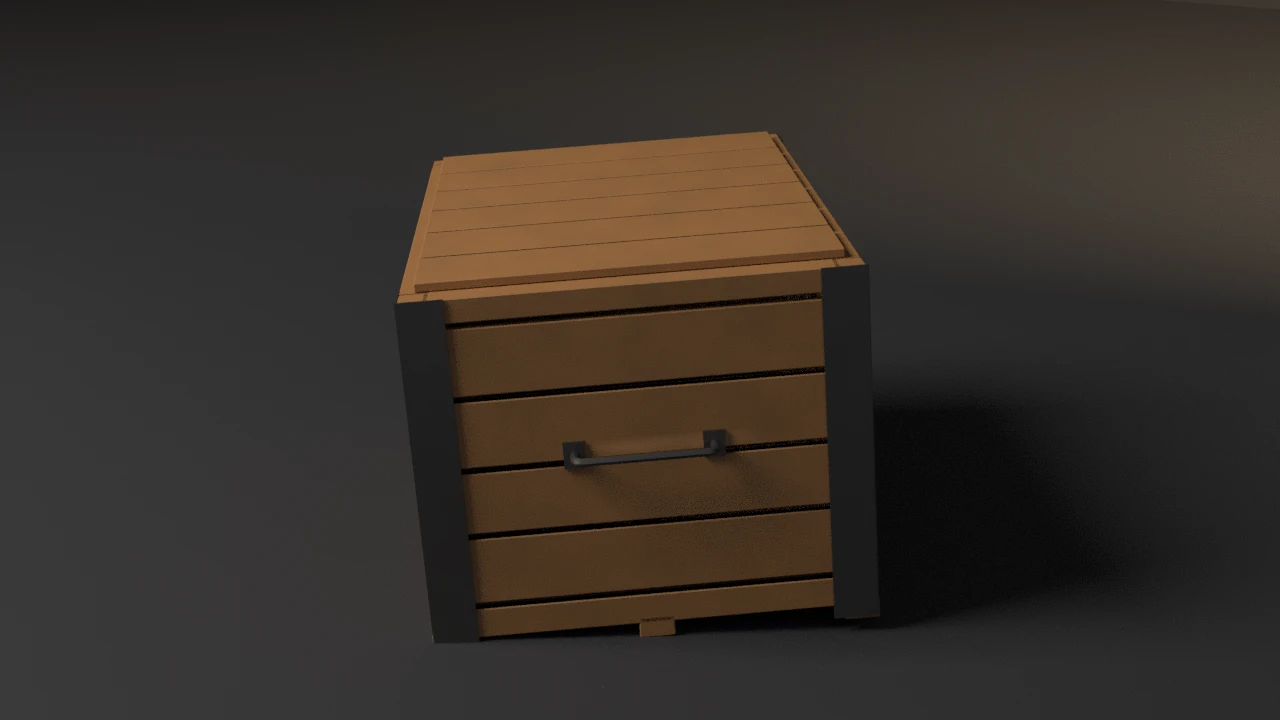
shipping-crate
A procedural shipping crate through UVs, bake, LOD, collider, and Unity glTF, asserting recomputed budgets rather than an API contract.
A procedural roadworks set on a cut-out patch of asphalt — a broken-edged asphalt slab with a worn white road line and two sealed tar cracks; seven 720 mm PVC traffic cones, each a hollow lathed body with a moulded bead and a rolled lip round an open tip, bonded into a square rubber base with chamfered corners, a raked top, a collar, four moulded lugs and a recess underneath, and hooped with 4 in and 6 in retroreflective collars; three standing in a taper line, three nested in a stack whose wall thickness sets the nesting pitch, and one knocked over onto the edge of its base and the lip of its tip, its roll solved so both touch; a folding A-frame barricade of four square steel legs hinged in pairs on pivot bolts, spread by pinned straps on spacers, each foot in a rubber pad, carrying two boards on each face split on 45-degree lines into orange and white retroreflective stripes and bolted to the legs; and a warning lamp with amber fresnel lenses on a bracket bolted to the top board — through UVs, bake, LOD, collider, and Unity glTF, asserting recomputed budgets rather than an API contract.
Rendered headless by the showcase piece itself — click to zoom.
category Vehicles
blender --background --python showcase/traffic-cones/traffic_cones.py --
A showcase piece, not an example, and the seventh in the vehicles category: things that direct movement. It builds a roadworks set standing on a cut-out patch of asphalt:
Everything that stands on the patch bears 1.5 mm into it: every base, the fallen cone's base and body, and the barricade's pads. Boards bear 1.5 mm into the legs they are bolted to; collars bear 0.6 mm into their bodies and stand 1.4 mm proud of them.
The stack is the piece's own invariant. A cone's wall is thick enough, for the slope of its body, that the next cone down seats on it one nesting pitch lower: WALL_H = BODY_SLOPE × STACK_PITCH + NEST_BITE. So each upper cone's inner wall bears 1 mm on the lower cone's outer wall along the whole overlap, and the bases hang 36 mm apart with the lower collar inside the upper recess (6 mm clear above it, 16 mm around it).
It asserts budget conformance of the generated result. It does not witness an API contract. "It rendered without error" is not a check.
Composes skills mesh-editing-and-bmesh, bake-high-to-low, depsgraph-and-evaluated-data, engine-export-presets, and snippets bake_normal_high_to_low.py, setup_bake_target_image.py, lod_chain.py / decimate_to_budget.py, convex_hull_collider.py, export_preset_unity.py (helpers copied inline, not imported).
Intended size: the patch is 3.04 × 2.04 m with its jittered edge; the lamp housing sets the top at 1.335 m. A cone is 0.720 m tall on a base 0.356 m across the flats; the barricade's hinges stand 1.0 m over the slab. The origin is under the patch centre at the slab's underside.
Every budget is declared as a named constant. Every gate recomputes its value from the mesh, materials, UVs, evaluated LOD, collider, or export file.
| Axis | Declared | Measured (5.2.1) |
|---|---|---|
| Base triangles | 45300–46400 | 45816 |
| LOD1 ratio | 0.32–0.62 of base | 0.5000 |
| LOD2 ratio | 0.10–0.35 of base | 0.2200 |
| Materials | exactly 11 distinct; ≥5560 cone PVC, ≥3760 reflective, ≥7440 rubber, ≥540 asphalt, ≥50 road paint, ≥450 tar, ≥58 orange sheeting, ≥350 board plastic, ≥2670 steel, ≥660 black plastic, ≥640 lens faces | 11 slots; 6048 / 4088 / 8096 / 596 / 56 / 496 / 64 / 384 / 2912 / 720 / 696 |
| UVs | in 0..1, AABB overlap ≤ 1e-5 | in range, overlap 0 |
| Outer AABB | (3.0365, 2.0374, 1.3354) m ± 0.01, read off the vertices | (3.0365, 2.0374, 1.3354), zmin 0 |
| Collider tris | ≤ 540 | 493 |
| Export | written, size > 0, removed after measuring | 3335792 bytes |
Every falsifier leaves the triangle count at 45816 and the envelope at (3.0365, 2.0374, 1.3354): they move parts, never add or remove them.
DECIMATE COLLAPSE triangle counts are not identical across Blender series, so the LOD gate is a ratio band, not an exact count. Bake pixels are stochastic, so the bake gate is has_data plus operator FINISHED, not byte-identity. Construction uses no RNG; two default runs print identical measurements, and 4.5.11 and 5.1.2 print the same measurements as 5.2.1 (the export differs by 28 bytes).
Recomputed from the generated mesh, not asserted about the script.
| Axis | Declared | Measured |
|---|---|---|
| Non-manifold edges | 0 | 0 |
| Loose verts / edges | 0 / 0 | 0 / 0 |
| Doubles merged at 1e-5 | 0 | 0 |
| Zero-area faces | 0 | 0 |
| N-gons | 0 | 0 |
| Coplanar cross-shell face pairs (KD range 0.05 m, plane ε 1e-4) | 0 | 0 |
Grounded: zmin | within 1e-4 of 0 | 0.0000 |
| Supports: every standing base, the stack's bottom base, the fallen cone's base and body, and the four pads, each against the slab top read off the asphalt | 10 supports; sink 0.8–3.0 mm | 10; 1.5 mm each |
The first draft measured 205 coplanar pairs, none of them in a part:
| Axis | Declared | Measured |
|---|---|---|
| Boards into legs: each board's back face against the front face of each leg it is bolted to, both planes read off the faces and compared along the board's normal | 4 boards, 8 joints; bite 0.8–3.0 mm | 4, 8; 1.5 mm each |
| Collar seat: per collar, per angular segment, the innermost vertex against the host body's outer wall (a ray toward the axis along the vertex's own radial), and the outermost vertex's stand-off | 14 collars, each on a host; seat 0.2–1.5 mm; proud ≥ 1.0 mm | 14; 0.600 mm; 1.400 mm |
| Plumb and size: each upright body's bottom-slab against top-slab centroid; its top over its base's bottom; the base's width across the flats (support function about the axis) | 6 upright cones; tilt ≤ 0.2°; 0.720 m and 0.356 m ± 3 mm | 6; 0.0000°; 0.720; 0.356 |
| Mirror: the barricade's four legs paired across the boards' centre, extents compared | 4 legs; ≤ 1 mm | 4; 0.0001 mm |
| Nesting: coaxial upright bodies form stacks; per pair, the pitch between body bottoms and, by rays at 40 mm stations and 16 angles along the overlap, the lower's outer wall less the upper's inner wall | 1 stack of 3; pitch 0.030–0.042 m; bite 0.4–2.0 mm | 1 of 3; 0.036, 0.036; 0.847–0.949 and 1.034–1.105 mm |
| One connected assembly (union of shells whose BVH trees overlap) | 1 component | 1 (125 shells) |
The nesting bite varies round each pair because the stacked cones are yawed differently, so a lower facet meets an upper facet off its middle; the chord sag of a 48-segment body is 0.29 mm at the bottom.
Each falsifier violates one named budget. Every one was run on 5.2.1 and 4.5.11 and exited its declared code, with the triangle count and envelope unchanged and every budget checked before the target green.
| Flag | Budget violated | Exit |
|---|---|---|
--skip-decimate | LOD1 ratio band (measured 1.0000) | 9 |
--stray-vert | loose vertex count is 0 (measured 1, placed inside the envelope) | 15 |
--lift-z | bounding box zmin is 0 (measured 0.05000) | 16 |
--float-cone | every support bedded in the slab (the right-hand standing cone lifted 4 mm: sink −2.5 mm, the rest 1.5 mm) | 16 |
--gap-board | boards bite their legs (the lower front board 3 mm off its legs: −1.5 mm at both) | 17 |
--float-band | collar seat (the left cone's 6 in collar 2 mm out: seat −1.4 mm) | 18 |
--lean-cone | plumb (the middle standing cone's body tipped 1.5° in its base: tilt 1.431°) | 19 |
--skew-leg | leg mirror symmetry (the right front leg 2.5 mm toward the centre: 2.500 mm) | 19 |
--loose-stack | nesting (the top cone lifted 10 mm: pitch 0.046, bite −0.576 to −0.505 mm) | 20 |
--loose-lamp | one connected assembly (the lamp 3 mm off its board: 2 components, 9 and 116 shells) | 21 |
--float-cone lifts a whole cone while the slab still grounds the box. --lean-cone tips the body and its collars about the collar top and leaves the base flat, so the supports hold; its measured tilt is a little under 1.5° because the slabs it compares are cut level through a leaning body. --skew-leg moves the front leg inward, into the 3 mm gap its washer fills, so it stays clear of its strap and its board's bite is unchanged. --loose-stack first lifted the top cone 12 mm, which put its base bottom on the middle cone's collar-top plane and exited 15 on 192 coplanar pairs; 10 mm keeps every horizontal plane of the two cones at least 2 mm apart. --loose-lamp pulls the lamp level off the board rather than along the board's normal, which had lifted the envelope's top 0.8 mm.
blender --background --python traffic_cones.py --
blender --background --python traffic_cones.py -- --skip-decimate
blender --background --python traffic_cones.py -- --stray-vert
blender --background --python traffic_cones.py -- --lift-z
blender --background --python traffic_cones.py -- --float-cone
blender --background --python traffic_cones.py -- --gap-board
blender --background --python traffic_cones.py -- --float-band
blender --background --python traffic_cones.py -- --lean-cone
blender --background --python traffic_cones.py -- --skew-leg
blender --background --python traffic_cones.py -- --loose-stack
blender --background --python traffic_cones.py -- --loose-lamp
blender --background --python traffic_cones.py -- --output cones.png
Smoke passes no flags.
The hero looks from the front left and above, so the taper line of cones reads in front of the barricade, the stack's three bases show at the left and the fallen cone's open base and recess face the lens. The wall stands 6 m behind the patch, and the warm wedge pools on it to the right. Default stage; no deviation.
The cone bodies, bases, lens, housing and every lathe are smooth-shaded; chamfers, the patch's rims and every material boundary stay crisp through sharp edges above 35°. The stripes are cut into the board's own faces, so their boundaries are hard edges on a flat face and cannot z-fight. Every cone, board and leg carries a PartTone face attribute that the shaders read to move each part between two tones, so no two cones are the same orange. Grime rises from the slab on every part; scuffs are sparse and small. The cone PVC and its collars also carry level rub marks, black on the orange and grey on the sheeting: a noise squashed sixteen-fold in height, so each mark runs round the cone like a tyre or boot rub rather than up it. The steel is galvanised, grey and rough, with a studio reflection term so it does not read as plastic on a dark stage.
File-local. 9 is a valid check code. 10 is reserved for gallery_framing.check_framing on the --output path. 15–19 are the hygiene and joint-fit family. 20 and 21 are file-local. 22 is the asset-quality floor on the render path: check_asset_quality returns 11, which this piece already spends on the collider ceiling, so the call site remaps it.
| Code | Meaning |
|---|---|
| 0 | Success |
| 1 | Uncaught exception (FATAL wrapper) |
| 2 | argparse / usage |
| 3 | Mesh did not build / no UV layer |
| 4 | Base triangle count outside range |
| 5 | Material count ≠ 11 distinct slots, or a face-count floor missed |
| 6 | UVs outside 0..1 |
| 7 | UV AABB overlap above tolerance |
| 8 | World AABB off declared outer size |
| 9 | LOD ratio band (--skip-decimate lands here) |
| 10 | Framing gate (render path only) |
| 11 | Collider triangle count above ceiling |
| 12 | Bake did not finish or image has no data |
| 13 | Export file missing or empty |
| 14 | --output produced no file |
| 15 | Mesh hygiene: loose, non-manifold, zero-area, doubles, n-gons, coplanar cross-shell pairs |
| 16 | Not grounded: bounding box zmin off 0, or a support outside its sink band, or not 10 supports (--lift-z, --float-cone) |
| 17 | A board's bite into a leg outside its band, or not 4 boards and 8 joints (--gap-board) |
| 18 | A collar's seat or stand-off outside its band, or a collar with no host, or not 14 collars (--float-band) |
| 19 | A cone not plumb, its height or base width off, or the legs not mirror-symmetric, or not 6 upright cones and 4 legs (--lean-cone, --skew-leg) |
| 20 | Nesting: not one stack of 3, or a pitch or wall bite outside its band (--loose-stack) |
| 21 | Assembly splits into more than one connected component (--loose-lamp) |
| 22 | Asset-quality floor (render path only; remapped from 11) |
"""Game-ready traffic cone and barrier set — a showcase piece, not an example. Asserts budget conformance of a procedural roadworks set after composing shipped pipeline pieces: bmesh construction, UVs, eleven materials, high-to-low normal bake, LOD chain, convex collider, Unity glTF export. A patch of asphalt, broken at its edges, carries a worn white road line and two sealed cracks. On it stand three 720 mm PVC traffic cones in a taper line, a stack of three cones nested one inside the next, and a fourth cone knocked over onto its side. Every cone is a moulded body (a hollow frustum with a bead above the collar and a rolled lip round an open tip) bonded into a square rubber base with chamfered corners, a raked top, a collar, four moulded lugs and a recess underneath, and two retroreflective collar bands. Behind them stands a folding A-frame barricade: four square steel legs hinged in pairs on pivot bolts, spread by straps on spacer pins, each foot in a rubber pad; two striped boards on each face, bolted to the legs; and a warning lamp on a bracket at one end of the top board. Budgets are declared below and recomputed from the generated result. They are not API-contract witnesses. Each falsifier violates one named budget: ``--skip-decimate`` the LOD-ratio band, ``--stray-vert`` mesh hygiene, ``--lift-z`` grounded zmin, ``--float-cone`` every support bedded on the slab, ``--gap-board`` the boards' bite into the legs, ``--float-band`` the collar bands' seat, ``--lean-cone`` and ``--skew-leg`` plumb, size and mirror symmetry, ``--loose-stack`` the nesting of the stack, ``--loose-lamp`` one connected assembly. No RNG. Construction is closed-form. DECIMATE COLLAPSE triangle counts are not byte-identical across Blender versions — the LOD gate is a ratio band, not an exact count. blender --background --python traffic_cones.py -- blender --background --python traffic_cones.py -- --skip-decimate blender --background --python traffic_cones.py -- --output cones.png """ import argparse import math import os import sys import tempfile import traceback import bmesh import bpy import numpy as np from mathutils import Matrix, Vector from mathutils.bvhtree import BVHTree from mathutils.kdtree import KDTree # Showcase lives at repo-root/showcase/, not under examples/. The framing # helper is the repo's only shared import and lives next to the examples; # resolve the repo root so we do not move gallery_framing.py. _REPO = os.path.abspath( os.path.join(os.path.dirname(os.path.abspath(__file__)), os.pardir, os.pardir) ) sys.path.insert(0, os.path.join(_REPO, "examples")) sys.dont_write_bytecode = True import gallery_framing # noqa: E402 import gallery_asset_quality # noqa: E402 # --- Asphalt patch ------------------------------------------------------------ SLAB_T = 0.060 SLAB_HX = 1.50 SLAB_HY = 1.00 SLAB_CORNER = 0.16 SLAB_PERIM = 120 SLAB_JITTER = 0.024 # broken edge, closed-form SLAB_TOP_CH = 0.010 SLAB_BOT_CH = 0.004 SEAT = 0.0015 # every support bears this far into the slab LINE_Y = -0.84 # worn white road line LINE_HALF_W = 0.050 LINE_END_CLEAR = 0.030 PAINT_TOP = 0.0010 PAINT_SINK = 0.0020 TAR_HALF_W = 0.011 # sealed cracks TAR_TOP = 0.0008 TAR_SINK = 0.0024 # --- Cone (local frame: base bottom at z=0, axis +Z) -------------------------- CONE_H = 0.720 # 28 in cone BASE_HALF = 0.178 # 14 in square base BASE_CUT = 0.046 # chamfered corners BASE_EDGE_T = 0.022 BASE_CH = 0.004 BASE_TOP_R = 0.165 # raked top meets the collar here BASE_TOP_Z = 0.028 COLLAR_R = 0.150 COLLAR_Z = 0.044 COLLAR_TOP = 0.048 RECESS_R = 0.166 # moulded recess under the base: takes the collar below RECESS_H = 0.018 BODY_BITE = 0.0015 # base hole bonded this far inside the body's wall BODY_Z0 = 0.024 BODY_R0 = 0.137 # body outer radius at the collar top BODY_R1 = 0.032 # ... at the top of the straight wall BODY_TOP = 0.700 BODY_SLOPE = (BODY_R0 - BODY_R1) / (BODY_TOP - COLLAR_TOP) STACK_PITCH = 0.036 # nesting pitch: set by the wall, not by the bases NEST_BITE = 0.0010 # an upper cone's inner wall bears this far on the lower's outer wall WALL_H = BODY_SLOPE * STACK_PITCH + NEST_BITE BEAD = 0.0015 LIP = 0.0025 BODY_SEGS = 48 BAND_Z = ((0.326, 0.428), (0.479, 0.631)) # 4 in and 6 in collars BAND_T = 0.0014 BAND_CH = 0.0006 BAND_BITE = 0.0006 LUG_RHO = 0.190 LUG_R = 0.016 STANDING = ((-0.74, -0.30, 12.0), (-0.12, -0.50, -7.0), (1.02, 0.34, 21.0)) STACK_XY = (-1.06, 0.44) STACK_YAW = (3.1, -8.7, 14.9) # never a multiple of the base's angle step apart TIPPED_XY = (0.52, -0.46) # base centre in plan TIPPED_YAW = 126.87 # tip toward the back right: its base faces the lens CONE_TONES = (0.15, 0.85, 0.45, 0.30, 0.65, 0.95, 0.05) # --- Barricade --------------------------------------------------------------- BAR_X = 0.10 BAR_Y = 0.46 LEG_X = 0.520 # hinge stations at BAR_X +- LEG_X LEG_SPLIT = 0.0175 # leg centres off the hinge station: 3 mm between the pair LEG_HALF = 0.016 # 32 mm square tube LEG_RC = 0.003 HINGE_Z = 1.000 FOOT_Y = 0.300 LEG_OVER = 0.045 PAD_HX = 0.042 PAD_HY = 0.078 PAD_T = 0.016 LEG_IN_PAD = 0.007 BOARD_L = 1.240 BOARD_H = 0.200 BOARD_T = 0.018 BOARD_RC = 0.004 BOARD_Z = (0.800, 0.500) # board centres, height above the slab, on the leg BOARD_BITE = 0.0015 STRIPE_W = 0.100 STRIPE_PHASE = 0.0371 BOLT_V = 0.060 BOLT_SINK = 0.0008 STRAP_Z = 0.300 STRAP_W = 0.028 STRAP_T = 0.004 STRAP_GAP = 0.004 # lamp on a bracket at the left end of the top front board LAMP_DX = 0.105 BR_T = 0.005 BR_HALF_W = 0.020 BR_BITE = 0.0008 BOX_H = 0.120 HOUSING_R = 0.098 # --- Falsifier sizes --------------------------------------------------------- FLOAT_CONE = 0.004 # --float-cone: standing cone 2 GAP_BOARD = 0.003 # --gap-board: lower front board FLOAT_BAND = 0.002 # --float-band: cone 0's upper band LEAN_DEG = 1.5 # --lean-cone: cone 1's body in its base SKEW_LEG = 0.0025 # --skew-leg: right front leg toward the centre LOOSE_STACK = 0.010 # --loose-stack: the top cone of the stack (12 mm put its # base bottom on the middle cone's collar-top plane) LOOSE_LAMP = 0.003 # --loose-lamp: lamp off its board BBOX_TOL = 0.01 # Fitted after locking geometry. Recomputed from the vertices. OUTER_SIZE = (3.0365, 2.0374, 1.3354) BASE_TRIS_MIN = 45300 BASE_TRIS_MAX = 46400 LOD1_RATIO_MIN = 0.32 LOD1_RATIO_MAX = 0.62 LOD2_RATIO_MIN = 0.10 LOD2_RATIO_MAX = 0.35 LOD1_TARGET = 0.50 LOD2_TARGET = 0.22 MATERIAL_COUNT = 11 UV_EPS = 1e-4 UV_OVERLAP_MAX = 1e-5 COLLIDER_TRIS_MAX = 540 BAKE_RES = 1024 CAGE_EXTRUSION = 0.01 ZMIN_EPS = 1e-4 DOUBLES_EPS = 1e-5 AREA_EPS = 1e-10 COPLANAR_NORMAL_EPS = 1e-4 COPLANAR_PLANE_EPS = 1e-4 COPLANAR_CENTRE_MAX = 0.05 LIFT_Z = 0.05 # Supports: every standing base, the stack's bottom base, the fallen cone's # base and body, and the four barricade pads bear into the slab in a band. SUPPORT_COUNT = 10 SINK_MIN = 0.0008 SINK_MAX = 0.0030 # Boards bite the legs they are bolted to. BOARD_COUNT = 4 BOARD_LEG_JOINTS = 8 BOARD_BITE_MIN = 0.0008 BOARD_BITE_MAX = 0.0030 # Collar bands: inner face seated into the body, outer face proud of it. BANDS = 14 BAND_SEAT_MIN = 0.0002 BAND_SEAT_MAX = 0.0015 BAND_PROUD_MIN = 0.0010 # Plumb and real-world size; the barricade's legs mirror about its centre. PLUMB_CONES = 6 PLUMB_MAX_DEG = 0.2 CONE_H_TOL = 0.003 BASE_W = 2.0 * BASE_HALF BASE_W_TOL = 0.003 LEGS = 4 MIRROR_EPS = 0.001 # Nesting: one stack of three, each on the one below at the nesting pitch. STACK_N = 3 PITCH_MIN = 0.030 PITCH_MAX = 0.042 NEST_MIN = 0.0004 NEST_MAX = 0.0020 HERO_YAW_DEG = 0.0 CAM_VIEW = (-0.42, -0.91) CAM_DIST = 5.9 CAM_LENS = 50.0 CAM_LIFT = 2.7 AIM_OFFSET = (0.0, 0.0, -0.32) WALL_Y = 6.0 CONE_IDX = 0 REFLECT_IDX = 1 RUBBER_IDX = 2 ASPHALT_IDX = 3 PAINT_IDX = 4 TAR_IDX = 5 SHEETING_IDX = 6 BOARD_IDX = 7 STEEL_IDX = 8 PLASTIC_IDX = 9 LENS_IDX = 10 FACE_FLOORS = { CONE_IDX: 5560, REFLECT_IDX: 3760, RUBBER_IDX: 7440, ASPHALT_IDX: 540, PAINT_IDX: 50, TAR_IDX: 450, SHEETING_IDX: 58, BOARD_IDX: 350, STEEL_IDX: 2670, PLASTIC_IDX: 660, LENS_IDX: 640, } MAT_LABELS = ("cone PVC", "reflective", "rubber", "asphalt", "road paint", "tar", "sheeting", "board", "steel", "plastic", "lens") X = Vector((1.0, 0.0, 0.0)) Y = Vector((0.0, 1.0, 0.0)) Z = Vector((0.0, 0.0, 1.0)) TONE = "PartTone" def eevee_engine_id(): return "BLENDER_EEVEE" if bpy.app.version >= (5, 0, 0) else "BLENDER_EEVEE_NEXT" def fail(msg, code): print(f"ERROR: {msg}", file=sys.stderr) return code def triangle_count(mesh): mesh.calc_loop_triangles() return len(mesh.loop_triangles) def evaluated_triangle_count(obj): # Duplicated from snippets/lod_chain.py / decimate_to_budget.py (not a package). depsgraph = bpy.context.evaluated_depsgraph_get() eval_obj = obj.evaluated_get(depsgraph) eval_mesh = eval_obj.to_mesh() try: eval_mesh.calc_loop_triangles() return len(eval_mesh.loop_triangles) finally: eval_obj.to_mesh_clear() # -------------------------------------------------------------------------- # Construction helpers # -------------------------------------------------------------------------- def _mark(faces, mat_idx): for f in faces: f.material_index = mat_idx return faces def _tone(bm, faces, t): layer = bm.faces.layers.float.get(TONE) for f in faces: f[layer] = t def faces_of(verts): return {f for v in verts for f in v.link_faces} def frame(ez, ex_hint): """Rotation whose local Z is ``ez`` and local X is ``ex_hint`` made orthogonal to it (columns ex, ey, ez).""" ez = Vector(ez).normalized() ex = Vector(ex_hint) ex = (ex - ez * ex.dot(ez)).normalized() ey = ez.cross(ex) return Matrix((ex, ey, ez)).transposed() def m4(rot3, loc): m = rot3.to_4x4() m.translation = Vector(loc) return m def add_lathe(bm, profile, segs, mat_idx, center=(0.0, 0.0, 0.0), rot=None, phase=0.0, solid=False): """Revolve a profile [(r, z), ...] about local Z. ``solid``: an open polyline closed by n-gon caps; otherwise a closed polygon revolved into a ring shell.""" c = Vector(center) m = rot if rot is not None else Matrix.Identity(3) rings = [] for i in range(segs): a = phase + 2.0 * math.pi * i / segs ca, sa = math.cos(a), math.sin(a) rings.append([bm.verts.new(c + m @ Vector((r * ca, r * sa, z))) for r, z in profile]) n = len(profile) last = n - 1 if solid else n faces = [] for i in range(segs): r0, r1 = rings[i], rings[(i + 1) % segs] for j in range(last): k = (j + 1) % n faces.append(bm.faces.new((r0[j], r1[j], r1[k], r0[k]))) if solid: faces.append(bm.faces.new([rings[i][0] for i in reversed(range(segs))])) faces.append(bm.faces.new([rings[i][n - 1] for i in range(segs)])) _mark(faces, mat_idx) return [v for ring in rings for v in ring] def revolve(bm, profile, segs, mat_idx, M, phase=0.0): """Closed (r, z) polygon revolved about local Z, placed by the 4x4 ``M``.""" rings = [] for i in range(segs): a = phase + 2.0 * math.pi * i / segs ca, sa = math.cos(a), math.sin(a) rings.append([bm.verts.new(M @ Vector((r * ca, r * sa, z))) for r, z in profile]) n = len(profile) faces = [] for i in range(segs): r0, r1 = rings[i], rings[(i + 1) % segs] for j in range(n): k = (j + 1) % n faces.append(bm.faces.new((r0[j], r1[j], r1[k], r0[k]))) return _mark(faces, mat_idx) def loft_loops(bm, loops, mat_idx, M): """Closed loops of equal length joined in a closed ring of loops (a torus).""" vs = [[bm.verts.new(M @ Vector(p)) for p in loop] for loop in loops] n, k = len(vs), len(vs[0]) faces = [] for j in range(n): a, b = vs[j], vs[(j + 1) % n] for i in range(k): i2 = (i + 1) % k faces.append(bm.faces.new((a[i], a[i2], b[i2], b[i]))) return _mark(faces, mat_idx) def rrect(ha, hb, rc, n_corner=4): """Rounded rectangle loop (counter-clockwise).""" rc = max(min(rc, ha - 1e-4, hb - 1e-4), 0.0006) pts = [] for k, (sx, sy) in enumerate(((1, 1), (-1, 1), (-1, -1), (1, -1))): cx, cy = sx * (ha - rc), sy * (hb - rc) a0 = 0.5 * math.pi * k for s in range(n_corner + 1): a = a0 + 0.5 * math.pi * s / n_corner pts.append((cx + rc * math.cos(a), cy + rc * math.sin(a))) return pts def add_rbox(bm, ha, hb, rc, profile, origin, rot, mat_idx, n_corner=4): """Loft of rounded rectangles along local Z: profile [(inset, z)], each loop inset from (ha, hb, rc); n-gon caps at both ends.""" o = Vector(origin) rings = [] for inset, z in profile: loop = rrect(ha - inset, hb - inset, rc - inset, n_corner) rings.append([bm.verts.new(o + rot @ Vector((x, y, z))) for x, y in loop]) n = len(rings[0]) faces = [] for r0, r1 in zip(rings, rings[1:]): for k in range(n): m = (k + 1) % n faces.append(bm.faces.new((r0[k], r0[m], r1[m], r1[k]))) faces.append(bm.faces.new(tuple(reversed(rings[0])))) faces.append(bm.faces.new(tuple(rings[-1]))) _mark(faces, mat_idx) return [v for ring in rings for v in ring] def add_prism(bm, outline, w0, w1, origin, rot, mat_idx): """Planar outline [(u, v)] extruded along local Z from w0 to w1.""" o = Vector(origin) a = [bm.verts.new(o + rot @ Vector((u, v, w0))) for u, v in outline] b = [bm.verts.new(o + rot @ Vector((u, v, w1))) for u, v in outline] n = len(outline) faces = [bm.faces.new((a[i], a[(i + 1) % n], b[(i + 1) % n], b[i])) for i in range(n)] faces.append(bm.faces.new(tuple(reversed(a)))) faces.append(bm.faces.new(tuple(b))) _mark(faces, mat_idx) return a + b def fillet_path(pts, rf, steps=4): pts = [Vector(p) for p in pts] out = [pts[0]] for i in range(1, len(pts) - 1): a, p, b = pts[i - 1], pts[i], pts[i + 1] r = min(rf, (a - p).length * 0.45, (b - p).length * 0.45) p0 = p + (a - p).normalized() * r p1 = p + (b - p).normalized() * r for k in range(steps + 1): t = k / steps out.append((1 - t) ** 2 * p0 + 2 * (1 - t) * t * p + t * t * p1) out.append(pts[-1]) return out def add_bar(bm, pts, wax, half_w, half_t, rc, mat_idx, fillet=0.008): """Flat bar bent in the plane normal to ``wax``: its width lies along ``wax``, its thickness in the bending plane; rounded-rectangle section.""" pts = fillet_path(pts, fillet) wax = Vector(wax).normalized() sec = rrect(half_w, half_t, rc, 2) rings = [] for i, p in enumerate(pts): a = pts[max(i - 1, 0)] b = pts[min(i + 1, len(pts) - 1)] t = (b - a).normalized() w = (wax - t * wax.dot(t)).normalized() th = t.cross(w) rings.append([bm.verts.new(p + w * x + th * y) for x, y in sec]) n = len(sec) faces = [] for r0, r1 in zip(rings, rings[1:]): for k in range(n): m = (k + 1) % n faces.append(bm.faces.new((r0[k], r0[m], r1[m], r1[k]))) faces.append(bm.faces.new(tuple(reversed(rings[0])))) faces.append(bm.faces.new(tuple(rings[-1]))) _mark(faces, mat_idx) return [v for ring in rings for v in ring] def add_ribbon(bm, pts2d, half_w, z0, z1, mat_idx): """A flat strip laid along a plan polyline: a six-point section with its top corners chamfered, swept with capped ends.""" pts = [Vector((x, y)) for x, y in pts2d] sec = [(-half_w, z0), (half_w, z0), (half_w, z1 - 0.0008), (half_w * 0.55, z1), (-half_w * 0.55, z1), (-half_w, z1 - 0.0008)] rings = [] for i, p in enumerate(pts): a = pts[max(i - 1, 0)] b = pts[min(i + 1, len(pts) - 1)] t = (b - a).normalized() nrm = Vector((-t.y, t.x)) rings.append([bm.verts.new((p.x + nrm.x * s, p.y + nrm.y * s, z)) for s, z in sec]) n = len(sec) faces = [] for r0, r1 in zip(rings, rings[1:]): for k in range(n): m = (k + 1) % n faces.append(bm.faces.new((r0[k], r0[m], r1[m], r1[k]))) faces.append(bm.faces.new(tuple(reversed(rings[0])))) faces.append(bm.faces.new(tuple(rings[-1]))) return _mark(faces, mat_idx) def hull2d(pts): """Convex hull, counter-clockwise (monotone chain).""" pts = sorted(set((round(x, 9), round(z, 9)) for x, z in pts)) def cross(o, a, b): return (a[0] - o[0]) * (b[1] - o[1]) - (a[1] - o[1]) * (b[0] - o[0]) lower, upper = [], [] for p in pts: while len(lower) >= 2 and cross(lower[-2], lower[-1], p) <= 1e-12: lower.pop() lower.append(p) for p in reversed(pts): while len(upper) >= 2 and cross(upper[-2], upper[-1], p) <= 1e-12: upper.pop() upper.append(p) return lower[:-1] + upper[:-1] def lug_outline(circles, n=16): pts = [] for u, v, r in circles: for k in range(n): a = 2.0 * math.pi * (k + 0.5) / n pts.append((u + r * math.cos(a), v + r * math.sin(a))) return hull2d(pts) def merge_bm(dst, src, M): """Copy every face of ``src`` into ``dst`` through the 4x4 ``M``, keeping material index and tone.""" sl = src.faces.layers.float.get(TONE) dl = dst.faces.layers.float.get(TONE) vmap = {v: dst.verts.new(M @ v.co) for v in src.verts} out = [] for f in src.faces: nf = dst.faces.new([vmap[v] for v in f.verts]) nf.material_index = f.material_index nf[dl] = f[sl] out.append(nf) return out def triangulate_ngons(bm): faces = [f for f in bm.faces if len(f.verts) > 4] if faces: bmesh.ops.triangulate(bm, faces=faces) def pack_uvs(bm, margin=0.08): uv = bm.loops.layers.uv.new("UVMap") faces = list(bm.faces) n = len(faces) cols = max(1, math.ceil(math.sqrt(n))) rows = max(1, math.ceil(n / cols)) cell_w = 1.0 / cols cell_h = 1.0 / rows pad_u = margin * cell_w * 0.5 pad_v = margin * cell_h * 0.5 usable_w = cell_w - 2.0 * pad_u usable_h = cell_h - 2.0 * pad_v for i, face in enumerate(faces): col = i % cols row = i // cols nrm = face.normal ax, ay, az = abs(nrm.x), abs(nrm.y), abs(nrm.z) coords = [] for loop in face.loops: co = loop.vert.co if az >= ax and az >= ay: coords.append((co.x, co.y)) elif ax >= ay: coords.append((co.y, co.z)) else: coords.append((co.x, co.z)) xs = [c[0] for c in coords] ys = [c[1] for c in coords] minx, maxx = min(xs), max(xs) miny, maxy = min(ys), max(ys) dx = max(maxx - minx, 1e-8) dy = max(maxy - miny, 1e-8) origin_u = col * cell_w + pad_u origin_v = row * cell_h + pad_v for loop, (x, y) in zip(face.loops, coords): loop[uv].uv = ( origin_u + (x - minx) / dx * usable_w, origin_v + (y - miny) / dy * usable_h, ) # -------------------------------------------------------------------------- # The asphalt patch # -------------------------------------------------------------------------- def slab_outline(): """Rounded rectangle resampled evenly and pushed along its normal by a closed-form jitter: the broken edge of a cut-out patch of road.""" loop = [Vector(p) for p in rrect(SLAB_HX, SLAB_HY, SLAB_CORNER, 10)] seg = [(loop[i], loop[(i + 1) % len(loop)]) for i in range(len(loop))] total = sum((b - a).length for a, b in seg) out = [] for k in range(SLAB_PERIM): target = total * k / SLAB_PERIM acc = 0.0 for a, b in seg: ln = (b - a).length if acc + ln >= target: out.append(a + (b - a) * ((target - acc) / ln)) break acc += ln pts = [] for k, p in enumerate(out): a = out[k - 1] b = out[(k + 1) % len(out)] t = (b - a).normalized() nrm = Vector((t.y, -t.x)) s = k / SLAB_PERIM j = SLAB_JITTER * (0.50 * math.sin(2 * math.pi * 3 * s + 0.4) + 0.30 * math.sin(2 * math.pi * 7 * s + 1.3) + 0.20 * math.sin(2 * math.pi * 19 * s + 2.1)) pts.append((p + nrm * j, nrm)) return pts def inset_ring(outline, inset): # the normal at each point is an average of neighbours; re-derive it so # the inset follows the jittered edge base = [p for p, _n in outline] out = [] for k, p in enumerate(base): t = (base[(k + 1) % len(base)] - base[k - 1]).normalized() nrm = Vector((t.y, -t.x)) out.append(p - nrm * inset) return out def slab_top_polygon(): return inset_ring(slab_outline(), SLAB_TOP_CH) def x_range_at(poly, y): xs = [] n = len(poly) for k in range(n): a, b = poly[k], poly[(k + 1) % n] if (a.y - y) * (b.y - y) < 0.0: t = (y - a.y) / (b.y - a.y) xs.append(a.x + (b.x - a.x) * t) return min(xs), max(xs) def build_slab(bm): outline = slab_outline() rings_2d = [(inset_ring(outline, SLAB_BOT_CH), 0.0), (inset_ring(outline, 0.0), SLAB_BOT_CH), (inset_ring(outline, 0.0), SLAB_T - SLAB_TOP_CH), (inset_ring(outline, SLAB_TOP_CH), SLAB_T)] rings = [[bm.verts.new((p.x, p.y, z)) for p in ring] for ring, z in rings_2d] n = len(rings[0]) faces = [] for r0, r1 in zip(rings, rings[1:]): for k in range(n): m = (k + 1) % n faces.append(bm.faces.new((r0[k], r0[m], r1[m], r1[k]))) faces.append(bm.faces.new(tuple(reversed(rings[0])))) faces.append(bm.faces.new(tuple(rings[-1]))) _mark(faces, ASPHALT_IDX) _tone(bm, faces, 0.5) # the road line runs to within a clearance of the patch's broken edge top = slab_top_polygon() lo0, hi0 = x_range_at(top, LINE_Y - LINE_HALF_W) lo1, hi1 = x_range_at(top, LINE_Y + LINE_HALF_W) x0 = max(lo0, lo1) + LINE_END_CLEAR x1 = min(hi0, hi1) - LINE_END_CLEAR line = [(x0 + (x1 - x0) * k / 8, LINE_Y) for k in range(9)] _tone(bm, add_ribbon(bm, line, LINE_HALF_W, SLAB_T - PAINT_SINK, SLAB_T + PAINT_TOP, PAINT_IDX), 0.5) # two sealed cracks, closed-form meanders crack_a = [] for k in range(41): t = k / 40 x = -1.28 + 1.10 * t y = -0.60 + 0.07 * math.sin(2.3 * x + 0.4) + 0.025 * math.sin(7.9 * x + 1.1) + 0.10 * t crack_a.append((x, y)) crack_b = [] for k in range(41): t = k / 40 crack_b.append((0.98 + 0.34 * t + 0.030 * math.sin(9.0 * t + 0.3), -0.66 + 0.30 * t + 0.022 * math.sin(13.0 * t + 1.7))) for path, tone in ((crack_a, 0.3), (crack_b, 0.7)): _tone(bm, add_ribbon(bm, path, TAR_HALF_W, SLAB_T - TAR_SINK, SLAB_T + TAR_TOP, TAR_IDX), tone) # -------------------------------------------------------------------------- # Traffic cone # -------------------------------------------------------------------------- def r_out(z): return BODY_R0 - BODY_SLOPE * (z - COLLAR_TOP) def r_in(z): return r_out(z) - WALL_H def base_angles(): """Uniform angles plus the eight corners of the chamfered square, so every square ring carries its corners exactly and every round ring follows.""" a, c = BASE_HALF, BASE_CUT t1 = math.atan2(a - c, a) corners = [] for q in range(4): corners += [t1 + q * 0.5 * math.pi, 0.5 * math.pi - t1 + q * 0.5 * math.pi] uni = [2.0 * math.pi * k / 56 for k in range(56)] keep = [u for u in uni if all(abs(((u - cc + math.pi) % (2 * math.pi)) - math.pi) > math.radians(2.0) for cc in corners)] return sorted(keep + corners) def sq_r(theta, a): c = BASE_CUT * a / BASE_HALF ca, sa = abs(math.cos(theta)), abs(math.sin(theta)) r = (2.0 * a - c) / (ca + sa) if ca > 1e-9: r = min(r, a / ca) if sa > 1e-9: r = min(r, a / sa) return r def base_loops(): angs = base_angles() def sq(a, z): return [(sq_r(t, a) * math.cos(t), sq_r(t, a) * math.sin(t), z) for t in angs] def circ(r, z): return [(r * math.cos(t), r * math.sin(t), z) for t in angs] return [ sq(BASE_HALF - BASE_CH, 0.0), sq(BASE_HALF, BASE_CH), sq(BASE_HALF, BASE_EDGE_T - BASE_CH), sq(BASE_HALF - BASE_CH, BASE_EDGE_T), circ(BASE_TOP_R, BASE_TOP_Z), circ(COLLAR_R, BASE_TOP_Z + 0.002), circ(COLLAR_R, COLLAR_Z), circ(COLLAR_R - 0.004, COLLAR_TOP), circ(r_out(COLLAR_TOP) - BODY_BITE, COLLAR_TOP), circ(r_out(RECESS_H) - BODY_BITE, RECESS_H), circ(RECESS_R, RECESS_H), circ(RECESS_R, 0.003), circ(RECESS_R + 0.003, 0.0), ] def base_top_z(theta, rho): """Height of the base's raked top at (theta, rho): linear between the square edge ring and the round ring at that angle.""" r3 = sq_r(theta, BASE_HALF - BASE_CH) t = (r3 - rho) / (r3 - BASE_TOP_R) return BASE_EDGE_T + t * (BASE_TOP_Z - BASE_EDGE_T) def body_profile(): pts = [(r_out(BODY_Z0), BODY_Z0), (r_out(0.064), 0.064), (r_out(0.069) + BEAD, 0.069), (r_out(0.080) + BEAD, 0.080), (r_out(0.085), 0.085)] for z0, z1 in BAND_Z: pts += [(r_out(z0), z0), (r_out(z1), z1)] pts += [(r_out(0.690), 0.690), (r_out(0.697) + LIP, 0.697), (r_out(0.709) + LIP, 0.709), (r_out(0.7165) + 0.0008, 0.7165), (r_out(CONE_H) - 0.0015, CONE_H), (r_in(CONE_H) + 0.0015, CONE_H), (r_in(0.716), 0.716), (r_in(0.700), 0.700), (r_in(BODY_Z0), BODY_Z0)] return pts def band_profile(z0, z1, extra=0.0): e = extra return [(r_out(z0) - BAND_BITE + e, z0), (r_out(z0) + BAND_T - BAND_CH + e, z0), (r_out(z0 + BAND_CH) + BAND_T + e, z0 + BAND_CH), (r_out(z1 - BAND_CH) + BAND_T + e, z1 - BAND_CH), (r_out(z1) + BAND_T - BAND_CH + e, z1), (r_out(z1) - BAND_BITE + e, z1)] def cone_bm(tone, lean_deg=0.0, float_band=0.0): """One cone in its local frame, in its own bmesh.""" cb = bmesh.new() layer = cb.faces.layers.float.new(TONE) ident = Matrix.Identity(4) loft_loops(cb, base_loops(), RUBBER_IDX, ident) # four moulded lugs on the raked top, one toward each corner for q in range(4): th = math.radians(45.0 + 90.0 * q) zc = base_top_z(th, LUG_RHO) prof = [(LUG_R, -0.003), (LUG_R, 0.002), (LUG_R - 0.004, 0.0048), (0.004, 0.0060)] add_lathe(cb, prof, 16, RUBBER_IDX, center=(LUG_RHO * math.cos(th), LUG_RHO * math.sin(th), zc), solid=True) lean = (Matrix.Translation((0.0, 0.0, COLLAR_TOP)) @ Matrix.Rotation(math.radians(lean_deg), 4, "X") @ Matrix.Translation((0.0, 0.0, -COLLAR_TOP))) revolve(cb, body_profile(), BODY_SEGS, CONE_IDX, lean) for bi, (z0, z1) in enumerate(BAND_Z): revolve(cb, band_profile(z0, z1, float_band if bi == 1 else 0.0), BODY_SEGS, REFLECT_IDX, lean) for f in cb.faces: f[layer] = tone return cb def tipped_matrix(cb): """The fallen cone lies on the edge of its base and the lip of its tip: solve the roll about local X at which both touch, then yaw and seat it.""" base = [v.co.copy() for v in cb.verts if any(f.material_index == RUBBER_IDX for f in v.link_faces)] lip = [v.co.copy() for v in cb.verts if v.co.z > 0.65 and any(f.material_index == CONE_IDX for f in v.link_faces)] def gap(phi): r = Matrix.Rotation(phi, 3, "X") return min((r @ p).z for p in base) - min((r @ p).z for p in lip) lo, hi = math.radians(90.0), math.radians(120.0) for _ in range(60): mid = 0.5 * (lo + hi) if gap(mid) < 0.0: lo = mid else: hi = mid phi = 0.5 * (lo + hi) rot = Matrix.Rotation(math.radians(TIPPED_YAW), 4, "Z") @ Matrix.Rotation(phi, 4, "X") zmin = min((rot @ v.co).z for v in cb.verts) return Matrix.Translation((TIPPED_XY[0], TIPPED_XY[1], SLAB_T - SEAT - zmin)) @ rot, phi def build_cones(bm, flags): k = 0 for i, (x, y, yaw) in enumerate(STANDING): cb = cone_bm(CONE_TONES[k], lean_deg=LEAN_DEG if (flags["lean_cone"] and i == 1) else 0.0, float_band=FLOAT_BAND if (flags["float_band"] and i == 0) else 0.0) lift = FLOAT_CONE if (flags["float_cone"] and i == 2) else 0.0 M = Matrix.Translation((x, y, SLAB_T - SEAT + lift)) @ Matrix.Rotation( math.radians(yaw), 4, "Z") merge_bm(bm, cb, M) cb.free() k += 1 for j, yaw in enumerate(STACK_YAW): cb = cone_bm(CONE_TONES[k]) lift = LOOSE_STACK if (flags["loose_stack"] and j == len(STACK_YAW) - 1) else 0.0 M = Matrix.Translation((STACK_XY[0], STACK_XY[1], SLAB_T - SEAT + j * STACK_PITCH + lift)) @ Matrix.Rotation( math.radians(yaw), 4, "Z") merge_bm(bm, cb, M) cb.free() k += 1 cb = cone_bm(CONE_TONES[k]) M, _phi = tipped_matrix(cb) merge_bm(bm, cb, M) cb.free() # -------------------------------------------------------------------------- # A-frame barricade # -------------------------------------------------------------------------- def leg_line(sgn, back, dx=0.0): """Foot-to-pivot line of one leg: (bottom end, top end, direction, outward face normal, pad centre).""" xs = BAR_X + sgn * LEG_X + (sgn * LEG_SPLIT if back else -sgn * LEG_SPLIT) + dx ys = 1.0 if back else -1.0 H = Vector((xs, BAR_Y, SLAB_T + HINGE_Z)) G = Vector((xs, BAR_Y + ys * FOOT_Y, SLAB_T)) d = (H - G).normalized() pad_top = SLAB_T - SEAT + PAD_T E = G + d * ((pad_top - LEG_IN_PAD - G.z) / d.z) T = H + d * LEG_OVER padc = G + d * ((pad_top - G.z) / d.z) n_out = X.cross(d) * (-1.0 if back else 1.0) return E, T, d, n_out, padc def leg_y(back, z): ys = 1.0 if back else -1.0 return BAR_Y + ys * FOOT_Y * (1.0 - (z - SLAB_T) / HINGE_Z) def board_bm(n_corner, tone): """A striped board in its own frame (u along its length, v up the leg, w through it), its faces split on 45-degree lines into orange and white.""" bb = bmesh.new() layer = bb.faces.layers.float.new(TONE) L, H, T = BOARD_L, BOARD_H, BOARD_T ch = 0.003 rings = [] for inset, u in ((ch, -L / 2), (0.0, -L / 2 + ch), (0.0, L / 2 - ch), (ch, L / 2)): loop = rrect(H / 2 - inset, T / 2 - inset, BOARD_RC - inset, n_corner) rings.append([bb.verts.new((u, v, w)) for v, w in loop]) n = len(rings[0]) for r0, r1 in zip(rings, rings[1:]): for k in range(n): m = (k + 1) % n bb.faces.new((r0[k], r0[m], r1[m], r1[k])) bb.faces.new(tuple(reversed(rings[0]))) bb.faces.new(tuple(rings[-1])) pitch = STRIPE_W * math.sqrt(2.0) no = Vector((1.0, 1.0, 0.0)).normalized() j0 = math.floor((-(L + H) / 2 - STRIPE_PHASE) / pitch) j1 = math.ceil(((L + H) / 2 - STRIPE_PHASE) / pitch) for j in range(j0, j1 + 1): c = STRIPE_PHASE + j * pitch geom = list(bb.verts) + list(bb.edges) + list(bb.faces) bmesh.ops.bisect_plane(bb, geom=geom, plane_co=(c, 0.0, 0.0), plane_no=no) bb.normal_update() for f in bb.faces: if abs(f.normal.z) > 0.95: s = sum(v.co.x + v.co.y for v in f.verts) / len(f.verts) k = math.floor((s - STRIPE_PHASE) / pitch) f.material_index = SHEETING_IDX if k % 2 == 0 else REFLECT_IDX else: f.material_index = BOARD_IDX f[layer] = tone return bb def add_dome(bm, center, axis, mat_idx, r=0.012, h=0.0062, segs=16): prof = [(r, -BOLT_SINK), (r, 0.0012), (r * 0.86, 0.0034), (r * 0.55, 0.0052), (r * 0.18, h)] return add_lathe(bm, prof, segs, mat_idx, center=center, rot=frame(axis, X if abs( Vector(axis).x) < 0.9 else Y), solid=True) def add_hex(bm, center, axis, a, b, r, mat_idx): prof = [(r, a), (r, b - 0.001), (r * 0.82, b)] return add_lathe(bm, prof, 6, mat_idx, center=center, rot=frame(axis, Y), phase=math.pi / 6, solid=True) def add_rod(bm, center, axis, a, b, r, mat_idx, segs=12): return add_lathe(bm, [(r, a), (r, b)], segs, mat_idx, center=center, rot=frame(axis, Y), solid=True) def build_barrier(bm, n_corner, bevel_verts, flags): parts = [] # (faces, tone) def keep(verts, tone): parts.append((faces_of(verts), tone)) for sgn in (-1.0, 1.0): for back in (False, True): dx = (-sgn * SKEW_LEG) if (flags["skew_leg"] and sgn > 0 and not back) else 0.0 E, T, d, n_out, padc = leg_line(sgn, back, dx) rot = frame(d, X) ln = (T - E).length keep(add_rbox(bm, LEG_HALF, LEG_HALF, LEG_RC, [(0.0015, 0.0), (0.0, 0.0015), (0.0, ln - 0.0015), (0.0015, ln)], E, rot, STEEL_IDX, n_corner), 0.4 + 0.1 * sgn + (0.1 if back else 0.0)) keep(add_rbox(bm, LEG_HALF + 0.0016, LEG_HALF + 0.0016, 0.0045, [(0.0, 0.0), (0.0, 0.011), (0.003, 0.0145), (0.0075, 0.0165)], T - d * 0.012, rot, PLASTIC_IDX, n_corner), 0.5) # the pad stays under the design foot; --skew-leg moves the leg alone _E, _T, _d, _n, padc0 = leg_line(sgn, back) keep(add_rbox(bm, PAD_HX, PAD_HY, 0.012, [(0.003, 0.0), (0.0, 0.003), (0.0, PAD_T - 0.004), (0.004, PAD_T)], (padc0.x, padc0.y, SLAB_T - SEAT), Matrix.Identity(3), RUBBER_IDX, n_corner), 0.4 if back else 0.6) # hinge: washer between the pair, a pivot bolt with a head outside and a nut inside xst = BAR_X + sgn * LEG_X ph = Vector((xst, BAR_Y, SLAB_T + HINGE_Z)) ax = X * sgn reach = LEG_SPLIT + LEG_HALF keep(add_lathe(bm, [(0.0125, -0.002), (0.0125, 0.002)], 20, STEEL_IDX, center=ph, rot=frame(ax, Y), solid=True), 0.5) keep(add_rod(bm, ph, ax, -(reach + 0.0068), reach + 0.0066, 0.006, STEEL_IDX), 0.5) keep(add_hex(bm, ph, ax, reach - 0.0006, reach + 0.0072, 0.0115, STEEL_IDX), 0.5) keep(add_hex(bm, ph, -ax, reach - 0.0006, reach + 0.0072, 0.0105, STEEL_IDX), 0.5) # spreader strap on the inner side, pinned to the front leg and, through a # spacer, to the back leg zs = SLAB_T + STRAP_Z x_front = xst - sgn * LEG_SPLIT x_back = xst + sgn * LEG_SPLIT x_strap = x_front - sgn * (LEG_HALF + STRAP_GAP + STRAP_T / 2) yf, yb = leg_y(False, zs), leg_y(True, zs) outline = lug_outline([(yf, zs, STRAP_W / 2), (yb, zs, STRAP_W / 2)]) srot = Matrix(((0.0, 0.0, 1.0), (1.0, 0.0, 0.0), (0.0, 1.0, 0.0))) sv = add_prism(bm, outline, -STRAP_T / 2, STRAP_T / 2, (x_strap, 0.0, 0.0), srot, STEEL_IDX) bevel_verts.extend(sv) keep(sv, 0.5) x_in = x_strap - sgn * STRAP_T / 2 for yy, xl, spacer in ((yf, x_front, False), (yb, x_back, True)): p0 = Vector((x_in, yy, zs)) far = abs((xl + sgn * LEG_HALF) - x_in) keep(add_rod(bm, p0, ax, -0.003, far + 0.0052, 0.005, STEEL_IDX), 0.5) keep(add_dome(bm, p0, -ax, STEEL_IDX, r=0.0095, h=0.0046, segs=16), 0.5) keep(add_hex(bm, Vector((xl + sgn * LEG_HALF, yy, zs)), ax, -0.0006, 0.0040, 0.0085, STEEL_IDX), 0.5) if spacer: s0 = x_strap + sgn * (STRAP_T / 2 - 0.0005) s1 = x_back - sgn * (LEG_HALF - 0.0005) keep(add_rod(bm, Vector((s0, yy, zs)), ax, 0.0, abs(s1 - s0), 0.0085, STEEL_IDX, segs=16), 0.5) # boards: two on each face, bolted to the legs of that face lamp_board = None for back in (False, True): _E, _T, d, n_out, _p = leg_line(1.0, back) for bi, zb in enumerate(BOARD_Z): G = Vector((BAR_X, BAR_Y + (FOOT_Y if back else -FOOT_Y), SLAB_T)) A = G + d * ((SLAB_T + zb - G.z) / d.z) gap = GAP_BOARD if (flags["gap_board"] and not back and bi == 1) else 0.0 C = A + n_out * (LEG_HALF - BOARD_BITE + BOARD_T / 2 + gap) M = Matrix((X, d, n_out)).transposed().to_4x4() M.translation = C bb = board_bm(n_corner, 0.2 + 0.2 * bi + (0.4 if back else 0.0)) merge_bm(bm, bb, M) bb.free() ux = LEG_X + (LEG_SPLIT if back else -LEG_SPLIT) for su in (-1.0, 1.0): for sv_ in (-1.0, 1.0): p = C + X * (su * ux) + d * (sv_ * BOLT_V) + n_out * (BOARD_T / 2) keep(add_dome(bm, p, n_out, STEEL_IDX), 0.5) if not back and bi == 0: lamp_board = (C, d, n_out) # warning lamp: a bracket bolted to the top front board, a battery box, a # drum housing with a fresnel lens and bezel on each face C, d, n_out = lamp_board # --loose-lamp pulls the lamp level off the board, so the envelope's top # (the housing) does not move level = Vector((0.0, n_out.y, 0.0)).normalized() shift = level * (LOOSE_LAMP if flags["loose_lamp"] else 0.0) xl = BAR_X - LEG_X + LAMP_DX f_top = C + d * (BOARD_H / 2) + n_out * (BOARD_T / 2) + X * (xl - BAR_X) + shift off = n_out * (BR_T / 2 - BR_BITE) q0 = f_top + off - d * 0.090 q1 = f_top + off + d * 0.006 q2 = q1 + Z * 0.035 q3 = q2 + Z * 0.045 keep(add_bar(bm, [q0, q1, q2, q3], X, BR_HALF_W, BR_T / 2, 0.001, STEEL_IDX, fillet=0.012), 0.5) # two bolts 40 mm apart on one bracket: the second sits 0.3 mm deeper, or # their base caps share a plane for s, deep in ((0.070, 0.0), (0.030, 0.0003)): keep(add_dome(bm, f_top + n_out * (BR_T - BR_BITE - deep) - d * s, n_out, STEEL_IDX, r=0.008, h=0.0042, segs=12), 0.5) z_box = q3.z - 0.020 keep(add_rbox(bm, 0.075, 0.042, 0.010, [(0.003, 0.0), (0.0, 0.003), (0.0, BOX_H - 0.004), (0.004, BOX_H)], (xl, q3.y, z_box), Matrix.Identity(3), PLASTIC_IDX, n_corner), 0.5) hc = Vector((xl, q3.y, z_box + BOX_H + HOUSING_R - 0.012)) keep(add_lathe(bm, [(0.080, -0.036), (0.094, -0.034), (0.098, -0.029), (0.098, 0.029), (0.094, 0.034), (0.080, 0.036)], 32, PLASTIC_IDX, center=hc, rot=frame(Y, X), solid=True), 0.5) lens = [(0.082, 0.0348), (0.082, 0.0400), (0.068, 0.0465), (0.068, 0.0450), (0.052, 0.0505), (0.052, 0.0490), (0.034, 0.0535), (0.034, 0.0520), (0.012, 0.0555), (0.004, 0.0558)] bezel = [(0.080, 0.0340), (0.090, 0.0340), (0.090, 0.0395), (0.086, 0.0432), (0.080, 0.0432)] for ax in (-Y, Y): keep(add_lathe(bm, lens, 32, LENS_IDX, center=hc, rot=frame(ax, X), solid=True), 0.5) f = revolve(bm, bezel, 32, PLASTIC_IDX, m4(frame(ax, X), hc)) parts.append((set(f), 0.5)) for faces, tone in parts: _tone(bm, [f for f in faces if f.is_valid], tone) def build_mesh(name, n_corner, bevel_segments, flags): bm = bmesh.new() try: bm.faces.layers.float.new(TONE) bevel_verts = [] build_slab(bm) build_cones(bm, flags) build_barrier(bm, n_corner, bevel_verts, flags) # chamfer the straps' rims (prisms), material= set, over sorted edges bm.edges.index_update() edges = sorted( {e for v in bevel_verts if v.is_valid for e in v.link_edges if len(e.link_faces) == 2 and all(f.material_index == STEEL_IDX for f in e.link_faces) and e.calc_face_angle() > math.radians(60.0)}, key=lambda e: e.index, ) if edges: bmesh.ops.bevel(bm, geom=edges, offset=0.0008, segments=bevel_segments, profile=0.5, affect="EDGES", clamp_overlap=True, material=STEEL_IDX) bmesh.ops.remove_doubles(bm, verts=list(bm.verts), dist=1e-5) bmesh.ops.dissolve_degenerate(bm, dist=1e-6) triangulate_ngons(bm) pack_uvs(bm) bmesh.ops.recalc_face_normals(bm, faces=list(bm.faces)) # Lathed and moulded bodies are smooth-shaded; chamfers, stripes and # material boundaries stay crisp. for face in bm.faces: face.smooth = True for edge in bm.edges: mats = {f.material_index for f in edge.link_faces} if len(mats) > 1 or not edge.is_manifold or len(edge.link_faces) != 2: edge.smooth = False else: edge.smooth = edge.calc_face_angle() < math.radians(35.0) me = bpy.data.meshes.new(name) bm.to_mesh(me) me.update() finally: bm.free() obj = bpy.data.objects.new(name, me) bpy.context.collection.objects.link(obj) return obj # -------------------------------------------------------------------------- # Materials # -------------------------------------------------------------------------- def _node(nt, kind, **inputs): n = nt.nodes.new(kind) for k, v in inputs.items(): n.inputs[k].default_value = v return n def _ramp(nt, a, ca, b, cb): r = nt.nodes.new("ShaderNodeValToRGB") r.color_ramp.elements[0].position = a r.color_ramp.elements[0].color = ca r.color_ramp.elements[1].position = b r.color_ramp.elements[1].color = cb return r def _mix(nt, fac_socket, c1, c2): mx = nt.nodes.new("ShaderNodeMixRGB") mx.blend_type = "MIX" nt.links.new(fac_socket, mx.inputs[0]) for i, c in ((1, c1), (2, c2)): if isinstance(c, tuple): mx.inputs[i].default_value = c else: nt.links.new(c, mx.inputs[i]) return mx.outputs[0] def _gray(v): return (v, v, v, 1.0) def weathered(name, col_a, col_b, rough, dirt_col, dirt_top, dirt_amt, scuff_col, scuff_amt, scuff_scale=38.0, metallic=0.0, rough_var=0.08, bump=0.0, bump_scale=600.0, coat=0.0, rub=0.0, rub_col=(0.030, 0.027, 0.025, 1.0)): """A designed surface: a per-part tone between two colours (the PartTone face attribute), grime rising from the slab to ``dirt_top``, sparse scuffs, ``rub``: level black tyre and boot rubs (a noise squashed flat, so each mark runs round the part, not up it), roughness breakup and an optional fine bump.""" mat = bpy.data.materials.new(name) mat.use_nodes = True nt = mat.node_tree bsdf = nt.nodes["Principled BSDF"] bsdf.inputs["Metallic"].default_value = metallic if coat > 0.0 and "Coat Weight" in bsdf.inputs: bsdf.inputs["Coat Weight"].default_value = coat coord = nt.nodes.new("ShaderNodeTexCoord") attr = nt.nodes.new("ShaderNodeAttribute") attr.attribute_name = TONE tone = _mix(nt, attr.outputs["Fac"], col_a, col_b) sep = nt.nodes.new("ShaderNodeSeparateXYZ") nt.links.new(coord.outputs["Object"], sep.inputs[0]) hmap = _node(nt, "ShaderNodeMapRange") hmap.inputs["From Min"].default_value = SLAB_T hmap.inputs["From Max"].default_value = SLAB_T + dirt_top hmap.inputs["To Min"].default_value = dirt_amt hmap.inputs["To Max"].default_value = 0.0 nt.links.new(sep.outputs["Z"], hmap.inputs["Value"]) dn = _node(nt, "ShaderNodeTexNoise", Scale=4.0, Detail=6.0) nt.links.new(coord.outputs["Object"], dn.inputs["Vector"]) dr = _ramp(nt, 0.35, _gray(0.25), 0.70, _gray(1.0)) nt.links.new(dn.outputs["Fac"], dr.inputs["Fac"]) dm = nt.nodes.new("ShaderNodeMath") dm.operation = "MULTIPLY" nt.links.new(hmap.outputs["Result"], dm.inputs[0]) nt.links.new(dr.outputs["Color"], dm.inputs[1]) grime = _mix(nt, dm.outputs["Value"], tone, dirt_col) sn = _node(nt, "ShaderNodeTexNoise", Scale=scuff_scale, Detail=10.0) nt.links.new(coord.outputs["Object"], sn.inputs["Vector"]) sr = _ramp(nt, 0.60, _gray(0.0), 0.70, _gray(scuff_amt)) nt.links.new(sn.outputs["Fac"], sr.inputs["Fac"]) col = _mix(nt, sr.outputs["Color"], grime, scuff_col) if rub > 0.0: mp = nt.nodes.new("ShaderNodeMapping") mp.inputs["Scale"].default_value = (1.0, 1.0, 16.0) nt.links.new(coord.outputs["Object"], mp.inputs["Vector"]) rn = _node(nt, "ShaderNodeTexNoise", Scale=3.2, Detail=6.0, Roughness=0.62) nt.links.new(mp.outputs["Vector"], rn.inputs["Vector"]) rk = _ramp(nt, 0.635, _gray(0.0), 0.700, _gray(rub)) nt.links.new(rn.outputs["Fac"], rk.inputs["Fac"]) col = _mix(nt, rk.outputs["Color"], col, rub_col) nt.links.new(col, bsdf.inputs["Base Color"]) rr = _ramp(nt, 0.30, _gray(max(0.03, rough - rough_var)), 0.70, _gray(min(0.95, rough + rough_var))) nt.links.new(dn.outputs["Fac"], rr.inputs["Fac"]) radd = nt.nodes.new("ShaderNodeMath") radd.operation = "ADD" radd.use_clamp = True nt.links.new(rr.outputs["Color"], radd.inputs[0]) nt.links.new(dm.outputs["Value"], radd.inputs[1]) nt.links.new(radd.outputs["Value"], bsdf.inputs["Roughness"]) if bump > 0.0: vor = nt.nodes.new("ShaderNodeTexVoronoi") vor.inputs["Scale"].default_value = bump_scale nt.links.new(coord.outputs["Object"], vor.inputs["Vector"]) bp = _node(nt, "ShaderNodeBump", Strength=bump) bp.inputs["Distance"].default_value = 0.0005 nt.links.new(vor.outputs["Distance"], bp.inputs["Height"]) nt.links.new(bp.outputs["Normal"], bsdf.inputs["Normal"]) return mat def add_studio(mat, color, env, stops): """A studio carried in the material (after espresso-machine): the world-space reflection vector looks up a soft band of softboxes round the horizon, brighter on the key's side, added as emission. A metal on a dark stage mirrors the dark stage and reads as grey plastic without it.""" nt = mat.node_tree bsdf = nt.nodes["Principled BSDF"] out = nt.nodes["Material Output"] coord = nt.nodes.new("ShaderNodeTexCoord") sep = nt.nodes.new("ShaderNodeSeparateXYZ") nt.links.new(coord.outputs["Reflection"], sep.inputs[0]) mz = nt.nodes.new("ShaderNodeMapRange") mz.inputs["From Min"].default_value = -1.0 mz.inputs["From Max"].default_value = 1.0 nt.links.new(sep.outputs["Z"], mz.inputs["Value"]) ramp = nt.nodes.new("ShaderNodeValToRGB") cr = ramp.color_ramp cr.elements[0].position, cr.elements[0].color = stops[0][0], (stops[0][1],) * 3 + (1.0,) cr.elements[1].position, cr.elements[1].color = stops[-1][0], (stops[-1][1],) * 3 + (1.0,) for pos, val in stops[1:-1]: e = cr.elements.new(pos) e.color = (val, val, val, 1.0) nt.links.new(mz.outputs["Result"], ramp.inputs["Fac"]) mx = nt.nodes.new("ShaderNodeMapRange") mx.inputs["From Min"].default_value = -1.0 mx.inputs["From Max"].default_value = 1.0 mx.inputs["To Min"].default_value = 1.0 mx.inputs["To Max"].default_value = 0.40 nt.links.new(sep.outputs["X"], mx.inputs["Value"]) side = nt.nodes.new("ShaderNodeMath") side.operation = "MULTIPLY" nt.links.new(mx.outputs["Result"], side.inputs[0]) side.inputs[1].default_value = env tint = nt.nodes.new("ShaderNodeMixRGB") tint.blend_type = "MULTIPLY" tint.inputs[0].default_value = 1.0 tint.inputs[2].default_value = color nt.links.new(ramp.outputs["Color"], tint.inputs[1]) em = nt.nodes.new("ShaderNodeEmission") nt.links.new(tint.outputs[0], em.inputs["Color"]) nt.links.new(side.outputs["Value"], em.inputs["Strength"]) add = nt.nodes.new("ShaderNodeAddShader") nt.links.new(bsdf.outputs["BSDF"], add.inputs[0]) nt.links.new(em.outputs["Emission"], add.inputs[1]) nt.links.new(add.outputs["Shader"], out.inputs["Surface"]) return mat def asphalt_material(): """Dense asphalt: a dark binder with light aggregate showing through, a few large darker oil stains that are also glossier, and the aggregate again as a bump.""" mat = bpy.data.materials.new("Asphalt") mat.use_nodes = True nt = mat.node_tree bsdf = nt.nodes["Principled BSDF"] coord = nt.nodes.new("ShaderNodeTexCoord") vor = nt.nodes.new("ShaderNodeTexVoronoi") vor.inputs["Scale"].default_value = 140.0 nt.links.new(coord.outputs["Object"], vor.inputs["Vector"]) agg = _ramp(nt, 0.0, (0.150, 0.144, 0.136, 1.0), 0.30, (0.030, 0.029, 0.028, 1.0)) nt.links.new(vor.outputs["Distance"], agg.inputs["Fac"]) stones = nt.nodes.new("ShaderNodeTexVoronoi") stones.inputs["Scale"].default_value = 60.0 nt.links.new(coord.outputs["Object"], stones.inputs["Vector"]) coarse = _ramp(nt, 0.0, (0.125, 0.118, 0.108, 1.0), 0.22, (0.030, 0.029, 0.028, 1.0)) nt.links.new(stones.outputs["Distance"], coarse.inputs["Fac"]) light = nt.nodes.new("ShaderNodeMixRGB") light.blend_type = "LIGHTEN" light.inputs[0].default_value = 1.0 nt.links.new(agg.outputs["Color"], light.inputs[1]) nt.links.new(coarse.outputs["Color"], light.inputs[2]) big = _node(nt, "ShaderNodeTexNoise", Scale=1.3, Detail=4.0) nt.links.new(coord.outputs["Object"], big.inputs["Vector"]) stain = _ramp(nt, 0.38, _gray(0.55), 0.62, _gray(1.0)) nt.links.new(big.outputs["Fac"], stain.inputs["Fac"]) mul = nt.nodes.new("ShaderNodeMixRGB") mul.blend_type = "MULTIPLY" mul.inputs[0].default_value = 1.0 nt.links.new(light.outputs[0], mul.inputs[1]) nt.links.new(stain.outputs["Color"], mul.inputs[2]) nt.links.new(mul.outputs[0], bsdf.inputs["Base Color"]) rr = _ramp(nt, 0.38, _gray(0.62), 0.62, _gray(0.92)) nt.links.new(big.outputs["Fac"], rr.inputs["Fac"]) nt.links.new(rr.outputs["Color"], bsdf.inputs["Roughness"]) hsum = nt.nodes.new("ShaderNodeMath") hsum.operation = "ADD" nt.links.new(vor.outputs["Distance"], hsum.inputs[0]) nt.links.new(stones.outputs["Distance"], hsum.inputs[1]) bp = _node(nt, "ShaderNodeBump", Strength=0.40) bp.inputs["Distance"].default_value = 0.002 nt.links.new(hsum.outputs["Value"], bp.inputs["Height"]) nt.links.new(bp.outputs["Normal"], bsdf.inputs["Normal"]) return mat def road_paint_material(): """Road paint worn through to the binder where a noise mask says so.""" mat = bpy.data.materials.new("RoadPaint") mat.use_nodes = True nt = mat.node_tree bsdf = nt.nodes["Principled BSDF"] bsdf.inputs["Roughness"].default_value = 0.72 coord = nt.nodes.new("ShaderNodeTexCoord") wear = _node(nt, "ShaderNodeTexNoise", Scale=13.0, Detail=9.0) nt.links.new(coord.outputs["Object"], wear.inputs["Vector"]) ramp = _ramp(nt, 0.30, (0.050, 0.048, 0.046, 1.0), 0.40, (0.62, 0.61, 0.57, 1.0)) nt.links.new(wear.outputs["Fac"], ramp.inputs["Fac"]) vor = nt.nodes.new("ShaderNodeTexVoronoi") vor.inputs["Scale"].default_value = 140.0 nt.links.new(coord.outputs["Object"], vor.inputs["Vector"]) speck = _ramp(nt, 0.0, _gray(0.72), 0.25, _gray(1.0)) nt.links.new(vor.outputs["Distance"], speck.inputs["Fac"]) mul = nt.nodes.new("ShaderNodeMixRGB") mul.blend_type = "MULTIPLY" mul.inputs[0].default_value = 1.0 nt.links.new(ramp.outputs["Color"], mul.inputs[1]) nt.links.new(speck.outputs["Color"], mul.inputs[2]) nt.links.new(mul.outputs[0], bsdf.inputs["Base Color"]) bp = _node(nt, "ShaderNodeBump", Strength=0.25) bp.inputs["Distance"].default_value = 0.0015 nt.links.new(vor.outputs["Distance"], bp.inputs["Height"]) nt.links.new(bp.outputs["Normal"], bsdf.inputs["Normal"]) return mat def principled(name, color, metallic, roughness): mat = bpy.data.materials.new(name) mat.use_nodes = True bsdf = mat.node_tree.nodes["Principled BSDF"] bsdf.inputs["Base Color"].default_value = color bsdf.inputs["Metallic"].default_value = metallic bsdf.inputs["Roughness"].default_value = roughness return mat def _emission(bsdf, color, strength): for key in ("Emission Color", "Emission"): if key in bsdf.inputs: bsdf.inputs[key].default_value = color break if "Emission Strength" in bsdf.inputs: bsdf.inputs["Emission Strength"].default_value = strength def set_materials(): """Slot order: cone PVC, reflective sheeting, rubber, asphalt, road paint, tar, orange sheeting, board plastic, galvanised steel, black plastic, amber lens. Shared by the check and the render.""" cone = weathered("ConePVC", (0.90, 0.19, 0.012, 1.0), (0.74, 0.20, 0.040, 1.0), 0.46, (0.13, 0.085, 0.050, 1.0), 0.26, 0.85, (0.30, 0.10, 0.04, 1.0), 0.55, scuff_scale=26.0, coat=0.15, rub=0.92) reflect = weathered("ReflectiveWhite", (0.78, 0.78, 0.76, 1.0), (0.66, 0.66, 0.63, 1.0), 0.30, (0.36, 0.32, 0.26, 1.0), 0.40, 0.60, (0.50, 0.50, 0.49, 1.0), 0.65, scuff_scale=70.0, bump=0.12, bump_scale=900.0, rub=0.6, rub_col=(0.10, 0.095, 0.088, 1.0)) rubber = weathered("RubberBase", (0.036, 0.035, 0.034, 1.0), (0.050, 0.048, 0.045, 1.0), 0.78, (0.17, 0.155, 0.14, 1.0), 0.03, 0.55, (0.10, 0.098, 0.095, 1.0), 0.8, scuff_scale=20.0, bump=0.25, bump_scale=400.0) asphalt = asphalt_material() paint = road_paint_material() tar = weathered("CrackSeal", (0.016, 0.015, 0.014, 1.0), (0.022, 0.020, 0.018, 1.0), 0.32, (0.05, 0.048, 0.045, 1.0), 0.01, 0.4, (0.06, 0.058, 0.055, 1.0), 0.5) sheeting = weathered("OrangeSheeting", (0.86, 0.23, 0.020, 1.0), (0.78, 0.25, 0.045, 1.0), 0.30, (0.24, 0.13, 0.07, 1.0), 0.70, 0.50, (0.55, 0.30, 0.16, 1.0), 0.55, scuff_scale=70.0, bump=0.12, bump_scale=900.0) board = weathered("BoardPlastic", (0.66, 0.65, 0.61, 1.0), (0.60, 0.59, 0.55, 1.0), 0.50, (0.30, 0.26, 0.21, 1.0), 0.80, 0.5, (0.45, 0.44, 0.41, 1.0), 0.5, scuff_scale=60.0) steel = weathered("GalvanisedSteel", (0.56, 0.57, 0.58, 1.0), (0.48, 0.49, 0.50, 1.0), 0.42, (0.22, 0.19, 0.15, 1.0), 0.35, 0.7, (0.32, 0.28, 0.23, 1.0), 0.5, metallic=1.0, rough_var=0.12, scuff_scale=18.0) add_studio(steel, (0.55, 0.57, 0.60, 1.0), 0.55, [(0.0, 0.02), (0.30, 0.05), (0.42, 0.45), (0.50, 1.0), (0.62, 0.30), (1.0, 0.12)]) plastic = weathered("BlackPlastic", (0.030, 0.030, 0.032, 1.0), (0.040, 0.040, 0.042, 1.0), 0.42, (0.16, 0.15, 0.13, 1.0), 0.05, 0.3, (0.12, 0.12, 0.12, 1.0), 0.6) lens = principled("AmberLens", (0.80, 0.26, 0.010, 1.0), 0.0, 0.10) lb = lens.node_tree.nodes["Principled BSDF"] if "Coat Weight" in lb.inputs: lb.inputs["Coat Weight"].default_value = 1.0 _emission(lb, (1.0, 0.36, 0.02, 1.0), 0.55) return cone, reflect, rubber, asphalt, paint, tar, sheeting, board, steel, plastic, lens def assign_slots(obj, wanted): # Do not materials.clear() — that resets polygon material_index to 0. mats = obj.data.materials for i, mat in enumerate(wanted): if i < len(mats): mats[i] = mat else: mats.append(mat) # -------------------------------------------------------------------------- # Audits # -------------------------------------------------------------------------- def vert_bbox(me): # read the vertices: bound_box is cached and an in-place edit does not refresh it co = np.empty(len(me.vertices) * 3) me.vertices.foreach_get("co", co) co = co.reshape(-1, 3) lo, hi = co.min(axis=0), co.max(axis=0) return (lo[0], lo[1], lo[2], hi[0], hi[1], hi[2]) def uv_stats(mesh): uv = mesh.uv_layers.active if uv is None: return 0.0, 0.0, 1.0, 1.0, 0, 1.0 data = uv.data us = [loop.uv[0] for loop in data] vs = [loop.uv[1] for loop in data] aabbs = [] for poly in mesh.polygons: pu = [data[i].uv[0] for i in poly.loop_indices] pv = [data[i].uv[1] for i in poly.loop_indices] aabbs.append((min(pu), min(pv), max(pu), max(pv))) aabbs.sort() overlap = 0.0 for i, a in enumerate(aabbs): for j in range(i + 1, len(aabbs)): b = aabbs[j] if b[0] >= a[2]: break x0 = max(a[0], b[0]) y0 = max(a[1], b[1]) x1 = min(a[2], b[2]) y1 = min(a[3], b[3]) overlap += max(0.0, x1 - x0) * max(0.0, y1 - y0) return min(us), min(vs), max(us), max(vs), overlap, len(aabbs) def face_area(me, poly): vs = [me.vertices[i].co for i in poly.vertices] if len(vs) < 3: return 0.0 v0 = vs[0] area = 0.0 for i in range(1, len(vs) - 1): area += (vs[i] - v0).cross(vs[i + 1] - v0).length * 0.5 return area def hygiene_audit(me): # Combinatorics match examples/mesh-hygiene-audit.audit (copied, not imported). ngons = sum(1 for p in me.polygons if len(p.vertices) > 4) zero_area = sum(1 for p in me.polygons if face_area(me, p) <= AREA_EPS) bm = bmesh.new() try: bm.from_mesh(me) loose_v = sum(1 for v in bm.verts if len(v.link_edges) == 0) loose_e = sum(1 for e in bm.edges if len(e.link_faces) == 0) nonman = sum(1 for e in bm.edges if not e.is_manifold) ret = bmesh.ops.find_doubles(bm, verts=list(bm.verts), dist=DOUBLES_EPS) doubles = len(ret.get("targetmap") or {}) finally: bm.free() return {"ngons": ngons, "loose_v": loose_v, "loose_e": loose_e, "nonman": nonman, "zero_area": zero_area, "doubles": doubles} def shells(me): neighbors = [[] for _ in range(len(me.vertices))] for edge in me.edges: a, b = edge.vertices neighbors[a].append(b) neighbors[b].append(a) seen = [False] * len(me.vertices) groups = [] for start in range(len(me.vertices)): if seen[start]: continue seen[start] = True stack = [start] group = [] while stack: cur = stack.pop() group.append(cur) for nxt in neighbors[cur]: if not seen[nxt]: seen[nxt] = True stack.append(nxt) groups.append(group) return groups def zfight_pairs(me, groups): """Coplanar face pairs from *different shells* (copied from showcase/grindstone).""" owner = {} for si, g in enumerate(groups): for vi in g: owner[vi] = si faces = [(p.normal.copy(), p.center.copy(), owner.get(p.vertices[0], -1)) for p in me.polygons] kd = KDTree(len(faces)) for i, (_n, c, _s) in enumerate(faces): kd.insert(c, i) kd.balance() hits = 0 for i, (ni, ci, si) in enumerate(faces): for _co, j, _d in kd.find_range(ci, COPLANAR_CENTRE_MAX): if j <= i: continue nj, cj, sj = faces[j] if si == sj: continue if abs(abs(ni.dot(nj)) - 1.0) > COPLANAR_NORMAL_EPS: continue if abs(ni.dot(cj - ci)) > COPLANAR_PLANE_EPS: continue hits += 1 return hits def shell_polys(me, groups): owner = [0] * len(me.vertices) for si, g in enumerate(groups): for vi in g: owner[vi] = si polys = [[] for _ in groups] for p in me.polygons: polys[owner[p.vertices[0]]].append(p) return polys class Shell: def __init__(self, me, idx, verts, polys): self.idx = idx self.verts = verts pts = [me.vertices[i].co.copy() for i in verts] self.pts = pts self.lo = Vector((min(p.x for p in pts), min(p.y for p in pts), min(p.z for p in pts))) self.hi = Vector((max(p.x for p in pts), max(p.y for p in pts), max(p.z for p in pts))) self.size = self.hi - self.lo self.centre = (self.lo + self.hi) * 0.5 self.mean = sum(pts, Vector()) / len(pts) mats = {} for p in polys: mats[p.material_index] = mats.get(p.material_index, 0) + 1 self.mat = max(mats, key=mats.get) if mats else None self.mats = set(mats) remap = {vi: n for n, vi in enumerate(verts)} self.tri_idx = [[remap[v] for v in p.vertices] for p in polys] self.tree = BVHTree.FromPolygons([tuple(p) for p in pts], self.tri_idx) self.polys = polys def pca_axis(pts, largest=True): p = np.array([tuple(v) for v in pts], dtype=np.float64) c = p.mean(axis=0) q = p - c _w, vecs = np.linalg.eigh(q.T @ q) axis = vecs[:, -1] if largest else vecs[:, 0] if axis[2] < 0.0: axis = -axis return Vector(c), Vector(axis) def classify(me): groups = shells(me) polys = shell_polys(me, groups) parts = [Shell(me, i, g, polys[i]) for i, g in enumerate(groups)] out = {"all": parts, "groups": groups} slabs = [s for s in parts if s.mat == ASPHALT_IDX] out["slab"] = max(slabs, key=lambda s: len(s.verts)) if slabs else None out["slab_top"] = out["slab"].hi.z if out["slab"] else 0.0 bodies = [s for s in parts if s.mat == CONE_IDX and max(s.size) > 0.5] for b in bodies: b.axis_c, b.axis = pca_axis(b.pts) b.tilt = math.degrees(math.acos(min(1.0, abs(b.axis.z)))) out["bodies"] = bodies rubber = [s for s in parts if s.mat == RUBBER_IDX] out["bases"] = [s for s in rubber if max(s.size) > 0.30] out["pads"] = [s for s in rubber if 0.06 < max(s.size) < 0.25] out["bands"] = [s for s in parts if s.mats == {REFLECT_IDX}] out["boards"] = [s for s in parts if BOARD_IDX in s.mats] out["legs"] = [s for s in parts if s.mat == STEEL_IDX and s.size.z > 0.8] return out def support_audit(cls): """Every standing base, the stack's bottom base, the fallen cone's base and body and every barricade pad bear into the slab in a band.""" top = cls["slab_top"] sup = [] for b in cls["bases"]: if b.lo.z < top + 0.012: sup.append(("base", top - b.lo.z)) for b in cls["bodies"]: if b.tilt > 45.0: sup.append(("fallen body", top - b.lo.z)) for p in cls["pads"]: sup.append(("pad", top - p.lo.z)) return sup def board_audit(cls): """Each board's back face against the front face of every leg it is bolted to: planes read off the faces, compared along the board normal.""" res = [] for bd in cls["boards"]: c, n = pca_axis(bd.pts, largest=False) for leg in cls["legs"]: _lc, ld = pca_axis(leg.pts) if abs(ld.dot(n)) > 0.02: continue if leg.hi.x < bd.lo.x or leg.lo.x > bd.hi.x: continue dist = (c - leg.mean).dot(n) if abs(dist) > 0.06: continue n_out = n if dist > 0.0 else -n bvs = [p for p in bd.polys if Vector(p.normal).dot(-n_out) > 0.999] lvs = [p for p in leg.polys if Vector(p.normal).dot(n_out) > 0.999] if not bvs or not lvs: res.append(-1.0) continue me_pts = bd.pts remap_b = {vi: k for k, vi in enumerate(bd.verts)} remap_l = {vi: k for k, vi in enumerate(leg.verts)} db = [me_pts[remap_b[v]].dot(n_out) for p in bvs for v in p.vertices] dl = [leg.pts[remap_l[v]].dot(n_out) for p in lvs for v in p.vertices] res.append(sum(dl) / len(dl) - sum(db) / len(db)) return res def host_radius(body, p): """The host body's outer surface at the vertex's own station and angle: a ray from outside toward the axis, along the vertex's radial.""" c, a = body.axis_c, body.axis rel = p - c s = rel.dot(a) q = rel - a * s rho = q.length if rho < 1e-6: return None, rho u = q / rho origin = c + a * s + u * (rho + 0.03) hit, _n, _i, _d = body.tree.ray_cast(origin, -u, 0.08) if hit is None: return None, rho return (hit - (c + a * s)).length, rho def band_audit(cls): """Per band: the host is the coaxial body whose outer wall is nearest the band; per angular segment, the innermost vertex's seat depth and the outermost's stand-off.""" seats, prouds, orphans = [], [], 0 for band in cls["bands"]: best, best_d = None, 9.0 for b in cls["bodies"]: rel = band.mean - b.axis_c if (rel - b.axis * rel.dot(b.axis)).length > 0.01: continue hr, rho = host_radius(b, band.pts[0]) if hr is None: continue if abs(rho - hr) < best_d: best, best_d = b, abs(rho - hr) if best is None: orphans += 1 continue bins = {} for p in band.pts: hr, rho = host_radius(best, p) if hr is None: orphans += 1 continue rel = p - best.axis_c q = rel - best.axis * rel.dot(best.axis) ref = Vector((1.0, 0.0, 0.0)) if abs(best.axis.x) < 0.9 else Vector((0.0, 1.0, 0.0)) e1 = (ref - best.axis * ref.dot(best.axis)).normalized() e2 = best.axis.cross(e1) ang = math.atan2(q.dot(e2), q.dot(e1)) key = round(ang / (2.0 * math.pi / BODY_SEGS)) % BODY_SEGS lo_d, hi_d = bins.get(key, (9.0, -9.0)) d = rho - hr bins[key] = (min(lo_d, d), max(hi_d, d)) for lo_d, hi_d in bins.values(): seats.append(-lo_d) prouds.append(hi_d) return seats, prouds, orphans def base_under(cls, body): """The base bonded to a body: the rubber shell on its axis whose bottom is just under the body's (in a stack, the bases of the cones above are also under the body's middle, so compare bottoms).""" a = body.axis body_bot = min(p.dot(a) for p in body.pts) best, best_d = None, 9.0 for b in cls["bases"]: rel = b.mean - body.axis_c off = (rel - a * rel.dot(a)).length if off > 0.03: continue dz = body_bot - min(p.dot(a) for p in b.pts) if 0.0 < dz < best_d: best, best_d = b, dz return best def across_flats(pts, cx, cy): p = np.array([(v.x - cx, v.y - cy) for v in pts]) th = np.radians(np.arange(0.0, 90.0, 0.02)) dirs = np.stack([np.cos(th), np.sin(th)], axis=1) h = (p @ dirs.T).max(axis=0) h2 = (-(p @ dirs.T)).max(axis=0) return float((h + h2).min()) def plumb_audit(cls): res = [] for b in cls["bodies"]: if b.tilt > 45.0: continue zs = [p.z for p in b.pts] z0, z1 = min(zs), max(zs) lo = [p for p in b.pts if p.z < z0 + 0.03] hi = [p for p in b.pts if p.z > z1 - 0.03] cl = sum(lo, Vector()) / len(lo) ch = sum(hi, Vector()) / len(hi) tilt = math.degrees(math.atan2(math.hypot(ch.x - cl.x, ch.y - cl.y), ch.z - cl.z)) base = base_under(cls, b) h = (z1 - base.lo.z) if base else 0.0 w = across_flats(base.pts, b.axis_c.x, b.axis_c.y) if base else 0.0 res.append((tilt, h, w)) return res def mirror_audit(cls): boards = cls["boards"] if not boards: return 9.0, 0 xm = sum(0.5 * (b.lo.x + b.hi.x) for b in boards) / len(boards) legs = cls["legs"] left = [l for l in legs if l.centre.x < xm] right = [l for l in legs if l.centre.x > xm] worst = 0.0 if len(left) != len(right): return 9.0, len(legs) for L in left: R = min(right, key=lambda r: abs(r.centre.y - L.centre.y)) worst = max(worst, abs((xm - L.lo.x) - (R.hi.x - xm)), abs((xm - L.hi.x) - (R.lo.x - xm)), abs(L.lo.y - R.lo.y), abs(L.hi.y - R.hi.y), abs(L.lo.z - R.lo.z), abs(L.hi.z - R.hi.z)) return worst, len(legs) def stack_audit(cls): """Coaxial plumb bodies form stacks; for each pair, the pitch between body bottoms and the upper's inner wall against the lower's outer wall, by rays at stations along the overlap.""" plumb = [b for b in cls["bodies"] if b.tilt < 45.0] stacks = [] used = set() for b in plumb: if b.idx in used: continue grp = [c for c in plumb if math.hypot(c.axis_c.x - b.axis_c.x, c.axis_c.y - b.axis_c.y) < 0.01] for c in grp: used.add(c.idx) if len(grp) > 1: stacks.append(sorted(grp, key=lambda s: s.lo.z)) pairs = [] for st in stacks: for lo_b, up_b in zip(st, st[1:]): pitch = up_b.lo.z - lo_b.lo.z ax, ay = lo_b.axis_c.x, lo_b.axis_c.y bites = [] z = up_b.lo.z + 0.06 while z < lo_b.hi.z - 0.05: for k in range(16): a = 2.0 * math.pi * (k + 0.25) / 16 d = Vector((math.cos(a), math.sin(a), 0.0)) o = Vector((ax, ay, z)) h_up = up_b.tree.ray_cast(o, d, 0.5)[0] h_lo = lo_b.tree.ray_cast(o + d * 0.4, -d, 0.5)[0] if h_up is None or h_lo is None: bites.append(-1.0) continue r_up = math.hypot(h_up.x - ax, h_up.y - ay) r_lo = math.hypot(h_lo.x - ax, h_lo.y - ay) bites.append(r_lo - r_up) z += 0.04 pairs.append((pitch, min(bites) if bites else -1.0, max(bites) if bites else -1.0)) return stacks, pairs def connected_components(cls): parts = cls["all"] n = len(parts) parent = list(range(n)) def find(i): while parent[i] != i: parent[i] = parent[parent[i]] i = parent[i] return i for i in range(n): a = parts[i] for j in range(i + 1, n): b = parts[j] if (a.lo.x > b.hi.x or b.lo.x > a.hi.x or a.lo.y > b.hi.y or b.lo.y > a.hi.y or a.lo.z > b.hi.z or b.lo.z > a.hi.z): continue if find(i) == find(j): continue if a.tree.overlap(b.tree): parent[find(i)] = find(j) roots = {find(i) for i in range(n)} sizes = {} for i in range(n): sizes[find(i)] = sizes.get(find(i), 0) + 1 return len(roots), sorted(sizes.values()) def add_stray_vert(me): bm = bmesh.new() try: bm.from_mesh(me) # inside the envelope, so only the hygiene budget can see it bm.verts.new((0.0, 0.0, 0.5)) bm.to_mesh(me) me.update() finally: bm.free() def make_lod(obj, name, ratio, skip_decimate): mesh = obj.data.copy() lod = bpy.data.objects.new(name, mesh) lod.matrix_world = obj.matrix_world.copy() bpy.context.scene.collection.objects.link(lod) if not skip_decimate and 0.0 < ratio < 1.0: mod = lod.modifiers.new("DecimateBudget", "DECIMATE") mod.decimate_type = "COLLAPSE" mod.ratio = ratio return lod def convex_hull_collider(obj, name): # Duplicated from snippets/convex_hull_collider.py (not a package). mesh = bpy.data.meshes.new(name) bm = bmesh.new() try: bm.from_mesh(obj.data) result = bmesh.ops.convex_hull(bm, input=list(bm.verts)) interior = result.get("geom_interior") or [] unused = result.get("geom_unused") or [] if interior: bmesh.ops.delete(bm, geom=interior, context="VERTS") # a loose vertex inside the hull is both interior and unused unused = [g for g in unused if g.is_valid] if unused: bmesh.ops.delete(bm, geom=unused, context="VERTS") bm.to_mesh(mesh) mesh.update() finally: bm.free() collider = bpy.data.objects.new(name, mesh) bpy.context.collection.objects.link(collider) collider.matrix_world = obj.matrix_world.copy() return collider def setup_bake_image(obj, target_mat, size=BAKE_RES): # Adapted from snippets/setup_bake_target_image.py — do not replace slots. if not obj.data.uv_layers: return None, None img = bpy.data.images.new("ConesNrm", size, size, alpha=True, float_buffer=False) img.colorspace_settings.name = "Non-Color" nodes = target_mat.node_tree.nodes tex = nodes.new("ShaderNodeTexImage") tex.image = img nodes.active = tex tex.select = True obj.active_material_index = BOARD_IDX return img, tex def bake_normal(high, low): # Duplicated from snippets/bake_normal_high_to_low.py (not a package). scene = bpy.context.scene scene.render.engine = "CYCLES" scene.cycles.device = "CPU" scene.cycles.samples = 1 scene.cycles.use_denoising = False for ob in bpy.context.view_layer.objects: ob.select_set(False) high.select_set(True) low.select_set(True) bpy.context.view_layer.objects.active = low return bpy.ops.object.bake( type="NORMAL", use_selected_to_active=True, cage_extrusion=CAGE_EXTRUSION, use_cage=False, normal_space="TANGENT", margin=4, margin_type="ADJACENT_FACES", use_clear=True, target="IMAGE_TEXTURES", ) def export_unity(path, objects): # Duplicated from snippets/export_preset_unity.py (not a package). for ob in bpy.context.view_layer.objects: ob.select_set(False) for ob in objects: ob.select_set(True) bpy.context.view_layer.objects.active = objects[0] bpy.ops.export_scene.gltf( filepath=path, use_selection=True, export_yup=True, export_apply=True, export_draco_mesh_compression_enable=False, export_animations=False, ) def check(skip_decimate, lift_z=False, stray_vert=False, **flags): bpy.ops.wm.read_factory_settings(use_empty=True) low = build_mesh("ConesLow", n_corner=1, bevel_segments=1, flags=flags) high = build_mesh("ConesHigh", n_corner=3, bevel_segments=3, flags=flags) mats = set_materials() assign_slots(low, mats) assign_slots(high, mats) # The bake targets the board plastic: the boards' edges are where the # high mesh's rounded corners differ from the low mesh's chamfers. target = mats[BOARD_IDX] if stray_vert: add_stray_vert(low.data) if lift_z: for v in low.data.vertices: v.co.z += LIFT_Z low.data.update() none3 = (None, None, None) if low.data is None or len(low.data.polygons) < 6: return (fail("mesh did not build", 3),) + none3 base_tris = triangle_count(low.data) slots = [s for s in low.data.materials if s is not None] nmat = len(slots) distinct_mats = len({id(s) for s in slots}) idx_counts = {} for poly in low.data.polygons: idx_counts[poly.material_index] = idx_counts.get(poly.material_index, 0) + 1 print(f"measured mat_index_counts={dict(sorted(idx_counts.items()))}") u0, v0, u1, v1, overlap, nfaces = uv_stats(low.data) bb = vert_bbox(low.data) size_x, size_y, size_z = bb[3] - bb[0], bb[4] - bb[1], bb[5] - bb[2] hyg = hygiene_audit(low.data) cls = classify(low.data) zf = zfight_pairs(low.data, cls["groups"]) sup = support_audit(cls) brd = board_audit(cls) seats, prouds, orphans = band_audit(cls) plumb = plumb_audit(cls) mirror, nlegs = mirror_audit(cls) stacks, pairs = stack_audit(cls) ncomp, comp_sizes = connected_components(cls) img, tex = setup_bake_image(low, target) if img is None: return (fail("mesh has no UV layer", 3),) + none3 bake_result = bake_normal(high, low) lod1 = make_lod(low, "ConesLOD1", LOD1_TARGET, skip_decimate) lod2 = make_lod(low, "ConesLOD2", LOD2_TARGET, skip_decimate) bpy.context.view_layer.update() lod1_tris = evaluated_triangle_count(lod1) lod2_tris = evaluated_triangle_count(lod2) r1 = lod1_tris / base_tris if base_tris else 0.0 r2 = lod2_tris / base_tris if base_tris else 0.0 collider = convex_hull_collider(low, "ConesCollider") col_tris = triangle_count(collider.data) export_path = os.path.join(tempfile.gettempdir(), f"bdt_traffic_cones_{os.getpid()}.glb") if os.path.exists(export_path): os.remove(export_path) export_unity(export_path, [low, collider]) export_size = os.path.getsize(export_path) if os.path.isfile(export_path) else 0 if os.path.isfile(export_path): try: os.remove(export_path) except OSError: pass sinks = [s for _l, s in sup] print(f"blender={tuple(bpy.app.version)} skip_decimate={skip_decimate}") print(f"measured base_tris={base_tris} lod1_tris={lod1_tris} " f"lod2_tris={lod2_tris} r1={r1:.4f} r2={r2:.4f}") print(f"measured nmat={nmat} uv=({u0:.4f},{v0:.4f})-({u1:.4f},{v1:.4f}) " f"overlap={overlap:.6f} nfaces={nfaces}") print(f"measured bbox=({size_x:.4f},{size_y:.4f},{size_z:.4f}) " f"outer={OUTER_SIZE} zmin={bb[2]:.5f} min=({bb[0]:.4f},{bb[1]:.4f})") print(f"measured collider_tris={col_tris} bake={bake_result} " f"bake_has_data={img.has_data} export_bytes={export_size}") print(f"measured hygiene loose_v={hyg['loose_v']} loose_e={hyg['loose_e']} " f"nonman={hyg['nonman']} zero_area={hyg['zero_area']} " f"doubles={hyg['doubles']} ngons={hyg['ngons']} zfight={zf}") print(f"measured shells={len(cls['all'])} slab_top={cls['slab_top']:.5f} " f"supports={len(sup)} {[(l, round(s * 1000, 3)) for l, s in sup]}") print(f"measured boards={len(cls['boards'])} board_bites_mm={[round(b * 1000, 3) for b in brd]}") if seats: print(f"measured bands={len(cls['bands'])} seat_mm=({min(seats) * 1000:.3f}," f"{max(seats) * 1000:.3f}) proud_min_mm={min(prouds) * 1000:.3f} orphans={orphans}") print(f"measured plumb={[(round(t, 4), round(h, 5), round(w, 5)) for t, h, w in plumb]}") print(f"measured legs={nlegs} mirror_mm={mirror * 1000:.4f}") print(f"measured stacks={[len(s) for s in stacks]} pairs=" f"{[(round(p, 5), round(a * 1000, 3), round(b * 1000, 3)) for p, a, b in pairs]}") print(f"measured components={ncomp} sizes={comp_sizes[-5:]}") if not (BASE_TRIS_MIN <= base_tris <= BASE_TRIS_MAX): return (fail(f"base tris {base_tris} not in [{BASE_TRIS_MIN}, {BASE_TRIS_MAX}]", 4),) + none3 if nmat != MATERIAL_COUNT or distinct_mats != MATERIAL_COUNT: return (fail(f"material slots {nmat} distinct {distinct_mats} != {MATERIAL_COUNT}", 5),) + none3 for idx, floor in FACE_FLOORS.items(): if idx_counts.get(idx, 0) < floor: return (fail(f"{MAT_LABELS[idx]} faces {idx_counts.get(idx, 0)} < {floor}", 5),) + none3 if u0 < -UV_EPS or v0 < -UV_EPS or u1 > 1.0 + UV_EPS or v1 > 1.0 + UV_EPS: return (fail(f"UVs outside 0..1: ({u0:.4f},{v0:.4f})-({u1:.4f},{v1:.4f})", 6),) + none3 if overlap > UV_OVERLAP_MAX: return (fail(f"UV AABB overlap {overlap:.6f} > {UV_OVERLAP_MAX}", 7),) + none3 if (abs(size_x - OUTER_SIZE[0]) > BBOX_TOL or abs(size_y - OUTER_SIZE[1]) > BBOX_TOL or abs(size_z - OUTER_SIZE[2]) > BBOX_TOL): return (fail(f"bbox ({size_x:.4f},{size_y:.4f},{size_z:.4f}) off outer {OUTER_SIZE}", 8),) + none3 if not (LOD1_RATIO_MIN <= r1 <= LOD1_RATIO_MAX): return (fail(f"LOD1 ratio {r1:.4f} not in [{LOD1_RATIO_MIN}, {LOD1_RATIO_MAX}] " "(--skip-decimate is the designed fail)", 9),) + none3 if not (LOD2_RATIO_MIN <= r2 <= LOD2_RATIO_MAX): return (fail(f"LOD2 ratio {r2:.4f} not in [{LOD2_RATIO_MIN}, {LOD2_RATIO_MAX}]", 9),) + none3 if col_tris > COLLIDER_TRIS_MAX: return (fail(f"collider tris {col_tris} > {COLLIDER_TRIS_MAX}", 11),) + none3 if bake_result != {"FINISHED"} or not img.has_data: return (fail(f"bake failed result={bake_result} has_data={img.has_data}", 12),) + none3 if export_size <= 0: return (fail("export file missing or empty", 13),) + none3 if (hyg["loose_v"] or hyg["loose_e"] or hyg["nonman"] or hyg["zero_area"] or hyg["doubles"] or hyg["ngons"] or zf): return (fail(f"hygiene {hyg} zfight={zf}", 15),) + none3 if bb[2] > ZMIN_EPS or bb[2] < -ZMIN_EPS: return (fail(f"grounded zmin={bb[2]:.5f}", 16),) + none3 if len(sup) != SUPPORT_COUNT or any(not (SINK_MIN <= s <= SINK_MAX) for s in sinks): return (fail(f"supports: {len(sup)} (want {SUPPORT_COUNT}), sink into the slab " f"{[(l, round(s * 1000, 3)) for l, s in sup]} mm (band " f"[{SINK_MIN * 1000}, {SINK_MAX * 1000}])", 16),) + none3 if (len(cls["boards"]) != BOARD_COUNT or len(brd) != BOARD_LEG_JOINTS or any(not (BOARD_BITE_MIN <= b <= BOARD_BITE_MAX) for b in brd)): return (fail(f"boards into legs: {len(cls['boards'])} boards, {len(brd)} joints " f"{[round(b * 1000, 3) for b in brd]} mm (band [{BOARD_BITE_MIN * 1000}, " f"{BOARD_BITE_MAX * 1000}])", 17),) + none3 if (len(cls["bands"]) != BANDS or orphans or not seats or min(seats) < BAND_SEAT_MIN or max(seats) > BAND_SEAT_MAX or min(prouds) < BAND_PROUD_MIN): return (fail(f"band seat: {len(cls['bands'])} bands, orphans {orphans}, seat " f"{min(seats) * 1000 if seats else 0:.3f}..{max(seats) * 1000 if seats else 0:.3f} mm " f"(band [{BAND_SEAT_MIN * 1000}, {BAND_SEAT_MAX * 1000}]), proud min " f"{min(prouds) * 1000 if prouds else 0:.3f} mm", 18),) + none3 if (len(plumb) != PLUMB_CONES or any(t > PLUMB_MAX_DEG or abs(h - CONE_H) > CONE_H_TOL or abs(w - BASE_W) > BASE_W_TOL for t, h, w in plumb) or nlegs != LEGS or mirror > MIRROR_EPS): return (fail(f"plumb/size/mirror: {[(round(t, 3), round(h, 4), round(w, 4)) for t, h, w in plumb]}" f", legs {nlegs}, mirror {mirror * 1000:.3f} mm", 19),) + none3 if (len(stacks) != 1 or len(stacks[0]) != STACK_N or any(not (PITCH_MIN <= p <= PITCH_MAX) or a < NEST_MIN or b > NEST_MAX for p, a, b in pairs)): return (fail(f"nesting: stacks {[len(s) for s in stacks]}, pairs " f"{[(round(p, 4), round(a * 1000, 3), round(b * 1000, 3)) for p, a, b in pairs]}" f" (pitch [{PITCH_MIN}, {PITCH_MAX}], bite [{NEST_MIN * 1000}, " f"{NEST_MAX * 1000}] mm)", 20),) + none3 if ncomp != 1: return (fail(f"assembly splits into {ncomp} components {comp_sizes}", 21),) + none3 return 0, low, target, tex def wire_normal(mat, tex): nt = mat.node_tree bsdf = nt.nodes["Principled BSDF"] nrm = nt.nodes.new("ShaderNodeNormalMap") nrm.inputs["Strength"].default_value = 1.0 nt.links.new(tex.outputs["Color"], nrm.inputs["Color"]) nt.links.new(nrm.outputs["Normal"], bsdf.inputs["Normal"]) def render_still(low, target, tex, path, engine): scene = bpy.context.scene wire_normal(target, tex) for ob in list(scene.objects): if ob.type == "MESH" and ob != low: ob.hide_render = True ob.hide_viewport = True low.rotation_euler.z = math.radians(HERO_YAW_DEG) bpy.context.view_layer.update() corners = [low.matrix_world @ Vector(c) for c in low.bound_box] lo = Vector((min(c.x for c in corners), min(c.y for c in corners), min(c.z for c in corners))) hi = Vector((max(c.x for c in corners), max(c.y for c in corners), max(c.z for c in corners))) centre = (lo + hi) * 0.5 floor_me = bpy.data.meshes.new("Floor") bm = bmesh.new() try: bmesh.ops.create_grid(bm, x_segments=1, y_segments=1, size=60.0) bm.to_mesh(floor_me) finally: bm.free() fmat = bpy.data.materials.new("Floor") fmat.use_nodes = True fb = fmat.node_tree.nodes["Principled BSDF"] fb.inputs["Base Color"].default_value = (0.03, 0.032, 0.037, 1.0) fb.inputs["Roughness"].default_value = 0.7 floor_me.materials.append(fmat) floor = bpy.data.objects.new("Floor", floor_me) floor.location.z = -0.001 scene.collection.objects.link(floor) wall = bpy.data.objects.new("Wall", floor_me.copy()) wall.location = (0.0, WALL_Y, 0.0) wall.rotation_euler = (math.radians(90), 0.0, 0.0) scene.collection.objects.link(wall) world = bpy.data.worlds.new("World") world.use_nodes = True world.node_tree.nodes["Background"].inputs["Color"].default_value = (0.02, 0.021, 0.025, 1.0) scene.world = world def light(name, offset, energy, size, col, target=None, spread=None): ld = bpy.data.lights.new(name, "AREA") ld.energy = energy ld.size = size ld.color = col if spread is not None: ld.spread = math.radians(spread) ob = bpy.data.objects.new(name, ld) ob.location = centre + Vector(offset) aim_at = centre if target is None else Vector(target) ob.rotation_euler = (aim_at - ob.location).normalized().to_track_quat("-Z", "Y").to_euler() scene.collection.objects.link(ob) # Key from the camera's left and high, a cool fill low right, a cool rim # behind to lift the cones and the barricade off the wall, and the warm # wedge pooled on the back wall. light("Key", (-3.6, -4.6, 4.4), 205.0, 3.0, (1.0, 0.95, 0.90), spread=32.0) light("Fill", (5.0, -3.4, 1.2), 26.0, 7.0, (0.72, 0.82, 1.0)) light("Rim", (-1.4, 3.0, 3.0), 170.0, 2.5, (0.62, 0.78, 1.0)) light("Wedge", (3.4, 2.4, 2.6), 330.0, 4.0, (1.0, 0.68, 0.38), target=(centre.x + 2.6, WALL_Y, 0.4)) cam_data = bpy.data.cameras.new("Cam") cam_data.lens = CAM_LENS cam = bpy.data.objects.new("Cam", cam_data) view = Vector((CAM_VIEW[0], CAM_VIEW[1], 0.0)).normalized() cam.location = centre + view * CAM_DIST + Vector((0.0, 0.0, CAM_LIFT)) scene.collection.objects.link(cam) aim = bpy.data.objects.new("Aim", None) aim.location = centre + Vector(AIM_OFFSET) scene.collection.objects.link(aim) con = cam.constraints.new("TRACK_TO") con.target = aim con.track_axis = "TRACK_NEGATIVE_Z" con.up_axis = "UP_Y" scene.camera = cam scene.render.engine = "CYCLES" if engine == "cycles" else eevee_engine_id() if engine == "cycles": scene.cycles.samples = 32 scene.cycles.device = "CPU" else: try: scene.eevee.taa_render_samples = 64 except AttributeError: pass scene.render.resolution_x = 1280 scene.render.resolution_y = 720 scene.render.image_settings.file_format = "WEBP" if path.lower().endswith(".webp") else "PNG" if path.lower().endswith(".webp"): scene.render.image_settings.quality = 90 scene.render.filepath = path # Standard, not AgX: AgX washes the fluorescent orange toward pastel scene.view_settings.view_transform = "Standard" fcode = gallery_framing.check_framing(scene, cam, hero=[low], elements=[low], stage=[floor, wall]) if fcode: return fcode # asset-quality floors return 11, which this piece spends on the # collider ceiling; remap at the call site if gallery_asset_quality.check_asset_quality(scene, cam, [low], stage=[floor, wall]): return 22 bpy.ops.render.render(write_still=True) if not (os.path.exists(path) and os.path.getsize(path) > 0): return fail("render produced no file", 14) return 0 def main(): argv = sys.argv[sys.argv.index("--") + 1:] if "--" in sys.argv else [] p = argparse.ArgumentParser() p.add_argument("--output", default=None) p.add_argument("--engine", default="eevee", choices=("eevee", "cycles")) p.add_argument("--skip-decimate", action="store_true") p.add_argument("--stray-vert", action="store_true") p.add_argument("--lift-z", action="store_true") p.add_argument("--float-cone", action="store_true") p.add_argument("--gap-board", action="store_true") p.add_argument("--float-band", action="store_true") p.add_argument("--lean-cone", action="store_true") p.add_argument("--skew-leg", action="store_true") p.add_argument("--loose-stack", action="store_true") p.add_argument("--loose-lamp", action="store_true") args = p.parse_args(argv) code, low, target, tex = check( args.skip_decimate, lift_z=args.lift_z, stray_vert=args.stray_vert, float_cone=args.float_cone, gap_board=args.gap_board, float_band=args.float_band, lean_cone=args.lean_cone, skew_leg=args.skew_leg, loose_stack=args.loose_stack, loose_lamp=args.loose_lamp, ) if code: return code if args.output: rcode = render_still(low, target, tex, os.path.abspath(args.output), args.engine) if rcode: return rcode print(f"rendered still {args.output}") print("traffic-cones OK") return 0 if __name__ == "__main__": try: sys.exit(main()) except Exception as e: traceback.print_exc() print(f"FATAL: {e}", file=sys.stderr) sys.exit(1)
A procedural shipping crate through UVs, bake, LOD, collider, and Unity glTF, asserting recomputed budgets rather than an API contract.
A procedural stone well through UVs, bake, LOD, collider, and Unity glTF, asserting recomputed budgets rather than an API contract.
A procedural wine-cask with boarded, croze-seated heads and chord-lofted hoops through UVs, bake, LOD, collider, and Unity glTF, asserting recomputed budgets rather than an API contract.