shipping-crate
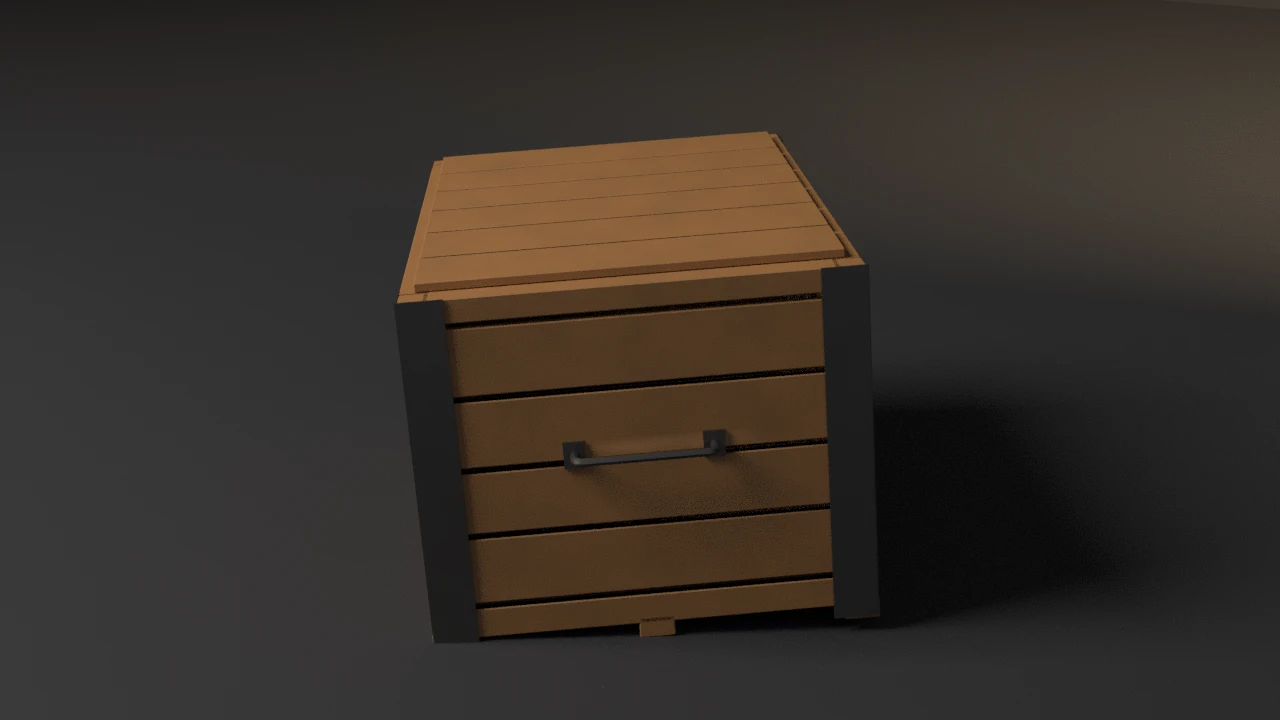
A procedural shipping crate through UVs, bake, LOD, collider, and Unity glTF, asserting recomputed budgets rather than an API contract.
A procedural Scots pine — buttressed trunk lathed from root flare to leader, ten seeded whorls of crooked limbs seated in the bark, faceted needled shoots on the outer branches, dead stubs and hanging cones — through UVs, bake, LOD, trunk collider, and Unity glTF, asserting recomputed budgets rather than an API contract.
Rendered headless by the showcase piece itself — click to zoom.
category Nature
blender --background --python showcase/pine-tree/pine_tree.py --
A showcase piece, not an example, and the first in the nature category. It builds a procedural game-ready Scots pine, about 7.2 m tall:
Every draw comes from random.Random(SEED) in plan_tree(), before anything is built: whorl spacing, branch count, yaw, length, rise, droop, crook and each shoot's tone. No flag draws from the stream, so a falsifier changes only what it names.
A needled shoot is one closed shell. A thin four-sided core runs along the shoot, and each quad of it is pulled out into a needle tuft that leans forward along the shoot. A terminal tuft closes the tip. Tuft lengths scatter by a closed-form hash. The shoots are flat-shaded, so each tuft catches light as a facet. The last hand-width of each shoot takes a lighter, yellower green (a Tip face attribute), which is this year's growth. The first draft used a star-section brush instead, and it read as holly leaves.
The bark follows Scots pine: thick grey-brown plates on the lower bole, changing over 2.4 to 4.4 m into thin fox-red flaking bark. The plate noise is squeezed round the girth and stretched up it, so the fissures run vertically. Wood (trunk, limbs, roots, dead wood) is smooth-shaded, because the ridges and taper carry the shape. Every material boundary is a hard edge. Dead wood is barkless silver-grey, and it has its own slot.
It asserts budget conformance of the generated result. It does not witness an API contract. "It rendered without error" is not a check.
Composes skills mesh-editing-and-bmesh, bake-high-to-low, depsgraph-and-evaluated-data, engine-export-presets, and snippets bake_normal_high_to_low.py, setup_bake_target_image.py, lod_chain.py / decimate_to_budget.py, convex_hull_collider.py, export_preset_unity.py (helpers copied inline, not imported).
Intended size: 7.23 m tall, a crown about 4.8 × 5.3 m across at its lowest whorl, and a 0.266 m trunk diameter at breast height (1.3 m). The collider is the convex hull of the trunk alone, without ridges or roots, because players walk under the branches.
Every budget is declared as a named constant. Every gate recomputes its value from the mesh, materials, UVs, evaluated LOD, collider, or export file.
| Axis | Declared | Measured (5.2.1) |
|---|---|---|
| Base triangles | 32500–36000 | 34210 |
| LOD1 ratio | 0.32–0.62 of base | 0.5000 |
| LOD2 ratio | 0.10–0.35 of base | 0.2200 |
| Materials | exactly 4 distinct; ≥3900 bark, ≥20500 needle, ≥1400 cone, ≥150 deadwood faces | 4 slots; 4348 / 22800 / 1664 / 172 |
| UVs | in 0..1, AABB overlap ≤ 1e-5 | in range, overlap 0 |
| Outer AABB | (4.775, 5.261, 7.226) m ± 0.01 | (4.7754, 5.2605, 7.2262), zmin 0 |
| Collider tris (trunk hull) | ≤ 60 | 48 |
| Export | written, size > 0, removed after measuring | 3299868 bytes |
DECIMATE COLLAPSE triangle counts are not identical across Blender series, so the LOD gate is a ratio band, not an exact count. Bake pixels are stochastic, so the bake gate is has_data plus operator FINISHED, not byte-identity. The plan is seeded and nothing else is random; two default runs print identical measurements.
Recomputed from the generated mesh, not asserted about the script.
| Axis | Declared | Measured |
|---|---|---|
| Non-manifold edges | 0 | 0 |
| Loose verts / edges | 0 / 0 | 0 / 0 |
| Doubles merged at 1e-5 | 0 | 0 |
| Zero-area faces | 0 | 0 |
| N-gons | 0 | 0 |
| Coplanar cross-shell face pairs (KD range 0.05 m, plane ε 1e-4) | 0 | 0 |
Grounded: zmin | within 1e-4 of 0 | 0.0000 |
The coplanar budget caught a real fault on the first run. The two fork shoots at a limb tip started at the same point in mirrored directions, and their start fans lay in one plane: 28 pairs. The forks now leave the limb at staggered stations.
These are the organic invariants. A tree has no joinery. What makes it read as a pine is that its branches grow out of the trunk, in whorls at regular spacing, on a trunk that stands straight under its crown.
The trunk axis is read off the mesh. Every lathe ring shares one height, so the ring centroids give the axis and the ring radii give the girth.
| Axis | Declared | Measured |
|---|---|---|
| Branch seat: for each of the 50 limbs and 6 seated dead members, the base ring's centre distance from the trunk axis at its height, over the trunk surface radius on the same bearing (raycast from the axis) | 0.25–0.75, and 50 limbs and 6 dead members found | 0.4268–0.4743, 50 / 6 |
| Whorl tiers: limb bases clustered by height (split at 0.18 m) | 10 whorls of 4–6 limbs, each whorl within 0.06 m, gaps between whorls 0.40–0.68 m | 10 whorls [6, 5, 4, 4, 5, 5, 6, 6, 4, 5], spread ≤ 0.0312, gaps 0.4495–0.5742 |
| Trunk plumb: least-squares lean of the ring centroids from 0.8 m to 6.0 m | ≤ 1.0° | 0.355° |
| Crown balance: needle-area centroid off the trunk axis at 0.5 m, horizontally (the tip-over check) | ≤ 0.15 m | 0.0191 m (centroid at 3.45 m) |
| Diameter at breast height (ring nearest 1.3 m) | 0.266 m ± 0.020 | 0.2665 |
| One connected assembly (union of shells whose BVH trees overlap) | 1 component | 1 (671 shells) |
A shell counts as a limb when it comes within 0.08 m of the trunk surface. Side branches start on their limb, out in the crown. The seat audit then says whether each limb's base is actually inside the bark. Counting limbs by "starts inside" instead would let a floating limb drop out of the count and hide from the seat check.
Each falsifier violates one named budget. Every one was run on 5.2.1 and exited its declared code. The envelope was unchanged in every run: --lean-crown moves the X extent 0.3 mm against a 10 mm tolerance.
| Flag | Budget violated | Exit |
|---|---|---|
--skip-decimate | LOD1 ratio band (measured 1.0000) | 9 |
--stray-vert | loose vertex count is 0 (measured 1) | 15 |
--lift-z | bounding box zmin is 0 (measured 0.05000) | 16 |
--float-branches | branch seat (every limb's tube starts at 1.2 × the trunk radius, outside the bark: worst 1.2675) | 17 |
--lean-crown | trunk plumb (axis bent x += 0.0075 (z − 1)²: lean 1.711°) | 19 |
--bunch-whorls | whorl tier spacing (whorl 6 lifted 0.30 m: gaps 0.2258–0.7970 m) | 20 |
--drop-cones | one connected assembly (cones lowered 50 mm off their limbs: 15 components) | 21 |
--float-branches keeps each limb's path, so the tip and everything hung on it stay put. Only the tube's first ring moves out of the bark. --lean-crown bends the whole trunk above 1 m and carries every limb with it. The crown balance moves too, to 0.0711 m, but stays inside its band, so the plumb budget is what fails. --bunch-whorls lifts one mid-crown whorl, whose limbs are not the extremes of the envelope. --drop-cones also leaves the rest of the tree whole: 14 cone clusters float free and the tree is the 15th component. The other clusters still touch a needled shoot below them, so the check counts components rather than cones.
blender --background --python pine_tree.py --
blender --background --python pine_tree.py -- --skip-decimate
blender --background --python pine_tree.py -- --stray-vert
blender --background --python pine_tree.py -- --lift-z
blender --background --python pine_tree.py -- --float-branches
blender --background --python pine_tree.py -- --lean-crown
blender --background --python pine_tree.py -- --bunch-whorls
blender --background --python pine_tree.py -- --drop-cones
blender --background --python pine_tree.py -- --output pine.png
Smoke passes no flags.
The hero turns the tree HERO_YAW_DEG (80°) about Z only. From there the lowest whorls spread widest to both sides, and the upper tiers and the red upper bole read through the gaps. The camera sits a little below the crown's middle, so the skirt of lower limbs reads against the wall. A warm wedge pools on the floor behind and to the right and washes the wall above it.
File-local. 9 is a valid check code. 10 is reserved for gallery_framing.check_framing on the --output path. 15–17 and 19 are the hygiene, joint-fit and plumb family. 18 is not used: no budget here is a wrapper's seat. 20 and 21 are file-local. 22 is the asset-quality floor on the render path: check_asset_quality returns 11, which this piece already spends on the collider ceiling, so the call site remaps it.
| Code | Meaning |
|---|---|
| 0 | Success |
| 1 | Uncaught exception (FATAL wrapper) |
| 2 | argparse / usage |
| 3 | Mesh did not build, no UV layer, or no single trunk shell |
| 4 | Base triangle count outside range |
| 5 | Material count ≠ 4 distinct slots, or a face-count floor missed |
| 6 | UVs outside 0..1 |
| 7 | UV AABB overlap above tolerance |
| 8 | World AABB off declared outer size |
| 9 | LOD ratio band (--skip-decimate lands here) |
| 10 | Framing gate (render path only) |
| 11 | Collider triangle count above ceiling |
| 12 | Bake did not finish or image has no data |
| 13 | Export file missing or empty |
| 14 | --output produced no file |
| 15 | Mesh hygiene: loose, non-manifold, zero-area, doubles, n-gons, coplanar cross-shell pairs |
| 16 | Not grounded: bounding box zmin off 0 |
| 17 | Branch seat: a limb or dead member's base outside its band in the trunk, or not 50 limbs and 6 dead members (--float-branches) |
| 19 | Trunk plumb, crown balance or breast-height diameter out of band (--lean-crown) |
| 20 | Whorl tiers: not 10 whorls of 4–6 limbs, a whorl spread too wide, or a gap between whorls out of band (--bunch-whorls) |
| 21 | Tree splits into more than one connected component (--drop-cones) |
| 22 | Asset-quality floor (render path only; remapped from 11) |
"""Game-ready Scots pine — a showcase piece, not an example. Asserts budget conformance of a procedural conifer after composing shipped pipeline pieces: bmesh construction, UVs, four materials, high-to-low normal bake, LOD chain, convex trunk collider, Unity glTF export. The trunk is one lathe from a buttressed root flare to the leader: it tapers, sways a little, and carries vertical bark ridges. Five surface roots leave the flare and dive into the ground. Ten whorls of branches rise in tiers above a bare lower bole; each whorl has 4-6 branches whose count, yaw, length, rise and droop come from a fixed seed. Each branch is a tapered limb seated in the trunk, carrying side shoots, and the outer shoots carry faceted bottlebrush needle masses: the inner limbs are bare, as a pine's are, so the tiers read as branches rather than a stack of cones. A few dead stubs and two dead lower branches stay on the bole, and clusters of cones hang in the upper crown. Budgets are declared below and recomputed from the generated result. They are not API-contract witnesses. Each falsifier violates one named budget: ``--skip-decimate`` the LOD-ratio band, ``--stray-vert`` mesh hygiene, ``--lift-z`` grounded zmin, ``--float-branches`` the branch seat in the trunk, ``--lean-crown`` trunk plumb, ``--bunch-whorls`` the whorl tier spacing, ``--drop-cones`` one connected assembly. Seeded, not random: ``random.Random(SEED)`` draws the whole plan before anything is built, so flags never shift the stream. DECIMATE COLLAPSE triangle counts are not byte-identical across Blender versions — the LOD gate is a ratio band, not an exact count. blender --background --python pine_tree.py -- blender --background --python pine_tree.py -- --skip-decimate blender --background --python pine_tree.py -- --output pine.png """ import argparse import math import os import random import sys import tempfile import traceback import bmesh import bpy from mathutils import Matrix, Vector from mathutils.bvhtree import BVHTree from mathutils.kdtree import KDTree # Showcase lives at repo-root/showcase/, not under examples/. The framing # helper is the repo's only shared import and lives next to the examples; # resolve the repo root so we do not move gallery_framing.py. _REPO = os.path.abspath( os.path.join(os.path.dirname(os.path.abspath(__file__)), os.pardir, os.pardir) ) sys.path.insert(0, os.path.join(_REPO, "examples")) sys.dont_write_bytecode = True import gallery_framing # noqa: E402 import gallery_asset_quality # noqa: E402 SEED = 1759 # --- Trunk ----------------------------------------------------------------- TRUNK_TOP = 7.00 # leader tip ring; a bud closes it TRUNK_R_BASE = 0.158 # taper term at z = 0 (above the flare) TRUNK_R_TIP = 0.010 TRUNK_TAPER = 1.25 TRUNK_SIDES = 20 TRUNK_SIDES_HIGH = 40 RIDGES = 10 # vertical bark ridges round the girth RIDGE_AMP = 0.050 # fraction of the radius FLARE_R = 0.190 # extra radius at the ground, on the buttress lobes FLARE_H = 0.28 FLARE_LOBES = 5 SWAY = (0.022, 0.018) # trunk axis sway, x and y amplitude (m) DBH_Z = 1.30 # breast height # --- Roots ----------------------------------------------------------------- ROOT_SIDES = 8 ROOT_REACH = (0.62, 0.82) # --- Whorls and branches ---------------------------------------------------- WHORLS = 10 WHORL_Z0 = 1.85 WHORL_STEP = 0.575 WHORL_STEP_SHRINK = 0.011 WHORL_STEP_JITTER = 0.035 BRANCHES = (4, 6) # per whorl, inclusive BRANCH_L_MIN = 0.30 BRANCH_L_SPAN = 1.72 BRANCH_SEAT = 0.45 # limb base centre, as a fraction of the trunk radius LIMB_SIDES = 6 TWIG_SIDES = 4 NEEDLE_L = 0.170 # needle tuft length off a shoot's core SHOOT_SIDES = 4 SHOOT_STEP = 0.120 # ring spacing along a shoot SHOOT_CORE = 0.24 # shoot core radius / needle length SHOOT_LEAN = 1.00 # needles lean forward along the shoot CONE_LEN = 0.095 CONE_R = 0.028 # --- Dead wood ------------------------------------------------------------- STUBS = ((0.72, 0.9), (0.98, 3.1), (1.38, 4.9), (1.62, 2.0)) # (z, yaw) DEAD_BRANCHES = ((1.18, 5.6, 0.62), (1.50, 1.2, 0.48)) # (z, yaw, length) BBOX_TOL = 0.01 # Fitted after locking geometry. Recomputed from bound_box. OUTER_SIZE = (4.775, 5.261, 7.226) BASE_TRIS_MIN = 32500 BASE_TRIS_MAX = 36000 LOD1_RATIO_MIN = 0.32 LOD1_RATIO_MAX = 0.62 LOD2_RATIO_MIN = 0.10 LOD2_RATIO_MAX = 0.35 LOD1_TARGET = 0.50 LOD2_TARGET = 0.22 MATERIAL_COUNT = 4 UV_EPS = 1e-4 UV_OVERLAP_MAX = 1e-5 COLLIDER_TRIS_MAX = 60 BAKE_RES = 512 CAGE_EXTRUSION = 0.01 BARK_FACES_MIN = 3900 NEEDLE_FACES_MIN = 20500 CONE_FACES_MIN = 1400 DEAD_FACES_MIN = 150 ZMIN_EPS = 1e-4 DOUBLES_EPS = 1e-5 AREA_EPS = 1e-10 COPLANAR_NORMAL_EPS = 1e-4 COPLANAR_PLANE_EPS = 1e-4 COPLANAR_CENTRE_MAX = 0.05 LIFT_Z = 0.05 # Branch seat: each limb's (and dead stub's) base centre sits inside the # trunk, measured as its radial distance from the trunk axis at that height # over the trunk surface's radius on the same bearing (raycast from the axis). SEAT_RATIO_MIN = 0.25 SEAT_RATIO_MAX = 0.75 FLOAT_BRANCHES = 1.20 # --float-branches starts every limb at 1.2 x radius LIMB_REACH = 0.08 # a bark shell within this of the trunk surface is a limb # Whorl tiers: limb bases cluster into whorls; gaps between whorls in band. WHORL_SPLIT = 0.18 WHORL_SPREAD_MAX = 0.06 WHORL_GAP_MIN = 0.40 WHORL_GAP_MAX = 0.68 BUNCH_WHORL = 5 BUNCH_LIFT = 0.30 # Plumb and balance: trunk lean from ring centroids, the needle mass's # centre over the trunk base, and the breast-height diameter. LEAN_MAX_DEG = 1.0 BALANCE_MAX = 0.15 # needle-area centroid off the base axis, m DBH = 0.266 DBH_TOL = 0.020 LEAN_BEND = 0.0075 # --lean-crown bends the axis x += k (z - z0)^2 LEAN_Z0 = 1.0 DROP_CONES = 0.05 # Hero yaw about Z only (level on the stage). HERO_YAW_DEG = 80.0 WALL_Y = 9.0 BARK_IDX = 0 NEEDLE_IDX = 1 CONE_IDX = 2 DEAD_IDX = 3 def eevee_engine_id(): return "BLENDER_EEVEE" if bpy.app.version >= (5, 0, 0) else "BLENDER_EEVEE_NEXT" def fail(msg, code): print(f"ERROR: {msg}", file=sys.stderr) return code def triangle_count(mesh): mesh.calc_loop_triangles() return len(mesh.loop_triangles) def evaluated_triangle_count(obj): # Duplicated from snippets/lod_chain.py / decimate_to_budget.py (not a package). depsgraph = bpy.context.evaluated_depsgraph_get() eval_obj = obj.evaluated_get(depsgraph) eval_mesh = eval_obj.to_mesh() try: eval_mesh.calc_loop_triangles() return len(eval_mesh.loop_triangles) finally: eval_obj.to_mesh_clear() # -------------------------------------------------------------------------- # The plan: every seeded draw happens here, before anything is built # -------------------------------------------------------------------------- def trunk_radius(z): t = max(0.0, 1.0 - z / TRUNK_TOP) return TRUNK_R_TIP + TRUNK_R_BASE * t ** TRUNK_TAPER def axis_at(z, lean=0.0): """Trunk axis centre at height z: a closed-form sway, zero at the ground.""" x = SWAY[0] * (math.sin(1.1 * z + 0.3) - math.sin(0.3)) y = SWAY[1] * (math.sin(0.8 * z + 1.9) - math.sin(1.9)) if lean: x += lean * max(0.0, z - LEAN_Z0) ** 2 return Vector((x, y, z)) def plan_tree(): rng = random.Random(SEED) def u(a, b): return a + (b - a) * rng.random() whorls = [] z = WHORL_Z0 top = TRUNK_TOP + 0.1 for i in range(WHORLS): if i: z += WHORL_STEP - WHORL_STEP_SHRINK * i + u(-WHORL_STEP_JITTER, WHORL_STEP_JITTER) f = (z - WHORL_Z0) / (top - WHORL_Z0) n = BRANCHES[0] + min(BRANCHES[1] - BRANCHES[0], int(rng.random() * 3.0)) yaw0 = i * math.radians(137.5) + u(-0.3, 0.3) branches = [] for k in range(n): reach = BRANCH_L_MIN + BRANCH_L_SPAN * ((top - z) / (top - WHORL_Z0)) ** 1.1 br = { "z": z + u(-0.018, 0.018), "yaw": yaw0 + 2.0 * math.pi * k / n + u(-0.32, 0.32), "L": reach * u(0.76, 1.12), "elev": math.radians(-6.0 + 44.0 * f + u(-6.0, 6.0)), "droop": (0.26 - 0.20 * f) * u(0.7, 1.25), "curl": u(-0.38, 0.38), "tipup": u(0.05, 0.12), "tone": rng.random(), "twig_jit": [rng.random() for _ in range(12)], "brush_tones": [rng.random() for _ in range(8)], "cones": (f > 0.35 and rng.random() < 0.34), "cone_jit": [rng.random() for _ in range(6)], } branches.append(br) whorls.append({"z": z, "branches": branches}) roots = [] for k in range(FLARE_LOBES): roots.append({"yaw": 2.0 * math.pi * k / FLARE_LOBES + 0.35 + u(-0.12, 0.12), "reach": u(*ROOT_REACH), "tone": rng.random()}) leader_tone = rng.random() return {"whorls": whorls, "roots": roots, "leader_tone": leader_tone} # -------------------------------------------------------------------------- # Construction helpers # -------------------------------------------------------------------------- def _mark(faces, mat_idx, tone_layer=None, tone=0.0): for f in faces: f.material_index = mat_idx if tone_layer is not None: f[tone_layer] = tone def frames(pts): """Parallel-transported (tangent, normal, binormal) along a polyline.""" tans = [] for i in range(len(pts)): a = pts[max(i - 1, 0)] b = pts[min(i + 1, len(pts) - 1)] tans.append((b - a).normalized()) ref = Vector((0.0, 0.0, 1.0)) if abs(tans[0].z) < 0.9 else Vector((1.0, 0.0, 0.0)) nrm = (ref - tans[0] * ref.dot(tans[0])).normalized() out = [] for t in tans: nrm = (nrm - t * nrm.dot(t)).normalized() out.append((t, nrm, t.cross(nrm))) return out def add_tapered_tube(bm, pts, radii, sides, mat_idx, layer, tone, phase=0.0, jag=None): """Capped round bar swept along a polyline with a radius per point. ``jag``: per-vertex radial factors for the last ring (a broken end).""" pts = [Vector(p) for p in pts] rings = [] fr = frames(pts) for idx, (p, (t, n, b)) in enumerate(zip(pts, fr)): ring = [] for k in range(sides): a = phase + 2.0 * math.pi * k / sides r = radii[idx] off = Vector((0.0, 0.0, 0.0)) if jag is not None and idx == len(pts) - 1: r *= jag[k % len(jag)][0] off = t * jag[k % len(jag)][1] ring.append(bm.verts.new(p + off + r * (n * math.cos(a) + b * math.sin(a)))) rings.append(ring) faces = [] for r0, r1 in zip(rings, rings[1:]): for k in range(sides): m = (k + 1) % sides faces.append(bm.faces.new((r0[k], r0[m], r1[m], r1[k]))) faces.append(bm.faces.new(tuple(reversed(rings[0])))) faces.append(bm.faces.new(tuple(rings[-1]))) _mark(faces, mat_idx, layer, tone) return faces def add_shoot(bm, pts, needle, layer, tone, seed): """A needled shoot: a thin core swept along ``pts`` whose every quad is pulled out into a needle tuft pointing forward along the shoot, closed by a terminal tuft at the tip. One closed shell.""" pts = resample([Vector(p) for p in pts], SHOOT_STEP) fr = frames(pts) sides = SHOOT_SIDES core = needle * SHOOT_CORE rings = [] for idx, (p, (t, nrm, bi)) in enumerate(zip(pts, fr)): ring = [] for j in range(sides): a = 2.0 * math.pi * j / sides + idx * math.pi / sides ring.append(bm.verts.new(p + core * (nrm * math.cos(a) + bi * math.sin(a)))) rings.append(ring) tip_layer = bm.faces.layers.float.get("Tip") faces = [] k = 0 nseg = len(rings) - 1 for idx, (r0, r1) in enumerate(zip(rings, rings[1:])): t = fr[idx][0].lerp(fr[idx + 1][0], 0.5).normalized() for j in range(sides): m = (j + 1) % sides q = (r0[j], r0[m], r1[m], r1[j]) c = sum((v.co for v in q), Vector()) / 4.0 out = c - pts[idx].lerp(pts[idx + 1], 0.5) out = (out - t * out.dot(t)).normalized() # closed-form scatter of needle length and lean, per tuft h = math.sin(seed * 12.9898 + k * 78.233) * 43758.5453 h -= math.floor(h) k += 1 ln = needle * (0.78 + 0.44 * h) apex = bm.verts.new(c + out * ln + t * (ln * SHOOT_LEAN)) for e in range(4): fc = bm.faces.new((q[e], q[(e + 1) % 4], apex)) fc[tip_layer] = (idx + 0.5) / nseg faces.append(fc) t0 = fr[0][0] t1 = fr[-1][0] start = bm.verts.new(pts[0] - t0 * core * 1.5) end = bm.verts.new(pts[-1] + t1 * needle * 1.15) for j in range(sides): m = (j + 1) % sides fa = bm.faces.new((rings[0][m], rings[0][j], start)) fb = bm.faces.new((rings[-1][j], rings[-1][m], end)) fa[tip_layer] = 0.0 fb[tip_layer] = 1.0 faces += [fa, fb] _mark(faces, NEEDLE_IDX, layer, tone) for fc in faces: fc.smooth = False return faces def resample(pts, step): """Polyline resampled at (about) ``step`` spacing, ends kept.""" lens = [(b - a).length for a, b in zip(pts, pts[1:])] total = sum(lens) n = max(2, int(round(total / step))) out = [] for i in range(n + 1): d = total * i / n for (a, b), ln in zip(zip(pts, pts[1:]), lens): if d <= ln or (a, b) == (pts[-2], pts[-1]): out.append(a.lerp(b, min(1.0, d / ln if ln else 0.0))) break d -= ln return out def add_cone(bm, top, axis, layer, tone, spin): """A closed pine cone hanging from ``top`` along ``axis``: stepped scale rings, each turned half a scale from the last.""" axis = axis.normalized() ref = Vector((0.0, 0.0, 1.0)) if abs(axis.z) < 0.9 else Vector((1.0, 0.0, 0.0)) u_ = axis.cross(ref).normalized() w_ = axis.cross(u_) prof = [(0.30, 0.00), (0.72, 0.14), (0.96, 0.30), (1.00, 0.48), (0.88, 0.66), (0.62, 0.82), (0.30, 0.95)] sides = 8 rings = [] for k, (rf, zf) in enumerate(prof): ring = [] for j in range(sides): a = spin + 2.0 * math.pi * j / sides + k * math.pi / sides rr = CONE_R * rf * (1.0 + 0.10 * ((j + k) % 2)) ring.append(bm.verts.new(top + axis * (CONE_LEN * zf) + rr * (u_ * math.cos(a) + w_ * math.sin(a)))) rings.append(ring) cap0 = bm.verts.new(top - axis * 0.004) tip = bm.verts.new(top + axis * CONE_LEN) faces = [] for r0, r1 in zip(rings, rings[1:]): for j in range(sides): m = (j + 1) % sides faces.append(bm.faces.new((r0[j], r0[m], r1[m], r1[j]))) for j in range(sides): m = (j + 1) % sides faces.append(bm.faces.new((rings[0][m], rings[0][j], cap0))) faces.append(bm.faces.new((rings[-1][j], rings[-1][m], tip))) _mark(faces, CONE_IDX, layer, tone) for fc in faces: fc.smooth = False return faces def trunk_ring_z(): zs = [0.0, 0.03, 0.08, 0.15, 0.25, 0.38, 0.55, 0.75, 1.0] z = 1.3 while z < TRUNK_TOP - 0.15: zs.append(round(z, 4)) z += 0.3 zs += [TRUNK_TOP - 0.08, TRUNK_TOP] return zs def add_trunk(bm, layer, tone, sides, lean, collider=False): """One lathe from the flare to the leader tip, closed flat at the ground and by a bud point at the top.""" rings = [] for z in trunk_ring_z(): c = axis_at(z, lean) rn = trunk_radius(z) flare = math.exp(-z / FLARE_H) ring = [] for j in range(sides): a = 2.0 * math.pi * j / sides lobe = 0.5 + 0.5 * math.cos(FLARE_LOBES * (a - 0.35)) r = rn + FLARE_R * flare * (0.30 + 0.70 * lobe * lobe) if not collider: # ridges: cos(RIDGES a) sampled on the lathe's own vertices, # so the high (40) and low (20) builds carry the same furrows r *= 1.0 + RIDGE_AMP * math.cos(RIDGES * a + 0.4 * math.sin(2.1 * z)) ring.append(bm.verts.new(c + Vector((r * math.cos(a), r * math.sin(a), 0.0)))) rings.append(ring) faces = [] for r0, r1 in zip(rings, rings[1:]): for j in range(sides): m = (j + 1) % sides faces.append(bm.faces.new((r0[j], r0[m], r1[m], r1[j]))) faces.append(bm.faces.new(tuple(reversed(rings[0])))) bud = bm.verts.new(axis_at(TRUNK_TOP, lean) + Vector((0.0, 0.0, 0.05))) for j in range(sides): m = (j + 1) % sides faces.append(bm.faces.new((rings[-1][j], rings[-1][m], bud))) _mark(faces, BARK_IDX, layer, tone) def limb_path(br, base, steps=6): """Branch centreline from its base: out along its yaw, rising at its elevation, sagging with droop and turning up again at the tip.""" pts = [] L = br["L"] for i in range(steps): s = i / (steps - 1) yaw = br["yaw"] + br["curl"] * s h = Vector((math.cos(yaw), math.sin(yaw), 0.0)) run = s * L * math.cos(br["elev"]) rise = s * L * math.sin(br["elev"]) - br["droop"] * L * s * s + br["tipup"] * L * s ** 5 # a crooked limb, not a dowel: closed-form kinks that vanish at the base ph = br.get("tone", 0.0) * 6.283 side = Vector((-h.y, h.x, 0.0)) * (0.045 * L * s * math.sin(7.0 * s + ph)) rise += 0.025 * L * s * math.sin(9.0 * s + 2.0 * ph) pts.append(base + h * run + side + Vector((0.0, 0.0, rise))) return pts def sample(pts, s): """Point at parameter s in [0, 1] along a polyline of equal steps.""" n = len(pts) - 1 x = min(max(s, 0.0), 1.0) * n i = min(int(x), n - 1) f = x - i return pts[i].lerp(pts[i + 1], f), (pts[i + 1] - pts[i]).normalized() def build_tree_mesh(name, plan, detail="low", float_branches=False, lean_crown=False, bunch_whorls=False, drop_cones=False): lean = LEAN_BEND if lean_crown else 0.0 bm = bmesh.new() try: tone_layer = bm.faces.layers.float.new("Tone") bm.faces.layers.float.new("Tip") # needle shoots: 0 at the base, 1 at the tip sides = TRUNK_SIDES_HIGH if detail == "high" else TRUNK_SIDES up = Vector((0.0, 0.0, 1.0)) add_trunk(bm, tone_layer, 0.1, sides, lean) # surface roots: from inside the flare, out and down into the ground for rt in plan["roots"]: h = Vector((math.cos(rt["yaw"]), math.sin(rt["yaw"]), 0.0)) reach = rt["reach"] c0 = axis_at(0.0, lean) prof = [(0.05, 0.38, 0.100), (0.32, 0.20, 0.090), (0.56, 0.085, 0.064), (0.80, 0.020, 0.040), (1.00, -0.010, 0.018)] pts = [c0 + h * (reach * rf) + Vector((0.0, 0.0, zc)) for rf, zc, _r in prof] radii = [r for _rf, _zc, r in prof] add_tapered_tube(bm, pts, radii, ROOT_SIDES, BARK_IDX, tone_layer, rt["tone"]) # dead stubs and dead lower branches dead_tone = 0.3 for z, yaw in STUBS: c = axis_at(z, lean) h = Vector((math.cos(yaw), math.sin(yaw), -0.25)).normalized() base = c + Vector((h.x, h.y, 0.0)).normalized() * (BRANCH_SEAT * trunk_radius(z)) ln = trunk_radius(z) * (1.0 - BRANCH_SEAT) + 0.06 + 0.02 * (yaw % 1.0) rb = 0.030 pts = [base, base + h * (ln * 0.55), base + h * ln] jag = [(0.85, 0.012), (1.0, -0.006), (0.75, 0.020), (0.95, -0.010), (0.80, 0.016), (1.0, 0.0)] add_tapered_tube(bm, pts, [rb, rb * 0.92, rb * 0.82], 6, DEAD_IDX, tone_layer, dead_tone, jag=jag) for z, yaw, ln in DEAD_BRANCHES: c = axis_at(z, lean) br = {"yaw": yaw, "L": ln, "elev": math.radians(-14.0), "droop": 0.20, "curl": 0.15, "tipup": 0.0} h = Vector((math.cos(yaw), math.sin(yaw), 0.0)) base = c + h * (BRANCH_SEAT * trunk_radius(z)) pts = limb_path(br, base, steps=5) add_tapered_tube(bm, pts, [0.024, 0.019, 0.014, 0.009, 0.005], 5, DEAD_IDX, tone_layer, dead_tone + 0.2) for s, side in ((0.45, 1.0), (0.7, -1.0)): p, t = sample(pts, s) d = (Matrix.Rotation(side * 0.9, 3, "Z") @ t) d.z -= 0.25 d.normalize() add_tapered_tube(bm, [p, p + d * 0.12, p + d * 0.22], [0.008, 0.006, 0.003], 4, DEAD_IDX, tone_layer, dead_tone + 0.1) # the live crown for wi, wh in enumerate(plan["whorls"]): for br in wh["branches"]: z = br["z"] + (BUNCH_LIFT if bunch_whorls and wi == BUNCH_WHORL else 0.0) c = axis_at(z, lean) h0 = Vector((math.cos(br["yaw"]), math.sin(br["yaw"]), 0.0)) R = trunk_radius(z) base = c + h0 * (BRANCH_SEAT * R) pts = limb_path(br, base) L = br["L"] rb = min(0.010 + 0.020 * L, 0.48 * R + 0.004) radii = [rb * (1.0 - 0.72 * i / (len(pts) - 1)) for i in range(len(pts))] limb_pts = list(pts) if float_branches: # the tube starts outside the bark; the path, and so the # tip and everything hung on it, is unchanged d0 = (pts[1] - pts[0]).normalized() hd = Vector((d0.x, d0.y, 0.0)) k = (FLOAT_BRANCHES - BRANCH_SEAT) * R / max(hd.length, 1e-6) limb_pts[0] = pts[0] + d0 * k add_tapered_tube(bm, limb_pts, radii, LIMB_SIDES, BARK_IDX, tone_layer, 0.55 + 0.4 * br["tone"], phase=br["yaw"]) bt = br["brush_tones"] jit = br["twig_jit"] needle = NEEDLE_L * (0.85 + 0.12 * min(L, 1.8)) seed = br["tone"] * 100.0 # the leading shoot: the limb's last quarter, turned up past # the tip, with two laterals forking off it on longer limbs p_a, _ = sample(pts, 0.76) p_b, t_b = sample(pts, 1.0) lead = (t_b + up * 0.55).normalized() tip_len = 0.14 + 0.07 * L add_shoot(bm, [p_a, p_a.lerp(p_b, 0.5), p_b, p_b + lead * tip_len], needle, tone_layer, bt[0], seed) if L > 0.8: for side in (-1.0, 1.0): # staggered, so the two forks never share a start p, t = sample(pts, 0.86 + 0.035 * side) d = Matrix.Rotation(side * 0.62, 3, "Z") @ Vector((t.x, t.y, 0.0)) d = (d.normalized() + up * 0.42).normalized() ln = 0.20 + 0.08 * L add_shoot(bm, [p, p + d * (ln * 0.5), p + d * ln + up * 0.04], needle * 0.92, tone_layer, bt[1 if side < 0 else 2], seed + side * 3.0) # side branches, alternating, each ending in its own shoots n_twigs = max(0, min(5, int(round(L / 0.34)))) for k in range(n_twigs): s = 0.34 + 0.40 * (k + 0.5) / max(n_twigs, 1) + 0.04 * (jit[k] - 0.5) side = 1.0 if k % 2 == 0 else -1.0 p, t = sample(pts, s) ang = side * (0.80 + 0.40 * jit[k + 5]) d = Matrix.Rotation(ang, 3, "Z") @ Vector((t.x, t.y, 0.0)).normalized() d = (d + up * (0.16 + 0.20 * jit[k + 6])).normalized() tl = (0.25 + 0.30 * (1.0 - s)) * min(L, 1.9) * 0.62 + 0.10 q1 = p + d * (tl * 0.5) q2 = p + d * tl + up * (0.04 * tl) tr = max(0.006, 0.42 * rb * (1.0 - 0.72 * s)) add_tapered_tube(bm, [p, q1, q2], [tr, tr * 0.75, tr * 0.5], TWIG_SIDES, BARK_IDX, tone_layer, 0.6 + 0.4 * br["tone"]) b0 = p.lerp(q2, 0.42) b3 = q2 + (d + up * 0.7).normalized() * (0.10 + 0.12 * tl) add_shoot(bm, [b0, b0.lerp(q2, 0.5), q2, b3], needle * (0.88 + 0.16 * jit[k + 3]), tone_layer, bt[3 + k], seed + 7.0 + k) if tl > 0.30: # a lateral off the side branch, forking forward pl = p.lerp(q2, 0.62) dl = Matrix.Rotation(-side * 0.7, 3, "Z") @ Vector((d.x, d.y, 0.0)) dl = (dl.normalized() + up * 0.45).normalized() add_shoot(bm, [pl, pl + dl * 0.11, pl + dl * 0.22], needle * 0.85, tone_layer, bt[(4 + k) % 8], seed + 11.0 + k) # cones hang under the limb, a cluster of two or three if br["cones"]: cj = br["cone_jit"] count = 2 + (1 if cj[0] > 0.5 else 0) for m in range(count): s = 0.60 + 0.06 * m + 0.03 * cj[m + 1] p, t = sample(pts, s) r_here = rb * (1.0 - 0.72 * s) outward = Vector((t.x, t.y, 0.0)).normalized() spin_side = Matrix.Rotation((m - 1) * 0.9, 3, "Z") @ outward axis = (-up * 1.0 + spin_side * 0.45).normalized() top = p - up * (r_here * 0.3) if drop_cones: top = top - up * DROP_CONES add_cone(bm, top, axis, tone_layer, cj[m + 2], spin=cj[m + 3] * 3.0) # the leader's own needles, round the top of the trunk zt = TRUNK_TOP l0 = axis_at(zt - 0.46, lean) l1 = axis_at(zt - 0.20, lean) l2 = axis_at(zt, lean) l3 = l2 + up * 0.06 add_shoot(bm, [l0, l1, l2, l3], NEEDLE_L * 0.85, tone_layer, plan["leader_tone"], 5.0) bmesh.ops.remove_doubles(bm, verts=list(bm.verts), dist=1e-5) bmesh.ops.dissolve_degenerate(bm, dist=1e-6) triangulate_ngons(bm) # roots dive into the ground: whatever is below z = 0 is bedded flat # on it (the trunk's own bottom cap is at z = 0 already) for v in bm.verts: if v.co.z < 0.0: v.co.z = 0.0 xs = [v.co.x for v in bm.verts] ys = [v.co.y for v in bm.verts] cx = 0.5 * (min(xs) + max(xs)) cy = 0.5 * (min(ys) + max(ys)) zmin = min(v.co.z for v in bm.verts) for v in bm.verts: v.co.x -= cx v.co.y -= cy v.co.z -= zmin pack_uvs(bm) bmesh.ops.recalc_face_normals(bm, faces=list(bm.faces)) # Wood is smooth-shaded (the ridges and taper carry in the silhouette); # needle masses and cones stay faceted, and every material boundary # is a hard edge. for face in bm.faces: if face.material_index in (BARK_IDX, DEAD_IDX): face.smooth = True for edge in bm.edges: mats = {f.material_index for f in edge.link_faces} if len(mats) > 1 or not edge.is_manifold or len(edge.link_faces) != 2: edge.smooth = False elif mats <= {BARK_IDX, DEAD_IDX}: edge.smooth = edge.calc_face_angle() < math.radians(50.0) else: edge.smooth = False me = bpy.data.meshes.new(name) bm.to_mesh(me) me.update() finally: bm.free() obj = bpy.data.objects.new(name, me) bpy.context.collection.objects.link(obj) return obj def build_collider_source(name, plan): """The trunk alone, without ridges: players walk under the branches.""" bm = bmesh.new() try: layer = bm.faces.layers.float.new("Tone") add_trunk(bm, layer, 0.5, TRUNK_SIDES, 0.0, collider=True) triangulate_ngons(bm) me = bpy.data.meshes.new(name) bm.to_mesh(me) me.update() finally: bm.free() obj = bpy.data.objects.new(name, me) bpy.context.collection.objects.link(obj) return obj def triangulate_ngons(bm): faces = [f for f in bm.faces if len(f.verts) > 4] if faces: bmesh.ops.triangulate(bm, faces=faces) def pack_uvs(bm, margin=0.08): uv = bm.loops.layers.uv.new("UVMap") faces = list(bm.faces) n = len(faces) cols = max(1, math.ceil(math.sqrt(n))) rows = max(1, math.ceil(n / cols)) cell_w = 1.0 / cols cell_h = 1.0 / rows pad_u = margin * cell_w * 0.5 pad_v = margin * cell_h * 0.5 usable_w = cell_w - 2.0 * pad_u usable_h = cell_h - 2.0 * pad_v for i, face in enumerate(faces): col = i % cols row = i // cols nrm = face.normal ax, ay, az = abs(nrm.x), abs(nrm.y), abs(nrm.z) coords = [] for loop in face.loops: co = loop.vert.co if az >= ax and az >= ay: coords.append((co.x, co.y)) elif ax >= ay: coords.append((co.y, co.z)) else: coords.append((co.x, co.z)) xs = [c[0] for c in coords] ys = [c[1] for c in coords] minx, maxx = min(xs), max(xs) miny, maxy = min(ys), max(ys) dx = max(maxx - minx, 1e-8) dy = max(maxy - miny, 1e-8) origin_u = col * cell_w + pad_u origin_v = row * cell_h + pad_v for loop, (x, y) in zip(face.loops, coords): loop[uv].uv = ( origin_u + (x - minx) / dx * usable_w, origin_v + (y - miny) / dy * usable_h, ) # -------------------------------------------------------------------------- # Materials # -------------------------------------------------------------------------- def enabled_socket(sockets, name): """The one enabled socket called ``name`` (Mix / Map Range carry one per data type under one name; identifiers changed in 5.2).""" for sock in sockets: if sock.name == name and sock.enabled: return sock return sockets[name] def surface(name, metallic=0.0): mat = bpy.data.materials.new(name) mat.use_nodes = True nt = mat.node_tree bsdf = nt.nodes["Principled BSDF"] bsdf.inputs["Metallic"].default_value = metallic coord = nt.nodes.new("ShaderNodeTexCoord").outputs["Object"] return mat, nt, bsdf, coord def mapping(nt, vec, scale=(1.0, 1.0, 1.0)): node = nt.nodes.new("ShaderNodeMapping") node.inputs["Scale"].default_value = scale nt.links.new(vec, node.inputs["Vector"]) return node.outputs["Vector"] def noise(nt, vec, scale, detail, roughness): node = nt.nodes.new("ShaderNodeTexNoise") node.inputs["Scale"].default_value = scale node.inputs["Detail"].default_value = detail node.inputs["Roughness"].default_value = roughness nt.links.new(vec, node.inputs["Vector"]) return node.outputs["Fac"] def ramp(nt, fac, stops): node = nt.nodes.new("ShaderNodeValToRGB") els = node.color_ramp.elements els[0].position = stops[0][0] els[0].color = (*stops[0][1], 1.0) els[1].position = stops[-1][0] els[1].color = (*stops[-1][1], 1.0) for pos, rgb in stops[1:-1]: els.new(pos).color = (*rgb, 1.0) nt.links.new(fac, node.inputs["Fac"]) return node.outputs["Color"] def remap(nt, value, from_lo, from_hi, to_lo, to_hi): node = nt.nodes.new("ShaderNodeMapRange") nt.links.new(value, enabled_socket(node.inputs, "Value")) enabled_socket(node.inputs, "From Min").default_value = from_lo enabled_socket(node.inputs, "From Max").default_value = from_hi enabled_socket(node.inputs, "To Min").default_value = to_lo enabled_socket(node.inputs, "To Max").default_value = to_hi return enabled_socket(node.outputs, "Result") def math_node(nt, op, a, b): node = nt.nodes.new("ShaderNodeMath") node.operation = op for i, value in enumerate((a, b)): if isinstance(value, (int, float)): node.inputs[i].default_value = value else: nt.links.new(value, node.inputs[i]) return node.outputs[0] def mix_color(nt, a, b, fac): node = nt.nodes.new("ShaderNodeMix") node.data_type = "RGBA" if isinstance(fac, (int, float)): enabled_socket(node.inputs, "Factor").default_value = fac else: nt.links.new(fac, enabled_socket(node.inputs, "Factor")) for nm, value in (("A", a), ("B", b)): sock = enabled_socket(node.inputs, nm) if isinstance(value, tuple): sock.default_value = (*value, 1.0) else: nt.links.new(value, sock) return enabled_socket(node.outputs, "Result") def tone_attr(nt): node = nt.nodes.new("ShaderNodeAttribute") node.attribute_type = "GEOMETRY" node.attribute_name = "Tone" return node.outputs["Fac"] def bark_material(): mat, nt, bsdf, coord = surface("PineBark") # Scots pine: thick grey-brown plates on the lower bole, thin fox-red # flaking bark above. Plates are noise squeezed round the girth and # stretched up it, so the fissures run vertically. plates = noise(nt, mapping(nt, coord, scale=(9.0, 9.0, 2.2)), 3.0, 8.0, 0.62) flakes = noise(nt, mapping(nt, coord, scale=(26.0, 26.0, 9.0)), 1.0, 5.0, 0.55) low = ramp(nt, plates, ((0.36, (0.030, 0.022, 0.017)), (0.50, (0.085, 0.062, 0.046)), (0.66, (0.150, 0.118, 0.090)), (0.82, (0.200, 0.165, 0.130)))) high = ramp(nt, flakes, ((0.30, (0.230, 0.090, 0.040)), (0.55, (0.420, 0.180, 0.075)), (0.80, (0.560, 0.290, 0.140)))) sep = nt.nodes.new("ShaderNodeSeparateXYZ") nt.links.new(coord, sep.inputs["Vector"]) zmix = math_node(nt, "ADD", sep.outputs["Z"], remap(nt, plates, 0.3, 0.7, -0.5, 0.5)) fac = remap(nt, zmix, 2.4, 4.4, 0.0, 1.0) col = mix_color(nt, low, high, fac) tone = tone_attr(nt) col = mix_color(nt, col, (0.05, 0.035, 0.025), remap(nt, tone, 0.0, 1.0, 0.0, 0.45)) nt.links.new(col, bsdf.inputs["Base Color"]) nt.links.new(remap(nt, plates, 0.35, 0.8, 0.92, 0.72), bsdf.inputs["Roughness"]) bump = nt.nodes.new("ShaderNodeBump") bump.inputs["Strength"].default_value = 0.8 bump.inputs["Distance"].default_value = 0.02 nt.links.new(plates, bump.inputs["Height"]) nt.links.new(bump.outputs["Normal"], bsdf.inputs["Normal"]) return mat def needle_material(): mat, nt, bsdf, coord = surface("PineNeedles") # Blue-green Scots pine needles: each mass takes its own tone, and a # fine speckle breaks the facets up so they read as needles, not plastic. tone = tone_attr(nt) base = ramp(nt, tone, ((0.0, (0.030, 0.062, 0.030)), (0.5, (0.048, 0.090, 0.040)), (1.0, (0.075, 0.120, 0.050)))) speck = noise(nt, coord, 90.0, 3.0, 0.7) col = mix_color(nt, base, (0.018, 0.034, 0.020), remap(nt, speck, 0.35, 0.7, 0.55, 0.0)) # this year's growth: the last hand-width of every shoot is a lighter, # yellower green tip = nt.nodes.new("ShaderNodeAttribute") tip.attribute_type = "GEOMETRY" tip.attribute_name = "Tip" col = mix_color(nt, col, (0.130, 0.175, 0.060), remap(nt, tip.outputs["Fac"], 0.55, 1.0, 0.0, 0.55)) nt.links.new(col, bsdf.inputs["Base Color"]) nt.links.new(remap(nt, speck, 0.3, 0.7, 0.86, 0.66), bsdf.inputs["Roughness"]) bsdf.inputs["Specular IOR Level"].default_value = 0.3 return mat def cone_material(): mat, nt, bsdf, coord = surface("PineCone") tone = tone_attr(nt) blot = noise(nt, coord, 60.0, 4.0, 0.6) base = ramp(nt, blot, ((0.35, (0.110, 0.066, 0.036)), (0.65, (0.260, 0.165, 0.090)))) col = mix_color(nt, base, (0.16, 0.12, 0.09), remap(nt, tone, 0.0, 1.0, 0.0, 0.35)) nt.links.new(col, bsdf.inputs["Base Color"]) bsdf.inputs["Roughness"].default_value = 0.72 return mat def deadwood_material(): mat, nt, bsdf, coord = surface("PineDeadwood") # Weathered, barkless: silver-grey with dark checks. streak = noise(nt, mapping(nt, coord, scale=(30.0, 30.0, 6.0)), 2.0, 6.0, 0.6) col = ramp(nt, streak, ((0.35, (0.070, 0.062, 0.055)), (0.55, (0.200, 0.186, 0.165)), (0.80, (0.310, 0.292, 0.262)))) nt.links.new(col, bsdf.inputs["Base Color"]) bsdf.inputs["Roughness"].default_value = 0.85 return mat def tree_materials(): """(bark, needles, cone, deadwood): shared by the check and the render.""" return bark_material(), needle_material(), cone_material(), deadwood_material() def assign_slots(obj, wanted): # Do not materials.clear() — that resets polygon material_index to 0. mats = obj.data.materials for i, mat in enumerate(wanted): if i < len(mats): mats[i] = mat else: mats.append(mat) # -------------------------------------------------------------------------- # Audits # -------------------------------------------------------------------------- def world_bbox(obj): corners = [obj.matrix_world @ Vector(c) for c in obj.bound_box] xs = [c.x for c in corners] ys = [c.y for c in corners] zs = [c.z for c in corners] return (min(xs), min(ys), min(zs), max(xs), max(ys), max(zs)) def uv_stats(mesh): uv = mesh.uv_layers.active if uv is None: return 0.0, 0.0, 1.0, 1.0, 0, 1.0 data = uv.data us = [loop.uv[0] for loop in data] vs = [loop.uv[1] for loop in data] aabbs = [] for poly in mesh.polygons: pu = [data[i].uv[0] for i in poly.loop_indices] pv = [data[i].uv[1] for i in poly.loop_indices] aabbs.append((min(pu), min(pv), max(pu), max(pv))) aabbs.sort() overlap = 0.0 for i, a in enumerate(aabbs): for j in range(i + 1, len(aabbs)): b = aabbs[j] if b[0] >= a[2]: break if b[1] >= a[3] or a[1] >= b[3]: continue x0 = max(a[0], b[0]) y0 = max(a[1], b[1]) x1 = min(a[2], b[2]) y1 = min(a[3], b[3]) overlap += max(0.0, x1 - x0) * max(0.0, y1 - y0) return min(us), min(vs), max(us), max(vs), overlap, len(aabbs) def face_area(me, poly): vs = [me.vertices[i].co for i in poly.vertices] if len(vs) < 3: return 0.0 v0 = vs[0] area = 0.0 for i in range(1, len(vs) - 1): area += (vs[i] - v0).cross(vs[i + 1] - v0).length * 0.5 return area def hygiene_audit(me): # Combinatorics match examples/mesh-hygiene-audit.audit (copied, not imported). ngons = sum(1 for p in me.polygons if len(p.vertices) > 4) zero_area = sum(1 for p in me.polygons if face_area(me, p) <= AREA_EPS) bm = bmesh.new() try: bm.from_mesh(me) loose_v = sum(1 for v in bm.verts if len(v.link_edges) == 0) loose_e = sum(1 for e in bm.edges if len(e.link_faces) == 0) nonman = sum(1 for e in bm.edges if not e.is_manifold) ret = bmesh.ops.find_doubles(bm, verts=list(bm.verts), dist=DOUBLES_EPS) doubles = len(ret.get("targetmap") or {}) finally: bm.free() return {"ngons": ngons, "loose_v": loose_v, "loose_e": loose_e, "nonman": nonman, "zero_area": zero_area, "doubles": doubles} def shells(me): neighbors = [[] for _ in range(len(me.vertices))] for edge in me.edges: a, b = edge.vertices neighbors[a].append(b) neighbors[b].append(a) seen = [False] * len(me.vertices) groups = [] for start in range(len(me.vertices)): if seen[start]: continue seen[start] = True stack = [start] group = [] while stack: cur = stack.pop() group.append(cur) for nxt in neighbors[cur]: if not seen[nxt]: seen[nxt] = True stack.append(nxt) groups.append(group) return groups def zfight_pairs(me, groups): """Coplanar face pairs from *different shells* (copied from showcase/grindstone).""" owner = {} for si, g in enumerate(groups): for vi in g: owner[vi] = si faces = [(p.normal.copy(), p.center.copy(), owner.get(p.vertices[0], -1)) for p in me.polygons] kd = KDTree(len(faces)) for i, (_n, c, _s) in enumerate(faces): kd.insert(c, i) kd.balance() hits = 0 for i, (ni, ci, si) in enumerate(faces): for _co, j, _d in kd.find_range(ci, COPLANAR_CENTRE_MAX): if j <= i: continue nj, cj, sj = faces[j] if si == sj: continue if abs(abs(ni.dot(nj)) - 1.0) > COPLANAR_NORMAL_EPS: continue if abs(ni.dot(cj - ci)) > COPLANAR_PLANE_EPS: continue hits += 1 return hits def shell_polys(me, groups): owner = [0] * len(me.vertices) for si, g in enumerate(groups): for vi in g: owner[vi] = si polys = [[] for _ in groups] for p in me.polygons: polys[owner[p.vertices[0]]].append(p) return polys class Shell: def __init__(self, me, idx, verts, polys): self.idx = idx self.verts = verts pts = [me.vertices[i].co.copy() for i in verts] self.pts = pts self.lo = Vector((min(p.x for p in pts), min(p.y for p in pts), min(p.z for p in pts))) self.hi = Vector((max(p.x for p in pts), max(p.y for p in pts), max(p.z for p in pts))) self.size = self.hi - self.lo self.centre = (self.lo + self.hi) * 0.5 mats = {} for p in polys: mats[p.material_index] = mats.get(p.material_index, 0) + 1 self.mat = max(mats, key=mats.get) if mats else None remap_ = {vi: n for n, vi in enumerate(verts)} self.tree = BVHTree.FromPolygons( [tuple(p) for p in pts], [[remap_[v] for v in p.vertices] for p in polys]) self.polys = polys class TrunkAxis: """Trunk ring centroids read off the mesh: every lathe ring shares one z.""" def __init__(self, trunk): rings = {} for p in trunk.pts: rings.setdefault(round(p.z, 5), []).append(p) # a ring has the lathe's full side count; the bud apex is a single vertex full = max(len(v) for v in rings.values()) self.rings = [] for z in sorted(rings): ps = rings[z] if len(ps) != full: continue c = sum(ps, Vector()) / len(ps) r = sum(((q - c).to_2d().length for q in ps)) / len(ps) self.rings.append((z, c, r)) def radius(self, z): rs = self.rings if z <= rs[0][0]: return rs[0][2] for (z0, _c0, r0), (z1, _c1, r1) in zip(rs, rs[1:]): if z <= z1: return r0 + (r1 - r0) * (z - z0) / (z1 - z0) return rs[-1][2] def centre(self, z): rs = self.rings if z <= rs[0][0]: return rs[0][1].copy() for (z0, c0, _r0), (z1, c1, _r1) in zip(rs, rs[1:]): if z <= z1: return c0.lerp(c1, (z - z0) / (z1 - z0)) return rs[-1][1].copy() def classify(me): groups = shells(me) polys = shell_polys(me, groups) parts = [Shell(me, i, g, polys[i]) for i, g in enumerate(groups)] out = {"all": parts, "groups": groups} bark = [s for s in parts if s.mat == BARK_IDX] trunk = [s for s in bark if s.size.z > 5.0] out["trunk"] = trunk if len(trunk) != 1: return out ax = TrunkAxis(trunk[0]) out["axis"] = ax out["roots"] = [s for s in bark if s is not trunk[0] and s.hi.z < 0.5] def starts_inside(s): return min((p - ax.centre(p.z)).to_2d().length - ax.radius(p.z) for p in s.pts) < LIMB_REACH # a limb (or a dead stub) starts at the trunk; a side shoot starts on # its limb, out in the crown. The seat audit then says whether a limb's # base is actually inside the bark. others = [s for s in bark if s is not trunk[0] and s not in out["roots"]] out["limbs"] = [s for s in others if starts_inside(s)] out["twigs"] = [s for s in others if not starts_inside(s)] dead = [s for s in parts if s.mat == DEAD_IDX] out["dead_seated"] = [s for s in dead if starts_inside(s)] out["brushes"] = [s for s in parts if s.mat == NEEDLE_IDX] out["cones"] = [s for s in parts if s.mat == CONE_IDX] return out def member_base(s, ax, n): """Centroid of the ``n`` vertices nearest the trunk axis: the base ring.""" ranked = sorted(s.pts, key=lambda p: (p - ax.centre(p.z)).to_2d().length) ring = ranked[:n] return sum(ring, Vector()) / len(ring) def seat_audit(cls): """Per limb and seated dead member: base-centre radial distance over the trunk surface radius on the same bearing (raycast from the axis).""" ax = cls["axis"] trunk = cls["trunk"][0] ratios = [_seat_ratio(s, LIMB_SIDES, ax, trunk) for s in cls["limbs"]] for s in cls["dead_seated"]: # stubs are 6-sided (3 rings), dead branches 5-sided (5 rings) n = 6 if len(s.pts) == 18 else 5 ratios.append(_seat_ratio(s, n, ax, trunk)) return ratios def _seat_ratio(s, n, ax, trunk): b = member_base(s, ax, n) c = ax.centre(b.z) d = (b - c).to_2d() dist = d.length if dist < 1e-6: return 0.0 direction = Vector((d.x, d.y, 0.0)).normalized() hit, _n, _i, surf = trunk.tree.ray_cast(Vector((c.x, c.y, b.z)), direction, 2.0) if hit is None: return 9.0 return dist / surf def whorl_audit(cls): """Cluster limb base heights into whorls; gaps, spreads, counts.""" ax = cls["axis"] zs = sorted(member_base(s, ax, LIMB_SIDES).z for s in cls["limbs"]) tiers = [] for z in zs: if tiers and z - tiers[-1][-1] < WHORL_SPLIT: tiers[-1].append(z) else: tiers.append([z]) heights = [sum(t) / len(t) for t in tiers] gaps = [b - a for a, b in zip(heights, heights[1:])] spreads = [max(t) - min(t) for t in tiers] counts = [len(t) for t in tiers] return heights, gaps, spreads, counts def plumb_audit(me, cls): """Trunk lean (line fit to ring centroids), needle-mass balance over the base, and breast-height diameter.""" ax = cls["axis"] rings = [(z, c) for z, c, _r in ax.rings if 0.8 <= z <= TRUNK_TOP - 1.0] n = len(rings) mz = sum(z for z, _c in rings) / n mx = sum(c.x for _z, c in rings) / n my = sum(c.y for _z, c in rings) / n szz = sum((z - mz) ** 2 for z, _c in rings) sx = sum((z - mz) * (c.x - mx) for z, c in rings) / szz sy = sum((z - mz) * (c.y - my) for z, c in rings) / szz lean = math.degrees(math.atan(math.hypot(sx, sy))) base = ax.centre(0.5) area = 0.0 acc = Vector((0.0, 0.0, 0.0)) for p in me.polygons: if p.material_index == NEEDLE_IDX: a = p.area area += a acc += p.center * a centroid = acc / area if area else Vector() balance = (centroid - base).to_2d().length dbh_ring = min(ax.rings, key=lambda r: abs(r[0] - (ax.rings[0][0] + DBH_Z))) dbh = 2.0 * dbh_ring[2] return lean, balance, dbh, centroid.z def connected_components(cls): parts = cls["all"] n = len(parts) parent = list(range(n)) def find(i): while parent[i] != i: parent[i] = parent[parent[i]] i = parent[i] return i order = sorted(range(n), key=lambda i: parts[i].lo.x) for oi, i in enumerate(order): a = parts[i] for j in order[oi + 1:]: b = parts[j] if b.lo.x > a.hi.x: break if (a.lo.y > b.hi.y or b.lo.y > a.hi.y or a.lo.z > b.hi.z or b.lo.z > a.hi.z): continue if find(i) == find(j): continue if a.tree.overlap(b.tree): parent[find(i)] = find(j) sizes = {} for i in range(n): sizes[find(i)] = sizes.get(find(i), 0) + 1 return len(sizes), sorted(sizes.values()) def add_stray_vert(me): bm = bmesh.new() try: bm.from_mesh(me) bm.verts.new((0.0, 0.0, 1.0)) bm.to_mesh(me) me.update() finally: bm.free() def make_lod(obj, name, ratio, skip_decimate): mesh = obj.data.copy() lod = bpy.data.objects.new(name, mesh) lod.matrix_world = obj.matrix_world.copy() bpy.context.scene.collection.objects.link(lod) if not skip_decimate and 0.0 < ratio < 1.0: mod = lod.modifiers.new("DecimateBudget", "DECIMATE") mod.decimate_type = "COLLAPSE" mod.ratio = ratio return lod def convex_hull_collider(obj, name): # Duplicated from snippets/convex_hull_collider.py (not a package). mesh = bpy.data.meshes.new(name) bm = bmesh.new() try: bm.from_mesh(obj.data) result = bmesh.ops.convex_hull(bm, input=list(bm.verts)) interior = result.get("geom_interior") or [] unused = result.get("geom_unused") or [] if interior: bmesh.ops.delete(bm, geom=interior, context="VERTS") if unused: bmesh.ops.delete(bm, geom=unused, context="VERTS") bm.to_mesh(mesh) mesh.update() finally: bm.free() collider = bpy.data.objects.new(name, mesh) bpy.context.collection.objects.link(collider) collider.matrix_world = obj.matrix_world.copy() return collider def setup_bake_image(obj, target_mat, size=BAKE_RES): # Adapted from snippets/setup_bake_target_image.py — do not replace slots. if not obj.data.uv_layers: return None, None img = bpy.data.images.new("PineNrm", size, size, alpha=True, float_buffer=False) img.colorspace_settings.name = "Non-Color" nodes = target_mat.node_tree.nodes tex = nodes.new("ShaderNodeTexImage") tex.image = img nodes.active = tex tex.select = True obj.active_material_index = BARK_IDX return img, tex def bake_normal(high, low): # Duplicated from snippets/bake_normal_high_to_low.py (not a package). scene = bpy.context.scene scene.render.engine = "CYCLES" scene.cycles.device = "CPU" scene.cycles.samples = 1 scene.cycles.use_denoising = False for ob in bpy.context.view_layer.objects: ob.select_set(False) high.select_set(True) low.select_set(True) bpy.context.view_layer.objects.active = low return bpy.ops.object.bake( type="NORMAL", use_selected_to_active=True, cage_extrusion=CAGE_EXTRUSION, use_cage=False, normal_space="TANGENT", margin=4, margin_type="ADJACENT_FACES", use_clear=True, target="IMAGE_TEXTURES", ) def export_unity(path, objects): # Duplicated from snippets/export_preset_unity.py (not a package). for ob in bpy.context.view_layer.objects: ob.select_set(False) for ob in objects: ob.select_set(True) bpy.context.view_layer.objects.active = objects[0] bpy.ops.export_scene.gltf( filepath=path, use_selection=True, export_yup=True, export_apply=True, export_draco_mesh_compression_enable=False, export_animations=False, ) def check(skip_decimate, lift_z=False, stray_vert=False, float_branches=False, lean_crown=False, bunch_whorls=False, drop_cones=False): bpy.ops.wm.read_factory_settings(use_empty=True) plan = plan_tree() flags = dict(float_branches=float_branches, lean_crown=lean_crown, bunch_whorls=bunch_whorls, drop_cones=drop_cones) low = build_tree_mesh("PineLow", plan, "low", **flags) high = build_tree_mesh("PineHigh", plan, "high", **flags) mats = tree_materials() assign_slots(low, mats) assign_slots(high, mats) bark = mats[BARK_IDX] if stray_vert: add_stray_vert(low.data) if lift_z: for v in low.data.vertices: v.co.z += LIFT_Z low.data.update() none2 = (None, None) if low.data is None or len(low.data.polygons) < 6: return (fail("tree mesh did not build", 3),) + none2 base_tris = triangle_count(low.data) slots = [s for s in low.data.materials if s is not None] nmat = len(slots) distinct_mats = len({id(s) for s in slots}) idx_counts = {} for poly in low.data.polygons: idx_counts[poly.material_index] = idx_counts.get(poly.material_index, 0) + 1 print(f"measured mat_index_counts={dict(sorted(idx_counts.items()))}") u0, v0, u1, v1, overlap, nfaces = uv_stats(low.data) bb = world_bbox(low) size_x, size_y, size_z = bb[3] - bb[0], bb[4] - bb[1], bb[5] - bb[2] hyg = hygiene_audit(low.data) cls = classify(low.data) zf = zfight_pairs(low.data, cls["groups"]) if len(cls["trunk"]) != 1: return (fail(f"trunk not found: {len(cls['trunk'])} candidates", 3),) + none2 expected_limbs = sum(len(w["branches"]) for w in plan["whorls"]) expected_dead = len(STUBS) + len(DEAD_BRANCHES) ratios = seat_audit(cls) heights, gaps, spreads, counts = whorl_audit(cls) lean, balance, dbh, mass_z = plumb_audit(low.data, cls) ncomp, comp_sizes = connected_components(cls) img, tex = setup_bake_image(low, bark) if img is None: return (fail("tree has no UV layer", 3),) + none2 bake_result = bake_normal(high, low) lod1 = make_lod(low, "PineLOD1", LOD1_TARGET, skip_decimate) lod2 = make_lod(low, "PineLOD2", LOD2_TARGET, skip_decimate) bpy.context.view_layer.update() lod1_tris = evaluated_triangle_count(lod1) lod2_tris = evaluated_triangle_count(lod2) r1 = lod1_tris / base_tris if base_tris else 0.0 r2 = lod2_tris / base_tris if base_tris else 0.0 collider_src = build_collider_source("PineColSrc", plan) collider = convex_hull_collider(collider_src, "PineCollider") bpy.data.objects.remove(collider_src, do_unlink=True) col_tris = triangle_count(collider.data) export_path = os.path.join(tempfile.gettempdir(), f"bdt_pine_tree_{os.getpid()}.glb") if os.path.exists(export_path): os.remove(export_path) export_unity(export_path, [low, collider]) export_size = os.path.getsize(export_path) if os.path.isfile(export_path) else 0 if os.path.isfile(export_path): try: os.remove(export_path) except OSError: pass print(f"blender={tuple(bpy.app.version)} skip_decimate={skip_decimate}") print(f"measured base_tris={base_tris} lod1_tris={lod1_tris} " f"lod2_tris={lod2_tris} r1={r1:.4f} r2={r2:.4f}") print(f"measured nmat={nmat} uv=({u0:.4f},{v0:.4f})-({u1:.4f},{v1:.4f}) " f"overlap={overlap:.6f} nfaces={nfaces}") print(f"measured bbox=({size_x:.4f},{size_y:.4f},{size_z:.4f}) " f"outer={OUTER_SIZE} zmin={bb[2]:.4f}") print(f"measured collider_tris={col_tris} bake={bake_result} " f"bake_has_data={img.has_data} export_bytes={export_size}") print(f"measured hygiene loose_v={hyg['loose_v']} loose_e={hyg['loose_e']} " f"nonman={hyg['nonman']} zero_area={hyg['zero_area']} " f"doubles={hyg['doubles']} ngons={hyg['ngons']} zfight={zf}") print(f"measured shells={len(cls['all'])} limbs={len(cls['limbs'])} " f"twigs={len(cls['twigs'])} brushes={len(cls['brushes'])} " f"cones={len(cls['cones'])} roots={len(cls['roots'])} " f"dead_seated={len(cls['dead_seated'])}") print(f"measured seat_ratio min={min(ratios):.4f} max={max(ratios):.4f} n={len(ratios)}") print(f"measured whorls={len(heights)} counts={counts} " f"heights={[round(h, 3) for h in heights]}") print(f"measured whorl_gaps min={min(gaps, default=0):.4f} max={max(gaps, default=0):.4f} " f"spread_max={max(spreads, default=0):.4f}") print(f"measured lean_deg={lean:.3f} balance={balance:.4f} mass_z={mass_z:.3f} " f"dbh={dbh:.4f}") print(f"measured components={ncomp} sizes={comp_sizes[-3:]} n={len(comp_sizes)}") if not (BASE_TRIS_MIN <= base_tris <= BASE_TRIS_MAX): return (fail(f"base tris {base_tris} not in [{BASE_TRIS_MIN}, {BASE_TRIS_MAX}]", 4),) + none2 if nmat != MATERIAL_COUNT or distinct_mats != MATERIAL_COUNT: return (fail(f"material slots {nmat} distinct {distinct_mats} != {MATERIAL_COUNT}", 5),) + none2 floors = ((BARK_IDX, BARK_FACES_MIN, "bark"), (NEEDLE_IDX, NEEDLE_FACES_MIN, "needle"), (CONE_IDX, CONE_FACES_MIN, "cone"), (DEAD_IDX, DEAD_FACES_MIN, "deadwood")) for idx, floor, label in floors: if idx_counts.get(idx, 0) < floor: return (fail(f"{label} faces {idx_counts.get(idx, 0)} < {floor}", 5),) + none2 if u0 < -UV_EPS or v0 < -UV_EPS or u1 > 1.0 + UV_EPS or v1 > 1.0 + UV_EPS: return (fail(f"UVs outside 0..1: ({u0:.4f},{v0:.4f})-({u1:.4f},{v1:.4f})", 6),) + none2 if overlap > UV_OVERLAP_MAX: return (fail(f"UV AABB overlap {overlap:.6f} > {UV_OVERLAP_MAX}", 7),) + none2 if (abs(size_x - OUTER_SIZE[0]) > BBOX_TOL or abs(size_y - OUTER_SIZE[1]) > BBOX_TOL or abs(size_z - OUTER_SIZE[2]) > BBOX_TOL): return (fail(f"bbox ({size_x:.4f},{size_y:.4f},{size_z:.4f}) off outer {OUTER_SIZE}", 8),) + none2 if not (LOD1_RATIO_MIN <= r1 <= LOD1_RATIO_MAX): return (fail(f"LOD1 ratio {r1:.4f} not in [{LOD1_RATIO_MIN}, {LOD1_RATIO_MAX}] " "(--skip-decimate is the designed fail)", 9),) + none2 if not (LOD2_RATIO_MIN <= r2 <= LOD2_RATIO_MAX): return (fail(f"LOD2 ratio {r2:.4f} not in [{LOD2_RATIO_MIN}, {LOD2_RATIO_MAX}]", 9),) + none2 if col_tris > COLLIDER_TRIS_MAX: return (fail(f"collider tris {col_tris} > {COLLIDER_TRIS_MAX}", 11),) + none2 if bake_result != {"FINISHED"} or not img.has_data: return (fail(f"bake failed result={bake_result} has_data={img.has_data}", 12),) + none2 if export_size <= 0: return (fail("export file missing or empty", 13),) + none2 if (hyg["loose_v"] or hyg["loose_e"] or hyg["nonman"] or hyg["zero_area"] or hyg["doubles"] or hyg["ngons"] or zf): return (fail(f"hygiene {hyg} zfight={zf}", 15),) + none2 if bb[2] > ZMIN_EPS: return (fail(f"grounded zmin={bb[2]:.5f}", 16),) + none2 if (len(cls["limbs"]) != expected_limbs or len(cls["dead_seated"]) != expected_dead or min(ratios) < SEAT_RATIO_MIN or max(ratios) > SEAT_RATIO_MAX): return (fail(f"branch seat: limbs {len(cls['limbs'])}/{expected_limbs} dead " f"{len(cls['dead_seated'])}/{expected_dead} base/radius " f"{min(ratios):.4f}..{max(ratios):.4f} not in " f"[{SEAT_RATIO_MIN}, {SEAT_RATIO_MAX}]", 17),) + none2 if (lean > LEAN_MAX_DEG or balance > BALANCE_MAX or abs(dbh - DBH) > DBH_TOL): return (fail(f"plumb/balance: lean {lean:.3f} deg (max {LEAN_MAX_DEG}), balance " f"{balance:.4f} m (max {BALANCE_MAX}), dbh {dbh:.4f} " f"(want {DBH} +/- {DBH_TOL})", 19),) + none2 if (len(heights) != WHORLS or min(counts) < BRANCHES[0] or max(counts) > BRANCHES[1] or max(spreads) > WHORL_SPREAD_MAX or min(gaps) < WHORL_GAP_MIN or max(gaps) > WHORL_GAP_MAX): return (fail(f"whorl tiers: {len(heights)} whorls (want {WHORLS}), counts {counts}, " f"gaps {min(gaps, default=0):.4f}..{max(gaps, default=0):.4f} (band " f"[{WHORL_GAP_MIN}, {WHORL_GAP_MAX}]), spread " f"{max(spreads, default=0):.4f}", 20),) + none2 if ncomp != 1: return (fail(f"tree splits into {ncomp} components", 21),) + none2 return 0, low, bark def render_still(low, path, engine): scene = bpy.context.scene for ob in list(scene.objects): if ob.type == "MESH" and ob != low: ob.hide_render = True ob.hide_viewport = True low.rotation_euler.z = math.radians(HERO_YAW_DEG) bpy.context.view_layer.update() bb = world_bbox(low) centre = Vector((0.5 * (bb[0] + bb[3]), 0.5 * (bb[1] + bb[4]), 0.5 * (bb[2] + bb[5]))) floor_me = bpy.data.meshes.new("Floor") bm = bmesh.new() try: bmesh.ops.create_grid(bm, x_segments=1, y_segments=1, size=60.0) bm.to_mesh(floor_me) finally: bm.free() fmat = bpy.data.materials.new("Floor") fmat.use_nodes = True fb = fmat.node_tree.nodes["Principled BSDF"] fb.inputs["Base Color"].default_value = (0.03, 0.032, 0.037, 1.0) fb.inputs["Roughness"].default_value = 0.7 floor_me.materials.append(fmat) floor = bpy.data.objects.new("Floor", floor_me) scene.collection.objects.link(floor) wall = bpy.data.objects.new("Wall", floor_me.copy()) wall.location = (0.0, WALL_Y, 0.0) wall.rotation_euler = (math.radians(90), 0.0, 0.0) scene.collection.objects.link(wall) world = bpy.data.worlds.new("World") world.use_nodes = True world.node_tree.nodes["Background"].inputs["Color"].default_value = (0.02, 0.021, 0.025, 1.0) scene.world = world def light(name, offset, energy, size, col, target=None, spread=None): ld = bpy.data.lights.new(name, "AREA") ld.energy = energy ld.size = size ld.color = col if spread is not None: ld.spread = math.radians(spread) ob = bpy.data.objects.new(name, ld) ob.location = centre + Vector(offset) aim_at = centre if target is None else Vector(target) ob.rotation_euler = (aim_at - ob.location).normalized().to_track_quat("-Z", "Y").to_euler() scene.collection.objects.link(ob) # Key, fill, rim and the warm wedge, scaled for a 7 m tree. The key's # spread keeps it on the crown instead of flooding the near floor. light("Key", (-11.0, -15.0, 9.0), 3000.0, 5.0, (1.0, 0.95, 0.88), spread=24.0) light("Fill", (15.0, -10.0, 1.0), 150.0, 18.0, (0.72, 0.82, 1.0)) light("Rim", (-4.0, 6.0, 5.5), 800.0, 5.0, (0.62, 0.78, 1.0)) light("Wedge", (8.0, 2.5, 3.5), 1900.0, 7.0, (1.0, 0.68, 0.38), target=(4.0, WALL_Y - 4.0, 0.0)) cam_data = bpy.data.cameras.new("Cam") cam_data.lens = 50.0 cam = bpy.data.objects.new("Cam", cam_data) view = Vector((-0.45, -0.89, 0.0)).normalized() cam.location = centre + view * 21.5 + Vector((0.0, 0.0, -1.2)) scene.collection.objects.link(cam) aim = bpy.data.objects.new("Aim", None) aim.location = centre + Vector((0.0, 0.0, 0.05)) scene.collection.objects.link(aim) con = cam.constraints.new("TRACK_TO") con.target = aim con.track_axis = "TRACK_NEGATIVE_Z" con.up_axis = "UP_Y" scene.camera = cam scene.render.engine = "CYCLES" if engine == "cycles" else eevee_engine_id() if engine == "cycles": scene.cycles.samples = 32 scene.cycles.device = "CPU" else: try: scene.eevee.taa_render_samples = 64 except AttributeError: pass scene.render.resolution_x = 1280 scene.render.resolution_y = 720 scene.render.image_settings.file_format = "WEBP" if path.lower().endswith(".webp") else "PNG" if path.lower().endswith(".webp"): scene.render.image_settings.quality = 90 scene.render.filepath = path # Standard, not AgX: AgX lifts the stage toward grey and pastels the needles. scene.view_settings.view_transform = "Standard" fcode = gallery_framing.check_framing(scene, cam, hero=[low], elements=[low], stage=[floor, wall]) if fcode: return fcode # asset-quality floors return 11, which this piece spends on the # collider ceiling; remap at the call site if gallery_asset_quality.check_asset_quality(scene, cam, [low], stage=[floor, wall]): return 22 bpy.ops.render.render(write_still=True) if not (os.path.exists(path) and os.path.getsize(path) > 0): return fail("render produced no file", 14) return 0 def main(): argv = sys.argv[sys.argv.index("--") + 1:] if "--" in sys.argv else [] p = argparse.ArgumentParser() p.add_argument("--output", default=None) p.add_argument("--engine", default="eevee", choices=("eevee", "cycles")) p.add_argument("--skip-decimate", action="store_true") p.add_argument("--stray-vert", action="store_true") p.add_argument("--lift-z", action="store_true") p.add_argument("--float-branches", action="store_true") p.add_argument("--lean-crown", action="store_true") p.add_argument("--bunch-whorls", action="store_true") p.add_argument("--drop-cones", action="store_true") args = p.parse_args(argv) code, low, _bark = check( args.skip_decimate, lift_z=args.lift_z, stray_vert=args.stray_vert, float_branches=args.float_branches, lean_crown=args.lean_crown, bunch_whorls=args.bunch_whorls, drop_cones=args.drop_cones, ) if code: return code if args.output: rcode = render_still(low, os.path.abspath(args.output), args.engine) if rcode: return rcode print(f"rendered still {args.output}") print("pine-tree OK") return 0 if __name__ == "__main__": try: sys.exit(main()) except Exception as e: traceback.print_exc() print(f"FATAL: {e}", file=sys.stderr) sys.exit(1)
A procedural shipping crate through UVs, bake, LOD, collider, and Unity glTF, asserting recomputed budgets rather than an API contract.
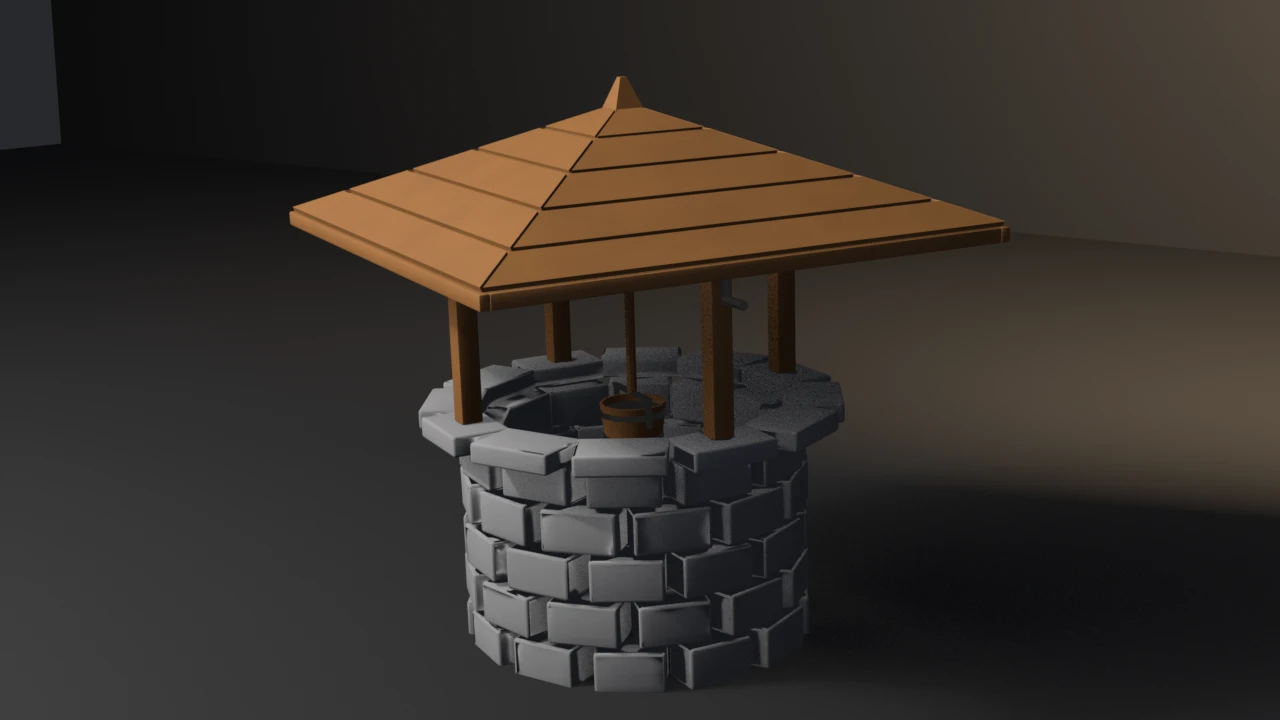
A procedural stone well through UVs, bake, LOD, collider, and Unity glTF, asserting recomputed budgets rather than an API contract.
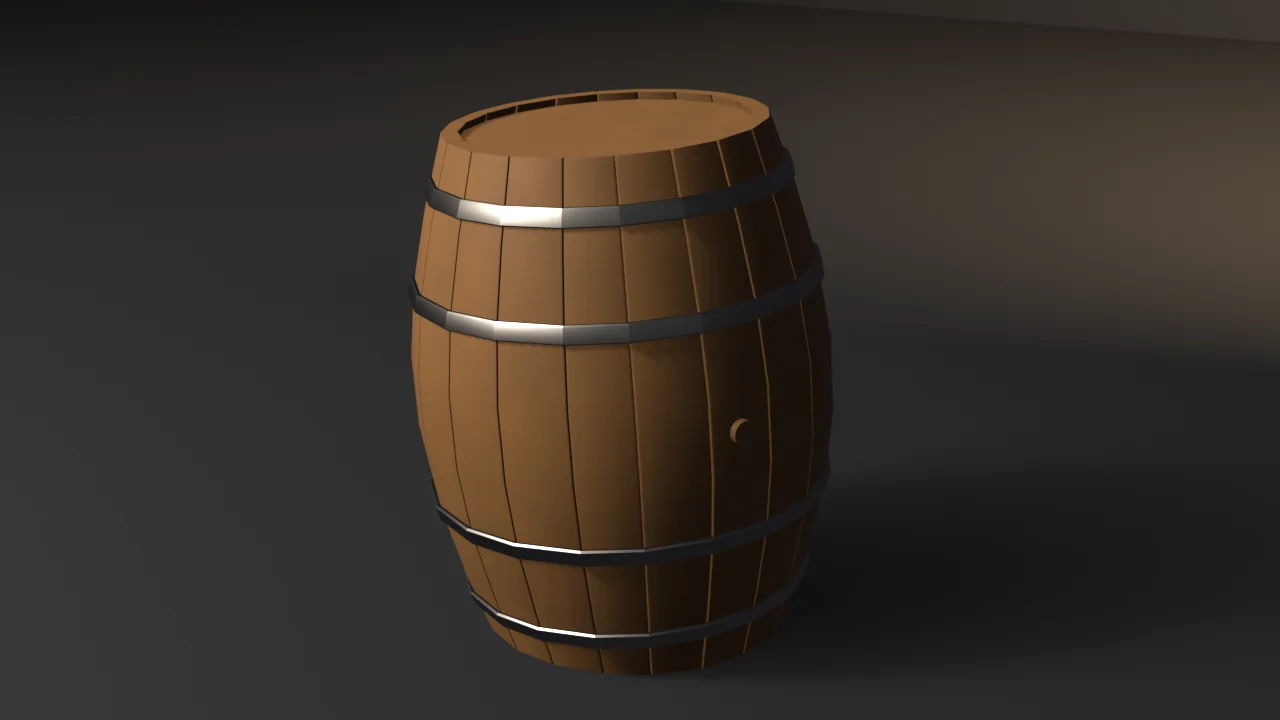
A procedural wine-cask with boarded, croze-seated heads and chord-lofted hoops through UVs, bake, LOD, collider, and Unity glTF, asserting recomputed budgets rather than an API contract.